
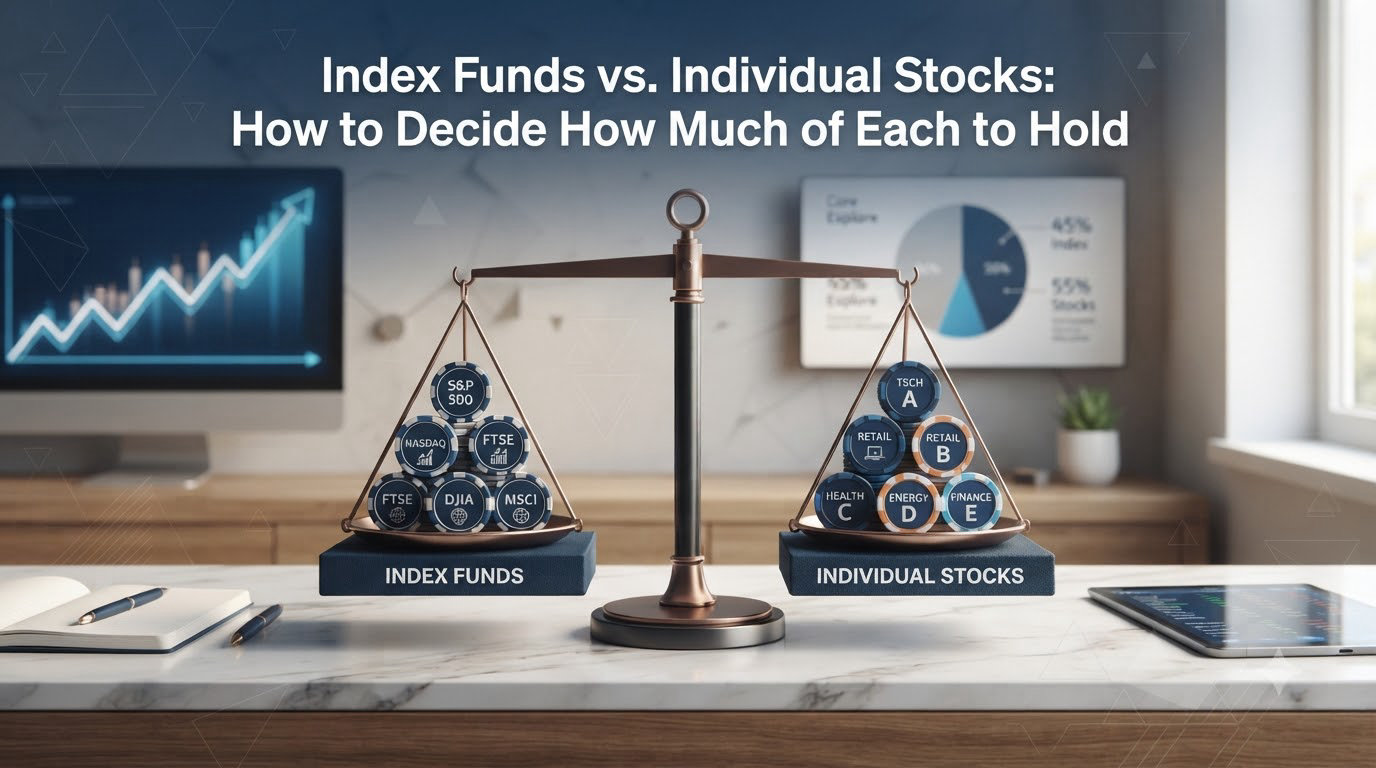
If you have ever stared at your brokerage account wondering whether to buy another index fund or take a chance on a single company, you are not alone. The question of index funds vs individual stocks and how to decide how much of each to hold is one of the most debated topics in personal investing. It comes up constantly on forums like r/Bogleheads and r/investing, where thousands of investors share their real-world struggles with this exact decision.
Most investors I have talked to eventually land on a hybrid approach. They keep the bulk of their money in low-cost index funds for broad market exposure, then carve out a smaller slice for individual stocks they believe in. The tricky part is figuring out what those percentages should actually be for your situation.
This guide breaks down everything you need to make that call with confidence. You will learn how each investment type works, the key differences that matter for your portfolio, proven allocation frameworks with specific percentages, and the common mistakes that trip people up. Whether you are just starting out or already have a portfolio you want to optimize, you will walk away with a clear plan.
The data is pretty clear on one thing. SPIVA scorecards consistently show that 85 to 90 percent of actively managed funds underperform the S&P 500 over a 15-year period. That statistic alone shapes how most experienced investors think about this split. But it does not mean individual stocks have no place in your portfolio at all.
The right answer is almost always some combination of both. Index funds provide the stability and diversification that protect your wealth over decades. Individual stocks give you the chance to earn higher returns and invest in companies you understand deeply. The art is in finding the split that matches your goals, risk tolerance, and available time.
Table of Contents
What Are Index Funds? Understanding the Basics?
An index fund is a type of investment that holds all the stocks in a specific market index, like the S&P 500 or the total stock market. Instead of trying to beat the market, an index fund simply mirrors it. When you buy a share of an S&P 500 index fund, you are buying a tiny piece of 500 different companies all at once.
This built-in diversification is the single biggest advantage index funds offer. If one company in the index tanks, the impact on your investment is minimal because you hold hundreds of others. That is fundamentally different from owning shares in one or two companies, where a single bad quarter can wipe out a large chunk of your portfolio.
Index funds are passively managed, meaning a computer essentially handles the buying and selling to match the index. No fund manager is making guesses about which stocks will win. This keeps costs extremely low. Many top index funds charge expense ratios of 0.03 percent or less, which means you pay just $3 per year for every $10,000 invested.
You can buy index funds as either mutual funds or ETFs (exchange-traded funds). ETFs trade throughout the day like individual stocks, while mutual funds are priced once per day after the market closes. Both give you the same underlying diversification and low-cost access to broad market returns.
The most popular index funds track well-known benchmarks. The S&P 500 covers the 500 largest US companies. Total stock market funds include thousands of companies large and small. International index funds give you exposure to companies outside the US. You can also find index funds that track specific sectors, bond markets, or commodities, though broad market funds are the best starting point for most investors.
What Are Individual Stocks? Direct Company Ownership?
An individual stock represents a direct ownership stake in one specific company. When you buy shares of Apple, Microsoft, or Tesla, you own a piece of that business. Your returns depend entirely on how well that single company performs over time. There is no safety net of diversification unless you build it yourself by owning many different stocks.
Stock prices move based on company earnings, industry trends, management decisions, and broader economic conditions. If the company grows profits and gains market share, the stock price typically rises. You make money through price appreciation when you sell shares for more than you paid, or through dividends if the company distributes a portion of its profits to shareholders.
As a shareholder, you also get certain rights. You can vote on corporate matters like board elections and major business decisions. Some investors value this direct involvement, even though retail investors rarely own enough shares to swing a vote. The connection to a company you understand and believe in is part of what makes stock picking appealing.
The catch is the risk. A single company can lose half its value overnight due to an earnings miss, a scandal, a product failure, or a lawsuit. Individual stocks are significantly more volatile than index funds. The bid-ask spread and liquidity can also work against you if you need to sell quickly in a down market.
Historically, a small number of stocks drive most of the market returns. Research shows that roughly 4 percent of publicly traded companies account for all the net wealth created in the stock market since 1926. This means finding those winners is extraordinarily difficult. Missing the best performers can mean dramatically underperforming the index, which is why diversification through index funds works so well for most people.
Index Funds vs Individual Stocks: Key Differences Explained
The core difference comes down to diversification, risk, cost, and time commitment. Index funds give you instant exposure to hundreds of companies for almost no effort and very low fees. Individual stocks concentrate your risk in a handful of companies and require ongoing research to manage well.
Here is how they compare across the factors that matter most:
Diversification: A single S&P 500 index fund spreads your money across 500 companies. Even a portfolio of 20 individual stocks is far less diversified, and most retail investors hold fewer than 10. The more concentrated your holdings, the higher your risk of a major loss.
Risk level: Index funds experience market-wide swings but rarely suffer catastrophic losses because no single company dominates the index. Individual stocks can drop 50 percent or more on company-specific news. Over the long run, index funds tend to deliver steadier returns with less stomach-churning volatility.
Fees and costs: Index funds charge a small expense ratio, typically between 0.02 and 0.15 percent annually. Individual stocks have no expense ratio, but you may pay trading commissions (though many brokers now offer commission-free trades) and deal with bid-ask spreads that eat into returns.
Time commitment: Index funds are essentially set-and-forget. You buy them, reinvest dividends, and check in occasionally. Individual stocks require hours of research on financial statements, earnings calls, competitive positioning, and industry trends. Many forum users cite this time burden as their main reason for switching to index funds.
Return potential: Index funds will never outperform the market because they are the market. Individual stocks can deliver massive returns if you pick winners, but the odds are against you. SPIVA data shows that the vast majority of professional stock pickers fail to beat the index over long periods.
Control: Index funds give you no say in which companies you own. You get the good and the bad together. Individual stocks let you invest only in companies you believe in and avoid those you do not, if your analysis is correct.
Emotional impact: Index funds move with the overall market, so daily swings are usually modest. Individual stocks can swing wildly on news, earnings, or analyst opinions. This volatility tests your discipline and can lead to panic selling or impulsive buying if you are not prepared.
Learning curve: Index funds require almost no investment knowledge to use effectively. You buy a fund, hold it, and let the market do the work. Individual stocks demand ongoing education in financial analysis, valuation, and market dynamics. Some investors enjoy this learning process, while others find it overwhelming.
Pros and Cons of Index Funds
Index funds are the default recommendation for most investors for good reason. They offer a low-cost, low-effort path to building long-term wealth that outperforms most active strategies. But they are not perfect for everyone.
Advantages of index funds:
Instant diversification across hundreds or thousands of companies with a single purchase. This dramatically reduces company-specific risk and smooths out volatility over time. You get broad market exposure without needing to research individual companies.
Extremely low fees. Top index funds charge expense ratios under 0.05 percent, saving you tens of thousands of dollars over a decades-long investing horizon compared to higher-cost alternatives.
Passive management means no ongoing research, no earnings calls to listen to, and no constant monitoring. You can focus your energy on your career, family, and other priorities while your investments quietly compound.
Historically reliable performance. The S&P 500 has averaged roughly 10 percent annual returns over the long run. While past performance does not guarantee future results, broad market index funds have consistently delivered solid returns for patient investors.
Tax efficiency, particularly with ETFs. Because index funds trade infrequently and simply track an index, they generate fewer taxable capital gains distributions compared to actively managed funds. This means more of your money stays invested and working for you.
Disadvantages of index funds:
You can never beat the market because you own the entire market. If your goal is to outperform, index funds will not get you there. You are locked into average returns by design.
You have no control over which companies you own. Index funds include overvalued companies, poorly managed businesses, and sectors you might personally want to avoid. You get no say in the matter.
During market crashes, index funds fall just as hard as the overall market. There is no active manager selling off risky positions to protect your capital. You ride the market down along with everyone else.
You are exposed to whatever the index holds, even if certain sectors appear overvalued. For example, if technology stocks dominate the S&P 500 and tech falls out of favor, your index fund goes down with it regardless of whether you think other sectors offer better value.
Pros and Cons of Individual Stocks
Individual stocks offer the potential for outsized returns and give you direct ownership in companies you understand. For some investors, that involvement is worth the added risk. But the statistics paint a cautionary picture that every stock picker needs to understand.
Advantages of individual stocks:
Unlimited upside potential. A single stock can double, triple, or more if you identify a winning company early. Index funds cap your returns at the market average by definition.
No expense ratios or management fees. Once you own shares, there are no ongoing costs beyond potential trading commissions. This saves money compared to fund expense ratios, though the savings are modest for low-cost index funds.
Voting rights and direct ownership. You have a say in corporate governance and own a real piece of a business. Some investors find this more engaging and meaningful than owning a fund.
The ability to invest based on your own research and convictions. If you have deep industry knowledge from your career, you may spot opportunities that fund managers miss. This edge is rare but real for some investors.
Flexibility to build a portfolio that reflects your values. You can avoid companies in industries you disagree with or focus on sectors where you have expertise. Index funds give you no such control.
Disadvantages of individual stocks:
High risk of underperformance. SPIVA data shows that 85 to 90 percent of professional fund managers fail to beat the S&P 500 over 15 years. If professionals struggle, individual retail investors face even longer odds.
Time-intensive research is required to pick well. You need to analyze financial statements, understand competitive dynamics, track industry trends, and stay on top of company news. Many forum users report this becoming a second job they eventually abandon.
Emotional stress from volatility. Watching a single stock drop 30 percent is far harder emotionally than watching a diversified index dip 10 percent. This leads many investors to panic-sell at exactly the wrong time.
Lack of diversification increases the chance of permanent capital loss. If a company you own goes bankrupt, you can lose your entire investment. Index funds virtually eliminate this single-company risk.
The temptation to trade frequently. Studies show that individual investors who trade more tend to earn lower returns. The accessibility of individual stocks can encourage behavior that destroys long-term wealth.
How to Decide How Much of Each to Hold: The Allocation Framework
The most widely recommended approach is the core-satellite strategy. You put 80 to 95 percent of your portfolio in low-cost index funds as your core, then allocate 5 to 20 percent to individual stocks as satellites. This gives you the stability of broad market exposure while leaving room to pursue higher returns with your best stock ideas.
Financial advisors frequently cite the 5 to 10 percent rule for individual stock allocation. Business Insider spoke with multiple advisors in 2026 who recommend keeping individual stocks to no more than 5 to 10 percent of your total portfolio. This way, even if every stock pick goes to zero, you lose only a small fraction of your wealth.
Here is a practical framework I recommend based on your experience and risk tolerance:
Conservative split (90-95 percent index funds, 5-10 percent stocks): Best for beginners, busy professionals, and anyone who wants market returns with a small side bet on companies they love. This is what most Bogleheads would consider the upper limit of individual stock allocation.
Moderate split (80-90 percent index funds, 10-20 percent stocks): Suitable for experienced investors who enjoy research and have the time to follow their picks. You accept more risk in exchange for higher potential returns, but the core keeps you grounded.
Aggressive split (70-80 percent index funds, 20-30 percent stocks): Only for highly knowledgeable investors with strong analytical skills and high risk tolerance. Beyond 30 percent in individual stocks, you are essentially running a concentrated portfolio that most professionals would warn against.
Age also plays a role in this decision. Younger investors in their 20s and 30s have more time to recover from losses, so they can afford slightly more aggressive allocations. Investors approaching retirement should lean heavily toward index funds to preserve capital and reduce volatility.
A common age-based guideline is to subtract your age from 100 and put that percentage in equities overall, with the vast majority in index funds. For example, a 30-year-old would have 70 percent in equities, with perhaps 60 to 65 percent in index funds and 5 to 10 percent in individual stocks.
The key principle is this: your index fund allocation should be large enough that your financial future does not depend on your stock picks succeeding. Individual stocks should be money you can afford to lose without it changing your retirement timeline.
Think of it as an asymmetric bet. If your individual stocks do well, you boost your overall returns modestly. If they do poorly, your index fund core keeps your financial plan on track. This structure lets you participate in stock picking without gambling your future on it.
Many successful investors on the Bogleheads forum describe a similar journey. They started with mostly individual stocks, learned through experience that beating the market is extremely hard, and gradually shifted toward index funds for their core while keeping a small stock allocation for fun and engagement.
Factors That Should Drive Your Allocation Decision
Your personal situation should drive your split between index funds and individual stocks, not a one-size-fits-all formula. Six factors matter most when making this decision.
Risk tolerance: How would you react if your individual stock portfolio dropped 40 percent in a month? If that thought keeps you up at night, keep your stock allocation low. If you can stomach volatility and have the conviction to hold through downturns, you can afford a slightly higher allocation.
Time horizon: The longer your investment timeline, the more risk you can take. A 25-year-old saving for retirement has decades to recover from mistakes. A 55-year-old needs to protect accumulated wealth and should lean much more heavily toward index funds.
Investment knowledge: Do you understand how to read financial statements? Can you evaluate a company’s competitive advantages? If not, stick with index funds until you build those skills. There is no shame in admitting you do not know enough to pick individual stocks yet.
Time availability: Researching stocks takes real time. Forum users frequently report spending 5 to 10 hours per week on stock research, and many eventually quit because it was not worth the effort. If you cannot commit consistent time, index funds are the better choice.
Financial goals: Are you saving for a down payment in three years, or retirement in thirty years? Short-term goals demand conservative, low-volatility investments. Long-term goals can handle more risk, but index funds still form the best foundation.
Career and income stability: If you have a stable, high-paying job, you can afford to take more investment risk. If your income is uncertain, protect your investments by leaning toward the safer, diversified option of index funds.
Be honest with yourself about each of these factors. Overestimating your risk tolerance or investment skill is one of the most common and costly mistakes investors make. If you are unsure, start more conservative and increase your stock allocation only after gaining experience.
Common Rules and Guidelines for Stock Allocation
Several well-known rules circulate in the investing community to help guide allocation decisions. Understanding these frameworks can help you structure your portfolio thoughtfully rather than guessing.
The 5 to 10 percent rule is the most common recommendation from financial advisors. It suggests limiting individual stocks to 5 to 10 percent of your total portfolio. This keeps your downside limited while still allowing you to participate in potential upside from your best ideas.
The 70-20-10 rule divides your portfolio into three buckets. Roughly 70 percent goes into broad index funds for stability, 20 percent into more targeted investments like sector ETFs or international funds, and 10 percent into speculative bets including individual stocks. This structure gives you a diversified core with controlled risk-taking on the edges.
The 3-5-7 rule is a risk management guideline for individual stock positions. It suggests never putting more than 3 percent of your portfolio in a single stock, holding no more than 5 to 7 individual stocks total, and being prepared to hold each position for at least 3 to 5 years. This limits the damage any single bad pick can do.
The 7 percent stop-loss rule comes from technical trading traditions. It suggests selling a stock if it drops 7 to 8 percent below your purchase price to limit losses. While some investors swear by this discipline, long-term index fund investors generally do not use stop-losses because they expect short-term volatility and hold for decades.
No single rule is perfect for everyone. The best approach is to understand the principles behind these guidelines and adapt them to your own situation, risk tolerance, and goals. Use them as starting points, not rigid laws.
How to Build a Combined Portfolio Step by Step
Building a portfolio that combines index funds and individual stocks is straightforward when you follow a clear process. Here is a step-by-step approach that works for most investors.
Step 1: Assess your financial situation. Before investing, make sure you have an emergency fund of 3 to 6 months of expenses and have paid off high-interest debt. Investing is for money you will not need for at least 3 to 5 years, ideally much longer.
Step 2: Choose your core index fund or funds. A total stock market index fund or an S&P 500 index fund makes an excellent foundation. Many investors add an international index fund and a bond fund for further diversification. Keep your core simple and low-cost.
Step 3: Decide your allocation percentage. Based on the framework above, choose how much of your portfolio goes to index funds versus individual stocks. For most people, starting with 90 percent index funds and 10 percent individual stocks is a sensible default.
Step 4: Fund your core first. Direct the majority of your monthly contributions to your index funds automatically. This ensures your foundation grows consistently regardless of what happens with your stock picks.
Step 5: Research and select individual stocks carefully. Only invest in companies you understand well. Look for strong balance sheets, competitive advantages, consistent revenue growth, and reasonable valuations. Start with just 3 to 5 stocks to keep your research manageable.
Step 6: Rebalance annually. Once a year, check your allocation. If your individual stocks have grown to more than your target percentage, sell some and move the proceeds back to index funds. If they have shrunk, you may add to them or let the core naturally grow larger.
Step 7: Keep emotions in check. The hardest part of investing is not picking stocks but managing your own psychology. Stick to your plan during market downturns. Do not chase hot stocks or panic-sell during corrections. Your index fund core exists precisely to help you stay the course.
Step 8: Review and adjust as your life changes. Your allocation should evolve over time. As you get older, gain more knowledge, or experience changes in your financial situation, revisit your split. Many investors gradually increase their index fund allocation as they learn that consistent stock-picking success is harder than it looks.
Tax Considerations for Index Funds vs Individual Stocks
Taxes can eat into your returns significantly over time, and index funds and individual stocks are taxed differently. Understanding these differences can help you hold each type in the most tax-efficient account.
ETFs are generally more tax-efficient than mutual funds because of how they handle redemptions. When other investors sell mutual fund shares, the fund may need to sell underlying securities, triggering capital gains distributions that all shareholders inherit. ETFs largely avoid this problem through a different structural mechanism.
Individual stocks give you complete control over when you realize capital gains. You only pay taxes when you sell, and you can choose which lots to sell to minimize your tax bill. This makes tax-loss harvesting more precise with individual stocks than with funds.
Index funds tend to have low turnover rates because they simply track an index, which means fewer taxable events inside the fund. Actively managed funds and frequent stock trading generate more short-term capital gains, which are taxed at higher ordinary income rates.
A smart strategy is to hold tax-inefficient investments in tax-advantaged accounts like IRAs and 401(k)s, while keeping tax-efficient investments like ETFs and stocks you plan to hold long-term in taxable accounts. This asset location strategy can add up to meaningful savings over decades.
Dividend taxes apply to both index funds and individual stocks. Qualified dividends are taxed at lower long-term capital gains rates, while ordinary dividends are taxed at your regular income rate. Index funds that hold dividend-paying stocks pass those dividends through to you, and you owe taxes on them whether or not you reinvest.
One advantage of individual stocks for tax planning is specificity. You can harvest losses on a specific underperforming stock to offset gains elsewhere in your portfolio. With index funds, selling for a tax loss means selling your entire position, though you can often buy a similar but not identical fund to stay invested while waiting out the wash-sale period.
Common Mistakes to Avoid When Splitting Your Portfolio
Even well-intentioned investors make predictable mistakes when balancing index funds and individual stocks. Knowing these pitfalls in advance can save you real money and stress.
Over-allocating to individual stocks: Many new investors get excited after a few wins and increase their stock allocation beyond what is prudent. Remember that early success is often luck, not skill. Keep your individual stock exposure within your predetermined limit.
Chasing past performance: Buying stocks because they have already risen dramatically is one of the most common and costly mistakes. By the time a stock is making headlines, much of the easy money has already been made. Focus on future potential, not past returns.
Ignoring fees and costs: Even small differences in expense ratios compound dramatically over time. A 1 percent fee on a $100,000 portfolio costs you $1,000 per year and potentially hundreds of thousands over 30 years. Always check the expense ratio on any fund you buy.
Making emotional decisions: Selling during market panics and buying during euphoric rallies destroys returns. Forum discussions are full of investors who sold at the bottom in fear or bought at the top in greed. Having a written plan helps you resist these urges.
Failing to rebalance: Without regular rebalancing, your allocation drifts as different investments grow at different rates. A portfolio that starts at 90 percent index funds can easily become 70 percent if your stocks have a great run. Rebalance at least once a year to stay on track.
Confusing luck with skill: In a bull market, most stocks go up, making everyone feel like a genius. The real test comes during corrections and bear markets. Do not increase your risk based on performance during favorable conditions that may not last.
Neglecting your index fund core: Some investors get so caught up in stock picking that they stop contributing to their index funds. This defeats the purpose of the core-satellite approach. Always fund your core first, then add to individual stocks with what remains.
Having no exit plan for individual stocks: Before buying any stock, know under what conditions you will sell. Setting rules in advance prevents emotional decision-making later. Decide whether you will sell based on price targets, fundamental changes in the business, or a set holding period.
FAQs
What is the 7% rule for individual stocks?
The 7 percent rule is a risk management guideline that suggests selling a stock if it drops 7 to 8 percent below your purchase price. The idea is to cut losses early before a small decline becomes a devastating one. This rule comes from trading traditions and works best for short-term positions. Long-term index fund investors generally ignore this rule because they expect and tolerate short-term volatility in exchange for long-term growth.
Is it better to own index funds or individual stocks?
For the vast majority of investors, index funds are the better choice. SPIVA data shows that 85 to 90 percent of professional fund managers fail to beat the Su0026amp;P 500 over 15-year periods, and individual retail investors face even longer odds. Index funds offer instant diversification, extremely low fees, and reliable long-term returns. Individual stocks can make sense as a small satellite allocation of 5 to 10 percent for investors who enjoy research and want to pursue higher returns, but they should not form the core of most portfolios.
What is the 70 20 10 rule in investing?
The 70-20-10 rule divides your portfolio into three tiers: 70 percent in broad index funds for stability and growth, 20 percent in targeted investments like sector ETFs or international funds for diversification, and 10 percent in speculative positions including individual stocks for potential outsized returns. This framework gives you a solid diversified core while allowing controlled risk-taking. It is a popular way to structure a core-satellite portfolio without overcomplicating things.
What is the 3 5 7 rule in stocks?
The 3-5-7 rule is a position sizing and risk management guideline for individual stock investors. It recommends limiting any single stock to no more than 3 percent of your total portfolio, holding no more than 5 to 7 individual stocks at once, and being prepared to hold each position for at least 3 to 5 years. This approach keeps your risk controlled by preventing overconcentration in any single company while giving your thesis enough time to play out.
Conclusion: Finding Your Right Mix
The decision of index funds vs individual stocks and how to decide how much of each to hold does not have a single right answer. It depends on your risk tolerance, time horizon, knowledge, and how much effort you want to put in. But the evidence points clearly toward building your foundation with low-cost index funds.
For most investors, a core of 80 to 95 percent index funds with a satellite of 5 to 20 percent individual stocks strikes the right balance. This gives you the diversification, low costs, and steady returns that decades of data support, while leaving room to pursue higher returns with companies you believe in.
Start simple. Open an account, buy a broad index fund, and begin building your core. Only add individual stocks once your foundation is solid and you have taken the time to learn how to evaluate companies properly. Your future self will thank you for the discipline.
Remember that investing is a long game. The investors who succeed over decades are not the ones who pick the hottest stocks but the ones who save consistently, keep costs low, and stick to their plan through market cycles. Index funds make that approach accessible to everyone, and a small allocation to individual stocks can make the process more engaging without putting your financial future at risk.