
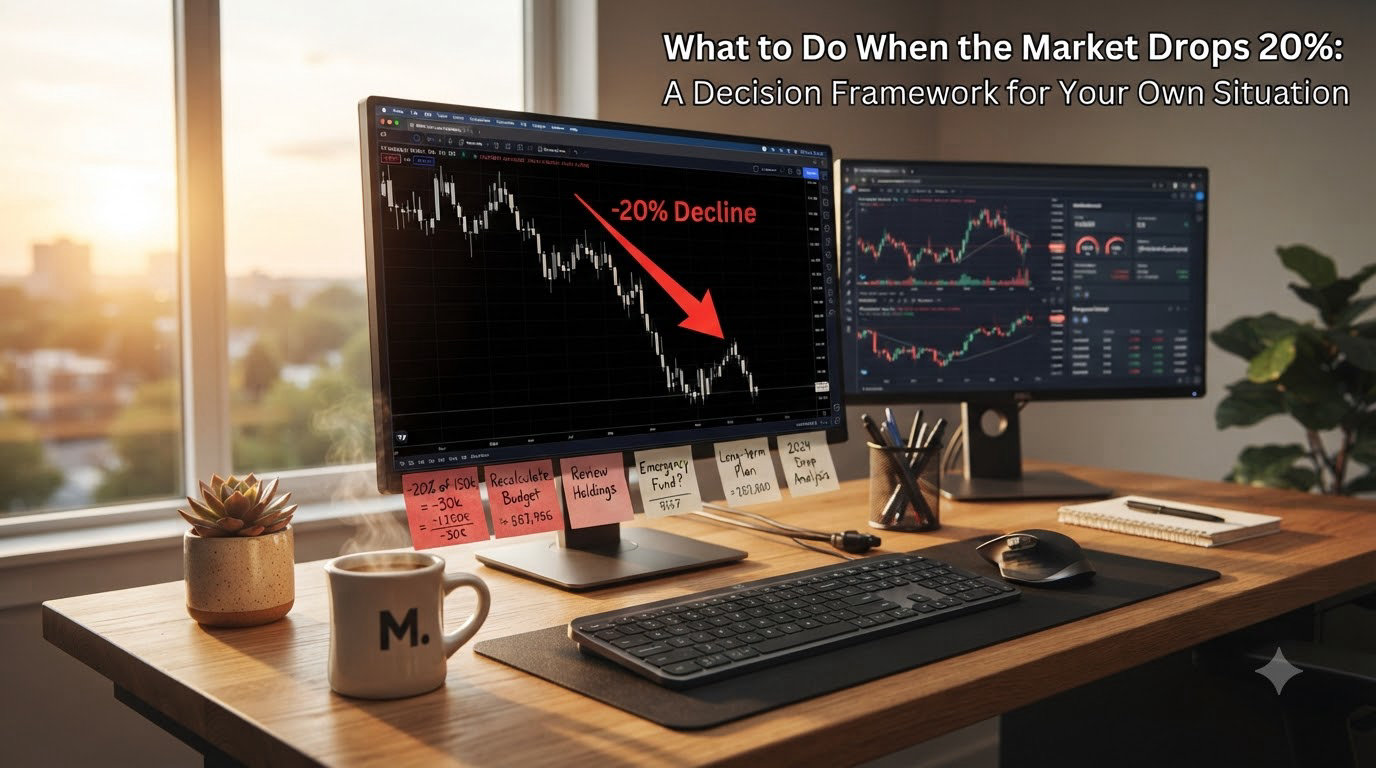
You open your brokerage account and see red. Not a little red. Your portfolio is down 20% from its peak, and the financial news is screaming about recession fears, rate hikes, or geopolitical chaos. Your stomach drops. A voice in your head says, “Should I sell before it gets worse?”
If you have ever felt this, you are not alone. Every investor who has lived through a bear market has faced this exact moment of panic. The problem is that most advice you will find online boils down to some version of “don’t panic” and “stay the course.” That is not wrong, but it is incomplete. Generic advice does not account for the fact that a 28-year-old with a 401(k) and a 64-year-old planning to retire in two years need wildly different playbooks.
That is exactly why we built this guide. Instead of telling you what investors in general should do when the market drops 20 percent, we walk you through a decision framework designed for your specific situation. You will assess your time horizon, your liquidity needs, your risk tolerance, and your current allocation. Then you will follow a decision path tailored to where you are in life.
We dug through forum discussions from real investors on r/Bogleheads, r/investing, and bogleheads.org. We studied what top financial institutions recommend and where their guidance falls short. The result is a framework that addresses the questions people actually ask when their portfolio is bleeding, not the questions institutions wish they would ask.
By the end, you will know exactly what to do when the market drops 20 percent based on your own numbers, timeline, and goals. You will have concrete actions, a psychological toolkit for staying rational, and historical context that puts this drop in perspective. Let us start by understanding what a 20% decline actually represents.
Table of Contents
Understanding What a 20% Market Drop Really Means
A 20% drop in a major index like the S&P 500 from its most recent peak is the technical definition of a bear market. This is not some arbitrary number. It is the threshold that financial professionals and media use to distinguish a normal market correction from something more serious. Understanding this distinction is the foundation for every decision you will make next.
Here is how the market decline spectrum works. A drop of 5% to 9.9% from a peak is called a pullback, and these happen frequently, often multiple times per year. A drop of 10% to 19.9% is a correction, which typically occurs once or twice a year. Once you cross that 20% line, you are in bear market territory.
How often does a 20% market drop happen? Bear markets have occurred roughly once every 5 to 7 years on average throughout modern history. They are a normal, expected part of the market cycle, not an anomaly. The S&P 500 has experienced dozens of bear markets since 1929, and every single one has eventually been followed by a new all-time high.
That last point matters more than any other fact in this article. A bear market represents a temporary decline, not a permanent loss, for long-term investors. The S&P 500 has never failed to recover from a bear market. The average bear market lasted about 9 to 10 months from peak to trough, and the average recovery time to new highs was about 2 to 3 years, though this varies widely.
Some recoveries are remarkably fast. After the pandemic crash of 2020, the S&P 500 fell 34% in just 33 days, then recovered to new highs in under 5 months. Others took much longer. The 2008 financial crisis saw the market take over 5 years to reclaim its prior peak. The key takeaway is that duration matters, but recovery has been inevitable historically.
Forum discussions reveal that many investors have never lived through a true bear market before. The 2020 crash was so brief that it barely registered as a prolonged ordeal. For anyone who started investing after 2010, a sustained downturn feels terrifying simply because it is unfamiliar. Recognizing that bear markets are normal, expected, and temporary is the first step toward making rational decisions.
One more thing to understand before we build your framework. A 20% drop does not mean you have lost 20% of your money permanently. It means the current market price of your holdings has declined. If you own broadly diversified index funds, the underlying companies are still producing earnings, paying dividends, and growing. The price will reflect that value again over time. Your job is to avoid turning a temporary paper decline into a permanent realized loss.
Step 1: The Self-Assessment — Where Do You Actually Stand?
Before you make a single move, you need an honest assessment of your personal financial situation. This is the step that most generic guides skip, and it is the most important one. The right action when the market drops 20 percent depends entirely on your answers to four questions. Grab a notepad or open a notes app, because you are about to evaluate your position objectively.
Assess Your Time Horizon
Your time horizon is the single most important variable in this entire framework. It is the number of years between now and when you will actually need to spend the money in your portfolio. If you are 30 years old and investing for retirement at 65, your time horizon for most of your portfolio is 35 years. A 20% drop today is almost irrelevant to you over that span.
If you are 62 and planning to retire at 65, your time horizon is dramatically shorter. You may need to start withdrawing from your portfolio within 3 years, which means a bear market right now has real consequences for your retirement lifestyle. Write down your time horizon for each bucket of money you have invested. Treat retirement accounts, college savings, and any taxable brokerage accounts separately, because they may have very different timelines.
Here is a simple way to categorize yourself. If you have 15 or more years until you need the money, you are in the long-horizon camp and a bear market is primarily an opportunity. If you have 5 to 15 years, you are in the medium-horizon camp and need a balanced approach. If you need the money within 5 years, you are in the short-horizon camp and capital preservation matters more than growth.
Reality-Check Your Risk Tolerance
Your risk tolerance is not what you think it is. Most investors overestimate their ability to stomach losses when times are good. When markets are hitting all-time highs, everyone feels like they can handle volatility. The true test comes when your portfolio is actually down 20%, 30%, or more and the news is full of doom.
Be brutally honest with yourself right now. Are you losing sleep? Checking your portfolio multiple times a day? Feeling tempted to sell? If so, your actual risk tolerance is lower than your portfolio allocation assumed. That is valuable information, not a personal failing. Write down how this current decline is making you feel, physically and emotionally.
Consider this question from forum discussions: If your portfolio dropped another 20% from here, would you be forced to sell, or would you be able to hold? The answer reveals whether your current allocation matches your true risk capacity. If you would be forced to sell at lower levels, you were taking on too much risk for your situation, and that needs to be addressed, though not necessarily during the current decline.
Evaluate Your Liquidity Needs
Liquidity needs are about cold hard cash requirements. Do you have an emergency fund that covers 3 to 6 months of expenses in a high-yield savings account or money market fund, separate from your investment portfolio? If yes, you have a buffer that means you do not need to sell investments at a loss to cover unexpected expenses.
If you do not have an adequate emergency fund, this is a vulnerability you need to acknowledge. One of the most common stories in forum discussions is retail investors being forced to sell at a loss during a recession because they lost their job and had no cash buffer. An economic downturn that causes a bear market often coincides with job losses, which is the worst possible time to be liquidating investments.
Write down any large expenses you anticipate in the next 3 years. A home down payment, a child’s college tuition, a wedding, medical expenses, or a business investment. Money needed for these expenses should not be in volatile investments. If it currently is, that is a risk you need to manage carefully during a market drop.
Review Your Current Allocation
Now look at what you actually own. What percentage of your portfolio is in stocks versus bonds versus cash? Within your stock allocation, how diversified are you across domestic and international, large cap and small cap, growth and value? A well-diversified portfolio will decline less than a concentrated one during a bear market.
Many investors discovered during the 2022 decline that their portfolio was far less diversified than they thought. They held tech-heavy index funds that all moved in the same direction. True diversification means holding assets that do not all decline simultaneously, which is why bonds, international stocks, and other asset classes matter.
Write down your current asset allocation as accurately as you can. This is your starting point. Every decision you make from here will be informed by this snapshot. If you are 90% in equities and 10% in cash with a 35-year horizon, your situation is fundamentally different from someone who is 90% in equities with a 5-year horizon.
Your Decision Path: Four Investor Situations
Now that you have completed your self-assessment, it is time to follow the decision path that matches your situation. We have built four paths based on the factors that matter most: time horizon, liquidity needs, and risk tolerance. Find the path that most closely describes you and follow its guidance.
Path A: The Young or Early-Career Investor (20+ Year Horizon)
If you have 20 or more years until you need this money, a 20% market drop is not a threat to your financial future. It is a sale. The companies you want to own are trading at a 20% discount, and your ongoing contributions will buy more shares at lower prices. Your primary action is to stay the course and keep investing.
Here is what you should do. First, do absolutely nothing with your existing holdings. Do not sell. Do not move to cash. The historical data is unambiguous: investors who stayed invested through bear markets captured the subsequent recoveries, while those who sold and tried to time the bottom almost always locked in losses and missed the rebound.
Second, continue your dollar-cost averaging strategy without hesitation. If you are contributing to a 401(k) through payroll deductions, keep it going. If you invest monthly in an IRA or taxable account, keep doing it. In fact, a market drop is the ideal time to increase your contributions if you can. Every dollar you invest at lower prices buys more shares, which will compound significantly over your 20-plus year horizon.
Third, if you have been sitting on extra cash, consider deploying it gradually. This is what people mean when they say buy the dip, but the execution matters. Do not dump everything in at once. Move cash into the market in tranches over several weeks or months. This reduces the risk of investing everything on a day that turns out to be a brief rally before further declines.
Fourth, resist the urge to shift your strategy entirely. Young investors sometimes panic and move from an aggressive growth allocation to a conservative one during a bear market, which is the exact wrong move. If anything, a young investor’s allocation should remain aggressive, because the long time horizon means you can afford short-term volatility in exchange for long-term growth potential.
The one exception to “do nothing” is if your self-assessment revealed that your allocation never matched your risk tolerance in the first place. If you were 100% in stocks, could not sleep, and now realize you need some bonds, that is a legitimate reason to adjust. But make that change as part of a deliberate plan, not as a panic response to red numbers on your screen.
Path B: The Mid-Career Investor (10 to 20 Year Horizon)
If you are 10 to 20 years from retirement, your situation requires more nuance. You have a long enough horizon that you should still be primarily invested for growth, but you also need to start thinking about protecting what you have accumulated. A 20% drop is less catastrophic for you than for someone about to retire, but it is not irrelevant either.
Your primary action is to stay invested while keeping your allocation aligned with your timeline. At this stage, you should have begun shifting some assets toward bonds and other fixed income investments to create a buffer. A common rule of thumb is to hold your age in bonds, or your age minus 10, as a percentage of your portfolio. If you are 45, that might mean 35% to 45% in bonds or similar stabilizing assets.
Here is what to do during the current drop. First, review whether your allocation drifted too aggressively during the previous bull market. When stocks rise faster than bonds, your portfolio naturally shifts toward a higher equity percentage than you intended. If your target was 70% stocks and 30% bonds but the bull market pushed you to 80% stocks, you were taking more risk than planned. Use this bear market to rebalance back to your target.
Second, continue dollar-cost averaging into your retirement accounts. Your ongoing contributions are still buying at a discount. Third, if you have a taxable account, look for tax-loss harvesting opportunities. If you hold individual stocks or funds that are down significantly, you can sell them to capture the tax loss and immediately buy a similar but not identical fund to maintain your market exposure. This reduces your tax bill without changing your investment strategy.
Fourth, if you have a Roth IRA and have been considering a Roth conversion from a traditional IRA, a market downturn can be an ideal time. When your traditional IRA balance is down 20%, converting to a Roth means you pay taxes on a lower amount. When the market recovers, all that growth happens tax-free inside the Roth. This is one of the silver linings of a bear market that most investors overlook.
Finally, take this opportunity to stress-test your retirement plan. If a 20% drop makes you nervous at this stage, ask yourself how you will handle it when you are actually retired. Use this experience to decide whether you need a larger bond allocation, a cash cushion, or a more conservative withdrawal strategy when you do retire. Learning from this experience now, while you still have time to adjust, is invaluable.
Path C: The Near-Retiree (Within 5 Years of Retiring)
This is the most challenging situation. If you are within 5 years of retirement, a 20% market drop represents a genuine risk to your retirement timeline. This is called sequence-of-returns risk, and it is the most dangerous financial threat a near-retiree faces. The order in which returns occur matters enormously when you are about to start withdrawing money.
Here is why it matters. If the market drops 20% in the year before you retire, and you begin withdrawing from a depleted portfolio, you are selling more shares at lower prices to generate the same income. Those shares are gone forever. Even when the market recovers, your portfolio has permanently fewer shares to participate in the recovery. This is how otherwise solid retirement plans fail.
Your primary action depends on your specific numbers. If you have built a cash buffer or short-term bond ladder that covers 2 to 3 years of expected retirement expenses, you have a critical safety net. In this case, you can ride out the bear market by spending from your safe assets rather than selling depressed stocks. This is called a bucket strategy, and it is one of the most effective tools for near-retirees during market downturns.
If you do not have a cash buffer and were planning to retire soon, you have three options. Option one is to delay retirement by a year or two, allowing the market time to recover before you begin withdrawals. Option two is to reduce your planned retirement spending to stretch your portfolio. Option three is to work part-time in early retirement to reduce the amount you need to withdraw.
What you should absolutely not do is panic-sell your entire equity portfolio and move to cash. Near-retirees still need growth to fund a retirement that may last 25 to 30 years. Going to cash locks in your losses and guarantees you will not participate in the eventual recovery. Instead, make sure you hold enough in safe assets to cover near-term expenses and keep the rest invested for long-term growth.
Consider working with a fee-only financial advisor at this stage if you have not already. The stakes are high enough that professional guidance can pay for itself many times over. Look for a fiduciary who is legally obligated to act in your best interest, not a commission-based salesperson.
Path D: The Already-Retired Investor
If you are already retired and withdrawing from your portfolio, a 20% market drop requires careful cash flow management. Your primary action is to avoid selling depressed stocks to fund your living expenses. Every share you sell at a loss during a bear market is a share that will not recover when the market rebounds.
The best strategy is to spend from your safe assets first. Money in high-yield savings, money market funds, short-term bonds, and CDs should be your primary source of withdrawals during a bear market. This allows your equity holdings time to recover without being forced to sell them at low prices.
If your safe assets are insufficient to cover a year or more of expenses, you may need to reduce discretionary spending temporarily. Cutting back on travel, dining, or major purchases during a bear market can preserve your portfolio for the long run. This is not fun, but it is far better than permanently impairing your retirement savings.
Another option to consider is a Roth conversion. If your traditional IRA is down 20%, converting some of it to a Roth IRA while values are low means paying taxes on a reduced balance. When the market recovers, the growth in the Roth is tax-free, and Roth withdrawals do not count as income, which can help manage your tax bracket and Medicare premiums.
Resist the temptation to go entirely to cash. Retirees sometimes panic and liquidate everything during a severe bear market, which is almost always a catastrophic mistake. Even in retirement, you likely need a meaningful allocation to equities to outpace inflation over a 20 to 30 year retirement. The goal is to manage withdrawals smartly, not to abandon growth assets entirely.
One practical tip from financial planners: if you are required to take required minimum distributions from a traditional IRA, a bear market is painful because you are forced to sell at low prices. Consider satisfying your RMD from the most stable portion of your portfolio, and if you do not need the money for living expenses, consider a qualified charitable distribution to satisfy the RMD without increasing your taxable income.
Action Strategies: What to Actually Do
Now let us get specific. Regardless of which path you are on, there are concrete actions that apply broadly during a 20% market drop. These are the moves that separate investors who weather bear markets successfully from those who permanently damage their portfolios. Work through each one methodically.
The Immediate Actions Checklist
When the market drops 20%, here are the first things you should do in order. Step one: stop looking at your portfolio constantly. Checking multiple times a day amplifies anxiety and increases the likelihood of an emotional decision. Set a schedule to review once a week at most, and stick to it.
Step two: take a breath and do nothing for 48 to 72 hours. Research on investor behavior shows that decisions made during acute market stress tend to be poor ones. Give yourself time for the emotional surge to subside before making any changes. The market will still be there in three days.
Step three: review your emergency fund. Confirm that you have 3 to 6 months of living expenses in cash or cash equivalents, completely separate from your investment accounts. If you do not, make building this buffer a priority, even if it means reducing new investment contributions temporarily.
Step four: write down your plan before the next market open. Document what you intend to do, why, and what conditions would cause you to change course. This written plan becomes your anchor when emotions surge again. The act of writing forces rational thinking and creates a record you can hold yourself to.
Rebalance Your Portfolio
Rebalancing is one of the most powerful and underused strategies during a market drop. When stocks fall 20% and bonds hold steady or rise, your portfolio’s asset allocation drifts away from your targets. A portfolio that was 70% stocks and 30% bonds before the drop might now be 60% stocks and 40% bonds, because the stock portion shrank while bonds held value.
Rebalancing means selling some of your bonds and buying more stocks to return to your target allocation. This forces you to buy stocks when they are down, which is exactly what a disciplined investor should do. It is a systematic, rules-based approach to buying low that removes emotion from the equation.
You do not need to rebalance constantly. A good rule is to rebalance when your allocation drifts more than 5 percentage points from your target, or once per year on a set schedule. During a significant market drop, check whether your drift exceeds that threshold and rebalance if it does. The transaction costs and tax implications in taxable accounts are worth considering, so prioritize rebalancing in tax-advantaged accounts like 401(k)s and IRAs where possible.
Harvest Tax Losses Strategically
Tax-loss harvesting is the practice of selling investments at a loss to offset capital gains and reduce your tax bill. In a 20% market drop, there are likely many losses available to harvest, particularly in taxable brokerage accounts. This is one of the few silver linings of a bear market.
Here is how it works. Say you bought a total stock market index fund for $10,000 and it is now worth $8,000. You can sell it, realize the $2,000 loss, and use that loss to offset capital gains from other sales. If your losses exceed your gains, you can deduct up to $3,000 per year against ordinary income, with any excess carrying forward to future years.
The key rule to remember is the wash-sale rule. If you sell a fund at a loss and buy the same or a substantially identical fund within 30 days, the IRS disallows the loss. To avoid this, you can buy a similar but not identical fund. For example, if you sell a total US stock market fund, you could buy an S&P 500 fund, which tracks a different but correlated index. This maintains your market exposure while staying compliant with tax rules.
Tax-loss harvesting only makes sense in taxable accounts, not in retirement accounts like IRAs or 401(k)s, where gains and losses have no immediate tax consequences. If you are unsure about the details, consult a tax professional, because the rules can get complicated.
Continue Dollar-Cost Averaging
If you are still in your earning years, dollar-cost averaging is your best friend during a market drop. Dollar-cost averaging means investing a fixed amount at regular intervals regardless of what the market is doing. When prices are low, your fixed contribution buys more shares. When prices are high, it buys fewer.
This strategy automatically does what most investors struggle to do manually: buy more when prices are low. If you contribute to a 401(k) through payroll deductions, you are already dollar-cost averaging. The key during a bear market is to maintain or increase your contributions rather than reducing them out of fear.
Some investors stop contributing during market downturns, thinking they will resume when things look better. This is backward. The best returns come from investing during the darkest moments of a bear market, not during the optimism of a bull market. If you can increase your contributions during a downturn, the long-term payoff can be significant.
Consider Roth Conversions
We mentioned Roth conversions in the decision paths, but they deserve their own focus because they are one of the most overlooked opportunities during a market drop. When your traditional IRA or 401(k) balance is down 20%, converting some of it to a Roth IRA means paying taxes on a lower balance. When the market eventually recovers, all of that growth happens tax-free inside the Roth.
This strategy is especially powerful for investors in the mid-career and near-retiree categories. The math works best when you expect to be in a similar or higher tax bracket in retirement, or when the conversion fills up your current tax bracket without pushing you into a higher one.
Roth conversions are not right for everyone. The conversion creates a taxable event in the year it occurs, so you need to have cash available to pay the taxes without selling the investments you are converting. If you are under 59 and a half, there are also five-year rules to consider. This is a strategy that benefits from professional tax advice, but the point is to be aware that a market drop creates a window of opportunity that does not exist during bull markets.
The Psychology of Market Drops: Why Smart People Make Bad Decisions
The hardest part of a 20% market drop is not the math. It is the psychology. Forum discussions are full of investors who knew intellectually that they should hold, but sold anyway because the emotional pressure became unbearable. Understanding why this happens is your best defense against becoming one of them.
The core problem is a cognitive bias called loss aversion. Research by behavioral economists has shown that losses feel approximately twice as painful as equivalent gains feel pleasurable. A 20% loss does not just feel 20% worse than a 20% gain feels good. It feels devastating in a way that is disproportionate to the numbers. This is why watching your portfolio decline can trigger a fight-or-flight response that overrides rational thinking.
Loss aversion leads to one of the most destructive investor behaviors: selling at the bottom. Studies by DALBAR and others have consistently shown that the average equity fund investor underperforms the funds they invest in by a significant margin. This gap, often 1% to 3% annually, is driven almost entirely by poorly timed buy and sell decisions fueled by emotion. Over a 30-year investing lifetime, that gap can represent hundreds of thousands of dollars.
Another psychological trap is recency bias. During a bear market, the constant stream of negative news makes it feel like the decline will last forever. The human brain is wired to project recent trends indefinitely into the future. In reality, bear markets have always ended, usually before most people realize the worst is over. By the time the news turns positive enough to feel safe investing again, a significant portion of the recovery has already happened.
So what can you actually do about this? First, reduce your exposure to financial news and social media during a market drop. Doom-scrolling investment forums and watching CNBC will amplify your anxiety without providing actionable information. Set specific times to check the markets and avoid them the rest of the day.
Second, write down your investment plan and the reasoning behind it before a crisis hits, or revisit it now if you already have one. When emotions surge, reading your own rational, calm reasoning from a less stressful time can help ground you. This is why we recommended documenting your plan in the immediate actions checklist.
Third, talk to someone. Whether it is a spouse, a financially literate friend, or a professional advisor, verbalizing your fears can reduce their intensity. Many forum users report that simply talking through their situation with others who have experienced bear markets helped them avoid panic selling.
Fourth, remember that doing nothing is an active decision. Holding your investments through a bear market is not passivity. It is a deliberate, historically validated strategy. The investors who “did nothing” during the 2008 crash, the 2020 crash, and every other major decline were the ones who captured the recoveries.
Finally, know when to seek professional help. If you find yourself unable to sleep, constantly anxious, or on the verge of making drastic portfolio changes, a fee-only fiduciary financial advisor can provide objective guidance. There is no shame in getting help during a crisis. The cost of an advisor consultation is trivial compared to the cost of a panic-driven investment mistake.
FAQs
What is a 20% market drop called?
A 20% decline in a major stock market index like the Su0026amp;P 500 from its most recent peak is called a bear market. This threshold distinguishes a bear market from a correction, which is a 10% to 19.9% decline, and a pullback, which is a 5% to 9.9% decline.
How to survive a 30% market crash?
To survive a 30% market crash, follow these steps: maintain an adequate emergency fund of 3 to 6 months of expenses, stay invested rather than selling at a loss, continue dollar-cost averaging to buy at lower prices, rebalance your portfolio back to target allocations, and avoid checking your portfolio obsessively. If you are near retirement, spend from safe assets like bonds and cash rather than selling depressed stocks. A 30% crash is more severe than a typical bear market but historically, markets have always recovered from even deeper declines.
Do you lose all your money if the stock market crashes?
No, you do not lose all your money if the stock market crashes. A market crash reduces the current market value of your investments, but you only realize those losses if you sell. If you hold diversified investments through a crash, the market has historically always recovered to new all-time highs. You only truly lose money permanently by selling at the bottom. Stocks in companies that remain solvent will recover their value over time.
How often does a 20% market drop happen?
A 20% market drop, or bear market, occurs on average once every 5 to 7 years. However, the frequency varies widely. Some decades see multiple bear markets, while others see very few. Since 1929, the Su0026amp;P 500 has experienced more than 25 bear markets. Every single one has been followed by a recovery to new all-time highs, though recovery times have ranged from a few months to several years.
Is a crash coming in 2026?
No one can predict exactly when a market crash will occur. Market timing consistently fails as a strategy. Instead of trying to predict crashes, focus on being prepared: maintain a diversified portfolio aligned with your time horizon, keep an emergency fund, and have a written investment plan. If you follow a disciplined approach, you will be positioned to weather any downturn regardless of when it arrives.
What is the 20% rule in stocks?
The 20% rule in stocks refers to the threshold that defines a bear market. When a major index like the Su0026amp;P 500 falls 20% or more from its most recent peak, it is officially in bear market territory. This is different from a correction, which is a 10% to 19.9% decline. The 20% threshold helps investors and analysts categorize the severity of market declines and adjust their expectations accordingly.
Putting It All Together: Your Framework Summary
Knowing what to do when the market drops 20 percent comes down to understanding your personal situation and following a disciplined plan rather than reacting emotionally. The framework we have built here works because it starts with you, not with the market.
Here is your recap. First, understand that a 20% drop is a bear market, a normal and expected part of the market cycle that has always been followed by recovery. Second, complete an honest self-assessment of your time horizon, risk tolerance, liquidity needs, and current allocation. Third, follow the decision path that matches your situation, whether you are a young investor with decades ahead, a mid-career saver building toward retirement, a near-retiree managing sequence-of-returns risk, or a current retiree managing withdrawals.
Fourth, take concrete actions: rebalance your portfolio, harvest tax losses in taxable accounts, continue dollar-cost averaging, and consider Roth conversions while values are low. Fifth, manage your psychology by limiting news consumption, revisiting your written plan, talking through your concerns, and seeking professional help if anxiety becomes overwhelming.
The investors who succeed during bear markets are not the ones who predicted them. They are the ones who had a plan and stuck to it. Write down your plan today, while you are thinking clearly, so you can rely on it when emotions are running high. Then do the hardest and most important thing of all: follow through.
Your future self will thank you for the discipline you practice today. Every bear market in history has ended. This one will too.