
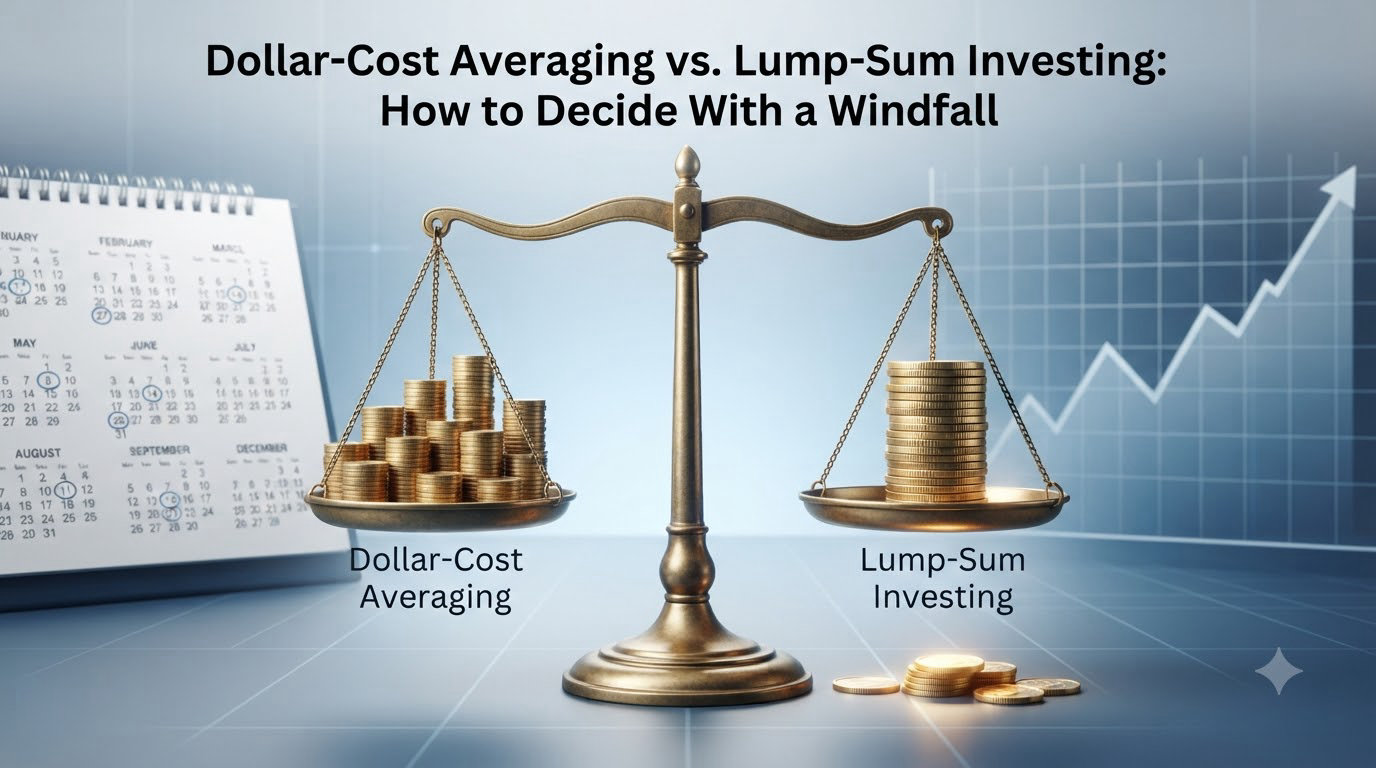
Receiving a windfall — whether an inheritance, a year-end bonus, a business sale payout, or a legal settlement — forces one of the hardest financial choices you will ever face. Do you put every dollar to work in the market on day one, or do you spread the money out over several months to cushion against a sudden drop? That single decision is what the dollar-cost averaging vs lump-sum investing debate is really about.
Our team has spent months reviewing Vanguard’s research, Morgan Stanley’s Monte Carlo simulations, and thousands of forum threads from Bogleheads and r/investing to find out what actually moves the needle. The honest answer is that the math leans one way and the human brain leans the other. This guide breaks down both sides and gives you a 5-step framework so you can decide with confidence rather than anxiety.
By the end of this article you will know exactly what each strategy does, what the historical data says, how risk tolerance and time horizon shift the answer, and which windfall scenarios favor which approach. Let’s get into it.
Table of Contents
What Is Dollar-Cost Averaging?
Dollar-cost averaging (DCA) is the strategy of investing a fixed dollar amount at regular intervals instead of putting the full sum into the market at once. You might take a $120,000 inheritance and invest $10,000 on the first of every month for a year, no matter what the market is doing that day.
The mechanic that makes DCA appealing is simple. When share prices fall, your fixed dollar amount buys more shares. When prices rise, it buys fewer. Over time this tends to average your cost per share downward relative to the average price during the period, which is where the name comes from.
DCA was originally designed as a way to invest payroll contributions automatically, and it shines for that use case. Many workers already use it without thinking twice — every 401(k) contribution is technically dollar-cost averaging. The strategy becomes more controversial when you have a large lump of cash sitting on the sidelines and must decide whether to feed it in slowly or commit it all at once.
What Is Lump-Sum Investing?
Lump-sum investing is the opposite approach. You take the entire windfall and put it to work in your target asset allocation immediately. If you receive $500,000 from a business sale and your plan calls for 80% stocks and 20% bonds, you move $400,000 into equities and $100,000 into fixed income in a single set of trades.
The logic behind lump-sum investing is time in the market. Markets historically spend more time going up than going down, so the longer your cash is invested, the more it benefits from compounding. Every month you hold cash on the sidelines is a month that capital earns little while it waits.
This is the strategy that Vanguard’s own research has consistently endorsed as the mathematically superior choice, with caveats we will get into shortly. It is also the default behavior of most automated investing platforms when you deposit a large sum — the system asks whether you want to invest it all now or set up a schedule.
Dollar-Cost Averaging vs Lump-Sum Investing: What the Data Shows?
Here is where the dollar-cost averaging vs lump-sum investing debate gets interesting, because the numbers tell a fairly consistent story across decades of backtesting.
Morgan Stanley ran Monte Carlo simulations comparing both strategies across thousands of market scenarios. Their finding: lump-sum investing produced higher annualized returns than dollar-cost averaging in roughly 56% of historical cases. For aggressive portfolios heavy in equities, the lump-sum advantage came in around 0.42% per year in additional return.
Vanguard reached a similar conclusion in their widely cited study, finding lump-sum beating DCA in about 66% of rolling periods across major international markets. The reason is straightforward — markets climb more often than they fall, so getting capital invested sooner captures more of those upward moves.
That does not mean DCA is a bad choice. The 44% of cases where DCA wins tend to cluster right before major market corrections, exactly the scenarios investors fear most. The tradeoff is statistical: lump-sum gives you a higher expected return, while DCA reduces the chance of a large immediate drawdown in the first months after you invest.
A common refrain on Bogleheads forums captures the consensus neatly: the worst strategy is usually the third option, which is holding cash indefinitely while you try to time the market. Delaying the decision often costs more than picking either approach and committing to it.
Pros and Cons of Lump-Sum Investing
Lump-sum investing is not the right call for everyone, but it has clear strengths and clear weaknesses.
Pros of Lump-Sum Investing
Lump-sum investing maximizes time in the market, which is the single biggest driver of long-term returns. The sooner your money is invested, the longer compound interest works in your favor.
It is also the lowest-effort option. One set of trades and you are done, with no ongoing decisions to second-guess for the next 12 months. Many investors underestimate how much mental energy a 12-month DCA schedule actually consumes.
Statistically, lump-sum comes out ahead more often than not. The Morgan Stanley and Vanguard research both tilt in its favor over long horizons and across global markets.
Cons of Lump-Sum Investing
The biggest downside is regret risk. If the market drops 15% the week after you invest, you sit with a large unrealized loss and a strong emotional temptation to sell at the bottom.
Lump-sum also front-loads all of your sequence-of-returns risk into a single moment. For investors near retirement or with a short time horizon, this concentration can be dangerous.
Finally, lump-sum requires iron discipline during volatility. If you cannot stomach watching your freshly invested windfall swing by tens of thousands of dollars in a week, the psychological cost may outweigh the statistical edge.
Pros and Cons of Dollar-Cost Averaging
DCA trades a small piece of expected return for a meaningful reduction in anxiety and downside risk.
Pros of Dollar-Cost Averaging
DCA reduces timing risk by spreading your entry points across many market days, so no single bad day determines your cost basis. This is the strategy’s main selling point.
It also delivers genuine psychological comfort. Forum users across r/Bogleheads and r/investing consistently report that DCA helps them sleep at night, even when they acknowledge lump-sum usually wins on paper.
When prices fall during your averaging period, your fixed contributions automatically buy more shares at lower prices, which compounds better when the market eventually recovers.
Cons of Dollar-Cost Averaging
DCA keeps a portion of your money in cash longer, which historically drags returns because cash earns far less than equities over multi-year periods.
It can also become a form of market timing in disguise. If you set a 6-month schedule and the market rallies 20% during those months, you have permanently missed that growth on the uninvested portion.
Finally, DCA requires ongoing discipline to actually follow through. Many investors who plan to dollar-cost average end up stalling when the market looks shaky, which defeats the entire purpose of the strategy.
How to Decide With a Windfall: A 5-Step Framework
This is the part most guides skip, so let’s walk through a concrete decision framework you can apply to your own situation tonight.
Step 1: Lock In Your Emergency Fund First
Before any windfall goes into the market, make sure 3 to 6 months of living expenses sit in a high-yield savings account or money market fund. Investing money you might need next year is a separate problem from deciding how to deploy true long-term capital.
Step 2: Define Your Time Horizon
If you need this money within 5 years, neither lump-sum nor DCA in equities is appropriate — keep it in cash equivalents. For horizons of 10 years or more, the historical edge of lump-sum grows because short-term volatility gets washed out by compounding.
Step 3: Assess Your Risk Tolerance Honestly
This is the single most important variable. If a 30% portfolio drop would cause you to sell, panic, or lose sleep, DCA is not a cop-out — it is the rational choice for your temperament. The best strategy is the one you can actually stick with through a downturn.
A useful test: imagine the windfall drops 20% in the first month. If that thought makes you physically anxious, lean DCA. If you would happily buy more, lump-sum is likely fine.
Step 4: Check Current Market Conditions Without Trying to Time Them
You are not trying to call the top, but context matters. If valuations are stretched and you feel uneasy, a 6 to 12 month DCA schedule is a reasonable compromise. If you have no strong view on valuation, the math says lump-sum.
Step 5: Pick a Schedule and Commit
If you choose DCA, set up automatic transfers for a defined period — most advisors suggest 3 to 12 months — and then stop second-guessing. The community consensus on investing forums is loud on this point: the worst outcome is to start DCA and then freeze when the market dips, leaving cash stranded on the sidelines indefinitely.
Write your decision down in an investment policy statement before you act. That single document can stop you from overriding your own plan during the next scary headline.
Windfall-Specific Scenarios
Not every windfall is the same, and the source of the money should shape your strategy.
Inheritance. Inherited money often comes with emotional weight, and beneficiaries tend to be more risk-averse with it. DCA over 6 to 12 months is a common and entirely defensible choice here, especially if the amount is large relative to your existing net worth.
Year-end bonus. Bonuses are usually a smaller fraction of your income, and the emotional stakes are lower. For most bonus recipients, lump-summing into a target-date or index fund within an existing allocation makes sense.
Business sale proceeds. A business sale is often the largest single sum a person will ever receive, and it frequently coincides with a major life transition. A longer DCA schedule of 12 to 24 months can give you time to reassess your asset allocation, tax structure, and new cash flow needs.
Legal settlement. Settlements can carry complex tax implications, and the lump sum itself may push you into a higher bracket. Coordinate with a tax advisor before deploying the funds, then choose DCA or lump-sum based on your time horizon and risk tolerance.
Retirement payout or pension commutation. If you are near or in retirement, the order in which you invest matters more than the speed. Consider DCA combined with a more conservative asset allocation to manage sequence-of-returns risk during the vulnerable first decade of retirement.
The Psychological Factor: Regret Risk
The behavioral finance literature has a name for what really drives this decision: regret risk. Studies repeatedly show that the pain of losing money feels roughly twice as intense as the pleasure of gaining the same amount, a phenomenon called loss aversion.
This explains why DCA remains popular even when lump-sum wins on average. Investors are not optimizing for expected return — they are optimizing for the worst story they might have to tell themselves later. If you lump-sum and the market crashes, you can vividly imagine the alternative path where you waited. If you DCA and the market rallies, the regret tends to feel more diffuse.
Forum data backs this up. Bogleheads users consistently report that DCA delivers peace of mind that is worth more than the small expected return gap. One common thread: higher net worth investors and younger investors tend to favor lump-sum for the compounding benefit, while near-retirees prefer DCA to limit sequence risk. Neither group is wrong — they are simply weighting different risks.
The practical takeaway is this: regret risk is a real cost, not a weakness to overcome. If choosing DCA lets you actually invest the money instead of agonizing for months, then DCA is the higher-expected-utility choice for you, full stop.
FAQs
What is the difference between dollar-cost averaging and lump-sum investing?
Dollar-cost averaging spreads a windfall across multiple smaller investments at regular intervals, while lump-sum investing puts the entire amount into the market in a single transaction. DCA reduces timing risk and lowers regret risk; lump-sum maximizes time in the market and historically produces higher average returns.
Which strategy has better returns: lump sum or DCA?
Historically, lump-sum investing has produced higher annualized returns than dollar-cost averaging in roughly 56% of cases according to Morgan Stanley research, with an edge of about 0.42% per year for aggressive equity-heavy portfolios. Vanguard found lump-sum ahead in about 66% of rolling periods across global markets. The tradeoff is that DCA reduces the chance of a sharp immediate drawdown.
How do I decide how to invest a windfall?
Start by securing your emergency fund, then assess your time horizon and risk tolerance. If your horizon is 10 years or more and a market drop would not change your behavior, lump-sum is usually the statistically better choice. If you are near retirement or would panic during volatility, dollar-cost averaging over 3 to 12 months is the more defensible option.
Is dollar-cost averaging safer than lump-sum investing?
Dollar-cost averaging is safer in the sense that it reduces timing risk and lowers the probability of a large loss in the first months after investing. It is not safer in terms of expected long-term return, which historically favors lump-sum. The right definition of safety depends on your time horizon, asset allocation, and emotional tolerance for volatility.
How long should I dollar-cost average a windfall?
Most advisors recommend a DCA schedule of 3 to 12 months for a typical windfall, with 6 to 12 months being common for larger sums such as inheritances or business sale proceeds. Longer than 12 months risks dragging returns by keeping cash on the sidelines too long, while shorter than 3 months offers little risk reduction over a single lump-sum investment.
Conclusion
The dollar-cost averaging vs lump-sum investing choice is not really a math problem — it is a behavioral one. Lump-sum wins more often on the numbers, but DCA wins more often on peace of mind, and the gap between them is small enough that your ability to stick with the plan matters more than which plan you pick.
Use the 5-step framework above to land on a strategy, write it into an investment policy statement, and then execute it on autopilot. The single worst move with any windfall is to let the cash sit undecided while you wait for the perfect moment that never arrives.