
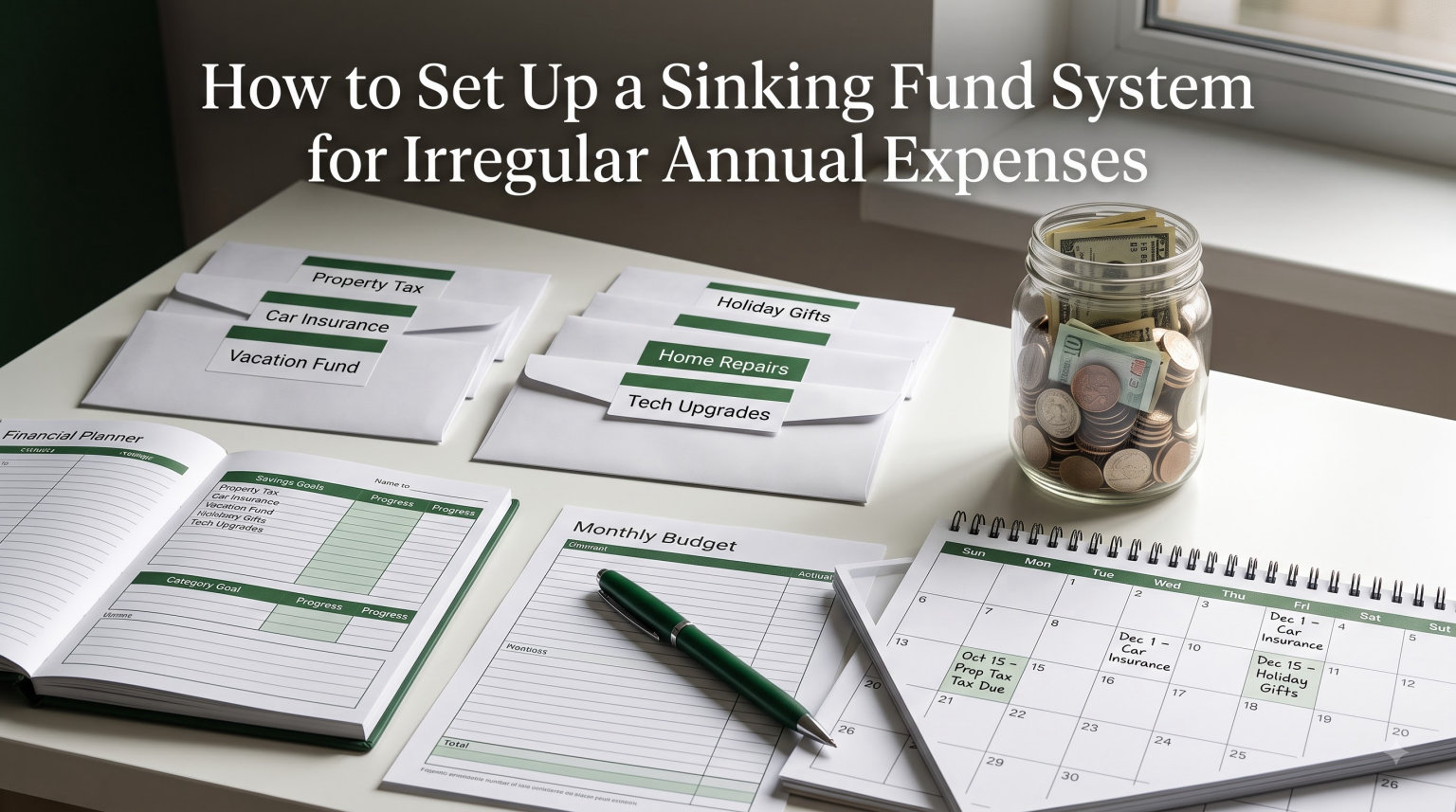
Every year around October, my family faced the same panic. Car insurance renewal hit. Holiday gifts were due. The vet needed a payment. We scrambled through our checking account and sometimes put bills on credit cards just to get through the month. None of these costs were surprises, yet they always felt like emergencies.
A sinking fund system fixes that. It is a planned savings method where you divide the cost of known but irregular expenses across 12 monthly contributions, so the money is sitting there waiting when the bill arrives. In this guide, I will walk you through how to set up a sinking fund system for irregular annual expenses, including the categories most families miss, the exact monthly math, and the automation tricks that keep it running on autopilot.
Table of Contents
What Is a Sinking Fund?
A sinking fund is money you set aside systematically for a planned, irregular expense like an annual insurance premium, holiday gifts, or car repairs. Instead of paying a $1,200 bill in one painful lump, you save $100 each month so the money is ready when the bill arrives. Sinking funds turn predictable-but-uneven costs into smooth, manageable monthly contributions that fit inside any budget.
The term “sinking fund” comes from old-school corporate finance, where companies set aside money over time to pay off bonds. Personal finance writers like Dave Ramsey and the YNAB budgeting community popularized the household version under names like “true expenses” or “planned savings.” Whatever you call it, the idea is the same: pay future you in advance.
Why Sinking Funds Beat the Alternative?
I have watched people try four alternatives to sinking funds. They pad their emergency fund, take on credit card debt, skip bills until the last minute, or raid other savings. All four cost more stress and more money than a sinking fund. Here is why the sinking fund approach wins.
You Stop Treating Known Bills Like Emergencies
Annual insurance, holiday shopping, and property taxes are not emergencies. They are scheduled events with known dates. When you treat them like emergencies, you pay for them with high-interest debt or with money earmarked for true crises. A sinking fund reassigns those costs to where they belong: a planned line in your monthly budget.
You Eliminate the Annual Money Panic
On Reddit’s r/budget and r/ynab communities, users consistently describe the same pattern: a “surprise” bill arrives, they feel like they are failing at money, and they scramble to cover it. The fix is rarely earning more. It is splitting the cost across 12 months so the bill never feels sudden. One user told me their car insurance bill used to ruin their December. After switching to monthly sinking fund contributions, they barely notice it.
You Build a Buffer for True Surprises
Once your sinking funds cover the predictable stuff, your emergency fund only has to handle real emergencies: job loss, medical bills, broken appliances. You stop dipping into emergency savings for known expenses, which means your true safety net stays intact.
You Reach Savings Goals Faster
Sinking funds are not just for bills. You can use the same structure to save for a vacation, a new laptop, or a down payment. The mental shift is powerful: every month, you are paying future you a little bit. That small habit compounds into thousands of dollars of funded goals each year.
Sinking Fund vs Emergency Fund vs Regular Savings (2026)
One of the most common forum questions I see is whether sinking funds are the same as emergency funds. They are not. Each type of savings has a specific job, and mixing them causes confusion. Here is how they differ.
| Type | Purpose | Target Amount | When You Spend It |
|---|---|---|---|
| Sinking Fund | Known, planned irregular expenses (insurance, gifts, repairs) | Exact cost of upcoming bill | On the scheduled due date |
| Emergency Fund | True unexpected events (job loss, medical crisis) | 3-6 months of essential expenses | Only for genuine emergencies |
| Regular Savings | Long-term goals (retirement, house down payment) | Varies by goal | When the goal is reached |
The biggest mistake people make is covering an annual insurance bill from their emergency fund. That is what sinking funds are for. Reserve your emergency fund for actual emergencies. Forum users consistently report that splitting these accounts reduces stress because each dollar has a clear job.
Yes, you can keep all three in the same bank, but I recommend labeling each clearly so you do not accidentally spend a sinking fund balance on a vacation. Many readers use separate savings accounts or sub-accounts at the same bank. We will cover organization tactics later in the guide.
Common Sinking Fund Categories and Real Monthly Amounts
The hardest part of starting is knowing which categories deserve their own fund. Most guides give you a vague list of “insurance, gifts, repairs” without telling you what most people actually save. Here is a practical list based on common American household budgets, with realistic monthly amounts so you can model your own.
| Category | Typical Annual Cost | Monthly Contribution |
|---|---|---|
| Auto insurance (paid in full) | $1,200-$1,800 | $100-$150 |
| Home or renters insurance | $1,000-$1,500 | $85-$125 |
| Holiday gifts (December) | $800-$1,500 | $65-$125 |
| Car maintenance and repairs | $600-$1,200 | $50-$100 |
| Property taxes (if not escrowed) | $2,400-$4,800 | $200-$400 |
| Annual subscriptions (software, memberships) | $300-$600 | $25-$50 |
| Pet veterinary care | $400-$800 | $35-$65 |
| Birthday gifts (multiple people) | $600-$1,200 | $50-$100 |
| Home maintenance (HVAC, roof, appliances) | $1,200-$3,000 | $100-$250 |
| School fees, sports, or activity registration | $500-$1,200 | $40-$100 |
Add up your own list and you will likely land somewhere between $400 and $1,500 per month across all sinking funds. That sounds like a lot, but remember: you are probably already spending this money. The only difference is whether you pay it in a panic in December or in calm monthly chunks all year.
Pro tip from the r/Frugal community: start with the three categories that bite you the hardest. For most families that is auto insurance, holiday gifts, and car repairs. Add more funds only after those three are running smoothly.
How to Set Up a Sinking Fund System: 5 Steps
Now the actual setup. I will walk you through the same five-step process I have used with my own household budget and have seen work for dozens of readers. Block out about two hours on a Sunday afternoon. You can finish this in a single sitting.
Step 1: Run a Financial Surprise Audit
Pull up your last 12 months of bank and credit card statements. Highlight every charge that surprised you, came in a lump sum, or made you scramble. Common offenders include insurance premiums, annual subscriptions, vehicle registration, holiday spending, and birthday gifts. List every irregular expense you can find. This is your starting category list.
Do not skip this step. Forum users who try to set up sinking funds without auditing first almost always underfund something and end up frustrated. The audit gives you a real category list based on your actual life, not a generic template.
Step 2: Calculate the Monthly Amount for Each Fund
For each category, take the annual cost and divide by 12. If your car insurance is $1,200 and renews in March, save $100 every month starting now. If holiday gifts will cost $900 in December, save $75 every month from January through November. The formula is simple: monthly contribution = total expected cost / number of months until the bill is due.
Use real numbers, not hopeful ones. Look at last year’s actual spending rather than guessing what you “should” spend. If you spent $1,400 on holiday gifts last year, plan for $1,500 this year with a small cushion.
Step 3: Open Dedicated Accounts or Sub-Accounts
You have three main options for organizing sinking funds. Pick one based on your bank and your comfort with technology.
High-yield savings account: Open one savings account at a bank like Marcus, Ally, or your existing bank’s HYSA option. Keep your regular savings and emergency fund in another account so the sinking fund is isolated.
Sub-accounts at the same bank: Many banks let you create multiple savings sub-accounts under one login. Label each one clearly: “Car Insurance 2027,” “Holiday Gifts 2026,” “HVAC Fund.”
Spreadsheet tracker with one account: Keep all sinking funds in a single savings account but track each category in a spreadsheet, deducting as you spend and adding as you save. This is the simplest method if you do not want to manage multiple logins.
The right choice is the one you will actually use. Forum users who picked complicated setups often abandoned them. Pick the simplest setup that separates your sinking fund money from your daily spending money.
Step 4: Automate Your Monthly Contributions
Once you know the monthly amount for each fund, set up automatic transfers on the day after payday. Automation is the single biggest predictor of sinking fund success. When the transfer happens without you touching it, the system runs itself. When you have to remember to move money manually, something always gets skipped.
If you cannot afford to fund every category at full speed, prioritize by urgency. A bill due in 30 days gets fully funded first. A bill due in 11 months can ramp up over time. Many readers start with 50% of the target amount and increase contributions each month as their budget allows.
Step 5: Track, Review, and Adjust Each Month
Set a 15-minute monthly review on your calendar. Check each fund’s balance against its target. If a fund is overflowing because the expense ended up cheaper than expected, roll the surplus into the next year’s contribution or into your emergency fund. If a fund is behind because the expense grew, increase next month’s contribution to catch up.
Forum users frequently ask what to do with overflow. The honest answer: do not overthink it. Either lower your future monthly contribution, move the surplus to another fund, or use it as a small reward for staying on track. A sinking fund is a tool, not a rule.
Tips to Make Your Sinking Fund System Stick
Setup is the easy part. The hard part is keeping the system running for years without losing motivation. Here are the tactics I have seen work consistently across dozens of households.
Name Each Fund With a Specific Date and Amount
Instead of a generic “Car Insurance” label, name the fund “Car Insurance – Due March 2027 – $1,200.” The specific date and amount keep you focused on the goal. It also makes the upcoming bill feel like a planned event instead of an interruption. This is one of the most repeated tips on r/ynab.
Use a Buffer Month to Catch Up
If you start your system mid-year, your first monthly contribution is going to be larger than normal because you have fewer months to save. That is fine. Treat the catch-up month as a one-time hit. After that first renewal, your monthly contributions drop to a normal pace.
Don’t Open Too Many Funds at Once
It is tempting to create 15 sinking funds the first weekend. Resist. Start with three to five categories that hurt the most. Master those. Once your automation and tracking are routine, add more funds gradually. Forum users who tried to fund everything at once usually abandoned the system within three months.
Refill Quickly After a Big Expense
When your car insurance bill hits in March and you drain that fund, restart the monthly contribution immediately. The fund should be back to its target by the time next year’s bill comes due. Some readers like to bump up the contribution for two or three months to refill faster. Either approach works as long as you restart the cycle.
Avoid These Common Mistakes
I have seen every mistake in the book. Here are the ones that derail sinking fund systems most often.
Borrowing from one fund to pay another. If your “Holiday Gifts” fund is full and your “Car Repair” fund is empty, do not transfer the holiday money over. Adjust your monthly contribution instead. Cross-pollinating funds defeats the purpose of having separate categories.
Spending the sinking fund balance on something else. If you build up $1,000 for holiday gifts and then spot a great vacation deal, the fund is not a vacation fund. Leave it alone.
Setting targets based on hope instead of history. Guessing you will only spend $500 on holiday gifts when you spent $1,400 last year is a recipe for underfunding. Use your actual numbers from your financial surprise audit.
Stopping contributions after the bill is paid. The cycle does not end after the bill clears. Restart contributions the following month so next year’s bill is also covered.
Talk to Your Partner With Specific Numbers
If you share finances with a spouse or partner, walk them through your list of categories and the monthly amounts. Show the audit. Show the upcoming bills. Concrete numbers defuse arguments about whether sinking funds are necessary. Forum users repeatedly say that getting buy-in from a partner is the difference between a working system and a constant source of household conflict.
FAQs
How do I create a sinking fund?
Identify the irregular expense, estimate its total annual cost, then divide that amount by the number of months until the bill is due. Save that monthly amount in a separate labeled account. When the bill arrives, pay it from the sinking fund instead of your checking account.
What is the 70-10-10-10 budget rule?
The 70-10-10-10 rule splits after-tax income into 70% for living expenses, 10% for short-term savings or sinking funds, 10% for retirement or long-term goals, and 10% for debt repayment or giving. Sinking funds fit naturally in the 10% short-term savings bucket.
What does Dave Ramsey say about sinking funds?
Dave Ramsey calls sinking funds u0022peace of mindu0022 money. He recommends saving a little each month for planned expenses like car insurance, gifts, and home maintenance so you never rely on credit cards or your emergency fund when the bill arrives. He treats sinking funds as a core part of his Baby Steps budgeting method.
How do you budget irregular spendings?
Budget irregular spending by listing every non-monthly expense, estimating its annual cost, and dividing by 12. Save that monthly amount in a labeled fund. Spend from the fund only when the planned bill arrives. Review the list every month to adjust for new or changed expenses.
How many sinking funds should I have?
Most households do well with 5 to 8 sinking funds. Start with the categories that hurt the most, such as auto insurance, holiday gifts, and car repairs, then add more funds only after those are running smoothly. More than 10 funds becomes hard to track without dedicated software.
Start Your Sinking Fund System This Week
A sinking fund system is one of the simplest changes you can make to your household budget, and it pays off the first time an annual bill arrives and the money is just there. You do not need fancy software. You need a list of irregular expenses, a monthly contribution amount, and a separate place to keep the money.
Pick three categories this week, calculate your monthly amounts, and set up an automatic transfer on payday. After two or three months of running smoothly, add another fund. Within a year, your irregular expenses will feel like routine monthly bills, and the December panic will be a thing of the past.