
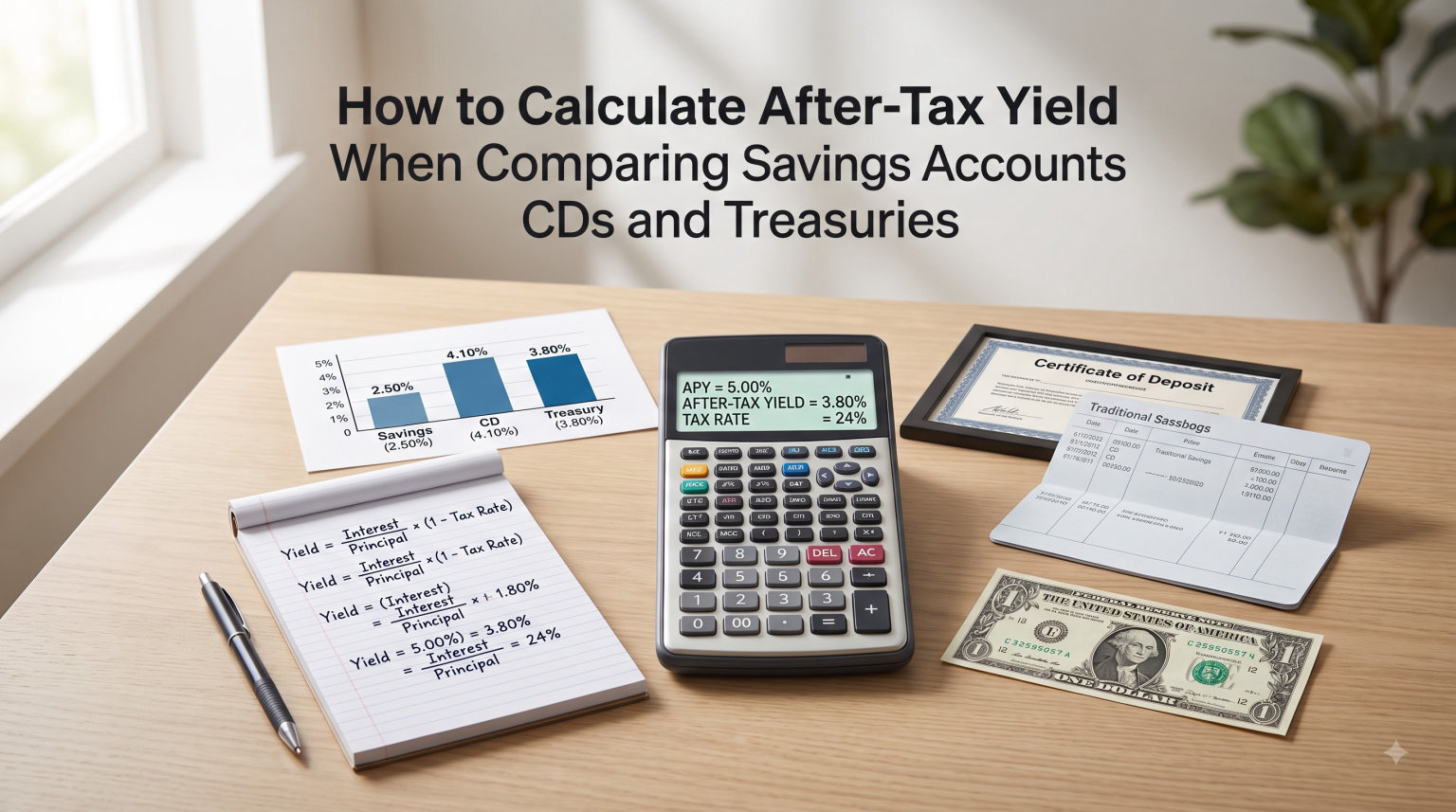
If you keep any cash in a high-yield savings account, a CD, or a Treasury bill, the rate you see advertised is not the rate you actually keep. Taxes take a bite before the money lands in your account, and that bite gets larger every year when more interest piles up.
I learned this the hard way one April when I owed around $2,800 in taxes on interest from a high-yield savings account. That is when I started running the after-tax yield calculation before every cash decision. In this guide, I will walk you through the exact formula, work three real examples, and show you how to compare a savings account, a CD, and a Treasury side by side.
The After-Tax Yield Formula
After-Tax Yield = Stated Yield × (1 − Marginal Tax Rate)
For a 5% APY in the 24% federal bracket: 5% × (1 − 0.24) = 3.80% after-tax.
Table of Contents
What Is After-Tax Yield?
After-tax yield is the real return you earn on an investment once taxes on the interest have been removed. It tells you how much money you actually keep.
Most banks advertise the APY, which is the stated yield before taxes. The after-tax yield subtracts federal, and in most cases state, income tax owed on that interest. The gap between APY and after-tax yield can be surprisingly large once you factor in your full marginal rate.
This matters because higher stated yields can mislead you. A 5% APY in the 32% federal bracket drops to 3.40% after-tax. A 4.3% tax-free municipal bond at the same bracket leaves you with the full 4.30%. The headline rate is not the comparison number.
Why After-Tax Yield Beats APY for Real Decisions
Comparing APYs only works when every option gets taxed the same way. The moment one is federally taxable, another is state-tax-exempt, and a third sits in a tax-advantaged account, APY comparison breaks down.
After-tax yield puts every option on the same footing by converting each rate to the dollars you actually keep. Once you do this consistently, picking between cash instruments gets much simpler.
The Core After-Tax Yield Formulas
There are two formulas you will use constantly. The first tells you what you keep. The second tells you what a tax-free yield would need to look like to match a taxable one.
Formula 1: Basic After-Tax Yield
The simplest version uses only your federal marginal tax rate:
After-Tax Yield = Stated Yield × (1 − Federal Marginal Tax Rate)
Example: A 4.5% APY high-yield savings account in the 22% federal bracket gives you 4.5% × (1 − 0.22) = 3.51% after federal tax. Your state will likely tax this interest too.
Formula 2: Combined Federal + State After-Tax Yield
For most people, the combined rate matters more than the federal rate alone:
After-Tax Yield = Stated Yield × (1 − Federal Rate) × (1 − State Rate)
Example: A 4.5% APY at 22% federal plus 5% state gives 4.5% × (1 − 0.22) × (1 − 0.05) = 4.5% × 0.78 × 0.95 = 3.33% combined after-tax. State taxes quietly shaved another 0.18 percentage points off your return.
Formula 3: Tax-Equivalent Yield
The tax-equivalent yield works the other direction. It tells you what taxable yield you would need to match a tax-exempt one:
Tax-Equivalent Yield = Tax-Exempt Yield ÷ (1 − Marginal Tax Rate)
Example: A Treasury bill yielding 4.20% in the 24% federal bracket is equivalent to a taxable yield of 4.20% ÷ (1 − 0.24) = 5.53% in a fully taxable account. This is the number to compare against a CD or savings account that gets taxed at both federal and state levels.
After-Tax Yield on Savings Accounts
Interest from a regular savings account, high-yield savings account, or money market account is taxed as ordinary income at both the federal and state level. There are no exemptions for federal tax, and almost every state taxes it as well.
Step-by-Step Calculation
Suppose you park $50,000 in a high-yield savings account at 4.50% APY and you are in the 24% federal bracket with a 4% state bracket.
Step 1: Pull the stated APY. You have 4.50%.
Step 2: Apply the federal haircut. 4.50% × (1 − 0.24) = 3.42%.
Step 3: Apply the state haircut. 3.42% × (1 − 0.04) = 3.28% combined after-tax.
Step 4: Convert to dollars. $50,000 × 0.0328 = $1,640 in after-tax interest for the year.
The Tax Bill Surprise
I see this come up constantly in forums. A user on Reddit with $175,000 in a high-yield savings account got hit with roughly $2,500 to $3,000 in taxes on interest alone. That is not an edge case. At 4.50% APY, $175,000 generates $7,875 in interest, which at 32% federal plus 5% state loses about 35% of its value to tax.
If you hold meaningful cash in a taxable account, you should plan for that tax bill. Holding part of that cash in tax-advantaged accounts like an IRA or HSA shelters the interest from federal tax entirely.
After-Tax Yield on Certificates of Deposit (CDs)
CD interest is taxed exactly the same way as savings account interest. It is ordinary income for federal purposes and almost always taxed at the state level too. The APY you see is the pre-tax number, just like with a savings account.
Bank CD vs Brokered CD
A bank CD purchased directly from a bank typically pays interest at maturity or on a set schedule, and the 1099-INT reports it all as taxable interest. A brokered CD, bought on a brokerage platform, may trade in the secondary market like a bond, which can trigger different tax rules if you sell before maturity at a gain.
For most people comparing cash equivalents, treat both the same way for tax purposes. The yield is the yield, and the tax treatment is ordinary income.
Step-by-Step Calculation
Suppose you lock $25,000 into a 12-month bank CD at 4.75% APY. Your federal bracket is 22% and your state rate is 0% (Texas, Florida, or another no-income-tax state).
Step 1: Pull the stated APY. 4.75%.
Step 2: Apply federal tax. 4.75% × (1 − 0.22) = 3.705%.
Step 3: No state tax to apply. After-tax yield remains 3.71%.
Step 4: Dollars. $25,000 × 0.0371 = $927 in after-tax interest for the year.
If you live in California with a 9.3% state bracket, the same calculation becomes 4.75% × 0.78 × 0.907 = 3.36% after-tax, or about $840 in real dollars. State tax cost you $87 of interest on this one CD.
After-Tax Yield on Treasury Bills, Notes, and Bonds
Treasury securities sit in a sweet spot for after-tax yield comparisons. Interest from Treasury bills, notes, and bonds is taxed at the federal level but exempt from state and local income tax. That single rule can flip the outcome of your comparison.
State Tax Exemption Highlight
If you live in a high-tax state like California (13.3% top marginal), New York (10.9%), or Hawaii (11%), Treasuries get a real edge. A Treasury yield that looks lower than a CD on paper often wins after you exempt state tax from the comparison. This is the single biggest reason high-income investors tilt toward Treasuries for cash.
Step-by-Step Calculation
Suppose a 1-year Treasury bill yields 4.20% and you are in the 24% federal bracket with a 5% state bracket.
Step 1: Pull the stated yield. 4.20%.
Step 2: Apply federal tax. 4.20% × (1 − 0.24) = 3.192%.
Step 3: Skip the state haircut. Treasuries are exempt from state tax. After-tax yield stays at 3.19%.
Step 4: Dollars. $25,000 × 0.0319 = $797 in after-tax interest.
Compare that with a fully taxable CD at 4.50% in the same bracket. The CD’s after-tax yield is 4.50% × 0.76 × 0.95 = 3.25%, or $812 on $25,000. So in this example, the CD edges out the Treasury slightly because its higher headline rate overcomes the state tax disadvantage.
When Treasuries Clearly Win
Swap the state rate for California’s 13.3% and the picture flips. A 4.50% CD in 24% federal plus 13.3% state drops to 4.50% × 0.76 × 0.867 = 2.96% after-tax. The Treasury stays at 3.19% after-tax. The Treasury now wins by 0.23 percentage points, or about $58 more on $25,000 in a year.
Multiply that across a six-figure cash position and the state tax exemption is worth real money.
Side-by-Side Comparison: Real Numbers by Tax Bracket
The table below uses current example yields: HYSA at 4.50%, 12-month CD at 4.75%, and 1-year Treasury bill at 4.20%. Numbers are after-tax percentages in your pocket.
| Tax Bracket (Fed + State) | HYSA 4.50% | CD 4.75% | T-Bill 4.20% |
|---|---|---|---|
| 22% Fed + 0% State (TX, FL) | 3.51% | 3.71% | 3.27% |
| 24% Fed + 5% State | 3.28% | 3.36% | 3.19% |
| 32% Fed + 5% State | 2.94% | 3.12% | 2.86% |
| 24% Fed + 13.3% CA State | 2.92% | 2.96% | 3.19% |
| 37% Fed + 10.9% NY State | 2.50% | 2.62% | 2.65% |
Reading the Numbers
In no-income-tax states, the CD wins at every federal bracket because its higher headline yield beats the Treasury even after federal tax. As state tax climbs past about 7%, the Treasury starts to catch up and eventually overtakes the CD.
For a California investor in the 24% bracket, the Treasury delivers 3.19% after-tax versus the CD’s 2.96%. That is roughly 23 basis points of additional yield per year on the same dollar. Over a five-year holding period with compounding, the gap widens further.
Other Tax Considerations You Should Know
The after-tax yield formula covers most cases, but a few edge situations come up regularly in real life.
Tax-Advantaged Account Wrappers
If your cash sits inside an IRA, Roth IRA, or HSA, the tax treatment changes dramatically. Traditional IRA interest is tax-deferred until withdrawal. Roth IRA and HSA interest, when used for qualified expenses, is entirely tax-free. Inside these wrappers, the comparison becomes simple again: pick the highest APY you can find.
Forms You Will Receive
Banks, brokerages, and the Treasury Department all issue a 1099-INT for interest over $10 in a year. Treasuries report interest on Form 1099-INT as well. Some brokered CD interest is reported on 1099-OID if the CD was issued at a discount. Either way, you owe the tax shown on these forms, so track them carefully.
Treasury Inflation-Protected Securities (TIPS)
TIPS add another wrinkle. The principal adjusts with inflation, and that adjustment is taxable in the year it occurs, even though you do not receive it as cash. Factor in the deferred-but-owed tax on the inflation accrual when comparing TIPS to nominal Treasuries.
Original Issue Discount on Brokered CDs
Some brokered CDs are sold at a discount to face value. The discount accrues each year as ordinary income, even if you hold the CD to maturity. This is similar to a Treasury bill. Treat both the same way in your after-tax yield calculation.
Frequently Asked Questions
How do I calculate after-tax yield?
Multiply the stated yield by (1 minus your marginal tax rate). For combined federal and state taxes, multiply the result again by (1 minus your state rate). Example: a 5% APY in the 24% federal bracket gives 5% x (1 – 0.24) = 3.80% after federal tax, and 3.80% x (1 – 0.05) = 3.61% after state tax too.
What is the tax-equivalent yield on a Treasury bill?
Treasury bill interest is exempt from state and local income tax, so the tax-equivalent yield uses only your federal marginal rate. Divide the Treasury yield by (1 minus federal rate). Example: a 4.20% Treasury bill in the 24% federal bracket is equivalent to a 4.20% / (1 – 0.24) = 5.53% taxable yield.
Which is safer, a CD or a Treasury bill?
Both are extremely safe for amounts within typical deposit and investment limits. Bank CDs are FDIC insured up to $250,000 per depositor per bank. Treasury bills are backed by the full faith and credit of the U.S. government with no insurance cap. For very large cash positions above the FDIC limit, Treasuries are safer.
Are CDs worth it after taxes?
CDs are worth it when the higher headline APY overcomes the tax disadvantage. In no-income-tax states, CDs usually beat Treasuries. In high state-tax states like California or New York, Treasuries often deliver more after-tax yield. Always run the combined federal plus state calculation before locking in a CD.
Why is HYSA interest taxable?
High-yield savings account interest is treated as ordinary income by the IRS and most states. The bank issues a 1099-INT each January showing the interest you earned. This interest has no special tax status like municipal bond interest does, so it gets added to your taxable income for the year.
Conclusion
Calculating after-tax yield when comparing savings accounts, CDs, and Treasuries comes down to three steps: identify your combined marginal tax rate, plug the stated yield into the formula, and compare the after-tax numbers.
Treasuries have a real edge in high-tax states because they skip state income tax. CDs and savings accounts win when state tax is low or zero and the headline APY is meaningfully higher. Run the numbers before each cash decision, and you will avoid the surprise tax bills that catch so many savers off guard.