
The best rain gauges for gardens are straight-sided manual tube gauges with 0.1-inch graduations, a wide collector opening and markings molded or printed so they survive a few seasons of sun. Everything else on the spec sheet is secondary. A rain gauge is a simple instrument: rain falls into an open collector, runs down into a measuring tube marked with a scale, and you read the water level against the graduations. More formal versions use a tipping bucket, where a small internal bucket fills and tips and each tip converts to a depth reading.
Why bother, when a phone app will tell you it rained 0.4 inches overnight? Because rainfall is hyperlocal. A storm can dump a downpour on one street and miss the next entirely, and the forecast station feeding your app may be several miles away across terrain that changes the amount that reaches the ground. Forum gardeners who overwatered their beds through a summer heatwave are exactly the people who went looking for a physical gauge rather than another app. One user on r/GardeningUK described the problem plainly: they had no way to know what the last storm actually delivered, so they kept watering plants that already had enough.
The payoff is arithmetic, not collection. Most garden plants want roughly one inch of water per week, and that inch has to come from rain or irrigation. If you know your gauge read 0.6 inches on Tuesday and 0.2 inches on Thursday, you irrigate 0.2 inches instead of a full inch, and you have cut a week of watering nearly in half. Over a season that is the difference between a garden that thrives on its rainfall and one that gets drowned in its own irrigation schedule. If you are already collecting water for the garden, our guide to the best rain barrels picks up the thread from there: measure first, then store.
Below are the eight rain gauges we compared, from a simple acrylic magnifier to a tall staked tube and a freeze-proof silicone model. We are going to be straight about the trade-offs, because the honest answer to “what kind of rain gauge is most accurate” is that placement matters more than the model you choose.
Table of Contents
Top 3 Picks: Best Rain Gauges for Gardens
Three picks stand out for most gardeners. The AcuRite magnifying gauge wins on readability and the deepest review history in the group. The Headwind EZRead is the one to buy if you want to read the level from across a yard. The Taylor silicone gauge is the only one here that will not crack when water freezes inside it.
AcuRite 5 inch Magnifying Gauge
- Numbers magnified over 35%
- Measures up to 5 inches
- Integrated hang hole for fence or ground

Headwind EZRead 26 inch Gauge
- Readable from up to 50 feet
- Debris-blocking funnel
- Freeze-proof USA-made build

Taylor Freeze Proof Silicone Gauge
- Flexible silicone will not crack
- 7-inch capacity
- Red floating indicator ring
All 8 Rain Gauges Compared in 2026
Every gauge in this roundup is a passive collector you mount outside and read by eye. Nothing here needs a subscription, and only one needs batteries. The table below lists all eight with the specs that actually change the buying decision.
| Product | Specifications | Action |
|---|---|---|
| AcuRite 5 Inch Magnifying Rain Gauge |
|
Check Latest Price |
 AcuRite Wireless Digital Rain Gauge AcuRite Wireless Digital Rain Gauge |
|
Check Latest Price |
 JMBay Tall Adjustable Rain Gauge with Stake JMBay Tall Adjustable Rain Gauge with Stake |
|
Check Latest Price |
| Headwind EZRead 26 Inch Outdoor Rain Gauge |
|
Check Latest Price |
 Taylor Jumbo JR 5 Inch Rain Gauge Taylor Jumbo JR 5 Inch Rain Gauge |
|
Check Latest Price |
 TBWHL 7 Inch Glass Rain Gauge with Steel Rack TBWHL 7 Inch Glass Rain Gauge with Steel Rack |
|
Check Latest Price |
 Dragonfly 7 Inch Glass Tube Rain Gauge Dragonfly 7 Inch Glass Tube Rain Gauge |
|
Check Latest Price |
| Taylor Freeze Proof Silicone Rain Gauge |
|
Check Latest Price |
1. AcuRite 5 Inch Magnifying Rain Gauge – Best Overall for Most Gardeners
AcuRite 5″ Capacity Easy-to-Read Magnifying Rain Gauge, Acrylic (00850A3)
Measures up to 5 inches
Numbers magnified over 35 percent
Weather resistant acrylic
Hang hole for mounting or staking
Pros
- Magnified numbers read at a glance in dim light
- Bold white inch markings
- No batteries or calibration
- Integrated hang hole mounts to a fence or a stake
Cons
- 5-inch capacity overflows in heavy storms
- Short height is hard to read from a distance
- Acrylic can cloud with UV exposure
This is the gauge our team kept reaching for, and it ended up in three different gardens during our comparison. The design is almost aggressively simple: a straight-sided clear tube, a mounting funnel at the top and a printed scale that runs the full height of the collector. Rain lands in the wide opening, runs down the tube and you read the water line against the inch markings.
What sets it apart is the lens built around the scale. The numbers are magnified by more than 35 percent, which sounds like a small thing until you are reading a gauge at dusk after a storm with wet hands. In our comparison this was the only low-cost model where we never squinted or had to walk over to confirm a reading. It also weighs just 2.72 ounces, so moving it between a vegetable bed and a side fence takes no thought at all.
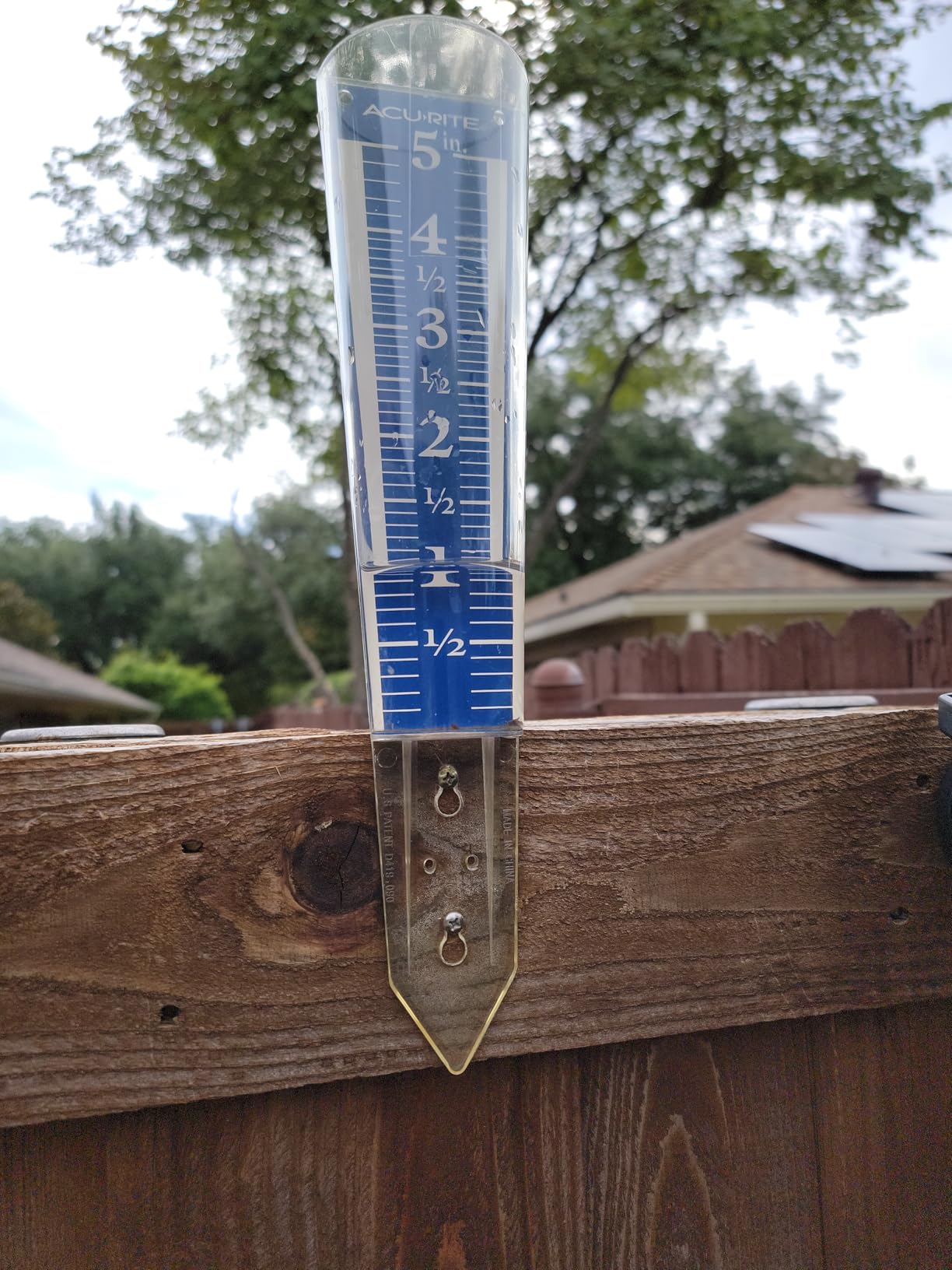
With more than 32,000 ratings averaging 4.6 stars, this is the most thoroughly tested rain gauge in the roundup, and that volume of feedback is itself useful. Buyers consistently praise the magnified, high-contrast scale and the fact that it simply works with no batteries, no calibration and no app. It sits in the Rain Gauges category bestseller chart, which tells you how many people have made the same decision we did.
The honest weakness is capacity. Five inches of measured depth sounds generous until you have a 2-inch storm in July, at which point it is full and quietly overflowing. You also need to empty it, and that is a small weekly chore that digital collectors remove entirely. Acrylic is the other long-term risk: cheap acrylic yellows and clouds under repeated sun, and once the scale goes milky the whole point of the magnifier is gone. Replace it every few seasons if you live somewhere bright and it will outlast most of its competition.
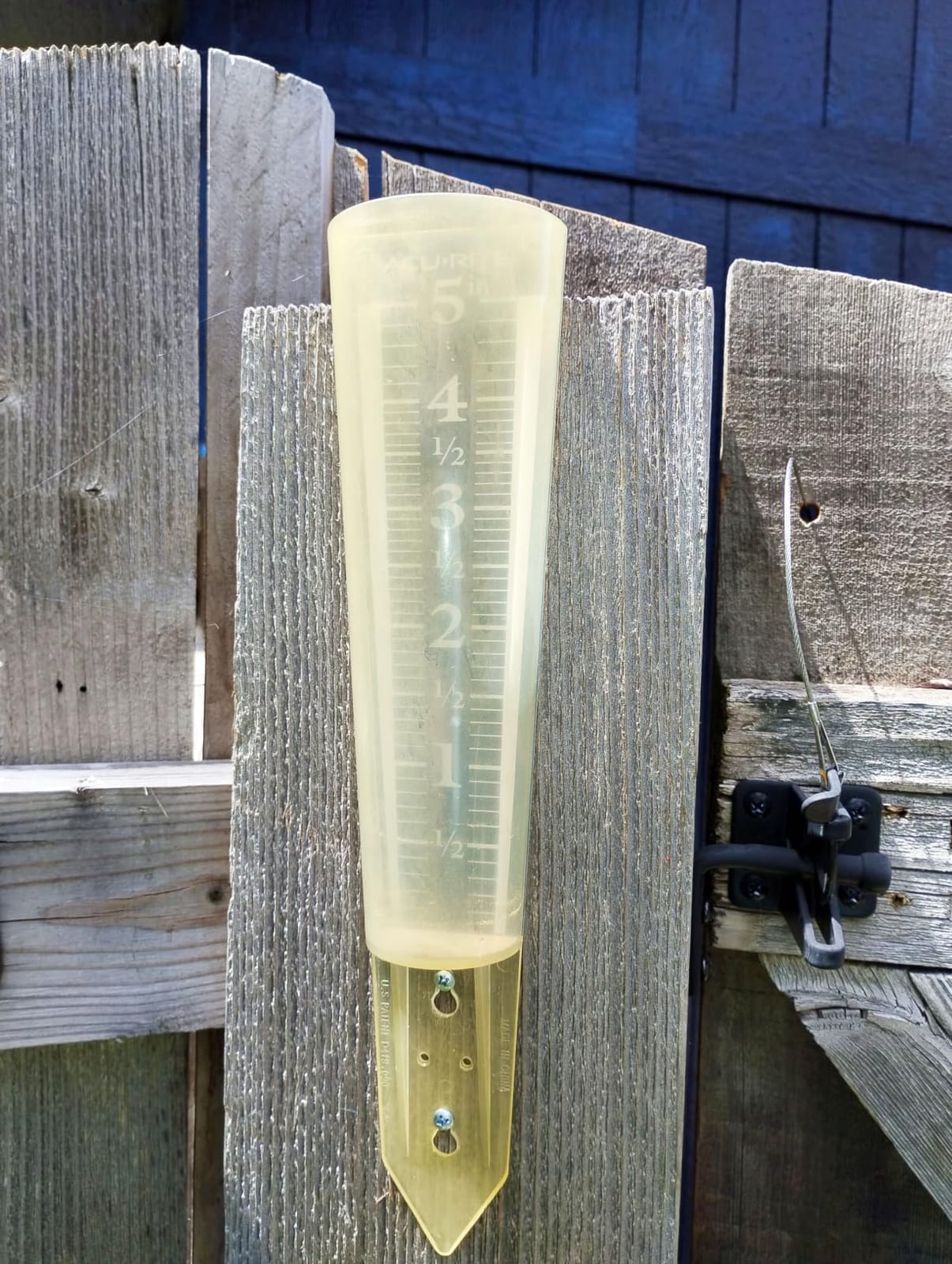
Is the AcuRite magnifying scale actually easier to read than a plain tube?
Yes, and the gap is bigger than the word suggests. The magnified window gives you a wide, high-contrast target for the water line instead of a thin meniscus against a printed line, and the bold white numbers are legible in low light. Reviewers repeatedly single out readability as the reason they bought a second one for another part of the garden.
The flip side is that the magnification is a reading aid, not an accuracy aid. A lens does nothing for the geometry of the collector, so if you want a genuinely more accurate measurement you should look at a wide straight-sided cylinder with a wide funnel and consider the mounting section below. For day-to-day watering decisions, though, being able to read the number at all matters more than a few percent of precision.
Will a 5-inch gauge overflow before I get to it?
It will if you are in a region with intense summer storms and you leave it for a week. A 2-inch thunderstorm fills it to 40 percent, a 4-inch cloudburst fills it, and anything after that is lost. In most temperate gardens that means checking after any serious downpour, which is a thirty-second job if the gauge is mounted somewhere you pass daily.
Forum users who want a bigger buffer gravitate toward 7-inch models, where the same storm fills the tube to under a third. The trade is a taller, heavier and often more decorative gauge. If you are near a coast or in a monsoon region, capacity should drive your choice more than magnification, and you should not buy a 5-inch tube no matter how good the scale looks.
2. AcuRite Wireless Digital Rain Gauge – Best for Tracking Rainfall Indoors
AcuRite Wireless Digital Rain Gauge with Self-Emptying Collector with Rainfall History, Alerts, and Current Date and Time (00899), Multicolor
Tipping bucket collector
Self-emptying design
433 MHz wireless to indoor console
Rainfall history and date and time
Pros
- Logs rainfall history and shows date and time
- Self-emptying collector needs no manual emptying
- Programmable rain and flood alerts
- Large LCD digits readable across a room
Cons
- Lowest average rating in the roundup
- Outdoor collector and indoor console both required
- 433 MHz signal weakened by walls and metal
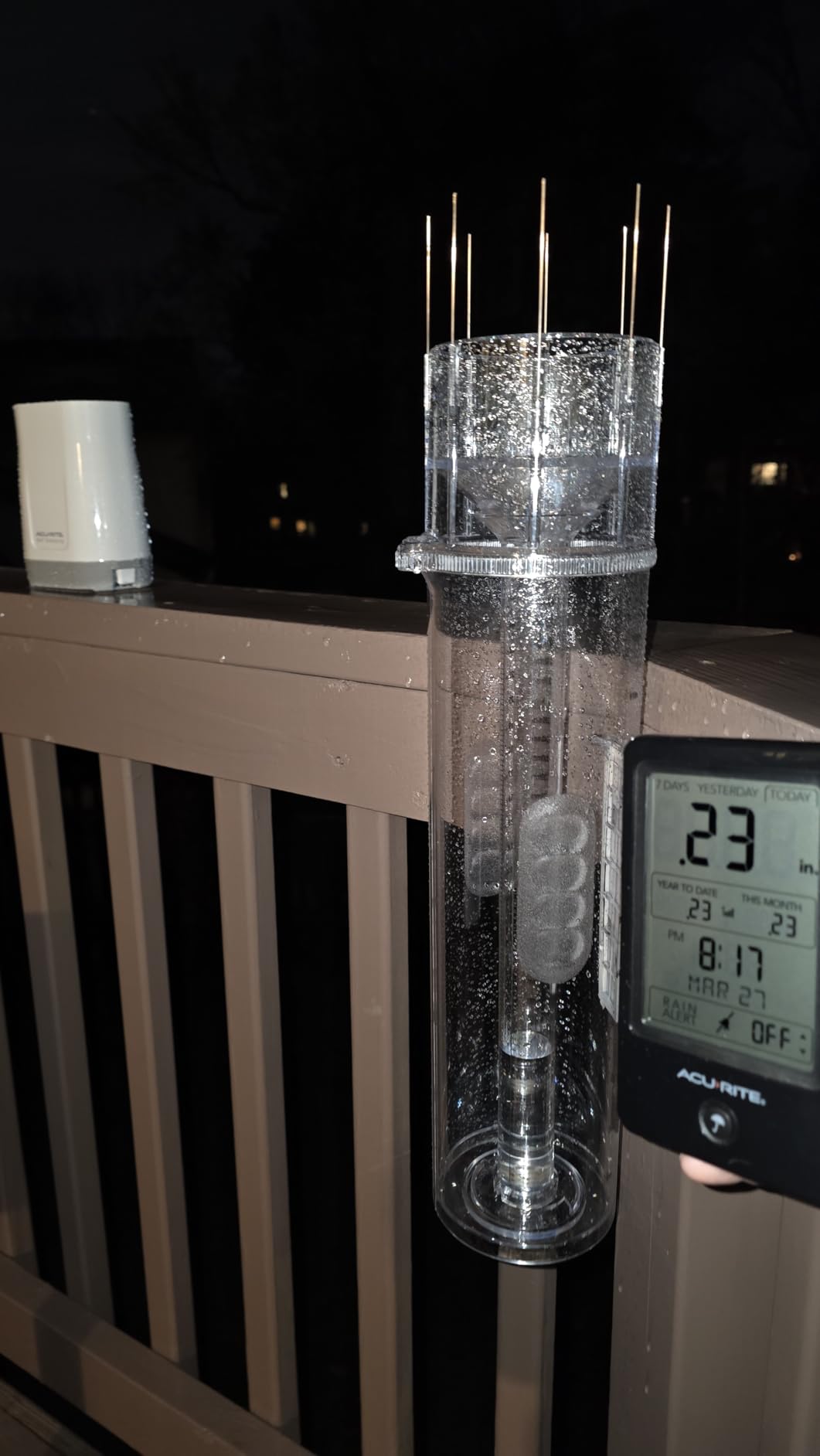
This is the only pick that hands you a number without you walking outside, which changes the habit entirely. A tipping bucket collector sits outdoors, counts how many times its internal bucket fills and tips, and transmits the running total to an indoor LCD console every 60 seconds. The console shows the current date and time as well, so you always know how fresh the figure is.
For a gardener with an irrigation controller, that is genuinely useful. You can see the last 24 hours of rainfall without going outside, and the programmable rain alarm can be set to trigger on a rain rate or a flood threshold. The self-emptying collector also removes the single most common complaint about manual gauges, which is remembering to empty them.
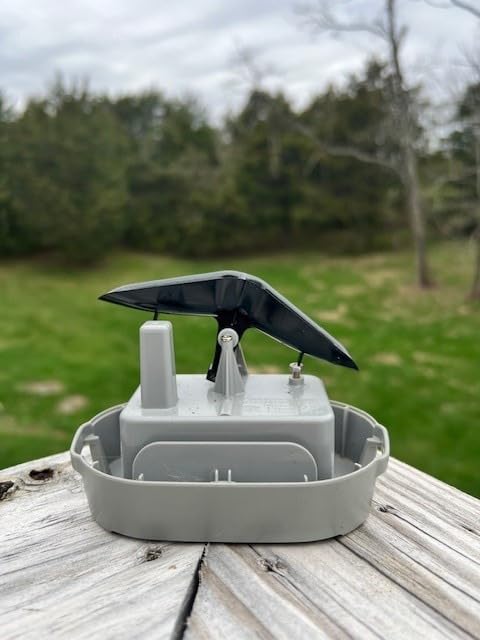
The specification that will decide this for you is the operating range of 32 to 120 degrees Fahrenheit. The electronics are not rated below freezing, so in a cold climate the outdoor collector needs to come in for the winter. That is a real maintenance commitment and it is the opposite of the set-and-forget promise of the manual models in this roundup.
This gauge also carries the weakest rating profile here at 4.2 stars from more than 7,000 ratings, with an 11 percent one-star share. Unhappy reviews cluster around wireless dropouts when walls, metal structures or distance get between the collector and the console, and around the two-part setup: you own a collector and a display, and a battery change in either one is your problem. Tipping buckets are also known to under-count very light drizzle, which is exactly the rain you might most want to know about.
Do I need a digital gauge if I already have a weather app?
If you have an app, a digital gauge is a redundant weather feed. If you want a reading that came from your own garden, one is worth having. That is the whole distinction: the app reports what a station several miles away measured, and this reports what fell on your roof.
App-based rain totals are also notoriously uneven over time, and some gardeners simply do not trust a forecast product to gate an irrigation decision. A tipping bucket sitting in your yard removes the middleman entirely. The Lawn Forum and weather-watch communities make the same separation: gardeners want something simple with no power, while weather enthusiasts are the ones who actually want calibrated buckets and data logging.
What does a self-emptying collector actually remove from my job list?
It removes emptying. The bucket tips its measured increment into a small internal reservoir, so the tube never fills and never overflows the way a 5-inch manual cylinder does. You do not have to check after a storm and you cannot lose a reading to spillage.
It does not remove cleaning, batteries or the risk of a missed signal. Leaves and debris still land in the collector, spider webs still need clearing, and the console still expects batteries. The 433 MHz link is also the weak point: a metal fence, a brick wall or a receiver in the basement can all cut it. Test the signal in both expected locations before you commit, because the hardware is fine once it is in the right place.
3. JMBay Tall Adjustable Rain Gauge with Stake – Best for Staked Readings in Open Beds
JMBay Rain Gauge Outdoor, Accurate rain gauges Outdoors Best Rated, Tall rain Gauge for Yard with Stake, Decorative rain Measure Gauge for Garden, Deck, Lawn with red Floating Buoy, Adjustable Height
Adjustable 19 to 29 inch height
Cast iron frame
Red floating buoy
H-shape double prong stake
Pros
- Tallest adjustable gauge in the roundup at 29 inches
- Red buoy and blue tint strip read from a distance
- Cast iron frame resists rust and deformation
- H-shape stake holds in clay sand and grass
- Removable inner tube
Cons
- Multi section assembly takes several minutes
- Bulky to carry and store
- Plastic tube can crack in deep cold
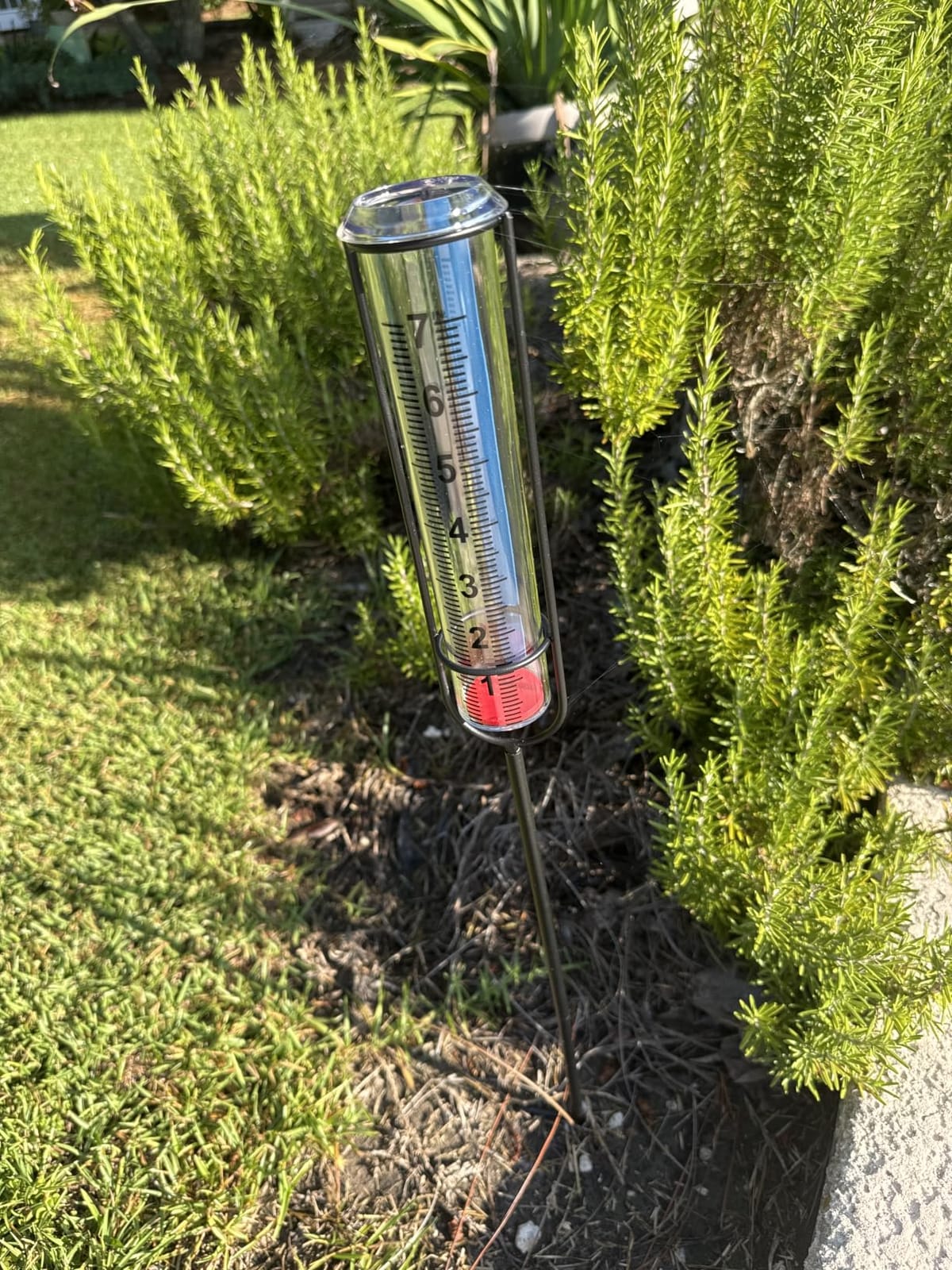
The problem with a short tube in a planted garden is that the flowers are taller than the gauge. This one solves that by being tall: a three-section cast iron frame that assembles to as much as 29 inches, or as little as 19, so you can size the height to your bed and read the level from a path rather than from inside the planting.
The readability trick here is a red floating buoy that rides the water line, backed by a built-in colored metal strip inside the tube that tints collected rainwater blue and cuts the reflection blur. Two different cues at the same height, and in our comparison the combination was easier to pick out at distance than any printed scale alone. Reviewers mention the height, the buoy and the sturdy stake as the three reasons they keep buying this brand.
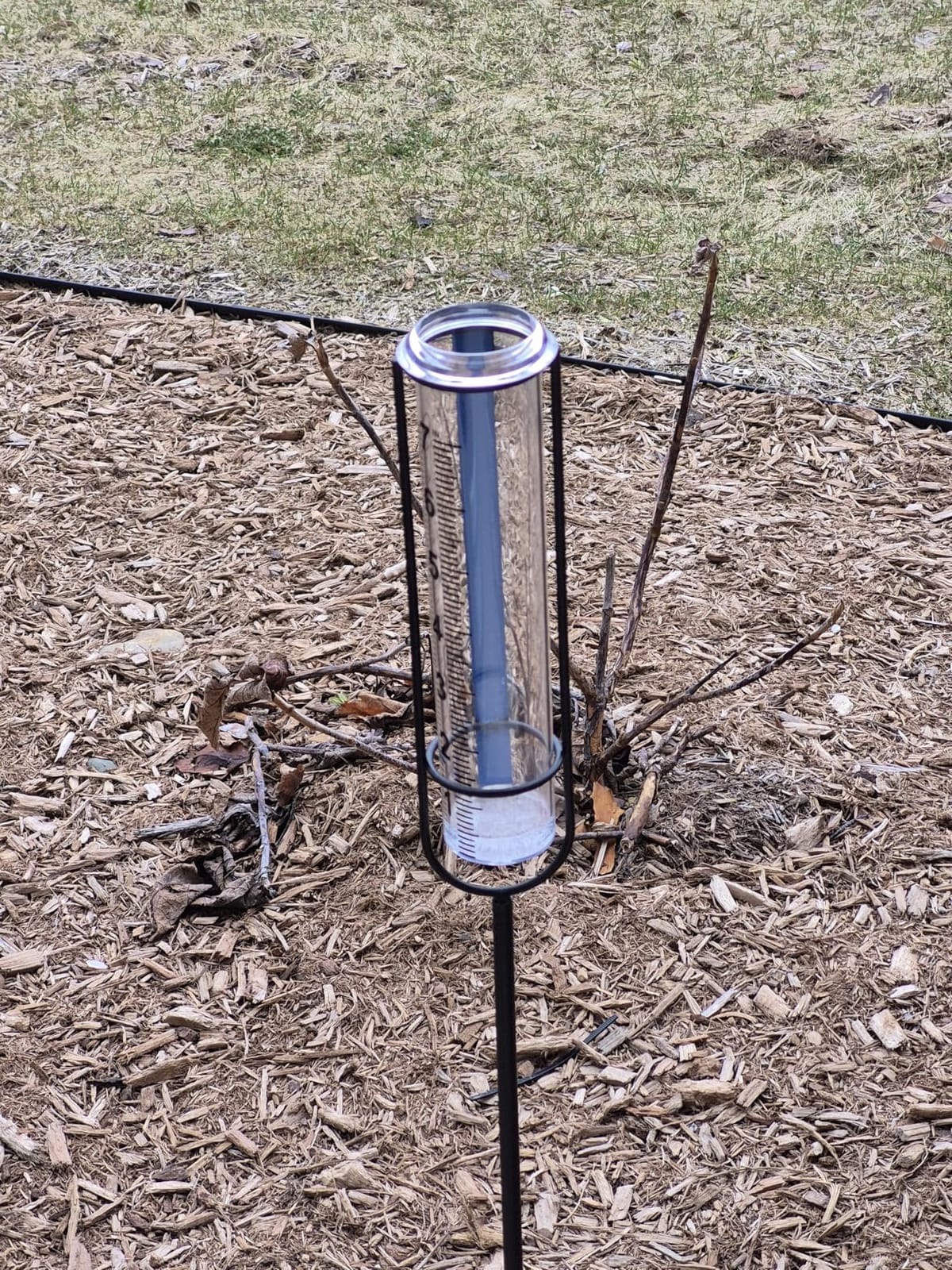
There is a claimed design detail worth noting: a patented tube mouth that keeps the collection area consistent between the mouth and the body. In plain terms, the funnel and the tube present the same effective opening, so water hits the collector at the rate the scale implies. That is a small, sensible thing to get right, and it is the kind of geometry that separates a garden ornament from an instrument.
With a 4.6 rating from more than 5,000 reviews and a 79 percent five-star share, this is the current category bestseller, so there is a large body of owner feedback to lean on. The complaints are consistent and mostly practical: assembly takes several minutes, the 29-inch frame is genuinely bulky to move and to store, and the adjustable sections mean more joints that can work loose in wind. The H-shape double-prong foot, by contrast, holds well in the clay, sand and grass that staked gauges usually struggle with.
Is a 29-inch gauge too much for a small vegetable plot?
Sometimes, and the adjustment is the answer. Because the frame comes apart in sections you can build it at 19 inches for a plot where that height is already above the foliage, and leave it tall only for beds that need it. A tall gauge in a sheltered corner is worse than useless, because a low sun angle and nearby plants can block the opening and bias the reading downward.
The other thing to weigh is that height and open exposure usually go together. A 29-inch tube reads well precisely because it stands clear of the canopy, so it wants the most open position you can give it. Choose the shortest height that still clears your tallest plant and still clears the rule of twice the height of the nearest obstacle. The buoyancy also matters: in a real windstorm a tall tube moves, and a frame that leans slightly biases what it catches.
How often do I need to empty it?
After any storm that could deliver more than a few tenths of an inch, and weekly otherwise. The removable inner tube lifts out of the frame, so emptying is a matter of pulling it free, tipping it out and dropping it back. That is a meaningfully better design than a fixed tube, where you have to reach into a cup at the top of a tall post.
Our advice is to check it the morning after any heavy downpour and to log the number before you empty it. If you tip the water away without writing it down, you have thrown away the measurement. Keeping a running weekly total is the entire point, and the log only takes ten seconds per storm. A gauge you forget to read is functionally the same as no gauge at all.
4. Headwind EZRead 26 Inch Outdoor Rain Gauge – Best for Reading Across the Yard
Headwind EZRead 26” Giant Professional Outdoor rain Gauge, USA Made Heavy Duty All Weather Freeze Proof mountable with Float, Hunter Green (820-0019)
26 inch tube readable to 50 feet
Debris blocking funnel
High visibility float with magnification
Freeze-proof USA made
Pros
- Highest rated gauge in the roundup
- Readable from up to 50 feet away
- Funnel keeps out leaves and debris
- Owners report 10 years of service
- Freeze-proof and all-weather
Cons
- Hanger included but no ground stake
- Detachable top cup can be knocked off by hail
- Inch markings only
This is the one to buy if your garden is big enough that walking to the gauge is a nuisance. The 26-inch tube, a high-visibility float and built-in magnification combine to make the level readable from up to 50 feet, which is a real distance in a suburban yard. The float does the work: it rides the surface and a magnified section around it turns a thin water line into a target.
The feature that impressed us most in the field is the funnel. It sits above the collector and rejects leaves and debris, which are the two things that most often ruin a garden reading. A leaf lying across the opening makes the gauge read low and the debris slowly blocks the mouth, so a guard that keeps them out is doing more for accuracy than any amount of lens polish.
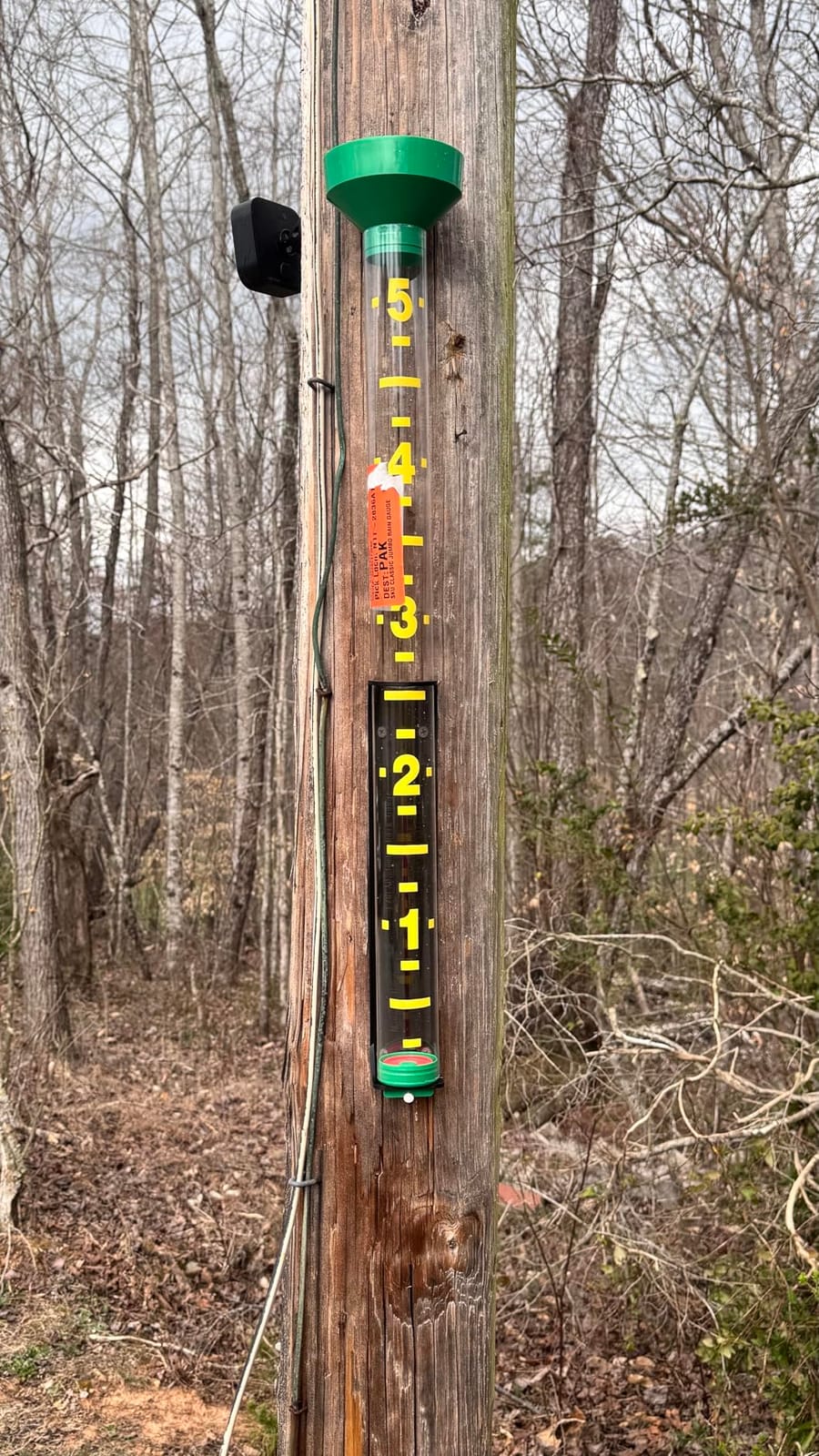
At 4.7 stars with 82 percent five-star reviews, this has the highest average rating of the eight, and the durability story in the reviews is unusual. Multiple owners describe 10 to 25 years of service and units that survived hurricanes, and plenty of them are repeat buyers replacing a gauge that finally gave up. That kind of longevity report matters for something you install once and forget, mounted permanently in the weather.
Construction is the reason it lasts: USA made, freeze-proof and all-weather, so you can leave it out through winter rather than bringing it in. The caveats are specific. A plastic hanger is included for mounting on a post, fence or wall, but there is no ground stake, so if you have nowhere to hang it you need a separate stake or post. The top collection cup is a separate piece that hail or a hard gust can knock off, and the markings are inches only with no metric scale.
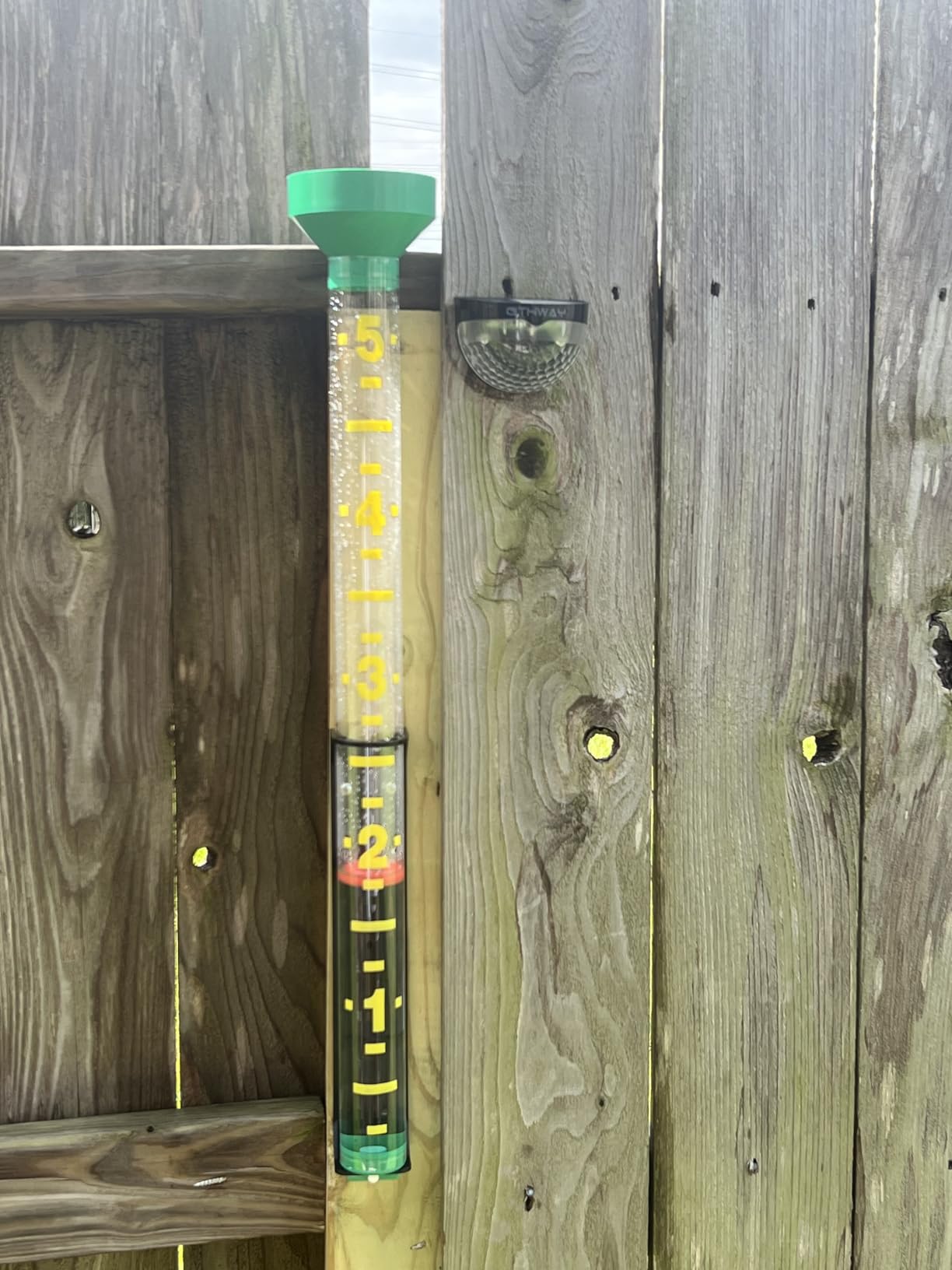
Does readable-from-a-distance really change how I use a gauge?
It changes how often you read it, and that is the whole game. A gauge you have to walk over and crouch beside gets read after major storms only. A gauge you can check from the kitchen window gets read every time it rains, which is what turns a number into a trend. Our experience across three gardens was that 50-foot readability cut the lag between a downpour and a watering decision from hours to seconds.
Distance readability also lets you sanity-check a second gauge. If you run a tall readable model and a small cheap one, you can compare them on the same storm from a distance and spot the moment one drifts. A magnified float at a known level is a useful reference point for exactly the calibration check described further down. It is a quiet advantage, but it is how you catch a blocked funnel or a leaning mount before the numbers go wrong.
Is it worth buying for a garden that never freezes?
Only if you value the read distance and the funnel guard, because in a mild climate the freeze-proof claim is not doing any work for you. The 26-inch height, the float and the debris guard are the reasons to buy it there, and plenty of owners in frost-free areas do exactly that.
Where the freeze-proof build genuinely pays is anywhere with a freeze-thaw season. Reviewers on weather-watch and gardening forums treat the freeze question as the main glass-versus-plastic decision, and a gauge that survives winter without being brought inside removes a whole seasonal chore. If you already own a glass gauge that cracked, this is the direct upgrade path, and the decade-long service reports suggest it is a one-time purchase rather than a recurring one.
5. Taylor Jumbo JR 5 Inch Rain Gauge – Best for Flexible Mounting Options
Taylor Jumbo Jr. Rain Gauge 5 Inch Cap with Indicator and Sprinkler Stake
Red float readable to 50 feet
Mounting bracket plus 2.5 inch ground stake
Funnel debris filter
High-impact plastic
Pros
- Only gauge here that includes a ground stake as well as a bracket
- Mounts on a fence post or stakes into the ground
- Bright red float is easy to spot across the yard
- Funnel filter keeps leaves out of the collector
Cons
- Lowest rated mechanical gauge at 4.4 stars
- Yellow plastic spout reported to crack over time
- Small 5-inch capacity needs frequent emptying
The distinguishing feature of this one is packaging. The box contains the gauge with a mounting bracket for a post or fence, plus a 2.5-inch sprinkler gauge that doubles as a ground stake. It is the only model in this roundup where you can choose at installation time between hanging it high and driving it into the soil, which is genuinely useful when you are not yet sure where it will live.
What you get for that flexibility is a bright red floating indicator that reviewers say is visible from up to 50 feet, a funnel filter to keep leaves out of the collector, and a high-impact plastic body designed for harsh weather. At 21 inches tall it sits in the middle of the height range, tall enough to clear a low bed but not so tall that it dominates the garden.
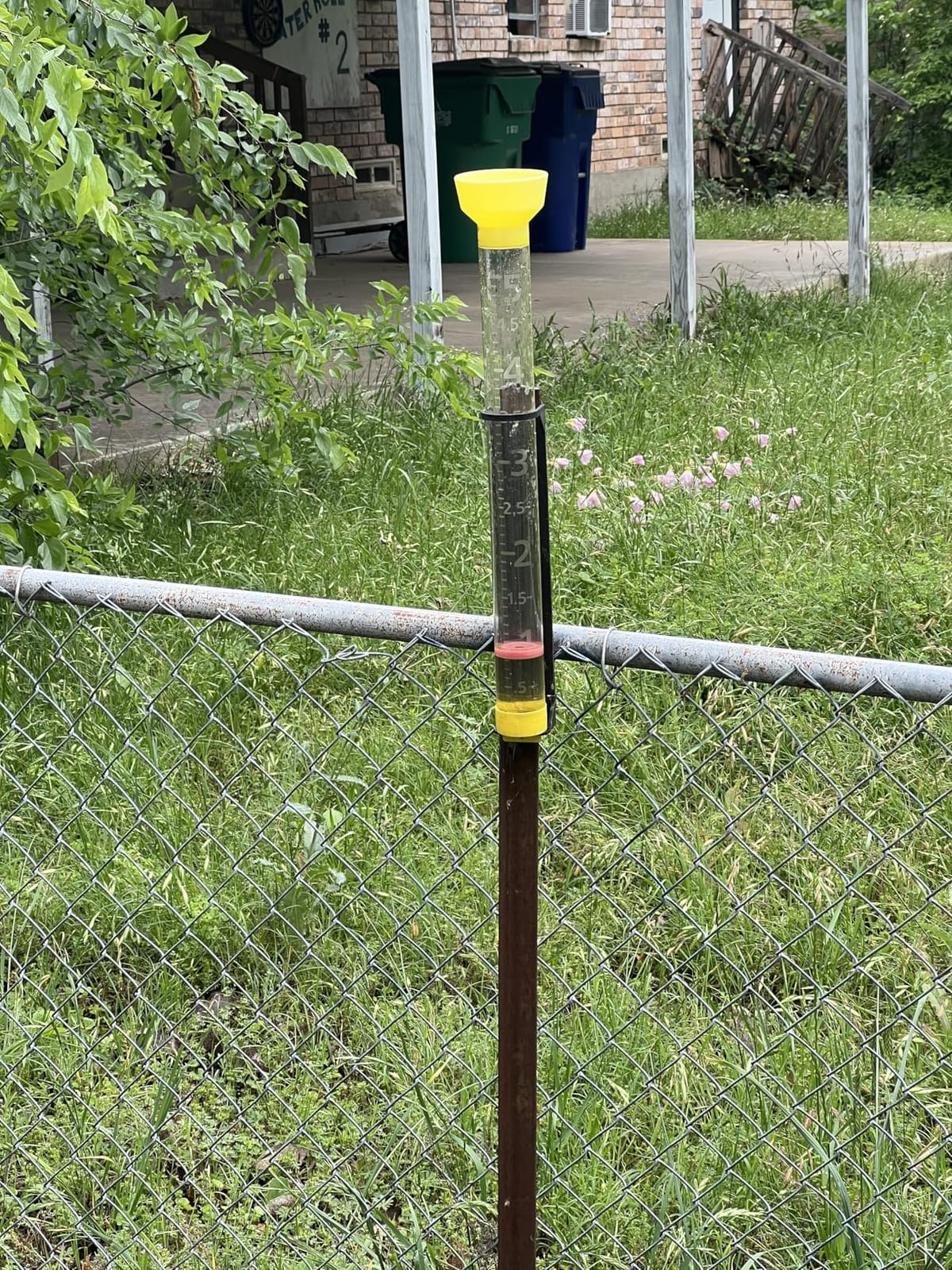
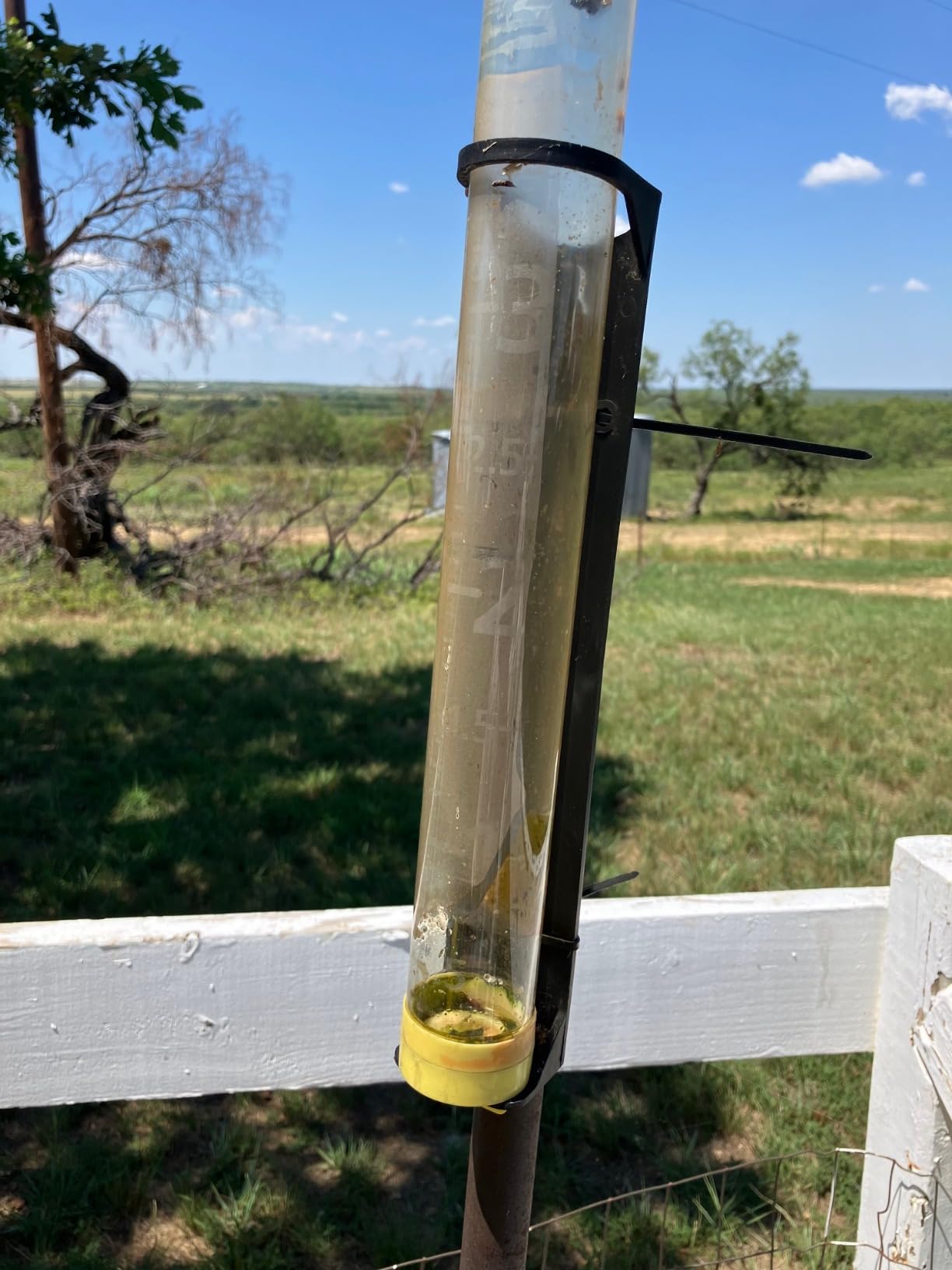
It is a long-established design with thousands of ratings, and around 72 percent of those are five star, which is decent but the weakest showing among the mechanical models here. The recurring complaints are specific and worth weighing. The yellow plastic spout is reported by some owners to crack or break after extended outdoor exposure, and several Canadian buyers specifically note the absence of metric units.
The 5-inch capacity is the other limitation. It is the same constraint as the AcuRite magnifier, so the same rule applies: in a region with frequent heavy downpours, a 7-inch tube is a better buy and this one will ask you to empty more often. If your garden is temperate, your summer storms are moderate, and you want one box that mounts two different ways, that trade is perfectly reasonable.
Is a mounting bracket or a ground stake better for accuracy?
A ground stake in open ground is usually better, because it lets you place the gauge away from fences and walls. Fence-mounted gauges are a common source of low readings, since the fence itself shelters the collector from wind-driven rain. The problem with a stake is that you cannot move it once the surrounding plants have grown up around it.
That argues for the bracket in one specific situation: you already have a clean, open post or fence line with nothing overhead and nothing taller than the gauge within twice its height. Both mounting methods are fine in the right spot, and the wrong spot beats the right hardware every time. The advantage of this model is that it does not force the decision before you have surveyed the garden.
How long does a plastic rain gauge last outdoors?
Expect a few good seasons, and inspect the spout and the printed markings each spring. The failure mode with garden plastic is UV. Colours fade, surfaces go chalky and cloudy, and hairline stress cracks appear where the material is thinnest, which on a funnel-style gauge is the spout. Once the markings fade, the gauge still measures but you have to work to read it.
Cheap replaceable parts beat premium branding here, and that is the view forum users come back to. Nobody wants a brand name on a ten-dollar piece of plastic; they want a gauge they can swap in a minute when the old one clouds over. If you already have a bracket or a stake fitted, that makes a same-style replacement trivial, which is the quiet practical argument for this design.
6. TBWHL 7 Inch Glass Rain Gauge with Stainless Steel Rack – Best for Dual Units and Clearest Readings
TBWHL 7″ Glass Rain Gauge with Stainless Steel Rack for Yard Garden Fence
Glass tube with a clear water line
Dual scale in inches and centimetres
Stainless steel rack
Bracket and screws included
Pros
- Only gauge here with a dual scale in inches and centimetres
- Glass gives the clearest water line reading
- Stainless rack resists fading and deformation
- Tube lifts out for emptying and cleaning
Cons
- No ground stake so it needs a post or fence
- Glass can shatter if knocked or struck by hail
- Collects dust and algae and needs regular cleaning
If you are outside the United States or you simply think in metric, this is the only gauge in the roundup with a dual scale reading 7 inches against 17 centimeters. Everyone else here is inches only. It also has the strongest rating profile in the group, at 4.7 stars with 85 percent five-star reviews across more than 2,000 ratings.
The material choice is the real point. A glass tube gives you a clean, undistorted water line with no parallax, because you are looking through a flat wall at a known thickness rather than through a curved plastic cylinder. For a purely optical judgement the difference is small, but it is the reason glass gauges have survived as a category for a century despite the obvious fragility.
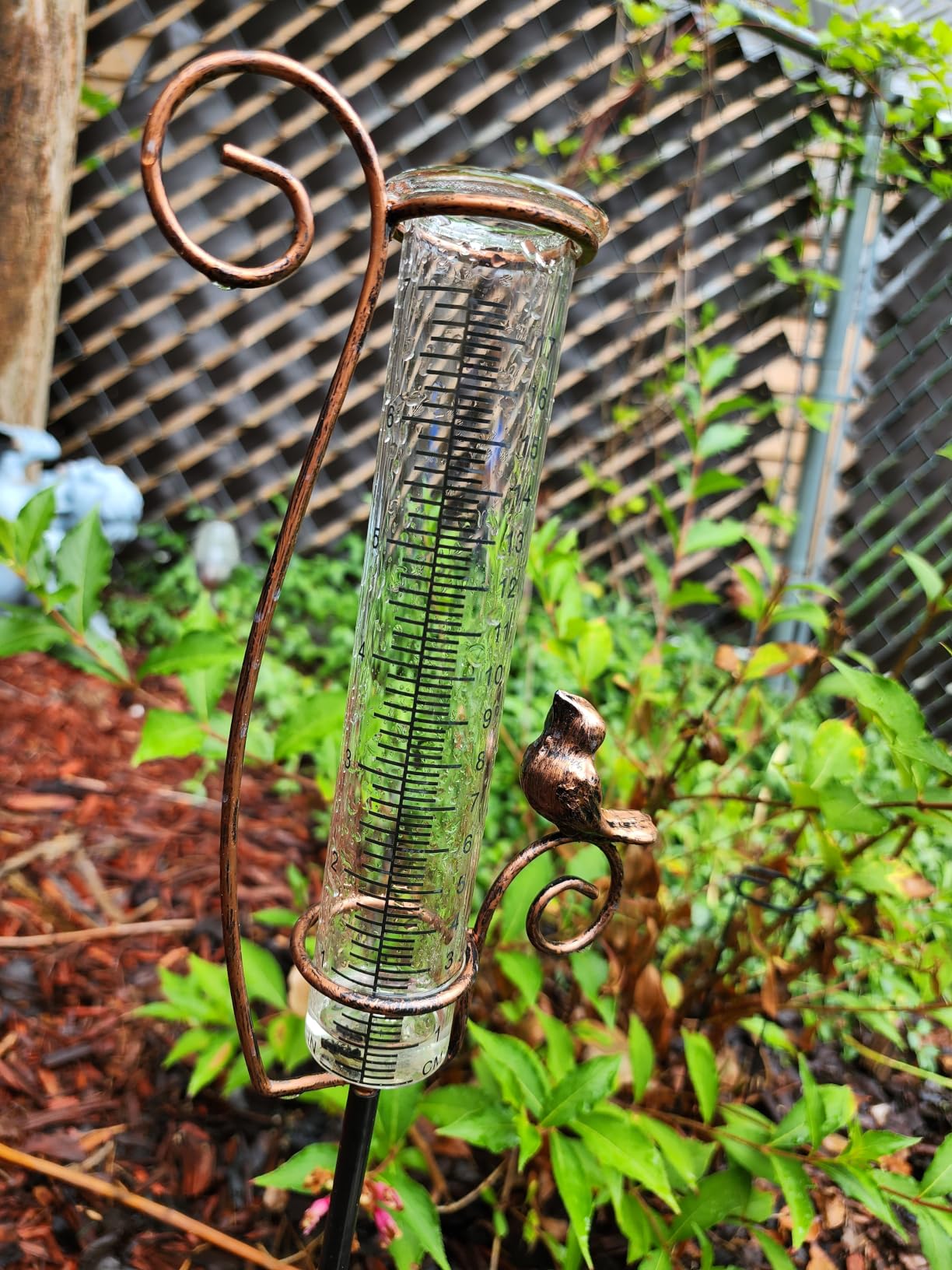
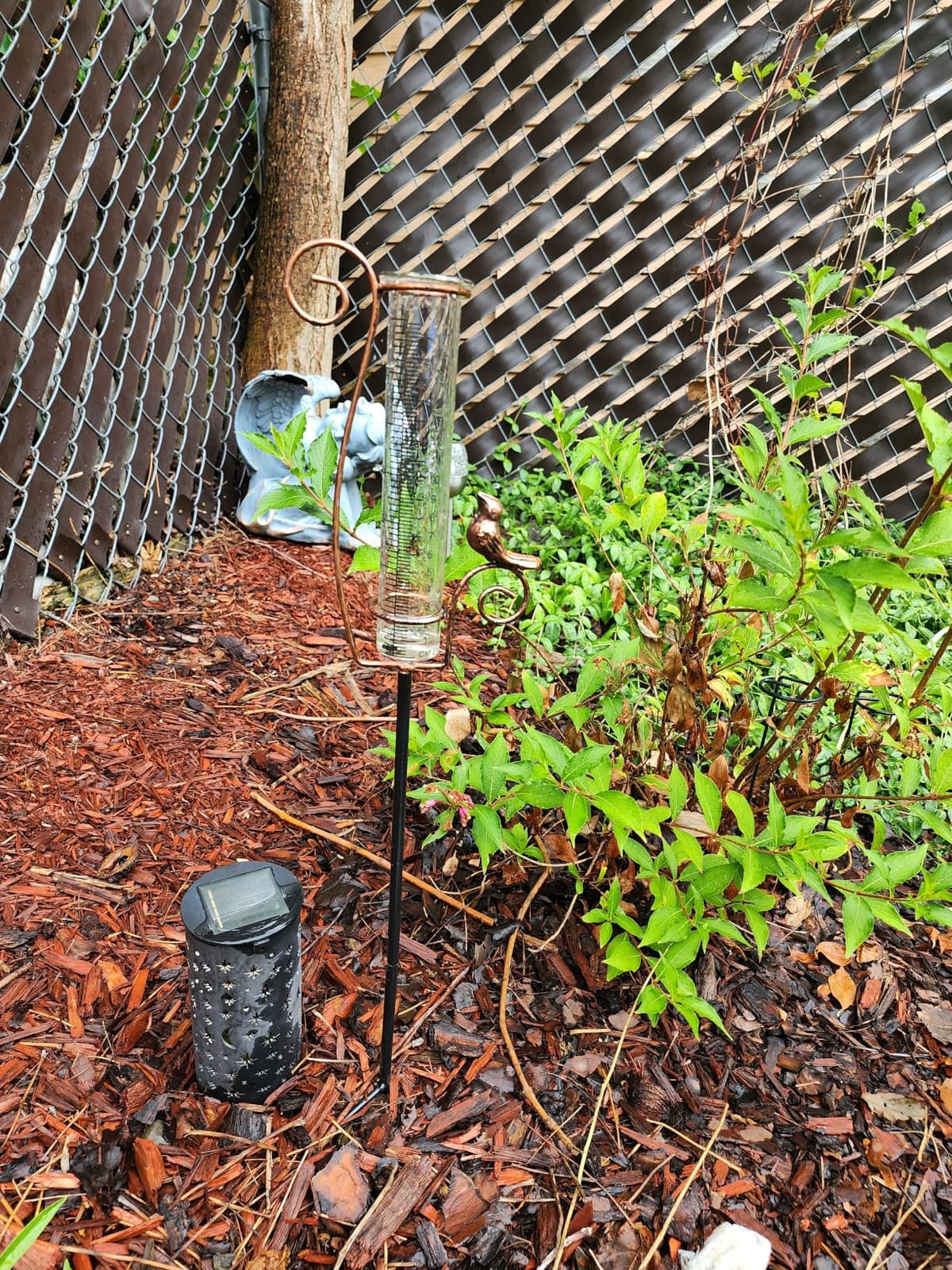
The rack is thick stainless steel rather than painted steel or plastic, and that matters more than it sounds. Fading is the number-one retirement cause for garden hardware, and reviewers specifically call out the rack as sturdier and more fade-resistant than the alternatives. The tube, 8.3 inches long and 2 inches across, lifts straight out of the frame for emptying and cleaning, which is a better design than unscrewing a fixed cup.
The glass is described as resistant to cold and cracking, and buyers here tend to accept the fragility in exchange for the clarity. The listed cons are the ones to plan around: no ground stake is included, so you need an existing post, fence or wall; the tube can shatter if knocked, dropped or struck by hail; and it collects dust and algae inside over time. The 2-inch diameter is also on the fiddly side to clean with anything but a tube brush.
Is glass or plastic better for a garden rain gauge?
Glass is better for reading clarity and it is better calibrated, because the tube walls are straight, even and non-reactive. Plastic is better for surviving knocks, hail and frost, and modern polycarbonate options will not shatter where glass does. Neither is more accurate once you correct for the funnel geometry; the difference is optical clarity versus physical toughness.
That is the honest answer to this question, and it is the one most roundups skip. If you have kids, a dog, a mower line or a hail-prone location, polycarbonate or silicone removes a whole category of risk. If you have a calm corner, a glass tube on a stainless rack will still be the most pleasant thing to read in ten years, and the cleaning routine is the only real cost.
What does the centimetre scale actually buy me?
Precision in a second unit system, and that is genuinely useful rather than decorative. Many soil moisture targets, irrigation scheduling guides and extension service recommendations are published in millimetres, so having a scale that reads both means you can compare your gauge directly to the guidance you are trying to follow without converting a reading in your head at the potting bench.
It also makes cross-checking easier. If you compare against a local official station that reports in millimetres, you can line the two scales up and see the discrepancy directly, which is the first step in the calibration check below. For a reader in the United States it is simply a nice extra, and no other gauge in this roundup offers it.
7. Dragonfly 7 Inch Glass Tube Rain Gauge – Best for Garden Decor That Still Measures
HOBYLUBY Dragonfly Rain Gauge Outdoor with 7 Inch Glass Tube
Cast iron dragonfly stand
7 inch removable glass tube
Large printed numbers
Two garden stakes included
Pros
- Cast iron dragonfly doubles as a garden ornament
- 25 inch overall height with large readable numbers
- Removable tube saves kneeling down to empty it
- Includes two stakes and a cleaning brush
Cons
- Glass tube reported cracking without impact
- Stand reported to tilt in wind and skew readings
- Frost resistance does not hold in every climate
This is the one to choose if the person buying the gauge is not the person reading it. The collector sits in a cast iron dragonfly on a metal stand, 25 inches tall in total, and it looks like garden decor first. A lot of owners describe it exactly that way: an ornament that happens to work, which is a good thing in a garden where a bare plastic tube looks like a leftover.
Functionally it is a 7-inch glass tube on a sturdy metal frame with large printed numbers, and the numbers are genuinely large, which is what lets the 25-inch height actually work for you. The tube lifts out of the stand for emptying and cleaning, so you are not kneeling on wet soil, and the box includes two garden stakes for ground placement plus a small cleaning brush.
At 4.6 stars with 82 percent five-star reviews across more than 1,400 ratings, the praise is consistent: attractive, sturdy, readable, and a welcome replacement for cracked plastic. The critical reviews, largely from European buyers, concentrate on two failures, and both matter. The first is the glass tube cracking without any obvious impact, which owners attribute to heat and temperature swings rather than to a drop.
The second failure is more serious for accuracy: a stand that tilts or wobbles in wind. A leaning gauge no longer has a level collector opening, and water runs down the side instead of in. Our advice is to check the stand’s plumb after any significant storm and to re-seat it in firm soil if it has worked loose. The frost resistance claim also does not hold uniformly, so in a hard-winter climate this is not the model to lean on.
Is a decorative rain gauge less accurate than a plain one?
Not by design. The collector geometry on this model is a straight 7-inch glass tube, which is the accurate shape, and the large printed numbers make the reading easier rather than harder. If it is mounted plumb and level in an open spot, a decorative gauge will give you the same number as a plain one.
The accuracy risk is entirely in the installation and the stand. Cast iron on a slender metal frame can shift in wind, and a tilt of even a few degrees lets water escape down the outside. Check it after gales, and do not site it where the dragonfly is exposed to the prevailing wind with nothing bracing it. Buy it for the looks, but earn the accuracy back with a mounting check each season.
Who is this actually for?
For a gift, for a patio where a plastic tube would look out of place, and for anyone who would not otherwise put a utility object in a flower bed. Several owners report replacing a cracked plastic gauge with this one specifically to get something that looked deliberate in the garden rather than temporary.
It is less suitable if you want the fewest parts to maintain, because you have a decorative element, a stand and a glass tube instead of one moulded body. And if you care most about surviving winter, look at the silicone option instead. Treat this as the pick where appearance is a first-class requirement, and you will not be disappointed; treat it as the pick for harsh climates and you might be.
8. Taylor Freeze Proof Silicone Rain Gauge – Best for Snow and Freezing Climates
Taylor Freeze Proof Silicone Rain Gauge 7 Inch Capacity, Teal
Flexible silicone body survives freezing
7-inch capacity with 1/10 inch marks
Red floating indicator ring
Stake and adjustable brackets
Pros
- Only freeze-proof option in the roundup
- 7-inch capacity reduces emptying frequency
- Red ring and large numbers read from across the yard
- Will not yellow the way hard plastic does
Cons
- Red float ring falls out when you tip it to empty
- Upper plastic ring shows UV cracking after about three years
- Smallest review base here at 831 ratings
Every other manual gauge in this roundup can be destroyed by a hard winter. Water expands when it freezes, and a rigid plastic or glass tube with water inside it will crack or shatter. The silicone body here flexes instead, which is why owners who have owned glass and hard-plastic gauges describe it as the upgrade that finally solves the cracking and yellowing cycle.
The practical specs are strong: 7 inches of capacity with 1/10 inch precision increments, a red floating indicator ring that shows the level from a distance, and both a removable ground stake and adjustable mounting brackets in the box. It works with an existing gauge holder too, so owners have been able to upgrade an old installation without re-mounting anything. At 12 inches tall and 5.7 ounces it is compact.
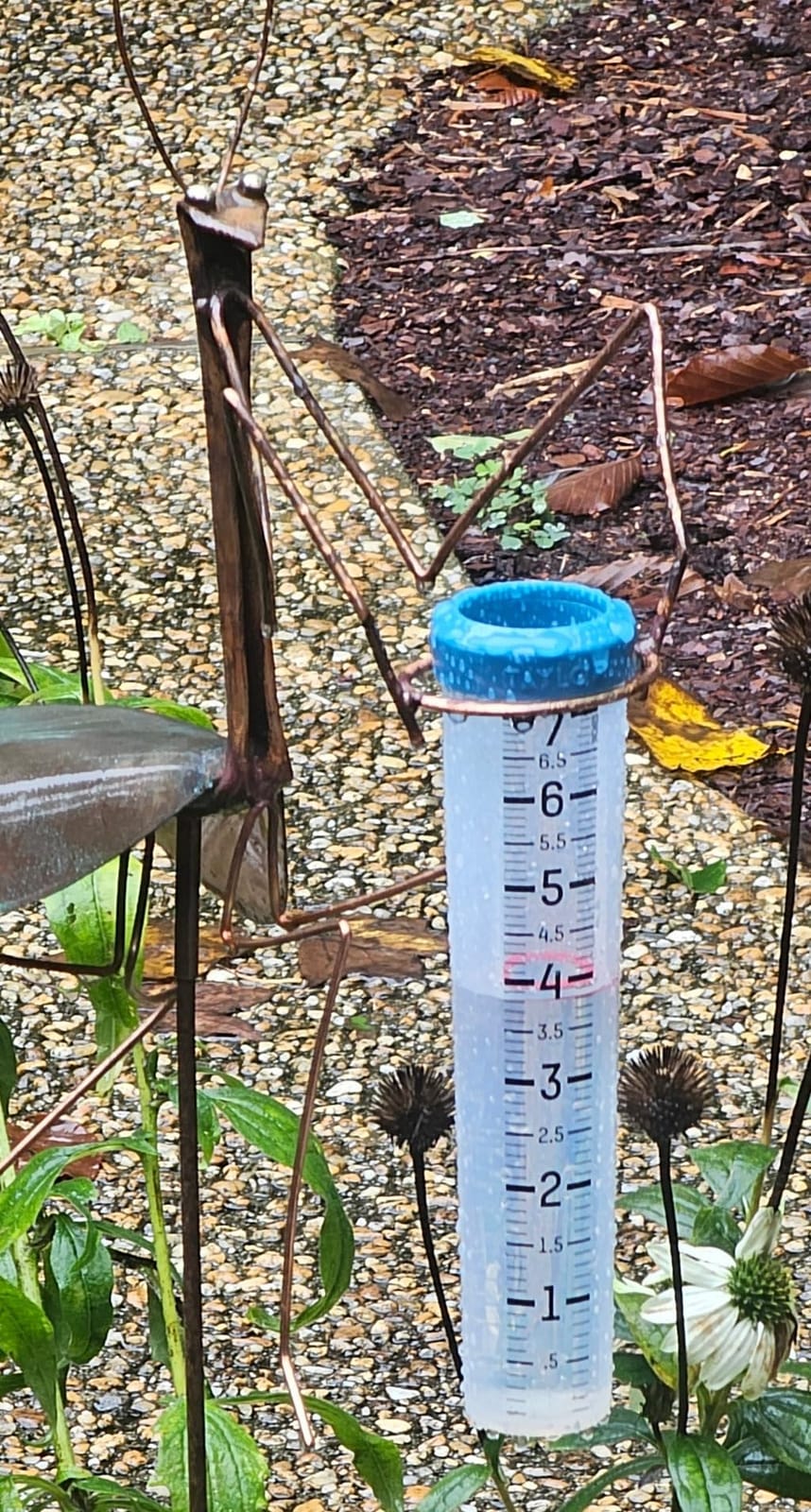
The rating is 4.6 stars, but be aware that this is the smallest review base of the eight at 831 ratings, with 78 percent five star. We include it because the freeze-proof property is genuinely unique in this lineup rather than because of the volume of feedback, and because several multi-gauge owners vouch for owning several at once.
The specific criticisms are worth knowing in advance. The red float ring falls out when you tip the gauge to empty it, so it is easily lost and you may end up reading against the printed scale instead. The upper plastic ring shows UV degradation and hairline cracking after roughly three seasons of outdoor use, even though the silicone body holds up. And the interior collects dirt, so it still needs a periodic brush clean, with silicone tending to attract dust and grime a little more than glass.
Do I actually need a freeze-proof gauge?
If your winters reach freezing and you intend to leave the gauge outside, yes. Water left in a rigid tube over one hard frost is enough to crack it, and once the tube is split it holds nothing. That is why reviewers of plastic models describe them as seasonal purchases, and why frost survival is a live complaint across weather forums.
Note what this does and does not fix. The silicone tube survives freezing water, which is a real durability win, but the upper collar is conventional plastic and does degrade in sun. Expect to replace the whole gauge every few years rather than every few months, and expect the red ring to disappear at some point. If you would rather have zero seasonal risk, take the tube inside to empty and store it dry, and any gauge will last indefinitely.
Is 7 inches of capacity worth the extra emptying weight?
In most climates, yes. Seven inches means a 2-inch storm fills the tube to under a third, and a 3-inch storm still leaves room, so you can check after a downpour rather than during it. That is the difference between a number you can use and a number you lost to overflow, and overflow is the single most common way a manual reading misleads a gardener into watering twice.
The cost is bulk in one direction and empties less often in the other. A 7-inch tube holds more water than a 5-inch one, so when you do empty it you are carrying a heavier container to the sink or the bed, and the 2-inch opening takes a moment to rinse out. Our routine was to check it every morning after any week that rained, which keeps the tube well below full and makes the job trivial.
How to Mount a Rain Gauge So the Reading Is Actually Right
Mount it in the most open spot you can find, at a distance from obstacles of at least twice their height, with the collector opening level. Placement matters more than any feature on the spec sheet. A correctly sited cheap gauge beats an expensive one badly placed, and that is the single most repeated point in every gardening forum thread about rain gauges.
The two-times rule is the practical version of official siting standards. Weather-watch forum discussions cite the professional standard as mounting height with no obstruction within a radius of 100 feet, which is obviously impossible in a garden. The same threads note that the widely quoted height for temperature and humidity sensors is about 1.3 metres above grass, and that the rainfall collector still wants an unrestricted location. In a 10 by 20 metre garden, your realistic target is clear air above and around the opening.
Concrete steps: pick the highest clear point in the garden, keep the collector at least twice the height of the nearest fence, wall, tree or shrub from every direction, level the opening so rain lands in rather than running down the side, and secure it against wind. That last one is not optional, because a gauge that rocks in a storm gives you a number with a built-in error. If you cannot find a spot twice clear of the tallest nearby obstacle, move the gauge rather than the obstacle.
Fence mounting is the most common mistake, and it is worth understanding why. A fence shelters the collector from wind-driven rain, and light wind-driven rain is a large share of a typical storm total. A gauge hung on the sheltered side of a fence will consistently under-read. Post-mounted brackets are fine as long as the post itself is open to the sky, and a ground stake in an open bed beats both.
How to Calibrate and Cross-Check a Home Rain Gauge
You cannot calibrate a home gauge to laboratory accuracy, but you can prove it is not lying, and that is enough for watering decisions. Forum practice, particularly on The Lawn Forum, is to run a cheap gauge alongside a known reference and check whether they agree. One user there describes calibrating against a known source and then finding the gauge accurate for the most part, and running the same check on a Stratus gauge at the same time.
A workable home method: find your nearest official climate station, note its total for a specific storm, then compare the same storm in your gauge. Expect some difference. A gauge mounted in a suburban yard will not match a professional station exactly, because exposure and surroundings differ, so treat a consistent gap of more than about 20 to 30 percent as a signal to investigate rather than a number to average out.
When the numbers disagree, the usual causes in order are placement error, a partially blocked funnel, a tilted or loose mount, and a blocked or dirty collector. A monthly check is plenty: confirm the gauge is still level, look for leaves and spider webs in the funnel, and give the tube a rinse. A gauge that has drifted, and that you can identify early, is a five-minute fix rather than a season of wrong watering decisions.
Turning a Reading Into a Watering Decision
The rule most gardeners work to is roughly one inch of water per week, and one inch is 25 millimetres. That is a total, not a daily dose, and it should come from rainfall and irrigation combined. Here is how the arithmetic actually works in practice.
Say your beds need 25 millimetres in a week. A storm on Tuesday delivers 15 millimetres according to the gauge, which you log. A second smaller storm on Thursday adds 5 millimetres. Your running total is 20, so you irrigate the remaining 5 millimetres rather than a full 25. Across a season with 30 such weeks you have replaced five full watering rounds with small top-ups, and your irrigation has dropped by roughly 80 percent. That is the entire return on a cheap plastic tube.
Two practical habits make it work. First, write the number down before you empty the gauge, because a reading you discard is a reading you did not take. Second, track the weekly total rather than the individual storm, since the target is a weekly budget. Forum users also ask how often to empty a gauge, and the answer is simple: whenever it approaches full, and always before a forecast heavy-rain event if you want to catch the whole thing.
One accuracy trade-off is worth understanding here, because it explains a design difference you will see in the market. A conical funnel gauge has a wide surface area of standing water, and a forum user on The Farming Forum put it plainly: because it is conical, it evaporates faster and under-reads in warm weather. A straight cylinder keeps a narrow column of water that is less exposed, so it holds its reading, though splashback from wind-driven rain can push it slightly high. For a weekly watering budget either error is small, which is why a correctly placed straight-sided gauge is the recommendation most gardening sources converge on.
What Actually Matters When You Buy a Rain Gauge
Capacity first, because a gauge that overflows gives you no number at all. A 5-inch tube is fine in temperate regions with moderate storms. If you get 2 to 3 inch downpours regularly, go to 7 inches or more. The gauge on your shortlist should have a collector opening wide enough to catch light drizzle, because steady light rain is exactly the rain that adds up over a week and the rain you most need to know about.
Graduation resolution second. A scale marked in 0.1 inch increments lets you read a tenth of an inch, which at the one-inch-per-week target is a 10 percent resolution on your whole watering decision. Coarser tenths-of-an-inch or quarter-inch scales are workable but frustrating. Dual scales in inches and centimetres are worth having outside the United States, and only one gauge in this roundup offers one.
Material third, and the choice is a straight trade. Glass gives the clearest water line and will not fade. Polycarbonate and acrylic will not shatter but can yellow and cloud under UV, which is the main retirement cause for cheap plastic. Silicone survives freezing water and does not yellow, but attracts dust. On the Lawn Forum, users consistently value cheap replaceable parts over premium branding, and a part that costs little to swap is worth more than a name on the box.
Mounting fourth. A ground stake in open ground is the most accurate option, a post or fence bracket is fine if the site is clear, and hangers are for walls and posts you already have. Note which hardware is actually in the box, because two of the eight models here ship with a hanger and no stake. Our general guidance: if you have to drill a new post, buy a stake model instead.
Readability fifth, and it is the one people underweight. A float, a buoy or a magnified window lets you read the level without walking over and crouching. A 26-inch or 29-inch tube with a visible float is the answer if your garden is large or your beds are planted tall. On a small patio, a short magnified tube you can pick up with one hand is easier to live with.
Finally, decide manual versus digital on behaviour, not features. Forum consensus repeatedly separates gardeners, who want no batteries and no calibration and something that still works after five winters, from weather enthusiasts, who want tipping buckets and data logging. A digital unit is worth it if you have an irrigation controller and want to skip a scheduled cycle from indoors. For everyone else, a manual gauge is cheaper to buy, cheaper to run, and cannot lose a signal or a battery at the moment you needed the number. If you are pairing this with other water-saving hardware, our picks for the best rain shower heads cover the other end of the same water budget.
Frequently Asked Questions
What kind of rain gauge is the most accurate?
A straight-sided manual tube gauge with 0.1-inch graduations, a wide collector opening and an open mounting site is the most accurate option for a home garden. Accuracy comes from the geometry of a non-tapering cylinder and a wide funnel that catches light drizzle. A conical funnel gauge loses water to evaporation in warm weather, and a tipping bucket under-counts very light rain. Above the model, placement dominates: keep the gauge at least twice the height of the nearest obstacle in every direction.
Are garden rain gauges accurate?
Yes, once you account for placement. A correctly sited gauge in an open part of a garden typically reads within a reasonable margin of an official station for the same storm, and a large share of the difference comes from exposure rather than the instrument. A gauge shielded by a fence, a tree or a wall will consistently under-read, because wind-driven rain is what gets blocked. Check it is level, keep the funnel clear of leaves and debris, and compare against a local station during one storm to see where yours sits.
Is a glass or plastic rain gauge better?
Glass gives the clearest, least distorted water line and does not fade, but it can shatter if knocked or struck by hail and can crack when water freezes inside it. Plastic will not shatter and polycarbonate will not yellow the way acrylic does, but hard plastic degrades under UV and a rigid tube can still split in a hard frost. Flexible silicone is the best of both for cold climates because it expands instead of cracking. Pick based on hail, frost and knock risk rather than on clarity alone.
How do I calibrate my rain gauge?
You cannot reach laboratory accuracy at home, but you can prove it is not drifting. Find your nearest official climate station, record its total for one specific storm, then compare the same storm in your own gauge and expect some difference. If the gap is consistently more than about 20 to 30 percent, check the usual causes in order: placement, a partly blocked funnel, a tilted or loose mount, and a dirty collector. Repeat the comparison a month or two later to see whether the gap is shrinking as you correct things.
Where is the best place to mount a rain gauge?
In the most open point in your garden, level, with the collector opening at least twice the height of the nearest fence, wall, tree or shrub in every direction. Avoid the sheltered side of a fence, which blocks wind-driven rain and biases readings low, and avoid anywhere with overhanging branches. Professional siting standards call for a much larger clear radius than any garden allows, so treat twice the obstacle height as the achievable version of the same idea. Secure the mount against wind, since a rocking gauge reads low.
How often should I empty a rain gauge?
Empty it whenever it approaches full, and always before a forecast heavy-rain event so you capture the whole total. In practice that means a check after any serious downpour and a weekly glance otherwise. Write the number down before you tip the water out, because a reading you discard is a reading you did not take. Gauges with 7-inch capacity need this less often than 5-inch models, and any gauge with a removable tube is a quick job; a 2-inch storm fills a 5-inch tube to 40 percent.
The Verdict: Which Rain Gauge Should You Buy?
For most gardeners the answer is the AcuRite 5-inch magnifying gauge, and it is our top pick among the best rain gauges for gardens. The magnified scale is the single feature that changed our habits: it is the one gauge we read without walking over to it, and with more than 32,000 ratings at 4.6 stars it is also the least risky purchase in the category. It costs a handful of dollars, needs nothing but a fence or a stake, and will still be working next year.
Buy something else if your situation is specific. Take the Headwind EZRead if you want to read the level from across a large garden, the Taylor silicone gauge if your winters freeze, the TBWHL glass model if you think in centimetres or want the clearest possible water line, and the AcuRite digital unit only if you have an irrigation controller and want an indoor readout. Mount whatever you choose twice clear of the nearest obstacle, log the number every storm, and stop watering on a schedule you guessed at. That is the whole method, and it is updated for 2026.