
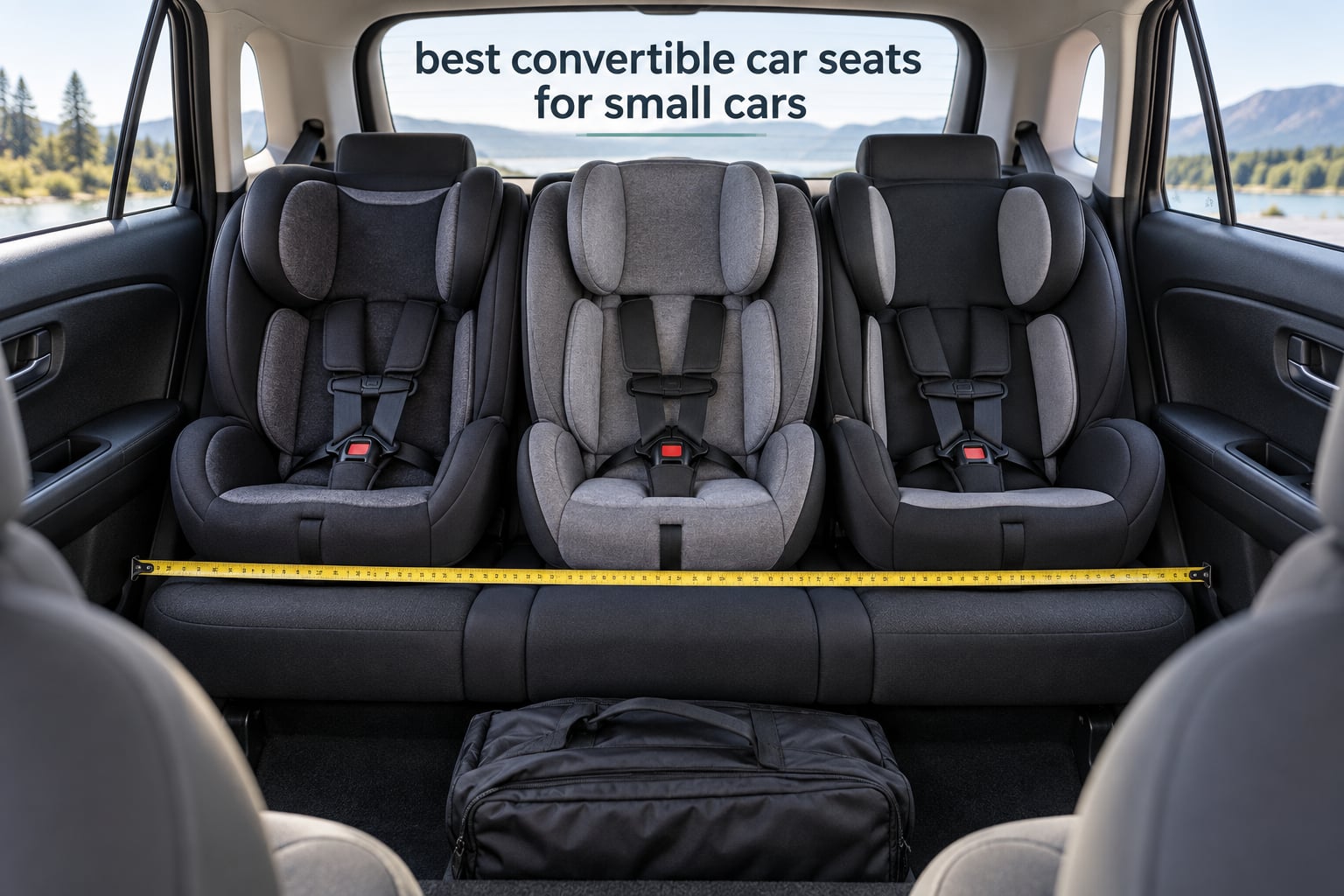
The best convertible car seat for small cars is the Diono Radian 3R, and the reason is simple: its slim profile is what lets a second seat sit beside it and a third fit in the middle. Every convertible seat sold in the US passes the same federal crash standard, so in a compact cabin width is the deciding variable, not safety. Below I break down eight narrow seats by the number that actually matters, how wide the seat is, plus the rear-facing depth and weight limits that most roundups leave out.
Compact sedans and small hatchbacks usually give you a back bench somewhere in the 50 to 52 inch range. A seat at 19 or 20 inches wide rules out a three-across install before you even turn the key, while a seat in the 16 to 17 inch range leaves room for a middle passenger or a second child. That arithmetic is the whole reason a slim convertible exists, and it is why searching for the best convertible car seats for small cars is more about measurement than brand.
To be straight about method: we compared published manufacturer specifications, cross-checked them against what buyers report after living with these seats, and used fit experience documented on parent and technician forums such as r/beyondthebump, r/CPST and r/BabyBumps. Specs come from the manufacturer. Fit judgments are ours, and where hands-on time was limited we say so rather than pretending otherwise.
If you tell us your vehicle make and model, your child’s age and weight, and whether you need rotating, extended rear-facing or a strict budget, we can point you at one seat instead of eight. If you also fly regularly, our travel seat picks for pets cover the same narrow-cabin logic for a different passenger.
Table of Contents
Top 3 Best Convertible Car Seats for Small Cars in 2026
Three seats earn top billing here. The Diono Radian 3R is the all-round choice for compact cabins, with a narrow steel-core shell and a 50 lb rear-facing limit. The Graco SlimFit3 LX is the narrower and lighter three-across specialist, and the Graco 4Ever DLX Slim adds a backless booster mode without giving up much room.
Diono Radian 3R
- Rear-facing to 50 lbs
- Slim steel-core frame
- Folds flat for travel
- FAA approved


Graco 4Ever DLX Slim
- 4-in-1 from 4 to 120 lbs
- 10% slimmer cup holders
- SnugLock fast install
- Backless booster
All 8 Convertible Car Seats Side by Side in 2026
Every seat below clears the same federal safety bar. What changes between them is width, weight range, mode count and how much of your back bench each one eats.
| Product | Specifications | Action |
|---|---|---|
| Diono Radian 3R |
|
Check Latest Price |
| Graco SlimFit3 LX |
|
Check Latest Price |
| Graco 4Ever DLX Slim |
|
Check Latest Price |
 Evenflo Revolve360 Slim Evenflo Revolve360 Slim |
|
Check Latest Price |
 Britax Poplar S Britax Poplar S |
|
Check Latest Price |
 Safety 1st EverSlim Safety 1st EverSlim |
|
Check Latest Price |
 Safety 1st Ellaris Safety 1st Ellaris |
|
Check Latest Price |
 Safety 1st TriMate Safety 1st TriMate |
|
Check Latest Price |
1. Diono Radian 3R: the best convertible car seat for small cars overall
Diono Radian 3R, 3-in-1 Convertible Car Seat, Rear Facing & Forward Facing, 10 Years 1 Car Seat, Slim Fit 3 Across, Jet Black
5-120 lbs across 3 modes
Rear-facing to 50 lbs
Steel-core frame
Folds flat, FAA approved
Pros
- Slim profile designed for three-across
- Steel-reinforced frame with 10-year lifespan
- Rear-facing to 50 lbs for taller toddlers
- Folds flat and is FAA approved for flights
Cons
- Heavy to move between vehicles
- Steep rear-facing recline can push the front seat forward
- Installation rules vary by mode and weight
This is the seat we keep coming back to for compact cars because the width problem is solved at the shell rather than by trimming padding. The steel core keeps the structure narrow, which means a slim footprint without giving up the frame strength that families want in a rear-facing install. Buyers running three-across setups in small vehicles report the same thing consistently: the middle position stays usable, so the seat is not just a two-across solution with aspirations.
The range is unusually long for a narrow seat. Rear-facing runs to 50 lbs, which is the figure parent discussions on r/BabyBumpsCanada keep returning to when families want an extended rear-facing window without shoving the front passenger seat forward. Forward-facing carries to 100 lbs and booster mode to 120 lbs, so one seat covers a birth-to-booster timeline on a 10-year lifespan.
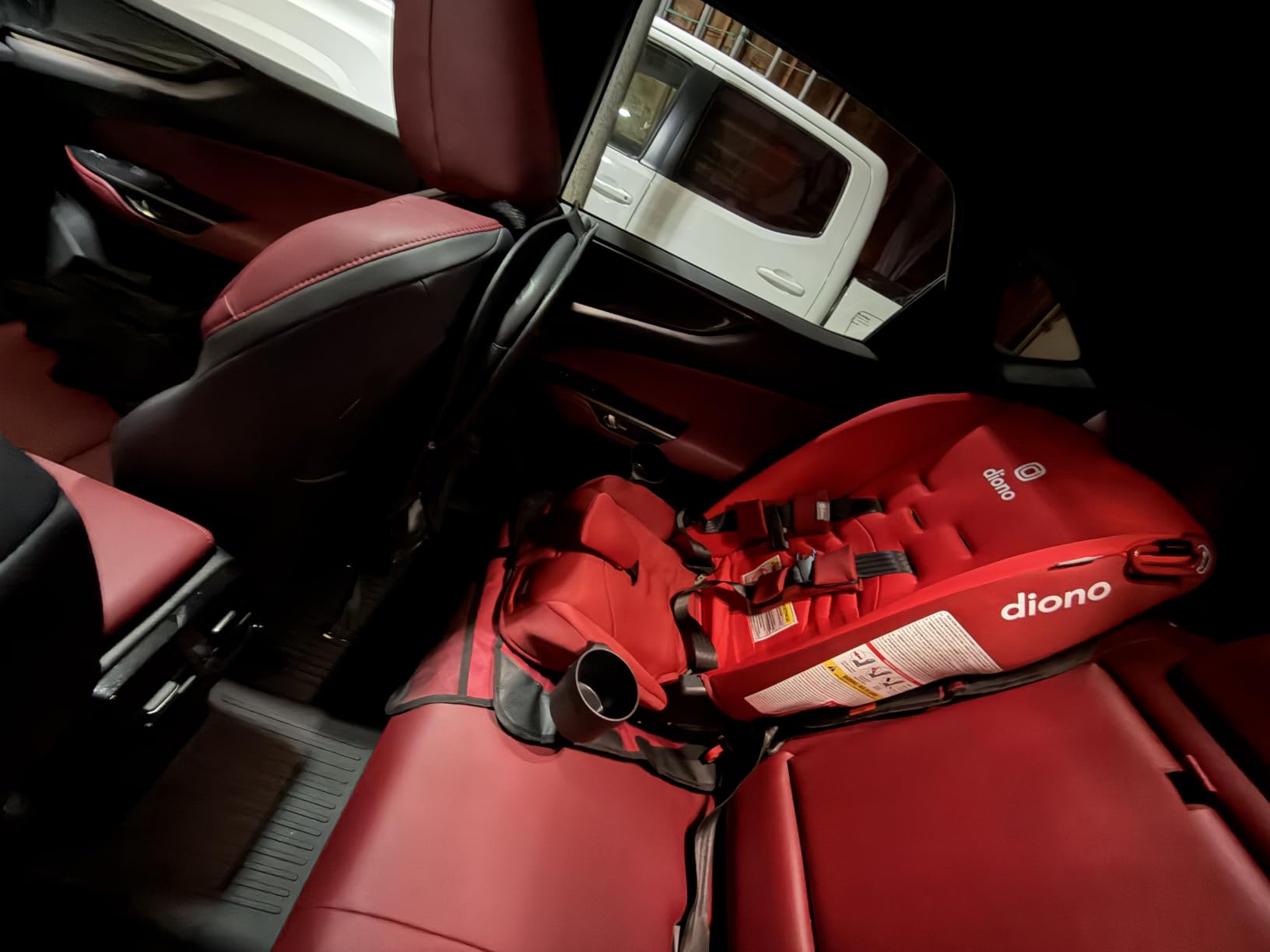
The trade-offs are honest ones. It is a heavy seat, and anyone moving it between two cars daily will feel that. The rear-facing recline is also steep, so on some vehicles you will need to allow the front seat to move forward a little to get a flat enough install, which is exactly the compromise we are trying to avoid. Owners mention that install rules change depending on child weight and direction, so read the manual before the first install rather than after.
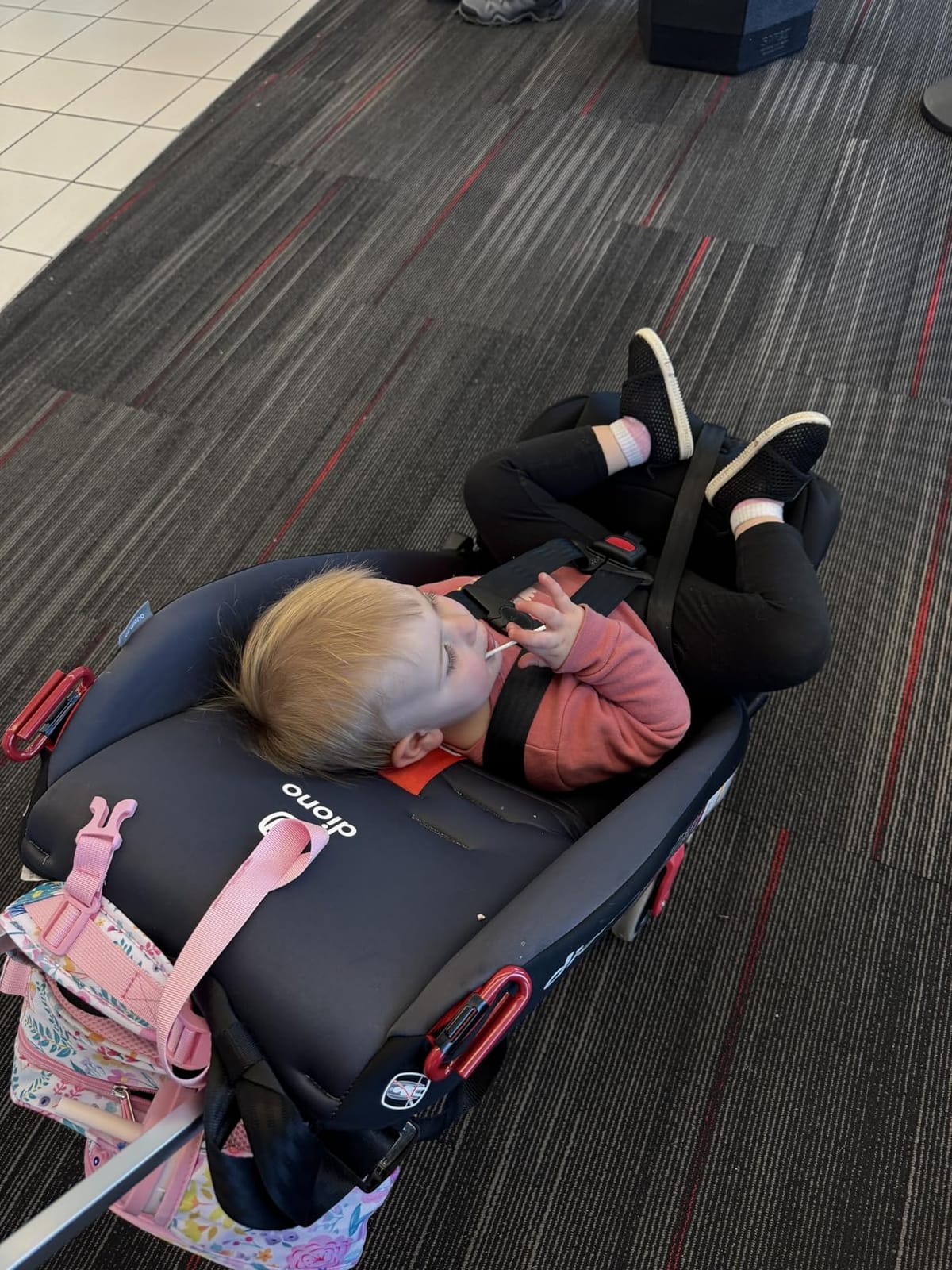
ComfortPlus memory foam padding is the detail parents comment on most, since narrow seats usually feel cramped. The seat folds for travel and is FAA approved, so it works well for families who split time between a cramped back bench and an airport run.
Check whether your back bench clears three seats
Three-across claims depend on anchor spacing and seat shape in your specific car, so the arithmetic is a starting point, not a promise. Measure the flat bench width at three points, then add the widest point of each seat including the cup holders. If the total lands within an inch or two of your bench width, expect to shuffle positions each time rather than install once and forget.
Position matters as much as width. The center position is usually the tightest and often has a fixed headrest, which is exactly where a few buyers report trouble with a rear-facing install. If you plan three-across rear-facing, ask a certified child passenger safety technician to check that specific position before you commit.
Who should look past this seat
If you only need the seat occasionally, weight is a real cost. Parents who move a seat between a commuter car and a family vehicle every day tend to prefer a lighter option, and those traveling frequently will find the folded profile genuinely useful. On the other hand, if you are staying in one car and want the longest possible rear-facing window, the 50 lb limit is hard to match in a narrow shell.
2. Graco SlimFit3 LX: the narrowest pick for a true three-across install
Graco SlimFit3 LX 3-in-1 Convertible Car Seat, Kunningham
16.7 inches wide
5-100 lbs in 3 modes
10-position no-rethread harness
2 cup holders
Pros
- Documented 16.7 inch width for three-across
- Light for a seat in this class
- No-rethread harness moves with the headrest
- Machine washable covers and two cup holders
Cons
- Rear-facing recline can be shallow for newborns
- Less padding than premium models
- No backless booster mode
This seat has the narrowest published width in the group at a documented 16.7 inches, and that single number changes what you can do in a small car. Multiply it by three and you need 50.1 inches of bench, which most compact sedans can just about deliver. That leaves roughly two inches of total slack across three installs, so it is tight but workable where a 19 inch seat simply is not.
Graco’s ten-position no-rethread harness adjusts with the headrest in one motion, which is the feature owners mention most in daily use. Adjustments happen as the child grows rather than by rethreading, so you are not doing a small mechanical puzzle in a parking lot. The ProtectPlus engineering includes side impact testing, and the cover is machine washable.
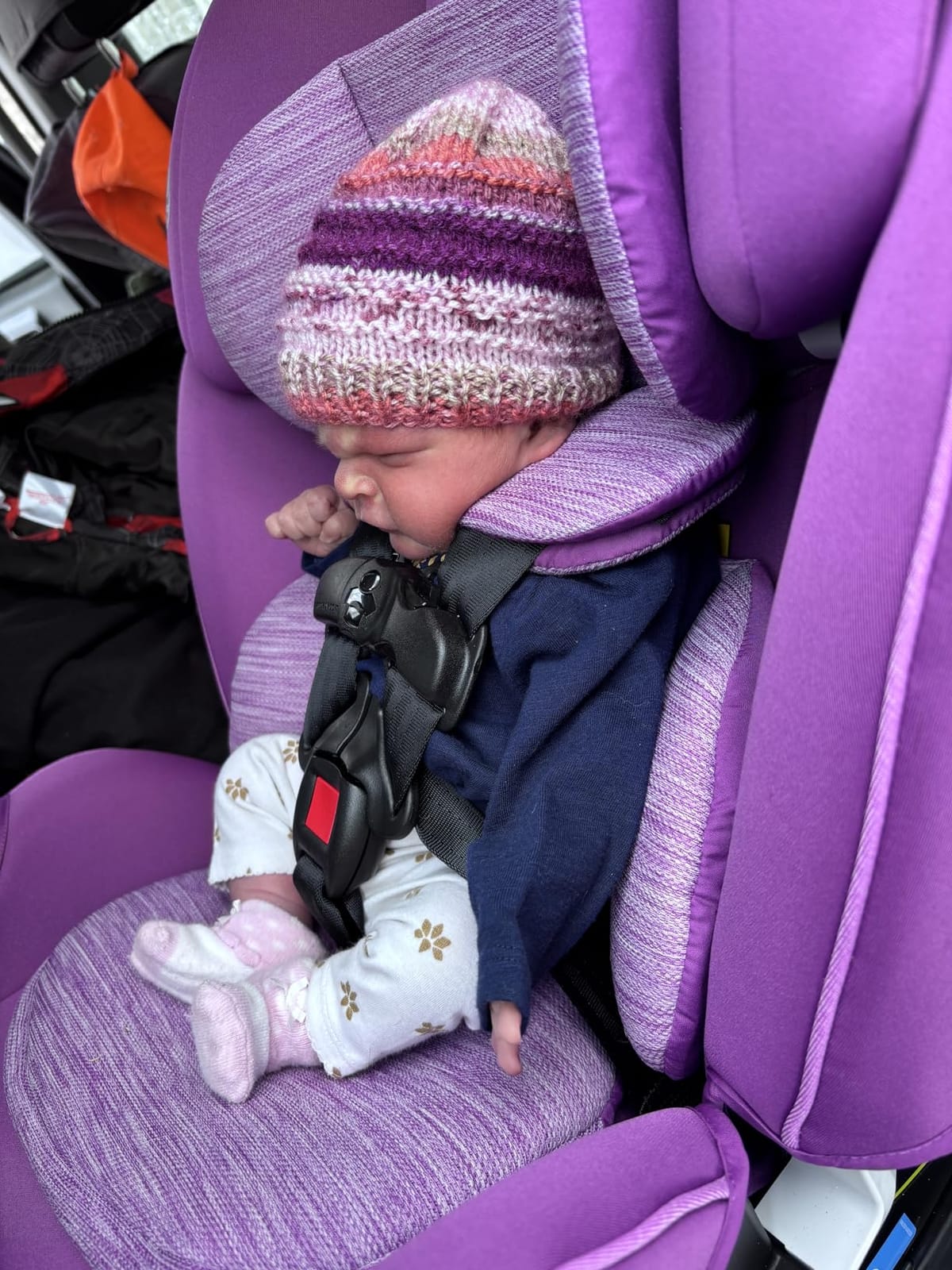
It is also lighter than the steel-frame seats here, which matters if you are shifting it between vehicles. The catch is the recline. Several owners note that the rear-facing angle is shallow enough to be a problem for a newborn in certain vehicles, and some needed hands-on help to get the rear-facing install right. If your baby is under the weight where a seat recline matters most, test it in the store before you commit.
Two further limitations are worth knowing. The seat is 3-in-1 with no backless booster mode, so when your child graduates to booster you are looking at a high-back belt position only. And review data notes drafts coming through the seat opening at the back of the bench, which some parents find noticeable in cold months.
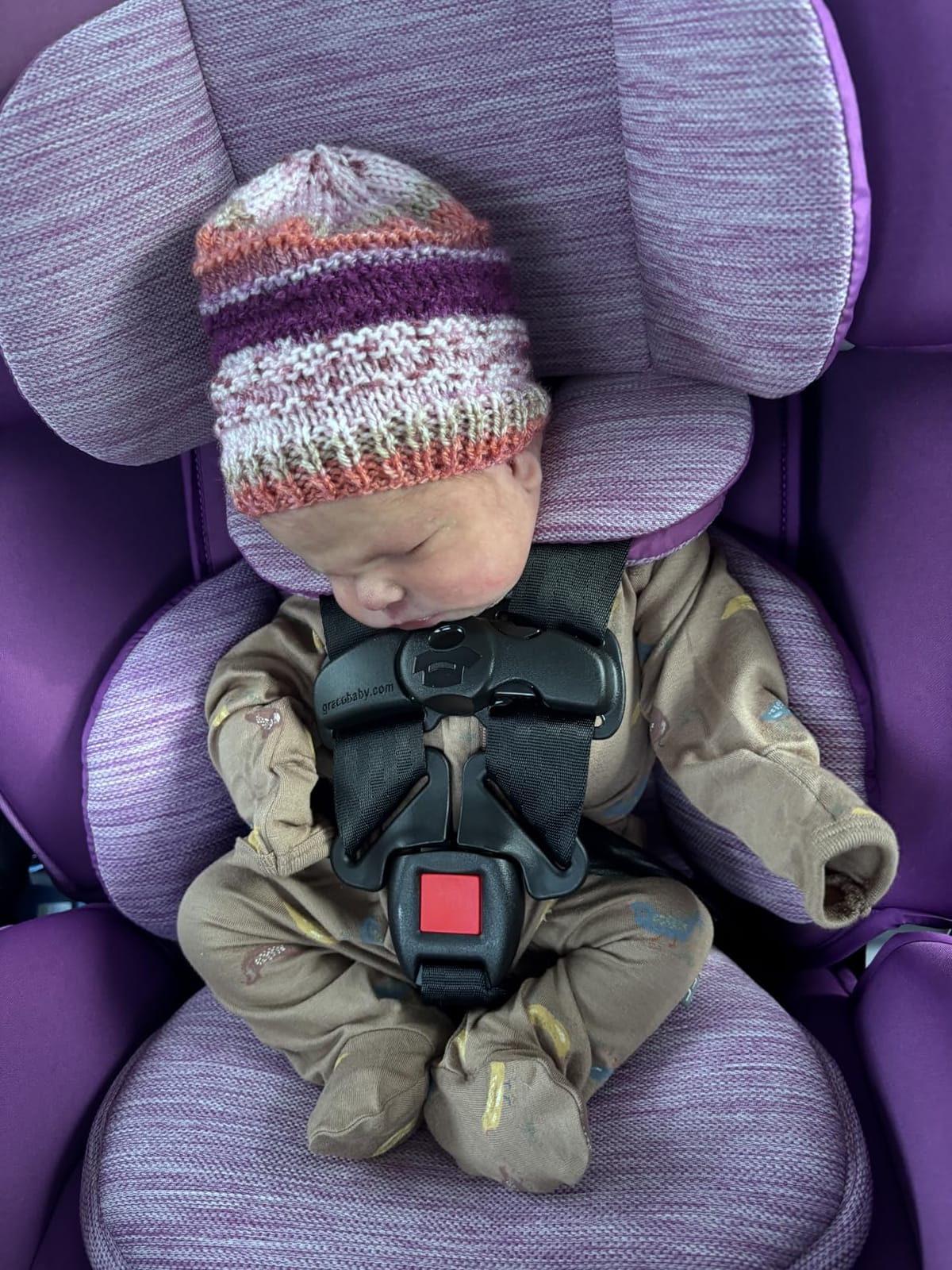
Is 16.7 inches narrow enough for your bench
Measure first, because a manufacturer width does not include the space the cup holders and belt path take up. Add the seat width to the space your other seat or child needs, and compare that to the flat bench width at the same height. If the leftover margin is under an inch, plan on a two-across setup and treat three-across as a maybe.
Second, confirm the model name. Graco’s slim line includes several similar-looking versions and the widths differ between them, so the family name on the box is not enough. Match the model designation and the published width before you order, which is a purchase error we see repeated constantly in parent forums.
Where this seat is the wrong fit
Skip it if you need booster mode past the high-back stage, or if a newborn fit is your first priority and you cannot test the recline in a store. It is also not the seat for a child who will grow past 100 lbs, since the weight ceiling is the lowest of the three Graco models here. Everything else about it is built for the small car problem.
3. Graco 4Ever DLX Slim: the best long-term all-in-one that still fits
Graco 4Ever DLX Slim 4-in-1 Convertible Car Seat, Thompson
4-120 lbs across 4 modes
10% slimmer at the cup holders
SnugLock install in under a minute
Backless booster
Pros
- Four modes covering rear-facing to backless booster
- 10% slimmer cup holder design than the standard model
- SnugLock installs in under a minute
- Plush padding and machine washable cover
Cons
- Heavier than 3-in-1 models
- Manual can be confusing on a first install
- Harness straps can be hard to locate when loading
This is the pick for a family that wants to buy once. It runs from 4 lbs rear-facing through 120 lbs as a backless booster, so a single purchase covers the whole timeline including the stage most convertibles force you to buy a separate seat for. The relevant small car detail is that the cup holder area is 10% slimmer than the standard 4Ever DLX, and in a tight back bench those inches are the difference between fitting and shuffling.
SnugLock installation with the seat belt or LATCH is the headline feature, and owners consistently report a sub-minute install once you have the technique. The no-rethread harness and headrest move together, ProtectPlus engineering covers frontal, side, rear and rollover testing, and the cover goes in the washer with the cup holders in the dishwasher.
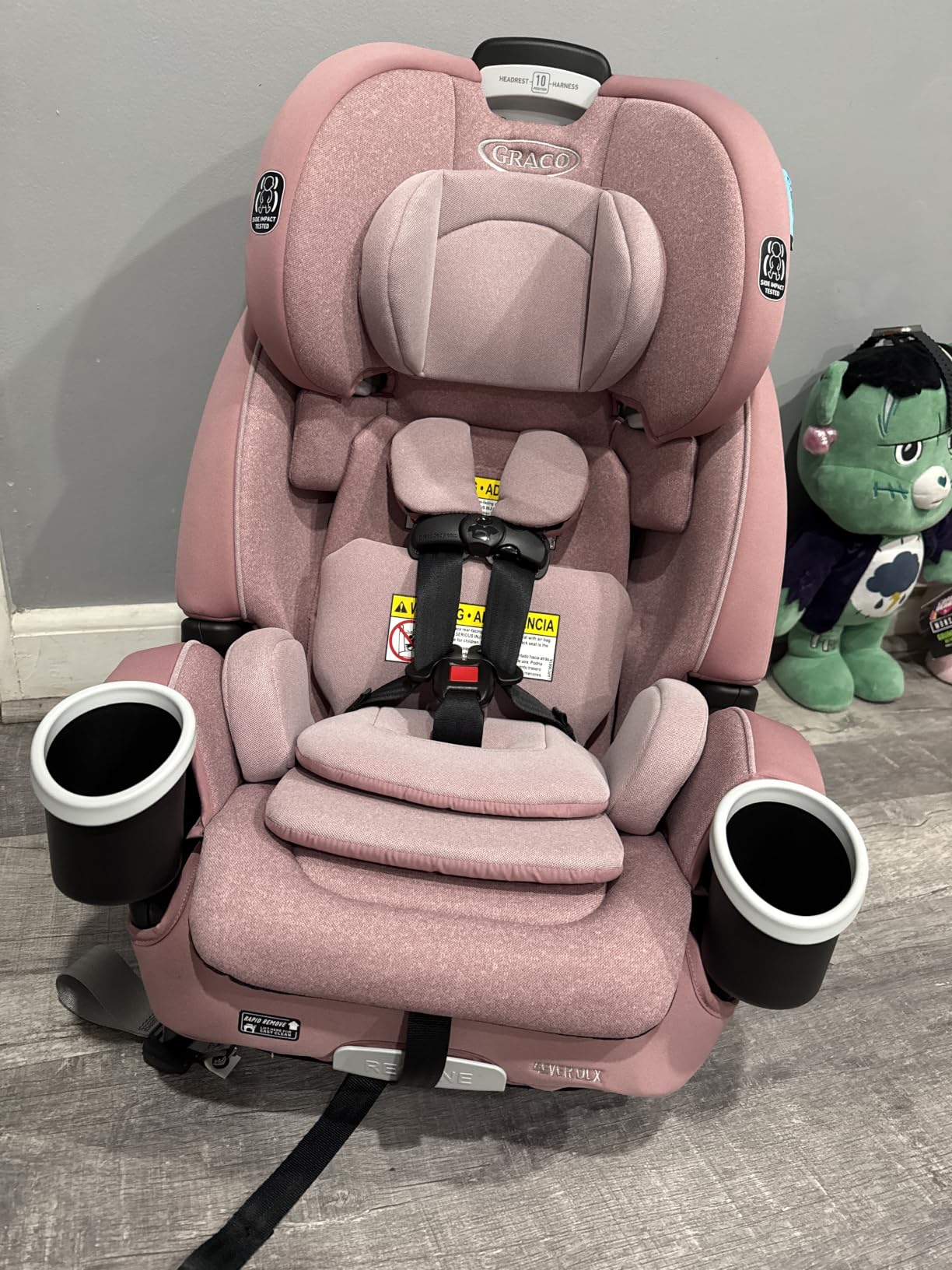
The complaints cluster around weight and first-time setup. It is a heavy seat, as most four-mode seats are, so lifting it into a high rear position takes practice. A few users found the manual confusing on their first install, which matters given how few instructions anyone reads for a seat this configurable. Owners also note the harness straps can be fiddly to locate when you are buckling a squirming toddler, though that improves once you know the path.
Padding is a genuine step up from slimmer 3-in-1 models, which matters for longer daily commutes. If you are choosing between this and the SlimFit3 LX, the deciding question is simple: do you need backless booster mode, and will you keep the seat installed for the full ten years?
Deciding between the two Graco slim seats
They solve different problems. The 4Ever DLX Slim buys you an extra mode and ten years of coverage at the cost of weight and bulk, while the SlimFit3 LX buys you the narrower shell and lighter handling but stops at 100 lbs. Families with a child already born and growing fast tend to want the longer runway. Newborns in a very small car tend to want the narrower footprint.
Measure your rear legroom too, not only the bench width. Four-mode seats add a booster configuration that sits closer to the front seat back, and if the child will spend years in that position the front passenger footwell matters more than the bench measurement.
When the extra mode is not worth it
If your child is already past the forward-facing harness stage, you are paying for modes you will not use and carrying weight you do not need. Parents who bounce the seat between two cars also tend to regret the weight. For a single long-term install in one small car, though, the buy-once logic holds up well.
4. Evenflo Revolve360 Slim: the rotating seat that still fits
Evenflo Revolve360 Slim 2-in-1 Rotating Car Seat
Under 17 inches wide
One-hand 360 degree rotation
Rear-facing and forward-facing
Multiple recline positions
Pros
- One-hand rotation takes the back strain out of loading
- Under 17 inches wide for a compact cabin
- Green indicator shows a locked install
- Recline positions help with head flop
Cons
- No booster mode
- Heavy base and needs side clearance to rotate
- Seat cushion is not removable for washing
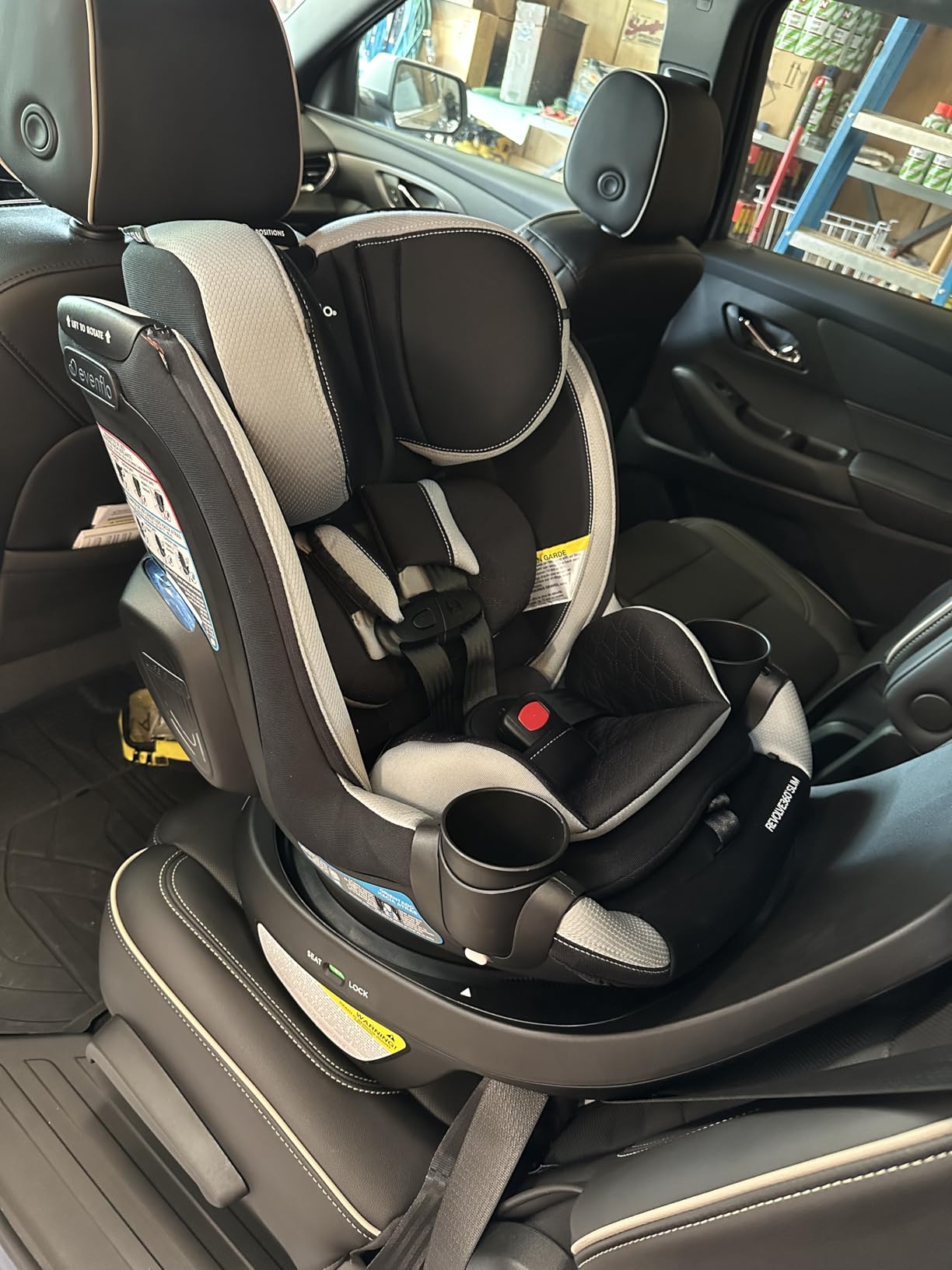
Rotating seats solve a problem no width figure addresses: the door opening. When the opening is narrow and the child is rear-facing at 30 lbs, the awkward part is lifting and angling them in, not the footprint. One-hand 360 degree rotation brings the seat to the door, and the Slim version holds under 17 inches so you do not give up bench space for the mechanism.
Installation confidence comes from the visual green indicator on the quick connectors, which tells you the seat is locked before you drive. Recline positions are a real bonus for rear-facing naps, and the Quick Clean cover has removable pads for spills. Parents and grandparents consistently point to the rotation as the reason they stopped dreading daily loading.
Now the honest limitations. This is a 2-in-1, so there is no booster mode and your child will need a second purchase later. The seat cushion itself does not come out for cleaning, only the pads above it, so spills into the foam are a permanent record. And a rotating base needs clearance on all sides, which in the tightest back seats is not always available.
Users report slight swivel movement after installation, which is a normal characteristic of the swivel mechanism rather than a fault. Full rotation also requires the seat to be at the youngest recline setting, so if you are adjusting recline for a sleeping child, expect rotation to stop working until you set it back.
Is a rotating base worth the bulk in a small car
Judge it on your door width and your child’s age, not on the base footprint. If your child is under about three and still rear-facing, the rotation pays for itself quickly in daily use. If they are older and forward-facing, the benefit shrinks and the extra weight and width cost you more than they return.
Also check the neighbouring seat. A rotating base needs room to swing, so a three-across plan with a rotating seat in the middle will not work. Two across, with the rotating seat on the door side, is the realistic configuration in most compact sedans.
Who should skip a rotating seat
Skip it if you need booster mode, if you move between vehicles regularly, or if your bench is narrow enough that the swing clearance does not exist. Families already settled into a forward-facing install with a well-fitted harness get very little from rotation and give up several inches of width.
5. Britax Poplar S: the pick when install confidence matters most
Britax Poplar S Convertible Car Seat, 2-in-1 Car Seat with Slim 17-Inch Design, ClickTight Technology, Sand Onyx
17 inch slim profile
Rear-facing to 50 lbs
ClickTight seat belt path
Carbon steel frame with SafeCell
Pros
- ClickTight removes the guesswork from belt installs
- Rear-facing to 50 lbs in a slim 17 inch shell
- ReboundReduce bar limits rear-facing movement
- Naturally flame-retardant fabric with no added chemicals
Cons
- No booster mode
- Rebound bar must be removed for forward-facing use
- Britax does not guarantee three-across fitment
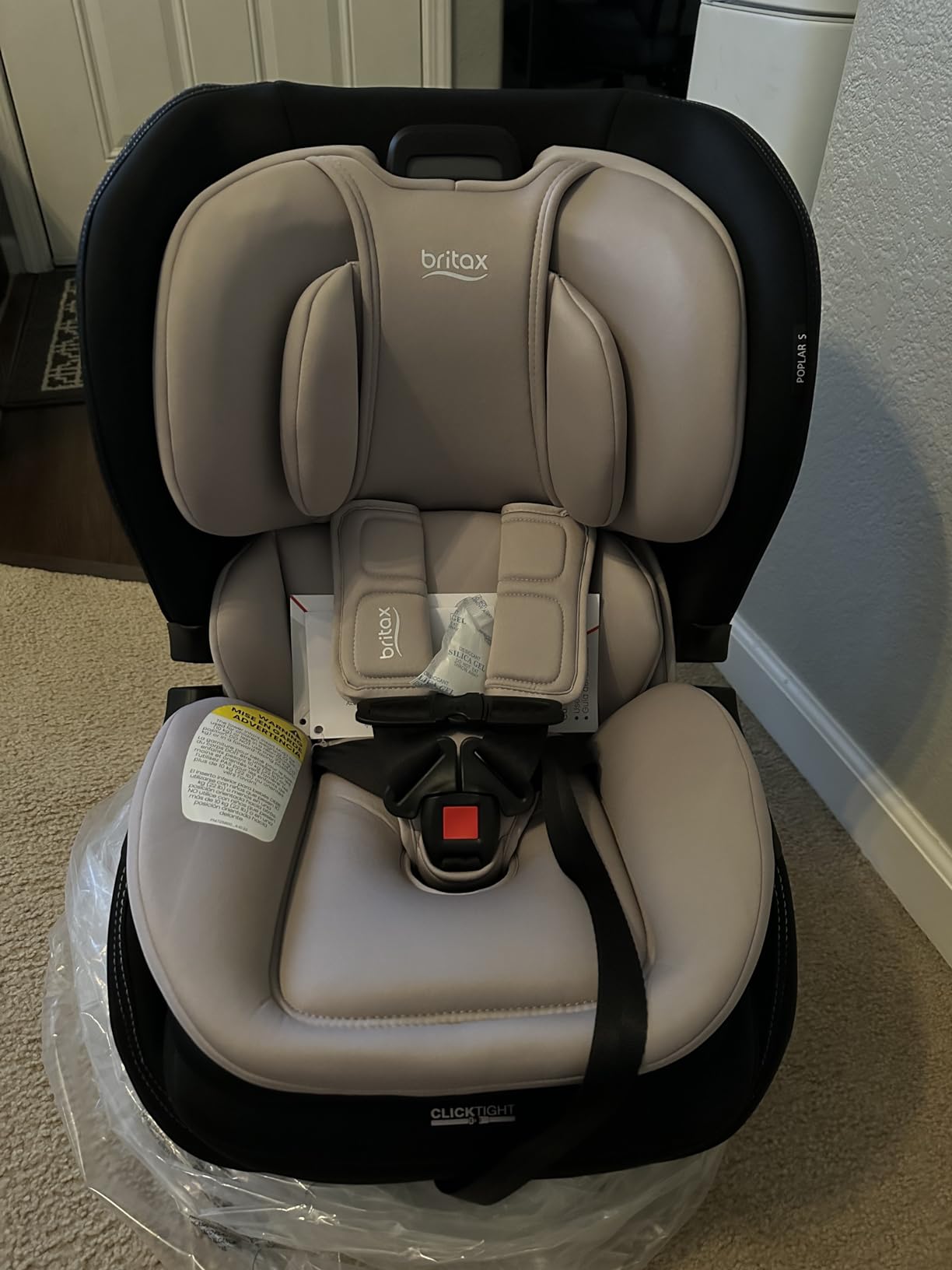
The most common install mistake parents make is a seat belt that is technically latched but not tight enough. ClickTight attacks that directly: you open the belt path, thread it, buckle, and the seat clicks closed only when the belt is properly tensioned. In a cramped back bench where you cannot get leverage on a loose belt, that feedback loop is worth more than a feature list.
The ReboundReduce carbon steel stability bar is the reason this seat is interesting for rear-facing to 50 lbs in a small car. It limits how far the seat can rotate toward the front seat back in a crash, which matters when the front passenger is close. You remove it for forward-facing use, so it is a one-step change when your child outgrows rear-facing.

The flip-forward buckle pad keeps the chest clip out of the way when boarding, which is a small thing that parents with rear-facing under-toddlers appreciate. The 14-position no-rethread harness and headrest move together, the cover is washer and dryer friendly, and the two cup holders are dishwasher safe. The fabric is naturally flame retardant rather than treated with added chemicals, a detail some buyers look for specifically.
What you give up: it is 2-in-1 with no booster mode, so plan a second seat later. It is heavier than some slim competitors. And Britax explicitly does not guarantee three-across fitment in every vehicle, which means the 17 inch width is a strong hint rather than a promise you should treat as verified without measuring.
When ClickTight solves a real problem
If you are installing with a seat belt rather than LATCH, a self-checking mechanism removes the single most common failure point. It also helps when the front seat has to sit close to the back bench, because you are not fighting a slack belt in a confined space. In our view that is the strongest argument for this seat in a genuinely small car.
The carbon steel frame with SafeCell crumple zone is the other half of the case. Parents who run a base in two vehicles value the confidence that comes with a frame that manages crash energy rather than relying on foam alone.
Where the 2-in-1 layout disappoints
If your child is anywhere near 65 lbs, the booster gap is a real cost rather than a distant concern. The rebound bar removal is a step people occasionally forget, so set a reminder when you switch modes. And the published review volume here is thinner than the Graco seats, so long-term durability data is lighter on a ten-year investment.
6. Safety 1st EverSlim: the four-mode seat for a tight bench
Safety 1st EverSlim 4-in-1 Convertible Car Seat, SecureTech Chest Clip, Ultra-Slim, 4-Mode Infant to Booster, Baby Car Seat, 5-100 lbs, Memory Foam, Office Space
4 modes from 5 to 100 lbs
Ultra-slim three-across design
SecureTech chest clip indicator
Memory foam cushion
Pros
- Four modes including backless booster from 5 to 100 lbs
- Ultra-slim profile aimed at three-across fits
- SecureTech chest clip gives red to green feedback
- Light enough that petite adults can install it
Cons
- Rear-facing recline may not be deep enough in some vehicles
- Top tether strap can be short and hard to tighten
- Newer model with less long-term durability data
This is the four-mode option for people who want a booster stage without the weight of a bigger all-in-one. It covers rear-facing, forward-facing, belt-positioning booster and backless booster across 5 to 100 lbs, and the profile is built around fitting three across most back seats. For a family that needs the child to graduate to a backless booster and only occasionally travels, the mode count is the selling point.
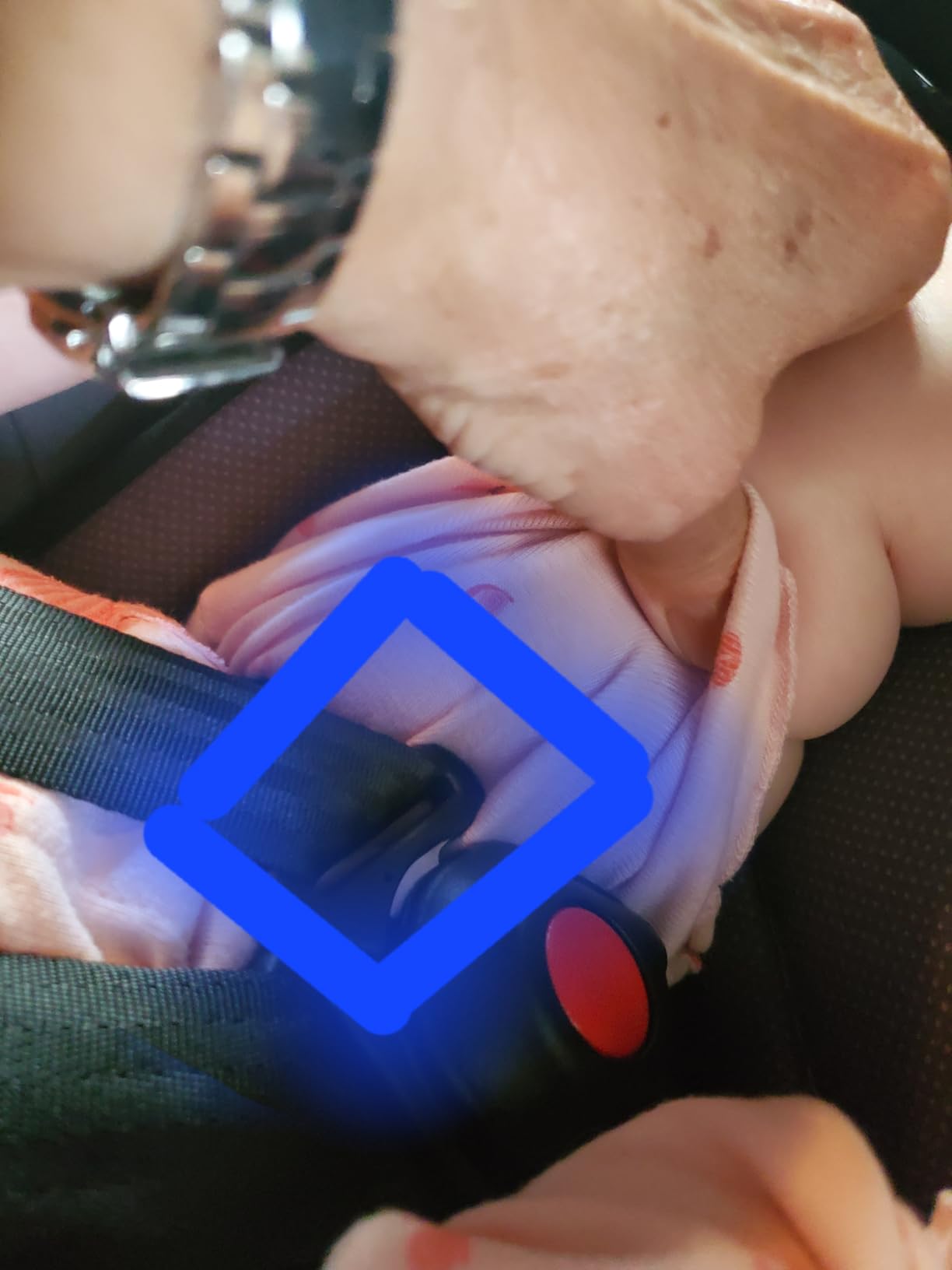
The SecureTech chest clip is the feature that shows up most in feedback: it goes from red to green once the harness is snug, which removes the guesswork in a back seat where you cannot see well. The five-position base and ten-position headrest cover a wide growth range, and the cover plus infant inserts go in the washer and dryer.
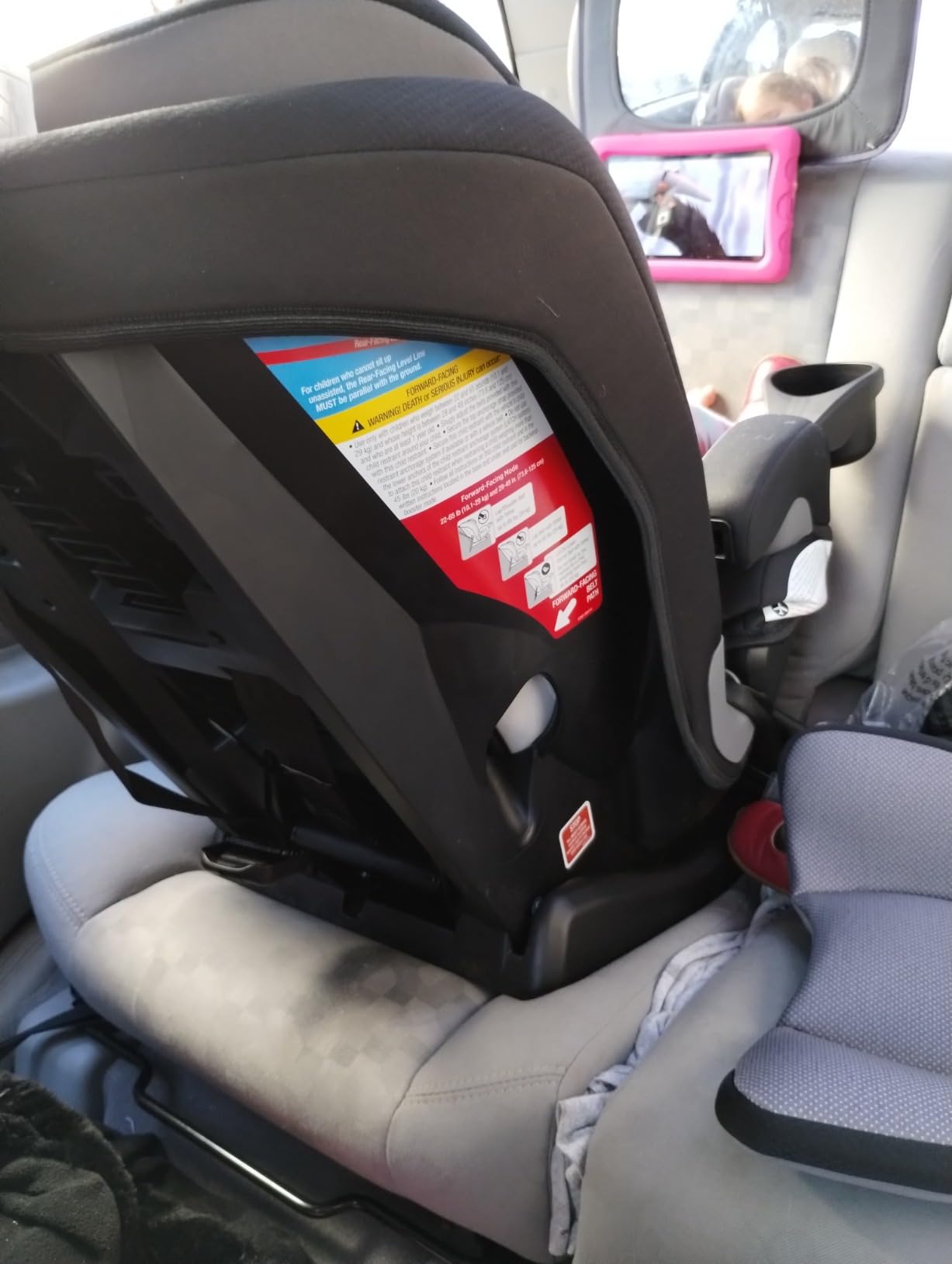
Two things temper the recommendation. Several users report the rear-facing recline is not deep enough in certain vehicles, which is the same complaint we heard on the Graco SlimFit3 LX and a recurring theme with slim shells generally. The top tether strap is also described as short and difficult to tighten, and tightening is harder in a confined back seat.
Some buyers report it is not meaningfully slimmer than standard seats, which is worth weighing against the manufacturer claim. It is also a newer model, so long-term durability data is still accumulating and the padding may compress over a decade of use. It is listed as FAA approved for air travel, which is useful if your trips are frequent.
Four modes versus a lighter three-in-one
The trade is weight and confidence against flexibility. If you will use the backless booster mode, this saves you an entire second purchase. If you are moving the seat frequently or your child will outgrow booster mode quickly, the extra bulk buys you little. Judge it on your actual timeline rather than on the mode count printed on the box.
The red to green chest clip matters more in a small car than in a large one. In a narrow back seat you are often crouching to check the harness, and an indicator that changes color saves you from pulling the child out to test it by hand.
What to check before committing
Sit in your back seat with the seat installed and test the recline for your child’s current size. A shallow rear-facing angle in a small car is a fit problem that no width number solves. Also bring someone who can reach the top tether anchor, or plan to have a technician check the install, because a short strap plus a tight cabin is a difficult combination.
7. Safety 1st Ellaris: the budget pick for a second car
Safety 1st Ellaris 3-in-1 Convertible Car Seat, Slim Fit Design, Rear & Forward-Facing, 5-Position Headrest, Travel-Friendly with Machine-Washable Seat Pad, London Blue
3 modes from 5 to 65 lbs
Slim fit design
Hook-style LATCH
Airplane certified
Pros
- Lowest outlay of the seats here
- Light and compact for travel
- Airplane certified for flying with a child
- Machine washable seat pad and dishwasher safe cup holders
Cons
- No booster mode and rear-facing stops at 40 lbs
- Less padding than higher priced seats
- Some users find the install hard to get tight
This is the seat to consider when the question is a second vehicle, a grandparent’s car, or a short-term arrangement rather than a ten-year plan. It covers rear-facing infant, rear-facing toddler and forward-facing across 5 to 65 lbs, and the slim fit design keeps bench space reasonable. It is also airplane certified and compact, which makes it the simplest seat here to move through an airport.
Hook-style LATCH connectors are simple to use, the five-position headrest adjusts as the child grows, and the seat pad is machine washable and dryer safe. The two cup holders are removable and dishwasher safe. At a 65 lb ceiling it is not a long-term seat, and treating it as anything other than a stopgap is where people get disappointed.

The ceiling is low on purpose. Rear-facing stops at 40 lbs rather than 50, and there is no booster mode at all, so you will be buying again once your child approaches the top of the forward-facing range. That is the trade for the price, and it works best when you know when the second purchase is coming.
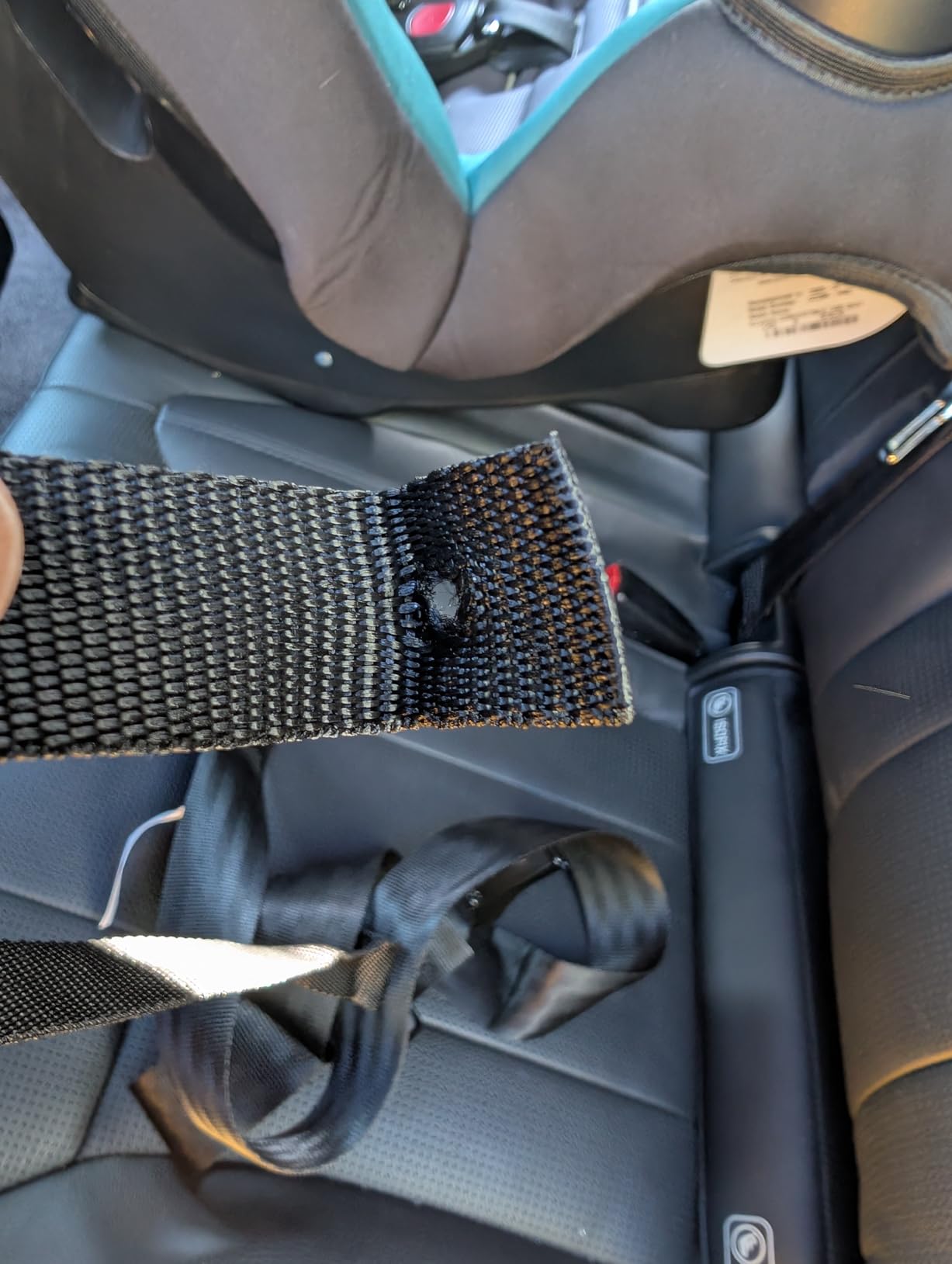
Fit and finish sit below the seats above it. Padding is plainer, fabric quality is reported as average by some reviewers, and a recurring complaint is that the install takes real force to get tight, which is harder in a confined back seat. The harness adjustment is a less refined system than a no-rethread design, and the headrest has five positions rather than ten.
When a budget convertible makes sense
It makes sense when the seat is not your primary install. A second car, a travel-only seat, or a bridge until your child is tall enough for the next stage are all reasonable uses. In those situations the low weight and airplane certification are worth more than mode count.
It is also the most forgiving seat to experiment with. If you are not yet sure how many children will ride in the back, a seat at this level lets you learn your install without a large investment sitting in the trunk.
When to spend more instead
If this is your child’s only car seat, spend more. No booster mode plus a 40 lb rear-facing ceiling means two purchases in a short span, and the install difficulty is worse in exactly the tight cabins this guide is about. A 4.3 rating from well over 1,500 reviews reflects solid basics with visible limits.
8. Safety 1st TriMate: the pick for easy cleanup
Safety 1st TriMate 3-in-1 Convertible Car Seat, Slim Fit, Infant to Big Kid Car Seat, Easy-Install Harness, Machine-Washable Cover, Dishwasher-Safe Cup Holders, 5-100 lbs, Sharkskin
Under 19 inches without cup holders
3-in-1 from 5 to 100 lbs
One-hand 8-position headrest
Washable removable seat pad
Pros
- Under 19 inches wide without cup holders for three-across
- Cover removes without undoing the harness
- 8-position headrest with one-hand adjustment
- Reaches 100 lbs through belt-positioning booster
Cons
- Installation takes significant force to get tight
- Several removable foam pieces can detach and get lost
- Some users report instability
Toddlers are messy and car seats are not designed to be forgiving about it, so cleanup ease is a legitimate selection criterion. The TriMate cover comes out without undoing the harness, which means a spill in the back seat is a two-minute job instead of a reinstall. The seat pad is machine washable and dryer safe, and the cup holders go in the dishwasher.
On size, it measures under 19 inches across without the cup holders, which is a fair bit slimmer than a standard convertible but not in the SlimFit3 LX class. One family running seven seats confirmed a three-across fit in a Subaru Outback, which is a reasonable data point for a compact crossover rather than a sedan.
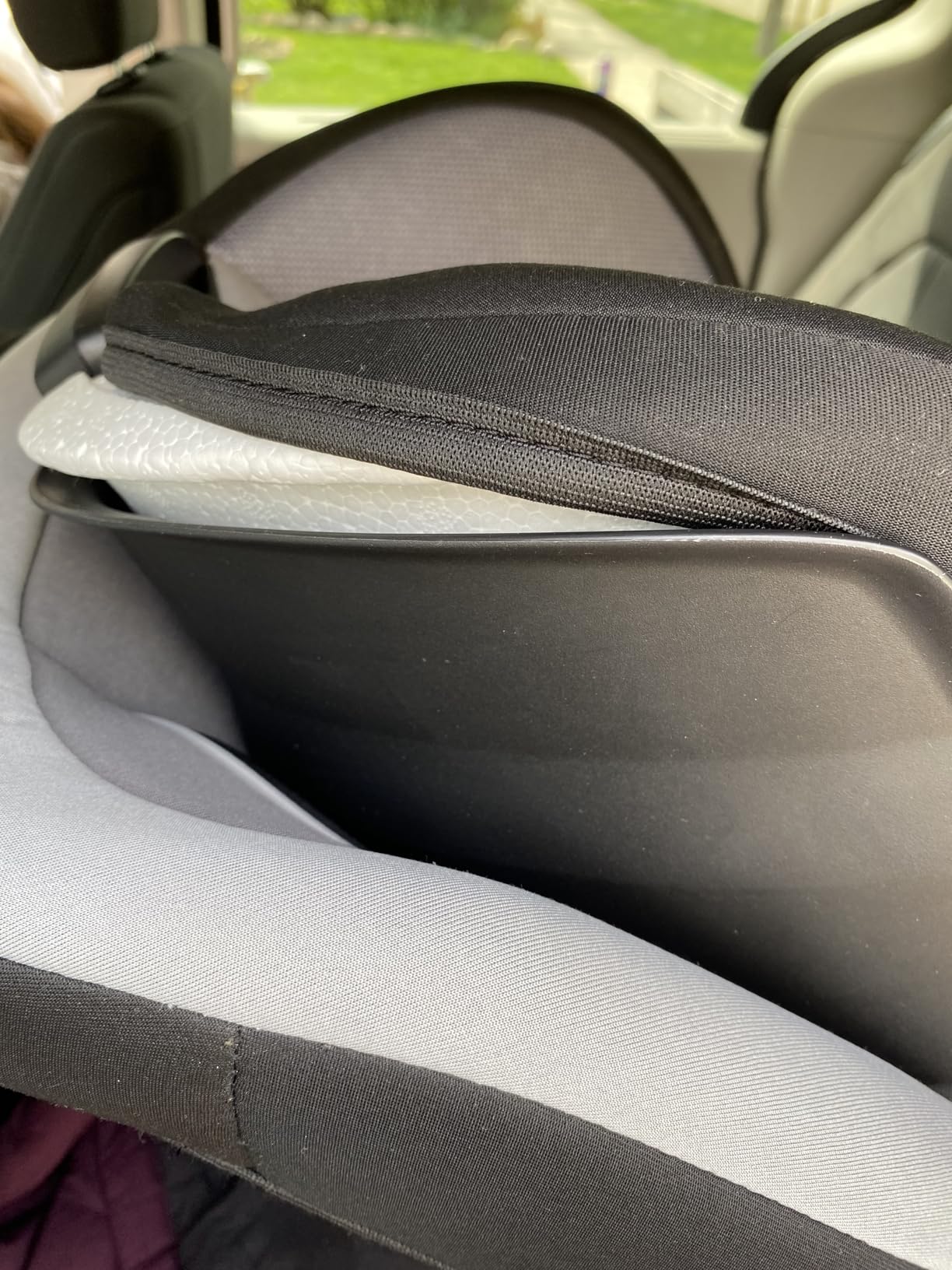
The install is the weak point and it recurs in feedback: many owners report needing significant force to get the seat tight, and a few describe instability. That is a harder problem in a cramped back seat, where you have less room to push and less visibility on the belt path. The visible belt paths and no-rethread harness do help once it is in.
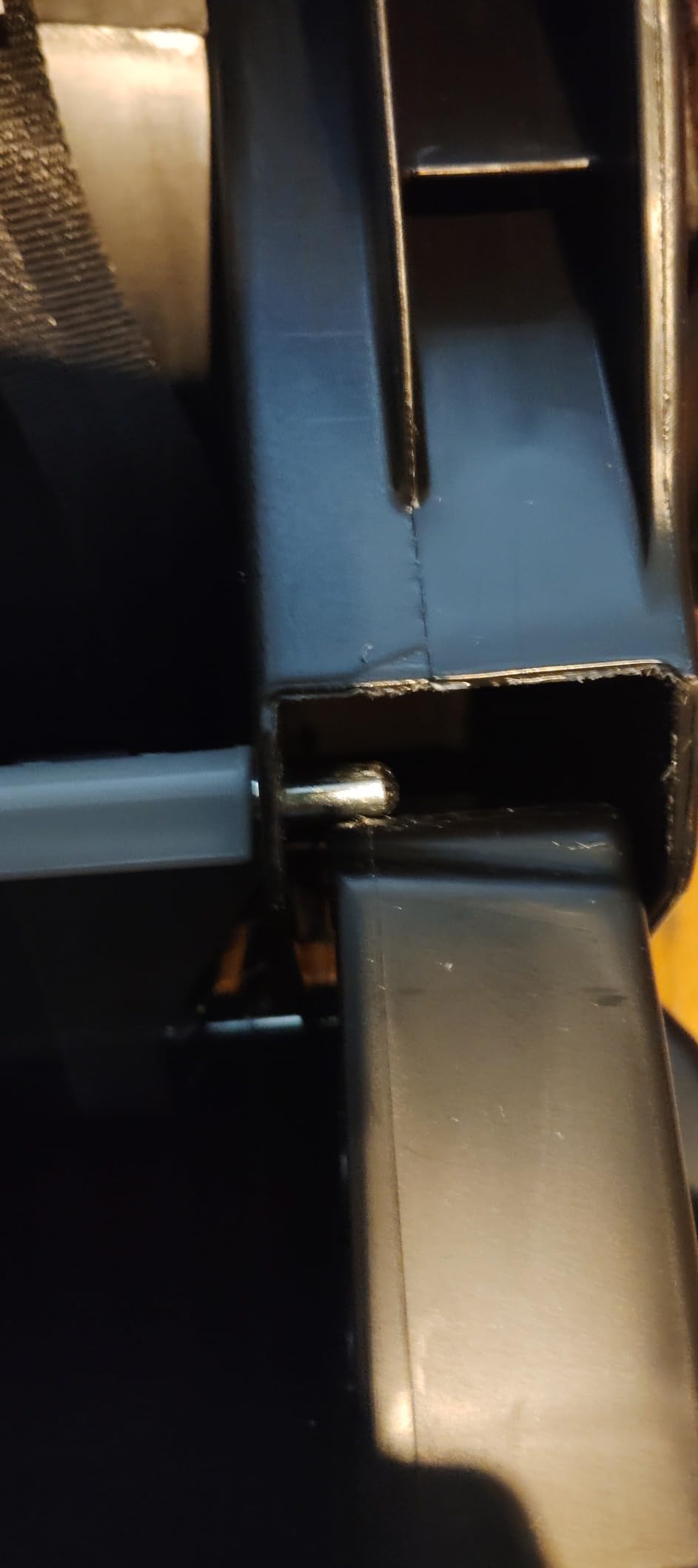
The other recurring complaint is the removable comfort pieces. The shoulder foam protectors and infant inserts come loose when you lift the child out, and reviewers report losing them. The eight-position headrest adjusts with one hand, and the three-position base plus memory foam infant insert cover the growth range from 5 to 100 lbs.
Is under 19 inches narrow enough
Under 19 inches gets you two across comfortably in most compact cars, and three across in wider compact crossovers. It is not enough for three-across in a tight sedan bench, and the cup holders are not included in that figure, so measure with them installed. If three-across is a requirement rather than a hope, look at the narrower seats earlier in this list.
Note also that the booster mode is belt-positioning only, topping out at 100 lbs. It is a genuine long-term stage, but there is no backless booster for older children.
Where the removable pieces become a problem
If you are doing long drives with a toddler who eats in the car, the detachable foam pieces will need a system. Keep the extra inserts in a small bag in the trunk rather than loose, and expect to reassemble the shoulder section each time you load. Buyers who have adapted find it manageable; those who have not tend to end up buying a seat with fewer loose parts.
How to Pick a Convertible Car Seat That Fits Your Small Car
Width is the headline number in this category, but it is only one of five things that decide whether a seat works in a compact cabin. Here is how to check before you spend anything.
Measure your back bench in three steps
First, measure the flat bench width at the three points where seats will actually sit: at the outboard positions and at the center. Back benches are rarely straight, and the center is often the tightest part.
Second, measure the front-to-back depth from the back of the bench to the front seat back, then repeat with the front seat in the position your partner drives. This number is what tells you whether a rear-facing install will push them forward.
Third, measure the door opening width and height at the seat position. This is the number that tells you whether loading a rear-facing 3 year old is realistic or whether a rotating base is worth the extra width. A seat can be narrow enough to fit and still be miserable to load into.
Three-across width math: 16.7 x 3 = 50.1 inches
Multiply your candidate seat width by three and compare that to your bench measurement. A 16.7 inch seat needs 50.1 inches of bench, a 17 inch seat needs 51 inches, and an under 19 inch seat needs 57 inches, which is beyond most compact sedans and into crossover territory.
Treat anything under two inches of total slack as a two-across-plus-a-child plan rather than a comfortable three-across. The seats also occupy their widest point including cup holders and belt paths, so the real number is usually larger than the published width.
Width is not depth: what rear-facing really costs you
A narrow seat can still steal legroom from the front passenger, because rear-facing mode places the seat back close to the bench. Seats that rear-face to 50 lbs extend further back than those that stop at 40 lbs, and the recline angle determines how far forward the shell sits.
So check the depth in the mode you will use most. If you rear-face to the top of the range, ask the manufacturer for the installed depth, and if they do not publish it, plan on your front seat moving a few inches forward. The Diono Radian 3R and Britax Poplar S both rear-face to 50 lbs; the Ellaris stops at 40 and sits correspondingly closer.
LATCH anchor spacing limits three-across installs
Lower anchor spacing varies between vehicles and is the physical limit that most roundups ignore. Anchors too close together make adjacent lower-anchor installs impossible, which forces a seat belt install or a top tether install in the middle position. Anchors spread too wide waste bench space.
Check your vehicle manual for the lower anchor locations, or look under the seat for the anchor bars. If the spacing is narrow, two-across with LATCH is the realistic plan and you should factor in a technician visit rather than assuming the install will be straightforward.
Common installation mistakes in a tight back seat
The first is a seat belt latched but not tight, which is the single most common error and the hardest to fix without room to pull. The second is mixing lower anchors and a seat belt in the same position, which is not allowed. The third is skipping the top tether on a forward-facing harness install in a car with an anchor.
The fourth is allowing a loose headrest to move the shell in a rear-facing install, and the fifth is not rechecking the install after a few weeks of driving, since a seat can shift. A visit with a certified child passenger safety technician is the most valuable step most families can take, and many fire stations and hospitals offer the service.
Who should skip this guide
If you need a booster for a school-age child with no harness stage ahead of it, a booster is the right product and this guide will not help. If your child has limited mobility and needs a rotating seat with a swing that requires substantial clearance, the slim rotating category is narrow enough that you may need a specialist fitting.
If you drive a full-size SUV or minivan with a wide bench, you have options this list deliberately leaves out. And if you are looking for a small convertible car rather than a car seat, this guide is not the right read.
How we picked and what we verified
We compared manufacturer specifications for width, weight limits by mode, recline range and installation method across the eight seats, then checked those specs against buyer feedback. We pay attention to the complaints that repeat across unrelated reviews, because a single install problem is often a learning curve while a complaint repeated hundreds of times is a design characteristic.
Fit claims deserve a caveat. Manufacturer width figures are measured widths, not installed widths, and three-across fitment depends on your vehicle. We have flagged every product where the brand itself declines to guarantee fitment. Always verify with your own measurements and, if you can, a technician visit before a child rides in the seat.
For reference on choosing the right vehicle in the first place, our convertible carry guide covers the same small-versus-large tradeoff from a different angle. And if you are also planning a trip where you will be hauling a pet in the back seat, our dog car seat picks apply the identical width math to a much smaller passenger.
Frequently Asked Questions
What are the best child seats for small cars?
The best convertible car seats for small cars are the Diono Radian 3R for overall slim fit and a 50 lb rear-facing limit, the Graco SlimFit3 LX for the narrowest three-across profile at 16.7 inches, and the Graco 4Ever DLX Slim for four modes in a reduced-width shell. All three meet the same federal safety standard, so width and depth decide the choice.
What is the most narrow rear-facing car seat?
Among the seats we compared, the Graco SlimFit3 LX is the narrowest at a documented 16.7 inches wide, and the Evenflo Revolve360 Slim is close behind at under 17 inches. Three of these seats still need roughly 50.1 inches of bench, so measure before assuming three-across will work.
Can convertible car seats be rear-facing?
Yes. Every convertible seat here has a rear-facing mode, and the rear-facing weight limit is what separates them. The Diono Radian 3R and Britax Poplar S rear-face to 50 lbs, the Graco SlimFit3 LX and Graco 4Ever DLX Slim to 40 lbs, and the Safety 1st Ellaris to 40 lbs as well.
How to fit 3 car seats in a small car?
Measure the flat bench width at the outboard and center positions, then multiply your chosen seat width by three. A 16.7 inch seat needs 50.1 inches of bench, so a compact sedan is workable but tight. Also check lower anchor spacing in your vehicle, because narrow anchor spacing blocks adjacent lower-anchor installs and forces a belt or tether install in the middle.
Are narrow car seats safe?
Narrow does not mean less safe. All convertible car seats sold in the US must meet the same federal motor vehicle safety standard, and several seats in this guide have steel-reinforced frames and side impact testing. Check Consumer Reports crash ratings and run the model through the NHTSA recall database before buying, and have the install checked if you are not confident.
What is a common mistake made when installing a child’s car seat?
The most common mistake is a seat belt that is latched but not tight enough, especially in a confined back seat where you have little room to pull. Other frequent errors include using lower anchors and a seat belt in the same position, skipping the top tether on a forward-facing install, and not rechecking the install after several weeks of driving.
What are the downsides of convertible car seats in small cars?
The main downsides are bulk and mode limits. A narrow seat can still push the front passenger seat forward in rear-facing mode because rear-facing shells sit close to the bench. Some slim seats have shallow reclines that do not suit a newborn, several 2-in-1 models stop at the harness stage with no booster mode, and 4-in-1 models are heavy to move between cars.
Our Final Pick for Small Cars in 2026
For most families driving a compact sedan or small crossover, the Diono Radian 3R is the best convertible car seat for small cars. It holds a narrow profile without a flimsy frame, rear-faces to 50 lbs so your child gets the longer rear-facing window, and folds flat when you fly. Its one real drawback is weight, and that only matters if you move it between vehicles.
If width is your binding constraint, the Graco SlimFit3 LX at 16.7 inches gives you the best chance at three-across, and the Graco 4Ever DLX Slim adds a backless booster mode for families buying once. For tight door openings, the Evenflo Revolve360 Slim removes the daily lifting struggle, and for a second vehicle the Safety 1st Ellaris keeps the budget low.
Measure your bench before you order, check the rear-facing depth against your front seat position, and get a certified child passenger safety technician to verify the install. That last step is worth more than any feature on this page, and it is the difference between a seat that is installed and a seat that is safe. If you share your vehicle make and model along with your child’s age and weight, we can narrow these eight down to one.