
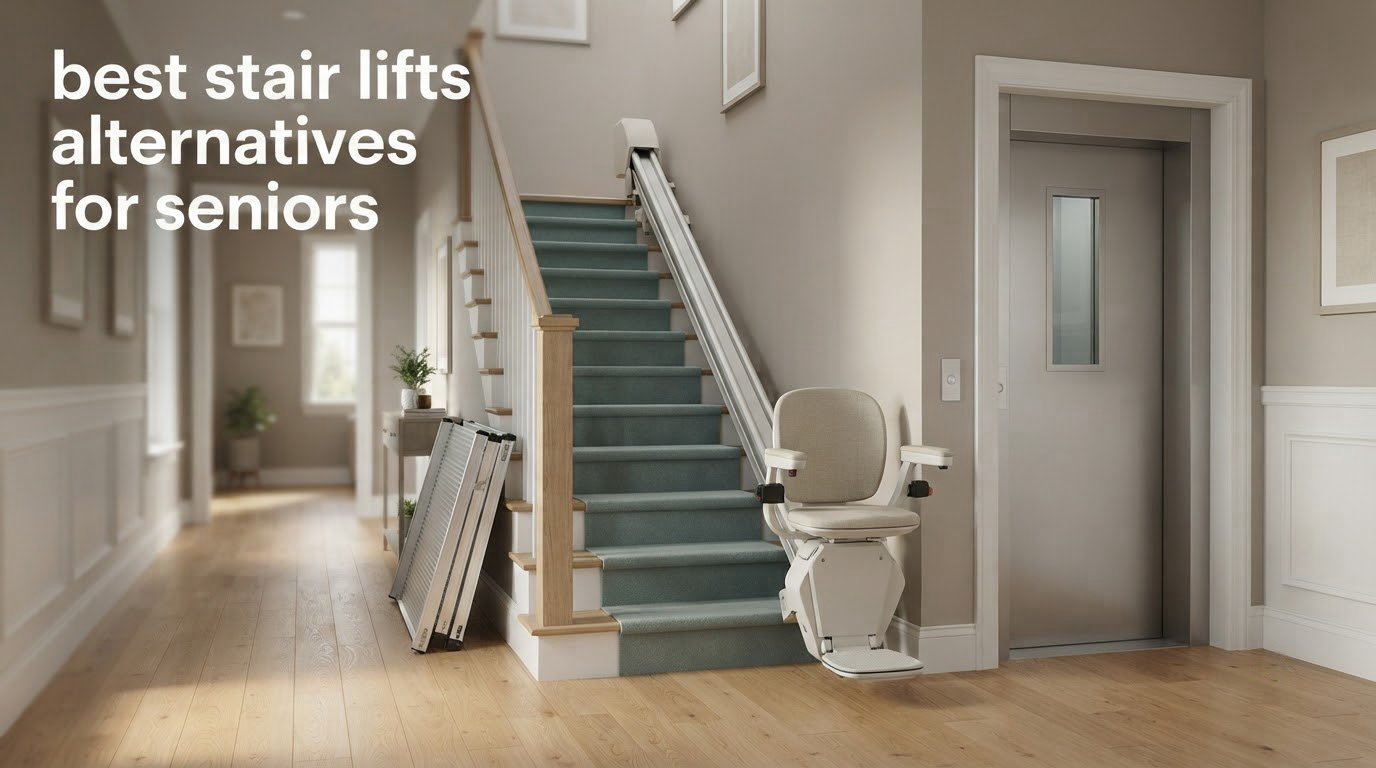
A stair lift is not the only way to get a senior safely between two floors, and for a lot of people it is the wrong way. The chairs that bolt to a wall, cost more than most families plan for, and take weeks to install fail three people outright: anyone who cannot transfer out of a wheelchair, anyone whose staircase is narrower than about 26 inches, and anyone whose stairs turn a corner where a rail cannot run.
That is why the hunt for the best stair lift alternatives for seniors has moved past dealer catalogs toward something practical. Buyers want to know which product gets a person up and down safely, how much caregiver involvement it demands, and whether it can be removed later. We compared ten of them, from folding aluminum wheelchair ramps to wall-mounted grab rails and stair-assist canes, and read what owners report after living with them.
The strongest alternatives turned out to be the simplest ones. A properly anchored handrail and a stair-assist cane cost a fraction of an installed lift, need no construction, and reverse cleanly when the house sells. A ramp handles the wheelchair user who cannot transfer at all. Everything between those two ends is a question of your staircase geometry and how many hands are free on a Tuesday morning.
If you are weighing a track-mounted climber or a through-floor lift instead, start with our stair climber machine guide, and see how lifting devices compare in our patient lift roundup when a caregiver is doing the work.
Table of Contents
Top 3 Picks for Stair Lift Alternatives in 2026

VNN 4FT Portable Ramp
- Covers 4-12 inch step heights
- 800 lb capacity
- Folds for storage
- Double non-slip surface

Purife 12 Inch Handrail
- Holds up to 500 lb when anchored
- 1.3 inch powder-coated pipe
- Direct wall mount
- Anti-slip grip
RECTOO 3 Ft Handrail
- 3 ft continuous grip
- 440 lb per bracket
- Indoor and outdoor use
- Mounts to most wall types
Best Stair Lift Alternatives for Seniors Compared in 2026
| Product | Specifications | Action |
|---|---|---|
| VNN 4FT Portable Wheelchair Ramp |
|
Check Latest Price |
 FACHNUO 2FT Portable Wheelchair Ramp FACHNUO 2FT Portable Wheelchair Ramp |
|
Check Latest Price |
 TaiH Leo 8FT Ramp with Support Legs TaiH Leo 8FT Ramp with Support Legs |
|
Check Latest Price |
| Purife 12 Inch Wall Mount Handrail |
|
Check Latest Price |
| RECTOO 3 Ft Metal Stair Handrail |
|
Check Latest Price |
 Frossvt 26 Inch Outdoor Grab Bar Frossvt 26 Inch Outdoor Grab Bar |
|
Check Latest Price |
 Support Way 2-in-1 Stair Assist Cane Support Way 2-in-1 Stair Assist Cane |
|
Check Latest Price |
 HeywoodCabin 20-Level Stair Assist Cane HeywoodCabin 20-Level Stair Assist Cane |
|
Check Latest Price |
 MMingo Adjustable Stair Climbing Cane MMingo Adjustable Stair Climbing Cane |
|
Check Latest Price |
 ZczCjWq 13-Adjustable Stair Assist Cane ZczCjWq 13-Adjustable Stair Assist Cane |
|
Check Latest Price |
1. VNN 4FT Portable Wheelchair Ramp – The All-Rounder for a Typical Front Entry
VNN Portable Wheelchair Ramp 4FT, Non-Slip Ramps for Wheelchairs for Home
4-12 inch step heights
800 lb capacity
23.8 lb weight
Aluminum with non-slip surface
Pros
- Covers the most common front step heights of 4-12 inches
- 800 lb leaves room for a caregiver riding with the user
- Folds to a slim package that fits a closet or vehicle
- Double non-slip surface plus reflective warning stickers
- Transition plates at both ends reduce bottoming out
Cons
- Will not span a full flight of stairs
- Long portable ramps can sink slightly under heavy load
- One adult may struggle to reposition it solo
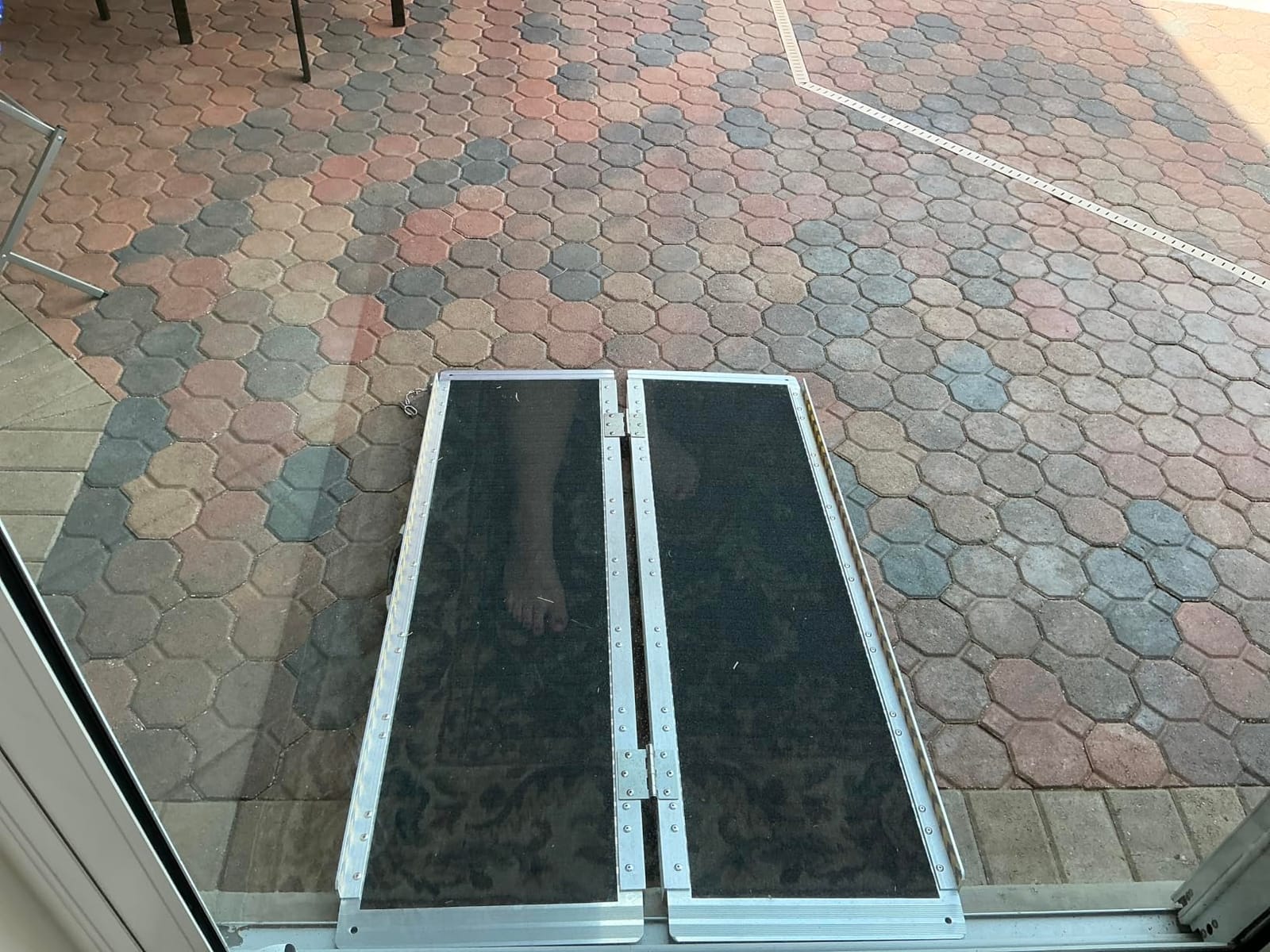
I put the VNN 4FT ramp first because it solves the most common version of this problem: a front door with three or four steps, no room for anything permanent, and a wheelchair user who wants to reach that door. It measures 48 by 29.2 inches unfolded and folds to roughly half that.
Owners point at the same two things, that the ramp feels rigid under a chair and that the double non-slip layer grips even in rain. One of the more than 2,000 reviews credits the fold with keeping it in daily use rather than pushed into a closet.
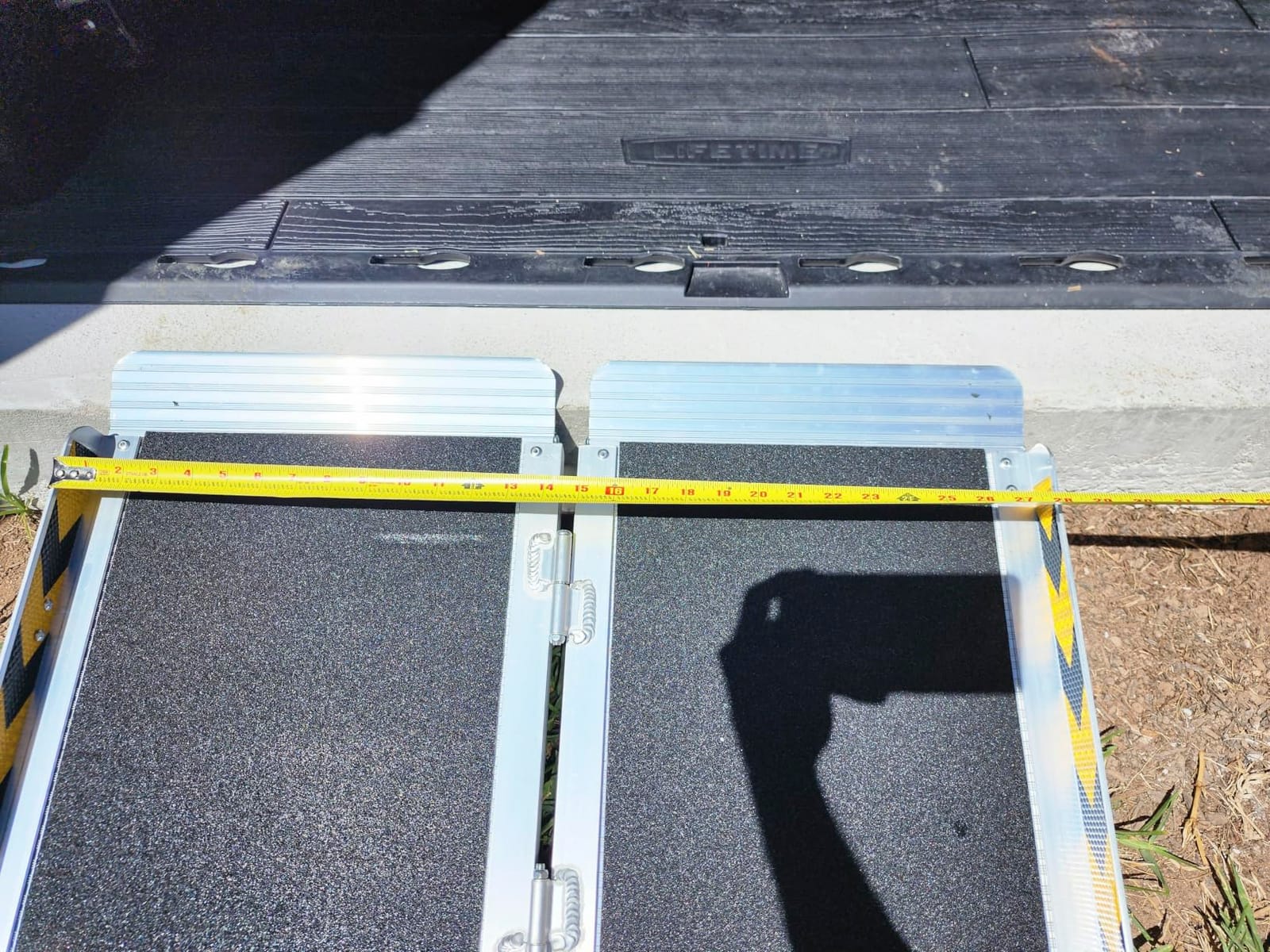
The engineering is unremarkable in a good way. Stainless steel hinges resist corrosion, side baffles stop a caster rolling off the edge, and transition plates at both ends keep the chair from clattering onto the ground. At 23.8 lb it stays put yet lifts with one hand.
The real limitation is range. Four to twelve inches of rise is generous by ramp standards, but it is still a step solution rather than a stair solution. A full flight means a longer ramp with support legs.
When this ramp is the right call
Choose it when the rise is a handful of steps, you can park at the bottom, and the user is in a wheelchair, powerchair or rollator. The 800 lb rating means a user and a caregiver can ride it together, which decides whether a relative will help or watch from the doorway.
When it will not work for you
Skip it if the rise is under four inches and you are dealing with a lip rather than a step, since a threshold ramp handles that better. Also skip it if the only parking is at street level far from the ramp foot, since that gap is where most falls happen. One reviewer saw slight flex under a heavy powerchair, so anchor the top edge to a wooden platform near the weight ceiling.
2. FACHNUO 2FT Portable Wheelchair Ramp – Best for a Single Doorstep
FACHNUO 2FT Portable Wheelchair Ramp for Home Steps, Non-Skid Aluminum Ramp
2-6 inch step heights
800 lb capacity
10.9 lb weight
Folds to 13.2 inch width
Pros
- Light enough for one caregiver to carry and reposition
- Folds narrow for a vehicle or closet
- Textured non-slip surface with extended guide rails
- Works with powerchairs
- scooters
- walkers and rollators
Cons
- Rated only for 2-6 inch rises
- Slope becomes steep above about 4 inches
- Side walls can foul a door or sliding track
- Some buyers report flex and surface rust outdoors
This is the ramp you buy when the problem is one step, not a staircase. At 10.9 lb and 24 inches long it is small enough for a spouse to move with one hand, which removes the most common complaint about portable ramps.
Reviewers describe solid, no-fuss kit for short rises, and the built-in handle is called out as the reason it stays where it is needed. It also ranks first in its category on the retail side, consistent with how owners talk about it.
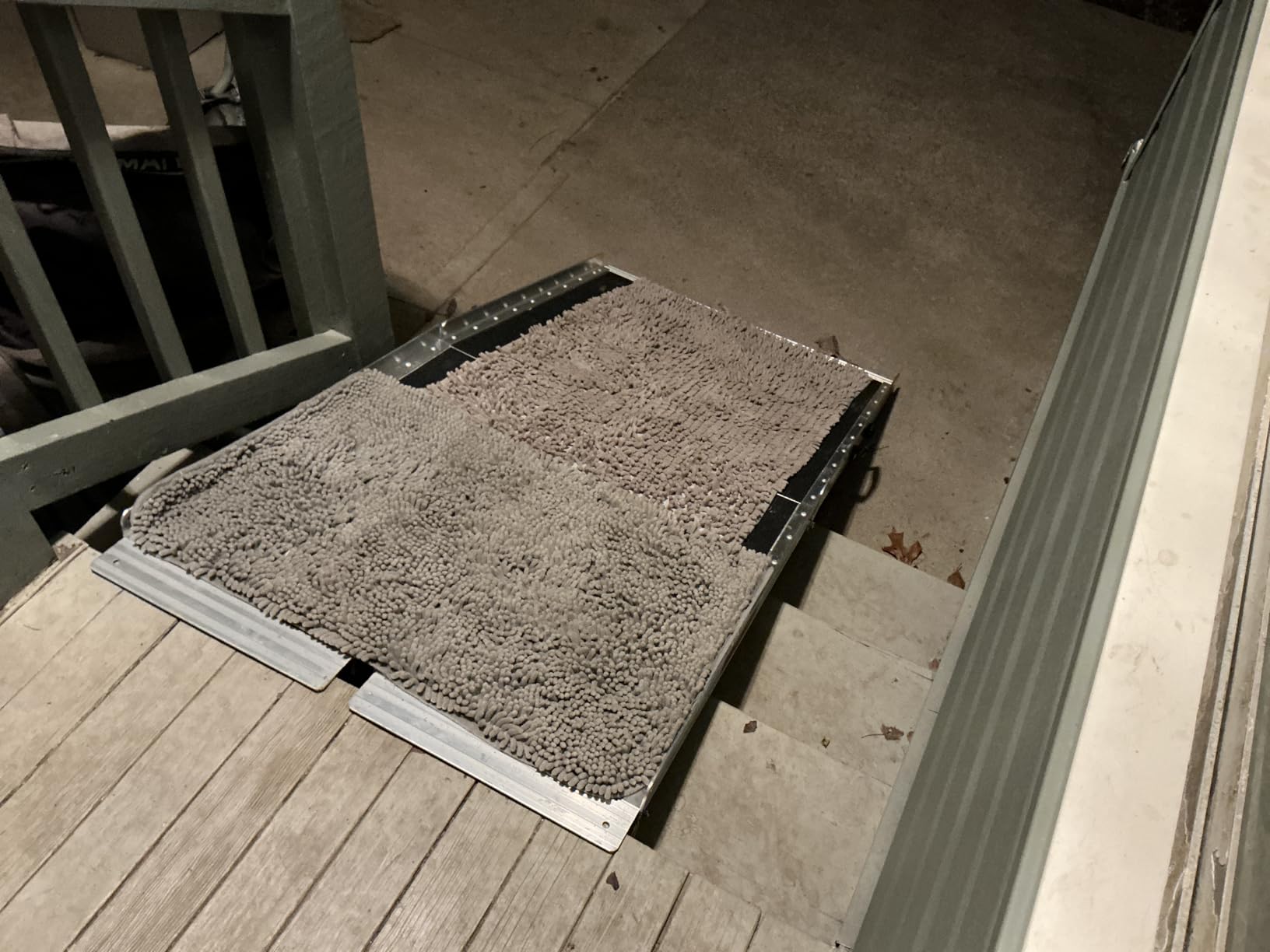
Unfolded it measures 24 by 29.2 by 2 inches and folds to 24 by 13.2 by 3.2 inches. Stainless steel hinges, reflective strips and guide rails at both ends match what you would expect from a better-made budget ramp, and the maker recommends not exceeding four inches of rise for independent access.
Keep one practical note in mind. The side walls stop a caster drifting off, and they are also what can block a door swing or sliding patio track if the ramp is rotated the wrong way. Set it up in the driveway before you need it, not on the morning of a therapy appointment.
Where it earns its place
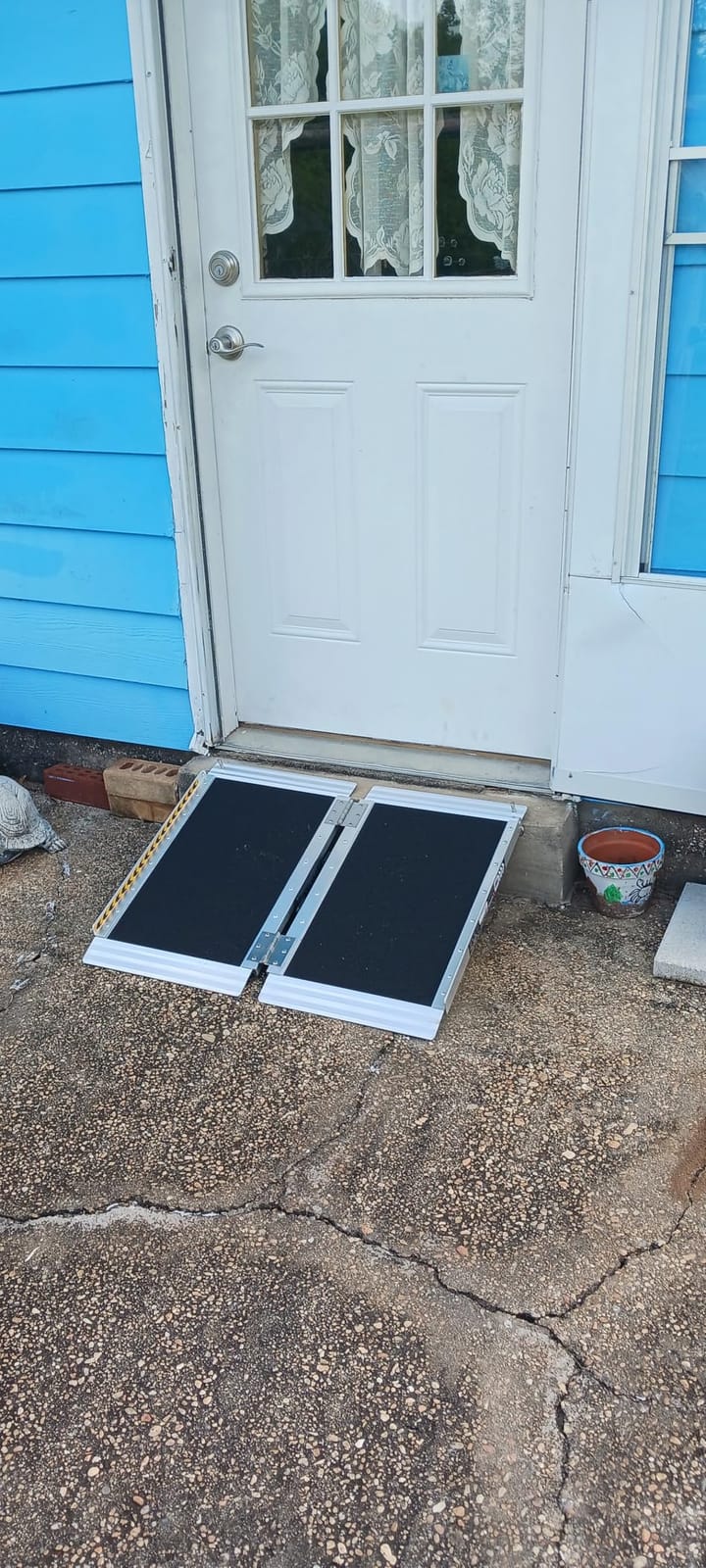
A two-to-four inch entry threshold is exactly what it is built for, and for many apartment and condo residents with a single step to the patio, that is the entire problem. Because it weighs so little, one caregiver can reposition it for a different door in seconds, and owners of powerchairs who split their time between homes use it wherever they are staying.
Where it falls short
Six inches is the absolute ceiling and the usable gradient is nearer four, so anyone managing a taller step should step up to the longer ramp rather than stretching this one. Buyers also report a springy feel under load and surface rust after wet seasons outdoors, and bringing it in overnight solves the second problem.
3. TaiH Leo 8FT Ramp with Support Legs – For Rises a Threshold Ramp Cannot Reach
8FT Wheelchair Ramp with Support Legs, Portable Ramps for Home Steps
8-24 inch step heights
Two adjustable support legs
800 lb capacity
55 lb weight
Pros
- Adjustable mid-span legs cut the sagging that plagues long ramps
- Covers 8-24 inches so it handles a full porch staircase
- Tool-free assembly
- 800 lb supports user plus caregiver
- Frosted non-slip layer over textured aluminum
Cons
- At 55 lb it is a two-person lift
- Long ramp still wants anchoring at the top
- Steep grades remain hard for an unassisted walker
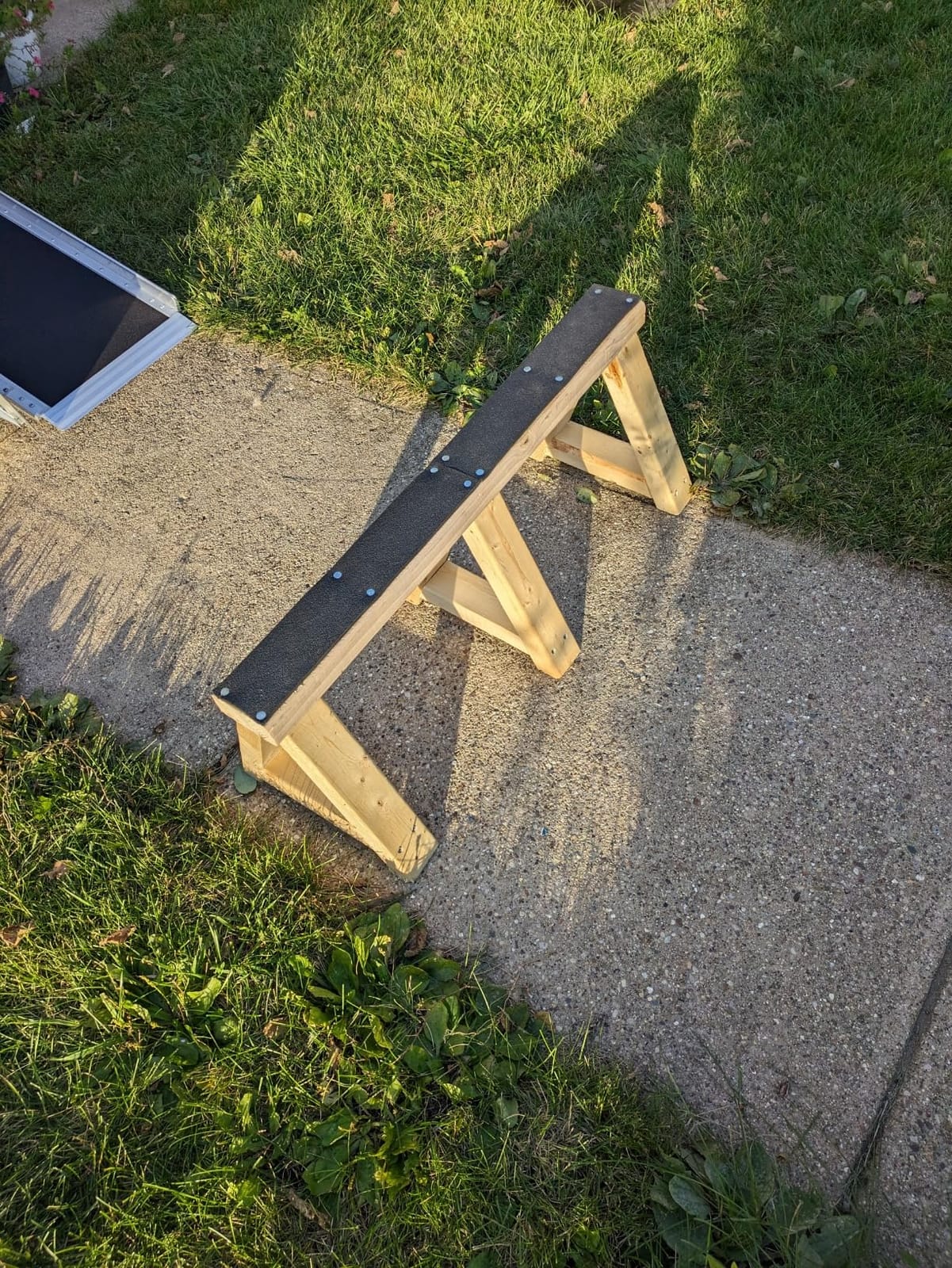
This ramp covers the gap between a threshold ramp and a permanently installed one. It unfolds to 96 by 29 by 2 inches and handles step heights from 8 to 24 inches, the range that covers most porch staircases and raised decks.
The feature that matters is the pair of adjustable support legs running 11 to 15.8 inches. Long aluminum ramps sag in the middle, and that sag is felt as a lurch each time a heavy chair crosses. Owners consistently credit the legs with removing that sensation.
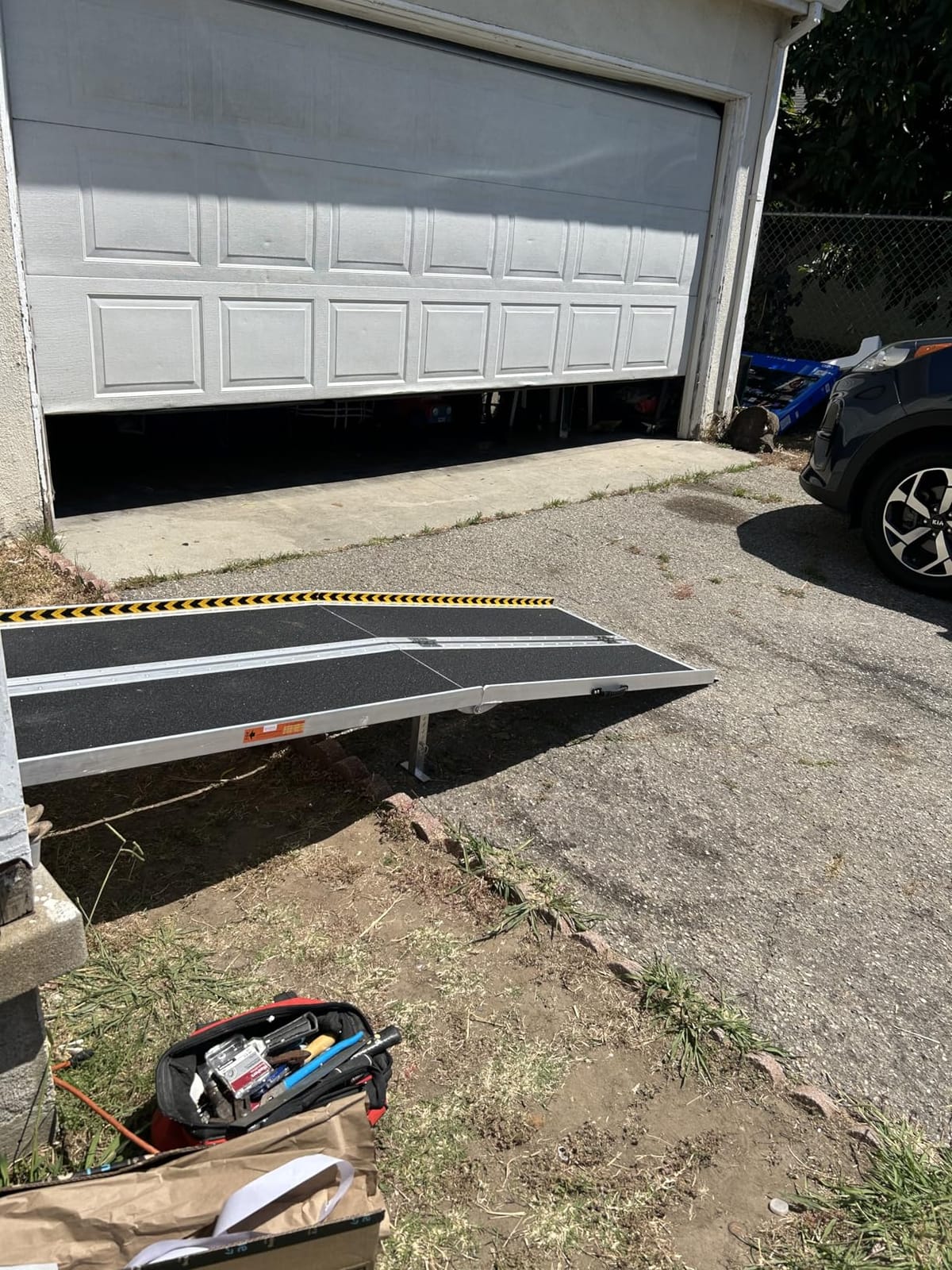
Setup is tool-free, which is unusual at this length. It folds to 48 by 14 by 6.3 inches, and side baffles plus reflective warning stickers come standard. Transition plates sit at both ends so the chair does not clip the step lip or dig into soft ground.
At 55 lb this is a two-person move, and buyers say so plainly. Several recommend fixing it to a wooden platform with screws to stop it shifting, particularly on a steep grade in wet weather.
When you need the extra reach
This is the ramp for a raised front porch, a deck with four to six steps, or a temporary run where the rise exceeds what a short portable ramp takes. Because it folds to 48 inches, a family that rents can still move it between a home and a relative’s house with a hatchback, which is the quiet advantage over a fixed ramp.
When it creates a new problem
Weight is the honest limitation, and a single senior will not reposition this safely. If you live alone and expect to change its position often, a shorter portable ramp or a permanent modular one serves you better. The second caution is grade, since an ambulatory user with a walker may still need a handrail beside the ramp.
4. Purife 12 Inch Wall Mount Handrail – The Highest Rated Safety Upgrade
Purife 12 Inch Wall Mount Stairs Hand Rails Indoor, 1 FT Safety Grab Bars
500 lb load capacity
1.3 inch iron pipe
Powder-coated finish
14.25 inch overall reach
Pros
- 4.8 average rating across more than 1100 reviews
- Holds up to 500 lb with correct installation
- Matte black anti-slip coating that is comfortable to grip
- Mounts directly with no assembly
- Available from 12 to 45 inches
Cons
- Only 12 inches of rail so a flight needs several units
- Fasteners must go into studs or blocking
- Short reach limits how far a user can lean while descending
A stair-assist cane only works if there is something stable to lean toward, and in most homes there is not. That is why a handrail is the highest-return modification on this list, and this Purife rail scores 4.8 across more than 1,100 reviews, the highest average in the group.
The pipe is 1.3 inch in diameter with a 1.5 millimeter wall and a matte black anti-rust coat. It mounts with a simple bracket and no assembly, and the same unit works as a stair rail, a balcony grip, a gate pull or a clothes rail in a garage.
Owners describe it as solid, easy to install and comfortable in the hand, which is exactly the brief for something a senior will actually use. The installation warning appears in reviews more than any other complaint: anchor into studs or added blocking, never drywall anchors.
At 12 inches this is a short grab point. For a full flight, plan two or three mounted at descending heights so a hand never has to travel far, and pick the length you need rather than cutting pipe.
Why a handrail comes before any device
Falls on stairs are among the leading causes of injury and lost independence for older adults, and a rail addresses that directly. It also changes what everything else on this list can do, because a cane is far more usable when something is within reach the whole way down. One hand on the rail frees the other for a stair-assist cane.
What to watch during installation
The substrate is the whole job. Fasteners into hollow drywall strip under a sideways pull, which is exactly the direction a hand travels when someone starts to fall, so locate studs or add blocking first. One reviewer also notes the short reach limits leaning on the way down, so mount it where a 5-foot-5 person can grip with a slightly bent elbow.
5. RECTOO 3 Ft Metal Stair Handrail – Best Value for a Full Flight
Rectoo Pipe Stair Handrail, 3 Ft Metal Staircase Handrail, Black Galvanized Industrial Iron Hand Rail for Indoor & Outdoor Wall Mount Support, Wall Hand Railing,Safety Handle, Steps Baluster(HR01)
3 ft continuous pipe rail
440 lb per bracket
Galvanized iron with black coating
Mounts to most wall types
Pros
- Three foot length gives real grip coverage on a full flight
- 4.7 average across more than 1000 reviews
- Pre-painted so there is no finishing work
- Brackets rated to 440 lb
- Usable on decks
- porches and indoors
Cons
- Supplied plastic anchors are weak in drywall
- Non-standard pipe threads make cutting and re-threading awkward
- Needs studs or blocking at the mounting points
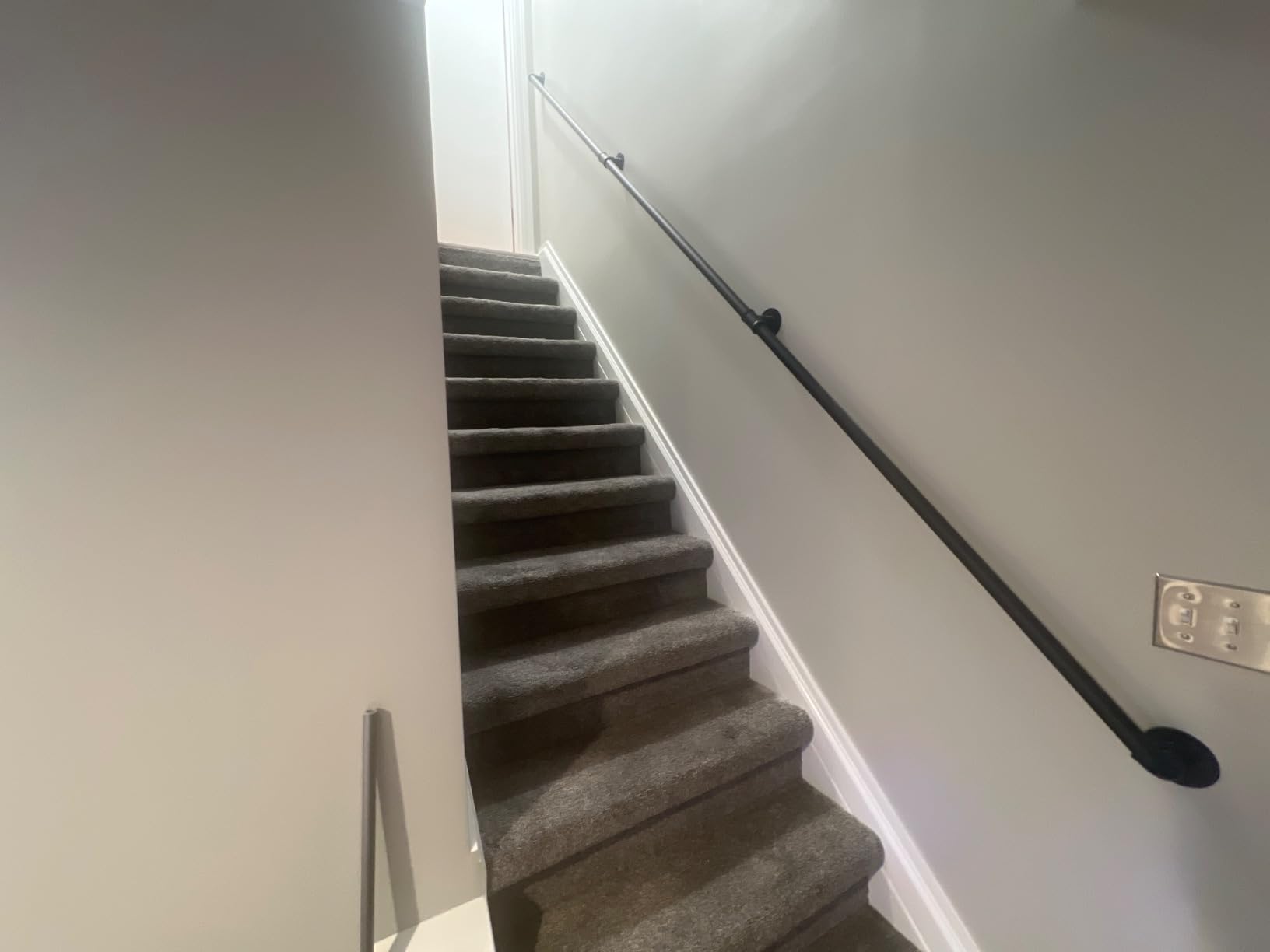
Where the Purife rail is a single grab point, this RECTOO rail is three continuous feet of grip. That difference matters on a staircase, because a user needs to keep one hand on the same rail for the whole descent rather than moving between stubs.
Owners consistently describe it as sturdy and well finished, and the black coating arrives ready to mount with no prep. The kit includes screws, and the rail mounts horizontally, on an incline or vertically depending on the staircase.
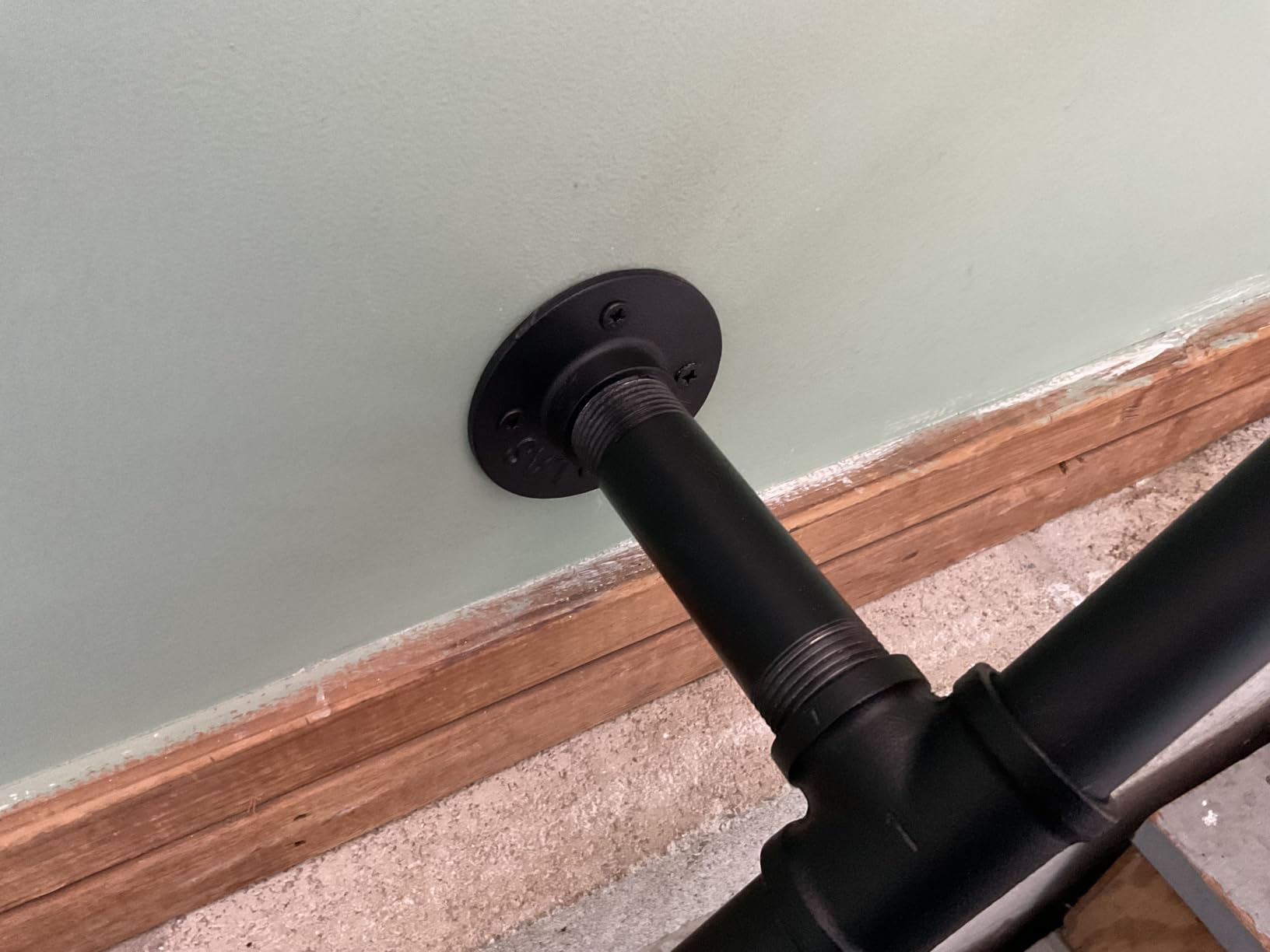
Each bracket is rated to 440 lb, ample for a rail carrying body weight in an emergency fall arrest. The pipe is 1.2 millimeter steel with a corrosion-resistant coating, and it mounts to wood, concrete, vinyl, brick and stucco with the right fasteners.
Buy the length you need rather than cutting it. The threads are non-standard, so shortening a rail and re-threading the fitting is a fiddly job, and the same range runs from 2 to 12 feet for long runs.
Why continuous grip changes the safety picture
The riskiest moment on a staircase is the descent, when a person is moving fast with no free hand. A continuous rail lets one hand stay committed the entire way while the other remains free for a cane, and it is the cheapest way to make an existing stair-assist cane work properly.
The fix for the weak hardware
Reviewers almost all mention the same problem, that the included plastic anchors strip in drywall. Swap them for toggle fasteners or screw into blocking and the complaint disappears, turning a mediocre install into a safe one in ten minutes. Outdoors, treat the base plate rather than the pipe as the weak point, since galvanized steel outlasts powder coat in standing water.
6. Frossvt 26 Inch Outdoor Grab Bar – For Porches and Garden Steps
Handrail for Outdoor Grab Bar Frossvt Wall Mount Handrail, 25.8” Garage, Porch, Garden 1 to 3 Steps Stairs Black
Rated to 500 lb
1.2 inch steel tube
45 degree grip tilt
Triple rust-proof coating
Pros
- Sized specifically for 1 to 3 step entries
- Ergonomic 45 degree tilt gives a natural climbing grip angle
- Well-made welds and substantial feel
- Basic tools are enough to mount
- Sold as a single or a two-pack
Cons
- Supplied screws can strip even with pilot holes
- Plastic anchors are not adequate for load-bearing grip
- Not designed for full body weight on a long flight
Most stair rails are designed for a carpeted interior. This one is not. The Frossvt bar is a 26 inch outdoor grab rail with 1.2 inch 16 gauge steel and three layers of rust-proof treatment, built for the three steps up to a porch or the steps into a garden.
What sets it apart is the geometry. After an 11.8 inch upright section the rail tilts down at 45 degrees, putting the hand at a natural angle for climbing rather than pushing the wrist into a reach. Owners of this style frequently describe regaining independence after surgery because of that grip position.
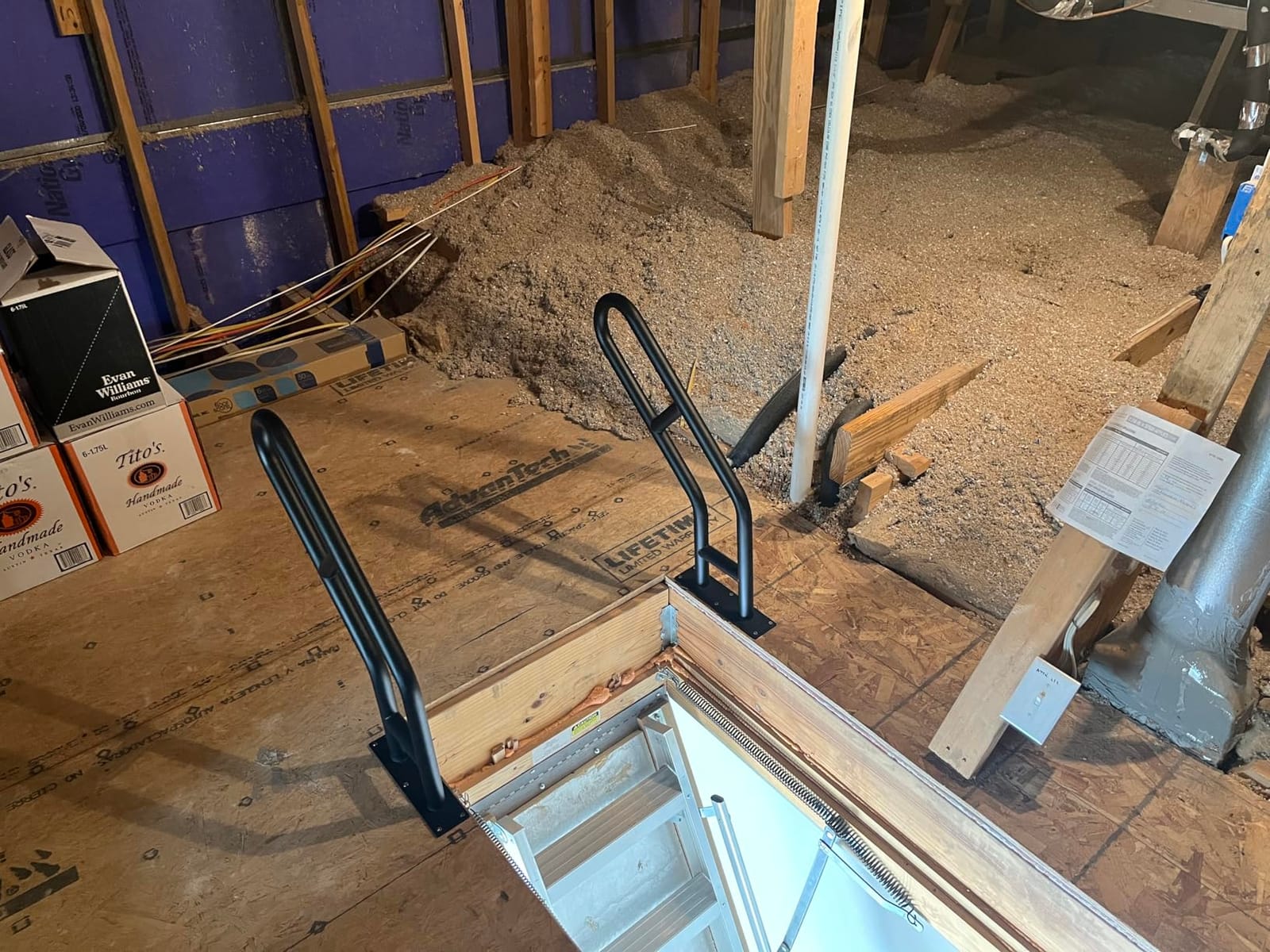
Six holes in the wall plate allow positioning, and the maker specifies a 6mm drill bit with plastic anchors on solid walls. Maximum rated load is 500 pounds, though the design intent is short transitions rather than supporting full body weight over a long descent. A two-pack is the sensible choice for anyone descending, since the hand works harder on the way down.
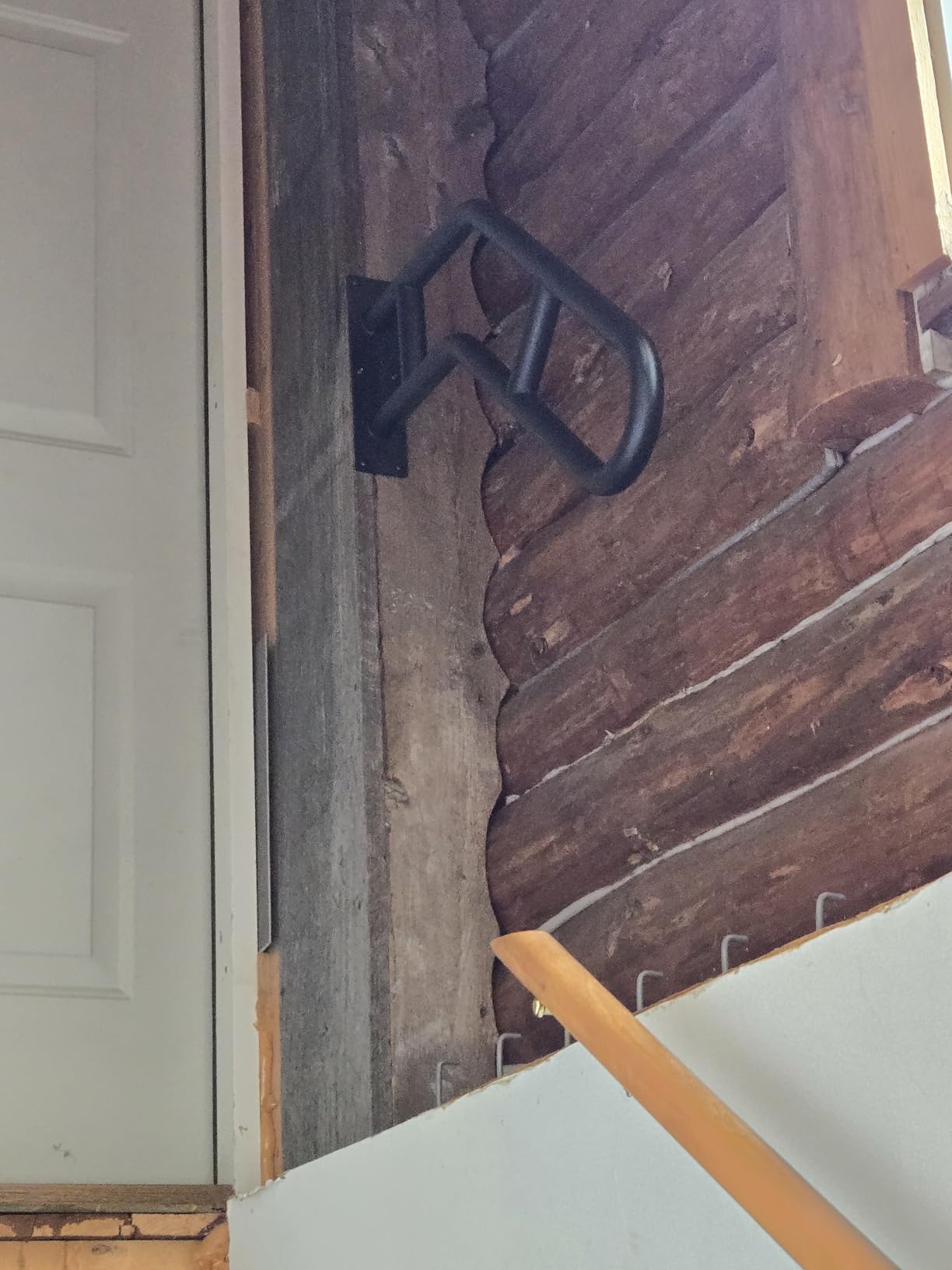
Best used at the front door, not mid-flight
The sizing is specific and correct at one to three steps. For the six-step return from a porch to a sidewalk path, or a run down to a basement, this is the wrong length and a continuous rail is the better buy. Where it is right is the front and back doors of a typical home, which is where most outside fall risk concentrates.
Outdoor mounting is the whole job
Several owners found the supplied screws strip even after drilling pilot holes and recommend longer screws anchored into a stud instead of a plastic anchor in a hollow wall, while concrete or brick needs a masonry bit. If the wall is siding over a cavity, the honest answer is that no grab bar is safe until there is solid material behind it, so add a backing board and then mount.
7. Support Way 2-in-1 Stair Assist Cane and Standing Aid – Two Uses for One Tool
Support Way 2-in-1 Stair Assist Cane & Standing Aid for Seniors
Stair cane and stand-assist rail
5.5 lb weight
Retractable Y-shaped legs
Two-step assembly
Pros
- Doubles as a stair aid and a rising aid for sofas
- chairs and toilets
- Retractable legs adapt to different step heights for a level base
- Symmetrical design works for either hand
- Light at 5.5 lb and assembles without tools
- Reduces strain on knees and hips
Cons
- Lowest average rating in this group with roughly 15 percent one-star reviews
- Stand-assist use needs a push rather than full body weight
- Retractable legs feel less stable on very steep or narrow stairs
The idea is a single piece of equipment for two moments in the day: getting up a flight of stairs, and getting out of a low sofa or off a toilet. Retractable Y-shaped legs shorten on one step and extend on the next, keeping the platform level on an uneven run.
At 5.5 lb with a cushioned handle and two-step assembly, it is the kind of thing you can hand to a parent and they will actually use, which is not a small thing in a category full of devices abandoned in a closet.
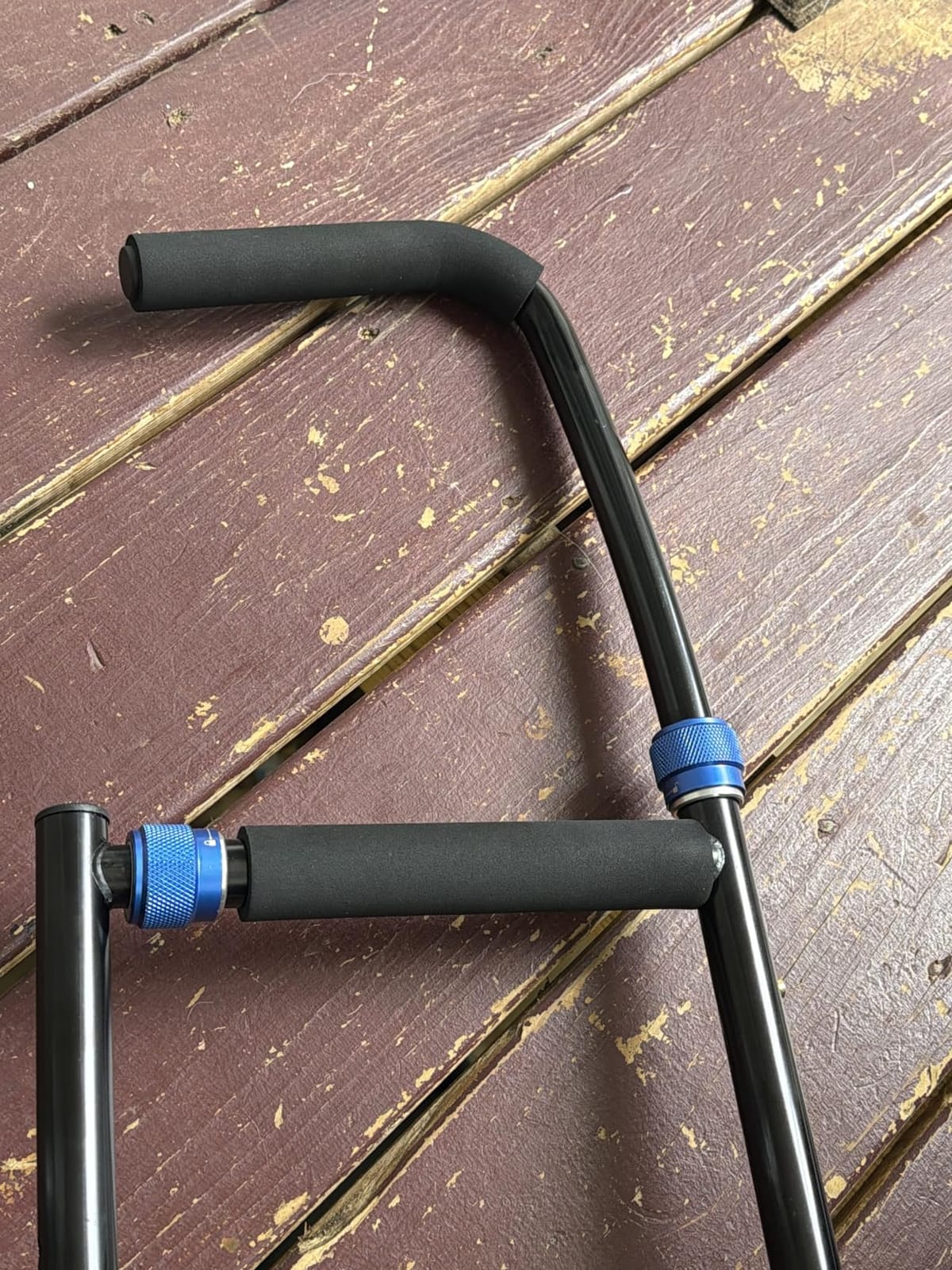
Users report the biggest benefit is on the standing transitions, since a fixed frame beside a chair is one more piece of furniture in the room while this folds and moves between locations, working indoors, out on steps, and along garden paths. Reviewers like the versatility and the control of the cushioned grip, and the symmetrical frame suits either hand.
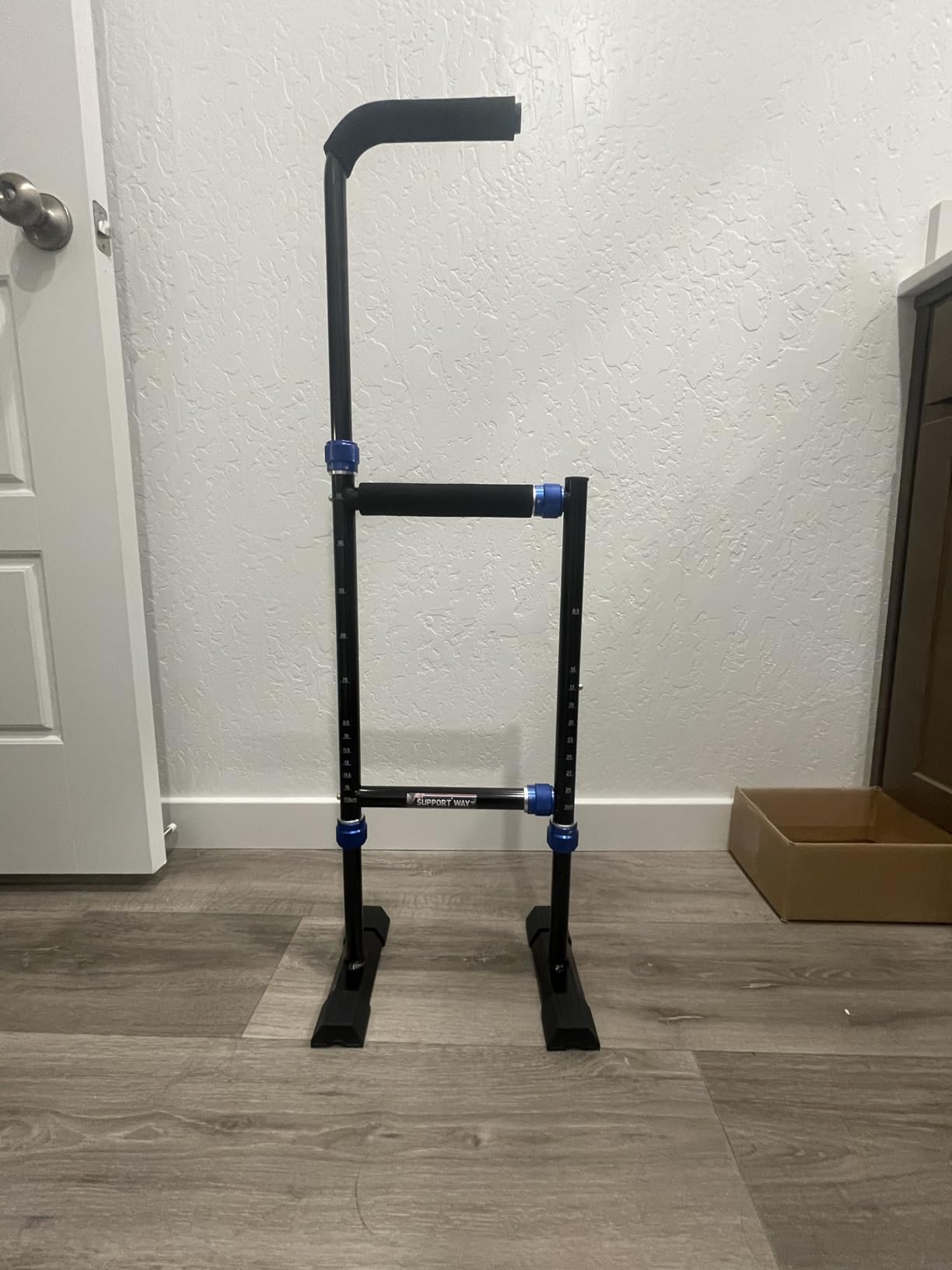
Best for someone who will actually use a cane
Any stair-assist cane depends on the user having a realistic chance of gripping it and bearing weight one step at a time. This suits an ambulatory senior with early balance trouble who walks slowly but reliably with a hand on the rail, and the sofa and toilet function often delivers the immediate win, since a person who feels steady on stairs can still be startled by the effort of standing from a deep seat.
Where the mixed reviews come from
The stand-assist function needs a controlled push rather than a full body-weight lean, and the telescoping legs give under a hard push on a steep step. Its 4.0 average is the lowest in this group and worth respecting rather than explaining away, so read it as a versatile lightweight aid paired with a properly anchored rail, not a load-bearing support on its own.
8. HeywoodCabin 20-Level Stair Assist Cane – Most Adjustable for Odd Stair Heights
20-Level Adjustable Stair Climbing Assist Cane & Elderly Stair Lift Assist with Anti-Slip Handle & Stabilizing Feet, Standard Steps-Patent Pending (grey)
35-45 inch adjustable height
300 lb capacity
4.4 lb weight
Four rubber feet
Pros
- Twenty height levels cover standard and unusual step heights
- Very light at about 4.4 lb so it moves between steps easily
- Four non-slip rubber feet grip wood
- tile and stone
- Tool-free pin adjustment
- Stands upright for storage at top or bottom of stairs
Cons
- Needs re-adjusting for every different stair run
- Plastic spacer plug is easy to miss during assembly
- One reviewer reported a bent handle at heavier loads
- Not practical to carry outdoors
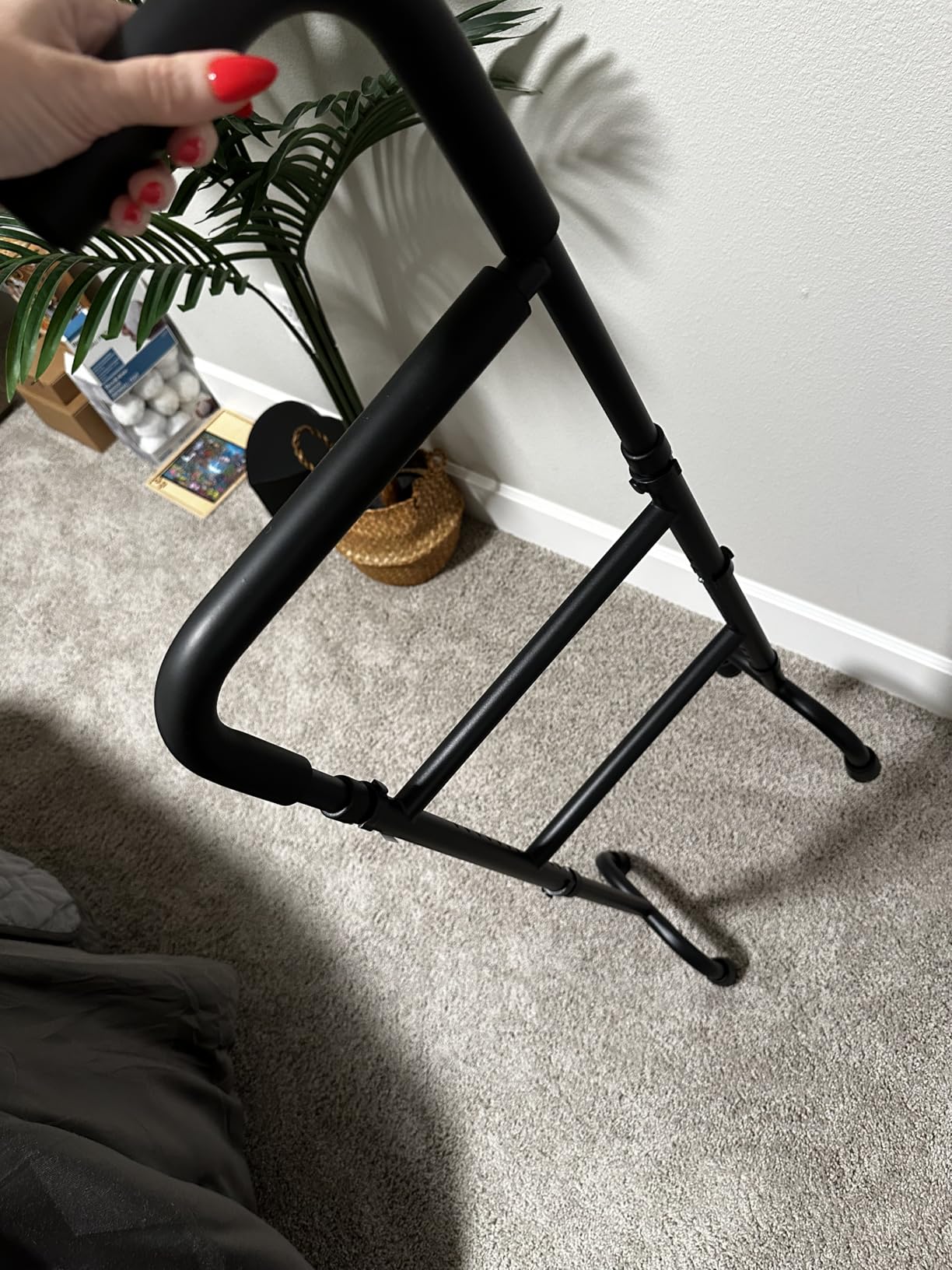
Twenty height settings from 35 to 45 inches is the widest range here, and that is what makes this cane interesting for old houses. Split-level floors, half-risers and converted attics rarely have consistent geometry, and a fixed-height cane becomes a compromise at one end of the run.
The frame is carbon steel with an anti-rust coating rated to 300 pounds, with four rubber feet and an anti-slip foam handle. Reviewers recovering from surgery or living with Parkinson’s describe real independence gains, provided the cane is held close to the body alongside a wall rail.
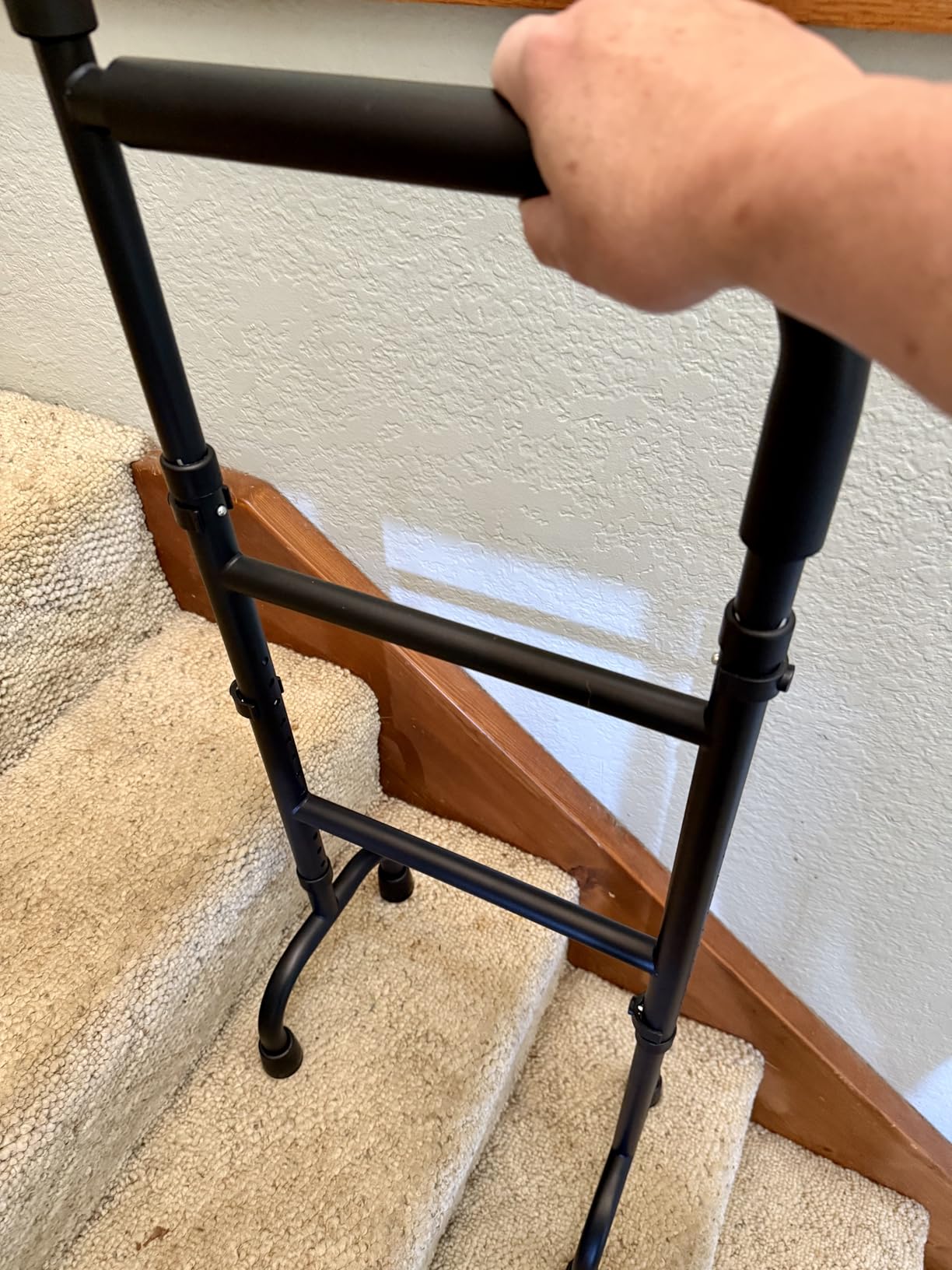
At about 4.4 lb it is light enough to pick up and reposition between steps without breaking stride, and it stands upright at the top or bottom of the stairs without needing a hook. One assembly detail catches people out: a white plastic spacer plug sits between the tubes and should not be removed, and the wobble owners felt was caused by leaving it out.
Where the adjustment actually earns its keep
Twenty levels are not a gimmick in a house with a split-level staircase, where the same cane must be set differently on each half, or where a taller and shorter person share the same stairs. Reviewers also value the weight, since on a long run the difference between carrying a light tool and a heavy one decides whether it gets used or abandoned.
What the 4.2 rating reflects
Two things recur. The handle is foam, and one reviewer at 270 lb pushing upward reported it bending, so anyone heavier should check the handle first. The other is re-adjustment on stairs with varying risers, plus the fact that the four-foot base that gives stability on a step becomes a trip hazard on flat ground, making this an indoor tool rather than a walking cane for trips outside.
9. MMingo Adjustable Stair Climbing Cane – One Device for Walking and Stairs
MMingo Adjustable Stair Climbing Assist Cane for Seniors, Non-Slip Walking Aid for Stability and Mobility on Stairs, Walk Up and Down with Ease
Walking cane and stair cane
10 height settings
300 lb capacity
Telescoping half-step pedal
Pros
- Works as a normal walking cane and a stair-assist cane
- Telescoping half-step pedal gives leverage on the riser
- Ten height settings from 28.8 to 37.8 inches
- Hand strap stops the cane slipping from a weak grip
- Stroke and hip surgery recovery users report regaining stair independence
Cons
- Pedal is stiff to extend and retract at first
- Rigid base lacks the flex of a quad cane
- About 1 kg is heavy for a cane
- Small base is not suitable for poor balance
- Some foam handles cracked within about a year
This is the only device here that works as an ordinary walking cane between trips and a stair-assist cane on the steps. For someone who uses a cane on the flat and struggles on stairs, owning two devices is a hassle and this removes the switch.
The mechanism is an extendable telescoping pedal that forms a half-step on the riser, giving the user something to push off. Reviewers recovering from stroke or hip surgery describe it as the feature that got them back on the stairs, which is a strong signal in a temporary recovery situation.
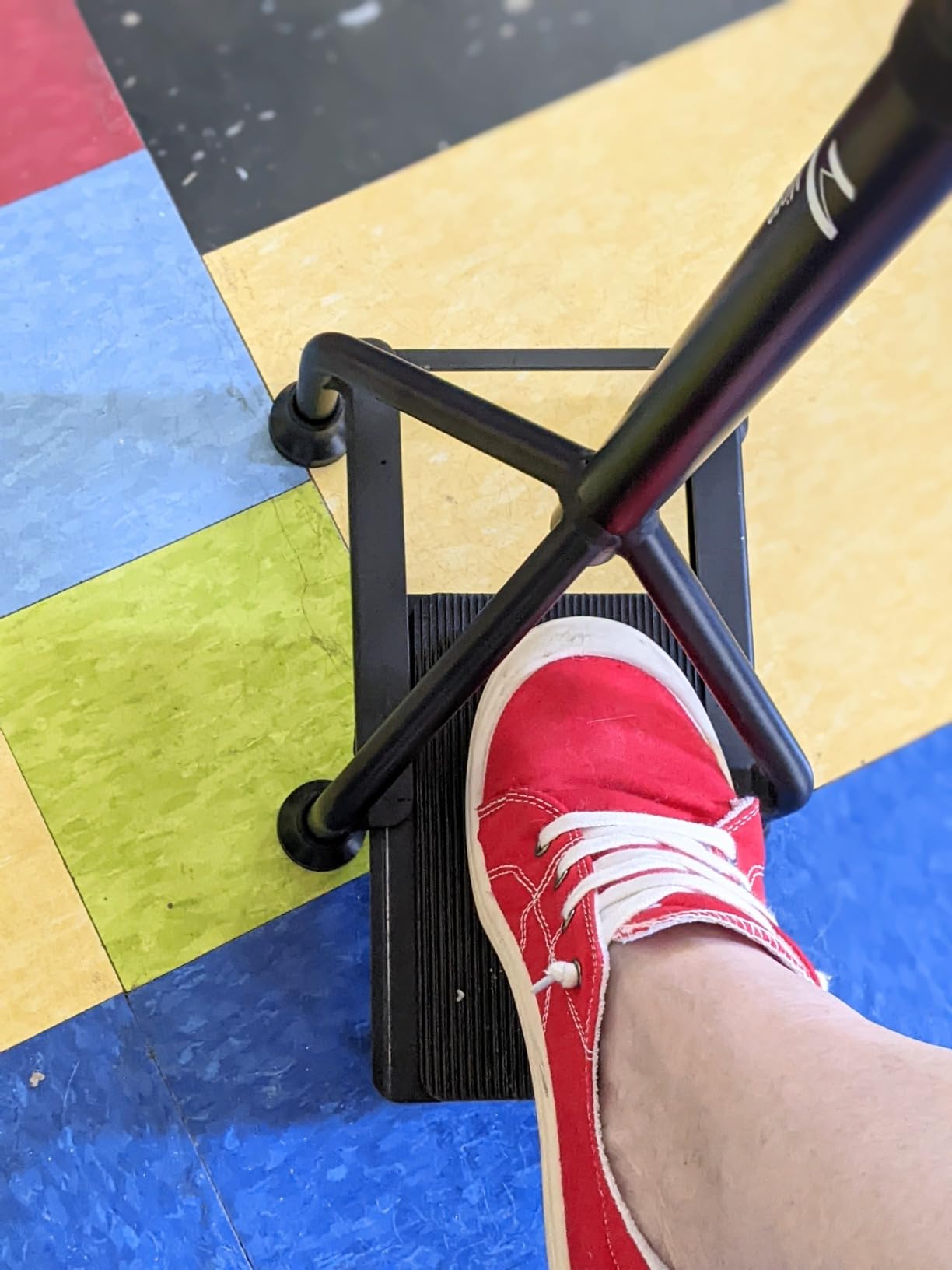
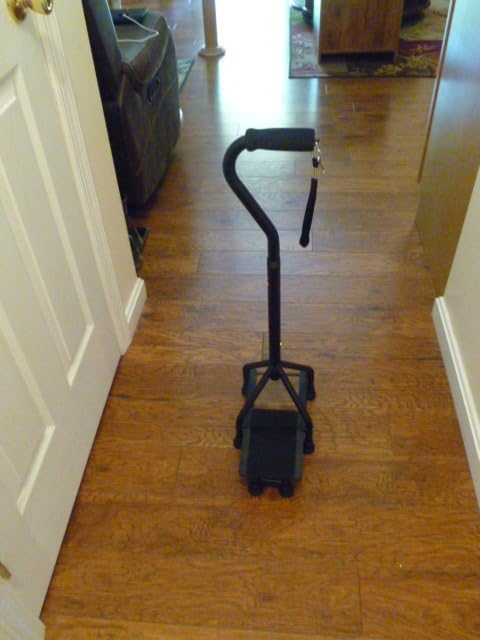
Construction is aluminum and steel with a rust-resistant textured coating, a 6-prong base rated to 300 pounds and a 7.83 inch base footprint. The hand strap is the detail worth noting, keeping the cane in place when grip strength is part of the reason the person needed help, with ten height settings from 28.8 to 37.8 inches and an anti-slip foam handle.
Best as a transitional aid
This is the strongest option here for a defined recovery window, where the goal is independence now and a cane at the end. Post-hip, post-stroke and post-operative patients get the most value because the tool does two jobs, and the hand strap removes the failure mode where a cane slides out of a relaxed grip mid-moment.
Where the dual function works against you
The pedal is stiff and owners report a learning curve before it moves smoothly, which matters if the user must operate it under fatigue or in a hurry, the exact conditions that make stairs dangerous. The rigid base is the second limitation, since a quad cane flexes to absorb small placement errors and this one does not, and some foam handles have cracked within about a year.
10. ZczCjWq 13-Adjustable Stair Assist Cane – The Lowest-Cost Way to Start
ZczCjWq Stair Assist Cane, 13-Adjustable Non-Slip Mobility Aid for Elderly
13 height settings
300 lb capacity
4.5 lb weight
Four-foot stabilizing base
Pros
- Least expensive stair-assist cane in this group
- Lightweight carbon steel build at about 4.5 lb
- Thirteen height settings for varying stair heights
- Four-foot base gives good stability when placed properly
- Dual cushioned grip points
- One-year warranty included
Cons
- Stability drops at the tallest setting for a tall user
- Does not sit level on stairs of uneven height
- One heavier buyer returned it as not sturdy enough
- Assembly screws need full tightening
When a family asks what the cheapest stair lift alternative is, this is close to the answer. It is a carbon steel stair-assist cane with 13 quick-pin height settings, a four-foot base and two cushioned grip points, and it is among the lightest canes here at about 4.5 pounds.
Buyers cite successful post-surgery use and the low cost relative to a handrail or a stair chair lift, and that framing is correct. For someone who can still walk the stairs with support, this is a fraction of the commitment.
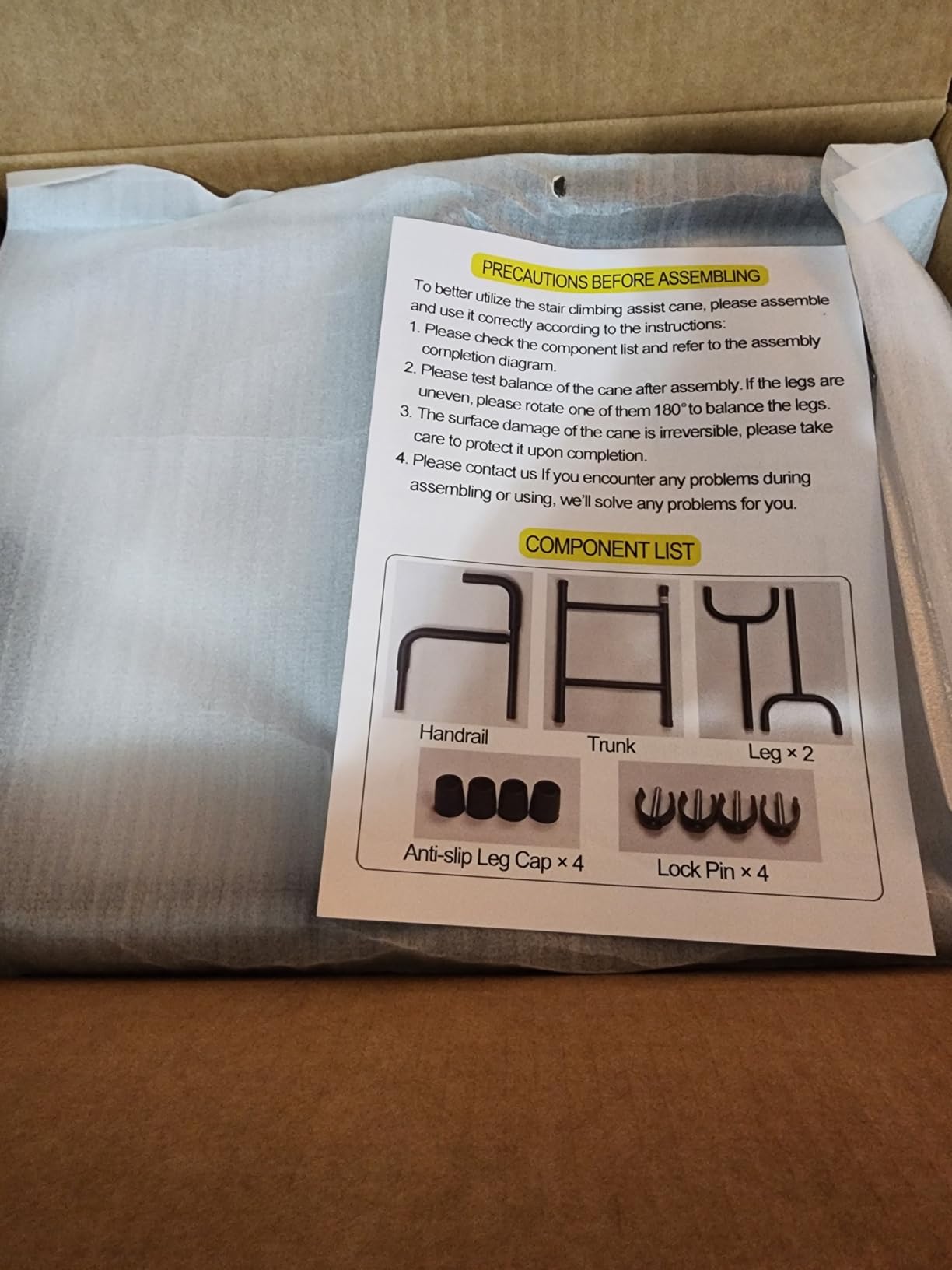
The details are sensible. Non-slip rubber tips grip wood, tile and carpet, reinforced plastic sleeves add rigidity, and a soft foam handle reduces hand fatigue over a long run. A one-year warranty and illustrated manual come in the box, which is more than most devices at this level provide, though assembly does require tightening every screw fully or it wobbles.
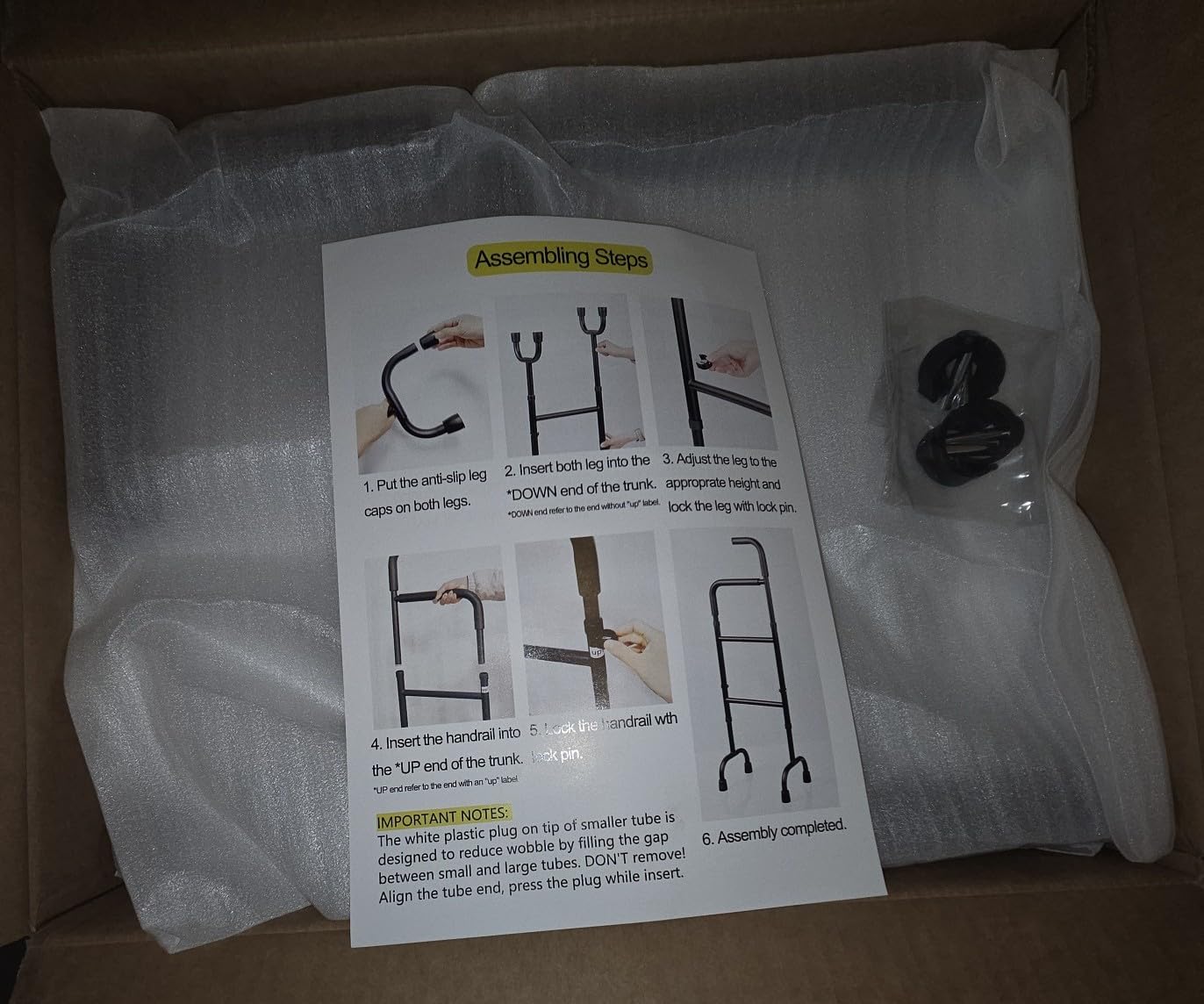
A sensible first step before spending more
For a senior with mild balance concerns who still walks the stairs independently, a cane and a rail together are the cheapest path to a safer staircase in this roundup. The rail anchors once and the cane is the tool carried between rooms, and nothing is drilled, so it is the reversible option that renters and condo owners are looking for.
The honest limits of a light cane
Stability drops noticeably at the tallest setting for a tall user because the base sits higher off the tread, and one heavier buyer returned the cane as not sturdy enough, so anyone near the 300 lb ceiling should test it on the top step first. It also sits unevenly on stairs of uneven height, so pair it with a continuous rail and reset the pin height on each staircase.
Who Should Not Use a Stair Assist Cane or Portable Device
Every review in this roundup has a happy path, and each one has a person who should not have bought the product. This is the section most comparison pages leave out, and it is the one that matters most.
Stair-assist canes require the user to take a step, bear weight on one leg, and grip with a hand that can hold. Someone with severe balance impairment, advanced arthritis in the hips or knees, or lower-limb weakness after a stroke may do none of those things, and a cane then becomes a liability rather than help. Caregivers on forums ask for exactly this guidance and rarely receive it.
Cognitive decline changes the calculation again. A device that must be positioned carefully, adjusted between flights, or fetched from the top of the stairs requires memory, planning and judgment. A cane forgotten at the bottom of a flight is a hazard, and so is one used in the wrong direction by someone who cannot recall the sequence.
Weight matters too. Every cane here is rated to 300 pounds and every handrail sits between 440 and 500 pounds, and those are hardware limits rather than judgements about the person. Portable ramps rated to 800 pounds have their own ceiling once a caregiver, a powerchair and its batteries are added.
If any of those apply, move to a caregiver-attached stair climber, a vertical platform lift, or a home lift. Those carry the person rather than relying on the person to move. Our stair climber machine comparisons cover the caregiver-operated options in detail, and our patient lift guide covers the transfer side of the same problem.
How to Pay for Stair Lift Alternatives
Almost every family starts with the same wrong assumption, that Medicare will pick up most of this. It will not, and the reason explains a lot about how the alternatives are funded.
Medicare Part B covers durable medical equipment, a category including wheelchairs, walkers, rollators, canes and patient lifts. A stair lift is not on that list because it attaches to the structure of your home, which places it in the home-modification category instead. Medicare Advantage Part C plans vary, and some offer a supplemental accessibility benefit, so read your specific plan rather than assuming.
Where the alternatives fare better is Medicaid. Home and community-based services waivers in many states can fund ramps, platform lifts and some home modifications when they are part of a care plan that keeps a person out of a nursing facility. Rules and waiting lists differ sharply by state, so contact your local office early rather than after choosing a product.
Veterans have dedicated routes. Specially Adapted Housing grants, the Home Improvements and Structural Alterations benefit, and the Temporary Residence Adaptation grant can fund accessibility work depending on disability rating and living situation. A state assistive technology program through the AT3 Center network is another underused source, and an Area Agency on Aging can point you at local funding. Health savings and flexible spending accounts can also be used for accessibility items with a doctor’s prescription, which is the fastest route for the lower-cost purchases here.
Renters, Condos, HOAs and Resale Value
Portable options win here outright. Nothing in the ten products above is permanently fixed to a home, so a renter can use every one of them, a condo owner can use all but the handrails without a board vote, and a moving family can take the solution along.
Handrails are the one to check first with a landlord or association, since mounting requires drilling into studs and usually needs written permission even when the rail costs little. Ask in writing, and offer a surface-mounted model that attaches to a stair stringer instead of the wall, because some buildings approve that where they will not approve wall penetration.
On resale value the picture is mixed. A rail-mounted stair lift is a fixed alteration that some buyers read as a sign of a difficult house, and fixed ramps can dominate a front elevation. Portable options are neutral because they leave no trace. Through-floor home lifts and shaftless elevators are the exception, and they generally add value because aging-in-place appeal is growing among buyers. Moving the bedroom and a full bathroom downstairs avoids the question entirely, and our bath lift roundup covers the smaller bathroom changes that make a downstairs conversion work as a full bath rather than a half one.
Caregiver Reality Check for Portable Options
The most common reason families return a portable stair device is not the device. It is realizing that “portable” and “independent” are different words, and most of the strongest options need a second able-bodied person for every trip.
A caregiver-attached stair climber is driven by a helper, and the chair typically weighs enough that loading it takes two people. Families caring for a heavy parent describe this as exchanging one problem for another: the fall risk is gone and the caregiver’s back becomes the risk. Ask any dealer how many trips a day the chair makes and who is available for each one.
That is the argument for the two categories of equipment on this list. A wheelchair ramp and an anchored handrail let the person do the work themselves with a caregiver nearby rather than attached, and devices where the user stays seated throughout, such as platform lifts and home lifts, sit at the other end of the spectrum. Where a sit-to-stand device is already part of the transfer routine, our patient lift roundup breaks down the weight classes and two-person operation requirements.
Frequently Asked Questions
What are some alternatives to stair lifts for seniors?
The main alternatives are portable or modular wheelchair ramps, stair-assist canes and standing aids, wall-mounted handrails and grab rails, portable stair climbers and track chairs, vertical platform lifts and porch lifts, home lifts and shaftless elevators, and home modification such as moving the bedroom and a full bathroom downstairs. Downsizing to a single-story home removes the problem entirely.
Why are stair lifts not covered by Medicare?
Medicare Part B covers durable medical equipment such as wheelchairs, walkers, rollators, canes and patient lifts. A stair lift bolts permanently to the staircase, so it is classified as a home modification rather than medical equipment, which puts it outside Part B coverage. Some Medicare Advantage Part C plans offer supplemental accessibility benefits, so check your specific plan documents.
Does AARP cover stair lifts for seniors?
AARP does not provide insurance coverage and does not pay for stair lifts or accessibility equipment. The real funding channels are Medicaid home and community-based services waivers, VA Specially Adapted Housing and Home Improvements and Structural Alterations grants, your local Area Agency on Aging, state assistive technology programs, and health savings or flexible spending accounts with a doctor’s prescription.
What are some modern alternatives to stairlifts?
Modern alternatives focus on the portable, no-construction end of the market. Folding aluminum wheelchair ramps handle 2 to 24 inch rises without any install, stair-assist canes add leverage while the user still walks, and wall-mounted grab rails give a fixed hand to pull on. At the permanent end, vertical platform lifts and through-floor home lifts carry the user rather than requiring them to move at all.
Do stairlifts devalue a house?
It depends on the type. A rail-mounted stair lift is a fixed alteration that some buyers read as a sign of a difficult house, and fixed ramps can dominate a front elevation. Portable devices leave no trace and are neutral. Through-floor home lifts and shaftless elevators generally add value because aging-in-place appeal is growing among buyers. Moving downstairs or downsizing avoids the question entirely.
Which Stair Lift Alternative Should You Pick?
After working through ten products, the best stair lift alternatives for seniors come down to a short set of decisions. If someone uses a wheelchair and cannot transfer, a ramp is the answer, and the VNN 4FT ramp covers the widest range of ordinary front step heights at a capacity high enough for a caregiver to ride along.
If the person can still walk the stairs but not confidently, start with a rail, because a handrail turns every other device on this list into a better one. The RECTOO 3 Ft rail gives the continuous grip a descent needs, and the Purife 12 inch bar is the highest rated option for a single grab point. Add a stair-assist cane only after the rail is anchored into studs.
If the user cannot take a step safely at all, none of the ten products here is the right answer, and the conversation should move to a caregiver-operated stair climber, a platform lift or a home lift, where the equipment does the carrying rather than the person.
Every pick above is reversible, and that is not a minor benefit. It is the difference between a solution you can try, adjust or remove when the stairs change and a permanent alteration you live with for a decade. Updated for 2026, these are the choices we would make first.