
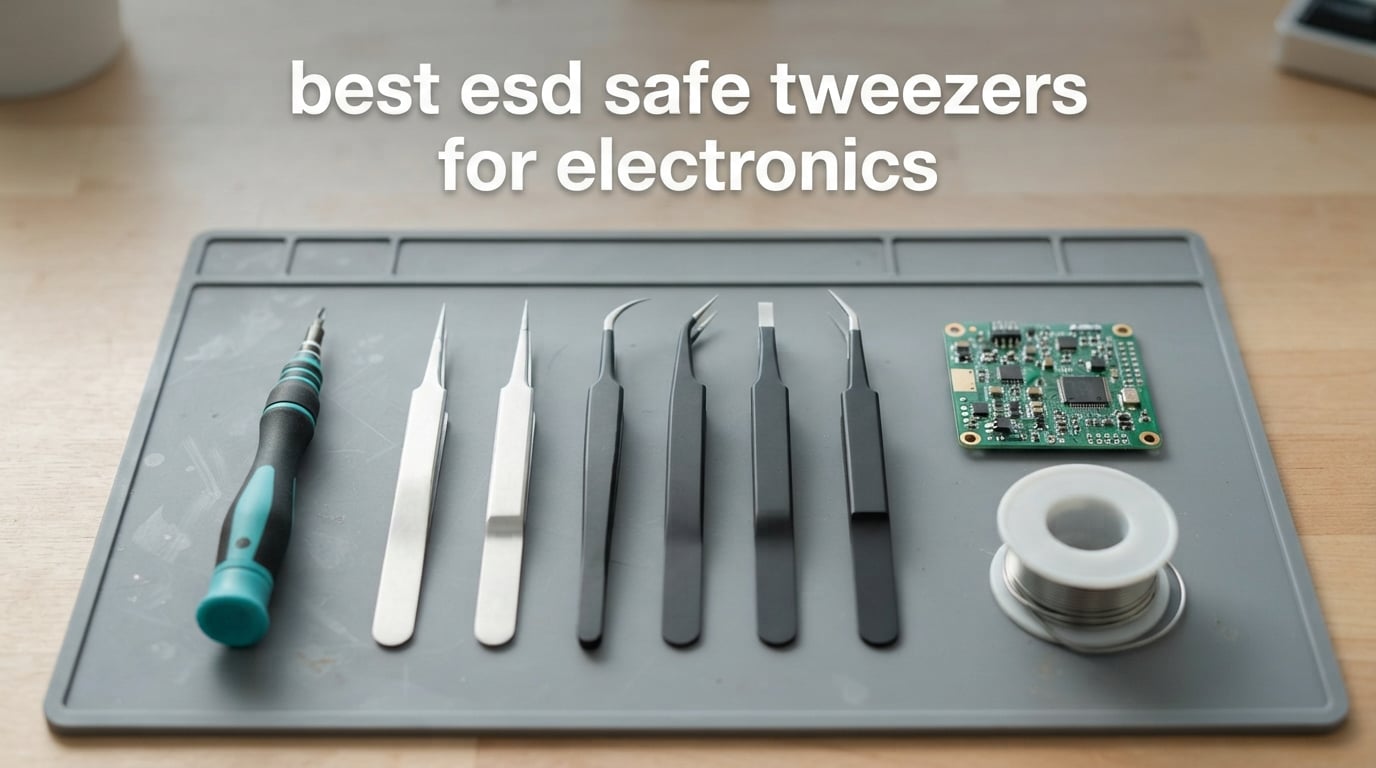
The best ESD safe tweezers for electronics are the ones that do two quiet jobs at once: they lift a 0402 capacitor off a board without knocking it flying, and they do not park a static charge on the part while they do it. That sounds like a small thing. It is not, because an electrostatic discharge from an ungrounded metal tool can exceed 5000 volts and kill a MOSFET, a CMOS sensor or a BGA IC with no visible burn mark at all. You find out weeks later when the board will not power up.
Our team has spent a lot of bench hours with precision tools and we keep coming back to the same conclusion: nobody needs one perfect pair of tweezers, they need three or four that cover different jobs. A straight fine point for dragging a QFP pin into line, a curved tip for lifting a part out of a phone, and a wide flat paddle for grabbing a shield can. That is why every set on this list is judged on shape range, tip alignment, steel thickness and whether the anti-static finish is a real dissipative coating or a thin paint that flakes off in a month.
We also read the forum threads, and the same complaint shows up over and over: sellers label anything stainless steel as anti-static without publishing a surface resistance figure, and many of those tweezers still stick to a magnet. If you are just starting out with electronics, our educational electronics kit roundup is a good companion read, since a soldering iron and a breadboard teach you far more about static than a spec sheet will. What follows is the full comparison, ten sets ranked, and an honest look at where budget ESD tweezers fall short.
Table of Contents
Top 3 Best ESD Safe Tweezers for Electronics in 2026
These three cover the widest range of bench work, from a first kit to a professional repair tray.


All 10 ESD Safe Tweezers Compared Side by Side
Every set below carries a resistive ESD finish. The differences that actually change your work are steel thickness, tip shape range and whether the tips hold alignment.
| Product | Specifications | Action |
|---|---|---|
| XOOL 9-Piece ESD Tweezers Set |
|
Check Latest Price |
 Kaisi 14-Piece Precision Set Kaisi 14-Piece Precision Set |
|
Check Latest Price |
| UUBAAR 10-Piece ESD Set |
|
Check Latest Price |
 Alitamei 10-Piece Multi-Config Set Alitamei 10-Piece Multi-Config Set |
|
Check Latest Price |
 Yababa 5-Piece Locking Set Yababa 5-Piece Locking Set |
|
Check Latest Price |
 HengTianMei 14-Piece Set HengTianMei 14-Piece Set |
|
Check Latest Price |
 HengTianMei 16-Piece Set HengTianMei 16-Piece Set |
|
Check Latest Price |
 Yababa 5-Piece Extended-Length Set Yababa 5-Piece Extended-Length Set |
|
Check Latest Price |
 XinYunfan 10-Piece ESD Set XinYunfan 10-Piece ESD Set |
|
Check Latest Price |
 YHYZ 3-Piece Precision Set YHYZ 3-Piece Precision Set |
|
Check Latest Price |
1. XOOL 9-Piece ESD Tweezers Set – Best Overall
XOOL 9 PCS ESD Precision Tweezers Set, Anti-Static Stainless Steel Tweezers Kit for Electronics, Soldering, Craft, Jewelry, Model Building
Nine tweezers in nine tip styles
Resistive ESD coating
Heat-treated steel
Pros
- Nine tip styles cover most precision tasks
- Resistive ESD coating on every piece
- Tips meet squarely and handle 0402 and QFP 0.4mm pads
- Ergonomic non-slip grip
- Canvas pouch and tip covers included
Cons
- Most tips are needle point with only two paddle styles
- No reverse-action tweezer in the set
- Dissipative coating wears with use
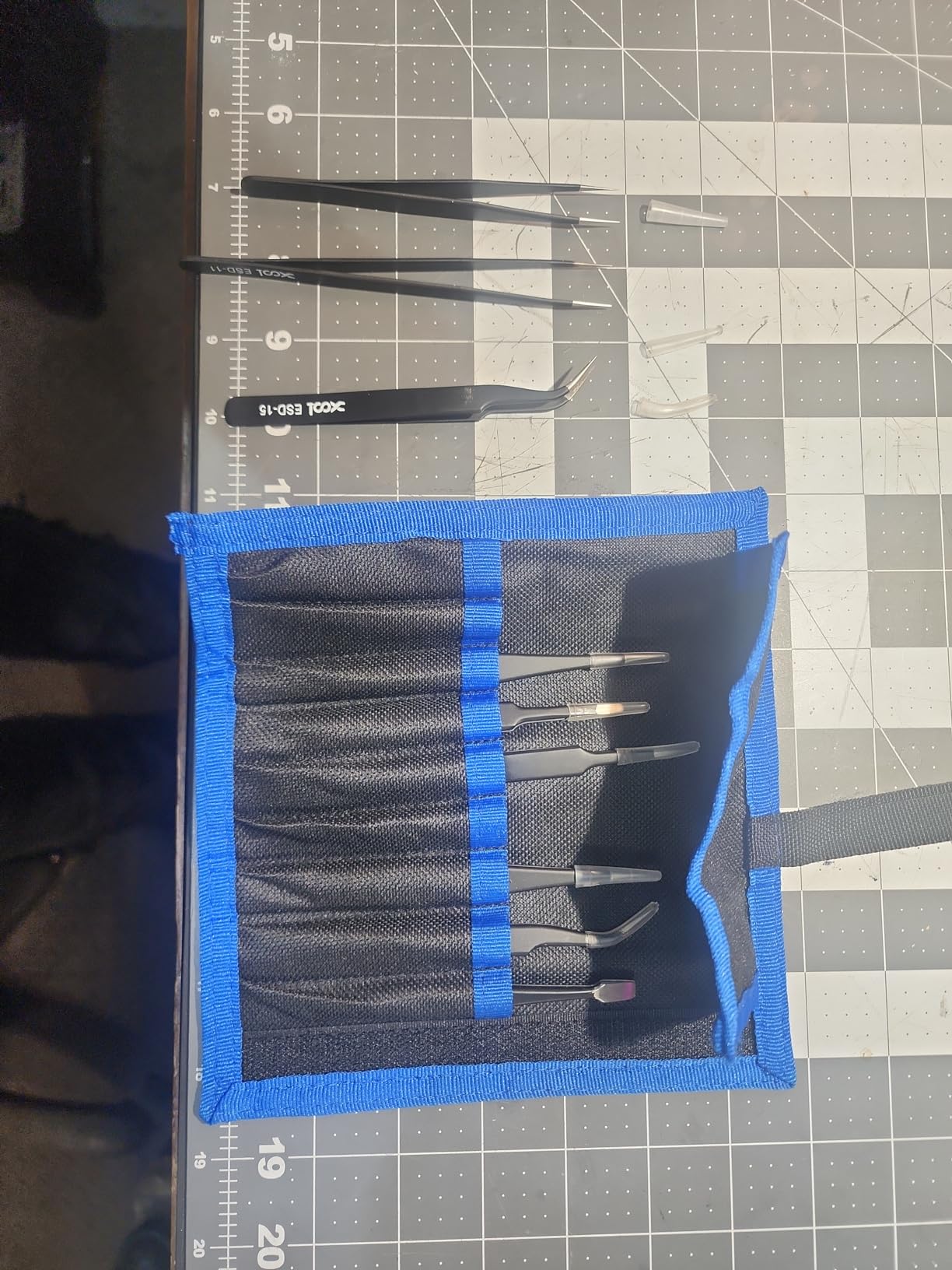
This is the set we hand to someone who is building their first bench. Nine tweezers, nine distinct tip shapes, and a resistive ESD coating on every one of them, all in a roll of canvas that takes up about as much room as a coffee mug.
The tips meet squarely, which is the thing that matters most and the thing cheap sets usually get wrong. SMD users report handling 0402 parts and QFP 0.4mm pads without the tips skating sideways, and the arm tension is tuned so the tweezers do not need a death grip to stay closed. Over a long session the non-slip surface keeps the grip steady and reviewers consistently note the handles stay comfortable.
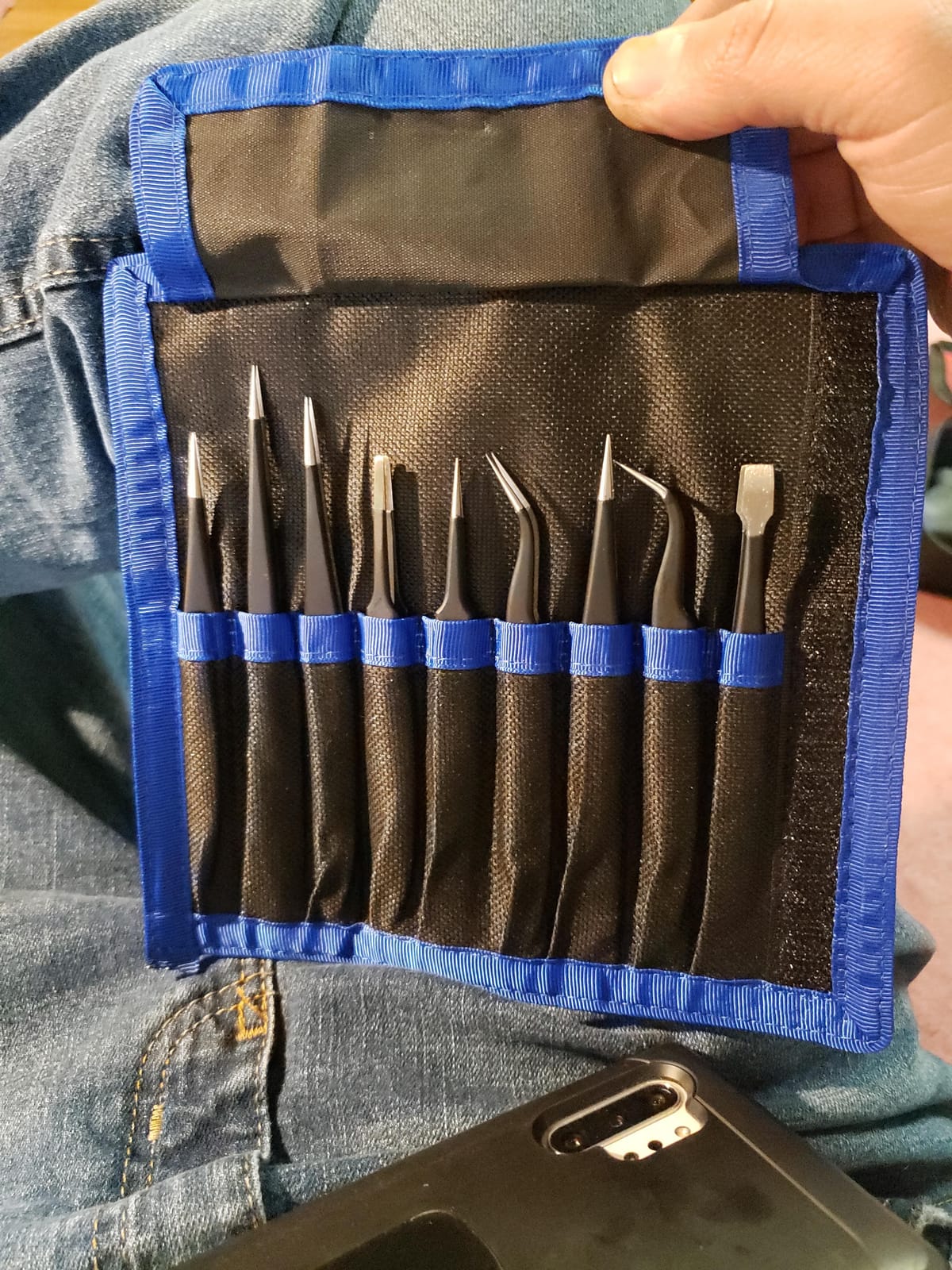
Two things to know before you buy. The assortment leans heavily toward needle point tips, with only two paddle style pieces, so if you do heavy tab-and-slot work you will be reaching for the same two tools. There is also no reverse-action tweezer in the box, which matters if you work on flex cables or flat flex connectors.
The other honest note is the coating. It dissipates charge properly when it is intact, but like most painted ESD finishes it wears with use. Treat it as a consumable surface, keep the tweezers in the pouch rather than loose in a drawer, and you will get years out of them. At 4.7 stars across more than 3.8k reviews, this is the pick with the largest review base on the list.
Who the XOOL 9-Piece Set Works Best For
If you solder surface-mount parts, rebuild a phone, or do general board repair, this is the set to start with. Nine shapes means you are not constantly re-grinding the same tip for a different job, and every tool carries the same coating, so you do not have to remember which pair is the anti-static one.
It is also a good gift for a teenager who has just discovered soldering. Nothing in the kit is fragile, the pouch stops tips getting bent in a school bag, and the tip covers keep the sharp ends from poking anyone.
Where the XOOL 9-Piece Set Falls Short
Buy a separate reverse-action or flat-blade pair if your work involves ribbon cables or removing metal shields. Those two tasks are exactly what the assortment under-serves.
For a professional repair shop doing continuous work, the painted finish is a maintenance item. You will eventually see it thin at the hinge, and at that point a bare steel tweezer is a bare steel tweezer again.
2. Kaisi 14-Piece Precision Tweezers Set – Best Value
14 PCS Precision Tweezers Set, ESD Tweezer Set, Anti-Static Stainless Steel Tweezers Set for Craft, Jewelry, Electronics, Laboratory Work
Fourteen pairs of anti-static tweezers
Heat-treated hardened steel
ESD surface finish
Pros
- Flush tips that grip even a single hair
- Heat-treated steel holds high elasticity
- Curved and cross-action tips included
- Handles 0603 surface-mount resistors reliably
- Steel tips resist rust
Cons
- Velcro on the canvas roll is misapplied so it cannot close
- Listing does not confirm the steel is non-magnetic
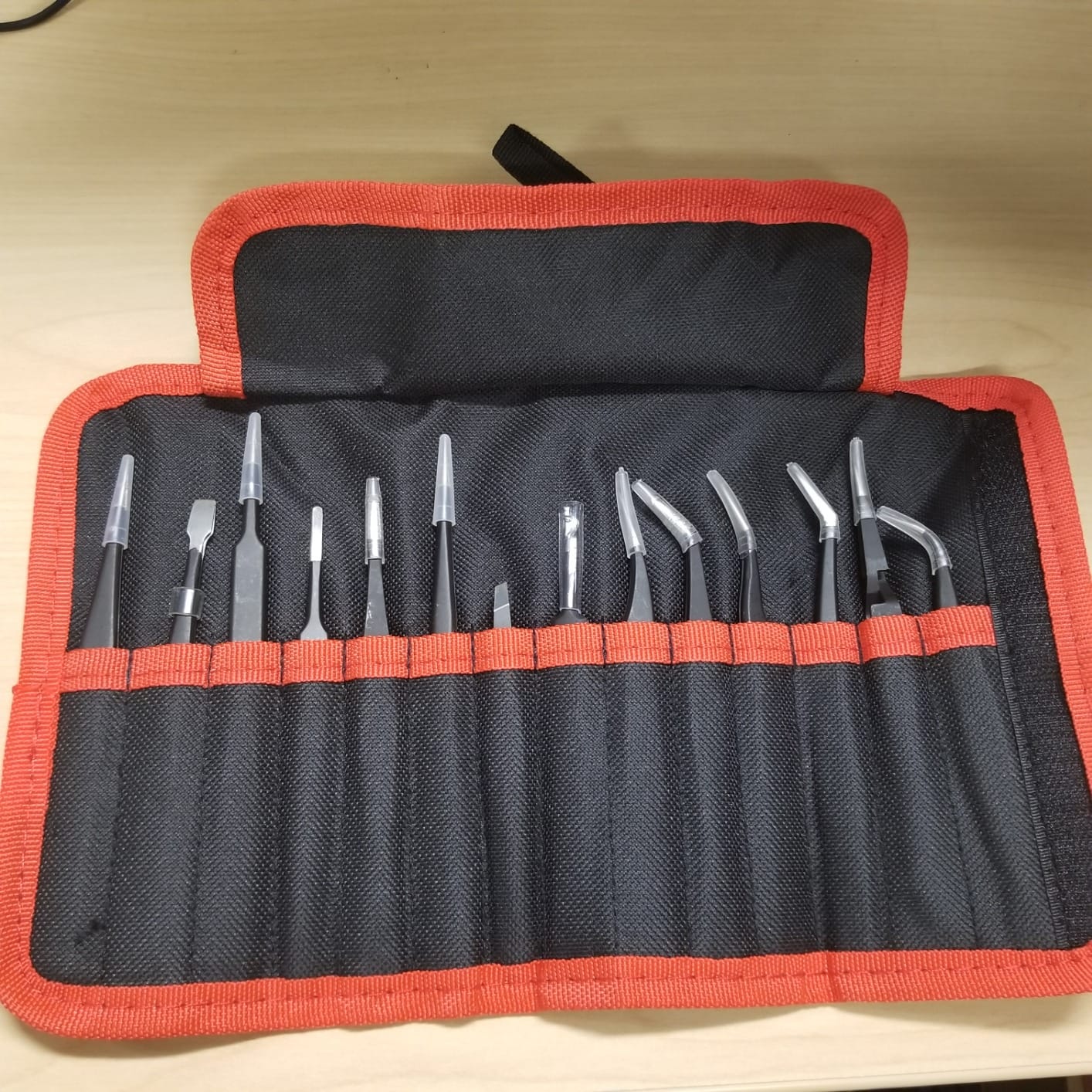
Fourteen pairs is more than most benches need and that is precisely why this one works. You stop thinking about which tool to grab and start thinking about the job. The heat treatment gives high elasticity, so the arms spring back after a year of intermittent use rather than staying splayed open.
Electronics engineers and model builders using this set report that each tweezer grips a 0603 surface-mount resistor reliably, which is the practical test that matters. Tips are high hardness, they do not narrow with heavy use, and the steel is easy to clean and resists rust at the bench.
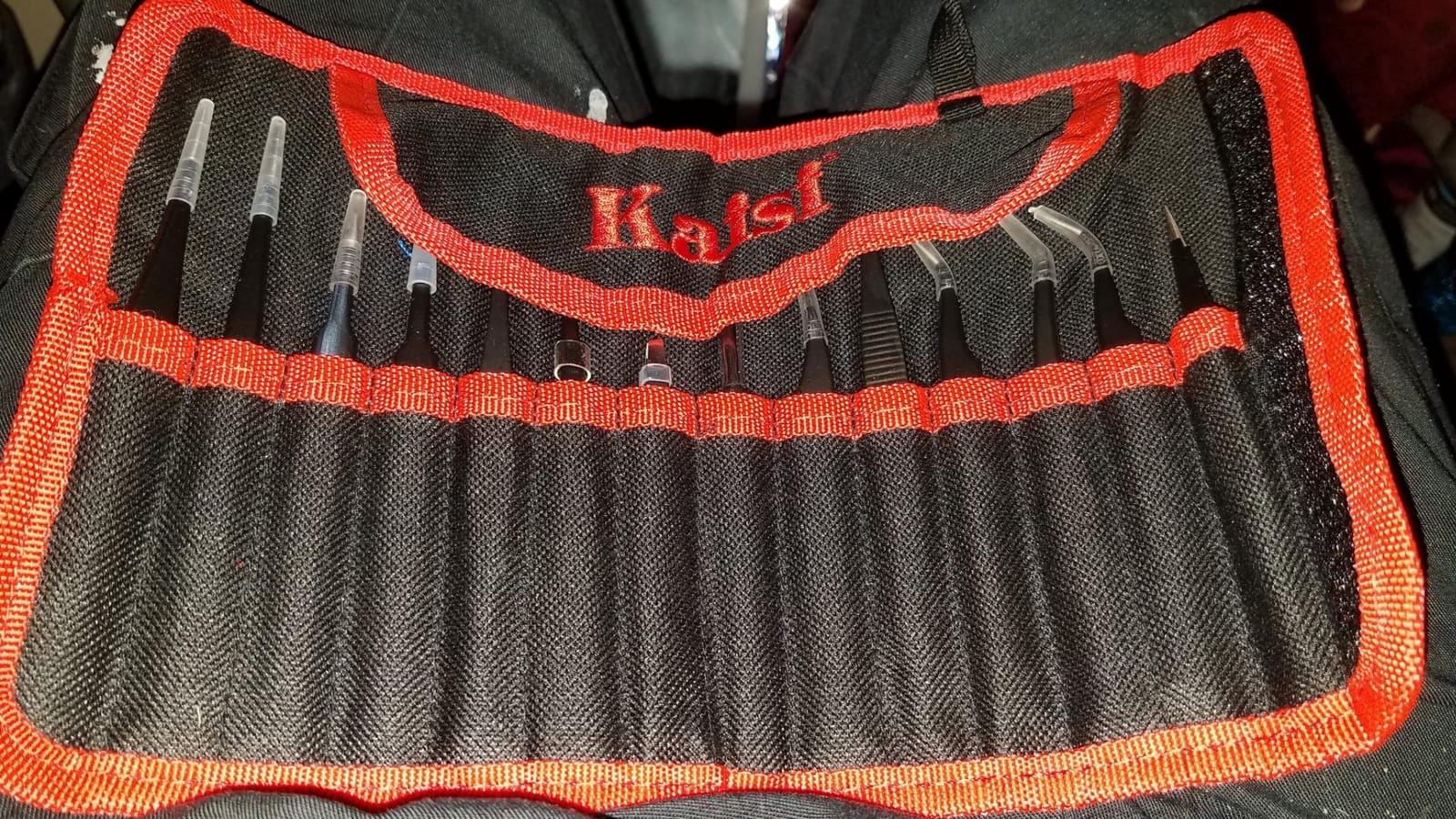
There is one recurring complaint, and it is about the case rather than the tools. The Velcro fastener on the canvas roll is misapplied, so the roll does not close completely. We have seen it work around this by folding the strap back on itself, but it is an annoyance worth knowing about before you rely on the pouch for transport.
Worth noting too: the listing describes an ESD surface antistatic finish but does not confirm the steel is non-magnetic. If you work near magnetised parts or do hard drive work, check with a magnet first. On the tool quality side, the finish and build are consistently rated as professional level, which is unusual at this tier.
Who the Kaisi 14-Piece Set Works Best For
This is the set for someone whose work changes shape from day to day. Craft one evening, board repair the next, watch servicing after that. The range of lengths, angles and shapes including curved and cross-action tips means there is always a correct tool in the roll.
It also suits a shared bench, since a second set costs less than replacing one damaged precision tool and there is no single pair anyone will fight over.
Where the Kaisi 14-Piece Set Falls Short
The volume is a mixed blessing. Fourteen tools in a soft roll is harder to scan quickly than six, so new users sometimes grab the wrong tip and wonder why placement feels clumsy.
Because the steel type is not specified as non-magnetic, run the magnet test before you commit this set to hard drive or speaker work.
3. UUBAAR 10-Piece ESD Set – Best for Rigid Steel
10 Piece Precision Tweezers Set, ESD Stainless Steel for Electronics Repair
Ten tweezers in nine tip styles
2mm heat-treated steel
Non-magnetic ESD coating
Pros
- 2mm steel resists bending under load
- Nine tip styles plus a double-ended crowbar
- ESD anti-static and non-magnetic coating
- Matte non-slip handle reduces fatigue
- Roll-up pouch with elastic slots
Cons
- Crowbar accessory adds bulk to a precision kit
- Several tip shapes overlap in practice
Most budget tweezers are stamped from 0.8mm to 1.0mm steel, which is why they bend when you squeeze a stubborn connector. This set is 2mm. That single spec change is why it feels like a different class of tool when you push on it.
The nine tip styles cover pointed needle nose, ultra-fine straight, 45 and 30 degree angled curved, rounded spade, and a square flat heavy-duty end. Customers using it for circuit board repair, soldering and SMD rework praise the variety, and the corrosion and acid resistance keeps the tips clean through flux and sweat.
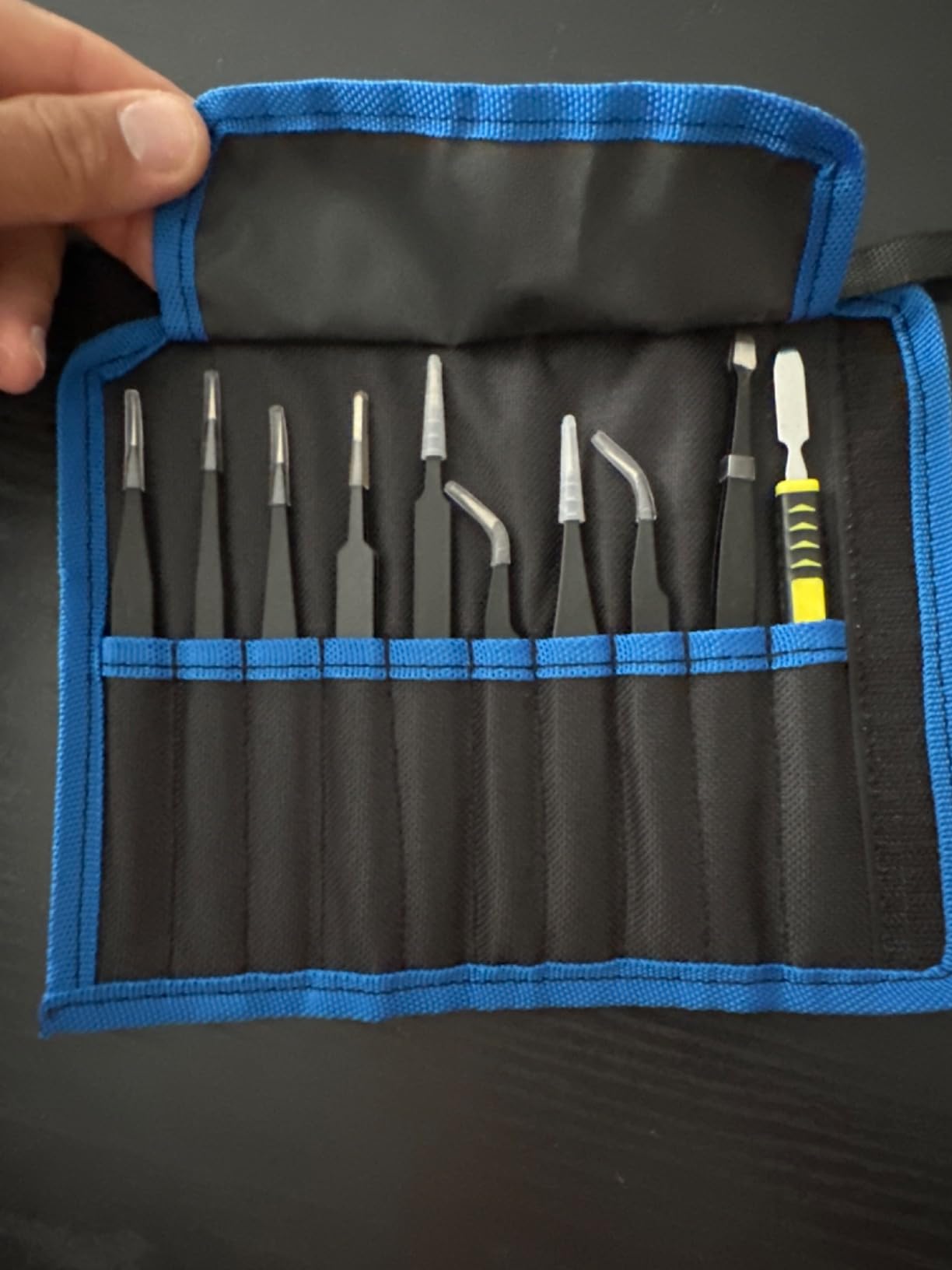
There is also a double-ended metal crowbar for prying and screw picking, which sounds gimmicky until you are opening a phone with a stripped screw. The matte textured handle is genuinely good over long sessions, and the roll-up canvas pouch with individual elastic slots means nothing rattles together in transit.
The honest drawback is that nine shapes plus a crowbar in a case this size is a lot to carry. And with that many similar-looking points, some of the range duplicates itself in practice. Pick the two or three you actually need and leave the rest in the pouch.
Who the UUBAAR 10-Piece Set Works Best For
It suits phone and laptop repair, where the boards are dense and the screws are small. The non-magnetic coating means stray screws on the mat do not leap onto your tips, which is a specific irritation on other sets.
It is also our pick for anyone who breaks tools. Thicker steel tolerates being dropped, leaned on and used as a probe, which thinner budget tweezers do not.
Where the UUBAAR 10-Piece Set Falls Short
Thick steel means a stiffer spring. If you are used to feather-light tension on 0402 parts, the first few placements take practice before the tips stop nudging the component instead of holding it.
The extra crowbar accessory makes the kit bulkier than a pure precision set, so it is less pleasant to carry around than a lighter three or five piece option.
4. Alitamei 10-Piece Multi-Configuration Set – Best for SMD Rework
Tweezers Precision Set,Easily Life 10pcs ESD Tweezers Set, Anti Static Stainless Steel Anti Magnetic Tweezers Set with Storage Bag for Craft,Electronics Repair,jewelry repair,Laboratory Work,etc
Ten tweezer configurations
Resistive ESD coating
Non-magnetic stainless steel
Pros
- Ten configurations cover most precision tasks
- Tips stay aligned after years of intermittent use
- Steel weight feels controlled without fatigue
- Non-magnetic stainless steel
- Storage bag with per-tweezer tip covers
Cons
- Tips are unhardened and bend rather than snap
- Heavier set takes longer to sort through
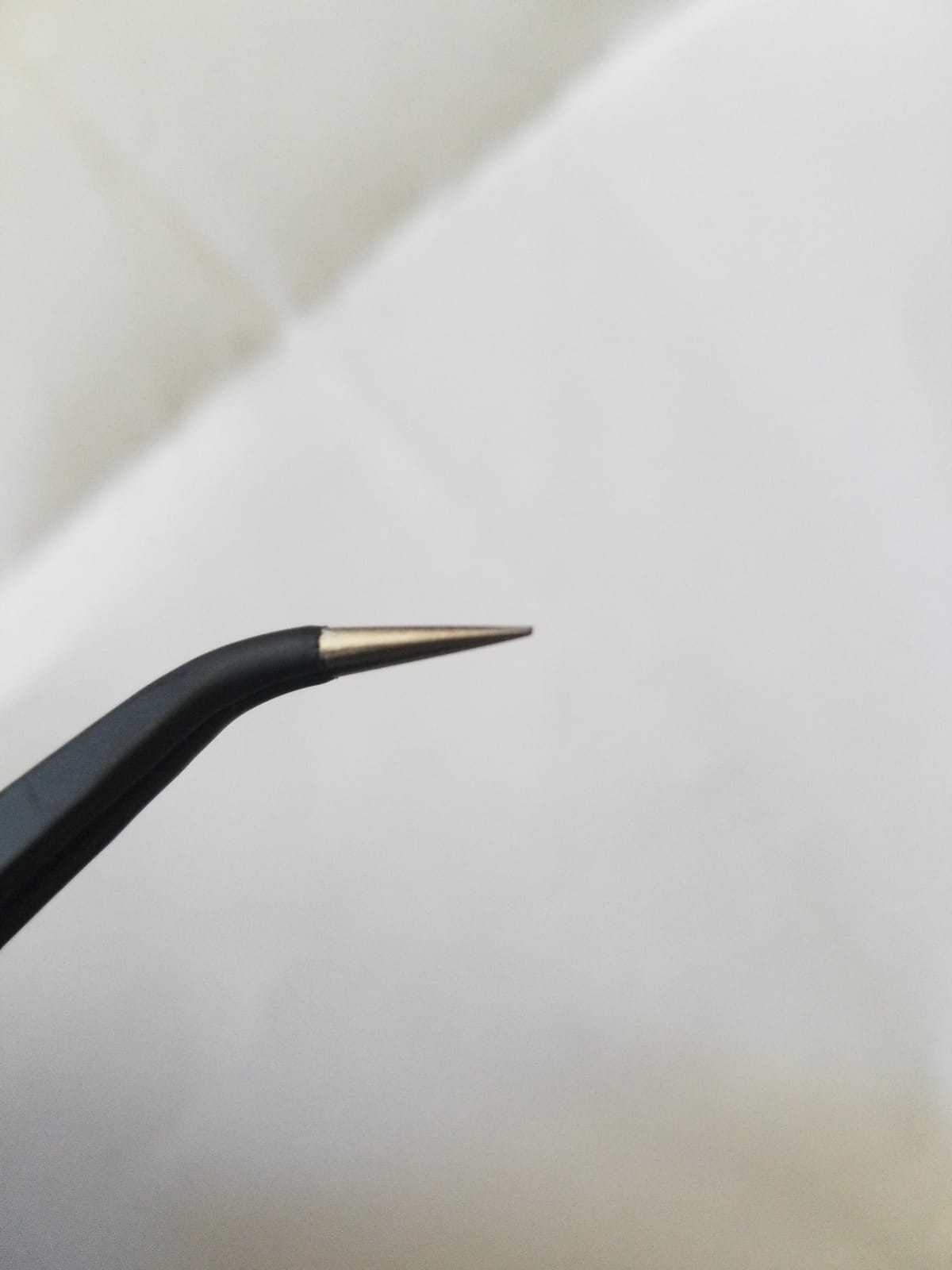
This is the set SMD solderers mention most often for rework, and the reason is the shape list: four straight fine tips, one angled fine, one straight rounded fine, one fine curved, two heavy-weight pointed and an acne needle tip. That acne tip alone justifies the set, because nothing else in this range gets you into a pad that small.
Owners describe tips that stay aligned after years of intermittent use without losing tension, which is the durability claim that separates a good budget set from a disposable one. The stainless steel carries enough weight to feel controlled, and the matte black surface keeps it from sliding in a damp hand.
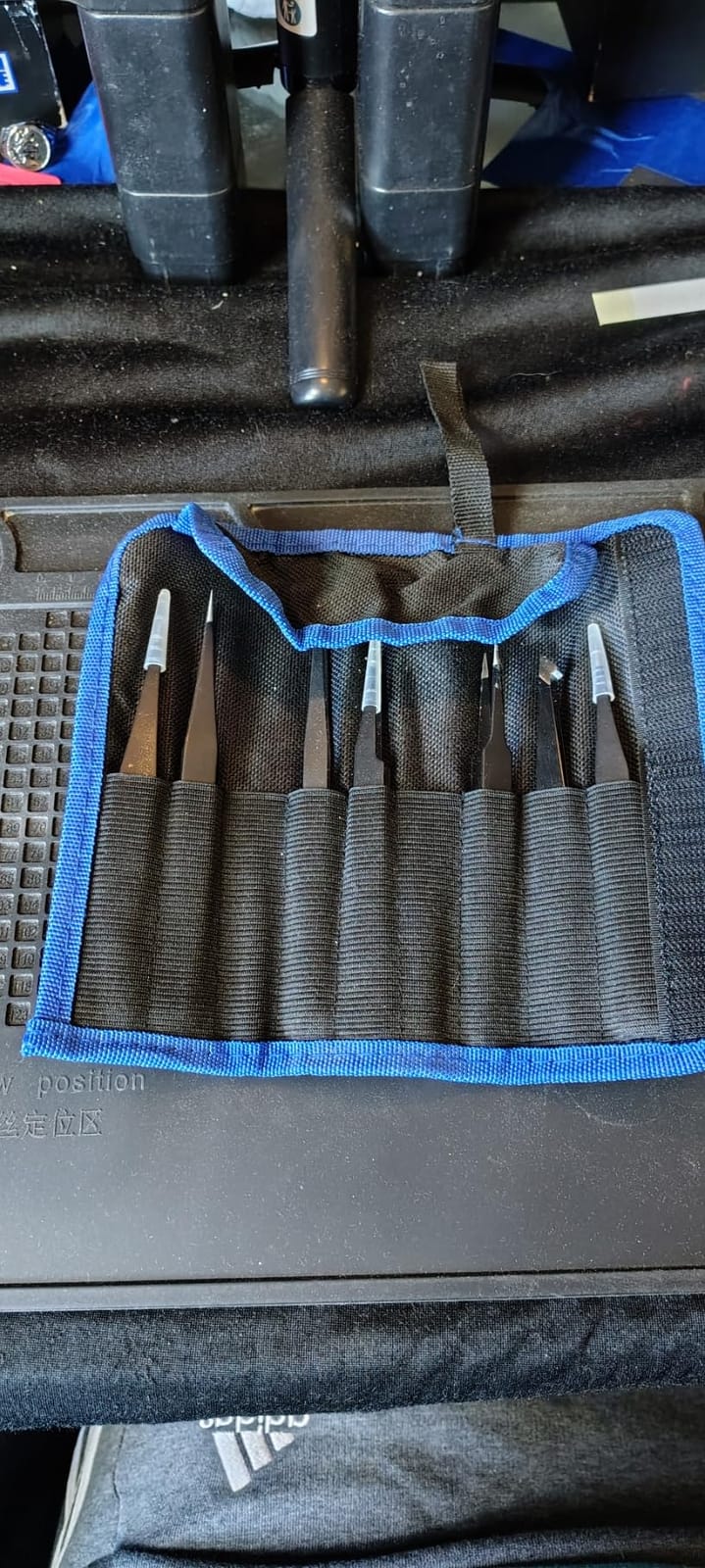
Every tweezer has a resistive ESD coating and the steel is non-magnetic, so this is one of the more honest listings in the category. The storage bag ships with individual tip covers for each tool, which sounds minor until you have fished a needle tip out of a carpet.
The main caveat is hardness. These tips are not hardened, so they will bend before they break, and a bent tip that still looks straight enough can quietly ruin placement accuracy. Use them for controlled work and avoid levering a connector with them.
Who the Alitamei 10-Piece Set Works Best For
It is built for rework: replacing components, cleaning pads, lifting small ICs. SMD solderers report the shape range covers everything from 0604 resistors to 44-pin microcontrollers, which is a wide span of real bench work.
It also makes a good first serious set for a hobbyist moving past through-hole work, because the angled and heavy-weight tips are shapes you will not find in a cheap three piece kit.
Where the Alitamei 10-Piece Set Falls Short
Unhardened tips are the deal breaker for anyone levering shields or prying connectors. Those are the jobs where the UUBAAR set at 2mm is the safer tool.
Ten tools in a bag is a lot to sort through mid-job. If you are new to fine work, mark your three favourites so you do not lose an hour hunting for the curved one.
5. Yababa 5-Piece Locking Tweezers – Best for Precision Placement
Tweezers, 5Pcs Precision Tweezers Set – Anti – Static Stainless Steel Tweezers for Electronics, Jewelry Making, Medical and Laboratory Work, Craft, Model Building, Soldering, Watch, Car Repair, Etc
Two curved, two straight and one flat tweezer
Sliding locking design
Anti-static non-magnetic paint finish
Pros
- Sharp well-aligned tips
- Sliding lock holds work in place
- Longer body is easier to grip
- Surgical-grade steel
- Handles micro screws and charging ports
Cons
- Locking clip slides down when held downward
- Very sharp points can prick fingers
- Some tip finishes are not perfectly smooth
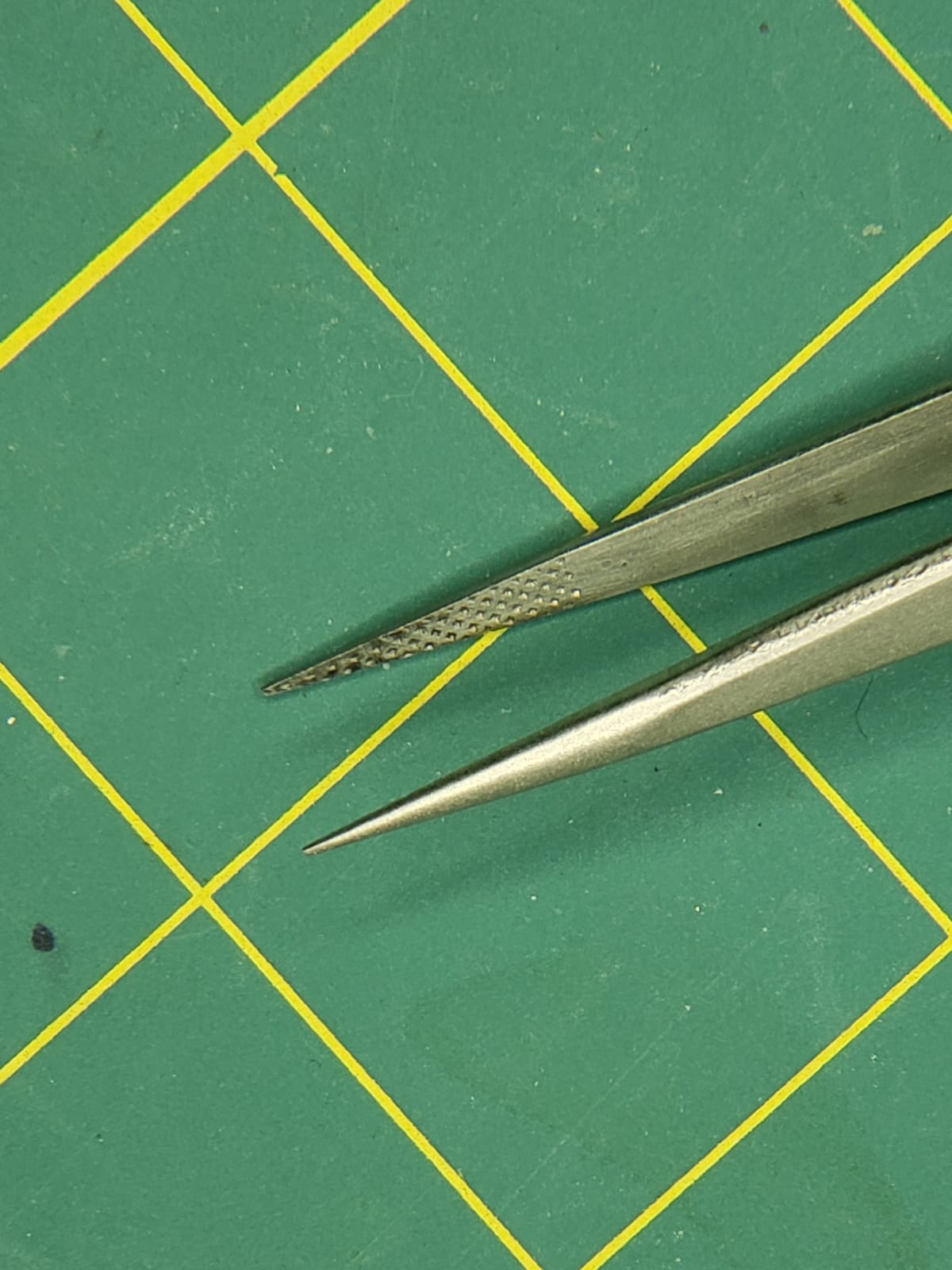
Five tweezers, and the reason to like them is the sliding lock. When you position a part with both hands and need it to stay put while you pick up the iron, a mechanical lock beats fighting spring tension. Reviewers single it out as genuinely useful and several report rescuing expensive devices with it.
The set gives you two curved, two straight and one flat tweezer, all longer than a typical medium ESD tweezer, with moderate flexibility that reduces hand fatigue. The points are fine enough to grip a hair, which sounds like a gimmick until you try to place a 0402 part with a blunt tip.
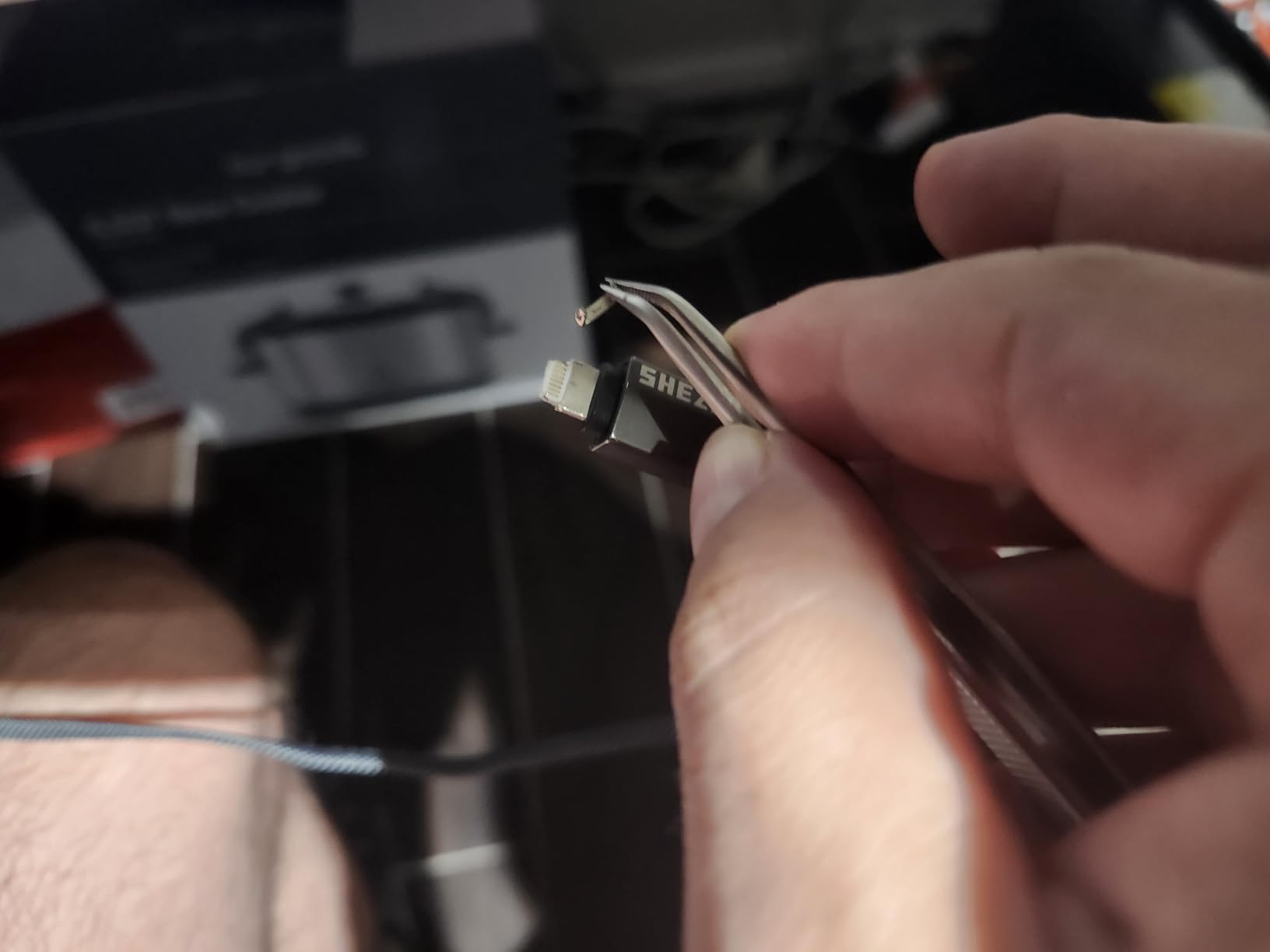
Build is sturdy surgical-grade stainless steel with an anti-static, non-magnetic paint finish that resists most acids and corrosive substances. Practical uses reported by owners include micro screws, small dip switches, thin wires and charging port repairs.
The lock is also the main complaint. Held with the tips pointing downward, the clip slides down on its own and the tweezers stop opening fully, so you end up readjusting constantly. The points are sharp enough to prick a finger, and a minority of units arrive with an imperfect tip finish. Still, the shape mix is the most useful five in this roundup.
Who the Yababa 5-Piece Set Works Best For
It suits anyone doing fine placement on a live board, where holding a part steady matters more than having a third hand. The flat tweezer takes connectors and shields, the curved ones lift components out of tight footprints, and the straight ones handle drag soldering.
Because the bodies are longer than average, this is also the set we prefer for extended fine work such as microscope-assisted assembly.
Where the Yababa 5-Piece Set Falls Short
If you work in a fixed orientation with tips pointing up, the sliding lock is not an issue. If you solder with the board tilted, expect to nudge the clip back into place.
Very sharp points are a real hazard on a busy bench, and the locking mechanism adds moving parts that can loosen over time compared with a fixed spring tool.
6. HengTianMei 14-Piece Set – Best for Model Building
HengTianMei Precision Tweezers Set, ESD Anti-Static Stainless Steel Tweezers Set for Craft, Jewelry, Electronics, Laboratory Work (14 PCS)
Fourteen tweezers in multiple configurations
Calibrated arm tension
Stainless steel
Pros
- Broad assortment of tip shapes
- Tips keep sharpness past a month of regular use
- Good grip and precise alignment
- Protective sleeves for each sharp tip
- Organised storage case
Cons
- Velcro on the case does not line up when rolled
- Flap does not cover every tweezer
- Craft and cosmetic tips dilute the electronics focus
Fourteen configurations covering slant, pointed and a dozen other shapes, built around stainless steel with precisely aligned gripping edges and calibrated arm tension. The tension is the part that separates a hobby set from a bench tool, because a tool with even tension does not need a hard squeeze to hold a part.
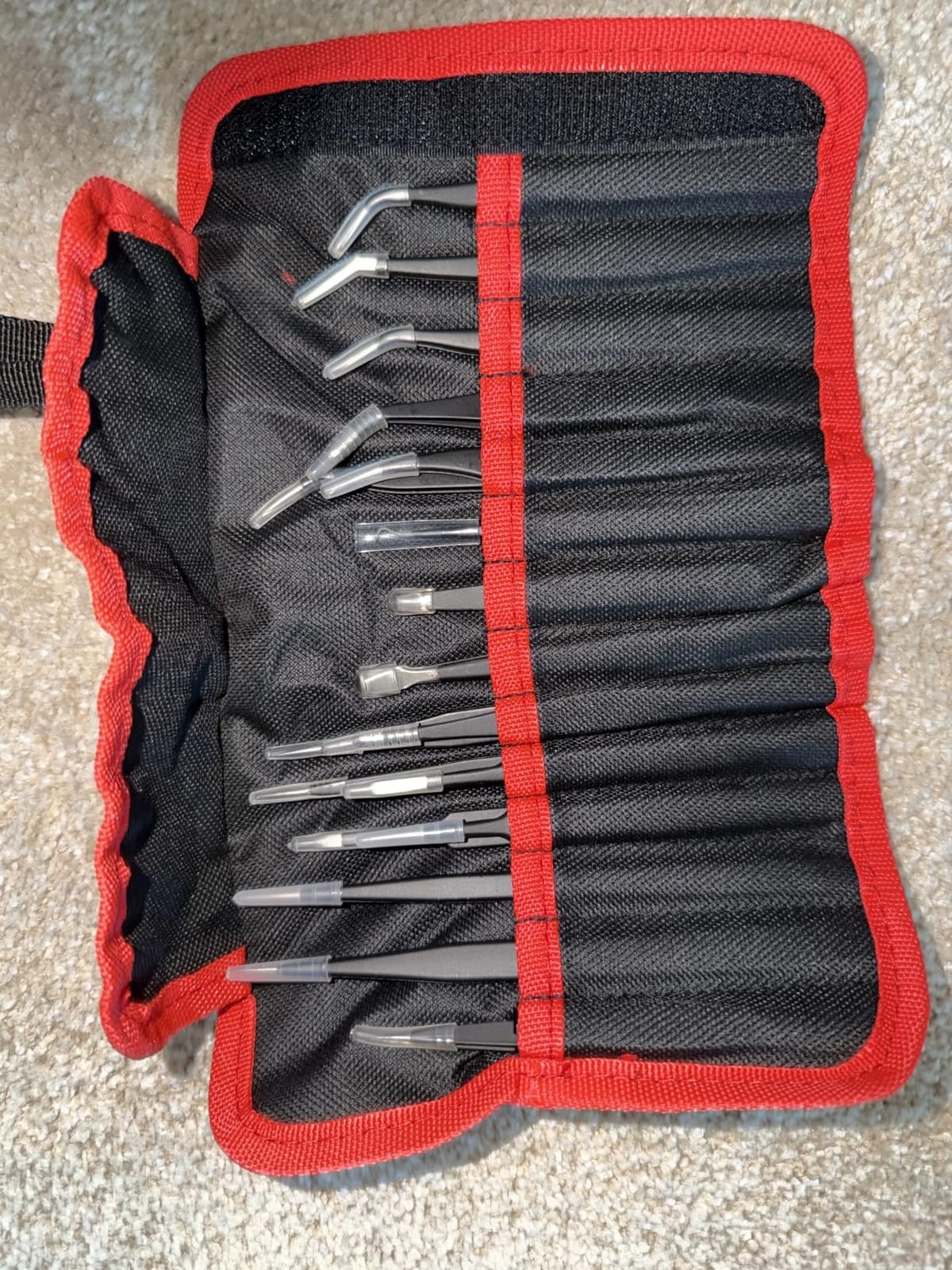
Owners report tips that retain their sharpness beyond a month or two of regular use, good grip and precise alignment for fine work. The protective sleeves for each sharp tip prevent accidental pokes while the case is open on a bench, which matters more than it sounds.
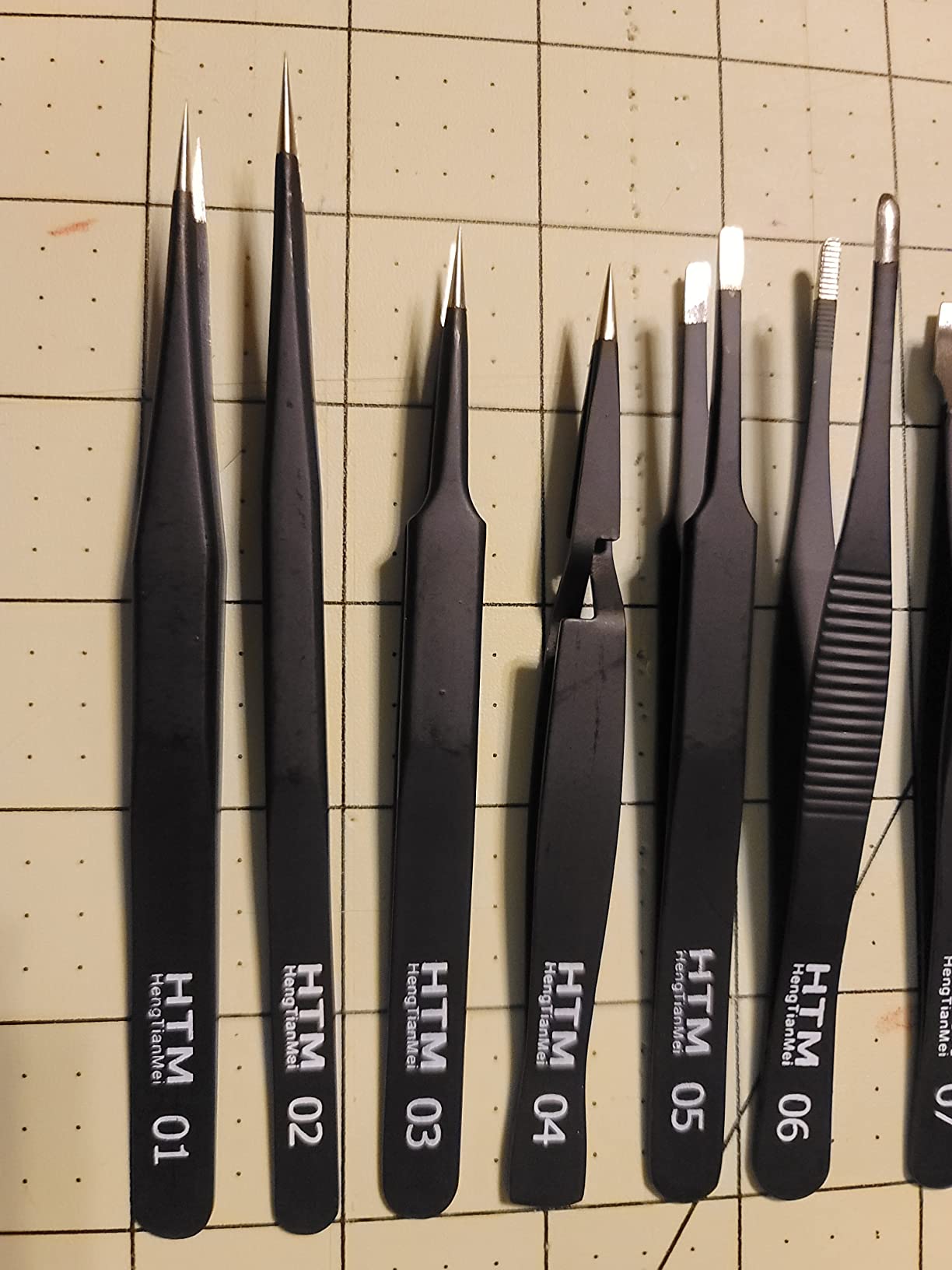
This set does double duty in a household where electronics is one of several hobbies. Reviewers apply it to crafts, book nooks, electronics repair and small model detailing, and at a 4.7 rating it is one of the best-scoring sets in this roundup.
The consistent complaint is the case rather than the tools. The Velcro does not line up when rolled and the flap does not cover all the tweezers, so a few can work loose in a bag. The assortment also mixes general craft and cosmetic shapes with the fine tips, so expect to fish through it.
Who the HengTianMei 14-Piece Set Works Best For
It fits a mixed workflow, from scale models to small board jobs, where one dedicated tool would be wasted. The uniformly arranged case is the bigger deal here than in cheaper sets, since it is what keeps tips from misaligning in a drawer.
It is also a sensible companion to a beginner electronics kit, giving a student enough tip variety to stop using the wrong tool for every job.
Where the HengTianMei 14-Piece Set Falls Short
The case is genuinely awkward to roll up. If you travel with your tools, budget a few minutes of setup or use a separate tray.
Because the tip mix skews toward general precision rather than electronics specifically, dedicated SMD work will find fewer specialised shapes than the Alitamei or UUBAAR sets.
7. HengTianMei 16-Piece Set – Best for Tip Variety
16 Pcs Sharp Precision Tweezers Set,Including 16 Types Of Anti-Static Stainless Steel Esd Medical Tweezers for Craft,Jewelry,Electronics Soldering,Laboratory Work,And Used for Beauty Etc
Sixteen pairs of anti-static tweezers
Straight, curved and flat tips
Heat-treated steel
Pros
- Sixteen distinct tip styles
- Anti-static non-magnetic surface paint
- Heat-treated steel with high elasticity
- Straight curved and flat tips in one case
- Acid and base resistant finish
Cons
- Cosmetic and hair-plucking tips mixed in with electronics tips
- Sixteen tools are more than most benches need
- Case layout makes one specific tip slow to find
Sixteen pairs is the widest range in this roundup, and it is the reason to consider it if you are building one kit that has to cover everything. Straight points for narrow spaces, flat heads for larger components and curved tips for precise extraction, all in a single case.
The construction is high-strength stainless steel with an anti-static, non-magnetic surface paint, heat treated and hardened for high elasticity with acid and base protection. The heat treatment means the arms keep their spring over years rather than going slack, which is the usual failure mode of a large cheap set.
Users cite it for electronics soldering, lab work, jewelry and craft. The variety is genuinely the selling point, and nothing else at this tier gives you this many shapes in one box.
The honest downside is the blend of beauty and electronics tips in one case. Some pieces are cosmetic and hair-plucking shapes that you will never use on a board, so the effective electronics range is smaller than the count suggests. Sixteen tools also take longer to sort through than six, and buyers looking for a focused electronics kit should look at the 10-piece sets instead.
Who the HengTianMei 16-Piece Set Works Best For
It suits a bench that serves several trades at once, from a repair shop counter to a hobby room where soldering, model work and lab tasks share a drawer. Sixteen styles means the shape you need is almost certainly in there.
It also works for anyone who has already outgrown a small set and does not want to keep buying single tweezers one shape at a time.
Where the HengTianMei 16-Piece Set Falls Short
Diluted focus is the main issue. A dedicated electronics buyer gets a smaller useful range than the piece count implies, because several tips target cosmetic rather than board work.
Finding one specific tip in a full case slows you down during a live repair, so this is a set to sort once and keep in a labelled tray rather than dig through repeatedly.
8. Yababa 5-Piece Extended-Length Set – Best for Deep Spaces
Tweezers, 5 Pcs Precision Tweezers Set, Anti-Static Stainless Steel Long Tweezers Kit for Electronics, Laboratory Work, Jewelry-Making, Craft, Soldering, Hobby, Watches, Car Machines Repair Etc
Five extended-length tweezers
Heat-treated hardened steel
Anti-static non-magnetic finish
Pros
- Perfectly aligned stainless steel tips
- Fine points suit micro-soldering under a microscope
- Solid heavy feel over long sessions
- Extended length reaches into deep cutouts
- Non-magnetic acid-resistant finish
Cons
- One welded tip end broke under heavy squeezing
- Thin packaging lets tips arrive bent
- Limited tip variety with no lock on the flat nose
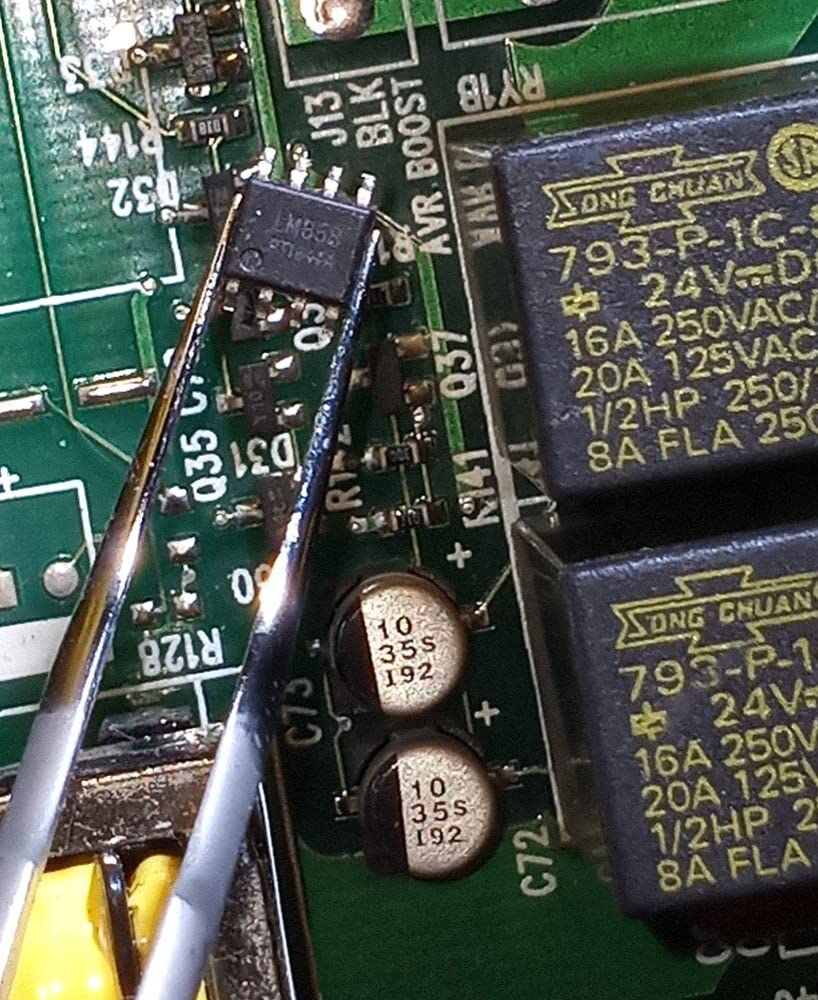
Length is the entire point of this set. The extended-length design is meant to be easier to grip than medium-length ESD tweezers, and it is what gets your hand out of the way of the camera when you work inside a deep cutout or under a microscope.
Owners highlight solid, well-aligned stainless steel tips and comfortable extended length, with micro-solderers using them under a video microscope and modellers using them for small parts. The smooth lines and fine processing make long sessions bearable, and the tips have a heavy solid feel that gives placement control.
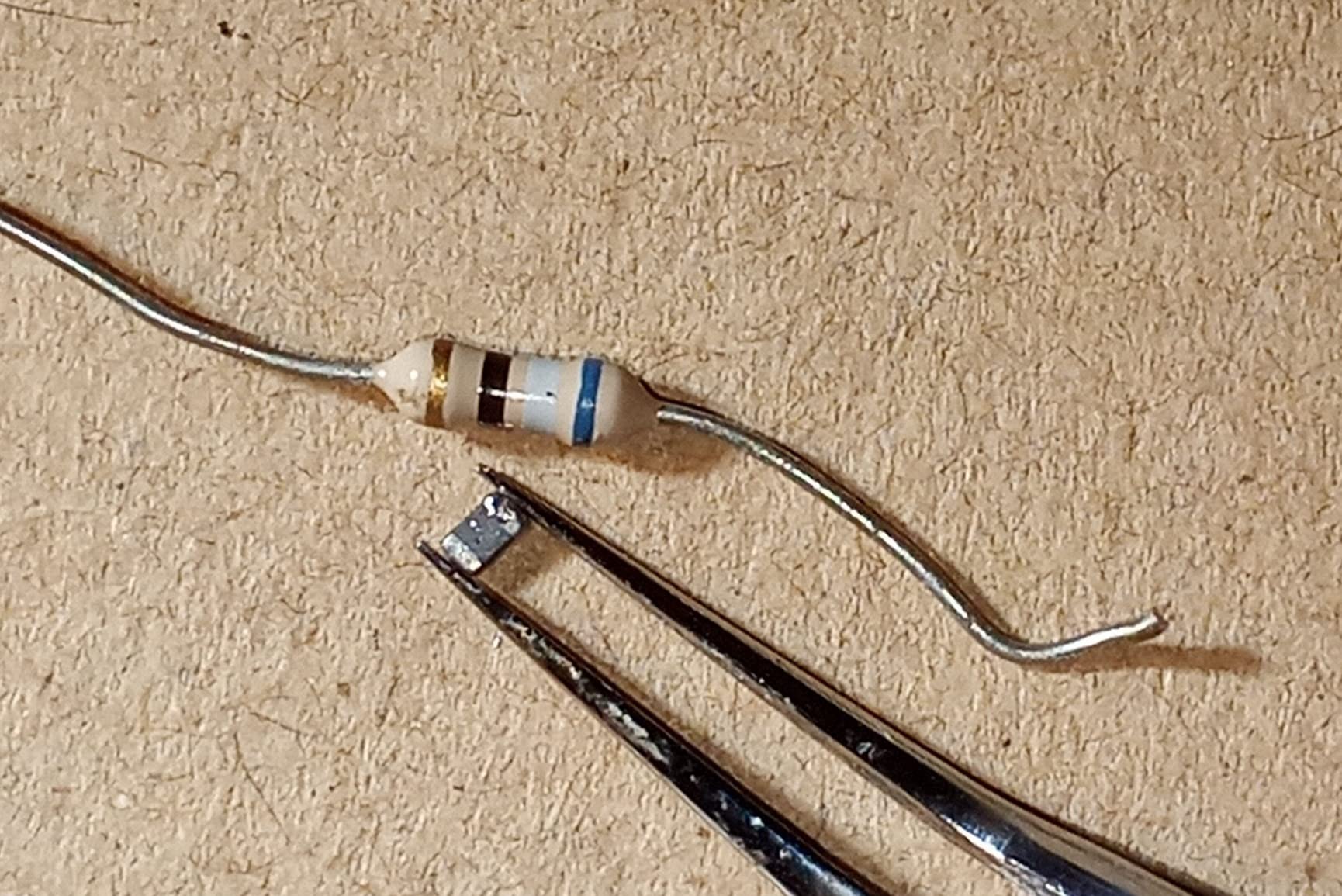
The anti-static, non-magnetic surface paint resists most acids and corrosive substances, so it holds up around flux and battery work. At a 4.7 rating this is one of the highest-scoring options here, and the alignment reviewers describe is what makes the fine points usable.
There are a few durability reports, including one welded tip end that broke open under heavy squeezing pressure and a screw that arrived loose. The packaging is also criticised as minimal, with individual plastic bags in a mailer, so tips can arrive bent. Check alignment on arrival before you rely on a fine point.
Who the Yababa Extended-Length Set Works Best For
It is built for deep or awkward geometry, where a shorter tweezer means your knuckles hit the board. Phone frames, laptop chassis work and microscope-assisted soldering are the obvious fits.
It also works for anyone whose hands tire quickly, because the longer grip spreads contact and reduces the squeeze needed to close the tips.
Where the Yababa Extended-Length Set Falls Short
Tip variety is limited. There is no lock on the flat nose and no lined inner surface on a pointed tip, so a few of the five feel interchangeable.
Thin packaging is a real risk with a precision tool. Inspect each tip on arrival and do not assume a straight-looking tweezer is square until you have checked it against a flat surface.
9. XinYunfan 10-Piece ESD Set – Best for Starter Kits
XinYunfan 10Pcs Precision Tweezers Set, Upgraded Anti-Static Stainless Steel Tweezers with Storage Box, for Craft, Electronics, Jewelry-Making, Laboratory Work, Soldering, DIY
Ten-piece electronics ESD set
Resistive anti-static coating
Premium stainless steel
Pros
- Ten tweezers across a wide range of needs
- Resistive ESD coating on every piece
- Acid and corrosion resistant steel
- Fine tips for high-density IC chips
- Each tool coded and stored in a clear box
Cons
- Tip consistency is not as tight as premium kits
- Some tips are less sharp out of the box
- Storage box is bulky for a small bench
This is the entry point. Ten tweezers with a resistive anti-static ESD coating on every piece, in premium stainless steel that resists most acids and corrosive agents, at a rating of 4.5 that is the lowest in the roundup but still firmly positive.
Some tips are hard and sharp for precise operations such as board soldering and watch repair, and the fine tips suit high-density integrated circuit chips, which is a specific and useful capability for a starter set. The ergonomic design gives a firm, accurate grip and reduces fatigue on longer sessions.
Each tweezer is individually coded and stored in a transparent plastic box, so you can see the whole set at a glance and find a replacement after using two for years. That storage approach is more considered than most kits at this tier manage.
What you give up is consistency. The feedback is practical rather than glowing, and users note the tips are not as precisely finished as premium kits. If you are learning, that gap matters less than having ten shapes on hand.
Who the XinYunfan 10-Piece Set Works Best For
It suits a new hobbyist who needs a full range without a large outlay, or a student building a first kit for a school electronics project. Ten tools cover chip work, soldering and general precision tasks.
It also works as a shared or spares set, since individually coded tools in a clear box make it easy to spot a lost or damaged pair.
Where the XinYunfan 10-Piece Set Falls Short
Tip consistency is the limitation. A few tips per set are less sharp than the rest, so the fine work takes a little more care than it would with a matched professional set.
The clear box is a bulk item for a small bench. Once you have picked your three or four regular tools, transfer them somewhere you can reach without moving the whole case.
10. YHYZ 3-Piece Precision Set – Best Budget Pick
YHYZ 3PCS Precision Tweezers Set, Premium Stainless Steel Anti-Static ESD Tweezes, Suitable for Tweezers, for Craft, Electronic, Soldering, Model, Hobby, Jewelry Making Laboratory
Fine pointed, curved pointed and flat tips
1.5mm high-elasticity steel
Non-magnetic ESD coating
Pros
- Sharp precise tips that make placement easy
- 1.5mm steel is thicker than typical budget tweezers
- Non-magnetic anti-static coating
- Cleaning cloth and pouch included
- Three tip styles cover pointed flat and curved
Cons
- Some tip ends do not fully meet
- Metal surface finish is rough on some units
- Only three tools in the set
Three tweezers is all you need to start soldering, and this trio is the reason it is in the roundup. You get a fine pointed tip, a curved pointed tip and a flat tip, which between them cover most electronics jobs you will meet in the first year.
The steel is 1.5mm thick with high elasticity, and the manufacturer is explicit that it is thicker and more precise than the 0.8 to 1.0mm tweezers typical at this price. That difference shows up the first time you grip a small part without the tips splaying.
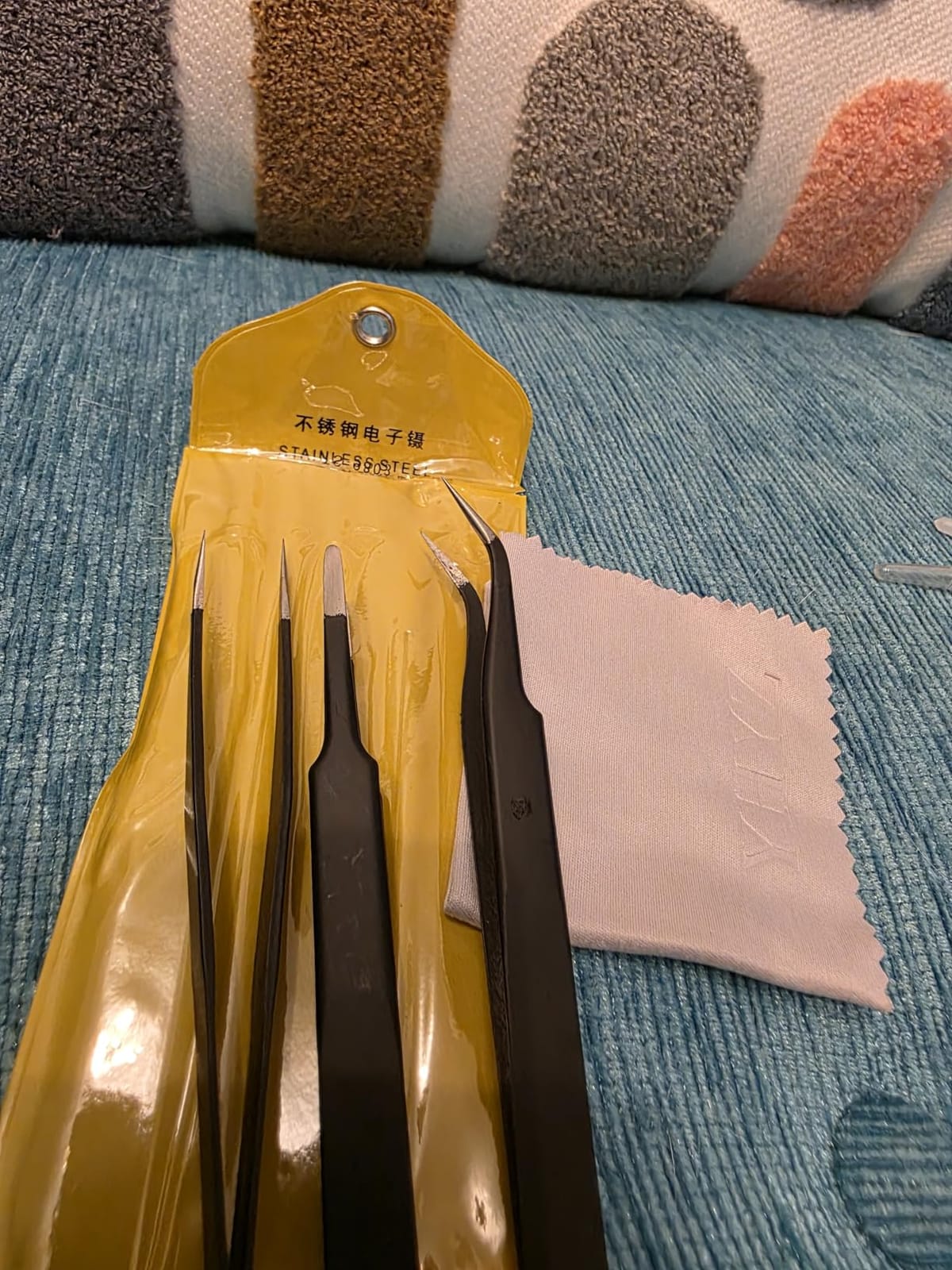
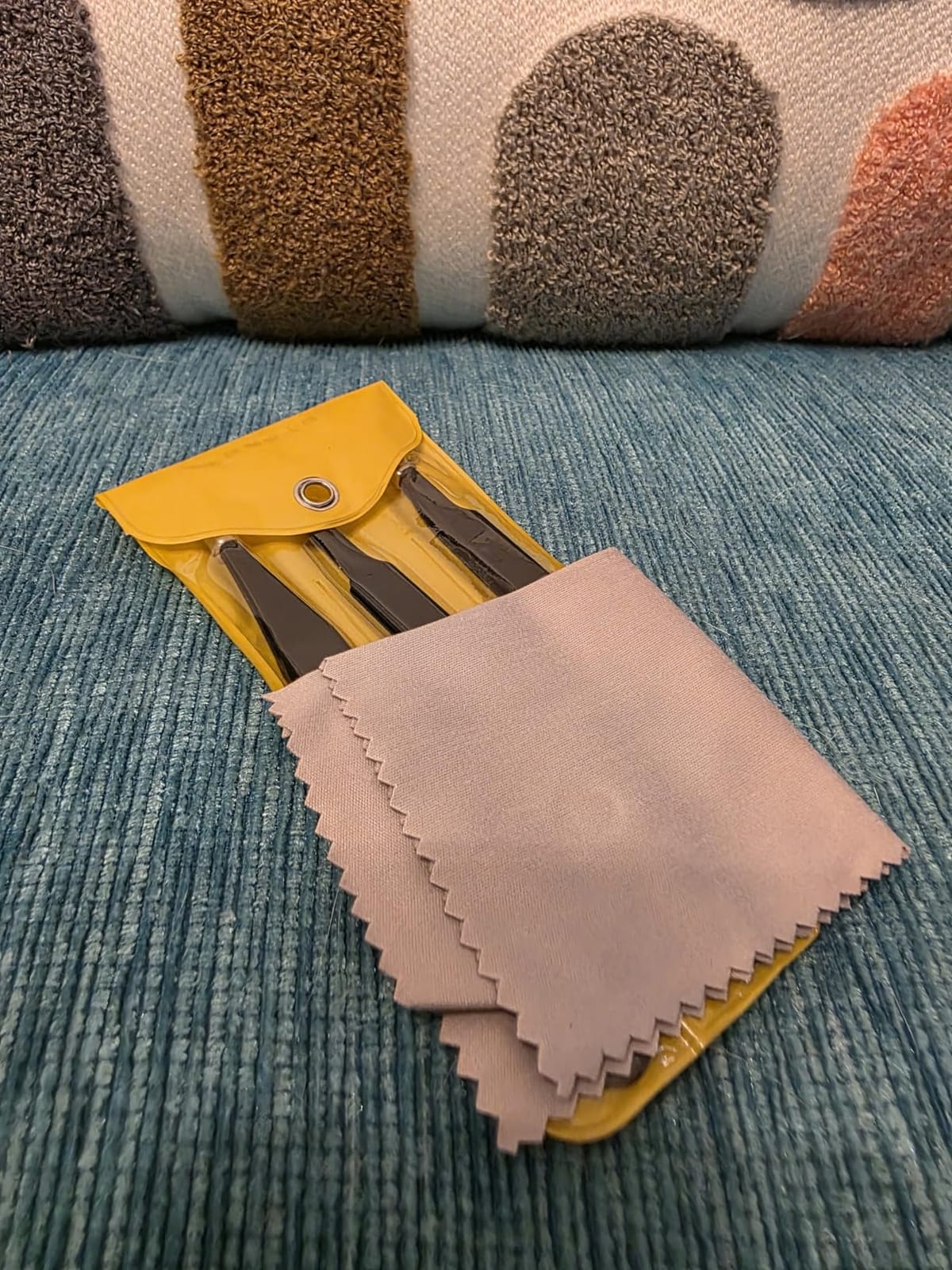
The non-magnetic anti-static coating protects components from static damage, and a cleaning cloth plus storage pouch are included, which is a thoughtful touch for tools that get handled constantly. Most buyers find the tips sharp, precise and well built, and use them for craft, jewelry and electronics alike.
A minority of buyers find tip ends that do not fully meet and a rough metal surface finish, judging it fine for coursework but not high-precision work. At three tools there is no spare if one gets bent, so keep the pouch in use.
Who the YHYZ 3-Piece Set Works Best For
It suits a first soldering kit, a student, or anyone who wants good tips without buying a full assortment. The three shapes are the ones you will use most, so nothing is wasted.
It is also a sensible second purchase later, when a larger set has lost the two or three tools you reach for daily.
Where the YHYZ 3-Piece Set Falls Short
Three tools means no backup. If you drop the fine point onto a hard floor, the set is finished for the job that tool was good at.
Tip meeting is not consistent across units. If your work is high-precision from day one, spend the extra and pick a matched set with harder tips.
How to Choose ESD Safe Tweezers: A Buying Guide for 2026
Do you really need ESD safe tweezers?
You need them if you handle bare PCBs, surface-mount components, CMOS sensors, hard drives, SSD boards, CMOS batteries, or any device with a main IC. That covers hobbyist soldering, phone and laptop repair, laptop motherboard work and semiconductor handling.
For coarse work on through-hole parts and jumper wires, they are optional. A single electrostatic discharge can exceed 5000 volts and instantly destroy a MOSFET, CMOS or BGA IC with no visible burn mark, so the failure shows up weeks later as a board that will not power up.
Can anti-static tweezers replace an ESD wrist strap?
No, and this is the question technicians ask most often. A wrist strap drains charge from your body continuously, which is what actually removes the risk of you transferring a charge to a part. Anti-static tweezers stop the tool from becoming a static source, which is a smaller and separate problem.
The two work together. Grounding yourself, using a dissipative bench mat and handling boards with ESD safe tweezers covers all three paths. Any one of the three on its own leaves a gap, which is why an electronics.stackexchange thread asking exactly this question runs long.
Stainless steel vs ceramic vs conductive plastic vs titanium
Non-magnetic stainless steel is the default because it is stiff, corrosion resistant, heat treatable and cheap. It is what every set in this roundup uses. Ceramic is non-conductive and will not scratch a die or a coated lens, but it chips and bends rather than flexing, so it is a specialist tool. Conductive plastic is fully non-magnetic and safe around magnetised components, but it has almost no heat tolerance and soft tips. Titanium sits in between, light and non-magnetic, often cited on forums as a good step up from budget sets.
Ceramic is worth naming because it is a common search term and a common misconception. It is genuinely ESD safe because it does not conduct at all, but a chipped ceramic tip is a broken tool, and most ceramic tweezers are less precise on small SMD work than hardened steel.
Tip shape: straight, curved, angled, pointed or reverse
Straight fine point is the generalist: drag soldering, lifting small parts, alignment work. Curved tips reach into footprints and around components without your hand blocking the view. Angled 30 and 45 degree tips are the classic pick and place shape. Wide flat or spade tips grip connectors, shields and larger parts where a fine point would slip.
Reverse or self-closing tweezers close when the arms squeeze, which some people find easier on long sessions. Forum sentiment is mostly negative on them, with users on r/diyelectronics describing them as far more awkward than standard parallel-action tweezers. We would skip them unless you already know you like that action.
Magnetic vs non-magnetic steel, and how to check
A magnetised tweezer picks up loose screws, small parts and shielding, and it can interfere with sensitive components. This is one of the listed deal breakers in repair communities and the reason non-magnetic steel appears in almost every good listing.
Testing takes five seconds. Hold the tweezer against a fridge magnet. If it grabs, the steel is magnetic and you should keep it away from hard drives, speakers and magnetised parts. Users report plenty of tweezers sold as anti-magnetic that still stick, so do not trust the label alone.
How to test a tweezer for genuine ESD safety
Check for a stated surface resistance figure. Genuinely dissipative tools sit in the 10^9 to 10^11 ohms range. A listing with no number at all is telling you nothing.
Run the magnet test above. Non-magnetic behaviour is a separate claim from ESD safety and both should hold.
Look at the coating on close inspection. Thin, paint-like finishes that scratch off under a fingernail are the most common failure mode reported on forums, particularly on budget tools.
Inspect the tips square and aligned before first use. Misaligned tips scratch component leads, which is a damage mode far more likely to ruin a board than a static event.
Brands worth knowing
The names that come up on technician forums are specialist brands, not generic Amazon sets. Erem, Dumont, Rubis, Aven, Hakko, Knipex, Vetus, Ideal-Tek, Wiha, Cole-Parmer, iFixit and Hozan all appear in real bench recommendations, and Erem and Dumont in particular are the reference points for high-end anti-magnetic tweezers. Eclipse shows up in the same circles for bench accessories.
None of those are in this roundup because the comparison is built on sets with verified ratings and specifications. Worth knowing though, because it tells you what the professional end of this category looks like and what a set you already own should be able to do.
What to look for when buying ESD safe tweezers
A stated ESD finish or surface resistance, not just the word anti-static.
Non-magnetic steel, verified by the manufacturer or by your own magnet test.
Tip shapes that match your actual work, not just the highest count.
Heat-treated or hardened steel so tips do not bend under light pressure.
Steel thickness of at least 1.5mm for anything finer than general craft work.
Tip covers and a case, so sharp points stay aligned and undamaged in storage.
A coating that looks like a finish rather than a thin paint layer.
One more thing worth doing alongside any of these picks: protect the rest of the bench too. Grounding and surge protection are separate concerns, and our pure sine wave UPS guide covers the power side if you are building at home rather than in a workshop.
Frequently Asked Questions
What are the best tweezers for electronics?
The best tweezers for electronics are non-magnetic stainless steel tools with heat-treated tips, a resistive ESD coating and a range of tip shapes. The XOOL 9-Piece set is the strongest all-rounder, the Kaisi 14-Piece set offers the widest range, the UUBAAR set has the thickest steel at 2mm, and the Alitamei set covers SMD rework shapes best.
What are ESD safe tweezers?
ESD safe tweezers are precision picking tools made from non-magnetic, electrostatically dissipative materials that bleed off static charge instead of holding it. They typically use non-magnetic stainless steel, ceramic or conductive plastic, often with a resistive anti-static coating, so the tool never releases a sudden spark into the component you are holding.
Do you need ESD tweezers?
You need them if you handle bare PCBs, surface-mount components, CMOS sensors, hard drives, SSD boards, CMOS batteries, or any device with a main IC. That covers hobbyist soldering, phone and laptop repair, motherboard work and semiconductor handling. For through-hole parts and jumper wires they are optional.
Are ceramic tweezers ESD safe?
Yes. Ceramic does not conduct at all, so ceramic tweezers are inherently ESD safe and non-magnetic. The trade-off is fragility: ceramic tips chip and bend rather than flexing, which makes them a specialist choice for delicate surfaces rather than a general replacement for hardened steel.
Can anti-static tweezers replace an ESD wrist strap?
No. A wrist strap drains static charge from your body continuously, which is the main source of risk. Anti-static tweezers stop the tool from becoming a static source. Grounding yourself, using a dissipative bench mat and handling boards with ESD safe tweezers covers all three paths, so any one of them on its own leaves a gap.
What brand of tweezers do professionals use?
Technicians most often name specialist brands rather than generic sets: Erem, Dumont, Rubis, Aven, Hakko, Knipex, Vetus, Ideal-Tek, Wiha, Cole-Parmer, Hozan and iFixit. These brands are recognised on forums for tip alignment, non-magnetic steel and repair-specific shapes.
Our Final Verdict on ESD Safe Tweezers for 2026
The XOOL 9-Piece ESD Tweezers Set is our pick for the best ESD safe tweezers for electronics in 2026, because nine shapes, square tips and a working resistive coating in one pouch is the package most people actually need. Buy the Kaisi 14-piece set if you want the widest range on the bench, the UUBAAR set if you break tools or work on phones, and the YHYZ trio if you are starting out and only need three shapes.
Whatever you choose, keep a wrist strap on, keep the tips covered in their case, and run the magnet test once. Those three habits matter more than the model name. For the power side of a home bench, our surge protector guide covers the rest of the risk.