
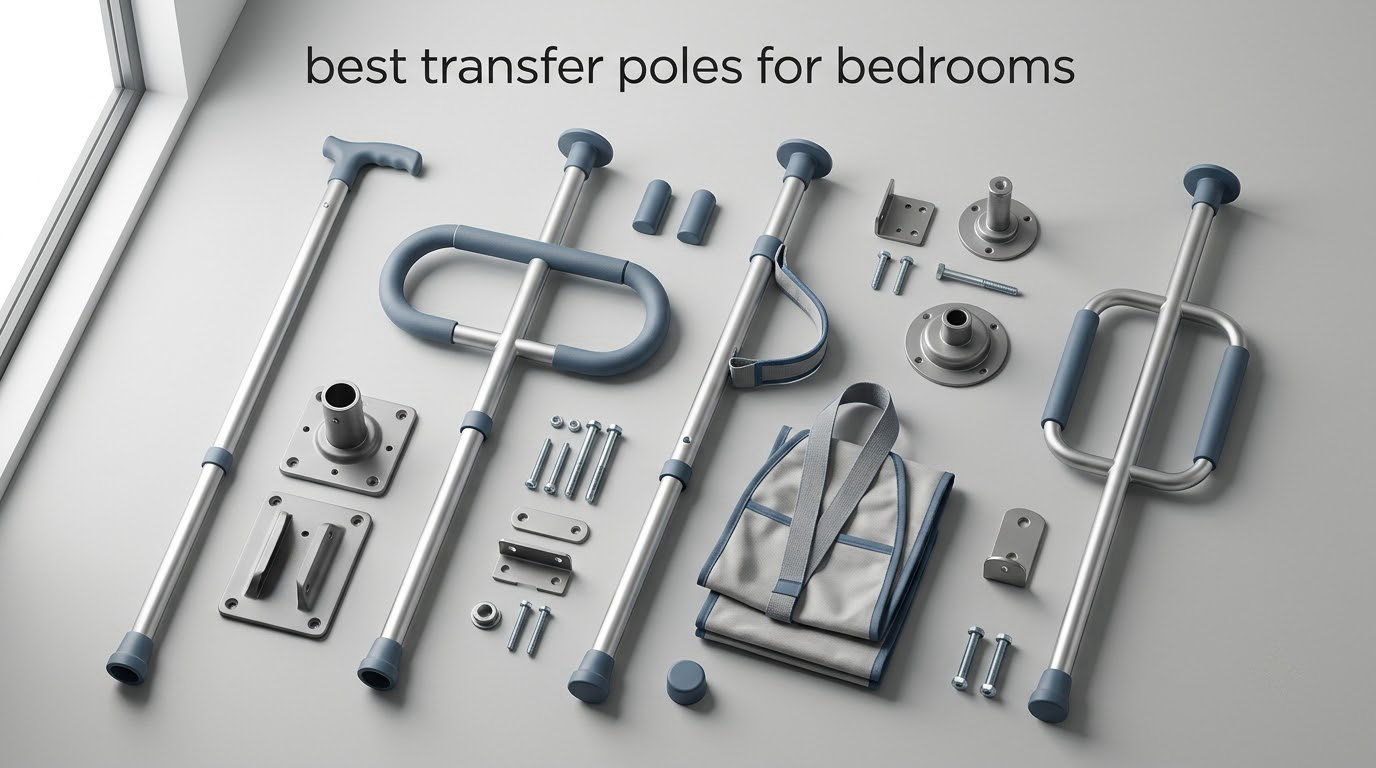
Most falls at home do not happen while someone is walking down a hallway. They happen in the three seconds around a bed, during the shift from lying to sitting and then from sitting to standing. That is why picking the right support for that exact spot matters more than the fit of anything else in the bedroom, and why we ranked the best transfer poles for bedrooms on placement and reach rather than on how they look on a shelf.
A transfer pole is a floor-to-ceiling tension pole that gives you a fixed vertical handhold to pull on while you stand up from the edge of the bed or lower yourself back down. It is braced between floor and ceiling using compression instead of screws, so nothing is drilled and the whole unit can be moved from room to room when you need the space back.
Are transfer poles safe to use? Yes. Properly tension-mounted transfer poles are considered safe for daily transfers when the pole is braced between a flat floor and a flat ceiling, sized for the room, and re-tightened periodically. The risks come from a loose pole, a low ceiling, or a user who cannot bear weight on their legs, not from the equipment itself.
We spent weeks reading hundreds of buyer reviews and comparing all ten poles in this roundup on weight capacity, height range, handle type, install method and bedroom fit. We also covered how a pole differs from a transfer bench for the parts of the transition where sitting down is the hard part, not standing up.
Table of Contents
Top 3 Best Transfer Poles for Bedrooms in 2026

Stander Wonder Pole Plus
- Rotating grab bar locks every 45 degrees
- 300 lb capacity
- No-drill tension mount for 7-10 ft ceilings

Stander Wonder Pole Slim
- Padded handle for longer holds
- Slim footprint for tight rooms
- 300 lb capacity

Stander Double Handle
- Two handles set at any height or angle
- 300 lb alloy steel
- No drilling
Every Transfer Pole in This Roundup at a Glance
Ten products, ten different ways to solve the same bedroom transition. Read the table first, then jump to the full review for the one that matches your ceiling and your grip.
| Product | Specifications | Action |
|---|---|---|
| Stander Wonder Pole Plus |
|
Check Latest Price |
| Stander Double Handle Grab Bar |
|
Check Latest Price |
| Stander Wonder Pole Slim |
|
Check Latest Price |
 VEVOR Trapeze Bar with Wheels VEVOR Trapeze Bar with Wheels |
|
Check Latest Price |
 AOSSA Ceiling Mount Bed Trapeze AOSSA Ceiling Mount Bed Trapeze |
|
Check Latest Price |
 VEVOR Floor-to-Ceiling Pole VEVOR Floor-to-Ceiling Pole |
|
Check Latest Price |
 Signature Life Sure Stand Pole Signature Life Sure Stand Pole |
|
Check Latest Price |
 Lumex 2940B Versa-Helper Lumex 2940B Versa-Helper |
|
Check Latest Price |
 Mybow Floor Stand Trapeze Mybow Floor Stand Trapeze |
|
Check Latest Price |
 Healthcraft SuperPole with SuperBar Healthcraft SuperPole with SuperBar |
|
Check Latest Price |
1. Stander Wonder Pole Plus: Best Transfer Pole for Bedrooms Overall
Stander Wonder Pole Plus with Rotating Double Grab Bar, Tension Mounted Security Pole for Seniors & Elderly Adults, No-Drill Floor to Ceiling Transfer Pole for Home & Bath Safety, White
Alloy steel pole
300 lb capacity
Rotating grab bar locks every 45 degrees
Fits 7 to 10 ft ceilings
Pros
- Rotating bar swivels 360 degrees and locks every 45 degrees
- Tension mounted with no drilling at all
- Hefty alloy steel build rated to 300 pounds
- Handle swings clear of a nightstand when not in use
Cons
- Heavy at 22 pounds so installation is a two-person job
- Plastic locking knob can loosen and need tightening again
- Will not work on vaulted ceilings or inside a tub or shower
- Hard bar with no padding for long holds
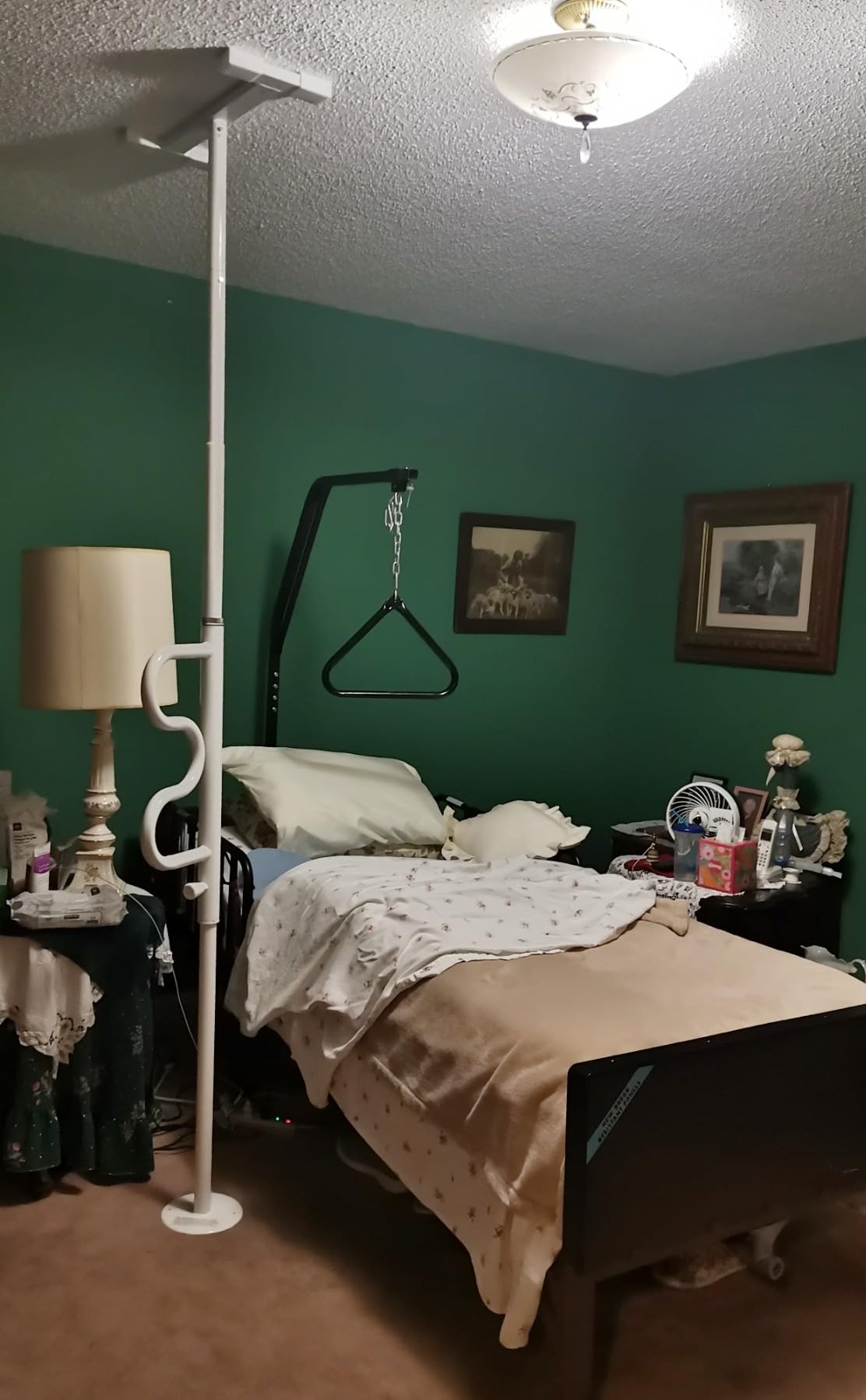
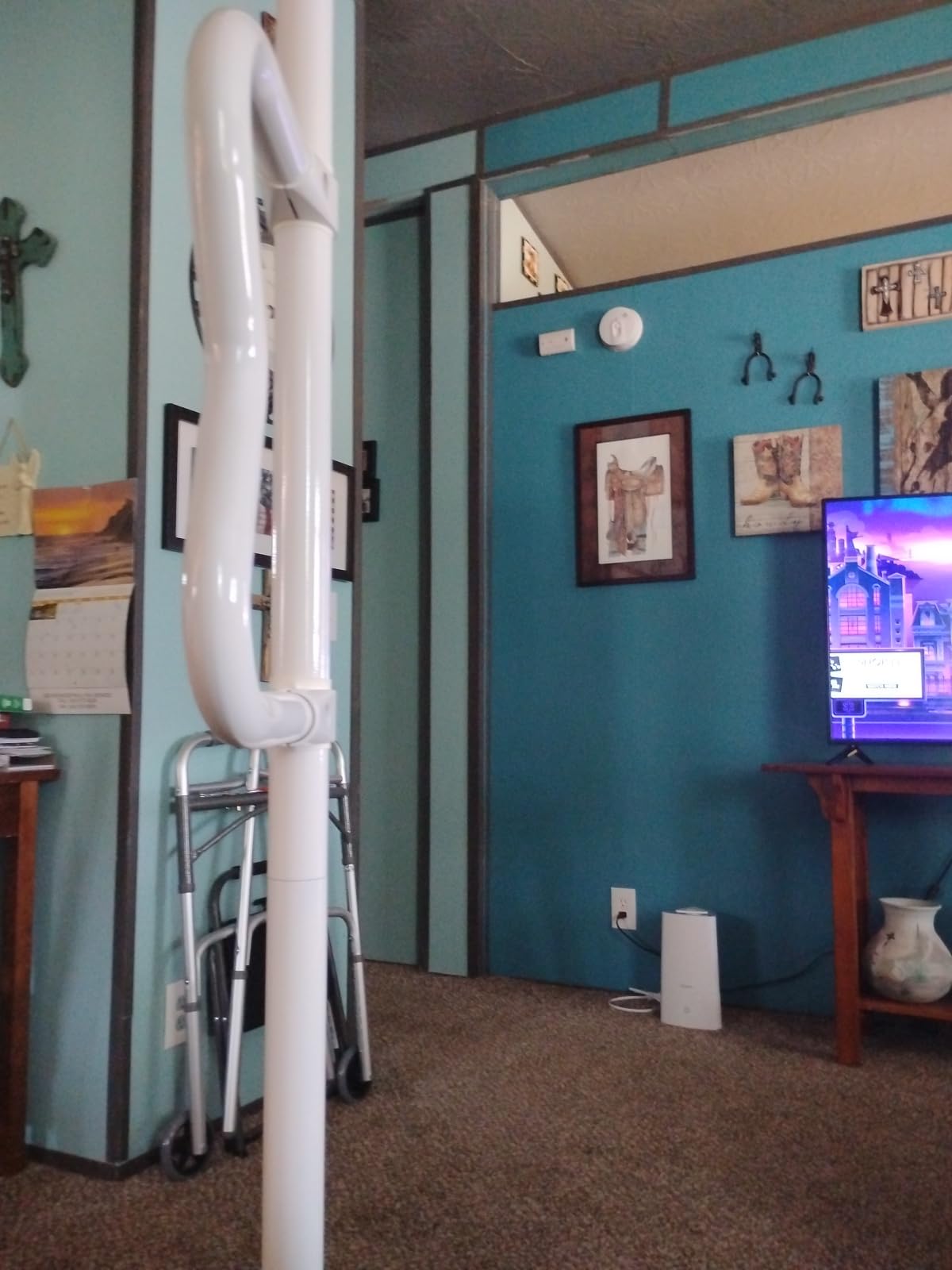
The rotating grab bar is the reason this one comes out on top for bedroom use. It swivels a full 360 degrees and locks every 45 degrees, so the handle can be swung out of the way of a nightstand and then pointed toward the mattress for the standing phase without moving the pole.
Buyers describe exactly the scenario we set out to test: getting out of a wheelchair next to the bed, or standing from a low mattress, without the handle being in the wrong place. The 300-pound rating and the alloy steel body held up consistently in reviews, and the tension mount leaves no holes in floor or ceiling.
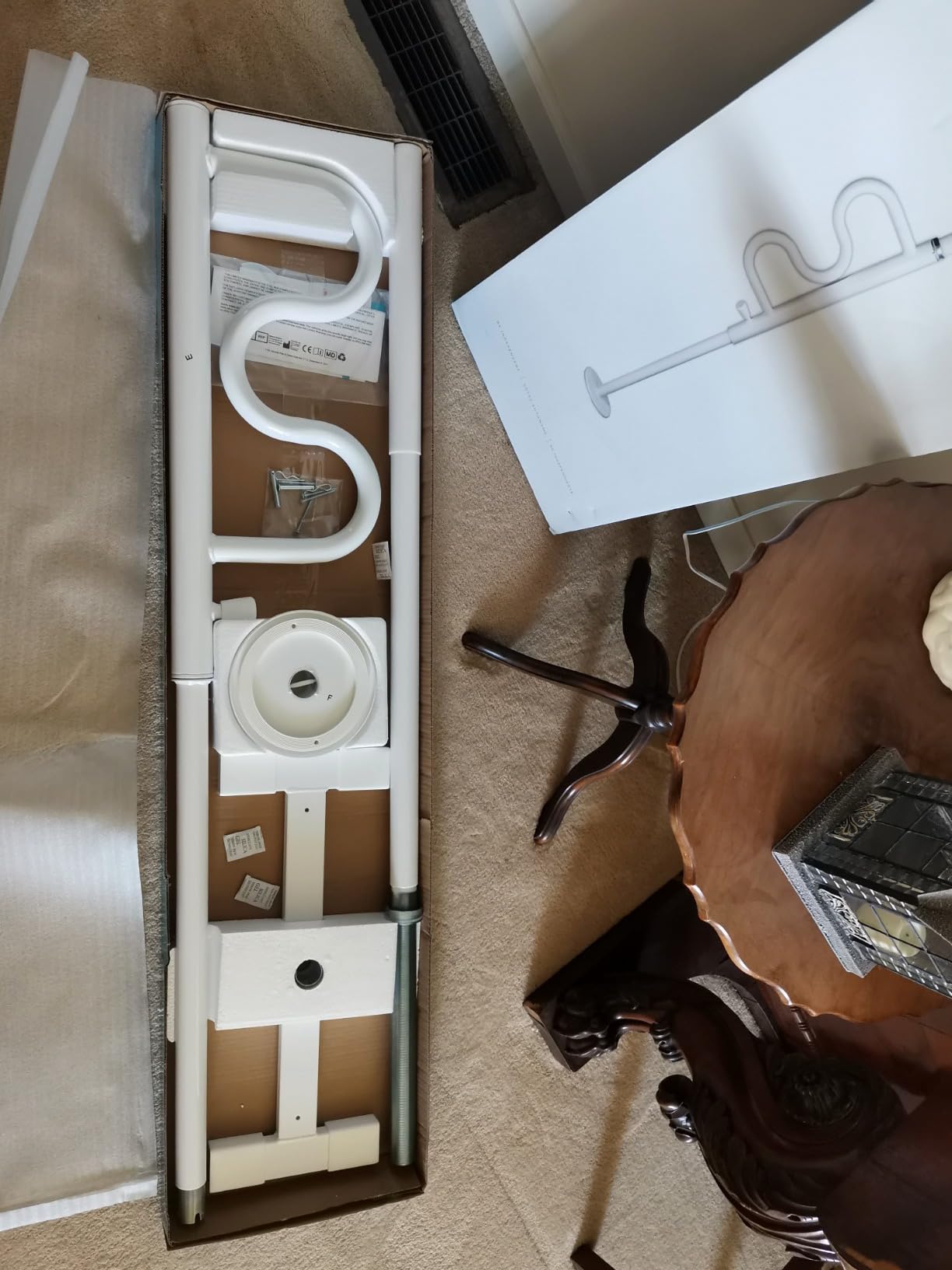
Two things to plan for. At 22 pounds it is a two-person install, and the plastic knob on the rotating handle occasionally loosens under repeated use and needs a quick finger-tighten, which is worth mentioning to anyone helping the person who uses it.
It also will not work on a vaulted ceiling, and the manufacturer excludes use inside a bathtub or shower, so treat this as a bedroom and hallway product rather than a bathroom one.
What to check before you order it
Measure your ceiling height first. The mount adjusts for flat ceilings from 7 to 10 feet, and anything outside that range will not tension correctly. Then measure the gap between the bed edge and where the pole base can sit, because the handle needs to land within easy reach of the mattress corner without blocking a walker.
Count the household members who will install it. If it is just one person, this 22-pound unit is a genuine problem and a lighter slim pole will go up faster.
Who it suits and who should pass
This suits anyone who transfers from more than one direction, for example a bed that slides for morning transfers and a wheelchair parked on the same side. It also suits caregivers who want the handle to move out of the way when it is not being used.
Skip it if your ceiling is angled or if you need a soft padded grip for long holds on the handle, since the Wonder Pole Plus has a hard bar rather than padding.
2. Stander Double Handle Grab Bar: Best Value for a Fixed Bedroom Setup
Stander Double Handle Non-Rotating Floor to Ceiling Grab Bar, No-Drill Tension Mounted Transfer Pole for Seniors, Bath Safety & Bedside Assist Rail for Home Standing Support & Fall Prevention, White
Alloy steel pole
Two adjustable handles
300 lb capacity
Fits 7 ft to 9 ft 6 in
Pros
- Two handles can be set at any height or angle
- No drilling and no permanent changes
- Alloy steel rated to 300 pounds
- Useful beside a bed
- chair or toilet
Cons
- Handles do not rotate during a transfer
- Ceiling range is narrower at 7 ft to 9 ft 6 in
- 20 pounds is heavy for a one-person assembly
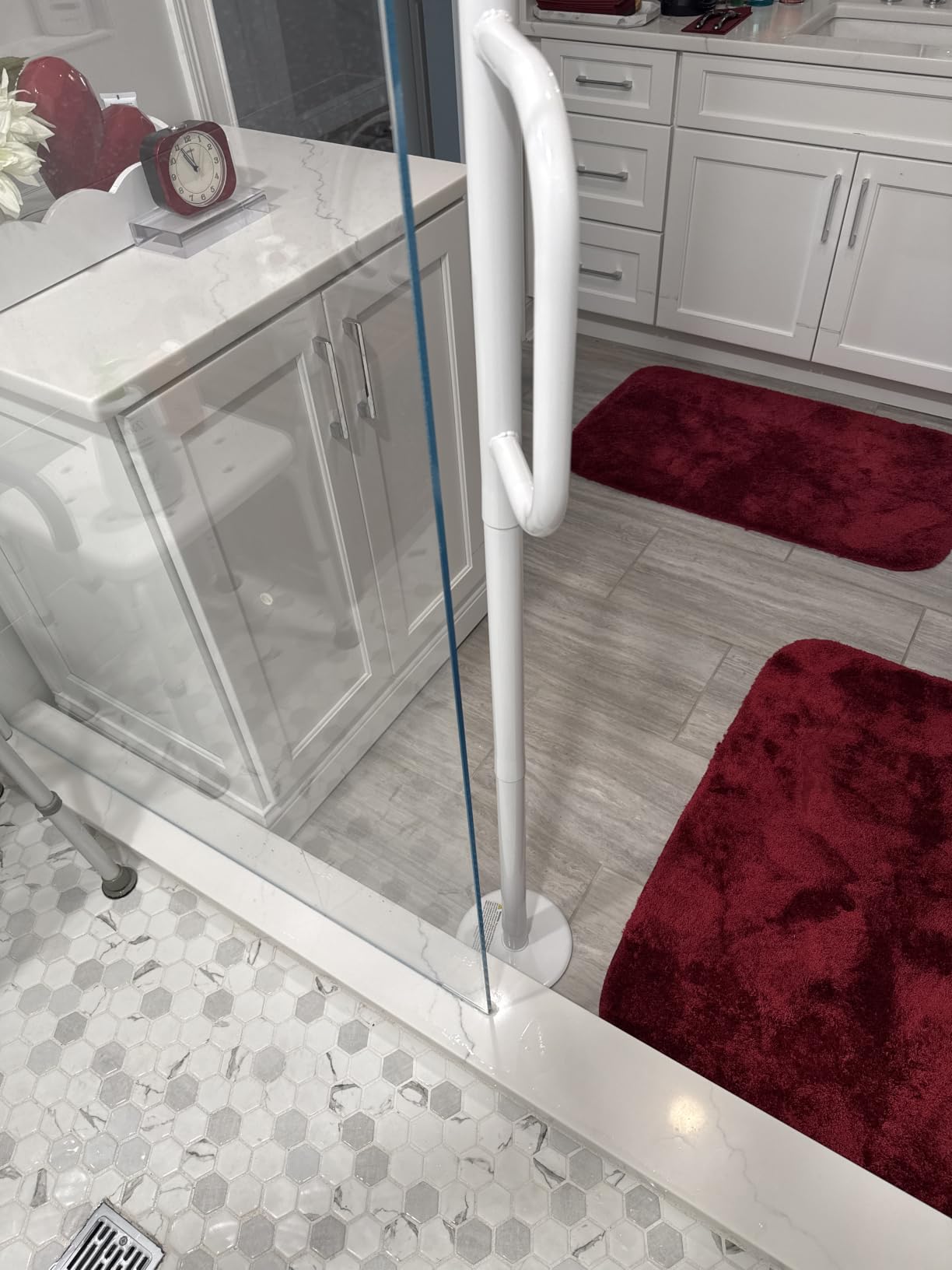
Two independently adjustable handles are the whole idea here. You can set one low for the sitting-to-standing push and one higher for the pull back down onto the mattress, which is a real advantage in a bedroom where the bed height does not match the user’s ideal grip.
The 4.6 rating across more than 1400 reviews reflects a straightforward design that works. Assembly is tool-free, the tension mount needs no wall fixings, and the same pole can move to a chair or a toilet when the bedroom job is done.
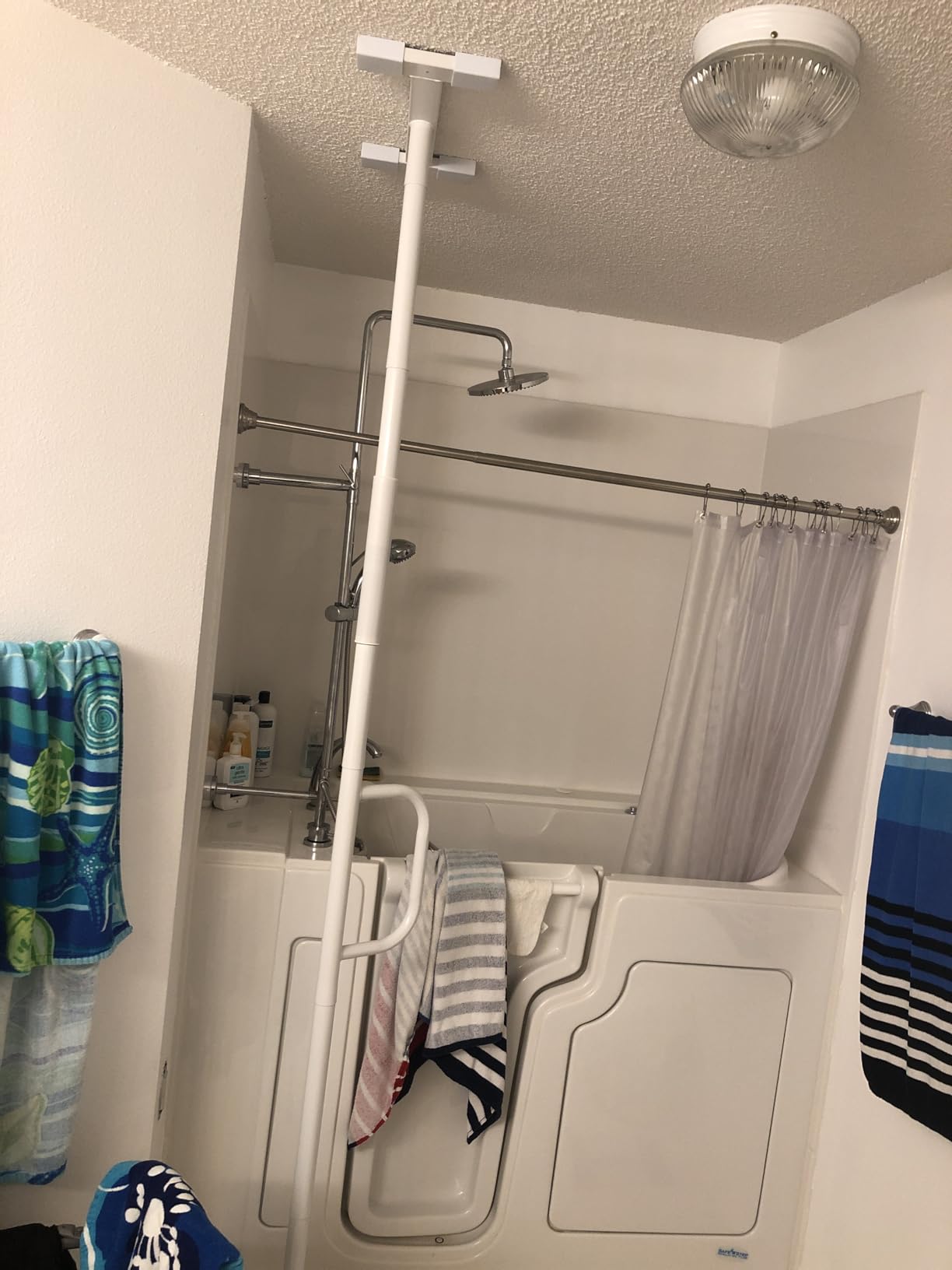
The catch is that the handles stay where you set them. If the bed position shifts or a caregiver wants the grip redirected mid-transfer, you are back to adjusting the handle rather than swiveling it.
The ceiling range is also narrower than several rivals here. It fits 7 ft to 9 ft 6 in, so a low 7-foot room works but a taller room needs a different model.
How to set the two handles for one user
Sit on the edge of the bed in your normal morning position and have someone mark where your hand naturally lands when you push down to stand. That height is your lower handle. The upper handle should sit roughly a hand span higher so the pull back down to sitting is a controlled descent rather than a drop.
Keep both handles on the same side of the pole as your dominant hand. Splitting them to opposite sides feels balanced in the showroom but awkward in a real bed transfer.
Where it beats the rotating model
Choose this over a rotating bar when the pole lives in one fixed spot and the transfers always come from the same direction. You give up the ability to swing the handle away, and in exchange you get two grips tuned to a single person’s reach.
It is also a good second pole for a second bedroom, or a spare for a room with a ceiling outside the wider ranges the rotating models claim.
3. Stander Wonder Pole Slim: Best Rated for Tight Bedrooms
Stander Wonder Pole Slim, Tension Mounted Security-Pole, Elderly Floor to Ceiling Transfer-Pole for Seniors, Bathroom Grab Bar Stability Rail with Padded Handle, White
Alloy steel with padded handle
300 lb capacity
Adjusts for 7 to 10 ft ceilings
17 pounds
Pros
- Strongest average rating in this roundup at 4.7 stars
- Padded handle is easy to hold during longer sits
- Slim footprint suits small rooms and tight bedside gaps
- No drilling
- adjusts for 7 to 10 ft ceilings
Cons
- Single fixed handle position instead of a rotating bar
- Not compatible with vaulted ceilings or inside a tub or shower
- Heavier than it looks for a one-person install
This is the pole to look at when the bedroom is small. The single column and padded handle take up almost no bedside space, which matters in a room where the bed already sits close to the wall and the nightstand takes the last six inches.
The padded handle is the sleeper feature for bedroom use. It stays comfortable through a slow, wobbly descent back onto the mattress, and at 4.7 stars from 676 reviews it holds the highest average rating of anything we tested.
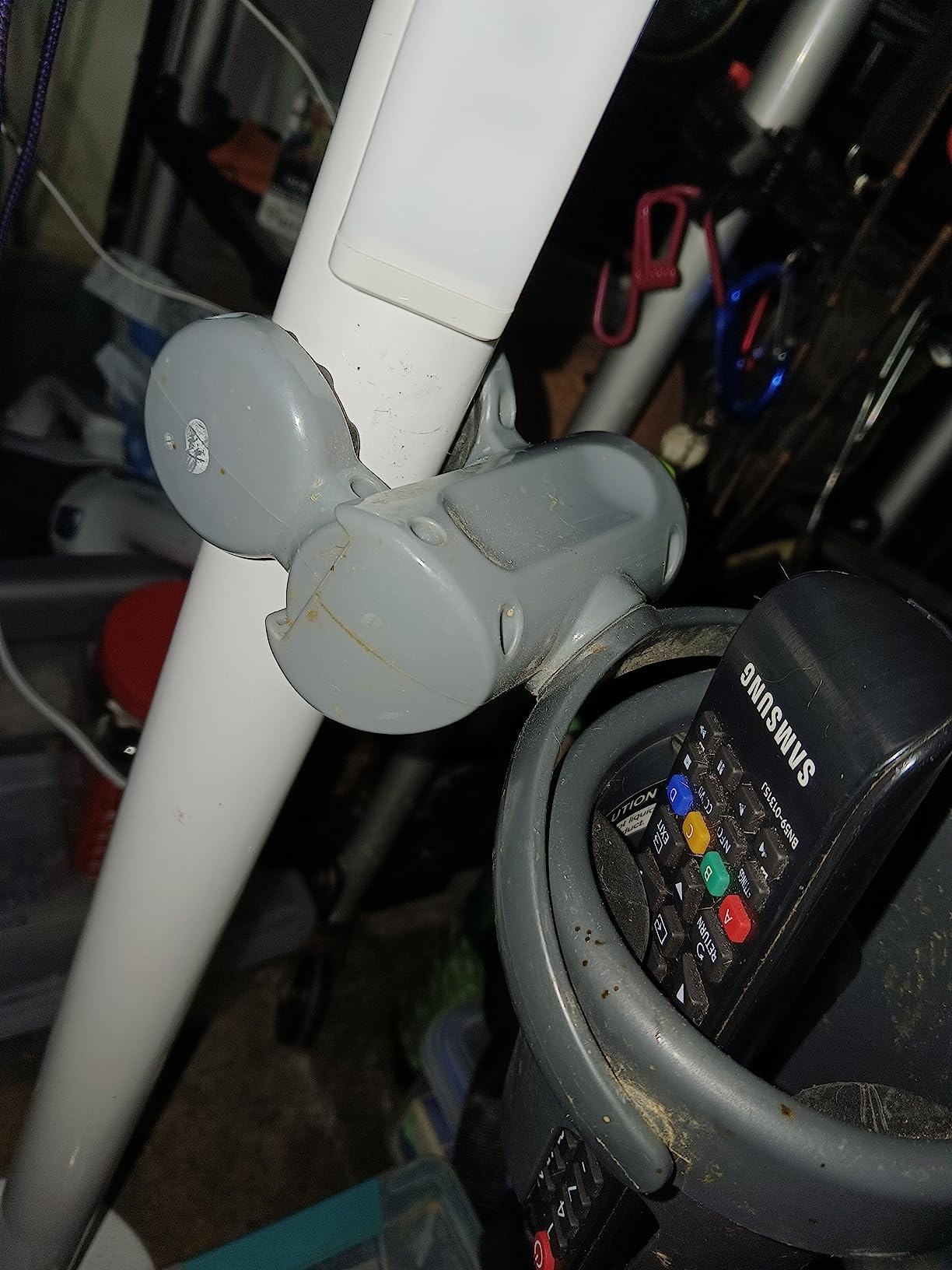
Like the rest of the Stander tension poles here, it adjusts for flat ceilings from 7 to 10 feet and will not touch a vaulted ceiling. It is also not approved for use inside a bathtub or shower.
At 17 pounds it is lighter than the rotating model, but buyers still describe it as heavier than expected for one person. Plan on a second set of hands or a slow, careful solo assembly.
Why padding matters more than people expect
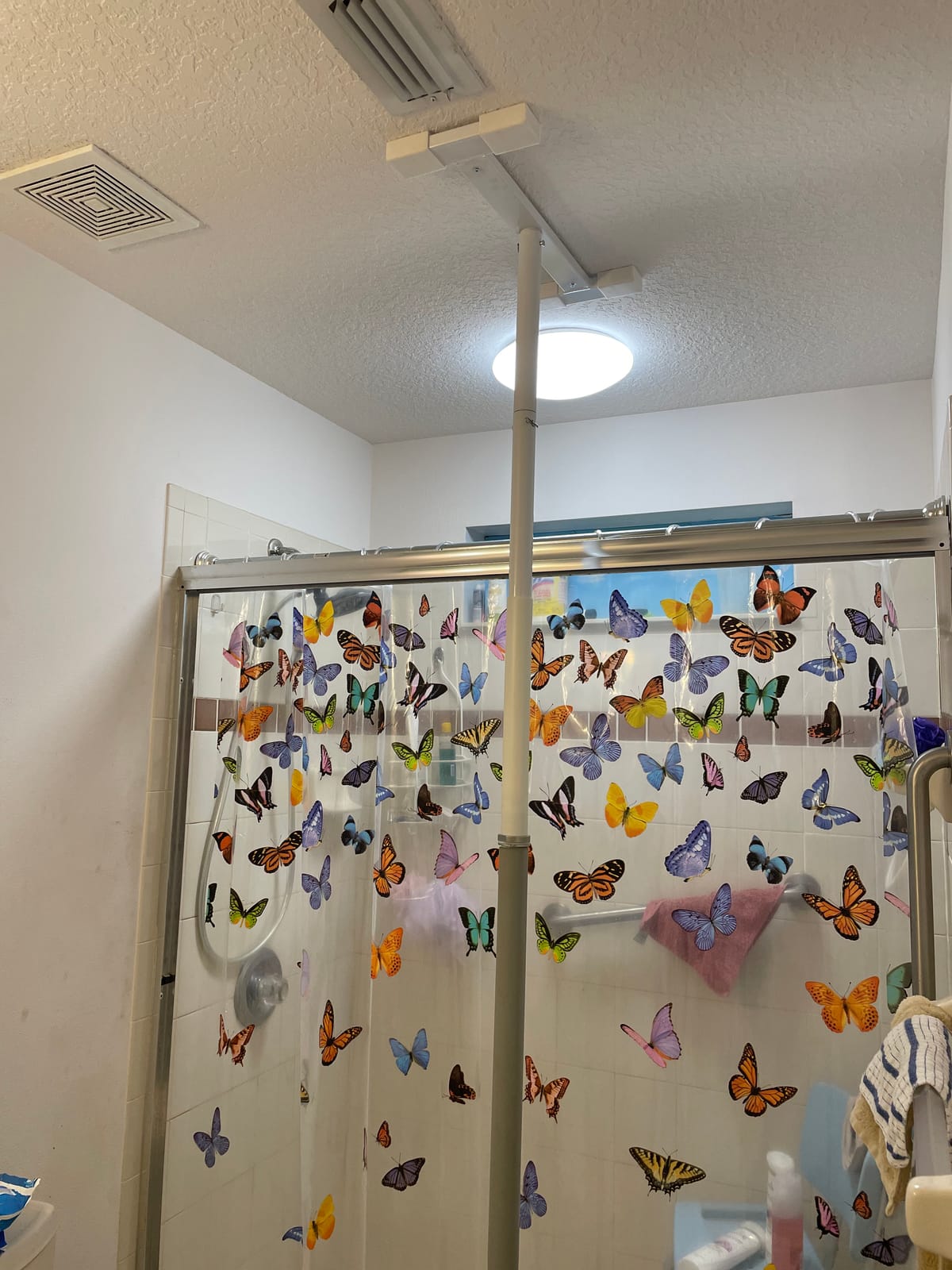
A hard steel grip gets uncomfortable after a few seconds when the user has limited grip strength, which pushes them toward twisting the pole or gripping harder than they should. The padded sleeve on this model spreads that pressure and gives cold or arthritic hands something with more give.
It also solves a small bedroom problem: the padding has a larger diameter than a bare bar, so check that the gap between the mattress edge and the pole base is still wide enough for the handle to be gripped comfortably.
Where the slim design loses out
One handle means one grip position. If someone needs a low push for standing and a high pull for lying down, they are better served by the double-handle model a few sections above.
It is also a single-purpose bedroom unit. Because there is only one handle, moving the pole to another room means losing the bedroom spot, whereas a double-handle pole can leave one grip behind for a chair or toilet.
4. VEVOR Trapeze Bar with Wheels: Best for Moving the Support Around
VEVOR Trapeze Bar for Bed Mobility, Height-Adjustable Free Standing Trapeze Bar with 2 Wheels, 300LBS Capacity Bed Pull Up Assist for Elderly Disabled, Ideal for Hospital, Nursing Home & Home Care
Free-standing Q195 steel frame
300 lb capacity
Two casters
Adjustable strap and overall height
Pros
- Free-standing base with casters needs no ceiling or bed mounting
- Reinforced double-rod base resists tipping
- Both overall height and strap height adjust
- Useful for home rehab and upper-body work
Cons
- Very heavy at 42.6 pounds so two people are needed
- Some bolt holes need filing before the screws seat
- The wheeled base occupies floor space beside the bed
This is the only product here that solves the lying-to-sitting phase rather than the standing phase. The overhead strap handle lets someone pull themselves up into a seated position and reposition in bed, which is the part a floor pole handle simply cannot reach.
The wheeled base is the other draw in a bedroom. It rolls to the head of the bed in the morning, to the side for a transfer, and out of the way when a caregiver needs to make the bed, with no ceiling or frame mounting at all.
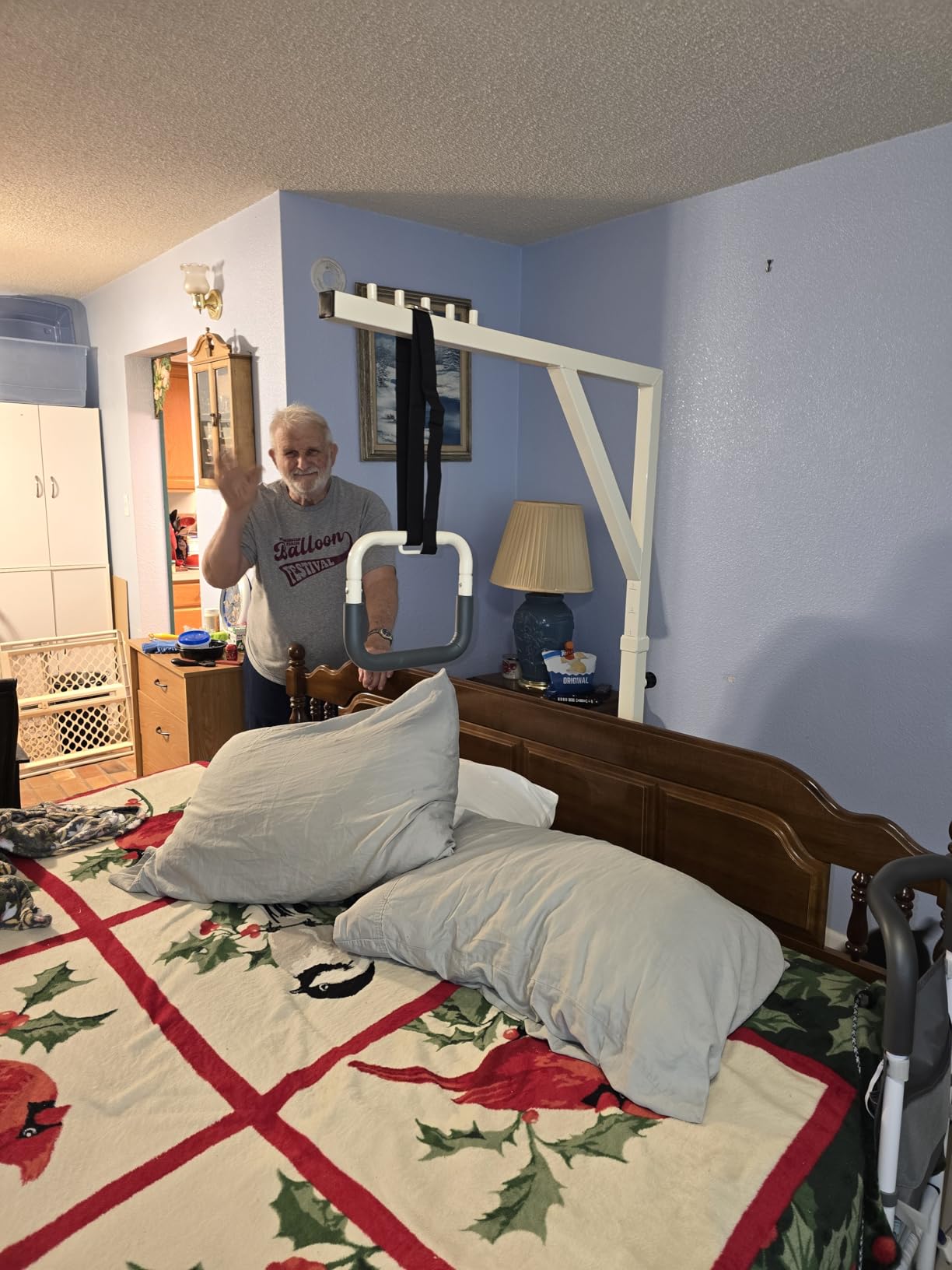
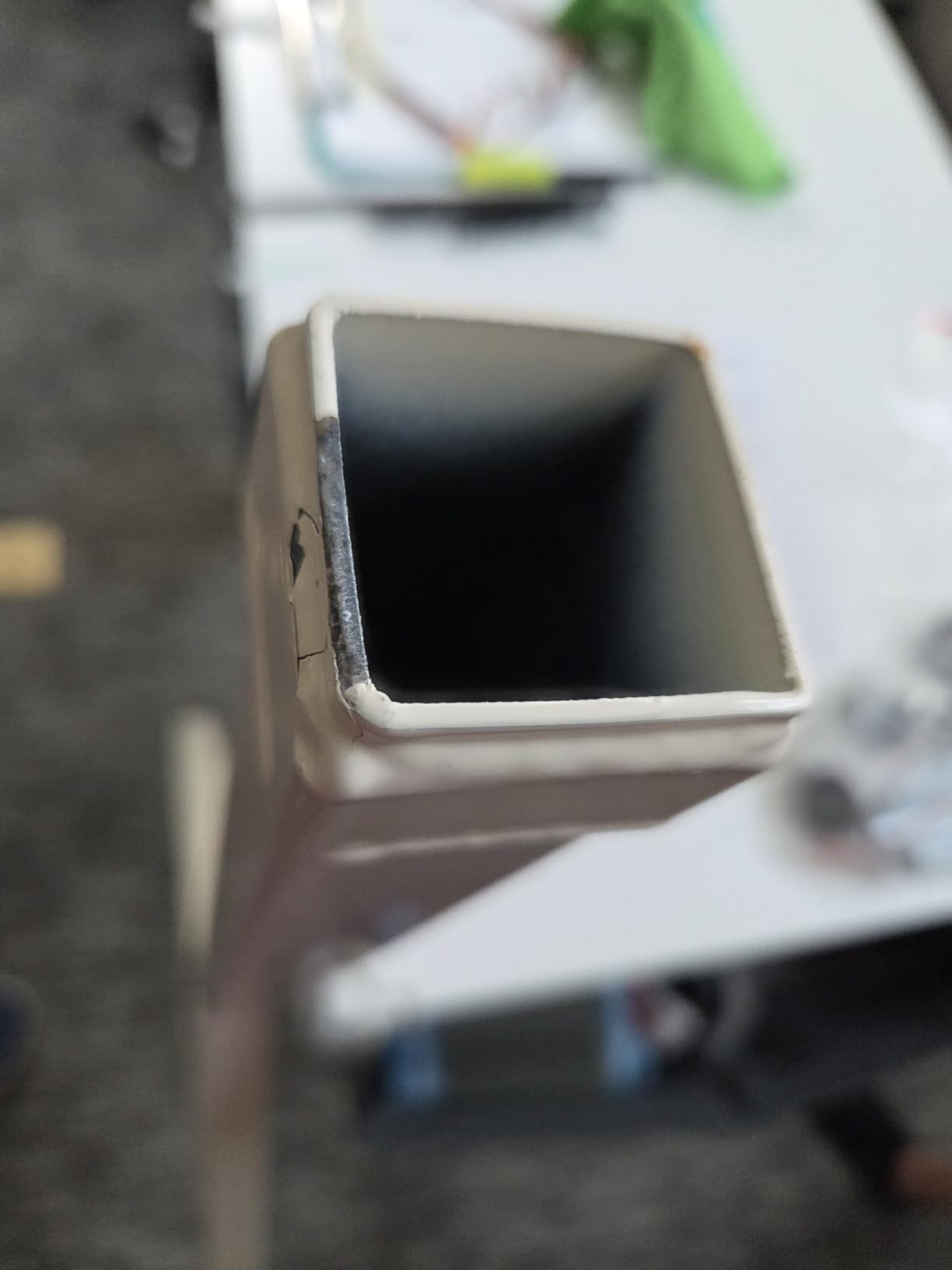
Expect assembly work. At 42.6 pounds it needs two people, and several reviewers report hardware holes that do not line up cleanly enough to seat without a little persuasion.
The height adjustment uses a tightening knob rather than pinned holes, so test it under load before trusting it. The wheeled base also means the bed cannot sit fully flush to the wall, which matters in a narrow room.
Room to swing versus ceiling height
A freestanding unit needs clearance above and beside the bed, not a matching ceiling height. That makes it a genuinely better fit for bedrooms with low ceilings, sloped ceilings or a heavy popcorn texture where a tension plate has nothing flat to bite into.
Measure the space beside the bed before ordering. If the bed has to sit several inches off the wall for the base, and the room is already tight, this swaps a ceiling problem for a floor problem.
Who should buy this instead of a pole
Buy it if the hard part is getting up from lying down, or if the person needs to roll and reposition independently overnight. Do not rely on it as the only support for standing up from the bed edge, since a strap handle is an in-bed aid first.
For the standing phase in the same room, caregivers often pair it with a slide sheet or an inflatable glide so the two devices each cover the step they are actually good at.
5. AOSSA Ceiling Mount Bed Trapeze: Budget Pick for In-Bed Repositioning
AOSSA Bed Trapeze for Elderly Pull Up, Stand Assist Lift Bar, Hospital Bedside Trapeze for Bed Mobility & Transfer, Ceiling Mounted Grab Bar, Stand Ladder Standing Helper for Disabled Handicap
Ceiling mounted trapeze
9-inch two-handed handle
Fits 7.5 to 9 ft ceilings
1.54 pounds
Pros
- Low cost entry into bed mobility aids
- Only 1.54 pounds and no floor space used
- 9-inch wide handle allows a firm two-handed grip
- Height adjusts within minutes
Cons
- Needs a real ceiling anchor point and ceiling weight capacity
- Ceiling range is 7.5 to 9 ft with no coverage above that
- No floor-based backup if the mount is weak
- Some reviews question the light build feel
This hangs from the ceiling rather than bracing floor to ceiling, which means it needs an actual fixing point. For a bedroom with a joist overhead and someone comfortable with a drill, that is a clean install with nothing on the floor to trip over.
The 9-inch handle takes a secure two-handed grip, so it is a genuine in-bed pull-up and repositioning aid for someone who wants to sit up without calling for help.
The ceiling range is the thing to check before anything else. It is designed for ceilings 7.5 to 9 feet, so a low bedroom or a tall room with a vault will not work without an alternative.
What has to be true before you buy it
There must be a structural fixing point overhead, not drywall alone, and the ceiling itself needs enough weight capacity to take the load. If you are renting or cannot confirm what is above the plasterboard, this is the wrong product to force.
Also check the swing path. A ceiling strap needs clear space over the pillow and head of the bed, which some low headboards and sloped ceilings will not give you.
Why buyers rate it mid-range
The 4.3 rating reflects a device that does one job cheaply and simply, with no mechanical advantage beyond a fixed strap. Buyers who expected a powered or multi-function lift were disappointed by what is essentially a well-sized hanging handle.
Some reviews also question the light packaged weight as a signal of light-duty construction. If you want a device that will see years of daily pulling, a heavier floor-stand model is the safer bet.
6. VEVOR Floor-to-Ceiling Transfer Pole: Best for Rooms Up to 10 Feet
VEVOR Floor-to-Ceiling Transfer Pole, Tension Mounted Bathroom Grab Bar with Anti-Slip Curve Handle, 300 Lbs Capacity Security Pole for Elderly, Ideal Senior Safety Pole for 7-10 Ft Ceilings, Black
Carbon steel with alloy tubing
300 lb capacity
7 to 10 ft ceiling range
20.3 pounds
Pros
- Segment choice at assembly covers 7 to 10 ft ceilings
- Handle rotates 360 degrees and locks every 45 degrees
- Thick-walled tubing resists shower mist and soap
- No drilling needed for installation
Cons
- Some reports of the handle bracket failing to tighten
- Threaded joint between pole sections can bind after assembly
- Heavier than expected at 20.3 pounds with sharp male threads
The ceiling fit is the standout here. Instead of a sliding adjustment, you pick pole segments during assembly, which is how it covers everything from a 7-foot bedroom up to a 10-foot room.
The handle also rotates and locks every 45 degrees, so it can be aimed toward the mattress for a standing transfer and turned away for a night trip to the bathroom.
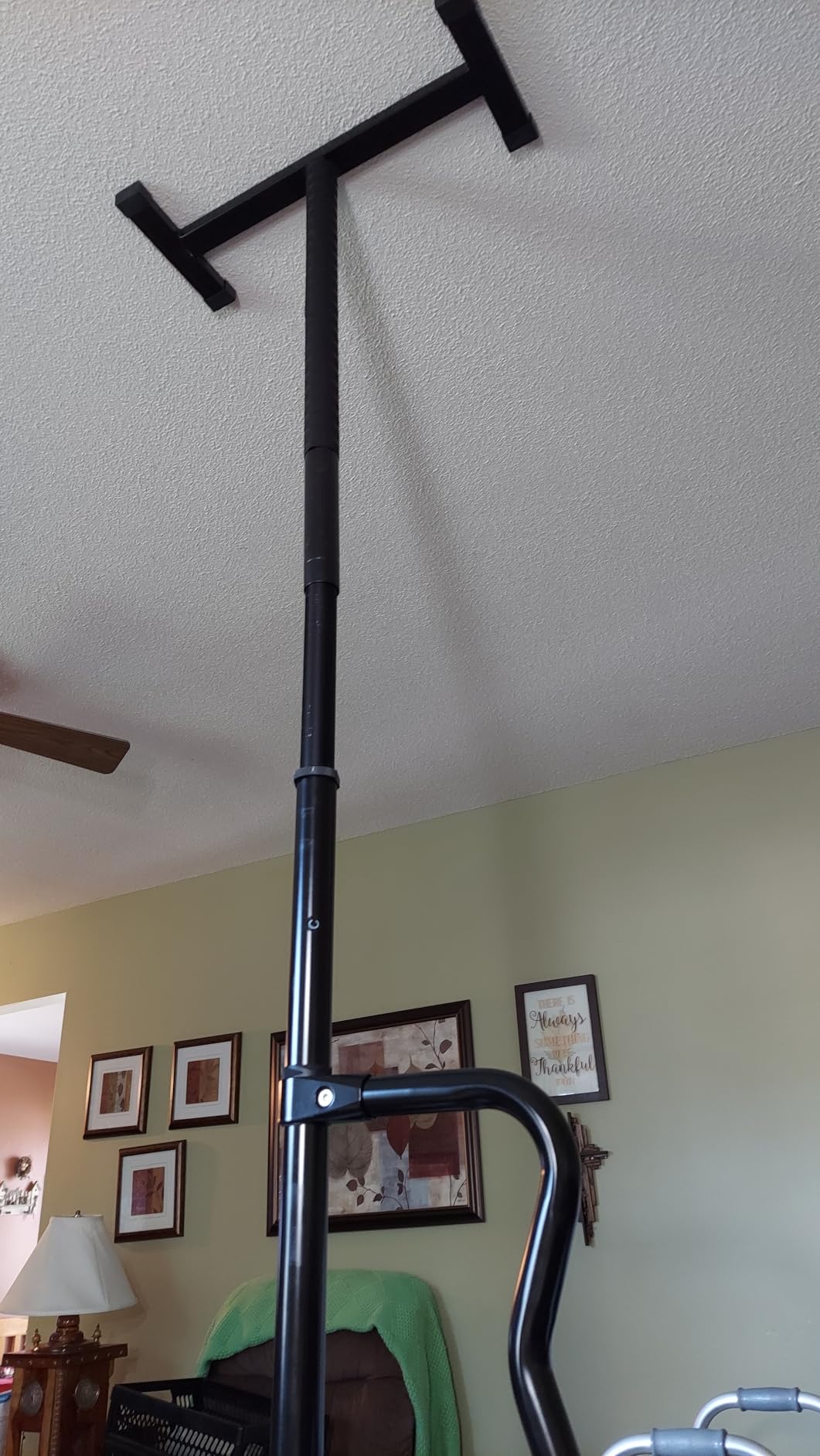
Build quality is uneven, and that shows in the 4.1 rating. Multiple reviewers report a handle bracket that will not clamp down properly, which lets the grab bar turn under load at exactly the moment you do not want it moving.
Read the assembly note carefully: measure the ceiling before joining the two sections, because a threaded joint that binds can stop you shortening the pole later.
How to avoid the two common failures
Measure your ceiling height and pick the segment combination that leaves slack before you thread anything together, then tighten fully. Do not thread the second section on first and hope for the best, because a bound joint is the main reason owners cannot shorten the unit.
Test the handle bracket under load before anyone relies on it. Push the bar hard in several directions while someone else watches the bracket; if it moves at all, tighten it now rather than at 7 am on a bad morning.
Where it beats the Stander poles
It covers a taller ceiling span than most non-vaulted models here and the metal tubing is specified to resist erosion from moisture, so it can be moved to a bathroom in a home where the bedroom ceiling is unusually tall.
Against the rotating Stander poles it trades polish for reach and adjustability. If build consistency matters more to you than ceiling range, pick the Stander.
7. Signature Life Sure Stand Pole: Best for Vaulted Ceiling Bedrooms
Signature Life Sure Stand Pole, Elderly Tension Mounted Floor to Ceiling Transfer-Pole, Bathroom Safety Grab Bar and Stability Rail with Adjustable Curved Hand Grips and Padded Handle, Deep Bronze
Tension mounted metal pole
300 lb capacity
Fits flat and vaulted ceilings 7-10 ft
Pros
- Works on flat and vaulted ceilings across 7 to 10 feet
- Two adjustable grab bars plus a padded handle
- Brushed metal finishes that suit bedroom decor
- Listed at 16.5 pounds
Cons
- Accessory grab bars are sold separately
- Premium end of the range for tension poles
- No white option with the brushed metal finish
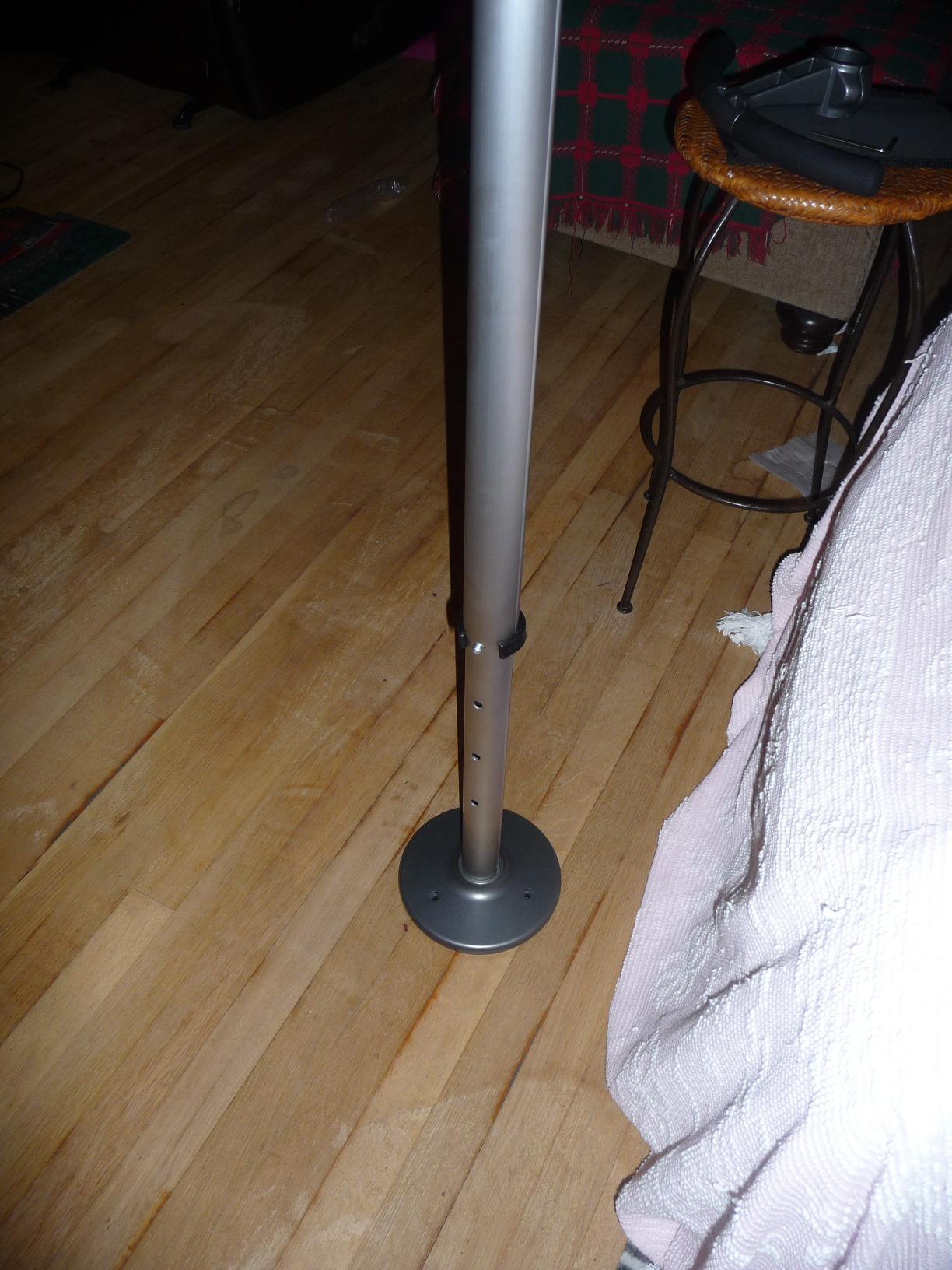
Vaulted ceilings rule out most tension poles in this roundup, because the ceiling plate needs a flat surface. This one is specified for both flat and vaulted ceilings from 7 to 10 feet, which makes it the pick for a bedroom under a slope.
You also get two adjustable grab bars and a padded handle on the same pole, so one unit can carry a low push grip, a high pull grip and a comfortable hold on the same column.
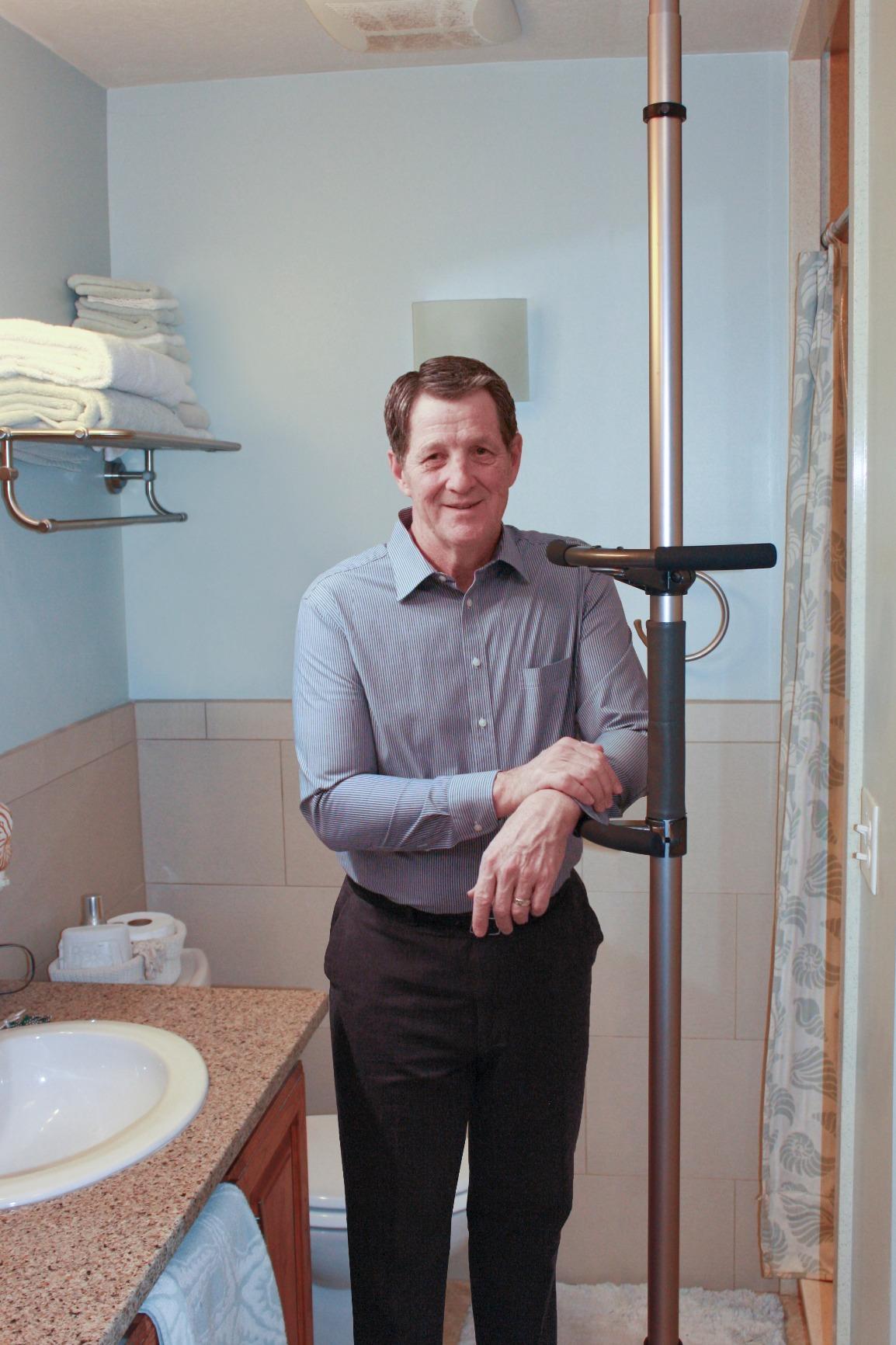
Two costs hide in this one. The versatile accessory grab bars are extra purchases, and the brushed metal finish is offered in Graphite or Deep Bronze rather than the white most people picture in a bedroom.
At 16.5 pounds it is listed lighter than the other floor-to-ceiling poles here, which makes positioning it against a sloped ceiling much easier for a single installer.
How the pole behaves on a slope
On a vaulted ceiling the pole still braces vertically, so it works as long as the ceiling meets the pole high enough. Measure the height at the exact spot where the base will sit, not at the highest point of the room.
If the slope means the top plate sits on an angle, check with the manufacturer before ordering. A pole that is specified for vaulted ceilings is a different ceiling plate design from the flat-ceiling units above it.
Who this finishes for that others do not
This is the model for a bedroom where every flat-ceiling option on this list has already been ruled out. It also suits a home that will be redecorated, since brushed metal reads as furniture rather than medical hardware.
Skip it if you only need one fixed grip and want the simplest install. Two grab bars plus optional accessories is more to assemble and more to set correctly than a single-handle slim pole.
8. Lumex 2940B Versa-Helper: Best for Higher Weight Capacity
Lumex 2940B Versa-Helper Trapeze Bar for Bed Mobility, Chrome, Medical Assist Handle With Floor Stand
Clinical trapeze bar
Up to 450 lb, 600 lb variant
Freestanding or clamps to bed frame
Pros
- Rated to 450 pounds with a 600-pound bar variant
- Floor stand or metal headboard clamping
- Triangular handgrip adjusts for height and reach
- Long-standing clinical design used in care settings
Cons
- Highest-ticket option in this roundup
- Frame clamping only works on metal headboards or footboards
- Base and upper arm take up floor space beside the bed
Capacity is the reason to look here. The bar is rated to 450 pounds with a 600-pound variant available, which puts it at the top of the range for this roundup and makes it a realistic option for heavier users who would be at the limit of a 300-pound pole.
The install is flexible in a way tension poles are not. It stands on the floor anywhere in the room, or clamps to a metal headboard or footboard to reclaim the floor space when the bedroom is tight.
Check the headboard before you order
The clamping option only works on a metal headboard or footboard. If the bedroom bed has a wooden frame with no exposed metal rail, the floor stand is the only route, and that changes the footprint question entirely.
Measure the room layout, not just the bed. The base and upper arm both occupy floor space beside the bed, which needs to clear a walker or a wheelchair parked overnight.
How the grip feels compared with a pole handle
The triangular handgrip adjusts for both height and reach, so the pulling angle can be set to match the person’s shoulder and arm rather than the geometry of a straight column. That makes it a better in-bed pull-up aid than a floor pole handle.
It does not help with the standing phase at the bed edge, since there is no vertical member to push against. For that step, users often run a pole on the other side of the bed.
9. Mybow Floor Stand Trapeze: Best for Narrow Bedrooms With No Ceiling Option
Mybow Trapeze Bar for Bed Mobility Aids, Bedside Pull Up Bar, Bed Lift for Elderly Seniors Transfer Rail, Medical Trapeze for Hospital Bed Standing Helper, Handicap Bariatric Bed Handle
Iron floor stand trapeze
Handle rated to 250 lb
Floor anchors rated to 300 lb
Pros
- I-shaped base fits hospital beds
- regular beds
- chairs and couches
- 9.5-inch handle with a metal buckle adjusts to grip position
- Three star-stud knobs reduce shaking during use
- Floor anchoring keeps the frame from drifting
Cons
- Handle rated to 250 lb
- below the 300 lb floor anchor rating
- Some users still report shake and wobble
- Only two adjustment holes on the upper support arm
Like the wheeled VEVOR unit, this is an in-bed trapeze rather than a standing pole, and it works without any ceiling at all. That makes it the practical choice in a bedroom with a low ceiling, a textured ceiling or a room where a tension plate will not seat.
The I-shaped base is narrower than a full floor stand and fits most bed frames as well as chairs and couches. It also needs no ceiling fixing point and no wheels, so it can stay tucked in the same corner between uses.
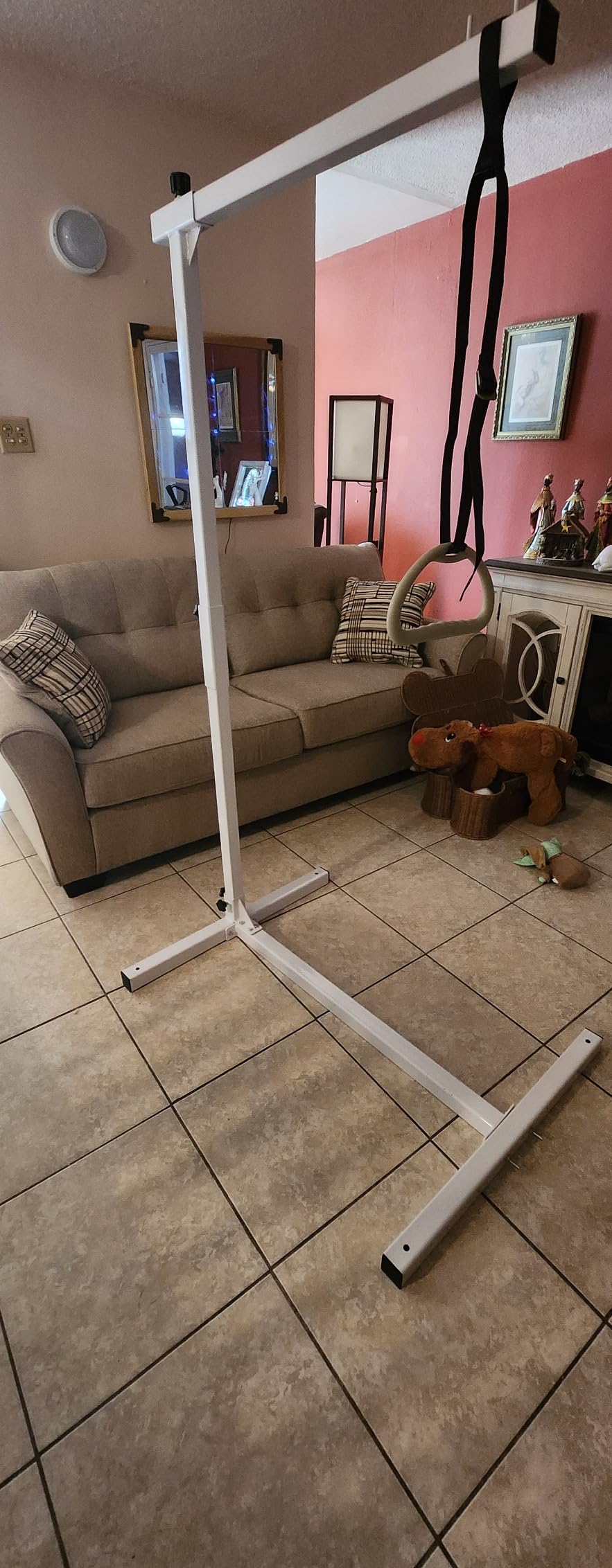
The 4.2 rating comes down to two numbers. The handle is rated to 250 pounds while the four floor screw holes are rated to 300, so the handle is the real limit and it is lower than most competitors here.
Some users also report residual shake despite the three star-stud knobs, and the upper support arm has only two adjustment holes, which limits handle height options for a tall user.
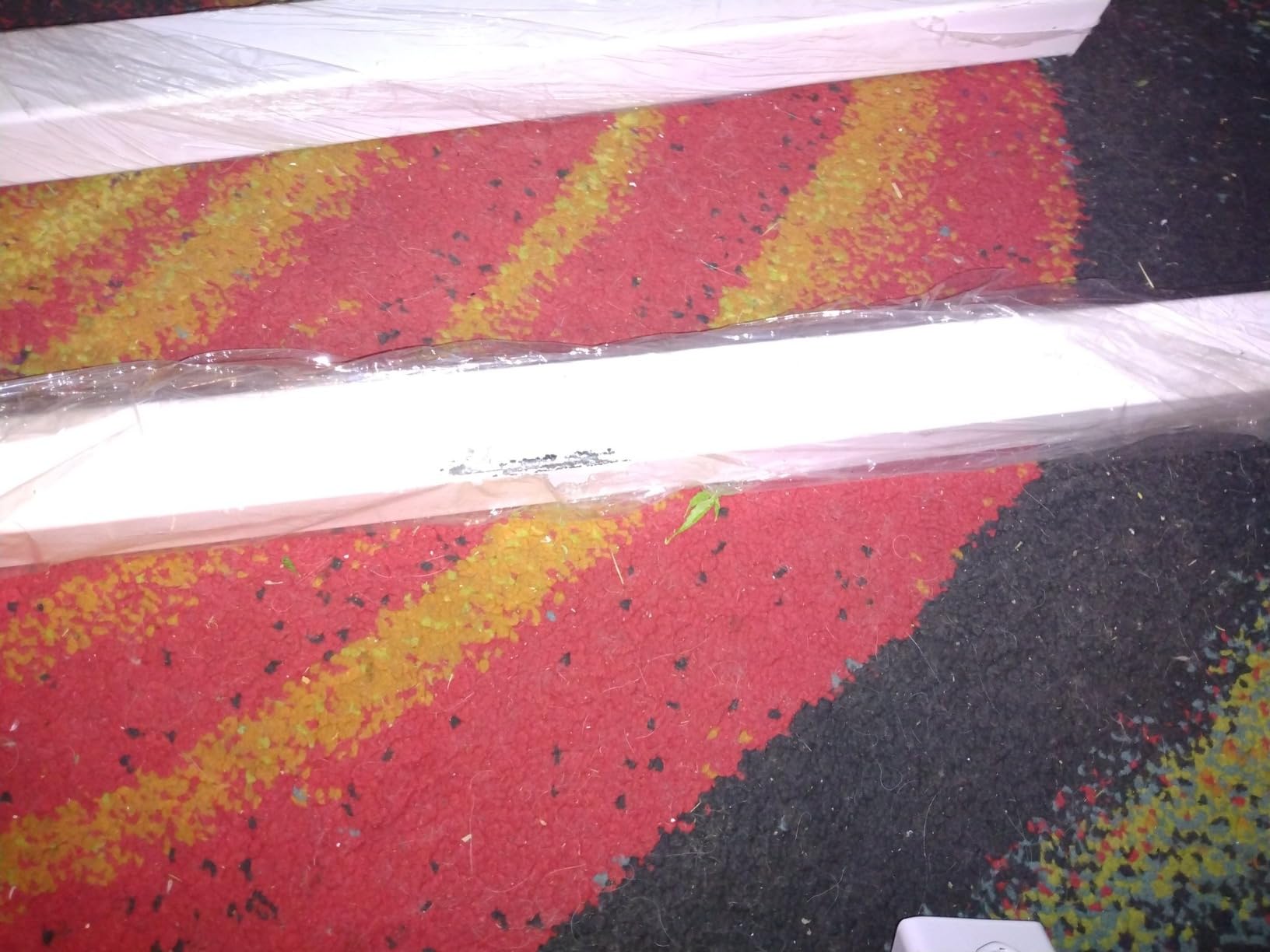
Where the narrow base actually helps
The footprint is the selling point in a small bedroom. A single I-shaped base tucked beside the mattress takes up less floor than a castored frame, which matters when the only clear floor strip is between the bed and the door.
Because it bolts down through four floor holes, it also stays put where a wheeled unit might drift. That is a safety argument rather than a comfort one, but it is the reason caregivers pick a floor stand over a rolling base.
When to choose a pole instead
Choose a tension pole when the goal is the sitting-to-standing push. A trapeze arm helps a user pull up and reposition while lying down, and does nothing for the moment they need to press down through their legs to stand.
For a user near the 250-pound handle limit, either move up to a higher-rated trapeze or plan a pole for the standing phase and treat this as the in-bed aid only.
10. Healthcraft SuperPole with SuperBar: Best for the Most Adjustable Grip
HEALTHCRAFT SuperPole with SuperBar 8-FT Floor-to-Ceiling Grab Bar, 300 Lbs
Alloy steel pole
16-inch SuperBar, 8 lock positions
300 lb
Fits 93-99 inch ceilings
Pros
- SuperBar locks in eight positions every 45 degrees
- Rubber pads under the mounts protect tile and floors
- Tension mount installs without drilling and moves between rooms
- The 16-inch bar leaves room for a two-handed grip
Cons
- Minimum fit is 93 inches so lower ceilings will not work
- Installation guidance is pictorial only
- 10-foot extender is a separate purchase
The SuperBar is the best-specified handle here. It is 16 inches long with Pivot and Lock technology and eight locking positions every 45 degrees, so the grip can be centered on the user instead of sitting off to one side of the pole.
For a bedroom floor, the rubber pads under the top and bottom mounts matter more than most buyers expect. They spread the load and stop the base from scuffing or marking tile and finished floors.
Measure before anything else, this one is fussy
This is the model most likely to surprise you on measurement. The minimum fit is 93 inches, so a room with a 91-inch ceiling will not work without a different pole, and the 10-foot extender is a separate purchase rather than included.
Expect a setup session with no written instructions. The guidance is pictorial only, so budget time to work out the mounting order yourself before you fit the bar into the pole.
Why the extra bar positions are worth it
Eight positions at 45-degree intervals let a caregiver set the bar once for the main user and then fine-tune for a second person without re-tensioning the pole. That matters in a shared bedroom or when a relative with a different height helps with transfers.
A 16-inch horizontal bar also gives two hands somewhere to go at once, which reduces the awkward single-arm grip that makes some users abandon a pole handle in the first week.
How to Place a Transfer Pole Beside a Bed
Placement does more for safety than the model you buy. A correctly placed pole turns a two-person lift into a controlled one-person transfer, and a badly placed one sits just far enough away to be useless at 6 am.
Measure reach from the mattress, not the room. Sit on the edge of the bed the way you do every morning and note where your hand lands when you push down. The pole handle should be within easy reach of that point without the user having to lean or twist away from the mattress.
Choose the side based on the transfer path. If a wheelchair parks on the left, the pole goes on the left. If the person slides toward the door in the morning, put the pole on that side so the standing movement finishes in open floor rather than against the nightstand.
Leave nightstand clearance. The base plate needs solid floor and the handle needs room to swing. A pole that blocks the nightstand drawer gets nudged loose within a fortnight, and a loose pole is worse than no pole.
Check the ceiling is flat and in range. Every tension pole here is rated for a specific height band and none of them like a slope or a textured surface. Measure at the exact spot where the base will sit.
Set the handle height last. Assemble the pole, tension it, then set the handle at hip level for standing. Hip level is where a push through the legs converts into upward movement rather than a forward lean.
Test the tension with real force. Push the handle sideways and forward with your full push-up weight. If the pole moves at all, tighten it further before anyone relies on it.
How to Use a Transfer Pole Safely
A transfer pole is a balance aid, not a lifting device. The person using it should still be pushing up through their own legs, with the pole providing a stable handhold rather than taking their weight. That distinction is the single most important safety point here, and it is the exact criterion caregivers on r/CaregiverSupport use when deciding whether a pole will work at all: if the user cannot use upper body and arm strength, a standing pole is the wrong tool.
Use it for the pull to standing and the controlled lowering back down. Sit on the edge, feet flat, then push through your legs while pulling lightly on the handle. Lower yourself in reverse over several seconds rather than dropping the last few inches.
Re-tension weekly. Turn the top and bottom mounts a quarter turn each and confirm the pole still does not move under a hard sideways push. Tension relaxes over time with footfalls and seasonal changes, and a slowly loosening pole is the most common cause of wobble.
Watch the ceiling and floor. If the tension mount leaves marks, is slowly creeping, or the ceiling surface is textured rather than flat, the pole is not seated correctly and needs re-tensioning or a different product.
Match the device to the phase of the transfer. A pole handles sitting to standing. An in-bed trapeze, slide sheet or inflatable glide handles lying to sitting and repositioning, and caregivers routinely pair the two rather than expecting one device to do both.
Transfer Pole vs Bed Rail vs Bedside Table: When a Pole Is the Wrong Choice
A pole is the wrong choice when the person cannot bear weight on their legs, when transfers need a full lifting assist rather than a handhold, or when the bedroom ceiling will not accept a flat plate. In those cases a full mechanical lift, an in-home caregiver, or a different room layout is the safer route.
It is also worth being honest about the alternatives. A half-bed rail gives a low horizontal bar for rolling and repositioning but does nothing for the standing phase. A bedside table gives a surface to push from but no fixed grip. An overhead trapeze solves the lying-to-sitting phase and leaves standing entirely unaddressed.
What a pole uniquely does is give a rigid vertical handle at the moment of standing. That is why it pairs well with the other devices rather than competing with them.
On cost, budget and mid-range poles share the same 300-pound alloy steel core, and the real differences are handle adjustability, ceiling range and finish. Premium options add vaulted-ceiling compatibility, higher capacities, or brushed metal that does not look like a medical device.
For renters, the no-drill tension mount is the whole argument. Ceiling-mounted trapezes need a real fixing point, and floor-stand trapezes need either anchors or enough clearance to be used safely. Medicare and DME coverage varies by region and prescription, so confirm before ordering rather than assuming.
Whatever you choose, talk to an occupational therapist or doctor first. They can tell you whether the user has the grip strength and leg strength a pole requires, and where in the bedroom it should go.
Frequently Asked Questions
Are transfer poles safe to use?
Yes. Properly tension-mounted transfer poles are considered safe for daily bed transfers when the pole is braced between a flat floor and a flat ceiling, sized for the room, and re-tightened regularly. The main risks come from a loose pole, a ceiling outside the stated height range, or a user who cannot bear weight on their legs.
Where can I buy a transfer pole?
Transfer poles are sold through online marketplaces, medical supply retailers, and pharmacy and mobility aid counters. Check the listed weight capacity, ceiling height range, and whether the model needs drilling before ordering.
How do you install a floor to ceiling transfer pole?
Assemble the pole sections to roughly your measured ceiling height, tighten the base until the pole is firmly braced, then turn the top mount until it seats against the ceiling. Push the handle hard in several directions to confirm it does not move, and re-tension weekly afterwards.
What height should a transfer pole be next to a bed?
Set the handle at about hip level for the person standing up from the bed edge, which lets them push through their legs rather than lean forward. For lowering back down to sitting, a second handle roughly a hand span higher gives a controlled descent.
Do transfer poles need to be drilled into the ceiling?
No. Tension-mounted poles use compression between the floor and ceiling rather than screws, so nothing is drilled and the unit can be moved between rooms. Ceiling-mounted trapeze bars are the exception, since those do need a solid fixing point overhead.
How much weight can a transfer pole support?
Most tension-mounted poles in this roundup are rated to 300 pounds. Higher-capacity trapeze bars reach 450 pounds with a 600-pound variant available, and one floor-stand model lists a 250-pound handle rating, so always check the rating of the specific handle rather than the frame.
Can a transfer pole be used on a vaulted ceiling?
Only a few. Most tension poles need a flat ceiling plate, so they will not seat properly on a slope. Models specifically specified for flat and vaulted ceilings from 7 to 10 feet exist, and free-standing or floor-stand trapezes avoid the ceiling entirely.
The Best Transfer Poles for Bedrooms, Final Word
After comparing all ten of these in a bedroom context, the Stander Wonder Pole Plus comes out as our pick for the best transfer poles for bedrooms, because the rotating grab bar is the feature that most directly improves a real bed-to-stand transfer.
Pick it if your ceiling is flat and between 7 and 10 feet and you have a second person to help with the install. For a tight room, the Wonder Pole Slim gives you the highest-rated model in a smaller footprint, and for a sloped ceiling the Signature Life Sure Stand Pole is the one that will seat at all.
Whatever you choose, measure the ceiling, plan the side, and set the handle at hip level before anyone relies on it. And check with an occupational therapist that the user has the grip and leg strength a pole actually requires.