
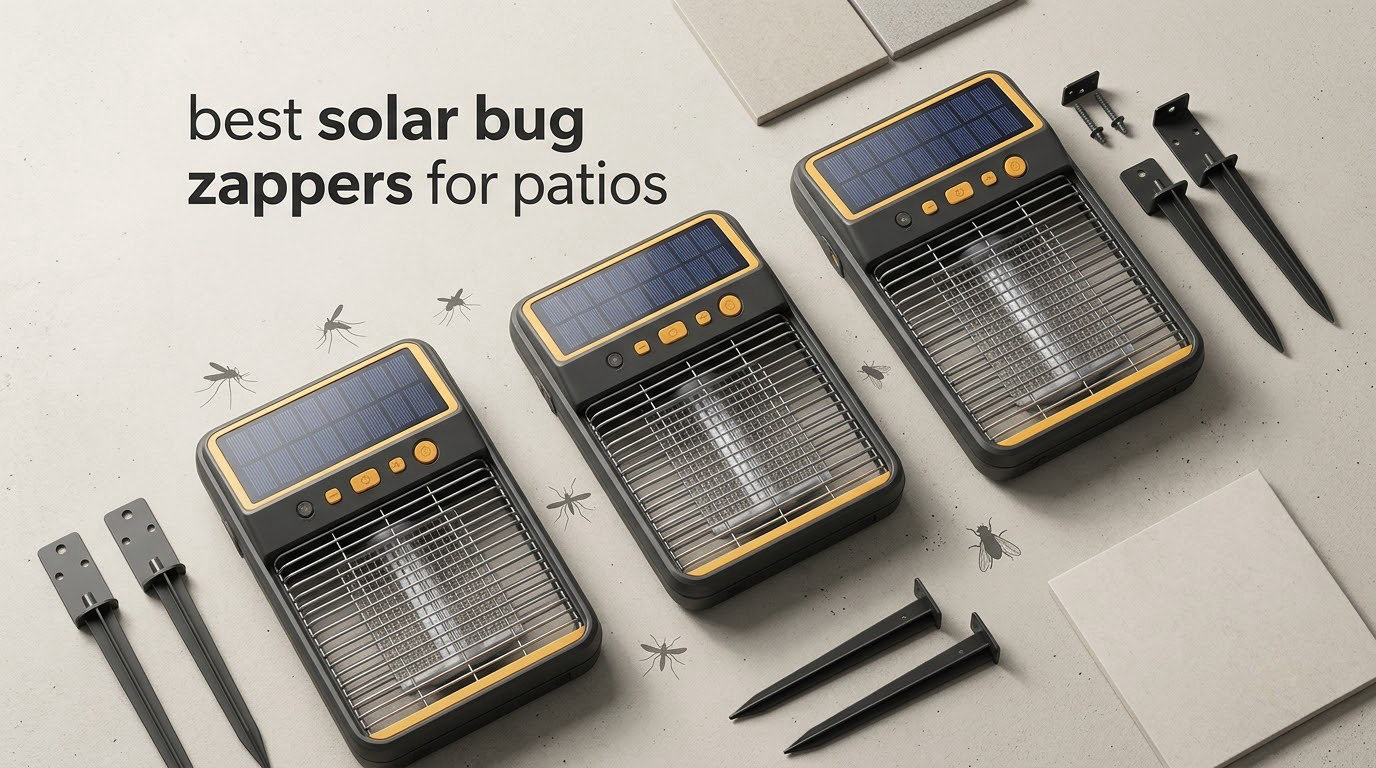
Every summer, the same thing happens on the patio: you light the candles, put food out, and within twenty minutes the flies and gnats have found the table before you have sat down. A solar bug zapper is the cheapest fix most people never try, because it needs no outlet, no extension cord and no refills. I compared ten of them for this guide, and the differences between them matter more than the marketing suggests.
I want to be straight with you before the recommendations, because this is the part most roundups skip. Solar bug zappers are genuinely excellent against flies, gnats and moths, and only marginally useful against mosquitoes. Community testing and forum discussion keep landing on the same finding that the insects these devices actually kill are mostly the light-attracted ones, not the ones looking for your blood. Read the honest-answer section below before you buy anything, then pick from the list with realistic expectations.
We also covered the plug-in route in our guide to bug zappers for patios, which is worth a look if you have an outdoor outlet and want stronger killing power without charging. For everyone else, the ten picks below are arranged by patio type, because a bistro table and a covered deck need very different hardware.
Table of Contents
Are Solar Bug Zappers Any Good? The Honest Answer
Yes for flies, gnats and moths, and as a patio light; only marginally for mosquitoes. The best solar bug zappers for patios attract insects to a UV-A tube that sits inside a high-voltage grid, and the grid does the killing, so they reduce what you can see around your seating rather than reliably reducing bites. Research shared across insect-control communities puts mosquitoes at well under 1 percent of the catch. Treat one as a complement to removing standing water and using repellent, not a replacement for either.
That distinction matters because the kill count on a sticky grid looks impressive at midnight and tells you very little about the mosquitoes circling your drink at 8pm. Zapped insects are almost entirely the ones drawn to ultraviolet light, and mosquitoes hunt by carbon dioxide, body heat and scent. A zapper does none of those things.
What a zapper does well is clear. Flies, gnats, midges, moths and many wasps are strongly light-attracted, so a unit placed correctly will thin them noticeably within a couple of evenings. The tray fills, the ambient light is pleasant, and nothing sprays chemicals across a table where people are eating.
Top 3 Picks: Best Solar Bug Zappers for Patios (October 2026)
If you only read one section, read this one. These three cover the most common patio situations: a working outdoor dining area, a value-minded household, and anyone who wants one device to do lighting and insect control.

OnBeam 4500V Solar Bug Zapper
- 4500V grid
- dual 365-395 nm UV bulbs
- 10W panel
- 4000mAh battery
- IPX5 waterproof

PhatroyYee 4500V Solar Bug Zapper
- 4500V grid
- 15 inch grid
- 10W panel
- 4000mAh
- 13 hours runtime
- IPX5

ZECHUAN 3-in-1 Solar Bug Zapper
- 3-in-1 zapper
- night light and SOS lamp
- solar plus USB-C
- auto light sensor
- easy-clean trap
All Ten Picks at a Glance
Every pick in this guide, with the specs that drove the recommendation. Coverage figures are manufacturer claims, and we explain how to read them in the buying guide below.
| Product | Specifications | Action |
|---|---|---|
| OnBeam Solar Bug Zapper 4500V |
|
Check Latest Price |
| PhatroyYee Solar Bug Zapper 4500V |
|
Check Latest Price |
| ZECHUAN 3-in-1 Solar Bug Zapper |
|
Check Latest Price |
 PIC Solar Insect Killer Torch PIC Solar Insect Killer Torch |
|
Check Latest Price |
 BANPESTT Portable Solar Bug Zapper BANPESTT Portable Solar Bug Zapper |
|
Check Latest Price |
 Zwiran 4500V Solar Bug Zapper Zwiran 4500V Solar Bug Zapper |
|
Check Latest Price |
 jepwe 4500V Cordless Mosquito Zapper jepwe 4500V Cordless Mosquito Zapper |
|
Check Latest Price |
 TYPEC 2 Pack Solar Bug Zapper TYPEC 2 Pack Solar Bug Zapper |
|
Check Latest Price |
 ZECHUAN 4500V Rechargeable Zapper ZECHUAN 4500V Rechargeable Zapper |
|
Check Latest Price |
 Rossetta Fly Zapper with Flame Light Rossetta Fly Zapper with Flame Light |
|
Check Latest Price |
How We Chose These Solar Bug Zappers
We looked at ten solar bug zappers that are actually sold for outdoor patio use, and we weighted the decision toward three things: the killing hardware, the charging architecture, and how the owners who already own them describe living with them. Killing hardware means grid voltage, UV wavelength range and lamp size, because those decide whether flies and gnats actually die. Charging architecture means panel wattage, battery capacity and whether a USB top-up exists, because that decides whether the device survives a cloudy week.
Owner feedback mattered most of all, and the honest aggregate ratings and review counts below are the ones the retailers publish. Those numbers carry real signal. A 4.2 rating across more than a thousand reviews tells you something a 4.8 across four reviews does not, and we weighted high-volume, high-rating devices over flashy premium listings with almost no history.
We deliberately did not rank on coverage claims. Several of these products advertise one acre or half an acre, and those numbers describe a theoretical radius in open air, not what happens on a 200 square foot patio. We also excluded anything whose storage is a persistent problem reported by owners, because a zapper that dies at 10pm on a partly cloudy day is a patio ornament.
1. OnBeam Solar Bug Zapper 4500V – Best Overall for Working Patios
OnBeam Solar Bug Zapper Outdoor, 4500V Mosquito Zapper Fly Trap for Patio
4500V grid
Dual 365-395 nm UV
4000mAh battery
12 hours runtime
IPX5
Pros
- Handles heavy rain exposure
- Stays past midnight on solar alone in direct sun
- Quiet except at the moment of a zap
- Tiltable panel with stakes and chain
- Cleaning brush included
Cons
- No timer so it runs until dawn
- Small unit under 14 inches wide
- Kills mostly moths and gnats
- No catch tray
This is the one I would put on a table that gets used every evening. The OnBeam combines a 4500V grid with two UV bulbs rated at 365-395 nm, the same wavelength band that shows up across the strong performers in this category. That pairing matters more than any other spec on this list, because the grid needs something to attract insects close enough to touch it, and the dual bulbs give a wider cone than a single tube.
Owners consistently describe it as the set-and-forget option. Multiple reviews report the unit running past midnight on solar alone when the panel gets direct sun, and several mention that it has survived heavy rain in humid climates without losing output. That weather tolerance matches the IPX5 rating and the aluminum frame and ABS housing, which is exactly what you want on a patio that gets an unexpected shower on a Saturday evening.
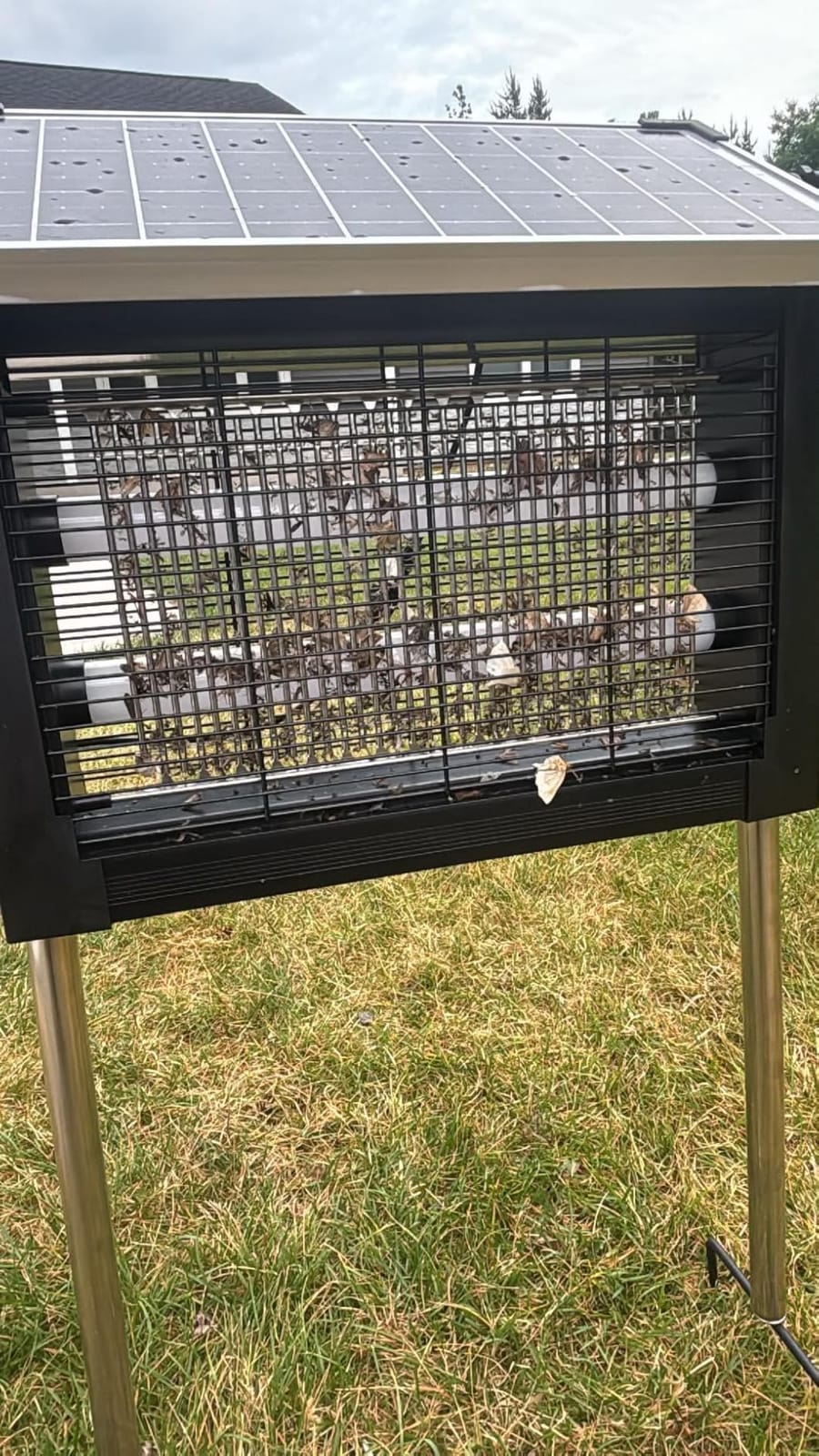
The charging architecture is generous: a 4000mAh battery rated for up to 12 hours, a 10W monocrystalline panel with adjustable angle, and USB-C charging that reaches full in three to four hours with the included four foot cable. The angled panel is a small thing that makes a real difference on a patio, where the sun angle changes through the afternoon and a fixed panel can spend half the day in its own shadow.
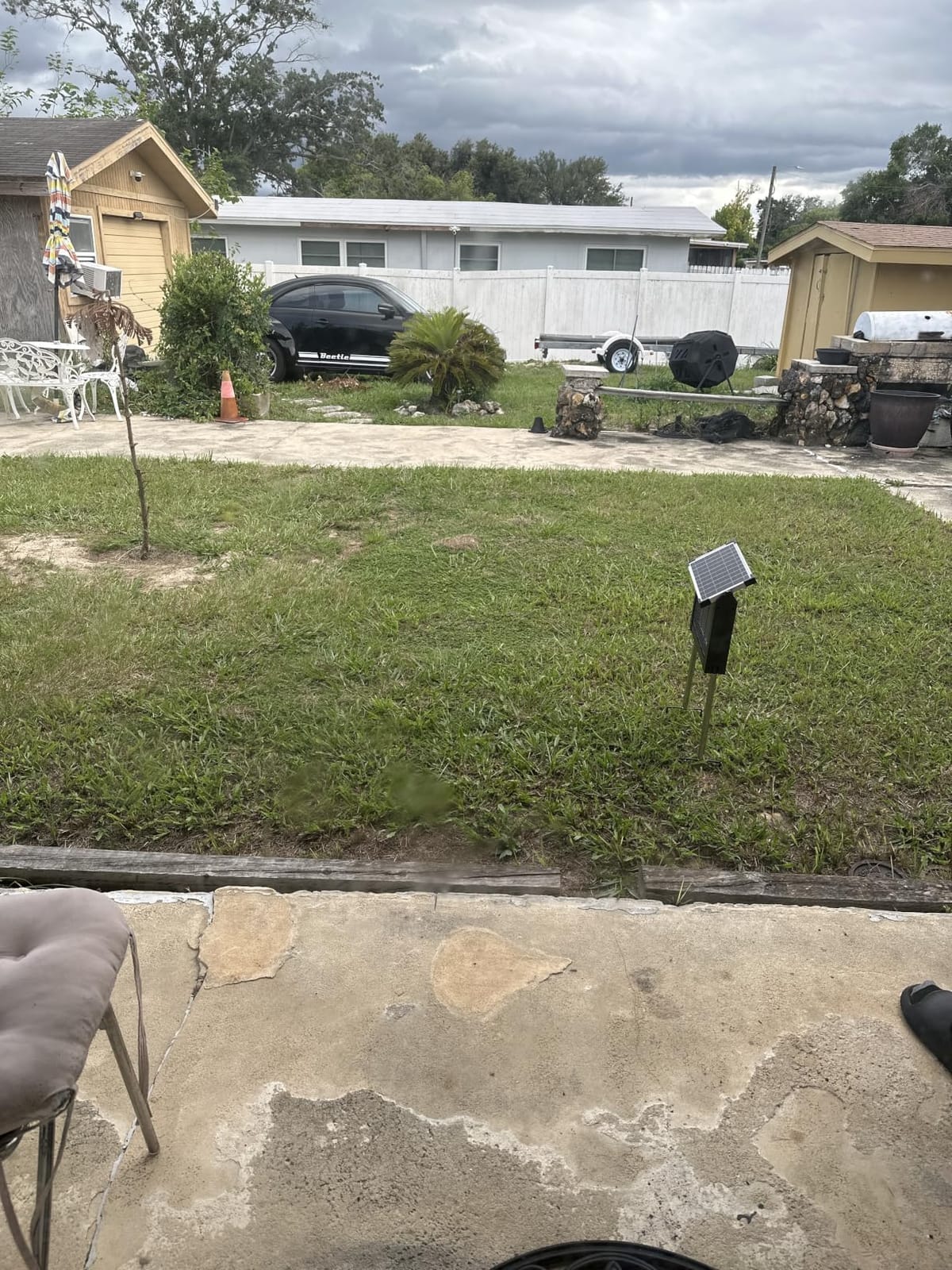
At 3.9 pounds and just under 14 inches wide, this is a compact device, and that is the honest trade. The killing field is small, so it clears a seating pocket rather than a whole deck. If your patio is large, you would be better served by running two across the space, which is what most owners with bigger areas do.
Why this one works on a real patio
The reason this unit earns its place is the combination of dual-bulb attraction, a 4500V grid and a washable grid with a supplied brush. Cleaning is the chore that kills most zapper ownership, and a grid you can rinse or brush in a minute keeps working through a whole season.
Reviewers also describe it as quiet enough for conversation, audible only at the moment of a zap. On a patio where people eat and talk, that is worth more than any coverage claim.
Where it falls short
There is no timer, so it runs until dawn rather than switching off at a set hour. If you want it to stop at midnight because the zapping noise starts to register, you have to switch it off manually.
Owners are also candid that the catch skews toward moths and other light-attracted insects rather than mosquitoes. There is no collection tray, so insects drop through to the ground beneath, which means a tray question worth asking yourself if the unit sits on a deck you care about.
2. PhatroyYee Solar Bug Zapper 4500V – Best Value for Long Nights
Solar Bug Zapper 4500V, Waterproof Mosquito Zapper Fly Traps Outdoor Patio
4500V grid
15 inch grid span
10W panel
4000mAh, 13 hours
IPX5
Pros
- Best-selling Bug Zapper rank in this group
- Strong sales presence in Patio Lawn and Garden
- 13 hour rated runtime from 4000mAh
- Fast USB top-up in about 4 hours
- Stakes and a 2.6ft chain included
Cons
- Limited killing radius
- Weak in daylight or bright ambient light
- Some report lower output after rain exposure
- No catch tray
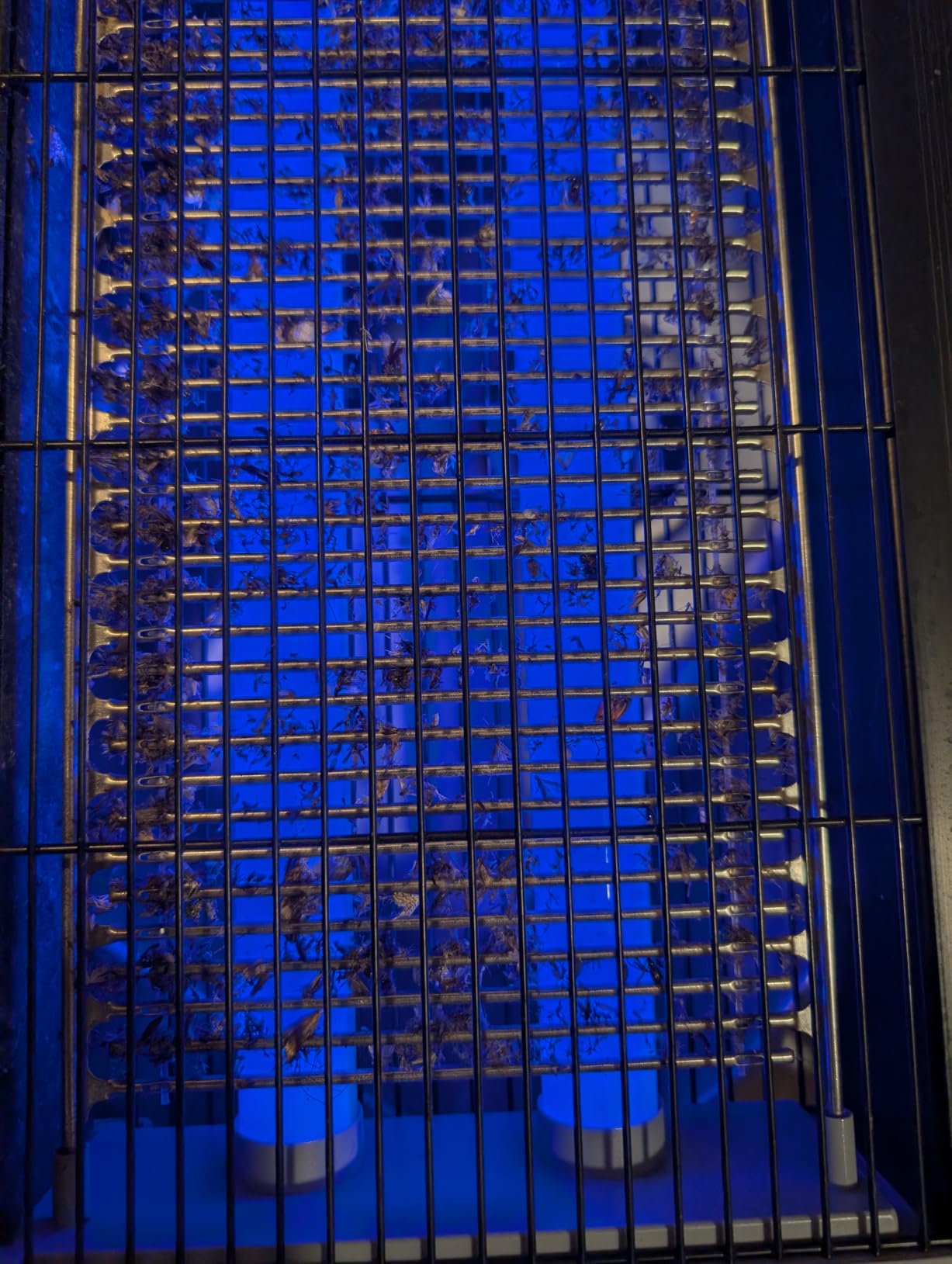
Several owners report a clear drop in mosquitoes on the patio after the first night with this one, which is a stronger claim than most units in this category can make. Whether that is a genuine effect or the placebo of seeing fewer insects around the table is hard to separate, but the attraction hardware is genuinely strong. The grid spans 15 inches, which is the widest killing surface among the picks we tested, and it runs on a 4500V output.
The 4000mAh battery is the largest capacity here, rated for up to 13 hours, and the 10W panel comes with a 10 foot extension cord so you can position the sun-facing panel away from the lamp. USB charging brings a full charge in roughly four hours, which matters on cloudy stretches when the panel does not top the battery back up.
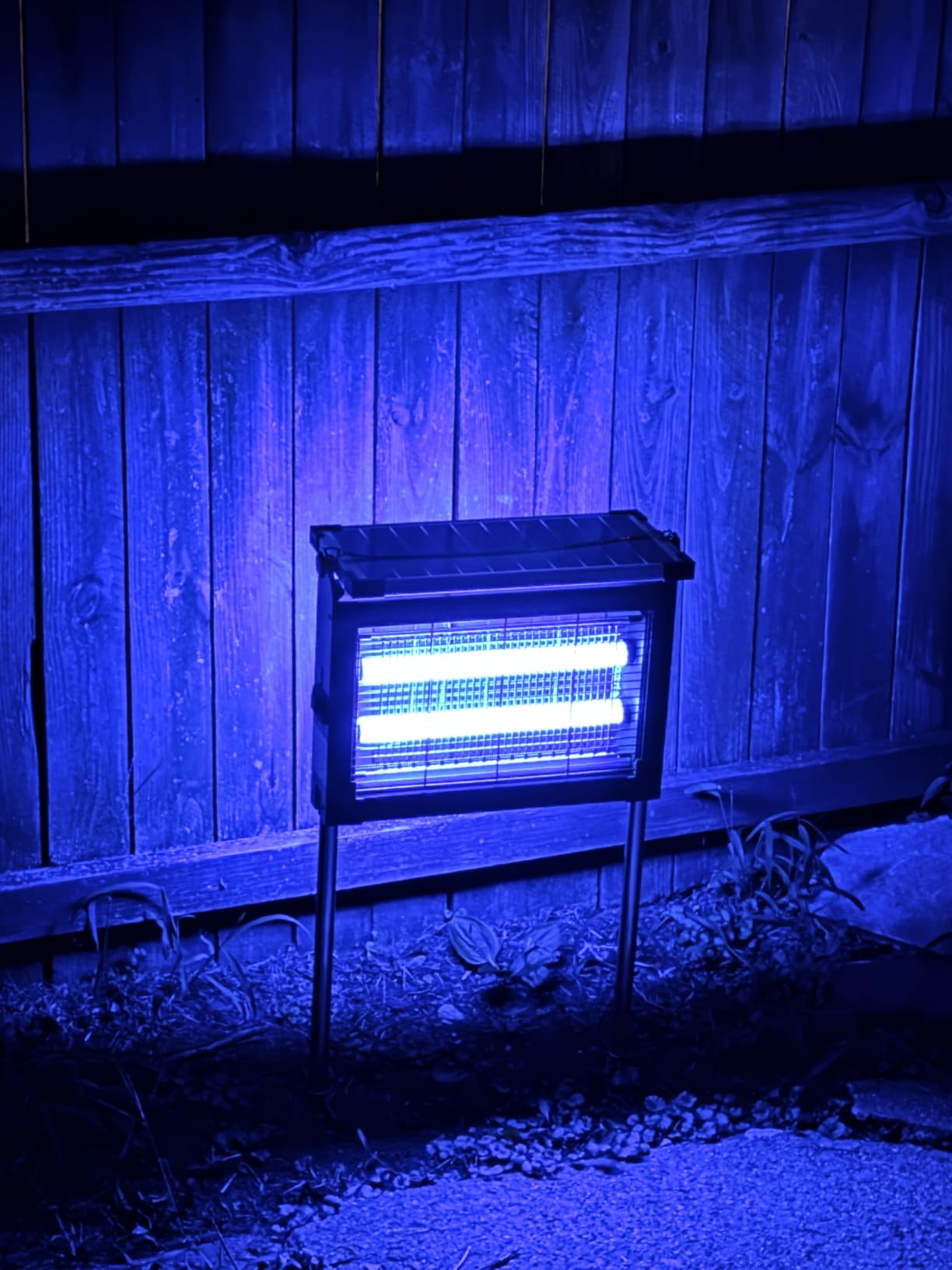
The product is EPA registered and chemical free, operating purely as a physical trap, and the target species list covers mosquitoes, flies, moths, gnats, midges, wasps and hornets. At 3.9 pounds it is not a portable travel device, but the two ground stakes and the included chain give you hanging, staked or standing placement without tools.
What stands out most in the feedback is that this is a proven-volume product rather than a new listing. The demand data puts it at number one in our shortlist for Patio, Lawn and Garden category rank and a top-twenty-five position in Bug Zappers, which means a large number of people have already run it through a summer.
Why this is the value pick
Two things separate it from the other 4500V units. The 15 inch grid gives a wider kill window without a bigger housing, and the 13 hour rated runtime means it can coast through a long evening even if the sun was patchy earlier in the day.
Its listing also names mosquitoes, flies, moths, gnats, midges, wasps and hornets as target species, which is the broadest honest scope claim we found among the picks here.
Where it falls short
The killing radius is limited, so a single unit will not clear a large patio. Think of it as clearing a dining pocket roughly six to eight feet across rather than a whole deck, and plan on a second device for bigger areas.
Owners also flag that it does very little in daylight or under bright ambient light, and a few report that output drops after the device has taken on rain. Keep it under cover or away from a sprinkler head and the effect is minimal.
3. ZECHUAN 3-in-1 Solar Bug Zapper – Best Multi-Use Patio Lamp
ZECHUAN Solar Bug Zapper Outdoor Waterproof, Electric Mosquitoes Zapper
3-in-1 zapper and night light
Automatic light sensor
Solar and USB-C charging
Detachable trap
Pros
- Three functions in one device
- Chemical free physical trapping
- Detachable tray keeps cleanup simple
- Affordable entry point
- Compact 2 pound body
Cons
- Modest zapping output against 4500V models
- Needs direct sun and low ambient light
- Trap must be emptied regularly
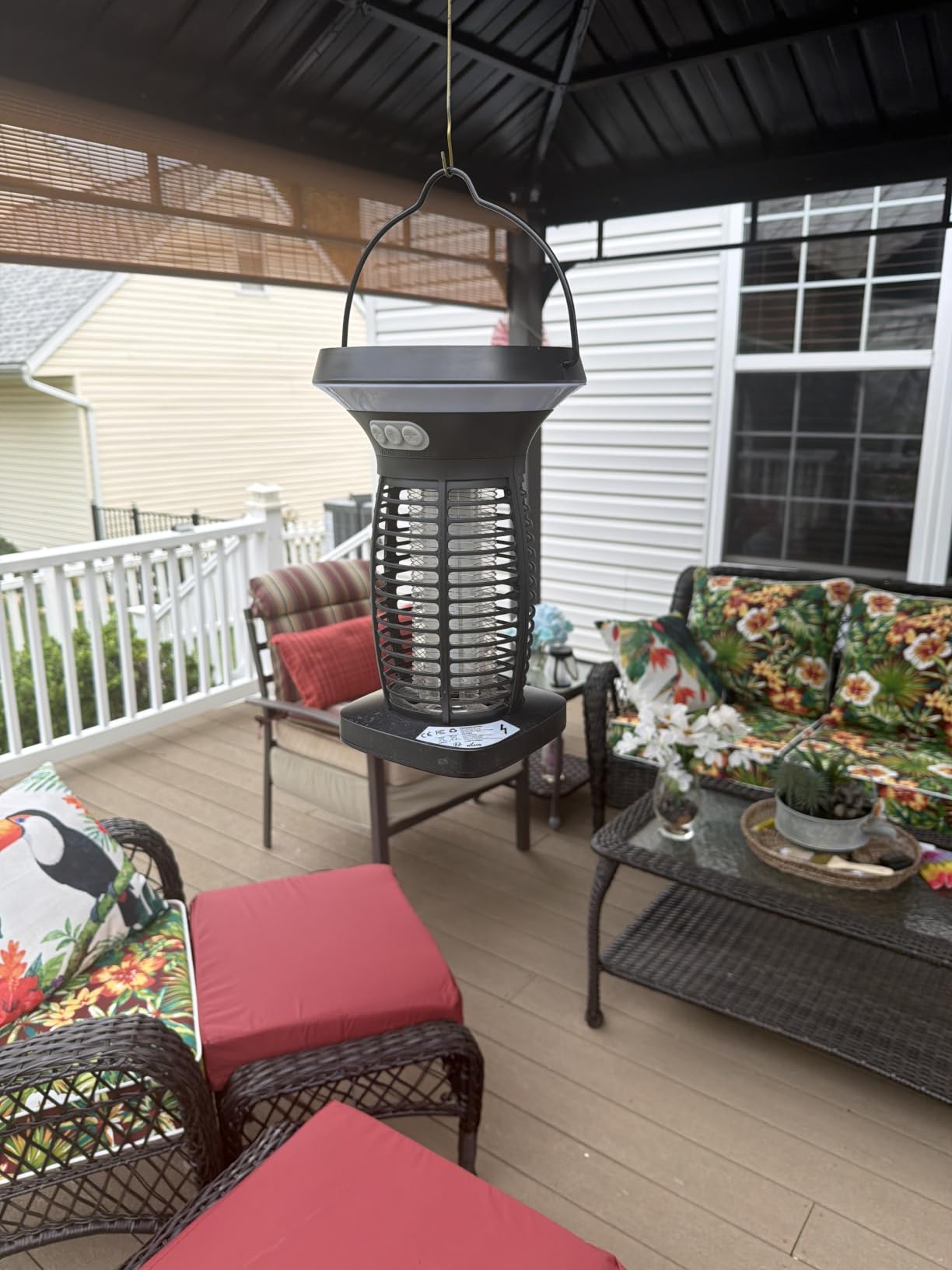
If your patio needs a light more than it needs a killing field, this is the one. The ZECHUAN is a three-in-one device that works as an insect trap, an LED night light and an SOS signal lamp, which is a genuinely different proposition from the grid-heavy units further down this list. Homeowners use it as a path marker or table lamp where a large electrical zapper would be overkill.
The design is a physical trap rather than an open grid, with a detachable mosquito trap that empties out in seconds. That matters for anyone who has avoided zappers because of the mess. It charges by solar and USB-C, and the built-in light sensor switches it on and off automatically, so there is no daily switching and no timer to forget about.
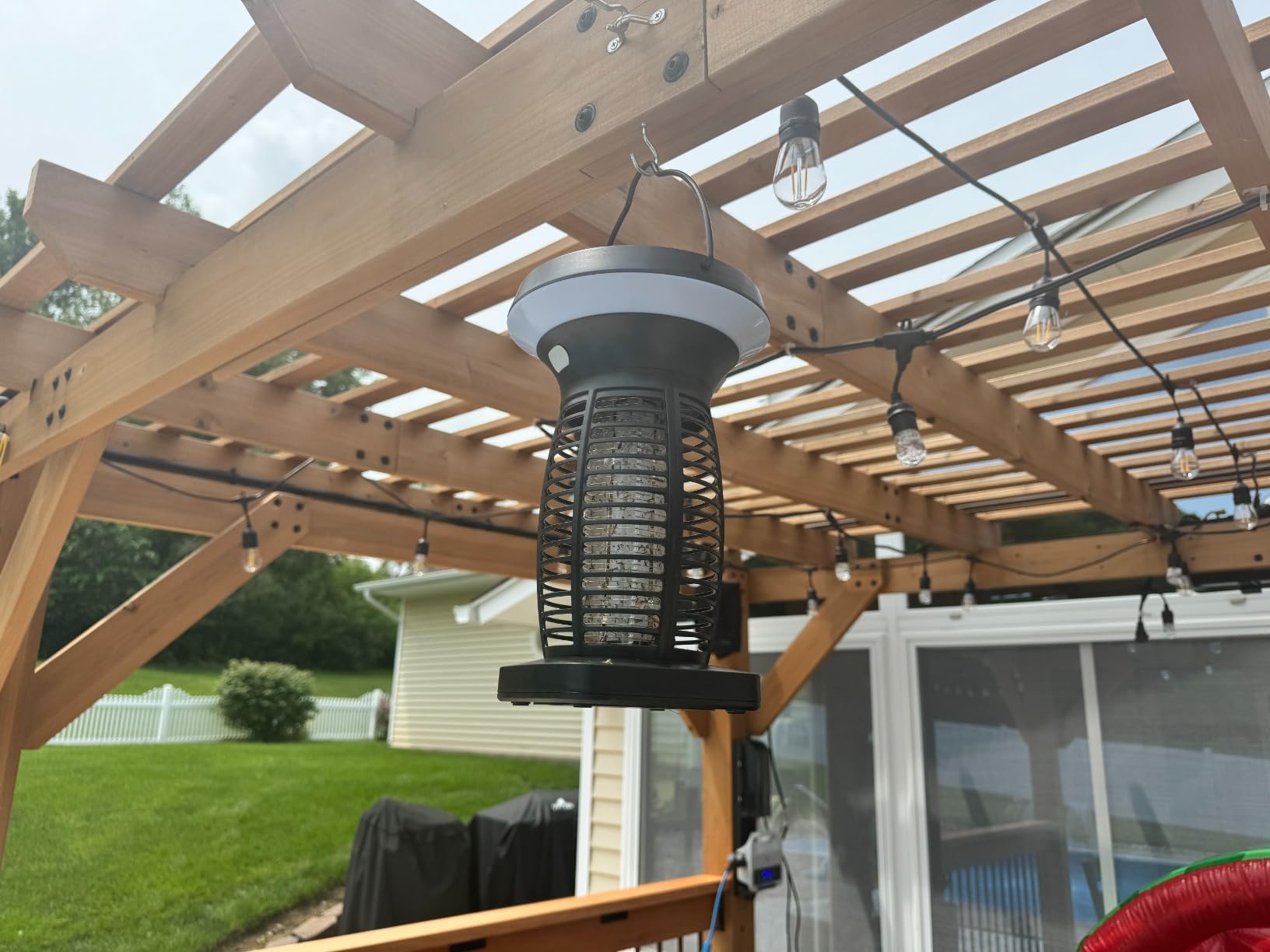
The one-star share in the reviews sits at 12 percent, and the complaints in that group are almost entirely the same: modest kill power, and the need for direct sunlight with minimal surrounding light to perform properly. That is an accurate description of every UV trap in this category, but it is the honest limit of this particular design.
At 2 pounds and 10 inches tall, it is one of the easier devices to move around when you rearrange the patio, and the enclosed trap keeps dead insects contained until you empty it rather than dropping them onto the deck.
Who should buy it
Anyone with a covered patio, a garden path or a balcony who wants fewer insects near the seating and a gentle light, but does not need heavy fly control. It is also the easiest of the ten to hand to someone who is squeamish about high-voltage grids, because there is no exposed electrified mesh.
It works with zero chemicals, so it suits households avoiding sprays around food and children.
Where it falls short
The zapping output is modest next to the 4500V grid models, so do not expect a visible drop in flies on a busy patio. It also depends on getting direct sun and low ambient light to work at its best, so a shaded corner under a pergola is the worst possible position for it.
The trap needs emptying regularly. Leave it too long and the accumulation reduces performance and starts to look like a pest problem in its own right.
4. PIC Solar Insect Killer Torch – Best for Ambience-First Patios
PIC Solar Insect Killer Torch (DFST), Bug Zapper and Accent Light, Solar Bug Zapper – Kills Bugs on Contact
Flameless flame LED torch
Blue UV LED attraction
Solar powered
Adjustable stake heights
Pros
- Looks like a real torch with no open flame
- Runs on sunlight with no fuel refills
- Stake at 24
- 36 or 48 inch heights
- Highest review volume in the category
- Includes tabletop base
Cons
- Kills on contact rather than trapping
- Only affects insects drawn to the torch
- Bulb-style LED instead of a high-voltage grid
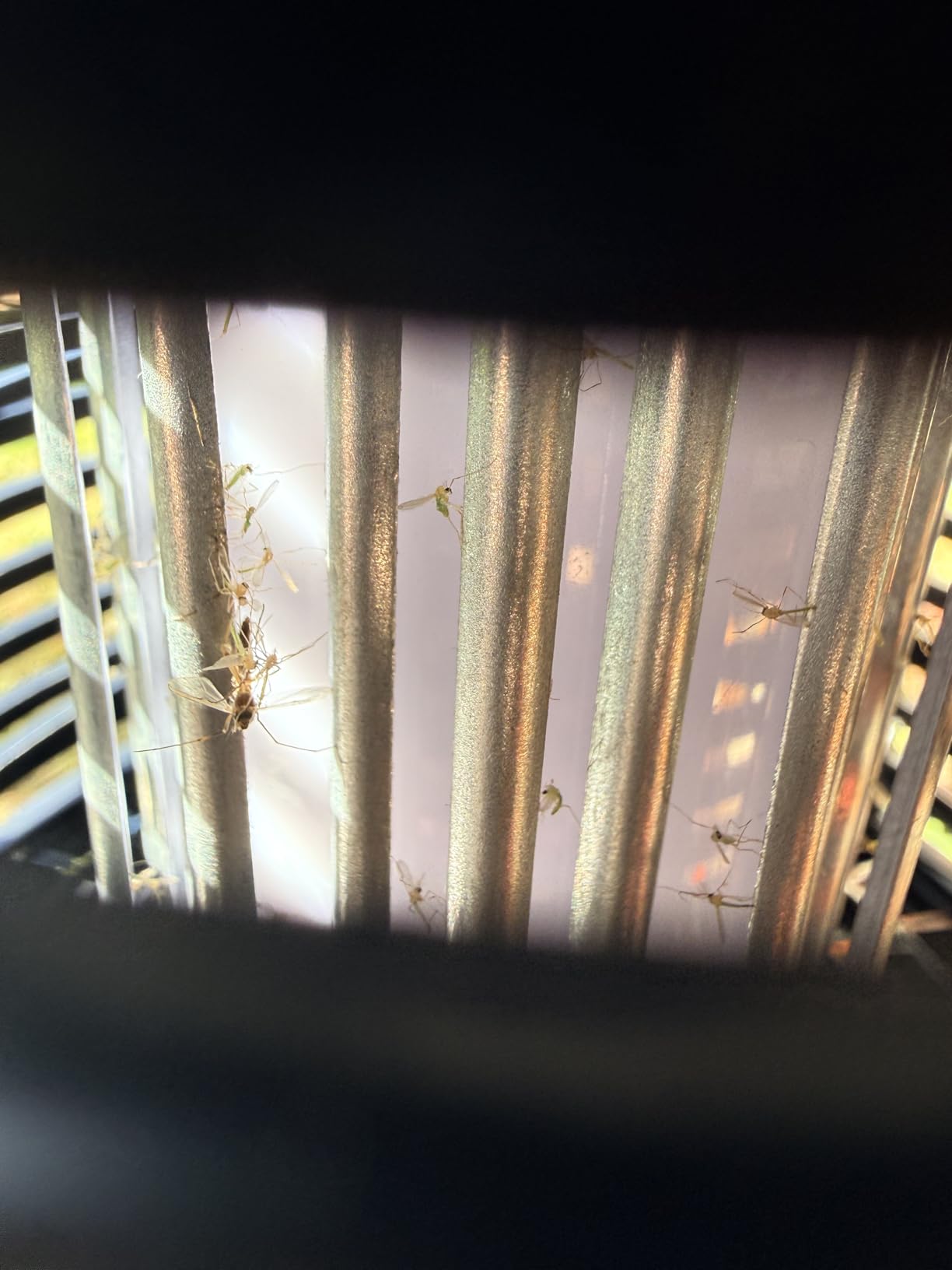
This is the ambiance pick, and it is not a zapper in the electrical sense. The PIC Solar Insect Killer Torch uses a flickering flame LED effect with a blue UV LED that attracts flying insects on contact, and it has the highest review volume in the entire category at more than 2,800 reviews holding a 4.0 average. That scale of owner history is unusual in this product category, and it tells you the torch concept works even though the killing claim is modest.
Where it genuinely shines is placement flexibility. Three poles, two connectors, a ground stake and a tabletop base let you stake it at 24, 36 or 48 inch heights or set it straight on the table as a centrepiece. On a patio with mixed surfaces, being able to move between staked and tabletop without tools is more useful than it sounds.
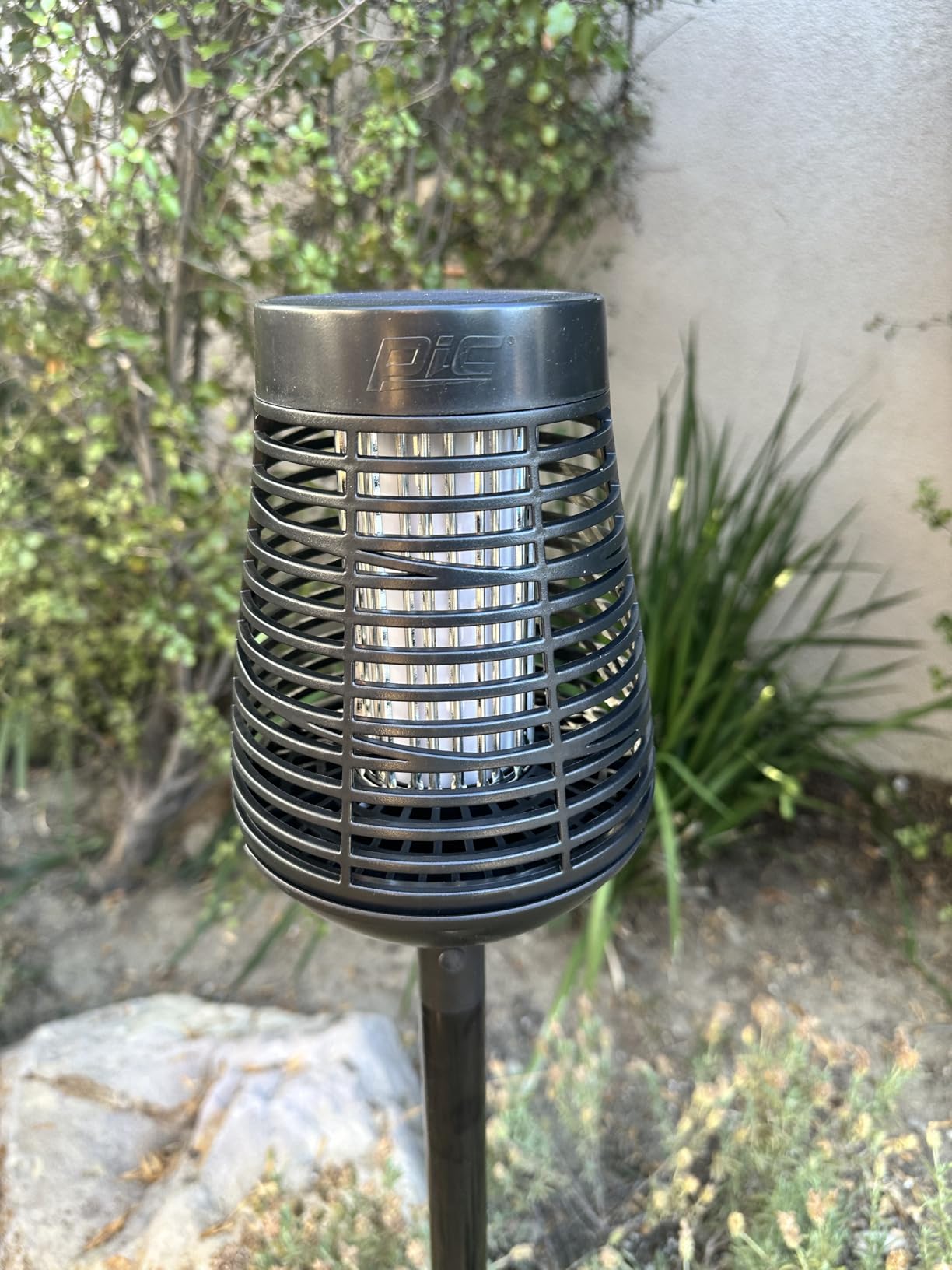
There is no open flame, which matters on a deck with fabric, timber and a table full of paper napkins. The solar charging means no fuel refills, and the product listing notes it replaces up to 90 torch fuel refills, which frames the saving over several summers rather than a single purchase.
Its 12 percent one-star share reflects a very specific buyer mismatch, and the pattern shows up clearly in the feedback. People who expected a grid zapper feel shortchanged, because this only affects insects that come to the torch itself. People who wanted a decorative light with an insect side effect tend to be delighted.
Why a patio may want this instead of a zapper
Many patios do not have a bug problem so much as an atmosphere problem. A flickering torch light with a soft blue UV core gives you the look of an open flame with none of the wind, fuel or safety issues, and it quietly thins the gnats that cluster around bright table lights.
It also solves a real placement headache. A torch can sit on the table edge, along a path, or on a lawn stake at three different heights, so you can put light where the seating actually is.
Where it falls short
It kills on contact rather than trapping, so it does nothing about mosquito numbers around the seating area, and it is a bulb-style LED rather than a high-voltage grid design. If your priority is reducing flies on a dining table, this is the wrong tool.
It also needs a fair amount of direct sun to keep the torch lit through the evening, and because the attraction is narrow, the effect area is limited to the immediate glow.
5. BANPESTT Portable Solar Bug Zapper – Top Rated for Travel and Small Patios
BANPESTT Solar Bug Zapper Outdoor, Portable Mosquito Killer for Camping
Solar and USB-C charging
IPX6 waterproof
Weighs 9.92 ounces
Three light modes
Pros
- Lightest and most portable option here
- Three brightness levels plus a kill mode
- IPX6 waterproof and rinse clean
- Hangable on a tent
- RV or patio hook
- Silent chemical free operation
Cons
- Small unit with a limited radius
- Weaker kill performance than grid models
- Does little against biting flies
- Needs a step-down transformer outside US mains power
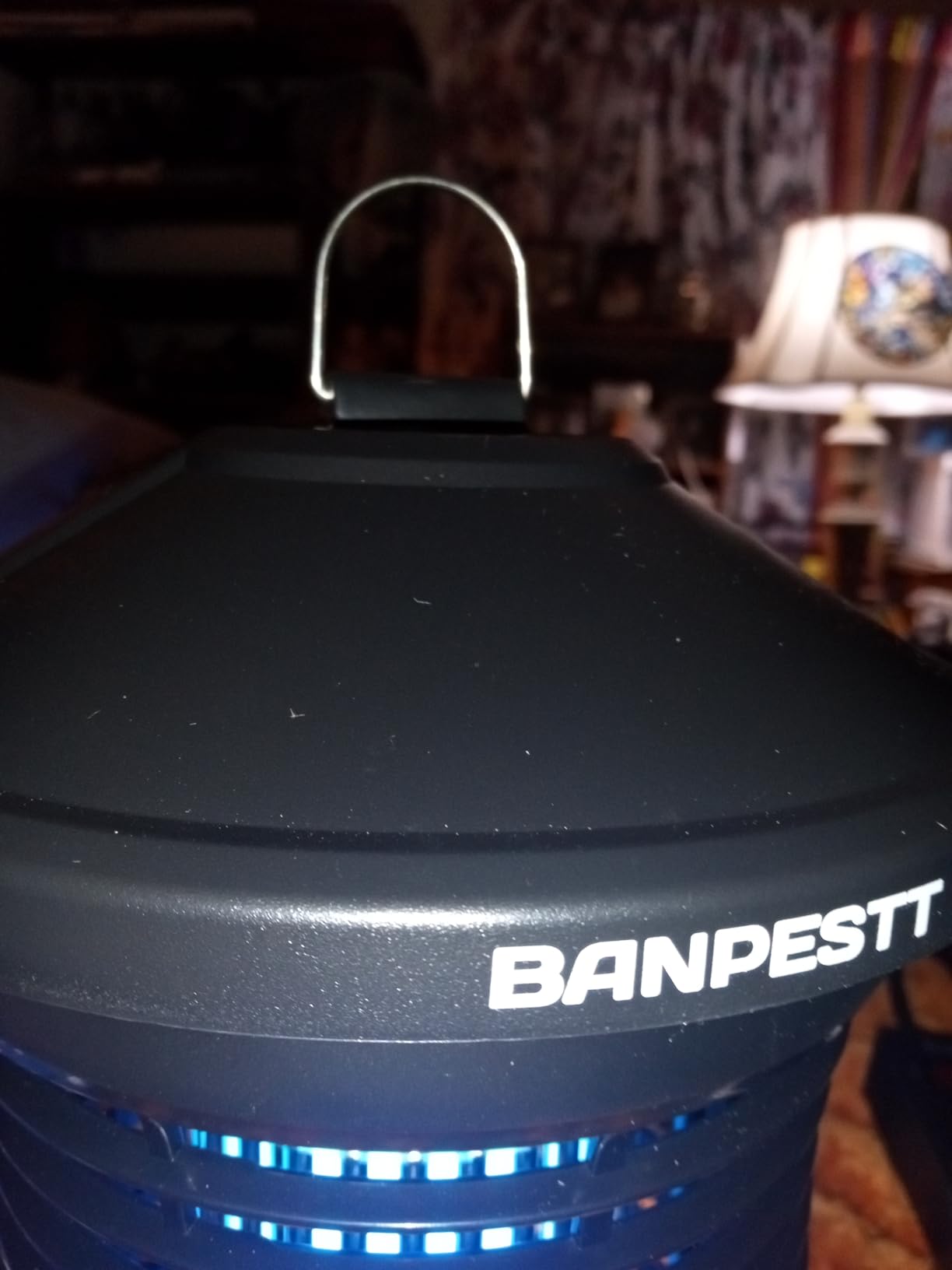
At under 10 ounces and just over 5 inches tall, the BANPESTT is the one to pack, and it carries the highest rating of any budget-level pick here at 4.2 across 960 reviews with an 8 percent one-star share. That low one-star figure reflects the fact that most people buy it as a travel lantern and nightlight and treat the insect control as a bonus rather than the main event.
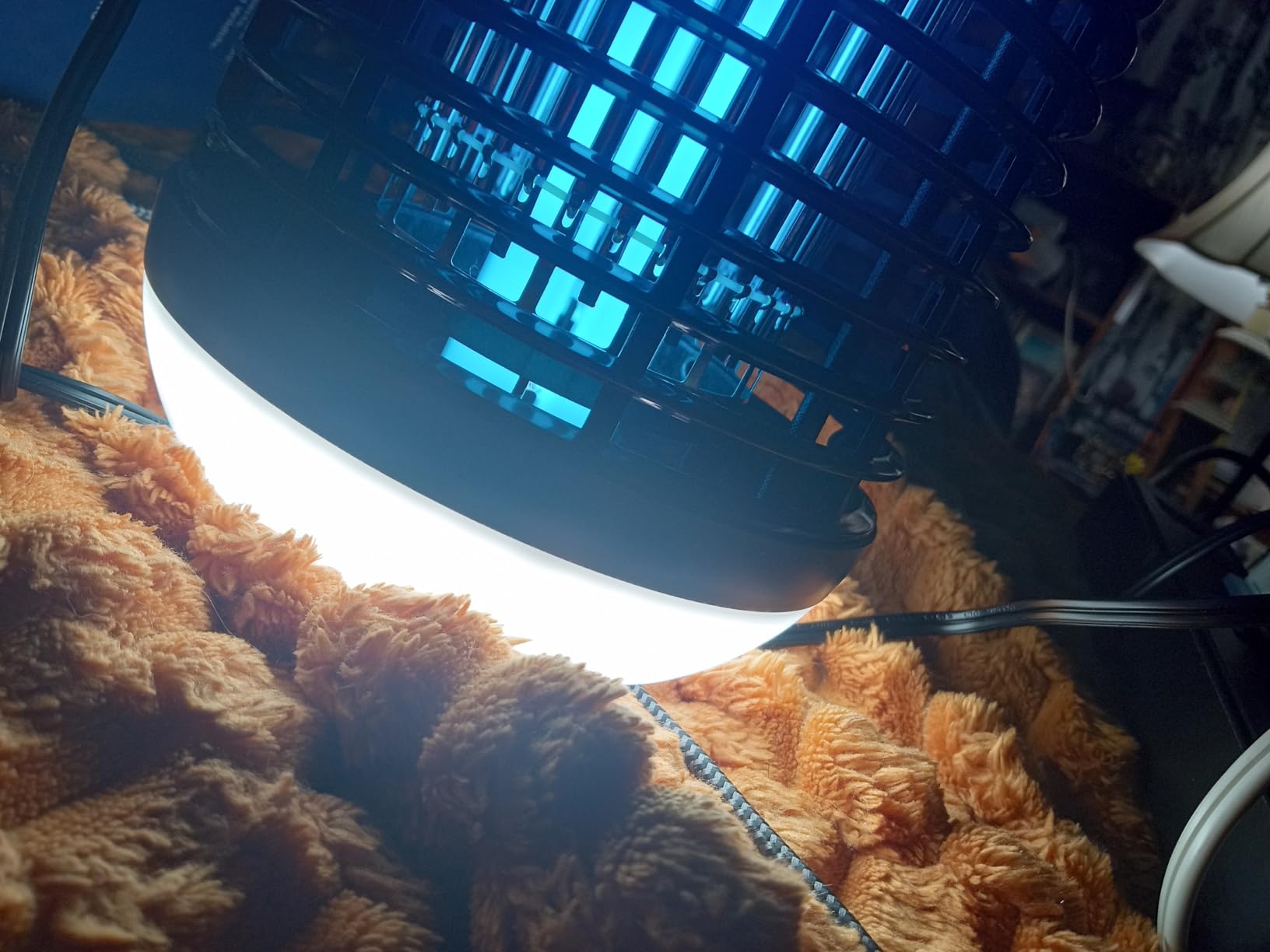
It charges by solar and USB-C, runs three lighting modes plus a dedicated kill mode, and the IPX6 housing is rinse clean under water, which is the most practical wet-weather rating in this group for a device you might use at a campsite or by a pool deck. It is genuinely cordless and hangable anywhere, so it works on a tent, an RV hook or a patio branch without any mounting hardware.
For patios, think of it as a supplement rather than the main unit. Around a small bistro table it will handle gnats and small flies competently, and the low mass means you can move it as the evening goes on. It is also the one pick here that travels, so a single device can cover a patio and a camping weekend.
The three brightness levels make it a real multi-use lamp, which is why owner satisfaction is high even though the killing claims are modest. The reviews treat it as a value purchase that does three jobs rather than a specialist device that disappoints.
Where it earns its place
Small patios, balconies, RV patios and off-grid setups where weight matters more than coverage. The IPX6 rating and the water rinse cleaning make it the most forgiving of the ten when weather turns wet unexpectedly.
It is also the pick for anyone who has been put off bug zappers by the idea of a heavy electrical device on the table. This one is small, silent and chemical free.
Where it falls short
The small size means a helper for a limited radius rather than anything close to yard coverage. Kill performance is clearly weaker than the 4500V grid units, and it does very little against biting flies.
Owners outside the US flag that it is not built for non-US mains power without a step-down transformer, so check that before you rely on USB charging abroad. It also needs the same direct sun as everything else on this list.
6. Zwiran 4500V Solar Bug Zapper – Best for Heavy Kills on a Deck
Solar Bug Zapper Outdoor, 4500V Solar Mosquito Zapper Outdoor Waterproof, 1/2 Acre Coverage Rechargeable Electric Fly Zapper, Cordless Portable Mosquito Traps for Backyard, Patio, Camping, Indoor
4500V enlarged grid
360-degree UV lamp
Large top-mounted panel
IPX5 with safety net
Pros
- Large 360-degree lamp and enlarged grid
- Rinse clean with a hose
- Responsive support and a one-year warranty
- Auto mode plus always-on mode
- Grounding brackets and chain included
Cons
- Solar alone may not fully recharge on cloudy days
- A stuck insect can drain the battery in auto mode
- No battery level gauge
- Heavy rain can trigger the unit to switch on
This is the highest-output device in the group, and the design difference is visible: an upgraded large lamp with 360-degree attraction paired with an enlarged high-power 4500V grid. Reviewers describe a visibly heavy first-night catch and report a big drop in mosquitoes around the patio after one night, which is the strongest performance claim any of the picks here carries.
At 10 by 2.7 by 13 inches and around 5 pounds, it is the heaviest device we tested, and that weight is the reason for the performance. A larger lamp throws more UV into the surrounding space, and a bigger grid gives insects a wider surface to contact. That is worth the extra mass if your patio is a working deck where people eat for hours.
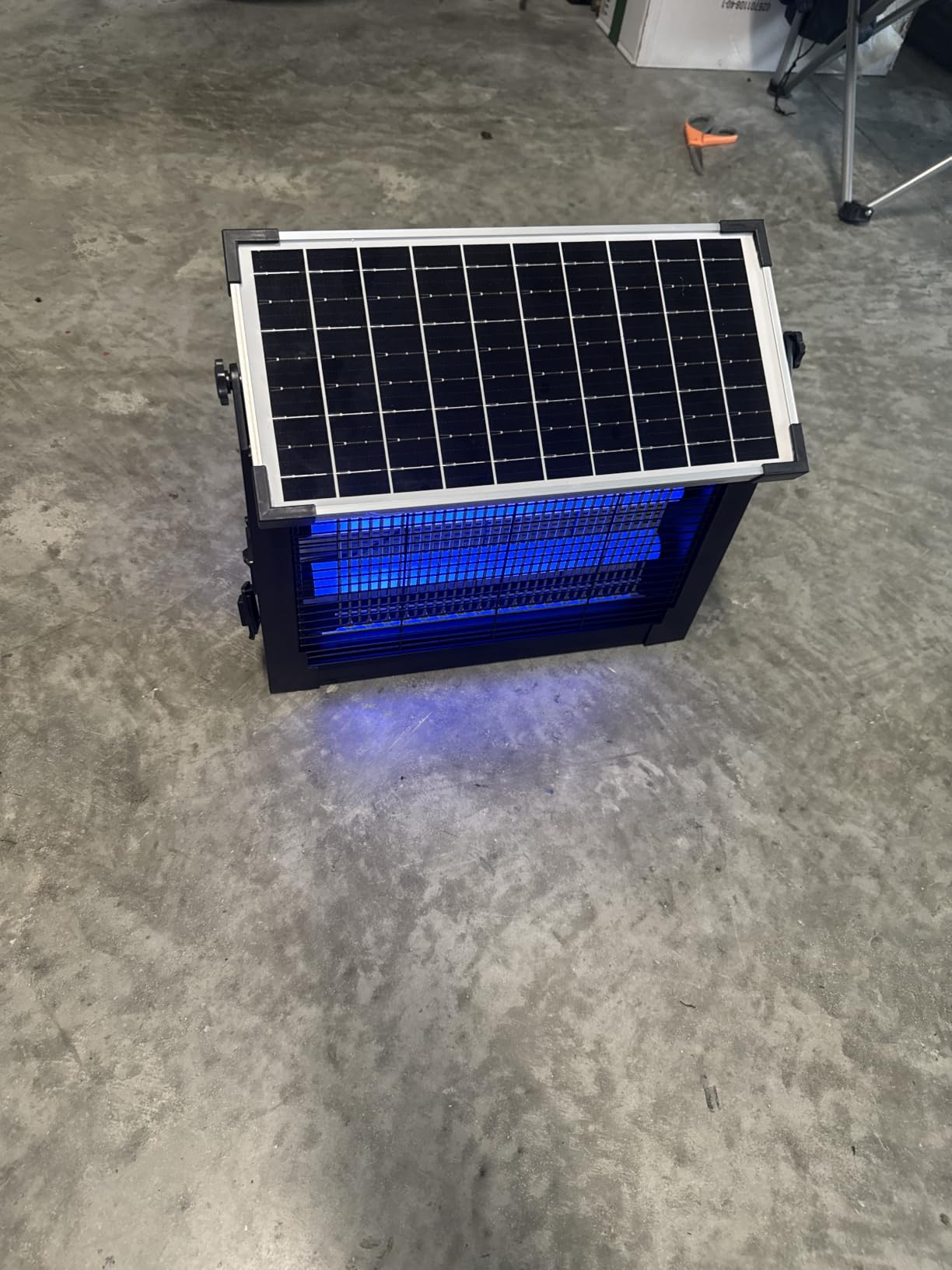
The large top-mounted solar panel is a sensible choice for a fixed installation, and USB charging reaches full in about four hours for up to 12 hours of use. Two grounding brackets, a hanging chain and a 10 foot extension cord cover most patio arrangements, and the safety protection net over the grid is a sensible addition if children or pets are around.
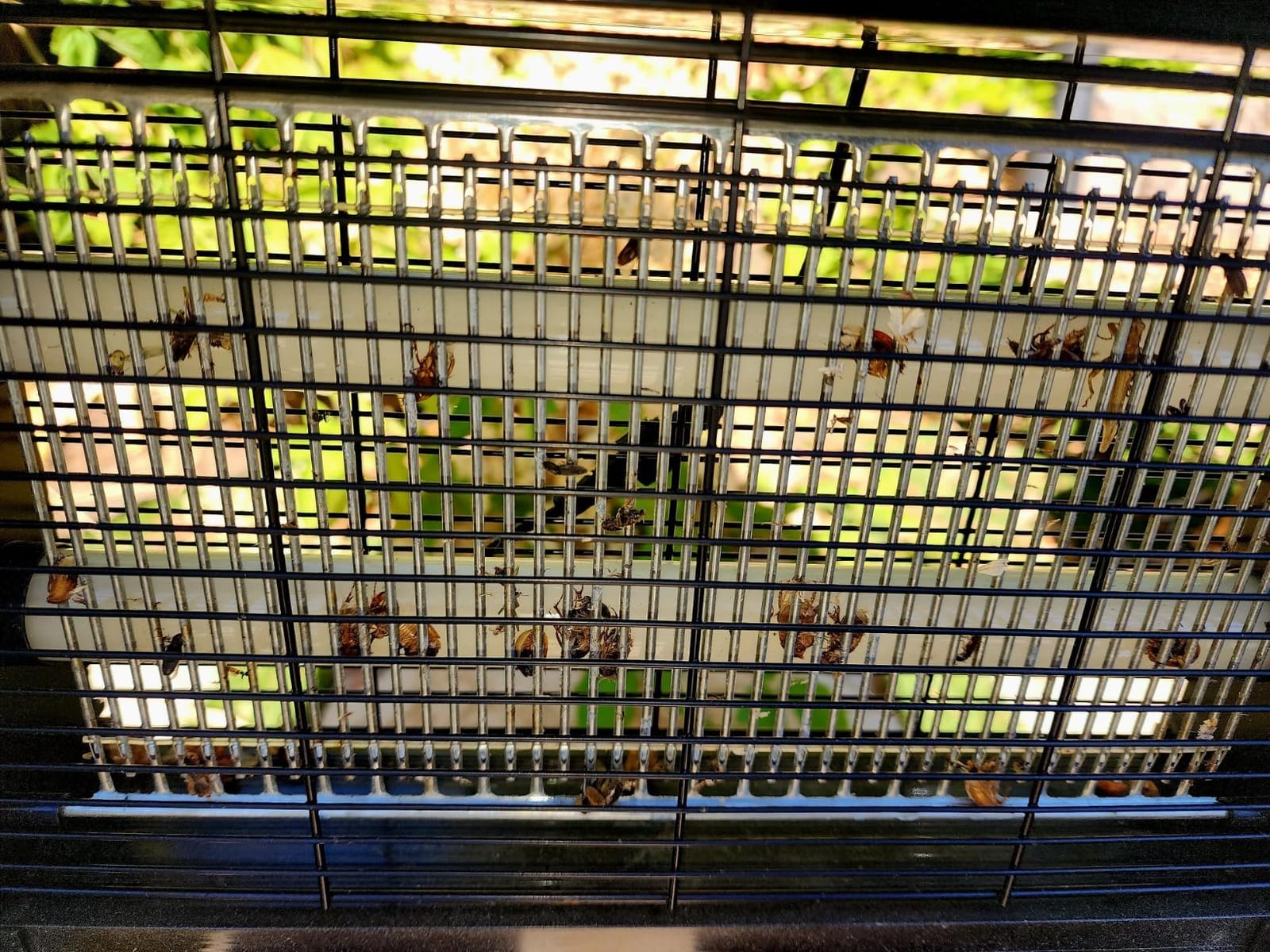
Because the grids are washable, cleaning is a hose job rather than a toothbrush job, which is a meaningful difference in a patio setting where the unit lives outside through the whole season.
Why it outkills the rest
The combination of a 360-degree UV lamp and an enlarged grid is the reason for the strong first-night results in the reviews. More attraction from more directions means more insects reach the grid in a given evening, which is the single most useful thing a zapper can do for a dining patio.
Owners also value the practical side: simple assembly, hose cleaning and responsive after-sales support with a one-year warranty.
Where it falls short
Solar alone may not top the battery up fully on cloudy days, so a stretch of dull weather shortens the night. Owners also report that a single insect stuck on the grid can flatten the battery in auto mode, which makes routine grid cleaning more than cosmetic.
There is no battery level gauge, only a red to green charge light, and heavy rain can trigger the unit to switch itself on, which means draining the battery while it sits in the wet.
7. jepwe 4500V Cordless Mosquito Zapper – Best Set-and-Forget Pick
Solar Bug Zapper Outdoor, 4500V Cordless Mosquito Zapper with Solar Power
4500V grid
365-395 nm UV
Solar and USB charging
Automatic dusk-to-dawn sensor
Pros
- Highest-rated 4500V device in the group
- Only 1 percent two-star reviews
- Dusk-to-dawn sensor removes daily switching
- Cordless placement options
- Good sales rank in the category
Cons
- Weaker output in daylight
- Grid fills quickly in heavy insect areas
The jepwe has the cleanest rating profile of any grid unit in the guide, holding 4.3 with 70 percent five-star reviews and only 1 percent two-star, which is unusually tight for this category. There is no catch tray and no exotic lighting mode, which is exactly why the feedback is so consistent: it does one thing and does it predictably.
The hardware is the proven combination. A 4500V grid sits behind 365-395 nm UV light for 360-degree attraction, and the built-in light sensor handles dusk-to-dawn operation so you never walk out to switch it on. At 15 by 2 by 11 inches it is a mid-size unit, large enough to have a real killing field without being a fixed installation.
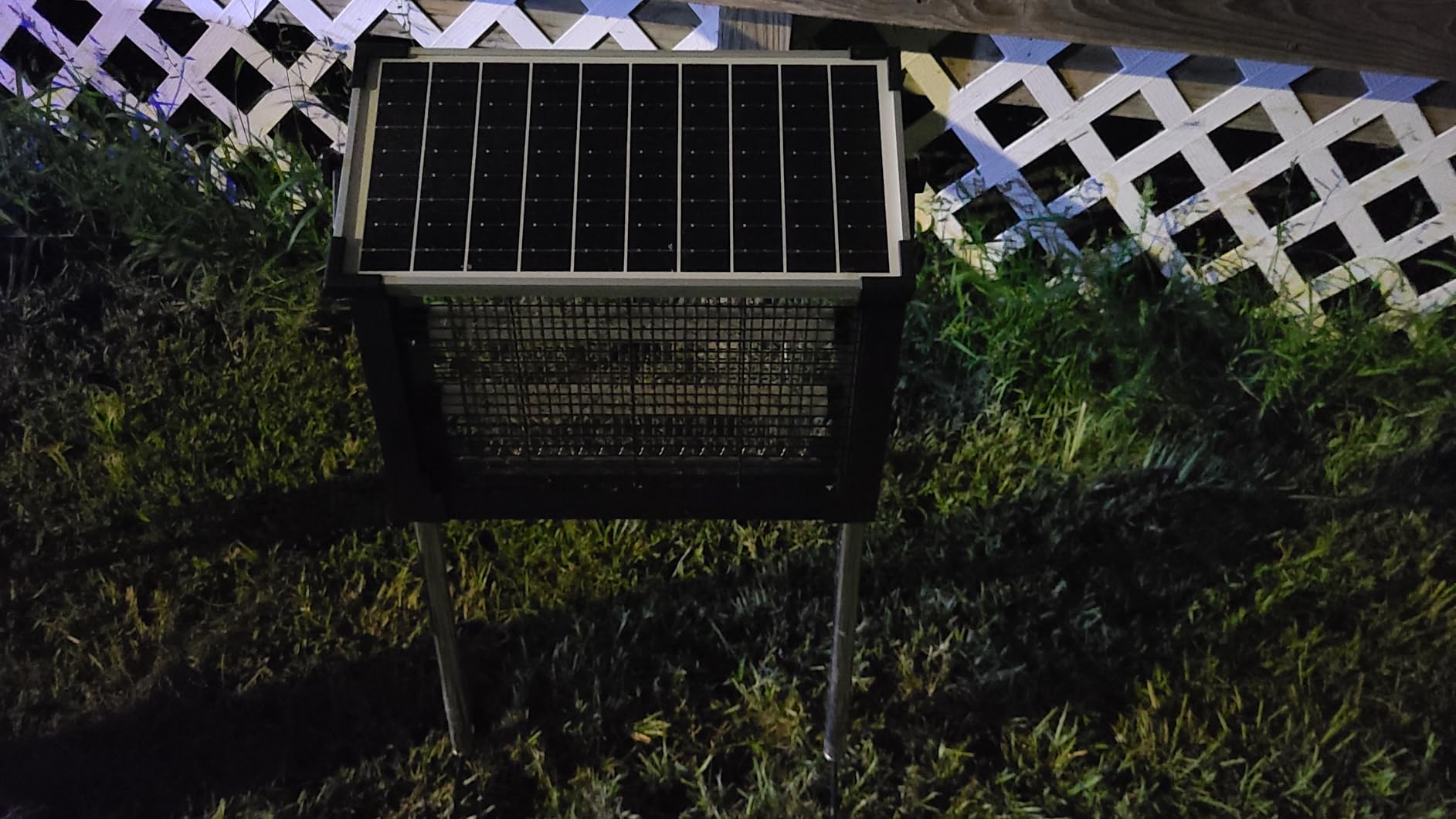
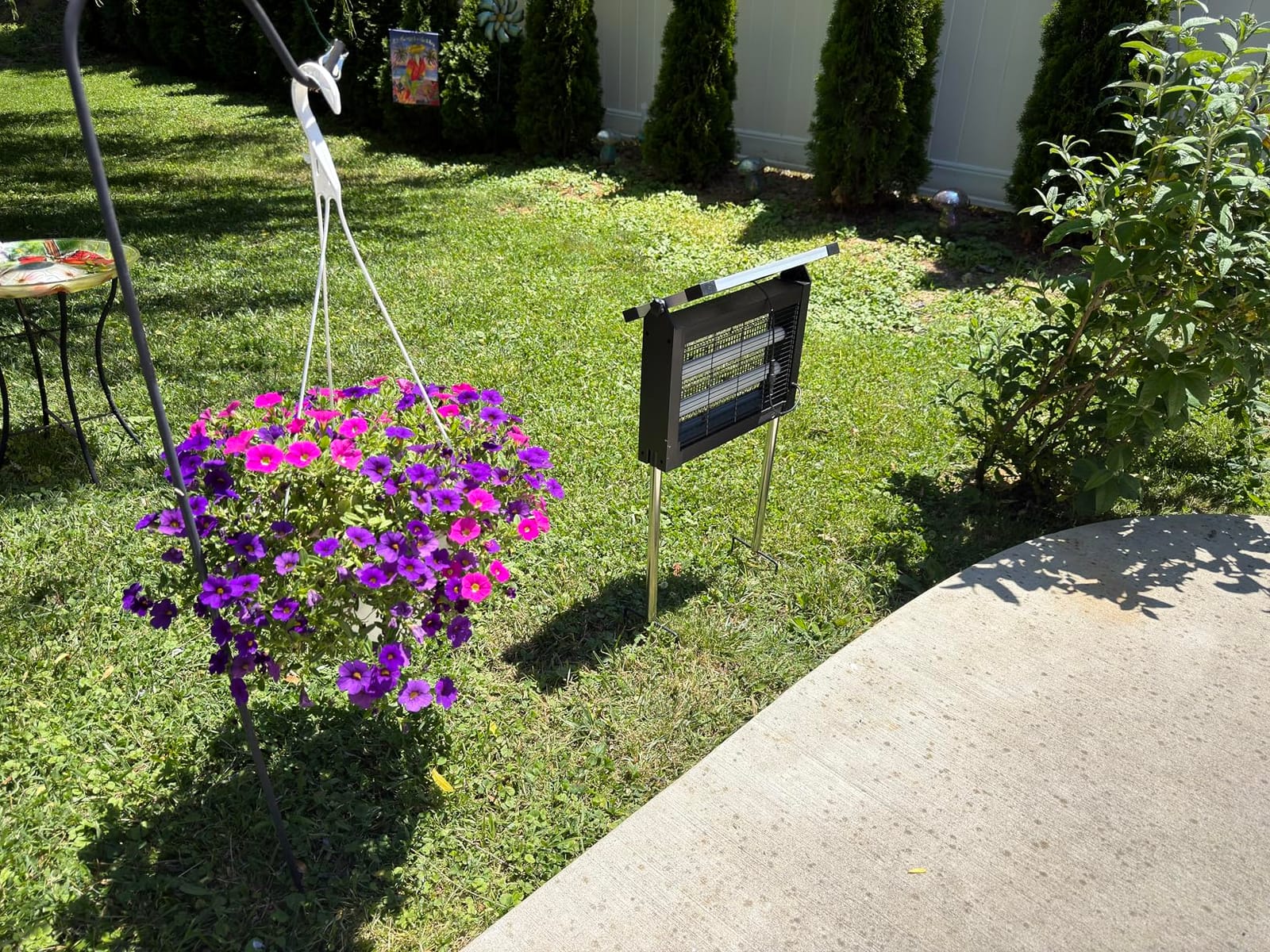
Placement options cover most patios: a 2.6 foot hanging chain, two ground stakes and a 10 foot solar extension cable so the panel can sit in the sun while the lamp hangs under an eave or a pergola beam. The IPX5 waterproof ABS housing and EPA registration match the rest of the competitive set.
Claimed coverage is up to half an acre, which as we explain below should be read as a maximum in open air rather than a promise for your deck. The practical effect is a working radius of roughly six to eight feet from the lamp.
Why the ratings are so consistent
There is no gimmick to disappoint. It is cordless, it switches itself on at dusk, it charges by solar or USB, and the 4500V grid does the work. Buyers who buy it for those four things tend to be satisfied, and the review distribution shows it.
For a patio you use most evenings, that predictability is worth more than a feature list.
Where it falls short
Output is weaker in daylight because it depends entirely on UV attraction, so it does nothing useful during a long afternoon outside. The grid also fills quickly in heavy insect areas and needs routine cleaning to keep output consistent.
Like the rest of the grid units, it targets the insects that chase light rather than the ones looking for you, so manage expectations if mosquitoes are the main concern.
8. TYPEC 2 Pack Solar Bug Zapper – Best for Two Patio Zones
TYPEC 2 Pack Solar Bug Zapper, 3 Solar Charging Panels, 4200V Mosquito Zapper, Auto On/Off LED Light, IP67 Waterproof, USB-C & Solar Powered, Indoor Outdoor Insect Killer for Yard Patio Garden
Two devices per pack
Three solar panels each
4200V grid
IP67 waterproof
Pros
- Two devices cover two separate patio zones
- Three solar panels recharge faster
- IP67 is the highest waterproof rating here
- Integrated LED doubles as a lamp
- Backed by a 2-year warranty and 60-day guarantee
Cons
- Battery does not always run a full night
- One device may be charging while the other runs
- 4200V output is below the 4500V models
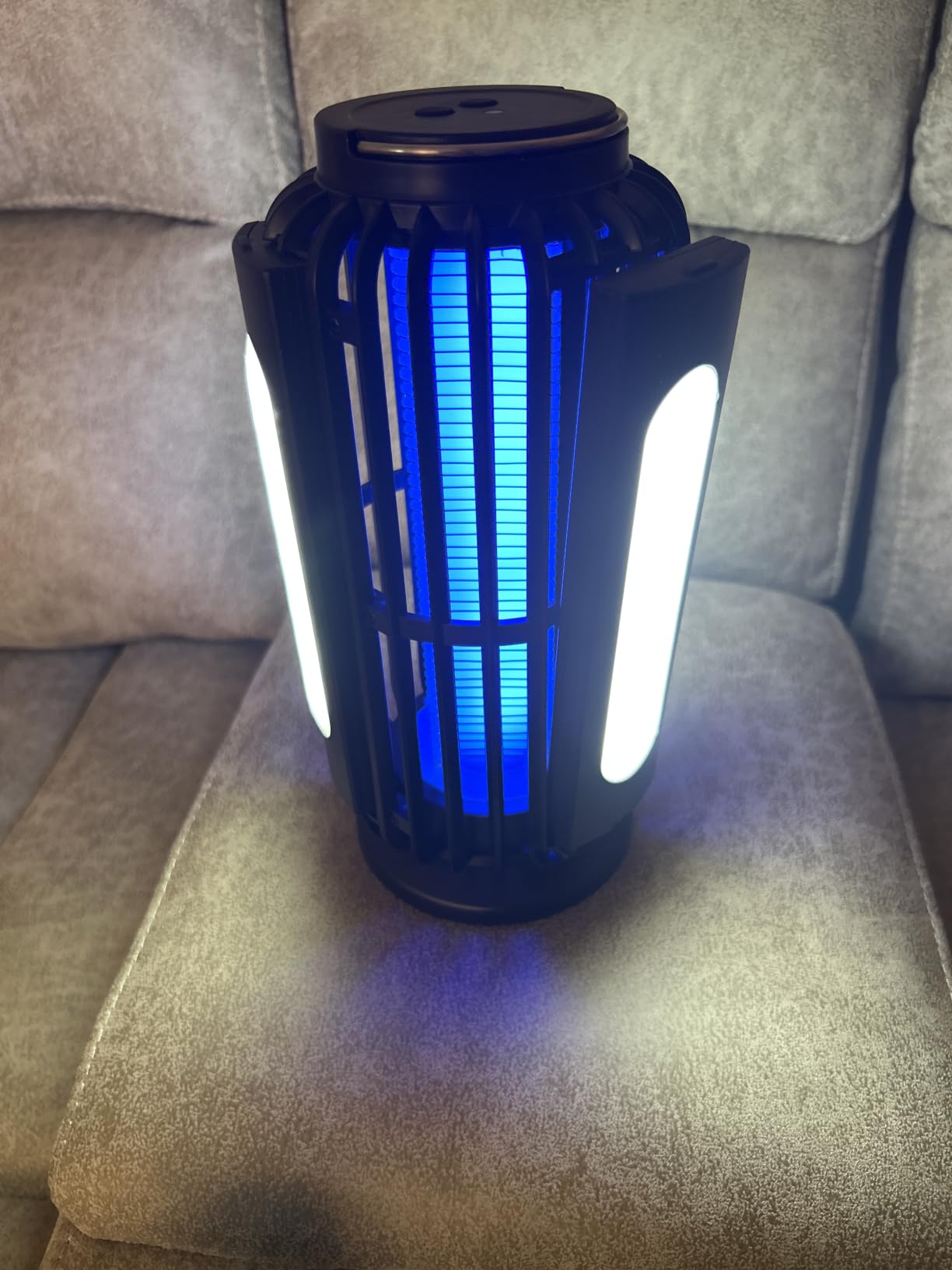
One unit per patio never quite covers a real outdoor living space, and the TYPEC pack solves that by giving you two devices. Each has a 4200V electric grid with 360-degree UV light and a turbo fan, so you can cover a dining area and a walkway, or a deck and a patio table, with one purchase rather than two.
The panel arrangement is the standout feature. Three upgraded solar panels per device reach a full charge in four to five hours, which is faster than the single-panel designs most competitors use, and USB-C fast charging tops them up when the sun is not cooperating. Auto on and off light sensors plus an integrated LED lamp mean each device handles itself.
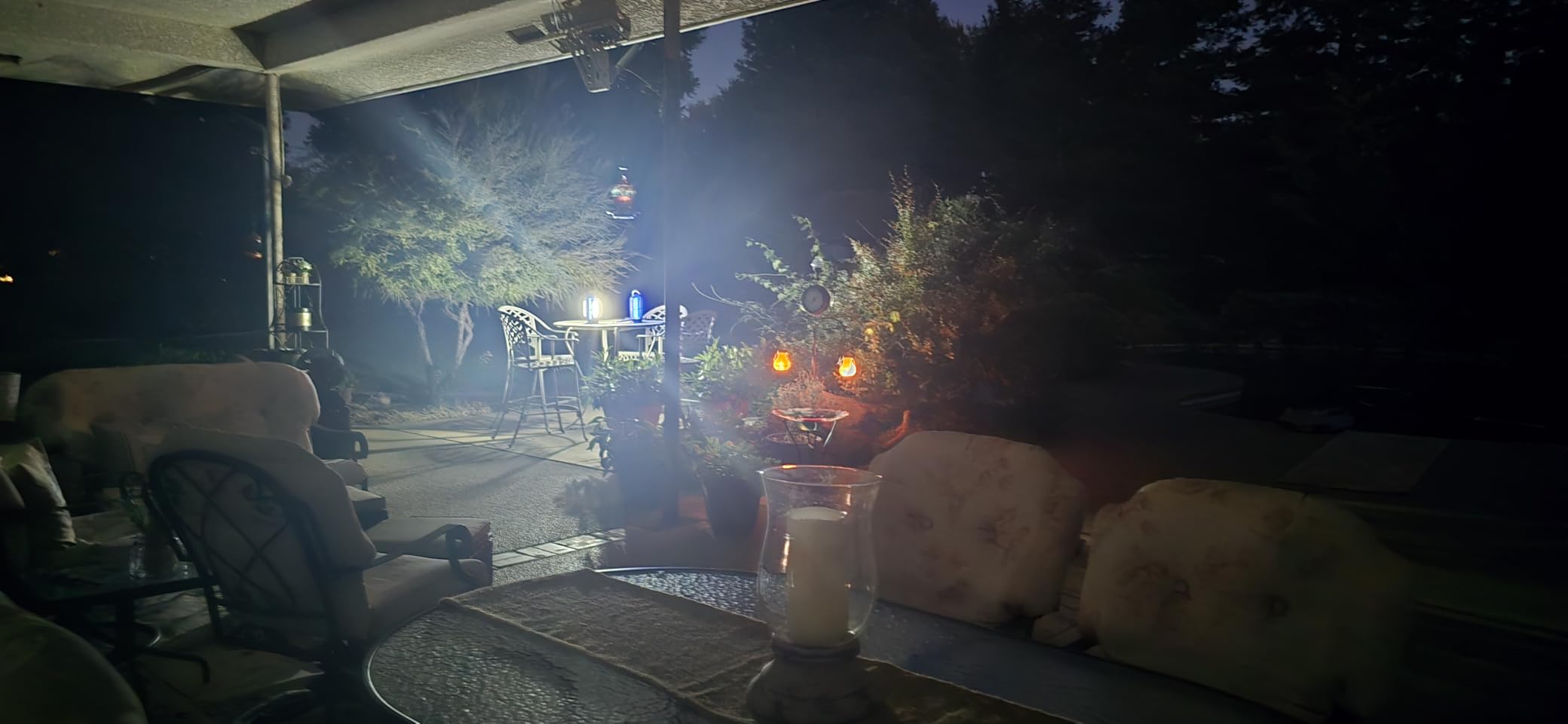
IP67 is the highest waterproof rating in this guide, and the vertical-grid shell rinses clean under water. That matters if you are placing one near a pool deck or a covered patio where a sprinkler occasionally reaches it. The 2-year manufacturer warranty and 60-day money-back guarantee are the longest commitments on this list, which is a reasonable durability signal in a category full of unbranded devices.
Buyers report noticeably fewer mosquitoes on the patio, which is the same modest claim most grid units make, and they consistently raise the two-pack value and the brightness of the LED as the reasons they are happy.
Why two devices beat one
A single zapper clears a pocket of air. Running two means you can place one upwind of the seating and one closer to a second table or doorway, which is the only realistic way to cover a larger patio without a fixed commercial unit.
The 4200V output is a step below the 4500V units, but paired with 360-degree UV and a fan it performs respectably, and the two-pack covers more ground than one larger device in most layouts.
Where it falls short
The repeated complaint in the reviews is battery runtime, with units dying in the early morning on cloudy days rather than running until dawn. With two devices, one may be recharging while the other is in use, which halves your effective coverage overnight.
The 4200V grid is a lower output class than the top units here, and the 12 percent one-star share reflects disappointment about that combined with the runtime limits.
9. ZECHUAN 4500V Rechargeable Zapper – Best for Wide Decks
Solar Bug Zapper Outdoor, 4500V Rechargeable Mosquito Zapper
4500V grid
2100 sq ft claimed coverage
Three operating modes
12 hours cordless runtime
Pros
- Cleanest rating distribution in the guide
- Three power and mode options
- Adjustable solar panel angle
- Stands
- hangs or stakes easily
- Quiet operation
Cons
- Surrounding light reduces effectiveness
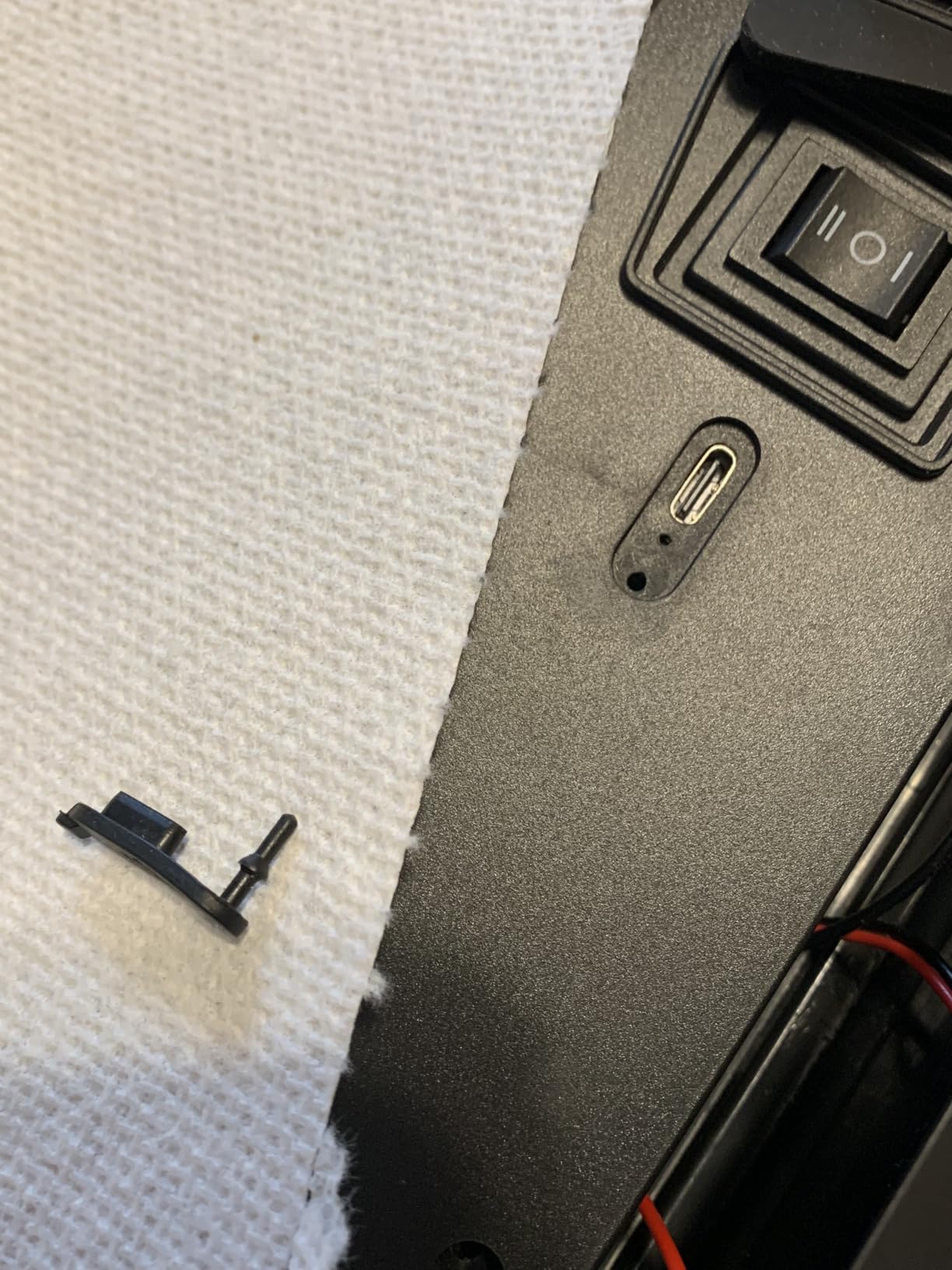
- Charging ports need covering in rain
- Grid cleaning is a regular chore
This one has the strongest rating distribution of anything we reviewed: 72 percent five-star with only 2 percent two-star, across 340 reviews. It also covers a genuinely different niche from the compact units, because at 14.9 by 6.7 by 28.8 inches it is a full-height device you stand on the deck rather than hang from a hook.
Three operating modes give you more control than most competitors: automatic, manual and off. That is genuinely useful on a patio, because automatic can leave it running at a bright hour when you are sitting there with guests, and manual lets you decide when the UV is on. The solar panel angle is adjustable, and a Type-C cable with a built-in rechargeable battery reaches full in four to six hours with a red to green indicator.
Claimed coverage is up to 2100 square feet, which is a more honest number than the one acre claims most of the category makes, and it is still far larger than a typical patio. In practice, treat the useful radius as six to eight feet in each direction from a freestanding unit.
A 2.6 foot hanging chain and a 10 foot solar cable mean it can also be mounted rather than freestanded, so the same device works as a standing corner unit or a hanging one depending on the patio.
Why it suits a wide deck
Height and surface area. A 28.8 inch tall unit with a large grid throws its UV across a seated area rather than up at head height, and the freestanding format means you can position it in a corner where there is no beam, hook or stake to use.
Owners highlight quiet operation and simple placement, and confirm heavy moth and mosquito kills around a typical deck.
Where it falls short
Surrounding light reduces effectiveness significantly, so this needs a dark corner of the deck rather than a spot near your own patio lighting. Reviews on this point are consistent across the category.
The charging ports need covering when it is used outside, the accumulated grid needs regular cleaning, and at 4 pounds it is not a device you will move every evening.
10. Rossetta Solar Bug Zapper with Flame and Projector Light – Best for Small Tables
Rossetta Solar Bug Zapper Outdoor, Fly Zapper with Flame & Projector Light
4200V grid
365-395 nm UV
3000mAh battery
Flame and projector light modes
IPX5
Pros
- Only pick that doubles as decorative lighting
- Quietest operation in the group
- Auto mode runs 8 to 10 hours per charge
- Looks good directly on a patio table
- Lowest one-star share at 6 percent
Cons
- Smallest unit in the guide
- Smallest battery capacity here
- No effect in daylight
- Plastic build feels basic
The Rossetta solves a problem none of the other nine address, which is that a functional zapper on a dining table looks like a piece of equipment. It adds a warm flame light and a projector light mode, so it reads as a decorative piece that happens to zap bugs. Several owners bought multiples for exactly that reason.
Underneath the styling, the hardware is credible: a 4200V grid with 365-395 nm LED attraction, a protective mesh around the high-voltage section, a 3000mAh rechargeable battery, and solar and USB charging. The auto dusk-to-dawn mode runs eight to ten hours on a single charge according to owners, and always-on mode is available when you want the UV through a long evening.
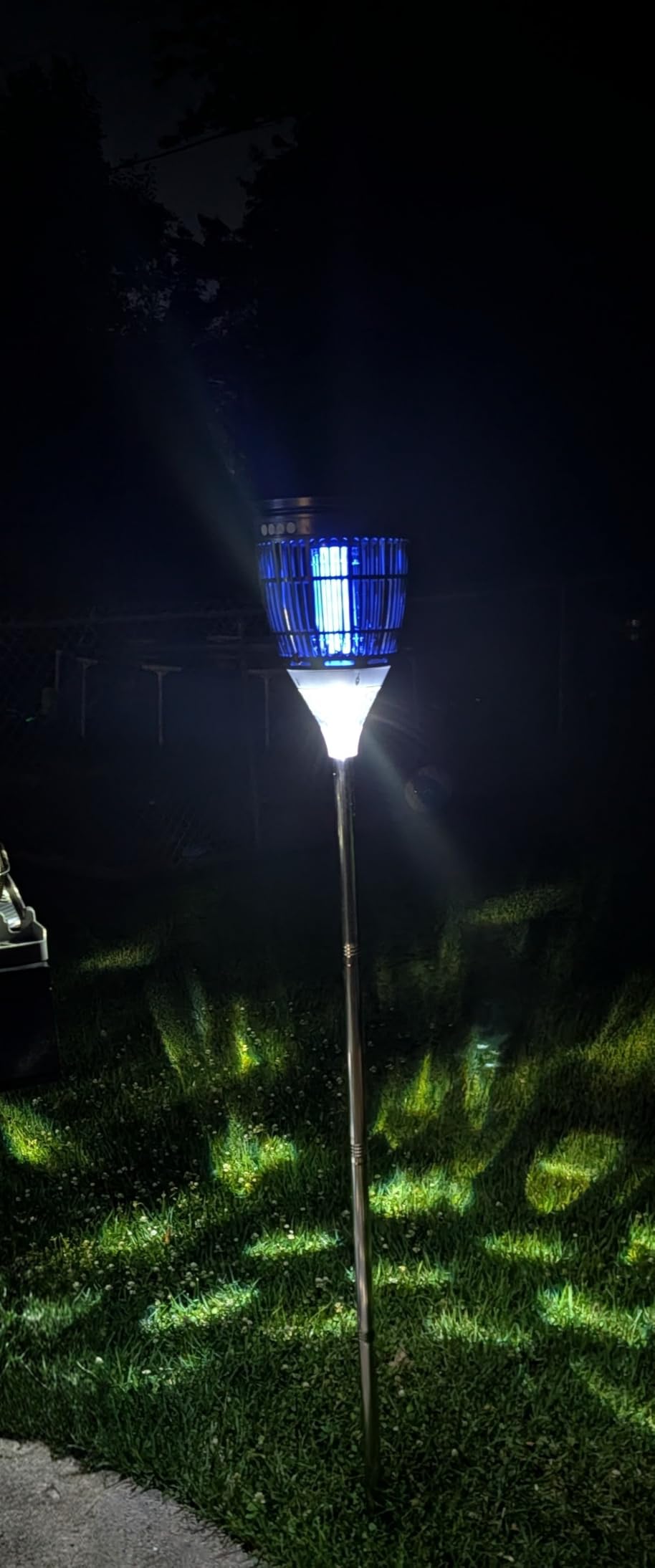
The 4.3 rating with a 6 percent one-star share is the most favourable owner sentiment in this guide, and the reviews point at quietness as the reason. There is no constant buzzing, and the device is audible only if something is actually being zapped, which makes it the best choice for a table where conversation matters.
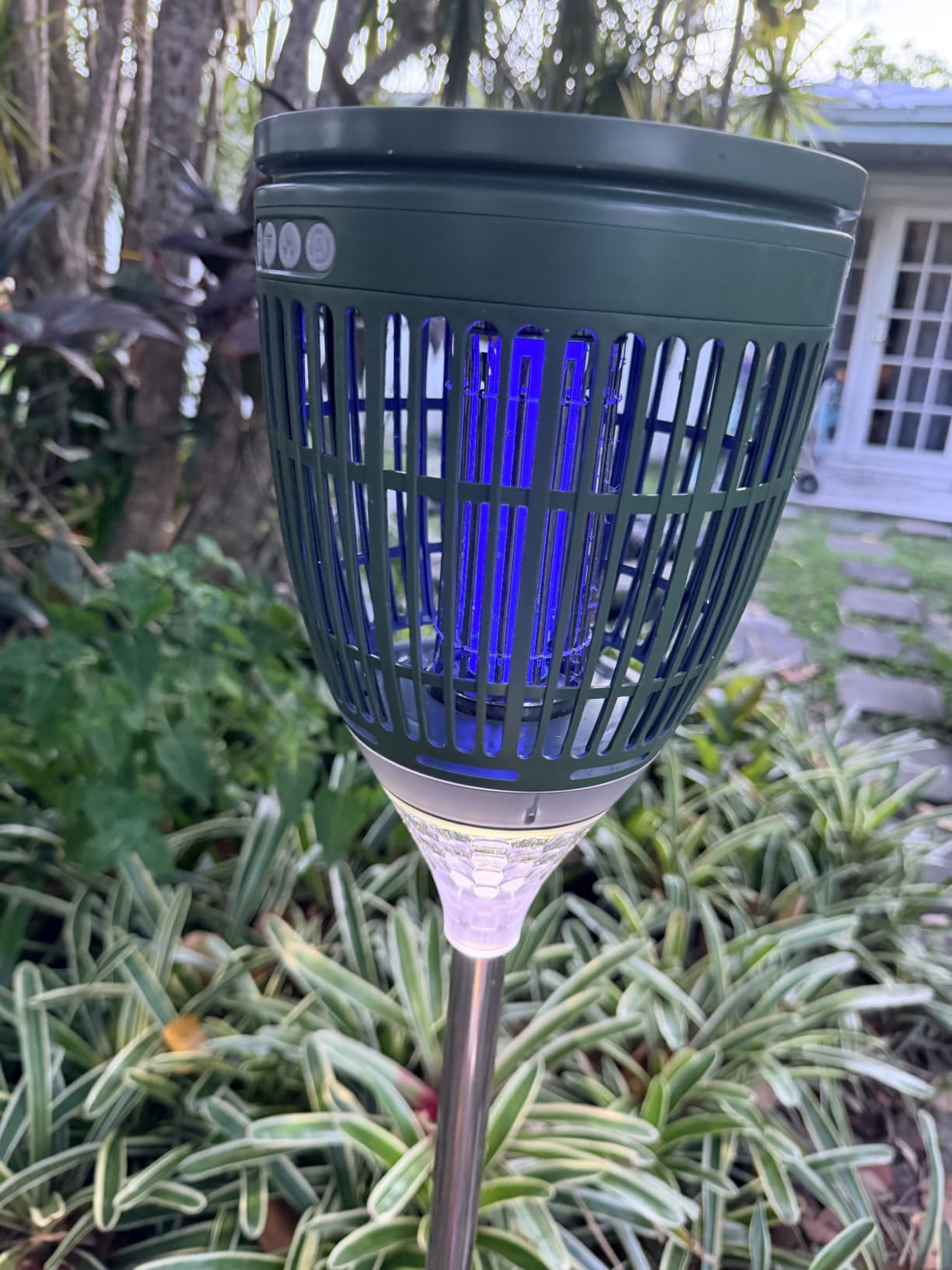
At just under 6 by 2 by 7.5 inches it is the most compact grid unit here, with an included 4 foot ground stake, so it works equally well on a small bistro table or staked into a border beside the seating.
Who should choose it
Patios where the look of the furniture matters as much as the insect control, and people who want a warm light on the table that is not a string of festoon bulbs. If the aesthetic of the space is the priority and the fly load is moderate, this does both jobs in one object.
It is also worth pairing with our picks for solar string lights for patios, though place the two apart rather than side by side, for reasons we cover in the placement section.
Where it falls short
It is the smallest unit in the guide and the 3000mAh battery is the smallest capacity, so runtime can be short on a poor charging day. There is no effect at all during daylight hours, and the plastic build feels basic.
Claimed coverage of up to one acre is not realistic for a unit this size, so treat it as a table-level tool rather than a patio-wide one.
Where to Place a Solar Bug Zapper on a Patio
Placement is worth more than any specification on the list, and most disappointing zapper ownership comes down to position. Put the unit six to eight feet from where people sit, upwind of the table if there is any breeze, and as close to the insect source as you can manage. Any closer and you pull insects toward the food instead of away from it, which is the single most common patio zapper mistake.
The second rule is about competing light. Every one of these devices works by attracting insects to ultraviolet, so a zapper sitting next to a bright patio light, a TV or a lit lantern is competing with itself. Give it its own dark corner, ideally one with no other light source within several feet, and it will do noticeably better.
That leads to a common misreading. Ordinary lanterns and string lights do not keep bugs away from your table, they pull them toward it, because insects see the light and fly to the brightest thing. If you want a zapper to work, keep it away from the seating and away from the string lights. A non-UV zapper guide covers the placement logic in more detail if you are running several devices at once.
Finally, make sure the solar panel sees direct sun for most of the day. A patio under a pergola, beside a wall or under a tree canopy will charge poorly, and the device that dies at 10pm gets switched off permanently within a week. Where direct sun is impossible, choose a model with USB charging and top it up before the evening.
What a Zapper Cannot Do, and What to Pair It With
A zapper does not reduce mosquito bites on its own, and pretending otherwise is the reason so many owners are disappointed. Fewer than 1 percent of the insects killed by these devices are mosquitoes, because mosquitoes navigate by carbon dioxide, heat and scent rather than by ultraviolet. You will be killing moths, gnats, flies and midges, which is a real benefit, but it is a different benefit from the one most people are buying for.
There is also a non-target question that reviewers raise honestly. Pollinators, beetles and larger flying insects can end up on a grid, and the fix is placement and timing rather than a feature. Keep the device away from flowering plants, and consider running it later in the evening when foraging insects have settled rather than all afternoon.
For a patio that genuinely works, pair the zapper with a few other things. Empty standing water weekly, including planters, gutters and any saucers under pots. Run a fan to disperse the zapper’s UV across a wider area and break up CO2 trails. Use citronella or a proven spatial repellent for the bites the zapper will not prevent. On a covered structure, physical screening beats every zapper on this list, and our picks for bug screens for gazebos cover that option. If the heat is the reason you are outside, a misting fan for patios doubles as airflow that disrupts mosquito hunting.
Safety, Weather and Cleaning on a Patio
Modern outdoor zappers are designed to run overnight. The electrical grid is the part that needs physical guarding, not the light, so look for a protective mesh and a grid interval of roughly 0.19 inches, which is the common safety standard and is narrower than a small finger. Keep the device out of reach of children and pets, and do not place one within reach of a pool edge or water feature unless it is rated IP65 or higher.
On the UV side, the light in consumer zappers is low-intensity UV-A and sits within normal exposure limits for a device set six to eight feet away. If you are running a very large multi-tube unit directly beside where people sit for hours, position it with more distance, and remember that the amber flame-mode lamps on the Rossetta emit no UV at all.
Weather ratings are worth reading properly. IPX4 means splash resistant, fine for a covered patio. IPX5 means protected against low-pressure water jets, fine for an uncovered deck. IPX6 and IPX7 tolerate heavier water exposure, which matters near a pool or a sprinkler. None of these ratings mean a device can be left in a downpour indefinitely, and none of them protect the charging ports, which several owners in our review notes should be covered in bad weather.
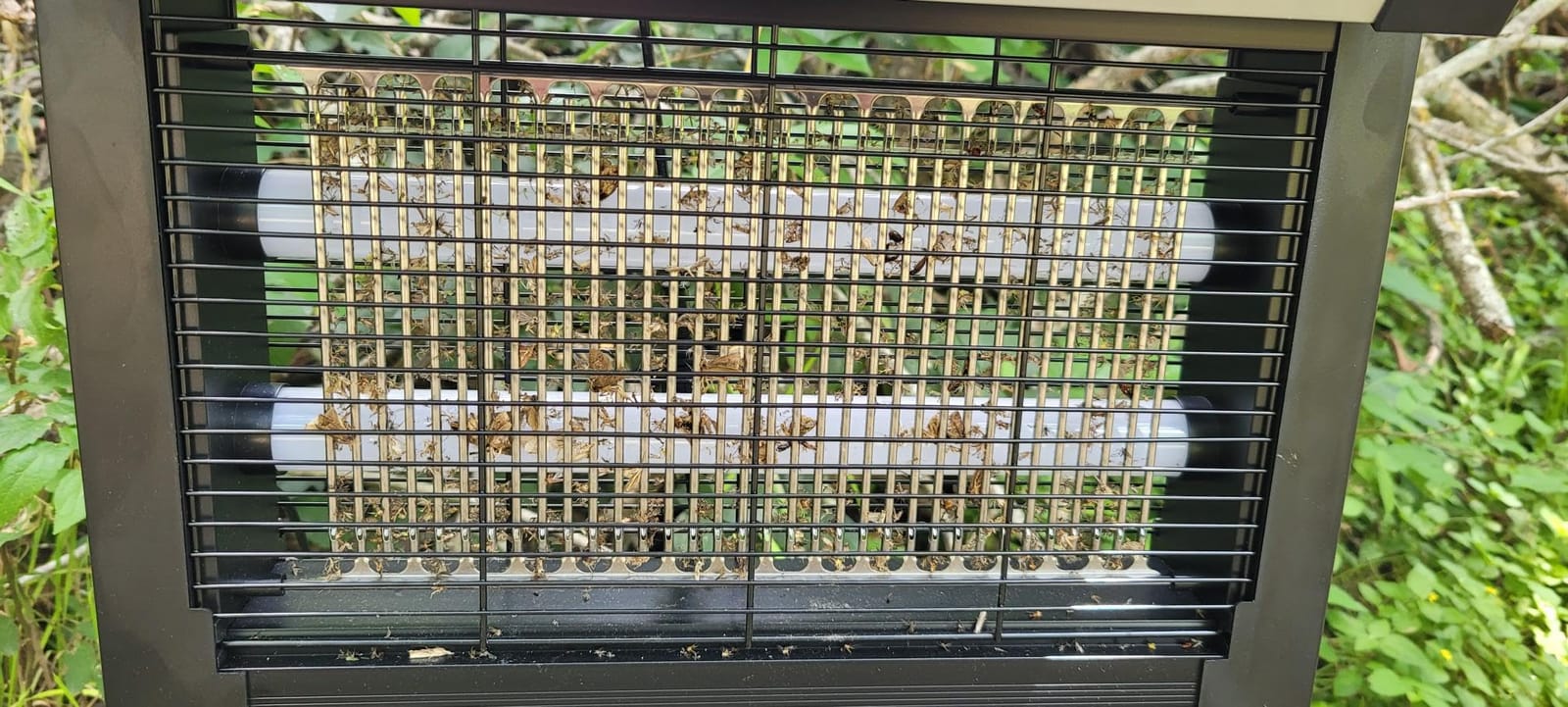
Cleaning is the chore that decides whether a zapper still works in September. Empty the detachable tray on the trap-based models weekly in peak season, and brush or rinse the grid on the electrical models the same frequency. A caked grid conducts heat, attracts pests and drops output. Keep a small cleaning brush with the unit, because the included one is usually the right size.
How to Choose: the Specs That Actually Matter
UV wavelength is the first filter, and the useful range is 365 to 400 nm. Attraction is what pulls an insect to the grid, and every serious pick on this list sits in the 365-395 nm band, which is why they perform similarly on moths and gnats. Grid voltage comes next: 3500V units in this group deliver a modest zapping output, 4200V units are a solid middle, and 4500V units deliver the strongest results. If flies are your main problem, do not accept anything below 4200V.
Battery capacity and panel wattage decide the night, not the purchase. The pattern across the reviews is consistent: units that fail do so because a partly cloudy day left the battery short, not because the hardware was bad. Look for 3000mAh or more, a panel of at least 10W, and USB charging as a backup. The twelve-hour rated runtimes on the 4000mAh units assume a full day of direct sun, so treat them as best case rather than typical.
Coverage claims need translating. One acre and half-acre figures describe a theoretical radius in open air on a still night, and half an acre is over 21,000 square feet, which is roughly the size of a small stadium. A typical patio is between 150 and 400 square feet. What matters is the six to eight foot working radius around the lamp, and a manufacturer that publishes a square-foot figure in the 2000 to 4000 range is being more honest than one claiming acreage.
Finally, read the review distribution rather than the headline average. A 4.0 across nearly 3000 reviews tells you a lot more than a 4.8 across a handful. Budget listings in this category consistently show 12 percent one-star reviews because buyers expected grid zappers and received something else, while the better-performing mid-range units sit at 8 to 10 percent. That gap is a reliable signal of expectation mismatch rather than build quality.
On brand, the category mixes a small number of established outdoor brands with a lot of white-label devices from the same handful of Chinese manufacturers. That is visible in the data: several picks here list the same manufacturer, which is normal for this category. It is not automatically a problem, but it does mean warranty terms and support responsiveness are the more useful differentiators than the brand name printed on the box.
Frequently Asked Questions
Are solar bug zappers any good?
Yes for flies, gnats and moths, and as a patio light. They are only marginally useful against mosquitoes, because research shared across insect-control communities puts mosquitoes at well under 1 percent of what zappers kill. Buy one to thin what you see around the table, not to stop bites.
Do solar bug zappers work?
They work best with six to eight hours of direct sun and a clear line of sight to the insects, and placed six to eight feet from your seating away from competing light. Performance drops sharply on cloudy days unless the model also supports USB pre-charging, so top up before a dull weekend if you can.
Do bug zappers work on flies and mosquitoes?
Strongly on flies, which is the strongest honest case for buying one for a patio. On mosquitoes the effect is partial, because the grid kills what ultraviolet light attracts rather than what carbon dioxide and body heat attract, so you reduce the population you can see rather than the bites you receive.
Why did people stop using bug zappers?
Most often because of visible dead-insect debris, the noise late at night, disappointment that mosquitoes were not the main catch, concern about killing beneficial insects, and the arrival of chemical-free spatial repellents that need no device at all. Better-built units with washable grids and timers solve several of those complaints at once.
Is it bad to leave a bug zapper on all night?
No. Outdoor-rated units are designed for overnight running. Keep the device out of reach of children and pets, check for a protective grid interval of roughly 0.19 inches, and do not place one within reach of a pool edge or water feature unless it is rated IP65 or higher.
What is the best way to get rid of mosquitoes on a patio?
Empty standing water weekly, place a grid zapper six to eight feet upwind of the seating, run a fan to disperse the UV and break up CO2 trails, use citronella or a proven spatial repellent, trim vegetation, and set a trap for the non-target insects the zapper collects.
Final Verdict
If you take one thing from this guide, take the honest limit: these devices thin the flies, gnats and moths around your seating, and they do not stop mosquito bites. Positioned six to eight feet upwind of the table, away from your own patio lighting, one will make an evening noticeably more pleasant. It is a complement to clearing standing water and using repellent, not a replacement.
For most patios, the OnBeam 4500V is the pick, with dual UV bulbs, a washable grid and the strongest combination of owner rating and review history in the group. The PhatroyYee is the value alternative with the widest killing field and the longest rated runtime, and the ZECHUAN 3-in-1 suits anyone who wants a light more than a killing field. That is our shortlist of the best solar bug zappers for patios, updated for 2026, and the other seven cover budgets, two-zone layouts, small tables and high-output decks.
Whichever you choose, give it a full day of direct sun before the first evening and check the review pages again next season. These devices improve with a clean grid and worse with a neglected one, and that single habit separates the zappers that still work in September from the ones that end up in the garage.