
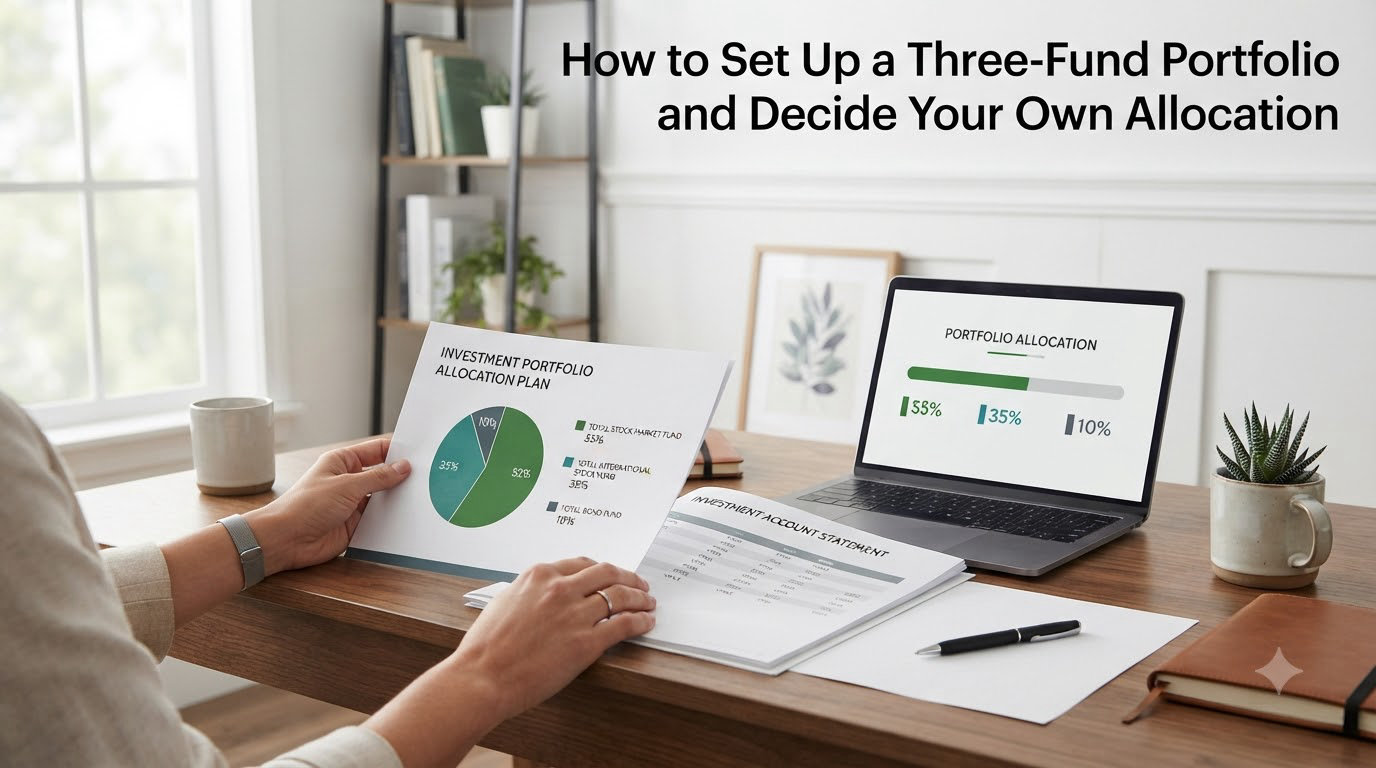
Most investors overcomplicate their portfolios when the simplest approach often wins. A three-fund portfolio gives you broad market diversification using just three low-cost index funds, and you can set one up in under an hour. Our team has studied how thousands of investors use this strategy on forums like the Bogleheads community, and the results speak for themselves: lower fees, less stress, and returns that track the market over the long haul.
This guide walks you through exactly how to set up a three-fund portfolio from scratch. More importantly, we break down how to decide your own allocation percentages based on your age, risk tolerance, and goals. By the end, you will have a clear framework for picking your stock-to-bond split, choosing specific funds at your brokerage, and knowing when to rebalance.
Whether you are investing in a 401(k), an IRA, or a taxable brokerage account, this approach works the same way. Let us start with the basics and build from there.
Table of Contents
What Is a Three-Fund Portfolio?
A three-fund portfolio is a passive investment strategy that divides your money across three broad index funds: a total U.S. stock market fund, a total international stock fund, and a total bond market fund. The idea is to capture global market returns while keeping costs and complexity to an absolute minimum.
The concept comes from the Bogleheads community, a group of investors inspired by Vanguard founder John Bogle. Bogle built his philosophy on a simple belief: do not try to beat the market, own the whole market through low-cost index funds instead. The three-fund portfolio distills that philosophy into something anyone can implement.
Here is how it works in practice. You pick a target allocation, say 60% U.S. stocks, 20% international stocks, and 20% bonds. You buy those three funds in those proportions. Then you contribute regularly and rebalance once or twice a year to bring the percentages back in line.
That is the entire strategy. There are no individual stocks to research, no sector bets to time, and no expensive actively managed funds eating into your returns.
This approach has remained popular for one simple reason: it works. Studies consistently show that the vast majority of actively managed funds underperform their benchmark indexes over 10-year and 20-year periods. By owning the whole market through index funds, you capture the aggregate growth of thousands of companies without paying premium fees for stock picking that rarely pays off.
The Three Core Components Explained
Each fund in a three-fund portfolio plays a distinct role. Understanding what each one does helps you make smarter decisions about your allocation.
Component 1: Total U.S. Stock Market Fund
This fund forms the growth engine of your portfolio. A total U.S. stock market index fund holds shares in virtually every publicly traded company in the United States, from Apple and Microsoft down to small companies you have never heard of. That gives you ownership in roughly 3,000 to 4,000 companies in a single purchase.
Many beginners wonder whether they should just buy an S&P 500 fund like VOO or VFIAX instead. The S&P 500 covers about 80% of the U.S. market by value, which is excellent coverage. A total market fund simply adds small-cap and mid-cap stocks for slightly broader diversification. The performance difference between the two is minimal over long periods.
Common total U.S. stock fund choices include VTSAX and its ETF equivalent VTI at Vanguard. These funds typically carry expense ratios below 0.05%, meaning you pay less than $5 per year for every $10,000 invested.
Component 2: Total International Stock Fund
This fund gives you exposure to companies outside the United States. A total international stock index fund typically includes developed markets like Japan, the United Kingdom, and Germany, plus emerging markets like India, Brazil, and Taiwan. You get exposure to thousands of foreign companies in one fund.
International stocks do not always move in the same direction as U.S. stocks, which is the whole point. When the U.S. market underperforms, international markets may hold steady or even rise. This lack of perfect correlation reduces the overall volatility of your portfolio.
The most widely used options are VTIAX and its ETF equivalent VXUS at Vanguard. The debate over how much international exposure to hold comes up constantly on investing forums, and we address that in detail in the allocation section below.
Component 3: Total Bond Market Fund
Bonds are the stabilizer in your portfolio. A total bond market fund holds thousands of government and corporate bonds, which pay regular interest and tend to hold their value when stocks decline. This is the component that lets you sleep at night during market crashes.
Bonds will not generate the long-term growth that stocks do, but they dramatically reduce the size of your portfolio’s drops during bear markets. For investors nearing retirement, that protection is worth its weight in gold.
The standard bond fund choices include VBTLX and its ETF equivalent BND at Vanguard. These funds have expense ratios around 0.03%, making them extremely affordable.
How to Build a Three-Fund Portfolio: Step by Step Guide
Setting up your three-fund portfolio is a straightforward process once you know the steps. Here is the exact sequence we recommend following.
Step 1: Choose Your Investment Account
Decide which account will hold your three-fund portfolio. The most common options are a workplace 401(k), a Traditional or Roth IRA, and a taxable brokerage account. Each has different tax treatment, but the portfolio construction process is identical regardless of account type.
If your employer offers a 401(k) match, prioritize that account first. The match is free money, and leaving it on the table is like turning down a raise.
Step 2: Open or Log Into Your Brokerage Account
If you already have an account with Vanguard, Fidelity, or Charles Schwab, you are ready to go. If not, opening an account takes about 15 minutes online. You will need your Social Security number, a government ID, and bank account information for funding.
All three major brokerages now offer zero-commission trades on their index funds and ETFs, so cost should not be a factor in choosing where to invest.
Step 3: Select Your Three Funds
Each brokerage offers its own versions of the three core funds. You want the total market index version of each, not a specialty or actively managed alternative. Look for funds with the word “total” in the name and expense ratios below 0.10%.
At Vanguard, the standard picks are VTSAX, VTIAX, and VBTLX. At Fidelity, use FSKAX, FTIHX, and FXNAX. At Schwab, the equivalents are SWTSX, SWISX, and SWAGX. We cover each brokerage in detail in the fund selection section below.
Step 4: Set Your Target Allocation Percentages
This is the step where most people get stuck, and it is the focus of the next major section. Your allocation depends on your age, risk tolerance, and investment timeline. Write down your target percentages before you invest a single dollar so you have a clear plan.
For example, a 35-year-old might choose 60% U.S. stocks, 20% international stocks, and 20% bonds. A 55-year-old might shift to 40% U.S. stocks, 15% international stocks, and 45% bonds.
Step 5: Place Your Initial Investments
Transfer money into your account and buy your three funds in the target proportions. If you are starting with a lump sum, divide it according to your percentages. If you are starting small, buy what you can and build toward your target over time.
Do not worry about market timing. Studies show that time in the market beats timing the market by a wide margin over long periods.
Step 6: Set Up Automatic Contributions
Automation is the secret weapon of successful long-term investors. Set up automatic transfers from your bank account on a weekly or monthly schedule. This makes sure you invest consistently regardless of what the market is doing or how you feel about it.
Many investors on the Bogleheads forum credit their success to this single habit. When investing becomes automatic, you remove emotion from the equation entirely.
How to Decide Your Own Asset Allocation
Deciding your allocation is the most personal and important step in building a three-fund portfolio. There is no universal right answer, but there is a reliable framework you can use to find the answer that is right for you.
Start With Your Time Horizon
Your time horizon is the number of years until you need to spend the money. If you are 30 and plan to retire at 65, your time horizon is 35 years. That gives you decades to ride out market downturns, which means you can afford to hold a high percentage of stocks.
As a general rule, the longer your time horizon, the more stocks you should hold. Stocks carry more short-term risk but deliver higher long-term returns. Bonds sacrifice some growth for stability, which matters more as you approach retirement.
Consider Your Risk Tolerance
Risk tolerance is your emotional ability to handle seeing your portfolio drop in value. This is different from your financial ability to withstand losses. Some investors can watch their portfolio fall 30% and barely flinch. Others lose sleep over a 10% dip.
Be honest with yourself here. If a market crash would tempt you to sell, you need a higher bond allocation even if your time horizon is long. The worst outcome is panicking and selling at the bottom, which destroys years of gains.
Age-Based Allocation Guidelines
One popular rule of thumb is to subtract your age from 110 or 120 and put that percentage in stocks, with the remainder in bonds. Using 120 as the baseline gives a more aggressive allocation that reflects longer modern lifespans.
Here is how that translates into three-fund portfolio allocations by age range:
Age 20 to 29: Approximately 90% to 95% stocks, 5% to 10% bonds. A typical split might be 54% U.S. stocks, 36% international stocks, and 10% bonds. Young investors have time on their side and can ride out volatility.
Age 30 to 39: Approximately 80% to 90% stocks, 10% to 20% bonds. A common allocation is 54% U.S. stocks, 26% international stocks, and 20% bonds. You are still decades from retirement but starting to build a modest safety cushion.
Age 40 to 49: Approximately 70% to 80% stocks, 20% to 30% bonds. A reasonable split is 48% U.S. stocks, 22% international stocks, and 30% bonds. You are entering your peak earning years and beginning to prioritize stability.
Age 50 to 59: Approximately 60% to 70% stocks, 30% to 40% bonds. An example allocation is 42% U.S. stocks, 18% international stocks, and 40% bonds. Capital preservation becomes increasingly important as retirement approaches.
Age 60 and above: Approximately 40% to 60% stocks, 40% to 60% bonds. A common split is 36% U.S. stocks, 14% international stocks, and 50% bonds. The focus shifts toward income generation and protecting what you have built.
These ranges are starting points, not rigid rules. Adjust based on your personal risk tolerance and financial situation.
Splitting Between U.S. and International Stocks
Once you decide your overall stock-to-bond ratio, you need to split the stock portion between U.S. and international funds. This question sparks endless debate on investing forums.
The global stock market is roughly 60% U.S. and 40% international by market capitalization. Some investors mirror that split exactly by holding 60% U.S. and 40% international within their stock allocation. Others prefer a heavier U.S. weighting due to familiarity and the strong historical performance of U.S. markets.
A middle-ground approach many Bogleheads recommend is holding 70% to 80% of your stock allocation in U.S. funds and 20% to 30% in international funds. This provides meaningful diversification without over-weighting international markets, which have underperformed U.S. markets over the past decade.
Pick a percentage, commit to it, and stop second-guessing. The exact split matters far less than your consistency in sticking with it.
The Warren Buffett 90/10 Approach
Warren Buffett has famously recommended a simple 90/10 allocation: 90% in a low-cost S&P 500 index fund and 10% in short-term government bonds. He suggested this as a default for investors who want to keep things as simple as possible.
You can adapt this for a three-fund portfolio by splitting that 90% stock portion between U.S. and international funds. For example, 63% U.S. stocks, 27% international stocks, and 10% bonds gives you a globally diversified version of the Buffett approach.
Adjusting Your Allocation Over Time
Your allocation should gradually shift toward bonds as you age and your time horizon shortens. This is called a glide path, and it is the same principle behind how target-date funds operate.
A simple approach is to increase your bond allocation by 1% to 2% each year. For example, if you start at 80% stocks and 20% bonds at age 35, you might move to 78% stocks and 22% bonds at age 36. This gradual shift reduces risk without requiring dramatic portfolio changes.
You do not need to obsess over this. Checking and adjusting once a year during your annual rebalance is more than enough.
Choosing Your Funds at Major Brokerages
Each major brokerage offers its own versions of the three core funds. The good news is that they are all remarkably similar in performance because they track the same indexes. Here are the specific fund choices at the three most popular brokerages.
Vanguard Three-Fund Portfolio
Vanguard is the spiritual home of the three-fund portfolio. The mutual fund versions are VTSAX for total U.S. stocks, VTIAX for total international stocks, and VBTLX for total bonds. The ETF equivalents are VTI, VXUS, and BND.
Vanguard mutual funds typically require a $3,000 minimum initial investment. If that is a barrier, the ETF versions have no minimum beyond the price of a single share, which makes them ideal for beginners starting with smaller amounts.
Fidelity Three-Fund Portfolio
Fidelity offers excellent zero-expense-ratio index funds through its Fidelity ZERO lineup. FZROX covers total U.S. stocks, FZILX covers total international stocks, and there is no zero-fee bond fund, so FXNAX is the standard bond pick.
The standard Fidelity index funds are FSKAX for U.S. stocks, FTIHX for international stocks, and FXNAX for bonds. These have no minimum investment requirements.
Schwab Three-Fund Portfolio
Charles Schwab’s fund equivalents are SWTSX for total U.S. stocks, SWISX for international stocks, and SWAGX for total bonds. All three have low expense ratios and no minimum investment requirement.
Schwab also offers ETF versions: SCHB, SCHF, and SCHZ, which are popular for their low costs and tradability.
What If Your 401(k) Has Limited Options?
Many workplace 401(k) plans do not offer total market index funds. This is one of the most common frustrations investors raise on forums, but it is manageable.
Look for the closest available alternatives. If your plan offers an S&P 500 index fund but no total market fund, use the S&P 500 fund for your U.S. stock allocation. The two perform nearly identically over time. If there is no international fund, see whether a target-date fund or a balanced fund is available at a reasonable cost.
You can also use your IRA or taxable account to round out your 401(k) holdings. For example, if your 401(k) only has U.S. stock and bond funds, hold your international allocation in your IRA. This approach is called managing your entire portfolio as one picture rather than optimizing each account in isolation.
Rebalancing: When and How to Adjust Your Portfolio
Over time, your allocation will drift away from your targets because different funds grow at different rates. If U.S. stocks have a strong year while bonds stay flat, your portfolio might shift from 80% stocks to 85% stocks without you doing anything. Rebalancing brings it back in line.
How Often Should You Rebalance?
Two approaches work well. The first is calendar-based rebalancing, where you check your allocation once or twice a year and make adjustments. The second is threshold-based rebalancing, where you rebalance only when any fund drifts more than 5 percentage points from its target.
Both methods produce similar long-term results. The most important thing is picking one and following it consistently. Avoid the temptation to check your allocation weekly or monthly, as frequent rebalancing increases costs and stress without improving returns.
Tax-Efficient Rebalancing
In tax-advantaged accounts like a 401(k) or IRA, rebalancing has no tax consequences. You can buy and sell freely. In a taxable brokerage account, however, selling funds that have gained value triggers capital gains taxes.
The most tax-efficient approach is to rebalance using new contributions. Instead of selling your overweighted funds, direct your next few contributions toward the underweighted funds until the balance is restored. This keeps your allocation on target without generating taxable events.
Common Mistakes to Avoid
Even a simple strategy can go wrong if you fall into common behavioral traps. Here are the mistakes we see most often among investors attempting a three-fund portfolio.
Overthinking your allocation. Many investors spend weeks agonizing over whether to hold 20% or 25% in international stocks. The difference in long-term returns between these choices is negligible. Pick a reasonable allocation, commit to it, and move on with your life.
Chasing performance and switching funds. When international stocks have a bad year, investors are tempted to drop their international allocation entirely. When bonds lose value during periods of rising interest rates, some investors abandon bonds altogether. This performance chasing destroys returns. Stick with your plan.
Adding complexity you do not need. The three-fund portfolio works precisely because it is simple. Adding a fourth, fifth, or sixth fund for real estate, gold, crypto, or sector bets dilutes the benefits of simplicity without meaningfully improving diversification.
Neglecting to rebalance. If you never rebalance, your portfolio will gradually become riskier than you intended as stocks outgrow bonds. Set a calendar reminder to check your allocation at least once a year.
Panic selling during downturns. Market crashes are when the three-fund portfolio proves its worth. The investors who hold steady through downturns capture the recovery. Those who sell lock in their losses and miss the rebound.
FAQs
What is Warren Buffett’s 90/10 rule?
Warren Buffett’s 90/10 rule suggests allocating 90% of your portfolio to a low-cost Su0026amp;P 500 index fund and 10% to short-term government bonds. He recommended this simple approach as a default for investors who want minimal complexity. In a three-fund portfolio, you can adapt this by splitting the 90% stock portion between U.S. and international funds.
Is having a 3 fund portfolio worth it?
Yes, a three-fund portfolio is worth it for the vast majority of long-term investors. It provides broad diversification across thousands of U.S. and international companies plus bonds, all at extremely low cost. The strategy consistently outperforms most actively managed approaches over 10-year and 20-year periods while requiring minimal time and effort to maintain.
What is the 3 portfolio rule?
The 3 portfolio rule refers to dividing your investments across three asset classes: domestic stocks, international stocks, and bonds. Each class is represented by a single low-cost index fund. This three-fund approach captures global market returns while keeping complexity and expenses low.
What three funds do bogleheads recommend?
The Bogleheads community recommends a total U.S. stock market fund (such as VTSAX or VTI), a total international stock fund (such as VTIAX or VXUS), and a total bond market fund (such as VBTLX or BND). These three funds provide complete global diversification in a simple, low-cost package.
Conclusion
Learning how to set up a three-fund portfolio gives you one of the most effective investment strategies available in 2026. Three low-cost index funds covering U.S. stocks, international stocks, and bonds provide all the diversification most investors will ever need.
The allocation you choose matters less than your consistency in sticking with it. Pick a stock-to-bond split based on your age and risk tolerance, split your stock portion between U.S. and international funds, automate your contributions, and rebalance once a year. Then go enjoy your life while your portfolio does the heavy lifting.
Your next step is simple: log into your brokerage account, buy your three funds, and set up automatic investments. The best portfolio is the one you actually implement and maintain.