
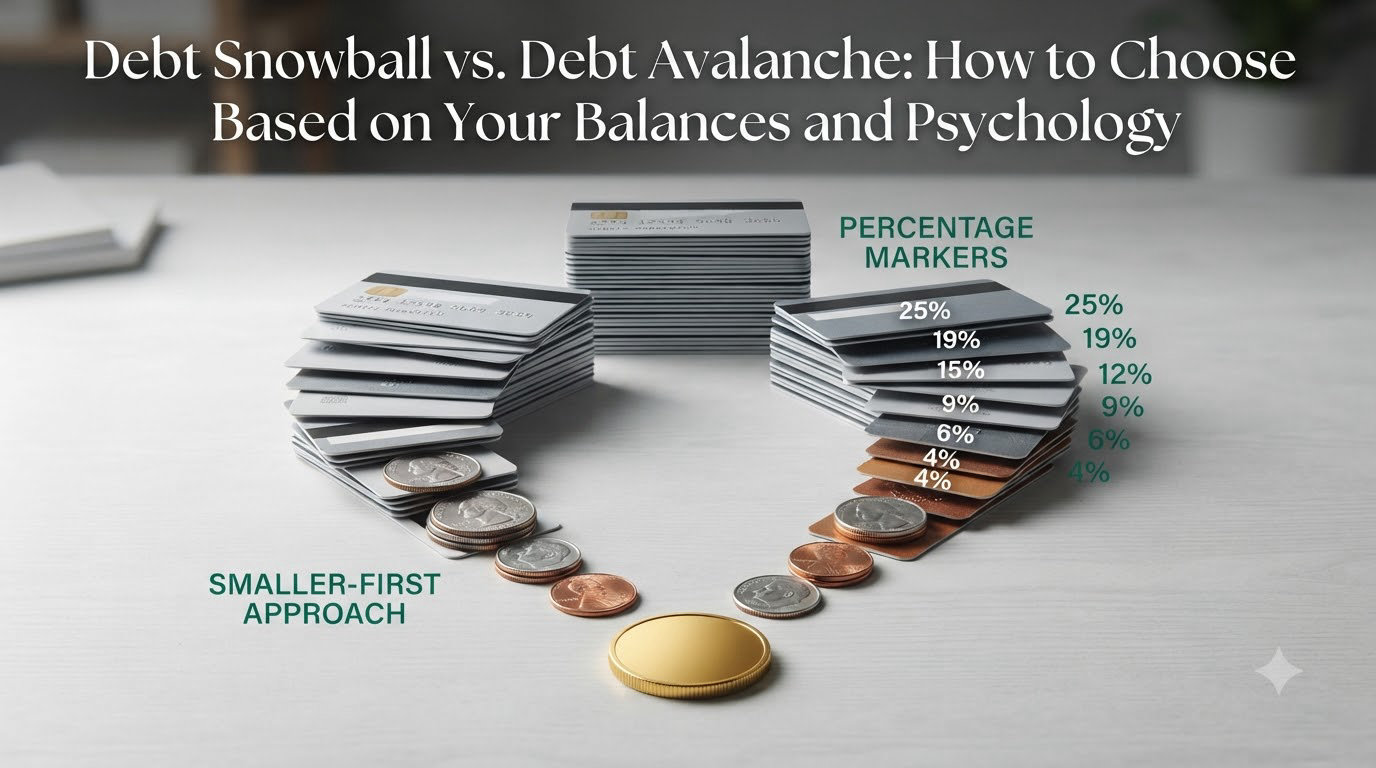
If you have multiple debts staring back at you, you’ve probably heard two names come up over and over: the debt snowball and the debt avalanche. Both promise to get you out of debt faster than just paying the minimums. Both work. But they take very different paths, and the right one depends on what your balances look like and what keeps you moving when the months start to feel long.
I’ve worked through both methods on my own debt (a card here, a personal loan there, plus a lingering car note), and I’ve watched hundreds of readers debate this on Reddit’s r/DaveRamsey and r/personalfinance. The real question isn’t “which is best.” It’s “which is best for your brain and your balance sheet.” In this guide, I’ll walk you through exactly how to answer that.
Table of Contents
What Is the Debt Snowball Method?
The debt snowball method is a payoff strategy where you list every debt you owe from the smallest balance to the largest, then attack the smallest with everything you can spare while paying the minimum on everything else. When the smallest balance hits zero, you roll that payment (plus the original minimum) into the next-smallest debt. That “snowball” keeps growing as each debt disappears.
Coined by financial personality Dave Ramsey, the method is built on the assumption that quick wins beat perfect math when motivation is the bottleneck. Here’s how it works in practice:
List all debts with their current balances.
Sort them from smallest balance to largest.
Pay the minimum on every debt, every month.
Throw every extra dollar at the smallest balance first.
Once it’s paid off, take that full payment and roll it into the next-smallest debt.
Repeat until you’re debt-free.
Say you have three debts: a $500 medical bill, a $2,000 credit card, and a $7,000 car loan. With snowball, you kill the $500 first, then the $2,000, then the $7,000. The pace visibly accelerates as the snowball grows, which is exactly the point.
What Is the Debt Avalanche Method?
The debt avalanche method uses the same basic mechanics, but you sort your debts by highest interest rate (APR) first instead of smallest balance. You still pay the minimum on everything and direct every spare dollar at the top of the list. Once the highest-rate debt is gone, you roll that payment into the next-highest-rate debt and keep going.
This is the mathematically optimal way to pay off debt. It produces the lowest total interest paid and the shortest payoff timeline when your extra-payment amount stays constant. The steps look like this:
List all debts with their current balances and APRs.
Sort them from highest APR to lowest APR.
Pay the minimum on every debt, every month.
Throw every extra dollar at the highest-rate debt first.
Once it’s paid off, roll the full payment into the next-highest-rate debt.
Repeat until every balance is zero.
Using the same three-debt example, your avalanche order might be: $2,000 card at 22% APR, then $7,000 car loan at 9%, then $500 medical bill at 0%. The $500 medical bill sits in last place even though it’s the smallest balance, because it costs you nothing in interest to wait.
Debt Snowball vs Debt Avalanche: Side-by-Side Comparison
Here’s a quick side-by-side look at the two methods so you can see where they diverge and where they overlap. Both require discipline. Both require a budget. The difference is in what you prioritize while you do the work.
Debt Snowball pros:
Fastest path to a first “win” – ideal if you’ve struggled to finish long projects.
Visible momentum in months 1-6, which keeps motivation high.
Simple to track – you only watch balances, not APRs.
Strong behavioral research backing, including a Texas A&M study showing small victories measurably increase follow-through.
Debt Snowball cons:
Usually costs more in total interest than avalanche.
High-interest debts can linger for months, even years, while you clean up small ones.
“Easy wins” can tempt you to take on new small debts to snowball again.
Debt Avalanche pros:
Lowest total interest paid – mathematically optimal.
Shortest payoff timeline when extra-payment amounts are equal.
Aggressively shuts down the debts that are growing fastest, which protects your cash flow.
Debt Avalanche cons:
First payoff can take a long time if your highest-APR debt is also large.
Discouragement is real – many people quit before the first debt disappears.
Requires tracking APRs, not just balances, which adds a small layer of work.
The short version: snowball is the psychological play, avalanche is the mathematical play. The method that wins is the one you actually stick with.
The Psychology of Debt Payoff: Why Motivation Matters?
Behavioral finance research keeps landing on the same conclusion: the best financial plan is the one you can execute. A 2016 study out of Texas A&M found that people who focused on achieving small, visible wins were far more likely to pay off their full debt load than those who chased the mathematically optimal path.
Here’s the mechanism. When you pay off a $400 credit card in two months, your brain gets a reward. Dopamine spikes. You feel like a person who pays off debt. That identity shift makes the next month easier. With avalanche, your first payoff might be 14 months away if your highest-APR debt is also your biggest balance. Fourteen months of “minimum payments plus interest” can turn even motivated people into quitters.
Dave Ramsey built his entire debt program around this. He argues that for most people, behavioral momentum is the limiting factor, not interest math. He’s not wrong. On r/DaveRamsey, success stories almost always start with a small first win.
That said, avalanche fans have a counter-point. If you’re the type of person who finds spreadsheet optimization soothing, who already has a long track record of finishing hard things, the math is real. Saving $1,500 in interest over two years is a reward that can rival the dopamine from a quick payoff. Knowing that is the reward.
The honest answer: psychology isn’t binary. It’s a spectrum. Where you sit on that spectrum should drive which method you pick.
How Your Balances and Interest Rates Affect the Decision?
The case for avalanche is strongest when one debt is both large in balance AND high in APR. The case for snowball is strongest when you have a handful of small balances (under $1,000) you can clear in a few months, regardless of rate.
Here’s a simple way to think about it. Calculate your balance-to-interest ratio for each debt:
High ratio ($100s of balance per 1% APR): the debt is small relative to its cost. Avalanche doesn’t save you much by attacking it first – snowball wins on motivation.
Low ratio ($10s of balance per 1% APR): the debt is large relative to its cost. Avalanche saves real money by going after it first.
Concrete example: a $500 store card at 28% APR has a balance-to-interest ratio of about $18 per percentage point. A $15,000 credit card at 22% APR has a ratio of about $680 per percentage point. The $15,000 card is the avalanche priority by a mile, because every month you delay it, you’re losing roughly $275 in interest. The $500 store card costs you about $11 a month – painful, but not catastrophic.
So if your smallest balances are also your highest-rate debts (often the case with credit cards), snowball and avalanche produce nearly identical results. If your highest-rate debt is also your largest (common with a big card balance or a private student loan), the gap between methods can be hundreds or thousands of dollars.
Real Example: Snowball vs Avalanche on $25,000 of Debt
Let’s run a realistic scenario. Suppose you have $25,000 split across four debts, and you can put $500 a month toward total debt payments (above the minimums).
Credit card A: $2,000 at 24% APR
Credit card B: $8,000 at 18% APR
Car loan: $10,000 at 7% APR
Student loan: $5,000 at 5% APR
Snowball order (smallest to largest): Card A ($2,000) → Student loan ($5,000) → Card B ($8,000) → Car loan ($10,000). Total interest paid: roughly $4,300. Time to debt-free: about 4 years.
Avalanche order (highest APR to lowest): Card A ($2,000 at 24%) → Card B ($8,000 at 18%) → Car loan ($10,000 at 7%) → Student loan ($5,000 at 5%). Total interest paid: roughly $3,600. Time to debt-free: about 3.5 years.
The avalanche saves you about $700 in interest and six months of payments. Not life-changing, but real. If your debt mix has a single oversized high-rate card (say, a $20,000 balance at 24% APR), the gap can balloon to $2,000-$5,000. That’s why your actual balance sheet matters as much as the method itself.
You can verify these numbers with any free debt payoff calculator – search “debt snowball calculator” or “debt avalanche spreadsheet” and plug in your real balances. The numbers never lie, and seeing them in black and white makes the choice easier.
The Hybrid Approach: Combining Both Methods
Here’s the secret that few articles mention: you don’t have to pick one and never deviate. The hybrid approach uses snowball to build momentum, then switches to avalanche once you have a few wins under your belt.
Here’s how a hybrid plan usually works:
Sort your debts by balance. Pay off the smallest one aggressively.
Once two or three debts are gone, re-sort your remaining debts by APR.
Switch to avalanche for the rest of the journey.
If motivation dips again, re-sort by balance and pick off a small one to reset momentum.
This works because early quick wins establish the habit, and the habit carries you through the slower middle stretch. Many r/debtfree success stories follow exactly this pattern. The trigger to switch is usually after 2-3 debts are paid off, when your confidence is high and your remaining debts are mostly the expensive ones.
You can also flip the strategy. Start with avalanche if you have a brutal high-rate card that’s stressing you out, kill that first to free up cash flow, then switch to snowball for the morale-boosting final stretch. The methods are tools, not religions.
Decision Framework: How to Choose Your Method
Use this quick self-assessment to pick the right starting method. Answer honestly – your future self will thank you.
Lean snowball if:
You’ve started debt payoff plans before and not finished.
You have multiple small balances (under $1,000) you can clear in 1-3 months.
You feel overwhelmed or anxious when you look at your debt list.
You respond more to visible progress than to abstract future savings.
Lean avalanche if:
You have a strong track record of finishing long, unglamorous projects.
Your highest-APR debt is also your largest balance.
The interest charges themselves are causing you stress (high minimums, cash flow crunch).
You find spreadsheet optimization motivating.
Lean hybrid if:
You can’t decide between the two – usually a sign you need momentum first.
You have a mix of small and large debts.
Your motivation is decent but not ironclad.
There’s no shame in picking snowball even if avalanche would save you money. Saving $700 over four years is meaningless if you quit after year one. A finished plan beats a perfect plan every time.
What to Do Before You Start (and After You Finish)
Before you start either method, do three things. First, build a small emergency fund – $1,000 to $2,000 – so unexpected bills don’t force you back into credit card debt. Second, check for prepayment penalties on any installment loans (some personal loans and mortgages charge fees for early payoff). Third, stop adding new debt. The fastest payoff method is the one where balances never go up.
After you finish the last debt, don’t celebrate by spending. Build a full emergency fund (3-6 months of expenses), then redirect your old debt payments into retirement and investments. The habits that got you debt-free will compound for decades.
Frequently Asked Questions
What is the key difference between the debt snowball and debt avalanche methods?
The debt snowball method prioritizes paying off your smallest balance first to build quick wins and maintain motivation, while the debt avalanche method targets your highest interest rate debt first to minimize total interest paid. Both methods use the same mechanics – pay minimums on everything, then attack one debt at a time – but they differ in which debt you attack first.
Should I snowball or avalanche student loans?
Student loans typically have lower APRs than credit cards, so the balance-to-interest ratio usually favors avalanche. If your highest-rate debt is a private student loan with a large balance, avalanche will save you meaningful money. If your student loans are mostly federal and under 7% APR, the gap between methods is small and snowball’s motivational edge may matter more.
Does Dave Ramsey recommend snowball or avalanche?
Dave Ramsey strongly recommends the debt snowball method. His reasoning is that small, visible wins create momentum and behavior change, which he considers more important than minimizing interest paid. Ramsey has publicly stated that the mathematics of the avalanche method are accurate, but argues that most people need psychological wins to actually finish paying off debt.
How do I decide between the debt snowball and debt avalanche methods?
Choose snowball if you have multiple small balances, a history of unfinished debt plans, or you feel overwhelmed and need quick wins. Choose avalanche if your highest-APR debt is also your largest balance, if you have a strong track record of finishing long projects, or if the interest charges themselves are stressing your cash flow. Choose a hybrid approach if you can’t decide or have a mix of small and large debts.
What are the main benefits of the debt snowball method?
The main benefits of the debt snowball method are: faster first payoff (often within 1-3 months), visible momentum that builds motivation, simple tracking based on balances only, and strong behavioral research backing that small victories increase follow-through. Users report higher completion rates with snowball because each paid-off debt is a tangible reward.
What are the main benefits of the debt avalanche method?
The main benefits of the debt avalanche method are: lowest total interest paid, shortest payoff timeline when extra-payment amounts are equal, and aggressive elimination of the debts that are growing fastest. Avalanche protects your cash flow by silencing high-interest charges first, which can lower your minimum payments sooner and free up money for the next debt.
Final Verdict: Choose the Method You’ll Actually Finish
The debt snowball vs debt avalanche debate gets heated because the answer is genuinely personal. The math says avalanche. The behavior science says snowball. The best answer is to look at your balances, look at your history with follow-through, and pick the method that matches.
If unsure, start with snowball for your first 2-3 debts, then switch to avalanche once momentum is built. That hybrid plan is what most successful debt-free stories actually use. Pull up a debt payoff calculator today, plug in your real numbers, and pick your starting method. In six months, you can be the next success story someone else learns from.