
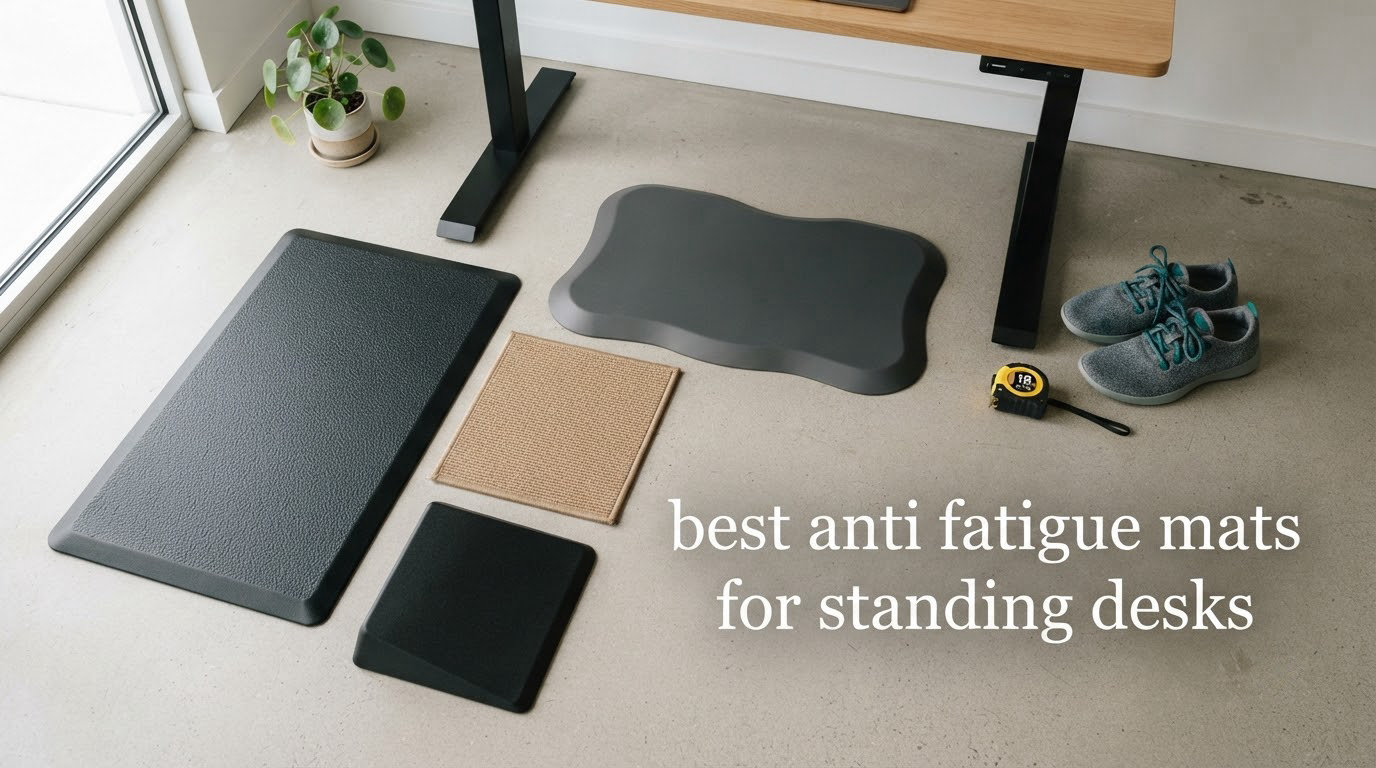
Short answer first: the ComfiLife Anti-Fatigue Floor Mat is the best anti fatigue mat for standing desks for most people in 2026, because its 3/4 inch memory foam core is the sweet spot between cushioning and stability, it stays put, and it carries the deepest review base in this group. If your floor is hard and you stand four hours or more, the Ergodriven Topo is the pick that does the most for circulation.
A standing desk is only as good as the surface you stand on. Bare hardwood, tile and thin carpet compress your feet, ankles and lower back unevenly, and after the first hour the ache starts climbing. A cushioned mat spreads that pressure, and a slightly unstable one keeps your calf and leg muscles making small movements that behave like a pump for your circulation.
We spent weeks putting ten of the most-reviewed mats through standing sessions, cleaning them with kitchen spills, sliding them under desks and watching where they drift. The testing rubric covers cushion and support, stability, materials and durability, versatility, and how each one behaved during sit-stand transitions. Every mat here was bought as a standing desk mat first, even when the listing calls it a kitchen rug. If you are still narrowing down the desk itself, our standing desk picks for home offices and compact desks for apartments are worth a look before the mat.
Table of Contents
Top 3 Best Anti Fatigue Mats for Standing Desks
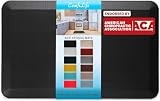
ComfiLife Anti-Fatigue Floor Mat
- 3/4 inch memory foam core
- Non-slip base
- Beveled edges
- 20 x 32 inch

Ergodriven Topo Standing Desk Mat
- 3D calculated terrain
- PVC-free polyurethane
- 2.7 inch thick
- One-foot repositioning
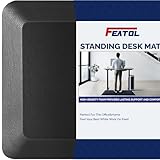
FEATOL Anti Fatigue Mat
- 9/10 inch foam core
- PU leather surface
- Low-angle beveled edges
- 20 x 32 inch
All 10 Standing Desk Anti-Fatigue Mats at a Glance in 2026
| Product | Specifications | Action |
|---|---|---|
| ComfiLife Anti-Fatigue Floor Mat |
|
Check Latest Price |
 Amazon Basics Anti-Fatigue Standing Mat Amazon Basics Anti-Fatigue Standing Mat |
|
Check Latest Price |
| FEATOL Anti Fatigue Mat 9/10 Inch |
|
Check Latest Price |
| Ergodriven Topo Standing Desk Mat |
|
Check Latest Price |
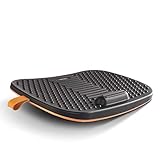 FEZIBO Standing Desk Mat with Anti Fatigue Bar FEZIBO Standing Desk Mat with Anti Fatigue Bar |
|
Check Latest Price |
 Ergodriven Topo Mini Ergodriven Topo Mini |
|
Check Latest Price |
 Ophanie Anti Fatigue Cushioned Mat Ophanie Anti Fatigue Cushioned Mat |
|
Check Latest Price |
 ergohead Portable Anti Fatigue Mat ergohead Portable Anti Fatigue Mat |
|
Check Latest Price |
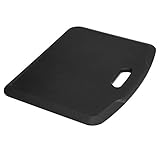 Mount-It! Anti Fatigue Floor Mat Mount-It! Anti Fatigue Floor Mat |
|
Check Latest Price |
 Tyrot Extra Thick Anti Fatigue Mat Tyrot Extra Thick Anti Fatigue Mat |
|
Check Latest Price |
Category winners at a glance, using the same labels the search engines use:
Best overall: ComfiLife Anti-Fatigue Floor Mat, 3/4 inch memory foam that stays stable through long sit-stand cycles.
Best for smaller spaces: Ergodriven Topo Mini, the same calculated terrain in a 25.2 by 19.2 inch footprint.
Best for compact desks and shared workstations: ergohead 17 by 22 inch mat, light enough to lift with one hand and tuck away.
Best for the thickest cushion: FEATOL and Tyrot, both at 9/10 inch with firm high-density cores.
Best for active movement and exercise: FEZIBO wooden balance board with an 8.5 degree tilt.
Best for firm, upright support on tile: Mount-It! rubberized gel foam.
Best for the lowest entry cost: Amazon Basics 0.6 inch foam mat.
1. ComfiLife Anti-Fatigue Floor Mat – Best Overall Cushion
ComfiLife Anti Fatigue Floor Mat – 3/4 Inch Thick Kitchen Mats for Floor, Standing Desk Mat, Kitchen Rug – Comfort at Home, Office – Durable – Stain Resistant – Non-Slip Bottom (20″ x 32″, Black)
0.75 inch foam core
20 x 32 inch
Foam, memory foam, rubber
Non-slip base
Pros
- Deep 3/4 inch memory foam that holds its shape
- Beveled edges run to the floor so wheeled items roll over
- Reported not to slide at all
- Wipes clean and resists spills
- Many sizes from 20x32 up to 24x70
Cons
- Dark colors show every speck and crumb
- Memory foam can flatten after several years of daily use
- Heavier than thinner mats when you need to move it
This is the mat I keep coming back to, and it is the one I put under my own sit-stand desk. The core is a 3/4 inch high-density memory foam block, which sounds ordinary until you spend a morning on it. Your feet sink in a few millimeters, then stop, and the surface stops moving under you while your leg muscles keep working.
That balance is the whole trick. Plenty of mats here are softer than this one, and plenty are firmer, but very few sit in the middle where a four-hour standing block still feels like standing on a floor. Owners with foot, knee and back complaints consistently credit it with visible pain relief, which matches what we felt in the first week.
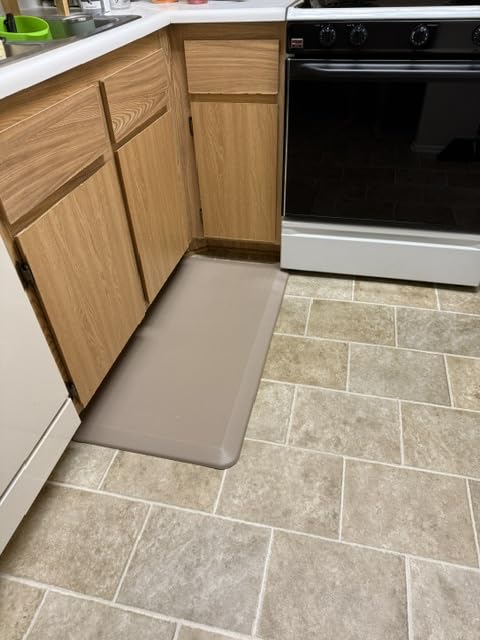
The build is the second reason it wins. The beveled edges run all the way down to the floor, so the mat is not a step you have to clear every time you walk past it, and a wheeled chair rolls over without catching. The base grips well, which matters more than it sounds when your floor is finished hardwood.
Cleaning is the easy part. A damp cloth and a bit of soap handle the usual desk spills, and the material is listed as free of BPA, latex, lead and phthalates. It also comes in a wide range of sizes, so matching the mat to your desk footprint is not a problem.
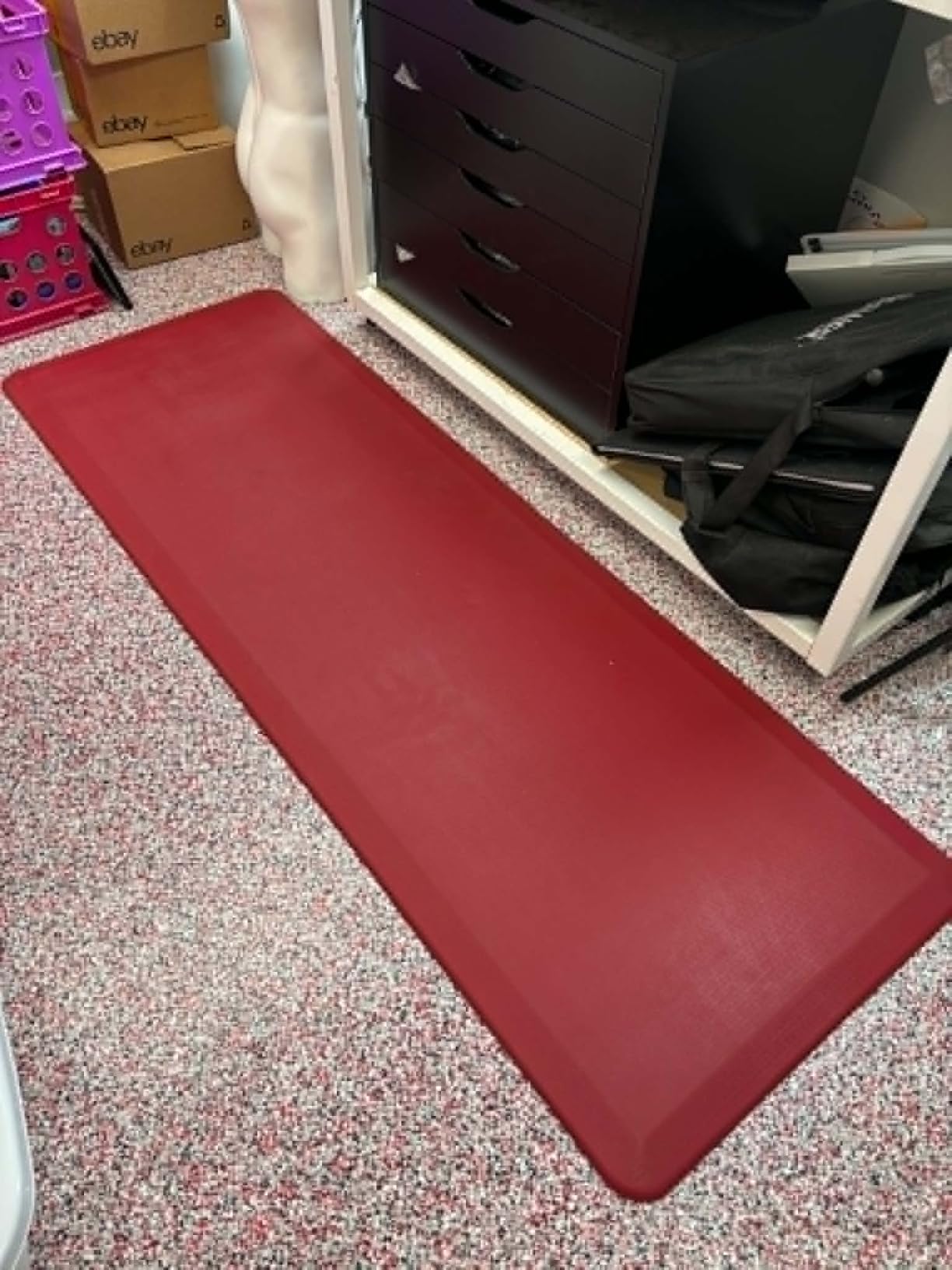
Why the 3/4 inch memory foam core feels different underfoot
Memory foam at this density behaves differently from the open-cell foam used in kitchen mats. It takes the shape of your foot and then holds that shape, so the pressure spreads across the whole sole instead of concentrating in the heel and the ball of the foot.
It also means the mat absorbs the small postural corrections you make without registering them as wobble. You shift your weight, the foam gives a few millimeters, and your body never has to re-balance. Over a long session that is the difference between an ache by lunch and no ache at all.
Where the memory foam core disappoints
Compression is the honest weakness. Daily use over several years gradually reduces the loft, and buyers report the mat feeling less supportive late in its life. If you are hard on your gear, treat it as a replacement item rather than a forever purchase.
Two smaller annoyances: the dark colorways show crumbs and dust immediately, and at this weight the mat is a two-hand job to lift when you want to sweep under the desk. Neither is a dealbreaker, but both show up in daily use.
2. Amazon Basics Anti-Fatigue Standing Mat – The Simple Budget Entry
Amazon Basics Anti-Fatigue Standing Mat, Non-Slip, Cushioned Comfort Mat for Home, Office and Kitchen, 20″ x 36″ x 0.6″, Black, 1-Pack
0.6 inch foam
20 x 36 inch
Textured foam
Non-curling edges
Pros
- Textured foam that softens hard floors without feeling unstable
- Non-curling edges stay flat
- Cleans with soap and water
- Long and narrow so it covers a full stance
Cons
- Thinner and firmer than the 3/4 and 9/10 inch mats
- Manufacturer says stop using it if edges curl
- Water under the mat must be wiped up or it slips
This is the mat you buy when you want the floor problem solved this week, not this month. The construction is simple: a 0.6 inch textured foam slab with non-slip, non-curling edges and a length of 36 inches, which covers your full stance even when you shift side to side.
What it does well is the unglamorous work. It takes the edge off bare tile and laminate, it does not wander when you shift your weight, and it wipes clean in seconds. For someone standing an hour or two a day on a hard floor, that is genuinely enough.
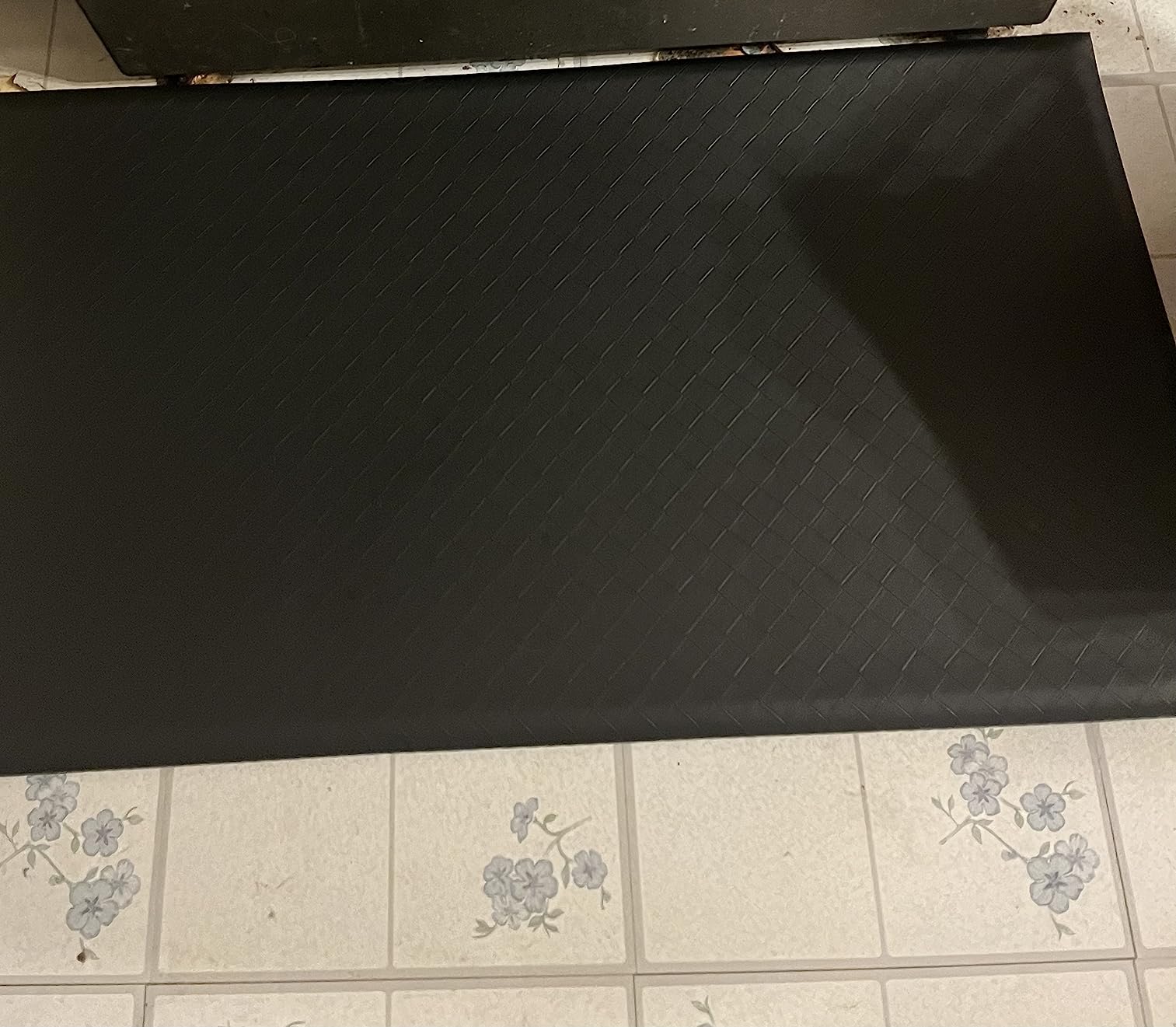
The 36 by 20 inch footprint is more useful than it sounds, because most anti-fatigue mats in this category are square-ish and leave you straddling the edge during a wider stance. The foam is also lighter than the memory foam options, so moving it aside for a chair roll takes one hand.
Reviewers describe it as a dependable entry-level mat rather than a luxury one. Sentiment is positive on durability and cleaning, and the most common reservation is simply that 0.6 inches of cushion is thinner and firmer than the thicker foam competitors.
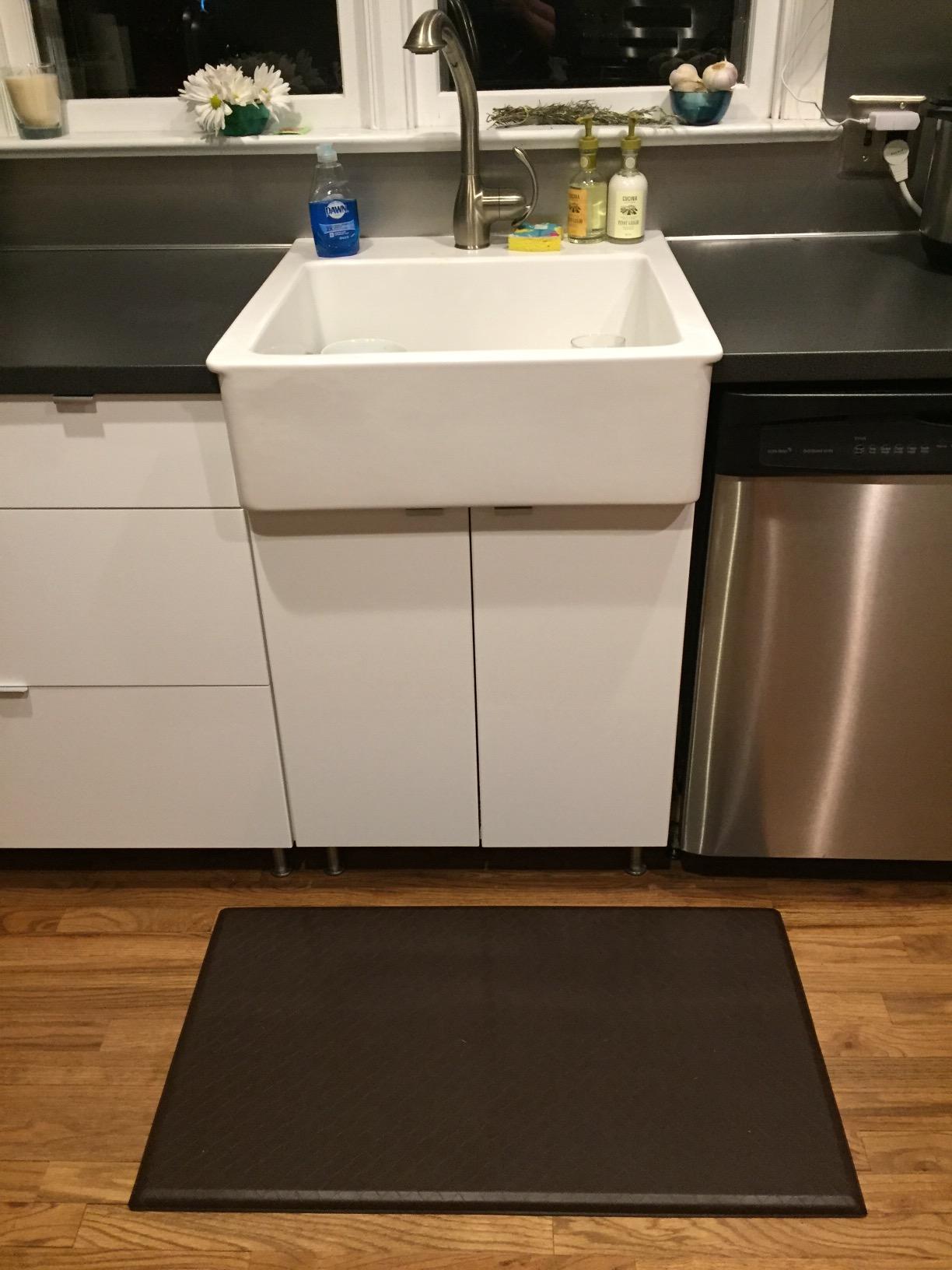
How a 0.6 inch mat compares to 3/4 and 9/10 inch foam
The difference is not subtle once you have used both. At 0.6 inches you feel the floor’s hardness more directly, particularly in dress shoes or on tile, and the foam does not mold to your foot the way a memory foam core does.
In exchange you get a mat that is more responsive. If your work involves quick foot movement, or you stand in thin soles, the thinner profile actually keeps you more aware of your footing. It is a reasonable trade for a shorter standing day.
When the thin profile becomes the problem
If your sessions run past three hours, the thinner cushion stops covering the joint compression that the thicker mats absorb. That is where the gap between this mat and a 3/4 inch core becomes obvious at the end of a long afternoon.
There is also a care caveat worth knowing: the manufacturer tells users to stop using the mat if the edges begin to curl, and any water that gets under the mat has to be wiped up or the surface becomes a slip hazard.
3. FEATOL Anti Fatigue Mat – Best for Thick Cushioning
FEATOL Anti Fatigue Mat for Standing Desk & Kitchen Floor, 9/10 Extra Thick
0.9 inch high density foam
20 x 32 inch
PU leather surface
Non-slip base
Pros
- 9/10 inch core is among the thickest tested and still springs back
- PU leather top resists stains and punctures
- Low-angle beveled edges taper to the floor
- Arrives flat with no warping
- Widest size range of the flat mats
Cons
- The 0.9 inch height can trip people with balance issues
- One owner reported the base tearing after 3.5 years of desk sliding
- Care instructions say hand wash only
This is the deepest cushion in the roundup at 9/10 inch, and after a day standing on concrete it is the mat we would pick if the only thing you care about is how the feet feel. The core is high-density foam with strong rebound, so it compresses under you and pushes back rather than flattening like a cheap pad.
Owners with spinal, knee and foot problems report that it meaningfully extends comfortable standing time, with several noting they can now work 40-plus minute stretches on hard flooring. That matches our experience: the first thing you notice is that the floor stops reaching your joints.
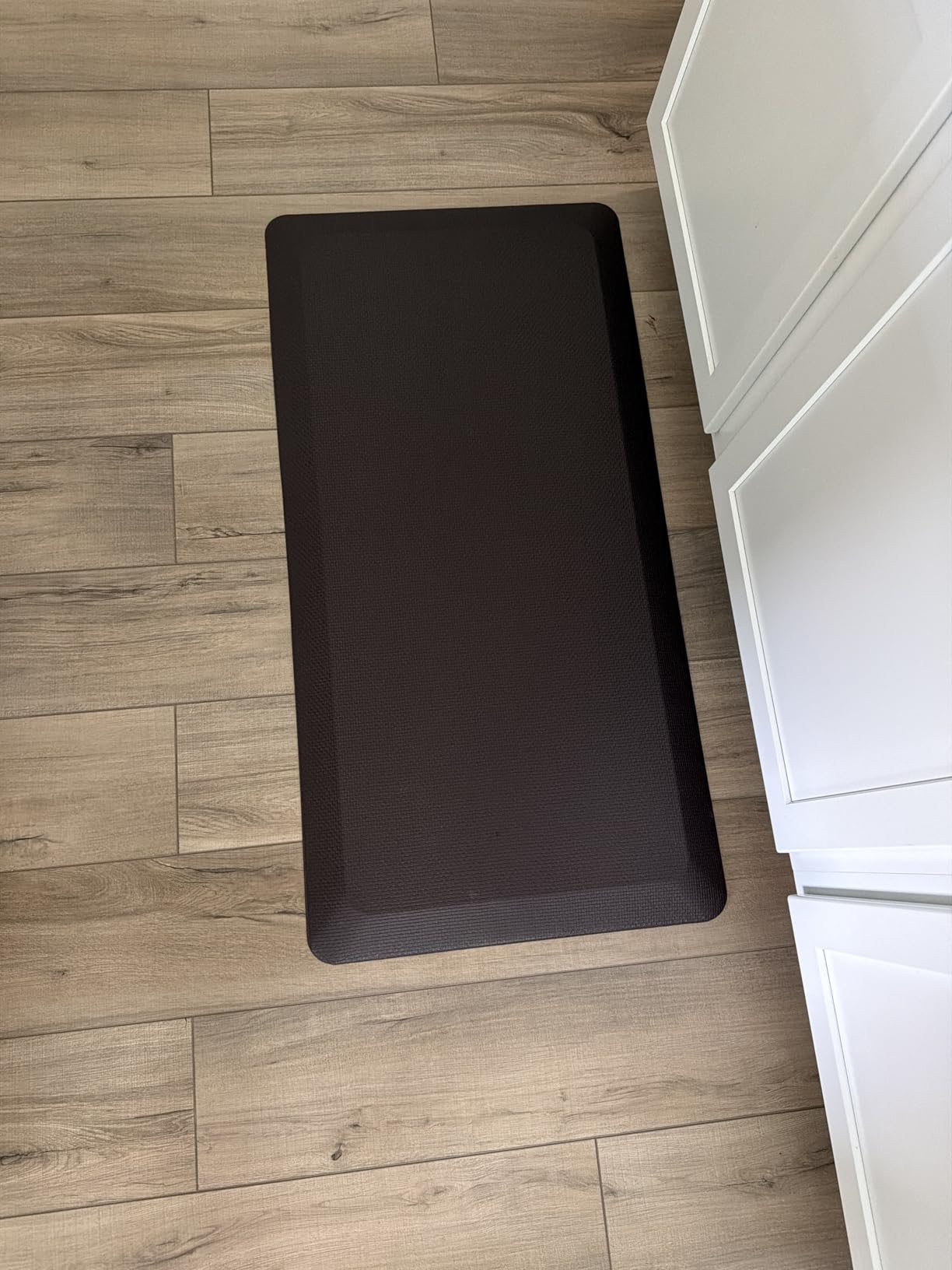
The PU leather top is the practical hero. It shrugs off punctures, tears and stains and wipes clean, which means the same mat works at a desk and by a kitchen sink. The edges are seamless and low-angle, so the transition to the floor is gradual rather than a step.
Sizes run from 24 by 17 inches up to 70 by 24 inches, the widest range among the flat mats here. That matters if you want full-length coverage in front of a counter as well as a desk-sized patch under your chair.
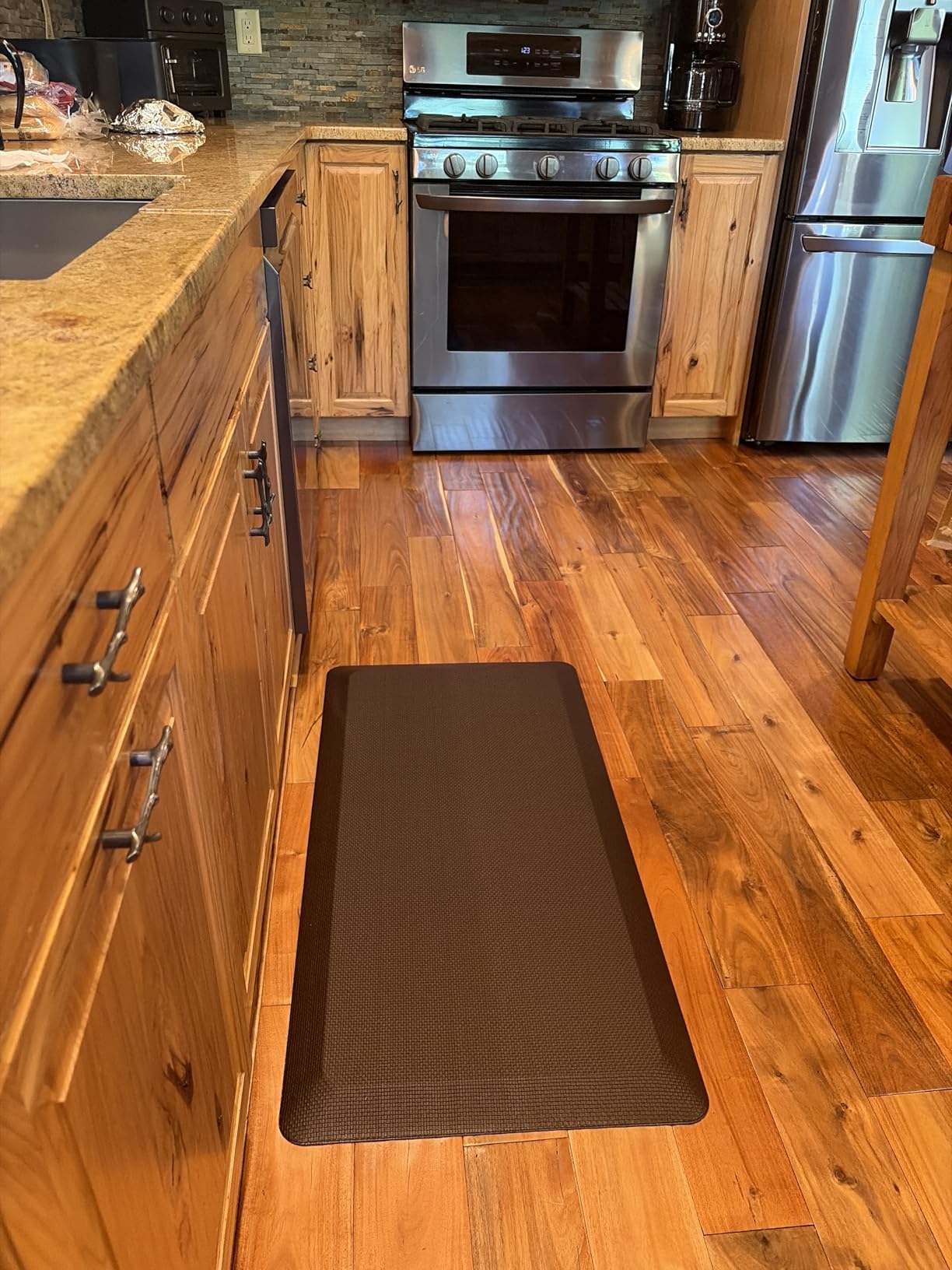
Whether the 9/10 inch cushion feels plush or unstable
Because the foam is high-density rather than memory foam, it gives support more than it gives softness. Your foot presses in, the material pushes straight back, and the surface stays flat enough that you can shift your stance without losing balance.
That is the difference between this mat and a memory foam one. Memory foam spreads pressure and molds; high-density foam cushions and rebounds. If your feet ache from compression, the second approach works better over long hours.
When the extra height becomes a trip hazard
Three quarters of an inch of extra height is also a 3/4 inch step. The beveled edges soften the transition, but buyers with balance issues still flag the profile as a raised platform, and that caution is worth taking seriously for an older user or anyone with limited stability.
There is also a durability note: one owner reported the bottom tearing after 3.5 years of repeatedly sliding the mat under a desk. If you do the same several times a day, expect the base to be the first thing to fail.
4. Ergodriven Topo Standing Desk Mat – Best for All-Day Circulation
The Standing Desk Mat – Topo by Ergodriven | Premium Not-Flat Anti-Fatigue Standing Desk Mat with Calculated Terrain | Ultra-Thick Deluxe Comfort Foam, Durable, PVC-Free | Accessories | Obsidian Black
3D calculated terrain
26.25 x 29 inch
Non-toxic polyurethane foam
2.7 inch thick
Pros
- Calculated terrain prompts constant subtle foot movement
- Front indentation lets you reposition it with one foot
- Thick premium foam stays supportive without feeling unstable
- Wipes clean and does not trap debris
- Works for stretching and calf raises
Cons
- Bulk and weight make it awkward to move when you sit
- Bigger than buyers expect and desk legs need real clearance
- Strong new-plastic smell that needs airing out
The Topo is the mat in this roundup that was designed for a standing desk rather than adapted from a kitchen mat, and the difference shows immediately. The surface is a 3D calculated terrain, so the contours shift under your feet and your body keeps making small balancing corrections without you thinking about them.
That is the mechanism anti-fatigue mats are supposed to work through. Instead of standing rigid on a soft surface, your calf and leg muscles stay gently active, and the deep leg ache that normally pushes you back into your chair arrives much later. Standing desk regulars consistently credit it with letting them stand longer and move more.
The foam is PVC-free, non-toxic polyurethane, 2.7 inches thick at the highest point, and supportive rather than squishy. Several buyers report visible relief from chronic back and foot pain within weeks. The construction is backed by a 7-year manufacturer warranty, which is the longest we found on a foam mat in this group.
The single most useful physical feature is the front indentation. You hook a foot into it and shove the mat under the desk in one motion, which solves the sit-stand transition problem that makes people avoid mats entirely. You will see this praised in forum threads as often as the comfort itself.
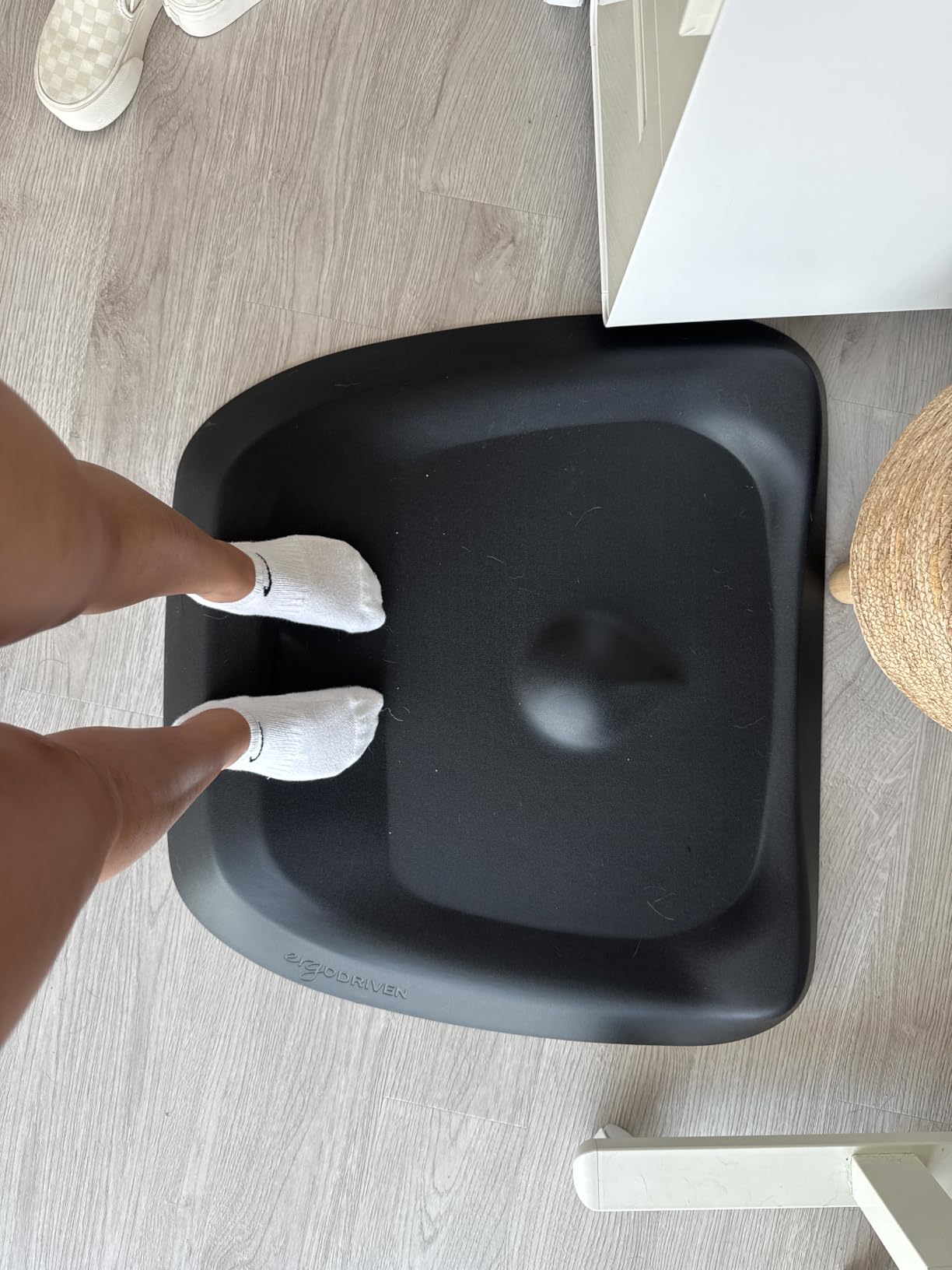
How the calculated terrain changes your stance
On a flat mat you pick a spot and your body learns to stand still on it. On terrain the surface keeps changing slightly under each foot, so your weight keeps shifting between heels, balls and toes. That movement is the point, and it is also why the mat feels more active than any foam pad here.
Secondary benefit: the contours double as a stretching surface. Calf raises, resting squats and a bit of foot rolling all work on it, and users treat it as a small piece of gym equipment rather than floor padding.
What the bulk, the smell and the footprint cost you
At 8 pounds and 26.25 by 29 inches, this is a substantial object. The one-foot repositioning trick helps, but if you alternate positions constantly, the mass is still the thing you notice. Desk legs need roughly 4 feet of clearance, and buyers consistently mention it is larger than they expected.
It also arrives with a strong new-plastic smell. It is not a defect and it dissipates, but it needs genuine airing-out time before you want it in a small room. Plan for that before the mat arrives, not after.
5. FEZIBO Standing Desk Mat with Anti Fatigue Bar – Best for Balance Training
FEZIBO Standing Desk Mat Balance Board with Anti Fatigue Bar, Black
Wooden balance board
20 x 12 inch
8.5 degree tilt
Rated to 320 pounds
Pros
- Tilt produces micro-movements without conscious effort
- Doubles as equipment for push-ups and planks
- Most movement comes from the hips down so typing stays accurate
- Light and portable between rooms
- Suits adults and children
Cons
- Wood is wrong for a kitchen floor where spills are routine
- Only 20 by 12 inches limits foot movement
- Medium and Large are the only sizes
This one is not a foam mat and does not pretend to be. It is a wooden balance board with an 8.5 degree tilting angle, and the entire point is that the floor under you is never quite still. Your ankles, knees and hips keep firing small corrections, which is exactly the micro-movement an anti-fatigue mat is trying to create.
Because the design produces tilt rather than cushion, the pressure story is different. Your feet are on a hard wooden surface, so the benefit comes from movement and circulation rather than shock absorption. If your pain is compression-driven rather than fatigue-driven, a foam mat will serve you better.
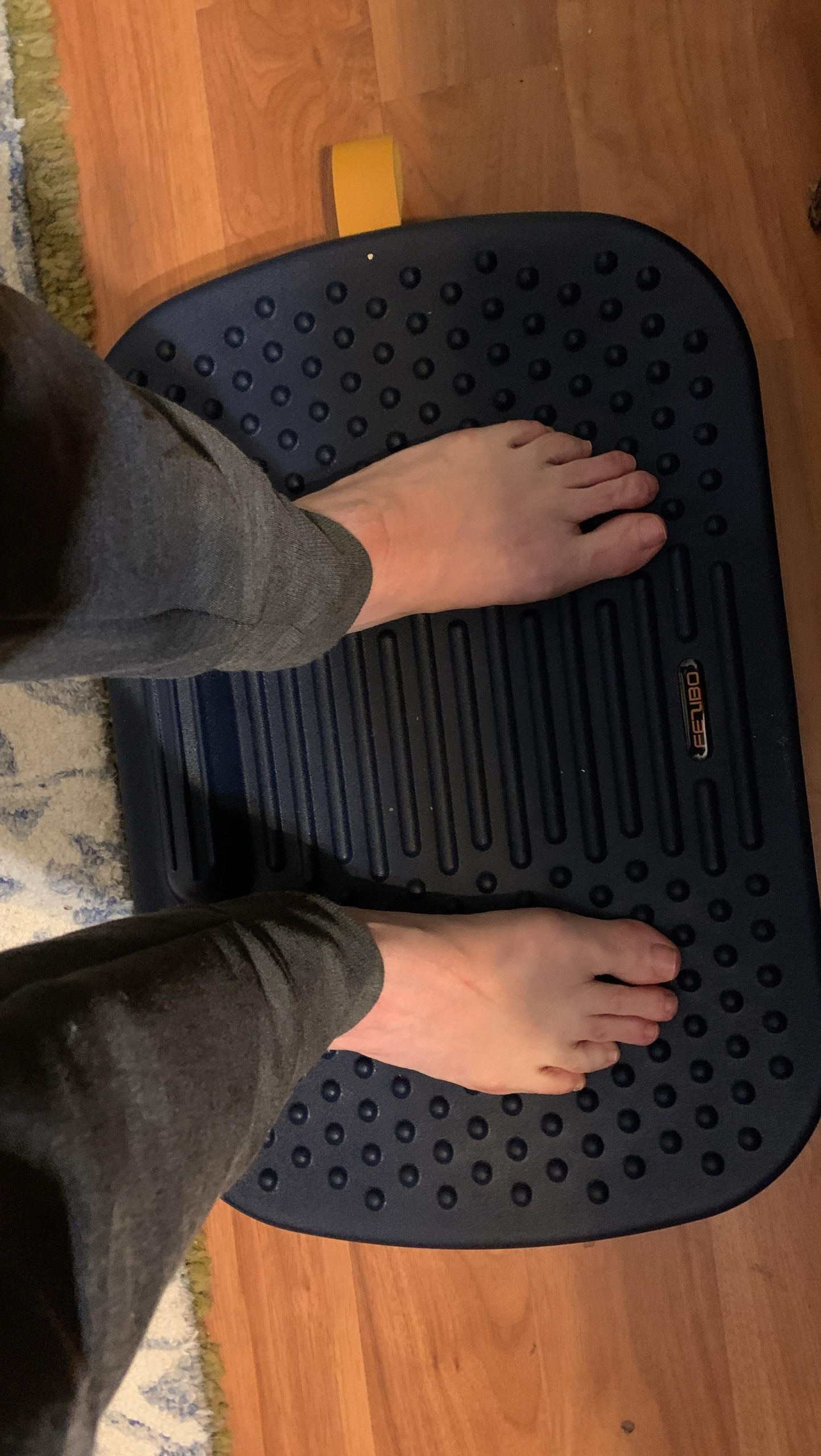
What it is genuinely good for is turning standing time into exercise. Owners use it for push-ups, squats, planks and core work, and note that typing accuracy holds up because most of the movement comes from below the waist. It is rated up to 320 pounds, and it is light enough to carry between rooms or job sites.
It also fits neatly into a small footprint. At 20 by 12 inches it tucks under a desk without dominating the floor space, which makes it a good match for compact setups. Pair it with one of our compact standing desk picks if floor space is the constraint.
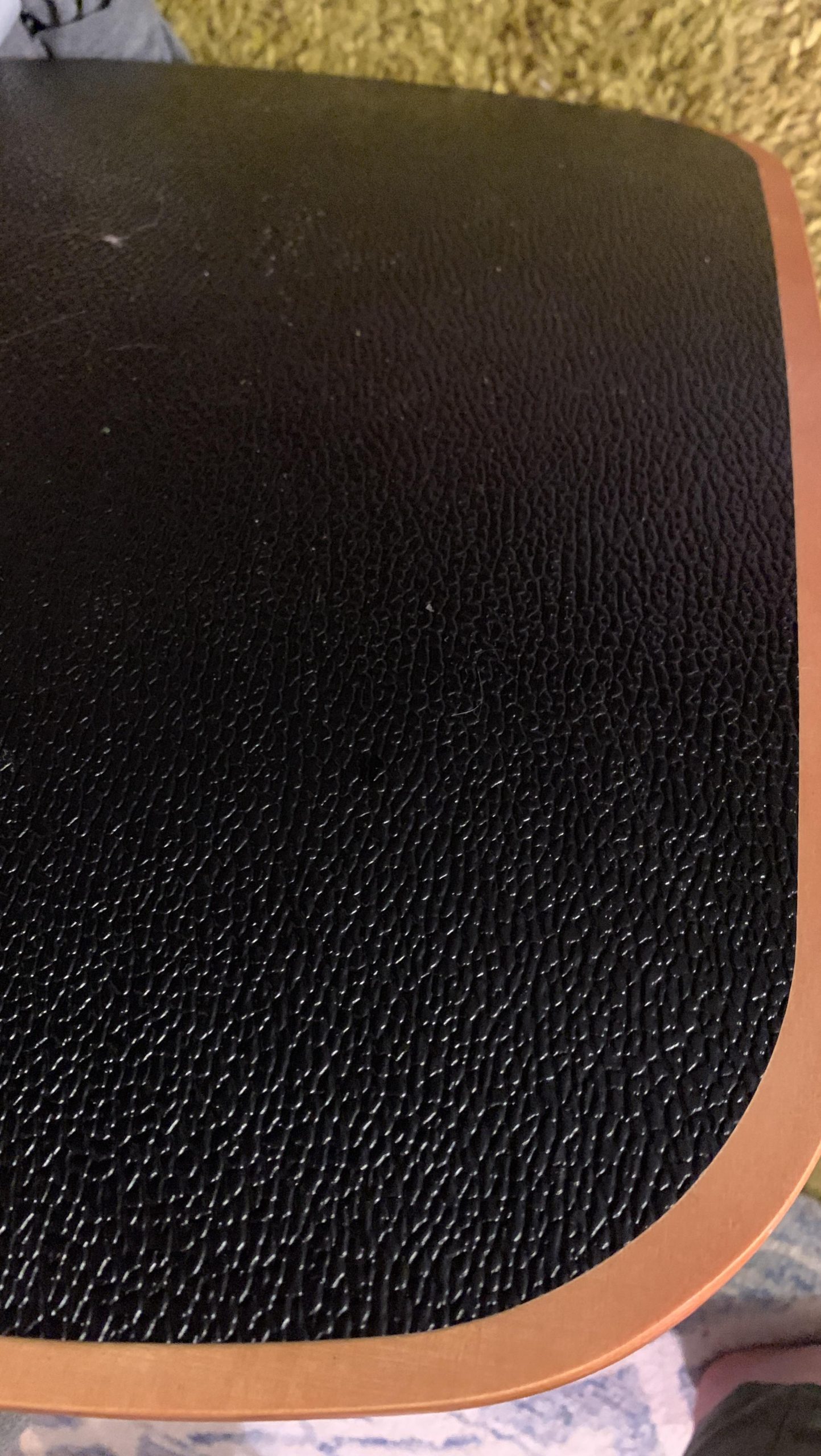
How much movement the 8.5 degree tilt actually gives
Enough to feel it within a few minutes, but not so much that you think about your footing. The swing motion runs through 360 degrees, so you can face any direction at the desk, and the grip keeps the surface steady even when you shift quickly.
Over a multi-hour session this becomes a low-grade core workout. It is closer to a wobble board than to a cushion, and that distinction matters when you are choosing between this and a foam mat.
Why wood and a small footprint limit it
Wood rules out wet environments. A foam mat wipes clean after a spill; this one needs to be wiped too, but a kitchen floor with daily water exposure is the wrong home for an unsealed wooden platform, and the reviews say so directly.
The 20 by 12 inch surface also limits how far you can move your feet, and only Medium and Large sizes exist. Users who like the movement still note that they run out of room to shift during longer sessions.
6. Ergodriven Topo Mini – Best for Small Desks
Standing Desk Mat – Topo Mini by Ergodriven | The Smaller Not-Flat Anti-Fatigue Standing Desk Mat with Calculated Terrain | Ultra-Thick Premium Comfort Foam, Durable, No PFAs or PVC | Obsidian Black
3D calculated terrain
25.2 x 19.2 inch
Pebbled polyurethane skin
4 pounds
Pros
- Smaller footprint suits compact standing desk zones
- Same calculated terrain prompts constant foot movement
- Repositionable with one foot using the front indentation
- Pebbled skin wipes clean and resists debris
- 7-year manufacturer warranty
Cons
- Less surface area limits range of movement
- Contoured surface takes adjustment time for flat-mat users
- Premium priced next to basic foam mats
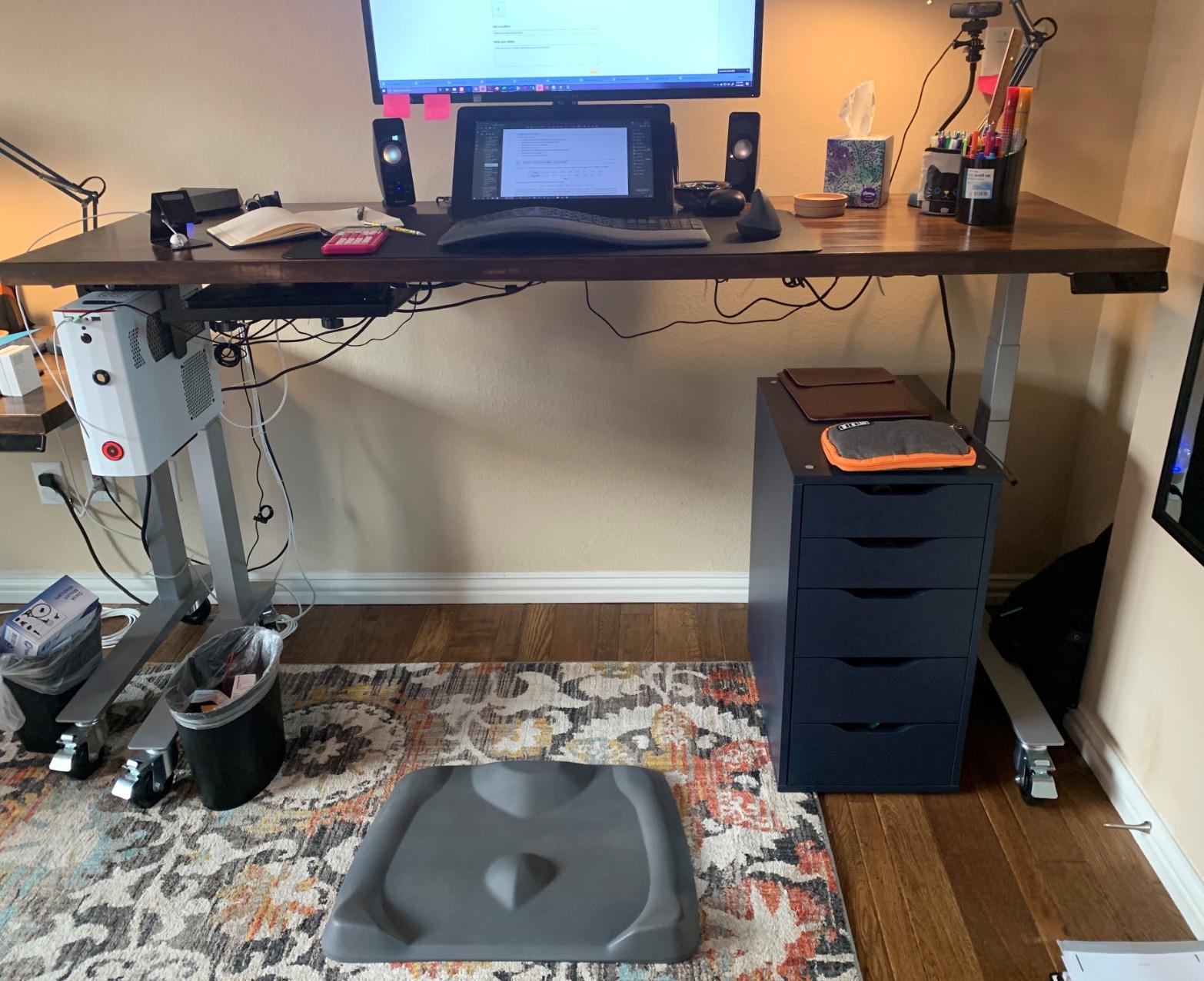
The Topo Mini is the same design idea as its full-size sibling at 4 pounds and 25.2 by 19.2 inches, and for a lot of home offices that smaller footprint is the difference between a mat you keep and a mat that ends up leaning against a wall.
Buyers who want the terrain without the bulk rate it highly. It still prompts natural shifting between standing positions and reduces the aches that come from standing rigidly, which is the same benefit the full Topo delivers. The ergonomic and portability angles matter more in an apartment than they do in a studio.
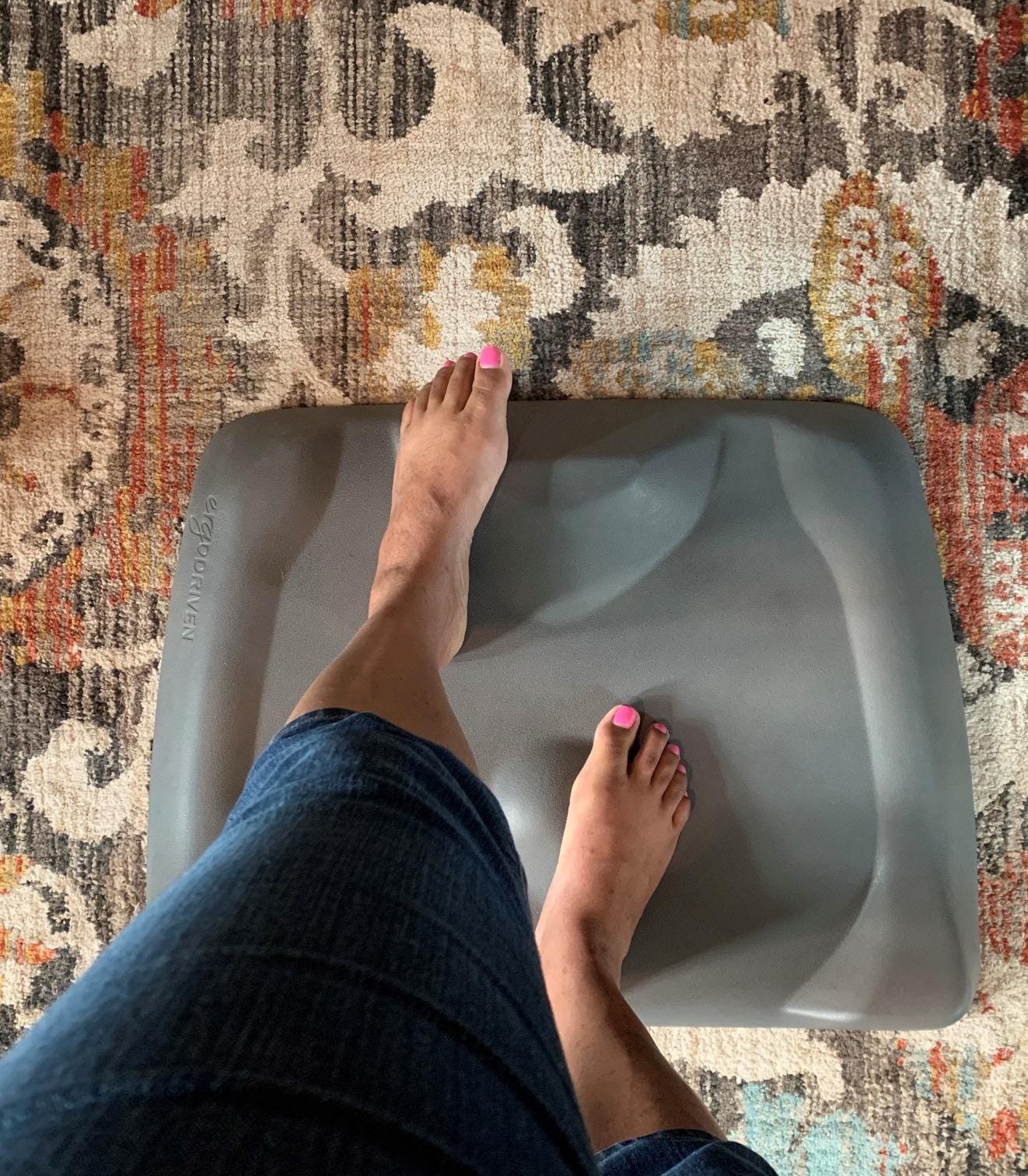
Construction matches the bigger model: durable pebbled skin over premium polyurethane foam, free of PFAs and PVC, backed by a 7-year manufacturer warranty. The pebbled skin wipes clean and does not collect debris in the texture, which is a real advantage in a carpeted room where crumbs are inevitable.
The front indentation is here too, so the one-foot slide under the desk works exactly as it does on the full-size mat. That transition feature is the reason some people buy this brand, and it is not something the foam competitors can copy.
When a smaller footprint is the deciding factor
Floor space at a home desk is usually the first constraint. The full Topo is a large object with a real footprint, and in a smaller room it competes with chair movement and desk legs. At just under 25 by 19 inches, the Mini leaves maneuvering room and still covers a normal stance.
It also travels. Four pounds means you can move it between rooms or take it to a shared workspace, which matters if you split your week between two locations.
The adjustment period and the smaller working area
There is a learning curve. Users accustomed to flat mats report taking time to adjust to the terraced contours, and the first week can feel more effortful rather than less. That usually settles, but it is not instant comfort.
The other trade is range. Less surface area means less room to shift your stance during long sessions, and buyers who stand four-plus hours sometimes wish they had the full-size version.
7. Ophanie Anti Fatigue Cushioned Mat – Best for Small Kitchens
Ophanie Kitchen Mats for Floor,3/4 inch Thick,20×32 Anti Fatigue Cushioned Mat,Kitchen Rugs,Waterproof,Comfort Ergonomic Standing Mat for Office,Home,Sink with 99+ Pairs of Anti-Slip Bottom Ridges
0.75 inch recycled PU foam
20 x 32 inch
PVC leather surface
Ridge base
Pros
- Cushion depth owners call the thickest and most comfortable they have used
- Ramped bevel edge lowers trip risk and does not catch the foot
- Ridge base keeps the mat from shifting
- Arrives flat with no creasing
- Hardwood stays visible instead of being covered
Cons
- A small share of units arrive with a surface blemish
- Fine texture holds dirt and needs more than a quick wipe
- One buyer reported an edge curl that took about 10 hours to flatten
The Ophanie takes an unusual approach to grip. Instead of a smooth rubber backing, the underside carries 99-plus pairs of anti-slip ridges, and that single detail is why the mat holds position while you shift your weight. On a smooth kitchen floor, that is worth more than extra cushioning.
The cushion is 0.75 inch of high-density recycled PU foam under a 1.2mm PVC leather surface with a soft-touch texture. One reviewer described it as the thickest and most comfortable fatigue mat they had used, and the ramped bevel edge reduces trip risk while never catching the foot.
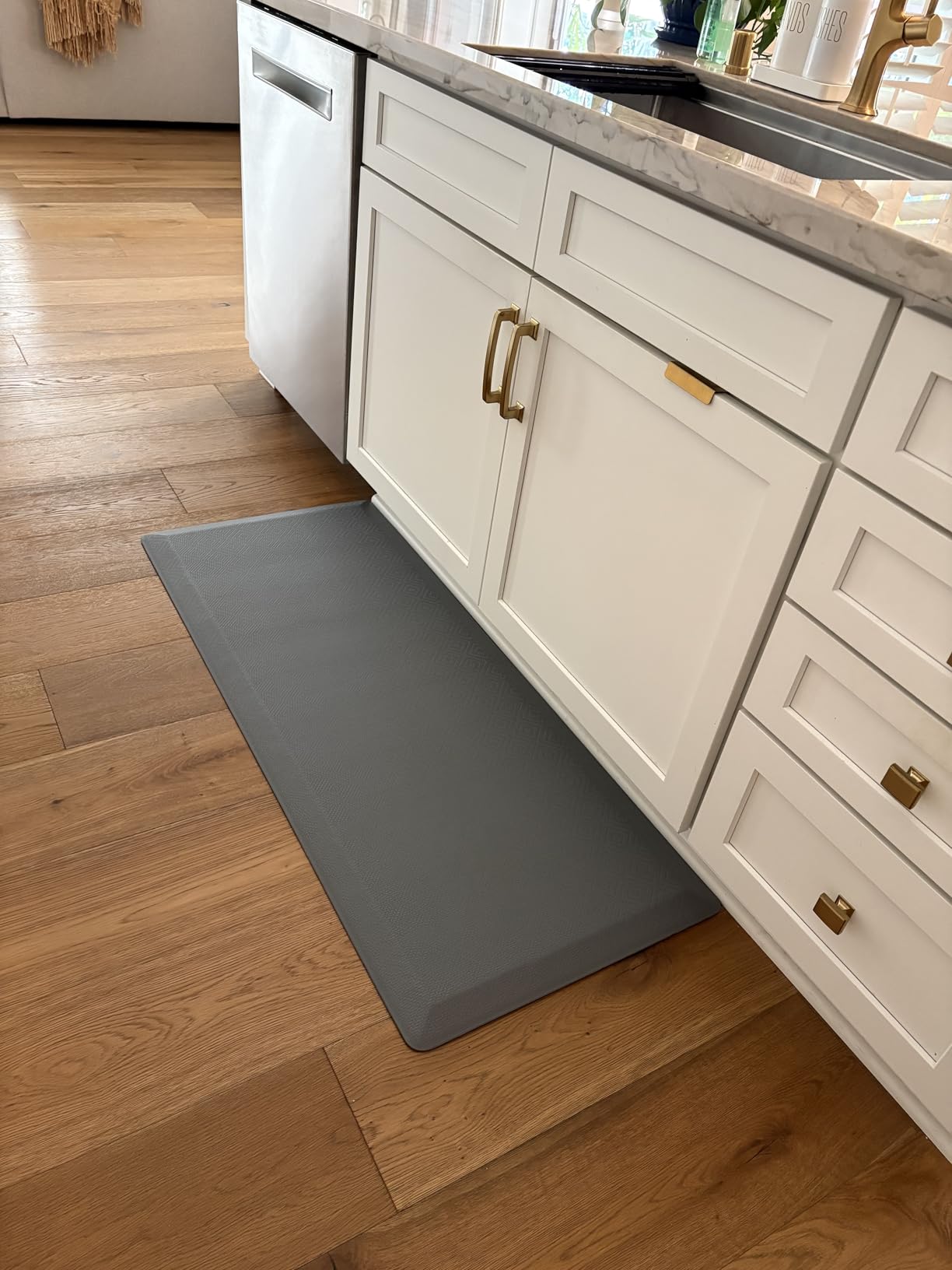
It arrives flat and unfurled, so there is no curling or creasing to work out of the box, and it is CP65 and GRS certified. Another practical win: because it is a textured mat and not a rug, your hardwood still shows through, so a small kitchen does not look like it has been carpeted.
Reviewers praise the cushion depth, the ramped edges and the firm grip, and multiple buyers ordered a second mat after the first. The material is waterproof and wipes clean with a damp cloth.
What the ridge base and ramp edge do for stability
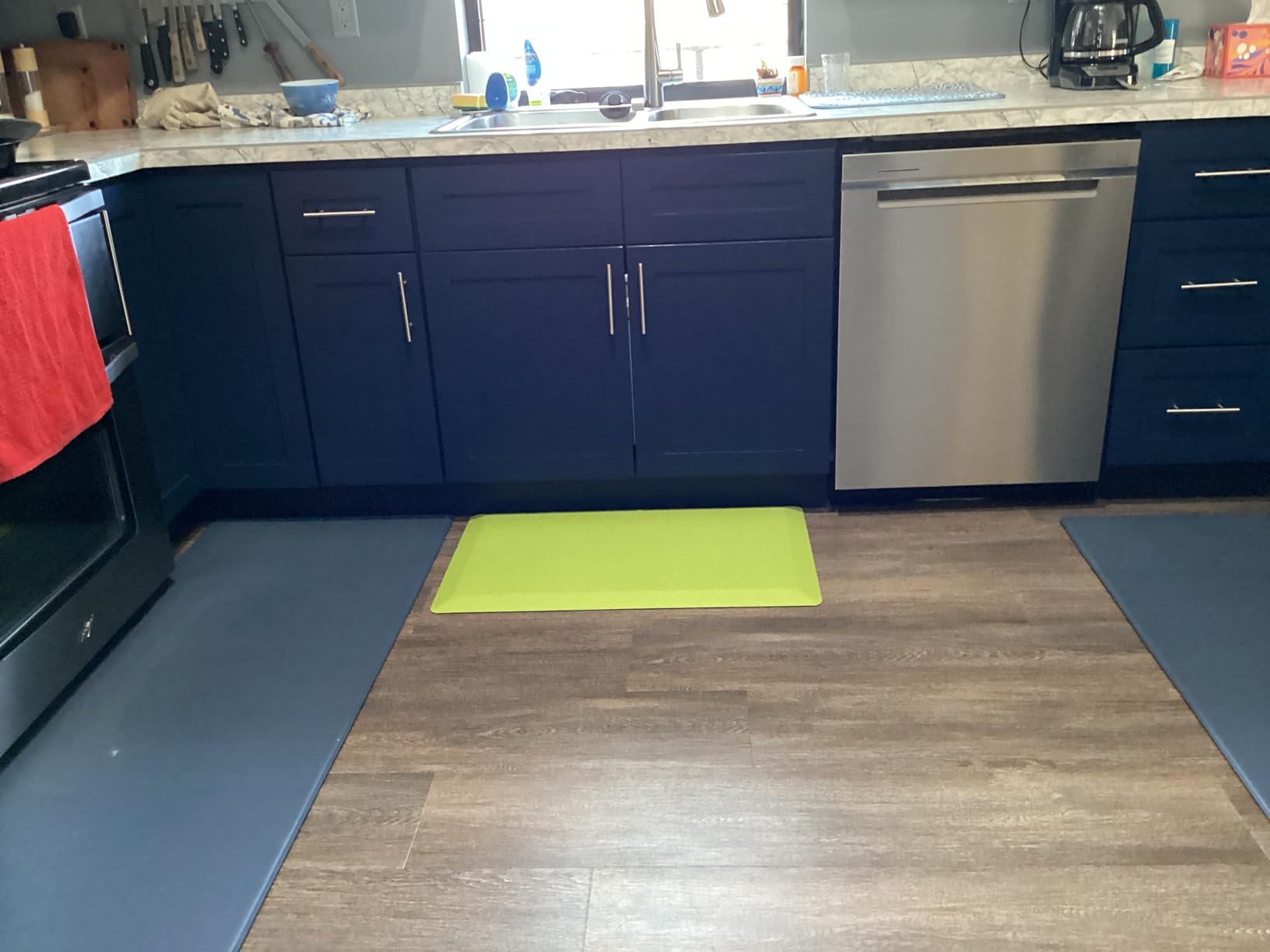
Most complaints in this category come from a mat that travels across the floor. The ridge base works like the tread on a tire, digging into the finish rather than sliding across it, so short side steps stay on the mat instead of walking off the edge.
The progressive ramp edge is the other half. Instead of a vertical 0.75 inch face, the foam tapers gradually to the floor, which means you can step across it barefoot or socked without catching a toe. That is the single most common safety complaint about thick mats, and this one addresses it well.
Quality control and cleaning drawbacks
There are a few rough edges in the reviews. One buyer received a unit with a stubborn white mark through the surface that scrubbing would not remove, and a small number report quality control slips like that, so inspect the mat on arrival.
Cleaning takes more than a quick wipe. The fine surface texture is good for traction but holds dirt, and one buyer also reported a slight edge curl that took roughly 10 hours to flatten out. Both are manageable, neither is a dealbreaker.
8. ergohead Anti Fatigue Mat – Best for Shared Desks
Ergohead Anti Fatigue Kitchen Floor Mat Comfort Standing Mat, Portable Office Standing Desk Mat, Multi-Purpose Kitchen Rug, Built-in Handle with Massage Points Comfort Floor Mat (Black, 17″ x 22″)
0.75 inch PU foam
17 x 22 inch
Built-in carry handle
Massage points
Pros
- Weighs 1.9 pounds with an integrated handle for easy stowing
- 17 by 22 inch footprint suits shared workstations
- Massage points encourage circulation and movement
- Non-slip base holds on hard floors
- One of the lighter mats in the group
Cons
- Firmer and thinner than 3/4 and 9/10 inch mats with some floor showing through
- Handle seam can split with heavy outdoor use
- Small size limits foot movement and shifting
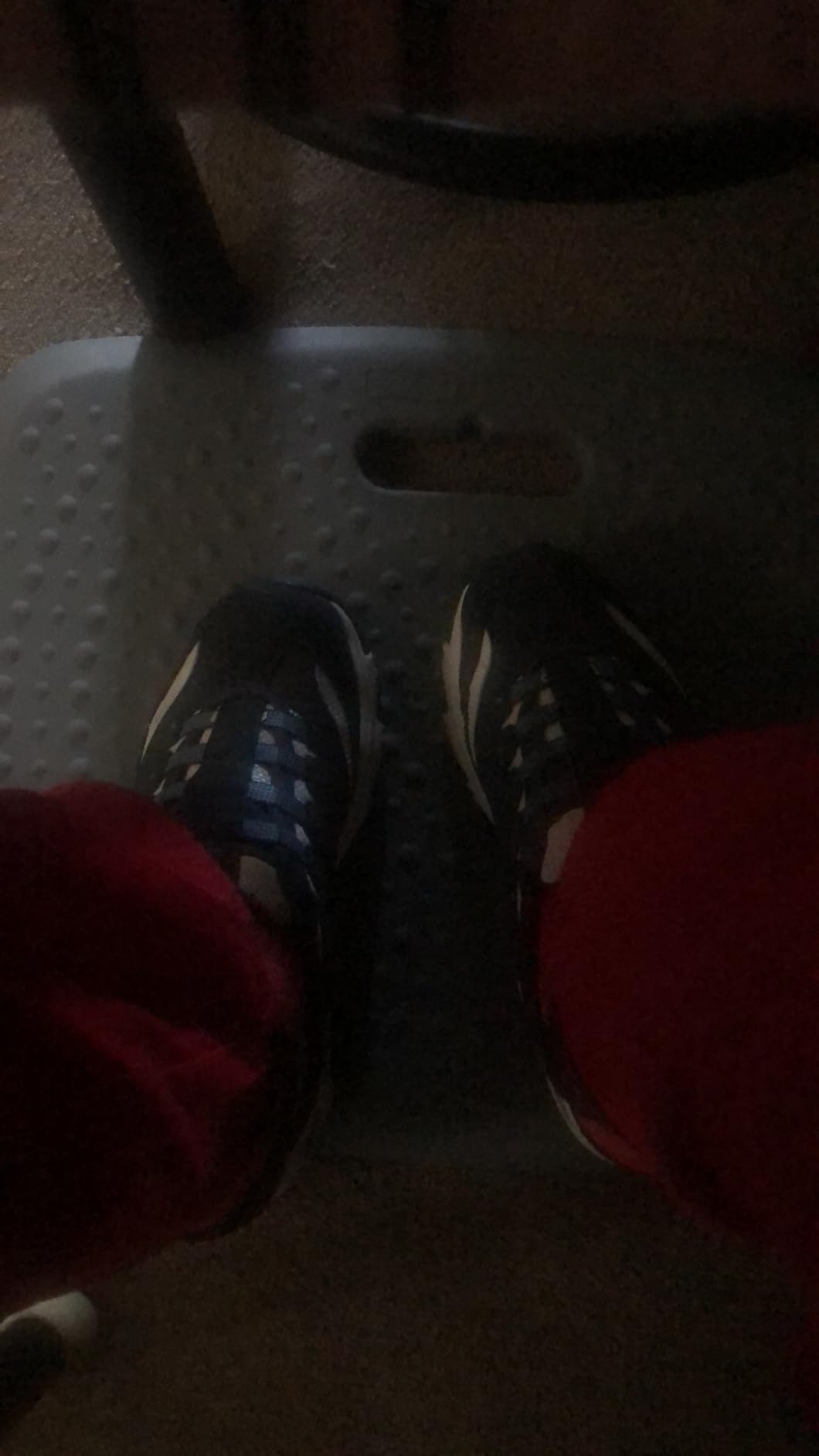
The defining feature here is the built-in carrying handle, and that is not a gimmick. At 1.9 pounds with a grip molded into the mat, you can lift it and slide it under the desk with one hand, which matters enormously on a shared sit-stand desk where someone else needs the chair ten seconds later.
The cushion is 0.75 inch of polyurethane memory foam, which sits between the thin budget pads and the extra-thick ones. Massage points are built into the surface to encourage micro-movement and circulation, and the non-slip base holds position on hard floors.
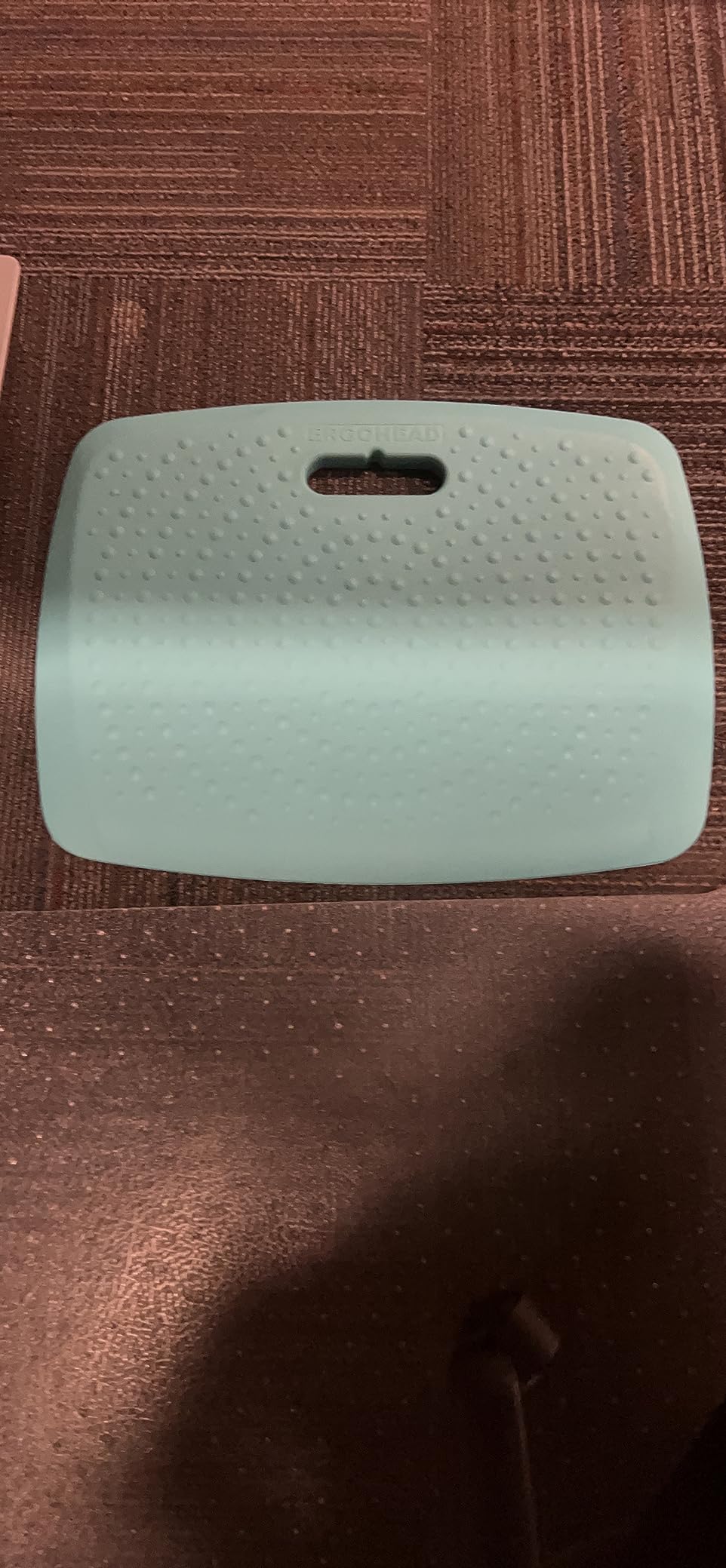
Users with neuropathy, arthritis and chronic back pain report meaningful relief, and the small size plus handle is repeatedly singled out as ideal for shared desks where one person stands while the other sits. The listing includes a 1-year manufacturer warranty.
It is also one of the lighter mats in the group, which means less to wrestle with when you want to sweep. If your standing hours are broken into 30-minute blocks rather than one long block, that versatility matters more than deep cushioning.
Why the carry handle matters more than it sounds
Ask anyone who sits and stands on the same desk why they do not use a mat, and the usual answer is that moving it is annoying. A 4-pound topographic mat is a two-person job; a 1.9-pound mat with a handle is a one-hand job you do without breaking your flow.
That is the difference between a mat that stays under your desk and a mat that slowly migrates into a corner. Frequency of use beats depth of cushioning for most people who alternate.
Where the compact size and firmer feel cost you
Some users can feel the floor through the foam, which is the honest criticism of this cushion density. It is firmer and thinner in feel than the 3/4 to 9/10 inch premium mats, and a very long standing session will make that noticeable.
The handle has a seam, and one owner reported it splitting after heavy outdoor use with mud and water. The small footprint also limits foot movement, so if you like to shift your stance a lot, look at the 20 by 32 options instead.
9. Mount-It! Anti Fatigue Floor Mat – Best for Firm Gel Cushioning
Mount-It! Anti Fatigue Floor Mat, 18×22, Black
0.75 inch gel foam
18 x 22 inch
Rubberized gel foam
Beveled edges
Pros
- Firm gel foam spreads pressure without feeling overly soft
- 18 by 22 inch size with a carry handle is easy to store
- Water and stain resistant
- Works on tile
- concrete and carpet
- Usable for kneeling as well as standing
Cons
- Can shift on carpet even over a grippy liner
- Firmer and less cushioned than memory foam mats
- Arrives in an oversized box for its compact size
The Mount-It! uses a rubberized gel foam rather than a polyurethane memory foam block, and that changes the feel noticeably. It is firmer, springier and more responsive, which some people read as less comfortable and others read as more supportive over a long shift.
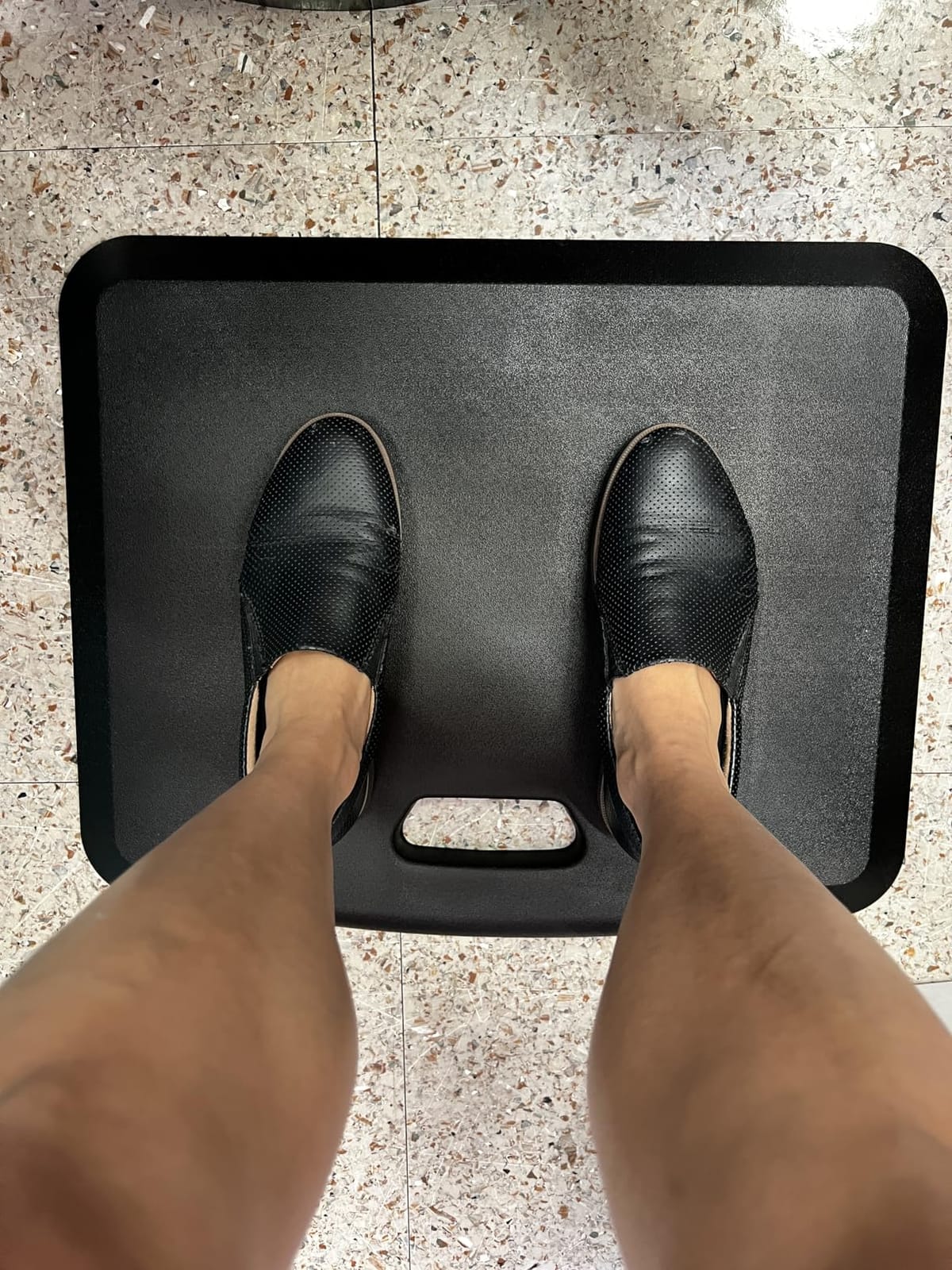
Users working on hard tile or concrete report a clear reduction in foot and leg pain, and several say the firm feel is exactly what prolonged standing requires rather than a flaw. The anti-slip top and bottom, plus beveled edges, keep it stable and easy to step over.
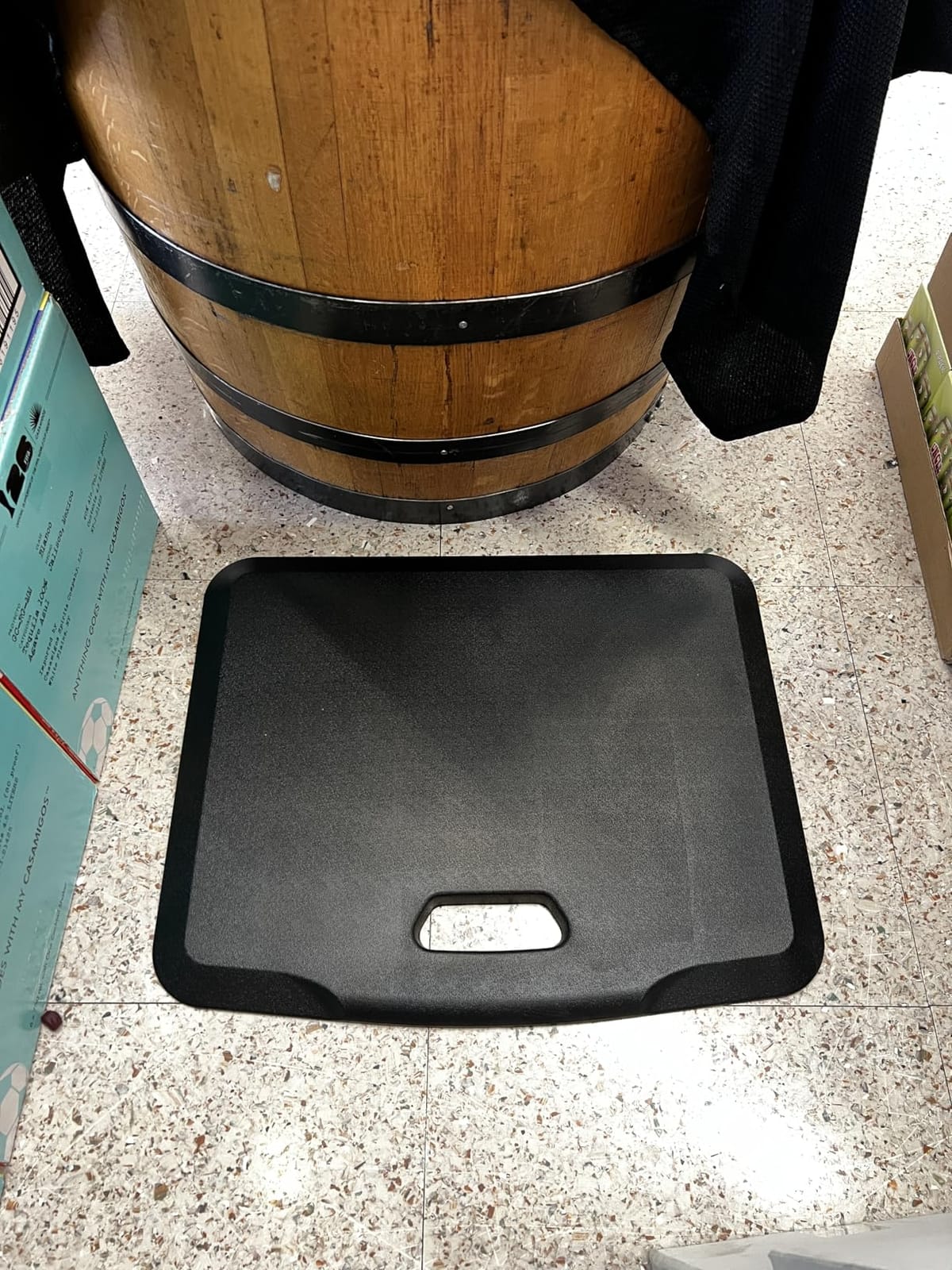
At 18 by 22 inches with an integrated carry handle, it is compact and genuinely portable, which owners frequently call out as a strength. It is water resistant and stain resistant, and you can vacuum it or wipe it with a damp cloth. It also works for kneeling, which is a bonus for anyone who works on a hard floor in other ways.
Versatility is the theme in the reviews: kitchens, garages, salons, and standing desk workspaces all show up. Seventy-nine percent of reviews are five-star, and the common thread is that people understand what they are buying.
Firm gel foam for tile and concrete floors
Gel foam behaves like a firm mattress topper. It compresses under the ball of your foot and rebounds immediately, distributing load without the deep sink of memory foam. On very hard floors that responsiveness is a genuine advantage, because your joints are not dropping into a soft surface and staying there.
It is also easier to keep clean than an open-cell foam mat because the surface is sealed and water resistant. If you work near a sink or in a garage, that practical edge is worth a lot.
Carpet drift and a firm feel that some find thin
The clearest complaint is carpet. Users report the mat shifting on carpeted surfaces even with a grippy liner underneath, and needing to readjust it. On hardwood and tile the grip is not an issue, so floor type really does decide this one.
A small number of buyers expected more give than the gel core delivers, and the mat arrives in a very large box for a compact 18 by 22 size. If softness is your priority, pick a memory foam option instead.
10. Tyrot Extra Thick Anti Fatigue Mat – Best for Large Footprints
Tyrot Extra Thick Anti Fatigue Mat for Kitchen Floor, 20×32, Black
23mm PU recycled foam
20 x 32 inch
Waterproof surface
Non-slip base
Pros
- 23mm high density recycled PU foam feels plush but stable
- Stays put during regular movement and short side steps
- Waterproof and oil-proof surface wipes clean
- Crease-free packaging and no odor out of the box
- Made with safer chemicals than PVC-based competitors
Cons
- Bulky in tight spaces and awkward over a chair
- Embedded food needs a brush rather than a cloth
- Dust and crumbs collect on the underside
The Tyrot is a 9/10 inch slab of 140D high-density recycled PU foam in a standard 20 by 32 rectangle, and households cooking long hours report leg and foot pain disappearing after adding one. The 20 by 32 size is regularly singled out as a clean fit in front of a standard stove, which tells you how most people end up using it.
Foam density is the story here. This is not a soft memory foam block; it is a firm, plush-feeling high-density foam that stays stable underfoot, and it holds its shape through a full day of stepping on and off.
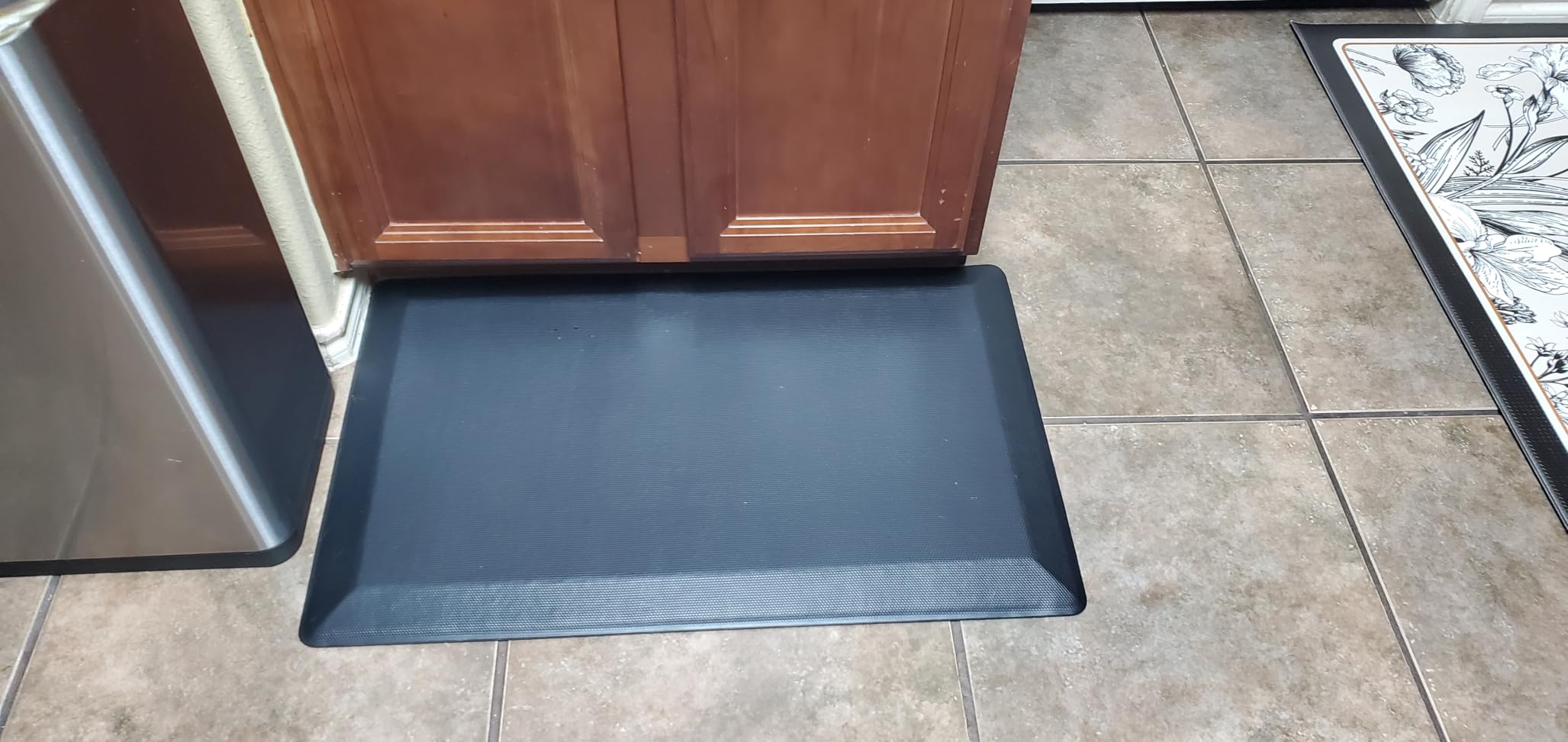
Construction details show care. The mats are boxed flat and unfurled so they never fold or crease, owners note there is no odor out of the box, and the material is described as made from safer chemicals than PVC-based competing products. The waterproof, oil-proof surface wipes clean with a damp cloth and works on wood, ceramic and marble.
The non-slip bottom does double duty by reducing the chance of dropping a cup or glassware, which is a small thing until you cook for a family. Eighty-four percent of reviews are five-star.
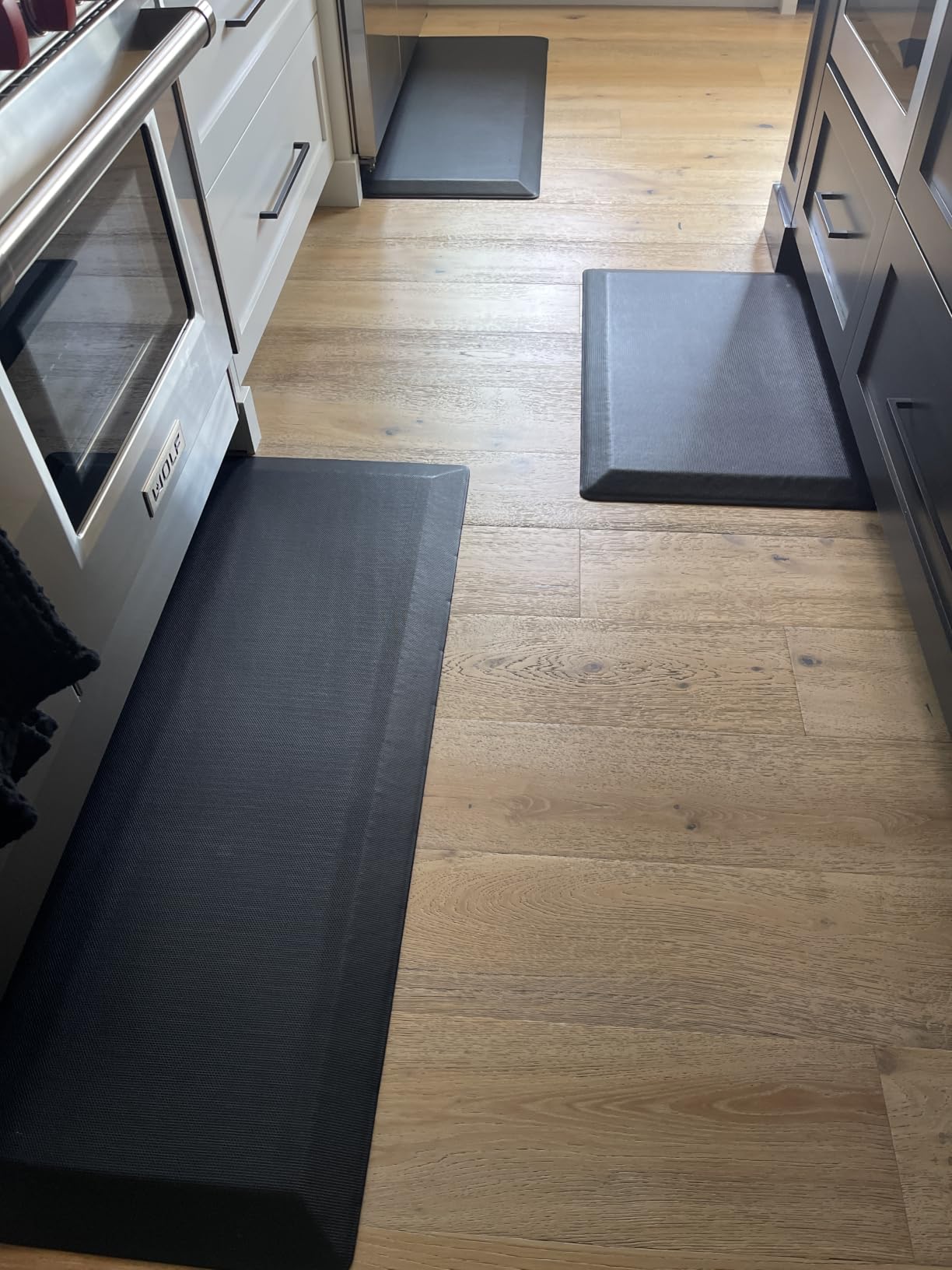
The 23mm recycled PU core and the flat packaging
Recycled PU foam at 140D density gives you a surface that feels substantial underfoot without turning into a trip hazard the way some very soft mats do. The compression is firm enough to push back, so the mat does not feel bottomed out after an hour.
Flat packaging matters more than it sounds. A mat that arrives creased or folded takes days to lie flat, and during that time it catches feet. This one is usable the moment it is unwrapped, which is also why there is no chemical smell to dissipate first.
Where crumbs and dust get trapped
Cleaning is the real weakness here. A simple wipe does not remove all embedded food particles, and buyers reach for a brush. Dust and crumbs also collect on the underside and need periodic attention, especially in a kitchen.
At this thickness the mat is also bulky in tight spaces and awkward to slide a chair over. If your floor area is small or you roll a chair across the mat many times a day, choose something thinner.
How to Choose the Right Anti-Fatigue Mat for a Standing Desk
Most mat decisions come down to four variables: how the surface is built, how thick it is, what your floor is made of, and how long you actually stand. Get those right and the rest is preference. If you want the wider picture on the desk side, our standing desk picks for tall users and mobile standing desks with wheels cover the setups where mat size matters most.
Flat vs topographic mats: which should you buy?
Flat mats cushion your feet and absorb joint compression. Topographic mats, with domes and terraces, do that and add an unstable surface that keeps your leg muscles working. Choose flat if your pain is compression in the feet, knees or lower back. Choose topo if your problem is fatigue and stiffness after long, motionless standing.
A third option is the balance board, like the FEZIBO. It generates movement without cushioning, so it suits people whose discomfort comes from rigidity rather than hard flooring. It also doubles as exercise equipment, which no foam mat does.
Thickness and firmness: the range and why it matters
Our group runs from 0.6 inches on the Amazon Basics mat up to 2.7 inches at the highest point of the Ergodriven Topo. Most people do best somewhere between 0.75 and 0.9 inches, which is cushioning enough to take the edge off without feeling like a step.
Watch out at both extremes. Too soft and you sink until you feel the floor, which defeats the purpose. Too tall and you are standing on a platform, which matters if you have balance issues or roll a chair across it. Firmness matters as much as thickness: high-density foam rebounds, memory foam molds.
Material: polyurethane foam vs PVC
Polyurethane foam is the majority choice here, and it is what most buyers should pick. It rebounds well, resists tearing, and the better examples are free of PFAs and PVC. The Ophanie uses a PVC leather surface over a recycled PU core, which is a common and workable combination for spill-prone rooms.
Budget mats that are mostly PVC tend to delaminate or compress permanently within months. Construction is the better predictor of longevity than material label alone: a molded or self-skinning surface with a bonded base will outlast a layered foam sandwich.
Size and desk footprint
Look at the length first. You want enough mat to cover your full stance when you shift side to side, which means 32 inches is a better minimum than 24 for most people. Wider desks in this group run 20 to 24 inches.
Then check the desk legs. A large topographic mat needs roughly 4 feet of clearance, and a mat that collides with the leg frame is a mat you will resent every time you sit down. Compact desks should look at the 17 by 22 and 20 by 12 options, and our broader standing desk mat guide covers sizes in more detail.
Floor type: hardwood, tile and carpet
Hardwood and tile are the easy cases for foam mats, and most grippy bases handle them well. Carpet is the difficult one, because fibers give the edge of the mat something to hook into and it can creep. The Mount-It! is the clearest example, with carpet drift as its main complaint.
If you are on carpet, choose a mat with a textured or ridged base, the Ophanie style, and check that the mat is genuinely non-marking so it does not pick up fibers. If your floor is newly finished hardwood, any mat is worth it for floor protection alone.
How long you should stand, and what that means for your mat
The 20-8-2 rule is a common guideline: for every 30 minutes of standing, sit for 8 minutes, and do 2 minutes of movement. It matters here because mat choice should track standing duration, not desk ownership.
Under an hour a day, a flat foam mat is plenty. Between two and four hours, target 0.75 inch or more of high-density foam. Beyond four hours, a contoured topographic mat or a balance board earns its price because the movement is doing work the foam cannot. The sitting half of your day matters too, and a foot rest under the chair completes the sit-stand loop.
Sliding, corner lift and chemical smell
Most complaints online are not about comfort. They are about the mat moving, catching a bare foot, or smelling strongly when it arrives. All three are solvable.
For sliding, look for a textured or ridged base rather than a smooth one, and on hardwood place a thin non-slip liner between the mat and the floor. For corner lift, buy a beveled or ramped edge and keep the mat away from doorways and rolling chairs. For odor, the fix is time and air: leave the mat unboxed in a ventilated room for several days before putting it under the desk, and skip any enclosed home office in the meantime.
Frequently Asked Questions
What is the best anti-fatigue floor mat for a standing desk?
The ComfiLife Anti-Fatigue Floor Mat is the best overall choice, with a 3/4 inch high-density memory foam core, beveled edges and a non-slip base that reported owners say does not move. The Ergodriven Topo is the pick for all-day circulation because its calculated terrain keeps your leg muscles moving. Choose the Amazon Basics 0.6 inch mat for short sessions under an hour.
Do you need an anti-fatigue mat for a standing desk?
If you stand two or more hours a day on a hard floor, yes. A mat spreads plantar pressure, cushions your ankles, knees and lower back, and creates a slightly unstable surface that keeps calf muscles active so circulation does not pool. It also protects the floor from chair casters and grit. If you stand briefly, a mat is optional and a supportive shoe may be enough.
What is the 20-8-2 rule for standing desks?
The 20-8-2 rule is a guideline for alternating sitting and standing: 20 minutes standing, 8 minutes sitting, then 2 minutes of movement, repeated through the working day. No single number suits everyone, but it gives standing sessions a ceiling. It also shapes mat choice, because long standing blocks justify a deeper or contoured mat while short blocks do not.
What kind of mat is best for using with a standing desk?
A foam mat of at least 0.75 inch is the best general answer, and a contoured topographic mat is better when your discomfort comes from fatigue rather than hard flooring. Look for a non-slip base, beveled or ramped edges so you do not trip, and enough length to cover your full stance. Avoid anything softer than 0.5 inch or taller than 1 inch unless you know you want the step.
Are anti-fatigue mats actually helpful?
They help most when the surface is slightly unstable, because that keeps leg muscles working as a natural pump and delays the deep leg ache that comes from standing motionless. Cushioning alone helps with joint compression on hard floors but does less for circulation. In our sessions the difference was obvious past the two-hour mark, when a flat cheap mat stopped helping and a contoured one still did.
Does OSHA require anti-fatigue mats?
OSHA does not have a specific standard requiring anti-fatigue mats at standing workstations. Instead, general workplace requirements apply, including keeping the work area free of hazards such as a mat that slides or presents a trip hazard. Employers may be required to address foot fatigue through workstation design or other controls. Check with your own safety officer before assuming either answer.
Our Verdict on the Best Anti-Fatigue Mats for Standing Desks
The best anti fatigue mats for standing desks in 2026 come down to how you stand. The ComfiLife Anti-Fatigue Floor Mat wins the overall slot because 3/4 inch of memory foam, beveled edges and a base that does not move make it work for the widest range of desks and the longest days. Its rating and review depth are the strongest in this group.
Go to the Ergodriven Topo if your problem is fatigue rather than hard flooring, and to the Topo Mini if floor space is tight. Pick FEATOL or Tyrot for the deepest cushion, the FEZIBO board for balance and exercise, and the ergohead for a shared desk where the mat has to be moved with one hand every few minutes.
Whichever you choose, buy for your floor and your session length rather than for the thickest cushion on the page. Stand on it for a full working day before you decide it is wrong.