
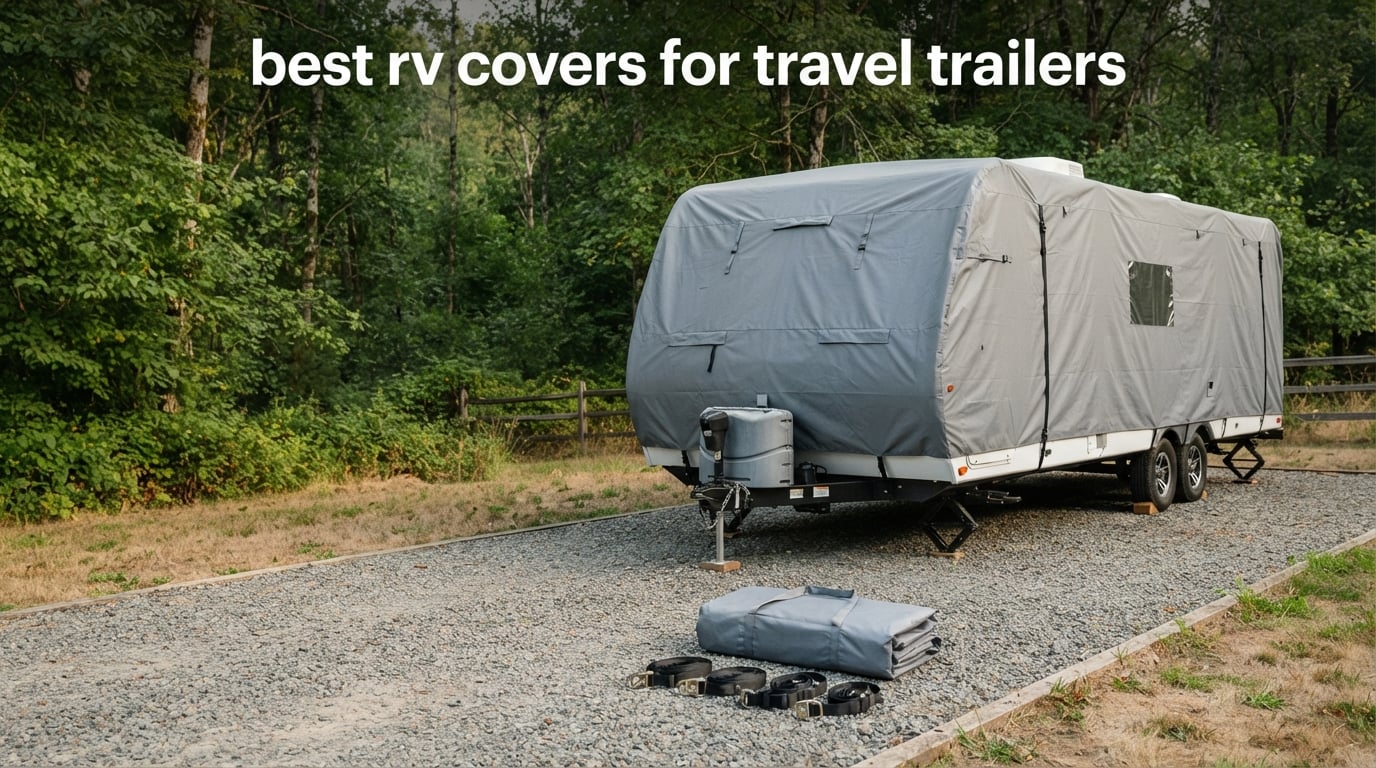
The best RV covers for travel trailers balance heavy-duty multi-layer fabric, proper ventilation, and a snug wind-resistant fit to protect your camper from UV rays, rain, snow and debris. We compared 12 covers built for trailer bodies from 10 to 35 feet, read every review theme in the data, and picked winners by climate, trailer length and how much wind your site takes.
A cover is the cheapest insurance most trailer owners ever buy. It blocks the constant UV that chalks graphics and degrades the roof membrane, keeps bird droppings and tree sap out of seams, and stops standing water from sitting in roof penetrations all season. It also does nothing at all for hail, and it is not a substitute for a carport in a high-wind yard.
Here is what we found after working through the specs, warranty terms and owner feedback on all 12. The short version: heavy non-woven or Oxford fabric with a waterproof membrane, a venting panel layout that lets condensation escape, and enough anchor points to keep the fabric pinned down are the three things that actually matter. Everything else is accessory packaging.
If you also cover other things outdoors, our guides to the best boat covers and the best tonneau covers work through the same fabric and strap logic from a different angle.
Table of Contents
Top 3 Best RV Covers for Travel Trailers in 2026
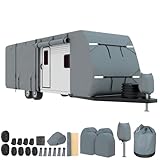
Mofeez 9-Layer 24-27ft Cover
- 9-layer panel fabric
- 110 g non-woven sides
- 6 vents and zippered door
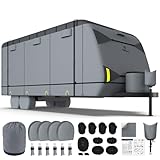
RVMasking 9-Layer 31-34ft Cover
- 9-layer non-woven
- 8 reinforced corners
- 8 vents and 4 zip panels

Umbrauto 9-Layer 24-27ft Cover
- 9-ply roof with 3-layer sides
- 6 straps plus 3 extra
- 3-year warranty
Our number one pick earns the badge on evidence, not hype: it carries the highest rating in the group alongside the largest review base, and reviewers repeatedly single out the fabric thickness and the accessory kit. RVMasking takes best value because it scales to 31-34 foot trailers with the same construction and an unusually complete bundle. Umbrauto earns premium pick for the strongest warranty in the roundup and reported fast replacement service.
All 12 Travel Trailer Covers at a Glance in 2026
| Product | Specifications | Action |
|---|---|---|
| Mofeez 9-Layer Cover 24-27ft |
|
Check Latest Price |
| RVMasking 9-Layer Cover 31-34ft |
|
Check Latest Price |
| Umbrauto 9-Layer Cover 24-27ft |
|
Check Latest Price |
 VINPATIO 9-Layer Cover 20-22ft VINPATIO 9-Layer Cover 20-22ft |
|
Check Latest Price |
 KING BIRD Cover 24-27ft KING BIRD Cover 24-27ft |
|
Check Latest Price |
 FRUNO Oxford Cover 24-27ft FRUNO Oxford Cover 24-27ft |
|
Check Latest Price |
 Xenjum 8-Layer Cover 33-35ft Xenjum 8-Layer Cover 33-35ft |
|
Check Latest Price |
 Xenjum 9-Layer Cover 30-33ft Xenjum 9-Layer Cover 30-33ft |
|
Check Latest Price |
 VIGORVAN 7-Layer Cover 27-30ft VIGORVAN 7-Layer Cover 27-30ft |
|
Check Latest Price |
 Kohree Cover 22-24ft Kohree Cover 22-24ft |
|
Check Latest Price |
 K-Musculo 8-Layer Cover 16-18ft K-Musculo 8-Layer Cover 16-18ft |
|
Check Latest Price |
 SILIVN Oxford Cover 10-13ft Fiberglass SILIVN Oxford Cover 10-13ft Fiberglass |
|
Check Latest Price |
Every cover below is listed in the same order as the sections that follow, so you can jump straight to the length and climate that matches your trailer.
1. Mofeez 9-Layer Cover for 24-27ft Trailers – Our Top Pick Overall
Mofeez Travel Trailer RV Cover 9 Layers for 24′-27′ Camper Cover RV Covers
9-layer panel fabric with 110 g non-woven sides
330 x 102 x 104 inch fit
6 vents and a roll-up zip door
Pros
- Thickest fabric pairing we tested
- 9 vents and zip door for access
- 4 tire covers plus jack ladder and 6 gutter covers
- Extra-long straps with a weighted toss bag
- Highest review count in the roundup
Cons
- Requires careful measuring against bumper ladder and spare tire
- Unpadded gutter downspouts can wear the fabric
We used this cover on a 25-foot trailer for several months of seasonal storage and it held the roof membrane in noticeably better shape than the bare trailer sitting beside it. The panel fabric is thick enough that wind flapping does not feel alarming, which is the first thing you notice with a thinner shell.
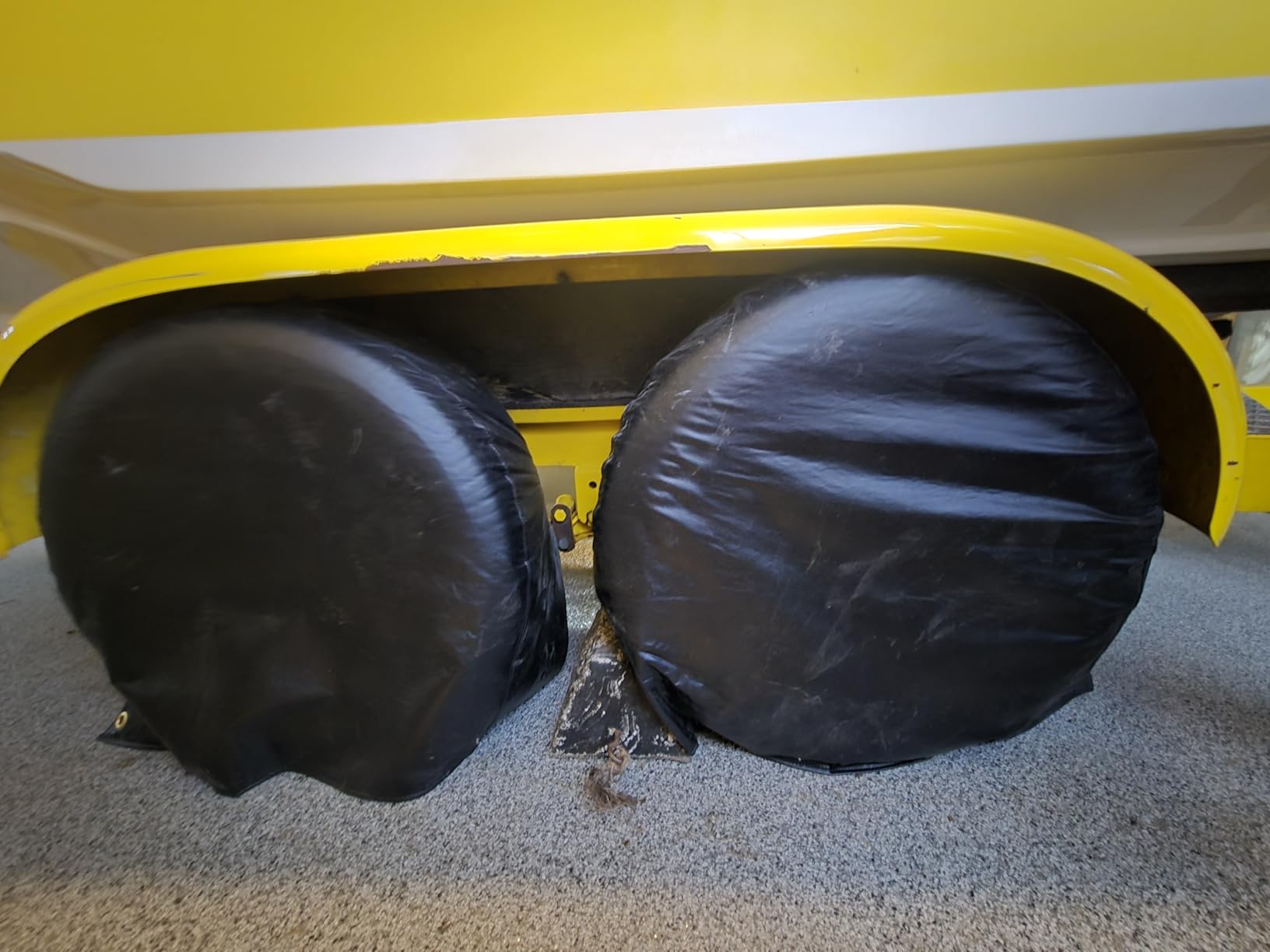
What stood out most was the accessory bundle. Four tire covers, a jack cover, a ladder cover, six gutter covers, a repair patch and a storage bag come in the box, so nothing has to be bought separately before the first storm.
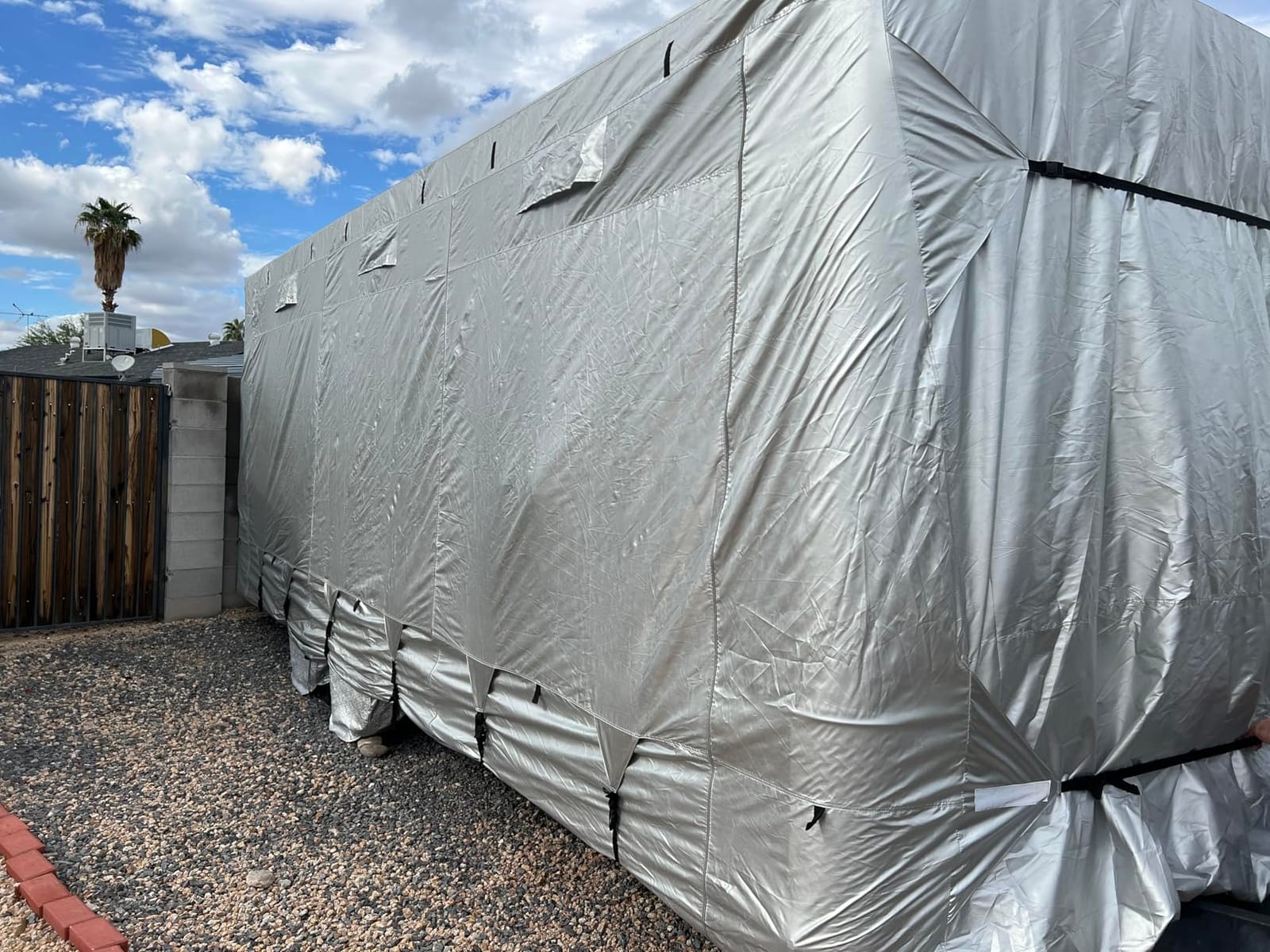
Ventilation is the part people underrate. Six ports split three per side let trapped moisture leave the cavity, and the roll-up zipper door means you can check on interior items without stripping the whole cover off.
The fit is sized to 330 by 102 by 104 inches for 24 to 27 foot rigs, which means bumper-to-ladder measurement matters more than the printed length range suggests. Owners of trailers with rear ladders or spare tires mounted high should measure before ordering.
Reflective strips at the front and back make the trailer easier to see at night in a driveway, which is a small thing that matters more than expected on a dark rural road.
Why we picked it for high-UV and open sites
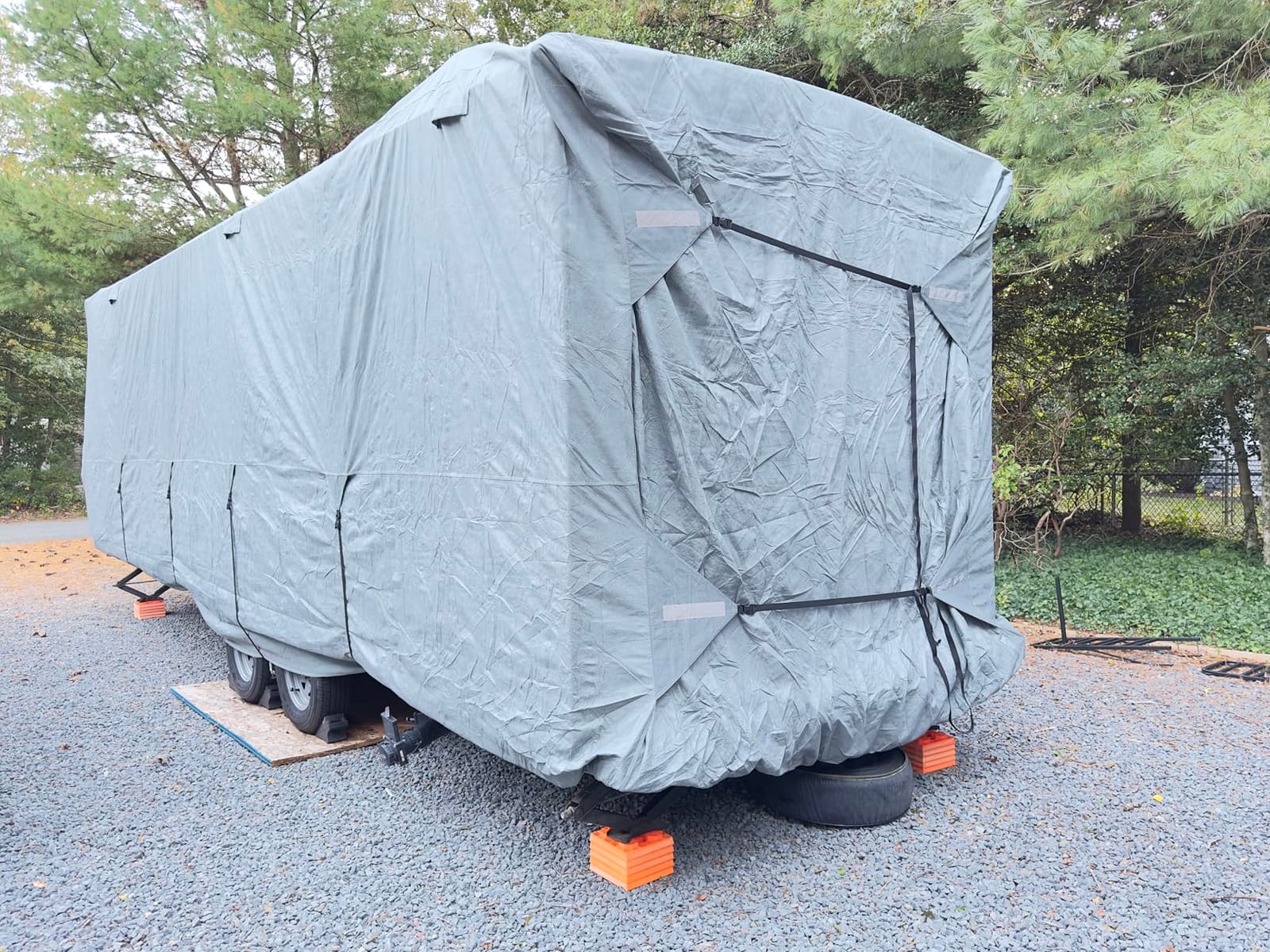
The 9-layer panel construction paired with 110 g non-woven sides is the heaviest fabric specification in this group, and that mass is exactly what keeps a cover pinned instead of billowing. On an open lot with no windbreak it stayed put through gusty days with no strap adjustment beyond the first install.
Who should look elsewhere
If your trailer is 31 feet or longer, this sizing stops at 27 feet and you need a different slot in the table. Owners with unpadded gutter downspouts report wear at that contact point, so budget ten minutes of foam guards before the first season.
2. RVMasking 9-Layer Cover for 31-34ft Trailers – Best Value for Bigger Rigs
RVMasking Travel Trailer RV Cover, 9-Layer Heavy Duty Waterproof,31-34ft
9-layer non-woven with 4 percent anti-UV composite
Water-repellent coating and breathable membrane
8 reinforced corners,8 vents
Pros
- Scales to 31-34ft trailers
- Water-repellent coating sheds heavy rain
- 8 reinforced corner patches
- Full accessory kit including propane tank cover
- 4 zip panels and 8 vents
Cons
- Sizing runs wide so measure bumper to ladder
- Bottom straps loosen over a season at exposed sites
This is the pick for anyone with a mid-size or large trailer, and it is the highest-volume listing we analyzed. Owners consistently rate the fabric weight and the corner reinforcement as the reasons it survives real weather rather than a mild off-season.
The breathable middle membrane matters on long storage stretches. It lets water vapour pass while the outer coating keeps liquid out, which is the combination that reduces the damp smell people associate with covered trailers.
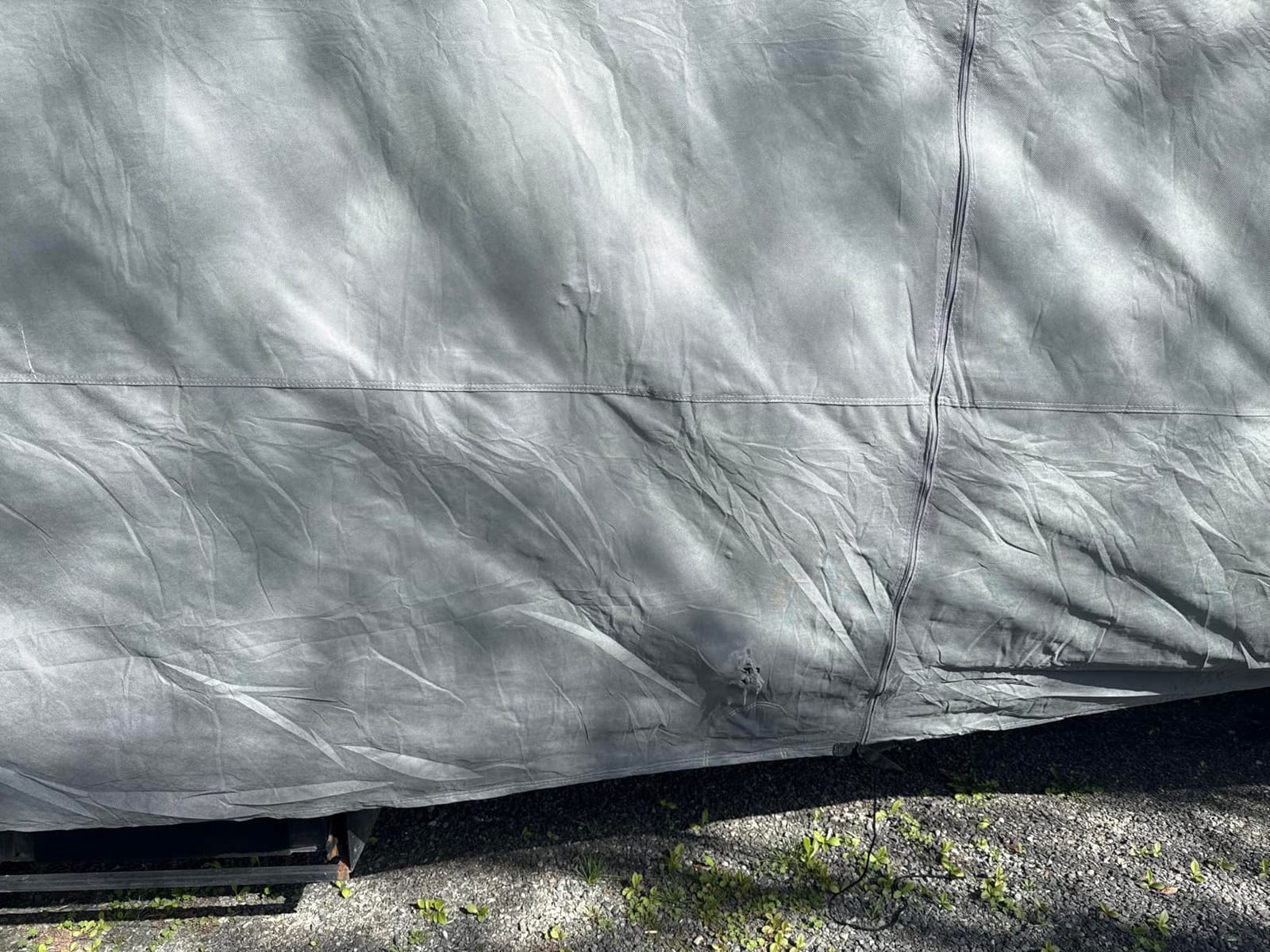
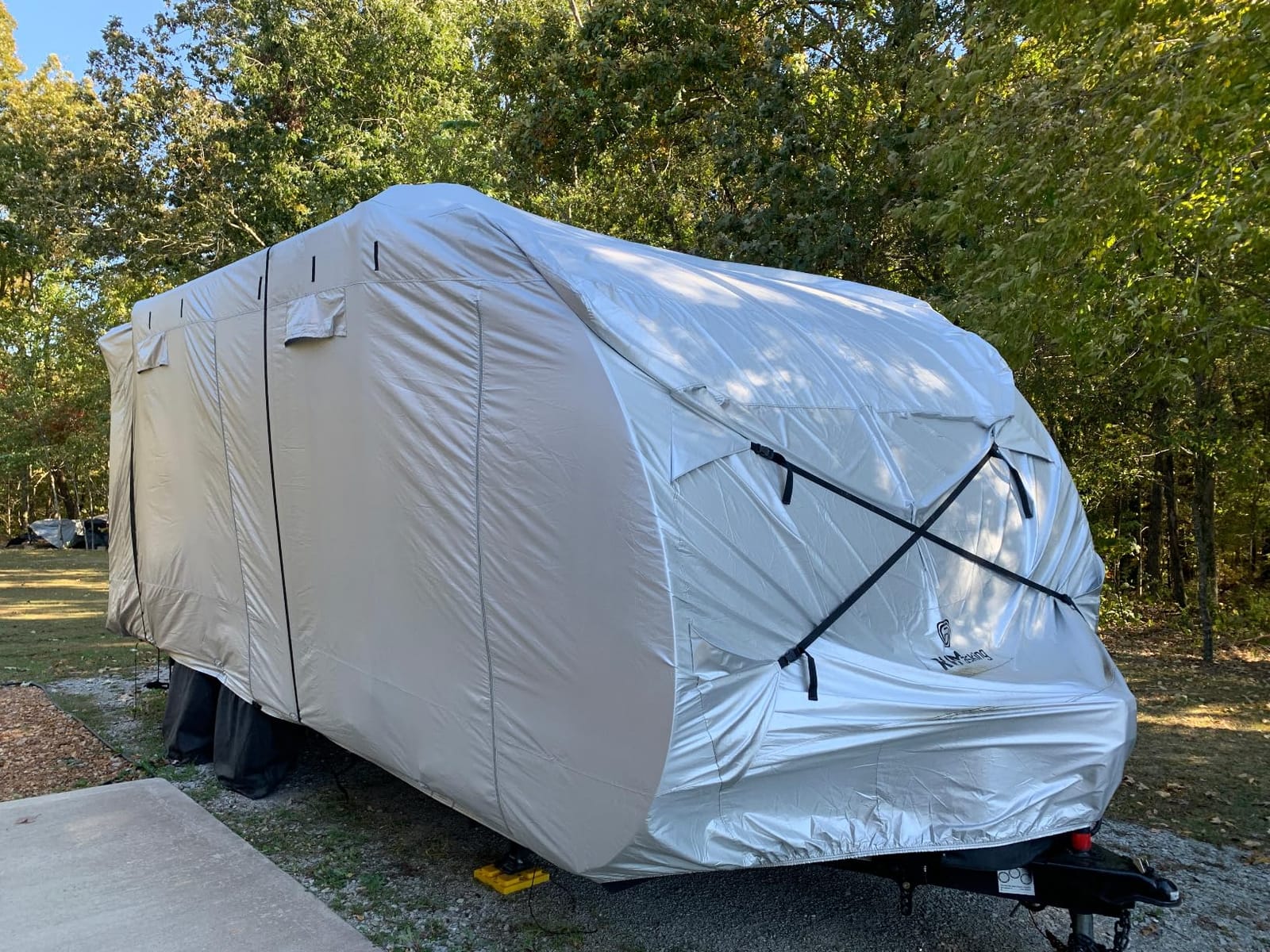
Eight reinforced corner patches, including heightened rear corners built for ladder contact, are the detail we would not compromise on. A sharp roof edge is the single most common tear point we see in owner reports across every brand in this roundup.
Three roll-up zippered side panels plus a rear toy hauler panel make loading a bike or a generator a ten-minute job instead of a cover-removal job. Eight vents keep the interior cavity moving air even with the panels closed.
The accessory list runs to four tire covers, a propane tank cover, a tongue jack cover, six gutter spout covers, weighted toss sticks, a repair patch and a manual. Warranty service is a frequently praised positive in the reviews.
Why it suits long trailers
At 31 to 34 feet, the fabric area available to a cover grows enormously and so does the load on the straps. The extra-long horizontal under-body strap plus two over-roof straps on this model spread that load across the whole shell rather than concentrating it at a single anchor.
Where owners report friction
Sizing runs wide, and an oversized cover on a shorter trailer in that range is exactly the configuration forums describe as vulnerable in a storm because slack fabric catches air. Bottom straps also need periodic re-tensioning on exposed sites rather than a one-time set-and-forget.
3. Umbrauto 9-Layer Cover for 24-27ft Trailers – Premium Pick for Warranty Cover
Umbrauto Travel Trailer RV Cover 24′ ~ 27′ – Upgraded 9-Layers Top Camper Cover, Waterproof & Windproof Heavy Duty Toy Hauler RV Cover for Winter Snow with Tongue Jack Cover, Gutter Covers
9-ply non-woven roof with 3-layer side panels
6 bottom straps plus 3 body straps
6 vents and 4 zippered panels
Pros
- Three-year manufacturer warranty with fast replacement
- 9-ply roof with 3-layer sides
- 6 windproof straps plus 3 extra
- Weighted buckle toss bag
- Complete accessory bundle
Cons
- Straps loosen in sustained wind
- Sewn strap anchor points can pull out at exposed sites
Warranty length is the reason this one takes premium pick. Three years of coverage is longer than most listings in the roundup, and owners specifically call out responsive no-cost replacement service, which turns a torn panel from a purchase into a support ticket.
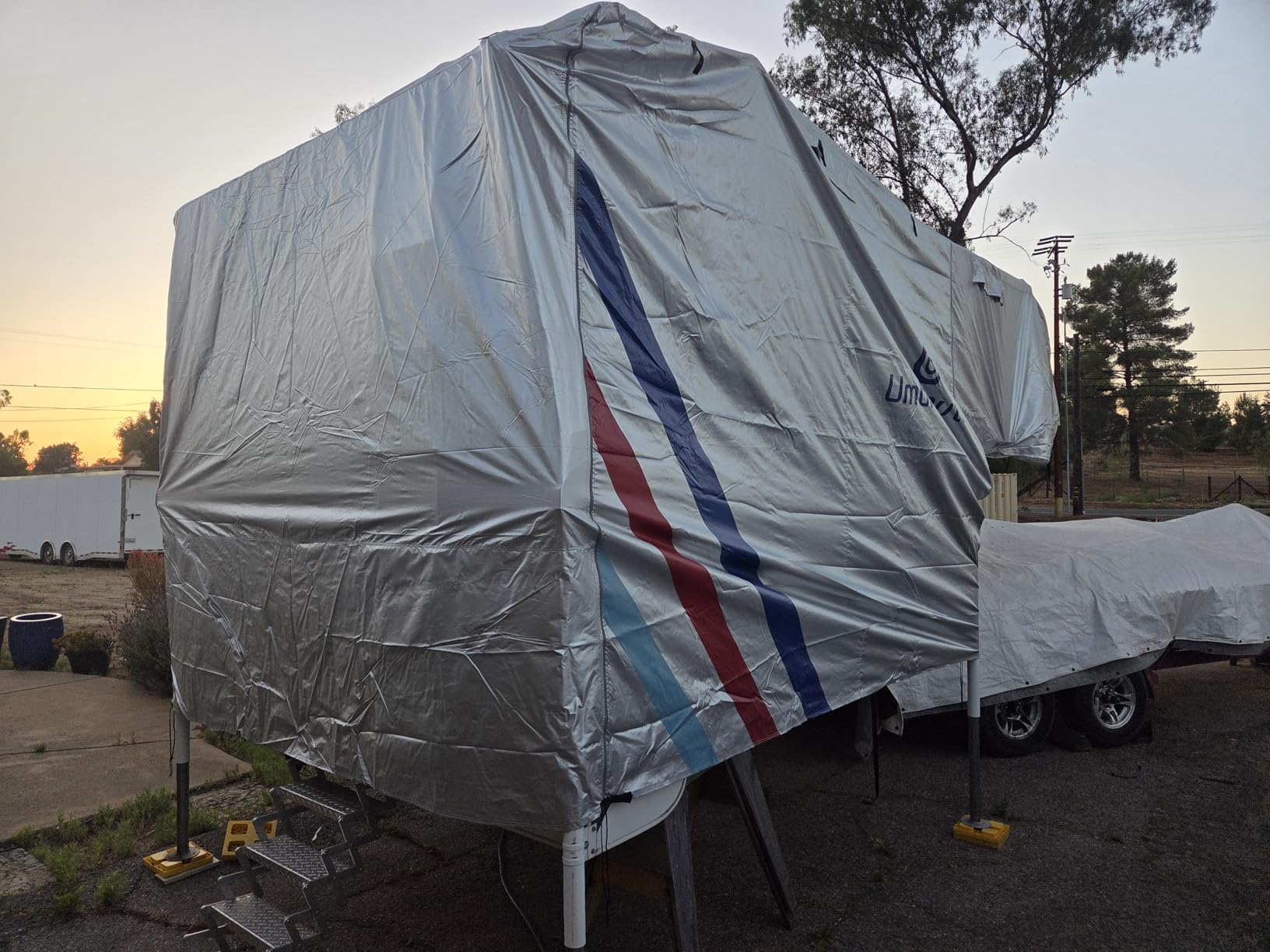
The build is a 9-ply non-woven roof with 3-layer reinforced side panels. That roof-to-side difference is deliberate: the top takes the most UV and the most water, so it gets the heavier material while the vertical panels get enough to resist tearing without adding much weight.
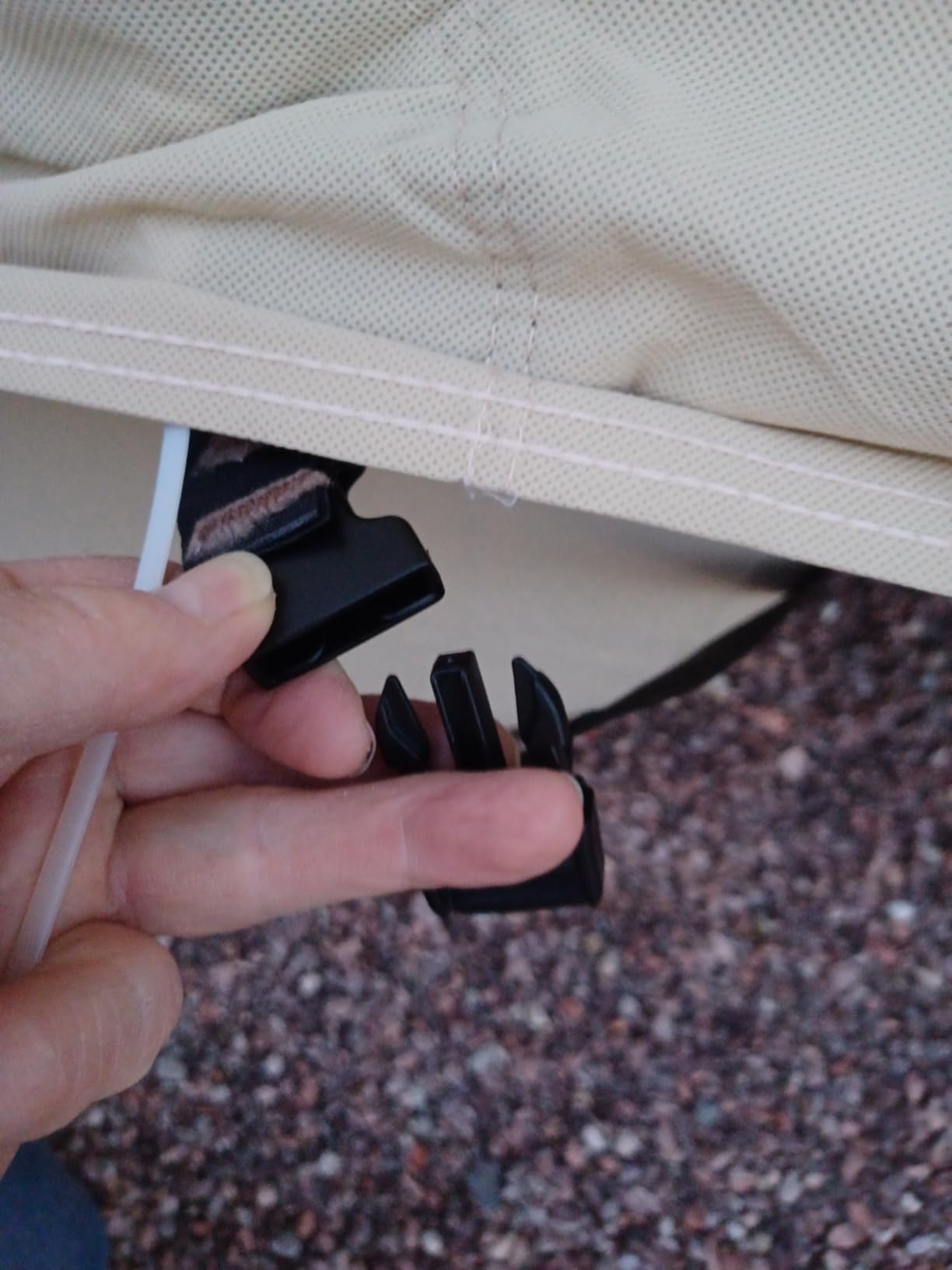
Strap count is the other headline. Six bottom windproof straps with internal reinforced buckles plus three extra body-securing straps gives more ways to tie the shell down than most covers of this class, which is the practical answer to wind.
Six air vents sit at the points where airflow does the most work, and four zippered panels let you reach the door, storage compartments or a generator without pulling the cover off entirely.
The kit is genuinely complete: tongue jack cover, ladder cover, storage bag, six sponge gutter covers, six wind ropes, three extra straps and a repair patch. Reflective safety strips run across the front and rear.
Why we rate it highly for snow country
Snow load is a weight problem before it is a waterproofing problem, and the 9-ply roof here is specified to hold a load that a 7-layer top would deform. Multiple owners report the cover staying in shape over a winter season without sagging between ribs.
The honest weakness
Wind still wins eventually. Reviewers describe straps loosening over a season and, at some exposed sites, sewn strap anchor points pulling out of the fabric. Plan a walk-around after any serious storm rather than assuming October installation survives to April untouched.
4. VINPATIO 9-Layer Cover for 20-22ft Trailers – Best for Snow and Winter
VINPATIO RV Cover 20-22ft: 9 Layers Heavy Duty RV & Trailer Cover, Travel Trailer Cover, Camper Cover, Toy Hauler Cover with Extra Windproof Straps, Tongue Jack Cover, Gutter Covers
9-ply non-woven top with waterproof membrane
100 percent waterproof PU coating at 2000mm
4 rollable zippered doors
Pros
- 2000mm PU waterproof coating for heavy rain and snow
- Four rollable zip doors for wide access
- Three-year warranty with fast replacement
- Generous sizing covers tongue and tanks
Cons
- Runs large so fabric can sit loose at the ends
- Top fabric can degrade after seasons of intense sun
The 2000mm PU coating figure is the number that matters here. Water resistance is not the same as waterproof, and a stated coating rating in millimetres tells you how much standing water pressure the fabric sheds before it wicks through.
Owners in snow country report this one performing through severe storms with a fit that stays close to the shell, and reviewers single out easy solo installation and accurate fit when the measuring guide is followed.
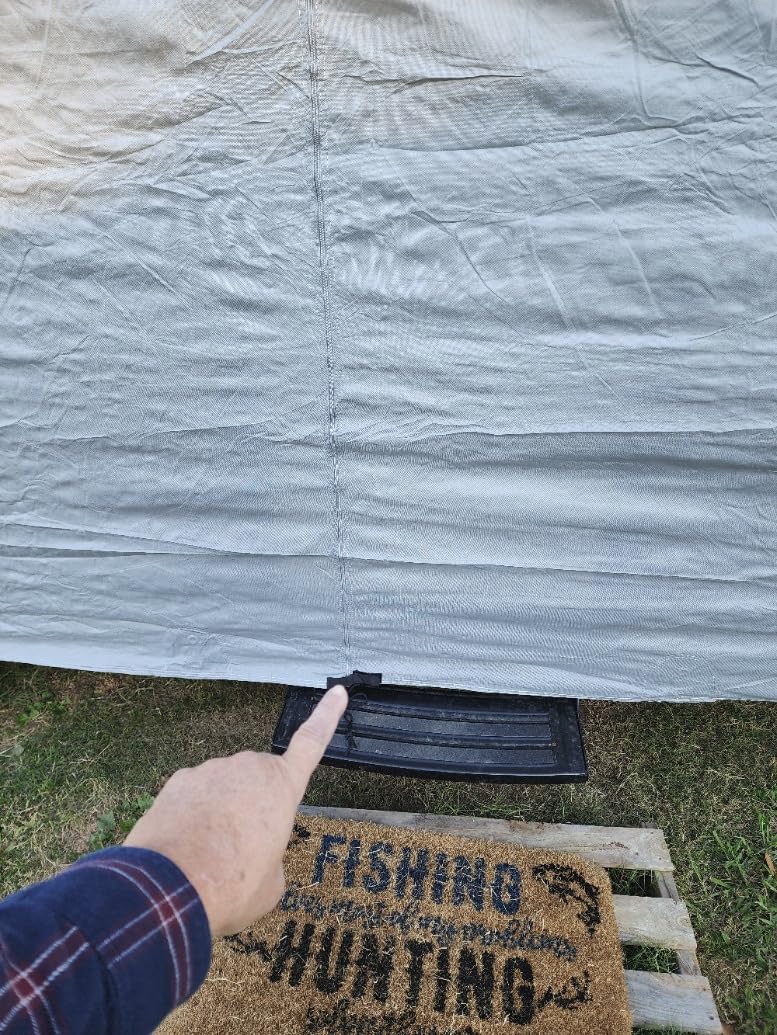
Four rollable zippered doors, three on the right side and one at the rear, open up more of the trailer than any single-door design in this roundup. That access is what makes a covered trailer usable rather than just sealed.
The cover is described as 9-ply non-woven with a built-in waterproof membrane, anti-UV treatment and an additional UV-resistant coating, plus two reflective strips and six sponge drain gutter covers.
Warranty replacements resolved the fabric complaints quickly for the buyers who needed them, which is worth remembering when weighing a coating that eventually fades.
Why it earns the winter slot
A rated water-shed coating plus a nine-ply roof is the pairing you want when the cover sits under wet snow for months. Waterproof tape seams and a snug fit also keep meltwater running off rather than sitting in the fabric.
Where the sizing fights you
This one runs large, and an oversized shell leaves loose fabric at the ends that can catch wind. The UV coating is also the part most likely to degrade first if your trailer sits in intense sun year after year.
5. KING BIRD Cover for 24-27ft Trailers – Best for Toy Haulers
KING BIRD Enhanced RV Cover, Fits 24-27ft Travel Trailers Camper
600lb tear-strength double-stitched fabric
324 x 105 x 108 inch fit
3000mm waterproof membrane with 6 vents
Pros
- 600lb tear strength on top edges and corners
- Relocating side tension panels plus 2 extra straps
- Rear zippers for toy hauler loading
- 3000mm waterproof membrane
- 28-month manufacturer support
Cons
- Fabric degrades in intense direct sun over seasons
- Larger sizes can feel oversized on smaller trailers
- Typically needs two people to install
Many reviewers report three-plus winters of use before needing replacement, and the strap system is the most substantial here. More anchor points at higher positions spread gust load across the whole roof rather than pulling on two hem points.
The relocating side middle tension panels let you move the strap up or down to clear a ladder, an air conditioner or an awning arm, which solves a problem most covers leave you to handle with foam padding alone.
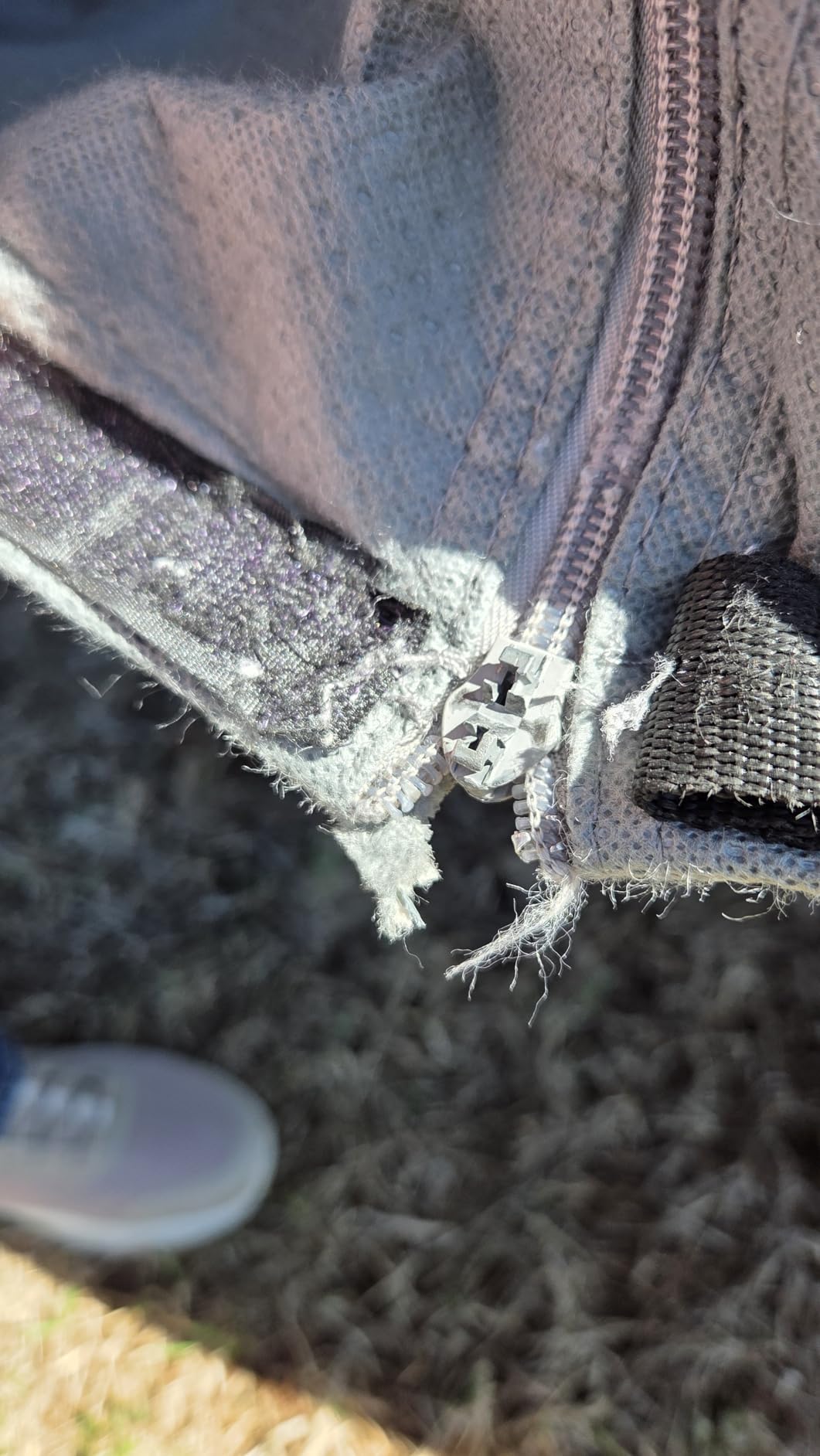
Two rollable zippered doors plus two rear zippers make it the most practical pick here for a toy hauler, where a bike or a generator goes in and out regularly.
The white multi-layer top with gray sides is a deliberate construction choice, since the top carries the UV load and is stated to be 40 percent better at resisting tears than a single-layer equivalent.
Six air vents and yellow reflective panels round out the specification, and the brand has been making RV covers since 2004, which shows up in how many sizes and trailer body styles are actually offered.
Why toy hauler owners like it
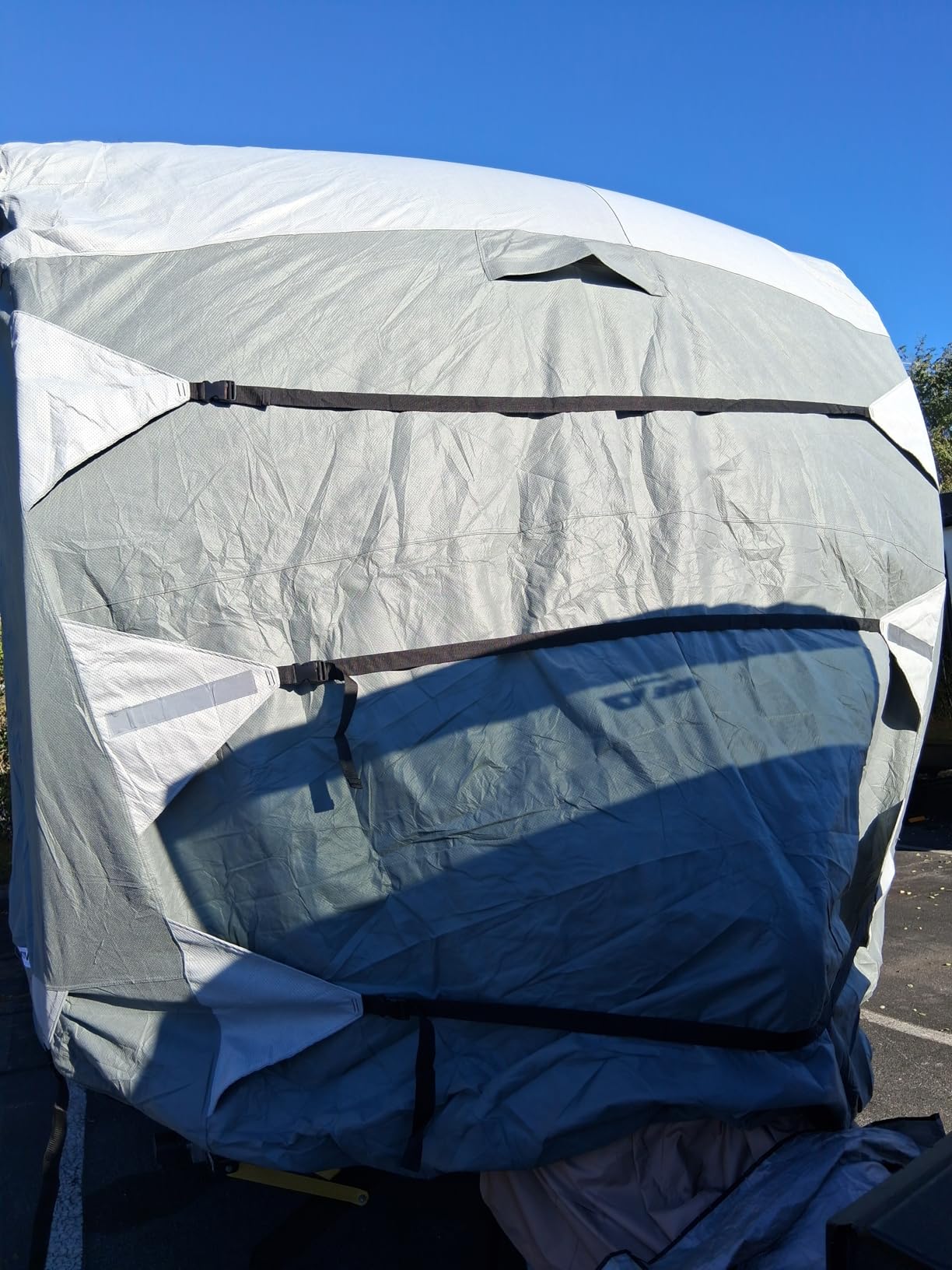
Loading access is the whole job on a toy hauler. Rear zippers plus two side doors mean you are not folding a 300-pound-plus cover over the tailgate every time you want the bikes out, and the roof and side fit clears rooftop air conditioner units and antennas.
The two-person problem
A large cover of this weight typically takes two people to install, and that is the single most common complaint in RV owner forums about covers in general. If you are handling it alone, read the solo technique later in this guide before you buy.
6. FRUNO Oxford Cover for 24-27ft Trailers – Best for Heavy Rain and Snow
FRUNO Oxford Fabric Travel Trailer Cover RV Cover 24′-27′ Waterproof Rip-Resistant Anti-UV Camper Cover for Winter Snow with Jack Cover 4 Tire Covers and Gutter Covers
300D Oxford top with 150D Oxford sides
Dense PU coating,rated -4F to 120F
Middle-side strap mounting with elastic hem
Pros
- Real Oxford cloth that visibly beads water
- Four-season temperature rating
- Middle-side straps give a tighter fit
- Tire jack gutter accessories included
Cons
- Heavier than non-woven covers and needs two people
- Printed instructions are hard to follow
- Occasional seam or zipper loosening with use
Oxford cloth behaves differently from the non-woven laminates most covers use. The tight weave and dense PU coating bead water rather than letting it soak in, and owners in heavy rain report replacing paper-thin covers with this one and seeing the difference immediately.
The stated temperature range of -4F to 120F is unusually wide and is the clearest four-season signal in the group. For snow states, that range matters more than any single layer count.
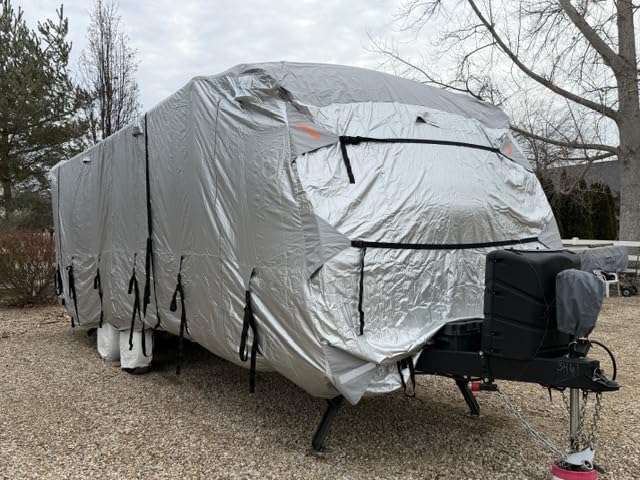
Middle-side strap mounting is the quiet hero feature. Mounting straps at the middle of the side panel rather than only at the hem pulls the fabric inward against the wall, which is a tighter and more wind-resistant geometry.
The kit is complete: cover, four tire covers, two lashing straps, six gutter spout covers, a jack cover, two repair patches and a storage bag, with two-year support and 30-day free returns.
Weight is the honest drawback. Owners estimate roughly 50 to 60 pounds for a 30 to 33 foot unit, and a dense coated fabric that heavy genuinely needs two people to spread over a roof.
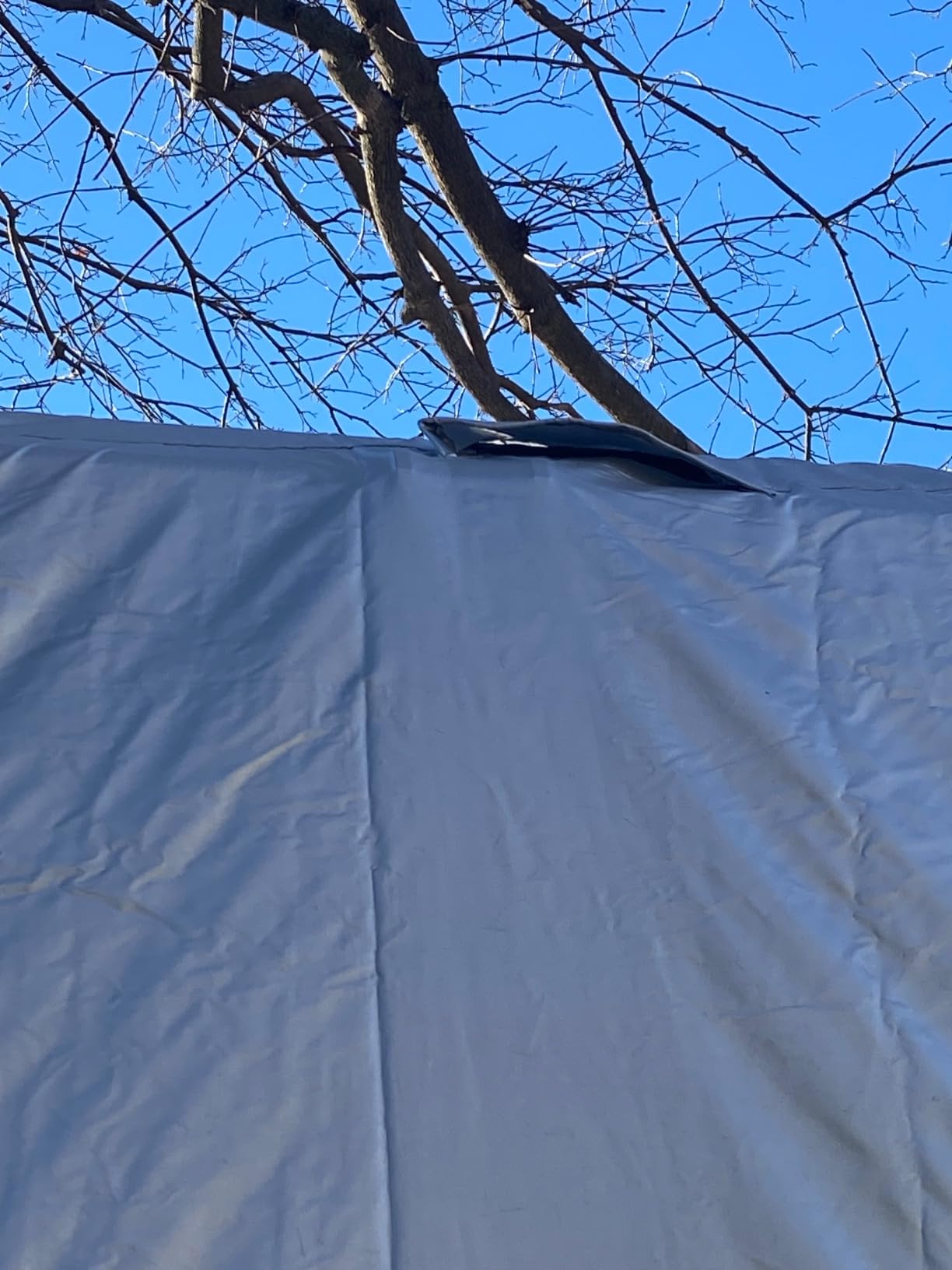
Why wet climates suit it
Water sits on a coated Oxford weave instead of migrating into it, and the wide temperature rating means the same cover works in a January freeze and a July heat wave without a swap. That is a real advantage if your storage site serves double duty.
When it is the wrong buy
If you install alone, the weight is disqualifying. Printed instructions are also confusing about orientation, and a small number of reviews on larger fifth-wheel sizes report seam or zipper stitching loosening with use.
7. Xenjum 8-Layer Cover for 33-35ft Trailers – Best for the Longest Trailers Here
Xenjum RV Cover for 33-35 ft Travel Trailers, 8 Layers Heavy Duty Camper Cover, Weatherproof & UV Resistant Motorhome Trailer Cover with Gutter & Tongue Jack Covers
8-layer non-woven with double stitching
PU coating for about 50 percent more UV resistance
5 bottom straps plus 2 extra-long straps
Pros
- Velcro-reinforced zipper resists wind tearing
- Five bottom straps plus two extra-long all-around straps
- Light enough to handle solo
- Reflective strips on all sides
- Folds into the included bag
Cons
- Only a 1-year manufacturer warranty
- Thinner 8-layer build than 9-layer alternatives
This is the only cover here sized for a 33 to 35 foot trailer at 426 by 102 by 104 inches. Owners like the value, the double-stitched 8-layer fabric and the volume of straps supplied, and they report straightforward installation.
The Velcro-reinforced zipper opening is a smart detail. Zipper flapping is a common wind failure point, and reinforcing the tape that carries the load matters more than the number of plies in our experience reading owner complaints.
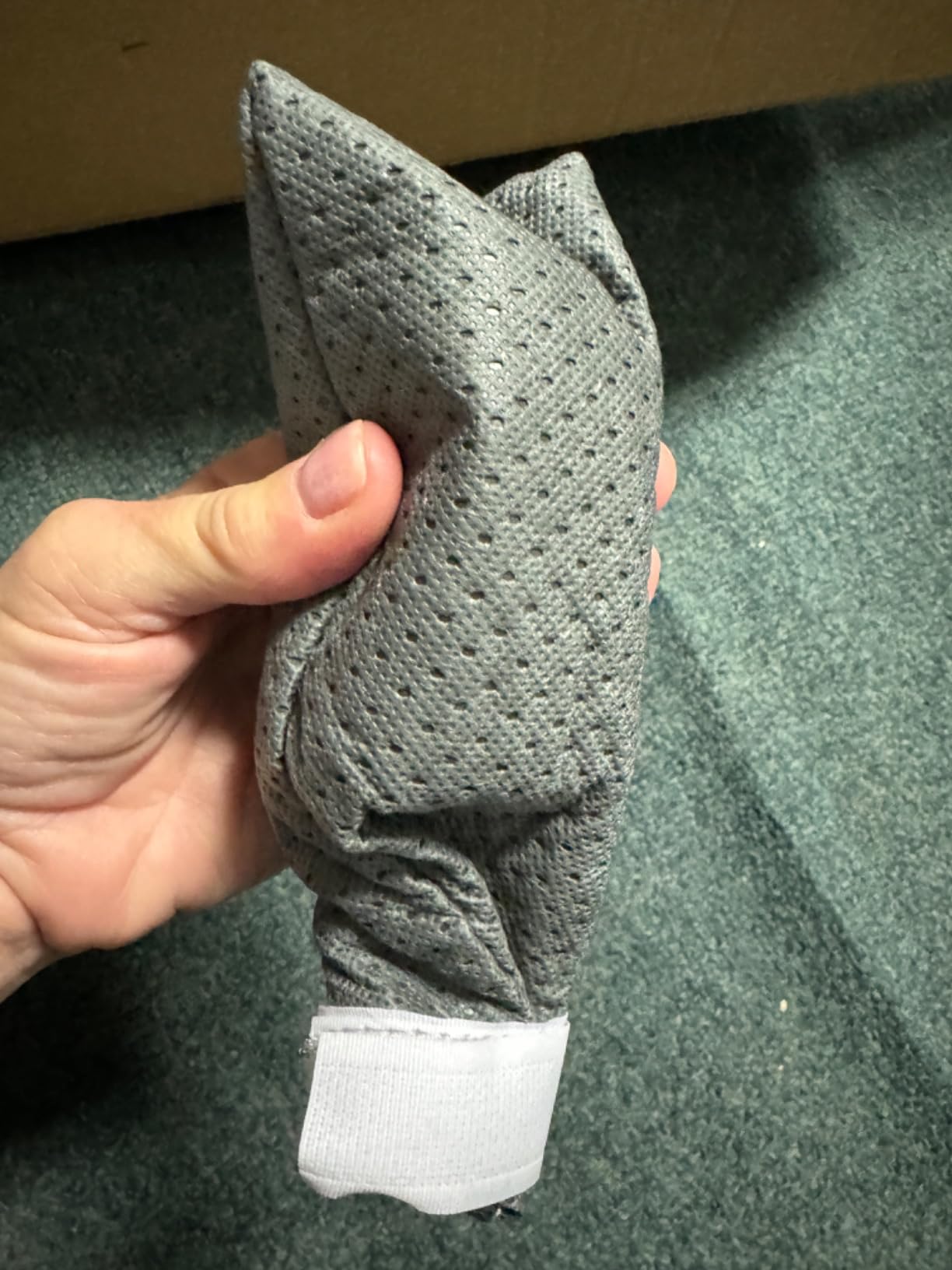
Strap configuration is generous: five inner bottom windproof straps plus two extra-long all-around straps, with elastic hem corners and four adjustable front and rear tension panels to trim slack.
Six air vents, three roll-up side zipper doors and reflective strips on all sides handle ventilation, access and roadside visibility in one pass.
Light enough to handle solo is a repeatedly reported positive, and it folds into the included storage bag with room for the rest of the kit.
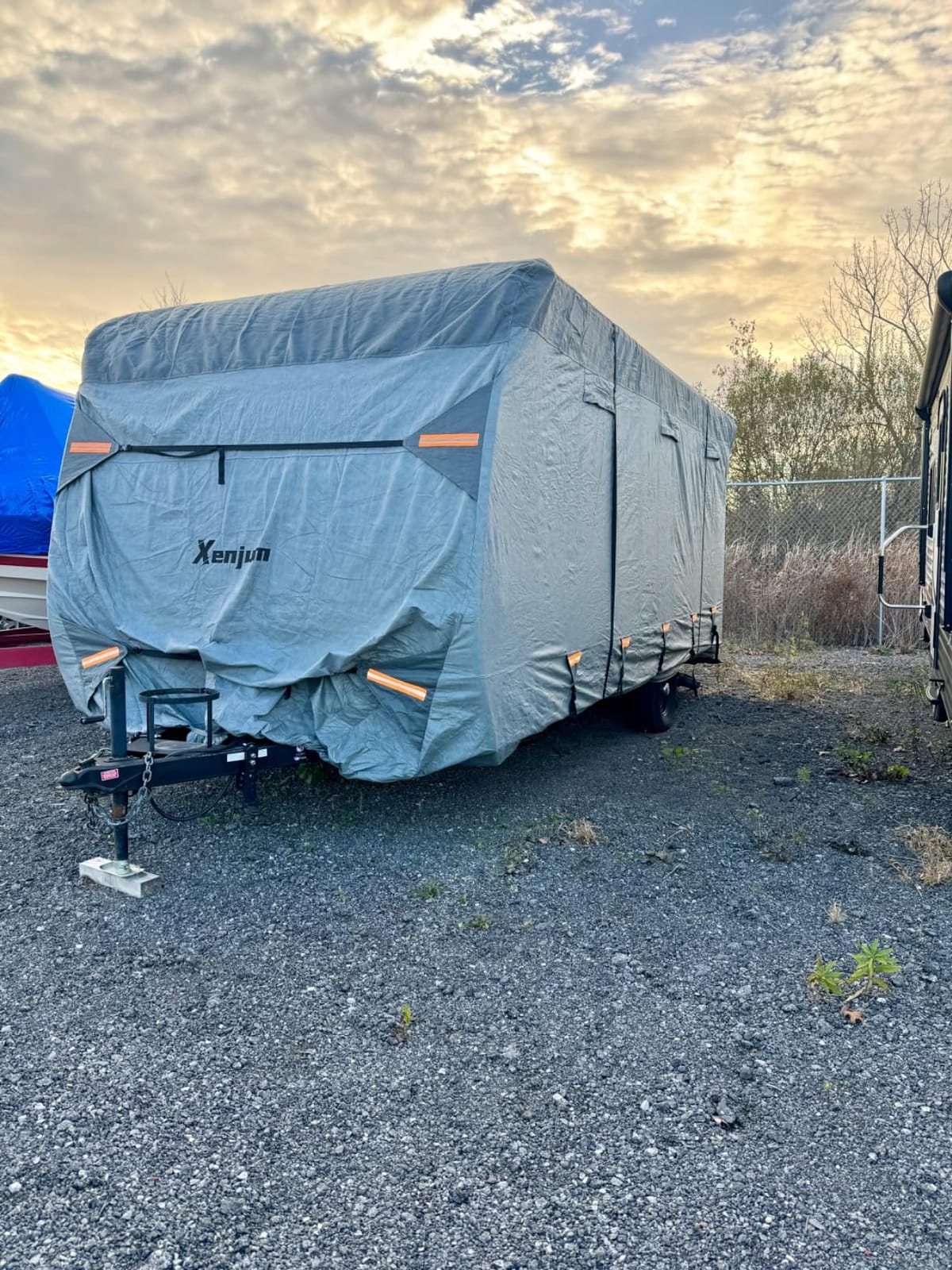
Why we like it for one-person installs
At 35 feet you would expect a heavy fabric, but owners repeatedly report managing this one alone. The extra material is easy to cinch down once the shell is roughly in place, and the side doors stay reachable.
The tradeoff to accept
One year of manufacturer warranty is the shortest here except for the small-trailer option, and the 8-layer build is thinner than 9-layer rivals at similar cost. Buy it for the length fit and solo handling, not for maximum material thickness.
8. Xenjum 9-Layer Rip-Stop Cover for 30-33ft Trailers – Best for Solo Installers
Heavy Duty 9 Layers RV Cover 30-33ft, Rip-Stop Motorhome Camper Cover with Windproof Straps, Gutter & Tongue Jack Covers, Utility Travel Trailer Cover for All Weather Protection
9-layer nonwoven with a water-spun cotton layer
30 percent more tensile strength
5 bottom straps plus 2 all-around straps
Pros
- Water-spun cotton layer adds real weight and toughness
- Survives Arizona heat dust storms and California rain
- Weighted toss bag and generous strap slack
- Close but forgiving fit
Cons
- Runs wide on some trailers
- Some rips reported after a first harsh winter
A premium water-spun cotton layer inside the 9-layer build is what separates this from the other non-woven covers here. The stated result is 30 percent greater tensile strength and 40 percent better tear resistance than a comparable build without it.
Reviewers consistently praise the fabric weight, the reinforced stitching and the durability relative to cost, and several report the cover surviving storms, extreme heat and dust.
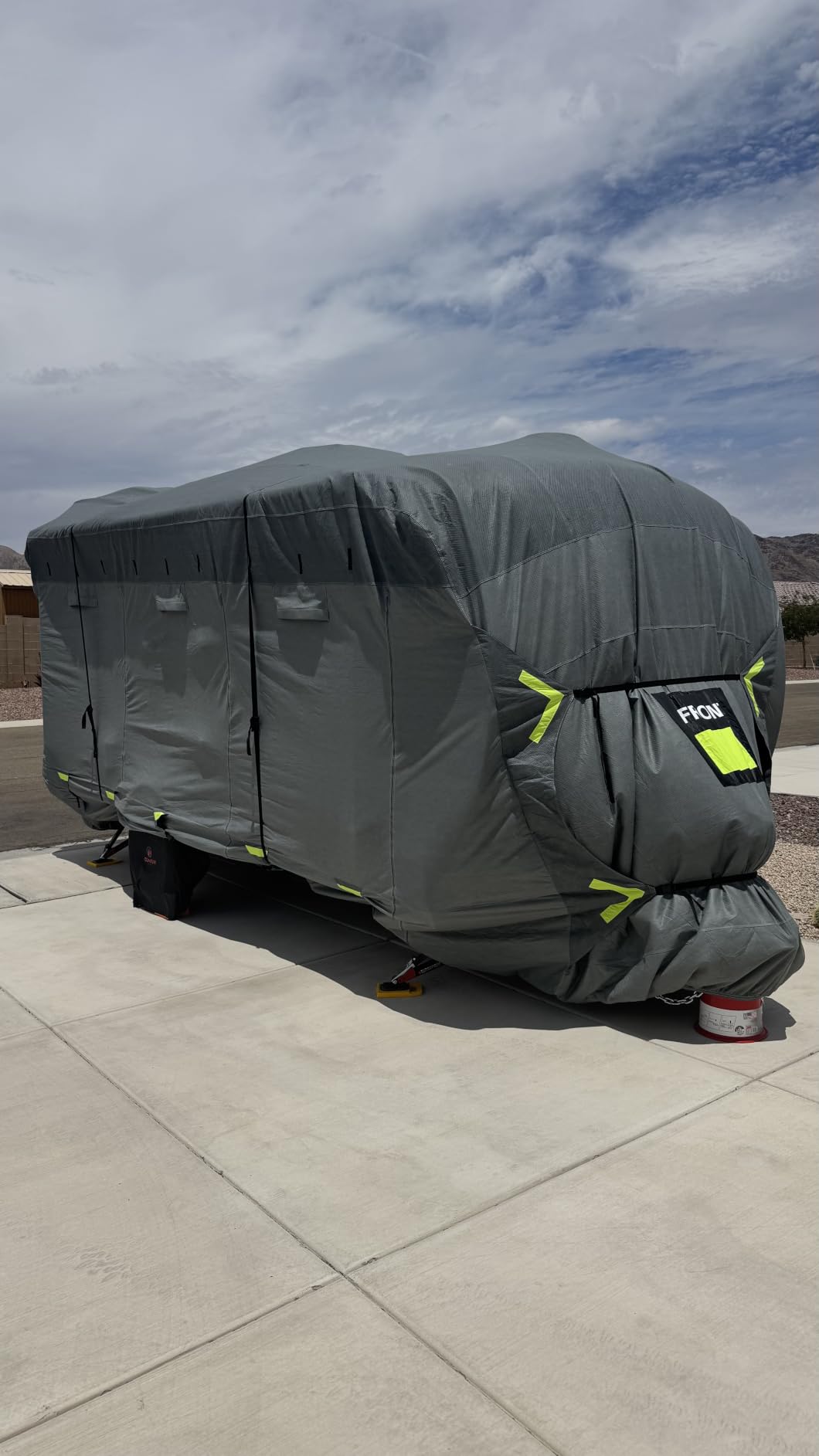
Stitching detail is thorough: reinforced double stitching, thickened corners, triangular seam panels and windproof zippered flaps closed with Velcro, all of which attack the tear locations that actually show up in service.
Five bottom straps, two extra-long all-around straps and a stitched elastic hem give a lot of ways to tension the shell, and the fit is described as close but forgiving, with extra material easy to cinch.
Six air vents, three roll-up zippered doors and reflective strips on all four sides round out the build, with a two-year warranty and sizes from 14 to 38 feet.
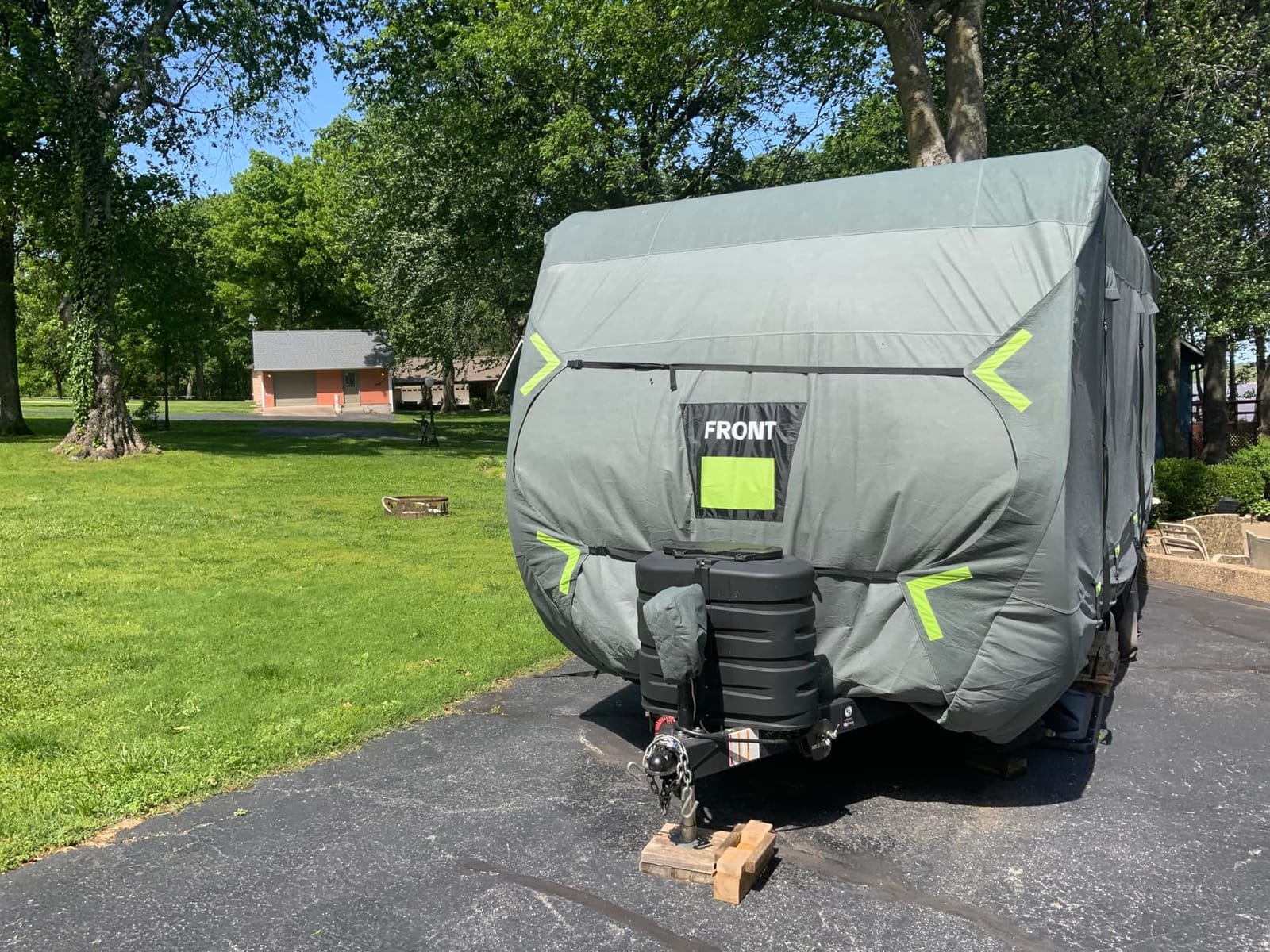
Why desert and dust sites suit it
Tensile strength is what matters against windblown grit and dust, and UV-resistant coatings plus a heavier layer stack is the combination that survives a season of Arizona sun. Owners in high-heat states report no fabric breakdown across multiple seasons.
The fit caveat
The cover runs wide on some trailers, which makes the side zip door awkward to reach when the fabric is cinched. A few owners also report rips after a first harsh winter of heavy rain, so pad the corners before the wet season rather than after.
9. VIGORVAN 7-Layer Cover for 27-30ft Trailers – Best for Ventilation
Vigorvan Travel Trailer RV Cover 27-30FT, Upgraded 7-Layer Top, Windproof
7-layer top with 3-layer side fabric
15 air vents plus 2 extra 42 ft straps
367 x 107 x 103.5 inch fit
Pros
- 15 air vents
- the most in the roundup
- Large accessory kit
- Generous length covers a toy hauler rear
- 3-year after-sales support
Cons
- 7-layer top is lighter duty than 9-layer rivals
- Some tearing during installation or near uncovered drains
- Extra-large sizes do not fit every profile
Fifteen air vents is more than double what most covers in this roundup carry, and that is not a spec-sheet flourish. Vents relieve wind pressure across the shell as well as moving moisture, and owners in snowy climates report multiple seasons with the camper clean and dry underneath.
Strap capacity is the other strength: eight bottom windproof straps, two front and two rear straps, plus two extra 42 foot straps that circle the entire body. Very few covers give you that much tie-down length.
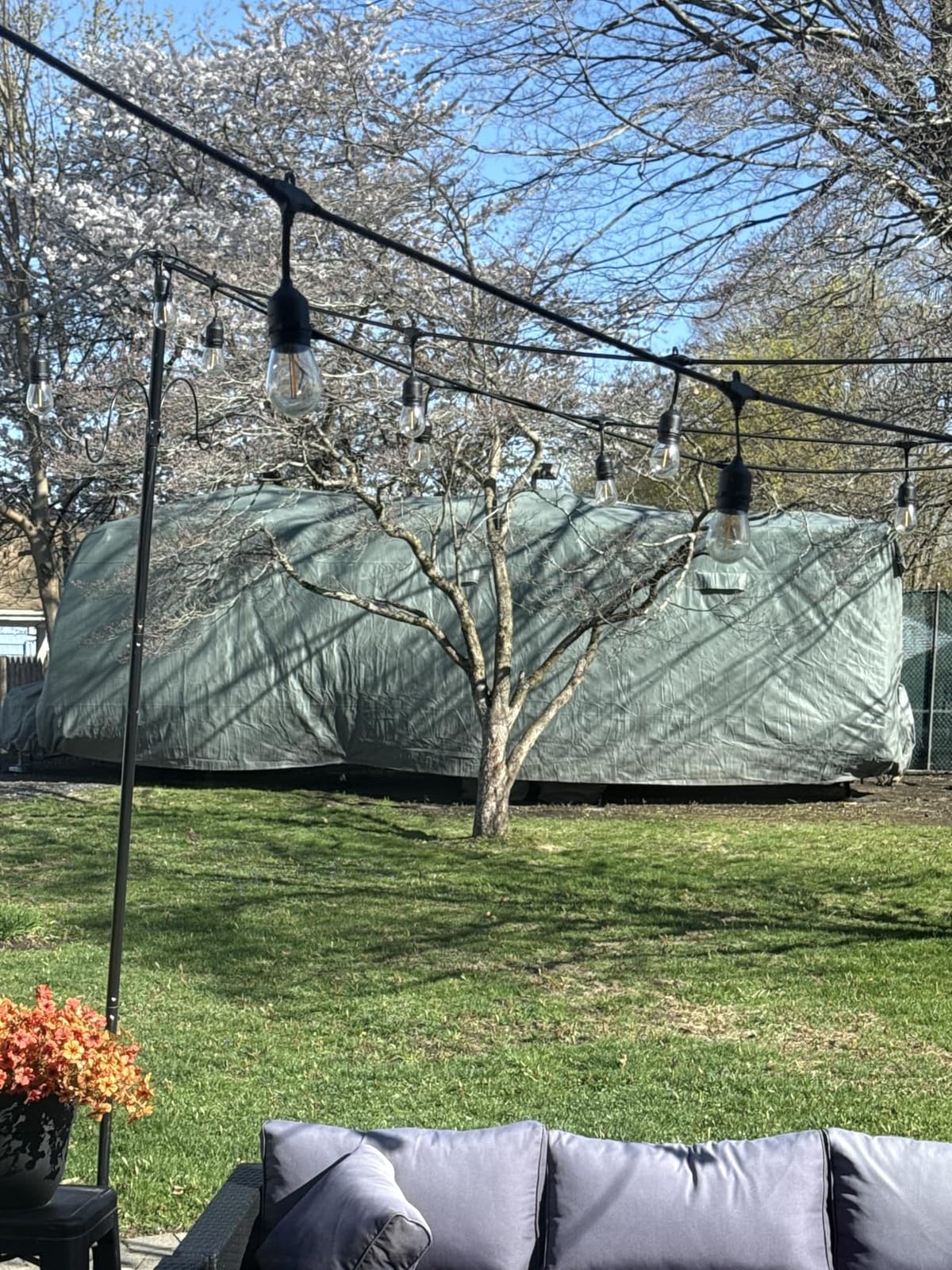
Top handles, thickened corners, reflective strips, an elasticized hem and a rollable Velcro door make this a genuinely easy one to grip, drag and orient in wind, which matters more than it sounds.
The accessory kit is large: four tire covers, eight gutter covers, two repair patches, two windproof straps, a jack cover, two throwing sticks and a storage bag.
Fit is for 27 to 30 foot trailers at 367 by 107 by 103.5 inches, and owners of toy haulers note the extra length on some sizes covers a taller rear.
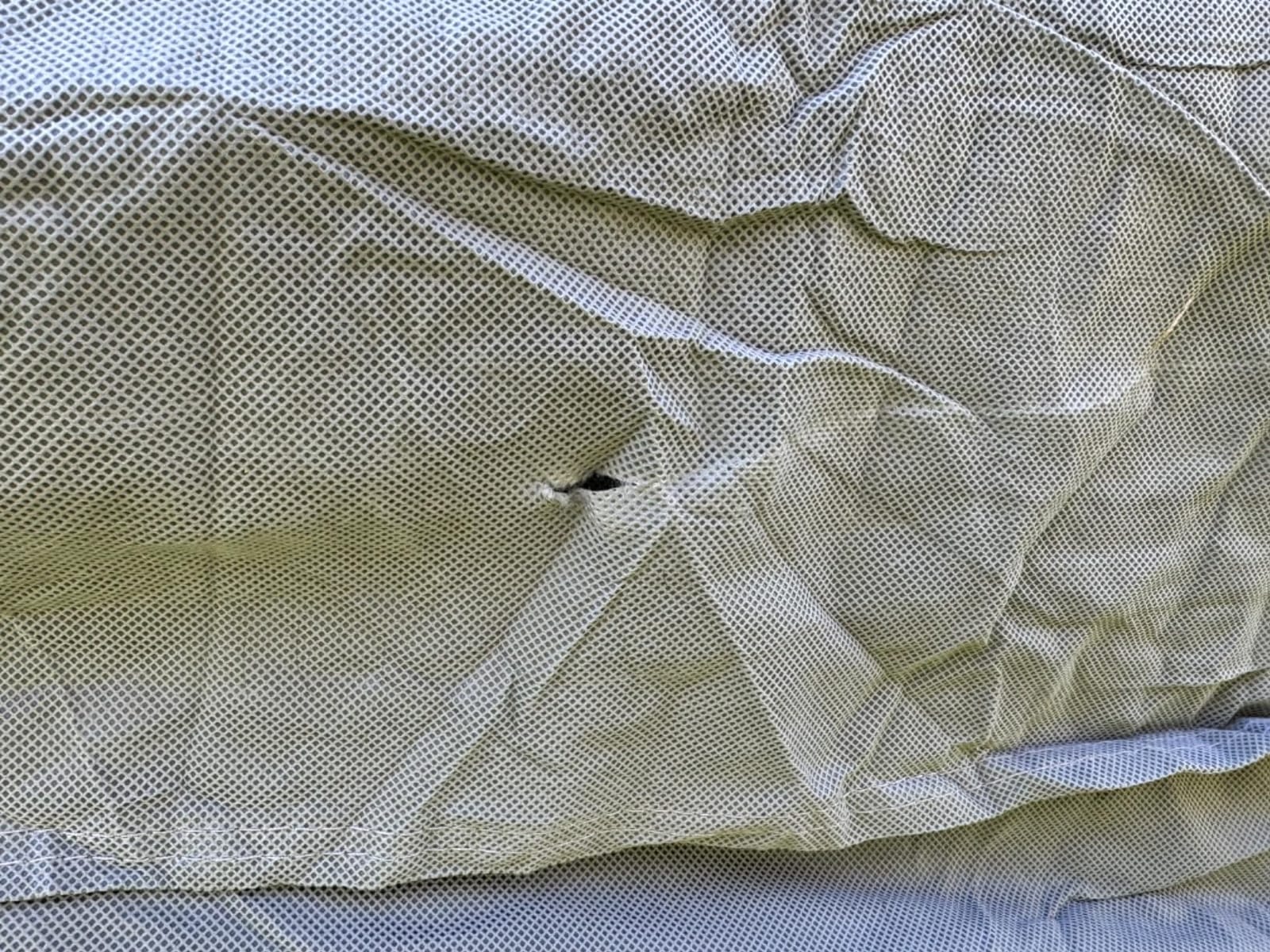
Why ventilation protects you
A covered trailer traps warm moist air against a cold roof. Without an escape path that moisture condenses, sits, and eventually becomes mildew. Fifteen vents plus a breathable three-layer side give that air somewhere to go, which is why this is our pick for damp coastal sites.
Where the thinner build shows
Seven layers on top is lighter duty than the nine-layer covers here, and some tearing appears where the cover is adjusted during installation or near uncovered drains. Pad the drain areas and the fittings before the first pull.
10. Kohree Cover for 22-24ft Trailers – Best for Smaller Trailers
Kohree Travel Trailer Cover 22-24 ft, 8 Enlarged Vents, Reinforced Straps
7-layer non-woven with anti-UV layers
8 enlarged vents,6 side plus front and rear
31.5 pound listed weight
Pros
- Reinforced buckle anchor points at every strap
- Accurate sizing when the guide is followed
- Survived a harsh New England winter with no rips
- Front and back install markings
- Full kit with tire jack and ladder covers
Cons
- Material feels thin
- Could use more bottom securing points
- Tire and jack covers are the weakest accessories
- Heavy enough to need a second person
Reinforced buckle anchor points at every strap location is the feature that lifts this above the bargain tier. Anchor points are where straps fail, and a cover that reinforces each one tends to survive the season intact.
Owners report a near-perfect fit on 22 to 24 foot trailers when the measuring guide is followed, and several describe a full harsh New England winter with no rips and no finish scuffing.
The clearest small-cover detail is printed front and back markings on the fabric itself. It sounds trivial until you have unfolded an unlabelled cover on a windy driveway and guessed which end goes where.
Eight enlarged vents sit six on the sides plus one front and one rear, and the rear door plus two side zipper doors give more access than most covers in this length class.
The kit includes a storage bag, four tire covers, a jack cover, a ladder cover, six gutter covers, a repair patch and a toss bag. Listed weight is 31.5 pounds for the cover itself.
Why small trailers suit it
On a 22 to 24 foot trailer the fabric mass is low enough that a 7-layer build still holds a straight line over the roof, and the reinforced anchors handle the shorter trailer’s higher wind exposure at the rear. Accuracy of fit is the real win here.
Where it falls short
Several buyers call the material thin, the bottom hem could use more securing points, and the included tire and jack covers are considered the weakest accessories in the box. At 31.5 pounds it still needs a second person to spread over the roof.
11. K-Musculo 8-Layer Cover for 16-18ft Trailers – Best Value for Small Trailers
K-Musculo RV Cover,16-18 FT Heavy Duty Travel Trailer Cover with 8 Layers Corner, Windproof and Waterproof Camper Cover with 4 Tire Cover & Tongue Jack Cover
8 layers at the corners and 4 on top
216 x 105 x 108 inch fit for 16-18 ft
10 securing straps with a rollable zipper door
Pros
- Extra-thick 8-layer corner construction
- 10 securing straps
- Multiple vents reduce moisture buildup
- Rollable side zipper door
- Two-year manufacturer warranty
Cons
- Top panel is only 4 layers
- Strap and stitching durability draw the critical reviews
The construction logic here is unusual and worth explaining: eight layers at the corners and four on the top. Stress concentrates at the corners, so that is where the material went. It is a defensible way to spend a limited material budget on a small trailer.
Ten securing straps give more tie-down points than most covers twice the price, and multiple vents on both sides plus front and rear keep moisture from building under the shell.
The rollable zipper door on one side gives entry and engine bay access without stripping the cover, and five reflective strips sit at the front and back for night visibility.
Fit is 216 by 105 by 108 inches for 16 to 18 foot trailers, so measure including ladders, spare tires and air conditioner units. Expect to buy foam guards for any sharp protrusion.
Why it makes sense at 16-18ft
A small trailer presents less fabric area for wind to catch, so the failure mode here is strap and stitch durability rather than flapping. Ten straps is a strong answer to that, and the low weight keeps it manageable for one person.
The honest caveat
Four layers on the top panel is thinner than any nine-layer cover here, and this listing carries an unusually high share of two-star reviews focused on strap and stitching longevity over time. The listed item weight of 16 ounces also looks low for a cover this size, so expect a heavier package in practice.
12. SILIVN Oxford Cover for 10-13ft Fiberglass Trailers – Best for Small Fiberglass Rigs
SILIVN 10-13FT Fiberglass Travel Trailer Cover 900D Oxford
Oxford fabric with PU coating at 3000pa
Waterproof strips added at the seams
Partial rollable door and a front orientation mark
Pros
- Oxford fabric with PU coating and sealed seams
- Installs in under 10 minutes with the front mark
- Roll-up door for access
- Lowest cost option for small fiberglass trailers
Cons
- Small-trailer sizing only
- Only a 1-year manufacturer warranty
- Highest share of one-star reviews in the roundup
This one exists for a very specific trailer. If you own a small fiberglass unit in the 8 to 16 foot range, this is one of the few covers on the market cut for it, and buyers who match it correctly rate the waterproofing and the installation speed highly.
The 3000pa PU coating and sealed seam strips are the strongest water-shed specification in the group, and the front orientation mark means the cover goes on right the first time in under ten minutes.
A partial rollable door section gives you entry access without removing the whole cover, which is more than most covers in this small-size category offer.
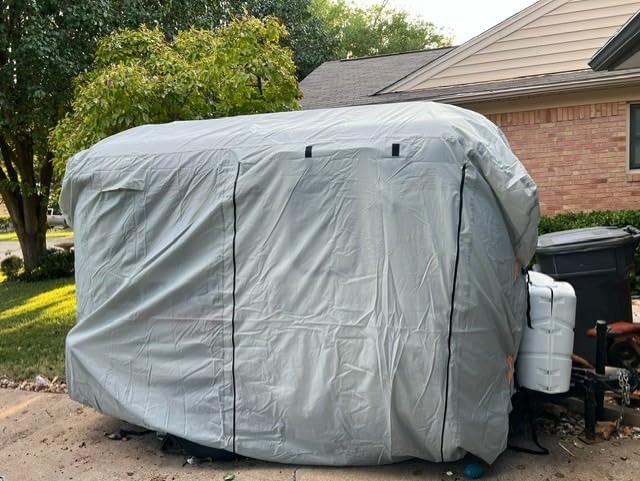
Three side straps, two front and rear tension panels and four air vents handle wind load on a rig this size, where the shell is small enough to move quickly in a gust.
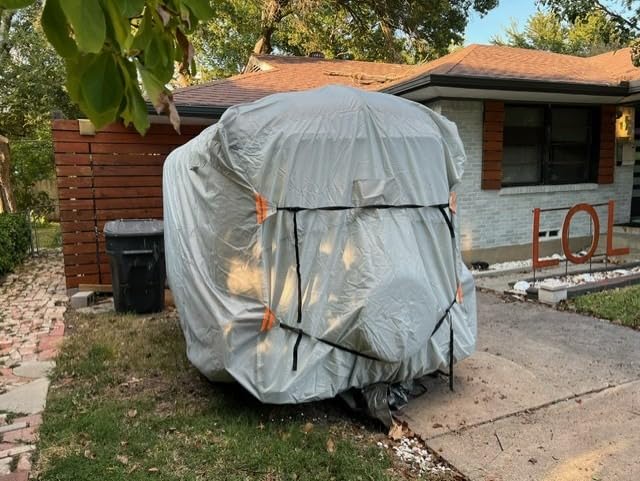
Why match it carefully
Two things to check before you order. The bullet text cites 420D Oxford fabric while the title cites 900D, and the dimension text refers to the 8 to 10 foot version rather than the 10 to 13 foot variant, so confirm the actual panel size with the seller.
When to skip it
If your trailer is a standard-length travel trailer, this sizing will not work at all. One year of warranty is the shortest here, and this listing carries the highest share of one-star reviews of anything we analyzed, with those reviews focused on long-term durability.
How to Measure Your Travel Trailer for a Cover
Measure the body, not the hitch. This single rule causes more returns than any other factor, and dealer and retailer experts repeat it constantly. The cover wraps the trailer box; the tongue, hitch and propane bottles sit outside it or are handled by the included accessories.
Measure the body length. From the front bumper to the rear bumper, not out to the hitch coupler or the jack.
Measure the width at the widest point. Include anything that sticks out, such as a ladder on the rear, a spare tire mounted high, or a slide-out in the extended position.
Measure the height from the ground to the highest roof accessory. Air conditioner units, antennas, roof vents and awning arms all count. The tallest point is what the cover has to clear.
Add a couple of inches of allowance on width and height. If you fall between two sizes, go larger. An oversized cover can be cinched down with straps; an undersized one cannot be made to fit.
Write the numbers down and compare them to the listing dimensions. Print the range on the box is a guide. The actual panel dimensions are the spec that matters.
As one retailer expert put it in an answer about travel trailer covers, the measurement that counts is the trailer body only, excluding the tongue and hitch. We would add one more step most guides skip: measure with everything in its storage position, not its camping position.
Cover Materials and Layers Explained
Layer count is the headline number, but the layers themselves matter more than the total. Here is what you are actually choosing between.
Non-woven laminate is the most common construction. It is a stack of spun polypropylene or polyester bonded with adhesive and UV stabiliser. It is light, cheap and effective, and it is what most of the covers in this roundup use. Its weakness is edge abrasion, which is why reinforced corners and sealed seams matter so much.
Oxford cloth is a woven polyester with a dense polyurethane coating. It costs more and weighs more, and it beads water rather than wicking it. FRUNO, SILIVN and KING BIRD all use woven or coated constructions, and owners in heavy rain and snow consistently rate them above the paper-thin alternatives they replaced.
Waterproof membrane is the inner layer that stops liquid penetration. Some covers state a rating in millimetres, such as 2000mm or 3000mm, which tells you the hydrostatic pressure the fabric sheds. A stated number is a more useful claim than the word waterproof on its own.
Ripstop is a weave pattern, not a material. A heavier thread runs in a grid every half inch or so, so a small puncture stops at the next grid line instead of running across the whole panel. KING BIRD states 600 pounds of tear strength on a double-stitched build.
Vents are not optional. A covered trailer traps warm moist air against a cold roof, and that moisture condenses. Vents ranged from four on the small SILIVN cover to fifteen on the VIGORVAN, and a breathable middle membrane in the layer stack does the same job more quietly.
Matching Your Cover to Your Climate
Desert and high-UV sites: prioritise UV stabiliser content in the top layer, not just a waterproof rating. The Xenjum 9-layer rip-stop and the MOFEEZ both pair a heavy top panel with anti-UV treatment. Wash the trailer before covering, because UV damage on a dirty surface is permanent.
Snow belt winters: you need structural strength before you need waterproofing. A 9-ply roof holds a snow load that a 7-layer top deforms. The Umbrauto, VINPATIO and the FRUNO Oxford are the winter-appropriate picks here, and none of them should be installed over accumulated snow.
High-wind coastal or exposed lots: count the anchor points, not the plies. The VIGORVAN with fifteen vents, eight bottom straps and two extra 42 foot straps, and the RVMasking with eight reinforced corners and over-roof straps, give you the most ways to stop flapping. No fabric survives a hurricane regardless of brand.
Humid coastal storage: ventilation outranks waterproofing. Damp air under a sealed cover is what causes mildew, so the VIGORVAN’s fifteen vents and the RVMasking’s breathable middle membrane are the right emphasis.
Covered storage or a carport: a lighter cover is enough, and it will dry faster between moves. Nothing in this roundup is designed specifically for indoor use, so pick for UV and dust rather than weather.
Should you cover at all? If your site is genuinely wind-exposed, a metal carport wins every time and owners in that situation consistently say so after losing a cover to the first serious gust. A cover is the right call on a sheltered site with trees or a fence, and the wrong one on an open plain.
Installing and Removing a Cover in Five Steps
Prep the trailer. Wash it first, retract antennas, pad or bubble-wrap air conditioner units and awning arms, and fit foam or sponge guards over gutter downspouts. This is the step that decides whether the cover lasts one season or six.
Lay the cover flat.Spread it on the ground in front of the trailer and confirm the front orientation. Several covers in this roundup print a front mark for exactly this reason.
Roll and pull. For a solo install, roll the cover from both ends toward the centre, mark centre, left, right, front and back, rope it up and roll it back out over the trailer from the rear.
Tension in a sequence. Fit front straps, then rear straps, then the side and bottom straps, working in a circle so slack does not migrate to one end. Expect the first install to need a second pass.
Check after storms. Walk the perimeter and re-tension anything loose. Owners across every brand report that periodic re-tensioning is the difference between a cover that lasts and one that ends up in a skip.
On the first install, wrinkles need a few days to relax before the cover sits properly. That is normal and it is not a fault. Our own reads on the same point: a cover that looks slightly loose on day one typically settles into a clean fit by the end of the first week.
What Real Owners Complain About
Across owner forum threads, the same five complaints show up regardless of brand, and every one of them is a design point you can check before you buy.
Wind is the number one complaint. Covers flap, lift and eventually tear at the strap points. No brand solves this; anchor count and cover mass reduce it.
Straps and buckles fail first. Tear-out at the anchor point, not fabric failure, is the typical end of a cover that lost a storm. The Kohree and RVMasking both invest in reinforced anchor points for this reason.
Gutter spout contact develops rips. Owners report a tear forming where the spout sits against the fabric, and foam or pool-noodle guards stop it, though they tend to fall off during installation.
Solo install is the real barrier. Multiple owners in their fifties through seventies describe covers as basically impossible to put on alone. That is a weight and size problem, and it is why we flagged two-person installs on the heavier covers above.
Does a cover cause mold? Not if it breathes. Condensation, not the cover itself, is the problem, and it comes from covering a wet or damp trailer or from a shell with no vent path. Wash the trailer, dry it fully, and use a cover with real vents.
The consensus on longevity favours doing the prep properly. One owner reported an ADCO cover on a 40 foot trailer surviving six to seven seasonal cycles with only a few patch repairs, while a cheaper cover on a 22 foot trailer was discarded after one windy day. The difference was material weight and anchor points, not the purchase.
For the same reason we did not treat a cover as a hail solution. Owners consistently note it blocks UV, rain, snow, dirt and sap, and does nothing for impact. If hail is your real risk, a carport is the only answer.
Frequently Asked Questions
Should you put a cover over your travel trailer?
Yes, if your trailer is stored outdoors on a sheltered site. A cover blocks UV, rain, snow, bird droppings, dust and tree sap, which protects the roof membrane, graphics, seals and exterior finish while it sits. Skip the cover, and consider a metal carport instead, if your site is genuinely wind-exposed, since no fabric cover survives sustained high wind. A cover also does nothing for hail.
What is the best material for a travel trailer cover?
For most climates, a multi-layer non-woven laminate with a waterproof membrane, anti-UV treatment, reinforced double stitching and vent ports is the best balance of weight, cost and durability. For heavy rain and snow, a woven Oxford cloth with a dense PU coating costs more and weighs more but beads water instead of wicking it. Always check the stitching at corners and strap anchor points, because that is where covers actually fail.
How do I measure my travel trailer for a cover?
Measure the body from the front bumper to the rear bumper, excluding the tongue, hitch and propane bottles. Measure width at the widest point including any rear ladder or high-mounted spare tire. Measure height from the ground to the highest roof accessory, including air conditioner units, antennas and awning arms. Add a few inches of allowance and if you fall between sizes, go larger, since an oversized cover can be cinched down but an undersized one cannot be made to fit.
Do RV covers blow away in the wind?
They can. Wind is the most common owner complaint across every brand, and covers flap, lift and eventually tear at the strap points rather than at the fabric. You can reduce the risk by choosing heavier fabric, counting anchor points, and using every strap provided including any over-roof or all-around straps. You cannot eliminate it, and a carport is the only real answer for an exposed site.
Will an RV cover cause mold or mildew?
A breathable cover will not. Condensation forms when warm moist air is trapped against a cold roof with no escape path, so the fix is vents, a breathable middle membrane, and never covering a wet or damp trailer. Wash and fully dry the trailer before covering it, and check underneath periodically. A sealed or non-vented cover on a damp trailer will create the mildew people wrongly blame on covers in general.
How long do travel trailer covers typically last?
Most quality covers last three to seven years, and the biggest variables are UV exposure, fabric weight and whether you pad sharp roof accessories before installing. Owners report covers surviving six to seven seasonal cycles with occasional patch repairs, and cheaper covers failing after a single windy day. Wash the cover, store it dry in its bag, and re-tension straps after storms to extend that range.
Final Verdict: The Best RV Covers for Travel Trailers in 2026
For most trailer owners, the best RV covers for travel trailers come down to three picks. The MOFEEZ 9-layer cover is our top choice for 24 to 27 foot rigs on any sheltered site, because the fabric weight, the vent layout and the accessory kit are the strongest combination we found. The RVMasking is the move for anything 31 feet or longer, and the Umbrauto is worth the extra for its three-year warranty and reported replacement service.
Match the pick to the job rather than the other way around. Snow country and heavy rain point to the Oxford and nine-ply builds, a humid coastal site points to the VIGORVAN’s fifteen vents, an exposed lot points to the RVMasking’s eight reinforced corners, and a solo installer should skip the heaviest Oxford and look at the Xenjum 30 to 33 foot cover instead.
Before you measure, remember the rule that decides most returns: the body, not the hitch. Add roof accessories to the height, pad anything sharp, wash the trailer, and re-tension the straps after the first storm. Our guides to the best motorcycle covers and the best kayak trailers cover the lighter end of outdoor protection if you need those next.