
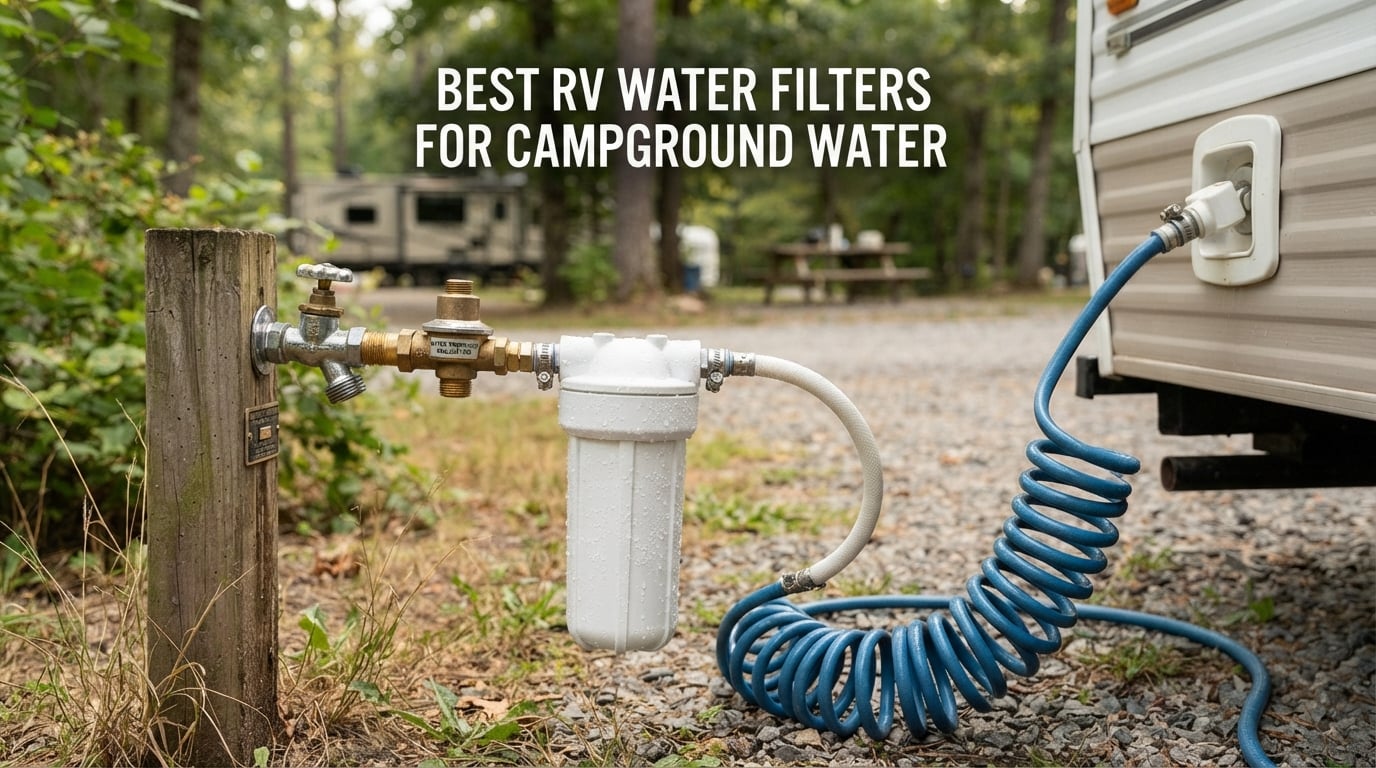
Campground water is the one supply almost every RVer learns to distrust. The spigot tastes metallic, the water runs faintly yellow, and nobody at the site can tell you when the lines were last flushed. We read owner forums and compared spec sheets to find the best rv water filters for campground water that earn their place in a wet bay.
Our short answer: the Camco TastePURE 40043 is the best overall inline filter here, the AQUA CREST inline is the best balance of certification and measurable chlorine reduction, and the GLACIER FRESH GF36 two pack is the pick for short seasonal trips. All three are inline filters, the category that suits most rigs.
The rest of this roundup covers twelve filters in detail, including one permanently mounted canister for people tired of rebuilding a hose connection every spring. Later sections cover micron ratings, why NSF/ANSI 42 and 53 are not the same thing, the hookup order owner forums converge on, and an honest list of what no inline filter can fix.
Every product below attaches to a standard 3/4 inch garden hose fitting and none require cutting into RV plumbing. If your problem is drinking water at the kitchen tap rather than everything from the shower, our under-sink water filter picks cover the point-of-use end of the market.
Table of Contents
Top 3 Best RV Water Filters for Campground Water

Camco TastePURE 40043
- GAC and KDF media
- 20 micron sediment filter
- NSF/ANSI 42 53 and 372 certified
- Made in the USA

AQUA CREST Inline Filter
- NSF/ANSI 42 and 372 certified
- KDF plus coconut shell GAC
- 0.5 gpm with no pressure loss

GLACIER FRESH GF36
- Lab tested 97.9 percent chlorine reduction
- GAC and KDF media
- Two hose protectors included
Best RV Water Filters for Campground Water in 2026 at a Glance
What separates these filters is media type, certification, flow rating and how much water a cartridge is rated to treat. The table below lists all twelve with the specs that change the buying decision.
| Product | Specifications | Action |
|---|---|---|
| Camco TastePURE 40043 |
|
Check Latest Price |
| GLACIER FRESH GF36 2 Pack |
|
Check Latest Price |
| AQUA CREST Inline Filter 2 Pack |
|
Check Latest Price |
 Kohree Inline Filter 2 Pack Kohree Inline Filter 2 Pack |
|
Check Latest Price |
 RVGUARD Inline Filter 4 Pack RVGUARD Inline Filter 4 Pack |
|
Check Latest Price |
 BELVITA Inline Filter 2 Pack BELVITA Inline Filter 2 Pack |
|
Check Latest Price |
 Bringpure Inline Filter Z036 Bringpure Inline Filter Z036 |
|
Check Latest Price |
 Beech Lane BL-113 Dual System Beech Lane BL-113 Dual System |
|
Check Latest Price |
 Hourleey Inline Filter 2 Pack Hourleey Inline Filter 2 Pack |
|
Check Latest Price |
 lifeegrn Lg4023 2 Pack lifeegrn Lg4023 2 Pack |
|
Check Latest Price |
 Lifefilter RV Marine 2 Pack Lifefilter RV Marine 2 Pack |
|
Check Latest Price |
 ICEPURE ICP-YW003 2 Pack ICEPURE ICP-YW003 2 Pack |
|
Check Latest Price |
1. Camco TastePURE 40043 — Best Overall Inline Filter for Campground Water
Camco Tastepure RV Water Filter – GAC & KDF Filtration – Made in the USA
20 micron sediment filter
GAC and KDF media
NSF/ANSI 42, 53 and 372 certified
Made in the USA
Pros
- Clears badly tasting park water
- Lead-free certified to three NSF standards
- Flexible hose protector resists kinks
- Built in the USA
- Largest review base in the group
Cons
- Seasonal replacement needed
- Black carbon flush on first use
- Adapter can leak if not seated square
There is a reason you see a Camco TastePURE screwed onto a hose at nearly every campground loop in North America. It has been the default inline filter longer than most people have owned their trailer, and the taste and odor improvement is the single most repeated comment across its review base.
What separates it from cheaper inline filters is the certification stack. It is listed as NSF/ANSI 42, NSF/ANSI 53 and NSF/ANSI 372 certified, meaning it has been tested for material safety and lead-free compliance rather than simply assembled.
Internally it runs a 20 micron sediment screen ahead of GAC and KDF media, and the KDF copper-zinc media carries the bacteria and mold control claim rather than the carbon alone. The wide body housing exists specifically to avoid choking flow.
The included flexible hose protector is a small detail owners mention more than anything else. It spreads the strain of the housing weight across the connection so the spigot fitting is not levered sideways, which prevents a class of slow leaks that plague cheaper inline setups.
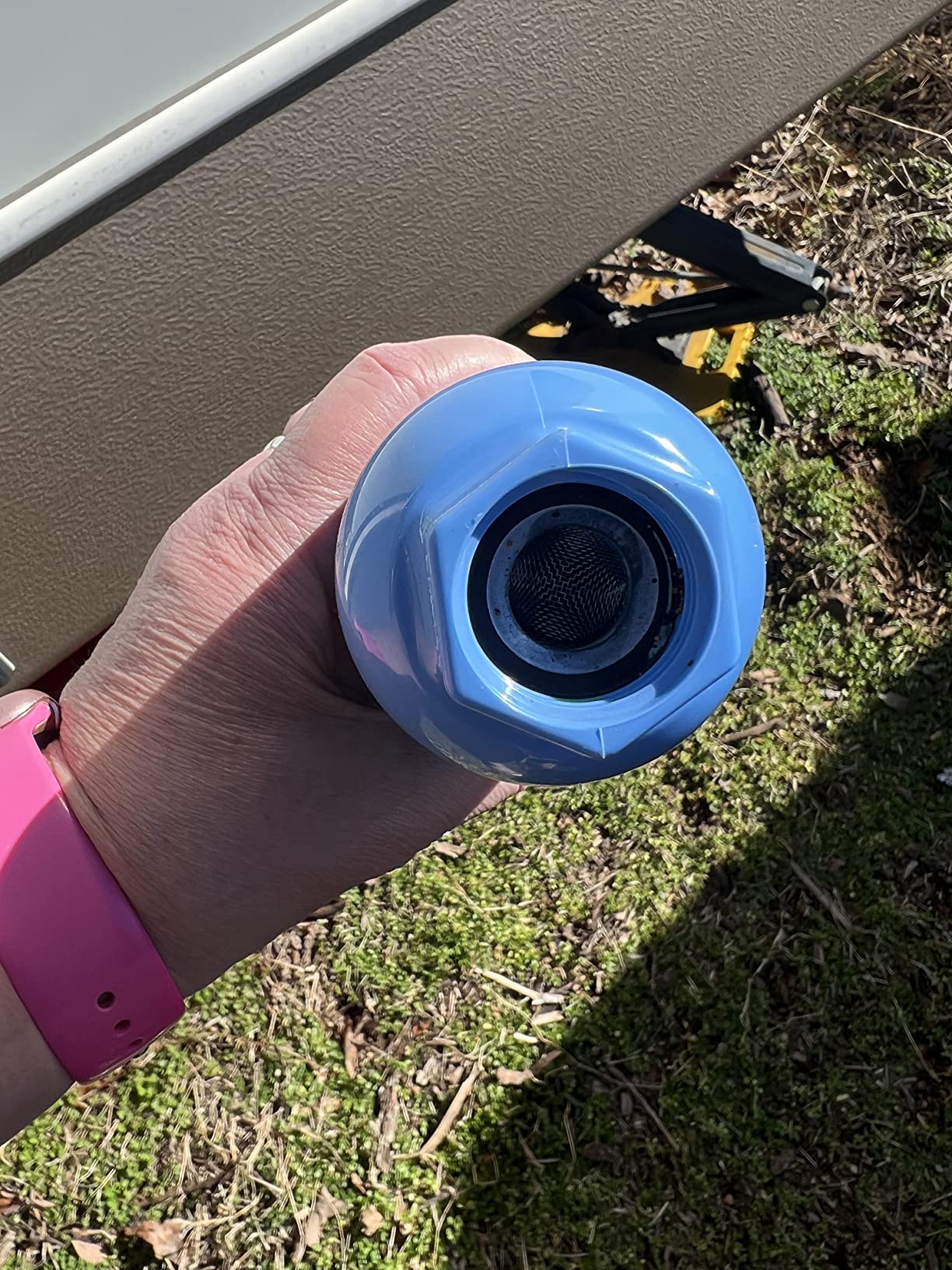
At 3.1 inches deep by 3.9 inches wide by 7.6 inches tall and 16 ounces, it is genuinely portable, and owners move it between hookups without tools.
What to check before buying this filter
Look at the adapter, not the filter. The most common complaint is a small weep where the included adapter meets the RV water inlet, and it is almost always caused by the housing hanging at an angle rather than sitting square. A bent adapter or a lower hookup height fixes it in seconds.
Then consider how long you camp in one stretch. A full-timer out for six months will not get through the season on one cartridge, and should budget for multiple cartridges or move to a permanently mounted canister.
Who should skip this filter
Skip it on well water with heavy iron. The 20 micron screen and carbon media chew through cartridge life quickly on sediment-heavy supply, and owners report swapping far earlier than the stated season.
Skip it if you need virus reduction. Carbon and KDF improve taste and handle some bacteria exposure, but an inline stage is not a pathogen barrier in the way a 0.2 micron absolute membrane or a UV purification stage is. Immunocompromised family members should get purification downstream of the inline stage.
2. GLACIER FRESH GF36 — Best Budget 2 Pack for Seasonal Trips
GLACIER FRESH RV/Marine Water Filter with 1 Flexible Hose Protectors 2 Pack
Lab tested 97.9 percent chlorine reduction
GAC and KDF media
20 micron rating
Two hose protectors
Pros
- Two protectors cover separate hookups
- No noticeable flow restriction
- Reinforced housing resists bursting
- Lab tested chlorine reduction figure
Cons
- No storage caps for travel
- Rough initial flush of blue gray water
- Higher one-star share than most filters here
The GLACIER FRESH GF36 two pack is the value pick of this list. You get two complete inline filters with hose protectors, enough for a couple of short seasons or two separate hookups at once, using the same GAC and KDF pairing found in filters costing several times as much.
Chlorine reduction is the headline claim and the one most likely to matter at a municipal campground. The listing states independent lab testing to 97.9 percent chlorine removal, a more specific claim than most budget inline filters make.
Reviewers consistently note that flow stays essentially unchanged after installation, a genuine advantage over filters that add noticeable backpressure. It is also frequently put to work beyond drinking water, for filling a pool or washing a car at the site.
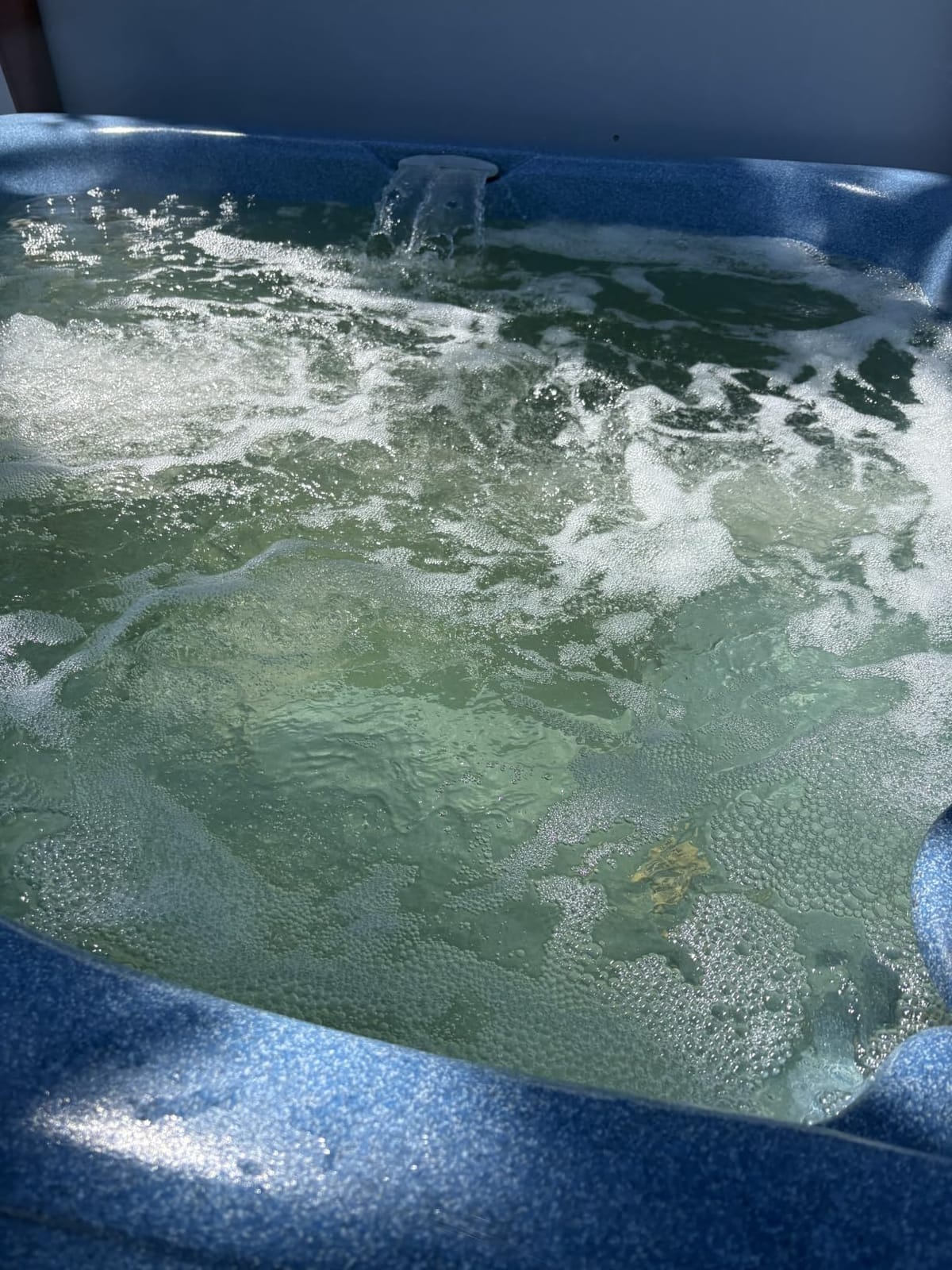
The 20 micron rating tells you this is a taste and odor device, not a particle barrier. It will not stop Giardia or Cryptosporidium cysts, and it is rated for roughly one three-month camping season per filter, so the two pack maps neatly onto a pair of short trips.
There are no screw-on storage caps. If you move sites mid-season, a wet open carbon bed is the first thing to pick up contamination, and a loose cap or zip bag solves it for very little.
What to check before buying
Check your camping pattern. A three-month rated cartridge life is honest, and two filters will not get a year-round camper through a full year without buying more.
Plan the first flush too. Owners report a light blue or gray tint for the first few minutes as carbon fines wash out, and this is best done at the spigot before you connect rather than in your fresh water tank.
Who should skip this filter
Skip it if you camp year round and want a single annual purchase. Skip it if you need a named health-effect certification, because the certification listing here is thin compared with competitors that state specific standards.
It is also the wrong pick for a trailer used seasonally with water sitting in the filter for months. A carbon bed that stays wet and unused is exactly the situation where bacterial growth becomes a concern, and this filter gives you no caps to protect it.
3. AQUA CREST Inline Filter — Best Value for Measurable Chlorine Reduction
AQUA CREST RV Inline Water Filter, Garden Hose & Camper Water Filter
NSF/ANSI 42 and 372 certified
KDF plus coconut shell GAC
0.5 gpm flow rate
Tool-free install
Pros
- Verified chlorine drop with a test kit
- No pressure or flow loss
- Tool-free install under five minutes
- 360 degree rotating hose protector
- Reduces iron and hydrogen sulfide
Cons
- Does not stop water spots from dried minerals
- Chlorine reduced but not eliminated
- Coconut shell carbon may matter to some
The AQUA CREST is the filter we would pick if the buyer is the kind of person who buys a residual chlorine test kit and checks. One reviewer measured 0.8 to 1.0 ppm at the tap and 0.1 to 0.2 ppm after the filter, calling it very good without claiming perfection.
The media is KDF combined with coconut shell granular activated carbon, the pairing that gives these inline filters their taste improvement. Owners report strong results on chlorine, rust, sulfur and tannin staining, which covers most of what shows up at park spigots.
It carries NSF/ANSI 42 and NSF/ANSI 372 certification, so the housing material is verified lead-free rather than claimed to be. That matters because the RV water inlet itself is a common source of trace metal pickup.
The spec sheet claims triple precision testing at ten times working pressure, 400 psi and 100,000 pulse cycles. Regardless of the numbers, the practical result reported by owners is a housing that does not crack and threads that do not leak.
Service flow is 0.5 gpm, the figure nearly every inline filter here carries. That is not slow for a drinking filter. The 360 degree rotating protector with anti-rust copper heads swivels so the housing can hang in a comfortable orientation instead of levering against the spigot.
What to check before buying
Buy a residual chlorine test kit if you camp at heavily chlorinated municipal sites. This filter reduces chlorine rather than eliminating it, and knowing your residual before and after tells you whether the cartridge is still worth anything.
Check your fitting size too. It attaches to any standard 3/4 inch GTH-threaded hose and installs in either orientation, which is unusual and useful in tight wet bays.
Who should skip this filter
Skip it if hard water spots are your main complaint. Reviewers note plainly that it does not reduce the mineral deposits behind air-dried water spots, and no inline carbon or KDF filter does. That is a softener problem.
Skip it if you have a sensitivity to coconut shell carbon. The media is explicitly coconut shell based, which matters to a small number of buyers and is worth knowing beforehand.
4. Kohree Inline Filter 2 Pack — Best for High-Chlorine Municipal Water
Kohree RV Water Filter, NSF Certified Inline Water Filter, BPA Free, 2 Pack
Five layer filtration
20 micron sediment filter
Up to 1057 gallon capacity
0.5 gpm flow rate
Pros
- Rated for over 1000 gallons of use
- Tight threads with no leaking
- Good value against name brand filters
- Tool-free screw-on installation
- Handles garden watering too
Cons
- Stacking two in series cuts flow sharply
- Swaps early in heavy chlorine areas
- Needs a carbon flush before first use
The Kohree stands out for one number: a rated capacity of up to 1,057 gallons per filter. Most inline filters here are described as a three-month camping season, which tells you nothing about how much water you actually use. A gallon rating lets you do the arithmetic against your own household.
Reviewers frequently compare it favorably to the Camco on value, saying the water tastes and smells better than filters costing roughly double. That comparison only shows up after a filter has been through a few thousand gallons.
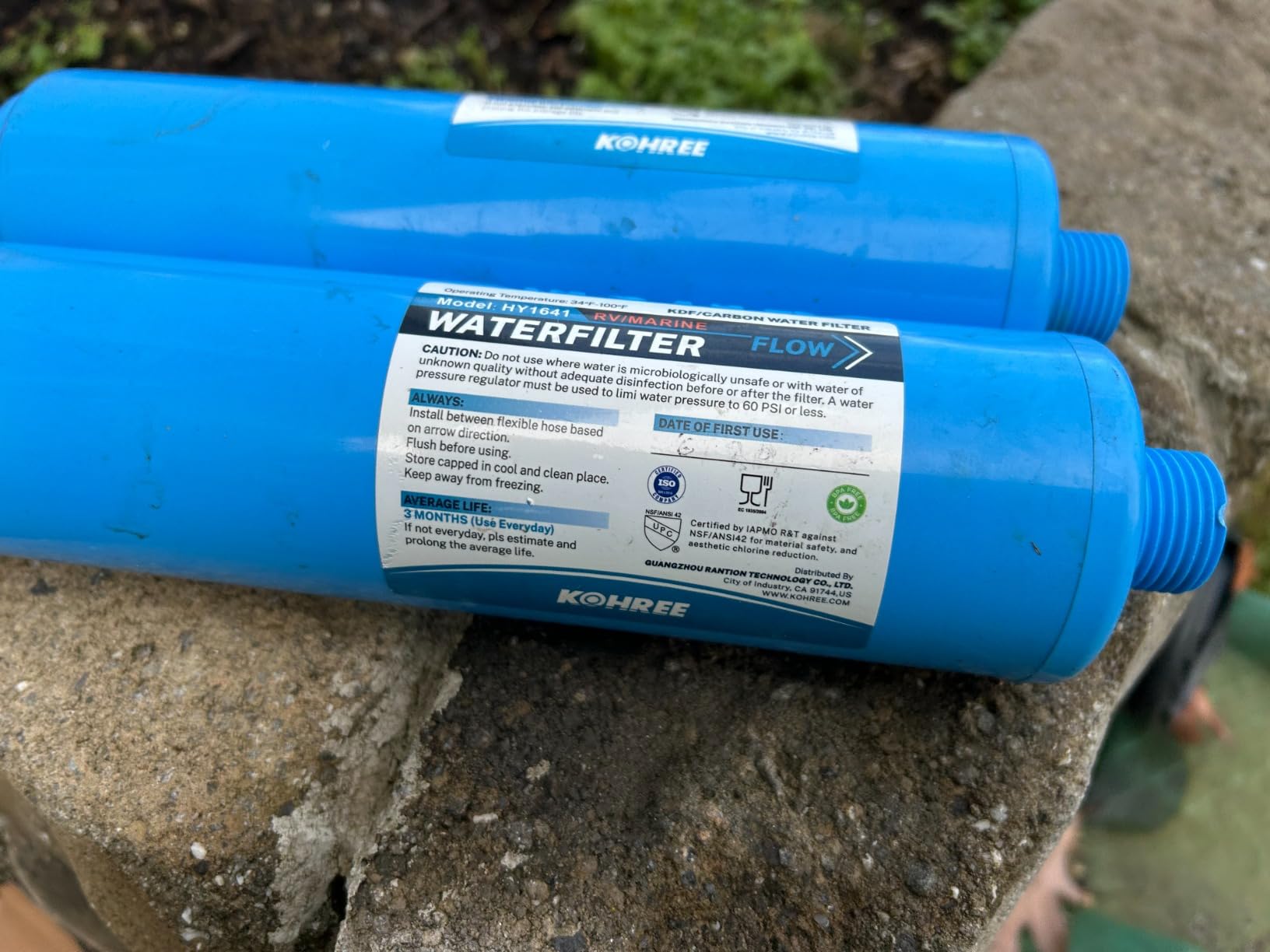
The construction is a five-layer stack with a 20 micron internal sediment filter under GAC and KDF media. It is NSF certified and BPA free, and the housing is described as thicker food-grade plastic that has passed burst pressure testing.
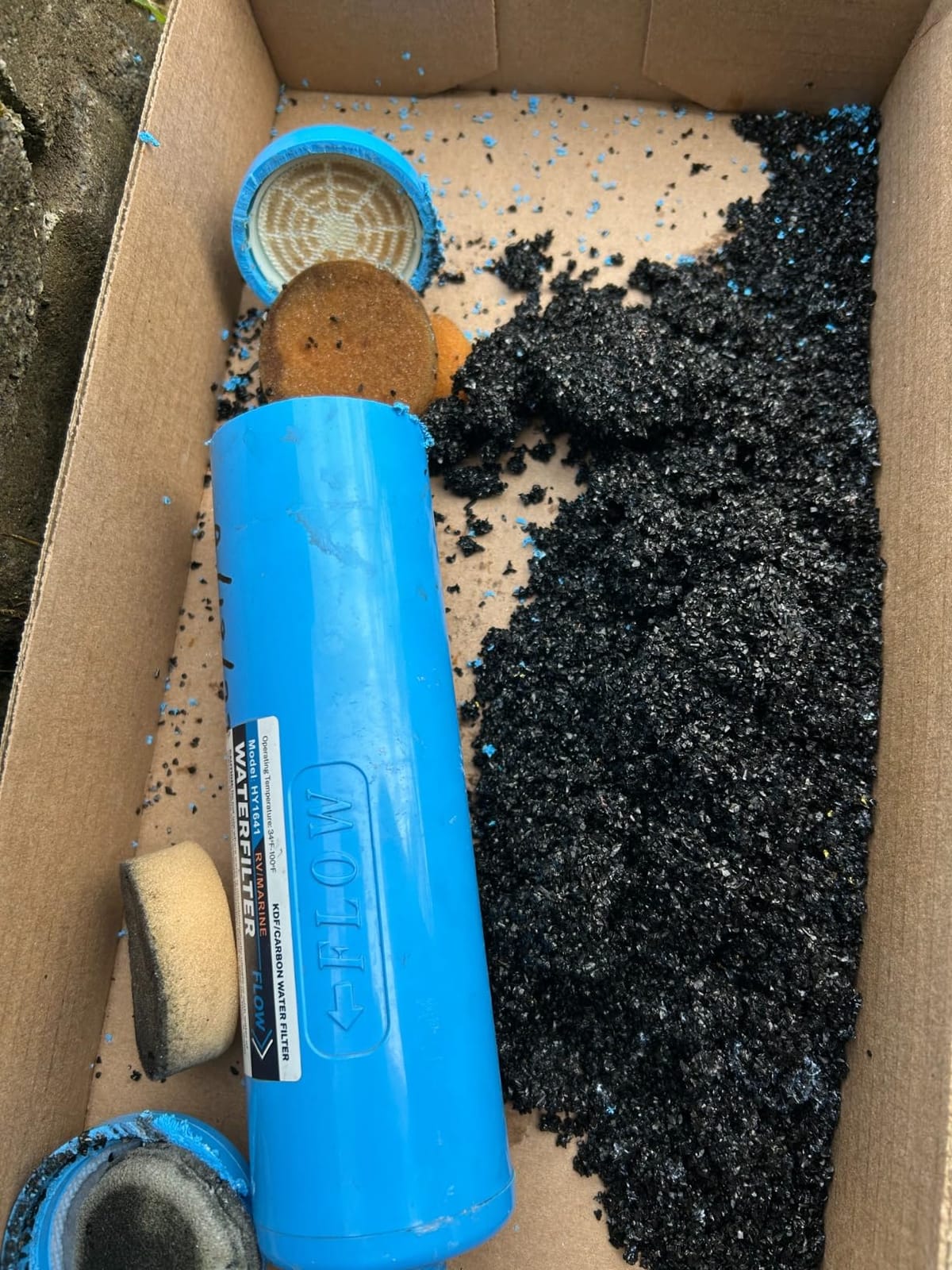
Service flow is 0.5 gpm through a wide body design, so the extra layers do not choke the stream. Replacement guidance is every three to six months, which is more honest than a single figure and lets you match the interval to your own use.
One pattern worth flagging: a buyer in a high-chlorine municipality found that running two of these in series cut flow by more than half and required monthly swaps. Stacking inline filters is a false economy. Parallel hookups work far better.
What to check before buying
Do the gallon math first. At ten gallons a day for drinking, cooking and hand washing, 1,057 gallons is a little over a hundred days. That is a full season, not a single weekend.
Decide whether you want one filter or two. A two pack lets you dedicate one unit to drinking water and one to greywater or car washing, keeping the drinking cartridge from clogging with sediment as quickly.
Who should skip this filter
Skip it on iron or sediment-heavy sources. A single 20 micron screen ahead of the carbon loads up faster than the gallon rating suggests, and replacement frequency climbs with it.
Skip it if you need a named health-effect certification for pathogen reduction. An inline carbon and KDF stack should be understood as a taste and odor device that also reduces some heavy metals, not as verified cyst or bacteria filtration.
5. RVGUARD 4 Pack — Best for Multi-Season and Multi-Hookup Ownership
RVGUARD Inline RV Water Filter, 4 Pack
IAPMO R and T certified to NSF/ANSI 42
60 psi working pressure
15000 gallon capacity
Pros
- Four filters per pack
- Published pressure and temperature range
- 18 month manufacturer warranty
- Clear first-use flush guidance
- Attaches to any standard hose
Cons
- Listed gallon capacity is not independently verified
- Dispenses dark carbon on first use
- Higher one-star share than most here
The RVGUARD four pack solves a logistics problem more than a filtration problem. If you travel between two rigs, run a boat and an RV, or simply do not want to think about cartridge timing, having four complete filters with published pressure and temperature ratings means you can stop planning.
It is IAPMO R and T certified to NSF/ANSI 42, a testing body independent of the manufacturer. Owners who shop by certification rather than by price repeatedly name that as the reason they chose it over cheaper unverified hoses.
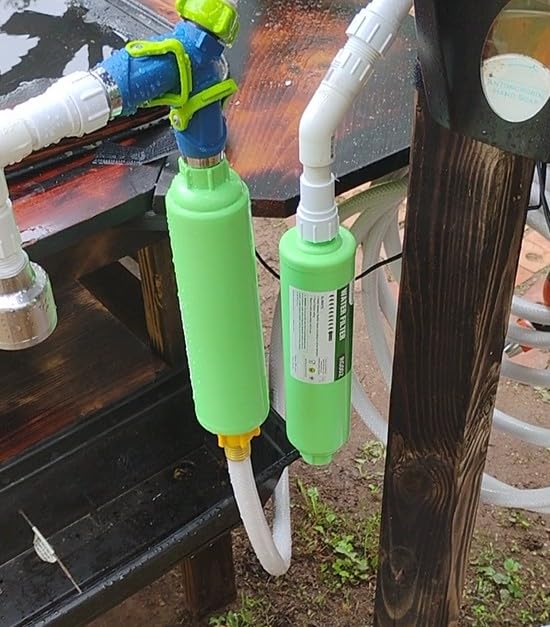
The spec sheet is unusually complete for a budget filter: 60 psi working pressure, an operating range of 34F to 100F, 0.5 gpm service flow, a 20 micron rating and a three-month lifespan per unit, all stated rather than implied.
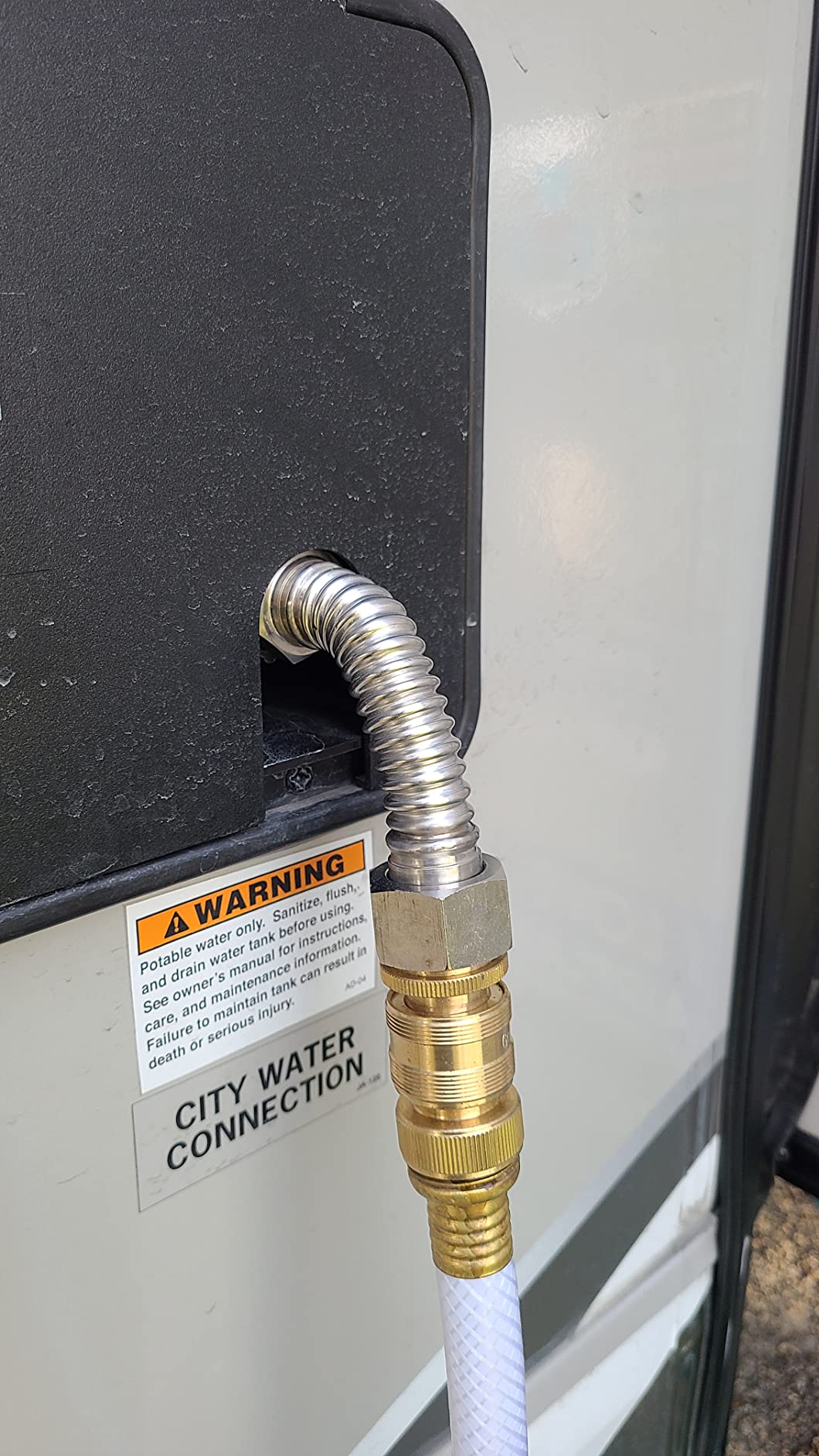
An 18 month manufacturer warranty also stands out, where most inline filters here offer a year or nothing. For anyone whose housing has cracked mid-trip, that coverage is worth more than it looks.
The listed 15,000 gallon capacity deserves a caveat. Buyers do not report that figure being independently confirmed, so treat it as a marketing ceiling and plan on the three-month interval instead.
What to check before buying
Check your campground pressure before hooking up. At 60 psi working pressure, a spigot that runs hard above that is a real risk, and an upstream regulator costs very little.
Check the season too. Three months per unit means four filters cover roughly a full year of continuous use, which is convenient for a full-timer and far more than a weekend camper needs.
Who should skip this filter
Skip it if you camp a handful of weekends a year. Four cartridges will outlast the housing itself, and you will end up storing carbon that has sat in a humid compartment for years.
Skip it if you camp below freezing. The stated operating range bottoms out at 34F, and a wet cartridge in a frozen wet bay is a wasted unit as well as a crack risk.
6. BELVITA 2 Pack — Best for Iron-Heavy Well Water
BELVITA RV inline water filter with Flexible Hose Protector
GAC and KDF media
Reduces lead and fluoride
Reinforced food-grade shell
2 hose protectors
Pros
- Month install stickers track replacement
- Handles well water and trailer hookups
- Installs in under five minutes
- Useful on hard water for car washing
- A cheap alternative to a full system
Cons
- Wears out in about a month in heavy iron water
- Housing weight can kink a spigot connection
- Certification is not tied to one named standard
The BELVITA is built around an idea most budget filters ignore: month install stickers. The pack includes stickers you apply to the housing when you put the filter on, which solves the most common failure in this category, which is using a filter past its rated life.
Owners pulling from iron-heavy well sites report the cartridge lasting closer to one month than the stated three. Several repeat buyers accept this and buy in volume, which says something honest about how it performs in bad water.
Media is GAC combined with KDF, reducing chlorine, sediment, bad taste and odor along with lead and fluoride claims. The reinforced food-grade shell resists cracking and impact, which matters for a part that lives in a wet bay.
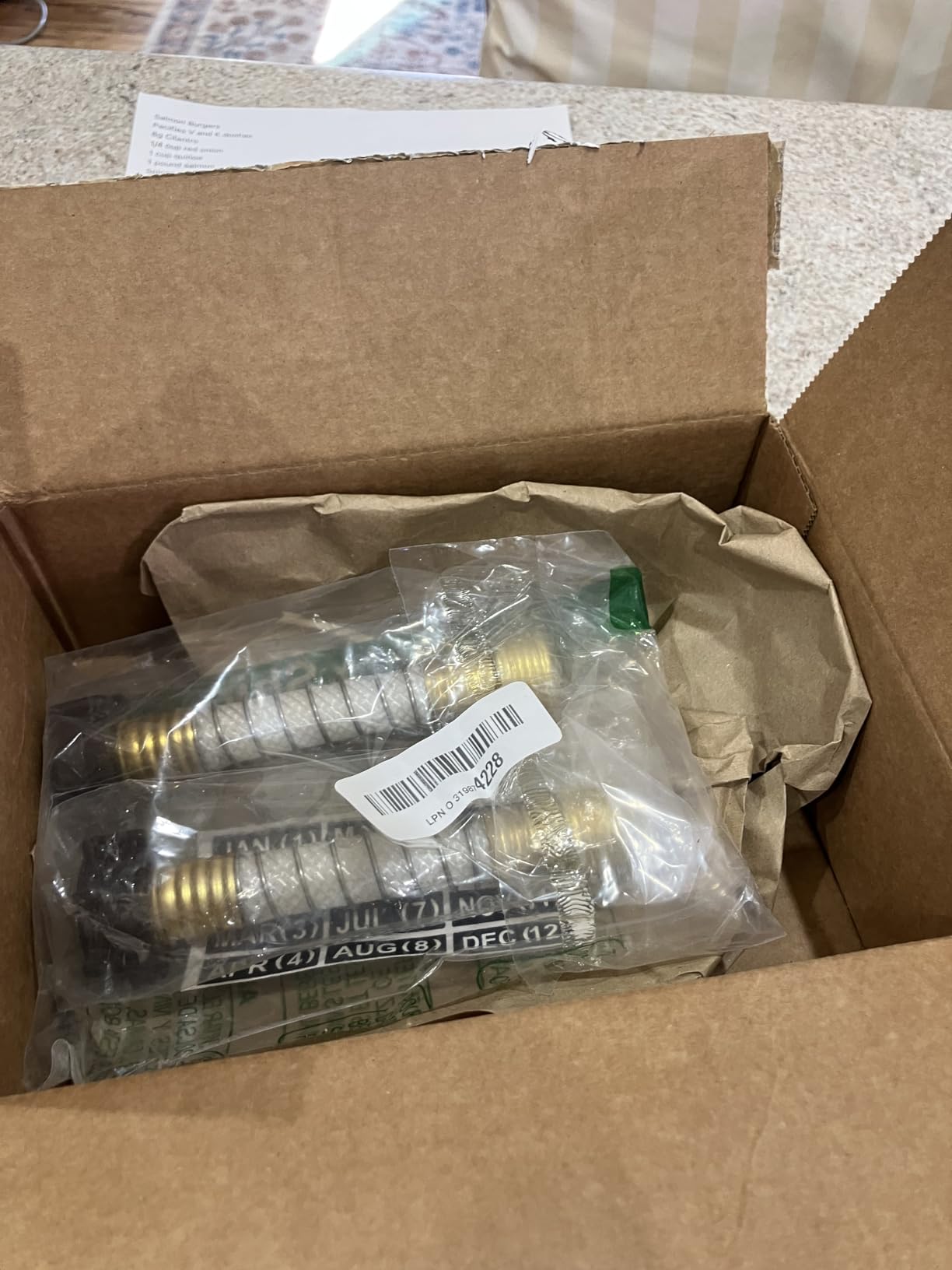
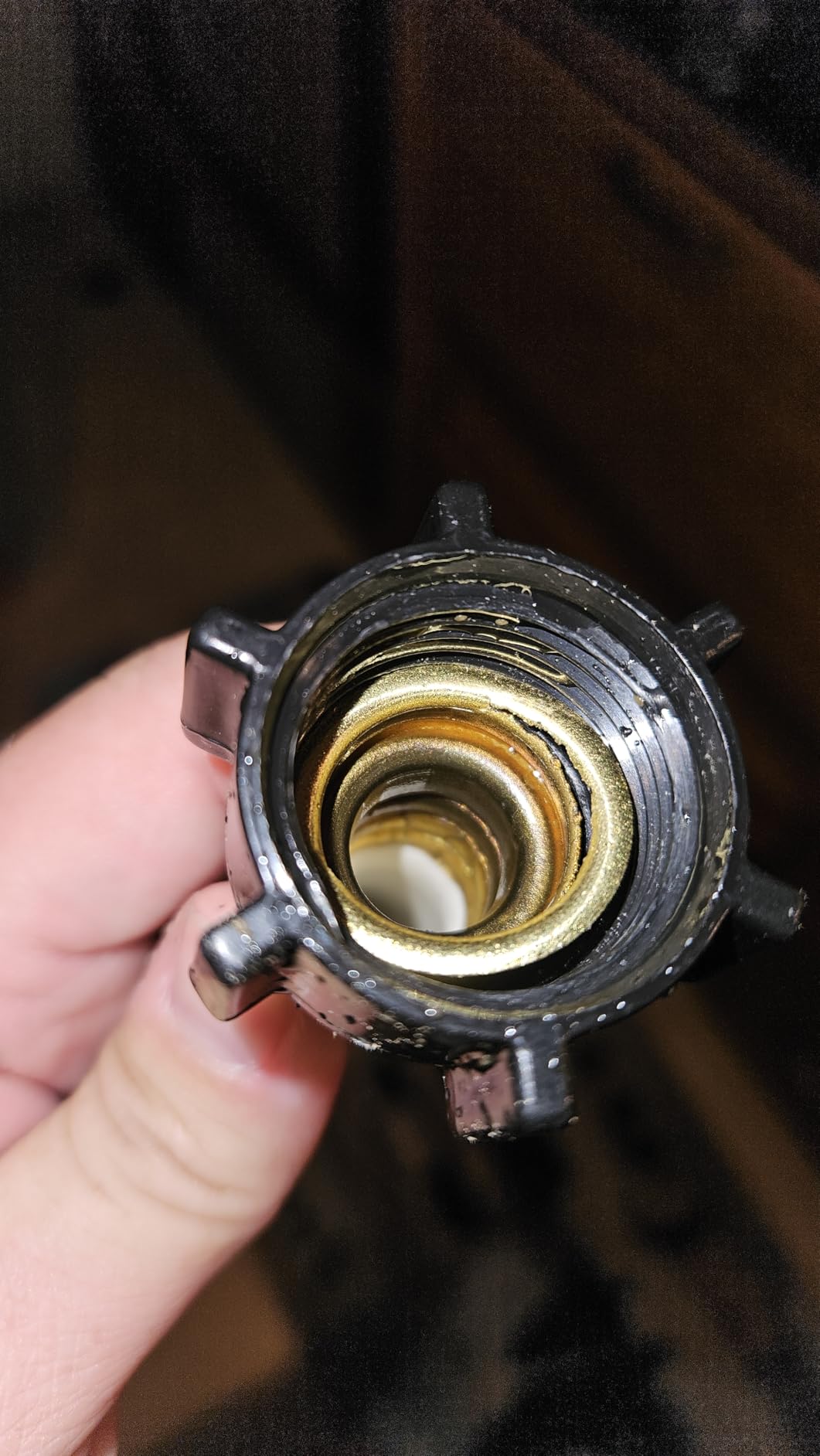
A useful trick from owners is a bent adapter or a lower outdoor spigot. At 1.9 pounds the housing is heavy enough to lever sideways on a standard park connection, and that leverage, not water pressure, causes the slow leaks people report.
Two anti-kink hose protectors are included, a step up from the single spring most competitors ship, taking strain off both ends of the run. At 2.52 inches by 10.91 inches it is slim enough for a narrow wet bay.
What to check before buying
Check the certification line carefully. The page lists several standards and organisations but does not tie them to one named standard the way NSF/ANSI 42 and 372 statements do on some competitors. If verified lead-free material matters to you, confirm before purchase.
Check how much iron is in your source. On municipal park water the three-month rating is realistic. On a well with visible orange staining, plan on monthly cartridges and keep spares on board.
Who should skip this filter
Skip it if you need certification you can point to. If you are filtering for a family member with a compromised immune system, an unverified certification claim is the wrong foundation for a drinking safety decision.
Skip it if your rig has no way to relieve strain on the connection. Without a bent adapter or a lower hookup point, housing weight will eventually work a leak into the fitting no matter how good the threads are.
7. Bringpure Z036 — Best for Leak-Free Threaded Connections
Bringpure RV Inline Water Filter with Flexible Hose Protector
97 percent chlorine reduction
NSF/ANSI 42 and 372 certified
20 micron
Heavy-duty hose protector
Pros
- Tight thread seals with no leaking
- Maintains pressure without clogging
- Highest five-star share in the group
- Clear water with no off taste after filtering
- Tool-free installation either orientation
Cons
- Cartridge life shortens on heavy sediment
- Reviews skew toward household and garden use
- Included adapter often unnecessary for RV hookups
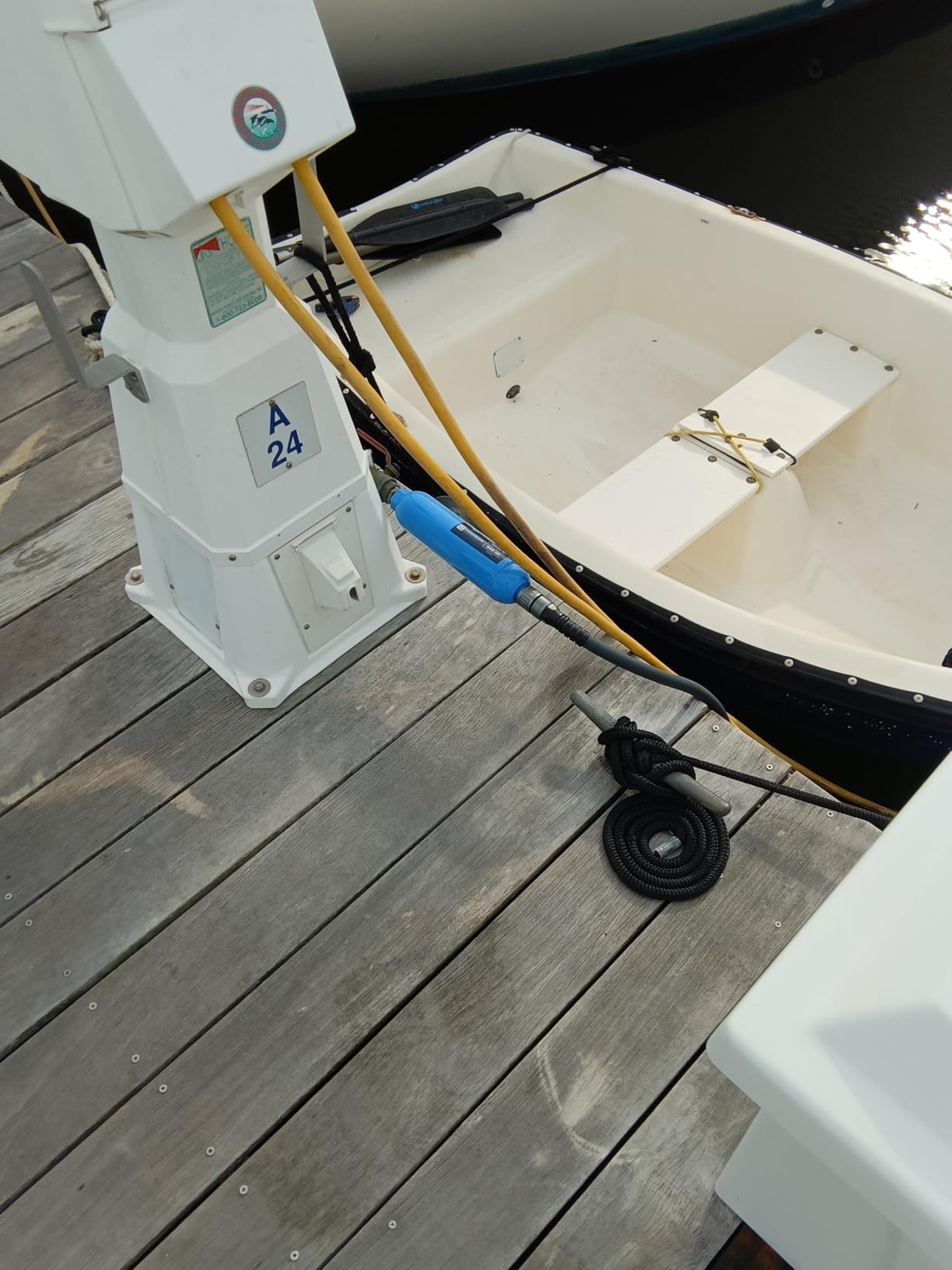
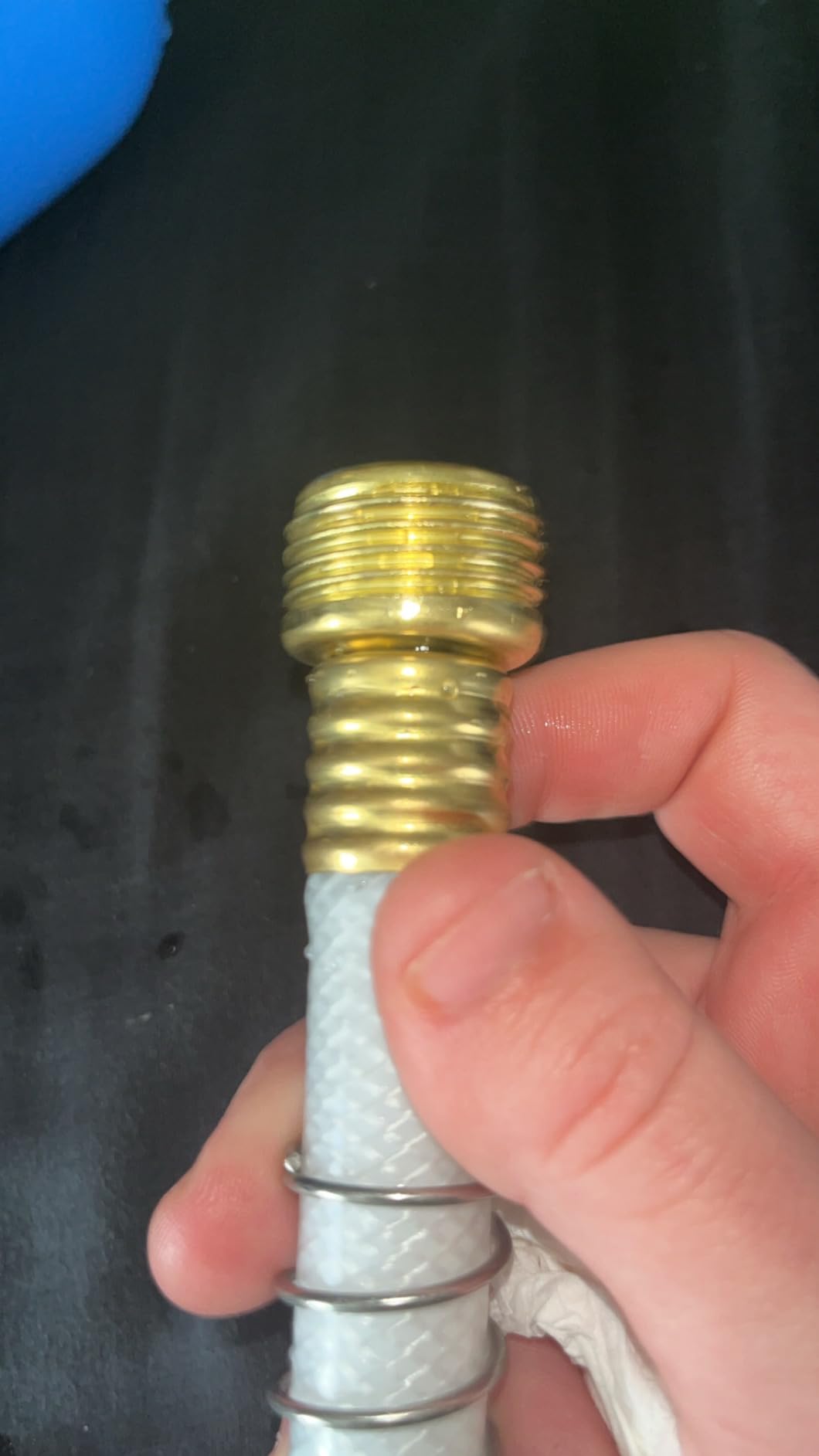
If your recurring frustration is a slow weep at the RV water inlet, the Bringpure Z036 is the one to look at. Reviewers describe the threads as tight with no leaking at the fittings, and several note that pairing it with a brass elbow keeps stress off the RV inlet.
Certification here is specific: NSF/ANSI 42 for 97 percent chlorine reduction and NSF/ANSI 372 for lead-free material. Both claims name standards with a testing body behind them rather than a generic badge.
At 4.6 stars this has the highest share of five-star ratings among the products we reviewed, which means the small number of complaints are concentrated and specific rather than spread across vague dissatisfaction.
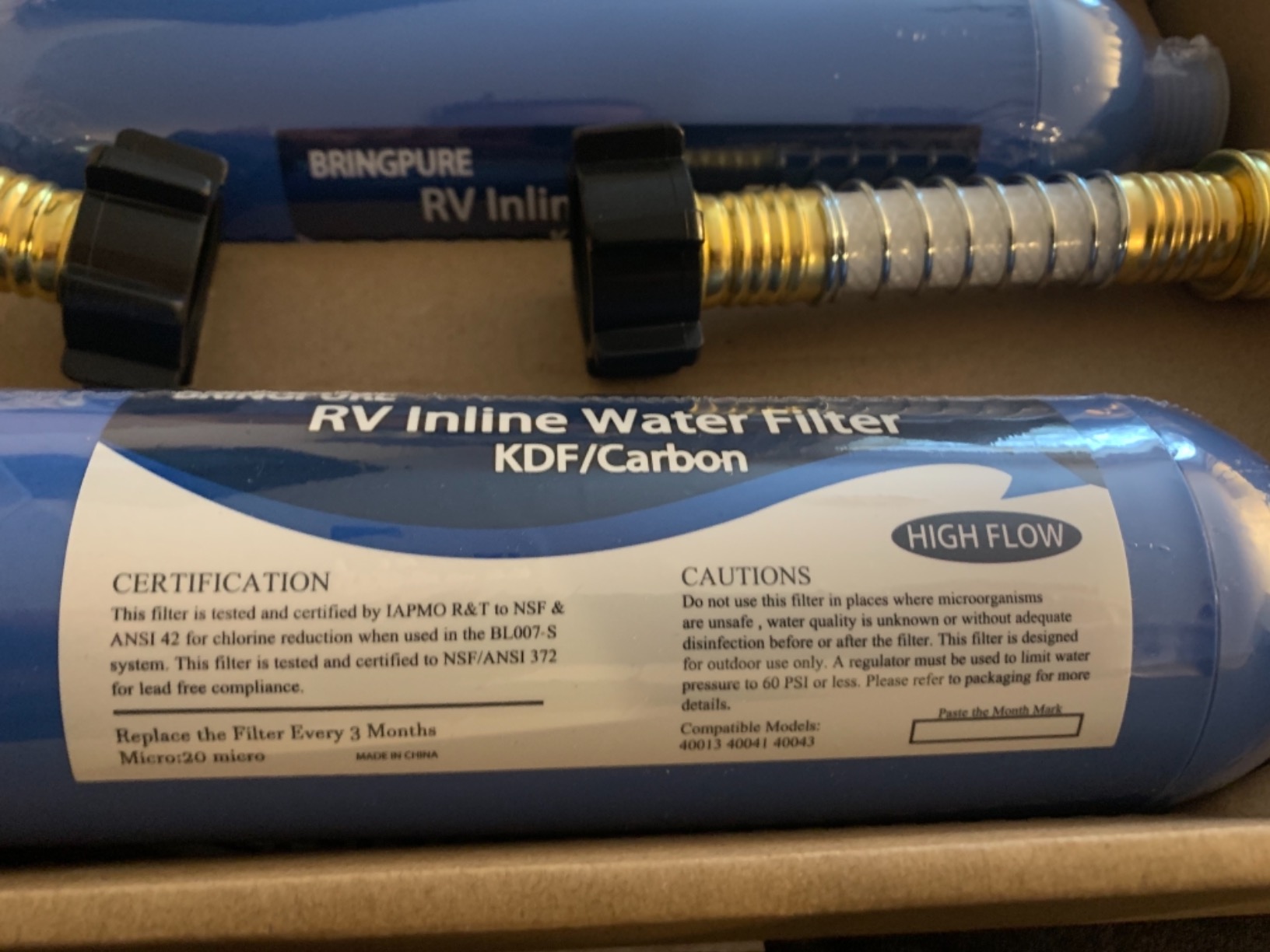
The heavy-duty anti-kink protector is thicker than the standard spring design, and the housing installs in either orientation, which matters in a wet bay where the only straight routing is not the comfortable one.
Much of the feedback comes from household and garden use rather than RV hookups. The performance claims largely transfer, but the review pool is less RV-specific than a Camco or Glacier Fresh listing.
What to check before buying
Check your RV water inlet fitting. The included hose adapter is often unnecessary on a standard inlet, and forcing an extra adapter into the chain is exactly how small leaks start. Fewer connections is more reliable.
Check the sediment load at the site. A 20 micron rating is fine on treated municipal water, but cartridge life shortens noticeably on heavily sedimented supply.
Who should skip this filter
Skip it if you want protection for your water heater. An inline filter on the hose only treats water at the moment you fill, and sediment already in the tank still settles in the heater. Only a permanently mounted canister addresses that.
Skip it if you are boondocking from an unverified source such as a park spigot or a truck bed tank. Good chlorine and taste reduction is not the same as verified pathogen safety, and this filter does not claim to be.
8. Beech Lane BL-113 — Best Permanently Mounted Canister System
Beech Lane External RV Dual Water Filter System, Leak-Free Brass Fittings, Mounting Bracket and Two Filters Included, Sturdy Construction is Built to Last
5 micron sediment plus 0.5 micron carbon block
Lead-free brass fittings
External RV canister
Pros
- Two stage 5 micron plus 0.5 micron filtration
- Brass fittings resist leaking
- Mounted outside so swaps need no plumbing work
- Lifetime manufacturer warranty
- Takes any brand of matching cartridge
Cons
- Most expensive option here and needs a permanent bracket
- Installation is more involved than an inline hose
- Cartridge changes need wrench access
The Beech Lane BL-113 is the only permanently mounted system in this roundup, and that single design decision changes everything about it. It mounts externally with a bracket, so you plumb it once and every future cartridge swap happens without touching RV plumbing.
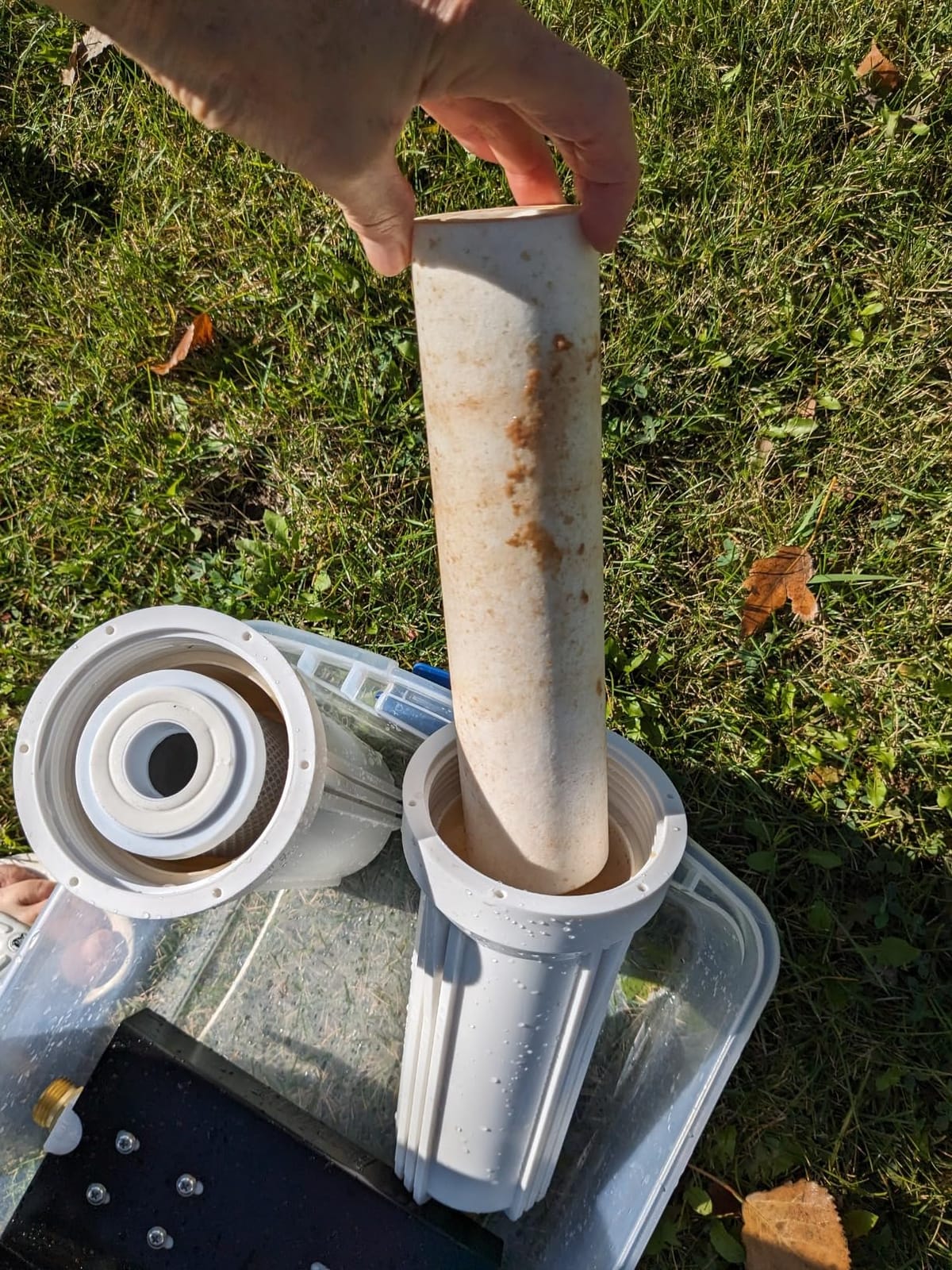
Filtration is genuinely two stage rather than one media bed: a 5 micron sediment stage paired with a 0.5 micron carbon block. The finer sediment stage protects the carbon and is what makes this a real whole-RV filter rather than a taste filter.
The fittings are 3/4 inch lead-free brass, and that is why it costs more than the plastic inline filters. Brass threads do not crack, strip or weep the way plastic housings in a wet bay eventually do.
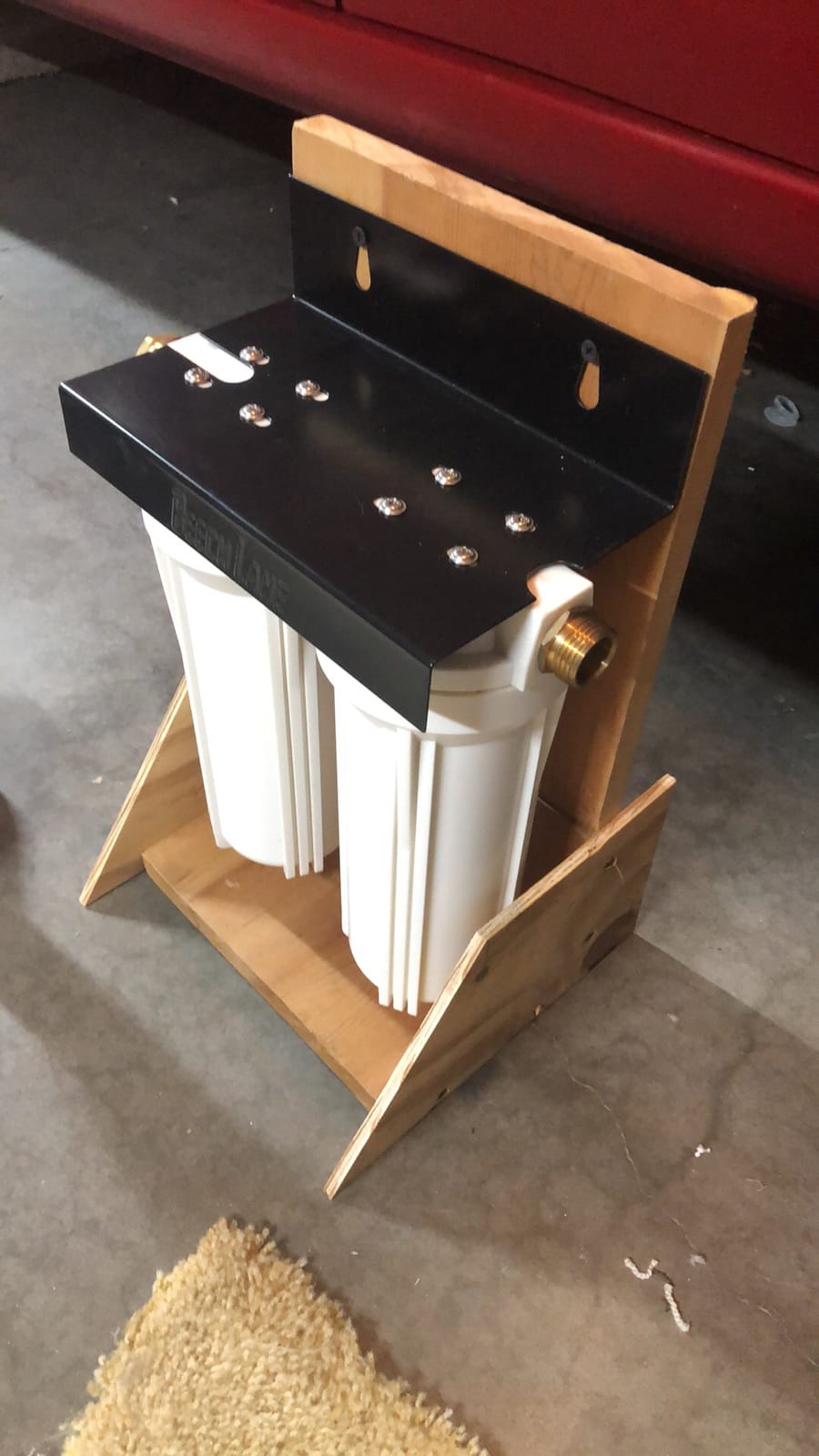
It is rated for water up to 2,000 ppm TDS. That is a tolerance figure, not a removal figure. A higher number here means the housing tolerates mineral-heavy water, not that it strips minerals out.
A replacement wrench is included and the cartridges are not proprietary. Any brand matching the same specification fits, which removes the most common long-term cost trap in RV water filtration.
What to check before buying
Check that you have a mounting surface. This is not an inline hose filter. It needs a bracket, clearance for cartridge changes, and room to pull the housing straight out without crushing a sidewall or a bay door.
Check your flow expectations. A canister with a fine sediment stage restricts flow more than a 20 micron inline screen, and a shower is the first place you will feel it.
Who should skip this filter
Skip it if you rent your trailer or swap rigs regularly. A permanently mounted system comes out and goes back in on every move, and that labour is exactly what inline filters avoid.
Skip it if you are solving a single bad week of water. A canister is a ten-year decision. For one rough municipal system, an inline filter and a spare cartridge is the cheaper answer.
9. Hourleey 2 Pack — Best for Two Hookups at Once
Hourleey 2 Pack RV Inline Water Filter with 2 Flexible Hose Protector, Reduce Bad Taste, Odors, Rust, Fluoride, Chlorine and Sediment in Drinking Water, Dedicated for RVs Campers Marines
GAC and KDF media
20 micron rating
Two flexible hose protectors
Reinforced food-grade housing
Pros
- No leaking at the connections
- Removes metallic garden hose taste
- Tool-free directional installation
- Sturdy housing for repeated seasonal use
- Good value at the two-pack price
Cons
- Monthly swaps in high mineral or high iron water
- Material listing does not match the plastic housing
- Manufacturer warranty listed as not applicable
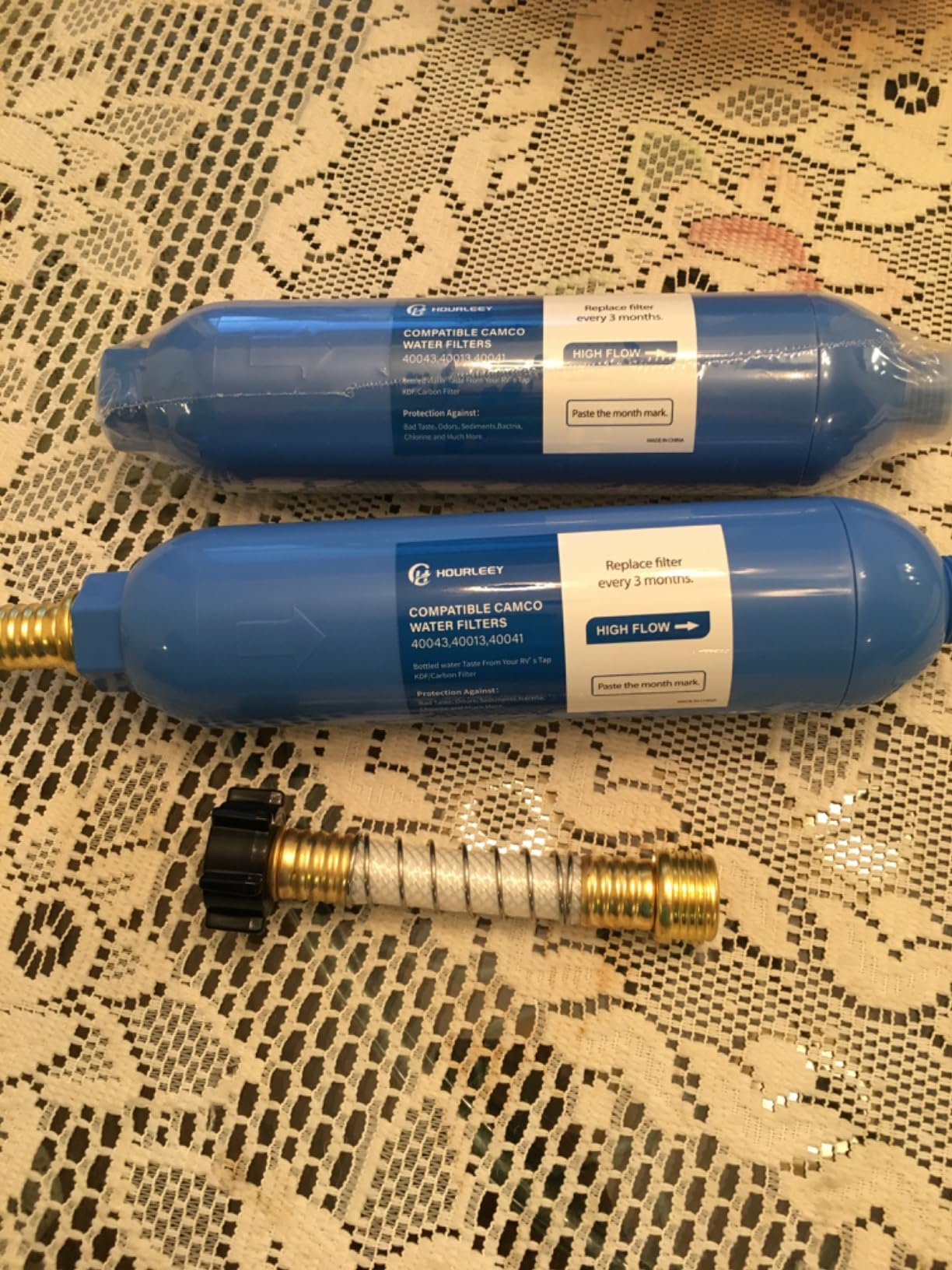
The Hourleey two pack is the practical pick when you run more than one source at a time. A common setup is one filter on the campground spigot and one on a tank or neighbouring site, and having two on hand avoids the mid-trip scramble.
Owners report the filter removing the metallic garden hose taste from water sitting in a hose, which is a distinct problem from bad source water. That taste is a function of hose material and storage time rather than the park supply.
The GAC and KDF pairing handles taste, odor, chlorine, rust, fluoride and sediment. The manufacturer also claims it regulates bacteria and mold growth while idle, which is worth taking with a grain of salt, though storing a drained filter with a cap remains the right habit.
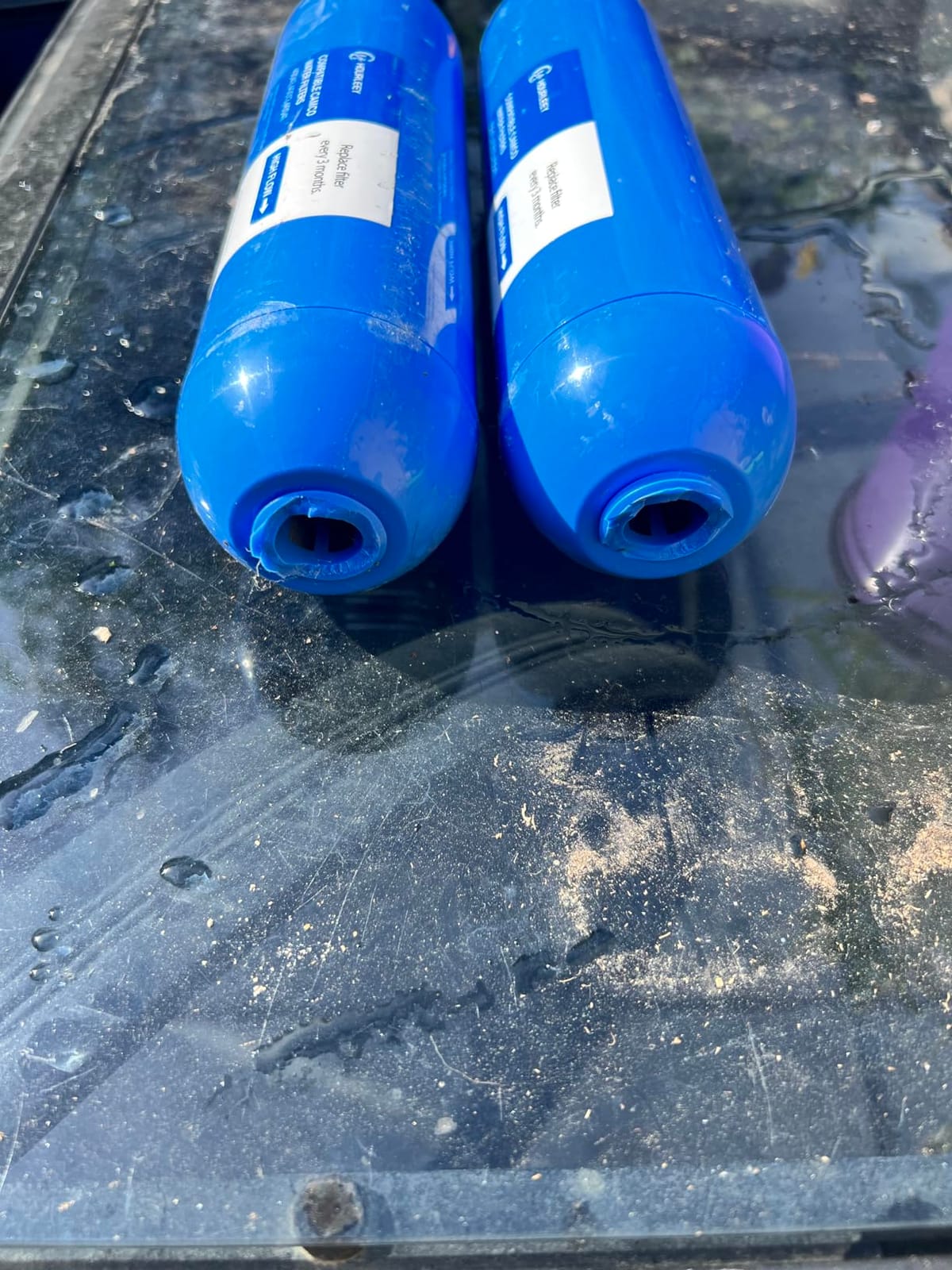
Installation is directional with no tools required, and getting flow direction right on a first install is the one thing that trips people up. The arrow is moulded into the body.
Two things to note: in high mineral or high iron water, owners swap cartridges monthly, and the listing describes a brass material that does not match the plastic housing, a sign the copy was not carefully edited.
What to check before buying
Check the warranty terms. The listing states a manufacturer warranty is not applicable, which is unusual in this price range and worth factoring in if you expect to keep it beyond one season.
Check your water chemistry. On an iron-rich well, plan monthly replacement and buy a four pack equivalent, because this only ships in a two pack.
Who should skip this filter
Skip it if you need a written warranty behind the housing. For a rig living outdoors in wet or freezing conditions, no stated warranty is a real difference from an inline option carrying an 18 month term.
Skip it if hard water is your issue. KDF and carbon improve taste and reduce some metals, but nothing in an inline carbon stack touches calcium and magnesium scale.
10. lifeegrn Lg4023 — Best for Garden, Pool and Compact Storage
lifeegrn RV Water Filter with Hose Protector – Inline Water Filter, Blue
NSF certified multi-stage
Taste odor chlorine sediment reduction
Fine mesh nozzle screen
3 month life
Pros
- Lowest cost while still NSF certified
- Easy hookup with no leaks
- Reported to taste better than bottled water
- Reduces mineral smell from RV lines
- Two filters cover roughly half a year
Cons
- No published chlorine reduction percentage
- Compact design limits total treatment volume
- Reviews skew to pool and well water
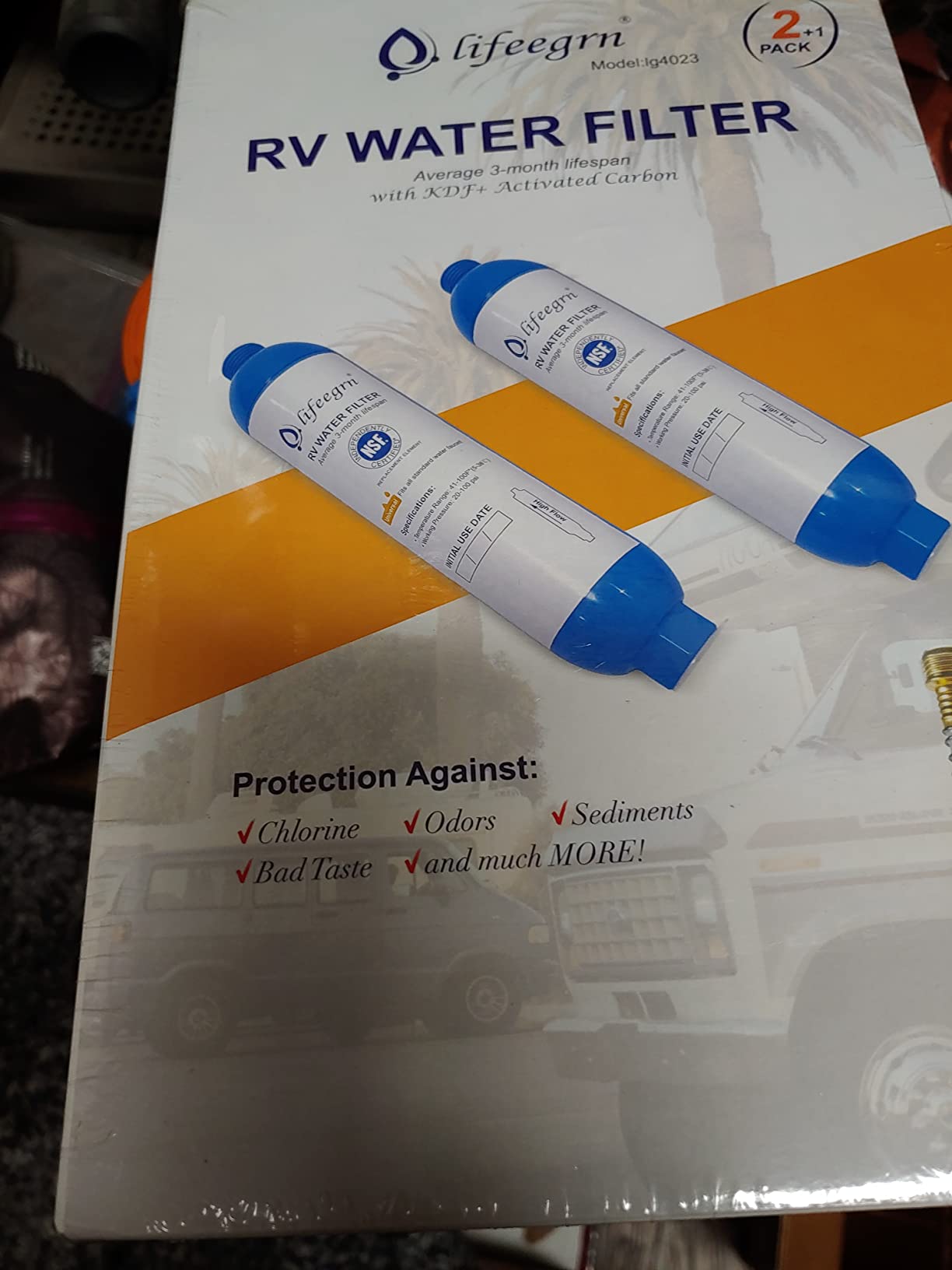
The lifeegrn is the cheapest NSF certified option we found, and that combination is unusual. Most sub twenty dollar inline filters carry no certification at all, so a verifiable standard at the bottom of the price range is worth noting.
One buyer reports the filtered water tasting better than bottled, a high bar that only gets claimed after several trips of hauling plastic. The two-pack format means roughly half a year of seasonal use from one purchase.
Media is a multi-stage structure with a fine mesh screen that stops particles from clogging the outlet nozzle. That screen is the practical feature, because a clogged nozzle shows up as a sudden loss of flow that owners often misread as a dead filter.
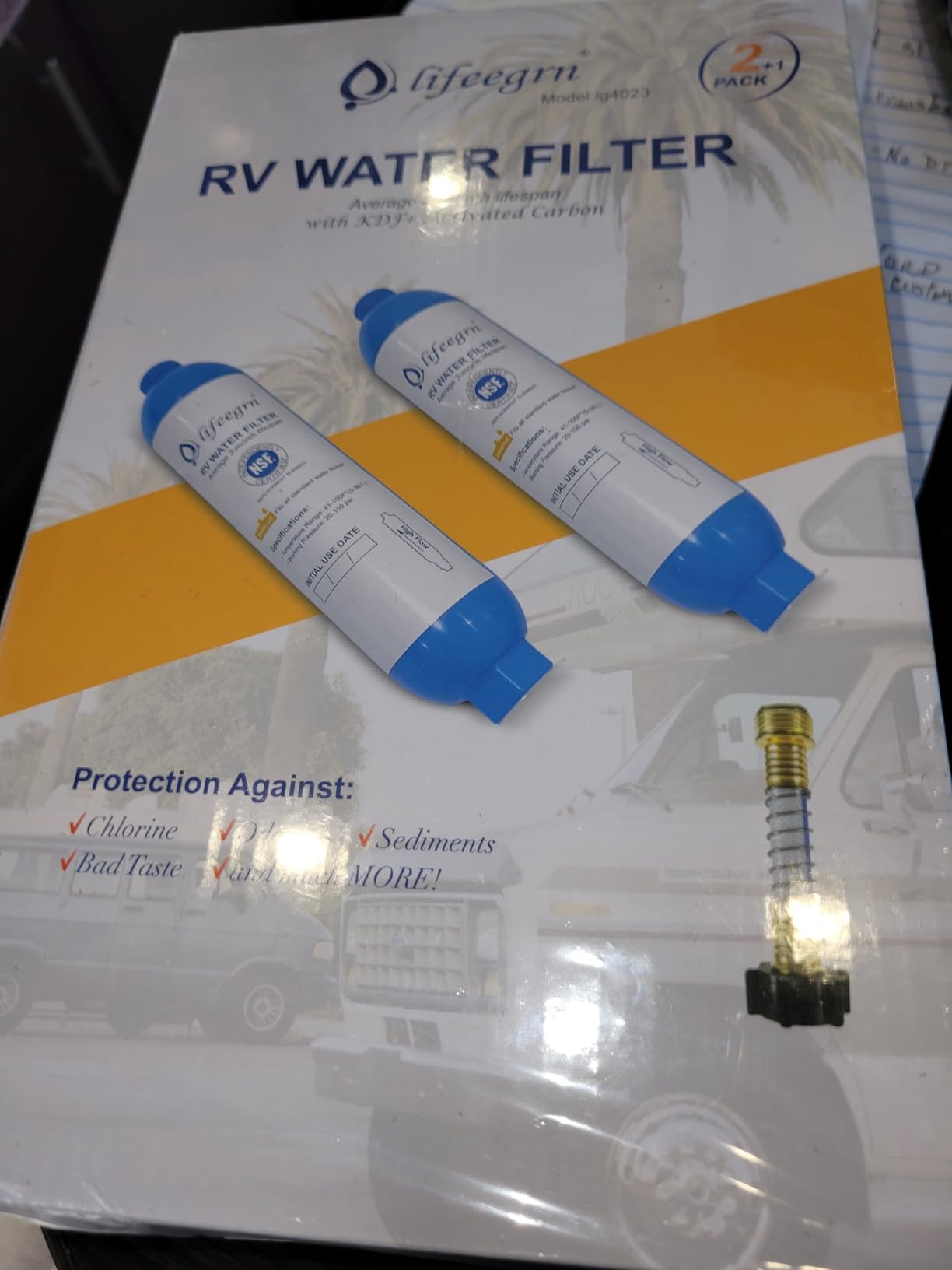
At 2.4 inches wide and 10.7 inches tall it is genuinely compact, which helps if you break camp every few days rather than parking for a month. Rated life is three months per filter.
No chlorine reduction percentage is published, so you are trusting the certification rather than a measured claim. A test kit is the only way to know the performance yourself.
What to check before buying
Check how you will use it. If you are also filling a pool or watering a garden, the compact treatment volume runs out much faster than three months suggests. Buy spares when you order.
Check that you accept an unspecified reduction percentage. If you want to know exactly what is being removed, filters that publish a figure answer that question and this one does not.
Who should skip this filter
Skip it if you need documented contaminant removal rates. The certification is real, but without a published figure you cannot make an informed comparison against filters that state their reduction percentages.
Skip it if you fill the tank through it repeatedly. At three months per cartridge and a compact housing, it is built for drinking and washing water, not high-volume tasks where a spent cartridge shows up as a flow drop.
11. Lifefilter 2 Pack — Best for Sediment-Heavy Supply Lines
Lifefilter RV/Marine Water Filter with 2 Flexible Hose Protectors
GAC and KDF media
Internal sediment screen
One three-month season per filter
Anti-kink hose protector
Pros
- Internal screen catches visible sediment
- No leaking at the hose fittings
- Good flow after installation
- Tool-free installation
- Consistent quality across repeat buys
Cons
- Can clog to a drip on heavily sedimented supply
- No NSF standard cited on the product page
- Replacement interval shortens in dirty water
The Lifefilter is built around sediment rather than taste. A multi-stage structure with an internal screen catches visible debris before it reaches the carbon, which is the right priority if you regularly fill at older parks with rust-coloured water.
Owners like the flow after installation and the way the internal screen traps sediment before it can make the water undrinkable. Repeat buyers report consistent quality across multiple purchases, a low bar several filters in this price range fail.
Media is GAC and KDF, reducing chlorine, bad taste and odor, and the listing states it does not deposit harsh minerals. Installation is tool-free with an anti-kink protector included.
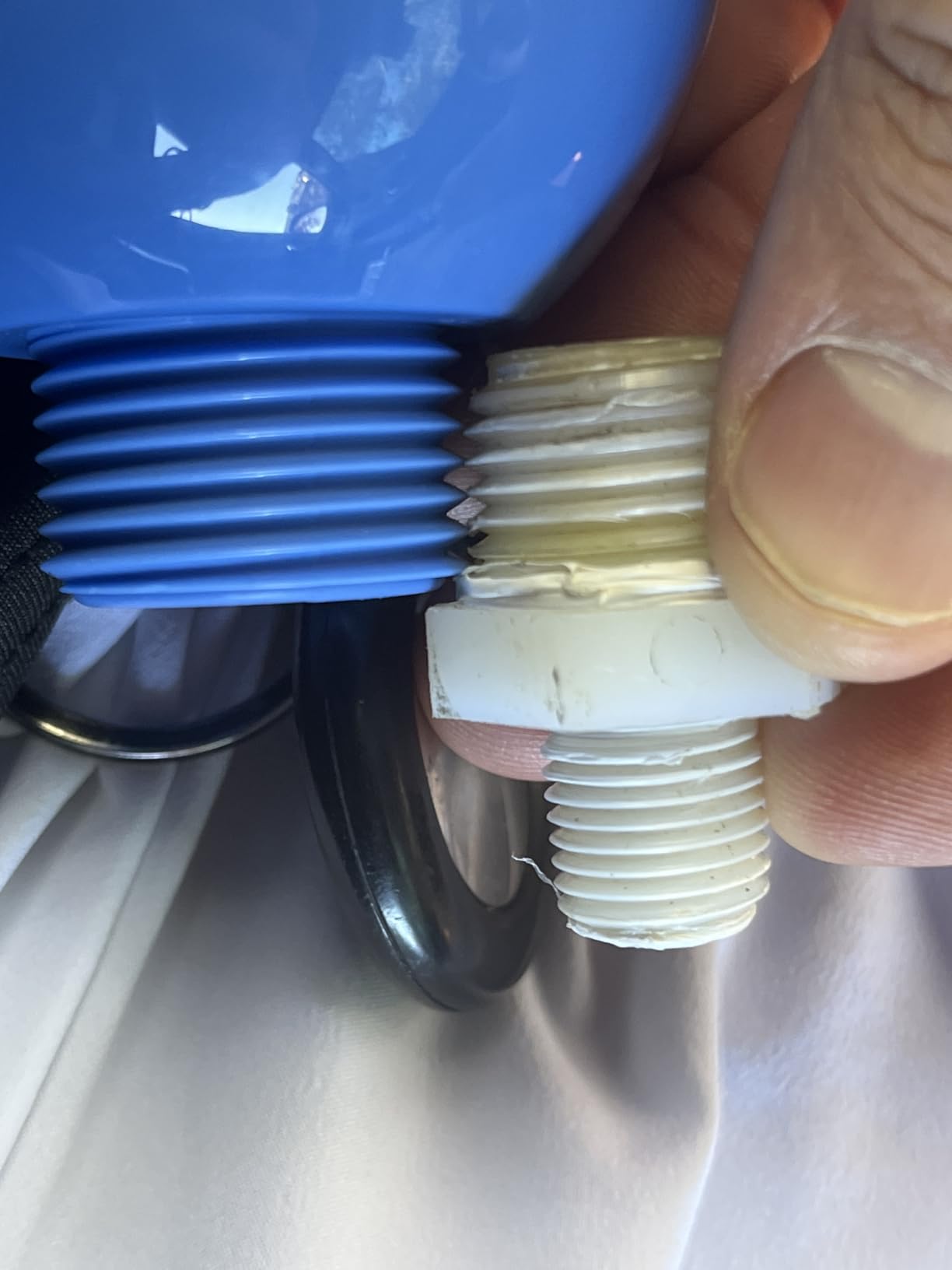
The honest drawback is clogging. One reviewer reports the unit slowing to a drip after a short period on a bad supply line, which is why the two pack is convenient rather than extravagant. Flow drop is your replacement signal, not a fault.
No NSF standard is cited on the product page, which puts it behind several competitors here on verification. If a named standard matters to your decision, choose a filter that states one.
What to check before buying
Look at the water before you connect. If it pours cloudy or orange, this filter will protect your system from debris but will need replacing much sooner than the stated season.
Check that a flow drop does not fool you. A slow trickle at the site tap after a few weeks usually means a loaded screen, not a failed filter, and it is easy to misdiagnose.
Who should skip this filter
Skip it if you need certified performance. With no NSF standard cited, this is a taste and sediment filter with no third-party verification, which is a hard limit when filtering for health reasons.
Skip it where water is heavily mineralised. The internal screen fills quickly, and a filter that clogs to a drip after a week is worse than one rated for the conditions.
12. ICEPURE ICP-YW003 — Best for International and Multi-Standard Certification
ICEPURE RV Water Filter system for Garden, RV, Pool, Camper, Marine, Boat Hose for Drinking, Car Washing, Gardening, Planting, Spa, Reduces Chlorine, Odors, with 1 flexible hose protector, 2PACK
IAPMO certified to NSF/ANSI 42
European EC food grade
GAC and KDF media
Lifetime warranty
Pros
- Widest certification coverage in the group
- Reduces VOC THMS and turbidity
- Retains beneficial minerals
- Lifetime product warranty
- Tool-free install with hose protector
Cons
- Highest one-star share among the top-rated products
- Only one hose protector for a two-pack
- Filter life varies with incoming water
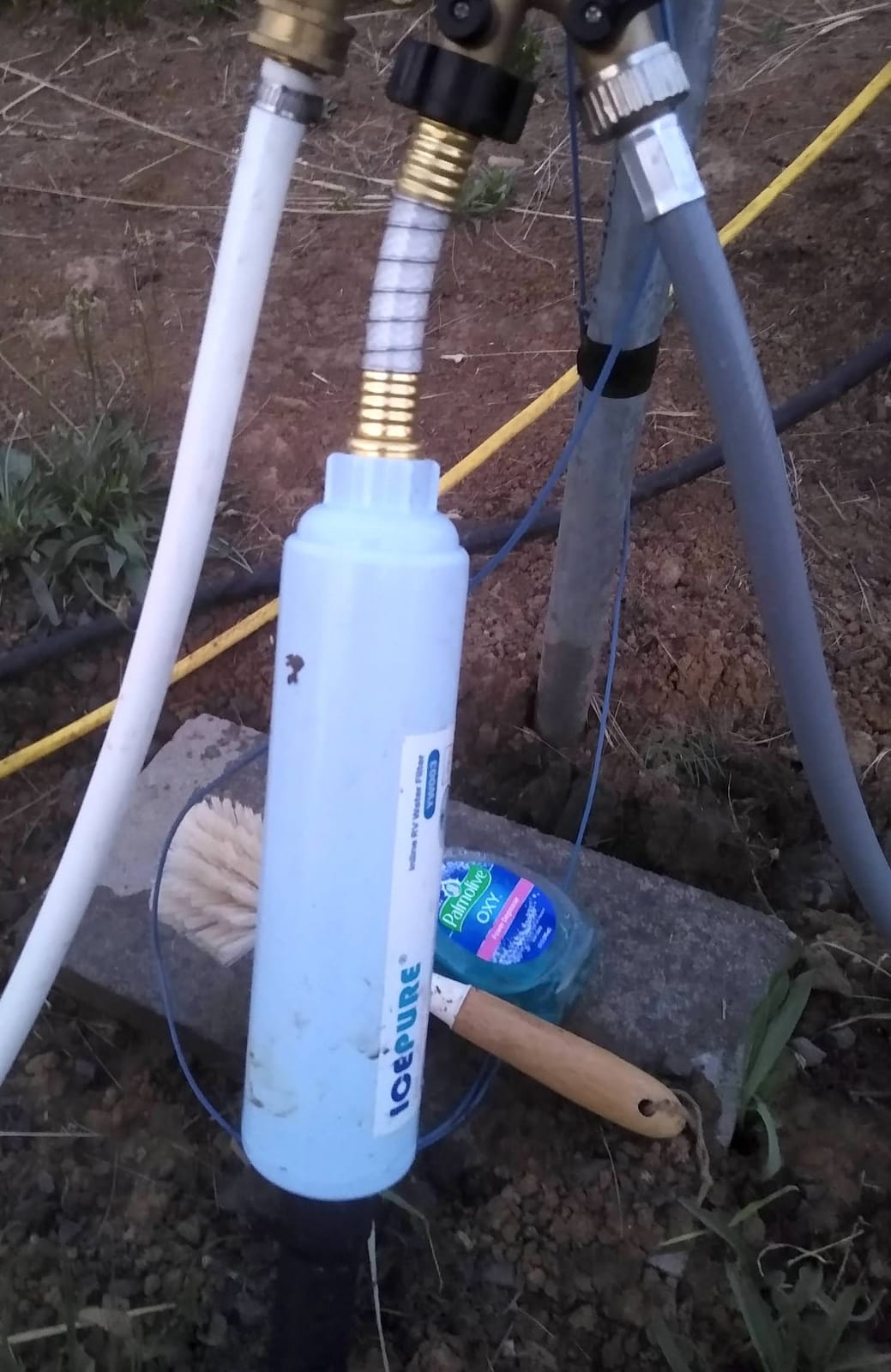
The ICEPURE is the certification story of this roundup. Alongside NSF/ANSI 42 through IAPMO, it lists European EC-1935/2016 food grade compliance, RoHS, REACH, TUV and Australian Water Mark certification. Nobody else here comes close on documented standards coverage.
That matters if you cross borders. When you drive from Canada into the US or into Europe, a filter certified only to a single US aesthetic standard is a narrower safety claim than you might want for an unfamiliar municipal system.
It also reduces a wider contaminant list than most inline filters, including VOCs, THMS, color, turbidity and corrosion byproducts alongside chlorine, rust and sediment. Beneficial minerals are retained rather than stripped, a real advantage over reverse osmosis.
The lifetime product warranty with a six-month defect return window is the strongest warranty terms in this roundup, and it comes from the manufacturer rather than a retailer.
At 4.5 stars it sits slightly below the group average, and its four percent one-star share is the highest among the products that scored well. Returns tend to point at variable filter life rather than a specific defect.
What to check before buying
Check whether you need multi-jurisdiction certification. If you camp entirely in North America, the extra European and Australian standards are reassuring but not decisive.
Check your mineral expectations. Retaining beneficial minerals is a genuine advantage over RO, but it also means this filter does nothing about hard water spots, which are mineral problems rather than contaminant problems.
Who should skip this filter
Skip it if you want the highest rating available. Several filters here sit at 4.6 or 4.7 with far larger review counts, and this one carries the highest one-star share among the well-rated products.
Skip it if you need pathogen or virus reduction. Every certification listed is an aesthetic and material safety standard, and breadth of certification is not a substitute for verified health-effect filtration.
How to Choose an RV Water Filter That Fits Your Rig
Eleven of the twelve products here are inline filters, and the twelfth is an externally mounted canister. That split is a fact about the market rather than a limit on our research. Inline hose filters dominate what is widely sold in this category, so that is where the depth is, but a mounted canister is a legitimate answer for a rig that stays put.
Inline, mounted canister, or point-of-use: which category you need
An inline filter clamps onto the hose between the campground spigot and your RV water inlet. It treats water as you fill the tank, costs little, installs in seconds, and protects the tank and everything downstream from sediment and chlorine. It does not treat water already in your plumbing, and it does nothing for a shower running off water you filled yesterday.
A mounted canister is plumbed permanently into the line, usually in a wet bay, with a sediment stage and a carbon block in separate housings. It handles more water, takes larger cartridges, and is the setup long-distance owners gravitate toward once they stop rebuilding a hose connection every season.
A point-of-use under-sink system filters drinking water only, at the kitchen tap. It is right if you are a weekend camper who only cares about drinking and cooking water, and wrong if you want shower water to stop smelling like chlorine. We cover that category in our under-sink filter roundup.
The rule owner forums converge on is simple. If you have a water heater, children in the trailer, or a long season ahead, treat the whole rig. If you camp a handful of weekends and only drink the water, an inline filter plus a tap filter is enough. Home filtration is a different category again, and our whole-house filtration system guide covers point-of-entry setups for fixed homes rather than rigs.
How to read micron ratings without being misled
A micron rating describes particle size, not contaminant type. Most inline filters here are rated at 20 microns, and that is not a weak specification. It is an honest statement that the housing is designed for sediment, not for cysts or bacteria.
The distinction that matters is nominal versus absolute. A nominal rating means the filter removes a stated percentage of particles above a given size under test conditions, and a small number of larger particles can pass. An absolute rating means nothing above that size passes. When you see 0.2 micron absolute, you are looking at a different class of device, with real backpressure and shorter cartridge life in exchange.
The practical takeaway: buy a 20 micron sediment stage for the front of your system and buy pathogen protection separately if you need it. A 0.2 micron stage across a whole-RV line will slow your shower to a trickle long before it finishes filtering.
NSF/ANSI 42 versus 53: the certification that matters
NSF/ANSI 42 is an aesthetic standard. It certifies a filter for taste, odor, chlorine reduction and sediment reduction. It is a real standard with real testing, but it says nothing about your health.
NSF/ANSI 53 is a health-effects standard. It certifies reduction of specific contaminants including cysts such as Giardia and Cryptosporidium, and bacteria such as E. coli. If a product page cites only 42, treat the filter as a taste and odor device no matter how good the carbon is.
In this roundup only the Camco TastePURE lists NSF/ANSI 53 alongside 42 and 372. That is a meaningful gap between the most-reviewed filter here and every other one, and it is worth weighing if anyone in your household has a compromised immune system. IAPMO certification to NSF/ANSI 42, listed on the RVGUARD and the ICEPURE, is a legitimate pathway for standard 42 claims.
NSF/ANSI 372 covers lead-free material specifically and applies to housing and fittings rather than filtration performance. It matters because the RV water inlet itself is a common source of trace metal pickup during filling.
Flow rate and why a 0.5 gpm inline is not a defect
Several filters here are rated at 0.5 gpm service flow, and buyers sometimes read that as slow. It is not. That figure is realistic for a carbon and KDF media bed and is more than adequate for drinking, cooking and hand washing. It is completely inadequate for a shower, which is why inline filters sit at the fill point rather than on the whole plumbing.
Backpressure becomes a real problem with a permanently mounted canister with a fine sediment stage, such as the Beech Lane, plumbed across the entire RV. Owners report reduced shower flow immediately, and the fix is not a stronger pump. It is accepting that the shower runs on tank water and treating the fill instead.
Campground pressure is a separate issue from flow. Park spigots can deliver well above the 60 psi working pressure several filters here are rated for, and a regulator upstream of the filter is cheap insurance against a cracked housing at a remote site.
The Correct Hookup Order From Spigot to Fresh Water Tank
Owner forum threads all arrive at the same sequence, and it is the most useful thing on this page for anyone wiring up a new filter. Put the components in this order.
1. Campground spigot. The source. Nothing goes before it.
2. Drinking water hose. The hose is the weak link in the chain, so it goes early where a kink or stale taste is easiest to diagnose and replace.
3. Pressure regulator. This goes before the filter, not after, and that is the point owners argue about most. A regulator downstream of the filter cannot protect the filter. Sitting upstream, it caps pressure before any housing or cartridge sees more than it was rated for.
4. Flow meter. Optional, but the only way to know when a cartridge is actually spent rather than guessing by date.
5. Filter. The inline filter or canister, plumbed after the regulator so the regulator does its job first.
6. Water softener, if you have one. The softener goes after filtration. Sediment and carbon removed first means the resin is not fighting particulate, and the softener then handles the minerals the filter never could.
7. RV water inlet and fresh water tank. Last, because everything upstream is serviceable by hand without opening the rig.
The benefit of this order is that every component can be reached and swapped from outside the trailer. Nothing is trapped behind a wall, and a cartridge change never becomes a plumbing job.
What an RV Water Filter Cannot Do
Most roundups on this topic skip a limitations section because the products do not advertise well without one. Here is the full list.
It cannot make viruses safe without a health-effects stage. Carbon and KDF reduce chlorine and some metals. They do not inactivate viruses. Only an NSF/ANSI 53 stage, a 0.2 micron absolute barrier or a UV purification unit closes that gap.
It cannot soften hard water. Scale on faucets, showerheads and coffee makers is a mineral problem. No carbon block, no KDF and no sediment filter touches it. That is exclusively a softener’s job, which is why the softener goes after the filter in the order above.
It cannot reduce most PFAS. Standard activated carbon and KDF do not reliably remove PFAS. At a source with documented PFAS contamination you need a system specifically tested for it, not a general inline filter.
It cannot fix a sulfur smell from a well source. Hydrogen sulfide is a gas. Carbon and KDF reduce it somewhat, but a persistent rotten egg smell usually means an anaerobic well, and the honest answer is treatment at the source rather than a cartridge on the hose.
It cannot make a TDS reading a safety test. A TDS meter measures dissolved solids. It gives you a number, not a verdict, and it cannot distinguish a benign mineral from a contaminant. High TDS is often just hard water.
It cannot fix water already in your tank and plumbing. An inline filter runs when you fill. A tank that has been sitting for a month needs its own sanitation routine, not a better hose filter.
One more risk rarely gets mentioned: a wet carbon bed sitting unused in a damp wet bay is a hospitable surface for bacterial growth. Store cartridges sealed and dry, use a filter from the season you bought it, and replace on the rated interval rather than pushing past it.
Filter Replacement Schedule and Winterizing
Almost every inline filter here is rated at one three-month camping season, and the question is how that maps to your own use. Those ratings assume seasonal usage rather than year-round travel, so full-timers burn through cartridges faster than the label implies.
A weekend camper at a reliable municipal park will comfortably get a year from two cartridges. A snowbird travelling six months will use one cartridge and often half a second. A full-timer filtering every week of the year should plan on four a year, which is the number that makes a mounted canister start to look attractive on running cost alone.
The Kohree and the RVGUARD are the two products here with a stated gallon rating rather than a season rating, and those are the ones to use for arithmetic. A thousand-gallon cartridge used at ten gallons a day is slightly over a hundred days of actual water. Track it with a flow meter and stop guessing by date.
Winterizing is where people lose money. Water expands as it freezes, and a sealed canister housing in a frozen wet bay can crack outright. Before cold weather, disconnect the inline filter, drain it completely, cap the ends and store it indoors. Canister systems need the same treatment.
Store replacement cartridges somewhere dry and sealed, not loose in the wet bay. Carbon media that absorbs moisture before use is carbon media that will not perform as rated, and it is also a growth surface.
Finally, sanitise the fresh water tank on its own schedule rather than assuming filtration replaces it. Filtering what goes in does not clean what is already sitting in the tank and the lines attached to it.
Frequently Asked Questions
What is the best water filter for RV camping?
The Camco TastePURE 40043 is the best overall inline filter for RV camping because it combines GAC and KDF media, a 20 micron sediment stage, a flexible hose protector and the broadest certification in this roundup at NSF/ANSI 42, 53 and 372. It also has the largest review base by a wide margin. The GLACIER FRESH two pack covers the same media pairing at a lower cost, and the AQUA CREST publishes a verified chlorine reduction figure.
What is the best-rated RV water filter?
The Camco TastePURE 40043 holds the highest rating in this roundup at 4.7 stars across more than 53,000 ratings, which is also the largest review base here. Several products sit at 4.6, including the Kohree, BELVITA, Bringpure, Beech Lane, Hourleey, lifeegrn and Lifefilter. The GLACIER FRESH two pack is the lowest rated at 4.4 and earns its place on pack size rather than rating.
Are Camco water filters good?
They are among the most widely used inline RV filters in North America, and this roundup found no consistent pattern of quality complaints. Owners report reliably better taste and odor on badly tasting park water, a hose protector that genuinely reduces connection strain, and a housing made in the USA with a one year warranty. The recurring criticisms are a required seasonal replacement, a black carbon flush on first use, and the included adapter weeping if the housing is not seated square.
Is a 0.2 micron filter good?
A 0.2 micron absolute filter is a fine particle barrier capable of catching cysts and bacteria, a different class of device from the 20 micron inline filters reviewed here. The tradeoff is backpressure and cartridge life, because forcing water through a very fine barrier slows flow dramatically. That is why almost no one runs a 0.2 micron stage across an entire RV plumbing system, where it would starve the shower. Use it at a single drinking outlet instead.
Which filter goes first, sediment or carbon?
Sediment goes first. Particulate carried by the water would blind a carbon block and end its useful life long before the carbon itself was spent, so a 5 micron sediment stage ahead of a 0.5 micron carbon block is the standard pairing, and it is exactly what the Beech Lane dual canister system uses. In the full hookup order the sediment protection sits inside the filter housing, which is installed after the pressure regulator so the regulator protects every stage downstream.
What are the downsides of using a carbon water filter?
The main downsides are that carbon blocks are not a barrier for viruses, they strip chlorine taste without removing the contaminants that cause it, and a wet carbon bed sitting unused can become a bacterial growth surface. Carbon also does nothing for hard water scale, because scale is mineral rather than organic. Inline carbon filters have limited capacity, typically one three-month camping season, and replacing them late is the most common way owners end up drinking water the filter can no longer treat.
The Bottom Line
For most RVers, the best rv water filters for campground water come down to one inline filter and a spare cartridge. Buy the Camco TastePURE 40043 if you want the broadest certification and the largest proven track record. Buy the AQUA CREST if you want a published chlorine reduction figure and a hose protector that swivels. Buy the GLACIER FRESH two pack for the cheapest path to the same carbon and KDF media.
Buy the Beech Lane BL-113 only if your rig stays put long enough to justify a permanent mount, and add a pressure regulator before anything else on the chain. Drop any expectation that a filter fixes hard water, viral risk or the water already sitting in your tank, because none of them do.
Whatever you choose, install it early in 2026 rather than the night before a trip, run the first flush until the water runs clear, and set a reminder for the replacement interval. The best filter in the world is the one that is still fresh when you need it.