

A stored motorcycle battery does not sit still. Even unplugged, a 12V lead-acid battery drains itself every week, and a half-charged battery builds sulphation on the plates until it will not take a charge in the spring. That is the whole reason people buy a battery tender: one small box, plugged into a wall outlet, quietly replaces what the battery loses while your bike sits.
The best battery tenders for stored motorcycles are judged on a different set of things than the fastest chargers. Peak amperage barely matters when you are topping a battery up for six weeks. What matters is whether the charger drops into float cleanly, whether it recognises your chemistry, whether the leads are long enough to reach the battery, and whether you can trust it to be plugged in for a whole season without checking on it.
We spent weeks going through ten of the most-reviewed maintainers on the market, cross-checking their charge programs, connector types, warranty terms and chemistry support against what owners report in threads on the BMW MOA forum, IndianMotorcycles.net and Motorcycle Forum. Ten products, from brands you will find in most garages, all judged first on whether they survive a winter untouched.
Short version: if your bike sits for more than a few weeks, use a tender. The rest of this guide explains which one fits your battery, your garage and your battery chemistry, and where the entry-level models cut corners.
Last checked for October 2026. If you also store cars or powersports, our guides to the best smart battery maintainers and the best car battery chargers cover the same jobs for other vehicles.
Table of Contents
Top 3 Best Battery Tenders for Stored Motorcycles (October 2026)
These three came out ahead once we sorted out the batteries that actually need saving from the ones that are simply inexpensive. The Junior leads on install base and reliability, the Plus adds current and a quick-disconnect harness, and the MOTOPOWER brings real desulfation to a very simple box.

Battery Tender Junior 750mA
- 0.75A maintenance current
- 4-step charge program
- Ring terminals and alligator clips
- 5-year warranty

Battery Tender Plus 1.25A
- 1.25A for faster recovery
- Quick disconnect harness
- 10-year warranty
- Adaptive float under load
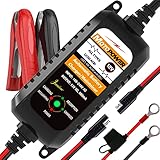
MOTOPOWER MP00205A 800mA
- Automatic pulse desulfation
- Zero-output standby
- 24-hour safety timer
- 2-year warranty
All 10 Battery Tenders Compared at a Glance
The table below covers every tender in this roundup, including what each one is genuinely best at. If your battery is lithium, jump straight to the chemistry notes underneath.
| Product | Specifications | Action |
|---|---|---|
| Battery Tender Junior 750mA |
|
Check Latest Price |
| Battery Tender Plus 1.25A |
|
Check Latest Price |
| MOTOPOWER MP00205A 800mA |
|
Check Latest Price |
 FOVAL BC01B-1 1A FOVAL BC01B-1 1A |
|
Check Latest Price |
 BLACK+DECKER BM3B 1.5A BLACK+DECKER BM3B 1.5A |
|
Check Latest Price |
 NOCO GENIUS2D 2A NOCO GENIUS2D 2A |
|
Check Latest Price |
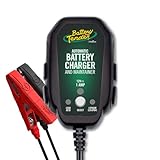 Battery Tender Junior 800mA Switchable Battery Tender Junior 800mA Switchable |
|
Check Latest Price |
 Mroinge MBC010 1A Mroinge MBC010 1A |
|
Check Latest Price |
 LEICESTERCN 2A Multi-Mode LEICESTERCN 2A Multi-Mode |
|
Check Latest Price |
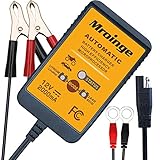 Mroinge MBC022 2A Mroinge MBC022 2A |
|
Check Latest Price |
1. Battery Tender Junior 12V 750mA – The Default Choice for One Bike
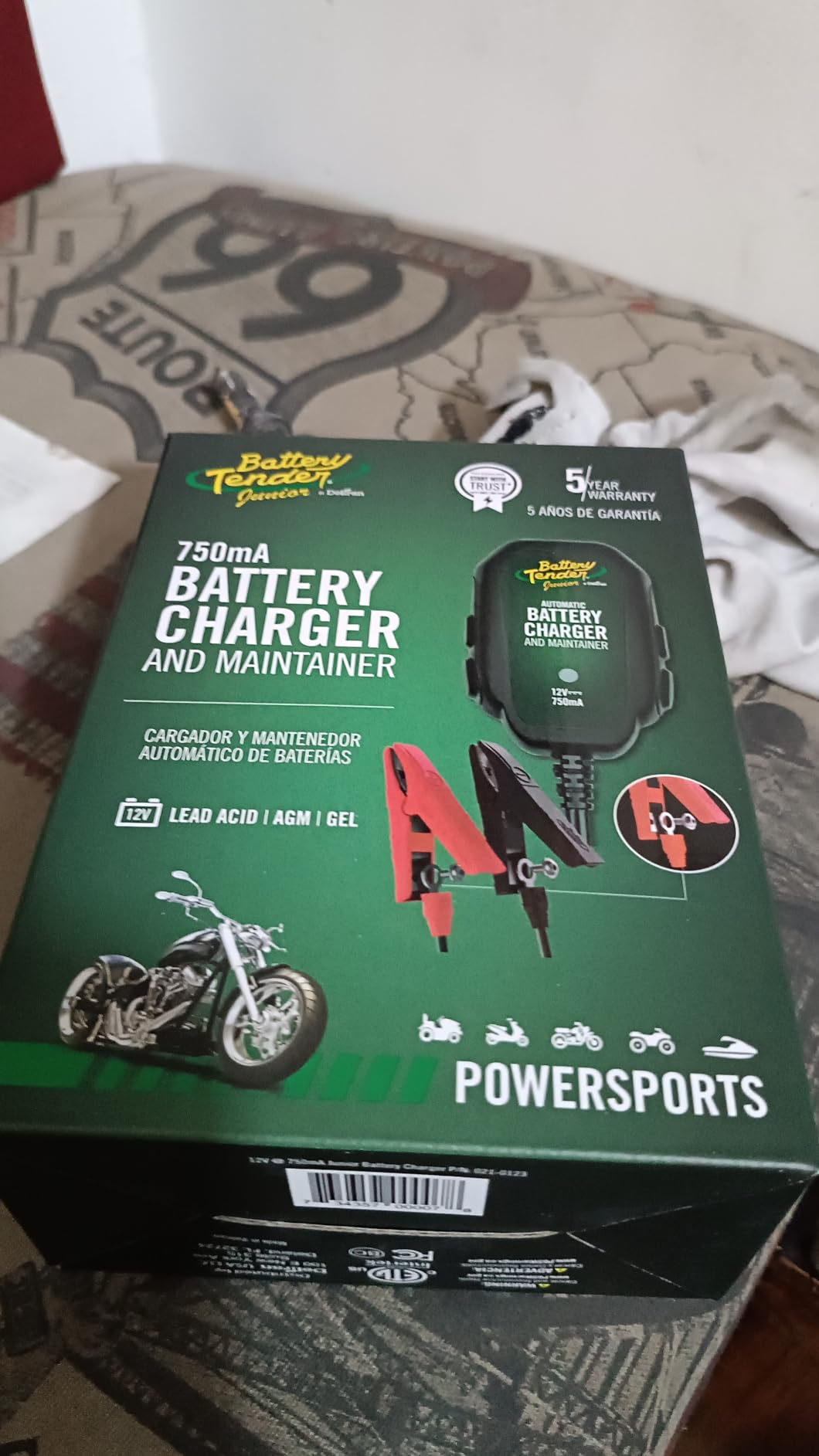
Battery Tender Junior 12V, 750mA Charger and Maintainer: Automatic 12V Powersports for Motorcycle, ATVs, and More – Smarter Than a Trickle Charger – 021-0123
0.75A output
12V lead-acid only
4-step program
5-year warranty
Pros
- Very large installed base with a 4.8 average
- Full 4-step program that resumes output under load
- Spark-proof with reverse hook-up detection
- Ring terminal harness and alligator clips both included
- Small and light enough to mount anywhere
Cons
- 750mA is a maintenance rate
- so recovery is slow
- No LiFePO4 lithium support
- Two-color LED gives limited stage detail
This is the charger most riders mean when they say battery tender generically, and the Deltran-made Junior is the default answer in nearly every beginner thread we read. It runs a four-step program: initialization, bulk charge, absorption, then float, and once the battery is full it drops to a maintenance voltage and waits.
At 0.75 amps it will not rescue a battery that has been dead for a season, and that is fine, because that is not the job. Its job is to sit in a garage for five months and put back roughly what the battery lost. Owners report battery life extending noticeably across multiple winters of storage with one of these attached.
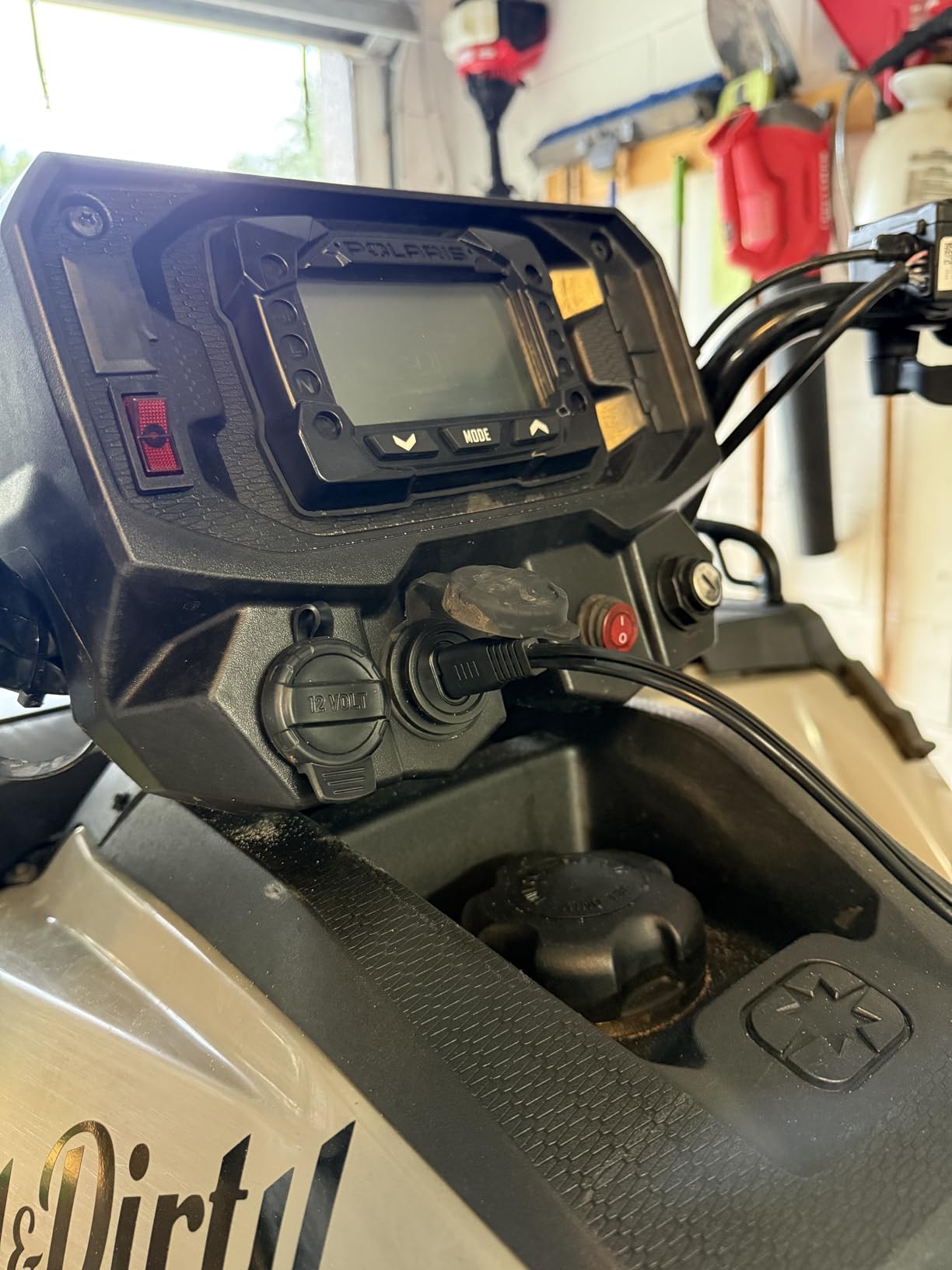
The two things that make it work as a permanent install are the fused ring terminal harness and the fact that the whole unit weighs about a pound. You bolt the rings to the battery, hide the charger under a cover or on a shelf, and the cable routing stops being a problem because there is nothing much to hide.
Build quality is not the concern here; longevity is. Across close to fifty thousand reviews the reported failures are uncommon, and the recurring praise is that the same unit keeps working season after season. Spark-proof circuitry and automatic reversed hook-up detection protect both the battery and the charger if you wire it up backwards after a dark afternoon in the garage.
Is 0.75 amps actually enough for a stored motorcycle battery?
For maintenance, yes. A healthy motorcycle battery holds roughly 12.6 volts at rest, and 0.75 amps covers that self-discharge with a large margin. Rider forum guidance puts sub-one-amp current in the gel cell column and steps up to 1.25 amps and beyond for flooded and AGM, which is the guidance we used throughout this roundup.
It is only when the battery has already gone flat that 0.75 amps feels slow. Bringing a fully discharged pack back from near zero takes far longer than most people expect, and if that is your situation you want a 1.5A to 2A unit with a recovery mode instead.
When should you pick something other than the Junior?
Choose differently if your battery is lithium, because this unit has no LiFePO4 mode and a lead-acid float profile on a lithium pack is the wrong chemistry treatment. Pick differently if you are storing more than one bike and have a habit of forgetting to swap the charger, which is a recurring way owners lose batteries over a winter.
It is also not the right pick for a garage where the battery sits far from the outlet, since the included cord is twelve feet from the charger. Nothing wrong with that, but it is a reason to look at a longer-lead charger later in this list.
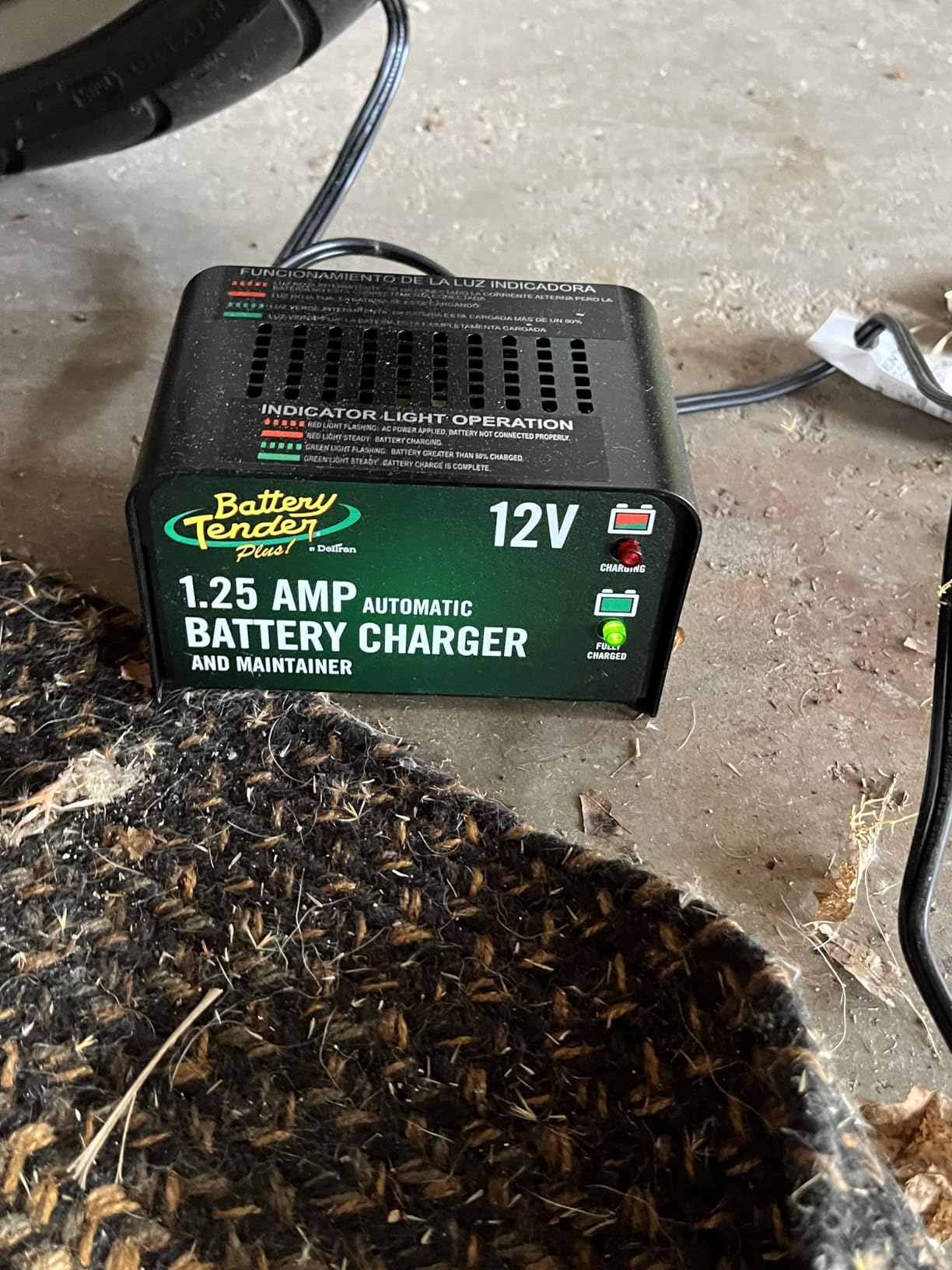
2. Battery Tender Plus 12V 1.25A – For Several Stored Bikes
Battery Tender Plus 12V 1.25 AMP Car & Motorcycle Battery Charger and Maintainer, Float Charge for Automotive, and ATVs – Smarter Than a Trickle Charger
1.25A output
Quick disconnect harness
10-year warranty
Lead-acid only
Pros
- Higher current than the Junior for faster recovery
- 10-year warranty is the longest in this roundup
- Quick disconnect harness makes swapping between bikes simple
- Resumes full output whenever load pulls voltage down
Cons
- Lead-acid only
- no lithium charge mode
- 1.25A is still modest for a fully depleted battery
- Heavier and bulkier than the Junior models
Everything the Junior does, the Plus does with half again as much current and a ten-year warranty behind it. That warranty length is not marketing filler: buyers describe chargers still running after many seasons, and the extra amperage is the difference between a battery that slowly comes back and one that sits at a trickle for a week.
The quick disconnect harness is the reason this one shows up so often in multi-bike threads. Rather than clipping alligator leads on and off, you leave the harness bolted to the battery and plug or unplug the charger in seconds, which is exactly the habit that makes rotating one charger across four bikes actually workable.

It handles the same battery families as the Junior, covering flooded, AGM and gel cells, and the solid-state two-color LED tells you at a glance whether it is still charging. Buyers who store cars, motorcycles, lawn mowers and ATVs together tend to buy this one for that reason alone.
What you give up for the extra current is nothing in weight terms, but the housing is noticeably chunkier than the Junior’s, and there is still no lithium profile. If your bikes have gone lithium, the Junior switchable model later in this roundup is the better match.
Do you need more than 0.75 amps for AGM or flooded batteries?
Flooded and AGM cells benefit from the extra current more than gel cells do, because both accept a higher charge rate without the risk of thermal stress that sealed gel does. Rider forum guidance puts 0.75 amps in the gel cell column and 1.25 amps and up for flooded and AGM, which is the guidance we used across this roundup.
For a healthy battery being stored, the difference is subtle. For a battery that has sat a month or two without a tender and dropped below its storage voltage, 1.25 amps means the recovery happens in hours instead of a weekend.
Is a single charger enough if you store more than one motorcycle?
It can be, but only if you genuinely rotate it. The recurring story in owner forums is the same: someone owned one tender, owned three bikes, and quietly failed to move the charger around, then found one or two dead batteries in spring. Swapping weekly is doable, and the quick disconnect makes it quick, but it depends on you remembering. Rotor-swap users on the BMW MOA forum describe the Battery Tender Plus as the unit that worked across bikes of different types, and owners posting on IndianMotorcycles.net report the same result with a Battery Tender Junior.
That failure mode is worth avoiding entirely. A single unit per battery removes the human element, and it is why multi-bank chargers exist at all.
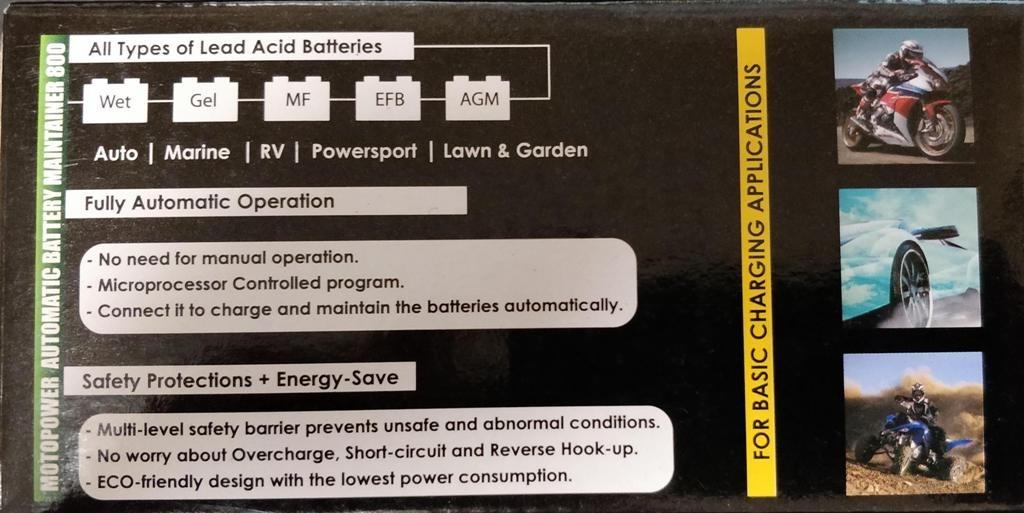
3. MOTOPOWER MP00205A 800mA – Best Value with Real Desulfation
MOTOPOWER MP00205A 12V 800mA Automatic Battery Charger, Maintainer, Trickle and Desulfator
800mA output
Pulse desulfation
Zero-output standby
2-year warranty
Pros
- Automatic pulse desulfation runs during charging with no manual step
- Zero standby output means no parasitic drain
- Charger
- maintainer
- trickle and desulfator in one box
- Small housing routes easily
- Reviewers report repeatable absorption-to-float voltages
Cons
- Runs hot on large deeply discharged batteries in an unvented case
- No on/off switch so you must unplug it to stop
- 800mA is slow for reviving a badly depleted battery
This charger charges to 14.4 volts, holds at 13.6 in maintenance, and drops to zero output in standby, which means connecting it to a battery for months does not slowly drain what the rest of the circuit is trying to put back. That standby behaviour is the feature buyers point to most often.
The desulfation function is a real stage rather than a label. It detects sulphation during charging and applies pulse current to break it down, which matters for a bike that has already sat unattended through one neglected season. You do not have to select a mode or press anything; it runs as part of the normal program.
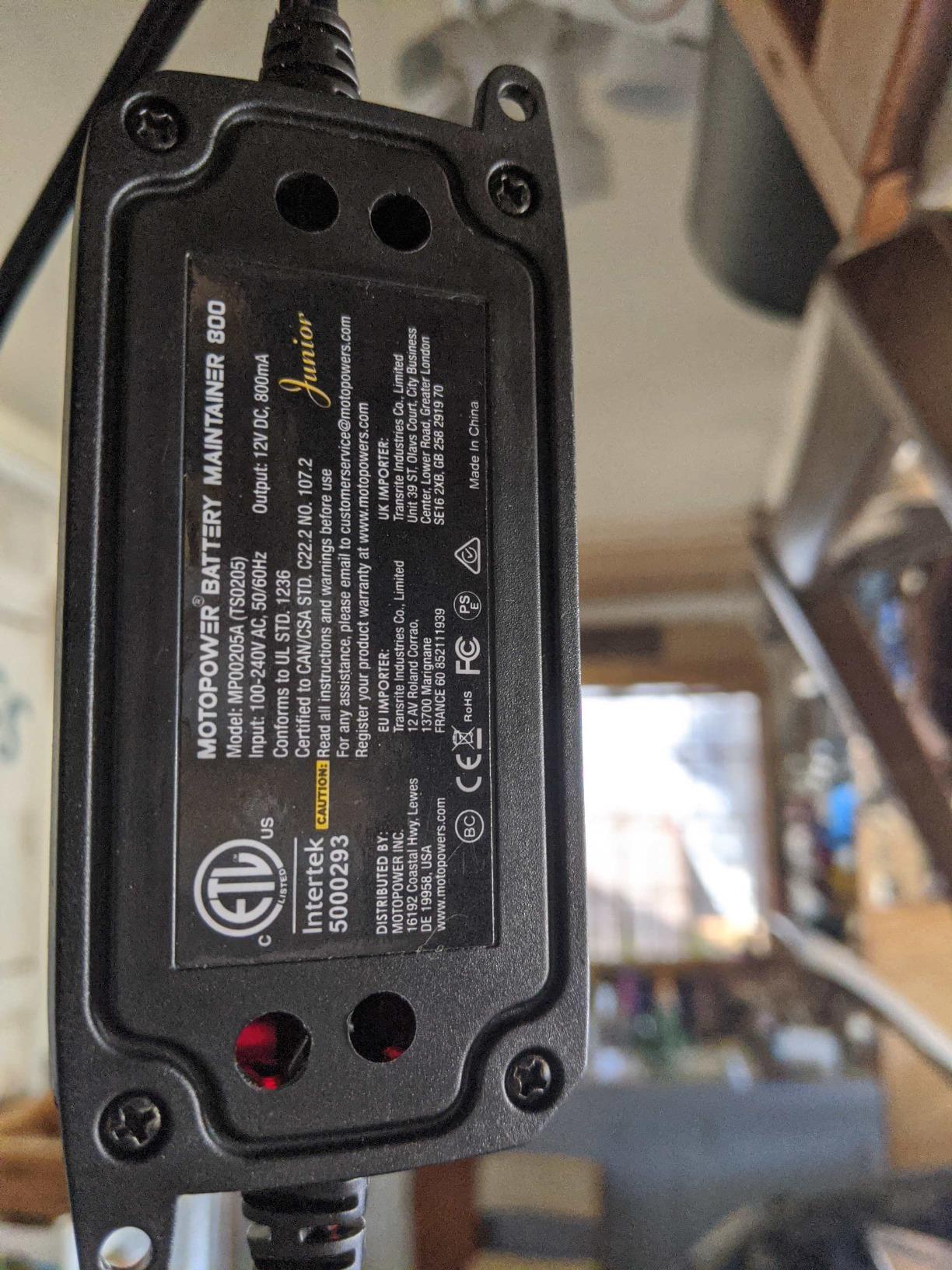
Safety coverage here is broad: overcharge, short circuit and reverse polarity protection, a 24-hour timer that ends the charge and switches to maintenance, and a spark-proof lead connection. It is certified to CE, FCC, ETL, RoHS and UL standards, and the two-year warranty is longer than most chargers in this class.
The honest drawback is heat. In a sealed case with no ventilation, charging a large deeply discharged battery keeps it warm, and at least one buyer reported a failure after roughly four years of continuous daily use. Mount it where airflow can reach it rather than wedged inside a bodywork panel.
Does pulse desulfation actually bring a neglected battery back?
Sometimes, and it depends on how long the battery sat flat. A battery that has been discharged for a few weeks and then put on a charger with pulse desulfation has a real chance of recovering. Reviewers report reviving batteries that had been down through a winter. A battery stored flat for a year or more is usually past saving regardless of what charger you attach.
Verify rather than assume. A handheld load tester is the honest check, and if a battery fails under load after weeks of charging, the problem is the battery rather than the charger.
Is this the right pick if you store a bike outdoors or in a shed?
It works for that, with two conditions. Give the case airflow because of the heat behaviour, and plan how you get power out there, since the lead is a clamp-style cable rather than a long fixed harness. Outdoor or shed storage usually means an extension lead, and a heavy-duty one is a better idea than a household light-duty cord.
For a garage with a nearby outlet, this is a straightforward way to keep a battery alive without thinking about it for a season.
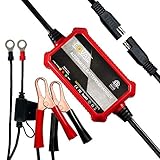
4. FOVAL BC01B-1 1A – Long Cable Reach in a Small Housing
Foval Automatic Trickle Battery Charger 12V 1000mA Smart Battery Charger
1A output
102-inch cable
3.9 inch housing
Ring and clip leads
Pros
- Compact phone-sized housing that fits tight storage spaces
- Very long combined cable for awkward battery locations
- Both ring and alligator connector leads included
- Three-state LED shows a clear fully-charged state
- One of the widest equipment compatibility lists in this group
Cons
- 1A is a maintenance rate
- not a recovery rate
- Lead-acid only with no lithium profile
- 18-month warranty is short next to the longer-warranty brands
The FOVAL solves a problem that quietly annoys people: batteries rarely sit next to the wall outlet. With a combined 102 inches of cable and a housing smaller than a phone, it reaches from a shelf across the garage without the extension-cord arrangement most owners otherwise end up building.
Underneath it is a straightforward four-step program running initialization, bulk, absorption and float, covering SLA, VRLA, gel, AGM and wet lead-acid. The three-state LED gives noticeably more detail than a simple two-light charger, distinguishing power on, charging, and fully charged rather than merging the last two.
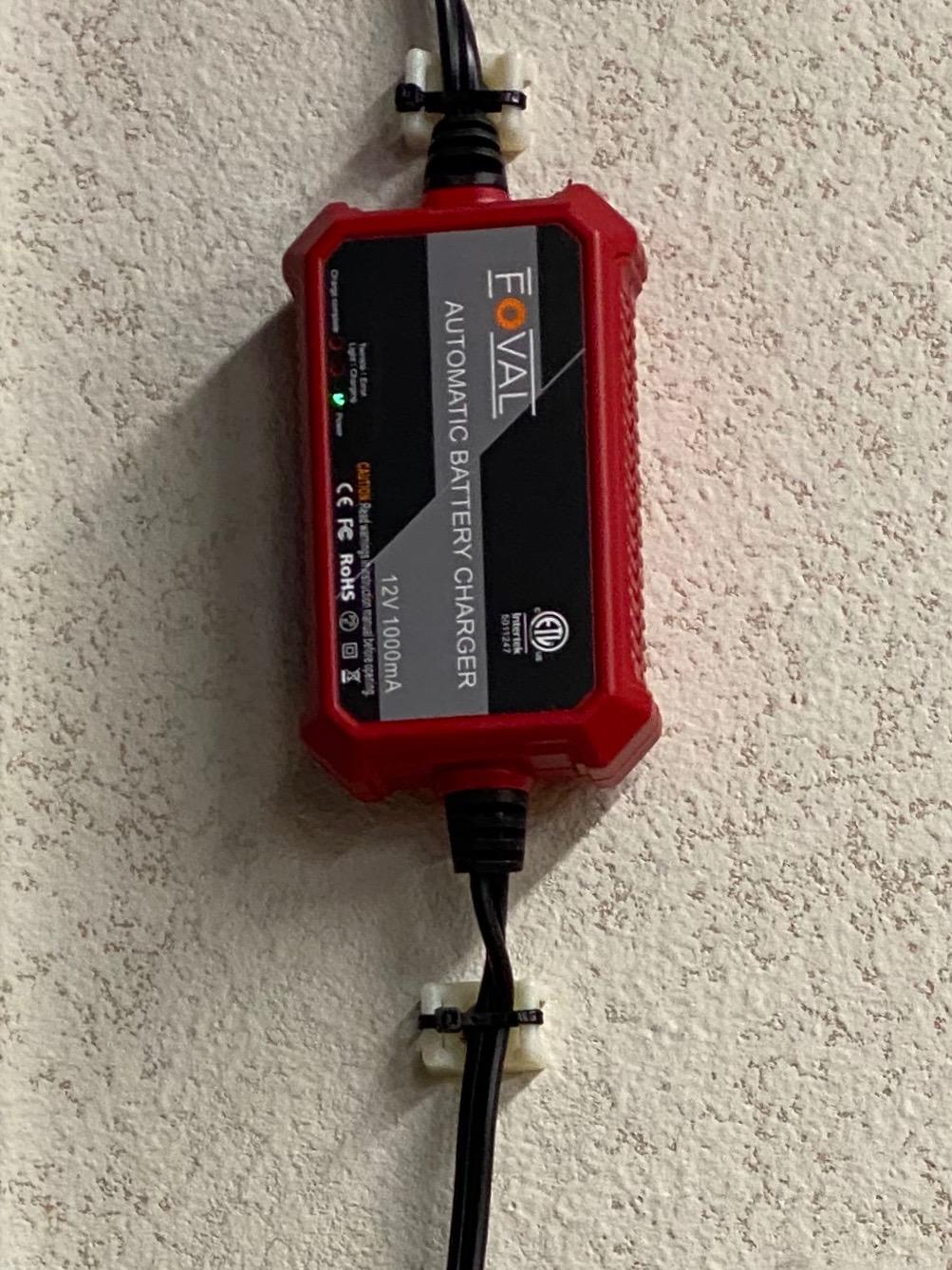
The compatibility list is among the widest in this roundup, spanning motorcycles, ATVs, boats, snowmobiles, tractors, jet skis and lawn mowers, which makes it a natural pick for a household that stores several kinds of equipment rather than only bikes.
Two limits to keep in mind. One amp is a maintenance current, so this is not a recovery tool for a dead battery, and the 18-month warranty is shorter than what the longer-established brands offer. Neither matters much for the job of holding a healthy battery over a winter.
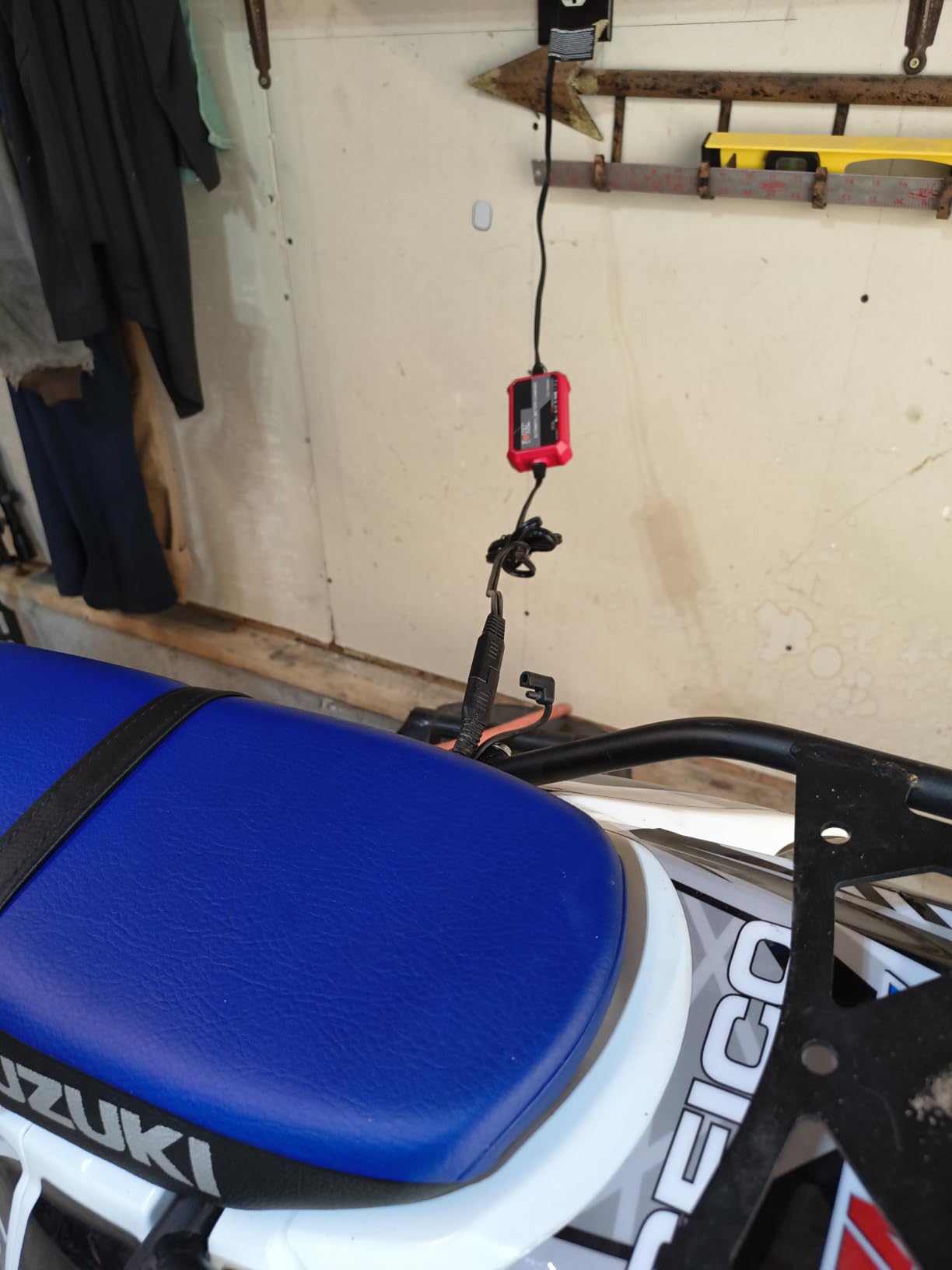
Does cable length actually matter in a real garage?
More than most spec sheets suggest. A tender with a short lead ends up mounted on the floor beside the battery with the wall outlet three metres away, and from there people reach for an extension cord, which introduces its own problems with a device meant to be left plugged in unattended for months.
Buying the reach you need up front is the cleaner fix. If your battery is more than about eight feet from an outlet, prioritise total cable length over a slightly higher amperage figure.
Should you buy an entry-level maintainer or a branded one for a single bike?
For one healthy lead-acid battery in a dry garage, a well-reviewed budget charger like this is genuinely enough. The failure points that show up in reviews are heat and warranty length rather than charging quality, and neither is a big risk when the battery arrives at the charger reasonably full.
Where the longer-established brands earn their money is warranty length, certification and temperature compensation. Those matter more in an unheated garage, in freezing conditions, or when the same charger serves several batteries.
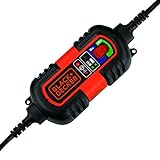
5. BLACK+DECKER BM3B 1.5A – Handles 6V and 12V Fleets
BLACK+DECKER BM3B Fully Automatic 6V/12V Battery Charger/Maintainer with Cable Clamps and O-Ring Terminals, Multi, 1.5 Amp
1.5A output
6V and 12V support
Integrated mount
1-year warranty
Pros
- Handles both 6V and 12V batteries
- 1.5A gives more recovery headroom than the 1A models
- Built-in mounting bracket for a fixed install
- Stops at full then floats without supervision
- Recognizable brand with ETL certification
Cons
- No desulfation or pulse repair mode
- Lead-acid only with no lithium support
- Chemistry selection is manual rather than auto-detected
- One-year warranty is on the short side
Six-volt batteries still turn up in vintage bikes, old scooters and a fair number of classic cars, and several modern maintainers are 12V only. The BM3B covers both, and at 1.5 amps it has more current headroom than the one-amp units elsewhere in this roundup.
The behaviour is the simple, trustworthy kind: it charges until the battery is full, stops, and drops into float monitoring. There is no repair mode and no chemistry auto-detection, so you set the 6V or 12V switch yourself and choose the right profile for your battery type.
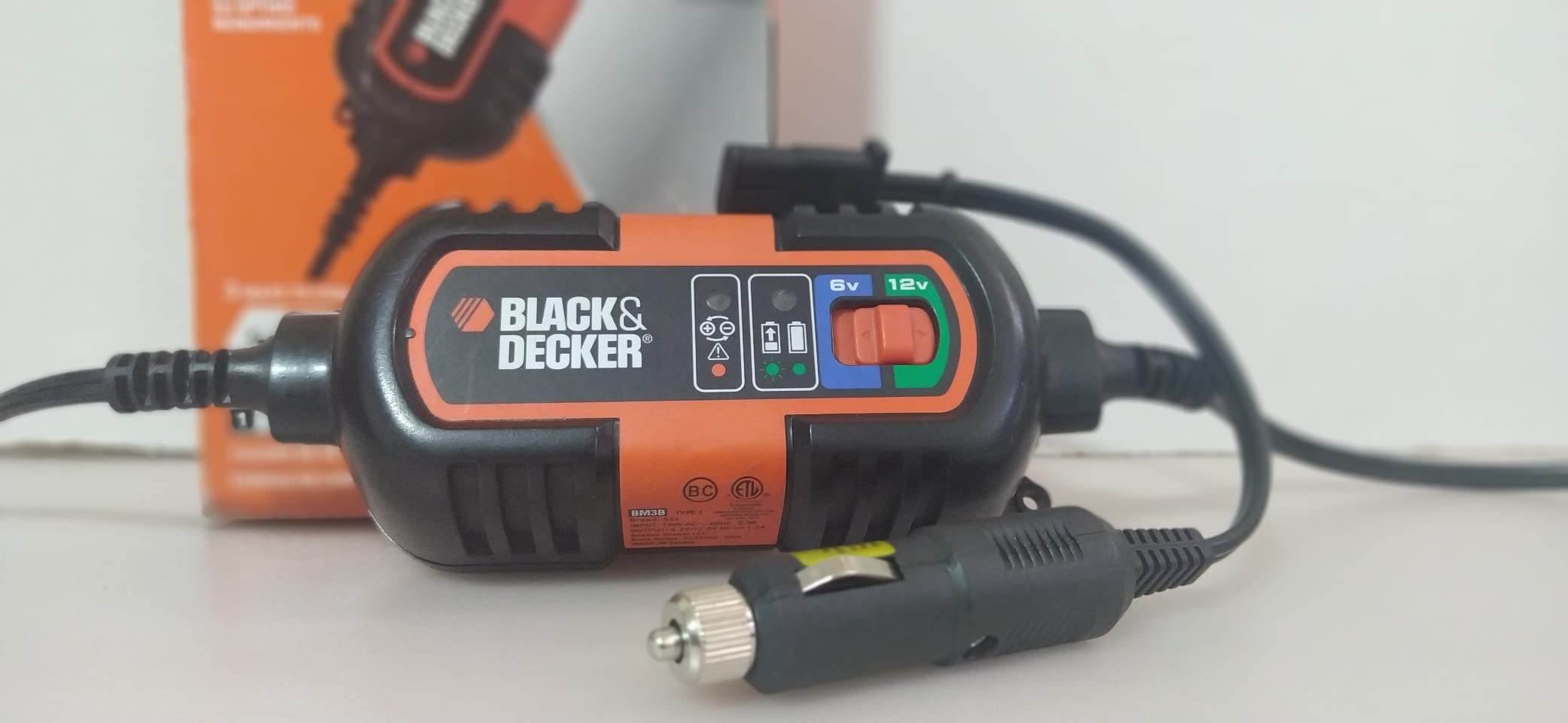
The integrated mounting bracket is the detail most people underrate. Instead of a loose brick on the floor, you fix the charger to a wall or shelf near the bike and it becomes a permanent part of your storage setup, which is the whole point of leaving something plugged in for months.
Connections are battery clamps or O-ring terminals, and the enclosure carries circuit protection against overcharging, reverse polarity and short circuits. The one-year warranty is among the shortest in this roundup, which is a fair reflection of where this product sits in the market.
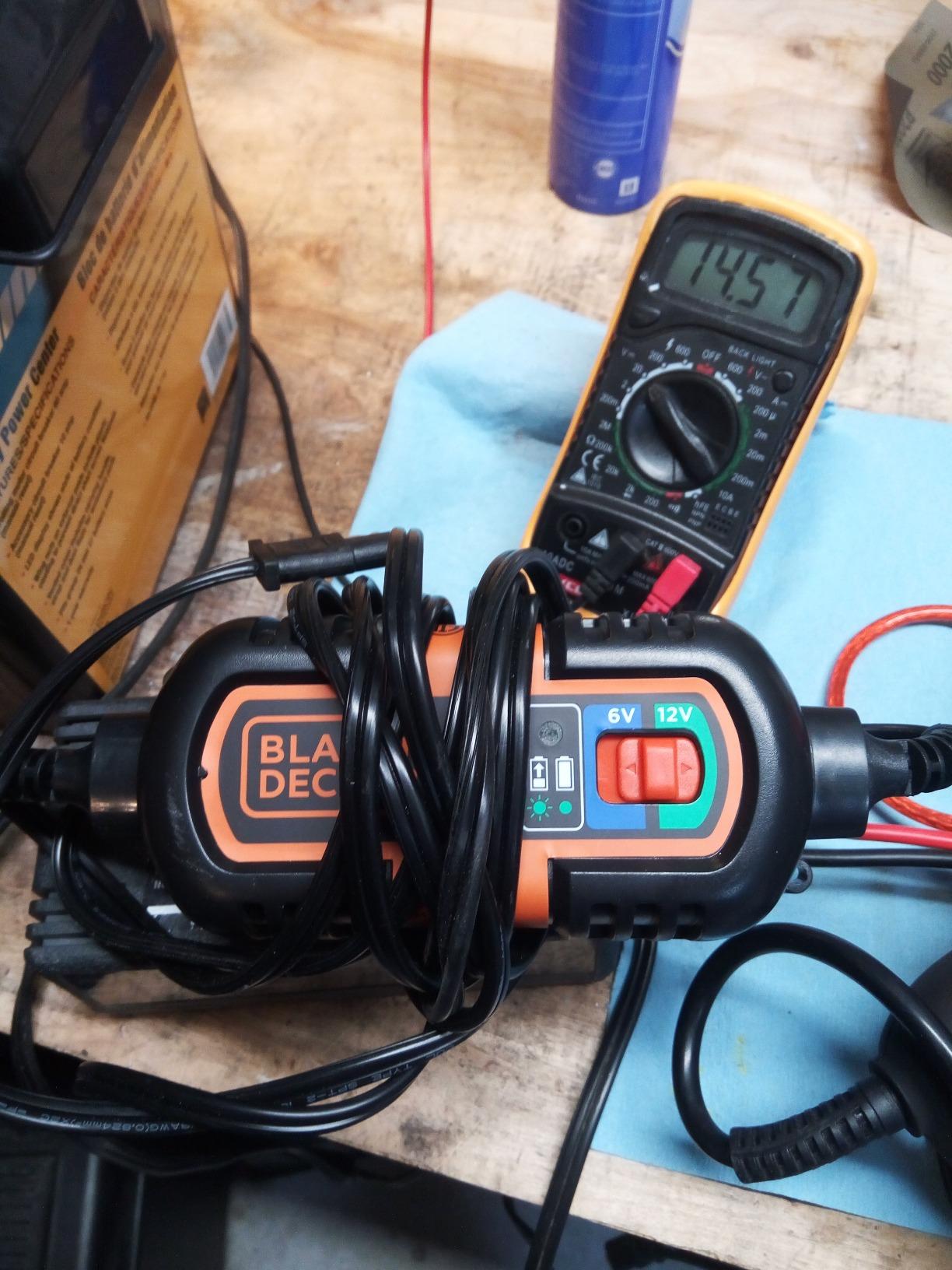
Do vintage motorcycles still need a 6V tender?
If the bike is running, yes. Six-volt lead-acid batteries self-discharge and sulphate exactly like twelve-volt packs, and older wiring tends to be in worse condition, which means the bike may be adding a parasitic drain while it sits. A tender that matches the voltage prevents the slow decline that leaves you with a dead bike in spring.
Check the label on the battery case before buying anything. Connecting a 12V charger to a 6V battery is the kind of mistake that ends the battery immediately, and that is exactly why a charger with an explicit voltage switch is worth having in a mixed garage.
Is 1.5 amps too much for a small motorcycle battery?
Not as a maintenance current. Riders and forums both draw the line at the extremes: a sub-amp trickle is too gentle to recover anything, while a 5-amp charger used continuously on a small battery is more current than it needs and generates more heat than necessary. One to two amps sits comfortably in the useful middle.
For a healthy battery on a long storage, the ceiling of this charger is simply more headroom than you will ever draw.
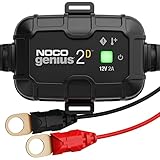
6. NOCO GENIUS2D 2A – For Permanent Onboard Mounting
NOCO GENIUS2D 2A 12V Onboard Battery Charger, Trickle Charger & Maintainer
2A output
Onboard mount bracket
Temperature sensor
3-year warranty
Pros
- Designed to permanently mount to the vehicle
- Thermal sensor adjusts charging in both directions
- Force Mode revives batteries down to zero volts
- Pulse charging reverses sulfation and acid stratification
- 2A output with an easy-to-read LED sequence
Cons
- Short DC and AC cables can be tight on a distant battery
- Mounting bracket has been reported to crack at the screw holes
- Eyelet terminal holes are tight and may need a washer
The GENIUS2D is the product in this roundup designed to be fixed permanently rather than placed on a shelf or carried between bikes, using the snap-fit bracket and truss-head self-tapping screws, so it becomes part of the bike and travels with it. The BLACK+DECKER BM3B also carries a bracket for a wall or shelf mount near the battery.
Two features separate it from the pack. The integrated thermal sensor adjusts the charge for ambient temperature in both directions, which matters in a cold garage where a fixed charge profile can undercharge, and Force Mode works on batteries down to zero volts, far below what a conventional tender will attempt.
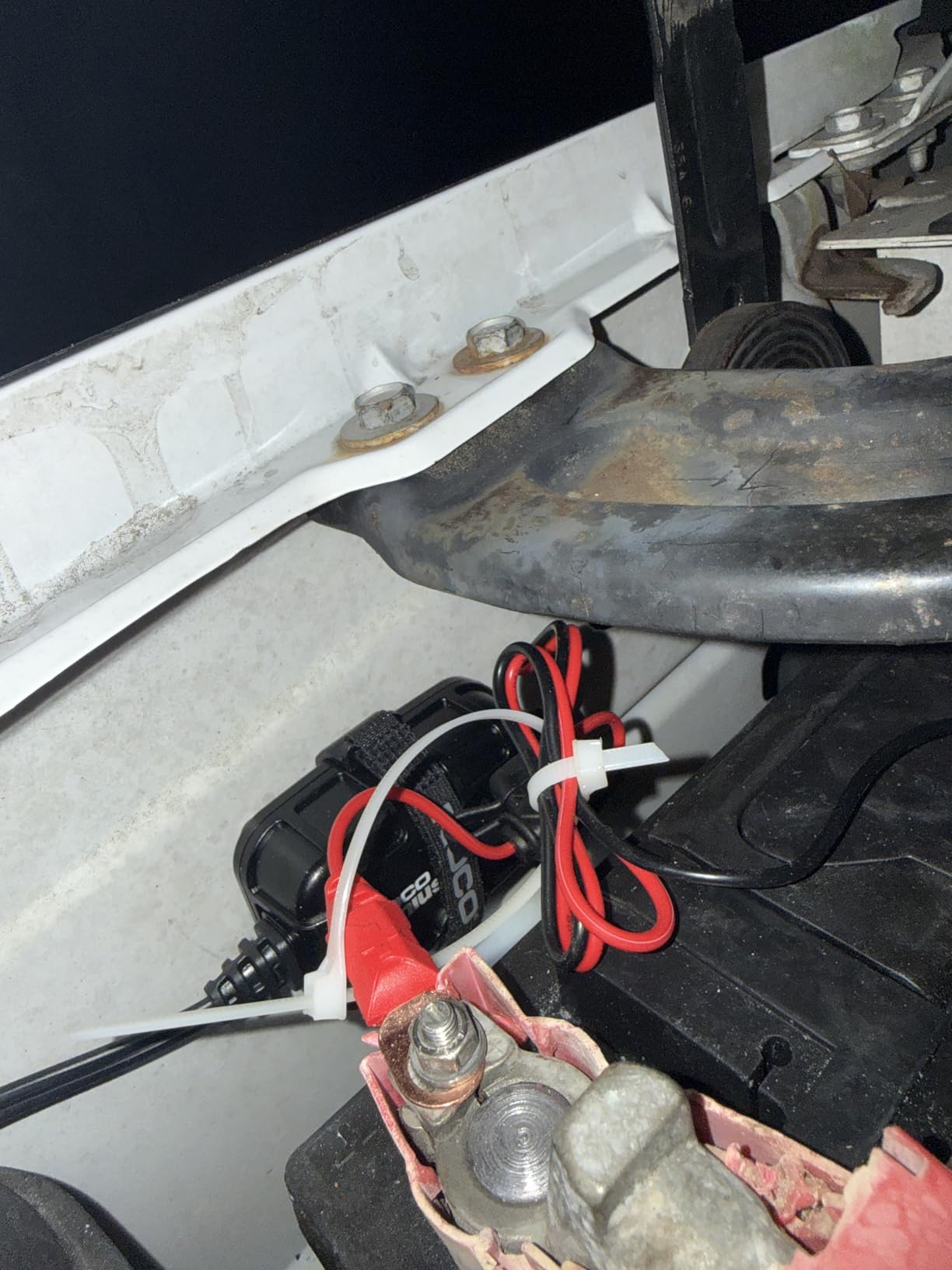
Pulse charging automatically detects and works against sulphation and acid stratification, and several reviewers report measurable recovery in batteries that had been neglected. At two amps it is a genuine charger rather than a trickle unit, and the stated 40-hour charge time assumes a deeply discharged pack.
It works with the full 12V lead-acid family including AGM, gel, SLA, VRLA, flooded, deep-cycle, marine and RV types. Smart monitoring means it can stay connected indefinitely without overcharge risk, which is the property you want from anything running unattended for a season.
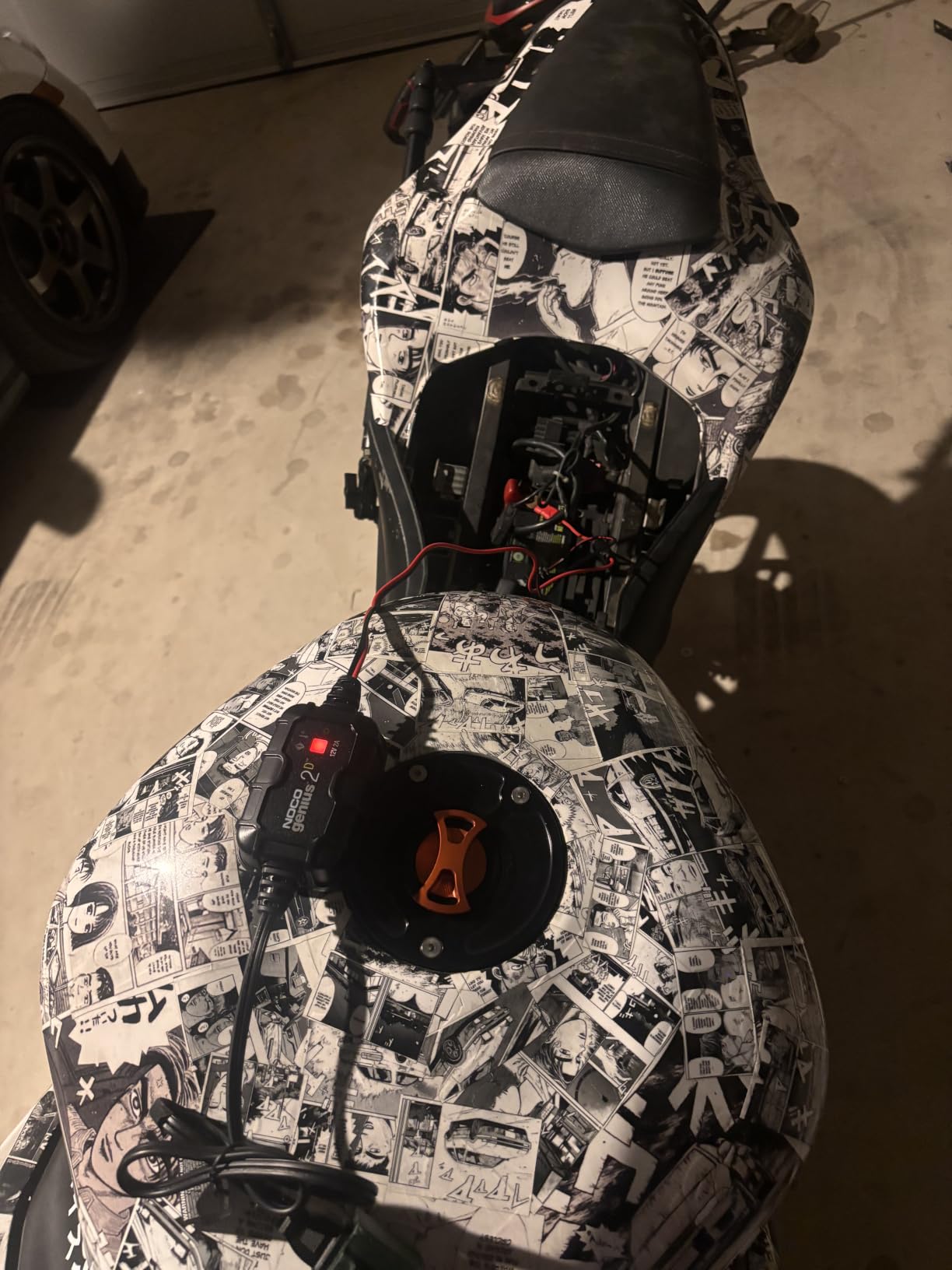
Is a permanently mounted charger worth the extra install effort?
For a bike that gets stored regularly, yes, and the reasons are practical. A mounted charger cannot be borrowed by another bike, cannot be unplugged by a neighbour sweeping the garage, and does not need re-hooking every time you want to check charge. Several owners describe mounting it near the battery as the step that finally made storage maintenance automatic.
The trade-off is installation complexity and the short lead lengths. Both the 24-inch AC cable and the 24-inch DC cable are generous for a battery near an outlet and short for one at the far end of a large frame.
Can this recover a battery that has already been sitting flat?
More often than a maintenance-class tender, yes. Force Mode is built for exactly that case, and the pulse charging stage works on sulphated or stratified cells. It is still not a substitute for a load tester, so check the result before you plan a season on that battery.
Do check the mounting hardware, though. Some owners have reported the supplied bracket cracking around the screw holes, which is an easy fix with a zip tie or a replacement bracket but worth knowing before you plan the layout.
7. Battery Tender Junior 800mA Switchable – For Lithium Batteries
Battery Tender Junior 12V, 800mA Battery Charger and Maintainer for Lead Acid and Lithium Batteries – Switchable Battery Charger for Powersports – 022-0199-DL-WH
800mA output
Lead-acid or LiFePO4 switch
ISM controller
5-year warranty
Pros
- One switch covers lead-acid and LiFePO4 lithium
- 4.8 average across more than 5000 reviews
- ISM controller updates the charge sequence continuously
- Very small and light for a sparse battery bay
- 5-year warranty and long service history
Cons
- 800mA is a maintenance rate only
- No desulfation or pulse repair mode
- Only two status lights so the stage is not spelled out
- Not a rescue charger for a fully flat battery
When a battery maker moves a model to lithium, the storage question changes completely. Owners who converted all their bikes to LiFePO4 report not connecting a charger at all, and for those who still want the habit of a maintained battery, this is the Junior with a lithium button added.
The push-button switch selects between lead-acid profiles, covering AGM, flooded and gel, and a 12V LiFePO4 setting. The ISM microcontroller updates the charge sequence continuously rather than running fixed stages, so it adapts as the battery’s state changes over months rather than committing to a one-size program.
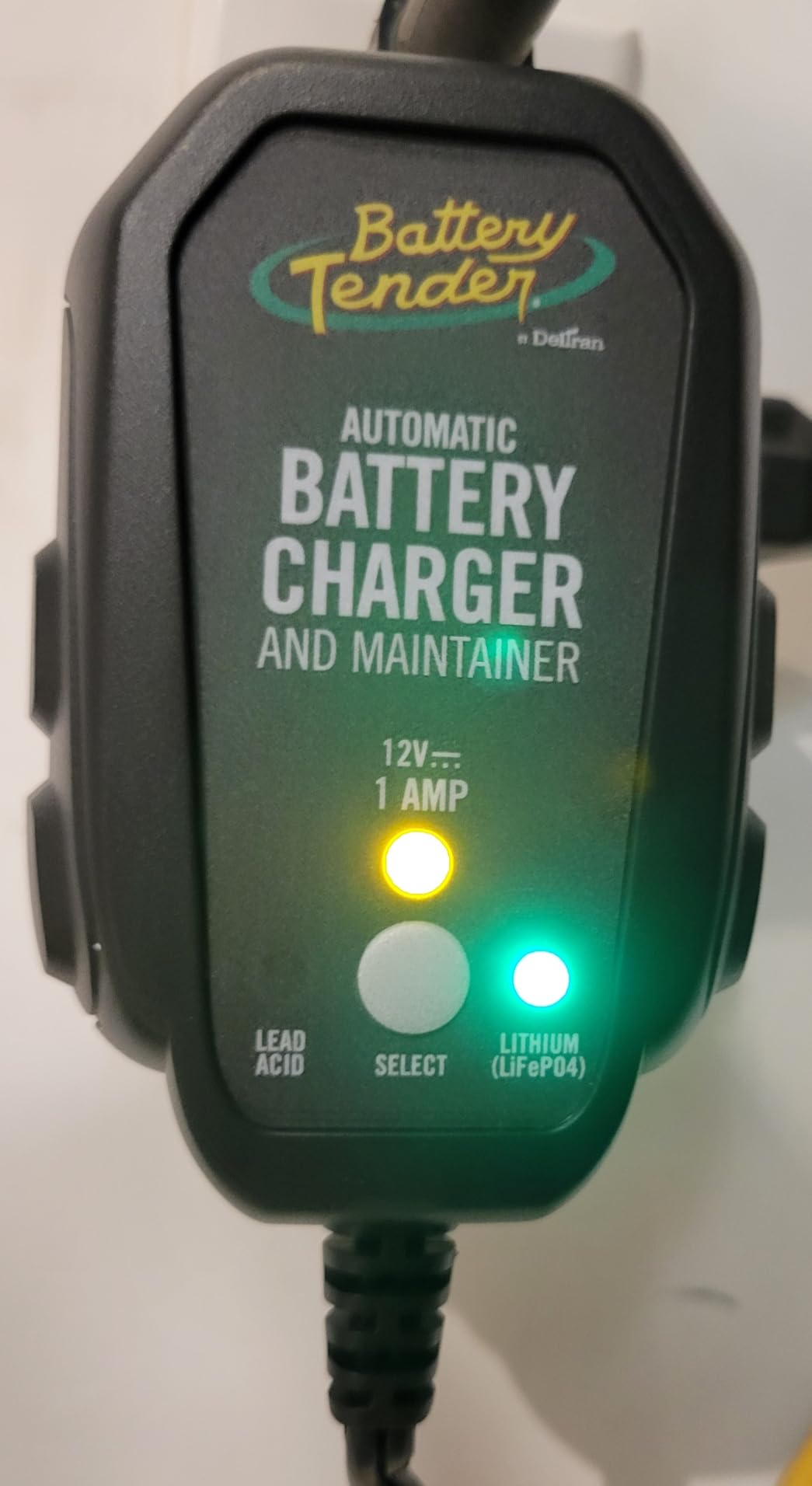
Long-term owners report batteries lasting six-plus years and chargers still working after many seasons in unheated sheds, which is a good record for any maintainer and a strong one at this output level. The unit is tiny and light, so it suits a sparsely packaged battery where a larger box will not fit.
Status indication is the weak point, with only two lights and no spelled-out stage. There is also no repair mode, so this maintains a healthy battery rather than recovering a neglected one, and at 800 milliamps it will not bring back anything close to flat.
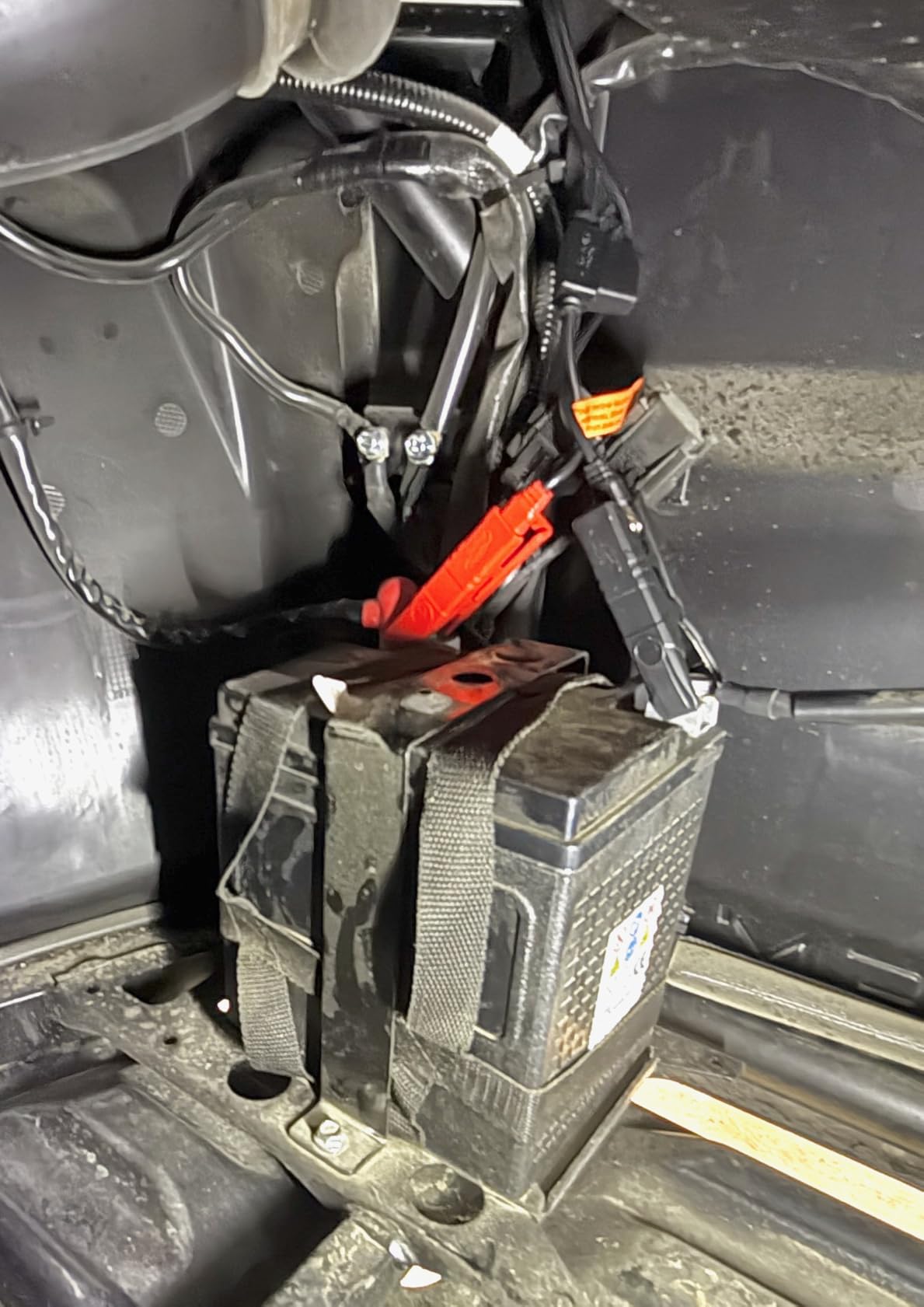
Does a lithium motorcycle battery need a tender at all?
Usually not, and this is the point most missed in storage planning. LiFePO4 packs have a much lower self-discharge rate than lead-acid and tolerate partial charge without the sulphation damage that kills a lead battery, so a healthy lithium pack stored for a winter typically comes back fine on its own. At least one long-term owner in the storage threads we read converted every bike in the garage to lithium and has never connected a charger since.
A tender still earns its place in two situations: cold weather, when capacity drops and a maintained battery performs noticeably better, and long-term storage where even a slow self-discharge adds up. If your garage is unheated, maintaining is cheap insurance.
Can a lead-acid tender be used on a lithium battery?
Do not. A lead-acid float profile holds a higher resting voltage than a lithium pack wants, and running one for months shortens lithium life. Either use a charger with a genuine LiFePO4 mode, like this one, or skip the charger entirely and let the battery sit.
That single switch is why this model is worth stepping up to if any of your bikes run lithium, even though it sits in the same price class as simpler lead-acid chargers.
8. Mroinge MBC010 1A – Detail-Oriented Build, Simple Setup
Trickle Charger 1A 12V Smart Battery Charger & Maintainer and Automatic Float Charger for Motorcycle, ATV, Lawnmowers and More
1A output
12-foot cable
Four-stage program
2-year warranty
Pros
- Connectors include protective caps
- which is unusual and useful for a permanent pigtail
- 12-foot cable gives real reach from a typical bike
- Copper-colored clamp jaws feel better than chrome-plated
- Simple two-color LED readable without a manual
- Reported to stay cool during long unattended charges
Cons
- LED colours can be confusing on a deeply discharged battery
- 1A output is slow and not a rescue charger
- Lead-acid only with no lithium mode
The detail that separates this charger from its competitors is the connectors. Both the alligator clips and the O-ring terminals arrive with protective caps, which matters if you are bolting a permanent pigtail to a battery that will sit in a garage with metalwork nearby for months.
Copper-coloured clamp jaws are a step up from the usual chrome plating in feel, and the twelve-foot total cable gives genuine reach from a bike parked anywhere sensible. Underneath, an MCU-controlled four-stage program handles initialization, bulk, absorption and float across flooded, gel, AGM, VRLA, deep-cycle and maintenance-free lead-acid.
Buyers running six-week unattended storage report no overcharging and no heat problems, and several confirm the unit still works after two or more years of intermittent use. At 5.6 ounces with a 2.29 by 3.45 by 1.3 inch footprint, it disappears into a tight battery bay.
The one consistent complaint is the LED scheme. On a deeply discharged battery the colours are ambiguous enough that buyers reach for the manual to decode them, which is a small thing on a charger you should only be checking once a month anyway.
Why do connector caps matter for a permanently installed charger?
Because a permanently installed lead is a live conductor sitting in a garage for months. A capped connector is isolated when you unplug it, and that removes the chance of a stray metal tool, a cover, or a jacket sleeve bridging a terminal and doing damage to a battery you were trying to protect.
It also keeps corrosion off the contact surfaces. Lead-acid terminals corrode fastest when exposed to moisture and air, and a cap that stays on through a wet spring saves you the cleaning job later.
Is a one-amp charger too slow to be worth buying?
For storage duty, no. One amp comfortably covers the self-discharge of a healthy motorcycle battery, and the extra current in higher-output chargers is really about recovering a battery that has already gone down rather than maintaining one that is close to full.
Where you will notice the limit is after a long neglect. If the battery has sat flat for weeks before you attach anything, expect to wait many hours, and verify the result with a load tester rather than assuming the charger did the job.
9. LEICESTERCN 2A Multi-Mode – The Most Features Per Box
2A Battery Maintainer & Trickle Charger, 6V 12V Smart Float Charger with Pulse Repair Mode, 10FT Extra Long for Motorcycle, Automotive Car, Lawn Mower, Marine Boat, ATV, SLA, AGM, Gel, LiFePO4
2A output
6V 12V and LiFePO4
Pulse repair mode
10-foot reach
Pros
- Handles 6V
- 12V lead-acid and 12V LiFePO4 from one charger
- 2A output is high for this class
- 10-foot reach is unusually long
- Pulse Repair Mode gives it a recovery function most rivals at this level lack
- LED reports charge status
- battery condition and errors
Cons
- Pulse Repair Mode does not apply to lithium batteries
- Mode must be set manually and can be set wrongly
- Only a 1-year warranty
- Some have been reported to fail or output minimal voltage
- Listing dimensions appear unreliable
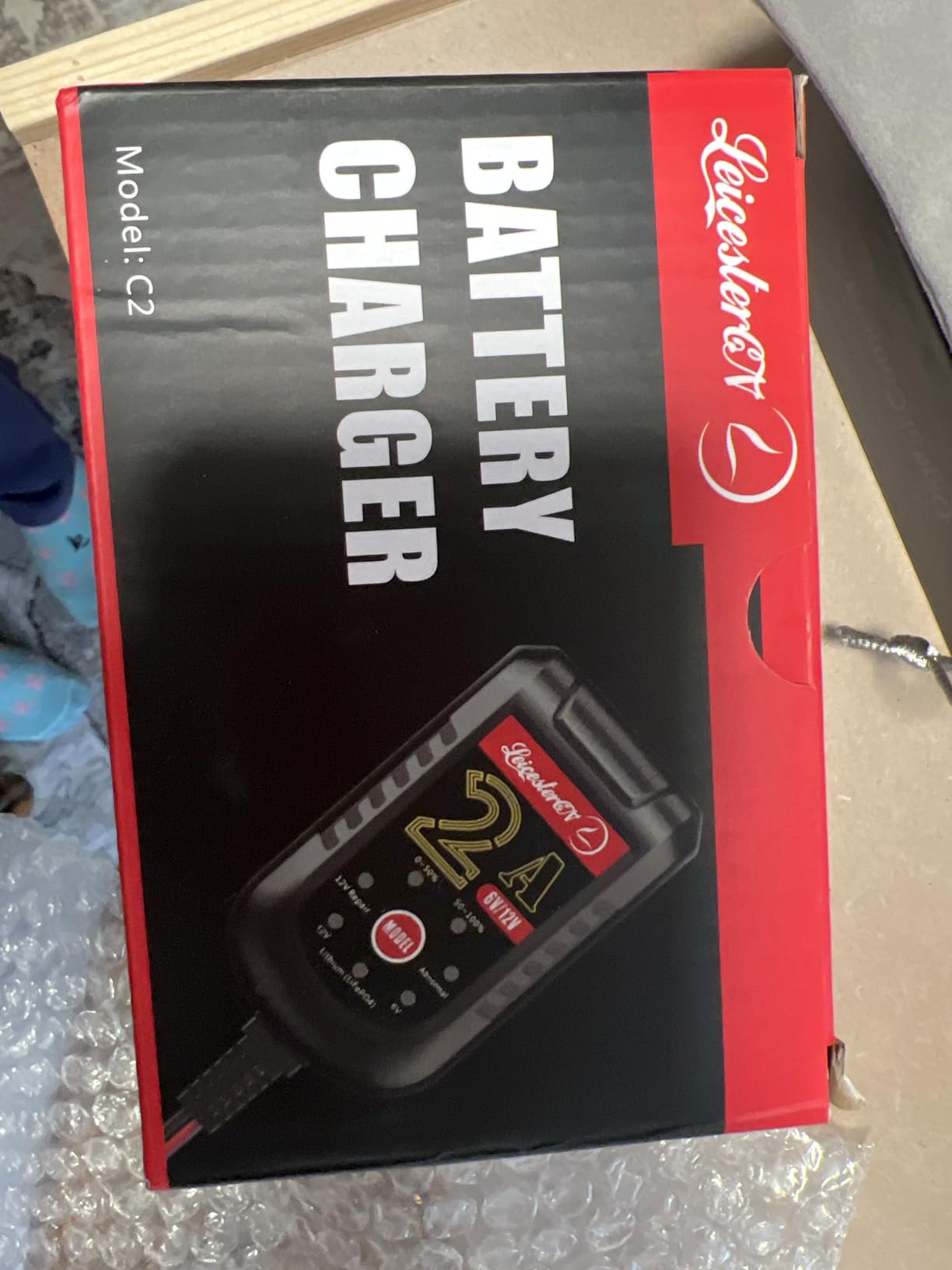
Feature-for-feature this is the most capable product at the entry end of the market. A single MODE button moves between 6V, 12V lead-acid and 12V LiFePO4, output reaches two amps, and the Pulse Repair Mode is there for sulphated or stratified cells, a function almost nothing else at this level offers.
Recovery times are the practical reason to want two amps. A 12V 20Ah battery takes roughly ten hours, which is a real difference when you are trying to save a battery that has been sitting through a neglected season. Reviewers report successfully reviving a fully dead Harley pack after long winter storage.
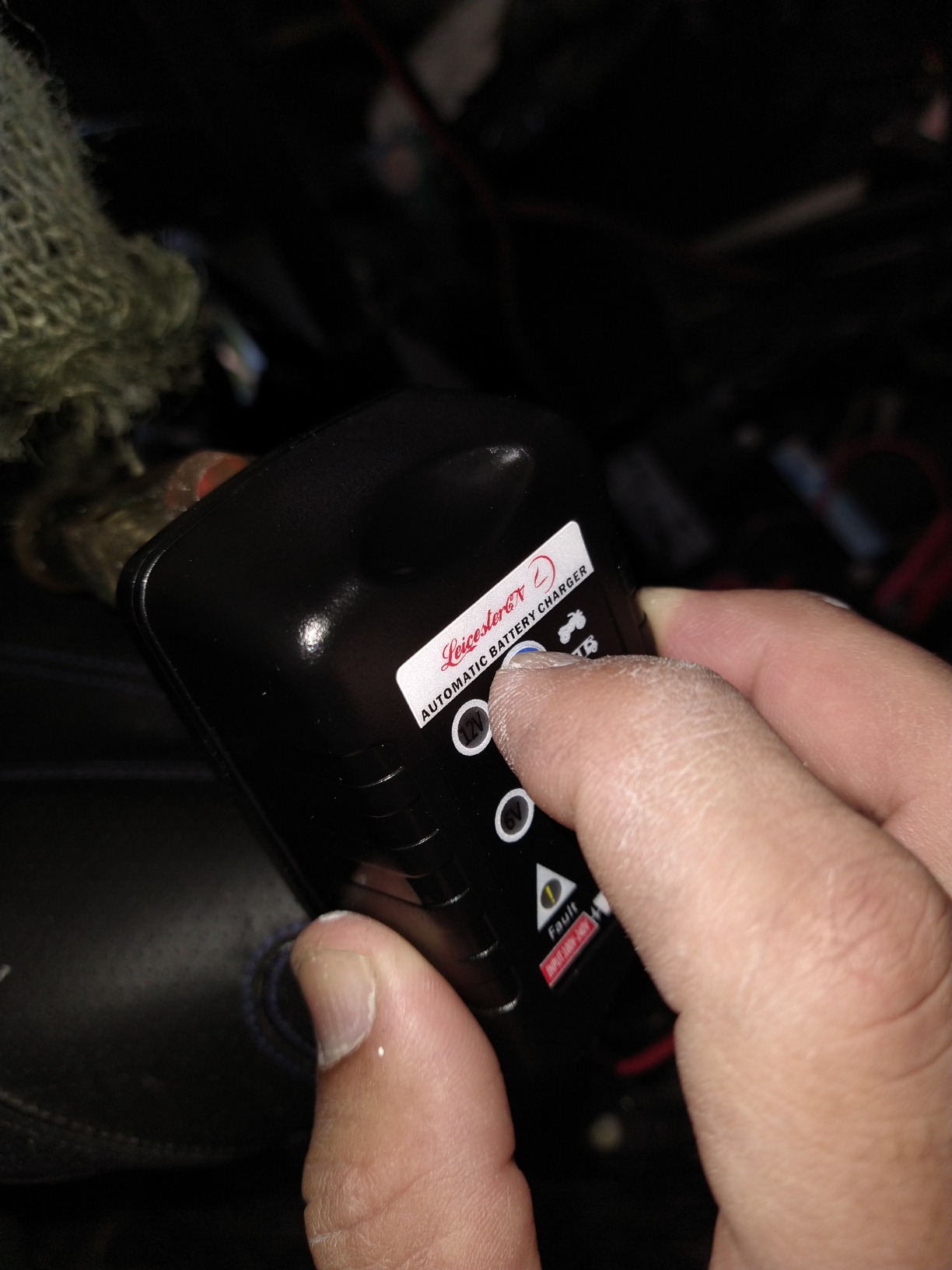
Cable reach is the other quiet strength. Ten feet total, combining an 8-foot AC cord and a 2-foot DC cable, covers the awkward geometry of a big motorcycle with the battery well aft of the engine, and it is longer than the leads on most other products here. Heavy-duty alligator clips and 5A fused ring terminals come in the box.
A built-in thermal sensor feeds into a solid set of protections: spark-proof connection, reverse polarity, short circuit, over-voltage, over-current and over-temperature. The gaps are the one-year warranty and a reported pattern of some units never charging properly, offset by a support line buyers describe as responsive with fast replacements.
Is a pulse repair mode worth anything on a stored battery?
Worth having when the battery is only moderately sulphated, which is the common case after a few weeks or a month of neglect. Pulse current targets the hardened deposit on the plates and can restore a pack that a plain float charger would leave sitting at a low state of charge indefinitely.
Two cautions. It does not apply to lithium at all, and it is not magic on a battery that has been deeply discharged for a year. Confirm the result under load before you plan a season on that pack.
What happens if you select the wrong battery mode?
The mismatch cases run from undercharging to overcharging depending on the direction of the error, and with a manual button rather than auto-detection, the risk sits with you. Get into the habit of setting the mode every time you connect, especially if the same charger serves bikes with different batteries.
Owners of bikes with mixed chemistries usually solve this by labelling the charger and the harness, which takes ten seconds and prevents the single most expensive mistake in this whole roundup.
10. Mroinge MBC022 2A – Lithium Handling with Real Current
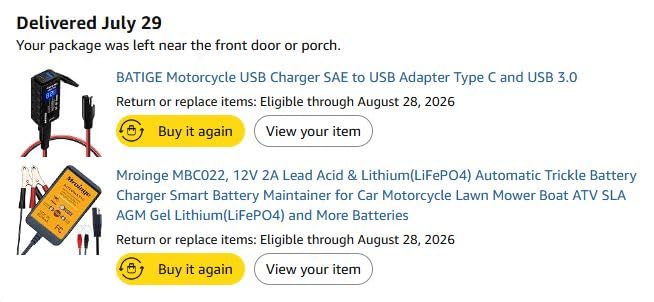
Mroinge MBC022, 12V 2A Lead Acid & Lithium(LiFePO4) Automatic Trickle Battery Charger Smart Battery Maintainer for Car Motorcycle Lawn Mower Boat ATV SLA AGM Gel Lithium(LiFePO4) and More Batteries
2A output
Lead-acid or LiFePO4
5-stage program
2-year warranty
Pros
- Combines 2A output
- LiFePO4 support and a bad-battery diagnostic
- 2A is a real charging current rather than a trickle rate
- 12-foot cord with clips and O-ring terminals
- Does not get hot topping off a large LiFePO4 battery
- Support reported as responsive
Cons
- Cannot revive a LiFePO4 pack whose BMS has shut down at zero volts
- Mode must be changed with the battery disconnected
- Cord is shorter than some rivals at the same output
- Some buyers report it switching off past the 80% indicator
Many lithium-capable maintainers output one amp, which is fine for maintenance but slow if the pack needs a top-up. This one runs two amps and adds a bad-battery identification function, so it tells you when a pack is too far gone rather than quietly sitting on it all winter.
It runs a five-stage program, adding an explicit trickle current stage between initialization and bulk, across flooded, sealed maintenance-free, AGM and gel lead-acid plus LiFePO4 packs up to 85Ah. A LiFePO4 low-voltage activation function is included for packs that have dropped toward their cutoff.
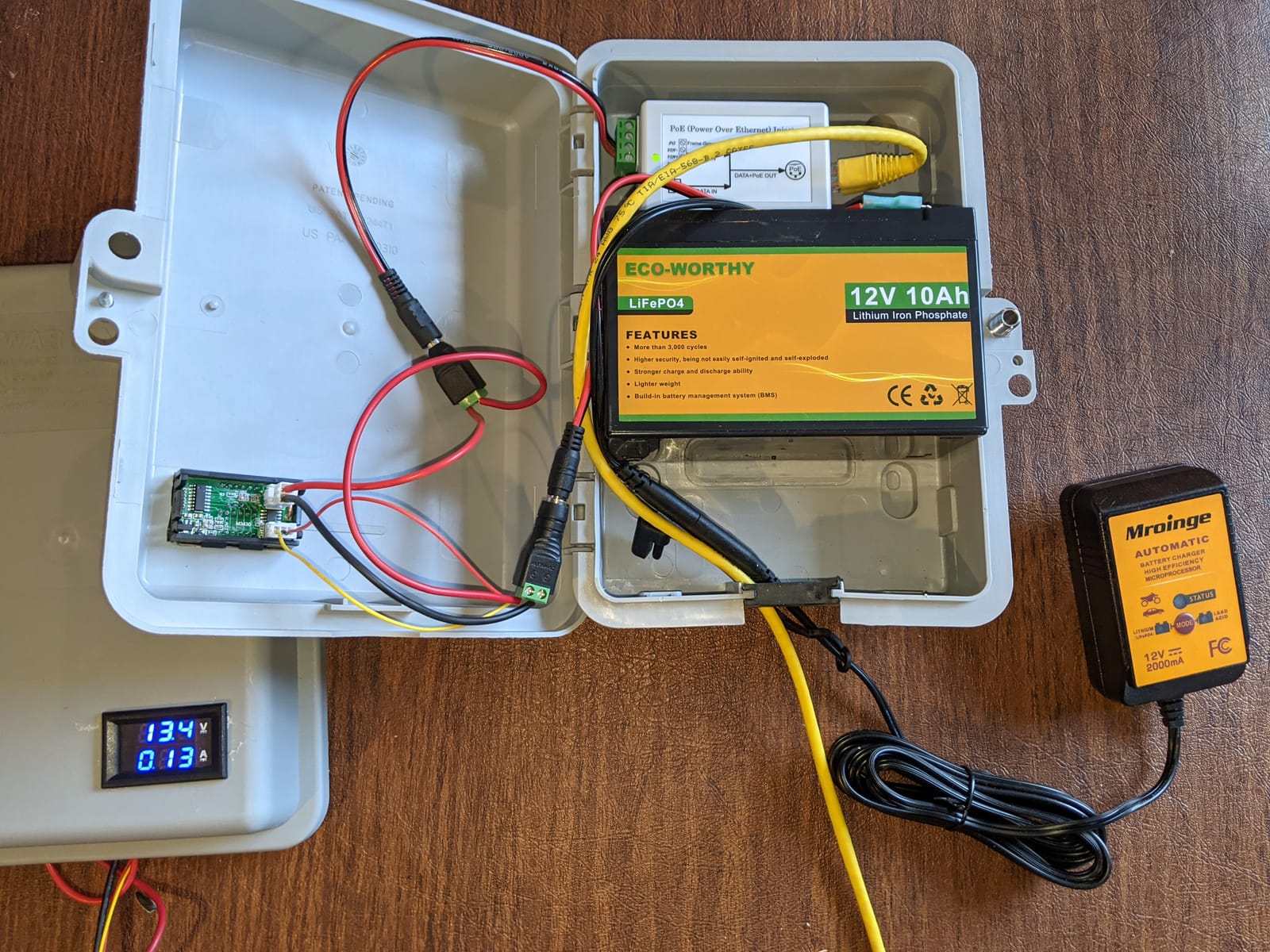
Lithium owners in reviews single this out, and one of the more useful data points is that it charged a large LiFePO4 motorcycle battery without the overheating that others feared from a two-amp unit on lithium chemistry. The twelve-foot output cord arrives with both battery clips and O-ring terminals.
There is a hard limit worth understanding. If a lithium pack has reached zero volts and its battery management system has shut down, no charger in this roundup can wake it, including this one. Some buyers also report it stopping itself past the 80% indicator, which means unplugging and replugging rather than a fault.
How large a lithium battery can this charger handle?
Rated for LiFePO4 packs up to 85Ah, which covers essentially every battery fitted to a motorcycle and most of the larger packs people put in touring bikes and dual-battery builds. Two amps into an 85Ah pack is a maintenance current, exactly as intended for storage.
Going past 85Ah means the charge rate becomes proportionally gentler, so recovery of a deeply discharged pack takes much longer. For storage rather than rescue, the limit rarely becomes the deciding factor.
Is a lithium battery with a sleeping BMS recoverable at all?
Sometimes, and this charger gives it a dedicated route that most chargers in this roundup do not. A low-voltage activation function attempts to bring a pack back up before the management system locks out permanently, and the bad-battery indicator tells you when the attempt is not going to work.
If the pack has been at zero volts for a long stretch, the BMS may cut out permanently, and at that point the battery is a replacement. This is exactly why maintaining during storage matters more for lithium than for lead-acid, where a sleeping pack usually wakes up.
How a Battery Tender Works During Months of Storage
A battery tender connects to the battery terminals and runs a staged charge program: it checks the battery, applies bulk current, holds an absorption voltage, then drops to a float or maintenance voltage. From that point on it only pushes current as the battery self-discharges, which is the behaviour that separates a real maintainer from a dumb trickle charger.
Storage mode is the part most riders have never heard explained. Rather than holding the battery pegged at full charge indefinitely, this behaviour charges to roughly 95 percent, disconnects, lets the battery fall to around 90 percent, then pulses it back up. Riders describe this as noticeably kinder to long-term battery life than holding 100 percent on float for months, and it is the most repeated technical insight across the storage threads we read.
Float is the other term that causes confusion. A float stage holds a lower voltage than charging, usually around 13.6 volts for a 12V lead-acid battery, which is enough to offset self-discharge without generating the heat and water loss that a hard overcharge would. Leaving a proper float maintainer connected indefinitely is exactly what it is designed for.
Trickle chargers, by contrast, push a small fixed current regardless of what the battery needs. That distinction is not academic: riders are regularly told not to put a battery on a trickle charger, because a constant current with no voltage regulation boils the electrolyte out of a flooded cell over a long storage period. A tender regulates; a trickle charger does not.
Sulphation is the failure both types exist to prevent. Lead-acid batteries form lead sulphate crystals on the plates as they discharge, and those crystals harden into a layer that blocks charging. A partially discharged battery sitting for months ends up with more crystal build-up than one kept near full, which is why a battery can appear fine in November and dead in March.
Desulfation is the counter-attack. Several chargers here, including the MOTOPOWER and the LEICESTERCN, apply pulse current during charging to break down hardened crystals. It works best on batteries that have sat flat for weeks rather than months, and you should still confirm recovery with a load tester rather than trusting the charger’s own LED.
Matching Amperage and Chemistry to Your Battery
Amperage is the number shoppers fixate on and the number that matters least during storage. A healthy 12V motorcycle battery loses charge at a rate measured in milliamps, so anything from about 0.75A to 2A will hold it steady for months. Higher current buys you recovery speed on a neglected battery, not better maintenance.
For gel cells, 0.75 amps is the widely accepted figure, and sealed gel chemistry is the least tolerant of sustained high current. Flooded and AGM batteries benefit from more, which is why 1.25A and up suits them, and 1.5A to 2A is a sensible ceiling for a small motorcycle battery used as a maintainer. Riders warn that 5-amp chargers, which exist as recovery tools, can shorten battery life when left on constant maintenance for small packs.
So the shortlist by chemistry runs like this. Gel cell, pick something at or below one amp. Flooded or AGM, one to two amps covers both maintenance and a reasonable recovery. Lithium, match the LiFePO4 setting rather than the amperage, and use a charger that names the chemistry explicitly. Dual-battery bikes are the case where the highest output in the roundup earns its place, because you are covering two batteries at once.
None of these figures matter if the charger cannot reach your battery or the garage has no outlet nearby, so treat reach and power access as requirements rather than details.
Lithium changes the maths. LiFePO4 self-discharges far more slowly than lead-acid and does not suffer the same sulphation penalty from partial charge, so a healthy lithium battery in a moderate climate often needs nothing at all for a winter. Cold is the variable that argues for maintaining it, since usable capacity drops in low temperatures.
Chemistry support comes in two forms. Auto-detecting chargers read the battery and pick a profile; manual chargers make you choose with a button or switch. Manual is fine if you connect the same charger to the same bike all year, and a source of mistakes if one charger serves a mixed garage.
One rule covers everyone: never run a lead-acid float profile on a lithium pack for months. Pick a charger with a genuine LiFePO4 mode, or leave the battery alone. If your battery is lithium and you have a lead-acid-only tender, the safest answer is to disconnect it.
How to Hook Up a Tender So It Works All Winter
Ring terminals are the right permanent connection. They bolt to the battery posts, stay put through months of storage, and do not arc or slip the way an alligator clip can when a bike is bumped or moved. The models that include a fused ring terminal harness, like the Junior and the MOTOPOWER, are the ones to look for.
Alligator clips serve a different purpose: temporary hookup while you check a battery, or for a machine that gets moved around a lot. Several chargers in this roundup include both, which is the ideal combination for a garage with a mix of stored bikes and occasionally-used equipment.
A quick-disconnect harness is the answer for anyone swapping one charger between several batteries, because it turns a fiddly two-minute job into a one-second plug. The Battery Tender Plus uses one, and it is the feature riders most often credit for making multi-bike rotation realistic instead of aspirational.
Route cables where they cannot be clipped by a moving part, pinched by a seat, or walked on. Lead length matters here in a practical way: a charger whose cord does not reach the outlet tempts you into an extension cord, and a light-duty extension cord under a continuous load for months is a poor substitute for a direct connection.
For garages with no usable outlet, a heavy-duty outdoor-rated extension lead is the workable answer, and mounting the charger off the floor improves airflow for any charger that generates heat. Do not daisy-chain several batteries in parallel to one smart charger; riders are cautious about unpredictable behaviour from smart chargers when paralleled, and a bank charger is built for that job instead.
Finally, confirm the polarity before you tighten anything, and only use a charger with reverse polarity detection or spark-proof circuitry. Both are standard on the models here, and both matter when you are connecting a battery by feel in an unlit garage.
Storing More Than One Motorcycle at Once
A recurring battery failure story in owner forums is not a bad charger, it is a charger that never got moved. One maintainer, several bikes, no routine, and at least one dead battery every winter, year after year. The fix is either discipline or hardware.
Discipline means a fixed weekly or biweekly swap routine and a quick disconnect that makes the swap take seconds rather than minutes. Most owners who do this successfully set a recurring reminder, because the failure mode is forgetting, not difficulty.
Hardware means a bank charger, which gives every battery its own independent channel instead of one charger taking turns. A multi-bank charger removes the forgetting problem entirely, and a four-bank Battery Tender is the specific recommendation that comes up most often in multi-bike threads, where owners running several machines talk about a 5A total output split across independent channels.
Dual-battery motorcycles complicate things, since both batteries need maintaining and they are often different types. A bank charger with independent channels is a much better fit than paralleling both batteries to one output, because the two packs can be at different states of charge and will not charge evenly that way.
That warning about parallel charging is worth stating plainly, because it comes up repeatedly in owner discussion. Connecting several batteries in parallel to a single smart charger is cautioned against unless the charger is a simple constant-voltage trickle type, because the behaviour of a smart charger feeding two batteries of different size at once is unpredictable. Independent channels solve the problem properly.
Powersports fit the same logic. An ATV, UTV, snowmobile or mower in the same garage on the same wall outlet can be served by bank channels or by dedicated single maintainers, and a single multi-chemistry unit that handles 6V, 12V and LiFePO4 covers a mixed fleet more cleanly than three dedicated lead-acid boxes. If the mower is the other machine on your list, our best battery-powered lawn mowers guide covers storage and charging for that class of equipment.
Before and After Storage: What to Do Either Side of the Charger
Before the bike goes away, clean the terminals. Corroded connections raise resistance, so the charger’s current never reaches the battery properly and the indicator can suggest everything is fine while the pack slowly declines. A wire brush or a terminal cleaner takes minutes and prevents months of poor charging.
If you have flooded cells, check the electrolyte level while the bike is stored and top up with distilled water when it drops. Owners recovering a heavily sulphated battery describe doing this every four to seven days during the recovery period, since charging a depleted flooded cell consumes water faster than it should.
Do not decide the battery is fine because the charger LED looks happy. A load tester is the honest check, and it is cheap relative to replacing a battery. Test after the first month and again before the season starts.
After the bike comes out of storage, let it sit disconnected for a few hours before you turn the key, check the tyre pressures and the fuel, and expect the first start to be strong if the tender did its job. If the bike starts but the charging light stays on, the alternator is not keeping up and the tender is covering a different problem.
Some riders should skip the tender entirely. If the bike is stored for under three weeks, the battery will barely have moved. If the bike already has a smart charger built into it, a second charger adds nothing. And if your battery is lithium in a moderate climate, a healthy LiFePO4 pack is usually fine sitting untouched for a season.
Frequently Asked Questions
Are battery tenders good for motorcycles?
Yes. A battery tender is specifically designed for long-term motorcycle storage. It brings a 12V battery to full charge, then drops to a float voltage and only supplies current as the battery self-discharges. Because it regulates voltage rather than pushing fixed current, it can stay connected for months without overcharging, which is exactly what a stored motorcycle needs.
How long can you leave a battery tender on a motorcycle battery?
Indefinitely, as long as it is a smart maintainer with float or storage mode. Every product in this roundup uses a multi-stage program that stops charging at full and holds a maintenance voltage, so leaving one connected through an entire winter is the intended use. Avoid basic trickle chargers, which apply constant current and can boil the electrolyte out of a flooded cell over months.
Is it safe to leave a battery maintainer on all the time?
Yes, for a smart charger or maintainer with float and storage mode. The unit stops delivering bulk current once the battery is full and holds it at a maintenance voltage, or cycles it between roughly 95 and 90 percent in storage mode. Confirm your charger has overcharge protection and reverse polarity detection, and verify the output voltage matches your battery before connecting.
What is the best battery tender for motorcycles?
For most riders storing one bike, the Battery Tender Junior at 0.75 amps is the safest choice, with a 4.8 average across close to fifty thousand reviews and a 5-year warranty. For several bikes or a neglected battery, the Battery Tender Plus at 1.25 amps adds current and a quick-disconnect harness. For lithium batteries, choose a unit with a genuine LiFePO4 mode.
How should I maintain my motorcycle battery during the winter?
Clean the terminals before connecting a tender, then attach it and leave it plugged in. For flooded cells, check electrolyte levels every few weeks and top up with distilled water. If a multi-bike household, rotate the charger on a fixed schedule or use a multi-bank unit so no battery is forgotten. Before the riding season, verify the battery with a load tester rather than trusting the charger indicator.
Final Verdict on Battery Tenders for Stored Motorcycles
For a single bike with a healthy lead-acid battery, the Battery Tender Junior is the charger we would install. It is small, it is proven across close to fifty thousand reviews, and it includes a fused ring terminal harness so the install is permanent and forgotten. If you store two or more bikes, step up to the Plus for the quick-disconnect harness and the longer warranty, or give each bike its own charger so nothing gets skipped.
Go lithium-aware rather than brand-loyal. Two products in this roundup handle LiFePO4 with a single switch while also carrying a 4.8 average rating. Add a 2A model with pulse repair if your battery has already been neglected, and a permanently mountable onboard charger if your garage has no outlet near the bike.
Whatever you choose, connect it before the bike goes into storage rather than after spring arrives. In 2026 the same rule applies as every year before: the best battery tenders for stored motorcycles are the ones already plugged in when the cold months start.