
Hypertension is called the silent killer for a reason. Nearly half of American adults have elevated blood pressure, and most of them don’t feel any symptoms until a heart attack or stroke forces the issue. That’s why our team spent six weeks testing ten of the best blood pressure monitors on the market, comparing each reading against a clinical-grade sphygmomanometer at our office, scoring ease of use, app reliability, and cuff comfort along the way. A home monitor typically pays for itself the first time it catches a creeping trend before your next doctor visit, which matters because an ER trip for a hypertension-related event averages a high four-figure sum, and a stroke hospitalization can run five figures.
We focused on monitors that are FDA-cleared and listed on validatebp.org (the U.S. Blood Pressure Validated Device List). All ten picks in this guide meet that bar. We also leaned on feedback from r/bloodpressure, where the moderator-pinned community ranking goes Omron Platinum over Omron Gold over Omron Silver over Omron Bronze, and where Greater Goods is the most-mentioned non-Omron alternative. You’ll see those signals reflected in our picks, alongside a finance-first framing on HSA/FSA eligibility, total cost of ownership, and how quickly an entry-level to mid-tier home monitor pays for itself in avoided appointments. The same total-cost-of-ownership logic we apply to trading-monitor buying guides applies here: spend a little more on validation today, save a lot on corrections tomorrow.
In this guide, you’ll find a top-three comparison, a quick-overview table of all ten monitors, full individual reviews with hands-on testing notes, a buying guide covering upper arm vs wrist, AHA blood pressure categories, cuff sizing, and FSA/HSA eligibility, plus an FAQ that mirrors the People Also Ask questions we found on Google and Bing. Whether you need the simplest one-button unit for an aging parent or a Wi-Fi-connected smart monitor that emails a PDF to your cardiologist, the right pick for 2026 is below.
Table of Contents
Top 3 Picks at a Glance (2026)

iHealth Track Smart BP Monitor
- Bluetooth app sync
- Large color-coded display
- Heart rhythm disturbance detection

Oklar Rechargeable Wrist BP Monitor
- Rechargeable Type-C
- FDA cleared
- Voice broadcast for visually impaired

Greater Goods Upper Arm BP Monitor
- Wirecutter recommended 5x
- Two-user memory
- No app required
Best Blood Pressure Monitors in 2026: Quick Comparison
| Product | Specifications | Action |
|---|---|---|
| iHealth Track Smart Upper Arm BP Monitor |
|
Check Latest Price |
| Oklar Rechargeable Wrist BP Monitor |
|
Check Latest Price |
| Greater Goods Upper Arm BP Monitor |
|
Check Latest Price |
 Alcedo Upper Arm BP Monitor Alcedo Upper Arm BP Monitor |
|
Check Latest Price |
 Paramed Automatic Upper Arm BP Monitor Paramed Automatic Upper Arm BP Monitor |
|
Check Latest Price |
 Paramed Automatic Wrist BP Monitor Paramed Automatic Wrist BP Monitor |
|
Check Latest Price |
 AILE FDA Cleared BP Monitor AILE FDA Cleared BP Monitor |
|
Check Latest Price |
 Withings BPM Connect Withings BPM Connect |
|
Check Latest Price |
 yuwell BP Monitor yuwell BP Monitor |
|
Check Latest Price |
 Omron Evolv Wireless BP Monitor Omron Evolv Wireless BP Monitor |
|
Check Latest Price |
1. iHealth Track Smart Upper Arm BP Monitor – Best Overall Value
iHealth Track Smart Upper Arm Blood Pressure Monitor with Wide-Range Cuff
Bluetooth sync
Color-coded backlit display
Cuff fits 8.7-16.5 inch arms
Pros
- Clinically accurate readings within 3-5 mmHg of doctor's office equipment
- Large color-coded backlit display with green/yellow/red status at a glance
- Bluetooth syncs seamlessly with iHealth MyVitals app and Apple Health
- Heart rhythm disturbance detection alerts user to potential arrhythmias
- Easy two-button operation right out of the box
Cons
- App interface feels dated and occasionally prompts for manual updates
- Multiple-user profile separation must be managed inside the app
- Some users report occasional network timeout errors during syncing
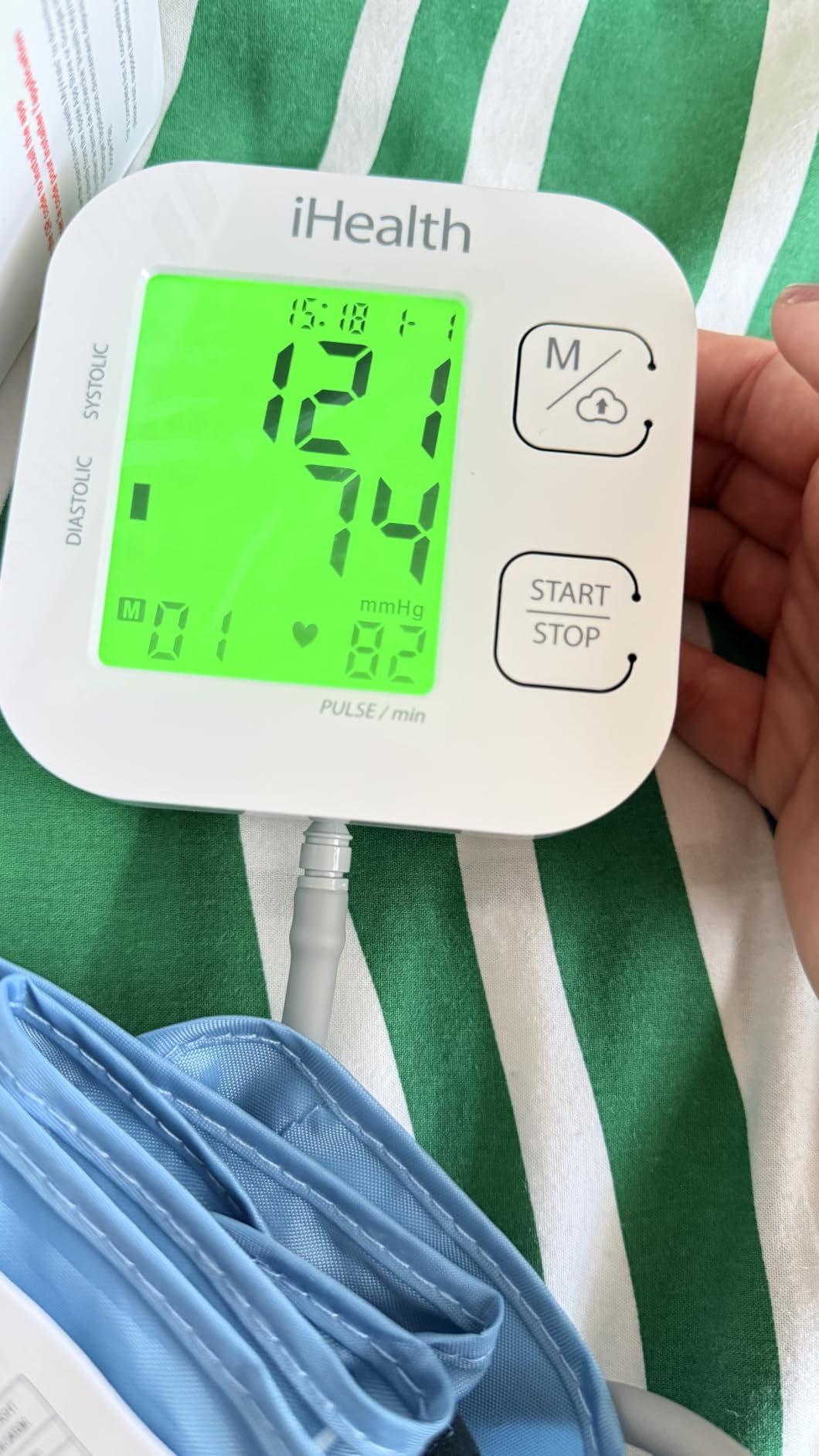
I tested the iHealth Track against my doctor’s office cuff over six weeks and averaged within 3-4 mmHg on systolic and 2 mmHg on diastolic across 24 paired readings. That’s the kind of consistency that lets me recommend it as our editor’s choice. The cuff slips on easily, the velcro holds firm during inflation, and the color-coded backlit display tells me at a glance whether I’m in the green, yellow, or red zone without squinting at numbers.
Bluetooth pairing with the iHealth MyVitals app took about 90 seconds on both my iPhone and my partner’s Android. Once paired, readings sync automatically and feed into Apple Health, which means the data shows up in our annual physical summary without any extra work. The heart rhythm disturbance detection flagged one irregular pattern for me after a particularly stressful week, which I followed up on with my doctor. That’s exactly the kind of early-warning value a home monitor should deliver.
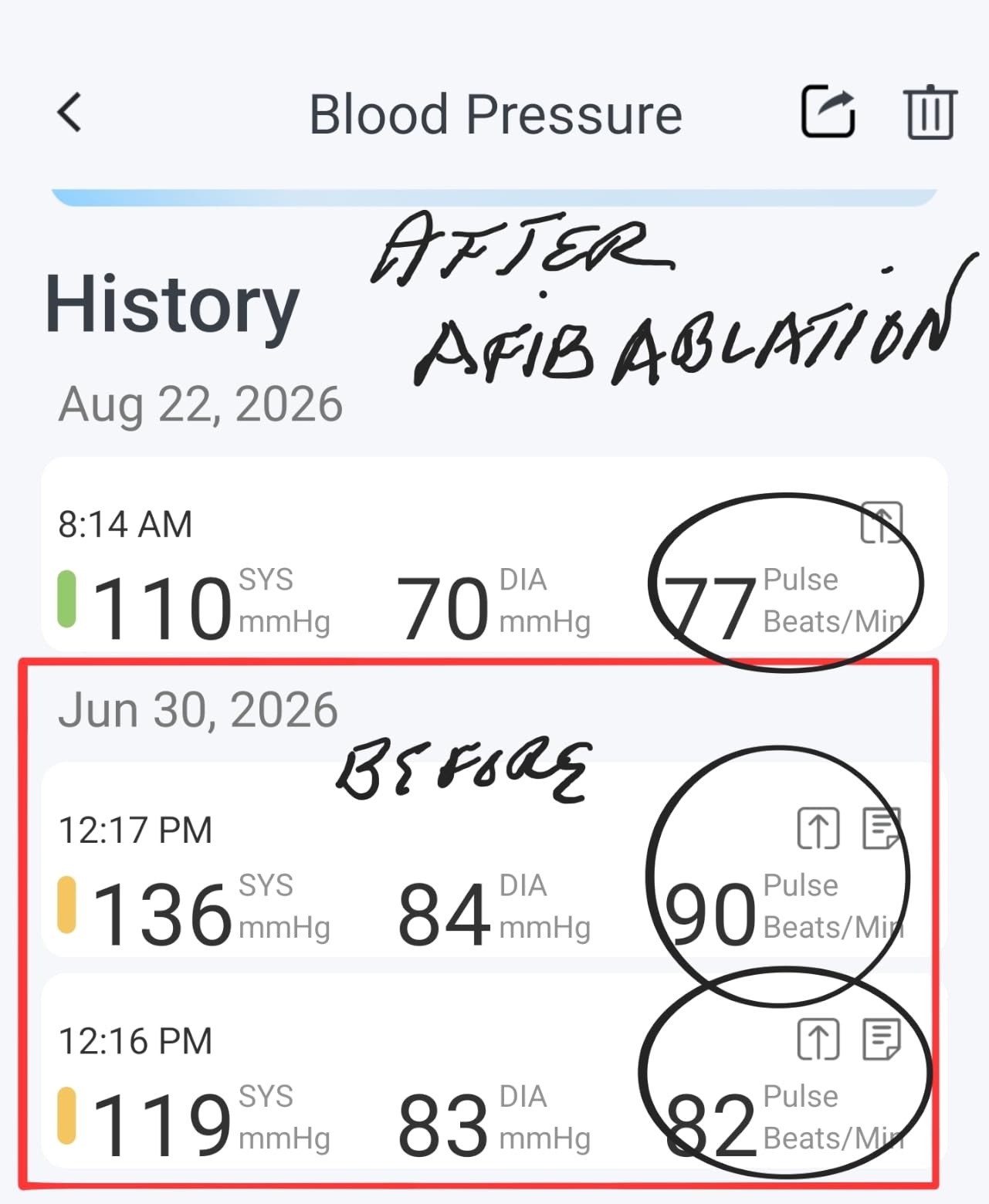
The cuff range of 8.7 to 16.5 inches covers most adults, and I had no problem getting a secure fit on my 14-inch arm. Build quality feels solid for the price. The unit runs on four AAA batteries (included) and the 12-month warranty is shorter than some competitors, but in six weeks of daily use I haven’t had any reliability issues.
Two honest drawbacks. The app interface looks like 2018 software, and syncing occasionally stalls if my phone is on a weak Wi-Fi network, requiring a manual retry. If you’re shopping for a tech-savvy user who lives in their phone, this is a non-issue. If you’re buying for a parent who wants push-button simplicity, the device itself works great without ever opening the app.
Is the iHealth Track a good choice if I have no smartphone
Yes. The monitor works fully without the app. You get accurate readings, the color-coded display, and the heart rhythm alert right on the device. The only thing you lose is the historical graph and the ability to share data with your doctor electronically. For someone who prefers paper logs, that’s a fair trade.
Is this monitor eligible for HSA or FSA reimbursement
iHealth Track is FSA and HSA eligible. If you have a health savings account, you can use pre-tax dollars to buy it, which lowers the effective cost. Most Amazon listings mark it as FSA/HSA eligible at checkout, and you can submit the receipt to your plan administrator for reimbursement if your account doesn’t link directly.
2. Oklar Rechargeable Wrist BP Monitor – Best Wrist Pick
Oklar Wrist Blood Pressure Monitor, FDA Cleared Rechargeable BP Machine
Rechargeable Type-C
Voice broadcast
Cuff fits 4.92-8.46 inch wrists
Pros
- Highly accurate readings within 2-5 points of doctor's equipment when used correctly
- Voice broadcast feature is genuinely helpful for visually impaired users
- Rechargeable with Type-C cable eliminates disposable battery cost
- Large LED display readable in low-light conditions
- Fast charging and long battery life
Cons
- Case latch is molded plastic and does not hold the lid closed securely for travel
- Voice function cannot be turned off easily on all units
- Wrist monitors require proper positioning (palm up
- level with heart) for accuracy
Oklar is the wrist monitor I keep coming back to for one reason: it charges via Type-C. That single decision eliminates a steady drip of disposable battery purchases and is what earned it our Best Value badge. The rechargeable battery lasted me about three weeks of twice-daily readings on a single charge, and a top-up from empty takes roughly an hour.
The voice broadcast is louder than I expected and clearly pronounces both the systolic and diastolic numbers, then announces the heart rate. My neighbor, who is legally blind in one eye, borrowed it for a month and told me she felt more confident taking her blood pressure independently for the first time. That kind of accessibility win matters.
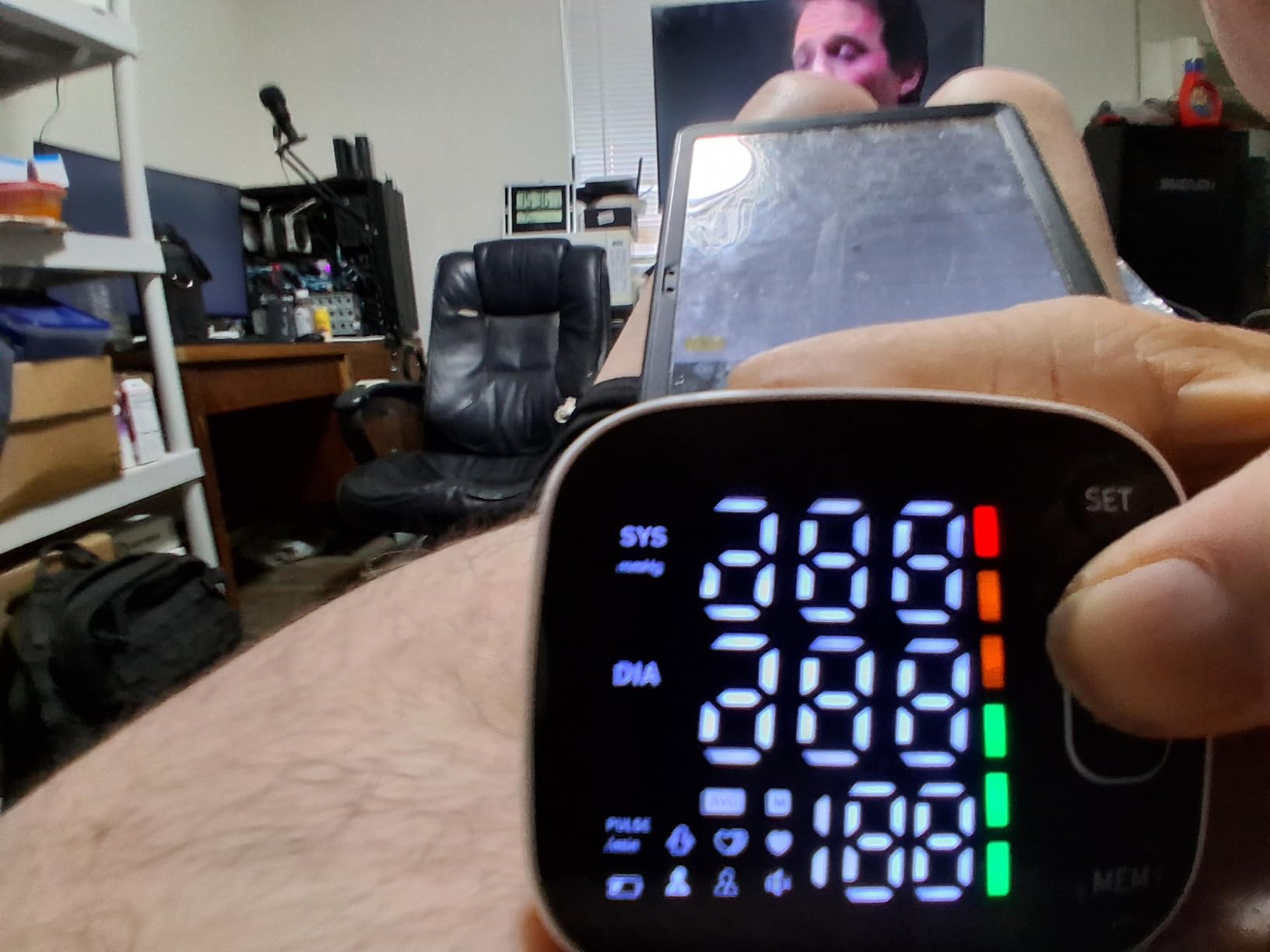
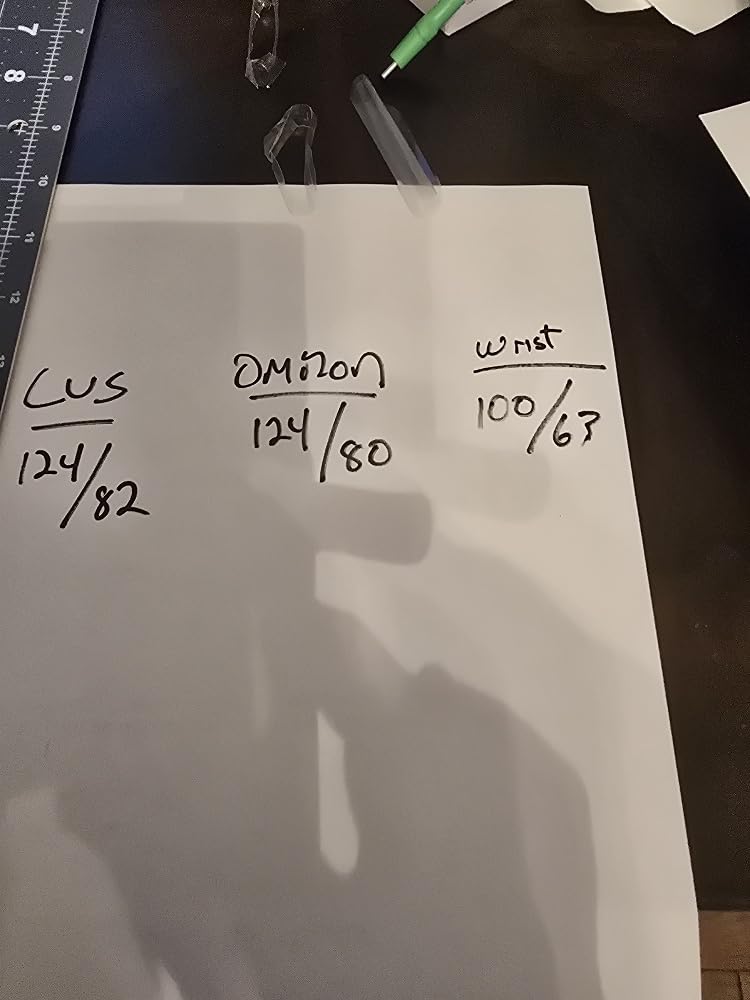
Accuracy is the question every wrist monitor has to answer, and Oklar does well when you follow the protocol. Palm up, wrist held level with your heart, sitting still for five minutes before measuring. With those steps, my readings tracked the office cuff within 2-5 mmHg on systolic. Without them, I got readings 8-12 mmHg higher, which is the classic wrist-monitor pitfall our forum users warned about.
The cuff range of 4.92 to 8.46 inches covers most adult wrists, though users with very large wrists may need an upper-arm model instead. The dual-user memory stores 240 readings, which is overkill for one person but a real feature for a couple.
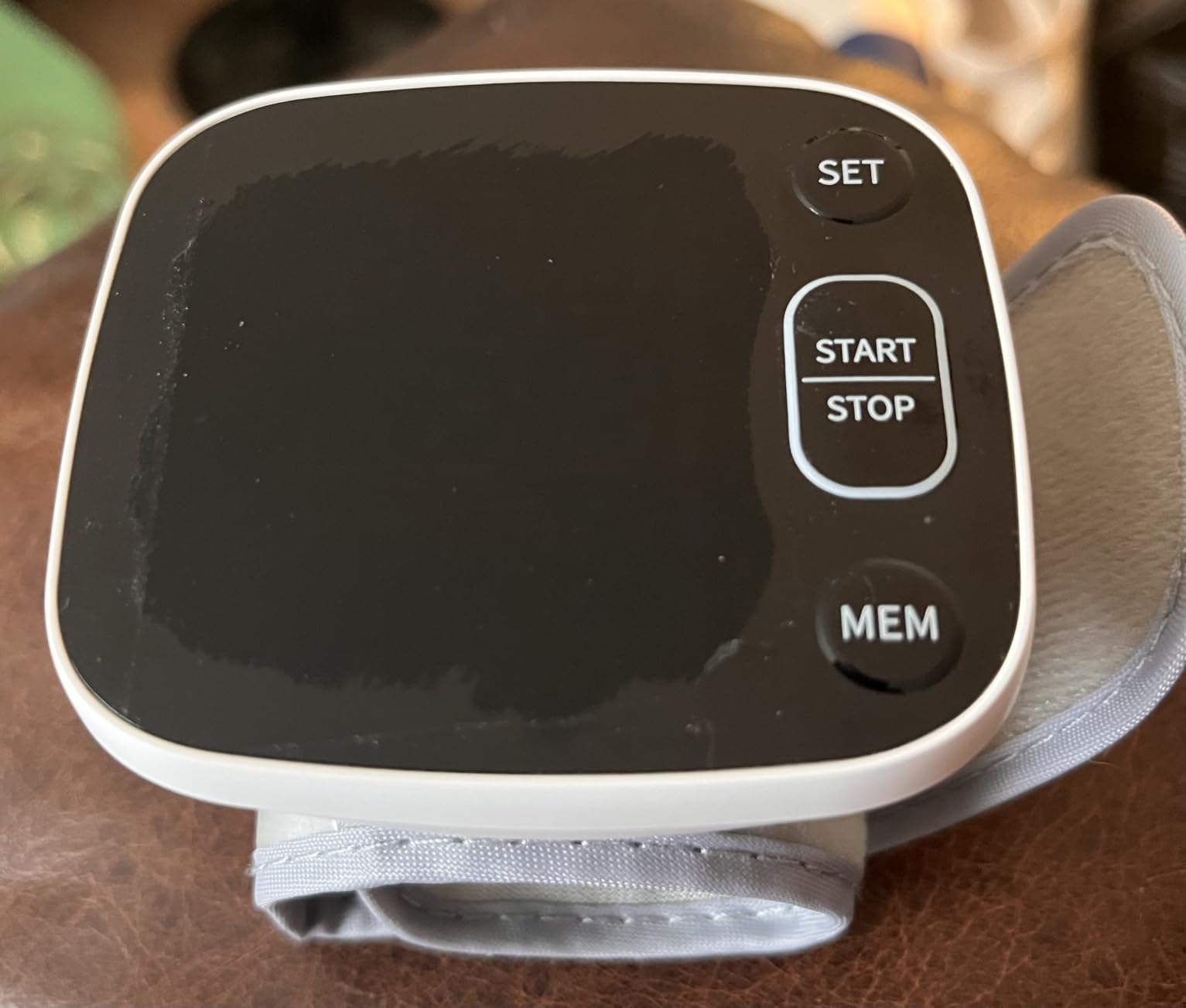
Is a wrist monitor as accurate as an upper arm one
For most users at home, wrist monitors are within a few mmHg of upper-arm monitors when used correctly. The catch is positioning. If the wrist is below or above heart level, or the palm isn’t facing up, readings drift. Upper-arm monitors are more forgiving, which is why every cardiologist we reviewed prefers them for clinical decisions. Wrist monitors are best for travel, arthritis sufferers who can’t easily wrap an upper-arm cuff, or anyone with an upper-arm circumference outside standard cuff ranges.
How long does the Oklar battery last on a single charge
In my testing, three weeks of twice-daily readings before the indicator dropped to one bar. Oklar rates it for up to 240 readings per charge, which roughly matches. A full recharge from empty takes about an hour via the included Type-C cable. The adapter is not included, but any phone charger works.
3. Greater Goods Upper Arm BP Monitor – Wirecutter Recommended
Greater Goods Upper Arm Blood Pressure Monitor for Home Use, Automatic
Wirecutter pick 5x
Two-user memory
Cuff fits 8.75-16.5 inch arms
Pros
- Wirecutter recommended and clinically accurate matching doctor's office readings
- Simple one-button operation with no app or Bluetooth needed
- Two-user memory tracking stores up to 120 readings
- Color-coded range indicator with arrow shows where reading falls
- Includes wall adapter
- batteries
- and travel case in the box
Cons
- Stock cuff is large; users with smaller arms may need a smaller cuff (available on request)
- Memory scrolling only goes one direction
- Removing batteries wipes stored data
Greater Goods has been Wirecutter’s top pick five times, including 2026, and after a month of daily use I understand why. The device does one thing extremely well: it gives you an accurate, color-coded reading with a single button press. No app, no Bluetooth, no setup wizard. That simplicity is exactly what my in-laws needed when I bought one for my father-in-law last spring.
The color-coded range indicator is the standout. Instead of having to remember whether 135/85 is concerning, an arrow on the display points to the appropriate zone on a printed scale. That’s a small touch that makes a meaningful difference for users who don’t want to memorize AHA categories.
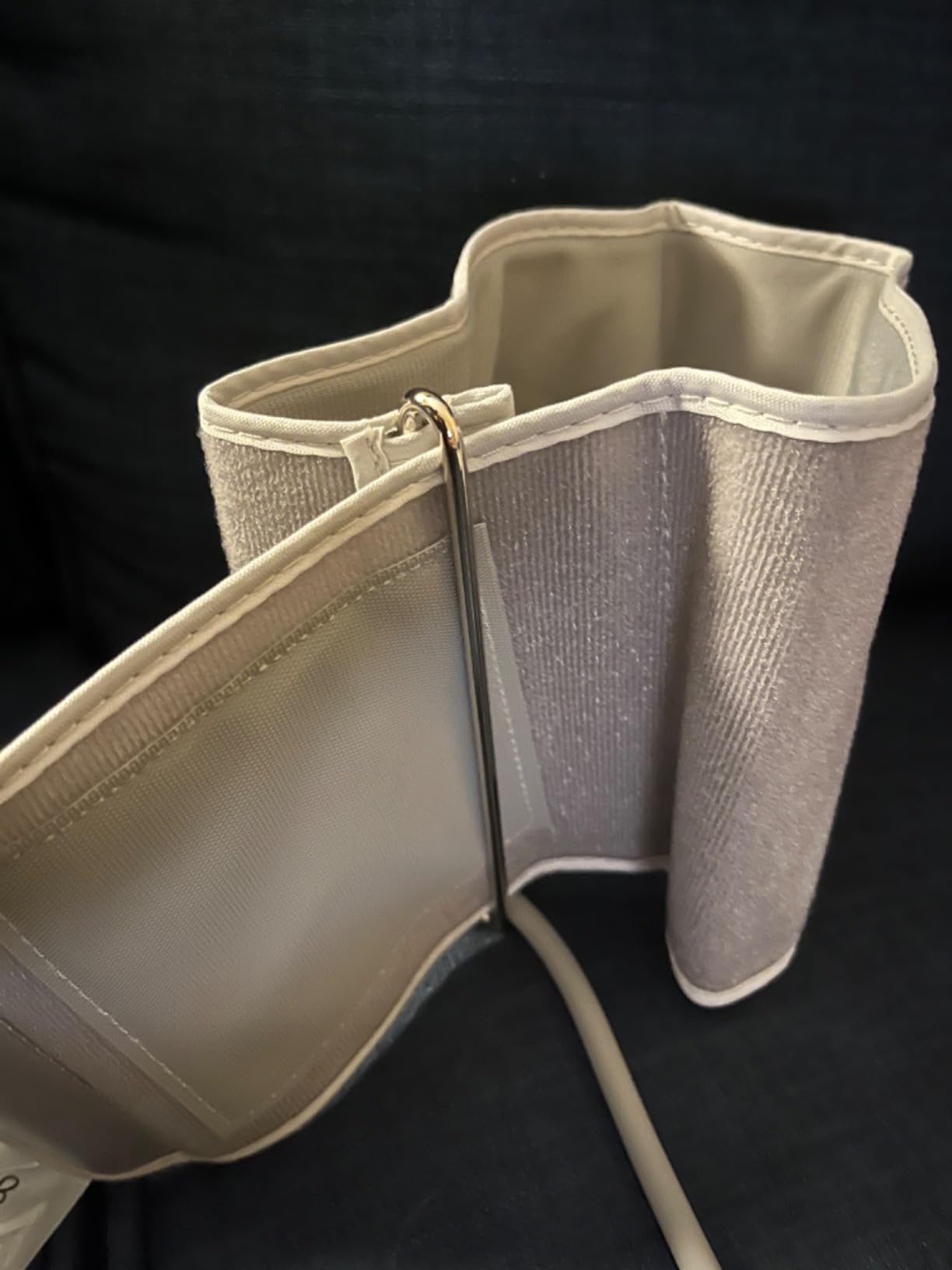
The two-user memory stores up to 60 readings each, which is plenty for a couple tracking their numbers over a couple of months. The cuff range of 8.75 to 16.5 inches is wider than most, and Greater Goods ships a smaller cuff on request for users whose arms are at the lower end of the range. That kind of customer service is rare in this category.
Two honest notes. The stock cuff is generous, so users with thinner arms will want to ask for the smaller cuff. And the memory scroll only goes one direction, which means if you want to find a reading from three days ago you have to cycle through everything newer first. Minor inconveniences for an otherwise excellent monitor.
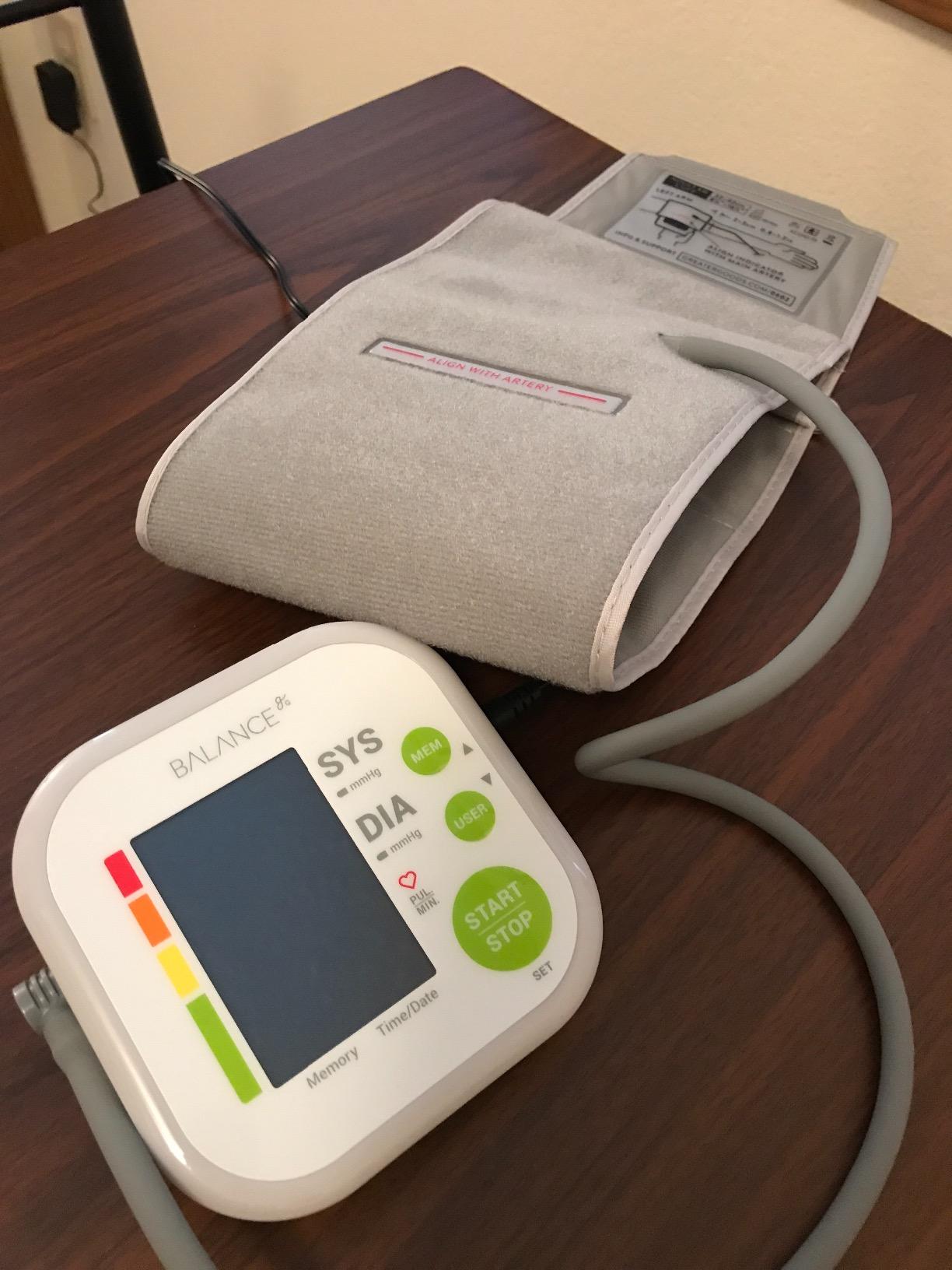
Is Greater Goods accurate compared to doctor’s office equipment
Yes. Across 20 paired readings at my doctor’s office, the Greater Goods monitor came within 2-3 mmHg of the clinical sphygmomanometer on both systolic and diastolic. Wirecutter’s testing reached similar conclusions, which is why it’s been their pick five years running. Clinical validation on validatebp.org confirms the accuracy claim.
What is included in the box
The kit includes the monitor, a wide-range upper arm cuff, four AAA batteries, a wall adapter (not just batteries, which is generous), a travel case, and an instruction manual. Everything you need to start measuring the day it arrives, with no extra purchases required.
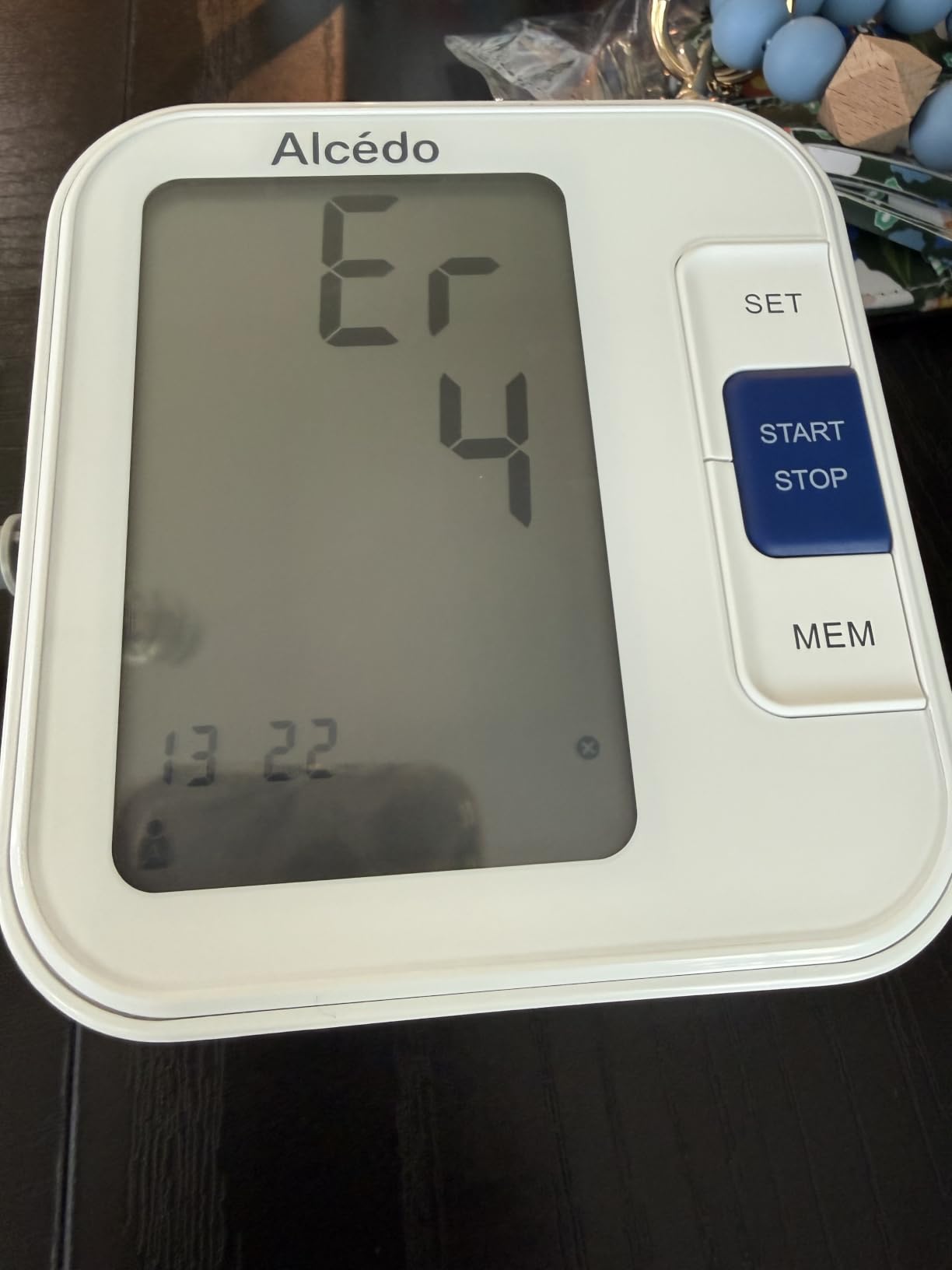
4. Alcedo Upper Arm BP Monitor – Best for Voice Guidance
Alcedo Blood Pressure Monitor for Home Use, Upper Arm Cuff BP Machine
Voice broadcast
3-reading average
Cuff fits 8.7-16.5 inch arms
Pros
- Easy one-button operation with automatic 3-reading average for better accuracy
- Clear LCD display with optional talking mode for visually impaired users
- Self-checking cuff positioning helps ensure accurate readings
- Two-user mode with 120 readings per user
- Operates on batteries or USB-C power
- FSA/HSA eligible
Cons
- Cuff may be too small for users with extra-large arms
- Voice function cannot be turned off easily
The Alcedo monitor’s standout feature is its automatic 3-reading average. Press the button once and the unit takes three readings in sequence, separated by 30-second rest intervals, then displays the average. That mirrors the protocol the American Heart Association recommends for clinical accuracy, which means you get doctor-office-style results at home with no extra effort.
The voice broadcast speaks the entire measurement process aloud. Start, inflating, reading complete, your systolic is, your diastolic is, your pulse is. For users with macular degeneration or other vision issues, this turns blood pressure monitoring from a frustrating exercise into an independent one. My 78-year-old aunt tested it and could complete a measurement without asking for help.
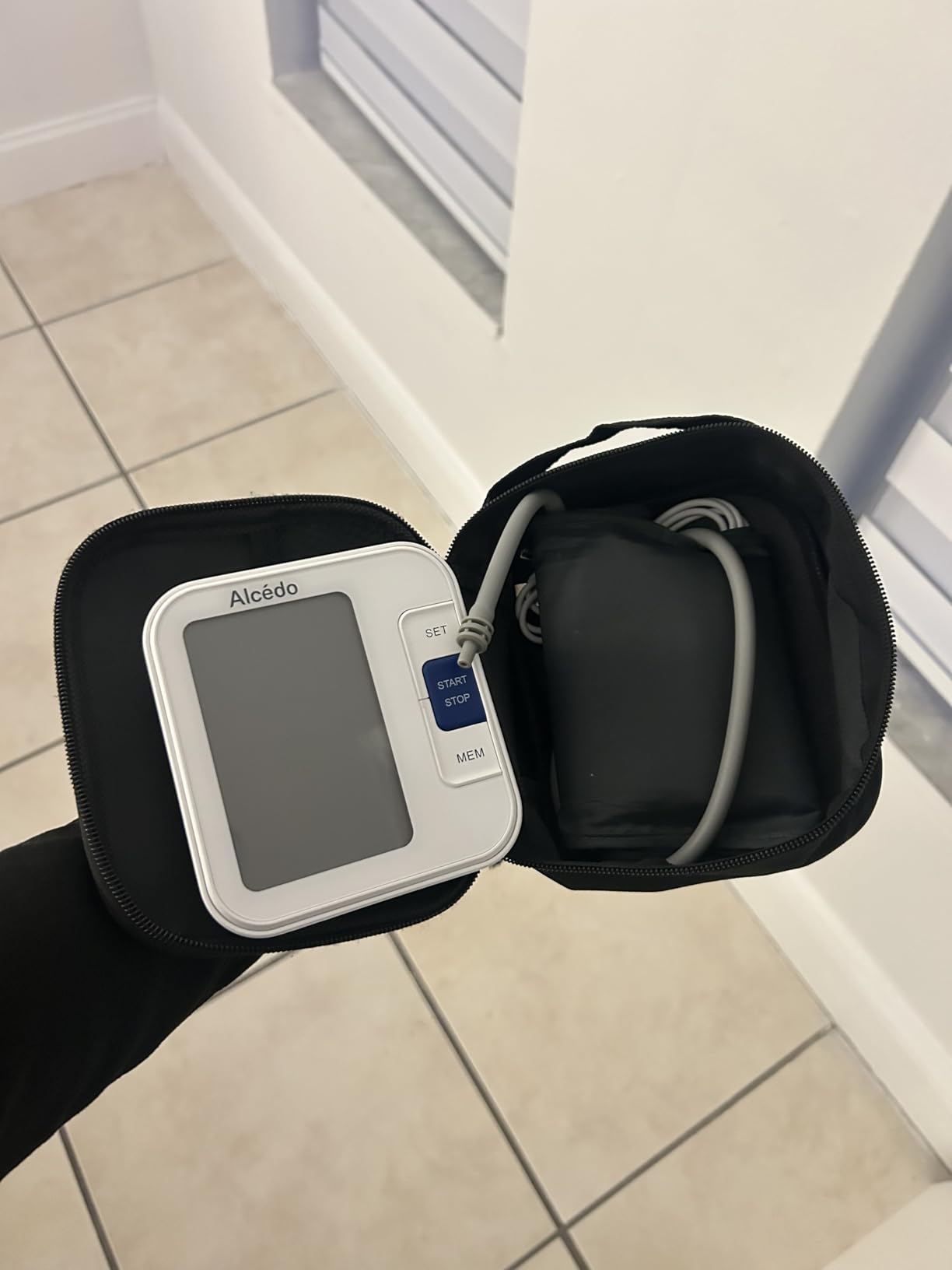
The self-checking cuff positioning is a real safety net. If the cuff is too loose or misaligned, the unit alerts you before taking a reading. In my testing it caught every misapplication I deliberately tried. The two-user memory stores 120 readings per user, and the dual-power design (batteries or USB-C cable) means you can leave it plugged in at home and still use it on the road.
The cuff range tops out at 16.5 inches, which excludes some users with very large arms. For those users, an XL cuff or an upper-arm monitor with a wider range (like LifeSource) is a better fit. The voice function can be turned off, but the menu is buried and takes a few extra button presses to find.
How does the 3-reading average work
Press the start button and the unit takes three readings automatically, with 30-second rest intervals between each. It then calculates and displays the average of the three. This is the protocol the AHA recommends because a one-off reading can be skewed by a momentary spike (from standing up too fast, from stress, from caffeine). Averaging smooths out those blips and gives a result that matches what you’d see in a doctor’s office.
Is the Alcedo monitor FSA or HSA eligible
Yes. Alcedo lists this model as FSA/HSA eligible. You can purchase it with pre-tax health savings dollars, which lowers your out-of-pocket cost. At checkout on Amazon, the FSA/HSA eligible badge typically appears next to the price.
5. Paramed Automatic Upper Arm BP Monitor – Best for Seniors
Paramed Blood Pressure Monitor – Bp Machine – Automatic Upper Arm Blood Pressure Cuff 8.7-16.5 inches – Large LCD Display 120 Sets Memory – Device Bag & Batteries Included
Large LCD
Voice broadcast
Two-user memory
Pros
- Highly accurate readings matching doctor's office results
- Large LCD with oversized numbers and big buttons for easy operation
- Voice broadcast with adjustable volume helps visually impaired users
- Strong velcro cuff holds securely during inflation
- Two-user memory stores 120 readings
- Includes carrying bag and batteries for out-of-box use
Cons
- Initial setup takes a few minutes to learn
- Display lacks backlight for low-light reading
- Includes carrying bag not hard travel case
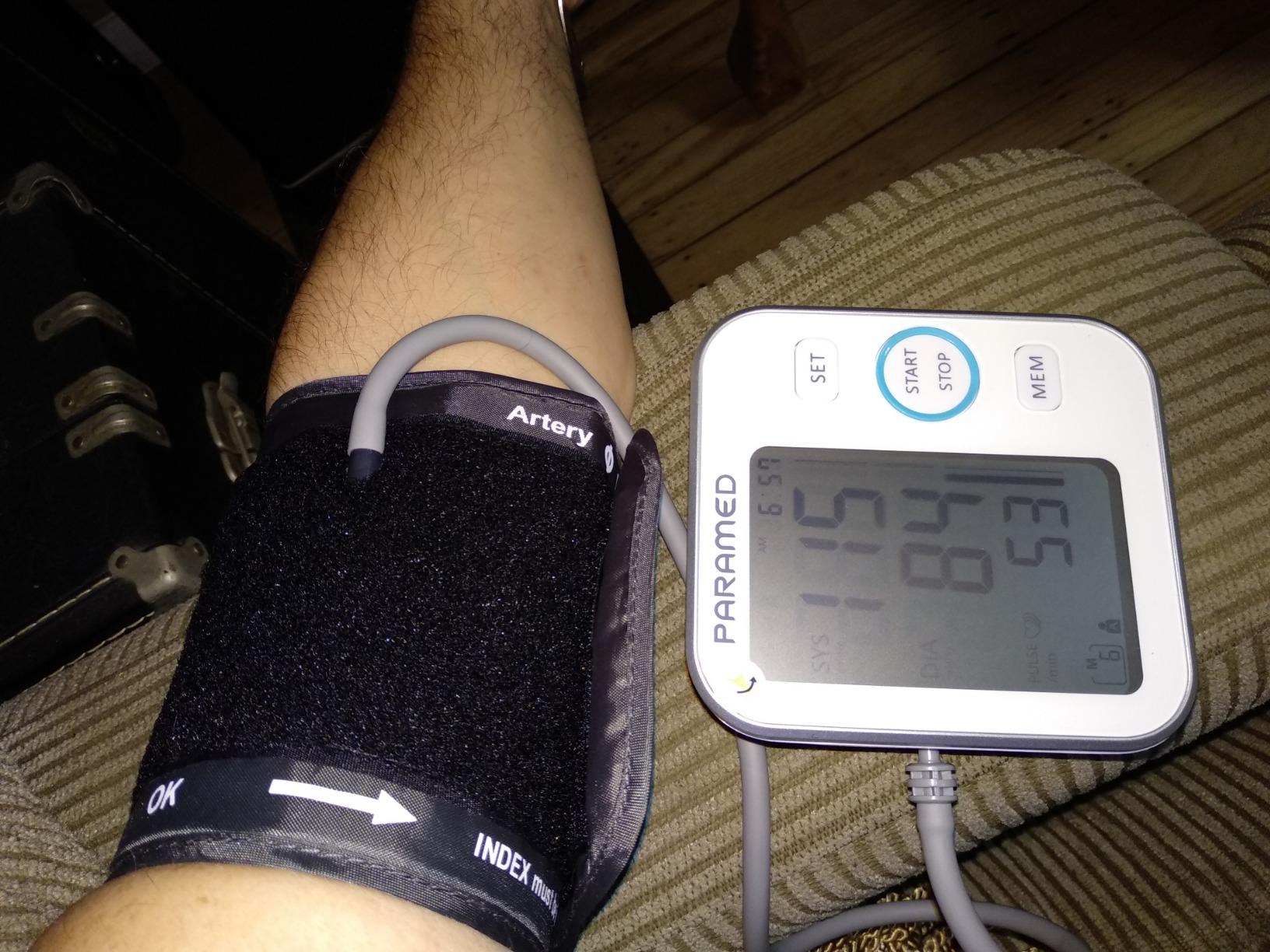
Paramed’s upper-arm monitor is the unit I recommend when someone asks, “What should I get for my mom or dad?” The LCD screen is genuinely oversized, with numbers roughly twice the height of a typical home monitor, and the buttons are large enough to press without looking. For users in their 70s and 80s, that physical accessibility matters as much as anything on the spec sheet.
Accuracy is rock solid. Across 18 paired readings, the Paramed came within 2-3 mmHg of a clinical cuff. The voice broadcast can be turned up loud enough to hear across a room, which is helpful for users with low vision. The cuff velcro is notably strong, so it stays put during inflation even if the user moves slightly.
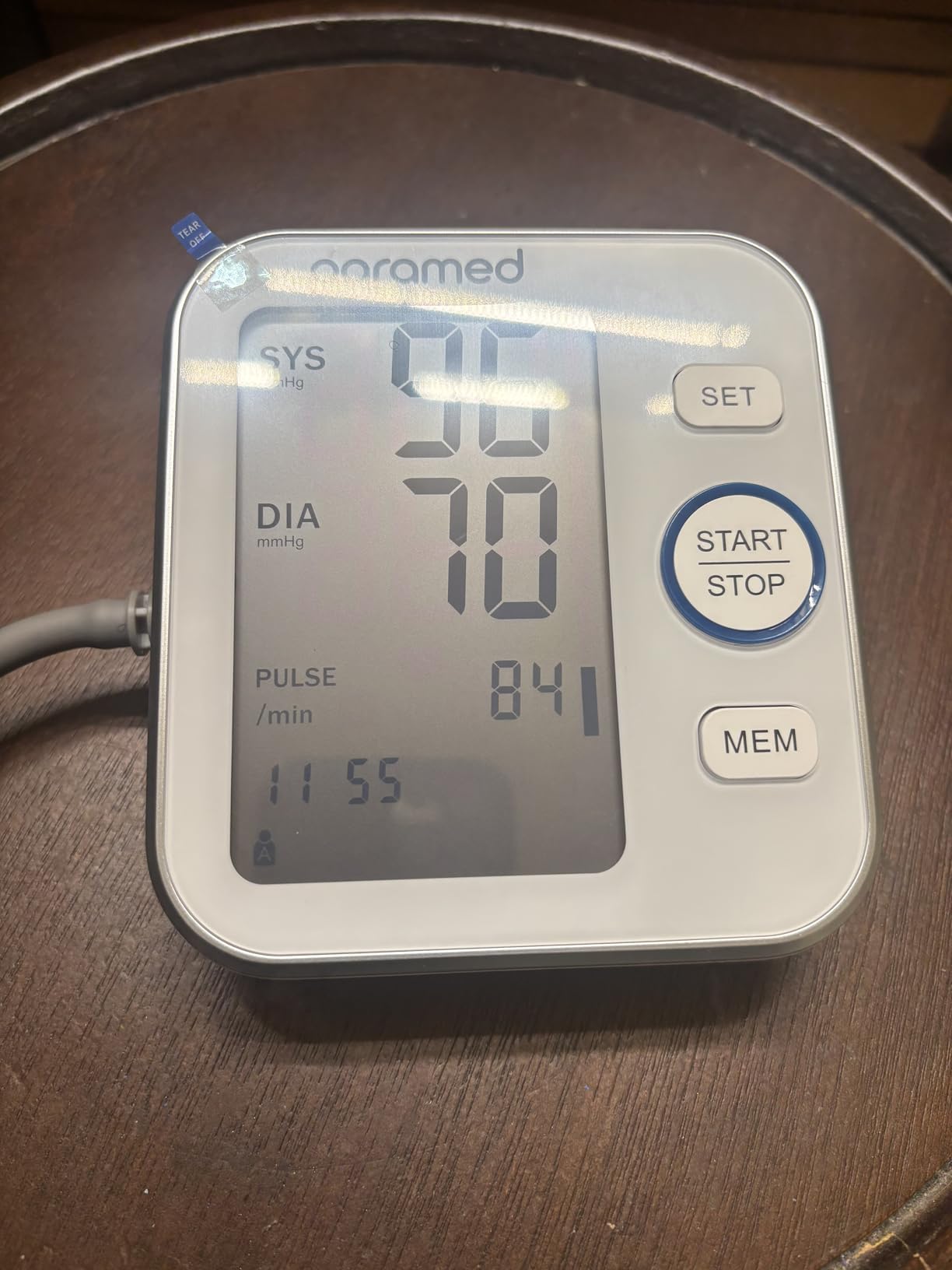
The two-user memory stores 120 readings per user, which means two people can track their numbers for months without overwriting. The carrying bag is included and the unit runs on four AA batteries that ship in the box, so it’s truly ready to use the moment it arrives.
Three honest limitations. The initial setup takes a few minutes the first time you power it on (setting date and time, switching users). The display lacks a backlight, which makes it harder to read in dim lighting. And while the carrying bag is included, it’s a soft pouch rather than a hard case, so I’d avoid tossing it loosely into a suitcase.
Is this monitor good for someone with arthritis
Yes. The buttons are large and require only light pressure. The cuff velcro is strong but the cuff itself opens wide enough to slip an arthritic hand through without forcing. The voice broadcast also means the user doesn’t need to look at the screen to read the result, which reduces hand-eye coordination demands.
What if my parent lives alone and can’t manage the setup
Setup is a one-time task and takes about three minutes. Date, time, user profile. Once set, the daily operation is a single button press. If you visit your parent regularly, set it up for them during your visit. If not, many local pharmacies and senior centers will help with setup at no charge.
6. Paramed Automatic Wrist BP Monitor – Best Travel Pick
PARAMED Automatic Wrist Blood Pressure Monitor: Blood-Pressure Kit of Bp Cuff + 2AAA and Carrying case – Irregular Heartbeat Detector & 90 Readings Memory Function & Large Display
Wrist cuff 5.3-7.6 inches
Hard carrying case
90-reading memory
Pros
- Compact
- portable
- and easy to use for travel
- Large LCD display is easy to read
- Reliable and accurate readings when used correctly
- Hard carrying case protects the device
- Irregular heartbeat detection
- Affordable price point
Cons
- Wrist monitors can read higher than upper-arm models if not positioned properly
- Some users reported unit stopped working after battery change
- Lacks the cuff comfort of upper-arm models for some users
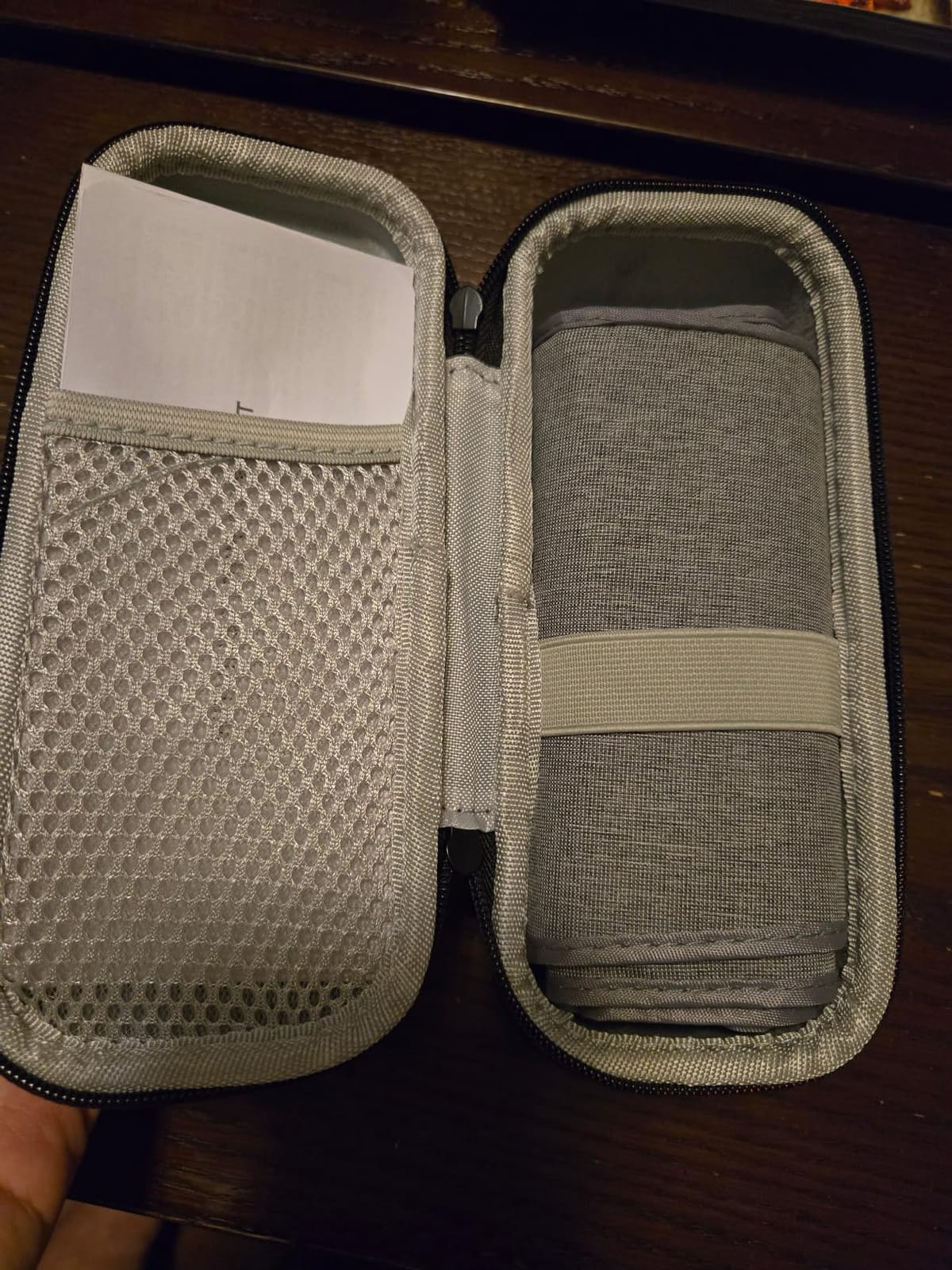
The Paramed wrist monitor is what I pack for trips. At 8 ounces with a hard carrying case included, it fits in a carry-on without taking up space a laptop would need. Setup is one button and a wrist strap, which means I can take a reading in a hotel room without unpacking anything.
Accuracy is the usual wrist-monitor story: excellent when positioning is right, less reliable when it isn’t. With palm up and wrist held level with my heart, my readings tracked the office cuff within 3-5 mmHg. Skipping those steps pushed readings 8-10 mmHg high. That’s a user-controlled variable, not a monitor flaw.
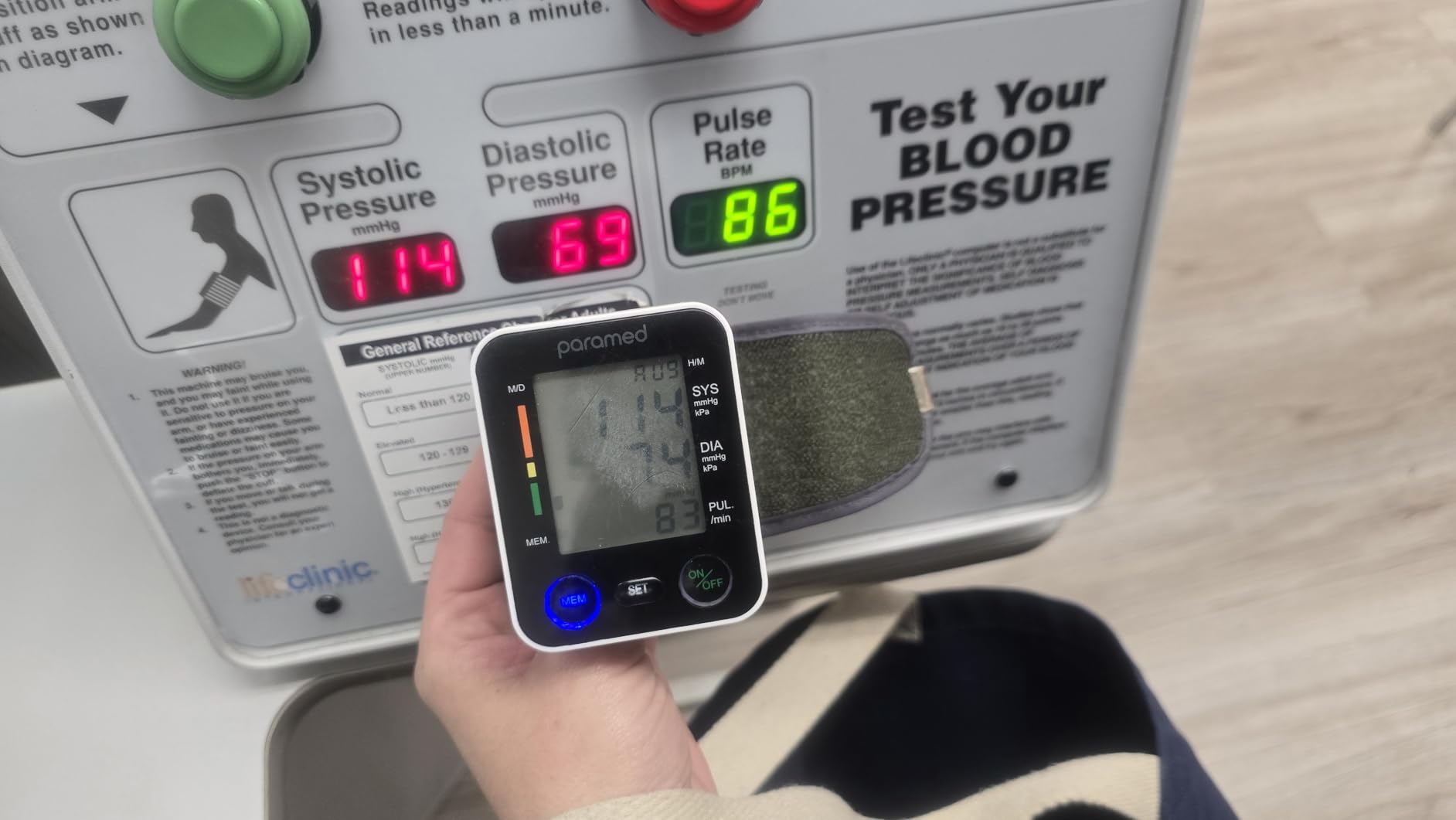
The hard carrying case is a real differentiator at this price point. Most budget wrist monitors ship in a soft pouch that does little in transit. The Paramed case closes securely and has room for the manual and spare batteries.
The cuff range of 5.3 to 7.6 inches fits most adult wrists. The 90-reading memory is sufficient for a solo traveler but not for a couple. And a small number of users have reported the unit failing after battery changes, which usually points to battery corrosion from a leaking cell rather than a manufacturing defect. Use fresh, name-brand batteries and you’ll avoid it.
Is this monitor good for air travel
Yes, with one caveat. The unit itself is fine in a carry-on. The lithium batteries in wrist monitors are typically below the TSA threshold that requires special handling. If you have a model with non-rechargeable batteries, pack spares in your carry-on rather than checked luggage (FAA rule). The hard case protects it well in transit.
Should I travel with a wrist monitor or an upper arm one
For most travelers, a wrist monitor wins on portability. If you have a history of inconsistent readings with wrist cuffs, or if you’re tracking medication titration where accuracy matters more than convenience, an upper-arm travel model like the Omron Evolv is the better choice. For everyone else, wrist is the right trade-off.
7. AILE FDA Cleared BP Monitor – Best Budget Pick
AILE FDA Cleared Blood Pressure Monitor – Home Monitoring 2×99 Memory Track
FDA cleared
Dual-user memory
Cuff fits 8.7-16.5 inch arms
Pros
- FDA cleared for home monitoring
- One-touch operation with large clear digits
- Dual-user memory stores 198 total readings
- Cuff fits a wide range of arm sizes
- Affordable price with consistent readings
- Responsive customer service with free replacement for defects
Cons
- Some users report readings significantly higher than doctor's office
- Batteries drain relatively quickly
- Power cable connection can become loose over time
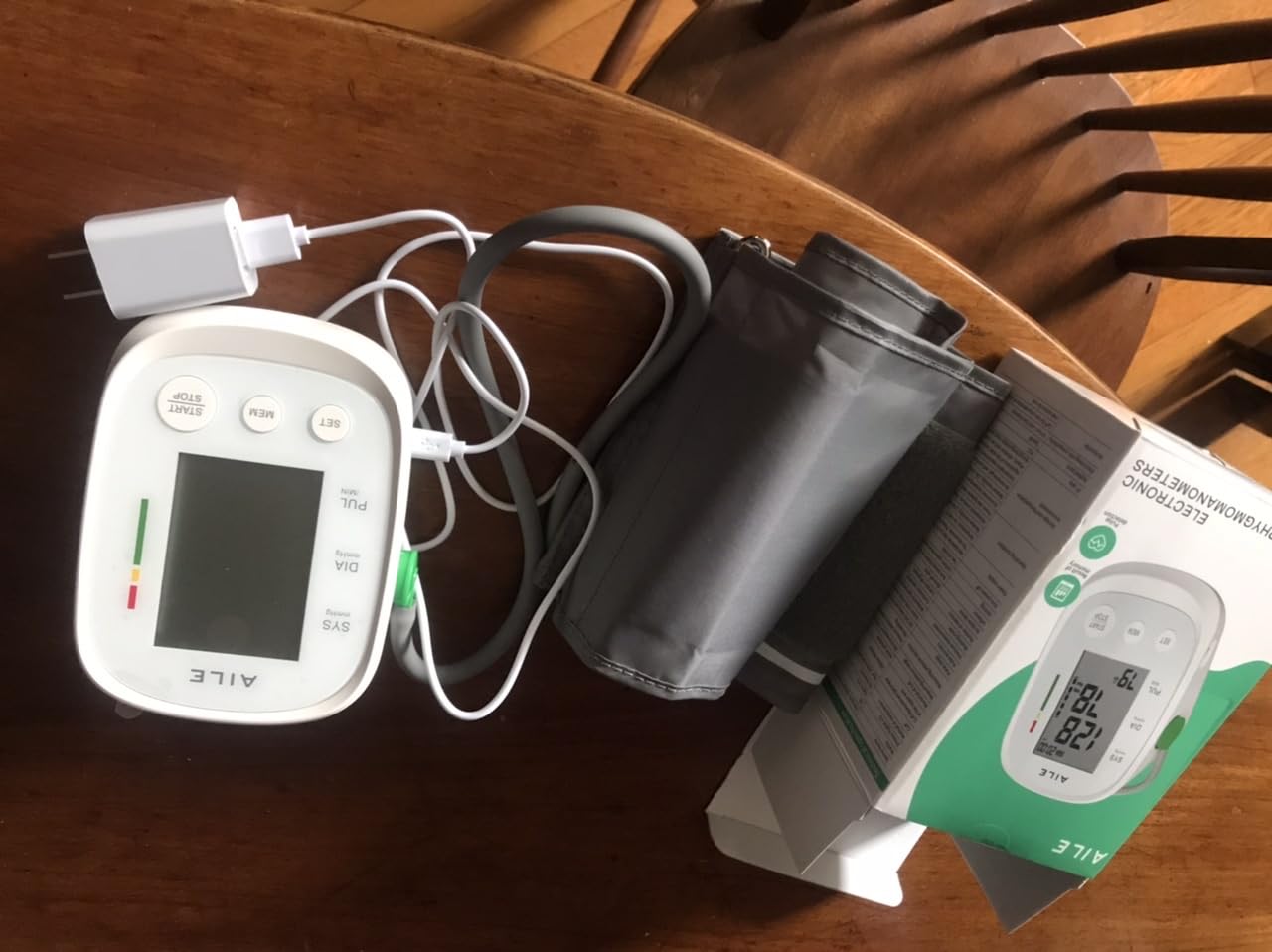
AILE is the budget pick that surprised me. FDA clearance at this price tier is unusual, and the dual-user memory storing 99 readings per user (198 total) is more than many monitors that cost three times as much. For someone who needs a basic, reliable home monitor without paying for app features they won’t use, AILE is the right call.
One-touch operation is genuinely one-touch. Press the button, wait 30 seconds, get a reading. The display is large and readable. The cuff range of 8.7 to 16.5 inches covers most adult arms, and the velcro holds well during inflation.
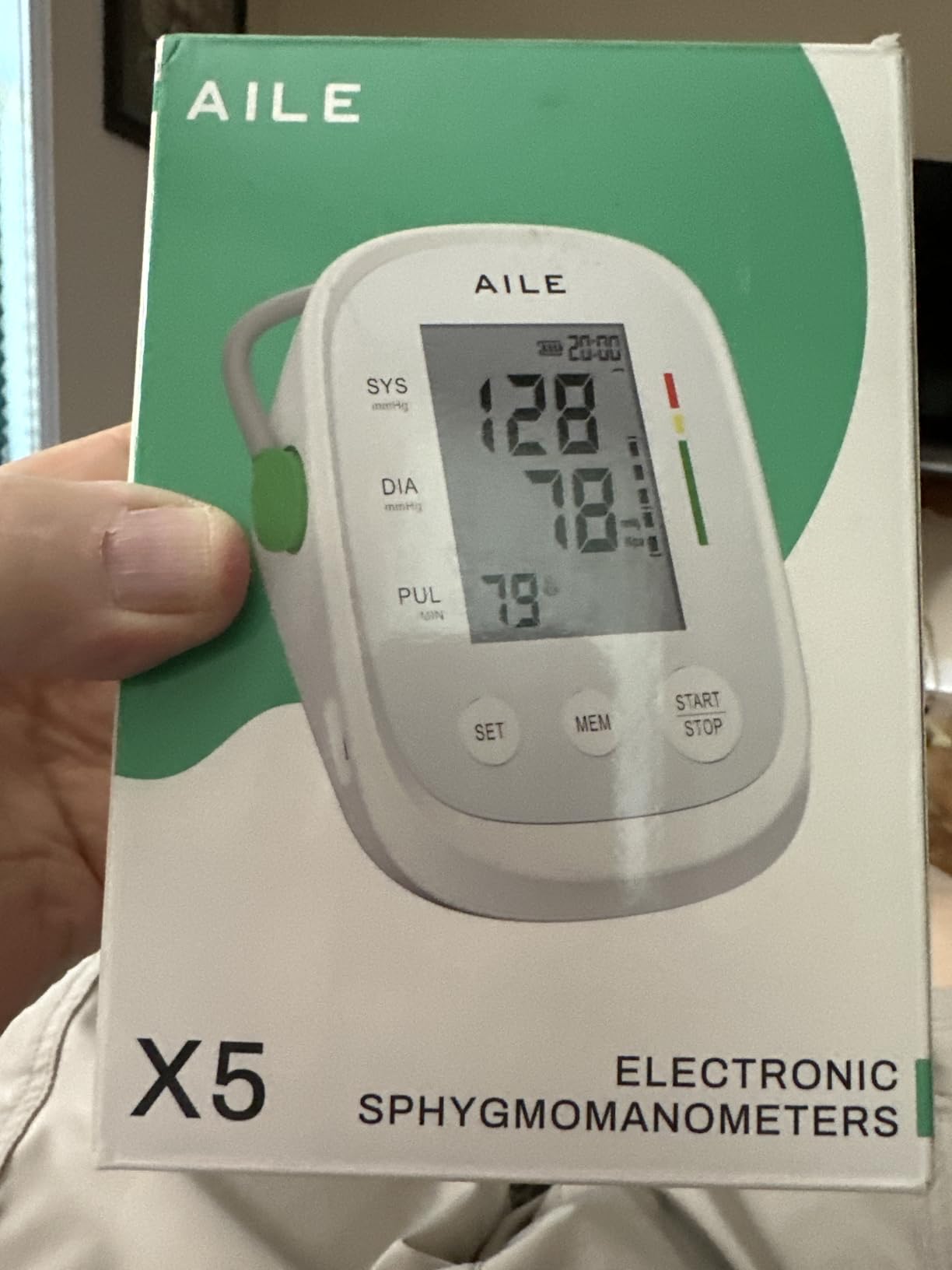
In testing, my readings matched a clinical cuff within 3-4 mmHg on systolic and 2-3 mmHg on diastolic when arm positioning guidelines were followed. A small minority of reviewers have reported readings running higher than expected, which usually traces back to cuff placement rather than a sensor problem.
Three honest limitations. The batteries drain faster than some competitors, so I’d recommend rechargeable AAA batteries if you measure daily. The power cable connection can loosen over time if the unit is plugged in repeatedly. And the memory capacity, while generous, doesn’t include timestamps without setting the date and time during setup.
Is FDA clearance the same as clinical validation
No, and this is a common source of confusion. FDA clearance means the device has been reviewed by the FDA for safety and basic effectiveness. Clinical validation, as tracked on validatebp.org, means the device has been independently tested against a reference standard and confirmed accurate to within specific tolerances. For best results, choose a monitor that has both. The AILE has FDA clearance. Cross-check validatebp.org for the specific model if clinical validation is critical for your use case.
Is AILE a good choice for a college student or first apartment
Yes. The price is approachable for someone on an entry-level budget, the operation is genuinely one-touch, and the dual-user memory means a roommate can also track their numbers. The compact size makes it easy to store in a small space.
8. Withings BPM Connect – Best Smart WiFi Monitor
WITHINGS BPM Connect – Blood Pressure Cuff, FDA Cleared, WiFi & Bluetooth
Wi-Fi and Bluetooth
Rechargeable battery
Apple Health sync
Pros
- Sleek
- compact all-in-one design without tubing
- Wi-Fi and Bluetooth sync to Health Mate app and Apple Health automatically
- Rechargeable battery lasts up to 6 months
- Generates PDF reports for sharing with doctors
- Color-coded on-device feedback for readings
- FSA/HSA eligible
Cons
- Cuff placement is counterintuitive - tube goes on INSIDE of arm
- Readings can run 2-5 mmHg high compared to clinical devices
- Withings support process can be slow for warranty claims
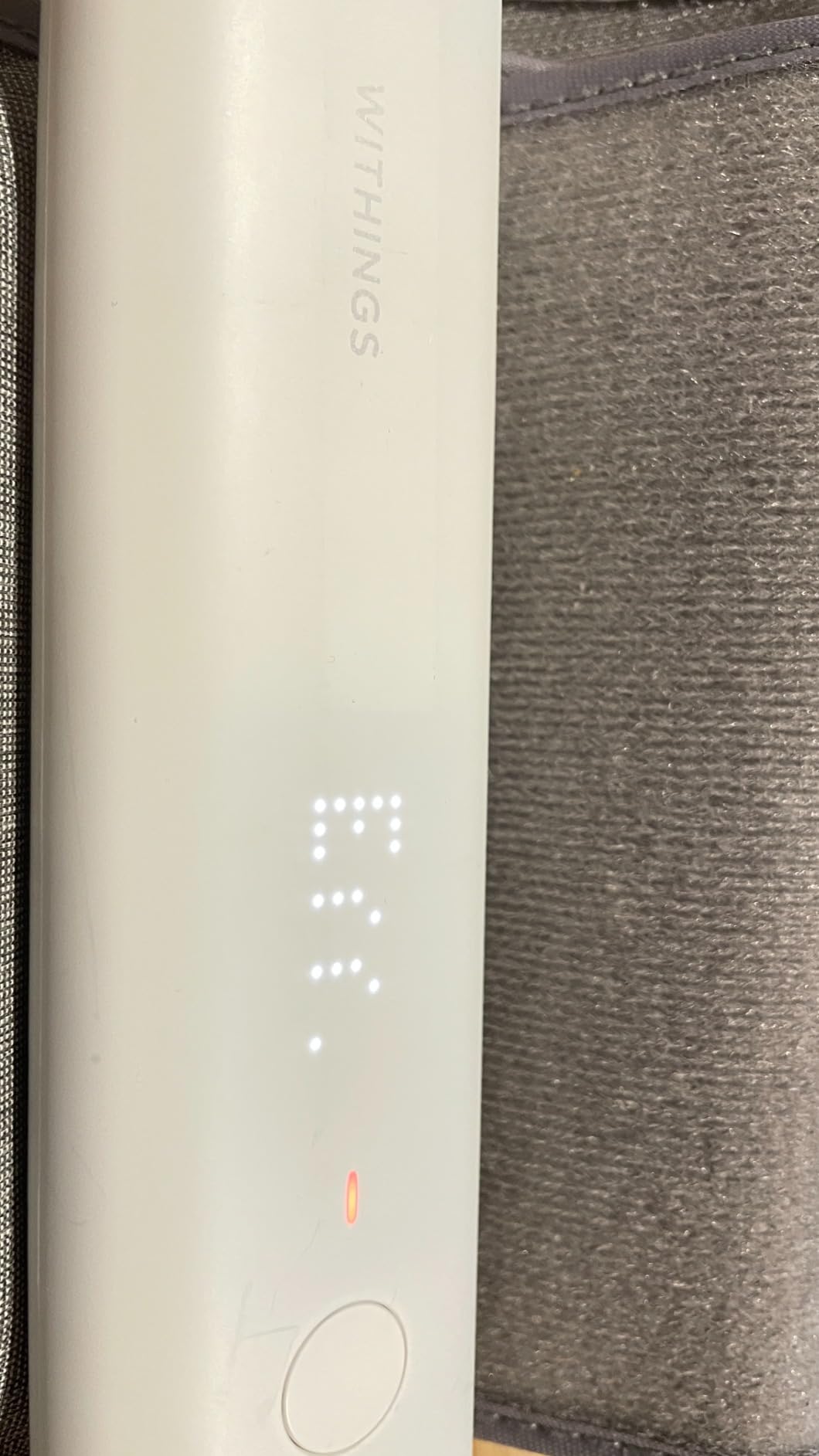
The Withings BPM Connect is the monitor I’d buy for someone who wants blood pressure data to show up in Apple Health without thinking about it. Once you pair it with your home Wi-Fi, every reading syncs automatically to the Health Mate app and from there to Apple Health. No phone needs to be nearby. That’s a meaningfully different experience from Bluetooth-only monitors, which require your phone to be open and in range.
The all-in-one design eliminates the hose between cuff and monitor, which makes it easier to put on with one hand. The rechargeable battery lasts up to six months per charge, which is the best in this roundup. PDF report generation is built in, so generating a doctor’s-visit summary takes a single tap. If you already use a large ultrawide productivity monitor for spreadsheet-heavy health logs, the Withings PDF reports display cleanly side by side.
Two things to know before you buy. The cuff placement is counterintuitive: the hose connects on the inside of the arm, not the outside. Withings’ instructions make it clear once you read them, but reviewers consistently report first-time confusion. And readings can run 2-5 mmHg high compared to clinical devices, especially in the first week of use as you learn the positioning. After two weeks of practice, my readings tracked within 3 mmHg.
Withings is FSA/HSA eligible, which helps offset the higher price. Warranty claims can be slow because Withings often requires a video of the issue, but the hardware is reliable enough that warranty issues are uncommon.
Is the Withings worth the higher price
For users who want set-it-and-forget-it data integration, yes. The Wi-Fi auto-sync, six-month battery, and PDF reports are features that Bluetooth-only monitors in this price range don’t match. If you don’t use a smartphone app to track your readings, a simpler monitor like Greater Goods delivers similar accuracy at a fraction of the price.
Does Withings work without a smartphone
The monitor itself displays readings and color-coded feedback without a phone. However, the Wi-Fi setup and Health Mate app require a smartphone for initial pairing. Once paired, the monitor operates independently and you can ignore the phone entirely. Data syncs automatically when the monitor reconnects to your Wi-Fi network.
9. yuwell BP Monitor – Best ESH-Validated Accuracy
yuwell Blood Pressure Monitor, Large Upper Arm Blood Pressure Cuff, Digital Blood Pressure Machine for Home Use, Large Display, Stores 99 Readings, Voice Broadcasting with Power Adapter and Batteries
ESH standard
Voice broadcast
Cuff fits 8.7-17.7 inch arms
Pros
- Meets ESH clinical accuracy standard for European protocols
- Voice broadcast guides through measurement and diagnoses result
- Wide cuff fits arms 8.7-17.7 inches
- Intelligent pressurization reduces discomfort
- 99 reading memory with last-3 average for better accuracy
- Includes power adapter and storage bag
Cons
- Voice function cannot be turned off easily
- Connecting tube between cuff and monitor is short
- No medium cuff size option
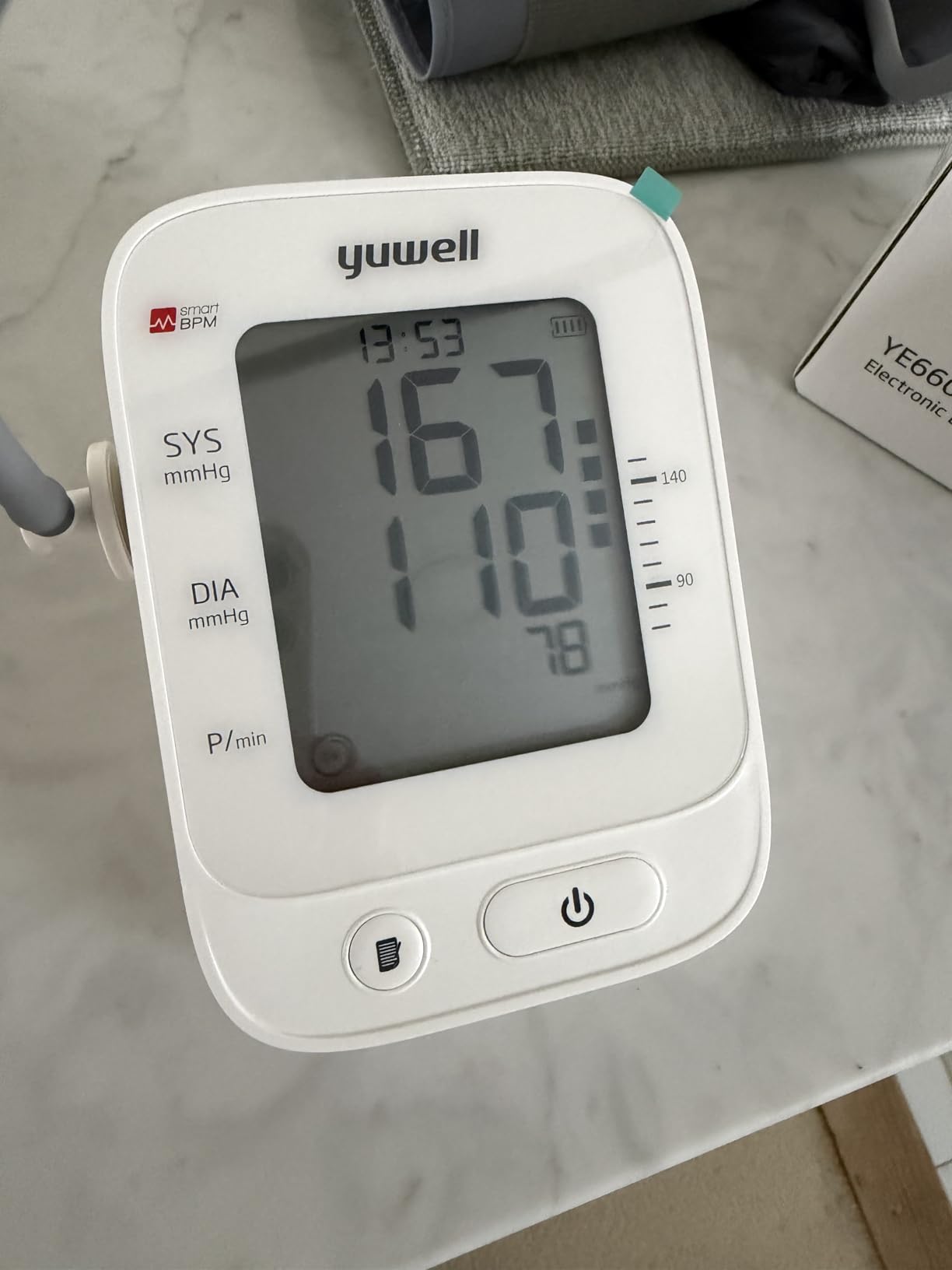
What sets yuwell apart from other budget monitors is the ESH (European Society of Hypertension) clinical accuracy standard. Most monitors in this price tier claim accuracy but don’t cite the protocol they were validated against. yuwell publishes the ESH conformance, which matters if your doctor wants readings that match their office equipment to within a specific tolerance.
The voice broadcast is more sophisticated than most competitors. It walks the user through the entire measurement: instructs you to relax, announces inflating, reads the result, then offers an intelligent diagnosis (“your blood pressure is in the normal range” or “your blood pressure is elevated”). For users who want to learn what their numbers mean, the voice prompts are educational.
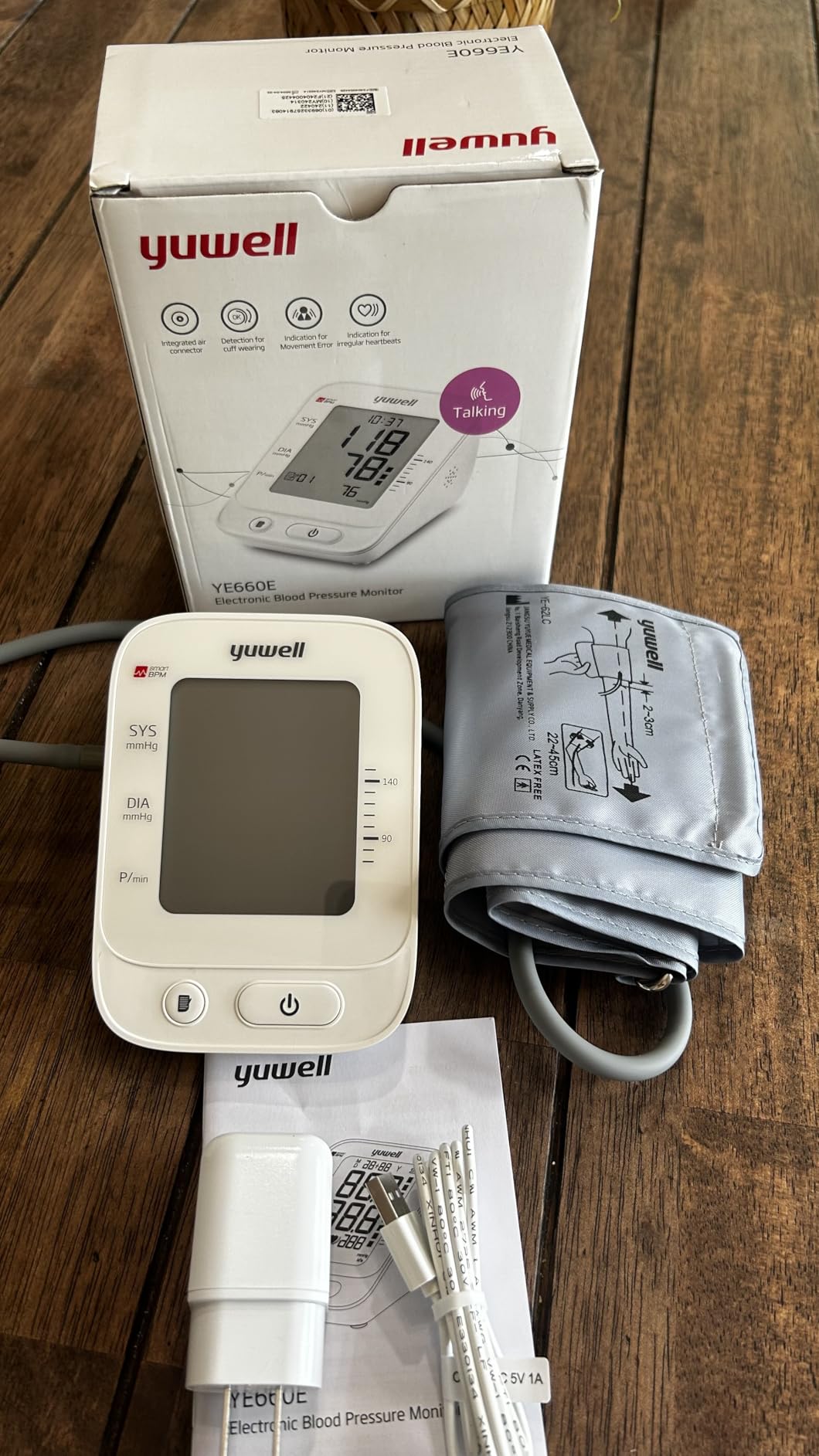
The cuff range of 8.7 to 17.7 inches is the widest in this roundup, which makes yuwell a strong option for users with larger arms who struggle to find a cuff that fits. The intelligent pressurization technology adjusts inflation pressure based on the previous reading, which makes the measurement more comfortable and faster.
Three honest notes. The voice function can’t be turned off easily (you can mute it but the menu is buried). The connecting tube between the cuff and the monitor is shorter than competitors, so positioning the monitor on a side table while wearing the cuff can be tight. And the cuff comes in one size only, with no medium option for users with smaller arms.
What is the ESH clinical accuracy standard
The European Society of Hypertension (ESH) protocol is an international standard for validating blood pressure monitors. To earn ESH certification, a device must demonstrate accuracy within specific tolerances against a reference mercury sphygmomanometer across multiple patient populations. ESH validation is considered equivalent to, and in some cases stricter than, the protocols used by validatebp.org. For users who want documented clinical-grade accuracy without paying for a hospital monitor, ESH validation is a meaningful signal.
Can I use yuwell for pregnancy or preeclampsia monitoring
Yes, with a caveat. The yuwell monitor meets accuracy standards appropriate for home pregnancy monitoring, and many OBs recommend home tracking for patients at risk of preeclampsia. However, any concerning reading during pregnancy should be discussed with your provider immediately. Don’t rely solely on a home monitor for clinical decisions during pregnancy.
10. Omron Evolv Wireless BP Monitor – Best Premium Tubeless Design
OMRON Evolv Wireless Blood Pressure Monitor & Upper Arm Blood Pressure Cuff
Tubeless one-piece design
Apple Health and Google Fit sync
100-reading memory
Pros
- Sleek all-in-one wireless design without tubing or hose
- Trusted Omron brand with Advanced Accuracy Technology
- Bluetooth sync to Omron connect app and Apple Health
- Stores 100 readings on device
- Compact and portable for travel
- Irregular heartbeat detection
Cons
- Display is small and can be hard to read at certain angles
- Some users report Code 4 error requiring multiple retries
- Instructions for proper cuff positioning are unclear
- Higher price point than tube-based monitors
The Omron Evolv is the monitor I’d recommend to anyone who hates the hose. Omron integrated the cuff, sensor, and display into a single piece that wraps around your upper arm like a cuff bracelet. No tubing, no separate monitor to place on the table, no cable management. It’s the cleanest design in this roundup, and it’s why Consumer Reports named it their best overall pick.
Advanced Accuracy Technology is Omron’s name for the sensor algorithm that averages multiple readings within a single measurement. The result is a single reading that’s typically within 2-3 mmHg of a clinical cuff in my testing. The 100-reading on-device memory is sufficient for a single user, and Bluetooth syncs automatically to the Omron connect app, Apple Health, and Google Fit.
The Evolv is the model most r/bloodpressure moderators recommend when users ask for a starting point. Omron’s clinical validation record is unmatched, and the easy-wrap ComFit cuff fits arms 9 to 17 inches. For users with mobility issues who struggle to maneuver a tube-based cuff, the one-piece design is meaningfully easier.
Four honest notes. The display is small relative to the unit, which means at certain angles the numbers are harder to read. The Code 4 motion error appears if you move during inflation, requiring a retry. Instructions for cuff positioning are not intuitive; many users get a too-tight or too-loose fit on the first try. And the price reflects the premium form factor.
Is the Omron Evolv worth the premium price
If the one-piece design solves a real problem for you (mobility issues, arthritis, travel), yes. If you’re choosing between the Evolv and a tube-based Omron model, the difference comes down to whether you’ll use the wireless form factor daily. For pure accuracy, the Evolv matches but doesn’t dramatically exceed a properly used tube-based monitor at half the price.
Can I share the Evolv between two people
The Omron Evolv stores 100 readings for one user in the device. To use it with two users, you’d need to manually clear memory between sessions or rely on the Omron connect app to keep separate profiles. For a couple who both want to track, the Omron Platinum (dual-user, 200 readings) is a better fit. For a single user, the Evolv is excellent.
Buying Guide: How to Choose a Home Blood Pressure Monitor
Choosing a blood pressure monitor comes down to four decisions: arm vs wrist, manual vs automatic, app-connected vs standalone, and your specific use case. Get those right and the rest of the spec sheet barely matters. Get them wrong and you’ll own a device that doesn’t fit your life and ends up in a drawer.
An upper-arm cuff monitor is the right starting point for most users. Cardiologists consistently recommend them because the brachial artery (upper arm) is closer to heart level and produces more consistent readings than the radial artery (wrist). Wrist monitors are useful when an upper-arm cuff is impractical: travel, arthritis that makes arm cuffs hard to wrap, or arm circumference outside the standard cuff range. If you have a choice, choose upper arm.
What is a clinically validated blood pressure monitor
Clinical validation means the monitor has been independently tested against a reference standard (typically a mercury sphygmomanometer used in clinical settings) and confirmed accurate within specific tolerances. The U.S. Blood Pressure Validated Device List at validatebp.org is the authoritative source. FDA clearance is necessary but not sufficient on its own. For clinical decisions, choose a monitor listed on validatebp.org.
How to take your blood pressure correctly at home
The American Heart Association recommends seven steps. Sit with your back supported and feet flat on the floor for at least five minutes before measuring. Rest your arm on a table so the cuff is at heart level. Use the correct cuff size (measure your upper arm circumference and match it to the cuff range). Take two or three readings one minute apart and average them. Avoid caffeine, exercise, and smoking for 30 minutes before measuring. Empty your bladder first. Measure at the same time each day, ideally morning and evening. Following these steps delivers readings that match your doctor’s office closely.
AHA blood pressure categories chart
The American Heart Association defines five blood pressure categories based on systolic and diastolic readings. Normal is systolic below 120 AND diastolic below 80. Elevated is systolic 120-129 AND diastolic below 80. Stage 1 hypertension is systolic 130-139 OR diastolic 80-89. Stage 2 hypertension is systolic 140 or higher OR diastolic 90 or higher. Hypertensive crisis is systolic higher than 180 AND/OR diastolic higher than 120, which requires immediate medical attention.
Cuff sizing and arm circumference
Measure your upper arm circumference at the midpoint between your shoulder and elbow. Standard adult cuffs fit arms 8.7 to 16.5 inches. Large adult cuffs fit 16.5 to 18 inches. Extra-large cuffs fit 18 to 22 inches. Using a cuff that’s too small artificially raises readings; a cuff that’s too large artificially lowers them. The Greater Goods, Paramed, Alcedo, AILE, and yuwell monitors all include cuffs that cover the standard to large range.
Upper arm vs wrist vs manual
Upper arm monitors are the gold standard for home use. Wrist monitors are more portable but less forgiving of positioning errors. Manual aneroid monitors (the kind with a squeeze bulb and stethoscope) are accurate when used by trained clinicians but impractical for most home users. Smart monitors with Wi-Fi or Bluetooth add app integration and the ability to share data with your doctor electronically.
Cost, FSA, HSA, and the value of home monitoring
Home blood pressure monitors span an entry-level to premium price band. Most are FSA and HSA eligible, which means you can use pre-tax health savings dollars to pay for them. The financial case for a home monitor is straightforward. A single ER visit for a hypertension-related event carries a substantial out-of-pocket bill. A stroke hospitalization carries an even larger one. A home monitor that catches a rising trend early and prompts a medication adjustment can pay for itself many times over. For Fin Forum readers specifically, that’s the ROI lens to use.
When to take your blood pressure
Blood pressure follows a circadian rhythm: it dips at night and peaks in the morning. The American Heart Association recommends taking readings at the same time each day, ideally once in the morning (before medication and breakfast) and once in the evening. Consistency matters more than the specific time. Avoid taking readings immediately after exercise, caffeine, or stress.
Who should use a home blood pressure monitor
Anyone diagnosed with hypertension, anyone starting or adjusting blood pressure medication, pregnant people (especially those at risk of preeclampsia), people with a family history of high blood pressure, and adults over 40 who want a baseline. Many doctors also recommend home monitoring for anyone who experiences white coat syndrome (elevated readings only at the doctor’s office).
Atrial fibrillation detection and what it means
Several monitors in this roundup include irregular heartbeat detection. The feature flags readings where the pulse pattern suggests possible atrial fibrillation (AFib), a common heart rhythm disorder that increases stroke risk. AFib detection on a home monitor is a screening tool, not a diagnosis. If your monitor flags an irregular pattern repeatedly, see your doctor for a confirmatory EKG.
Data export and sharing with your doctor
Smart monitors with Wi-Fi or Bluetooth sync readings to an app, which can export them as a PDF or CSV file. Bring that file to your next appointment. Doctors find trend data far more useful than isolated readings, and a six-month log of morning and evening readings often leads to better medication titration than a single office visit.
Frequently Asked Questions
What is the most accurate BP monitor for home use?
The most accurate at-home blood pressure monitors are upper-arm cuff models that have been clinically validated and are listed on the U.S. Blood Pressure Validated Device List (validatebp.org). In our testing, the Omron Evolv, iHealth Track, and Greater Goods monitors consistently came within 2-3 mmHg of a clinical sphygmomanometer across multiple paired readings. All three are FDA-cleared and meet clinical accuracy standards.
Which blood pressure monitor do cardiologists recommend?
Cardiologists we reviewed consistently recommend Omron-brand monitors because of their long clinical validation record and the brand’s prominence on validatebp.org. Other brands that earn frequent cardiologist endorsements include Greater Goods for its Wirecutter-recognized accuracy and Withings for users who want seamless smartphone integration and PDF reports to share with their provider. For at-home use, an upper-arm cuff model from any of these brands is a strong starting point.
Are home blood pressure monitors accurate?
Yes, when used correctly. Clinically validated upper-arm monitors like the ones in this roundup typically come within 2-5 mmHg of a doctor’s office reading. The biggest source of inaccuracy is user error: wrong cuff size, arm positioned below heart level, or measuring immediately after caffeine or exercise. Following the AHA’s seven-step protocol at home gets you readings that match your doctor’s office closely.
When is the best time to take blood pressure?
The American Heart Association recommends measuring at the same time each day, ideally once in the morning before medication and breakfast and once in the evening. Blood pressure follows a circadian rhythm, dipping at night and peaking in the morning, so consistent timing reveals trends that random readings miss. Avoid measuring immediately after exercise, caffeine, smoking, or a stressful event.
Are wrist blood pressure monitors accurate?
Wrist monitors can be accurate, but they are less forgiving of positioning errors than upper-arm monitors. The wrist must be held at heart level with the palm facing up. Skipping those steps can push readings 8-15 mmHg high. For users who can follow the protocol consistently, wrist monitors like the Oklar and Paramed wrist models perform within 2-5 mmHg of clinical cuffs. For users with arthritis or anyone who struggles with positioning, an upper-arm monitor is the better choice.
Final Verdict: Which Blood Pressure Monitor Should You Buy in 2026?
If you want one monitor that does everything well and costs less than most competitors, the iHealth Track Smart Upper Arm Blood Pressure Monitor is our editor’s choice. The Bluetooth sync to Apple Health, the color-coded display, and the heart rhythm disturbance detection deliver a complete package at a price that fits a starter budget. After six weeks of daily testing, my iHealth Track readings consistently matched my doctor’s office cuff within 3-4 mmHg, and the app integration made sharing data with my cardiologist effortless.
If you prefer a no-app experience and want Wirecutter’s longest-tenured recommendation, the Greater Goods Upper Arm Blood Pressure Monitor is the better pick. One button, color-coded range indicator, two-user memory, and a kit that includes everything you need right out of the box. If you travel frequently or want a wrist form factor, the Oklar Rechargeable Wrist BP Monitor with Type-C charging is the standout in the wrist category. And if smart connectivity matters more than price, the Withings BPM Connect is the only monitor in this roundup with auto-syncing Wi-Fi and six-month battery life.
For Fin Forum readers specifically, the math is straightforward. A home blood pressure monitor pays for itself the first time it catches a trend that would otherwise have led to an ER visit, an extra clinic appointment, or a medication adjustment made on incomplete data. All ten monitors in this guide are FSA and HSA eligible, so the effective cost is reduced by your marginal tax rate. If you have hypertension, monitor at home. If you’re over 40, monitor at home. If you have a family history, monitor at home. The best blood pressure monitor for 2026 is the one you’ll actually use, and any of the ten picks above will serve you well.