
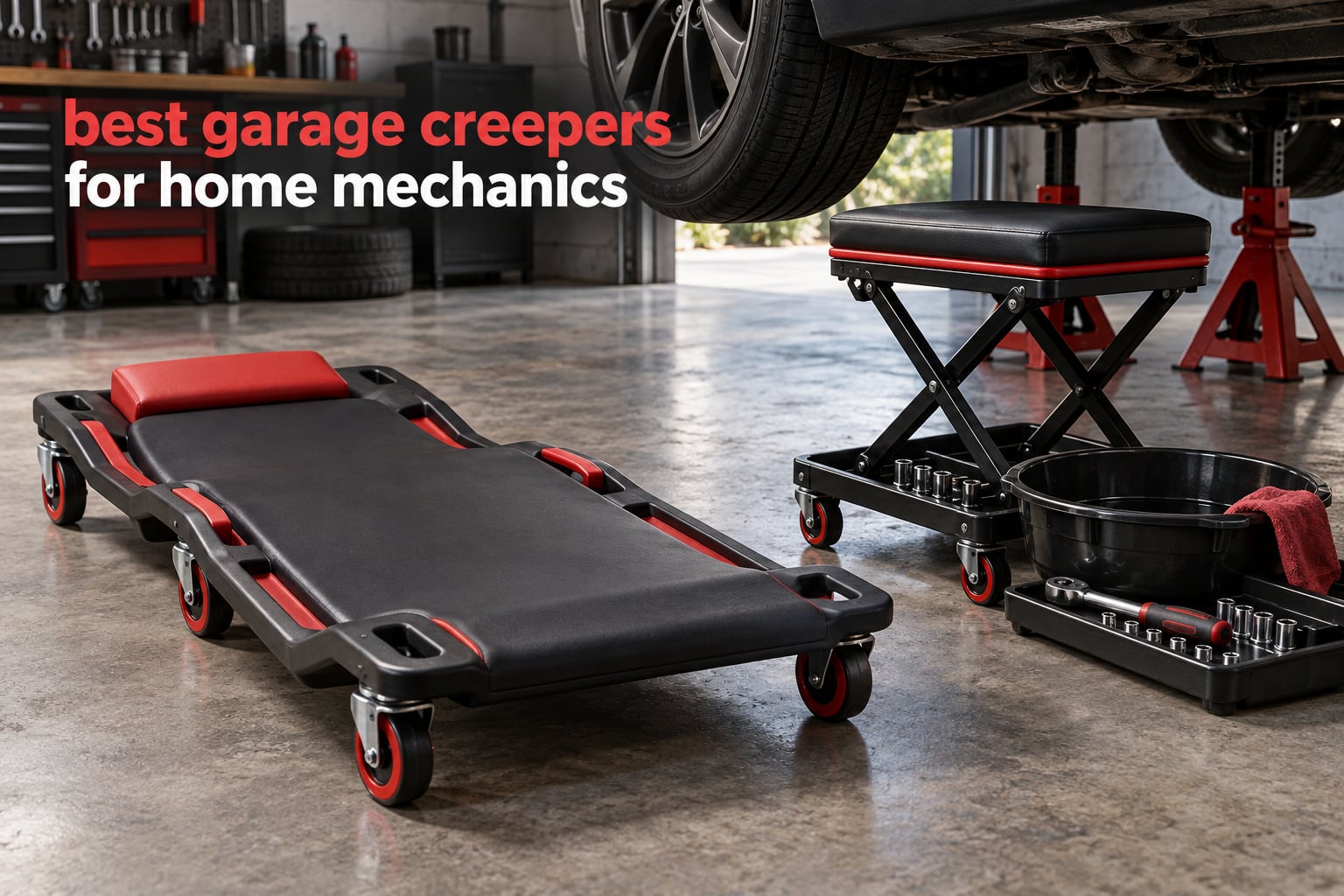
Most home mechanics do not need a rolling tool chest or a professional shop creeper kit. They need a low, stable board that rolls under a car parked in a residential garage, holds their weight plus a few tools, and does not jam the first time it crosses a crack in the concrete.
Short answer: for most home garages the best garage creepers are a convertible Z-creeper that folds flat and flips into a seat, or a low-profile plastic creeper with 2-inch swivel rollers if the car sits low. Match the deck length to your height, add your body weight plus tools to pick a capacity, and choose the caster diameter to match your floor.
Convertible Z-creeper for oil changes, exhaust and brake work plus a free rolling seat when the job is topside.
Low-profile plastic creeper for lowered cars, low-clearance sedans and anything where 7/8 inch of ground clearance matters.
Padded bench creeper for long undercar sessions where your back and shoulders take the punishment.
Pneumatic rolling stool for engine bays, interiors and detailing where a deck is in your way.
We compared ten of the strongest options available for 2026, from blow-molded HDPE boards to folding steel Z-creepers to pneumatic roller seats. Each pick below carries its own best-for label, because the honest answer here is not that one creeper wins every job. It is that four different jobs call for four different shapes of tool, and a home garage with one car and one jack does not need any of the rest.
Along the way we dig into the thing almost every roundup skips: casters. Bearing failure, missing wheels in the box and mis-drilled frames from repackaged units are the most common complaints in the customer review data, and they are all things you can catch in five minutes before you ever put the tool under a car. We also cover how to size a deck for a taller or heavier frame, which is the failure mode that pushes people back to the store.
If you are still building out the rest of the garage, our guides to the best floor jacks for home garage and pro shop and the best garage storage cabinets cover the two tools that pair with a creeper on almost every job.
Table of Contents
Top 3 Best Garage Creepers for Home Mechanics
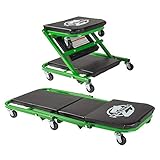
Pro-LifT C-2036DG Z-Creeper
- 300 lb capacity
- Alloy steel frame
- Converts to a seat with a pin
- Folds flat for storage

Torin Big Red TR6350 Stool
- Pneumatic height adjustment
- Segmented tool tray
- Four 360-degree swivel casters

Lisle 97102 Plastic Creeper
- 7/8 inch floor clearance
- 300 lb capacity
- Replaceable ball-bearing rollers
- Lifetime body warranty
All 10 Garage Creepers Compared in 2026
| Product | Specifications | Action |
|---|---|---|
| Pro-LifT C-2036DG Convertible Z-Creeper |
|
Check Latest Price |
 M-AUTO 36 inch Foldable Z Creeper M-AUTO 36 inch Foldable Z Creeper |
|
Check Latest Price |
 WEN 73012T Pneumatic Rolling Stool WEN 73012T Pneumatic Rolling Stool |
|
Check Latest Price |
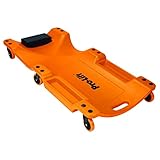 Pro-LifT PL9400 40 inch HDPE Creeper Pro-LifT PL9400 40 inch HDPE Creeper |
|
Check Latest Price |
| Torin Big Red TR6350 Creeper Seat |
|
Check Latest Price |
 Torin Big Red TR6452 Padded Bench Torin Big Red TR6452 Padded Bench |
|
Check Latest Price |
 VEVOR 300 lb Mechanic Stool VEVOR 300 lb Mechanic Stool |
|
Check Latest Price |
 MaxWorks 80771 Pneumatic Roller Seat MaxWorks 80771 Pneumatic Roller Seat |
|
Check Latest Price |
 Performance Tool W85005 Creeper Performance Tool W85005 Creeper |
|
Check Latest Price |
| Lisle 97102 Low Profile Creeper |
|
Check Latest Price |
1. Pro-LifT C-2036DG Convertible Z-Creeper – Best Overall
Pro-LifT C-2036DG Black/Green 300 Lbs Mechanic Creeper
300 lb capacity
Alloy steel frame
22 x 17.5 x 4.53 in deck
6 swivel casters
Pros
- Converts from flat creeper to seat with a retractable pin
- Thick padded cushions and a padded headrest
- Compact folding design stores flat
- Alloy steel frame rated to 300 lb
Cons
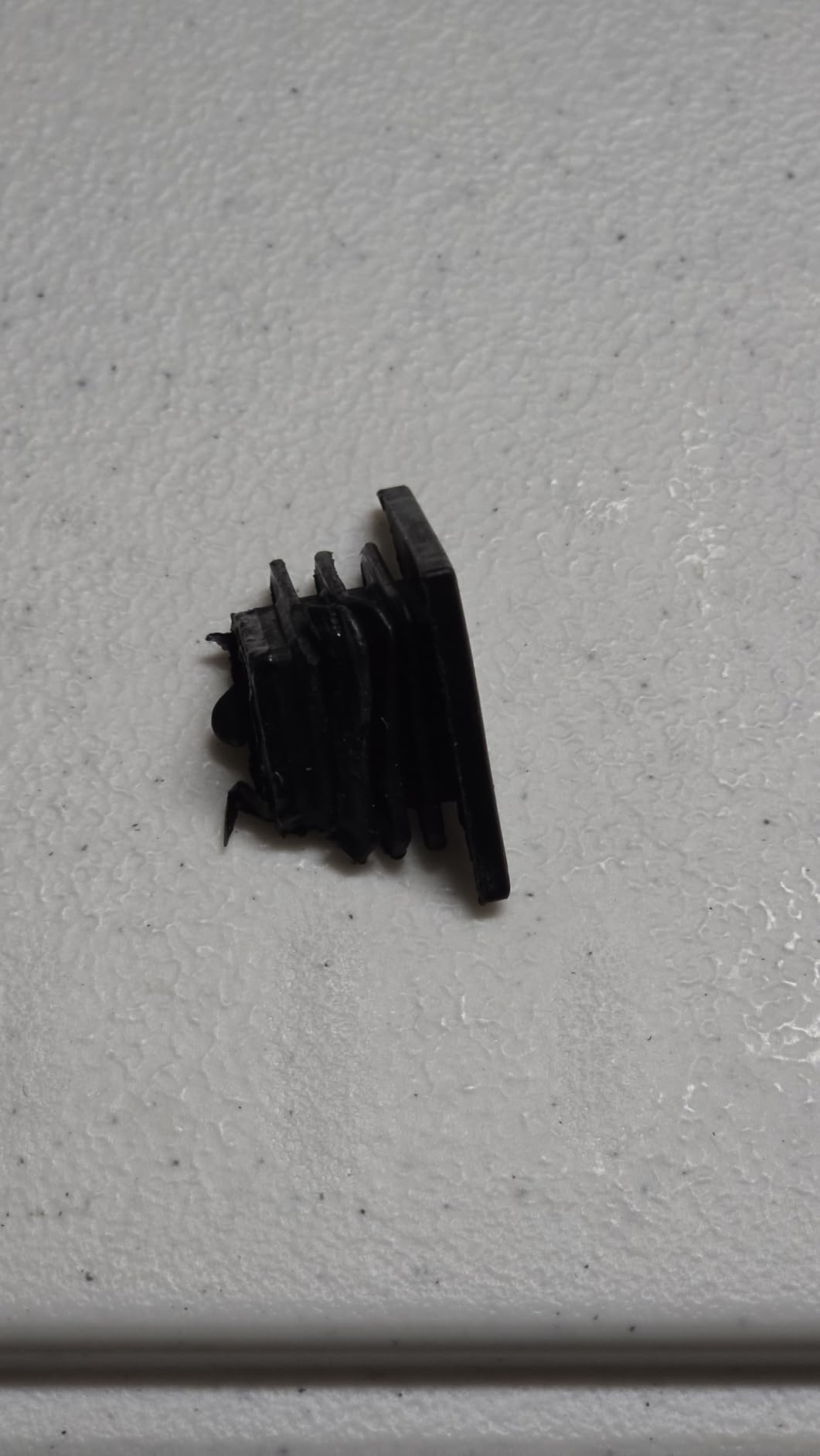
- Supplied casters wear out before the frame does
- Flat position sits high for low-clearance cars
- Vague assembly instructions
This is the pick we would hand to somebody whose garage holds one daily driver and whose weekend jobs are oil changes, tire rotations, a seized caliper and the occasional exhaust hanger. It is a steel Z-frame with a padded deck, and a retractable pin that lets you fold it flat or stand it up as a rolling seat in a couple of seconds.
The reason it tops this list is not the spec sheet, it is the review volume. Just under 28k ratings at a 4.5 average gives you a much clearer picture of failure modes than any lab test can, and the pattern that emerges is consistent: the frame and the padding hold up, the supplied casters are the weak link.
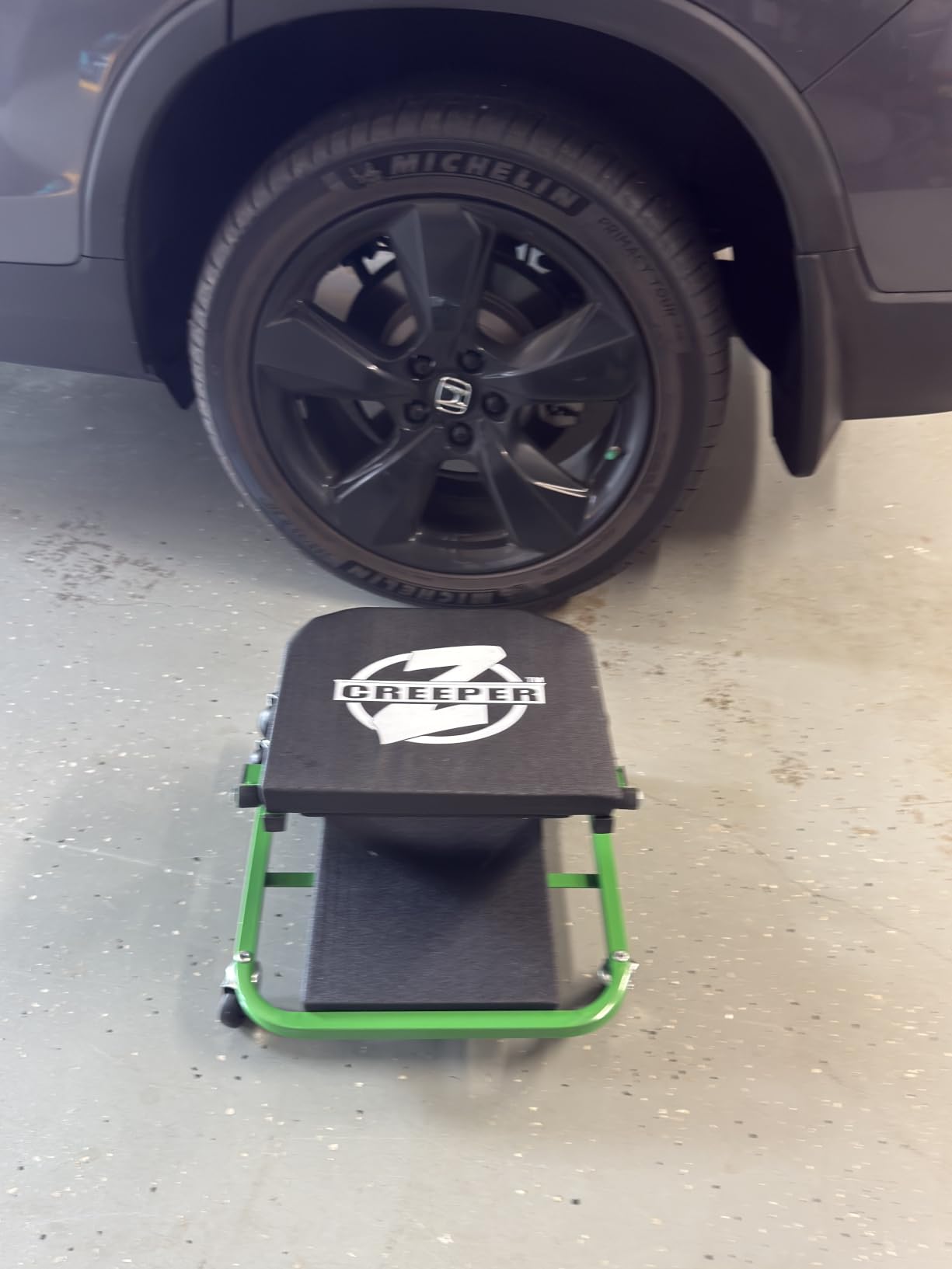
Mechanically it is a straightforward design. The alloy steel frame carries a listed 300 lb rating, the vinyl seat is 17 inches wide, and the packed dimensions come in around 22 by 17.5 by 4.53 inches. Six swivel casters let you push it into position with your feet rather than dragging yourself across the floor.
What we like most is the storage angle. A folding steel creeper is bulky, and bulky tools are the first thing to disappear behind a stack of tires in a one-car garage. This one folds to roughly the size of a folded jacket and stands on edge against a wall.
What you get for the money
You get two tools in one frame: a padded creeper for undercar work and an upright seat for engine bays and interiors. Owners report using the seat mode as often as the flat mode, which is the honest argument for a convertible design over a fixed board. A fixed bench is a better creeper; a convertible is a better value.
The 300 lb rating is the part to think about. Add your body weight, a 20 lb socket set and a drain pan, and a 200 lb user is already near the practical ceiling. Taller or heavier users should look at the 350 lb HDPE board further down this list.
What to check when it arrives
Spin every caster before you put it on the car. The most common owner fix on this model is replacing the included wheels after a season of weekend use, and swapping them early is far cheaper than finding one seized mid-job.
Also confirm the retractable pin actually locks the hinge in both positions. It is the single part that carries the seat conversion, and it is the part that gets dropped during assembly when the instructions are vague. Check the deck sits flat on the frame before you trust it with your weight.
2. M-AUTO 36 inch Foldable Z Creeper 2-in-1 – Best Budget 2-in-1
M-AUTO Foldable Z Creeper 2-in-1 Rolling Folding Car Creeper & Seat, 36″ Adjustable Roller Garage Chair Lay Down or Sit, 330LBS Capacity Under Car Roller Creeper with 6 Swivel Casters, Red
330 lb capacity
Steel frame
35.5 x 16 x 3.5 in deck
6 polyurethane casters
Pros
- Quick pin-release conversion between creeper and seat
- Highest capacity in this lineup at 330 lb
- Thick padding for lying work
- Available in 36
- 40 and 48 inch lengths
Cons
- Lowest average rating here at 4.2
- Some reports of cracked casters and bent bars under heavy riders
- Confusing instruction sheet
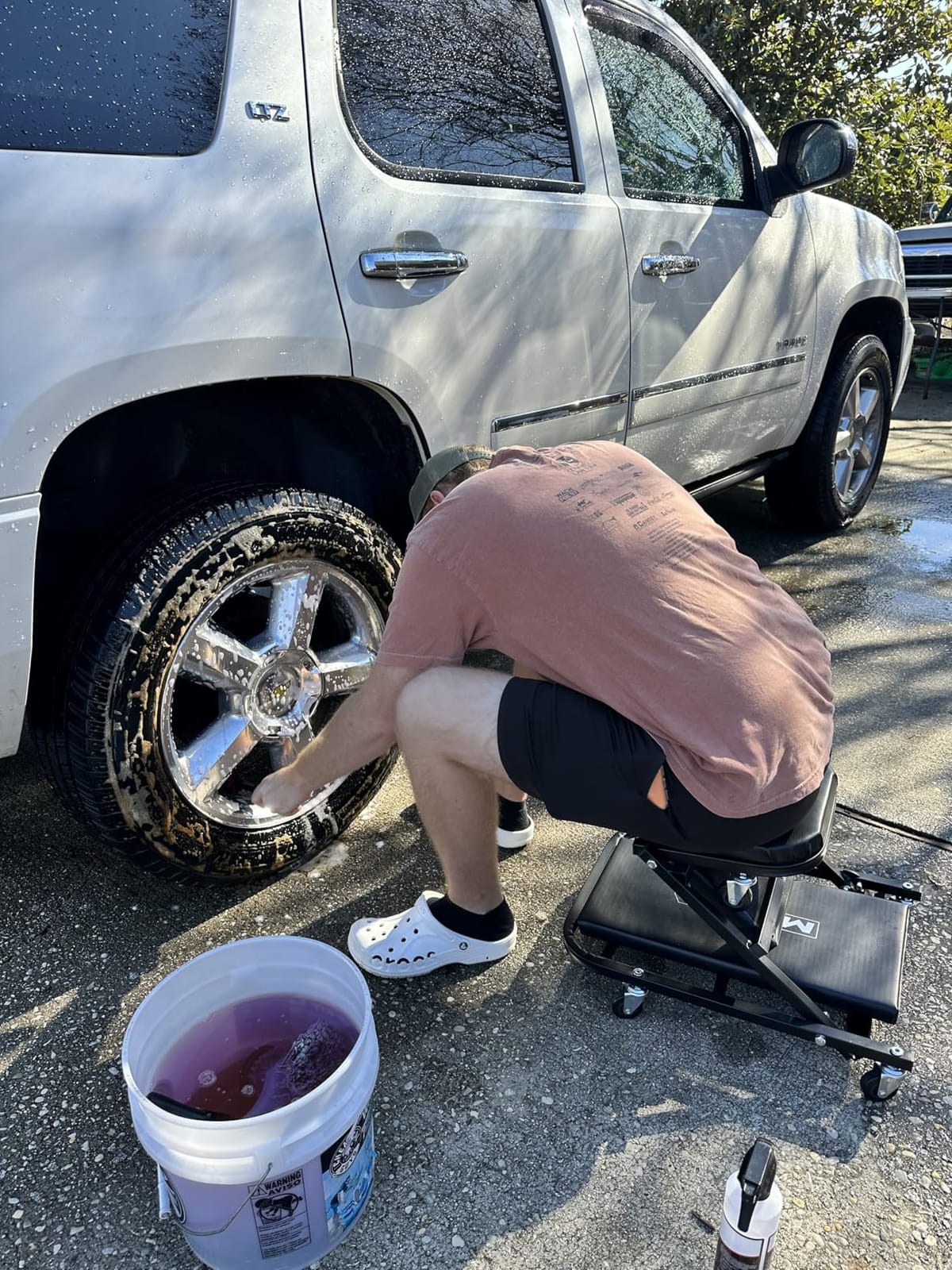
This is the budget answer to the same question the Pro-LifT answers at a higher tier, and for a home user doing weekend work it does the job. Six non-marring polyurethane swivel casters, a steel frame, thick padding and a pin that folds the whole thing flat.
One detail makes it stand out among budget Z-creepers: the family comes in 36, 40 and 48 inch lengths off the same model number. If you are over six feet, or simply want room for a creeper and a jack in the same footprint, that option matters more than most buyers expect at this tier.
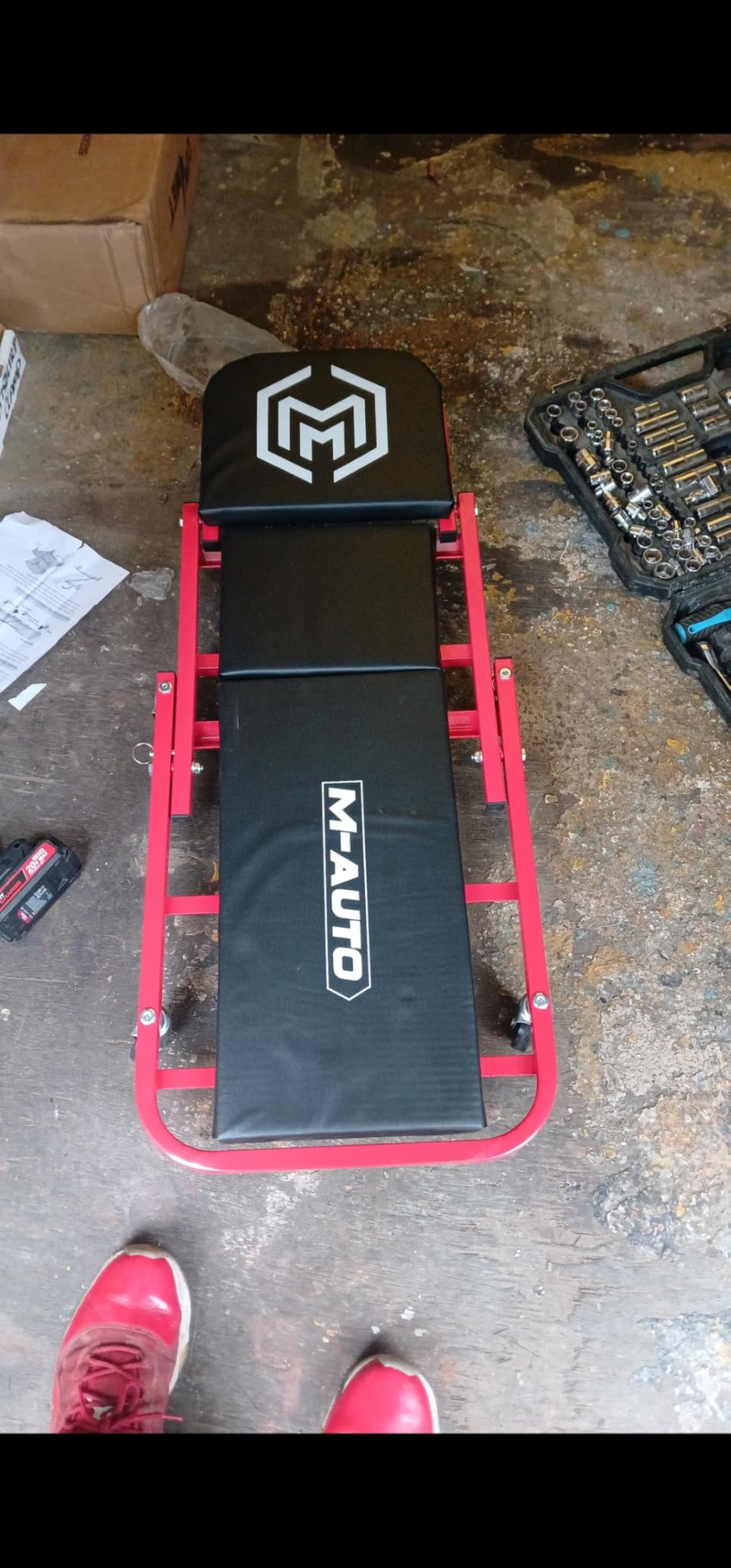
Measured dimensions are 35.5 by 16 by 3.5 inches with a listed weight of 10.69 lb, so it is genuinely easy to carry out to the driveway. At 3.5 inches tall in the packed figure, the flat position is lower than the Pro-LifT convertible, which helps under a low nose.
The 4.2 star average is the lowest of the ten here, and roughly one review in eight is a one-star. Read that cluster carefully rather than skipping it: the complaints concentrate on cracked casters and bent bars under heavy riders, which is a durability ceiling, not a defect in the design.
Who this suits
Home users and detailers rate this very highly, and for someone maintaining one car without tools falling off the underside of the car, the 330 lb rating and the 40 inch length option cover the two things that trip people up in cheaper boards.
It is not a daily shop tool. If you are a full-time mechanic putting eight hours a day on a creeper, the wear pattern described in the reviews is exactly the wear pattern you will accelerate. Occasional weekend use is the design point.
What to check when it arrives
Inspect the six casters and the mounting bolts at each corner. Bent or cracked caster mounts are the first thing to look for, and it is much easier to return a unit than to argue about it after a month of use.
Work the conversion pin several times before first use. Owners report it feeling stiff initially, and a stiff pin that does not fully engage is a safety problem the moment you sit on it. Wipe the frame bolts and torque them evenly.
3. WEN 73012T Pneumatic Rolling Mechanic Stool – Best Rolling Stool
WEN 73012T 300-Pound Capacity Pneumatic Rolling Mechanic Stool
15 to 20 in seat height
300 lb steel frame
5 x 2-1/2 in casters
Onboard storage
Pros
- Smooth pneumatic height adjustment across a 5 inch range
- Thick multi-layer vinyl padding
- Five swivel casters for omni-directional movement
- Tool storage within reach
Cons
- Assembly instructions are not included
- Round seat is smaller than rectangular stools
- Onboard storage is limited
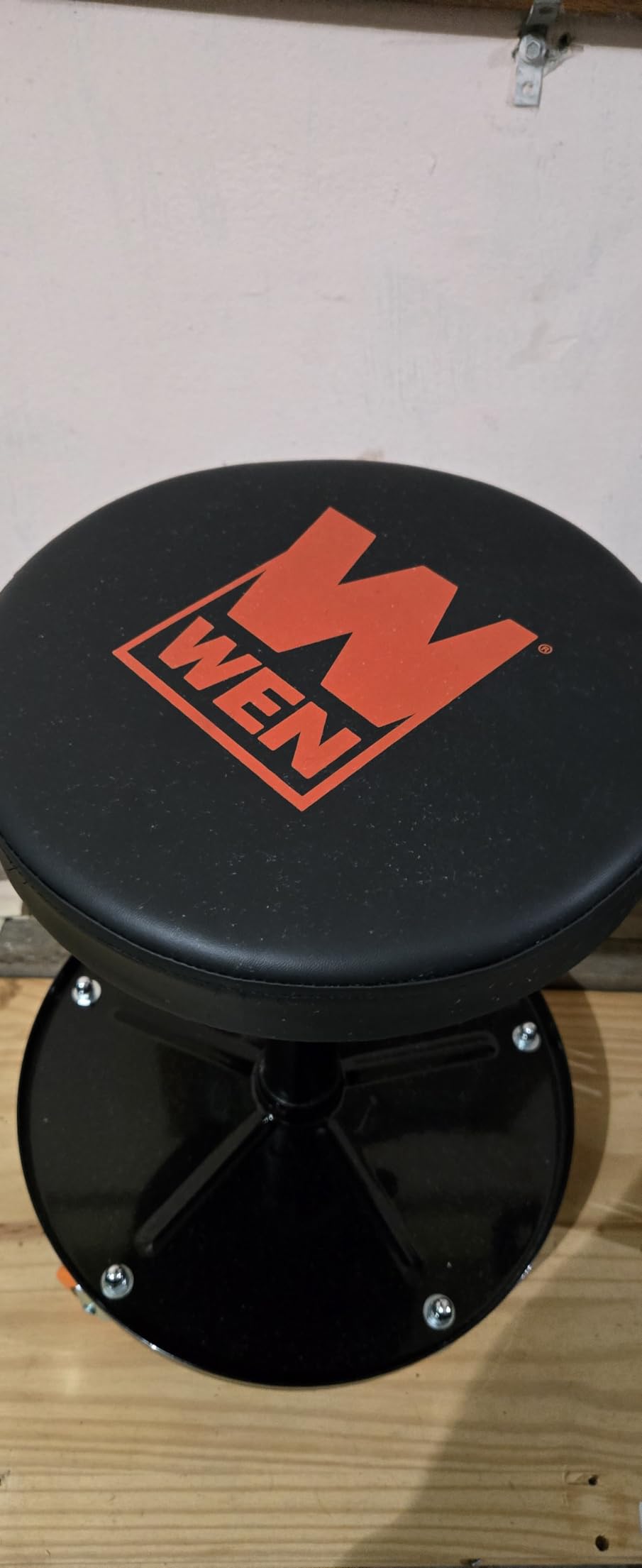
Not every job happens underneath a car. Roughly half of home garage work happens from above: battery terminals, air filters, belts, brake bleeds, interior trim. A pneumatic rolling stool handles all of it, and this one is the highest-rated stool in the group at 4.6 stars across 4,496 ratings.
The height range is 15 to 20 inches via a side lever, which is wide enough to work in a raised hood, a pickup bed or a low sports car without stopping to swap tools. That lever adjustment is the reason we rate pneumatic over a fixed seat: a ratchet lever feels better for a few minutes, a pneumatic cylinder still feels right on hour four.
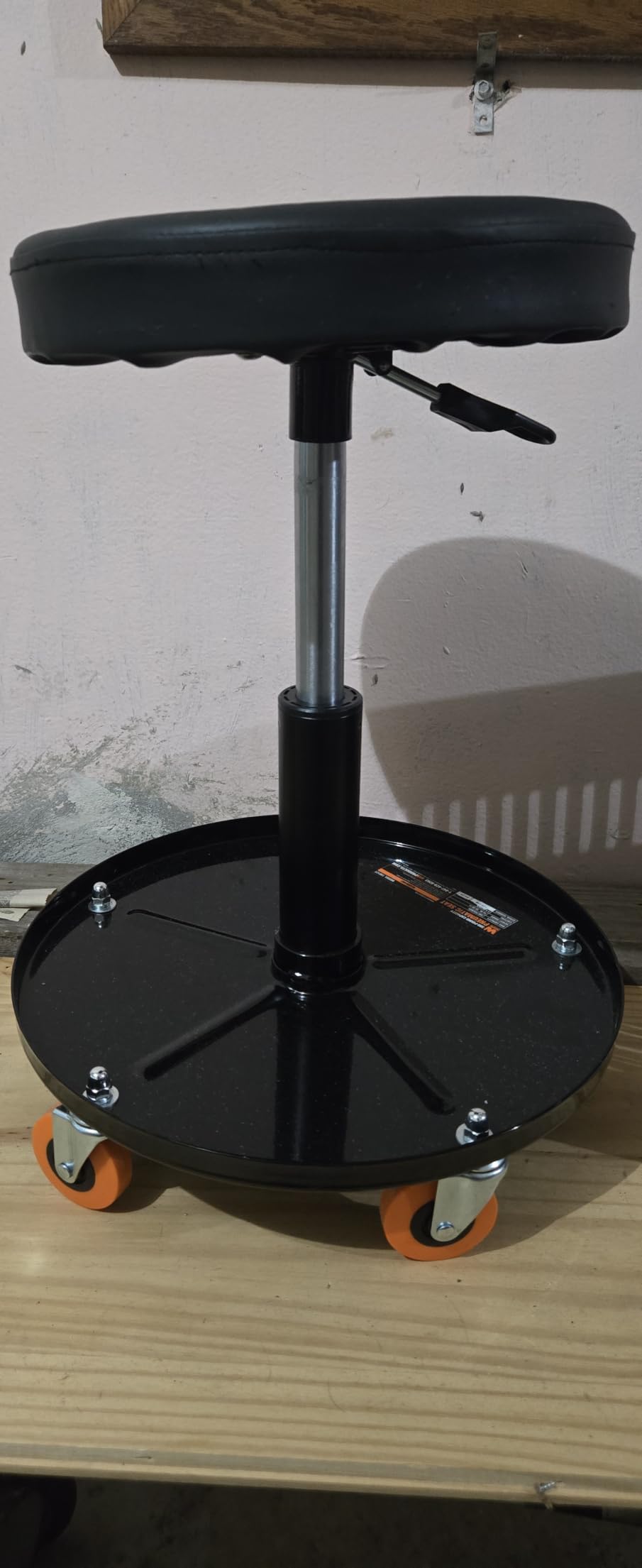
Specs are straightforward. Steel frame rated to 300 lb, vinyl seat, five 2-1/2 inch swiveling casters, packaged dimensions of 15 by 15 by 20 inches. The caster diameter is the thing to weigh against your floor, and we cover that in the buying guide below.
The one friction point owners mention constantly is that assembly instructions are not in the box. Budget ten minutes with a socket set and a phone photo of the finished product, and it is a thirty minute build for most people.
When to reach for a stool instead of a creeper
Rule of thumb: if your head is above the rocker panel, you do not need to be flat on your back. Oil filter changes, radiator flushes, battery work, interior jobs, and anything where you need to move quickly between two sides of the engine all favor a stool.
A stool also stores better. This one stands in a corner in about a 15 inch square, where a 40 inch creeper needs a wall or a ceiling hook. In a small single-car garage, that is not a minor consideration.
What to check when it arrives
Test the pneumatic cylinder early, before any load is on it. Pump it to full height a few times, then sit on it and pump again. A cylinder that drifts is a return, and it is cheaper to catch on day one.
Check that all five casters swivel freely and that none of the wheels is pinched against the fork. Add a drop of light oil to each swivel race if your garage floor is dusty, and the stool will stay quiet for years.
4. Pro-LifT PL9400 40 inch HDPE Plastic Creeper – Best for Larger Bodies
Pro Lift Mechanic Plastic Creeper 40 Inch – Blow Molded Ergonomic HDPE Body with Padded Headrest & Dual Tool Trays – 350 Lbs Capacity Orange
350 lb capacity
40 x 19 in deck
6 three-inch casters
14 lb body
Pros
- Highest capacity here at 350 lb with a 40 inch deck
- Three-inch multi-terrain casters roll over gravel and cracks
- Lightweight one-piece body at about 14 lb
- Dual tool trays and a padded headrest
Cons
- Rigid plastic deck with no back padding
- Included plastic assembly wrench strips easily
- Headrest padding can crack with use
If a 36 inch deck with a 300 lb rating has ever left you curled up with your feet hanging off the end, this is the board that fixes it. Forty inches long, nineteen inches wide, and rated to 350 lb, from a one-piece blow-molded HDPE body that weighs about 14 lb.
The casters are the quiet hero here: six 3 inch multi-terrain swivel casters described as resistant to oil, chemicals and grease. Three-inch diameter is the practical difference between gliding over a home garage floor and getting stuck in it, and it is the single spec we would weight most heavily for a residential garage.
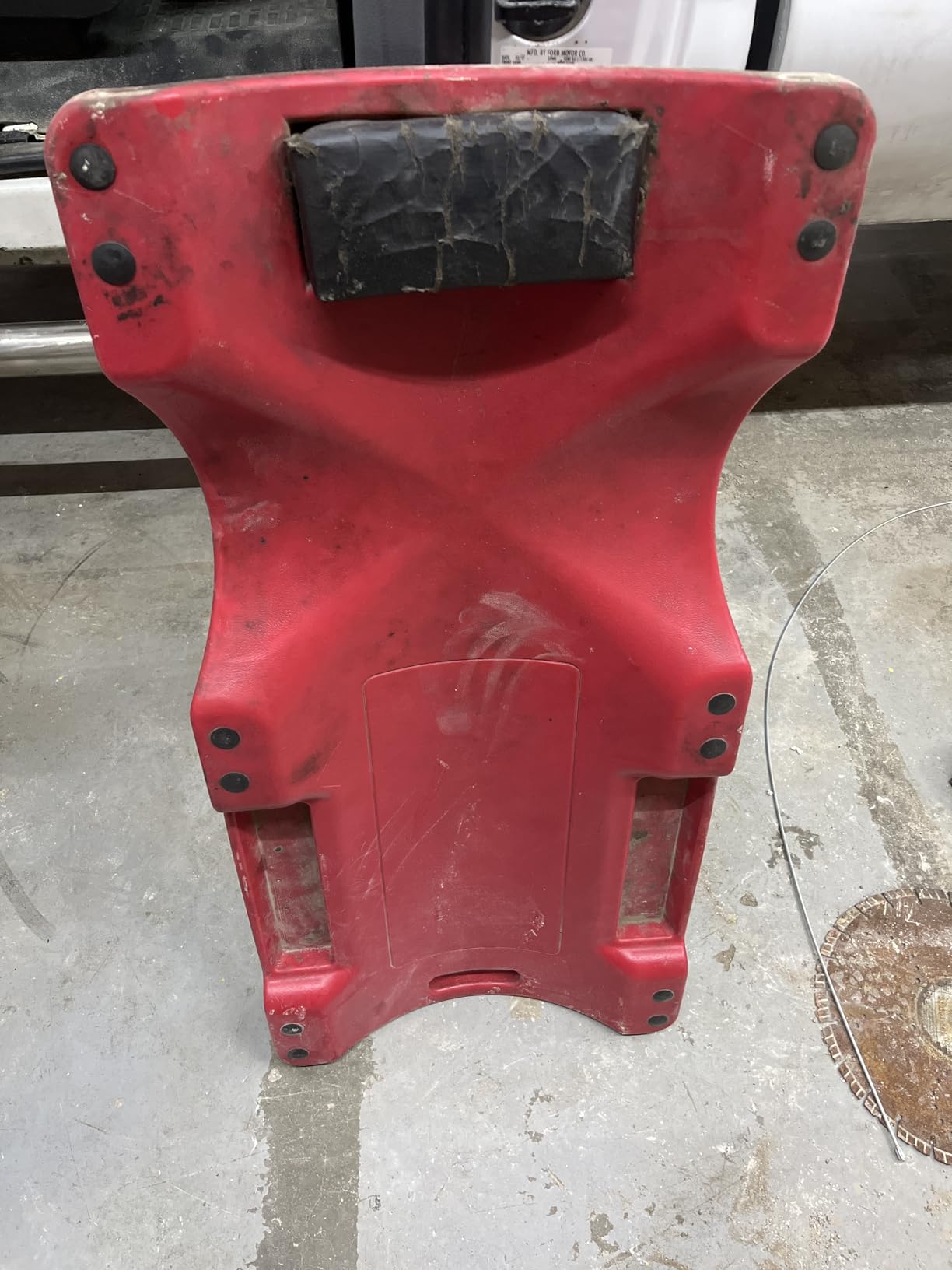
Two molded-in tool trays and a padded headrest add real value once you are lying under a car with headlight work in your hands. A built-in carry handle and a one year limited warranty round out a package that assembles in roughly five to fifteen minutes with hand tools.
Roughly 82 percent of ratings are five star, which is an unusually high share for a garage tool. The recurring theme in the reviews is that it suits occasional home maintenance and detailing far better than daily shop work, and the reason is the deck itself.
What the 40 inch deck actually fixes
Body size, not car size, is what ends most early creeper purchases. A 40 inch deck with a 19 inch width gives a taller user shoulder room and leg support, and it gives anyone room to turn their head without craning. Buyers around six foot nine and near 300 lb rate it very highly for exactly this reason.
The 350 lb rating also leaves headroom. Your body weight plus a toolbox and a drain pan is a real load, and a board rated 50 lb above your own weight is not over-engineering, it is margin.
What to check when it arrives
Do not trust the included plastic assembly wrench. Owners report it stripping, which leaves you mid-assembly with a half-built creeper. Have a socket or an impact driver ready before you start.
Inspect the one-piece body for stress marks around the caster pockets and the tool trays, and press on the headrest padding. Rigid plastic decks do not have the forgiveness of a padded bench, and a cracked headrest pad is easier to live with than a cracked frame.
5. Torin Big Red TR6350 Pneumatic Creeper Seat – Most Compact
Big RED Pneumatic Rolling Mechanic Stool, Large
Pneumatic height adjustment
Segmented steel tool tray
4 swivel casters
250 lb rating
Pros
- Large thick vinyl seat comfortable for extended sessions
- Wide seat and wheelbase resists tipping forward
- Four 360-degree swivel casters
- Segmented tray sits close to the seat
Cons
- 250 lb rating is the lowest here
- Minimum height of roughly 16 inch
- Casters are not lockable
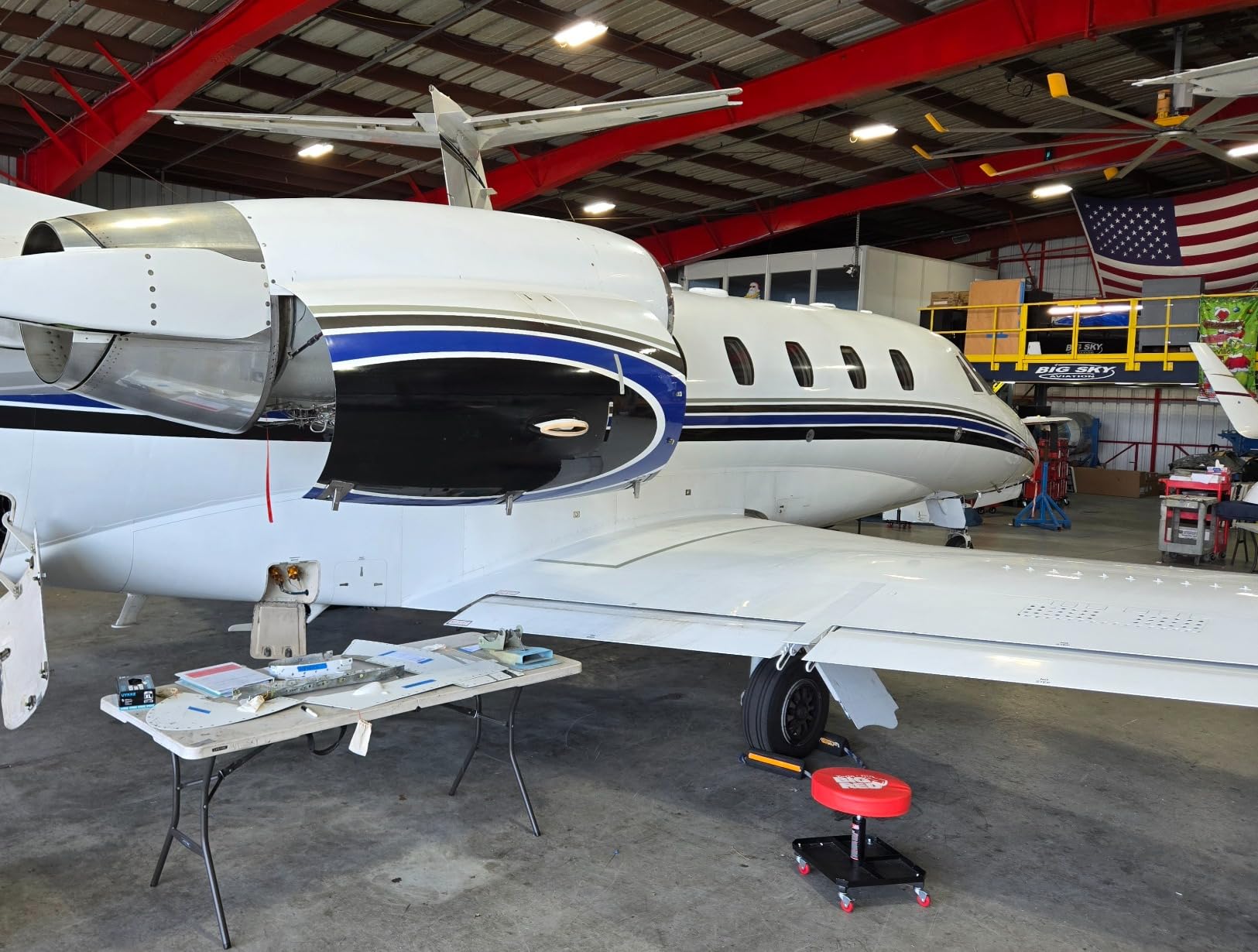
This is the stool that professionals actually name, and at 4.7 stars across 1,711 ratings the consensus is well earned. The Torin TR6350 pairs a large padded vinyl seat with a segmented steel tool tray and four 360-degree swivel casters, all on a pneumatic height adjustment with a 4-1/2 inch range.
What separates it from cheaper pneumatic stools is stability. Owners specifically call out that the wide seat and wheelbase resist kicking out when you lean forward into a confined space, which is the exact failure that puts a lesser stool on its side under a dashboard.
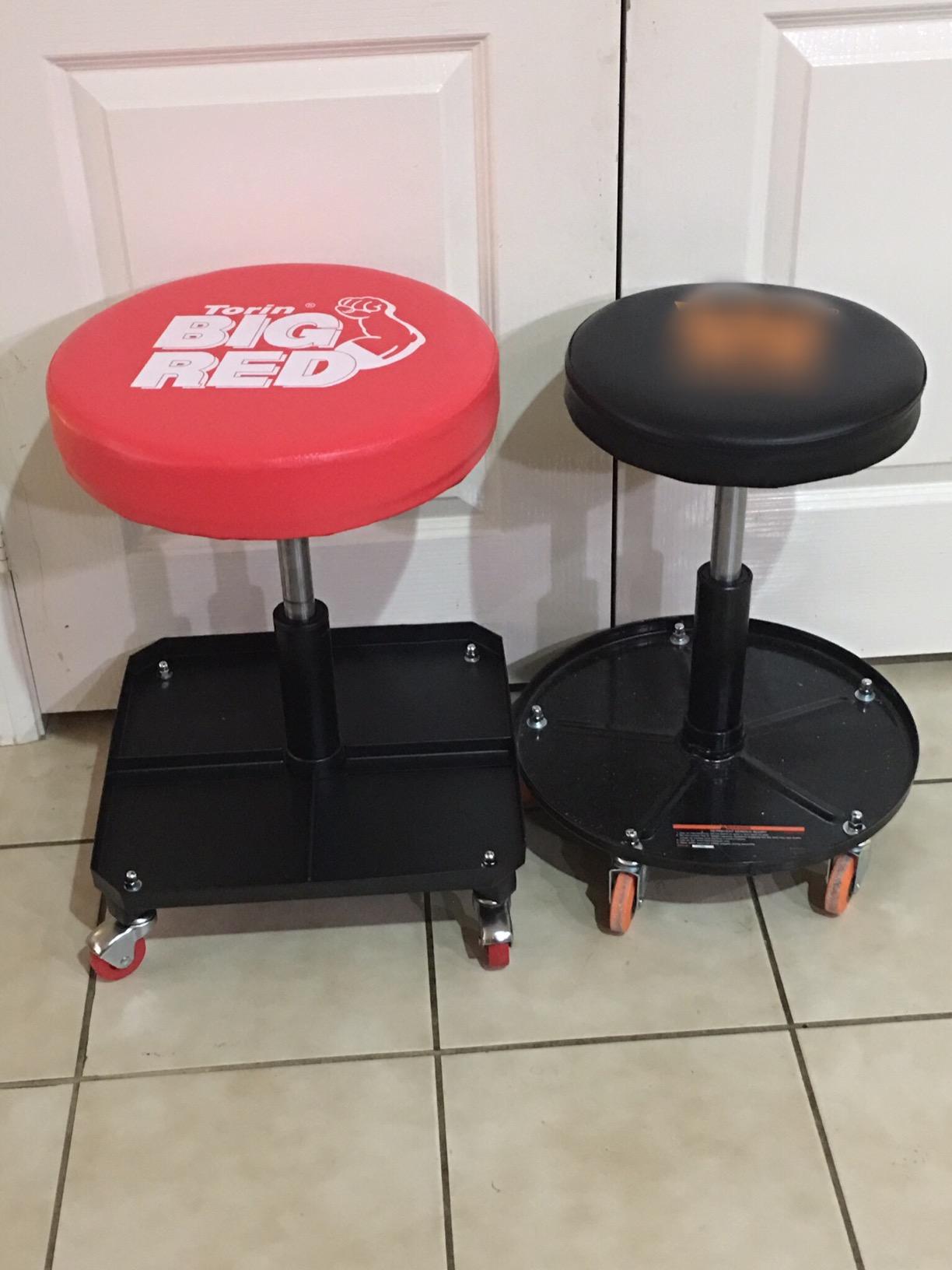
The tray is square and segmented, sized close to the seat itself, which means it never swings into your legs. Owners list it as a genuine time-saver for bolts, nuts and fasteners. The unit itself weighs 11 lb, which is easy to move around a garage.
Warranty coverage is a limited one year from the manufacturer, and care is a damp cloth. Neither is remarkable; both are stated plainly so you can judge.
Where the premium tier earns it
Sign installers and working mechanics use this stool daily, and the reviews reflect that: a firm, thick seat that does not bottom out, casters that roll smoothly over debris and finished concrete, and a tray that holds parts rather than tossing them.
For a home garage doing one job on a Saturday, that quality level is real but not required. This is the pick for you if you work on vehicles most weekends, or if you have had cheaper stools tip over on you before.
What to check when it arrives
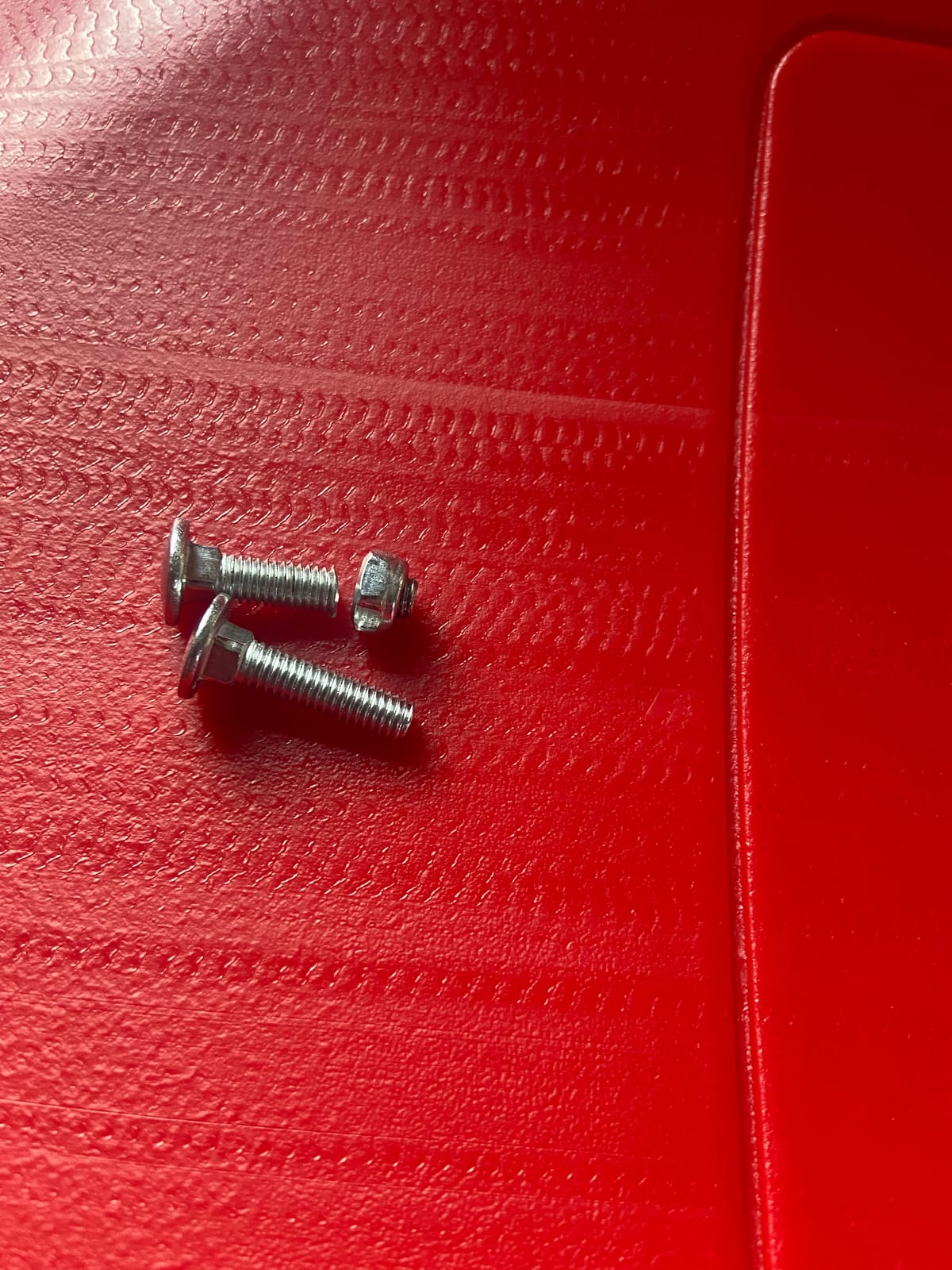
Look closely at the box. Owners of this model report some units arriving in damaged or repackaged packaging with aftermarket screws in place, so confirm the hardware is the original finish and the casters are the correct size before you build it.
Confirm the pneumatic cylinder holds height with weight on it, and check the four casters for free swivel. Note that the casters here are not lockable, which matters if you work on a slight incline.
6. Torin Big Red TR6452 40 inch Padded Bench Creeper – Best Padded Bench
BIG RED TR6452 Torin Rolling Garage/Shop Creeper: 40″ Padded Mechanic Cart with Adjustable Headrest and 6 Casters, Red
40 x 16.8 in padded bench
Adjustable headrest
6 swivel casters
13.2 lb
Pros
- Full-length padded bench plus an adjustable cushioned headrest
- Tubular alloy steel frame
- 6 x 360-degree swivel casters
- Easy assembly
Cons
- 250 lb rating is lower than plastic and hybrid boards
- Fixed bench with no convertible seat option
- Wider footprint than a compact stool
Brake and exhaust jobs put you in one spot for a long time, and a fixed padded bench is better for that than any convertible. The TR6452 gives you a fully padded 40 inch bench with a cushioned headrest that adjusts, on a tubular alloy steel frame with six 360-degree swivel casters.
That headrest is not a gimmick on a 40 inch bench. Owners across the reviews mention it as the difference between resting your head on steel and actually relaxing, which matters if a caliper job turns into a two-hour bleeding and adjustment cycle.
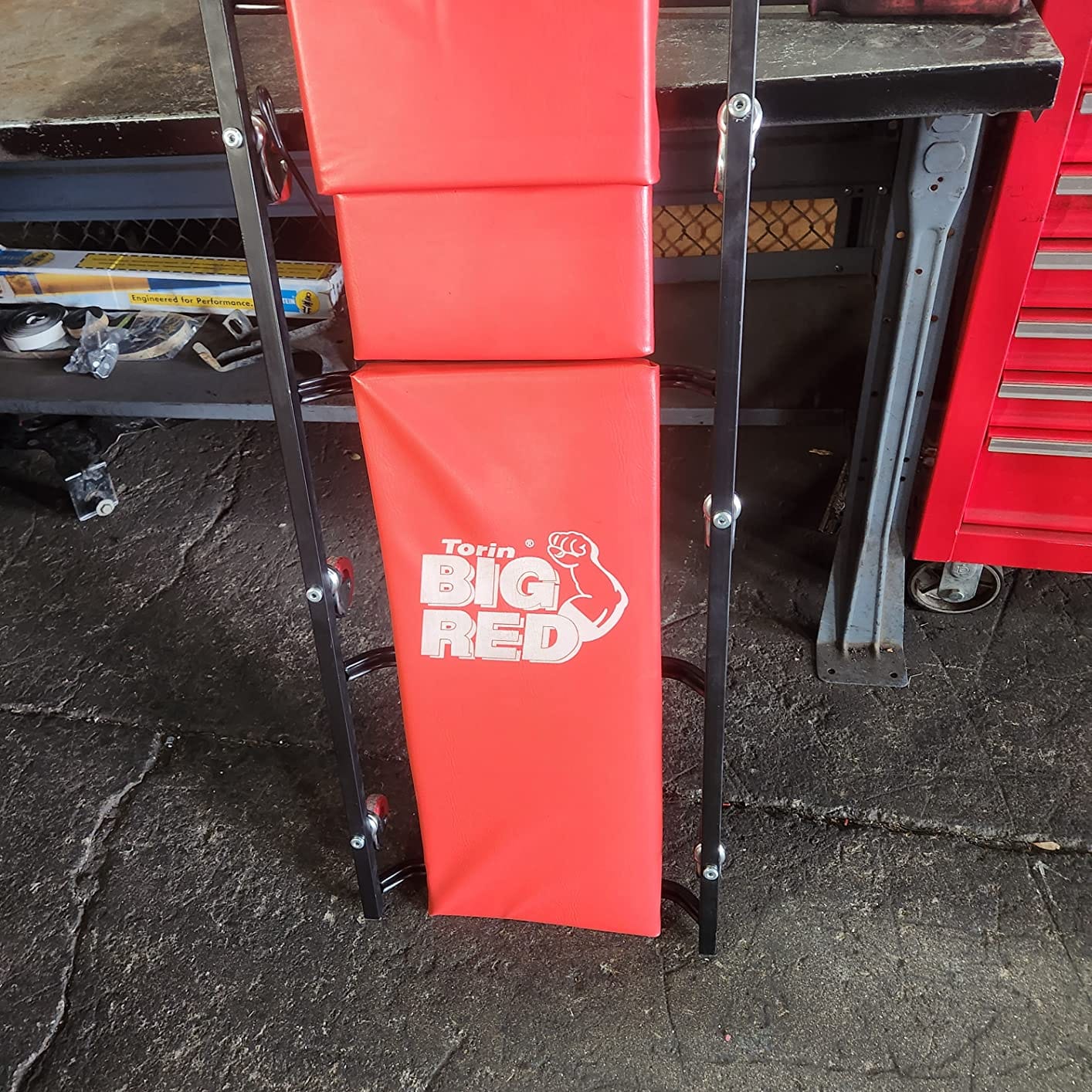
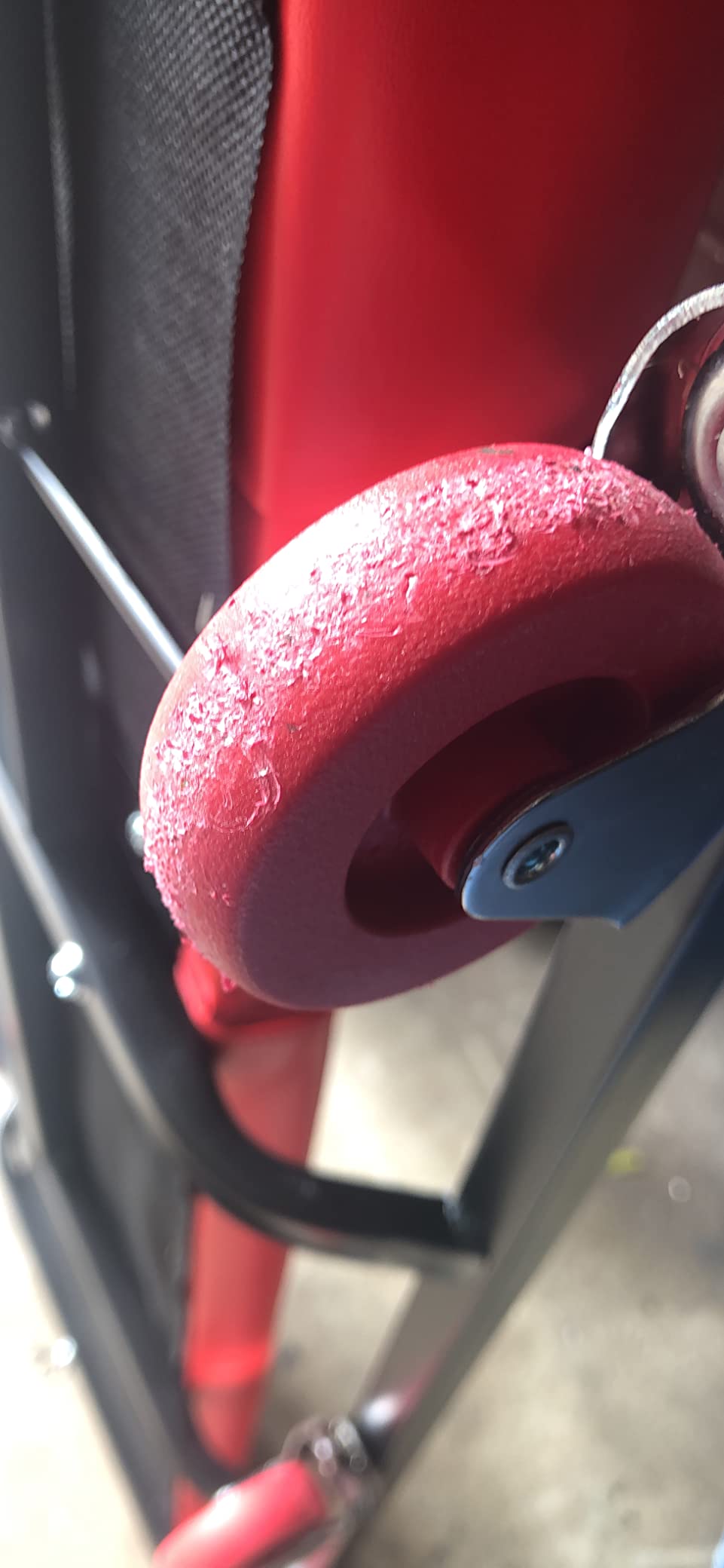
Dimensions are 40 inches deep, 16.8 inches wide and 4.4 inches high, at 13.2 lb. Assembly is described as easy, and the frame is backed by a limited one year manufacturer warranty. Colors include black, red and blue.
The trade-off is the 250 lb rating. It is a steel bench rated below the plastic boards in this list, and for a larger user that is a genuine ceiling rather than a rounding error once you add tools.
Fixed bench or convertible
A fixed bench gives you a wider, more stable platform with no hinge to fail and no pin to check. If your work is consistently under the car, that is the better shape. The convertible designs win when the same tool needs to be a seat half the time.
This one also folds down in footprint terms better than most steel benches, but it still wants a wall or a corner. In a small garage, plan the storage spot before the purchase rather than after.
What to check when it arrives
Inspect the welds at the frame joints and the underside of the padded deck. Steel frames that have been in transit can arrive with bent mounting tabs, and a crooked caster square is the giveaway.
Test the headrest adjustment through its full range and confirm the cushion does not slide on the rail. Then run the bench across the floor at load; a new padded creeper that scrapes in one direction is a bent caster plate, and it is a five minute fix with a wrench if you catch it now.
7. VEVOR 300 lb Mechanic Stool with Slide-Out Trays – Best Tool Storage
VEVOR Mechanic Stool 300 LBS Capacity Garage Stool Gift for Men, Heavy Duty Rolling Mechanics Seat, with Three Slide Out Tool Trays and Drawer, Tools for Automotive Auto Repair
300 lb capacity
15.4 in seat height
3 slide-out trays
4 in casters with brakes
Pros
- Best storage in the group with three slide-out trays and a bin
- 4 inch rubber casters including two brake casters
- Curved sponge cushion with a washable cover
- Low 15.4 inch profile stores in a corner
Cons
- Casters and hollow support arms are the weak point
- Supplied wheel nuts have poor threads
- Pre-drilled wheel holes can be misaligned
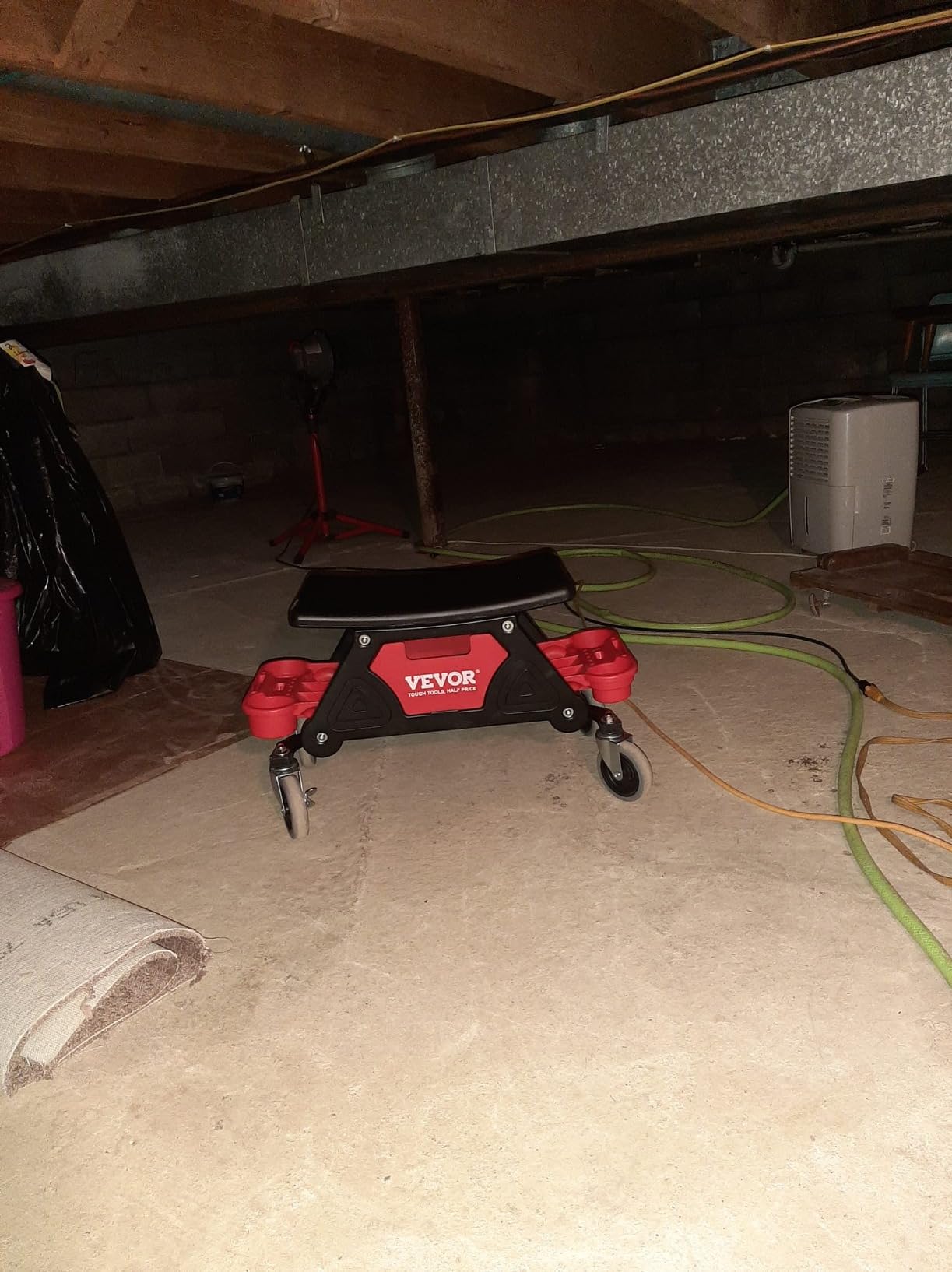
If the reason you cannot finish a job is that the socket you need is across the room, this stool is built to solve that. Three slide-out tool trays with card slot partitions, plus an under-seat storage bin, and a 300 lb steel base with a plastic seat.
The casters are different from every other pick here: four inch rubber wheels, and two of the four are brake casters. Rubber on a coated or sealed concrete floor is quiet and floor-safe, and the brakes mean the stool stays where you put it while you are both hands deep in a job.
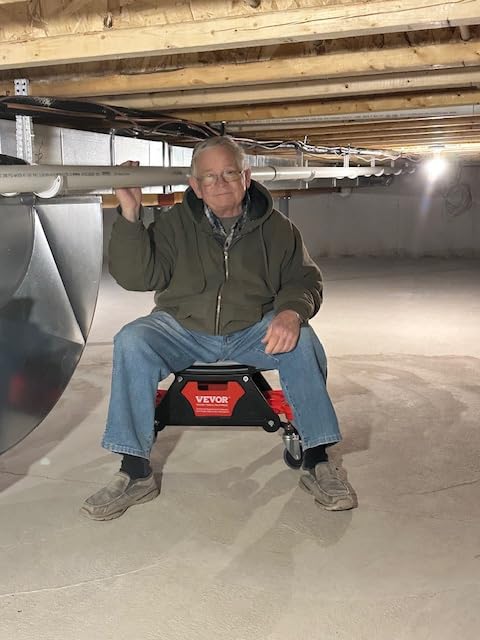
Seat height is a low 15.4 inches with 360-degree rotation, and the cushion is a curved sponge pad under a removable washable cover. Overall dimensions are 25.2 by 13.2 by 15.4 inches, which is still a compact footprint despite the trays.
At 4.4 stars with roughly 73 percent five-star ratings, the complaints cluster on hardware rather than design. Supplied wheel nuts, pre-drilled wheel holes and the hollow support arms are the recurring names, and all three are knowable at unboxing.
Who benefits most from the trays
Detailers and anyone doing repetitive work with small fasteners. The card slot partitions are the detail: sockets and extension bars stay upright and separated instead of a loose pile in a drawer, which is the difference between finding a 10 mm in four seconds and four minutes.
Know the limitation up front. The partitions are pre-sized, so large bottles, spray cans and long extensions do not fit neatly. Plan on carrying a separate tray for fluids.
What to check when it arrives
Check every wheel nut and replace any that strip easily. This is the most common fix owners report, and hardware stores carry the right thread for a few cents each.
Push a bolt through each pre-drilled caster hole and confirm the plate sits flat. Misaligned holes are a known issue on this model, and a caster mounted at an angle will not spin freely no matter how much you tighten it. Check that both brake casters actually engage.
8. MaxWorks 80771 Pneumatic Roller Seat – Best Compact Stool
MaxWorks 80771 Pneumatic Roller Seat/Creeper with Adjustable Height – 300 lb Capacity
15 to 20 in height
300 lb capacity
5 x 2-1/2 in casters
10.5 lb
Pros
- Smooth pneumatic side-lever adjustment from 15 to 20 inch
- Tool-free assembly
- Large steel base doubles as a tool tray
- Five non-marring swivel casters
Cons
- Tool tray is one open dish with no compartments
- 2-1/2 inch wheels catch on cracks in concrete
- Can roll under heavy lateral force
At 4.7 stars and 10.5 lb, this is the most capable stool per pound in the group. The MaxWorks 80771 is a pneumatic roller seat rated to 300 lb, with a height range of 15 to 20 inches and five 2-1/2 inch non-marring swivel casters.
Assembly is the standout for a first-time buyer. You push the seat onto the pedestal and you are done, no tools, no hardware bag, no instruction sheet to misread. For a Saturday purchase decided at the kitchen table, that removes the single most common reason people give up on assembly.
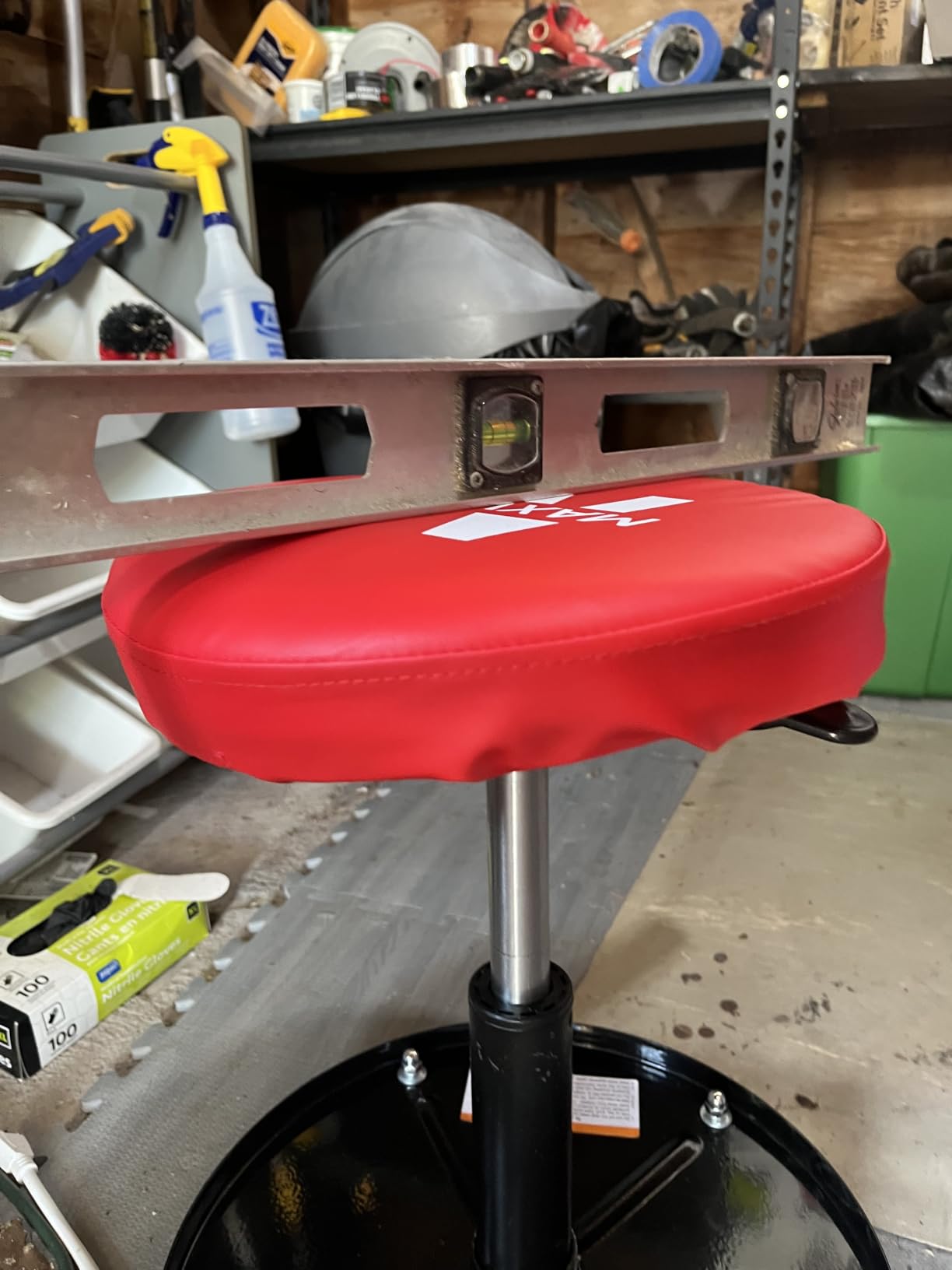
The base is a solid steel disc that doubles as a built-in 15-1/4 inch diameter tool tray, which gives the stool a low center of gravity and no separate frame to flex. The seat cushion is thickly padded for a roll of this price.
Owners rate it as sturdy and stable for users in the 200 to 275 lb range. The wheel diameter is where the money went elsewhere, and it is the reason to pay attention if your floor is anything other than smooth.
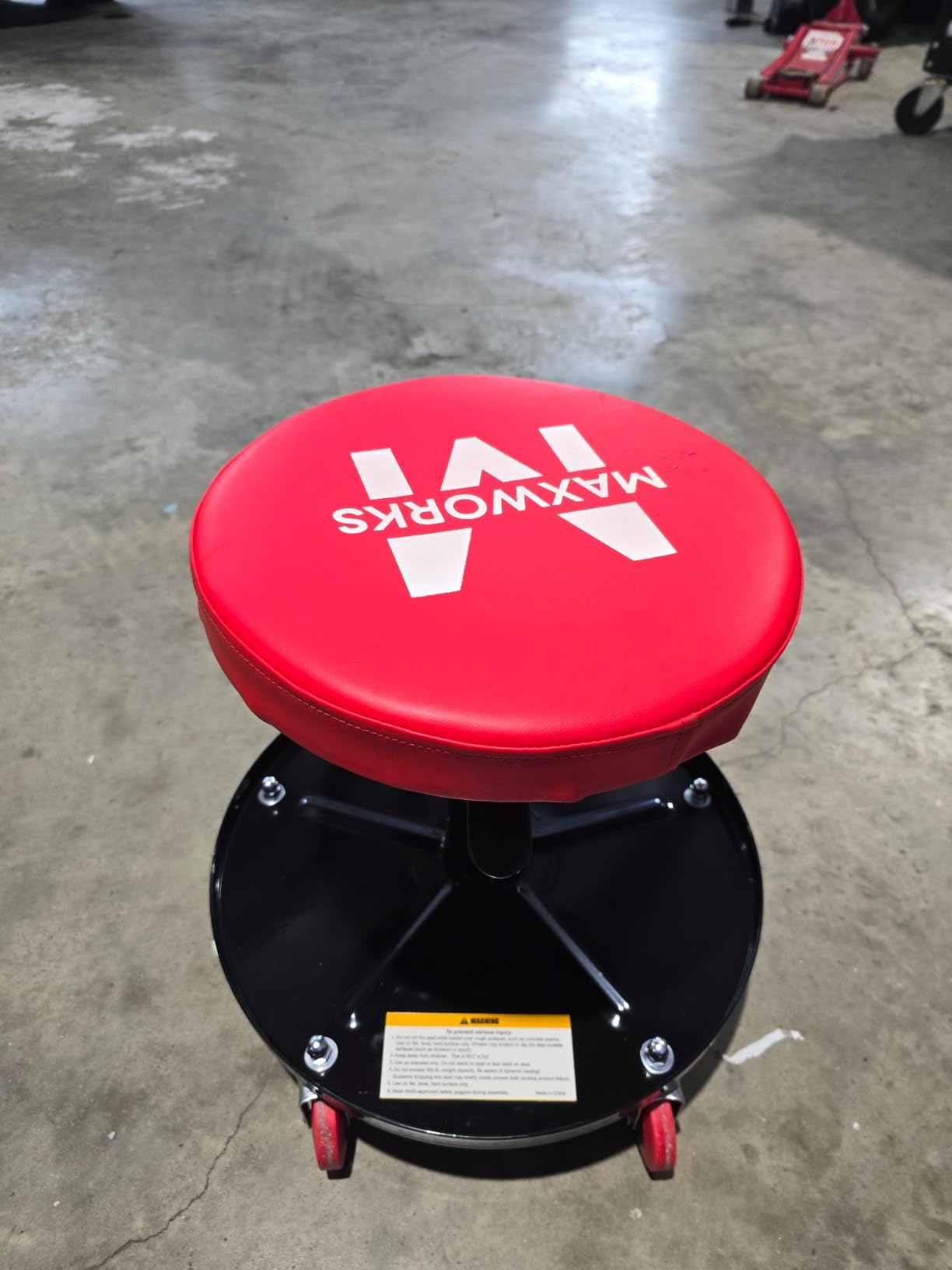
Small wheel, small floor problem
Two and a half inch casters glide beautifully on a smooth floor and catch on anything with a lip. If your garage has an expansion joint running through the parking spot, or a sealed crack you cross every time, expect to lift the stool over it rather than roll it.
Buyers on the forums make the same point independently: caster size decides whether a tool glides or fights you, and 2-1/2 inch wheels are at the bottom of the useful range for concrete.
What to check when it arrives
Before you press the seat down, confirm the pedestal is fully seated and locked. Push the seat firmly downward until you feel the stop, because a half-seated seat is the failure mode that shows up a week later.
Cycle the height lever through its full range under load, then check all five casters for free swivel and side play. If your floor is rough, a drop of grease on each swivel race takes a minute and keeps the stool quiet.
9. Performance Tool W85005 40 inch Padded Creeper – Lightest Steel Frame
Performance Tool W85005 40 in. 6-Caster Rolling Shop Creeper
40 inch padded deck
3-position headrest
6 x 2-1/2 in casters
10 lb
Pros
- Fully padded deck from headrest to foot
- Lever-action headrest adjusts to three positions
- Powder-coated tubular steel frame
- Lightest steel creeper here at 10 lb
Cons
- Fixed bench with no convertible seat option
- 2-1/2 inch casters are small for rough floors
- 41.5 inch footprint is awkward to store
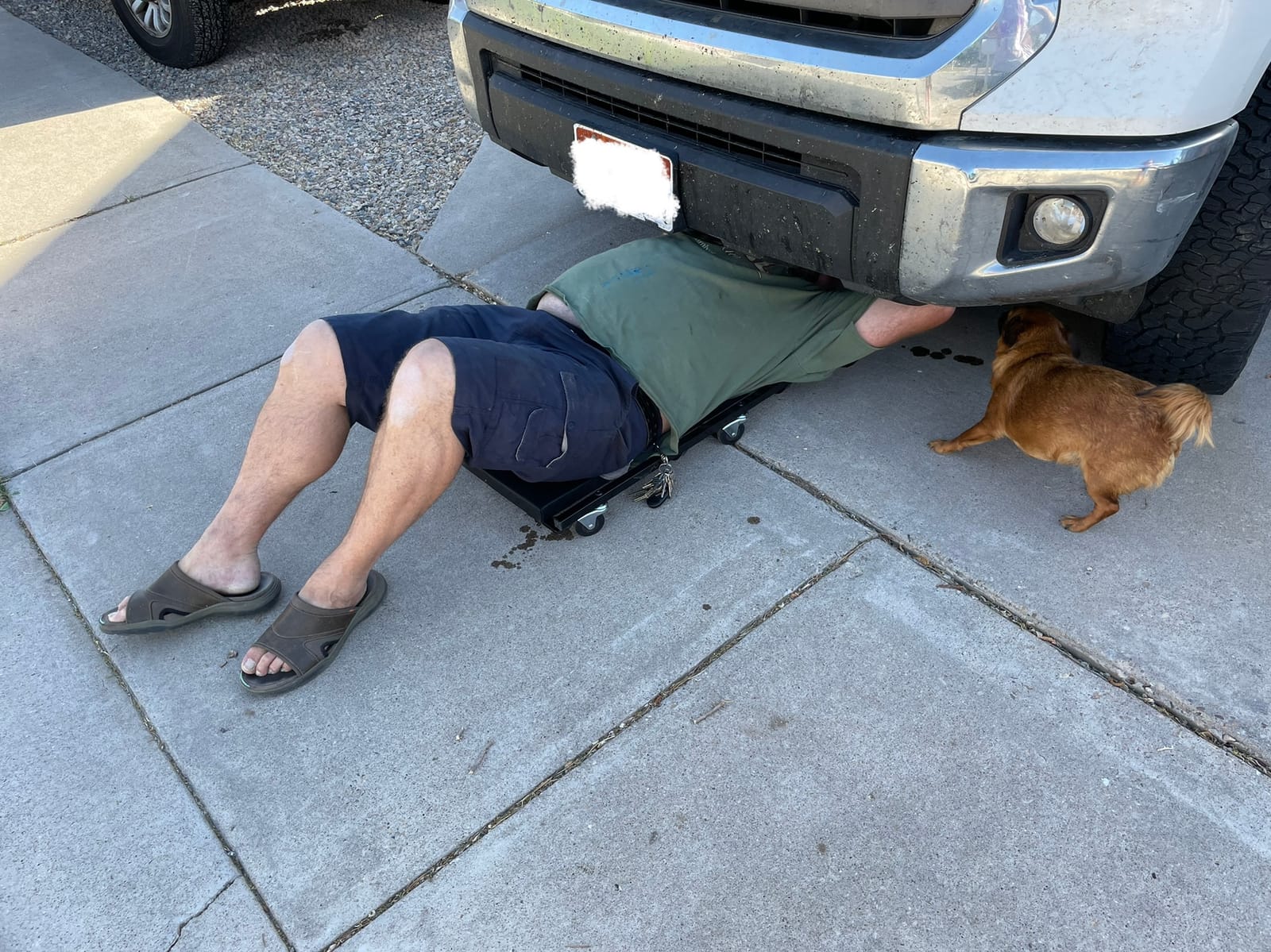
The Performance Tool W85005 is the simple version of a padded bench creeper done well: a 40 inch fully padded deck, a lever-action headrest with three positions, six shielded 2-1/2 inch swivel casters and a powder-coated tubular steel frame. It weighs 10 lb.
That three-position headrest is the feature we would point a taller user to. Owners highlight it because it changes where your head sits relative to your shoulders, which is what actually determines whether a 40 inch bench works for your frame.
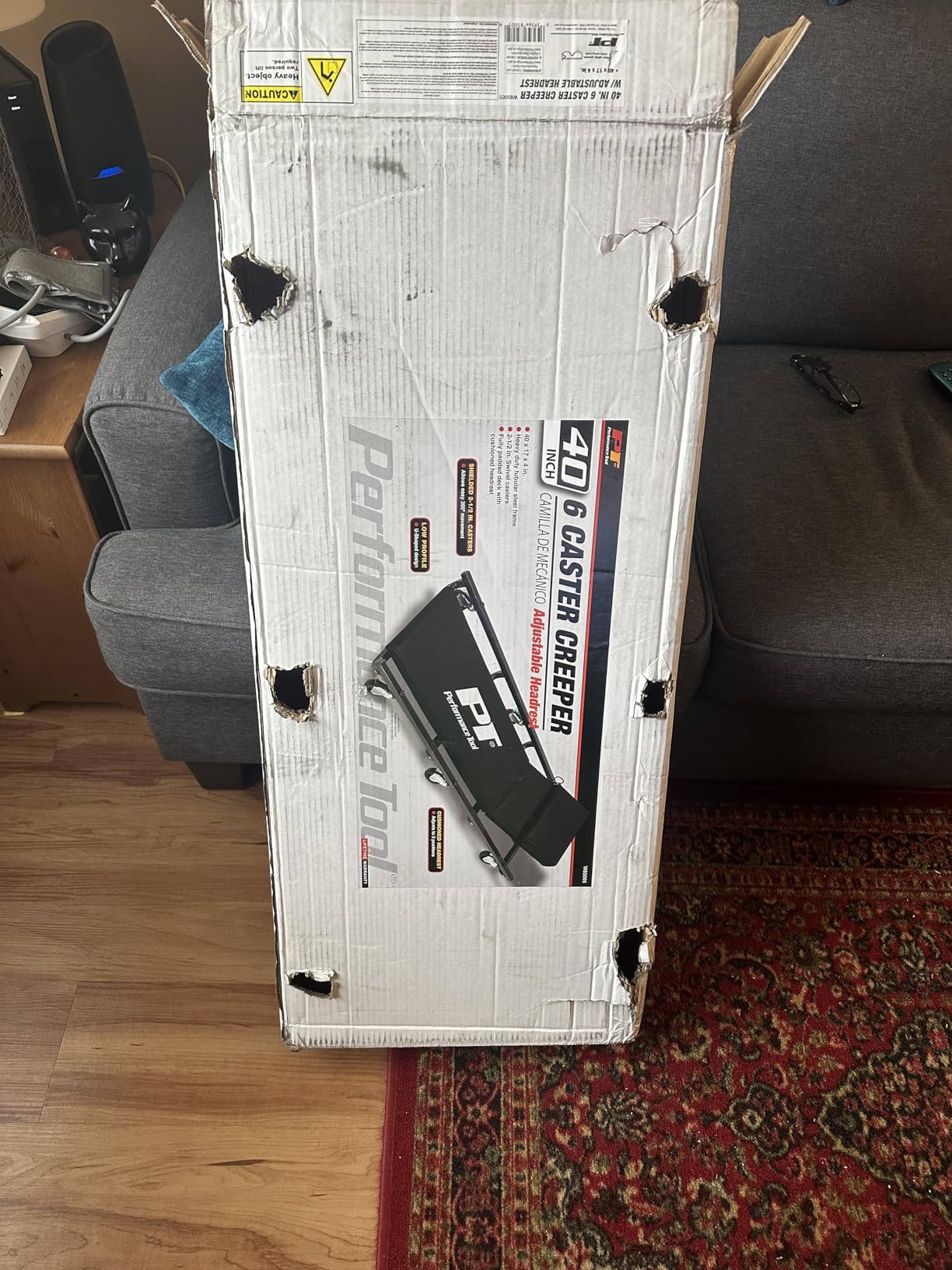
Dimensions are 41.5 by 17.5 by 4.2 inches. The 2-1/2 inch shielded casters give 360-degree movement, and the shielding is useful in a garage where grit and metal filings are the norm rather than the exception.
At 4.5 stars across roughly 1,200 ratings, the reviews are steady and unexcited, which is what you want from a bench. The full padding from headrest to foot is the most common point of praise.
When a simple bench beats a convertible
If you only ever work underneath vehicles, a fixed bench with continuous padding beats a convertible that folds in the middle. There is no hinge to creak, no pin to check before loading, and a wider usable surface for your shoulders and arms.
Storage is the catch. At 41.5 inches long, this is the widest footprint in the roundup, and folding does not apply. If your garage is a single bay with a shared wall, plan the hang location before the purchase.
What to check when it arrives
Check the caster shields are not bent inward, since a bent shield pinches the wheel and stops it dead. Roll the bench the length of your garage before loading it, and listen for a scrape.
Work the headrest lever through all three positions and confirm each one locks positively. Then check the powder coating at the welds for chips, because bare steel at a weld is where corrosion starts in a damp garage.
10. Lisle 97102 Low Profile Plastic Creeper – Best Low Profile
Lisle 97102 Black Low Profile Plastic Creeper
7/8 inch floor clearance
300 lb capacity
39 x 18 in body
11.1 lb
Pros
- Highest rated here at 4.8 stars
- Genuine 7/8 inch low profile that clears hoses and cords
- Ball-bearing urethane rollers pop in and out for replacement
- Lifetime warranty on the body
Cons
- Firm plastic deck with less cushioning than padded steel
- Wheels carry no warranty
- Top-tier price point of the group
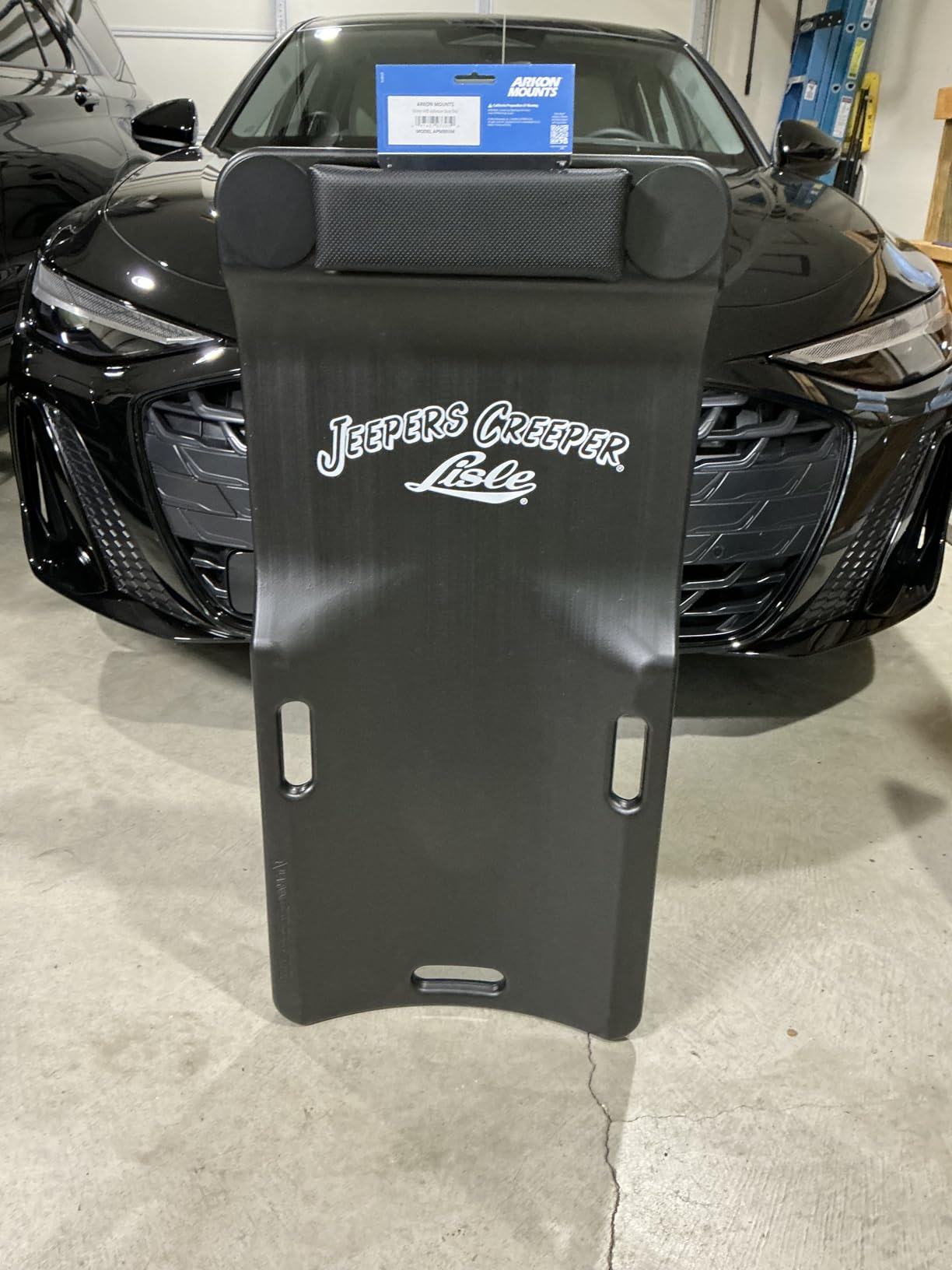
This is the one to buy when clearance is the deciding factor. The Lisle 97102 is a one-piece high-density polyethylene blow-molded body with a listed floor clearance of 7/8 inch, a 300 lb capacity and six 2 inch ball-bearing swivel urethane rollers.
Seven-eighths of an inch is a real number with a real use. Air hoses, extension cords, drain pans, a bicycle, the lip on a garage door track, a car lowered on springs in the next bay. Where other boards in this roundup need three inches of daylight, this one needs under one.
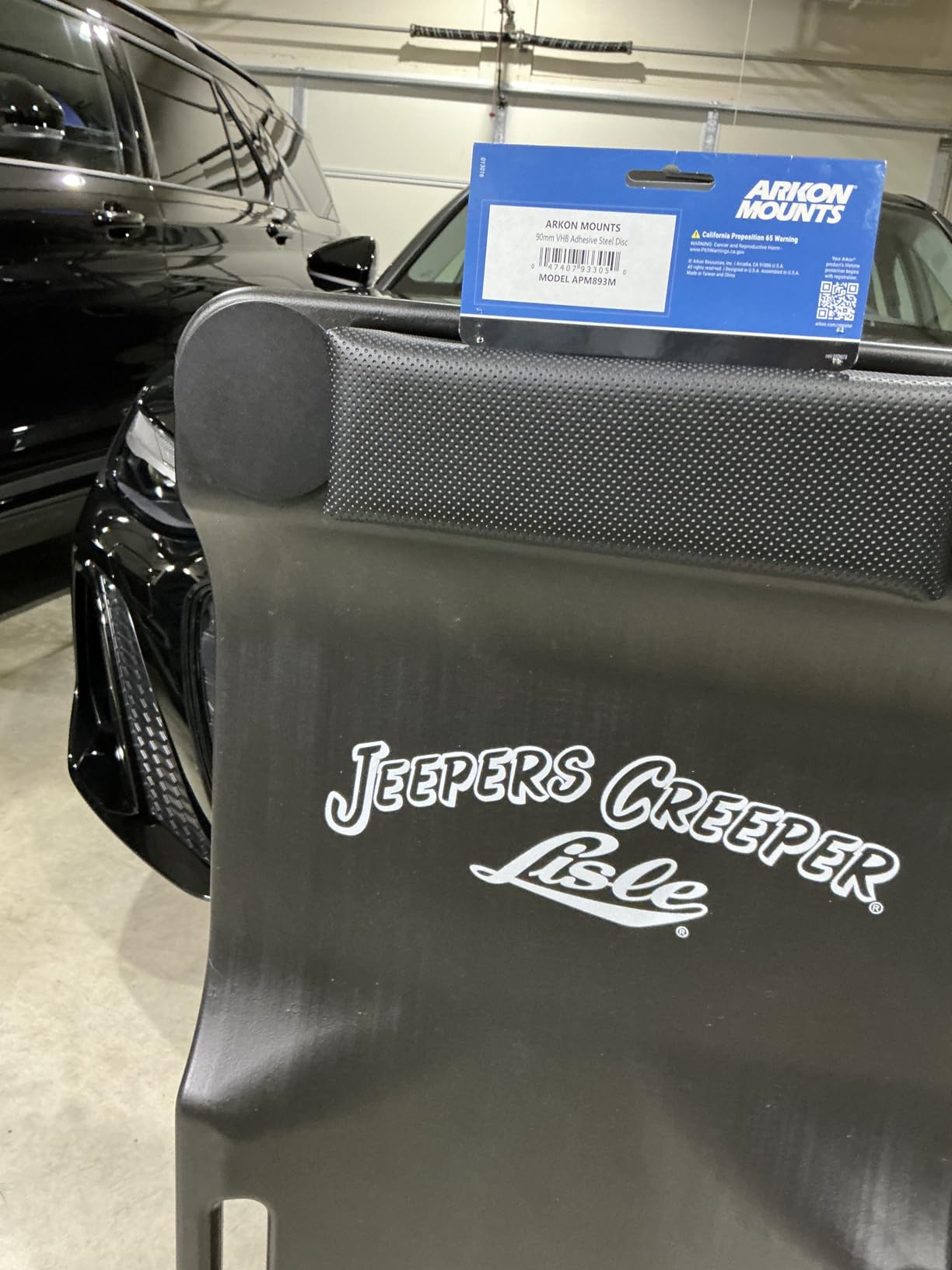
The shape is ergonomic rather than flat, with lumbar support and a padded, replaceable headrest. Total length is 38 inches at a width of 17.5 inches, and the body weighs 11.1 lb, which makes it one of the easiest boards here to carry to a driveway job.
The warranty structure is unusual and worth reading closely: lifetime on the body, and no warranty on the wheels. That is an honest split. The shell is the part that fails slowly, and the rollers are the part you will replace eventually anyway.
Why the 2 inch rollers are not a problem here
The general advice is that 2 inch casters struggle on rough concrete, and that is true. On this board the rollers are ball-bearing urethane, and they pop in and out of the body without tools, so replacing them takes seconds rather than a teardown.
That replaceability changes the calculation completely. Instead of accepting a weak wheel forever, you buy a set of ball-bearing rollers once and the issue is closed. The surface is also described as resistant to solvents, greases and fuels, which matters more than it sounds on a board that lives under a car.
What to check when it arrives
Check that all six rollers are present and seated in their sockets. A missing roller is the single most common complaint across plastic creepers in general, and it is obvious in the first thirty seconds if you count.
Then check the body itself for cracks around the caster sockets and the headrest mount, and confirm the padded headrest locks into position. The body carries a lifetime warranty, so anything structural is worth documenting with photos on arrival.
How to Choose a Garage Creeper for Your Home Garage ?
Every pick above works. The wrong one for your garage wastes money and, more importantly, leaves the job undone because the tool fought you the whole time. These are the five decisions that actually change the outcome.
Fixed board, folding Z, or convertible seat
A fixed plastic board is the simplest and cheapest answer: a one-piece molded shell that slides in and out. It is light, low, and it nests against a wall. It is also the least comfortable for long sessions because there is no padding and no shape.
A folding Z-creeper adds a steel frame, a hinge and a seat. You get structure, a place to put tools, and a second mode. The cost is bulk and a taller profile in the flat position.
A convertible 2-in-1 adds a second function: the same unit becomes a rolling seat. For a home garage this is often the deciding factor, because owners report using the seat mode as much as the flat mode. If your work is half under the car and half above it, the convertible wins on paper and in practice.
Caster size versus your floor
Caster diameter is the most underrated number in this whole category, and forum owners consistently say the same thing: wheel size decides whether the tool glides or fights you.
Two inch rollers give the lowest floor clearance and the least ability to cross anything uneven. Three inch multi-terrain casters roll over gravel, dirt and cracked concrete far more easily. Four inch rubber casters are quiet and floor-safe. Five inch casters glide over almost anything, at the cost of height.
For a typical residential garage with a sealed or cracked concrete floor, 3 inch is the sweet spot. On a smooth epoxy floor, 2 inch is fine and gets you lower. If your floor is patched, oil-stained or uneven, spend the height on a 3 inch caster board.
Sizing the deck to your body
This is where most early purchases go wrong, and it has nothing to do with your car. It is you. A 36 inch deck with a 300 lb rating leaves a tall or heavy user curled, feet off the end, and that is the failure mode named repeatedly in the forums. One Garage Journal thread is literally a request from a six foot five, 260 lb owner asking for a longer deck.
Under about five foot ten and under 200 lb, a 36 inch deck is comfortable. Between five ten and six two, go to 40 inches. Above six two, or if you carry a lot of tools with you, look for 40 to 48 inch decks and a model family that offers the length. The M-AUTO in this list is the one that comes in 36, 40 and 48 inch versions.
Capacity is your body weight plus your tools
Add it up before you buy. Your body weight, plus a socket set, plus a toolbox, plus a drain pan, plus the odd removed part you set down on the deck. A 300 lb board under a 200 lb user with a full toolbox is already loaded well past half its rating.
Pick a rating with at least 50 lb of margin over that total. The 350 lb HDPE board and the 330 lb Z-creeper in this roundup are the two to look at if you are 250 lb or more. The 250 lb stools are honest tools, but they leave no room for a heavy user plus a full load.
Storage in a single-car garage
Measure before you order, and measure the folded size rather than the deployed one. A 40 inch steel bench that stands on end against a wall is very different from the same bench laid flat across the only free patch of floor you have.
Priorities in order: a folding or convertible design, a plastic board light enough to lift one-handed onto a shelf, and a stool under 16 inch tall. Keep a clear path between the door and the car; the tool you cannot get past the car is the tool you will not use.
Your five minute on-arrival inspection
No competitor publishes this, and the customer reviews explain why it is worth doing. Caster failure, missing wheels and mis-drilled frames are the three most common complaints in this category, and all three are visible before the tool is ever loaded.
Count the casters. Every pick here ships with four, five or six, and a missing or substituted wheel is the most common defect in the box.
Spin each caster by hand. It should roll freely with no side play and no grinding, and the swivel should move without resistance.
Push the tool across the floor. A scrape in one direction means a bent caster plate or an out-of-square mounting hole.
Check frame holes and welds for alignment. Mis-drilled holes show up as a frame that will not sit flat or bolt up without force.
Confirm the hardware is the correct finish and thread size, and that the original bolts are present rather than aftermarket substitutes.
Test the conversion pin or headrest lever through its full range and confirm each position locks.
Photograph everything before assembly. Shipping damage and QC issues are only arguable with a timestamp.
How to replace and grease casters
Casters are a consumable, and treating them that way is cheaper than replacing a creeper. Long-term owners recommend greasing the casters out of the box and keeping a spare set, and that advice applies to every pick in this roundup except the Lisle, whose rollers pop out without tools.
Flip the creeper over and note the caster type: threaded stem, bolt-on plate, or the pop-in style used on replacement roller creepers.
For bolt-on casters, remove the four bolts supporting the caster, not the bolts locking the swivel race, so the swivel keeps its grease seal.
For pop-in rollers on a molded plastic body, press and twist the roller out of its socket; replacement rollers of the same diameter drop straight in.
Match the replacement on diameter first, then on mounting style, then on capacity. Mounting height changes the deck height, which changes your floor clearance.
Fit the new caster, spin it, and push the tool across the floor to confirm nothing now scrapes.
Add a light film of grease to the swivel race and wipe the wheel surface clean so it does not pick up grit.
Price tiers without the marketing
Three tiers cover essentially the whole category, and where you sit in them is a decision about how often the tool will be used.
Budget: simple plastic boards, single-brand folding steel creepers and basic pneumatic stools. Fine for a first creeper and a car you maintain occasionally. Check every caster and bolt on arrival, because QC is the variable here.
Mid: this roundup lives here. Convertible Z-creepers, HDPE boards with large multi-terrain casters, padded steel benches. This is the tier that suits someone who works on vehicles most weekends.
Premium: the low-profile specialist boards with lifetime body warranties and replaceable rollers, plus the stools built for daily professional use. Worth it when you need the clearance, the capacity, or you are using the tool every day. Not worth buying because a listing says heavy duty without naming a pound rating.
Pro-shop creeper garage kits and multi-piece tool carts sit above all three and cost several times more. For a home garage with one car, we would not buy one, and this is the clearest example of a case where the premium model is the wrong call.
Frequently Asked Questions
What is the best creeper for mechanics?
For a home garage, the best creeper is a convertible Z-creeper rated 300 to 350 pounds with 3-inch swivel casters, or a low-profile plastic creeper with 7/8-inch clearance if the car sits low. Match the deck length to your height first, then your body weight plus tools against the capacity. A padded fixed bench wins for long brake and exhaust jobs; a pneumatic stool wins for engine bay and interior work.
What is the best roller seat for a mechanic?
The best roller seat is a pneumatic model with a wide wheelbase and 4-inch or larger casters, because a narrow base tips when you lean forward under a dashboard. Look for a segmented or divided tool tray and a 300-pound capacity if you are around that weight. The Torin TR6350 and WEN 73012T are the two we rate highest in this group.
Are mechanic creepers comfortable?
Comfort comes from padding, deck length and shape rather than from the label. A fully padded steel bench is the most comfortable for long sessions, a convertible Z-creeper is next, and a bare blow-molded plastic board is the least comfortable. Deck length matters as much as padding: a 40-inch deck supports a taller body far better than a 36-inch one.
How do I replace creeper casters?
Flip the creeper over and identify the caster style. On bolt-on casters, remove the caster bolts and keep the swivel race intact so the grease seal survives. On pop-in roller creepers, press and twist the roller out of its socket and press the replacement in. Match replacements on diameter, mounting style and capacity, then check the deck height and floor clearance are unchanged.
What are people saying about the Magic Creeper mat?
A zero-clearance mat like the Magic Creeper slides on body oil with no wheels at all, which is its entire appeal: no casters to jam and no height to clear. Owners like it for detailing and inspection work. The honest caveat is that it gives you no load rating, no tool storage and no way to move around under a car, so it works alongside a creeper rather than replacing one.
Which Harbor Freight creeper is the best?
Within the budget tier, the Harbor Freight Icon 400-pound model is the stronger of the two commonly recommended listings, with a 4.5 rating from about 519 reviews, against the Daytona 350-pound model at 4.7 from about 469. Judge by whether the listing states a specific pound capacity and caster diameter. Listings that only say heavy duty tend to score lower, and the Pittsburgh 300-pound board sits at 3.7 from more than 1,600 reviews.
How much weight should a mechanic creeper hold?
Add your body weight, your tools, a drain pan and any parts resting on the deck, then buy a rating with at least 50 pounds of margin over that number. Most home users land between 250 and 450 pounds total, which is why 300-pound boards suit a 200-pound user with a modest toolkit. Anyone over 250 pounds should look at 330 to 350 pound models rather than a 250-pound steel bench.
Do creeper casters wear out?
Yes, and they usually wear out before the frame does. Caster bearing failure, casters cracking and wheels falling out of their mounts are the most common complaints in this category. Grease the swivel races out of the box, keep a spare set of the same diameter, and inspect every caster on arrival because that catches missing or mis-fitted wheels before the first job.
One more tool belongs on the same shelf. Whatever creeper you choose, a pair of properly rated jack stands is what actually supports the vehicle, and the caster style and capacity ratings on these boards assume you are working on stands, not on the creeper. Our floor jack guide covers matching a jack to a vehicle, and garage heater picks matter more than most people expect if you are doing winter jobs in an unheated bay.
The Best Garage Creepers for Home Mechanics in 2026
Ten tools, four different jobs. That is the honest summary of this roundup, and it is why picking a single winner for everything would be a mistake.
Buy the Pro-LifT C-2036DG if you want one tool that covers undercar work and topside work and folds flat against the wall. It has the deepest proven track record of the ten, with close to 28k ratings, and the one weak point, the supplied casters, is a part you can replace for pennies.
Buy the Lisle 97102 if your car sits low. A genuine 7/8 inch of floor clearance solves a problem no other pick here solves, and its rollers pop out without tools, which also makes the low caster diameter a non-issue.
Buy the Pro-LifT PL9400 if you are tall or heavy. A 40 inch deck and a 350 lb rating fix the sizing failure that sends people back to the store, and its 3 inch multi-terrain casters handle a cracked concrete floor that 2 inch rollers will not.
Buy the M-AUTO 36 inch Z creeper if budget is the deciding factor and your use is weekend rather than daily. Take the 40 inch version if you are near six feet, because the length options cost nothing to choose up front.
And buy a stool. The WEN 73012T, Torin TR6350, VEVOR or MaxWorks will cover everything above the rocker panel, and any of them stores in a corner the size of a wastebasket. Whichever you pick, count the casters, spin them, and push the tool across the floor before you ever take it under a car.