
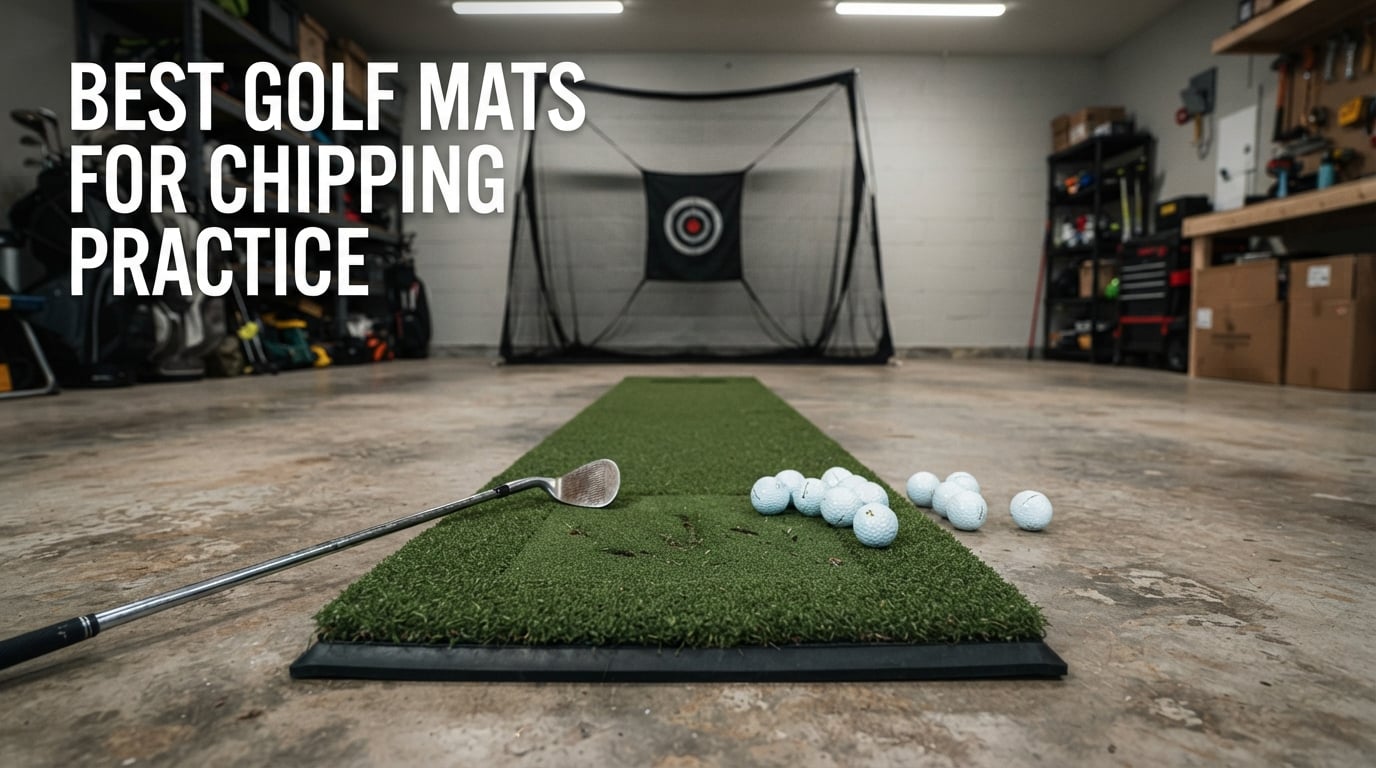
If you have scrolled past the first ten results for the best golf mats for chipping practice, you will have noticed something. Almost none of them mention the complaint that actually decides this purchase. A thick foam mat can grab the club face on a low shot and slow it down enough that you start building a stroke that is far more punitive than anything you would hit on grass.
That exact problem is the headline of a long-running thread on r/Golfsimulator, where one golfer describes a 3 by 5 foot mat roughly 1.5 inches thick that slows the club 15 to 20 percent and is, in their words, far more punitive than hitting off grass. What he wanted was a mat with little or no grab, but enough cushion to be easy on the hands and joints. That combination is what we spent this roundup trying to find.
We compared ten golf mats for chipping practice across size, turf type, base material, thickness and portability. We weighted stability and turf realism most heavily, because those two specs decide whether a session builds a repeatable strike or just builds frustration. Our best overall pick is the GoSports Elite Golf Mat, which pairs a 5 by 4 foot footprint with a 15mm EVA foam base and a non-slip backing that holds on concrete. The best value pick is the CHAMPKEY Synthetic Turf Golf Mat, a 13 by 17 inch strip that fits in a golf bag and stores flat against a wall.
Everything in this guide is aimed at chipping rather than driver bombs. If you are building a full swing bay, most of the large mats here will suit you too, but sizing and grab matter far less for short shots than they do for a full-speed swing. If you are pairing a mat with a launch monitor setup, start with our home golf simulator picks so the footprint matches your bay before you buy the turf.
Table of Contents
Top 3 Best Golf Mats for Chipping Practice Worth Your Money


COSPOPTIC Feedback Golf Mat
- Swing path traces
- Spare velvet surface
- Weighted rubber base
- 16x12 in
Best Golf Mats for Chipping Practice in 2026: Quick Overview
| Product | Specifications | Action |
|---|---|---|
| GoSports Elite Golf Hitting Mat |
|
Check Latest Price |
 CHAMPKEY Synthetic Turf Golf Mat CHAMPKEY Synthetic Turf Golf Mat |
|
Check Latest Price |
| COSPOPTIC Golf Mat with Feedback |
|
Check Latest Price |
 GoSports Tri-Turf XL Golf Mat GoSports Tri-Turf XL Golf Mat |
|
Check Latest Price |
 SAPLIZE Foldable Golf Hitting Mat SAPLIZE Foldable Golf Hitting Mat |
|
Check Latest Price |
 Bltend Golf Mat 36mm Bltend Golf Mat 36mm |
|
Check Latest Price |
 Ywitio Premium Dual-Turf Golf Mat Ywitio Premium Dual-Turf Golf Mat |
|
Check Latest Price |
 Golfguru Golf Mat 5×4 ft Golfguru Golf Mat 5×4 ft |
|
Check Latest Price |
 JAYA Golf Mat with Ball Tray JAYA Golf Mat with Ball Tray |
|
Check Latest Price |
 LYDARZ 3-in-1 Golf Practice Mat LYDARZ 3-in-1 Golf Practice Mat |
|
Check Latest Price |
What Makes a Good Golf Mat for Chipping Practice
A good golf mat for chipping practice is a flat, layered surface, usually synthetic turf over an EVA foam or rubber base, built for short wedge shots rather than full driver swings. The turf pile gives you a lie to react to, and the foam underneath absorbs impact so the club never strikes hard ground.
Three specs do most of the work. Base stability keeps the mat planted on concrete or tile so your stance stays honest. Turf density decides whether the ball feels like it is rolling on grass or off carpet. Thickness decides how the club interacts with the surface on low shots, which is where grab either helps or hurts.
1. GoSports Elite Golf Hitting Mat – Best Overall for Chipping
GoSports Golf Hitting Mat – Elite 5 x 4 ft – 15 mm Artificial Turf Training Mat for Indoor/Outdoor Swing Practice, Includes 3 Rubber Tees
5x4 ft
15mm EVA foam base
Commercial-grade turf
6 tee holes
Pros
- Realistic fairway feel and ball feedback
- 15mm foam takes the sting out of fat shots
- Holds up to thousands of shots
- Leaves no green residue on clubs
- Non-slip backing works on concrete or grass
Cons
- Arrives folded with a centre crease that takes days to flatten
- Crease can persist and sink the middle strip
- Heaviest option in this group
The GoSports Elite is the mat we keep coming back to because it solves the two problems that ruin at-home chipping at the same time: a base that stays planted and a foam layer thick enough to take the edge off a mishit. The 15mm EVA base is the reason joint-friendly reviews show up so often with this mat, and the 5 by 4 foot footprint means you can stand on it with the ball at your feet rather than in front of a short strip.
Owners report long service lives. The recurring pattern across reviews is thousands of shots with almost no visible wear, and the turf compresses slightly under use but rebounds when you rotate it. That rebound behaviour matters more than people expect, because it means the mat keeps giving you the same lie instead of quietly turning into a dented carpet.
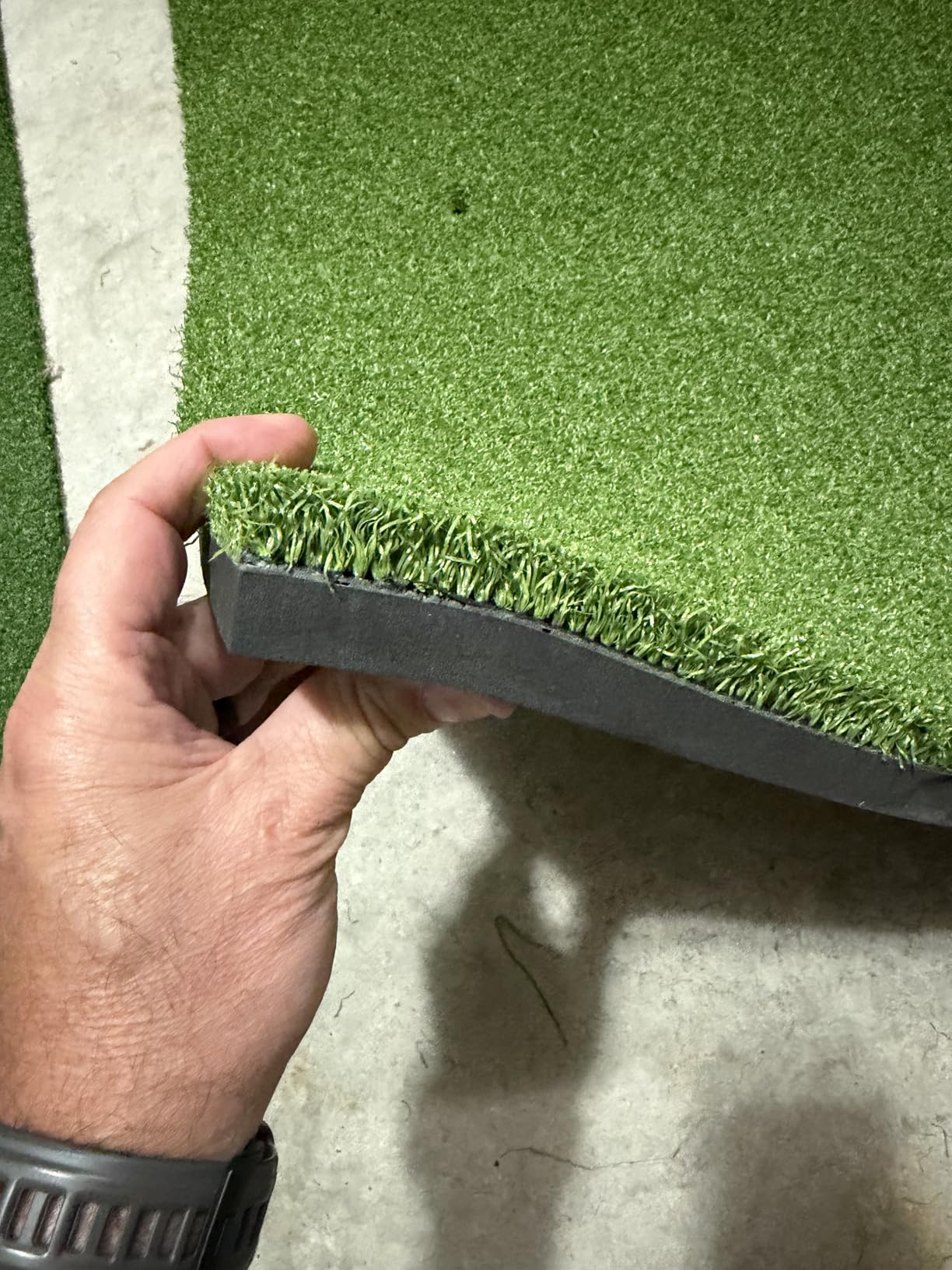
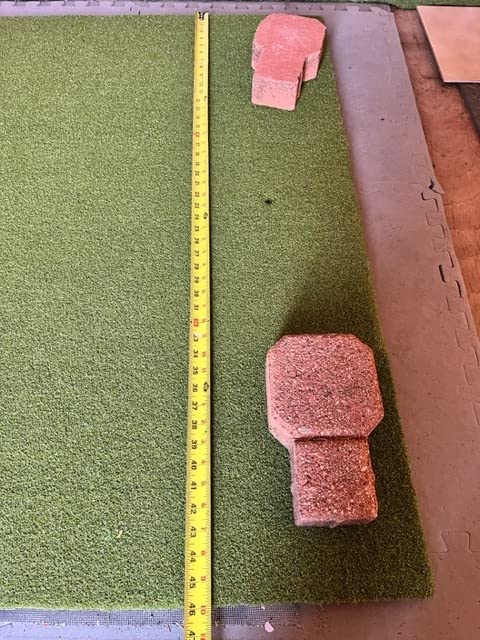
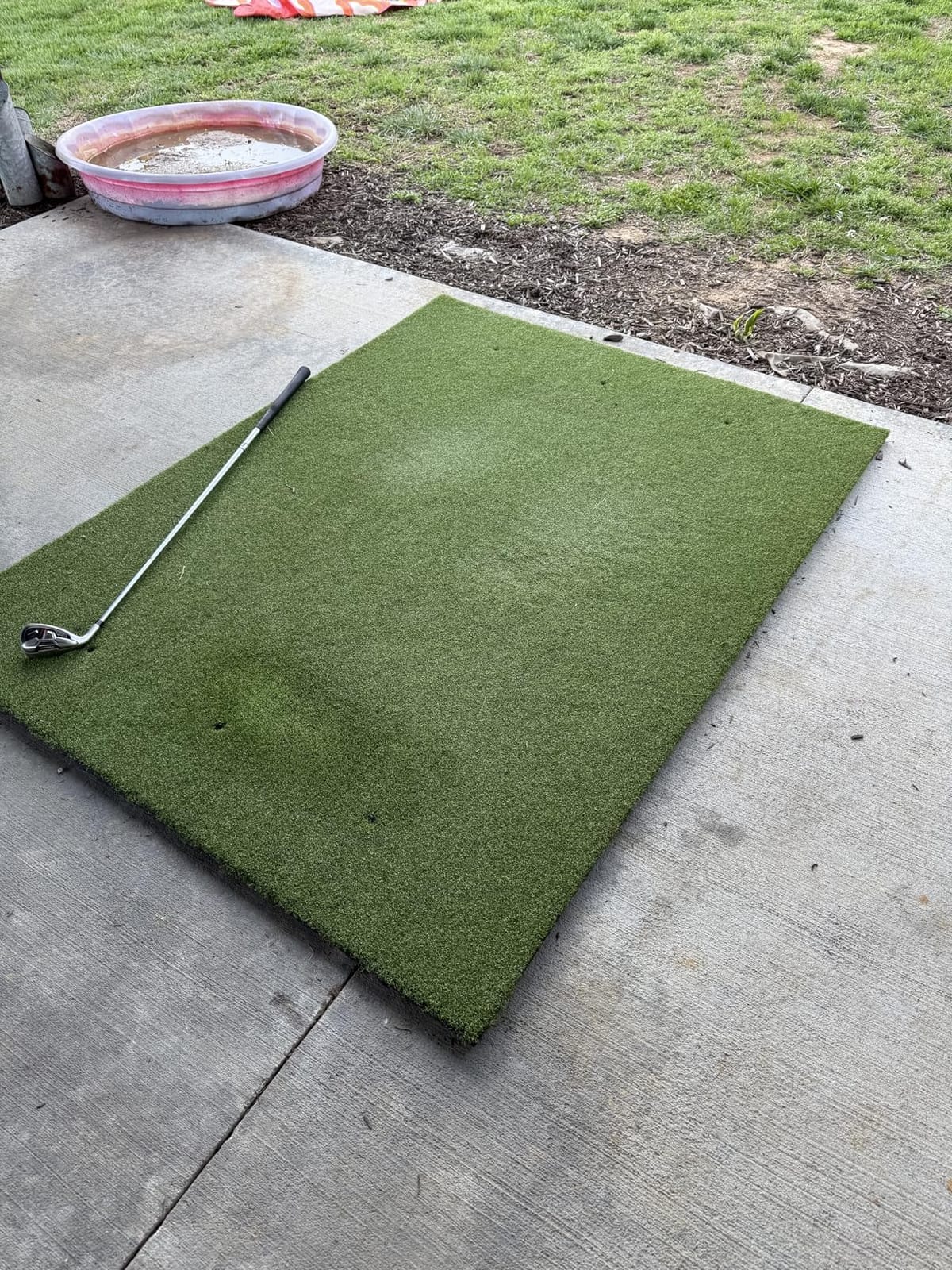
Technically it is a 60 by 48 inch mat at 0.59 inch thick, weighing 11.48 kg, with six integrated tee holes and three rubber tees in 1.5, 2.25 and 3.5 inch lengths. For chipping work the tees are mostly irrelevant, which is fine, because the surface is the reason to buy it. The turf is described as commercial-grade synthetic, and reviewers consistently compare its feedback favourably to grass.
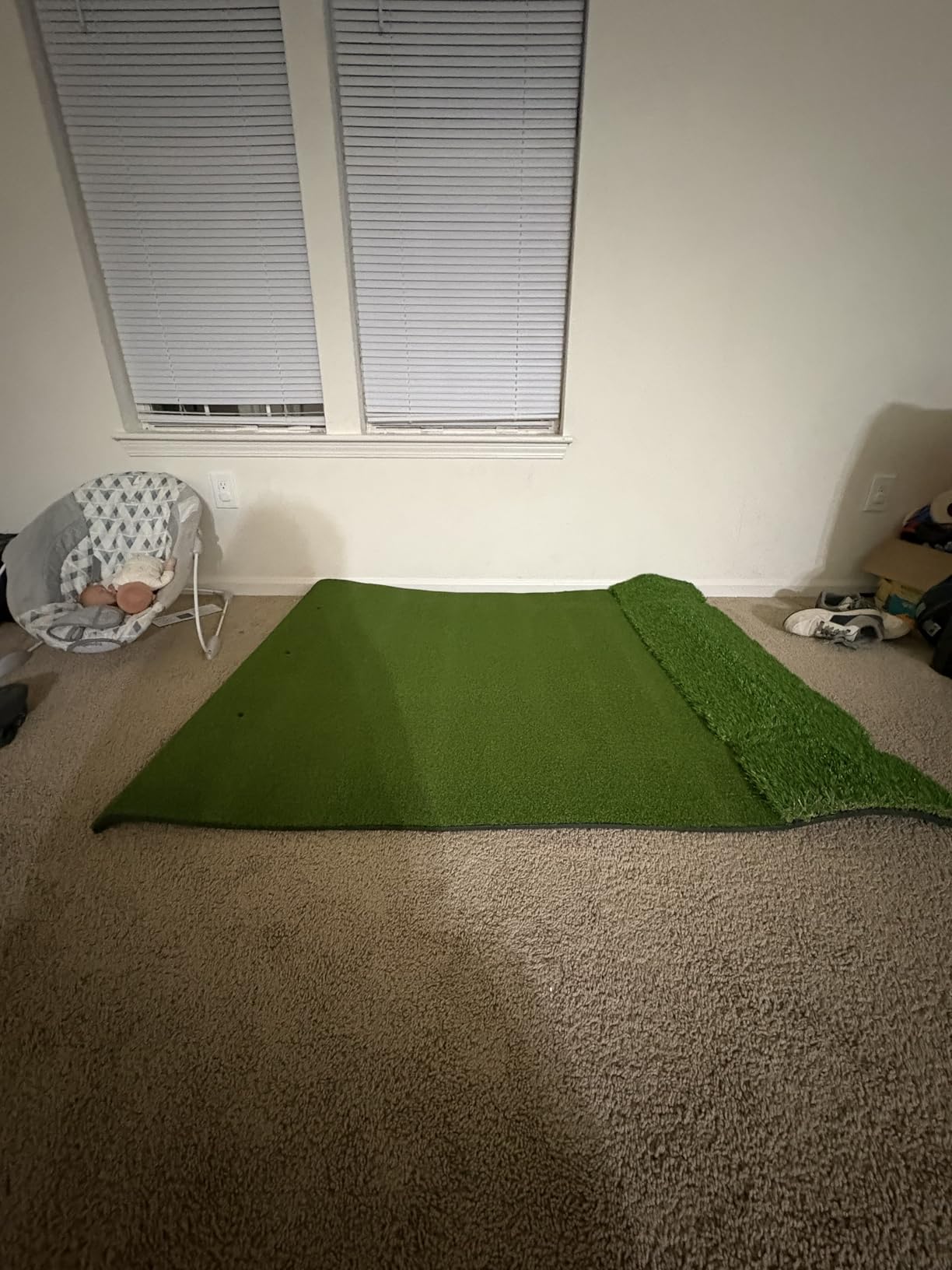
There is one genuine complaint and it shows up often enough that you should plan around it. The mat ships folded in half, and the centre crease can take several days under weights before it lies truly flat. Some buyers report the crease never fully disappears, and that the centre strip sinks more than the edges, which means your ball can behave slightly differently down the middle than out near the perimeter.
What to check before you buy it
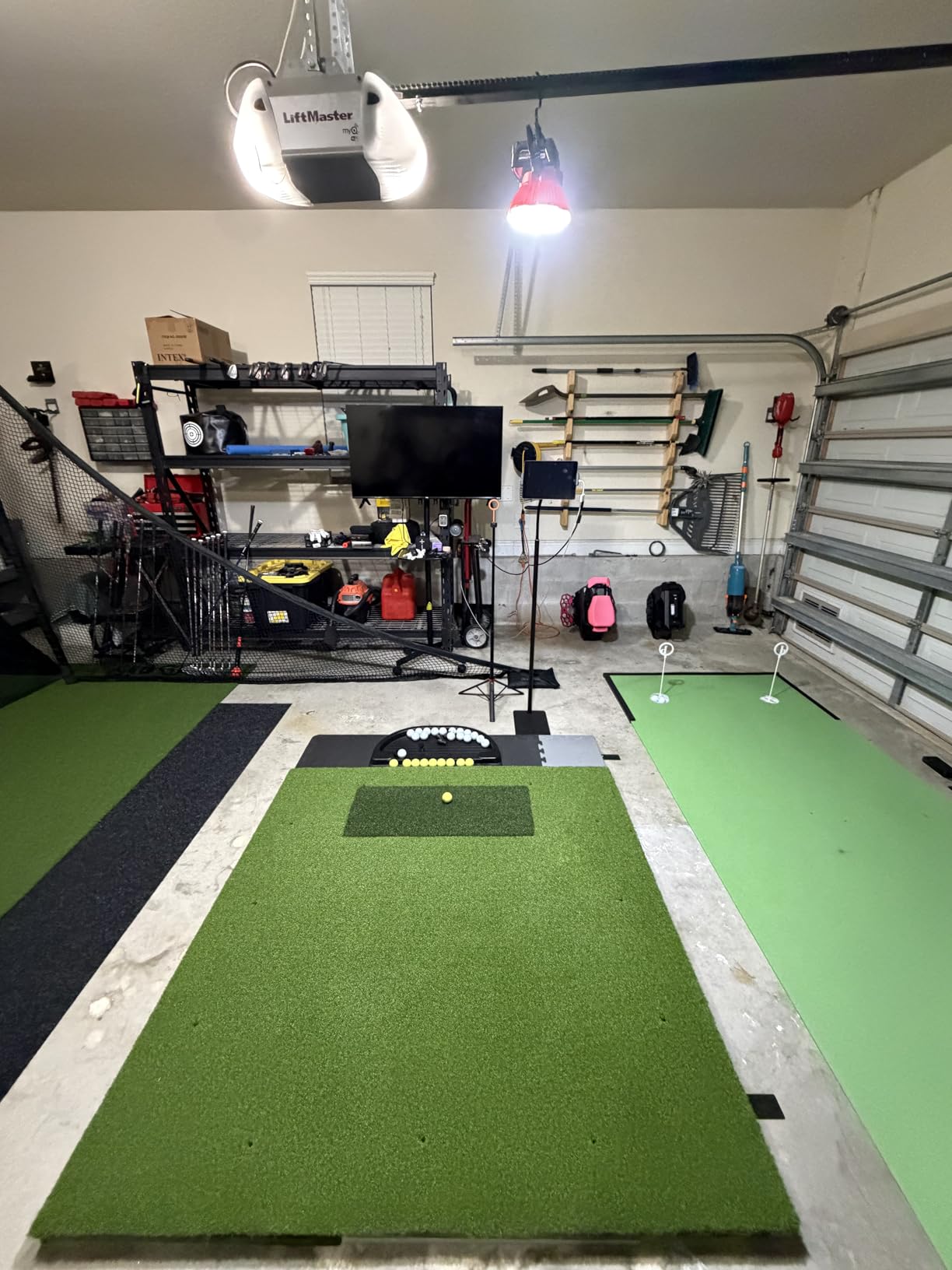
Make sure you have floor space for a 5 by 4 foot mat and somewhere to store it flat or rolled without the crease being crushed further. If your practice area is a carpeted spare room rather than a garage, the non-slip backing still works, but you will get more from this mat on a hard floor where the foam has something to absorb against.
Buyers who like it most tend to be the ones hitting repeated wedges over months rather than taking an occasional full swing. The turf reward comes from volume, so if you are going to put in 200 chips a week, this is the mat that keeps giving.
Where it falls short
At 11.48 kg it is not a mat you carry to the park, and it is the heaviest item we tested. If you have elbow or wrist history and you want the absolute softest possible feel, a thinner mat with a softer face can feel kinder, though you trade away ball response and durability for it.
It is also not a dual-turf mat. You get one consistent surface, which is good for repeatable chipping reps but means you cannot rehearse the same shot from a rough lie and a fairway lie without a second mat.
2. CHAMPKEY Synthetic Turf Golf Mat – Best Value Pick
CHAMPKEY Premium Synthetic Turf Golf Hitting Mat | Heavy Duty Rubber Base Golf Practice Mat | Come with 1 Rubber Tee and 9 Plastic Tees(Green,13″ x 17″)
13x17 in
16mm turf
Rubber non-slip base
Foldable
Pros
- Weighs almost nothing and fits a golf bag
- Rubber base stays put and absorbs shock
- 16mm turf gives a fairway feel for short shots
- Nine plastic tees plus a rubber tee holder
Cons
- Too small for full swings or driver
- Thin profile gives less joint protection than thick foam
- Turf wears faster under heavy use
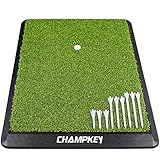
The CHAMPKEY mat is the answer when you want chipping reps and nothing else. It is a 13 by 17 inch strip weighing 90.72 grams, which means it lives in the side pocket of a golf bag and travels to the office, the patio or a friends yard without any planning at all.
What you get underneath is a non-slip rubber backing that absorbs shock and does not mark hard floors, topped with 16mm of turf meant to simulate a fairway or tee box. For knockdown shots and short pitch rehearsals, that surface is entirely adequate, and the felt-like feedback surprises people who expect a mat this small to feel like carpet.
For scale, the mat is 0.63 inch thick at 17 inches long and 13 inches wide. That profile is thin next to the 36mm builds in this roundup, so it does less to soften a fat shot, but for chipping where contact quality matters more than impact absorption, thin is often the more honest feel.
Where it earns its place
If your practice time is fragmented, portability beats surface area. A mat you can grab on the way out the door gets used; a large mat in the garage gets used after dark in February. The lightweight build and low profile here make it the easiest habit-forming option in the guide.
It is also the mat to buy if you want to practise indoors in a rental or a small flat. The rubber base grips laminate and tile and will not scuff the floor, which matters more than turf realism when the surface underneath belongs to someone else.
Where it falls short
Thirteen by seventeen inches is a chipping area, full stop. You cannot take a driver swing on it, and even a long iron would put you on one foot. Anyone whose goal includes distance practice should skip straight to a 5 by 4 foot model.
The 16mm turf also wears faster than a thicker build when you hit heavy shots into the same spot. Rotate it occasionally and it will outlast your enthusiasm, but treat it as a short-game tool rather than a long-term surface.
3. COSPOPTIC Golf Mat with Swing Path Feedback – Best for Travel and Feedback
COSPOPTIC Golf Hitting Mat with Swing Path Feedback, Heavy-Duty Rubber Base Anti-Slip Golf Training Mat, Extra Replaceable Surface, Portable Practice Mat for Home Office Garage Yard Indoor Outdoor
16x12 in
1.5 inch thick
Rubber non-slip base
Spare velvet surface
Pros
- Swing path traces show contact point without video
- Spare velvet surface refreshes a worn face
- Light enough to carry anywhere
- Weighed rubber base grips hard floors
Cons
- Velvet surface is fragile under steep swings
- Too small for full swings
- Only a one month warranty
The COSPOPTIC mat does something the other budget options do not: it tells you where you struck the ball. The impact surface leaves a visible trace of the swing path, so you can read toe, centre or heel contact without filming a single swing or owning a launch monitor.
That is genuinely useful for chipping, because most mishits around the green are contact errors and the feedback is immediate. It sits at 1.5 inches thick on a 16 by 12 inch footprint, weighs 2.5 ounces, and ships with a spare replaceable velvet surface that is meant to extend the life of the main face and reduce club wear.
Reviewers consistently find the trace feature instructive and report that it helps correct habits quickly rather than gradually. The construction quality is the weak point: several owners report peeling or visible damage after a short or steep swing, and the felt face is not built to absorb mishits indefinitely.
What to check before you buy it
Plan on swapping to the spare surface as soon as the first one wears, and use a controlled chip rather than a full swing to protect it. The base is a textured rubber that grips hardwood, concrete, carpet and garage floors, so you are not restricted to a single surface type.
It ranks near the top of the golf hitting mat category on review volume for this kind of money, which is why it appears so high despite the small footprint. For a practice aid aimed at contact position rather than distance, the footprint is not really a limitation.
Where it falls short
A one month warranty is short, and the velvet surface is the first thing to go. If you have a tendency to dig at the ball on mishits, expect to burn through both faces faster than you would a turf mat with a nylon or polypropylene surface.
It also tells you very little about distance or spin, because the small surface gives the ball almost no room to run out. Treat it as a contact trainer you can carry anywhere, not as a chipping surface that will sharpen your pace control.
4. GoSports Tri-Turf XL Golf Mat – Best for Practising Different Lies
GoSports Tri-Turf XL Golf Hitting Mat – 24×24 in Golf Practice Mat for Indoor/Outdoor Training, Fairway Rough Tee Turf, Portable Golf Mat for Backyard, Garage & Golf Simulator Use
24x24 in
Three turf zones
Rubber base
Foldable
Pros
- Fairway rough and tee zones on one mat
- 24x24 in gives a comfortable full stance
- Rubber base protects grass from divots
- Folds for easy storage
Cons
- Smaller footprint than the 5x4 ft mats
- Artificial grass feels thinner than premium turf
The Tri-Turf XL is the pick if the reason you want a mat is to rehearse the same shot from different lies. It carries three separate turf zones, fairway, rough and tee, so you can hit an identical chip off three surfaces and start to learn which one your stroke is unprepared for.
That is closer to real golf than almost anything else in this roundup. On a course, roughly half your poor chips come from a bad lie rather than a bad swing, and a single-surface mat will never surface that problem. The 24 by 24 inch area gives you a full stance for irons, wedges and drivers without the bulk of a 5 by 4 foot mat.
The heavy rubber base does double duty. It keeps the mat from moving on concrete or a patio, and it stops divots forming when you use it on a lawn, which is why you will find it in backyards as often as garages.
What to check before you buy it
Decide which zone you want to stand on before you start, and change it deliberately. Most golfers get more from hitting the same 20 chips from a stance-side rough position than from moving around the mat each rep, so pick a rotation and stick to it for a session.
Its 4 square foot area is genuinely comfortable for wedges and irons. If your future plans involve a driver or a launch monitor, you will run out of stance room quickly and want a larger bay mat instead.
Where it falls short
Artificial grass is a step down in feel from the denser commercial-grade turf used on the larger mats, and golfers chasing premium ball response will notice the difference, and a denser surface is available if that matters to you.
The square footprint is also the reason this is not a driver mat. Chip and pitch with it and it is very good. Take it to full swing and you are fighting for balance on all four sides.
5. SAPLIZE Foldable Golf Hitting Mat – Best for Small Spaces and Storage
SAPLIZE 23″ x 16″ Foldable Golf Hitting Mat, 2-in-1 Golf Turf Grass Mat, Rough and Fairway for Hitting, Chipping and Putting Golf Practice and Training Mat for Indoor/Outdoor
23x16 in
10mm EVA backing
Dual turf
One year warranty
Pros
- Roughly 40 percent larger than typical foldable mats
- EVA backing eases wrist and joint stress
- Dual fairway and rough surfaces
- Reinforced glue layer
- Does not stay bent once unfolded
Cons
- Small footprint suits the short game only
- Single tee hole limits tee-height options
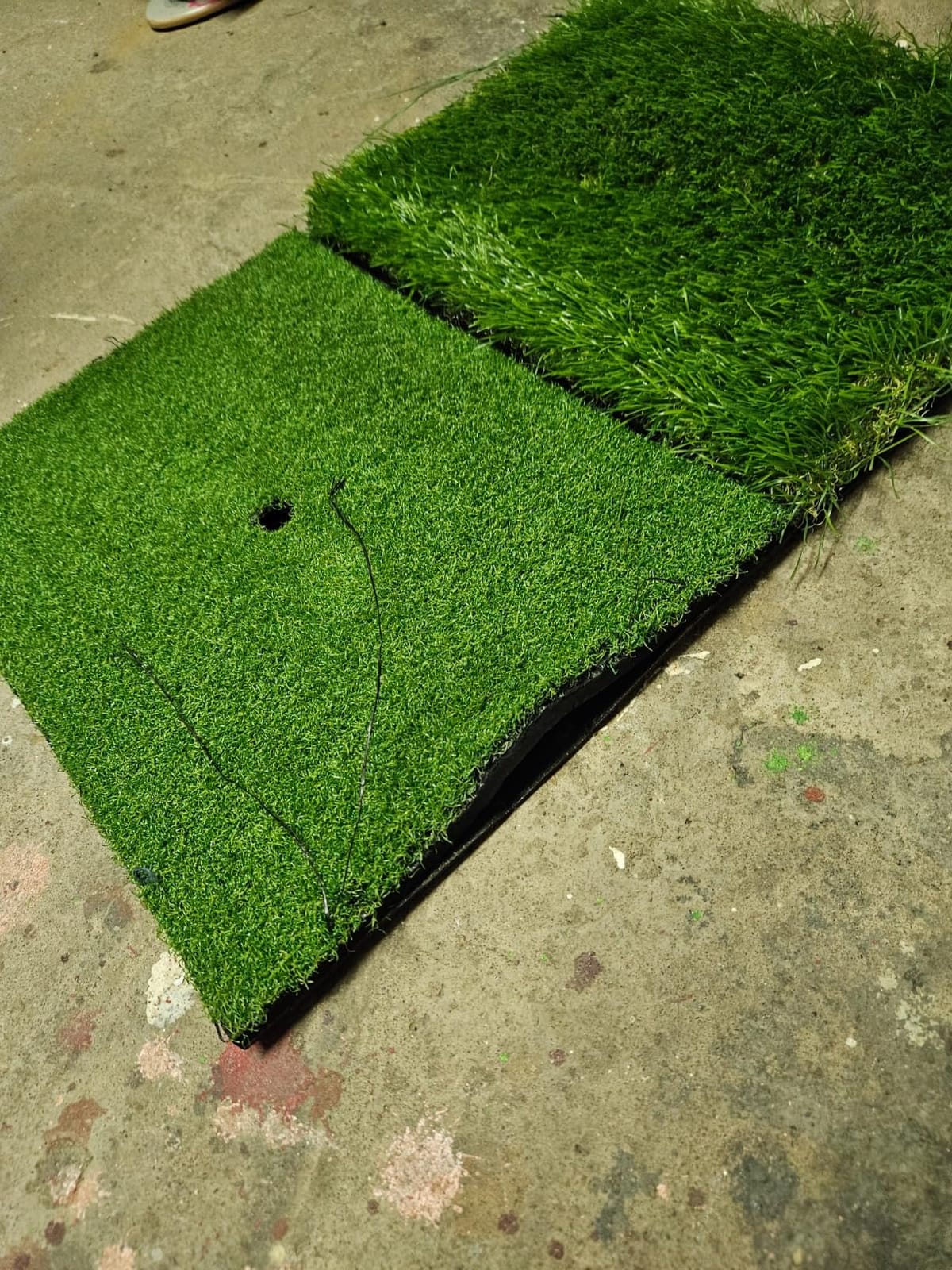
The SAPLIZE mat solves a problem most foldables have, which is that they stay folded. Owners report it lies flat immediately after unfolding, with no pronounced bend, and that is what separates it from the foam mats that need days of weighting down.
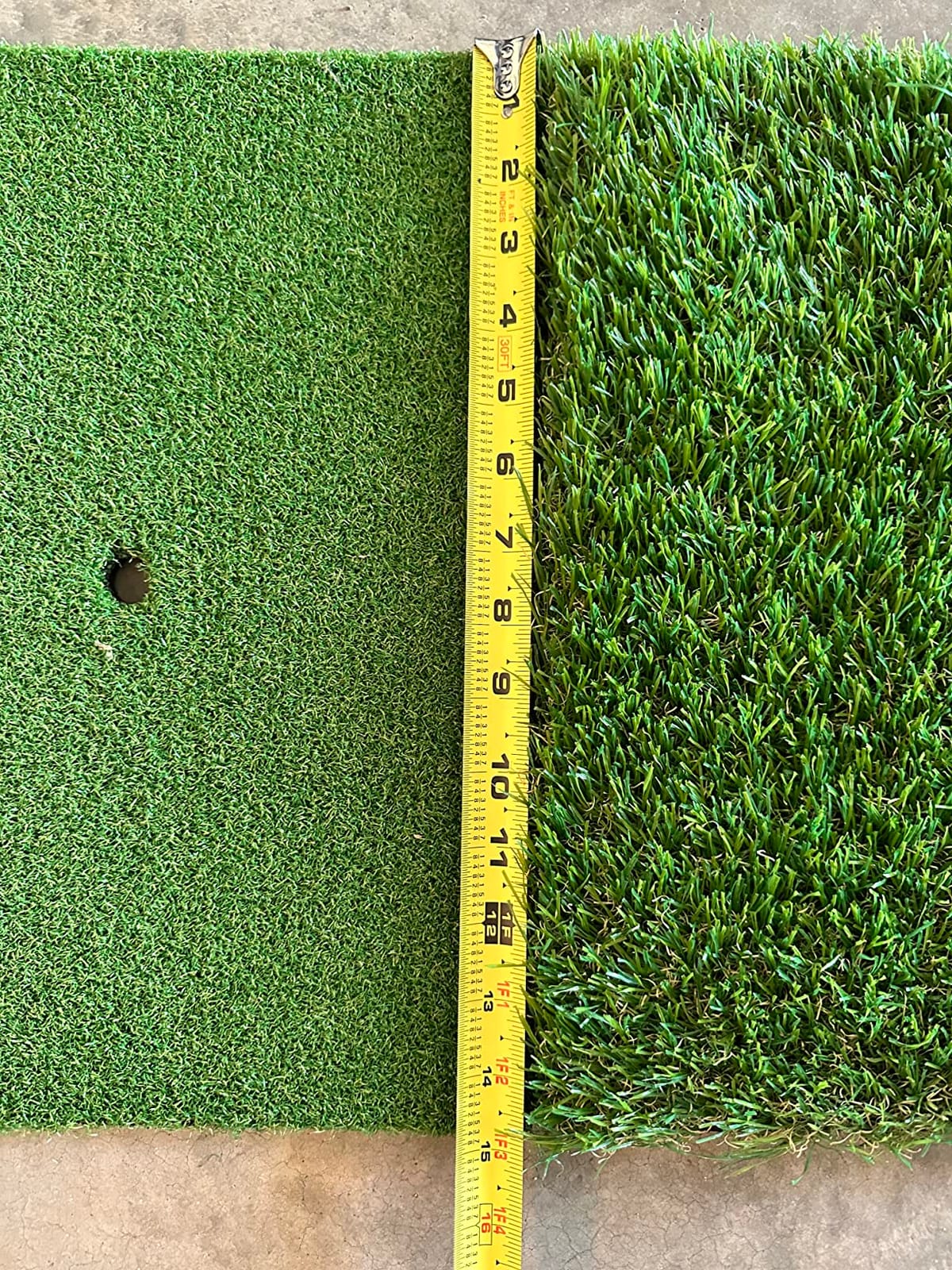
At 23 by 16 inches it is roughly 40 percent larger than a typical collapsible three-in-one mat, which sounds minor until you spend a session trying to hit a chip from a stance that keeps falling off the edge. The two turf surfaces, short fairway and longer rough, give you lie variety in a footprint that still fits in a cupboard or a trunk.
Underneath is 10mm of EVA foam, which reviewers credit with reducing wrist and joint stress on heavier shots, plus an upgraded glue layer that helps the turf stay bonded through repeated impact. The mat weighs 735 grams and is 1.3 inches thick.
What to check before you buy it
Confirm your storage plan before buying anything in this size. A mat you cannot fold flat and put away will quietly become the reason you stop practising, which is the single most common way a cheap mat gets wasted.
The single tee hole is irrelevant for chipping and limiting for anything else, but the rubber tee included makes practice immediate. With the fairway and rough zones, it works as a chipping, swing and putting surface in a very small area.
Where it falls short
23 by 16 inches is a chipping and pitching surface. There is no room to shift your strike point laterally, and full swings are out of the question. If you want to work on transition through the bag at speed, choose a bigger mat.
It is also one of the thinner builds here at 10mm of foam, so it does less for joint protection than the 36mm models. If you already have wrist or elbow discomfort, spend the extra on thickness.
6. Bltend Golf Mat 36mm – Best for Joint-Friendly Repetition
Bltend Elite Golf Hitting Mat: 5x4ft 21mm Golf Mat Practice Outdoor Indoor
5x4 ft
36mm thick build
6 tee holes
Complete kit
Pros
- Among the thickest builds here and easy on wrists
- Stays put on concrete with no sliding
- Generous 5x4 ft stance area
- Kit includes balls tees and a tee holder
- Reviewers report thousands of shots with no visible wear
Cons
- Ends curl and resist lying flat even under weights
- Curled ends can roll the ball
- Included rubber tees are too short for driver
- Heavy at 12 lb to reposition
The Bltend is the thickest general-purpose mat in this roundup at 36mm, and that single number explains why it shows up on the shortlists of golfers who already have wrist or elbow trouble. Dense commercial-grade turf sits over a cushioned EVA backing with an anti-tearing layer, and owners describe it as one of the easiest surfaces here to take 200 swings off per week.
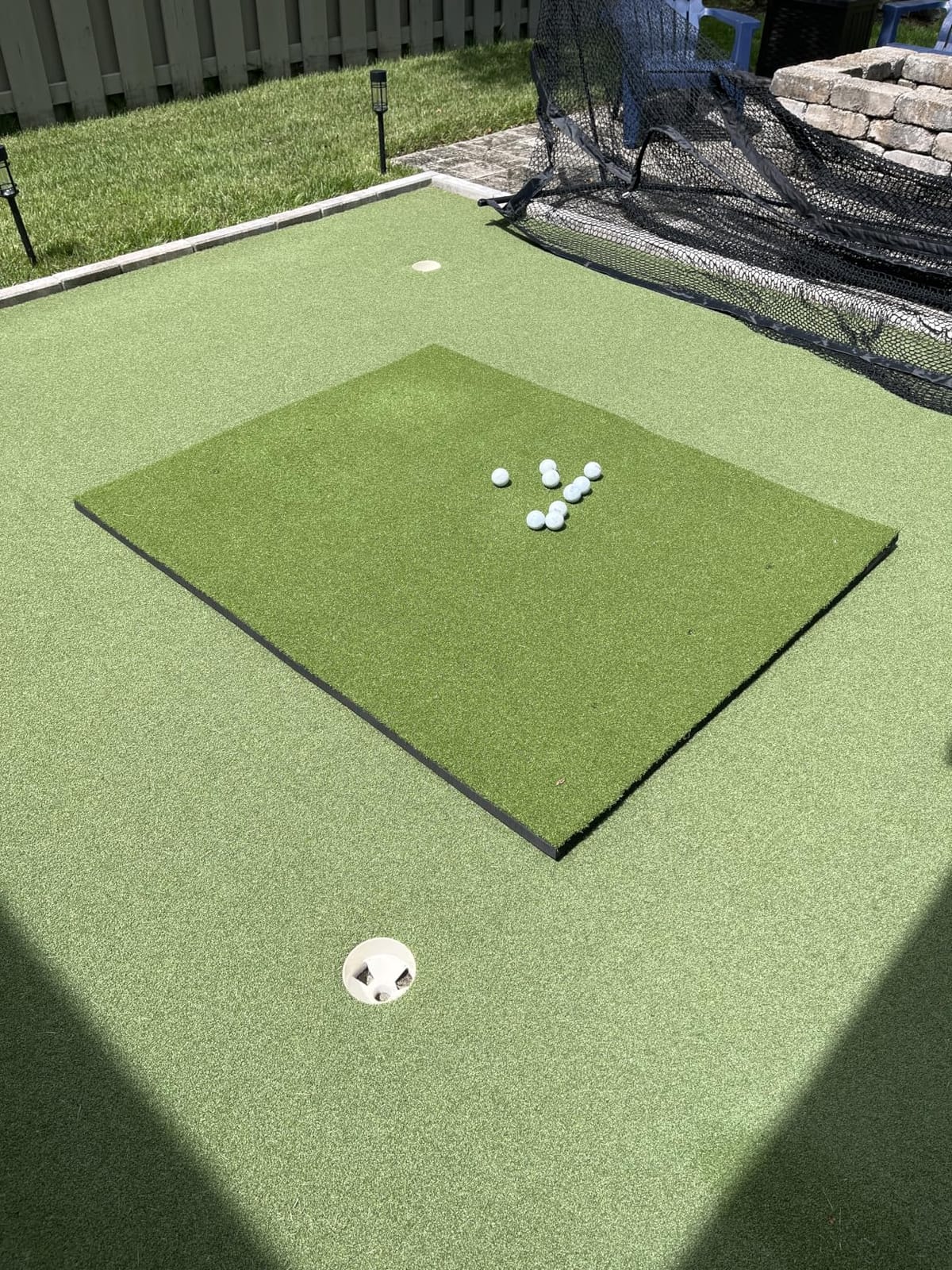
Stability is the other headline. At 12 pounds on a 5 by 4 foot footprint, it does not move on a concrete garage floor, which removes the single biggest source of swing error in an indoor setup. Reviewers report no visible wear after 2,000 or more shots, and several describe the turf feel as close to real grass.
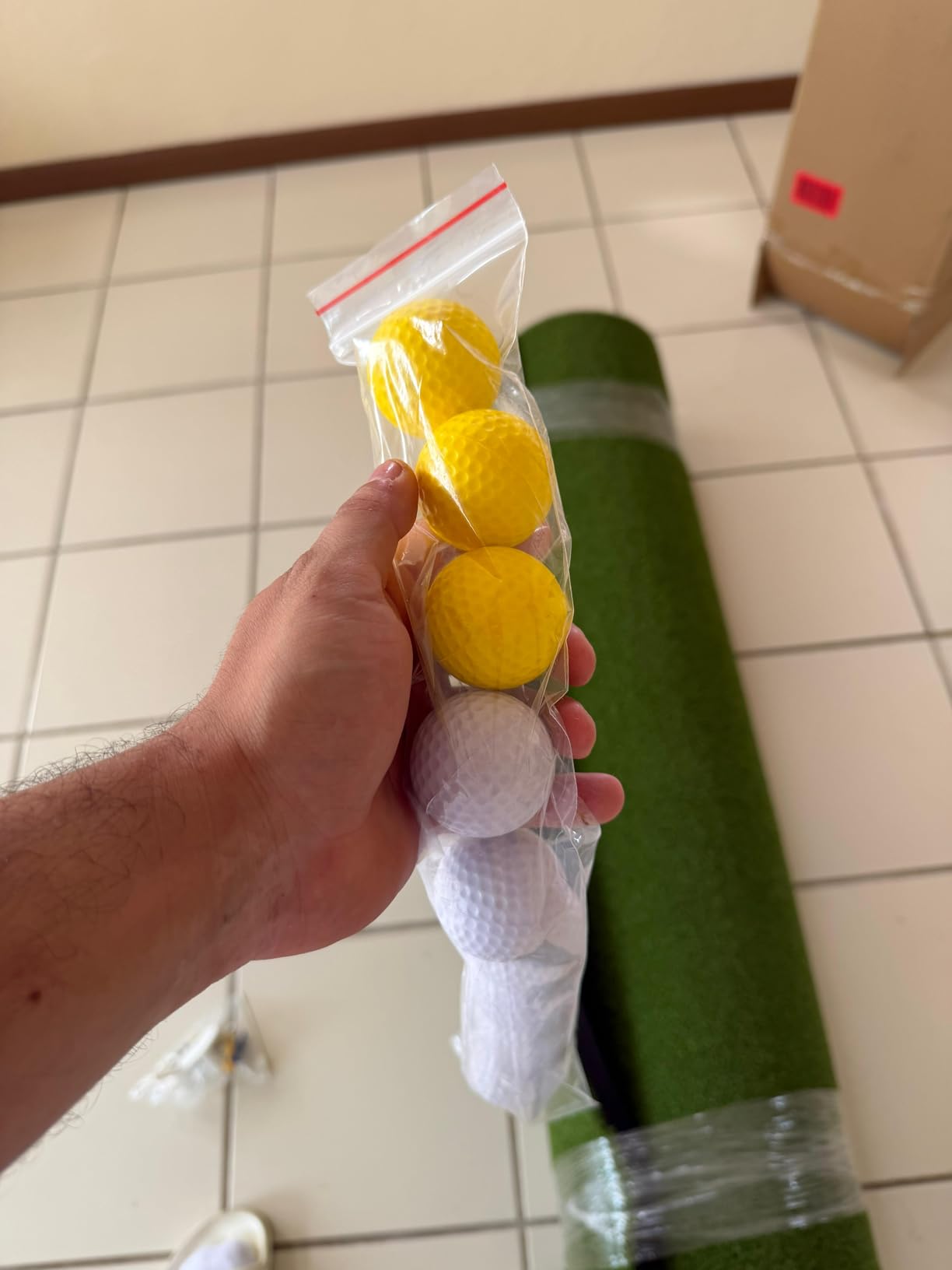
The kit is unusually complete for the money: the mat, nine practice balls, seven tees and a rubber tee holder. Six tee holes serve both right- and left-handed golfers. Item dimensions are 60 inches by 48 inches at 0.83 inch, and it rolls out and stores away for indoor or backyard use in any weather.
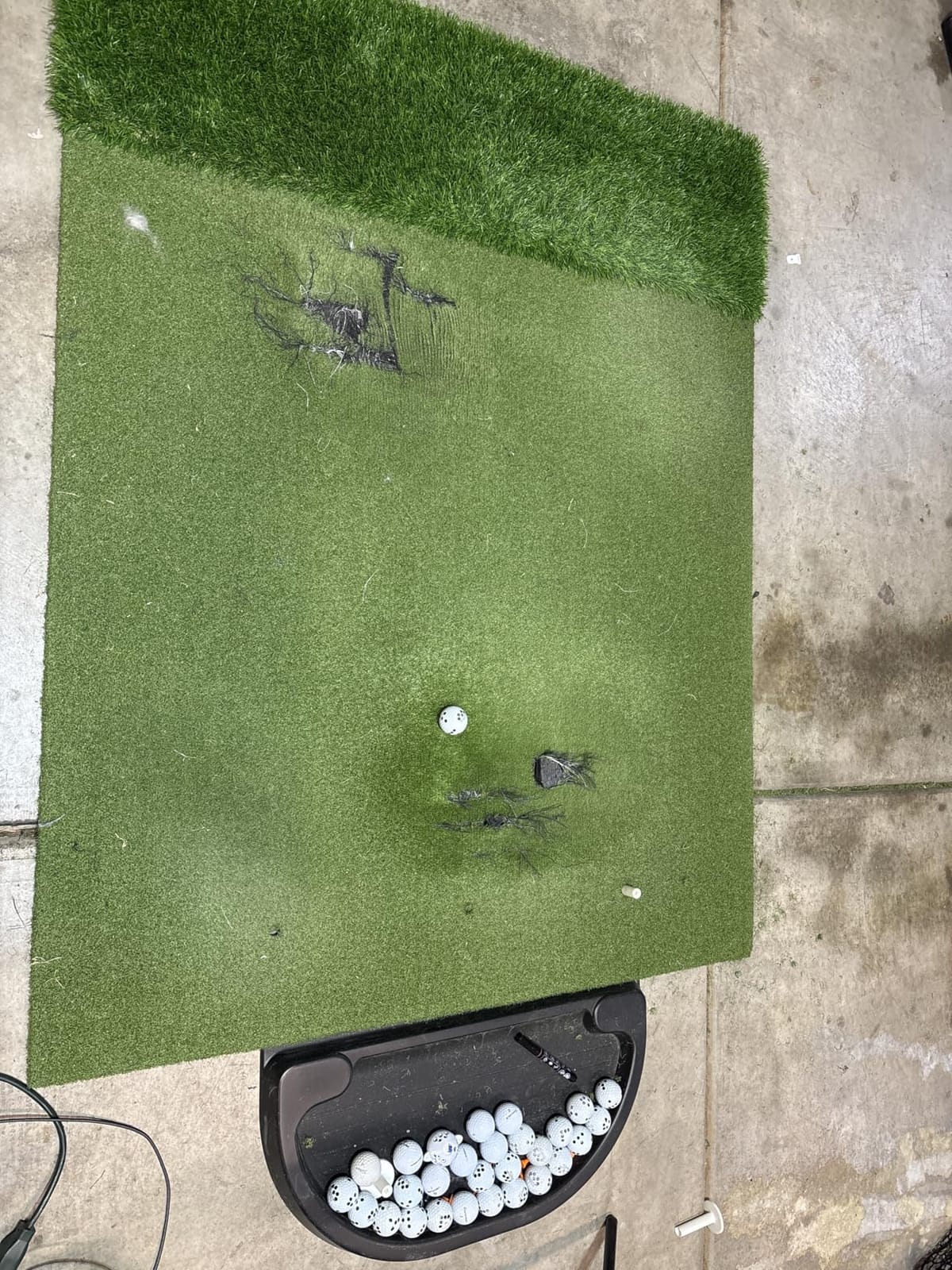
There is one problem worth planning around, and it is not a small one. The ends curl and can resist lying flat even after several days under heavy weights. Curled ends roll the ball unpredictably and eat into your stance room, which is exactly the part of the mat you need for a clean chip setup.
What to check before you buy it
If you buy this, weigh the ends down the day it arrives and give it a few days before your first session. Owners who report the best results are the ones who unrolled it in the spot they planned to use it and left it there rather than rolling it back up each session.
The thickness also changes how the mat feels under a low strike. On very thin shots the club digs into the foam rather than sliding, so a fast putter-style swing over a small contact area will feel slower here than it would on grass. That is the trade you make for the joint protection.
Where it falls short
At 12 pounds this is not portable in any meaningful sense, and repositioning it takes real effort. The included rubber tees are also too short for driver work, so treat this as a wedge and iron mat despite its generous footprint.
If curl is a deal breaker for you, go with a mat that rolls out and stays flat instead. Nobody wants to spend this much and then have to fight the ends of the mat every session.
7. Ywitio Premium Dual-Turf Golf Mat 5×4 ft – Best for Dual-Turf Chipping
Premium Dual-Turf Golf Mat: 5x4ft, 6x4ft, 21mm to 50mm Thickened Base for Backyard, Driving Range, Indoor & Outdoor Practice Hitting, Swing & Chipping (Pro 5x4ft 21mm to 45mm Base)
5x4 ft
21mm to 50mm EVA base
Dual PP turf zones
2 year service
Pros
- Thick high-elasticity EVA base absorbs impact
- Dual turf for fairway chips and rough lies
- 5x4 ft gives ample stance room
- Two year after-sale service with spare parts
- PP turf shows little wear over time
Cons
- Heavy at nearly 6 kg so storage needs two hands
- Foldable design needs time to relax back flat
The Ywitio is the most straightforward answer to what a golf chipping mat should be. A 5 by 4 foot surface, two turf zones, and a thick high-elasticity EVA base that absorbs impact rather than passing it into your wrists. The fairway strip is where you work chips, and the rough strip is where you rehearse the awkward lies that decide a round.
Turf density is above average here. It is a high-density polypropylene construction, and owners report little visible wear after repeated shots, which is the main thing you want from a surface you will hit the same spot on hundreds of times. Base options run from 21mm up to 50mm, so you can pick how much cushion you want rather than accepting a fixed profile.
Two practical details stand out. The two year after-sale service runs through Amazon orders with replacement parts offered, which is a longer commitment than most mats in this price range carry. And the mat rolls up for storage or transport despite its full-size footprint, which is unusual for something this heavy.
The catch is weight and the settling period. At nearly 6 kg it is a two-person job to roll in and out of storage, and because it is foldable, the foam needs time to relax back to a flat shape after unpacking. Plan a few days of downtime before you need it for a lesson.
What to check before you buy it
Work out where it lives before purchase, because a mat this heavy that lives in a hallway is a mat you will stop using. If you have a garage or a basement corner with a hard floor and a straight wall to lean it against, this suits you well.
Choose your base thickness by joint history rather than by feel on day one. Thicker foam feels better after a month of volume and feels vague during the first week, so give it a proper trial before you decide it is too soft.
Where it falls short
This is a full-size hitting mat being asked to do a chipping job, so if your entire goal is short shots you are paying for stance room you may never use. A dedicated shorter mat would suit a chipping-only routine and leave more of your garage free.
It also carries no tee holes, so any driver or iron work off a tee means adding your own. For wedge and chip practice that is a fair trade, but check it is a trade you want to make.
8. Golfguru Golf Mat 5×4 ft – Best for Simulator Bays
Golfguru Golf Mat 5x4FT, 36mm Dense Elite Turf with 10 Balls & 9 Tees
5x4 ft or 5x5 ft
36mm total thickness
20mm PVC padding
10 balls included
Pros
- Very thick foam is easy on joints to stand on
- Full kit with 10 PU balls and tees included
- Both feet sit level with the ball
- Owners report 900 plus balls with little wear
- Built-in tee holes show no wear
Cons
- Arrives rolled and takes days to flatten
- Corners may never fully settle
- Turf can separate at corners after months of daily use
- Bulky to move
The Golfguru is the one to build a launch monitor bay around. It comes in 5 by 4 and 5 by 5 foot versions, and the 5 by 5 size exists for a specific reason: owners point out that with the larger footprint both feet sit level with the ball, so the ball is no longer perched above your stance the way it is on a narrow strip.
That single feature changes your contact. When the ball sits level with your feet, you feel the weight of it and your low point settles where it should. It is the smallest design decision on the mat and the one that most improves short-game contact.
Construction is a 36mm total build, a 16mm grass layer over a 20mm EVA pad, finished with 20mm of PVC non-slip foam rubber padding. Six tee holes serve either handedness, and an integrated anti-tearing layer is rated for thousands of swings. Owners report using it with 900 plus balls and seeing little visible wear.
Everything you need to practise arrives in the box: 10 PU balls, seven golf tees, three step-down tees and two rubber tees. That matters for simulator work specifically, because the balls are the part you will lose into the rafters. The full one year warranty comes with customer service support.
Two drawbacks appear in reviews. The mat arrives rolled up and takes several days of weighting to lie flat, though owners note it flattens faster if you roll it in reverse. And a few buyers report turf separating at the corners after several months of daily simulator use.
What to check before you buy it
Match the footprint to your bay before anything else. If you are already running a home golf simulator setup, measure the clear floor space and choose 5 by 5 only if you can still walk around the mat. Consistency only counts if you can measure it, so our rangefinder picks are worth pairing with the sessions.
The 20mm PVC padding is worth understanding: it sits on top of the EVA pad, so this is one of the more slip-resistant surfaces here on smooth concrete. That is the single biggest factor in getting trustworthy simulator numbers, because a mat that moves under load produces data you cannot repeat.
Where it falls short
It is bulky to move despite the foldable form factor, and if your garage has limited floor space, a mat this size will dominate it. Chip-only golfers should read the chipping drills section below before committing to this footprint.
Corner separation after months of daily use is worth knowing about if you plan on this being a permanent fixture. Rotate your stance position and inspect the corners every few months and it will tell you well before it becomes a problem.
9. JAYA Golf Hitting Mat with Ball Tray – Best for Keeping Balls in Place
JAYA Golf Hitting Mat with Heavy Rubber Base, Foldable Golf Practice Mat for Indoor & Outdoor Training, Dual Turf Fairway & Rough Grass Mat for Swing, Chipping and Driving Practice
25x17 in
Dual turf
12 ball tray
Weighted rubber base
Pros
- Heavy weighted base protects grass from divots
- Integrated tray keeps balls organised
- Two turf heights in one mat
- Sloped edges reduce peeling
- Folds in half for storage
Cons
- Small footprint by modern standards
- Low side can tear after about a year
- Can leave green residue on the clubface
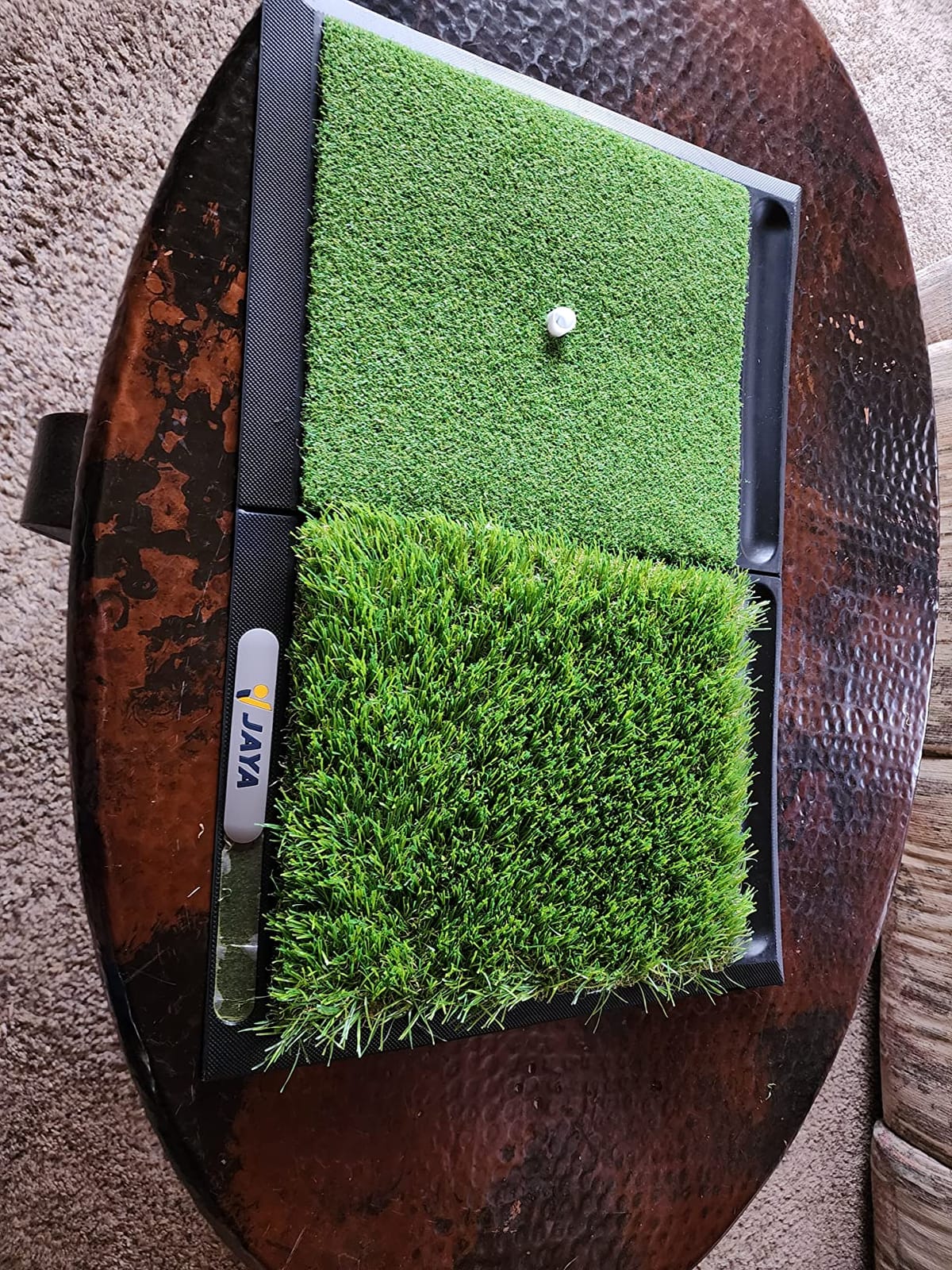
The JAYA mat is built around the problem every at-home chipping setup has, which is balls. The integrated rubber tray holds up to 12 balls, so instead of chasing them across a garage floor mid-session, you scoop them up with your club and carry on. It is a small feature that changes how long a practice session actually lasts.
The build underneath is weighted three-layer construction with a textured rubber bottom for grip and shock absorption. At 2.09 kg it is one of the heavier mats relative to its size, and that weight is why it stays planted and why it protects your lawn from divots when you use it outside.
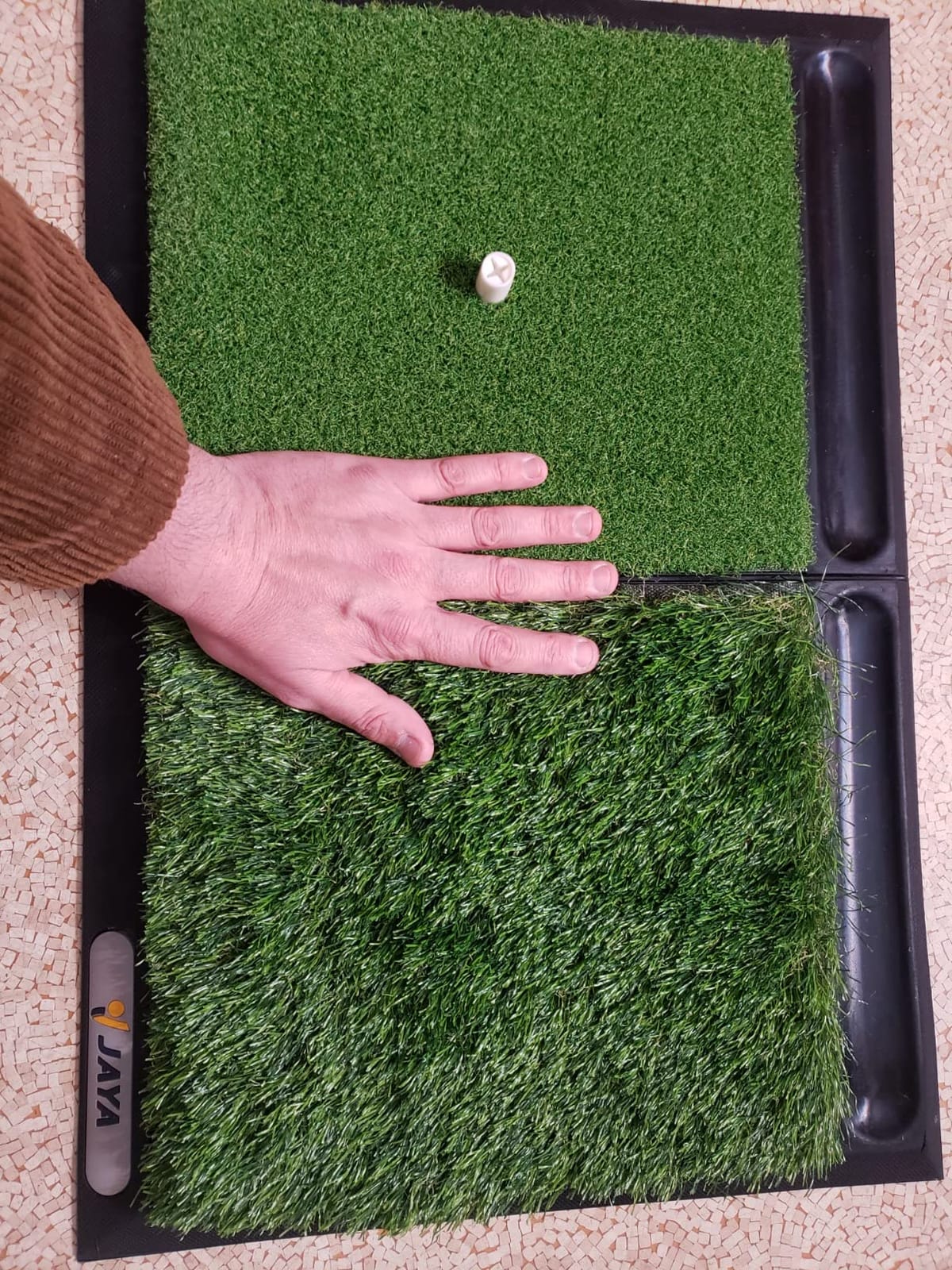
Dual turf gives you a long rough section for chipping and a short fairway section for swing and driving work. Sloped edges are designed to limit turf peeling and extend the life of the surface, and owners report it being used at classroom volume without scuffing floors.
What to check before you buy it
Measure the ball tray against your actual ball count. If you practise with a sleeve plus a scatter of extras, 12 balls means regular trips to a bag mid-session, and a mat without a tray may honestly serve you better.
This is also the mat to consider if you share a mat with kids or beginners. Reviews mention it being used heavily in school PE settings, and the forgiving weighted base means a bad swing from a beginner does not send a ball across the neighbourhood.
Where it falls short
Size is the recurring complaint. Newer golfers say they would prefer a larger surface so they can stand on it at ball height, and at 25 by 17 inches this is closer to the old narrow-strip format than to a modern stance mat.
Two smaller issues: the low side can tear after about a year of daily practice, and it can leave a green plastic residue on the clubface. Wipe the face occasionally and the residue is a non-issue.
10. LYDARZ 3-in-1 Golf Practice Mat – Best for Instant Swing Feedback
Golf Hitting Mats Training Equipment, Golf Practice Mat with Instant Swing Path Feedback, 3 Replaceable Golf Training Mats with No-Slip Heavy Duty Rubber Base
16x12 in
Three swappable surfaces
Swing path board
Rubber base
Pros
- Three surfaces cover rough fairway and path work
- Feedback mat shows contact point immediately
- Marks wipe clean for instant reuse
- Weighted base holds on smooth floors
- Easy to carry between locations
Cons
- Felt surface peels from the base after limited use
- Trace contrast is faint for precise reading
- Strong rubber smell when unboxed
- Small 16x12 in footprint
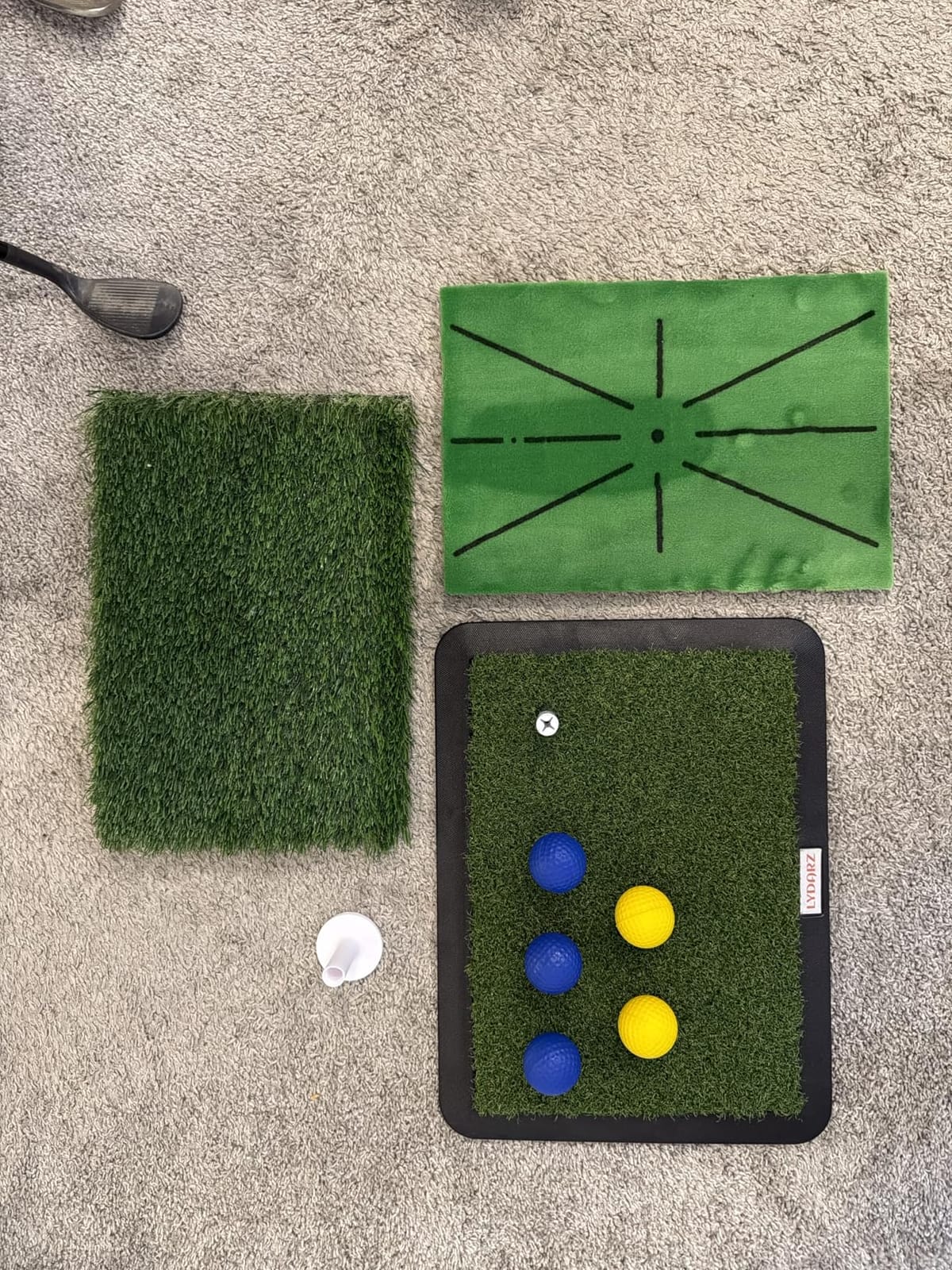
The LYDARZ mat is the most flexible feedback kit in the group because it does not ask you to choose between a training surface and a practice surface. It ships with three interchangeable panels: rough turf, fairway turf and a path feedback chipping mat, all seating into the same weighted rubber base.
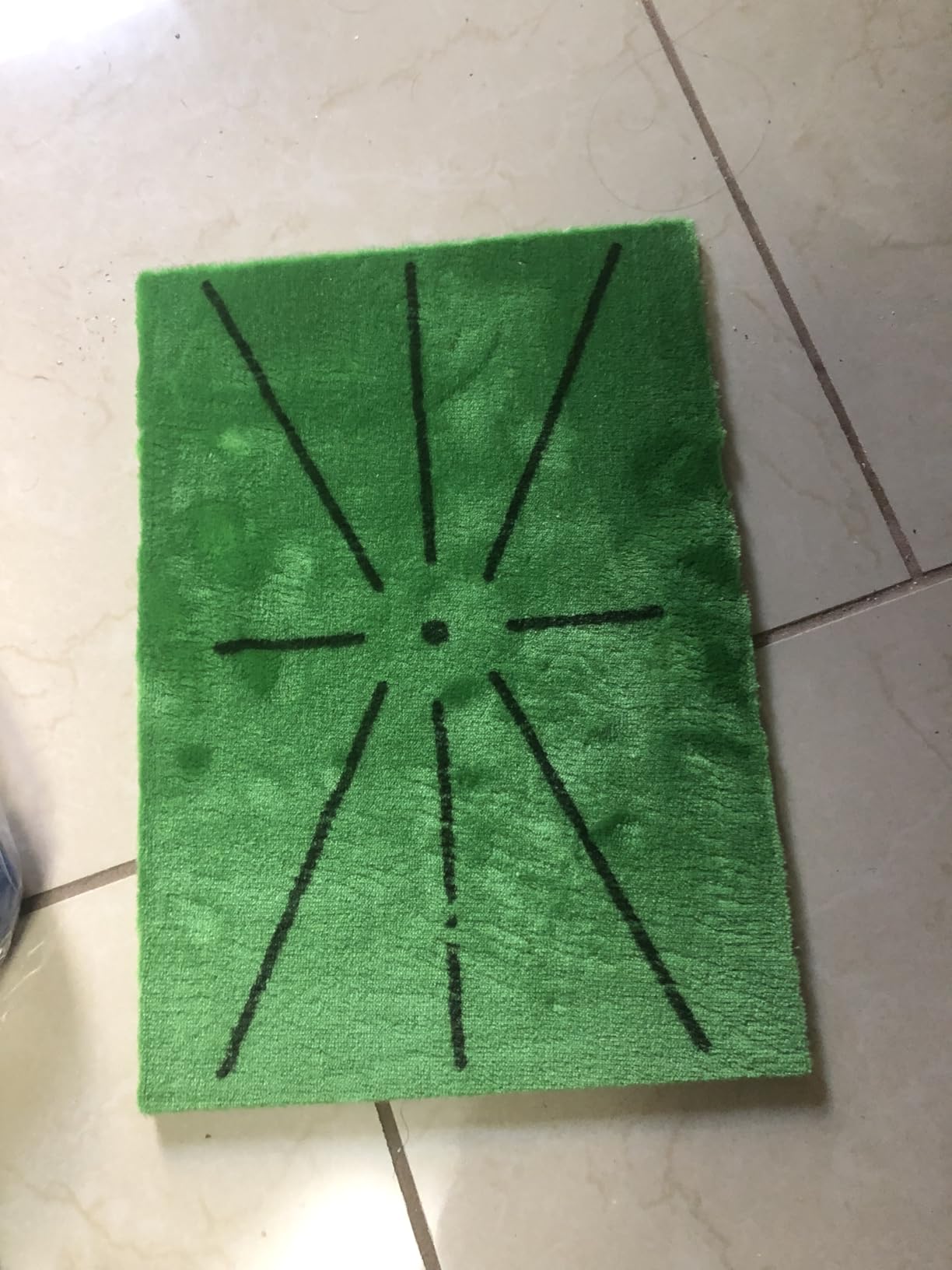
The feedback panel is the reason to buy it. Its velvet-style impact surface leaves a visible mark that wipes away after each swing, so you can read where the club struck and how the path travelled. For chipping, where contact errors outnumber distance errors, that is genuinely the most useful feedback you can get without a camera or a launch monitor.
Reviewers find the tracing panel instructive for refining contact and swing shape, and like being able to swap conditions without swapping mats. It is 2.5 inches tall on a 16 by 12 inch footprint, so it stacks thick and stays planted on smooth garage floors.
Construction is where it falls short. Several owners report the green felt surface peeling away from the base after limited use, which is the same weakness the other feedback mats in this roundup share. You also get a noticeable rubber smell on first unboxing, and the trace contrast is faint enough that reading the exact strike point takes practice.
What it does offer that pricier feedback systems do not is a wipe-and-reuse cycle. Because the marks clear with a hand or a brush, you can hit 30 chips, read the pattern across all of them, adjust once, and hit 30 more. That is a better feedback loop than most electronic devices.
What to check before you buy it
Expect to treat the felt panels as consumables and keep an eye on the edges where lifting starts. If the panels are lifting early, the base is still fine and you can replace just the surface rather than the whole kit.
Because all three panels share one base, this is also the most compact way to practise varied lies in a small space. If your problem is limited room rather than limited feedback, the panels solve both at once.
Where it falls short
Sixteen by twelve inches is small even for chipping, and it is the reason this ranks last despite a solid feature set. You have to be deliberate about foot position, which is hard to do while also reading a feedback trace.
The one year warranty is the shortest meaningful cover on mats this size, and the faint trace contrast means it teaches contact location more reliably than it teaches swing shape. Buy it for contact work, not for path work.
How to Actually Practice Chipping Off a Mat
A mat is a lie machine, not a distance machine. These four drills turn it into the short-game tool the query implies, and each one is designed to be hit off a mat rather than off grass.
1. The knockdown drill. Take half-swings and aim for a landing spot six to ten feet in front of you, then let it roll. Chasing a small target forces the ball to drop steeply and keeps the finish under control. Twenty reps, then study where the shots landed.
2. Landing-spot control. Pick three targets at increasing distances and treat them as a game. The point is not distance, it is whether you can move the ball the same amount three times in a row, which is the actual skill behind a good chip.
3. Lie rotation. If your mat has dual or tri-turf zones, hit the same shot from each one. You will quickly discover whether your swing is built for the fairway and fails in the rough, which is a lesson no single-surface mat can teach you.
4. Contact control with two balls. Set two balls a foot apart on the fringe of your strike area and try to land both near the same target. This is contact training, and it is the most transferable chipping drill you can do indoors.
How to Choose a Golf Mat for Chipping Practice
Turf type and realism
Turf quality shows up in how the ball behaves after contact. Dense synthetic and nylon turf holds a line and gives you a consistent speed, while thin artificial grass feels closer to carpet and slows the ball. In the lower tiers, accept a slightly slower ball and work on contact rather than chasing speed with a different swing.
Dual-turf and tri-turf layouts are worth paying a little more for, because lie variety is the part of chipping that actually transfers to a course. A single turf surface teaches one shot very well.
Base material and stability on hard floors
A mat that slides on concrete or tile will destroy your concentration and skew your swing, so a weighted or textured rubber base is not a luxury. Reviews across this category describe base grip as the most common deciding factor between a mat people keep and a mat in the garage corner.
Rubber bases also protect whatever is underneath, which matters indoors on laminate or tile where a mat with an exposed foam edge can leave marks.
Size: how much mat does chipping actually need
Far less than most buyers think. Chipping needs a 3 by 4 foot area as a practical minimum, and a 4 by 5 foot mat is ideal because you can stand level with the ball. A 5 by 5 foot mat only makes sense if you also want full swings from the same bay.
Many buyers overestimate their need and end up with a mat they cannot store. Measure your floor and your storage space before you shop.
Mat grab, thickness and joint impact
Grab is what happens when the club face catches on turf pile or digs into soft foam on a low shot, and it slows the club by a meaningful margin. It is the most repeated complaint in this category, and the fix is not simply a thinner mat.
The fix is a firmer, denser surface with foam sitting underneath the turf rather than in it. Thick foam helps your joints and hurts your speed at the same time, so the two goals genuinely conflict. Decide which one you are optimising for before you spend, because every thick mat on this list makes the same trade.
Forgiving suits higher handicaps and anyone still building a repeatable stroke. Punishing suits golfers who already have the motion and need feedback on contact, which is why premium mats get recommended so often on instruction forums.
Ball type and indoor floor safety
The ball is the real blocker for at-home chipping, not the mat. Foam and foamie balls are the safest choice indoors because they travel a fraction of the distance and will not break a window. Wiffle balls and limited-flight range balls are the next step up for more realistic feel.
Never take a full-force swing indoors regardless of the mat. Check how much clearance your side walls give you, and see our hitting net picks before you cut an opening in a wall.
Portability, storage and lifespan
Portability beats surface area if your practice time is irregular. A mat that folds or rolls and stores in a closet gets used in a way a 12 kg mat never will, and habit is worth more than turf density.
On lifespan, thin turf mats wear through and thick ones outlast your interest. Extend the life of any mat by spreading your stance position across the surface rather than hitting one divot-shaped patch, by rotating the mat periodically, and by cleaning the face so the pile does not mat down. Replaceable panels and insert systems are worth paying extra for when a product offers them.
For most golfers the practical alternative to one large mat is a hybrid: a short premium turf strip for the strike area, paired with a cheaper stance mat for your feet. Used driving-range mats are also validated for chipping specifically, with forum golfers reporting them receptive to chips out to around 30 yards.
Frequently Asked Questions
What is a good mat for chipping?
A good golf mat for chipping practice has a dense turf surface over a firm foam or rubber base, a non-slip backing, and a footprint of at least 3 by 4 feet. Chipping needs far less surface than driving, so prioritise stability and turf density over sheer size.
What mat size is best for dedicated chipping practice?
A 3 by 4 foot area is a practical minimum and a 4 by 5 foot mat is ideal, because it lets you stand level with the ball. A 5 by 5 foot mat only makes sense if you also want full swings from the same bay.
What is the best way to practice chipping at home?
Use half swings and aim at a landing spot rather than a target line, work on moving the ball the same distance three times in a row, and rotate between rough and fairway zones if your mat has them. Short controlled reps beat long practice swings indoors.
Are golf practice mats worth it?
Yes for consistency and convenience, with one caveat: no mat replicates real course feel, and thick mats that grab the club can ingrain a slower, more punitive stroke. Pick a firm base with foam underneath and treat the mat as contact and lie practice rather than distance practice.
How can I make a DIY chipping mat?
Cut a strip of turf onto plywood or a thick board for a simple practice surface, pair a short premium turf strip with a cheaper stance mat for a hybrid setup, or pick up a used driving-range mat. Indoors, a carpet wedge drill with foam balls needs no mat at all.
What is the best hitting mat for a golf simulator?
Match the mat footprint to your bay first, then prioritise a weighted non-slip base so the mat stays planted under load. A surface with both feet level with the ball gives cleaner contact, and 20mm of padding helps stop the surface moving on smooth concrete.
The Bottom Line
The best golf mats for chipping practice come down to two things most listings bury: whether the base stays planted, and whether the club grabs on a low shot. Get those right and almost any mat in this roundup will build a repeatable short game. Get them wrong and no amount of turf quality will save your contact.
Our best golf mat for chipping practice overall is the GoSports Elite at 5 by 4 feet with a 15mm EVA base, the safest place to start for most golfers. The best value option is the CHAMPKEY strip if portability matters more than surface. For joint comfort under high volume, the Bltend at 36mm is the thickest build we tested, and for simulator bays the Golfguru at 5 by 5 puts your feet level with the ball.
Whichever you choose, buy foam or wiffle balls with it, spread your stance position across the turf, and give it a few sessions before you judge the feel. A mat needs a settling period, and so does your short game.