
Best grafting tools for fruit trees come down to one thing: how cleanly your blade cuts. A straight, flat, uncrushed cut across a scion and a rootstock lines up the cambium layer, and that alignment is the biggest single driver of whether the graft takes. Ragged or concave cuts leave gaps the callus cannot bridge, and you lose the variety you paid good money for.
So the expensive tool rarely wins on price. It wins if you are cutting hundreds of rootstocks a season, if your scion wood is dense enough to roll a cheap edge, or if you want a mechanical shear that cuts both pieces to a matching profile in one squeeze. For a backyard orchard with a dozen grafts a year, a sharp folding knife is the smarter buy and will still be in your pocket in ten years.
We spent weeks comparing the ten grafting tools for fruit trees below, checking blade steel, bevel geometry, edge retention on hardwood scion wood, grip, and whether replacement blades are actually available. Four are knives you carry into the orchard, three are mechanical shears that cut scion and rootstock in one motion, and three are kits that bundle the two together. We also pulled in what growers actually say on permies.com and growingfruit.org, because this category has almost no credible retailer review volume to fall back on.
Everything below is organized by tool type rather than by brand, so you can start from the job you need to do and work backwards to the tool. Updated for 2026, and written for people grafting apples, pears, peaches, citrus, grapes, and plums in soil rather than in a catalog.
Table of Contents
Top 3 Picks: Best Grafting Tools for Fruit Trees (October 2026)
If you want an answer in the next thirty seconds, these three cover the range most growers actually need.

Glarks Grafting Pruner Kit
- Cuts 5-14 mm stock
- 3 replaceable Omega/U/V blades
- Wallet with tapes and bands

NAYE Folding Grafting Knife
- 2.625 inch 5Cr blade
- Curved and straight blades
- 3 tapes and 12 labels

NAYE 6-Blade Grafting Kit
- Japan SK5 steel
- 3/16 to 17/32 in capacity
- 6 blades including spares
Glarks Professional Grafting Pruner Kit is the one to buy if you want matched cuts without counting cuts. The three replaceable blades cover Omega, U, and V profiles for stock between 5 and 14 mm, and owners report take rates above 90% on avocados, peaches, and lemon. It is our pick for anyone grafting a real collection rather than one tree.
NAYE Folding Grafting Knife is the value pick and the safest place to start. It is a 2.625 inch 5Cr stainless blade in a rosewood handle, sharp enough out of the box that commercial growers use it on half-inch scions, and it folds into a pocket.
NAYE 6-Blade Grafting and Pruning Kit is the premium pick for volume. Japanese SK5 steel, six blades in the box including spares, and a capacity of 3/16 to 17/32 inch make it the most complete mechanical option in this roundup.
How We Evaluated These Grafting Tools
We judged each tool on seven things, and we weighted them in the order they actually affect your results.
First is cut quality: does the blade produce a flat face without flexing or crushing the cambium. Growers on growingfruit.org report the exact failure we looked for, describing concave cuts from a flimsy blade in a cheap box cutter and blaming their own habit of flexing it. Blade thickness matters more here than brand.
Second is edge retention on hardwood. Asian pear is singled out in grower reports as both infection-prone and hard, and one buyer of a premium tool reported that the fine edge bent over after about a dozen cuts and the tool ended up sitting in a drawer. A tool you cannot keep sharp is a tool you stop using.
Third is bevel geometry. Single bevel cuts flatter and cleaner on a stock surface; double bevel makes two matched faces but leaves a small ledge on the flat, which is wrong for some graft cuts. Fourth is steel: 5Cr, 2Cr13, SK5, and high carbon each behave differently against sap and hardwood.
Fifth is grip and weight over a long session, because these tools weigh between 0.72 and 1.8 pounds in the kits. Sixth is whether replacement blades or a sharpening path exists. Seventh is technique fit: which graft types the tool can physically produce, and how tightly it constrains rootstock and scion diameter.
All 10 Grafting Tools for Fruit Trees Side by Side
The full lineup, with the cutting capacity and the thing each tool is genuinely best at.
| Product | Specifications | Action |
|---|---|---|
| Glarks Professional Grafting Pruner Kit |
|
Check Latest Price |
| NAYE Folding Grafting Knife |
|
Check Latest Price |
| NAYE 6-Blade Grafting and Pruning Kit |
|
Check Latest Price |
 PUELDU Folding Grafting Knife PUELDU Folding Grafting Knife |
|
Check Latest Price |
 PUELDU 3-in-1 Grafting Kit PUELDU 3-in-1 Grafting Kit |
|
Check Latest Price |
 KREWEY 2-in-1 Grafting Pruner Kit KREWEY 2-in-1 Grafting Pruner Kit |
|
Check Latest Price |
 MIDOUWEST Rosewood Grafting Knife MIDOUWEST Rosewood Grafting Knife |
|
Check Latest Price |
 Mudder Double-Blade Grafting Knife Mudder Double-Blade Grafting Knife |
|
Check Latest Price |
 QWORK Folding Grafting Cutter QWORK Folding Grafting Cutter |
|
Check Latest Price |
 MIDOUWEST 6-Piece Grafting Cutter Kit MIDOUWEST 6-Piece Grafting Cutter Kit |
|
Check Latest Price |
1. Glarks Professional Grafting Pruner Kit: The Matched-Cut Workhorse
Glarks Professional Garden Fruit Tree Plant Pruning Shears Grafting Cutting Tool Kit with Grafting Tape Rubber Bands
High carbon steel shear blades
5-14 mm grafting diameter
3 replaceable blades
186 rubber bands and tape
Pros
- Cuts fit tightly with take rates reported above 90% on avocado peach and lemon
- Blades swap with a single screw and spares are included
- Handles pencil-thickness grapevine and fruit tree grafts
- Storage wallet holds every tape and band
Cons
- Closure clip on the spring broke for one buyer after use
- Replacement blades dulled and deformed after roughly ten cuts
- Not suited to branches thicker than about 14 mm
This is a 2-in-1 tool where the shear blades prune the branch down and three replaceable cutting blades carve the Omega, U, or V profile in one squeeze. The profile blade cuts scion and rootstock with the same blade at the same setting, which means the two pieces are cut to the same geometry without any hand adjustment. That is the entire point of a mechanical grafter, and it is why this one works where cheaper kits struggle.
Owners doing the real work report graft take rates above 90% on avocados, peaches, and lemon. The blade system is genuinely good: swapping profiles takes a single screw, and two spare blades ship in the case, so you are not waiting on parts when a profile dulls.
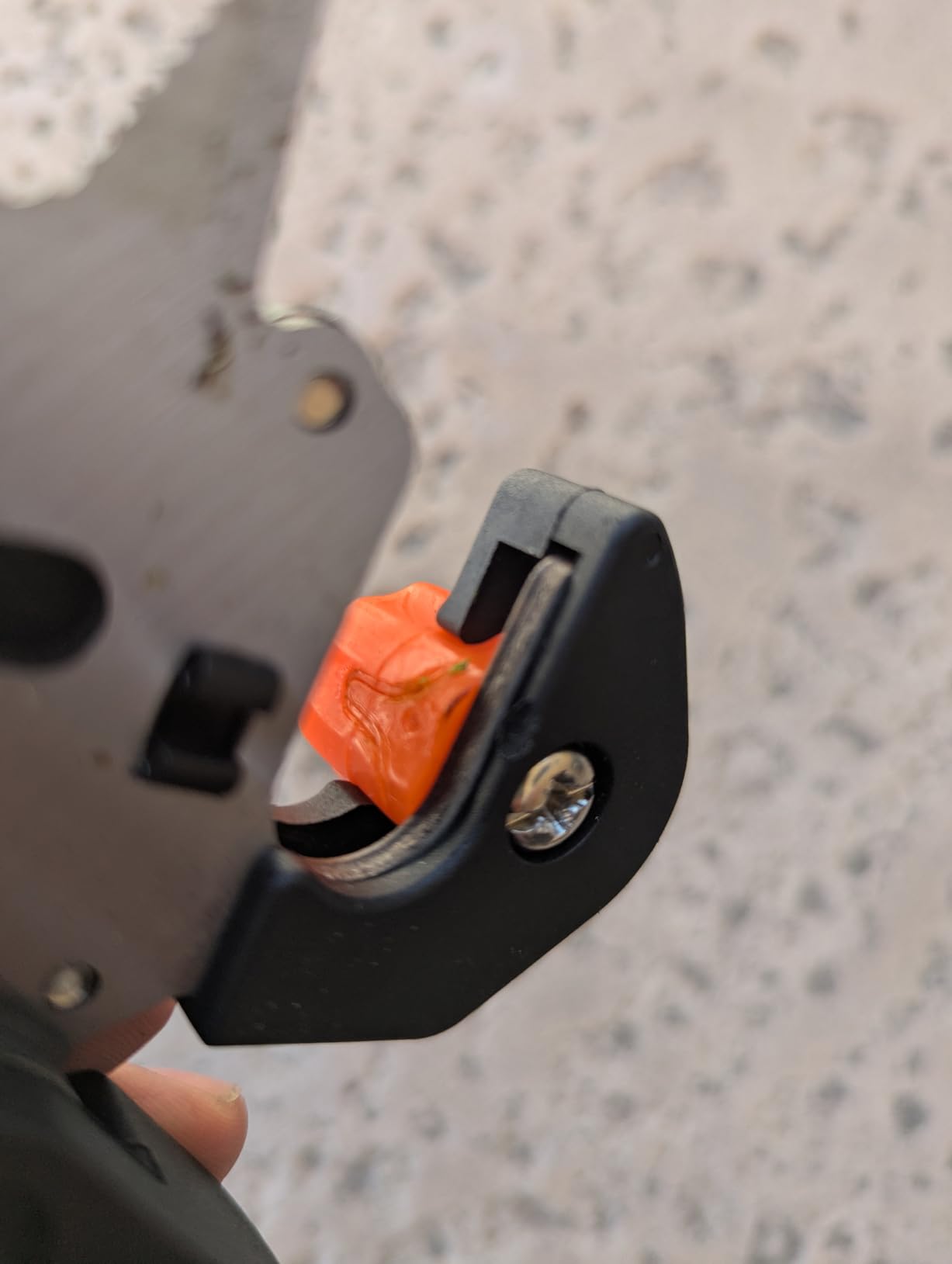
The honest weakness is consumable blade life. Reviewers report that replacement blades dulled and deformed after roughly ten cuts, mostly practice cuts, and the spring closure clip on the sheath broke shortly after use for one buyer. If you are doing serious volume, treat blade replacement as part of the running cost rather than a surprise.
Capacity is 5 to 14 mm, so pencil-thickness grapevines and young fruit tree stock sit comfortably in range. Anything thicker than about 14 mm needs a knife or a larger cutter, which is why we pair this with a blade rather than recommending it alone.
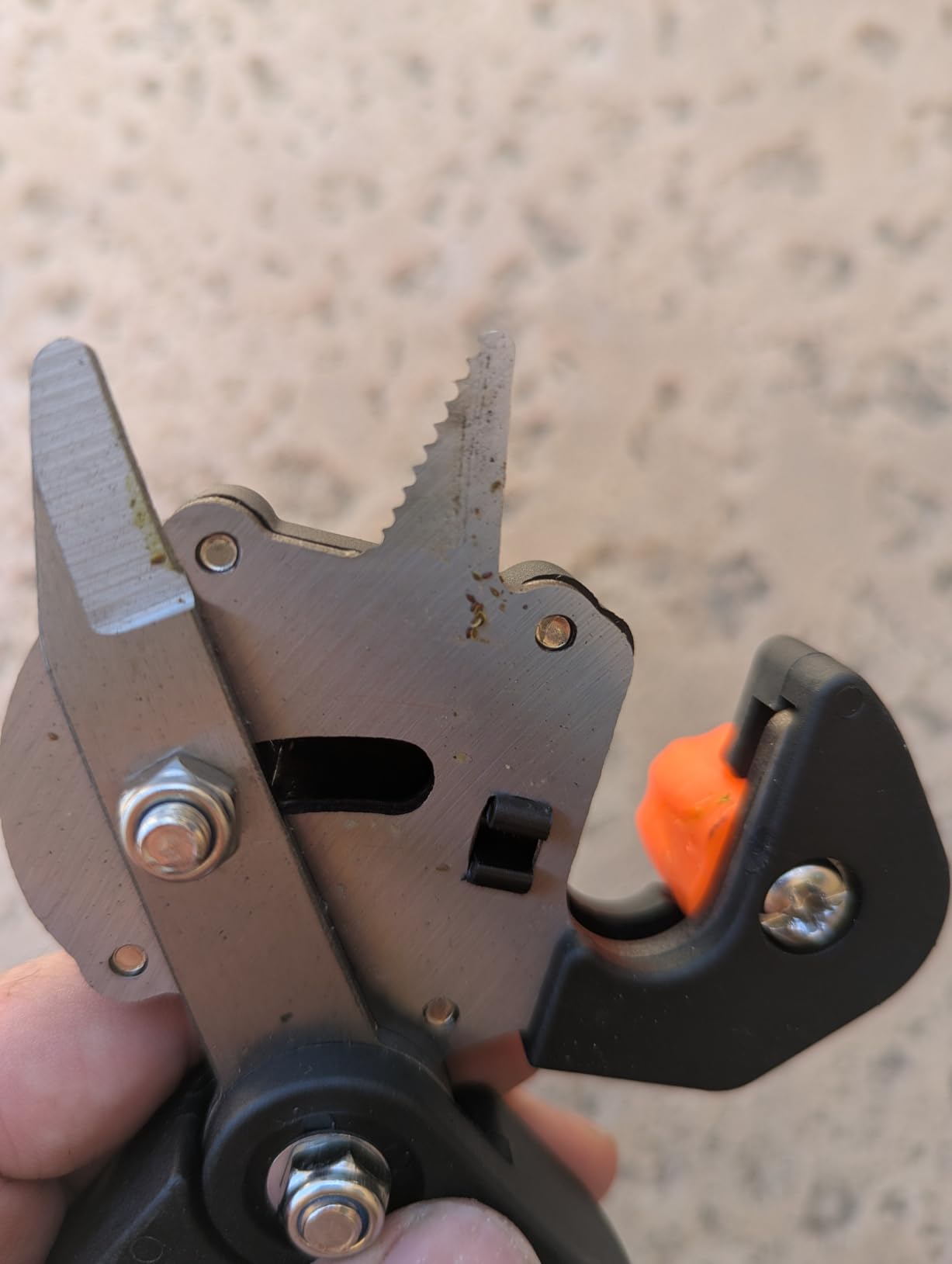
What you get for the money
The kit is unusually complete: a wrench and screwdriver for blade changes, 36 wide rubber bands, 150 thick rubber bands, and a roll of self-adhesive biodegradable grafting tape, all in a black wallet. Those bands are what hold the graft union while the tape does its sealing work, and having both widths in the box saves a second order.
Blades are #65 high-carbon steel with a convex edge on an anvil-type body, and the handle is spring-loaded ABS. The ABS will not survive being dropped onto stone, but the spring return makes long sessions easier on the hand.
Where it falls short
If your scion wood comes from a collector and arrives in mixed diameters, this tool works against you. It physically requires the rootstock and scion to be near-identical in size, so a box of ten different pear varieties scion wood is a poor match even when the price looks right.
It also does nothing for bench grafting on thin wood. Below 5 mm you want a knife, and above 14 mm the frame is working past its design. The 0.72 kg weight is noticeable in a full day of work but not punishing.
2. NAYE Folding Grafting Knife: The Best Value Blade
NAYE Grafting Gardening Knife,2-5/8″ Curved Straight Blades Garden Knife for Budding Pruning,with Grafting Tape Plant Labels/Tree Tags
2.625 inch 5Cr stainless blades
Bladed curved plus straight and bark lifter
Rosewood handle
Folds to pocket size
Pros
- Very sharp out of the box with commercial growers using it on half inch scions
- Three tape widths cover different scion sizes
- Write-on labels record graft date and variety
- Tight well-finished fittings at a low price
Cons
- Straight blade is double edged which is wrong for flat graft cuts
- Included tape is plastic film rather than parafilm
- Blades need frequent sharpening and the steel is not premium
- Write-on tags are brittle
This is the knife we would hand to somebody grafting their first apple tree. The blade is 5Cr stainless steel, curved and straight in one folding body, with a bark lifter at the heel for opening the rootstock skin cleanly. It is 2.625 inch, which is short enough for controlled work on pencil-thickness wood.
Out of the box it is genuinely sharp. Reviewers include commercial coffee, mango, and avocado growers who use it on half-inch scions, which is a stronger endorsement than any star rating. The rosewood handle is contoured rather than round, and that shape is what keeps it from rolling in a wet hand.
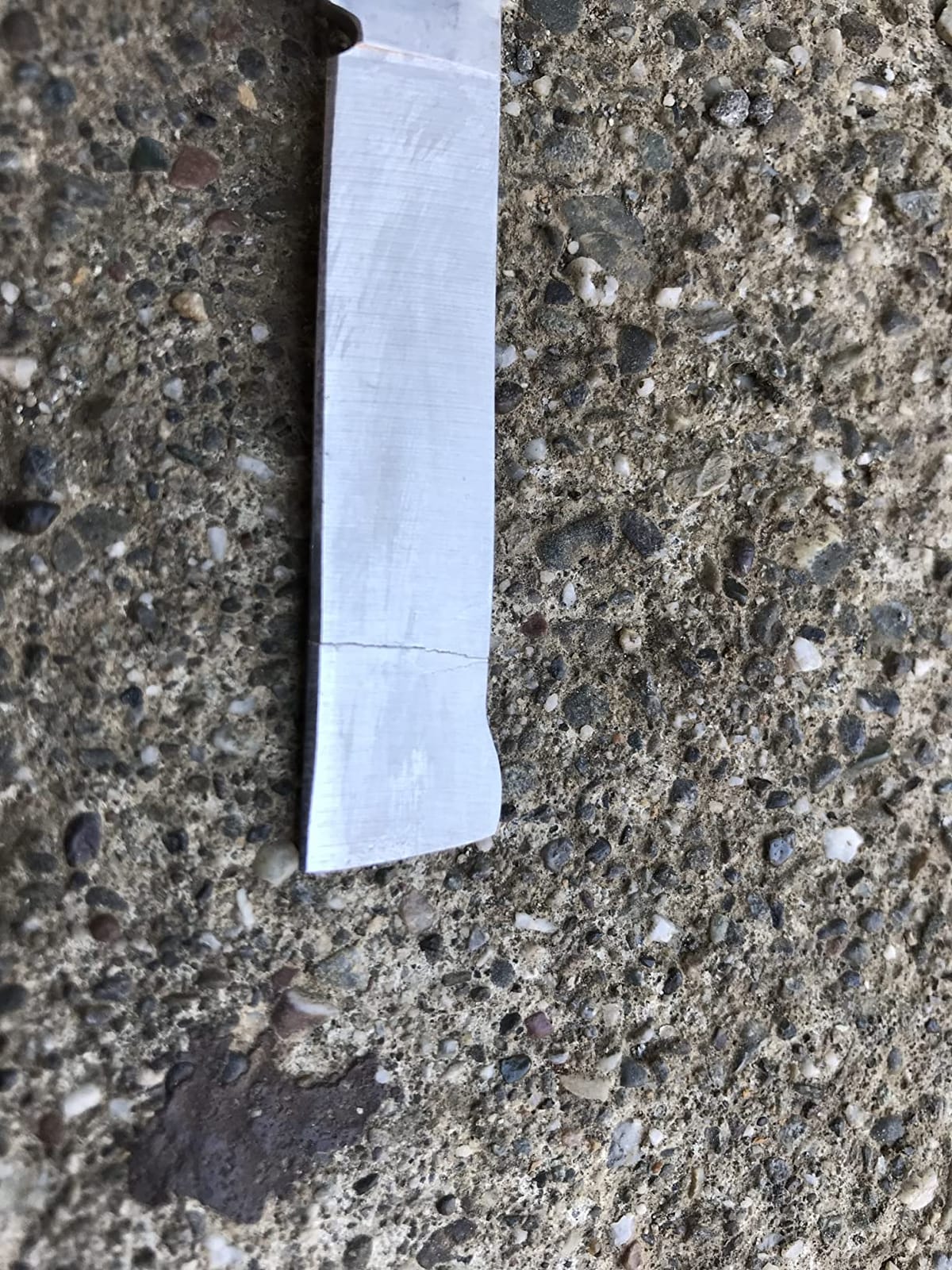
The catch is the straight blade. It is double-edged, which is wrong for the flat, clean cuts a whip or cleft graft wants, because it leaves a small secondary bevel on the face. The curved blade is the one you will actually reach for on a stock surface.
The bundled tape is also a problem. It is plastic film rather than parafilm, so it has to be peeled off later or it can strangle a swelling union. Buy real grafting tape separately before your first session rather than trusting what is in the box.
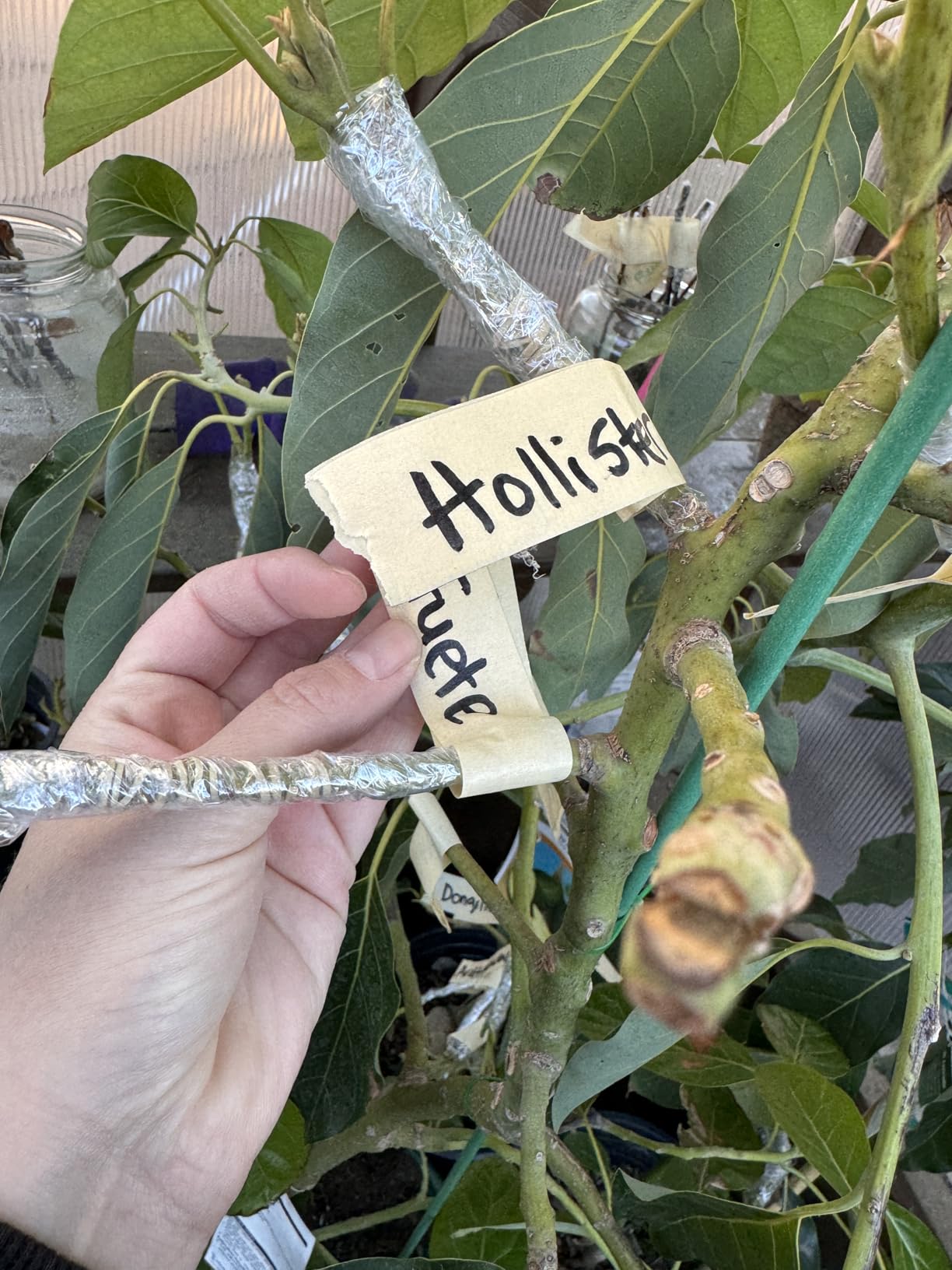
Why this is the beginner’s knife
It does several jobs at once. The bark lifter handles T-budding, the curved blade handles position cuts, the straight blade handles splitting and trimming, and the twelve write-on plant labels let you record the graft date and variety next to the tree. Those labels matter more than they sound, because a failed graft you cannot identify is a failed graft you repeat next year.
It folds, which matters when you are walking a row of rootstocks in February with both hands full. A 2.625 inch blade is also far easier to control for a first-timer than a four-inch utility blade, which is where a lot of beginners are told to start.
Where it falls short
Steel quality is the limit. The 5Cr is serviceable, not premium, and reviewers report that blades need sharpening often, with some buyers resharpening immediately out of the box. If you are cutting old, hardened wood repeatedly, budget time on a whetstone rather than expecting a season between sharpenings.
Multiple buyers warn the edge is sharp enough to cause injury without gloves, and one noted the tape cannot be relied on for moisture control. Treat it as a knife first and a kit second.
3. NAYE 6-Blade Grafting and Pruning Kit: Most Blade Depth in the Roundup
[6 Blades Enhanced] NAYE 2 in 1 Garden Grafting Tool Kit for Fruit Trees with Grafting Knife Grafting Tapes,Extra Replacement Blades Included,Professional Grafting Scissor Shear
Japan SK5 cutting steel
6 blades including spares
3/16 to 17/32 in capacity
0.82 kg complete set
Pros
- Higher blade count than most 2-in-1 kits so replacements last longer
- SK5 steel makes matched cuts that seat well for cambium contact
- Combines pruning and grafting with tapes included
Cons
- Heavier at 0.82 kg which tires the hand on long sessions
- Capable only up to about 17/32 inch scion wood
- Replacement blades are consumables that raise cost per graft
This kit carries six blades where most competitors ship three, and the cutting steel is Japanese SK5 rather than the usual high-carbon or 2Cr13. That combination is why we rate it as the premium mechanical pick: the extra spares mean you are not reordering consumables every week, and SK5 holds an edge noticeably longer on hard wood.
Capacity runs from 3/16 to 17/32 inch, with Omega-Cut, U-Cut, and V-Cut profiles plus a separate 1/8 inch pruning blade for clearing leaves and twigs. Because the same profile blade cuts both scion and rootstock, the two faces seat together for maximum cambium contact without any hand fitting.
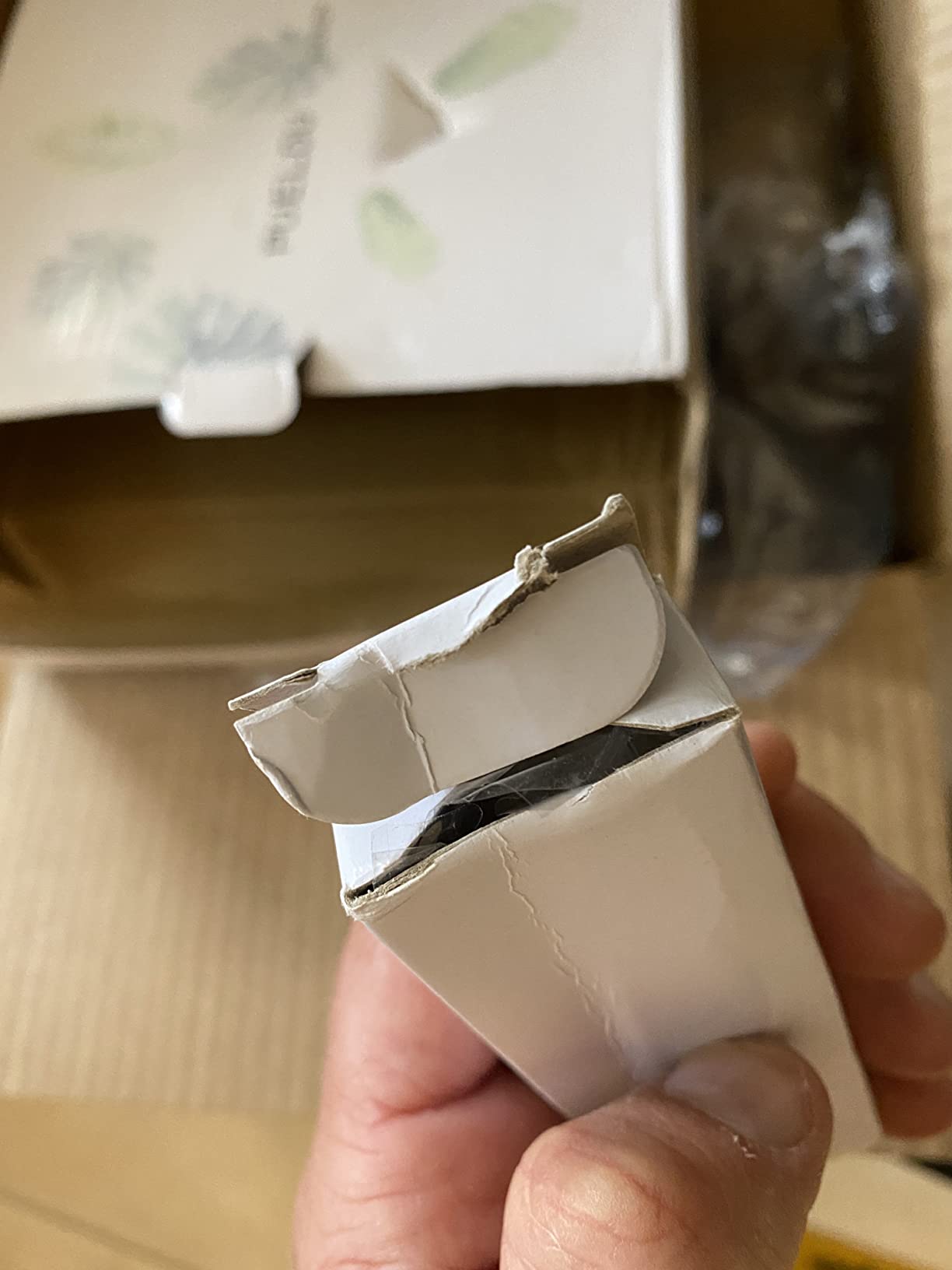
![[6 Blades Enhanced] NAYE 2 in 1 Garden Grafting Tool Kit for Fruit Trees with Grafting Knife Grafting Tapes,Extra Replacement Blades Included,Professional Grafting Scissor Shear customer photo 1](https://finforum.org/wp-content/uploads/2026/10/B0921QQVRQ_customer_1.jpg)
Users report clean, well-matched cuts on nursery and orchard stock, and the fit of the two woods is the specific thing reviewers praise. On paper this is the closest thing in the roundup to a real nursery tool without leaving the two-in-one format.
The weight is the honest drawback. At 0.82 kg it is the second-heaviest kit here, and owners doing long sessions report hand fatigue. If you are grafting a hundred rootstocks in a sitting, plan to set it down every twenty minutes.
![[6 Blades Enhanced] NAYE 2 in 1 Garden Grafting Tool Kit for Fruit Trees with Grafting Knife Grafting Tapes,Extra Replacement Blades Included,Professional Grafting Scissor Shear customer photo 2](https://finforum.org/wp-content/uploads/2026/10/B0921QQVRQ_customer_2.jpg)
Best for nursery-scale bench work
Six blades means three profiles in rotation plus three spares, which removes the single biggest interruption in mechanical grafting: stopping to sharpen mid-run. If your season involves propagation on a bench rather than field work on mature trees, that is the feature that actually pays.
The 1/8 inch pruning blade also removes the need for a second tool on the bench. Clear the leaves and twigs from a whip, then drop into the profile cut without switching instruments or losing your reference line.
Where it falls short
The ceiling is 17/32 inch, roughly half an inch. Anything thicker needs a knife or a bigger cutter, and top-working a mature tree with two-inch limbs is outside this tool’s range entirely.
Consumables still add up. Replacement blades are a running cost, and a grower doing serious volume should factor them into the cost per graft rather than treating the kit price as the total. The overlap between the pruning and grafting functions can also confuse beginners about which blade to reach for.
4. PUELDU Folding Grafting Knife: Best Blade for Field Work
PUELDU Grafting Knife With 2 Blades & 2 Tapes – Stainless Steel Gardening Tool for Plant Grafting, Pruning, Fruit Picking – Portable Rosewood Handle, Bark Lifter (Foldable)
5.5 inch stainless steel blade
Rosewood handle at 9.6 oz
Folding body with safety lock
2 PE grafting tapes
Pros
- Dual blades plus bark lifter give fine control lifting bark on scion wood
- Rosewood handle stays secure when wet
- Folding safety lock makes pocket and toolbelt carry easy
- Light at 9.6 oz so it carries easily in the field
Cons
- Included PE tapes are film and need removal later which can strangle the union
- Larger than a pocket knife so less convenient for everyday carry
- Limited sharpening and replacement blade options
A 5.5 inch blade in a rosewood handle at 9.6 ounces is the best carry-and-cut balance here. Longer blades make a longer, more repeatable cut, which is the preference echoed in grower discussions on growingfruit.org where people using utility blades specifically favor the four-inch over the three-inch for the same reason.
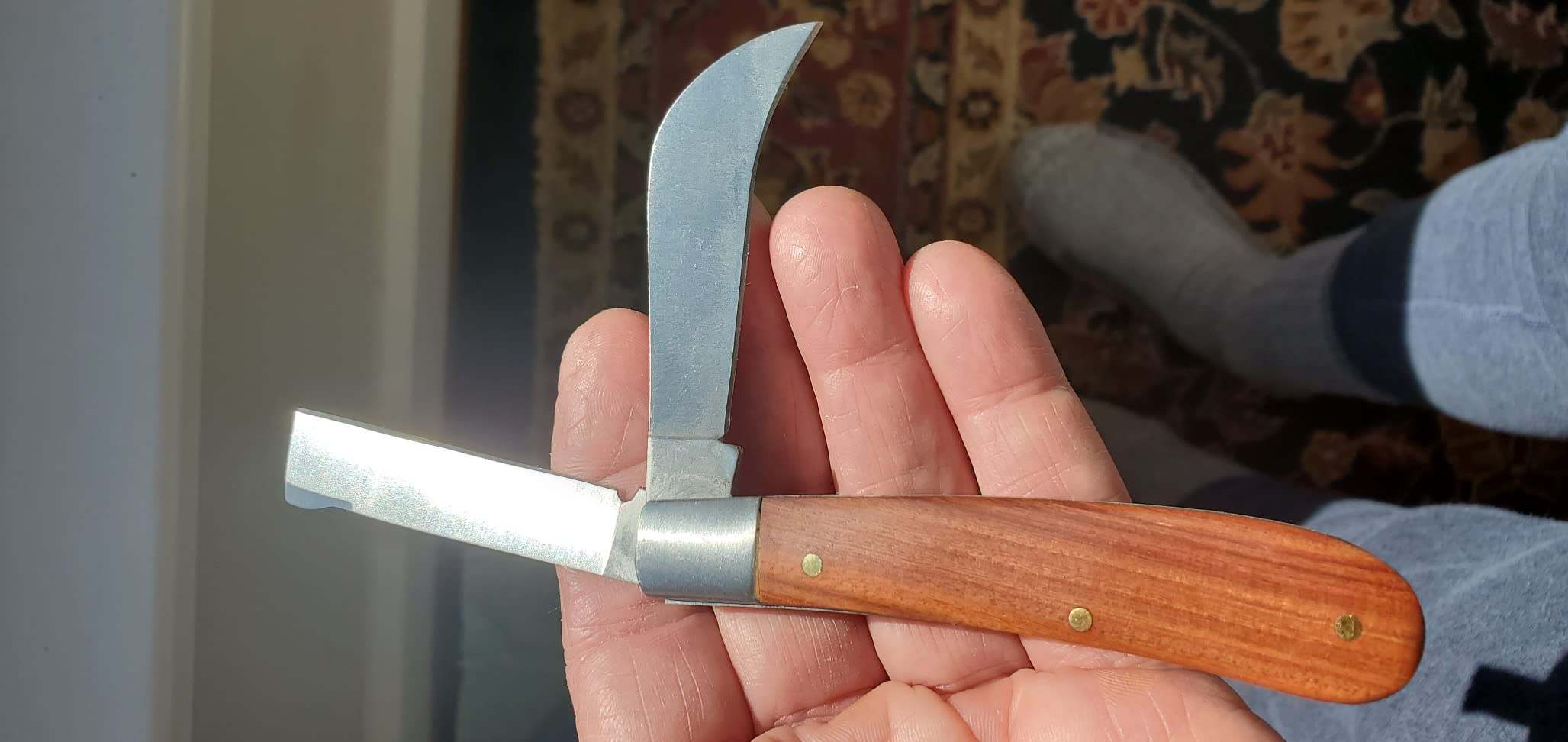
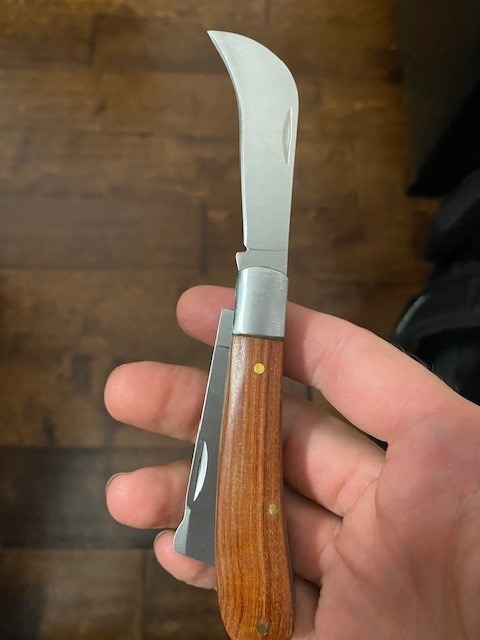
The dual blades cover the two jobs you actually need on a field visit: a curved blade for positioning cuts and a straight blade for splitting and trimming, plus a bark lifter for opening the rootstock without slicing the wood underneath.
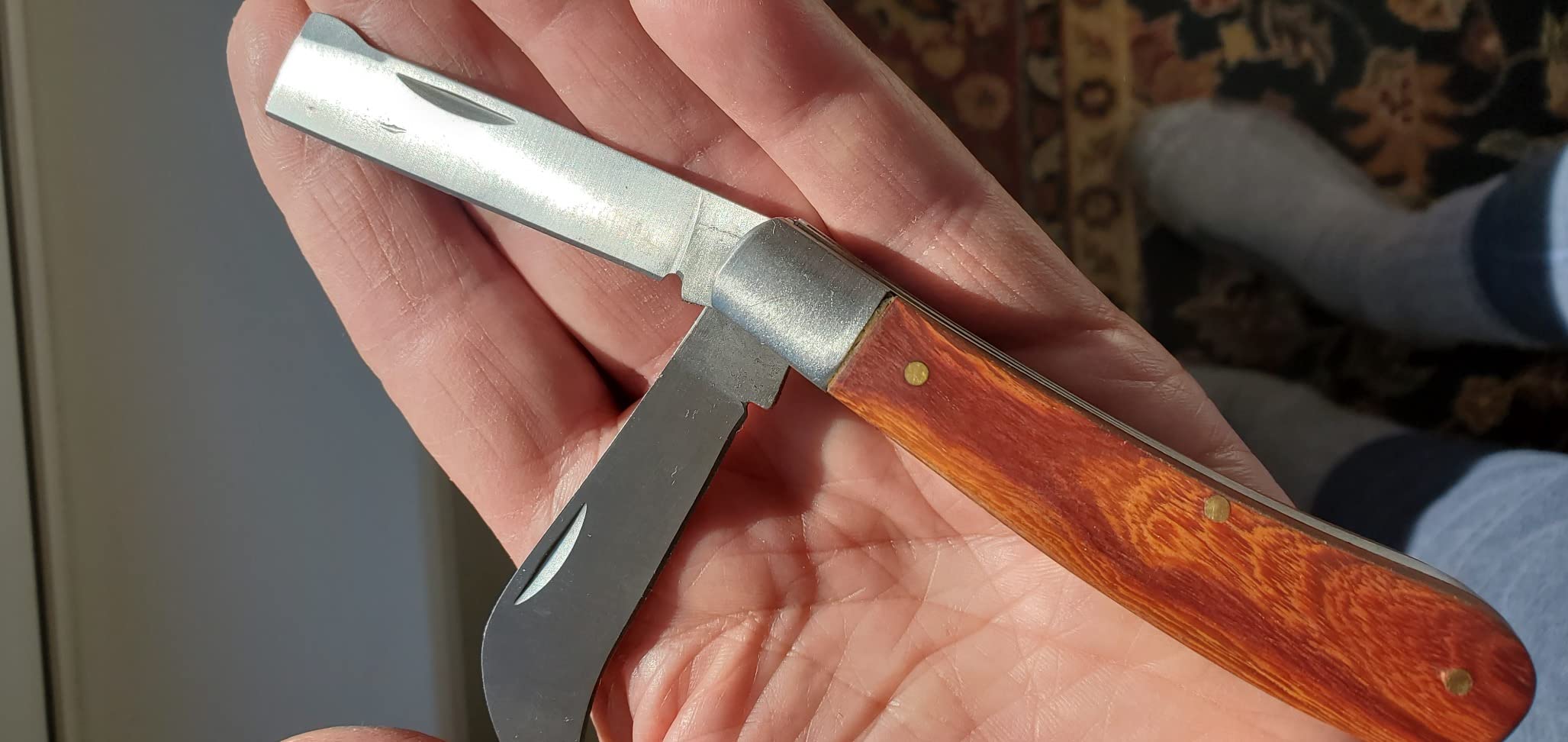
Edge retention is rated highly for fruit tree and rose work, which is notable for a stainless blade in this price bracket. The compound bevel gives you a serviceable single-bevel working edge with enough secondary angle to survive bark and grit.
The rosewood handle is the detail that pays off on a wet February morning. Owners specifically call out that it grips securely when wet and stays comfortable over long sessions, and it is the reason this knife feels like a tool rather than a novelty.
What makes it the field pick
The folding body has a safety lock, so it will not open in a pocket, and at 6.3 inches overall it clips to a toolbelt without snagging. When you are walking twenty potted rootstocks from a greenhouse to an outdoor row, that is worth more than any specification on the box.
It is also multipurpose in a way that matters for small-scale work: mushroom picking, vegetable and fruit picking, and rope cutting all fall inside its remit, so it earns its place even in seasons when you are not grafting.
Where it falls short
Sharpening options are limited for this model. There is no replaceable blade system and no factory resharpening path, so the edge is entirely your problem, which on a 5.5 inch blade takes real skill to put back properly.
The two included tapes are polyethylene film rather than parafilm. Experienced grafters buy their wrap separately and treat the bundled rolls as a convenience for a first session only.
5. PUELDU 3-in-1 Grafting Kit: The Complete Starter Box
Professional Grafting Tool Kit – 3-in-1 Pruner with SK5 Blades, Grafting Knife, Tapes, Labels & Clips – Fruit Tree Grafting Supplies for Apples, Peaches, Grapes (Gardening Grafting Tools)
SK5 high carbon steel at HRC 58-60
Cuts to 1/2 inch diameter
32 ft tape and 30 labels
3 interchangeable blades
Pros
- Sharp knife and pruner making clean incisions with tape that holds moisture
- Genuinely complete set with knife pruner tape labels and reusable clips
- Clips and tags let you label and secure each graft
- Good value for assembling a first starter kit
Cons
- Wrapping grafts with the supplied tape is awkward for beginners
- Build quality is basic and some buyers rate it as not premium
- Some grafts failed even though the cuts themselves worked
If you are buying your first grafting setup, this is the box that stops you making three separate orders. It contains a bypass pruner with SK5 high-carbon blades rated HRC 58-60, a curved and straight grafting knife in 420J2 stainless with a walnut handle, 32 feet of self-adhesive tape, 30 plant labels, and six reusable clips.
Those six reusable clips are the underrated part. On a graft union, mechanical support takes pressure off the cambium alignment while the tape handles sealing, and clip-and-tape is far easier for a beginner to do one-handed than a full spiral wrap.
The pruner carries three interchangeable double-edged blades with a nano-coating intended to resist sap buildup and a V-groove design for cleaner cuts. It handles branches up to half an inch, which is the widest capacity in this roundup.
Reviewers consistently praise the sharpness of both the knife and the pruner, and the tape’s stretch and moisture retention. A five-year blade warranty and an illustrated grafting guide are included, which is unusual at this level.
What you actually need on day one
This kit maps almost exactly onto the essentials list: a sharp grafting knife, a cutting tool for sizing stock, wrap, labels, and clips. The labels matter because graft records are how you avoid re-grafting a variety that already failed.
Beginners are often directed to cleft grafting rather than whip and tongue because the surfaces are bigger and easier to align, and a bypass pruner plus clips is a comfortable way to hold that union together while it calluses.
Where it falls short
The criticism that comes up most is practical rather than quality related: wrapping grafts with the supplied tape is awkward for newcomers, because both hands are already occupied holding the union together. Buy the clips, use them, and do not fight the tape.
Construction is basic for the price and some owners rate it as not premium, and a few report grafts failing even when the cuts themselves looked right, which usually points to timing or moisture rather than the tool. At 0.84 kg it is also a heavy kit for a single afternoon of practice.
6. KREWEY 2-in-1 Grafting Pruner Kit: The Entry-Level Shear
Krewey 2-in-1 Garden Grafting Tools Pruner Kit, V-Graft Omega-Graft and U-Graft, Plant Branch Vine Fruit Tree Cutting Tool Kits Scissors
High carbon steel shear blades
5-12 mm grafting diameter
3 replaceable blades
Oiled blade surface
Pros
- Lowest cost full pruner kit in this roundup with three cut styles
- Makes clean cuts with minimal crushing once sharpened
- Useful for bonsai propagation and small fruit tree branches
- Blade changes are quick so you can match cut style to the job
Cons
- Blades are not sharp enough out of the box and bruise stems
- One buyer reported 20 consecutive grafts failing with this tool
- Parts feel loose and cheap after a few uses
- No instructions in the package
This is the cheapest complete pruner kit here, with the same three replaceable profile blades you would find on pricier two-in-one tools. It handles 5 to 12 mm stock, which sits slightly below the Glarks range, and the blades are oiled at the factory to slow rust.
Used correctly on thin wood it does the job. Once sharpened, reviewers report clean cuts with minimal crushing, and it is a genuinely useful tool for bonsai propagation and small fruit tree branches where a larger frame simply will not fit.
The problem is factory sharpness. Multiple buyers report that the blades arrive not sharp enough and bruise stems rather than cutting them cleanly, and that sharpness fades early so later cuts no longer match the listing photos. That matters here, because a bruised cambium does not callus.
There is also a hard failure report in the reviews: one buyer grafted twenty times with this tool and all twenty failed. Parts feeling loose after a few uses is the likely mechanism, and no instructions in the package means nobody is there to tell you the correct blade tension.
Our advice is simple. If you buy it, hone both blades on a whetstone before your first real tree and check the blade fit after every ten cuts.
Where it earns its place
It is a cheap way into mechanical grafting, and the three profiles plus quick blade changes let you try V, U, and Omega cuts without buying three tools. For someone experimenting on a handful of bonsai or seedling stock, the cost of a mistake is low enough to accept.
The anvil-type body and high carbon steel shear blades also mean the pruning half is a working bypass pruner for light orchard tidying, not just a grafting gimmick.
Where it falls short
Sharpness out of the box is the dealbreaker for anyone grafting a variety they care about. Sharpen first, and if you have never sharpened a blade before, learn on this tool rather than on a scion.
At 0.77 kg it is not noticeably lighter than costlier kits, so you are not saving weight. If your scion wood is anything like hardwood, the cheap consumable blades will not survive it.
7. MIDOUWEST Rosewood Grafting Knife: The Highest Rated Blade
MIDOUWEST Garden Grafting knife,Stainless Steel Double Blades Rosewood Handle Pruning Knife,3 Grafting Tape Buddy Tape for Fruit Trees,Gardening Grafting Tool
2CR13 stainless curved and straight blades
Bark lifter and rosewood handle
3 grafting tape widths
Folding pocket format
Pros
- Highest average rating in the group at 4.5 stars with very few one-star reviews
- Three tape widths with the wide film singled out as most useful
- Clear tape works well for first-time grafting of crabapple
- Rosewood handle is comfortable and the curved blade makes tidy slices
Cons
- 2CR13 needs frequent sharpening and some sharpen after every use
- Can crush branches around 1/4 inch rather than cutting them
- Thin green tape breaks easily and does not cling
- Struggles with hardened old wood
This knife carries the highest average rating in the entire roundup at 4.5 stars, with 69% of reviews at five stars and only 1% at one. The blades are 2CR13 high-hardness stainless in curved and straight formats with a bark lifter, and the handle is rosewood.
For apple and crabapple work in particular, the clear tape in this kit gets singled out repeatedly. Reviewers mention first-time grafting of crabapple specifically, and clear film is easier than coloured film for seeing whether a bud has pushed through.
The curved blade makes tidy slices on scion wood, which is exactly what a whip and tongue graft needs for a long sloping taper. It is the one knife here reviewers describe as equally good for hobby grafting and air layering, and it is a folding pocket knife at 12.16 ounces, so it goes out to the tree with you.
Three tape widths in different flexibilities are included, which is more choice than most kits at this level give you. Two of the three are described as genuinely useful.
What the rating is telling you
The 4.5 comes with a very small one-star share, which in a category this thin usually means people are not being let down. Buyers call it sharp, well finished, and attractive, which for a rosewood-handled tool matters when it lives in a pocket.
The bark lifter is what makes it work for budding as well as grafting. Opening the bark on a T-bud with a knife edge risks slicing into wood, and a lifter at the heel lets you peel instead.
Where it falls short
2CR13 steel is the trade-off. It needs frequent sharpening, and at least one user sharpens after every use. On branches around a quarter inch the straight blade can crush rather than cut, and it struggles with hardened old wood such as dead limbs.
One of the three tapes, the thin green film, breaks easily and does not cling well. Ignore it, buy a proper roll of grafting tape, and the kit is strong.
8. Mudder Double-Blade Grafting Knife: Most Wrap Material in the Box
Grafting Knife with 2 Grafting Tape for Pruning Budding Fruit Tree Floral
7.9 cm 2Cr13 curved and straight blades
Wood handle at 4 inches
2 rolls of PE film at 131 yards each
Compact 3-piece set
Pros
- Sharp out of the box for a budget knife on budding and layering work
- Two tape widths at about 131 yards each give plenty of material
- Curved blade allows precise cuts where you want them
- Wood handle is comfortable for the size
Cons
- Blades frequently arrive too dull and must be sharpened before use
- Blade design leaves a sharp protrusion that has cut through gloves
- Looks smaller in photos than it actually is
- Some units report average build quality
Two rolls of polyethylene budding film at roughly 131 yards each is generous wrap material for a kit at this level, and it is the reason this one shows up in air layering circles. Air layering wraps a wound along its whole length rather than just sealing a union, so you go through tape faster than any other grafting technique.
The blades are 2Cr13 stainless, curved and straight with different bevels, and the curved one is for accurate position cuts. Blade is about 7.9 cm with a 10.2 cm wooden handle, which makes it a small, quick-handled tool.
Owners like the value and confirm the knife is sharp for fruit tree and air layering tasks when it works well. The film stretches with plant growth, which is the property that matters for a wrap left on for weeks.
Do not skip the sharpening. Several buyers had to sharpen both blades immediately on arrival, which is the single most cited problem with this knife.
There is also a real safety note here: the blade design leaves a sharp protrusion when the curved blade is open, and that has caused cuts through gloves. Keep the folding body closed when the knife is not in your hand.
Where the tape quantity pays off
Layered wrapping is the community favourite approach for a reason, and this kit supports it out of the box. Wrap the whole scion in film for moisture control, then run a structural tape over the union itself.
The white roll is about 3 cm wide and the green about 2 cm, so you have a width for a pencil-thickness scion and a width for a two-inch air layer wound. That range is more useful than three identical narrow rolls.
Where it falls short
Factory sharpness is the recurring complaint, and a knife that bruises cambium on the first cut is not a bargain at any price. Budget twenty minutes on a whetstone before day one.
It is a polyethylene film, not parafilm, so it must be removed before buds push through. Build quality is average on some units, and the tool looks smaller in photos than it is in the hand.
9. QWORK Folding Grafting Cutter: The Lightest Way In
QWORK Gardening Grafting Cutter, Manual Grafting/Pruning Cutter, Plant/Fruit Tree Budding Tool with 2 Plants Repair Tapes for Floral Fruit Tree
Stainless steel curved and straight blades
Wood handle
Folding self-locking blade
2 rolls of PE grafting tape
Pros
- Lowest cost in the roundup and still reviewed as sharp
- Curved and straight blades cover both slicing and splitting cuts
- Self-locking blade in two positions is handy in the field
- Two tape sizes hold grafts well on new growth
Cons
- Blade does not close all the way and stays partly open
- Supplied tape is plastic film rather than parafilm so it must be removed
- One buyer reported the box arriving already opened
The cheapest tool we tested, and the rating says the money is well spent. Buyers confirm the blades are sharp for budding small branches and that both blades earn their keep rather than one being decoration.
The curved blade is for precise position cuts and the straight blade for cutting and splitting wood, which between them cover a budding season on new growth. The folding body self-locks in two positions, so you can leave it open while working without it spring shut.
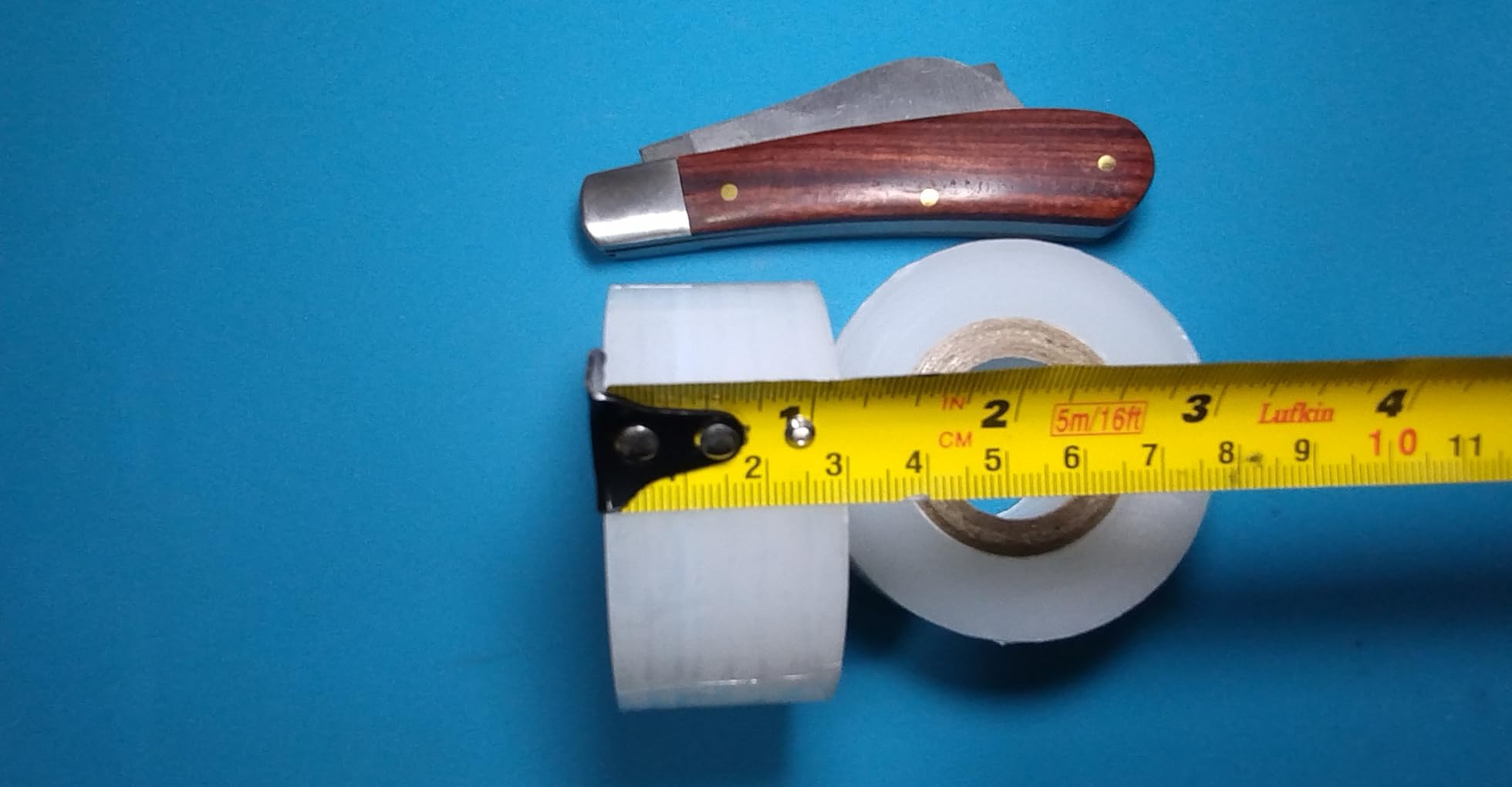
Two tape sizes come in the box and hold grafts well on new growth, which is the relevant test for summer budding rather than winter grafting. Nothing else about it is overbuilt, and that is the point: it does one job at a small cost.
If you are doing T-budding in July on peach, plum, or apple, this is a sensible tool to carry. It is small, it is sharp, and it will not be the limiting factor in your take rate.
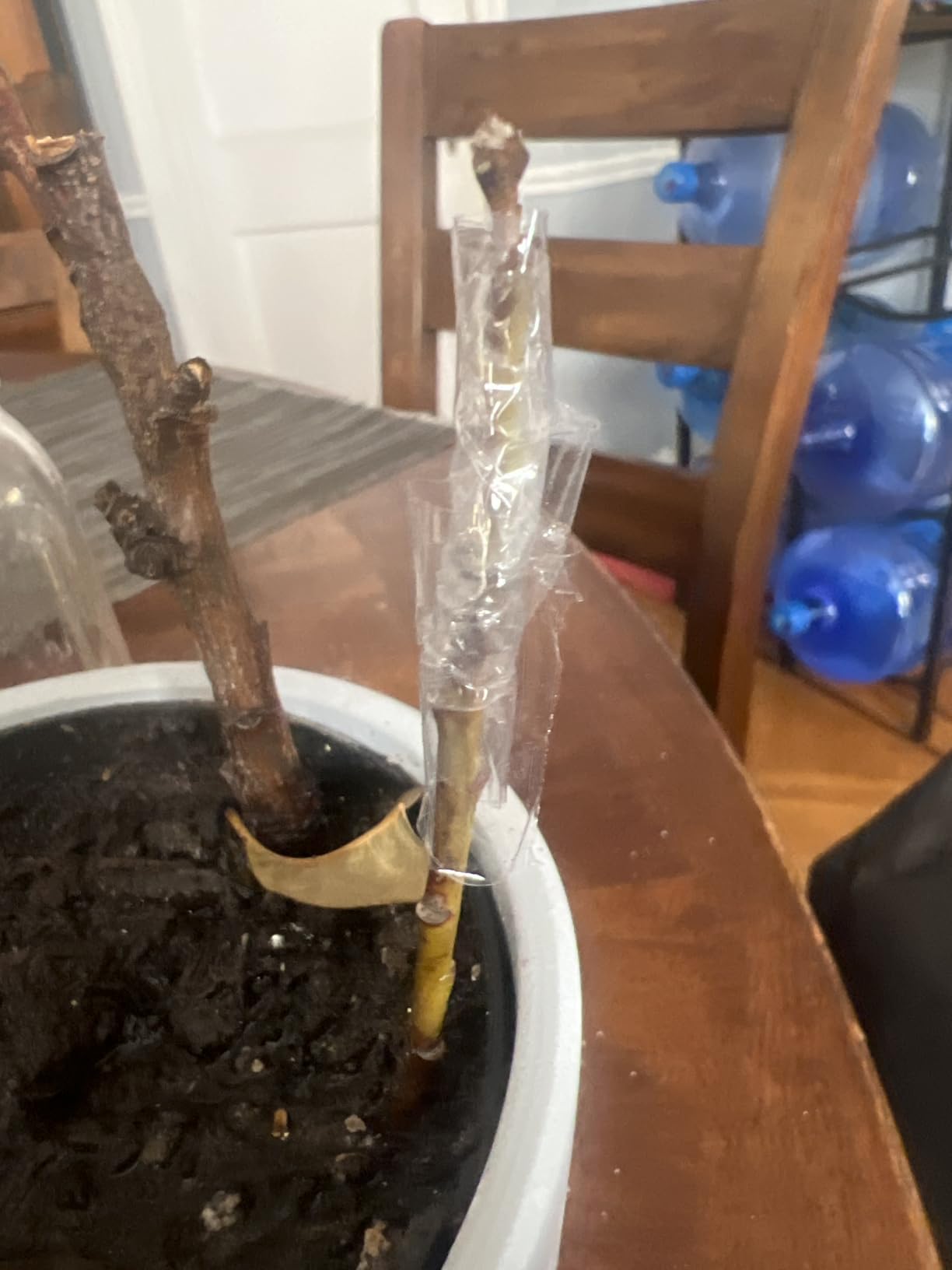
Why it suits summer budding
Budding needs a knife that makes a thin, precise slice for cutting the bud shield, and a compact blade does that better than a heavy pruner. The straight blade also handles the split for inserting the shield on rootstocks that are actively growing.
The two-position self-lock matters outdoors. Most folding knives need to be held or set down carefully, and this one stays put on a folding chair or a fence rail while you cut rootstock.
Where it falls short
The blade does not close all the way and stays partly open, which means it will dull against whatever it sits on and it will not sit flush in a pocket. Several buyers mention this directly.
The bundled tape is plain plastic film rather than parafilm, so it must be peeled off for buds to push through rather than self-sealing. And one buyer received an already-opened box, which is a packaging note worth knowing about.
10. MIDOUWEST 6-Piece Grafting Cutter Kit: The Broadest Range of Cuts
MIDOUWEST Grafting Cutter Kit 6-Piece for Fruit Trees & Vines
SK5 cutter for V Omega and U grafts
1/6 to 1/2 inch diameter
2CR13 grafting knife included
6 pieces at about 1.8 lb
Pros
- Best value all-in-one with a real SK5 cutter plus a knife three tapes and a tie
- SK5 cutter makes clean cuts that promote fast callusing
- Covers V Omega and U cuts so one tool handles most techniques
- Rosewood knife handle is comfortable for detailed trimming
Cons
- Heaviest kit in the roundup at about 1.8 lb
- Tape and wire tie still need proper technique to seal a graft
- Redundant overlap between cutter and knife confuses beginners
This is the only kit here that pairs an SK5 multi-profile cutter with a separate 2CR13 knife, and it is among the most complete packages in the roundup. The cutter handles scion and rootstock from 1/6 to 1/2 inch, matching the capacity of the PUELDU 3-in-1, and produces V, Omega, and U cuts designed to promote callus formation.
Because it cuts both pieces with the same blade at the same depth, the match is close enough that reviewers report clean cuts and fast callusing on 1/6 to 1/2 inch stock. The knife is there for trimming and for the cuts the cutter cannot make.
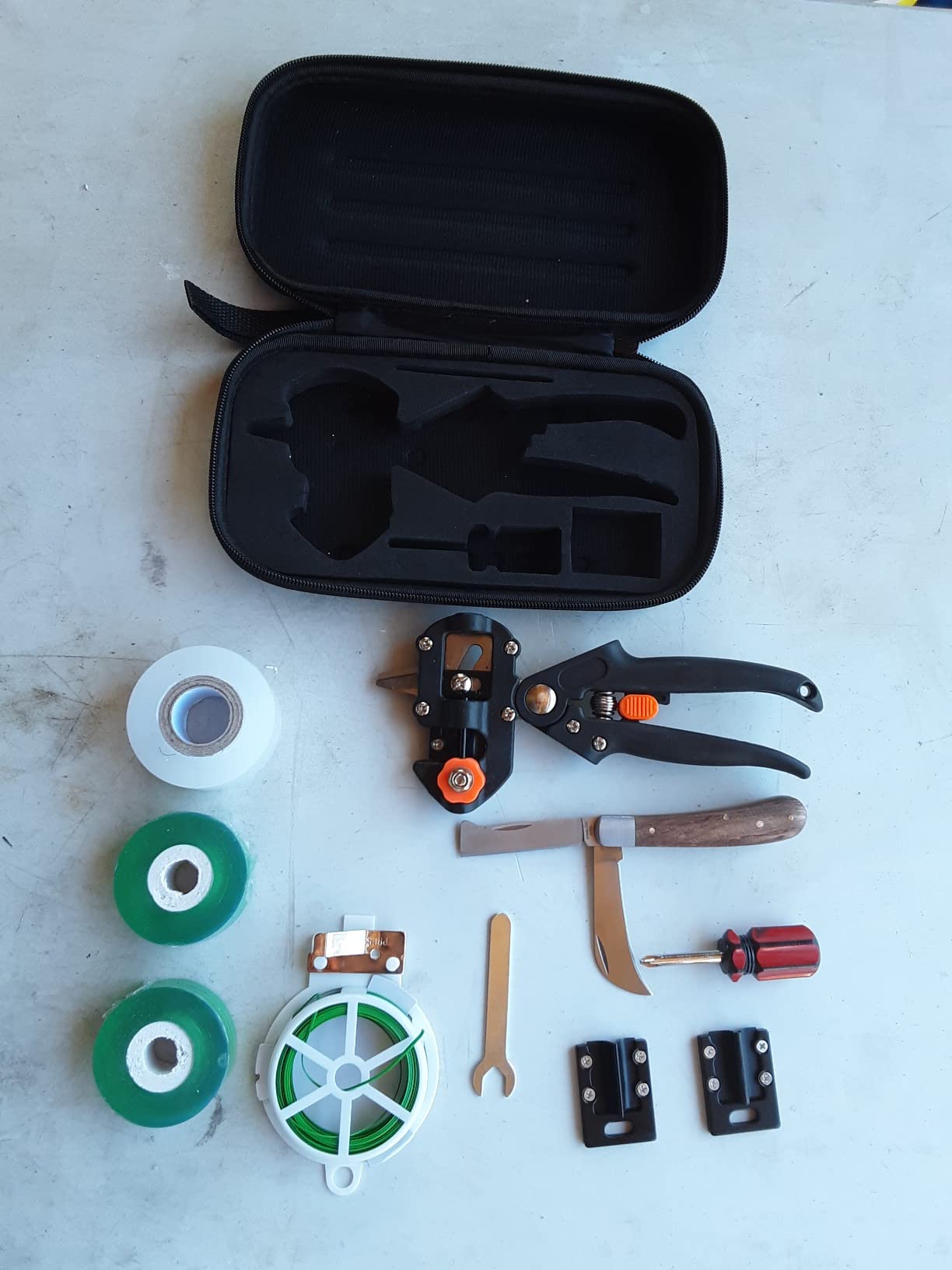
Three rolls of tape and a flexible wire tie come in the box, and the tie is genuinely useful for holding a graft before you have mastered wrapping. Owners rate the rosewood knife handle as comfortable for detailed trimming.
It suits home orchards, nurseries, and propagation work across fruit trees, vegetables, and ornamentals, which is the widest application range of anything here.
When two cutting tools is the right number
There are graft jobs the cutter should not touch. Preparing a rootstock, splitting a thicker limb, or making the long straight taper on a whip are all knife work, and having both removes the temptation to force a mechanical tool past its capacity.
For a grower moving from a dozen grafts to a few hundred, this is a sensible place to grow into. You get the speed of matched cuts on compatible wood and keep the flexibility of a knife on everything else.
Where it falls short
At about 1.8 pounds it is the heaviest kit in the roundup, and that weight sits on your wrist through a full bench session. Owners doing large batches notice the fatigue.
The overlap between the cutter and the knife genuinely confuses beginners, since more than one blade can do a given task. Decide which is for matched-profile cuts and which is for everything else before you start, and tape and wire still need proper technique to seal a union properly.
Why These Are the Best Grafting Tools for Fruit Trees: How to Choose
Start with the answer to the question most asked on this topic: what tools do you need to graft fruit trees? Five things, and nothing else is essential.
A sharp budding or grafting knife. Either a folding double-blade model or a fixed single-bevel blade. This does the actual cutting for whip and tongue, cleft, and bud grafts.
A cutting mat or flat scrap surface. Grafting on a flat board with a blade laid against a straight edge is how you stop a cut going concave.
Grafting tape or parafilm. Parafilm for moisture control, or self-adhesive PE film if you want the cheapest option that works.
Grafting wax or sealant. Optional but useful on larger wounds and in arid climates where film alone loses too much moisture.
Cut-resistant gloves. Worn on the hand at risk. Growers on permies.com give this advice without exception.
What you do not need on day one is a mechanical grafter. That is the mistake most beginners make, and it costs them money and confidence for nothing.
The diameter-match rule
A mechanical grafting shear cuts a fixed profile into both pieces in one squeeze. That is only possible if the scion and the rootstock are close to the same diameter. A grower on permies.com put it plainly, explaining that most such tools require a very close match in rootstock and scion diameter to work, which is fine for large commercial operations controlling their own sizes but poses problems for the smaller mixed orders an individual typically receives.
This is the single most decision-relevant fact in the category, and almost no retailer tells you. If you buy scion wood from a collector or a mail-order nursery in assorted varieties, a multi-graft pruner will frustrate you. If you propagate one variety of one fruit on uniform rootstock, it will change your season.
Our rule: use a knife unless your rootstock and scion come from the same source and are sized alike. Check the capacity figure on the tool against your actual wood before you buy, not after.
The 100-graft threshold
The number nobody publishes. A grower who did 100 grafts in year one and 1,000 in year two said the same mechanical tool works great and would be recommended over a knife if you are doing 100. That is the crossover point, and it is lower than the marketing implies.
Below 100 grafts a season, a sharp knife is cheaper, more flexible, tolerant of mismatched diameters, and able to make every graft type. Above 100, the shear earns its price through speed and repeatability. Another grower reported moving from dismal results by hand to a 98% success rate after switching to a mechanical tool, though he also left only three buds on the stock and grew grafts in pots for a year, so the tool was not the only variable.
And be honest about the top end. Premium grafting machines at the very top of the price range draw the loudest price objection in the forum record, with comments like the price scared me off and it makes my two-dollar box cutter look great. For most home growers they are not worth it.
Knife or shear: the honest comparison
A knife is cheap, portable, makes every graft type, and tolerates any diameter. It demands practice and it carries a real cut risk, which is why gloves are not optional.
A shear is fast, needs far less skill, and produces matched faces with almost no fitting. It constrains diameter, costs more per unit, and needs consumable blades. It also cannot do a bud shield or a long freehand taper.
Choose a knife for under 100 grafts, for mixed-size wood, and for budding. Choose a shear for uniform stock over 100 grafts, bench work, and matched V, U, or Omega profiles.
Matching the tool to your graft type
Whip and tongue needs a knife. The long sloping taper on both pieces is cut freehand or against a guide, and no mechanical cutter in this roundup produces a tongue. Cleft grafting also favours a knife, since you are splitting the stock with a blade and inserting a wedge-shaped scion. Beginners are commonly steered toward cleft first because the surfaces are larger and easier to align.
T-budding and patch budding need a knife with a bark lifter, because the cut needs to be a thin slice rather than a slice and a split. Budding in summer is knife work across the board.
V, U, and Omega grafts are where mechanical shears earn their place, since both pieces are cut to a complementary profile by the same blade. Bench grafting hundreds of rootstocks is the same argument at larger scale.
Top-working a mature tree with thick limbs is knife work on the cut and scion preparation, then shear or clip for holding the union. Nothing in this roundup cuts the branch itself; that is a saw job.
Reading a blade specification
Steel matters less than geometry, but it is not irrelevant. 5Cr and 2Cr13 are budget stainless steels that stay rust-resistant and sharpen easily but lose an edge quickly on hardwood. SK5 is Japanese high-carbon steel at roughly HRC 58-60 and holds its edge considerably longer, which is why it shows up in the premium picks here.
Single bevel gives the flattest cut on a stock surface. Double bevel makes two matching faces but leaves a small ledge, which is wrong for some flat cuts and is exactly the complaint levelled at the NAYE straight blade.
Blade thickness is the anti-concavity metric. Thin flexible blades deflect and give you a scooped cut, which is precisely the complaint raised against flimsy utility blades. A thicker, stiffer blade held against a flat guide beats a premium steel blade used freehand.
Timing your purchase
Grafting happens in late winter to early spring during dormancy, before bud break. That is why classes are not running when a beginner first searches for them, as one grower explained, and why the same answer was to order rootstock while the season is wrong.
So order tools and rootstock in late summer or autumn for the following dormant window. Grafting tape can go on the same order. Buying a grafter in January means grafting in the wrong season on wood that will not take.
Grafting Tape, Wax, and Wrap Accessories
What is the best type of grafting tape for fruit trees? It depends on the job you are doing, and the honest answer is that the wrap matters as much as the cut.
Self-adhesive stretchy film. Cheap, widely available, and the film bundled with most of the knives in this roundup. It works, but it does not self-seal and it has to be peeled off before buds push through, or it can strangle the union.
Parafilm. The best moisture control of the three because it stretches with the growing scion and seals itself as it tightens. It is the standard recommendation when you want one material to do the whole job, and experienced grafters on permies.com use it over the entire scion rather than just the union.
Grafting wax. The best option for arid climates and for large wounds, since it holds moisture without needing tension. The tradeoff is that it does not stretch, so it cannot follow a thickening scion.
The method most growers converge on is layered: parafilm over the whole scion for moisture control, then standard tape over the graft union itself for structural hold. Whichever you choose, the wrap’s job is to hold the cambium aligned and stop the wood from drying out. That is why many kits here include six reusable clips, which handle the structural half of the job while the tape does the sealing.
Do not evaluate a tool by the wrap that ships in its box. Four of the ten knives and shears here include plain polyethylene film rather than parafilm, which is the most common disappointment buyers report.
Grafting Tool Safety and Sharpening Basics
Cutting tools and blades are the one part of this job where carelessness has consequences, and the safety advice in grower discussions is simple enough to follow.
Wear thick cut-resistant gloves on the hand at risk. Not on both hands, which makes the cut worse, but on the supporting hand. Multiple buyers of folding knives here warn that blades are sharp enough to cause injury without gloves, and one reports cuts through gloves from a blade design that leaves a sharp protrusion when open.
Cut away from your body and keep the non-cutting hand behind the blade rather than around it. Let gravity do the work: a blade drawn toward you with your fingers supporting the stock is the combination that produces the hand injury everyone warns about.
Keep blades closed and locked when they are not in use, and do not put a folding grafting knife in a pocket with the blade partly open. Two tools in this roundup have that partly-open design, which is convenient in the field and a nuisance in a jacket pocket.
Sanitize between cuts, particularly between different fruit species. Sap carries fungal and bacterial problems from tree to tree, and this is one of the few pieces of nursery guidance that barely appears in consumer writing. Wipe the blade with alcohol between trees.
Clean sap off immediately. Dried sap is abrasive and it will dull an edge faster than the wood will, so a wipe with a rag at the end of every grafting session does more for edge retention than any steel choice.
On sharpening, the routine that works is: hone on a fine stone before every session, strop on leather after every session to realign the edge, and do a full sharpen on a medium whetstone only when the edge actually rolls over. That last case is the hard-wood problem several owners here describe, where a fine edge bends over after about a dozen cuts on dense scion wood. When it happens, change the edge angle slightly rather than just sharpening harder, and consider a thicker-bladed tool for that species.
Frequently Asked Questions
What tools do you need to graft fruit trees?
Five essentials: a sharp budding or grafting knife for the actual cuts, a flat cutting surface or board to keep cuts straight, grafting tape or parafilm to seal the union, grafting wax for larger wounds or dry climates, and cut-resistant gloves for the hand at risk. A mechanical grafting shear is optional and only worthwhile above roughly 100 grafts per season.
What is the best grafting tool?
For most home growers, a sharp folding budding knife with a curved blade and a bark lifter. It handles every graft type, tolerates mismatched rootstock and scion diameters, and costs little. Mechanical grafting shears only earn their price above roughly 100 grafts per season, when the speed and matched cuts start to matter more than flexibility.
What is the best knife for grafting?
Look for a thin but rigid blade, ideally around 2.5 to 3 inches, with a single bevel on the side used for stock cuts and a bark lifter at the heel for budding. Stainless or high-carbon steel both work. Our top pick is a folding 5Cr stainless model that is sharp out of the box, though any of these ten that you keep sharp will outperform a dull premium blade.
How to choose a grafting knife?
Check six things: bevel geometry, blade thickness and rigidity, steel type, edge retention on hardwood, grip and handle comfort, and whether sharpening or replacement blades are available. Thickness matters more than brand, since a thin blade flexes and leaves a concave cut that fails to callus. Always confirm whether the straight blade is single or double bevel, because a double bevel leaves a ledge that is wrong for flat graft cuts.
What is a professional grafting knife?
Define it by construction rather than price: a fixed or folding blade, stainless or high-carbon steel with defined bevel geometry, a defined grind angle, a scabbard or sheath, and a manufacturer or orchard-supplier brand. Most professional labels are marketing. A well-maintained folding knife from this roundup will outperform a neglected expensive one every season.
Are grafting shears better than a knife?
Neither is better overall. Shears are faster and need far less skill, but they require rootstock and scion of near-identical diameter and only make matched V, U, or Omega cuts. A knife is cheaper, makes every graft type, tolerates any wood size, and handles budding, but it takes practice and carries a cut risk. Below about 100 grafts a season, use a knife.
Do I need a grafting machine, or is a knife enough?
A knife is enough for almost every home grower. Mechanical grafters and grafting machines pay off above roughly 100 grafts per season, where matched cuts speed the work and reduce waste, and they require closely matched diameters to function at all. Premium grafting machines at the top of the price range are not worth it for most home growers.
What time of year should I graft fruit trees?
Graft in late winter to early spring while the trees are dormant and before bud break. Order your rootstock and tools in late summer or autumn instead, because grafting season is when classes run and when suppliers have stock ready. Grafting out of season puts wood into the ground that will not callus, and no tool fixes that.
What is the best type of grafting tape for fruit trees?
Parafilm gives the best moisture control because it stretches with the scion and self-seals. Self-adhesive stretchy PE film is the cheapest option and widely available, but it does not self-seal and must be removed before buds push through. Grafting wax suits dry climates and large wounds but cannot stretch with a thickening scion. A common method is parafilm over the whole scion with standard tape over the union.
How do I keep a grafting knife sharp?
Hone on a fine stone before every session, strop on leather after each session to realign the edge, and do a full sharpen on a medium whetstone only when the edge rolls over. Wipe sap off blades immediately after use, since dried sap dulls an edge faster than the wood does. On dense scion wood, change the edge angle slightly rather than just sharpening harder.
Conclusion
The best grafting tools for fruit trees for most people is a sharp folding knife, and the best one in this roundup for a collector or small nursery is the Glarks pruner kit, because it cuts matched profiles and reported take rates above 90% on the crops people actually grow.
Pick this way. Grafting a dozen apple or pear trees a year, working from mixed-size scion wood, or budding in summer: buy a folding knife with a bark lifter, and sharpen it before your first tree. Propagating one variety on uniform rootstock past about 100 grafts a season: buy a multi-graft shear, and check its stated diameter range against your actual wood first. Building a first kit without three separate orders: the PUELDU 3-in-1 box covers knife, pruner, tape, labels, and clips in one place.
Whichever you choose, order it in late summer or autumn, practice on branches cut to matching length before you touch a real variety, and keep the blade clean of sap. That last habit does more for your take rate than any feature on this list.