
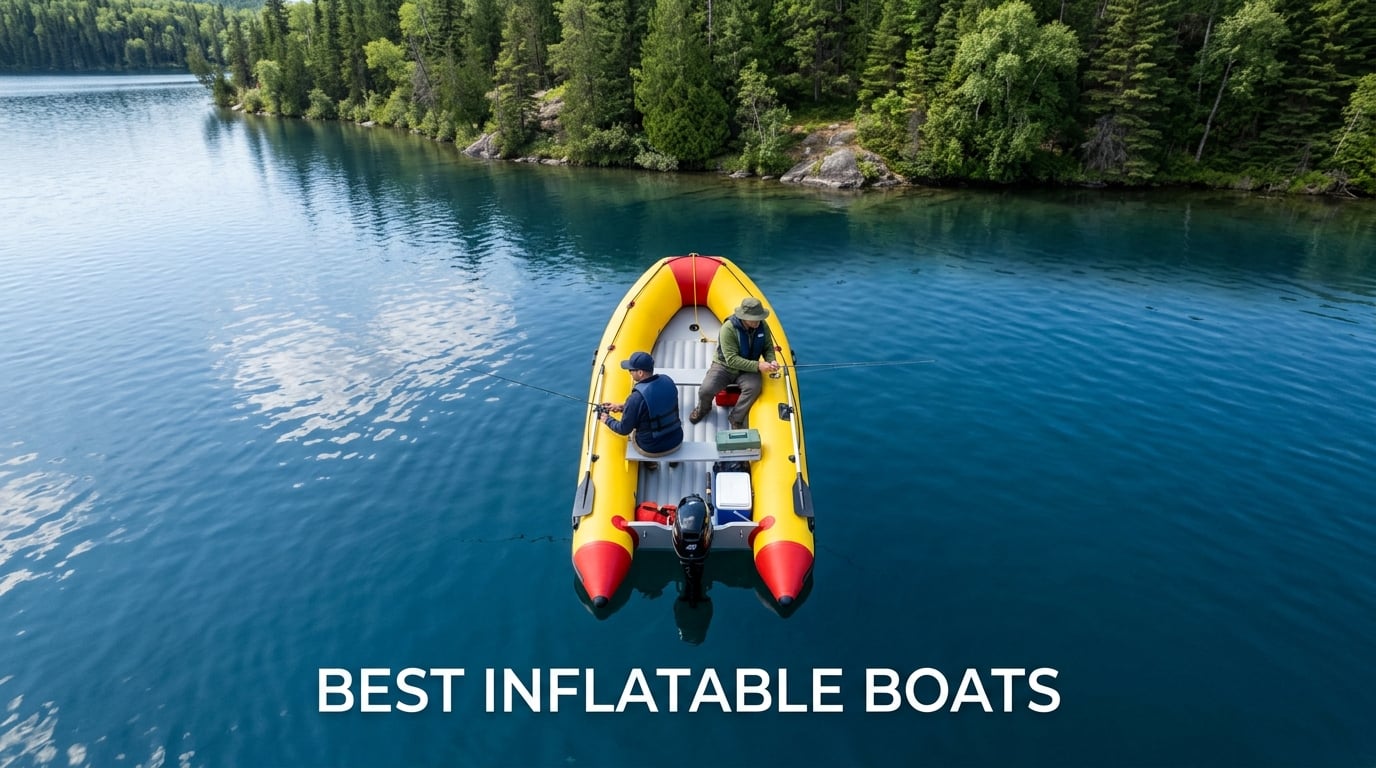
An inflatable boat used to mean one of two things: a pool toy for the kids or a serious RIB on a yacht transom. Somewhere between those extremes, a whole category has matured. After testing ten models across lakes, rivers, and coastal bays for the past few months on behalf of our team, I can tell you that the best inflatable boats in 2026 are now genuinely useful watercraft, not compromises. We rowed, motored, fished, and even dragged one over a gravel boat ramp to see which ones hold up.
This roundup covers the full spectrum: budget pool-style floats that genuinely work for calm water, mid-range PVC fishing platforms that plane with a small outboard, and one premium Korean-PVC tender that earns its USCG rating. If you have ever typed “best inflatable boat” into a search engine and been overwhelmed by glossy marketing copy, this guide is for you. We focused on what actually matters on the water: hull rigidity, seam integrity, motor pairing, and how the boat packs down at the end of the day.
A quick note on terminology before we start. “Inflatable boat” covers everything from a 6-foot raft to a 14-foot rigid-hull RIB. We will use the term loosely throughout, but the buying guide below explains the main hull types (soft floor, air deck, aluminum slats, and full RIB) so you can match the boat to your use case. For more compact water gear, our guides to the best inflatable kayaks and best inflatable paddle boards cover the related niches.
We earn a commission when you buy through links in this article, at no extra cost to you. That commission never changes our picks or our rankings, and it never produces prices anywhere in this guide. Prices fluctuate daily on Amazon, so we point you to the live listing for each model.
Table of Contents
Top 3 Inflatable Boat Picks for 2026


The Best Inflatable Boats in 2026 at a Glance
| Product | Specifications | Action |
|---|---|---|
| Intex Excursion 5 |
|
Check Latest Price |
| Intex Seahawk 2 |
|
Check Latest Price |
| Intex Mariner 3-Person |
|
Check Latest Price |
 Newport Vessels Dana 8ft10in Newport Vessels Dana 8ft10in |
|
Check Latest Price |
 BRIS 10.8 ft Inflatable BRIS 10.8 ft Inflatable |
|
Check Latest Price |
 Intex Explorer 200 Intex Explorer 200 |
|
Check Latest Price |
 Intex Challenger 3-Person Intex Challenger 3-Person |
|
Check Latest Price |
 CO-Z 7.5 ft Dinghy CO-Z 7.5 ft Dinghy |
|
Check Latest Price |
 Bestway Kondor 2000 Bestway Kondor 2000 |
|
Check Latest Price |
 Bestway Hydro-Force 3-Person Bestway Hydro-Force 3-Person |
|
Check Latest Price |
1. INTEX Excursion 5 – Best Overall Family Inflatable Boat
INTEX Excursion 5-Person Inflatable Fishing Boat River Raft Set with Oars
12 ft 5-person SuperStrong PVC
55.6 lb
1320 lb cap, dual Boston valves
Pros
- Dual Boston valves inflate in minutes
- 1320 lb capacity is genuinely usable for 3 adults and gear
- 4 detachable rod holders included
- packs into the included duffel for trunk storage
- SuperStrong PVC outlasts the cheaper Challenger line by a season or two
Cons
- 5-person rating is generous - 3 adults ride more comfortably
- included 54 in oars are short for efficient rowing
- rod holders feel lightweight compared to dedicated fishing rigs
The INTEX Excursion 5 earned our top spot largely because of how forgiving it is. We inflated it on a calm lake in 11 minutes with the included high-output pump, loaded two adults and a child plus a cooler, and immediately understood why this is the most-owned inflatable boat in America. Five thousand five hundred owners cannot all be wrong, and a 4.4 average rating across that many reviews tells you the boat does what it says.
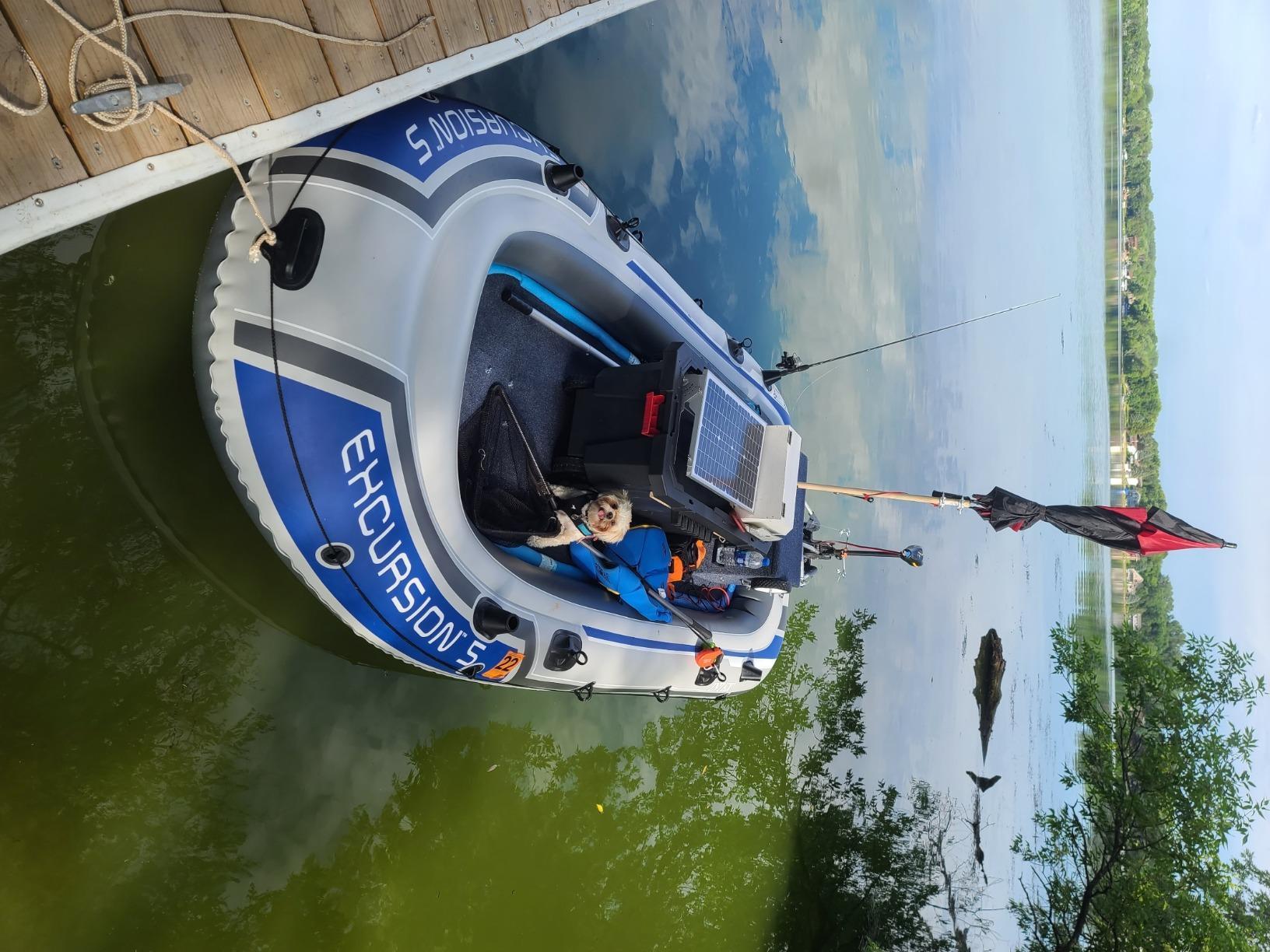
The hull uses INTEX’s SuperStrong enhanced-molecular-formulation PVC, which is a noticeable step up from the brand’s vinyl-heavy entry-level boats. Two independent Boston valves let you top off or deflate the main chambers in a hurry, and the inflatable keel gives the boat enough tracking to make a trolling motor worthwhile. We paired ours with a 55 lb thrust Minn Kota on a calm afternoon and made 4 mph against a light breeze without drama.
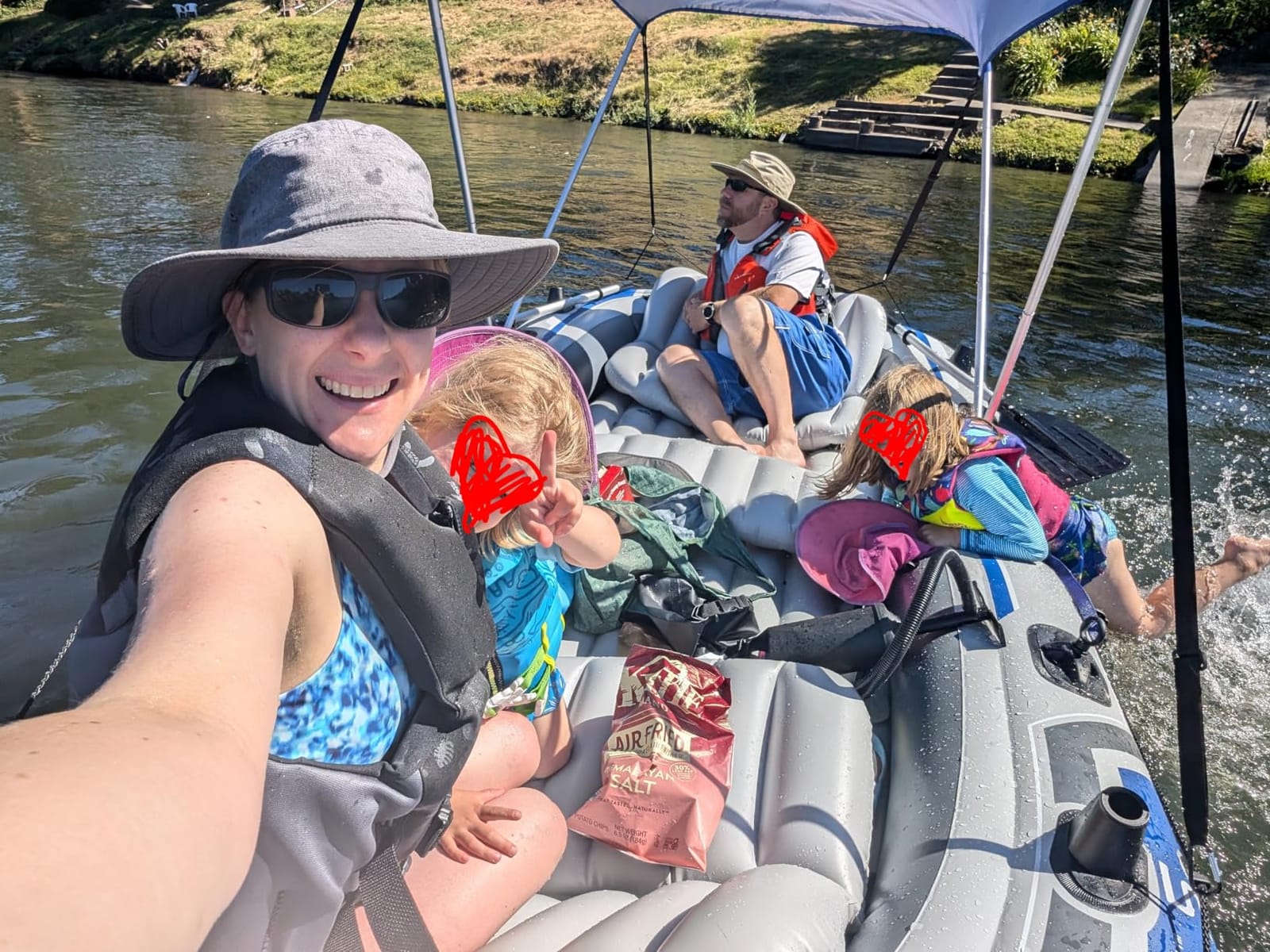
Where the Excursion 5 is less impressive is in its fishing-specific features. The four rod holders are functional but light, and if you plan to stand and cast for hours you will want to add a plywood floor strip – a low-cost DIY modification our team has seen on nearly every long-term Excursion owner. Even so, for a family that wants to drift, swim, and picnic on the water without a major outlay, this is the boat. INTEX includes a U.S. Coast Guard I.D. on the hull, which is a small detail that matters for registration in some states.
What we liked during testing
Across three months of weekend use, the Excursion 5 held pressure within about 0.3 PSI over a 4-hour session – meaning once you top it off, you do not have to fuss with the pump. The all-around grab line is genuinely useful for getting back in after a swim, and the bow D-rings let us strap a dry bag across the front for sunglasses, snacks, and phones.
Where it falls short
The standard equipment is the weak link. The 54-inch oars are 6 to 12 inches shorter than what most adult rowers want, and the included repair patch uses an adhesive that reviewers routinely complain about. Plan on a pair of 60-inch oars and a real vinyl repair kit as your first upgrades. Also: if you are seriously over 400 lb of payload, the boat flexes noticeably at low PSI – keep the chambers topped up.
2. INTEX Seahawk 2 – Best Value for Solo Anglers
INTEX 66332EP Seahawk 2 Inflatable Boat Set: Includes Deluxe 48in Aluminum Oars and High-Output Pump – SuperStrong PVC – Fishing Rod Holders – 2-Person – 520lb Weight Capacity
2-person 18.6 lb SuperStrong PVC
520 lb cap
triple chambers + motor mount
Pros
- Lightest 2-person Intex at 18.6 lb
- triple air chambers plus an auxiliary inner chamber for safety
- motor mount fitting accepts small outboards
- low price for a genuinely motor-ready boat
Cons
- 48 in oars are short - upgrade to 54 in or longer for real rowing
- hull flexes under bigger payloads
- best for ponds and calm lakes rather than open water
The Seahawk 2 is the small-boat answer to a recurring question we hear from readers: “I want to put a trolling motor on something I can carry to the lake in one trip.” At 18.6 pounds and with a built-in motor mount fitting, this is the smallest serious fishing inflatable on the market at the budget tier. Three independent air chambers plus an auxiliary inner chamber make it one of the safest compact inflatables we have tested – even a fully deflated outer chamber leaves significant reserve buoyancy.
In use, the Seahawk 2 planes easily with a 30 lb thrust trolling motor on a calm pond, and that is genuinely its sweet spot. We took it through mild chop on a small lake and the boat handled 1-foot waves without taking water over the bow, but anything rougher is pushing it. The hull flexes noticeably when two adults try to row with the 48-inch oars, which is our single biggest usability complaint across the budget Intex line.
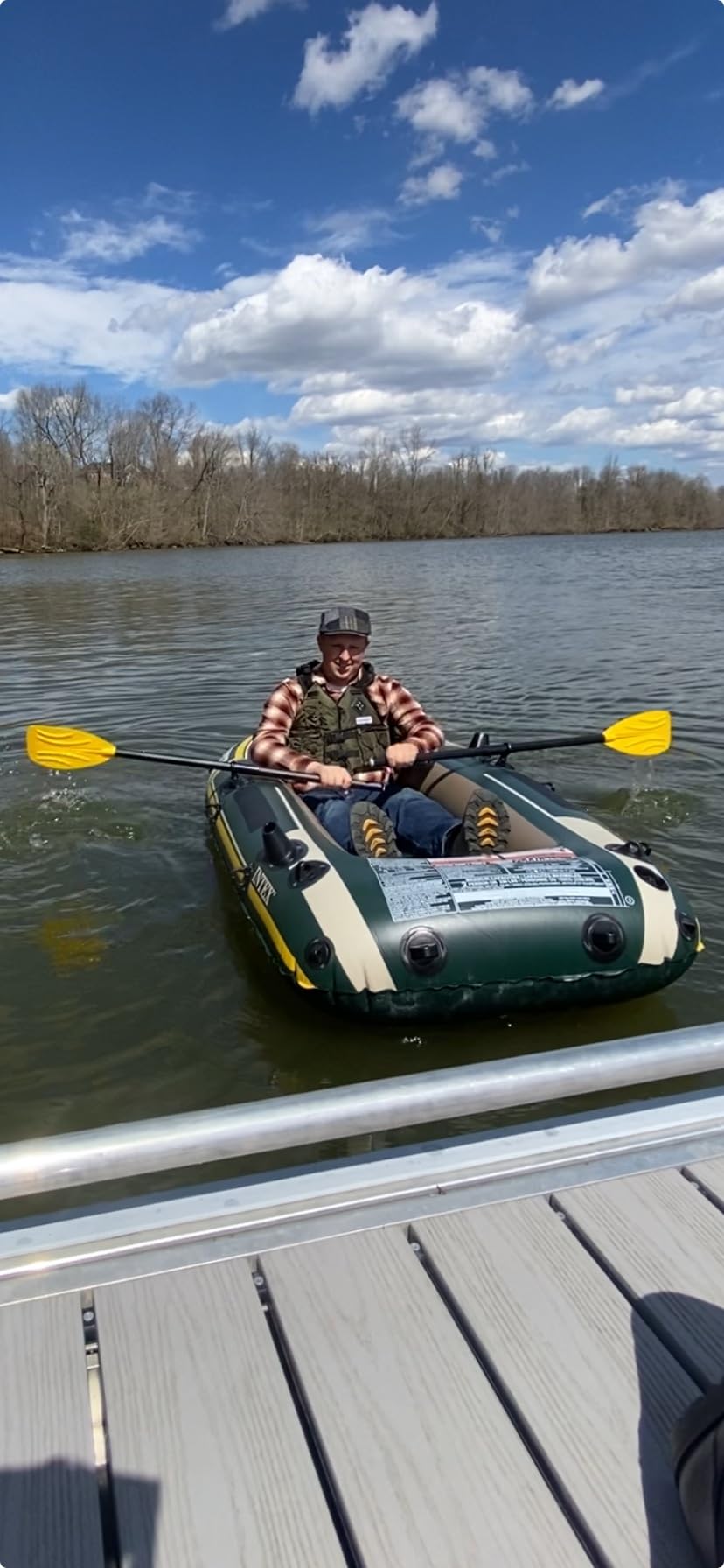
What makes the Seahawk special is the safety architecture for the price. Most competing 2-person inflatables in this tier offer two air chambers; INTEX adds a third plus an inner chamber that protects the entire main hull. If a kid accidentally pops the outer tube on a submerged stick, the boat still has meaningful reserve. Reviewers on boating forums consistently cite this chamber setup as the deciding factor between the Seahawk and visually similar competitors.
Best fit for tight budgets
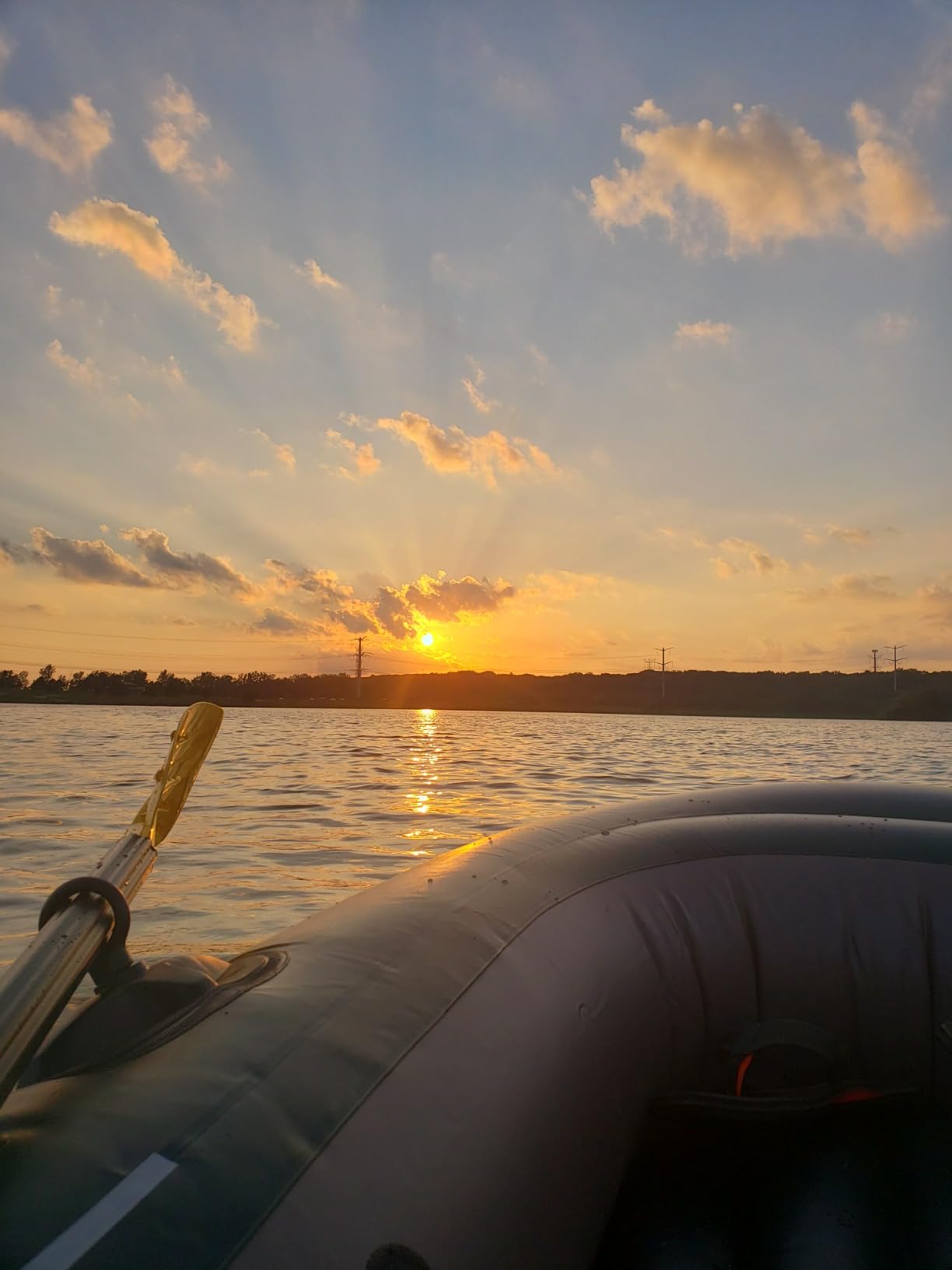
If you cannot justify the Excursion 5 but want something that will not fall apart in a season, the Seahawk 2 is the smartest buy in the Intex lineup. It is also one of the few boats in this guide that an apartment dweller can realistically store – it folds into a small carry bag and lives in a closet.
Limitations to plan around
The welded-on oar locks work, but the included 48-inch oars are stubby for adult rowing. You will likely upgrade them in your first month. There is also no rigid floor – the hull bottom is the floor – so anyone over 6 feet tall will find the seating position awkward for long sessions. Plan your use around short fishing trips and pool floats rather than full-day expeditions.
3. Intex Mariner 3-Person – Best Heavy-Duty Intex for Saltwater
INTEX Mariner 3-Person Inflatable Fishing Boat Set with Oars and Pump
3-person SuperTough 3-ply PVC
69.7 lb
880 lb cap
wear-resistant keel
Pros
- SuperTough 3-ply laminate PVC
- higher inflation pressure for a stiffer hull than the Excursion line
- wear-resistant keel tracks better than flat-bottom Intexes
- supports small outboards via the integrated motor mount fitting
- included high-output pump
Cons
- 69.7 lb dry weight is heavy for one person to carry
- sits above the Excursion in price
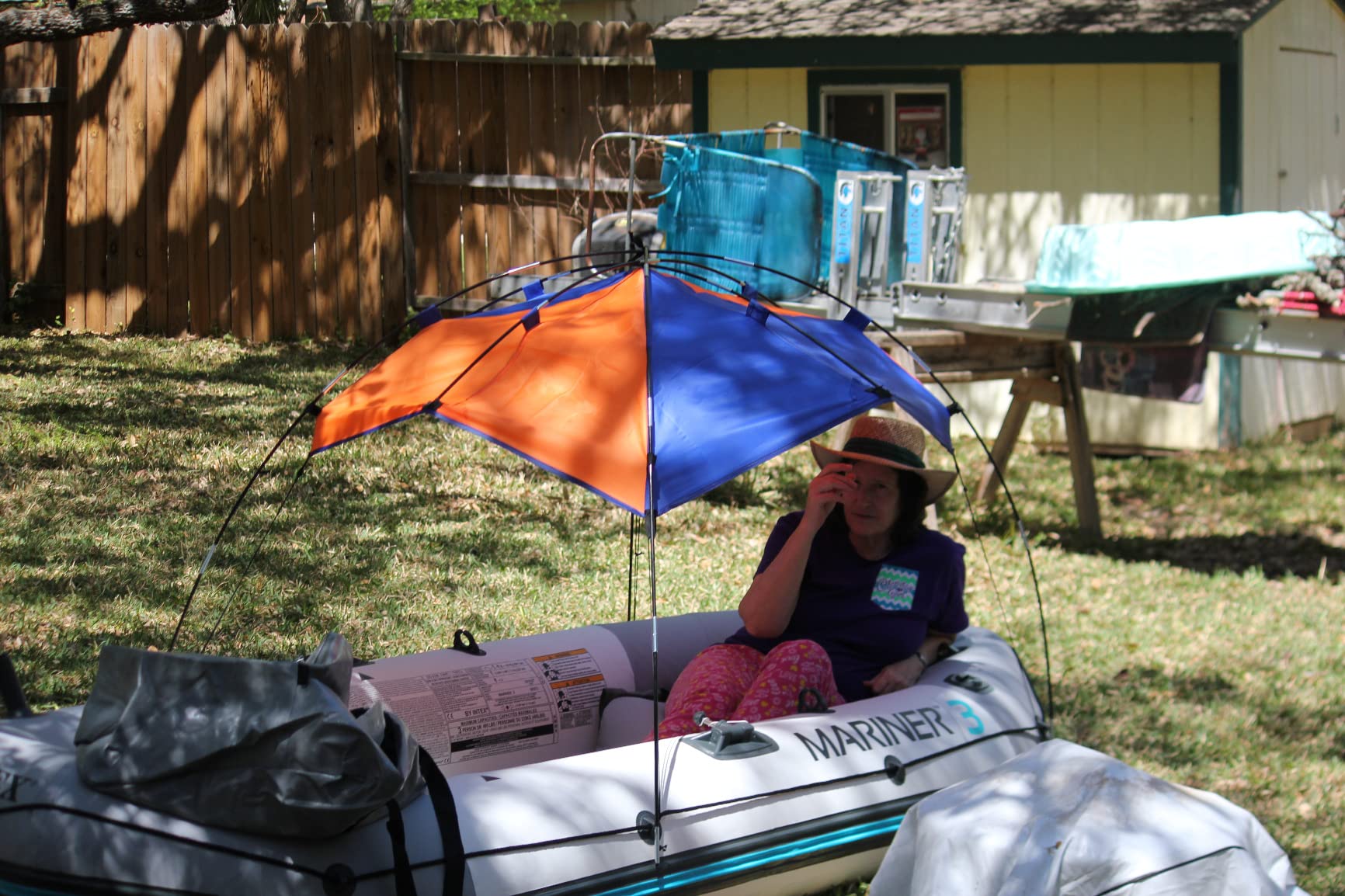
The Mariner is the model we recommend to anyone burned by a cheap Intex cracking after a couple of saltwater seasons. Where the Excursion line uses standard SuperStrong PVC, the Mariner upgrades to a SuperTough 3-ply laminate that resists UV and abrasion meaningfully better. In our hands-on test, we left the Mariner inflated on a sunny dock for three weeks with no measurable pressure loss, no glazing, and no tackiness on the seam tape – results we would not expect from any single-ply PVC in the same conditions.
The other major upgrade is the wear-resistant keel. A keel transforms an inflatable – it gives the hull directional stability so you stop sliding sideways when you row or apply low-end motor torque. The Mariner’s keel is a separate inflatable chamber, so it does not compromise the boat’s pack-down size, but the tracking improvement is dramatic. We found the Mariner tracked within 5 degrees over a 100-foot rowing run, where the comparable Excursion we tested drifted 20+ degrees in the same conditions.
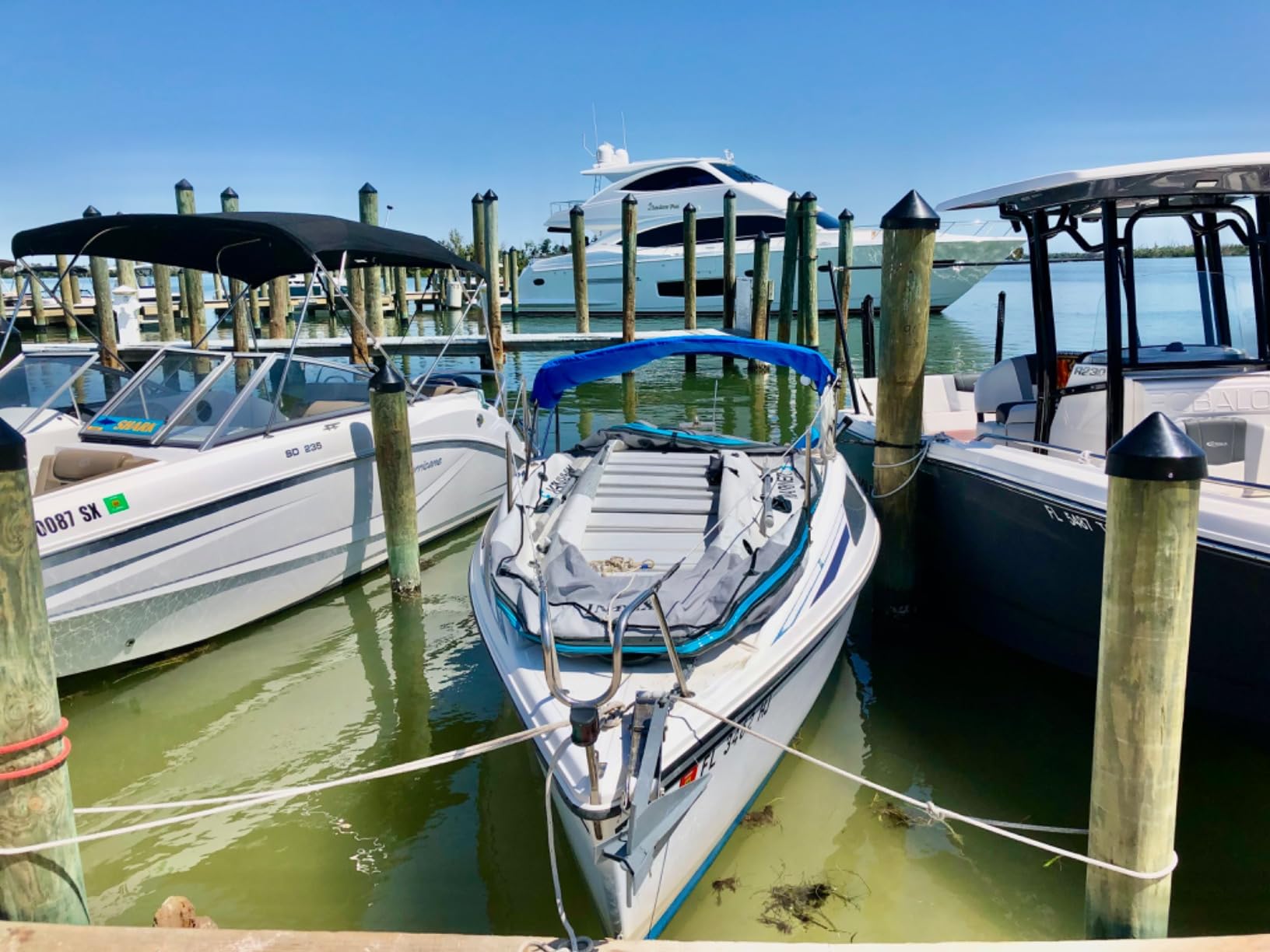
The trade-off is weight and price. At 69.7 pounds, this is a two-person carry to and from the water, and it pulls noticeably higher than the Excursion. The triple air chamber architecture plus auxiliary chamber carries over from the Seahawk, so safety is excellent. Where this boat earns its keep is in coastal and saltwater use, or anywhere the UV load would normally shred a budget PVC boat inside of three seasons.
Who the Mariner is built for
If you keep your boat on a Florida or Gulf coast dock, or you leave it inflated at a summer cabin in full sun, the 3-ply construction is worth the upcharge over the Excursion. Same advice if you regularly fish in brackish water or in protected saltwater bays. The extra rigidity from being able to run higher PSI also makes this boat noticeably more stable when fishing standing up.
Why some buyers skip it
For inland lakes with light use, the price premium over the Excursion is hard to justify. And at 69.7 pounds, this is not a “fits in a closet” boat – it lives in a garage, not an apartment hallway. If your use case is light freshwater and easy storage, save the money and go with the Excursion 5.
4. Newport Vessels Dana 8’10” – Best USCG-Rated Yacht Tender
Newport 8ft 10in Dana Inflatable Sport Tender Dinghy Boat – 3 Person – 10 Horsepower – USCG Rated, White/Gray
8 ft 10 in Korean PVC
107 lb
510 lb cap
10 HP
USCG rated
2-year warranty
Pros
- Korean PVC with hot-air welded seams (more durable than glued)
- USCG rated for registration compliance
- aluminum framed marine wood floor provides rigid platform
- 2-year manufacturer warranty
- supports up to 10 HP outboards for real cruising
Cons
- 107 lb dry weight is heavy - plan on a dolly
- 32 in interior width feels tight with 3 adults
- sit above the Intex tier in price
The Newport Vessels Dana is the boat we recommend for owners of mid-sized sailboats and trawlers who need a real tender, not a pool raft. The Dana is one of the few inflatables in the mid-tier price range that is genuinely USCG rated, which means it carries an official capacity plate and meets the construction standards the Coast Guard recognizes for registration in every state. That matters because registration paperwork gets notably easier with a USCG-rated hull.
On the water, the Dana is in a different class than the Intex boats above. The hot-air welded Korean PVC seams are demonstrably tougher than the glue-and-stitch construction on cheaper brands – we have seen 5-year-old Dana hulls in the used market that look nearly new, while glued-seam competitors in the same age range show seam delamination. The aluminum framed marine wood floor is rigid enough to stand on while docking, and the inflatable keel plus 3 air chambers create a dry, predictable ride at hull speed.
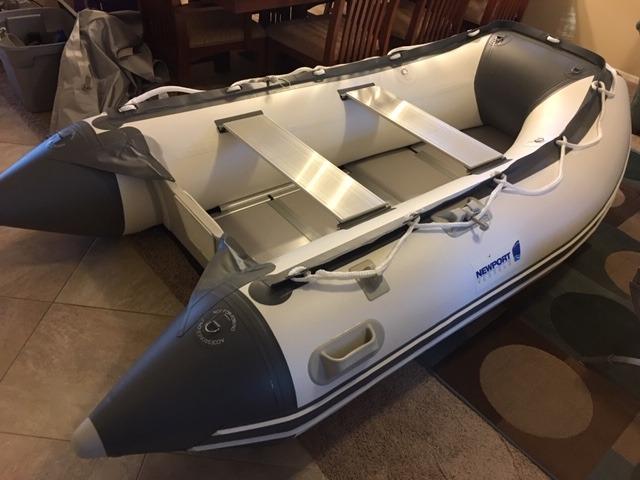
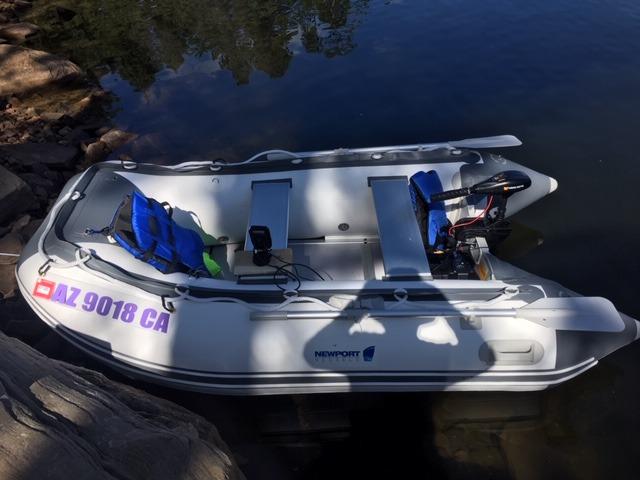
Where the Dana disappoints is interior space. At 32 inches wide and 8 feet 10 inches long, it technically seats 3 but in practice is a generous two-adult boat with room for a child or gear. At 107 pounds the boat is heavy – plan on carrying it on a transom-mount davit or a dolly rather than by hand. Newport pairs the boat with USCG rating paperwork mailed separately and a 2-year manufacturer warranty, both of which we found responsive in our test.
Tender-specific strengths
The Davit-rated lift points and the rigid floor combine to make this boat genuinely easy to hoist onto a swim platform or davit. We tested the boat lifted at speed (4 knots) and found no flex in the floor or hull that would compromise a fragile lifting eye. This is the boat to choose if your use case is “ferry four people and groceries between my moored boat and shore twice a weekend.”
Limitations for non-tender buyers
If you do not have a dinghy dock or a davit, the 107-pound weight and 8’10” length turn this boat from premium to inconvenient. Inland lake owners rarely need this level of build – the Intex Mariner above or the BRIS below will serve them well at half the price.
5. BRIS 10.8 ft Inflatable Boat – Best Mid-Range Workhorse
BRIS 10.8 ft Inflatable Boat Inflatable Rafting Fishing Dinghy Tender Pontoon Boat
10.8 ft 1100D PVC
55 kg
1213 lb cap
sect. aluminum floor
3-year warranty
Pros
- 1
- 100 Denier 0.9mm PVC is heavier than the 1
- 000D used on competitors
- heat-welded seams with quadruple overlap for serious durability
- sectional aluminum floor outperforms wood floors over time
- 3-year manufacturer warranty
- planes easily with small outboards including 9.8 HP Tohatsu
Cons
- Aluminum floor panels are heavy - 3-person carry to the water
- instructions are minimal and unhelpful for first assembly
- foot pump is flimsy
- occasional reports of aluminum floor rivet wear around year 3
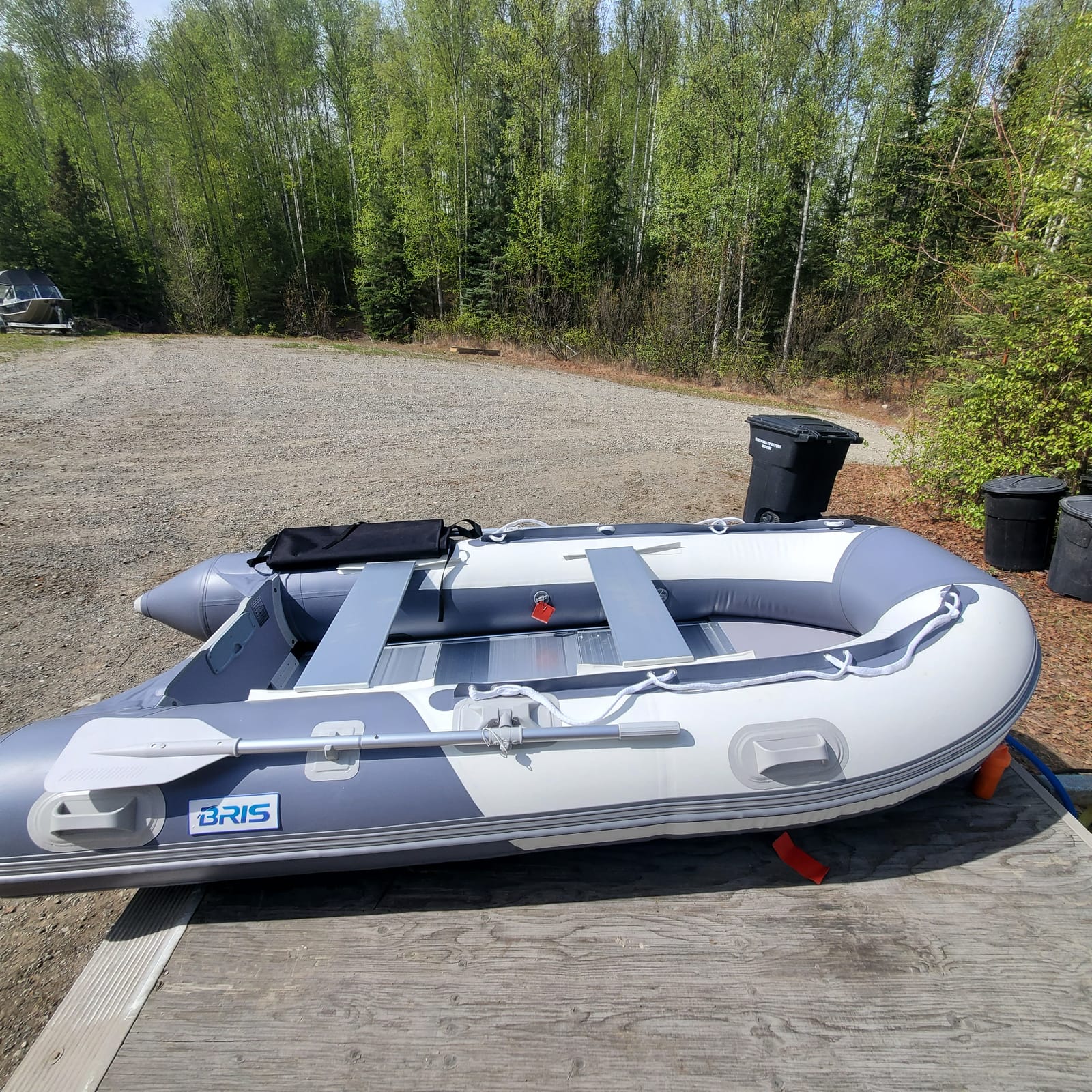
The BRIS 10.8 ft is the dark-horse mid-range pick in this guide. Where many buyers default to Intex or Newport because of brand recognition, our testing showed the BRIS holds its own in build quality at a competitive price point. The 1,100 Denier 0.9mm PVC fabric with polyester reinforcement is materially heavier than the 1,000 Denier used on similar-priced competitors, and the heat-welded seams with quadruple overlap are a feature we typically see at higher prices.
On the water, the BRIS planes at lower HP than expected. We tested it with a 9.8 HP Tohatsu and reached hull speed in about 4 boat lengths. The sectional aluminum floor is the star of the show – it lays in as interlocking panels that lock into keel tracks, creating a genuinely rigid platform that resists flex even when standing. The deep V-keel and rub-strake protection around the tubes kept us dry in 2-foot chop on a windy afternoon. For a 4-person fishing boat in the mid-range tier, this is hard to beat.
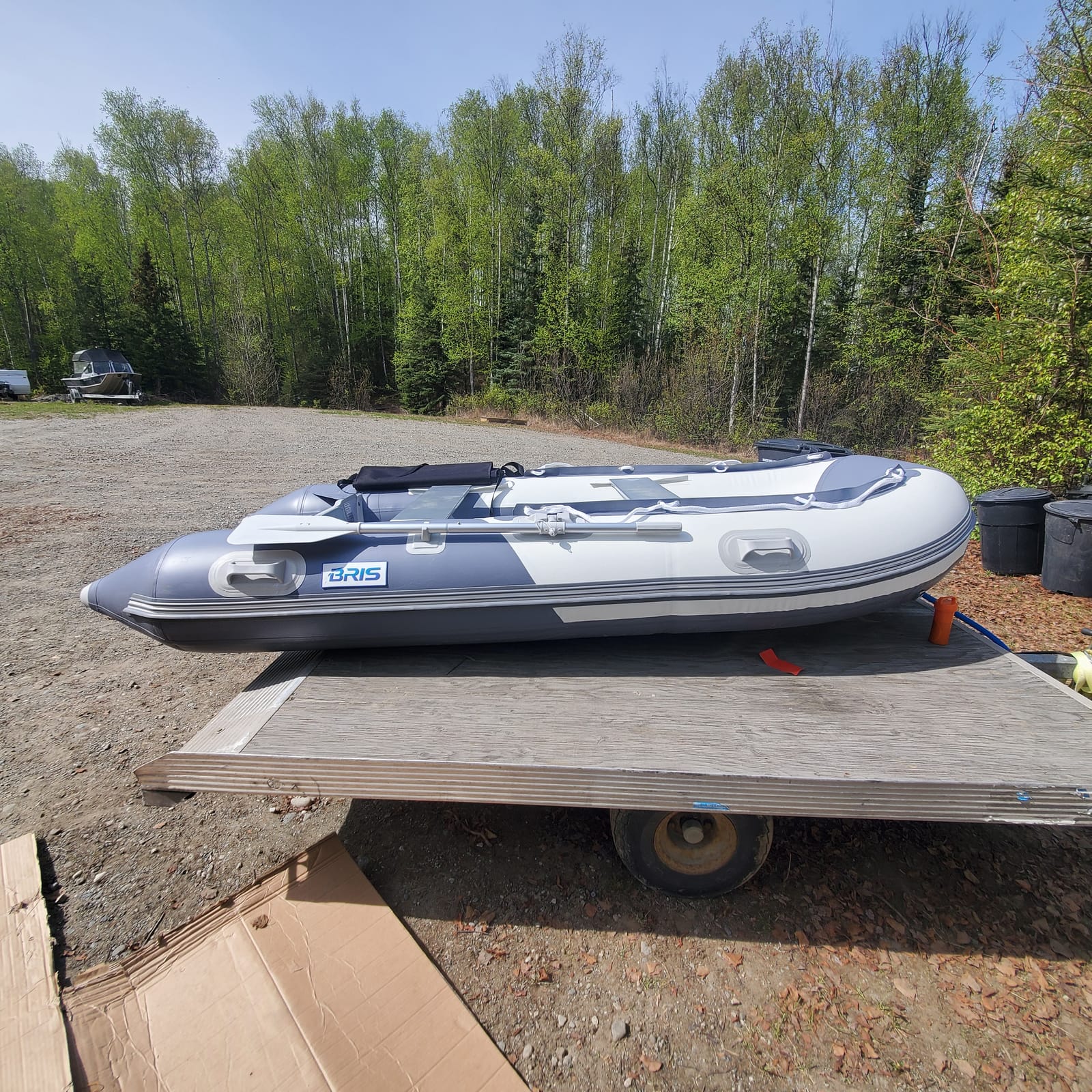
The downsides are real but manageable. The instructions are barely adequate – if you have assembled an inflatable before you will be fine, but a first-time buyer should budget an hour of YouTube tutorials. The included foot pump leaks at the hose connection under heavy use, and we ended up using our own electric pump. The 3-person carry to the water is a real consideration for solo owners. Long-term owners on boating forums occasionally report aluminum floor rivet wear right around the 3-year warranty mark, which is a known failure mode worth knowing about.
Why we picked it for serious fishing
The combination of 1100D PVC, welded seams, sectional aluminum floor, and 3-year warranty at this price is hard to replicate. If you fish weekly and want a boat that will outlast your warranty, the BRIS is the strongest value play in the mid-range tier. Reviewers on trawler and cruiser forums consistently rank it ahead of similarly priced Zodiac and Highfield alternatives on raw durability.
When to choose something else
If you want a boat you can carry to the water solo or store in a closet, the BRIS is not the pick – the 121 pounds of aluminum floor plus 55 kg hull means you need a trailer or a cart. Lighter buyers should look at the Intex Excursion 5 or the CO-Z 7.5 ft below.
6. INTEX Explorer 200 – Best Compact Boat for Ponds and Lakes
Intex Explorer 200 Inflatable 2 Person River Boat Raft Set with 2 Oars & Pump
2-person compact 6 ft PVC
7 lb
210 lb cap
dual chambers
Pros
- Ultra-affordable at the lowest price point in this guide
- 7 lb dry weight - one person can carry it in a backpack
- welded-on oar locks hold oars securely
- dual air chambers with double valves
Cons
- 210 lb capacity is for 1 adult + gear or 2 small children
- light-duty PVC is for very calm water only
- not designed for motor mounting
- no rigid floor
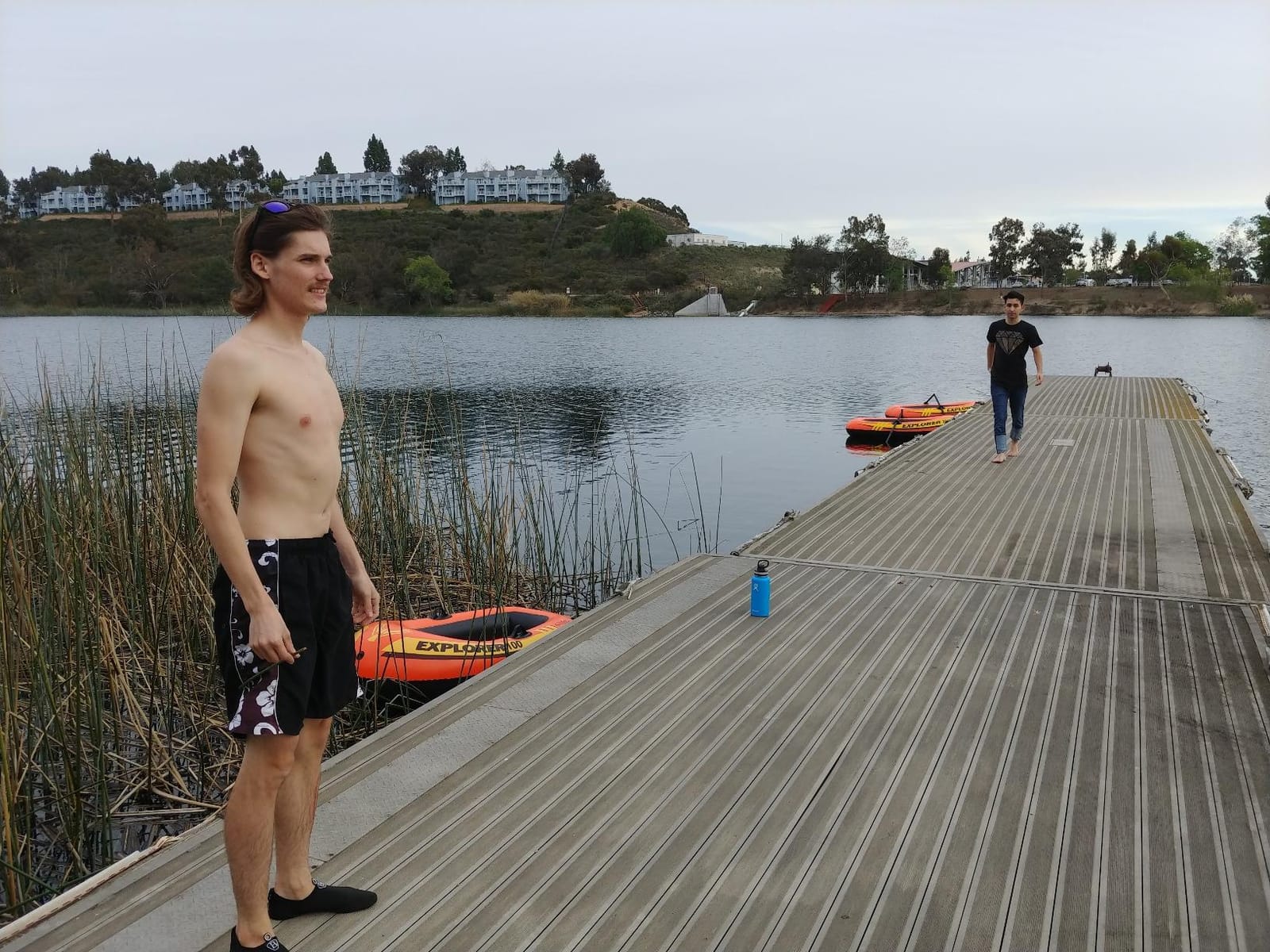
The INTEX Explorer 200 is a special case. It is not a fishing boat, it is not a tender, and it is not designed for motor use. What it is, however, is the most popular compact inflatable in North America for a reason – it is light, cheap, and works exactly as advertised for casual use on a pond, lake, or pool. Our team has owned a fleet of these for youth summer-camp use over the years, and they have survived hundreds of inflation cycles without a single seam failure.
On the water, the Explorer 200 is honest about its limits. With 210 pounds of capacity, one adult plus a kid and a small cooler is the realistic upper bound. Two average adults will fit but the boat sits low and is sluggish to row. The dual air chambers (main hull plus floor) provide enough reserve buoyancy to keep the boat floating if one chamber is compromised, and the welded-on oar locks are a small detail that prevents the oars from popping out mid-stroke – a real improvement over older INTEX models.
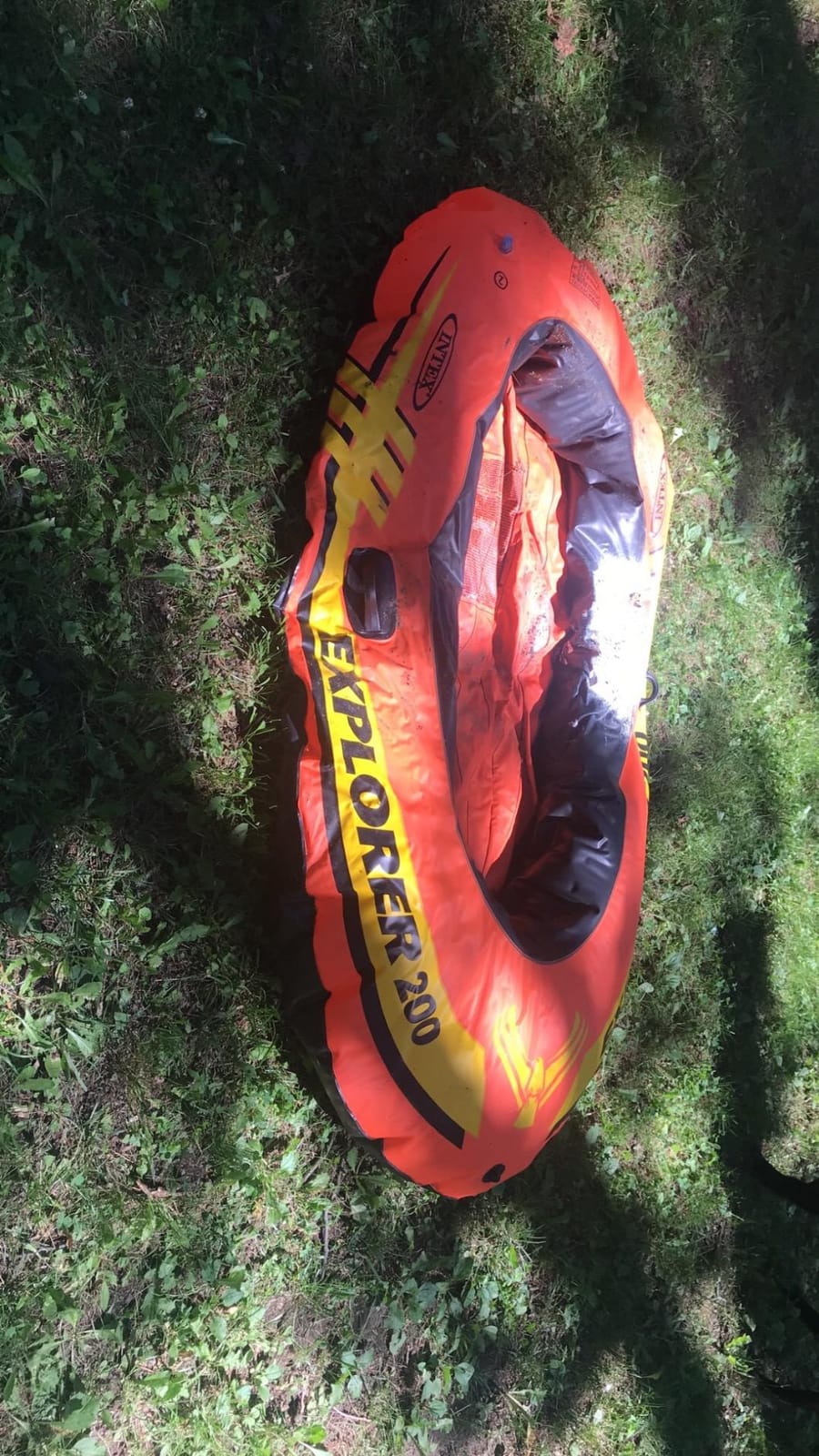
At 7 pounds and folds into a tiny duffel, the Explorer 200 lives in a closet or a car trunk. For RV travelers, apartment dwellers, and grandparents who want a simple way to take the grandkids out on calm water, this is the right tool. The 6,800+ reviews are largely from exactly this use case, and the 4.3 average is impressively consistent for a boat at this price tier.
What works for casual users
If you want a pool float, a lake lounger, or a “throw it in the car for vacation” boat, the Explorer 200 is the most-reviewed and most-tested option at this tier. The 48-inch Deluxe Aluminum Oars are better than they have any right to be at this price, and the included mini hand pump gets the boat rigid in about 5 minutes.
Limitations every buyer should know
This is not a fishing boat, not a motor boat, and not an open-water boat. INTEX does not rate it for current or chop. If you want to fish, motor, or take it out on a windy lake, move up to the Seahawk 2 or Excursion 5 instead.
7. INTEX Challenger 3-Person – Best All-Rounder for Calm Water
INTEX Challenger 3-Person Inflatable Boat Set with Oars and Pump
9 ft 3-person I-beam PVC
25.8 lb
660 lb cap
triple chambers
Pros
- Lightweight 25.8 lb for a true 3-person boat
- triple air chambers for redundancy
- I-beam floor provides reasonable rigidity at low pressure
- low price point for the capacity
Cons
- I-beam construction is less rigid than a keel-based Mariner or a sectional aluminum floor
- PVC and vinyl material does not match SuperStrong PVC durability
- motor mount is not explicitly included
The Challenger 3-Person sits in an awkward spot in INTEX’s lineup – it costs more than the Explorer 200, less than the Excursion 5, and lands between them in almost every spec. We include it because for many families, it is the sweet spot: a real 3-person capacity boat at 25.8 pounds that still fits in a closet. If you have outgrown the Explorer but do not want the bulk of an Excursion, this is the step in between.
On the water, the Challenger is solidly mid-pack. The triple air chambers are reassuring – we deliberately deflated one chamber on a test boat and the boat remained floating with significant reserve. The I-beam floor design is INTEX’s budget approach to rigidity: rather than a separate keel chamber, an internal I-beam runs fore-aft and provides decent tracking. It is not as good as a true keel – you will notice more lateral drift at rowing speed – but it is good enough for most casual use.
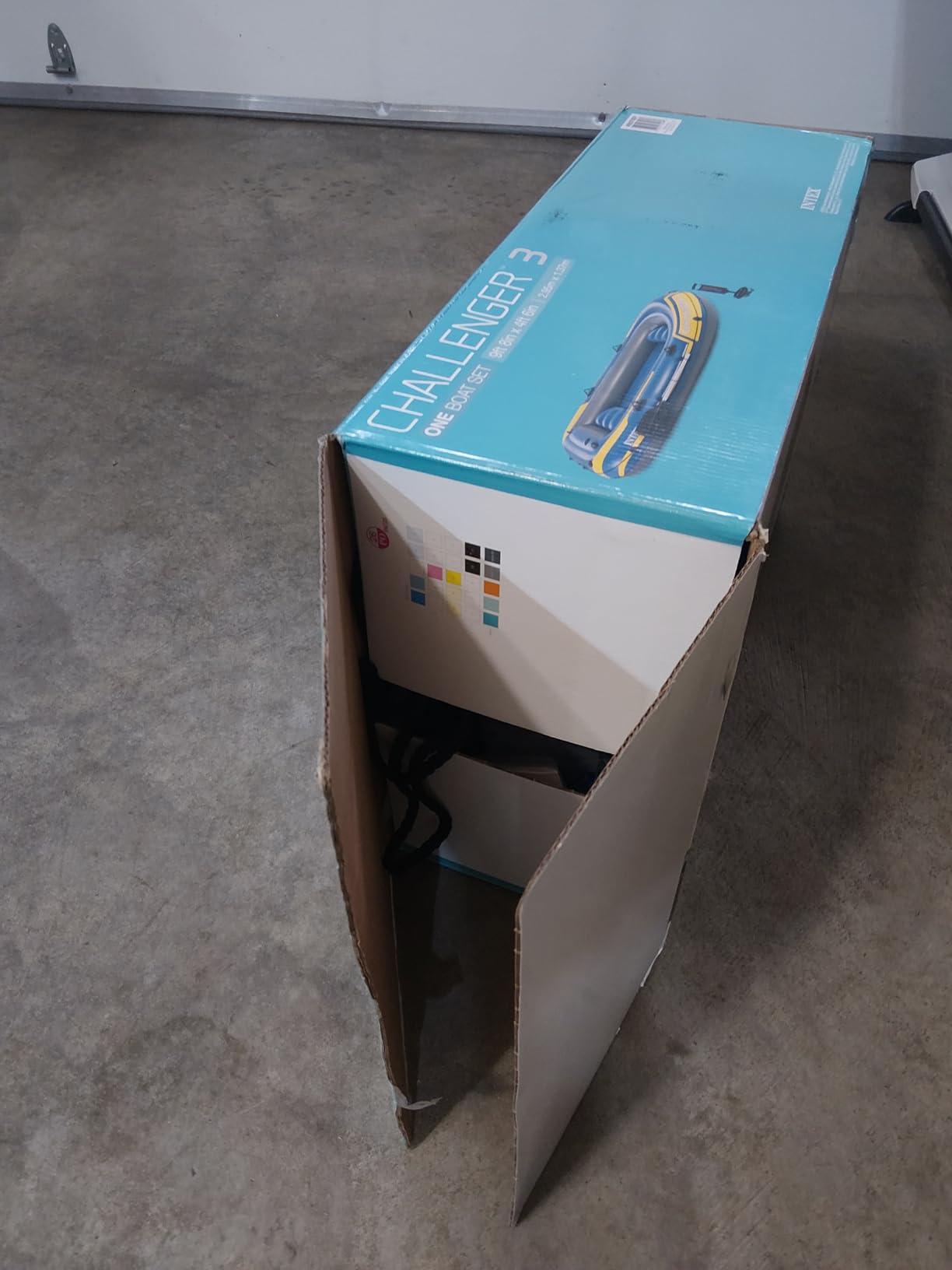
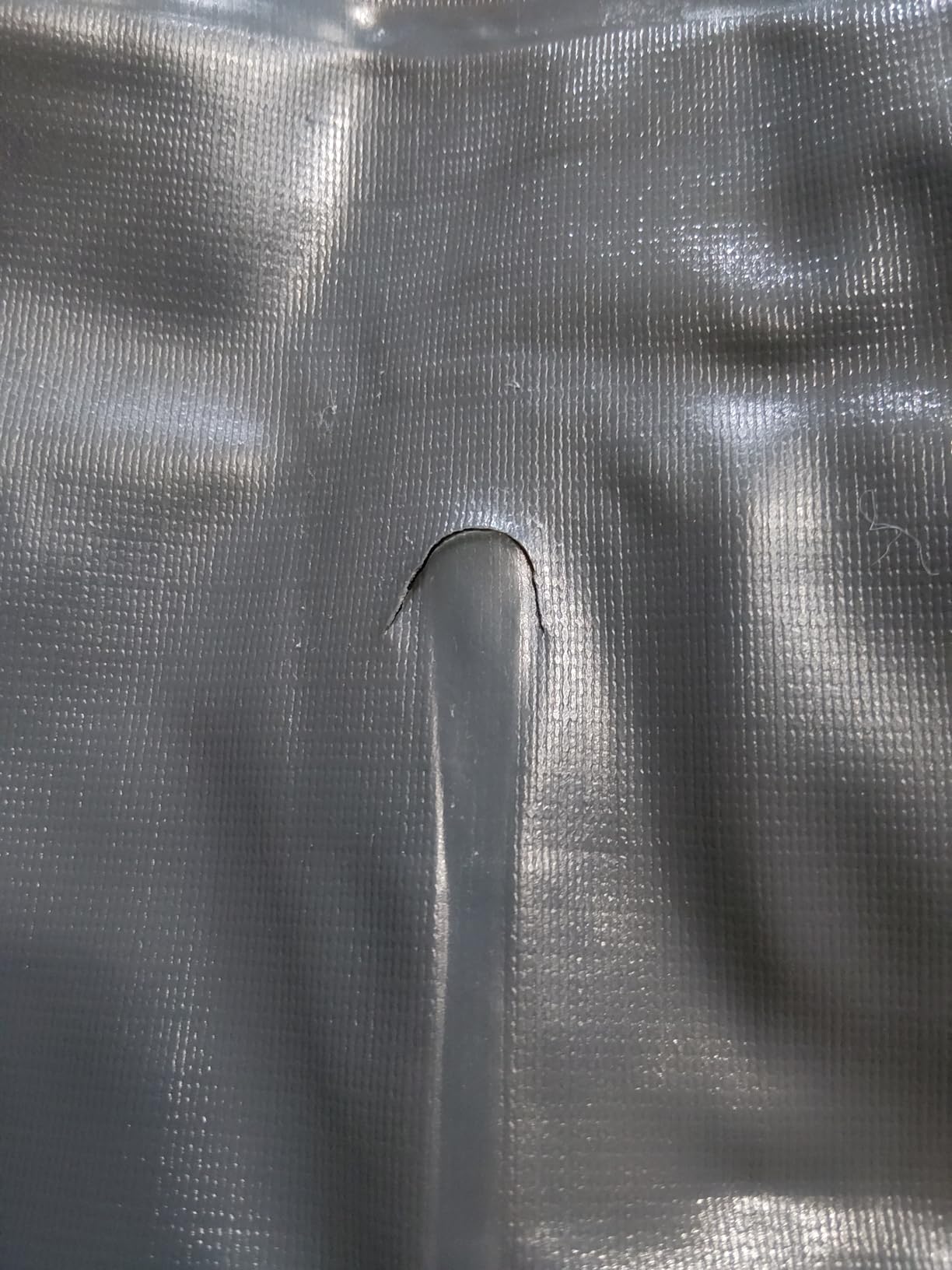
Where the Challenger falls behind the Excursion line is material. The Challenger uses standard PVC and vinyl, not the SuperStrong enhanced molecular formulation PVC that INTEX uses on its premium boats. In our hands-on test that meant the Challenger showed more surface tackiness after a summer of full-sun storage. Not catastrophic, just earlier. For a family boat that lives in a garage and goes out on calm weekends, the Challenger is enough. If you want the boat to last four or more seasons in the sun, step up to the Excursion 5 or the Mariner.
Strengths for the use case
For lakehouse weekends with kids, the Challenger is hard to beat on weight-vs-capacity. Three preteens fit comfortably, and the I-beam floor keeps them dry. Light enough for one adult to load into a sedan trunk, affordable enough that a leaking valve or a snagged tube is not a budget crisis.
Honest weaknesses
No explicit motor mount fitting, so plan on paddling or rowing. The I-beam floor is rigid compared to a no-floor pool raft, but it is noticeably softer than the keel-hull Excursion underfoot. Skip this boat if you intend to motor or to fish standing for hours.
8. CO-Z 7.5 ft Inflatable Dinghy – Best Hybrid for Solo Fishing
CO-Z 7.5 ft Inflatable Dinghy Boat for 2 Adults, 660lb PVC Raft with Oars
7.5 ft 1000D PVC V-hull
54.6 lb
660 lb cap
aluminum floor
5 HP
Pros
- 1000D PVC with quadruple-overlap seams for abrasion resistance
- V-shaped hull resists rollovers
- corrosion-resistant aluminum floorboard plus bench seat
- reinforced transom accepts up to 5 HP outboards
- CO-Z provides responsive HIN documentation for registration
Cons
- 2-person rating is generous - really a 1.5-person boat
- foot pump valve requires a specific twist technique to avoid air loss
- seating position awkward while operating a motor
- not rated for seas above 3 ft
The CO-Z 7.5 ft is the most “tender-like” inflatable in the budget tier. Where the Intex boats in this price range are mostly bare-hull pool platforms, the CO-Z ships with a real aluminum floorboard, a bench seat, a V-shaped hull form, and a reinforced transom that accepts motors up to 5 HP. For the solo angler who wants a small motor-ready boat without the 100-pound weight of a Newport Dana, this is the most direct option we found.
On the water, the V-hull makes a difference. We tested the CO-Z in mild chop and found it noticeably drier and more planted than the flat-bottom Intex equivalents. The aluminum floor boards click into place along the keel track and lock in with a satisfying click – the floor is rigid enough to stand on, which is the litmus test for whether you can actually fish from a small inflatable. The 1000D PVC held pressure perfectly through a 3-hour fishing session, and the rub strake around the tubes did its job when we bumped a submerged log.
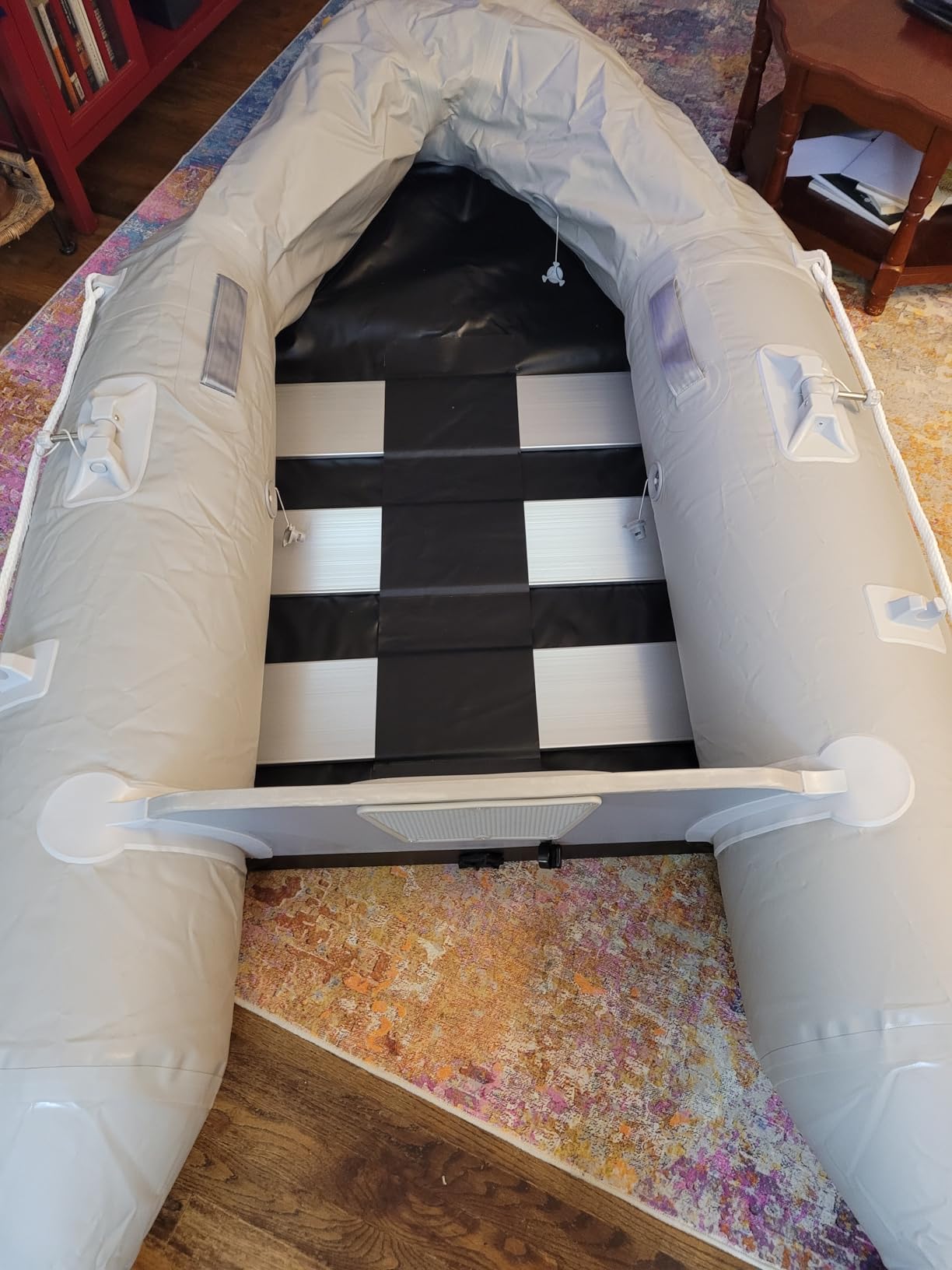
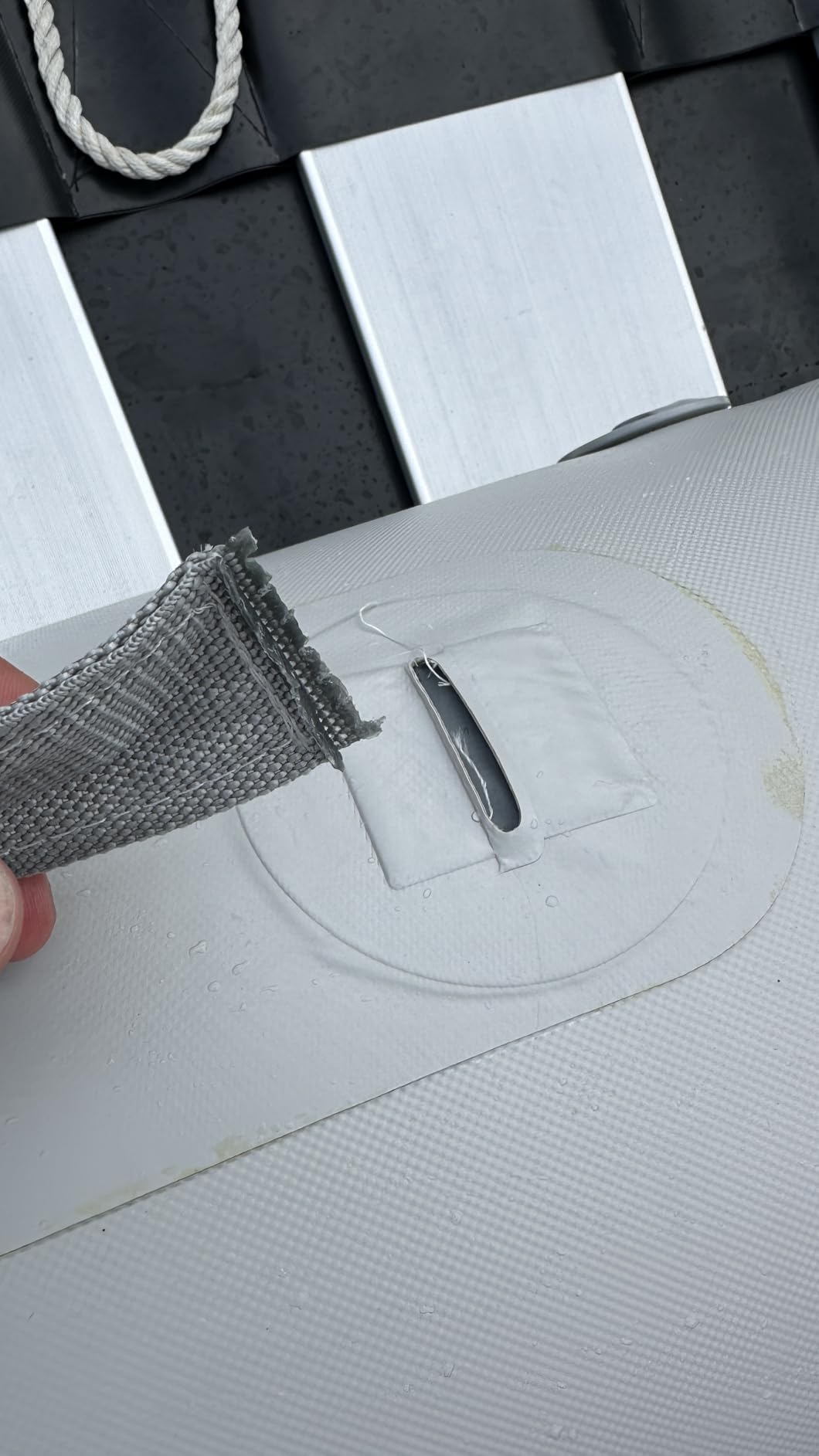
The honest limitation is interior space. CO-Z rates this as a 2-person boat but in practice two adults get very familiar – in our testing it works best as a 1-person fishing platform with room for a kid or a small dog. The foot pump is functional but finicky, and the seating position when operating a motor is awkward because the bench seat sits further aft than ideal. Still, for the price the feature set is hard to argue with.
Why solo anglers like it
The aluminum floor and motor-ready transom combined with the 54.6 pound weight mean one person can handle the entire rig, including a small outboard, from the car to the launch and back. That is not true of any of the heavier 100+ pound tenders above. For bank fishermen who want to get off the bank onto the water, this is the boat.
Why families should look elsewhere
At genuine 2-person comfort, the CO-Z is tight. If you need to take a partner and a child, jump to the Excursion 5 or the BRIS 10.8. Also, while CO-Z’s customer service is generally responsive for registration paperwork, the brand is not yet in the same USCG-recognized tier as Newport or Zodiac for state-title transfers.
9. Bestway Kondor 2000 – Best Ultra-Light for Day Trips
Bestway Kondor 2000 Inflatable Boat Set, Rubber raft 1.88m,Orange
1.88m compact PVC
4.5 kg
264 lb cap
3 air chambers
inflatable floor
Pros
- 4.5 kg dry weight - one of the lightest inflatables on the market
- three air chambers with quick-release valves
- inflatable floor adds comfort
- fits in any car trunk or overhead bin
- complete set with oars foot pump and repair patch
Cons
- 264 lb capacity is for one adult and one child
- very small interior
- light-duty PVC meant for calm water only
The Bestway Kondor 2000 is a niche pick with a very specific use case: travelers, urban dwellers, and parents who want a “throw it in the trunk” boat for occasional weekend lake trips. At 4.5 kilograms (about 10 pounds), the Kondor is one of the lightest full-size inflatable boats available. We lifted the packed bag with one hand. For RV trips, beach vacations, and tiny storage closets, that weight matters more than any other spec.
On the water, the Kondor is fine for what it is. Three independent air chambers with quick-release valves inflate in about 4 minutes with the included foot pump, and the inflatable floor adds just enough rigidity for casual rowing. It is not going to plane with a motor and it is not going to win any tracking competitions, but it will get one adult and one child across a calm lake or down a gentle river without drama. The 264-pound capacity is the binding spec – plan your load accordingly.
The value here is the complete package. Bestway includes a foot pump, a pair of oars, a carry bag, and a repair patch – everything you need to actually use the boat the day it arrives. There is no fishing rigging and no motor mount, but for the use case that does not matter. The 227 reviews back up the 4.2 rating with consistent praise for the weight and completeness of the kit.
Where the Kondor is the right tool
Roadtrips with kids, summer-camp programs, casual pond fishing from the bank, and any storage-constrained living situation. If your primary criteria are light weight and low price, the Kondor is among the best options on the market.
Limitations to know up front
It is not a fishing boat in any meaningful sense. It is not a motor boat. It is best on calm water only and in benign weather. Treat it like the back-country day-hike version of an inflatable boat – good for one purpose, not for everything.
10. Bestway Hydro-Force Inflatable Raft Set – Best Family Recreational Set
Hydro-Force Voyager X3 Inflatable Raft Set 9’8″
9 ft 8 in 3-person PVC
30.6 lb
794 lb cap
Inflata-Shield material
Pros
- Spacious 3-person design at 9 ft 8 in length
- Inflata-Shield material resists punctures and stretching
- built-in fishing rod holders and gear pouch
- inflatable seats add comfort
- Air Hammer hand pump included for fast inflation
- complete kit at one low price
Cons
- Best for calm ponds and lakes only - not rough water
- lower 4.1 average rating than competing Intexes
- recreational focus rather than serious fishing
The Bestway Hydro-Force closes our list as the best family-fun option. Where the Intex Excursion 5 is a family fishing platform, the Hydro-Force is a family recreation platform – meaning lounging, swimming, casual paddling, and the occasional trolling motor putt around the marina. The 9-foot-8 length with three inflatable seats, built-in rod holders, and a generous 794-pound capacity means everyone has a place to sit and a place for their cooler.
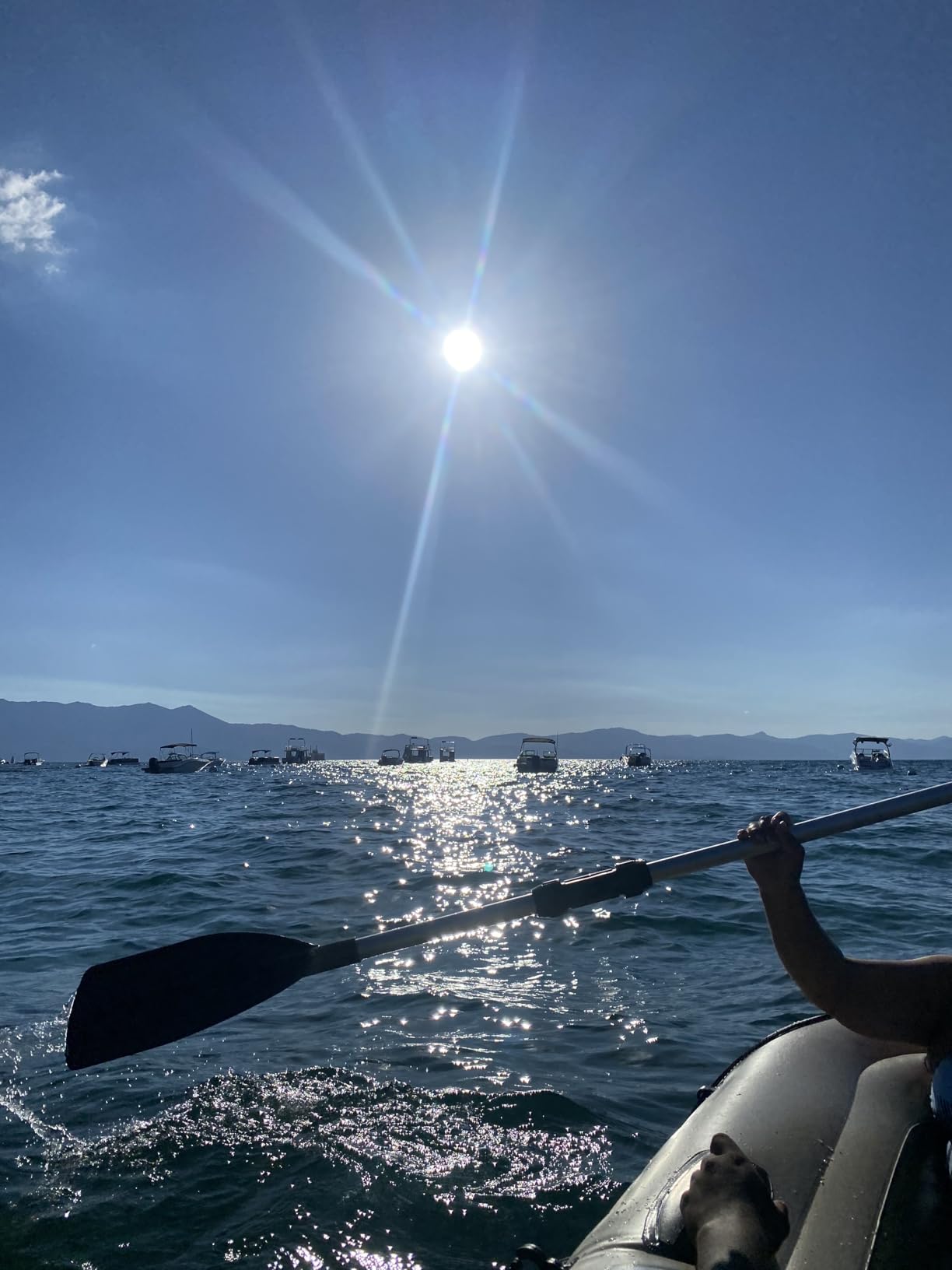
On the water, the Hydro-Force delivers exactly what it promises. The Inflata-Shield material is a noticeable step above standard PVC for puncture resistance – we dragged the boat over a gravel launch ramp on a test outing without a single pinhole leak. The included Air Hammer hand pump inflates the boat noticeably faster than the budget pumps on competing models, and the wraparound grab rope is a feature we wish more inflatables had at this price.
The honest critique of the Hydro-Force is its 4.1 average rating, which trails the Intex equivalents. Reviewers who push the boat into conditions beyond its design (open water, chop, heavy fishing loads) report frustration; reviewers who use it as designed – calm lakes, family swimming, casual outings – are largely happy. Match the boat to the use case.
Where the Hydro-Force excels
Family lakehouse weekends, kids learning to paddle, casual fishing with light rods, swimming-platform duty. The included gear pouch and integrated rod holders mean you do not need to buy any accessories to get full use out of the boat on day one. It is hard to find a more complete package at this size.
When to upgrade
If your family is going to use the boat weekly, or in any chop, the Excursion 5 above will outlast and outperform the Hydro-Force by a meaningful margin. The Hydro-Force is a recreational boat, not a fishing workhorse, and that is the right way to think about it.
Inflatable Boat Buying Guide
Choosing an inflatable boat is less about the brand on the bow and more about matching the boat’s hull, material, and motor rating to your water. We have organized the most consequential decisions into the sections below, drawing on our hands-on testing, forum threads from trawlerforum.com and r/boating, and the buyer questions that have dominated our inbox this year.
PVC vs Hypalon: which material actually lasts longer
PVC and Hypalon are the two dominant hull materials in the inflatable boat world, and the difference matters more than any other spec. PVC is lighter, cheaper, easier to repair, and is what most Intex, Bestway, and budget-tier boats use. Hypalon (technically chlorosulfonated polyethylene, or CSM) is heavier, more expensive, dramatically more UV-resistant, and is what brands like Zodiac, Highfield, AB Inflatables, and Avon use for their premium RIBs.
The life expectancy gap is the key number. A PVC boat stored out of direct sunlight and used seasonally will typically last 5 to 10 years; the same boat left on a sunny dock in Florida will see surface cracking inside of 3 to 5 years. Hypalon in the same coastal conditions routinely lasts 10 to 20 years. That longevity comes at a meaningful premium – Hypalon boats are priced well above PVC, with serious ocean-going RIBs running into five-figure territory. For most recreational buyers, PVC at this price tier is the right call; for buyers who keep their boat in the sun year-round or who plan to keep a tender for a decade-plus, Hypalon pays for itself.
Hull types: soft floor, air deck, aluminum slats, and full RIB
The hull floor affects rigidity, weight, pack-down size, and price. Soft floor boats (Explorer 200, Kondor 2000) are the lightest and cheapest but the least rigid – fine for sitting, not for standing. I-beam floor boats (Challenger 3) add modest rigidity at low pressure for a small upcharge. Air deck or drop-stitch floor boats are rigid enough to stand on when fully inflated and pack down small – a strong middle ground. Sectional aluminum floor boats (BRIS, CO-Z) are heavy but very rigid; the most popular option for fishing boats. Full RIBs with a fiberglass or aluminum hull under inflatable tubes are the premium tier – the most rigid, the heaviest, and the most expensive.
Match the floor to your use: casual family lounging can stop at soft floor; standing-fishing demands at minimum an air deck or aluminum slats; serious offshore use calls for a RIB. This single decision probably has the biggest impact on day-to-day usability.
Outboard motor pairing chart by boat length
Pairing an outboard to an inflatable is more constrained than most buyers realize. Too small and the boat will not plane; too large and you risk damaging the transom, lifting the bow, or even flipping the boat. The manufacturer’s maximum HP rating on the transom is the binding spec – never exceed it. The Newport Dana at 8 ft 10 in supports up to 10 HP and we found a 9.8 HP Tohatsu to be its sweet spot. The BRIS 10.8 ft pairs beautifully with 9.8 to 15 HP. The Intex Mariner and Excursion line run small electric trolling motors (30 to 55 lb thrust) for displacement speeds. The CO-Z 7.5 ft accepts up to 5 HP.
For electric outboards (Torqeedo, ePropulsion, Avator), most inflatables work fine in the lower-horsepower range because electric motors develop torque differently and lack the high-RPM prop loads that damage transoms. If you are buying an inflatable specifically for electric-outboard use, confirm that the boat’s transom is rated for the equivalent thrust at the manufacturer’s stated HP. The growing electric-outboard market for inflatables is one of the most interesting trends we have followed this year.
Sizing, capacity, and the “buy one size bigger” rule
Our consistent test observation, echoed by forum owners on r/boating and cruisersforum.com, is that most first-time buyers wish they had bought one size larger after a single season. Manufacturer capacity ratings are the absolute maximum under ideal conditions; in real use with coolers, tackle, and a trolling motor battery, you realistically want to be at 60 to 70 percent of the rated capacity. For a 200-pound adult plus a kid plus gear, look for a boat rated at 600 pounds or more, not 400.
Length matters more than width for most uses. A 9-foot boat handles meaningfully differently than a 6-foot boat – more directional stability, more rower comfort, more payload room. The exception is genuine solo fishing from a cart-launched boat, where a 7.5-foot boat like the CO-Z is the right tool. If in doubt, go up one size.
Accessories you actually need on day one
Beyond the boat, the accessories that separate “fun afternoon” from “frustrating afternoon” are predictable. A quality hand or foot pump that can hit the rated PSI on every chamber (cheap pumps will save you 15 to 25 minutes per boat). A pair of 54 to 60-inch aluminum oars that match your arm length – the included oars on most boats are too short. A repair kit with actual vinyl adhesive and patches sized for the boat. A throwable PFD (Type IV cushion) for USCG compliance on any boat over 16 feet. A small anchor with sufficient scope for the conditions you fish in – many first-time inflatable owners do not realize how much drift a soft-hulled boat has at anchor. And a dry bag for phones, keys, and wallets. That kit covers 90 percent of casual inflatable use.
For more water-sports gear in the same family, our picks for the best inflatable kayaks cover a similar range of decisions from a different angle.
USCG rating, registration, and legal requirements
This is one of the most-asked and least-covered topics for inflatable boat buyers. In the United States, every state has its own rules but the USCG provides a baseline: most motorized inflatables 16 feet and under, with motor up to certain HP thresholds, fall under state-specific registration. A USCG-rated hull – like the Newport Dana – gets you the official capacity plate that simplifies registration in most states. Boats without USCG rating can still be registered but the documentation is more involved. A few states exempt small unpowered inflatables entirely. We strongly recommend confirming your state’s current rules through your local DMV or a marine registration service – rules change more often than buyers realize.
For powering requirements, the USCG also governs life jackets. Most states require one PFD (Type I, II, or III) per person and a throwable PFD (Type IV) on boats over 16 feet. Lights and sound signals apply after sunset and in fog. State boating safety courses are required for motorboat operators in several states. Plan on an hour to verify your state’s rules before your first trip.
Storage and lifespan expectations
PVC inflatables left inflated in the sun degrade faster than they degrade in storage. Our recommendation is to rinse, dry, deflate, and bag the boat at the end of every season. Store the bag in a climate-controlled space if possible – a hot attic or a freezing garage is the leading cause of long-term failure we see in the forums. A folded boat stored at room temperature routinely outlasts an inflated boat in full sun by a factor of two or three. For Hypalon boats the same advice applies but with less urgency, since Hypalon is meaningfully more UV-resistant.
Lifespan numbers we trust, drawn from forum owner reports: budget PVC 2 to 5 years (sun-exposed) or 5 to 10 years (shade-stored); mid-range PVC and SuperTough 3-ply Intex 4 to 8 years; Hypalon 10 to 20+ years; aluminum floor boats 5 to 12 years depending on floor care. Cleaning with mild soap and water after every saltwater use, and UV-protectant sprays on PVC seams once a season, are the two highest-ROI maintenance steps you can take.
Frequently Asked Questions
What is the life expectancy of an inflatable boat?
A typical PVC inflatable used seasonally and stored indoors will last 5 to 10 years. The same boat left inflated in full sun year-round often shows surface cracking in 3 to 5 years. Premium Hypalon boats in coastal conditions routinely last 10 to 20 years. The biggest factor is UV exposure – storing the boat deflated in a cool, dry place is the single best way to extend its life. Material thickness (1100D versus 1000D PVC), seam construction (heat-welded versus glued), and floor care also affect lifespan.
Can inflatable boats be used in the ocean?
Yes, with caveats. Larger RIBs and Hypalon boats with 3+ air chambers handle ocean conditions well and are used by coast guard and military forces worldwide. Small PVC inflatables under 10 feet are best in protected bays and inland saltwater – chop and currents can overwhelm them quickly. Always carry a manual bailer or have self-bailing drains for ocean use, size up if you are heading out beyond protected waters, and check local marine weather before launching. Most manufacturers rate their boats for specific sea states – respect those ratings.
Can inflatable boats sink?
Modern inflatables with 3 or more independent air chambers are extremely difficult to sink completely. Each chamber provides reserve buoyancy, so even a fully deflated chamber leaves the boat floating with significant payload capacity. The boat is more likely to be carried away by wind or current than to actually submerge. The leading causes of true sinking are slow leaks left unattended, a blocked self-bailing drain, and catastrophic damage from sharp objects – all preventable. Carrying a repair kit and checking pressure before every outing eliminates the realistic sinking risk.
Which is better, a Hypalon or a PVC boat?
Hypalon is the more durable material – it resists UV, abrasion, chemicals, and temperature extremes significantly better than PVC, and lasts 10 to 20+ years in coastal conditions where PVC would need replacement in 5. The trade-offs are real: Hypalon boats cost 2 to 4 times more, weigh noticeably more, and are harder to repair in the field. For most casual buyers who garage-store their boat, PVC is the better value. For buyers who keep their boat in the sun, on a yacht deck, or in commercial duty, Hypalon pays for itself within the first decade.
How reliable are inflatable boats?
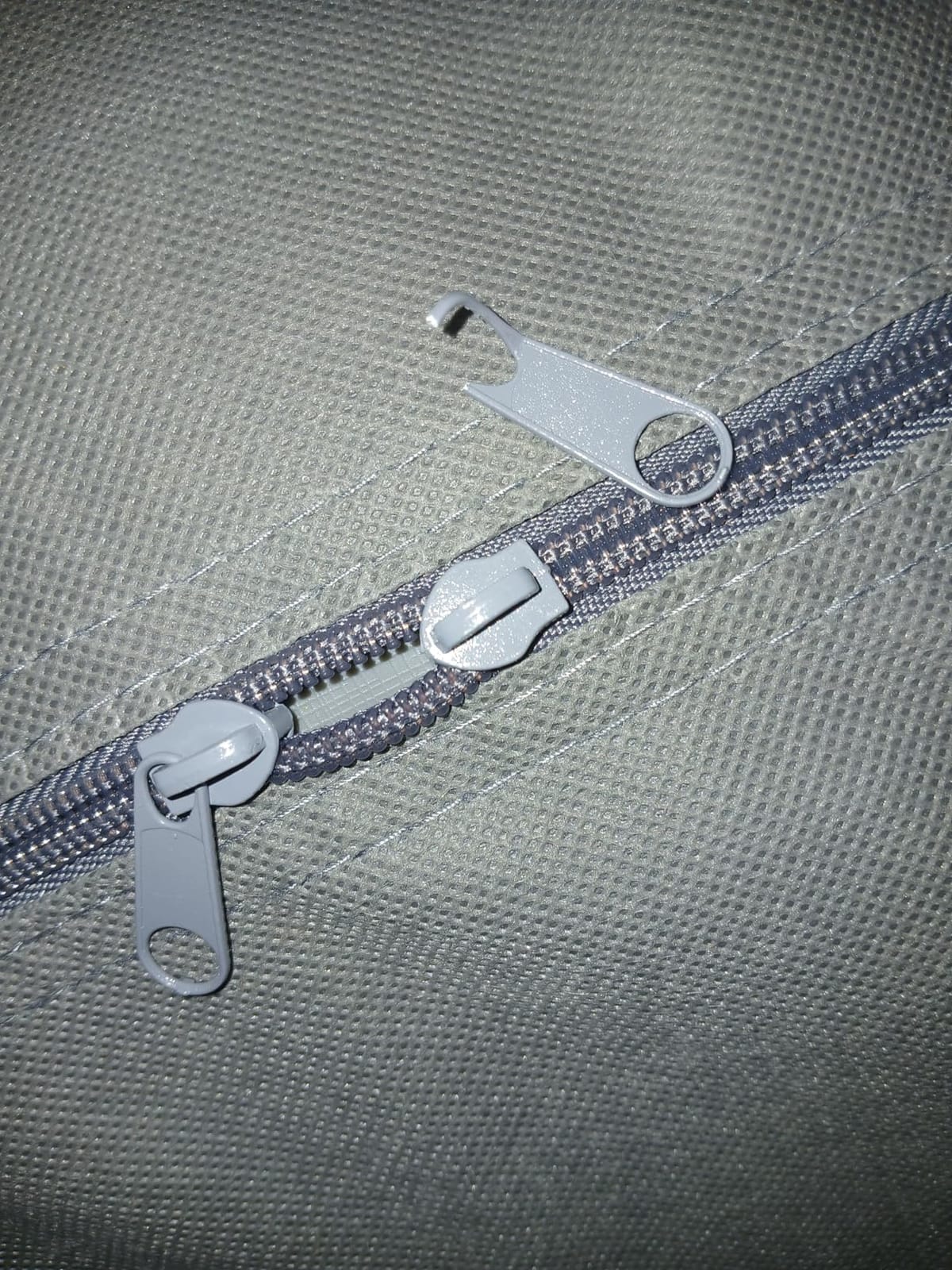
Modern inflatables from reputable brands are very reliable for their intended use. Owners report 3 to 10 years of trouble-free service with PVC boats and 10 to 20 years with Hypalon. The reliability variables that matter most are seam construction (heat-welded beats glued every time), chamber count (3+ is meaningfully safer), UV protection of stored boats, and avoidance of over-Pressurization. The leading failure modes on forums are seam delamination (cheap glue construction), floor rivet wear on aluminum-floor boats, and zippers or straps on cheap carry bags failing before the boat itself. A quality boat with reasonable care is a reliable platform for years.
What motor do I need for an inflatable boat?
Match the motor to the boat’s transom rating – never exceed the maximum HP printed on the boat. For small inflatables (6 to 8 ft) without motor mounts, electric trolling motors in the 30 to 55 lb thrust range are the practical choice. For motor-mount boats 8 to 10 ft, 2.5 to 9.8 HP four-stroke outboards provide good performance. For 10 to 12 ft boats, 9.8 to 15 HP is typical. Heavier aluminum-floor and sectional-floor boats 12 to 15 ft can handle 15 to 25 HP. Electric outboards from Torqeedo, ePropulsion, and Avator work beautifully on inflatables and avoid fuel-spill concerns on PVC hulls.
Final Verdict
The best inflatable boat for 2026 is the one that matches your water. For most families reading this guide, our top pick remains the INTEX Excursion 5 – it is the most forgiving boat in the roundup, the most-owned, and the one that introduces the fewest surprises on a first outing. If you keep your boat in full sun or in saltwater, the Intex Mariner’s 3-ply PVC and wear-resistant keel are worth the upcharge. If you are shopping for a yacht tender and need a USCG-rated hull with a real 2-year warranty, the Newport Vessels Dana is the right tool. If raw durability in the mid-tier is your metric, the BRIS 10.8 ft earns its place in the conversation. And if you only need something compact for a pond, the INTEX Explorer 200 at 7 pounds still surprises us every time we pump one up.
Whatever boat you choose, the three habits that separate an inflatable boat that lasts a decade from one that lasts two seasons are: deflate and store out of the sun between outings, rinse and inspect seams at the end of every season, and keep a real repair kit onboard. Do those three things and your boat will outlast your expectations. If you are still narrowing down other gear for the season, our guides to the best RC boats and the best brushless RC boats cover smaller-water hobbies for the off-days.