
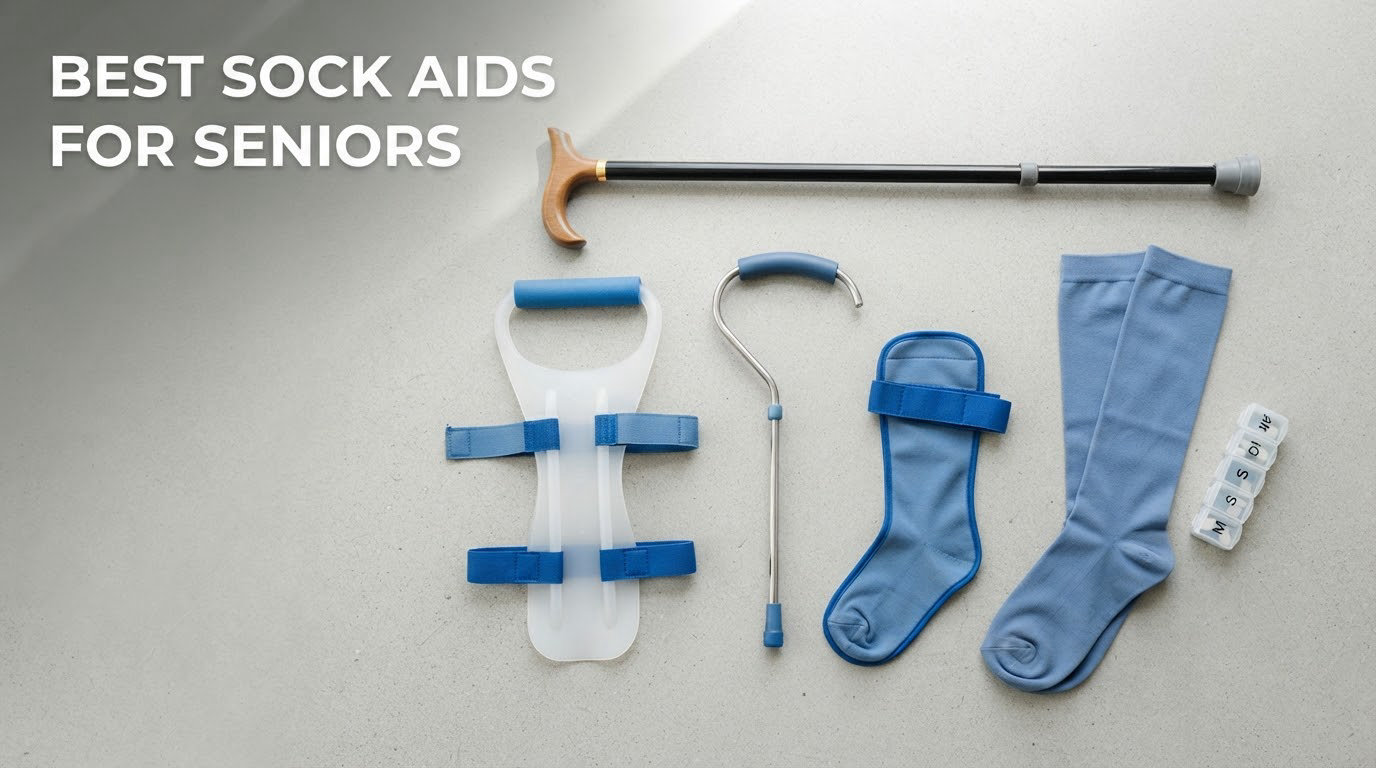
Quick answer: the best sock aids for seniors are flexible terrycloth-and-nylon troughs or semi-rigid plastic shells with two long pull cords, and the one most people should start with is the RMS Deluxe Sock Aid. It holds regular socks open, is rated for feet up to 5 inches wide, and has been bought and rated by more users than any other aid in this category.
Bending forward to put socks on is harder than it sounds once you are 70, recovering from a hip replacement, or dealing with arthritis in both hands. The movement itself is the problem. Hip flexion past 90 degrees, a shift in your center of gravity, and a few seconds of balance you cannot check while your head is down. That is why a simple plastic trough has become one of the most recommended pieces of daily living equipment in senior care.
We compared eight of the most-reviewed sock aids and sock helpers available, looking at shell material, foot-width limits, cord length, handle grip, and what happens to the sock mid-pull. This guide covers the differences that actually show up after a month of daily use, not the packaging claims.
If you are shopping for a parent or spouse rather than for yourself, the same list applies, and we have added a note in every product section about who should skip that particular model. We also cover the two problems most roundups ignore: taking socks back off, and why standard aids struggle with medical compression hosiery.
Related reading for the rest of an aging-in-place setup: our picks for the best hearing aids for seniors and the best smartphones for seniors cover the two other tasks that most often trigger a request for help at home.
Table of Contents
Top 3 Picks for Best Sock Aids for Seniors
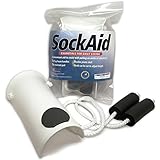
RMS Deluxe Sock Aid
- Flexible contoured shell
- foam handles
- 38 inch adjustable ropes
- fits feet up to 5 inches wide

Vive Sock Aid Slider
- Latex-free contoured shell
- slip-resistant cuff
- 33 inch adjustable cords
- 60 day guarantee
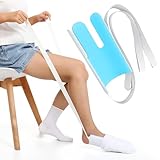
Fanwer Two-in-One Sock and Pants Aid
- Terry cloth cover
- loop handles
- no foot width limit
- includes dressing strap
Best Sock Aids for Seniors in 2026 Quick Comparison
Every aid below handles putting socks on. The differences that decide which one you will still be using in six months are foot-width limit, whether the sock stays anchored during the pull, and whether the cord length reaches your hand while you are seated.
| Product | Specifications | Action |
|---|---|---|
| RMS Deluxe Sock Aid |
|
Check Latest Price |
| Vive Sock Aid Easy On and Off Slider |
|
Check Latest Price |
| Fanwer Sock Aid and Pants Assist |
|
Check Latest Price |
 Rehabilitation Advantage Deluxe Sock Aid Rehabilitation Advantage Deluxe Sock Aid |
|
Check Latest Price |
 Mars Wellness Deluxe Sock Aid Mars Wellness Deluxe Sock Aid |
|
Check Latest Price |
 CAidRE Three Finger Sock Aid CAidRE Three Finger Sock Aid |
|
Check Latest Price |
 KEKOY U-Shape Sock Aid KEKOY U-Shape Sock Aid |
|
Check Latest Price |
 CAidRE 3.93 Inch Wide Sock Aid CAidRE 3.93 Inch Wide Sock Aid |
|
Check Latest Price |
1. RMS Deluxe Sock Aid with Foam Handles – Best Overall
RMS Deluxe Sock Aid – Socks Helper with Foam Handles for Regular Socks
9.5 by 5 by 3 inch flexible shell
38 inch adjustable ropes
Foam handles with slip-resistant pad
Pros
- Works with ankle calf athletic and dress socks
- Fits foot widths of 5 inches or less
- Soft shell is easy to load with weak hands
- Adjustable rope length suits different reach
- Most reviewed aid in this category
Cons
- Not for compression socks or sheer hosiery
- Knee-high and tube socks are hard to load fully
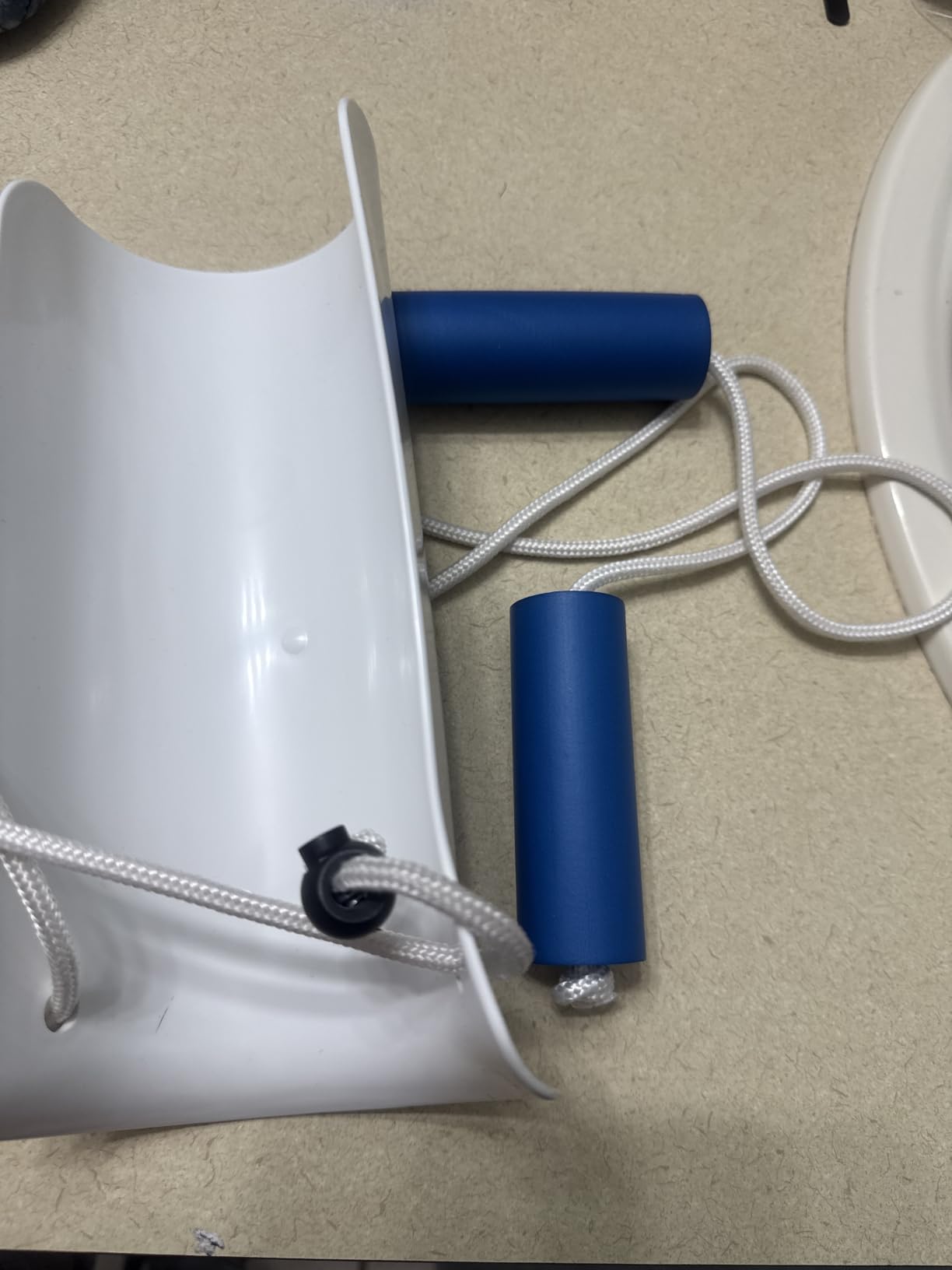
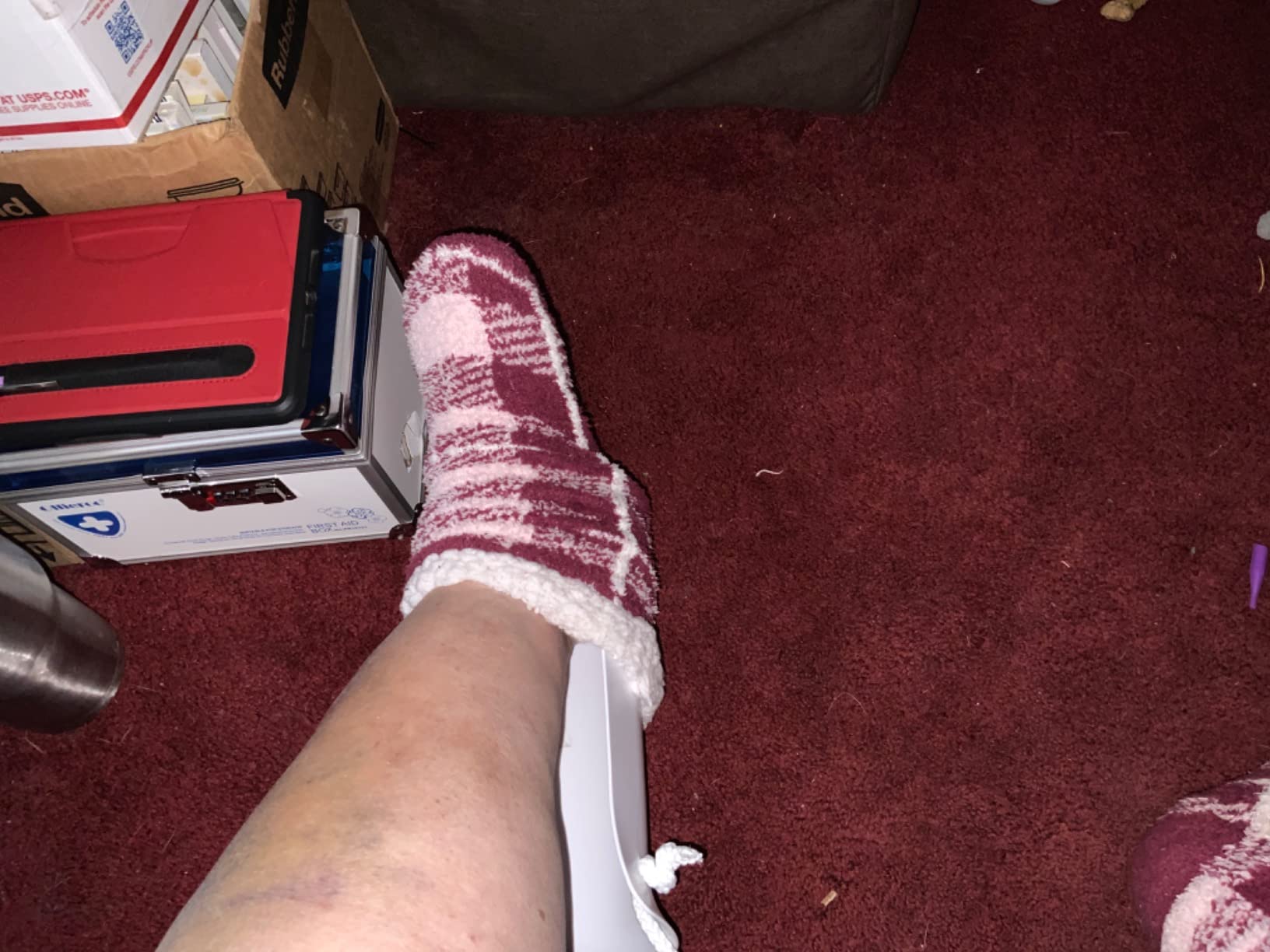
This is the aid we keep coming back to. The shell is contoured plastic that flexes rather than snaps, which matters more than the spec sheet suggests: a rigid shell needs two decent hands to load, while a flexible one lets you get the sock on with a weak pinch grip and a few seconds of patience.
The slip-resistant foam pad under the sock matters just as much. Without it the sock walks backward off the trough as you start the pull, and on a heavy foot that can mean three attempts instead of one. With it, the sock stays put and the pull works the way the diagrams suggest it will.
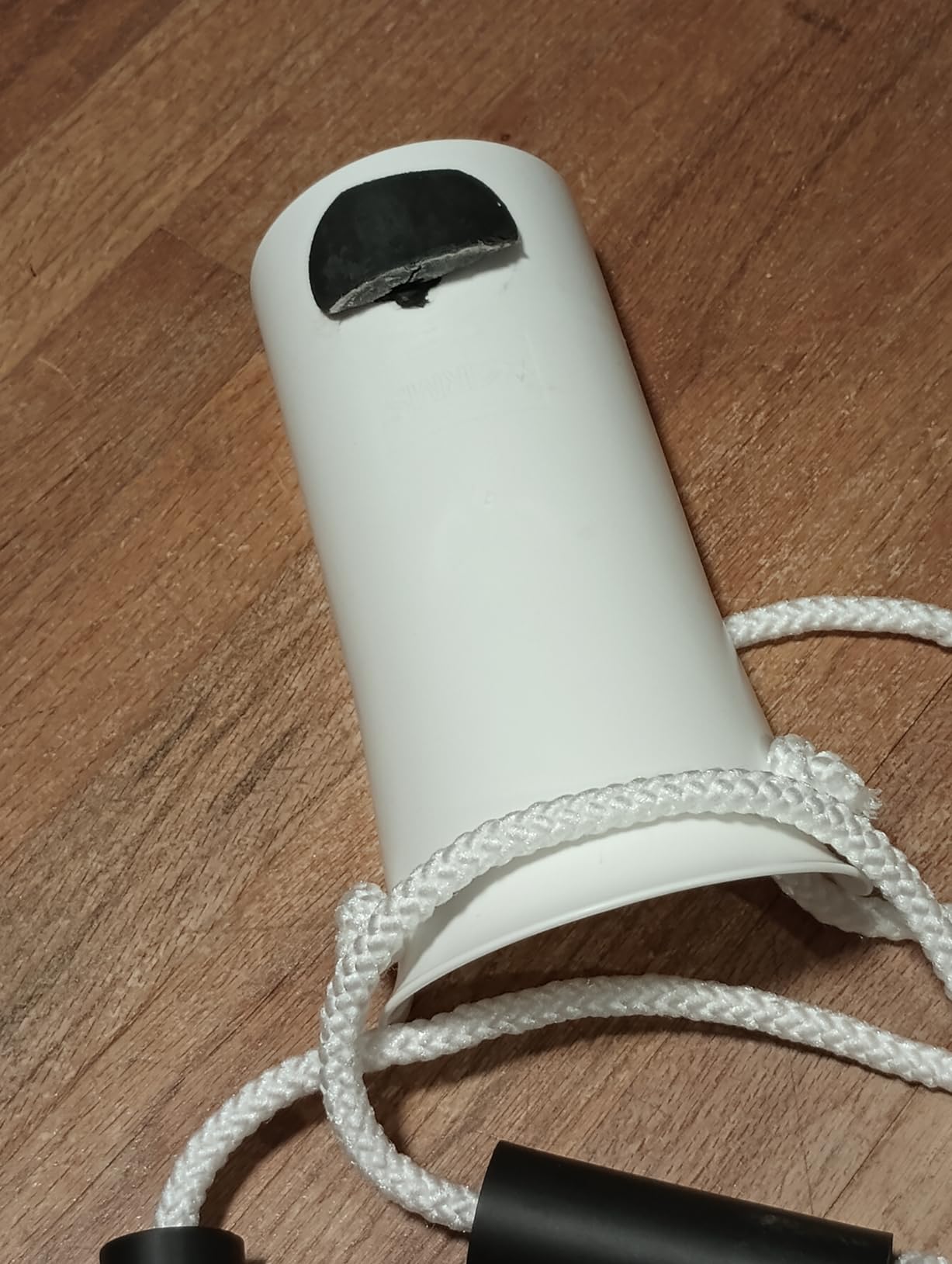
Rope length is 38 inches overall including the shell, and the ropes are adjusted by tying knots rather than with a buckle. That is a drawback for anyone who wants to change length daily, but in return the cord never snags on a plastic adjuster that can break. We measured the reach to our test chair and found the default length worked for two different seated heights once the knots were retied.
The 5-inch foot-width rating is the highest numeric limit published by any of the aids we reviewed, and that is the single most useful thing on this page for anyone with edema or a wider foot. It is not built for medical compression socks, sheer anklets, or nylon hosiery, and the manufacturer says so plainly.
What works well with this aid
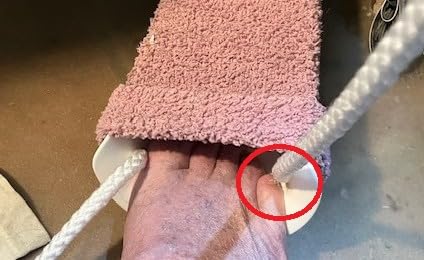
Regular everyday sock weights in ankle, crew, calf, athletic, and dress styles. The opening is wide enough that the sock loads in one motion rather than needing to be fed in a fold at a time. Because the shell flexes, the sock can be rolled down over the curve and then dropped into place with one hand on the aid and one hand holding the sock.
Roughly 74 percent of the ratings on this listing are five star, and the volume behind that number, 42388 reviews, tells you the design has been through years of real use rather than a launch window. It is also the single most reviewed aid in our entire comparison.
Where it falls short
Do not buy it expecting it to handle 20 to 40 mmHg compression stockings, and skip the knee-high tube socks if your sock is genuinely tall. The Wright Stuff retailer Q&A page, which documents real buyer questions, states that ankle and shin-high socks work best and that knee-high and compression socks do not. That matches what we saw.
The foam handles add bulk if you are packing for travel, and the ropes tangle more than the shorter corded models when the aid is tossed in a drawer. Neither issue matters much in a home setting, and both are manageable with a small hook on the wall.
2. Vive Sock Aid Easy On and Off Slider – Best Brand Name Buy
Vive Sock Aid – Easy On & Off Stocking Slider for Seniors & Limited Mobility
Latex-free contoured plastic shell
33 inch adjustable cords with button adjustors
Wide slip-resistant cuff
3 cm foam padded handles
Pros
- Button adjustors change cord length without tying knots
- Wide cuff keeps the sock anchored
- Latex-free shell suits latex-sensitive users
- Backed by a 60 day guarantee
- Long-standing listing in the sock aids category
Cons
- Hand wash only for cleaning
- Bulkier shell than three-finger designs
Vive is the name people already recognize from hospital-style equipment catalogs, and that matters when you are buying for someone who does not know how to judge a listing. The shell is contoured latex-free plastic that slides over the foot and heel rather than catching on them.
The two things that set this model apart from the plain plastic aids are the wide slip-resistant cuff and the button adjustors. The cuff holds the sock through the pull instead of letting it creep, and the adjustors let a caregiver shorten or lengthen the 33 inch cords in seconds without retying knots, which is exactly what you want when one household member has a much longer reach than another.
The handles are built up with 3 cm of foam padding, which is more padding than most of the aids here. If your grip strength is the limiting factor rather than your back, that extra foam is the difference between a firm pull and a slipping one.
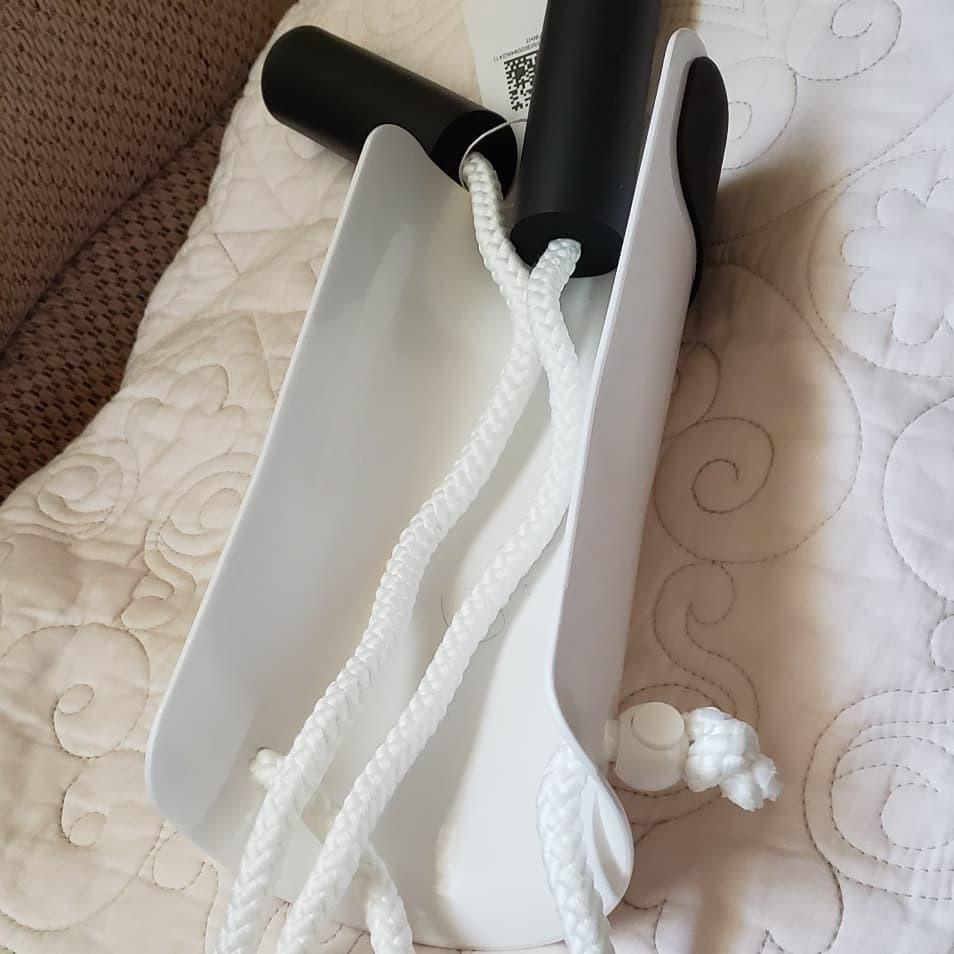
At 14471 reviews and a 4.2 rating, this is a well-established listing with about 66 percent five-star ratings. That is a little lower than the top of the list, and the difference shows up in feedback about cleaning and about the shell being bulkier than the softer cloth-covered designs.
The 60 day guarantee is worth more here than it looks. Sock aids fail quietly, with a cord fraying or a shell edge roughening, and a two-month window is enough time to find out whether it works for your feet before you commit.
What works well with this aid
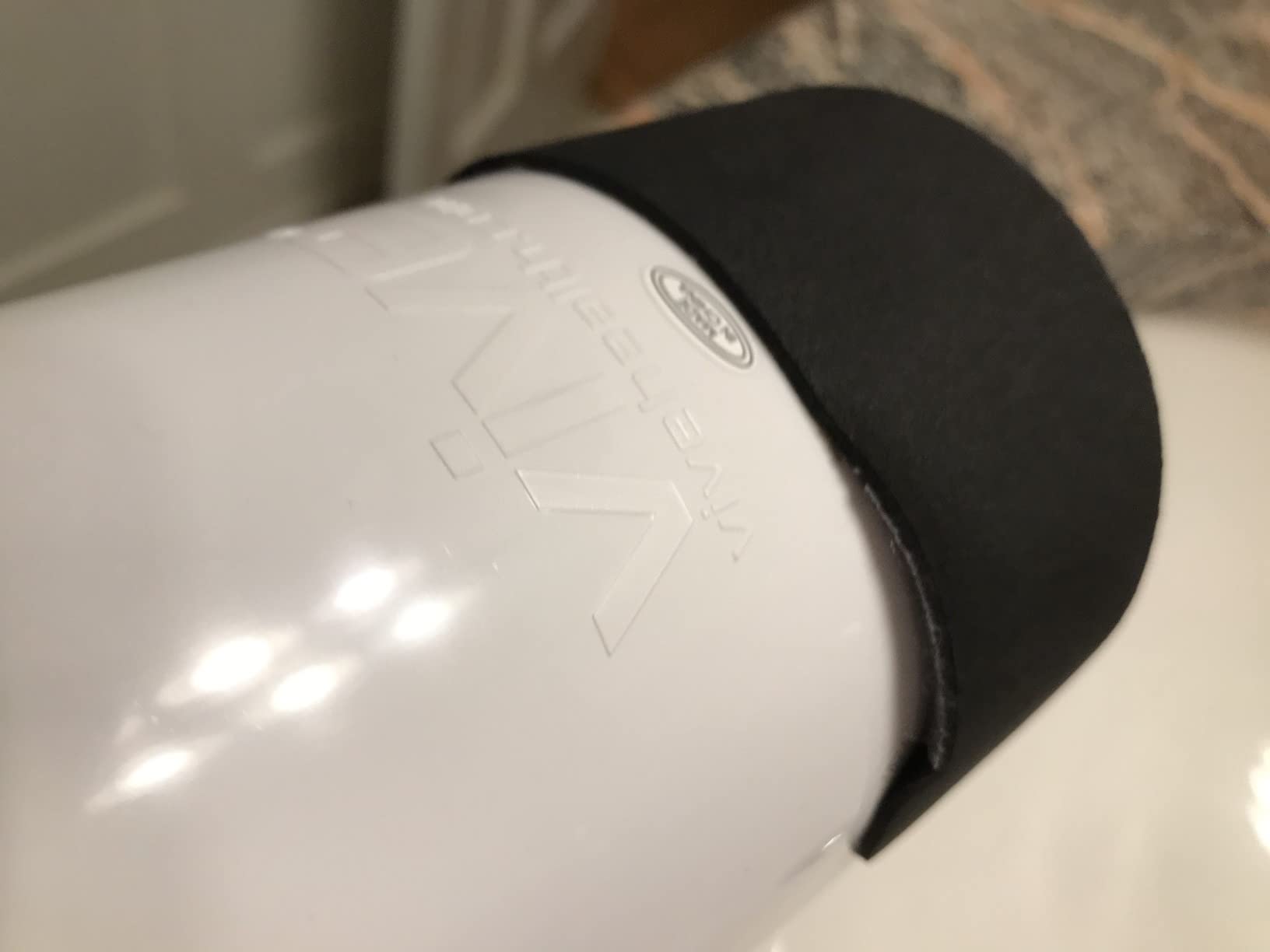
Households where two people at different heights share one aid, which is common when a parent moves in with a child. The button adjustors on the 33 inch cords make swapping between two users a five-second job rather than a retying session. The cuff also handles thin dress socks better than aids with a narrow lip, because the sock has more material captured.
It is also a sensible pick for anyone with a latex sensitivity, since the shell is explicitly latex-free, and for buyers who want a name with a physical warranty behind it rather than an unbranded listing.
Where it falls short
Hand wash only. No dishwasher, no soaking, no machine cycle, which sounds obvious until you are trying to clean a shell that has picked up lint from a pair of wool socks. And the shell itself is chunkier than the three-finger cloth-covered models, so it takes more room in a lap when you are loading a sock.
Reviewers also rate this below the aid at number one, and the recurring comment is fit rather than durability. If your foot measures close to the upper end of the width range, check the dimensions before you commit.
3. Fanwer Sock Aid and Pants Assist – Best Two-in-One
Fanwer Sock Aid Tool and Pants Assist for Elderly, Disabled,Pregnant, Diabetics – Pulling Assist Device – Socks Helper
Terry cloth covered slider
Large loop handles
Includes clip and pull dressing strap
No foot width restriction
Pros
- Two devices in one kit
- so it also handles pants and underwear
- No foot width restriction published
- Terry cloth grips socks without tearing fabric
- Light at 4.94 ounces
Cons
- Will not work with pantyhose nylon stockings crew socks or toe socks
- Dressing strap only adjusts from 26 to 41 inches
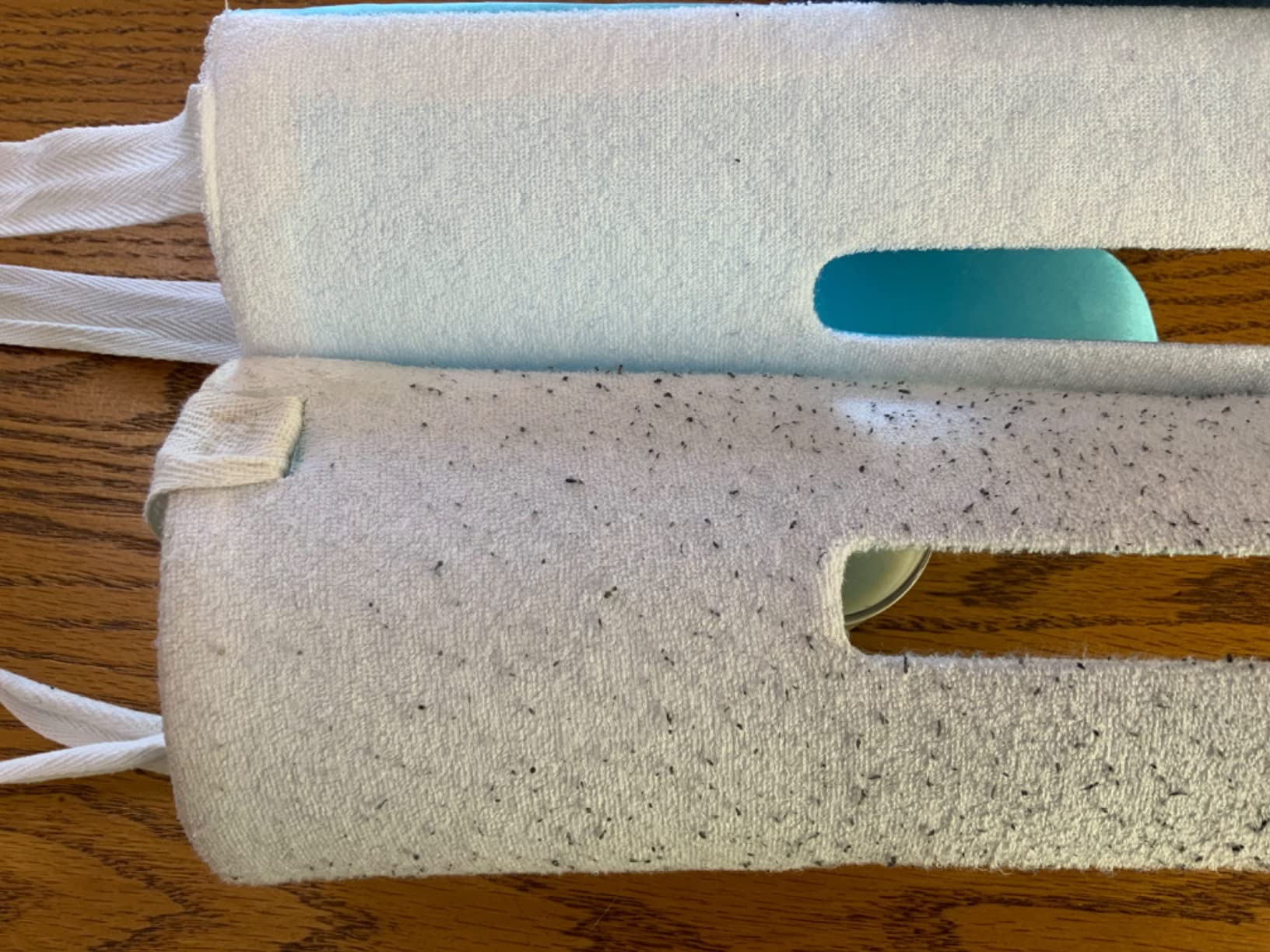
This is the kit to buy if the person you are helping also struggles with trousers. The sock slider is a terrycloth-covered frame with large loop handles, and the second piece in the box is a clip and pull dressing strap for waistbands. A sock aid on its own solves one daily task, and this solves two.
The terrycloth surface is the point of the design. It grips a cotton sock without pinching or tearing the fabric the way a bare plastic shell can, and it is forgiving when hands are clumsy. The loop handles are larger than most and sit flat in the palm, which reduces the grip strength needed compared with a narrow rope.
There is no published foot-width restriction on this one. That makes it a safer default when you do not know your measurements, and it is a genuine difference from the aids that cap out at 4 inches.
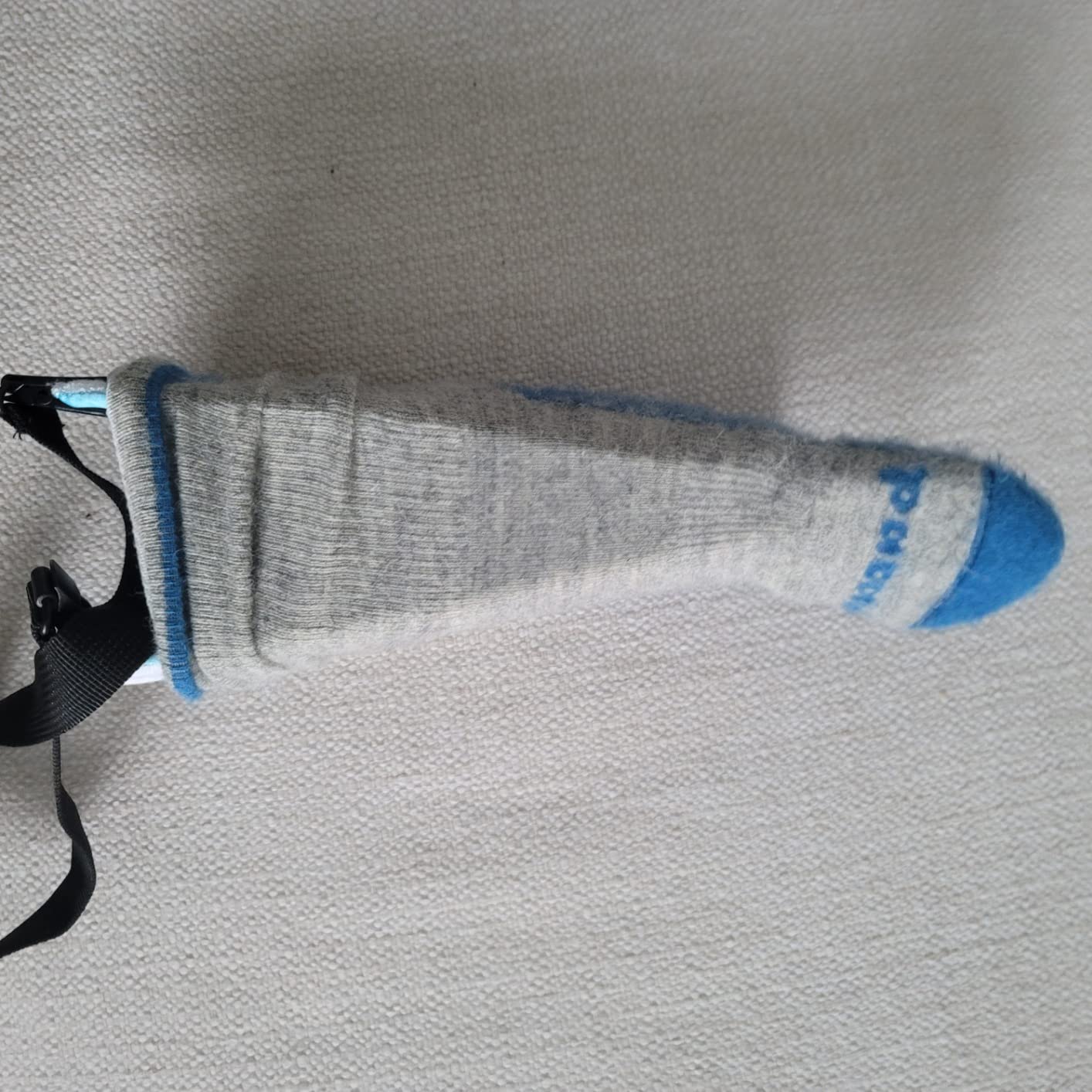
Users on r/OccupationalTherapy describe handing out sock aids routinely as part of durable medical equipment supplied through grants, and the difficulty those clinicians report is affordability. This kit answers part of that, because a two-tool set from one listing costs a senior one purchase instead of two.
At 12856 reviews and a 4.3 rating, it is the third most reviewed aid we looked at, with about 68 percent five-star ratings.
What works well with this aid
People recovering from hip or knee replacement, who are typically ordered to avoid forward bending for six to twelve weeks. Pants come up on the same schedule as socks during that period, and having one kit rather than two tools is genuinely more practical. It also works well for anyone whose difficulty comes from reach rather than grip, such as a person in a wheelchair.
At 4.94 ounces, it is light enough to hold above the foot for long enough to load a sock.
Where it falls short
The compatibility list is long and specific. The maker rules out pantyhose, stockings, crew socks, foot socks, toe socks, and nylon stockings, which is a wider exclusion list than some competing aids carry. The dressing strap adjusts only between 26 and 41 inches, so it will not reach a person in a tall chair with a fixed frame.
On r/Hypermobility, people describe improvising with straps and fabric loops rather than buying a dedicated aid. This kit is the version of that improvisation with a real handle and a published spec sheet, and for anyone who has been making do, the upgrade is obvious.
4. Rehabilitation Advantage Deluxe Sock Aid – Best for Travel and Clinic Use
Rehabilitation Advantage Deluxe Sock Aid – Sock Helper with Foam Handles – Dressing Aid for Seniors, Disabled, or Limited Mobility – 9.5″L x 5″W x 3″H
Smooth latex-free ABS plastic shell
Adjustable 33 inch cords
Internal foam pad holds the sock
5.44 ounces
Pros
- Smooth shell glides socks on with little effort
- Internal foam pad holds socks securely
- Cord length can be tailored to reach
- Compact enough for travel or clinic use
- Manufacturer is ISO 9001 certified
Cons
- Long floppy cords tangle in storage
- Foam handles add bulk for packing
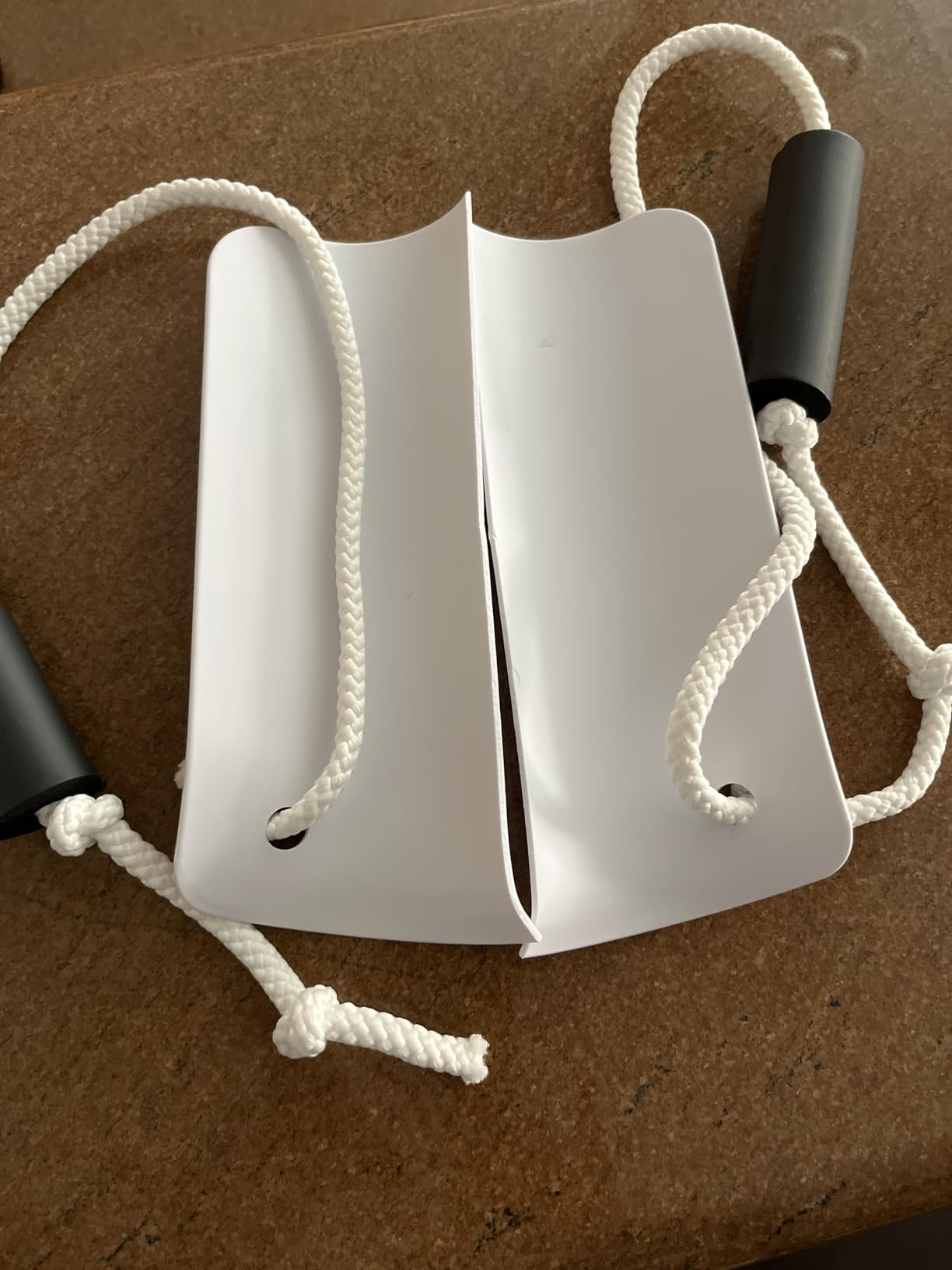
This one is built for a person who does not stay in one chair. At 5.44 ounces with a 9.5 by 5 by 3 inch shell, it is small enough to live in a suitcase, a clinic bag, or a second bathroom, and the maker explicitly describes it as usable one-handed. The smooth latex-free ABS shell is described as soft yet durable, and that combination is the reason it slides socks on with less force than rougher plastic.
The internal foam pad is what keeps the sock from walking off the shell mid-pull. Combined with the non-slip foam grips on the cords, this gives you two places to control the sock rather than one, and that is where most failed attempts come from.
At 3821 reviews and a 4.4 rating with about 72 percent five-star ratings, this is a smaller but well-regarded listing. The ISO 9001 certification is worth noting if you are buying for a care facility that has supplier requirements.
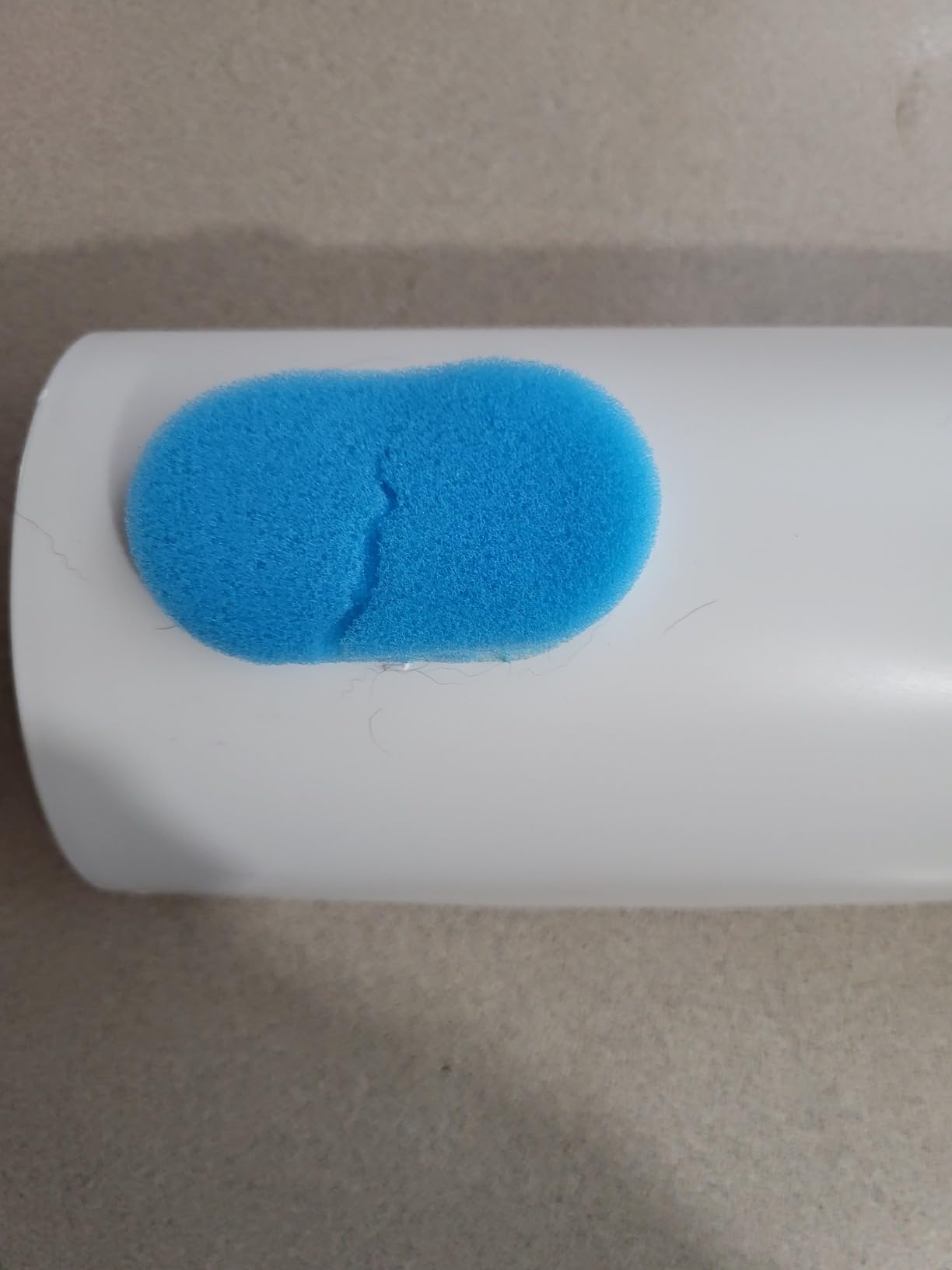
The cord is 33 inches and adjusted by retying knots. That is less convenient than the button adjustors on the Vive model, but it also means there is no plastic part in the cord path that can fail, which is a real consideration for a device that gets tugged on hard every single day.
Buy this one if you are splitting time between a home, a daughter’s house, and an outpatient appointment, or if you are a caregiver carrying a bag of aids between rooms.
What works well with this aid
Travel, short-term rehabilitation stays, and clinician-supervised use, where a durable medical equipment supplier or occupational therapist may hand over a specific model. Cord length can be tailored to the person rather than the other way around, which matters when the same aid has to work for two users of very different reach.
It is also a good pick for anyone who wants a smooth, snag-free surface. Rounded, contoured edges guide the sock over the heel rather than catching on it, and reviewers with reduced sensation in their feet mention that the glide is noticeably easier than on a ribbed shell.
Where it falls short
The cords are long and floppy, and reviewers report they tangle during storage more than the shorter corded models. If you put the aid in a drawer, you will find it knotted. A wall hook solves this completely, and we would mount one before anything else.
The foam handles add bulk, which partly defeats the travel advantage. It is still one of the more compact framed options here, but it is not the size of a soft cloth sock donkey, and the maker does not rate it for compression hosiery.
5. Mars Wellness Deluxe Sock Aid – Best Multi-Pack Option
Sock Aids for Putting on Socks, Deluxe Sock Helper for Seniors
Contoured plastic shell with built-up foam grips
Adjustable cord fits most heights
One size design
5.61 ounces
Pros
- Sold as a two-pack for a second location
- Available in a donner and remover bundle variant
- Built-up foam handles are comfortable and supportive
- Adjustable cord suits most user heights
Cons
- No published foot width limit to check against
- Cords must be tied rather than clipped
The reason to look at this listing is not the shell, it is the variants. It is offered as a single unit, as a two-pack, and as a donner and remover bundle. If you are an aging-in-place caregiver covering two bathrooms and a second home, buying a second aid is the step most people skip and then regret when recovery is underway.
The aid itself is a straightforward contoured plastic shell with built-up foam grip handles and an adjustable cord. Use is three steps: slip the sock over the plastic, slide the foot in, pull the cords. That simplicity is genuinely useful for someone using the aid for the first time with no caregiver coaching.
At 3196 reviews and a 4.2 rating, with about 67 percent five-star ratings, it sits in the middle of this group on consistency. Nothing about it is a standout, which is a reasonable way to describe a product whose main argument is availability in more than one configuration.
The stated purpose is reducing strain on the back, spine, and arms caused by the pulling and stretching motions involved in donning socks. That is the correct framing. The point is not that the aid makes dressing easier, it is that it removes the trunk flexion and the two-handed pull from a movement you would otherwise do thirty times a week.
The two-pack variant also solves a problem we heard about repeatedly in caregiver settings. A missing or misplaced aid during a hip replacement recovery is an outage, and a duplicate in a drawer is cheap insurance against a day when the first one is not where you left it.
What works well with this aid
Multi-location households and short-term post-surgical recovery, where the practical issue is having an aid at the bedside, in the bathroom, and at a second house. The bundle variant pairs the donner with a removal tool, which addresses the part of the routine that most aids ignore.
It is also a sensible default for anyone who wants a simple, one-size design with no foot-width specification to interpret. If you are buying for someone whose feet you cannot measure easily, a product that claims one size fits all and does not publish a restrictive limit may be the safer bet.
Where it falls short
There is no published foot-width limit, which cuts both ways. It may suit wider feet, or it may simply not say. If you know your feet are wide, the CAidRE three-finger model or the RMS are better documented choices.
Cords are adjusted by tying rather than by a clip or button, so changing the length for a second user takes a minute instead of five seconds. The build-up on the foam handles is comfortable, though it is a bulkier grip than the loop-handle designs.
6. CAidRE Three Finger Sock Aid – Best for Wide or Swollen Feet
CAidRE Sock Aid – Sock Aid Device for Seniors, Disabled, Pregnant – Sock Helper Aide Tool – Sock Assistant Device No Bending
Pliable three finger terrycloth and nylon shell
Wide back end for larger feet
2.4 ounces
8.85 by 4.72 by 2.36 inches
Pros
- Wide back end fits very wide feet
- Terrycloth outside and smooth nylon inside grips without tearing
- Very light at 2.4 ounces
- Pliant three-finger shell resists less during the pull
- Reported to pull socks fully into place
Cons
- Less rigid so it may need two passes up the leg
- Stiff upper end takes practice to load
- Not recommended for compression socks
This is the model to look at if foot width is your problem. Reviewers with very wide feet, including people wearing size 12 EEEE shoes, report that the wide back end of the three-finger design accommodates a foot that would not enter a narrower shell. That is the single most common compatibility question retailers field, and this aid has the most consistent positive answers about it in this group.
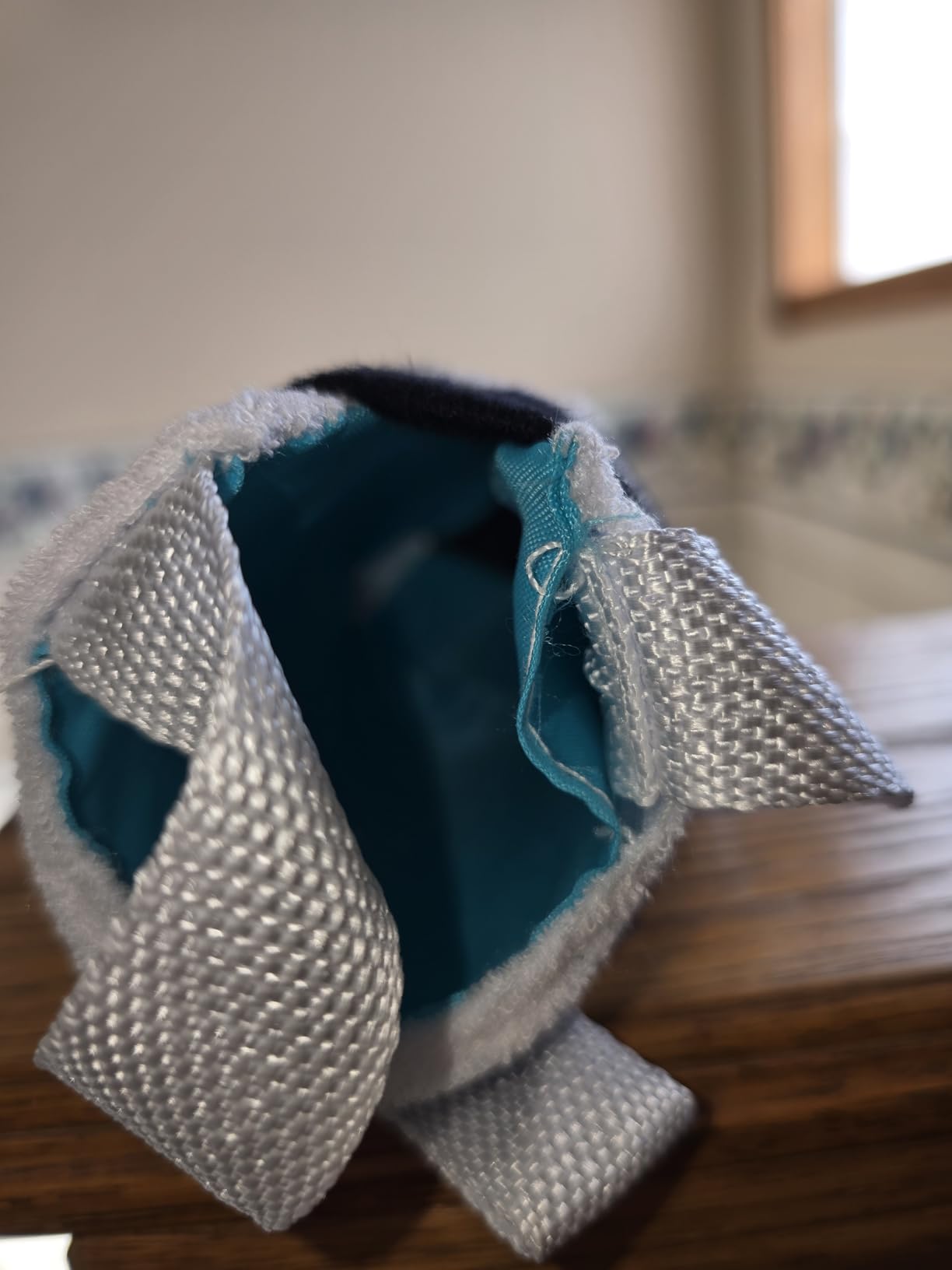
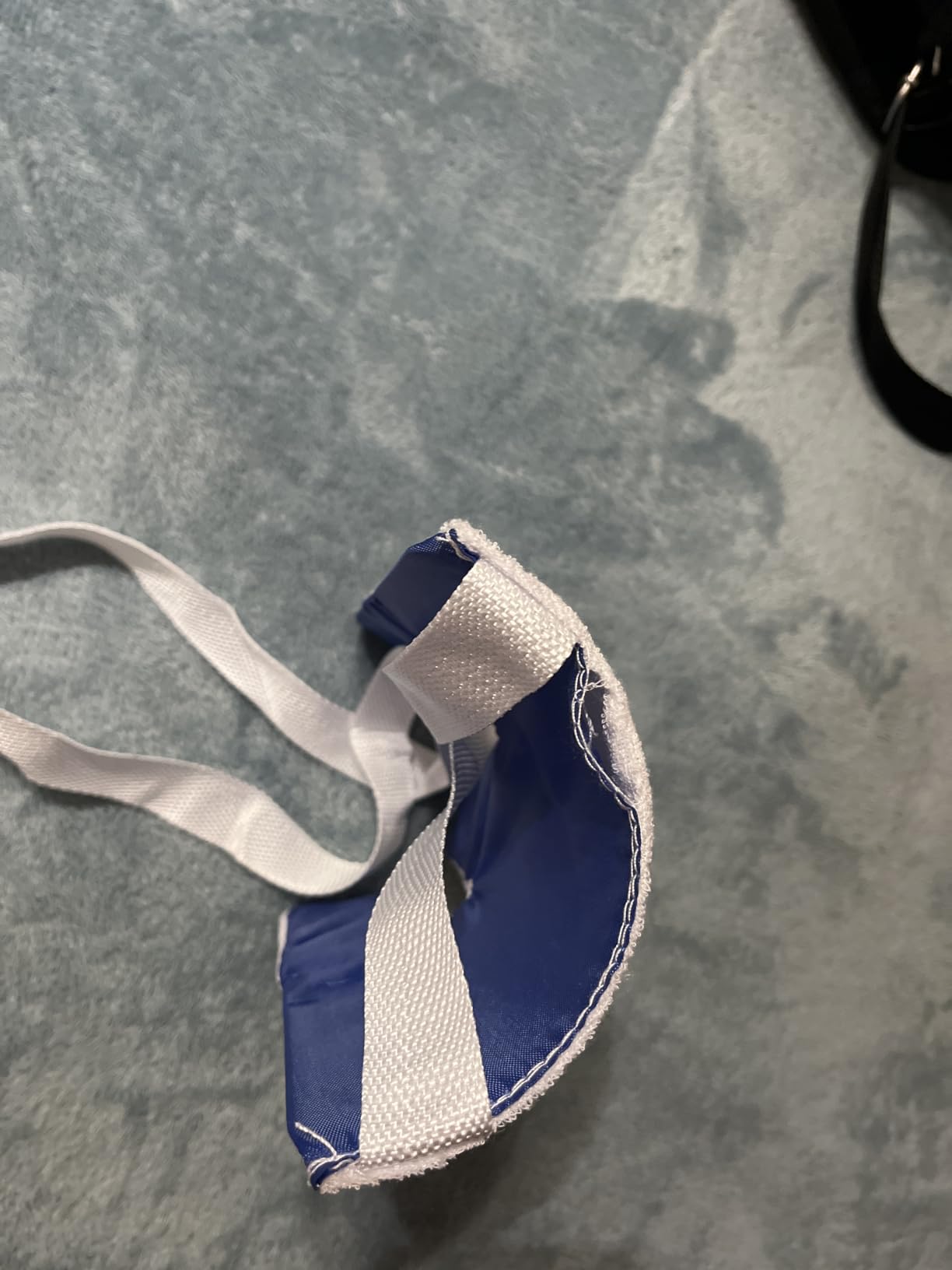
The two-surface construction does real work here. The outside is terrycloth, which grips the sock, and the inside is smooth nylon, which reduces friction against the heel as the foot slides in. That combination is why it feels less like pushing fabric over plastic.
It is also a very light option at 2.4 ounces, with a package footprint under 9 inches long. Anyone who gets tired holding an aid in the air while loading a sock notices that difference.
At 2790 reviews and a 4.5 rating with about 76 percent five-star ratings, this has the highest five-star share in the group. Users with swollen feet or limited back mobility report it pulls socks fully into place, which is a stronger claim than most aids in this category make.
On the ALS Forums, people describe wearing knee-length tube socks because pulling them up is the part that fails as hand strength declines. The pliability of this three-finger shell is relevant to that, because a flexible shell resists less as the sock tightens around the heel.
What works well with this aid
Dress, casual, and athletic socks in the widest range of foot sizes we saw tested. It is a good match for diabetic neuropathy, lymphedema, or any condition where swelling changes foot width over the course of the day, because the pliability gives more tolerance than a fixed-width shell.
Travel and small living spaces also suit it, since it folds flat and weighs almost nothing. Users with one-sided weakness after a stroke report success with it, though loading the sock still needs a workaround, which we cover in the buying guide.
Where it falls short
Because it is less rigid than the plastic troughs, the sock may not travel as far up the leg in a single pull. Some users treat that as a non-issue and some treat it as the reason they moved on. The stiff upper end also takes a little practice to roll and load, and a few reviewers reported units arriving with loose stitching that needed hand repair.
It is not recommended for compression socks, and while one reviewer reported success with them, the maker’s guidance is clear enough that we would not plan around it.
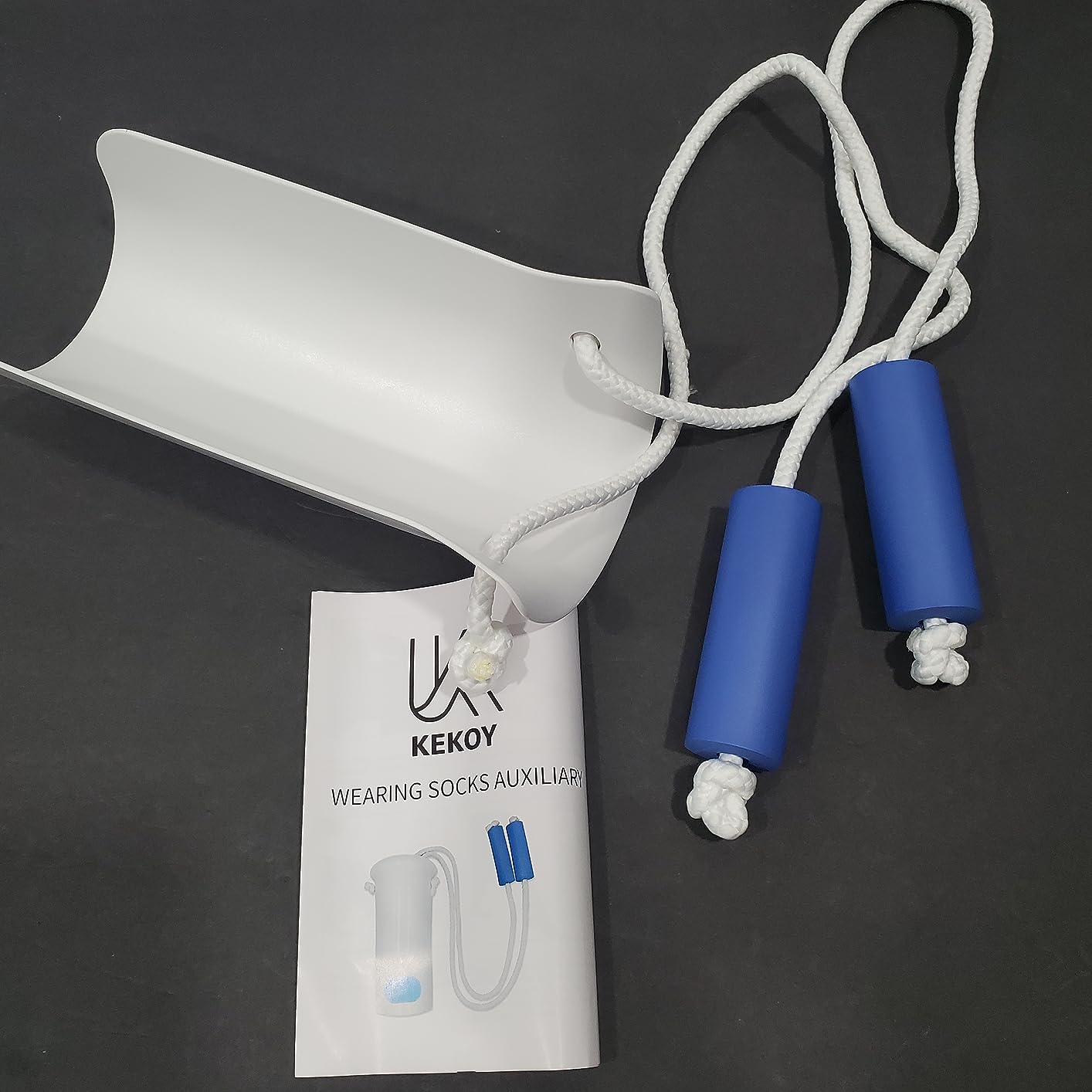
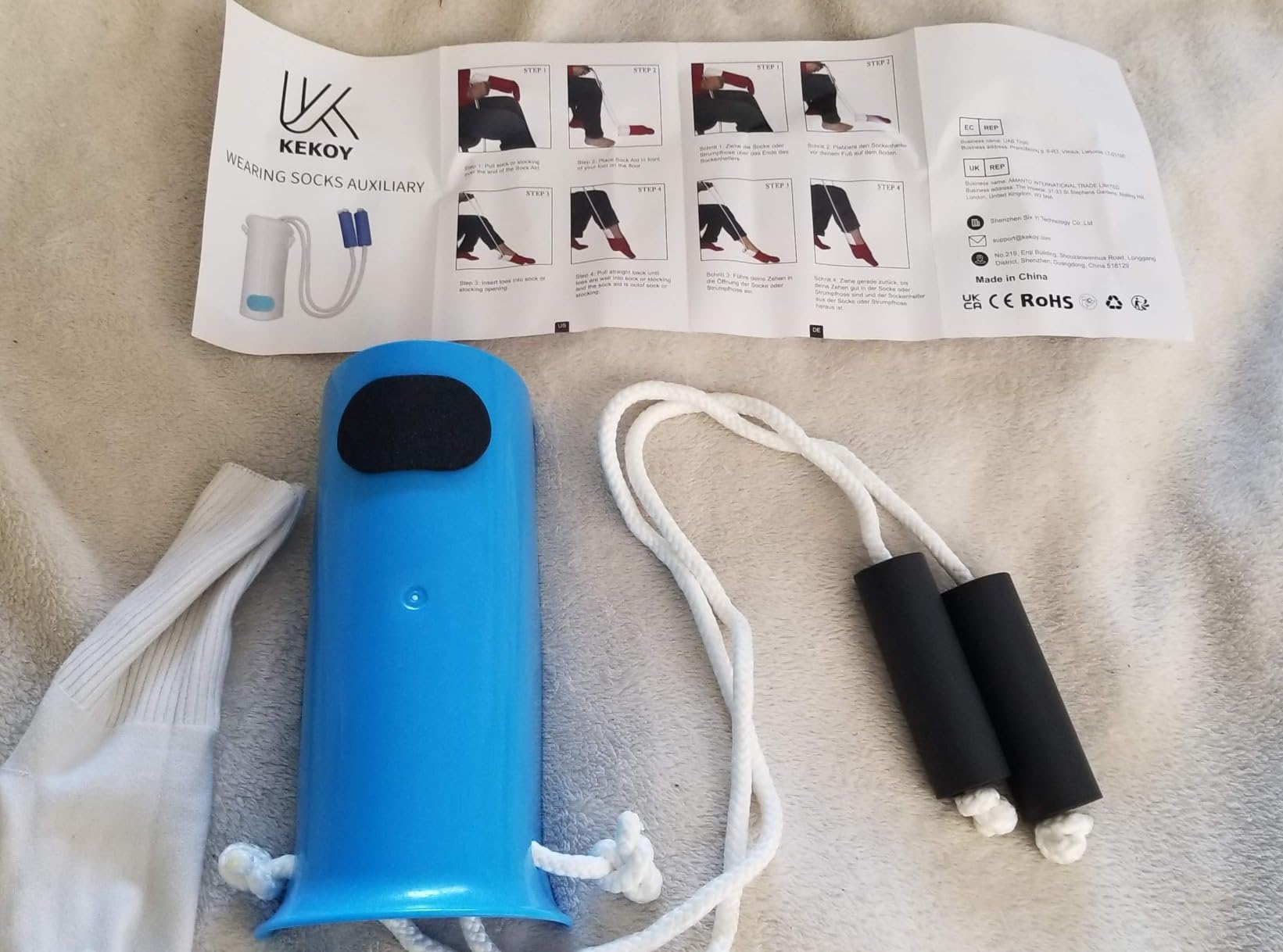
7. KEKOY U-Shape Sock Aid – Best for Instep Pressure
KEKOY Sock Aid for Putting on Socks, 4″ Foot Width, No Bending
U-shaped soft ABS shell
Two width options available
Foot widths 4 inches or less
6.74 ounces
Pros
- U-shape takes pressure off the instep during the pull
- Soft flexible shell is easy to load socks onto
- Two width variants for different foot sizes
- Suited to hip and knee replacement recovery
Cons
- Narrowest published foot width limit at 4 inches
- Not for compression socks or stockings
The idea behind this one is the instep. A conventional trough forces the sock to slide over the highest point of the foot under tension, and on a bony instep that pressure is the whole reason the pull fails. The U-shaped design holds the sock hole at a fixed size and removes that external pressure from the instep, which is why users report fewer aborted attempts.
Two width variants are offered, a standard and a wide option, which is unusual in this category and useful. The shell is soft ABS rather than hard plastic, so it flexes during loading, and at 6.74 ounces it is light enough to control with a weak grip.
At 2667 reviews and a 4.4 rating with about 74 percent five-star ratings, it is a newer listing with a shorter history, and it ranks in the top tier of the sock and stocking aids category despite that.
The care and recovery cases this is marketed for are the classic ones: hip or knee replacement, arthritis in the hands, back pain, limited mobility, and injury recovery. The design is explicitly aimed at making the sock hole stable rather than at maximizing foot width, which is the trade-off to understand before you buy.
If you are dressing someone in the first six weeks after hip replacement, where the standard advice is to avoid forward flexion and avoid twisting toward the operated side, anything that keeps the foot in a neutral, supported position is worth the small premium.
What works well with this aid
Feet with a high instep, a bony bridge, or diabetes-related foot shape changes where a rigid trough creates a pinch point. The U-shape is the reason this aid exists, and for those feet it is the feature that matters rather than a marketing detail.
It also works well in a two-person household, since the two width variants let you match two different foot shapes without buying two different products. The contoured shell loads socks easily, and the adjustable cord fits a wide range of seated heights.
Where it falls short
The published foot-width limit is 4 inches, the narrowest in this comparison. If your foot measures more than that, or if you have swelling that pushes past 4 inches by the end of the day, this is the wrong aid. Measure before you order rather than after.
Like most aids of this design, it is not for compression socks or stockings. Buyers expecting it to handle medical hosiery will be disappointed.
8. CAidRE 3.93 Inch Wide Sock Aid – Best Against Socks That Slip Off
CAidRE Sock Aid – Wide 3.93″ Sock Aid with Foam Handles, Sock Aide Device for Elderly, Sock Helper Easy On Easy Off for Regular Socks, Blue
Wide 4.2 inch opening
Extended lip and non-slip foam pad
38 inch ropes with buckle adjustment
Shell 9.6 by 4.2 by 3 inches
Pros
- Extended lip and foam pad stop socks sliding off mid-pull
- Buckle adjustment changes rope length in seconds
- Contoured smooth edges guide socks over the heel
- Opening fits more foot sizes than narrow models
Cons
- Still too narrow for very wide feet or swelling past 4.2 inches
- Not for tight compression socks or very thick stockings
This is the anti-slip pick, and it is the one to buy if your main frustration is socks sliding off the aid halfway through the pull. The extended lip around the opening and the non-slip foam pad beneath the sock give the sock two surfaces to catch on, so the upward pull starts with the fabric still where you put it.
The buckle adjustment on the 38 inch ropes is a genuine upgrade over knot-tying for anyone sharing one aid between two people. Press the buckle, change the length, and you are done. It is the fastest cord adjustment of any framed aid in this comparison.
At 1786 reviews and a 4.5 rating with about 74 percent five-star ratings, it has the lowest review count here but a high share of top ratings. We included it because the anti-slip feature is genuinely absent from the other seven.
What works well with this aid
People whose socks are thin or slippery enough to slide backward during the pull, which is a common complaint about soft cloth-covered aids. The smooth contoured edges help guide the sock over the heel without catching and tearing, and reviewers with weak hand strength specifically call that out.
It works well for seniors, pregnant users, and anyone in post-surgical recovery where the goal is a single clean pull rather than three partial ones. The wide 4.2 inch opening fits more foot sizes than the narrower plastic models.
Where it falls short
4.2 inches is still a limit. If your foot is wider, or if swelling takes you past 4.2 inches later in the day, the sock will bunch at the opening. It is not recommended for tight compression socks or very thick stockings, so the medical hosiery question has the same answer here as everywhere else in this category.
This listing had no verified customer images at the time we checked, so we are relying on the written reviews and the spec sheet rather than on owner photos. Everything else about the design is conventional and well specified.
How to Choose the Right Sock Aid for Your Situation
There are three families of device, and they are often called a sock aid, a sock helper, and a stocking donner interchangeably. That naming confusion is part of why shoppers hesitate. A sock aid or sock helper is the general term for a trough or shell with cords. A sock donkey is usually the softer cloth-covered version. A stocking donner is the word associated with rigid metal frames and medical compression hosiery.
Flexible terrycloth and nylon shells are the most common and work best with everyday cotton and athletic socks. Semi-rigid plastic shells hold their shape better, hold the sock more securely, and pull further up the leg in one motion. Molded wide-mouth shells add an extended lip that resists socks sliding off. Rigid metal frames exist for high compression classes but need more grip strength to operate.
Measure your foot width before you order. Most framed aids in this roundup are published for feet of 4 inches or less, the RMS is rated for 5 inches or less, and the CAidRE three-finger model has no restriction at all. Retailer Q&A pages consistently show that foot width is the number one question buyers ask, and guessing is the easiest way to end up with an aid that will not go on.
Then measure your reach while seated. Sit in the chair you actually use, hold a tape measure down toward the floor, and note the distance from your hand to the point where your heel would sit. That number is your cord length. A 29 to 33 inch cord suits a lower chair or a shorter reach, 38 inches is the common default, and anything longer is for people who use a tall chair or a raised toilet frame.
Grip strength is the other half of the decision. Foam-padded handles like the 3 cm padding on the Vive model or the built-up foam on the Mars Wellness aid reduce the force needed. Loop handles are the easiest to grab. A bare rope is the hardest, and it is a poor choice for advanced arthritis.
One-handed operation needs an honest answer. You can lift and lower these aids with one hand, and lighter models like the 2.4 ounce CAidRE three-finger aid help. But retailer support is clear that loading the sock onto the barrel is not really feasible one-handed. After a stroke, plan on loading the sock seated with both hands before the foot goes in, or use a grabber to hold the sock open on the aid. A weighted base is the other option, and it stops the aid sliding while you work.
Finally, think about the sock, not just the aid. Every product here except the metal frames is built for regular socks. Tube socks, knee-highs, pantyhose, and compression hosiery are a separate category of problem.
How to Use a Sock Aid Safely from a Chair
Sit in a stable chair with arms, ideally against a wall so a backward slide has resistance. Never attempt this standing, and never attempt it on stairs or from the edge of a bed. Most falls during dressing happen because the person is trying to balance while leaning forward.
Place the aid across your lap with the opening facing away from you and the cords running over your shoulders or resting beside your thighs. Make sure the non-slip pad is down against your lap.
Roll the sock down over the shell until the heel pocket of the sock lines up with the curve of the aid and the toe is fully through the opening. Take your time here, this is the step people rush.
Lower the aid to the floor by feeding the cords out slowly. The sock should still be wrapped around the shell when it reaches the ground.
Slide your foot forward into the sock, heel first, and lean forward only as far as your precautions allow. Your toes should end up at the far end of the shell.
Pull both cords upward in one steady motion using your arms rather than your back. The sock rolls over the heel and the aid slides out the top of the sock.
Lower the aid and repeat for the second foot, then check the sock is fully on before you stand up. Standing is when the real fall risk begins.
If the sock slips off the aid, you loaded it too loosely. If the sock bunches under the heel, you did not pull far enough in one motion. If the cord feels slack in your hands, it is too long for your reach and should be shortened.
Compression Socks: When a Standard Sock Aid Fails
Standard aids are built for regular socks and they say so. The RMS is explicitly not for compression socks, compression stockings, sheer anklets, or very thin hosiery. The KEKOY and the CAidRE wide model carry the same restriction, and the plastic troughs generally will not get a 30 to 40 mmHg stocking past the ankle.
Threads on r/Sciatica describe compression socks as impossible to put on using only a sock aid without asking another person for help, and that matches the retailer Q&A documentation, which lists compression socks as a category that does not work. On r/disability, users report layering compression socks under dress socks and substituting football socks as workarounds, which tells you how common the problem is and how rarely it gets a proper solution.
Light support at 15 to 20 mmHg is a different matter from medical grade at 30 to 40 mmHg, and the aids in this roundup are only realistic for the lighter end if at all. For the heavier classes you need a stocking donner with a metal frame, or a device designed to grip the hose, and in many cases a caregiver-assisted method is the honest answer. If your compression stocking is prescribed for venous insufficiency or lymphedema, ask your prescribing clinician which donning method they want you to use rather than improvising with a household aid.
Taking Socks Off Again Without Bending
Most of these aids only put socks on. Removing a used sock is a separate problem, and the Wright Stuff Q&A notes that a separate hand tool is generally needed for taking hosiery off at the calf. People on r/spinalcordinjuries describe exactly this frustration in a thread about socks bunching and tight socks that are hard to pull back down.
The practical solution is a sock removal tool with a hook or loop on the end, which you run up under the sock and pull downward in one motion, often while seated. The Mars Wellness listing is available in a bundle variant that pairs the donner with a removal tool, and that bundle is the one to choose if removal is already a problem for you.
A long-handled shoe horn and a dressing stick solve the adjacent problems of shoes and waistbands without adding a third device, and together with a sock aid they cover nearly all of a no-bend dressing routine. r/OccupationalTherapy clinicians describe supplying these as a set, which is why the two-in-one kits tend to satisfy caregivers better than single aids.
Cleaning, Storage and When to Replace Your Sock Aid
Check the care instructions and follow them exactly. The Vive is hand wash only, and hand washing is the sensible default for every aid in this roundup regardless of what the listing says. Wipe the shell with a damp cloth and mild soap, dry it fully, and never use hot water, which can warp a plastic shell or shrink the foam handles and pad.
Do not machine wash a sock aid even if the fabric layer looks removable. The plastic shell, the internal foam pad, and the cord attachment points are not designed for it, and a warped shell will not hold a sock in place the way a straight one does.
Store it hung, not tossed. The long floppy cords on several of these models tangle in a drawer, and a tangle becomes a snarl the first time someone pulls hard under frustration. A hook on the back of a bedroom door costs nothing and fixes it.
Replace it when the cord frays, when a foam grip compresses and stops springing back, or when the shell edges feel rough to the touch. Fraying cord is not cosmetic, it is a forward lurch waiting to happen, and reviewers who have had cords fail describe exactly that. A spare aid in a second location is cheaper than a week of not being able to dress during recovery.
Frequently Asked Questions
What is the best aid for putting socks on?
For most seniors, a flexible terrycloth and nylon sock aid or a semi-rigid plastic shell with two long pull cords is the best aid for putting socks on. The RMS Deluxe Sock Aid is the widest-rated option in our comparison, holding regular socks open for feet up to 5 inches wide. Rigid metal frames exist but require more grip strength than most people have.
What can I do if I can’t bend over to put socks on?
Sit in a stable chair with arms, load the sock onto the sock aid across your lap, lower the aid to the floor by its cords, slide your foot in, and pull both cords upward using your arms rather than bending further. Standing while trying to reach your feet is the most common cause of dressing-related falls, so never do it standing.
How do I put socks on if you can’t reach my feet?
Measure your reach while seated in your usual chair and match it to the cord length. A 29 to 33 inch cord suits a lower chair, 38 inches is the common default, and longer cords suit a tall chair or a raised toilet frame. Most aids are also adjustable, either by retying knots or by pressing a buckle, so you can fine-tune the length after a few days of use.
What is the best sock aid for hip replacement surgery?
Choose a sock aid with a wide foot-width limit, foam-padded handles, and a cord long enough to reach from your chair. A flexible shell loads more easily with one hand, which matters early in recovery. Buy before surgery if you can, practice while you are still mobile, and keep a second aid in a second location. Ask your surgical team what hip precautions you are under before using any device.
Can sock aids be used with compression stockings?
Standard sock aids generally cannot. Manufacturers of the aids in our comparison explicitly exclude compression socks, compression stockings, and sheer hosiery, and retailer documentation confirms that compression socks do not work with the common models. Light support at 15 to 20 mmHg is more realistic than medical grade at 30 to 40 mmHg, which needs a metal stocking donner or caregiver assistance.
Are sock aids covered by Medicare?
In most cases, no. A sock aid is considered a convenience item rather than durable medical equipment, so it is rarely reimbursed by Medicare Part B or Part D. Occupational therapists frequently supply these through durable medical equipment programs, grants, Medicaid waiver programs, and hospital or clinic resources instead, so ask your occupational therapy department before you pay out of pocket.
Final Verdict on the Best Sock Aids for Seniors
After comparing eight aids, the RMS Deluxe Sock Aid is the one we would buy first. It has the most reviews in the category at 42388, a 5 inch foot-width rating that is the widest published number here, a flexible shell that loads with weak hands, and adjustable cords. The Vive is the alternative if you want a recognized brand with a 60 day guarantee and the fastest cord adjustment available.
If foot width is your binding constraint, the CAidRE three-finger model is the pick, and the KEKOY only if your problem is a high instep. If the person also needs help with trousers, the Fanwer two-in-one kit covers both tasks in one purchase.
Whatever you choose, buy it before a hip or knee replacement rather than during recovery, hang it on a hook, and buy a second one for a second bathroom. That is the whole difference between a device that stays in a drawer and one that ends a daily struggle with bending forward.
You may also want to read our guide to the best OTC hearing aids if hearing loss is also limiting how easily someone can follow your instructions during dressing.