
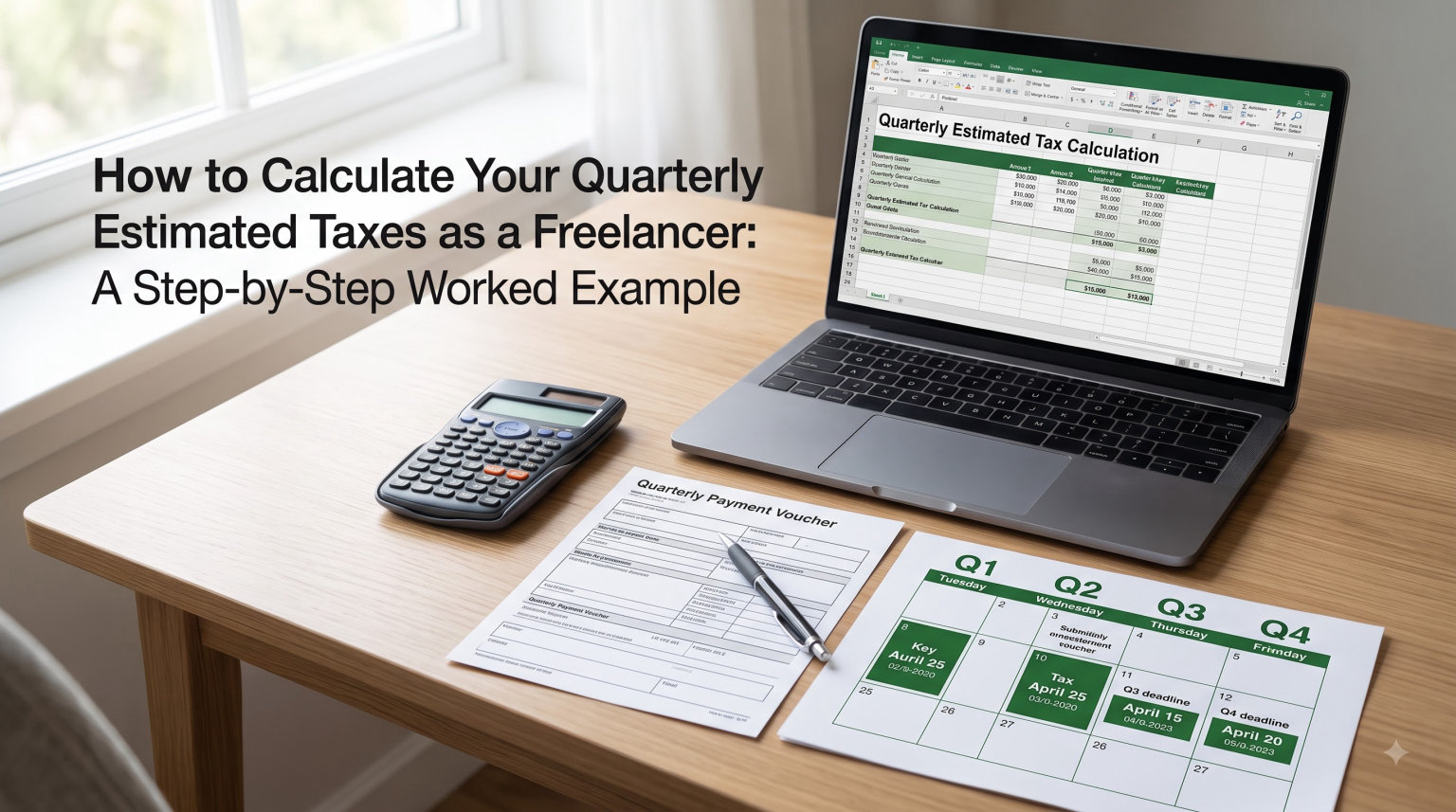
I remember the April morning a designer friend called me in a cold sweat. She had just filed her first full-year freelance return and owed the IRS $11,400. She had made zero quarterly payments. That single phone call is the reason I wrote this guide. If you earn freelance or 1099 income and you have not been sending quarterly estimated payments to the IRS, you are building the same surprise she got. The fix is not complicated, but it does require you to do math four times a year instead of once.
Quarterly estimated taxes are the way the United States collects federal income tax and self-employment tax from people who do not have an employer withholding from every paycheck. Freelancers, independent contractors, sole proprietors, and gig workers all fall into this bucket. In this guide I will walk you through exactly how to calculate your quarterly estimated taxes as a freelancer, using a real $120,000 worked example that you can adapt to your own numbers.
You will learn the four 2026 due dates, the exact formula for self-employment tax, how to layer income tax on top, the safe harbor rules that protect you from penalties, and how to actually send the money to the IRS. I will also flag the most common mistakes I have seen other freelancers make, including the Q2 June 16 deadline surprise that catches people every single year.
Table of Contents
Why Freelancers Must Pay Quarterly Estimated Taxes?
The simplest way to understand quarterly estimated taxes is to imagine that your freelance business is your own employer. When you work a regular W-2 job, your employer takes a slice of every paycheck for federal income tax, Social Security, and Medicare before you ever see the money. That automatic withholding is essentially the government pre-collecting your tax bill in small chunks. Freelancers do not have an employer doing that for them, so the IRS asks them to send in four payments a year instead.
The Employer Withholding Analogy
Think of each quarterly payment as a stub for a paycheck you never received. If you bill a client $10,000 in March, that money is yours in full, but the IRS still expects to collect roughly 25 to 35 percent of it for taxes over the course of the year. Skipping the quarterly payments does not mean you escaped the tax. It just means you will owe it all in April, plus interest on the portions you should have paid in advance.
The $1,000 Threshold
The IRS does not require quarterly payments from everyone. You only need to make them if you expect to owe at least $1,000 in federal tax for the year after subtracting withholding and refundable credits. Most freelancers earning above $40,000 to $50,000 a year cross this line easily, even after the standard deduction. If your net freelance profit is below that, you can probably skip quarterly payments, but check with a tax professional if you also have W-2 income or investment gains.
The $400 Rule for Self-Employed People
There is a separate rule that often gets confused with the $1,000 threshold. If your net earnings from self-employment are $400 or more in a year, you owe self-employment tax. That is the 15.3 percent Social Security and Medicare levy that employees normally split with their employer. The $400 rule does not determine whether you pay quarterly. It determines whether you owe SE tax at all. Most freelancers easily cross $400 in net profit, so they will owe SE tax in addition to income tax.
Income Tax Plus Self-Employment Tax
One of the biggest shocks for new freelancers is realizing they owe two distinct taxes, not one. Income tax is what everyone pays based on taxable income, with progressive brackets from 10 percent up to 37 percent. Self-employment tax is the 15.3 percent Medicare and Social Security levy that gets stacked on top. Together, a freelancer in the 22 percent income tax bracket with no other income can easily face an effective federal tax rate of 35 to 40 percent on every dollar of profit. That is why the 25 to 30 percent savings rule of thumb exists.
The 2026 Quarterly Estimated Tax Deadlines
There are exactly four quarterly estimated tax due dates each year. Each one covers a three-month period of income you earned during that quarter. Missing a deadline does not let you off the hook. It just starts the clock on an underpayment penalty for that quarter, even if you pay the full amount with your April return.
The Four 2026 Due Dates at a Glance
Q1 estimate (covers Jan 1 to Mar 31 income): April 15, 2026
Q2 estimate (covers Apr 1 to May 31 income): June 16, 2026
Q3 estimate (covers Jun 1 to Aug 31 income): September 15, 2026
Q4 estimate (covers Sep 1 to Dec 31 income): January 15 of next year
The Q1, Q3, and Q4 dates are familiar because they fall on the 15th of the month. The Q2 deadline catches people every year because the period it covers is only two months long (April and May) instead of three. That is why June 15 is the normal deadline, but June 16 in 2026 because June 15 lands on a Monday and federal estimated tax deadlines shift to the next business day when they fall on a weekend or federal holiday.
What Happens If You Miss a Deadline
The IRS charges interest on the underpaid amount for each day from the missed deadline until you pay. The current underpayment interest rate adjusts quarterly and is tied to the federal short-term rate plus 3 percent. As of 2026 that rate is around 8 percent annualized. The penalty is not a flat fee. It is daily compounding interest on the shortfall. That is why a $3,000 underpayment from one missed quarter can cost $80 to $120 in penalties by April, depending on timing.
How to Calculate Quarterly Estimated Taxes: A Step-by-Step Worked Example
This is the section most freelancers actually want. I will take a single realistic scenario, run every line through the math, and show you how I get to the final quarterly payment. You can copy the structure and plug in your own numbers. For this example, assume the freelancer is single, has no W-2 income, lives in a state with no state income tax, and has no other deductions beyond the standard deduction.
The Scenario
Our example freelancer, Alex, is a graphic designer. In 2026, Alex expects to bill $140,000 in gross revenue. Business expenses (software, equipment, home office, health insurance, continuing education) add up to $20,000. So Alex expects $120,000 in net self-employment income for the year. We will calculate Alex’s quarterly estimated tax liability using the official IRS formula.
Step 1: Calculate Net Self-Employment Income
Net self-employment income equals your gross freelance revenue minus ordinary and necessary business expenses. For Alex: $140,000 minus $20,000 equals $120,000. This number goes on Schedule C and is the starting point for both self-employment tax and income tax calculations.
Step 2: Calculate Self-Employment Tax
Self-employment tax uses a counterintuitive multiplier. You do not pay the 15.3 percent on 100 percent of your net earnings. The IRS gives you a deduction equivalent to the employer’s half of FICA. That deduction works out to 7.65 percent, which leaves 92.35 percent as the base. So the formula is:
SE tax base = Net self-employment income x 92.35%
SE tax = SE tax base x 15.3%
For Alex: $120,000 x 0.9235 = $110,820. Then $110,820 x 0.153 = $16,955.46 in self-employment tax for the year. Round to $16,955.
One thing to watch: only 92.35 percent of your net SE income is also subject to Social Security tax up to the annual wage base (about $176,100 in 2026). The Medicare portion of 2.9 percent applies to the full 92.35 percent. Above certain income thresholds, an extra 0.9 percent Medicare surtax applies. For our $120,000 example, both effects are simple because Alex is well under the Social Security cap and the $200,000 single-filer Medicare threshold is not yet triggered, so the plain 15.3 percent formula works.
Step 3: Calculate Deductible Portion of SE Tax
You can deduct half of your self-employment tax as an above-the-line adjustment to income. This is a meaningful tax break that lowers your income tax bill but does not change the SE tax you owe. For Alex: $16,955 / 2 = $8,478 deductible portion. Half is taken precisely; the other half covers the employer’s share.
Step 4: Calculate Adjusted Gross Income
AGI equals net self-employment income minus the deductible portion of SE tax, plus or minus any other adjustments. For Alex, this is $120,000 minus $8,478 = $111,522 in AGI.
Step 5: Subtract the Standard Deduction to Get Taxable Income
The 2026 standard deduction for a single filer under 65 is around $15,750 (adjusted for inflation each year). For simplicity, we will use $15,750. Alex’s taxable income is $111,522 minus $15,750 = $95,772.
Step 6: Apply the QBI Deduction
Freelancers often qualify for the 20 percent Qualified Business Income deduction. Assuming graphic design is not a specified service trade or business (SSTB) limitation issue at Alex’s income level, Alex can deduct 20 percent of qualified business income. The QBI deduction is limited to the lesser of 20 percent of QBI or 20 percent of (taxable income minus net capital gains). For Alex, 20 percent of $120,000 in QBI is $24,000, and 20 percent of $95,772 in taxable income is $19,154. The smaller figure applies, so the QBI deduction is approximately $19,154.
Taxable income after QBI: $95,772 minus $19,154 = $76,618.
Step 7: Calculate Federal Income Tax Using 2026 Brackets
Apply the single-filer 2026 tax brackets (exact thresholds adjusted for inflation). For a taxable income of about $76,618, Alex falls into the 22 percent bracket. Federal income tax using the brackets works out to roughly $11,890 (this combines 10 percent on the first bracket, 12 percent on the next, and 22 percent on the rest). Round to $11,890 for the example.
Step 8: Add Self-Employment Tax and Income Tax Together
Total annual federal tax liability for Alex = $16,955 in SE tax + $11,890 in income tax = $28,845.
Step 9: Divide by Four for the Quarterly Payment
$28,845 / 4 = $7,211.25 per quarter. Alex should plan to send $7,211 to the IRS four times a year. Many freelancers round to the nearest $50 or $100 for simplicity, so $7,200 per quarter works.
The Shortcut: The 25 to 30 Percent Rule of Thumb
If you do not want to do this math in detail every quarter, the 25 to 30 percent rule of thumb is widely used by freelancers. Take your net freelance profit, multiply by 0.25 to 0.30, and that is roughly what you should set aside for federal taxes each year. For Alex’s $120,000 net income, that is $30,000 to $36,000, which works out to $7,500 to $9,000 per quarter. Slightly more than the detailed calculation suggests, which is exactly why this rule of thumb works well. It builds in a small cushion.
Safe Harbor Rules: How to Guarantee Zero Penalties
Safe harbor rules are the IRS’s way of saying that even if your estimate is wrong, you can avoid underpayment penalties as long as you paid enough based on one of three tests. The IRS does not care if your actual tax bill is higher than you expected. They only care whether your quarterly payments met a safe harbor threshold.
The 100 Percent Rule
Pay 100 percent of last year’s total tax liability through withholding and estimated payments, and you owe zero penalties for the current year, regardless of how much you actually owe in April. For most freelancers with relatively stable income, this is the simplest safe harbor. Pay the same total each year, in four roughly equal chunks, and you are protected.
The 110 Percent Rule for High Earners
If your prior year adjusted gross income was more than $150,000 (or $75,000 if married filing separately), the safe harbor threshold rises to 110 percent of last year’s tax instead of 100 percent. The extra 10 percent covers the fact that higher earners tend to have more volatile income. For Alex, if 2025 AGI was $200,000, Alex needs to pay 110 percent of 2025 tax through quarterly payments to fully safe-harbor 2026.
The 90 Percent Current-Year Rule
The third option is paying 90 percent of your current year’s actual tax liability through quarterly payments. This is the hardest to use in practice because you do not know your current year liability until you are filing your return. It is most useful for freelancers whose income has dropped sharply and who can prove they paid 90 percent of the lower actual bill.
Which Safe Harbor Should You Use
If your income is flat year over year, use the 100 percent rule. If your income is growing, use 110 percent of last year. If your income dropped sharply, recalculate your expected current-year liability and pay 90 percent of that. The safe harbor you choose does not change the total tax you owe in April. It only changes whether you owe a penalty on top of that bill.
Form 1040-ES Walkthrough
Form 1040-ES is the IRS worksheet designed to help you estimate your quarterly tax liability. There are two parts: a worksheet that helps you calculate expected tax for the year, and four payment vouchers that you send with your actual quarterly payments if you are paying by check or money order.
What Form 1040-ES Contains
The form includes a one-page Estimated Tax Worksheet that mirrors the calculations we just did for Alex, plus four payment vouchers (one per quarter) pre-printed with the appropriate tax year and quarter identifier. Most freelancers today skip the vouchers because they pay electronically, but the worksheet logic remains the official IRS approach.
When the Worksheet Changes
The IRS releases an updated Form 1040-ES each year, usually in late December or early January. The new worksheet reflects updated tax brackets, updated standard deduction amounts, and any inflation adjustments. If you use the prior year’s worksheet, your estimate will be off by the inflation adjustment, which can be 2 to 5 percent. Always use the worksheet for the tax year you are estimating.
How the Worksheet Guides Your Math
The worksheet walks through the same steps we did manually: enter expected AGI, subtract deductions to get taxable income, apply the tax tables or brackets, add SE tax, then divide by four. The biggest value of the worksheet is not the math. It is the discipline of filling it out quarterly so you actually look at your numbers.
How to Pay Your Quarterly Estimated Taxes
Once you know the dollar amount, you have several ways to send the money to the IRS. Each method has tradeoffs in convenience, processing time, and confirmation.
EFTPS (Electronic Federal Tax Payment System)
EFTPS is the IRS’s own payment portal for businesses and self-employed individuals. You enroll online, wait about seven business days for a PIN in the mail, and then schedule payments up to 365 days in advance. EFTPS is free, and the confirmation screen is the gold standard for proving you paid on time. Most accountants recommend EFTPS for high-volume payers because you can schedule all four quarterly payments in January and not think about them again.
IRS Direct Pay
IRS Direct Pay is the IRS’s simpler website for individuals paying estimated taxes. You enter your bank routing and account number, choose the tax type (estimated 1040-ES), pick the applicable quarter, and submit. There is no enrollment, no PIN wait, and payments post in one to two business days. Direct Pay is ideal if you only have one or two quarterly payments to make or if you missed a deadline and need to send money today.
Debit Card, Credit Card, or Check
You can also pay by debit or credit card through an IRS-approved processor (there is a small convenience fee of around 1.85 to 2.95 percent), or by mailing a check with the printed 1040-ES voucher. Mailing a check is the slowest option and the easiest to lose, but it still works if you are not in a rush. Avoid paying by credit card unless you want to earn rewards points and are willing to absorb the fee.
Which Method Is Best
For most freelancers, IRS Direct Pay is the right balance of convenience and speed. For freelancers who want to schedule everything in advance, EFTPS is unbeatable. For freelancers who prefer paper records, mailing a check with the voucher is fine as long as you send it at least 10 days before the deadline.
Underpayment Penalties: What They Actually Cost?
Underpayment penalties are not a fixed fine. They are interest charges that accrue daily on each quarterly shortfall from the missed due date until you pay. Understanding how the penalty compounds will help you see why even small gaps in your quarterly payments cost real money.
How the Penalty Is Calculated
For each quarter, the IRS computes a required installment equal to 25 percent of your smallest safe harbor amount (100 percent of last year, 110 percent if high earner, or 90 percent of current year). If you paid less than that installment by the due date, interest begins accruing on the shortfall at the current federal short-term rate plus 3 percent. That rate adjusts every three months. As of mid-2026, the annualized underpayment interest rate is around 8 percent.
Penalty Calculation Example
Suppose Alex paid only $5,000 each quarter instead of the required $7,200. Each quarter had a $2,200 shortfall. The shortfall for Q1 begins accruing interest from April 15, Q2 from June 16, Q3 from September 15, and Q4 from January 15 of the following year. Assuming an average of 120 days of accrual per quarter at an 8 percent annualized rate, the interest on each $2,200 shortfall would be about $58. Over four quarters, the total underpayment penalty would be roughly $230. That is real money for an avoidable mistake.
Compounding makes the math worse if you skip entire quarters. If you skipped Q2 and Q3 entirely while paying the rest, the underpayment penalty can easily reach $400 to $600 by April 15. The IRS also charges the penalty separately for federal income tax and self-employment tax underpayments, so the total bill is often higher than most freelancers expect.
The First-Year Penalty Exception
There is no formal first-year exception to the underpayment penalty, but there is a practical workaround. The IRS does not charge an underpayment penalty if you had zero tax liability in the prior year. So if you started freelancing in 2026 and you were a W-2 employee in 2025 with enough withholding to cover your entire 2025 tax bill, you can technically skip quarterly payments in 2026 without penalty. That does not mean you should. It just means the IRS will not penalize you if you do. You will still owe the full tax in April of the following year.
Common Mistakes That Cost Freelancers Money
After watching dozens of freelancers handle their first quarterly tax cycle, I have noticed the same handful of mistakes come up over and over. Avoiding these will save you more money than any tax optimization trick.
Forgetting the Self-Employment Tax
The single most expensive mistake is forgetting that SE tax is on top of income tax. If you only pay 100 percent of your expected income tax and ignore SE tax, you are underpaid by roughly 15.3 percent of your net profit every quarter. For Alex, that is a $4,239 annual shortfall, or about $1,060 per quarter, plus interest.
Using Gross Instead of Net Income
Calculating tax on your gross revenue before subtracting business expenses makes you overpay. That is not dangerous to your IRS standing, but it locks up cash you could be using for the business. Always estimate tax on net self-employment income, not gross billings.
Missing the Q2 June 16 Deadline
The June 15 date (or June 16 in 2026 because of the weekday shift) catches even experienced freelancers. Because Q2 only covers two months of income, people mentally file it under “the July 15 date” and miss it entirely. Mark all four dates on your calendar at the start of the year.
Ignoring State Estimated Taxes
The federal quarterly system is mirrored at the state level in most states with an income tax. State deadlines and rates vary, but the principle is identical. If you live in California, New York, or any other state with an income tax, you likely have separate quarterly payments to your state franchise or revenue board. The federal IRS does not forward your payments to your state.
Saving Nothing Throughout the Year
Many freelancers treat tax payments as a cash flow problem instead of a planning problem. The right approach is to open a separate savings account, transfer 25 to 30 percent of every freelance payment into it the day it arrives, and then pay your quarterly estimate from that account. Out of sight is out of mind, and the money is there when the bill comes.
Quarterly Tax Checklist: What to Do Each Period
To make this practical, here is the recurring checklist I use for each of my own quarterly estimated tax payments. Run through it the week before each due date.
Open your bookkeeping software and pull year-to-date net profit.
Project total annual net profit based on the run rate.
Recalculate SE tax (92.35 percent x 15.3 percent).
Recalculate federal income tax using current brackets.
Apply the safe harbor test: is your cumulative payment equal to or greater than 25 percent of the smallest safe harbor amount?
Calculate the required quarterly payment.
Send the payment via IRS Direct Pay or EFTPS.
Save the confirmation number in your tax folder.
Repeat in 90 days.
First-Year Freelancer Specific Guidance
If you are transitioning from a W-2 job to freelancing, your first year has a unique wrinkle. You will likely have both W-2 income (with employer withholding) and freelance income (with no withholding). The W-2 withholding counts toward your total annual tax, but only for the months you were employed. You still need to make quarterly payments for the freelance income that came in after your last paycheck.
As a practical matter, set aside 25 to 30 percent of every freelance invoice starting on day one. After your first full quarter, run the actual numbers using the steps above. If your withholding was high enough in your W-2 months, you may be able to make smaller quarterly estimates. Do not assume you are exempt just because you had a job earlier in the year.
Multi-State Freelancer Complications
If you freelance across state lines, you may owe estimated taxes to more than one state. Each state with an income tax has its own thresholds, payment schedule, and rules about when you owe taxes there. Some states use your physical presence during the work. Others use where the client is located. If you have nexus in multiple states, consult a tax professional about apportionment. For most freelancers working in their home state only, this section does not apply.
When to Get Professional Help
If your freelance income exceeds $75,000 a year, you have multi-state tax exposure, you operate as an S-corp or partnership, or you simply find the math overwhelming, hire a CPA or enrolled agent for at least one tax season. The cost of a few hundred dollars in professional setup usually saves thousands in missed deductions and avoided penalties. Once you have a system in place, you can often handle future years yourself.
Frequently Asked Questions
How do quarterly estimated taxes work for freelancers?
Quarterly estimated taxes are four advance payments freelancers send to the IRS each year to cover federal income tax and self-employment tax. You estimate your annual tax liability, divide it by four, and pay it in four installments. The IRS uses these payments as a substitute for the employer withholding that W-2 employees receive automatically.
How do I calculate quarterly estimated taxes for self-employed individuals?
Calculate your net self-employment income for the year. Multiply by 92.35 percent, then multiply by 15.3 percent to get self-employment tax. Separately, calculate federal income tax using the brackets on your taxable income after the standard or itemized deduction and the QBI deduction. Add the two together and divide by four for your quarterly payment.
Do freelancers have to pay quarterly taxes?
You must pay quarterly estimated taxes if you expect to owe at least $1,000 in federal tax for the year after subtracting withholding and refundable credits. Most freelancers earning more than $40,000 to $50,000 in net profit easily cross this threshold.
What is the $400 rule for self-employed people?
The $400 rule is the threshold at which self-employment tax applies. If your net earnings from self-employment are $400 or more in a year, you must file Schedule SE and pay the 15.3 percent self-employment tax. It does not by itself determine whether you must pay quarterly.
What is the 90 percent rule for estimated taxes?
The 90 percent rule is one of the IRS safe harbor tests. If you pay at least 90 percent of your actual current-year tax liability through withholding and estimated payments, you avoid underpayment penalties. This rule is harder to use because you do not know your actual liability until you file.
What is the penalty for not paying quarterly estimated taxes?
The underpayment penalty is interest that accrues daily on each quarterly shortfall from the missed due date until you pay. As of 2026, the annualized underpayment interest rate is around 8 percent. A $2,000 shortfall for 120 days costs roughly $53 in penalties. Multiple missed quarters or larger shortfalls can result in several hundred dollars in penalties.
Do I have to pay quarterly taxes in my first year of freelancing?
There is no formal first-year exception, but if you had zero tax liability in the prior year (for example, because your W-2 withholding covered everything), the IRS will not charge an underpayment penalty. You will still owe the full tax in April. To avoid a large April bill, make estimated payments anyway.
How much should I save for quarterly taxes as a freelancer?
The most common rule of thumb is to save 25 to 30 percent of every freelance payment for federal taxes. If you also owe state income tax, add another 5 to 10 percent on top. Open a separate savings account, transfer the percentage in the day the payment arrives, and pay your quarterly estimate from that account.
Putting It All Together
Learning how to calculate your quarterly estimated taxes as a freelancer is the single highest-leverage thing you can do for your freelance business this year. The mechanics are not complicated. Estimate annual net profit, apply the 92.35 percent and 15.3 percent formulas for SE tax, layer income tax on top using the brackets, divide by four, and send the payment to the IRS by the deadline.
Pick your payment method today. Mark the four 2026 quarterly estimated tax deadlines on your calendar right now: April 15, June 16, September 15, and January 15 of next year. Then transfer 25 to 30 percent of your next freelance invoice into a separate tax savings account before you spend it. That single habit is the difference between the April surprise that started this guide and a tax season that feels routine.