
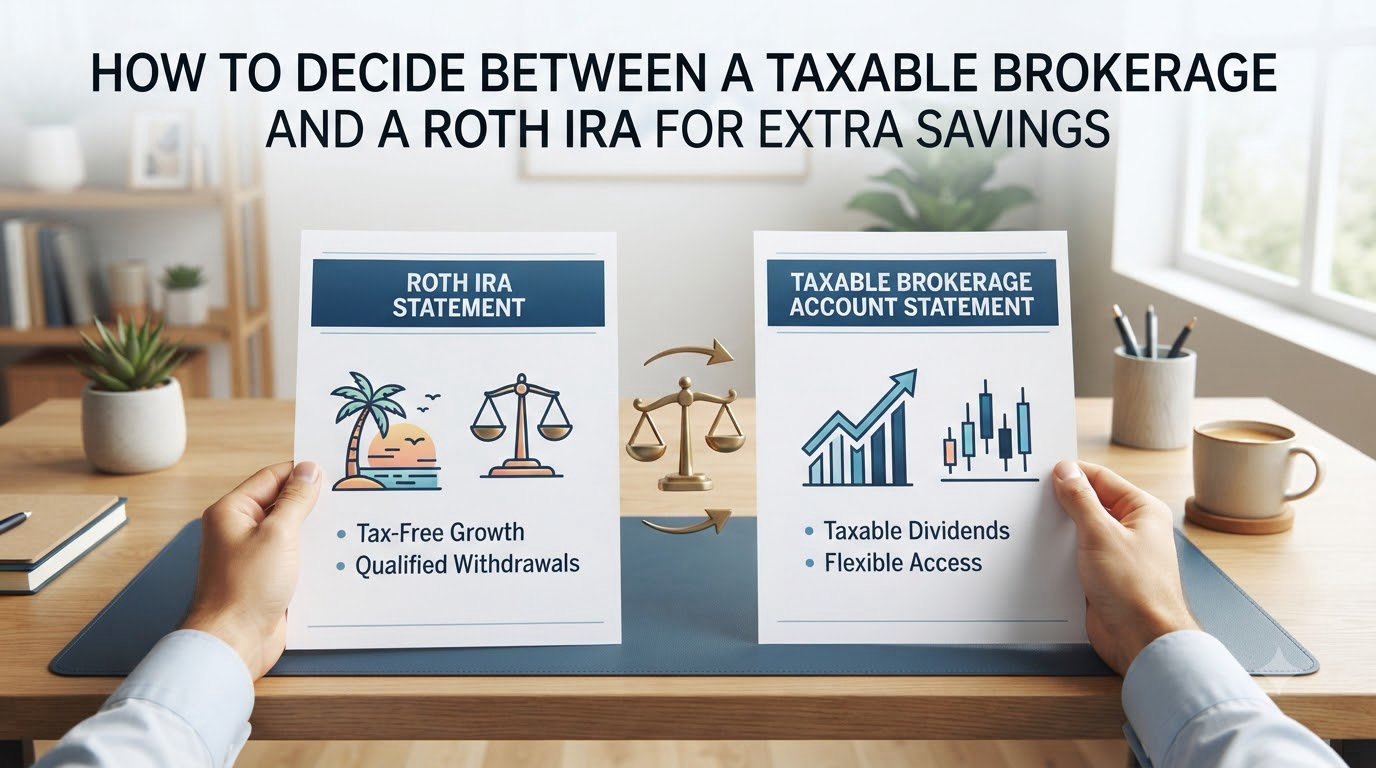
If you have extra money left after covering your bills and maxing out your employer retirement match, you face a common question: where should that surplus go? The taxable brokerage vs Roth IRA decision trips up a lot of savers because both accounts let you invest in stocks, bonds, and funds, but they treat your money very differently when it comes to taxes, access, and long-term growth. I have spent years helping people sort through this exact choice, and the right answer almost always comes down to your income level, your timeline, and how much flexibility you need.
The short version: a Roth IRA gives you tax-free growth and tax-free withdrawals in retirement, but it caps how much you can contribute each year and locks your earnings behind age and time rules. A taxable brokerage account has no contribution limits and no withdrawal restrictions, but you owe taxes on dividends and gains as they happen. Most people benefit from using both, but the order in which you fund them matters a lot.
In this guide, I will walk you through exactly how each account works, compare them head to head, and give you a clear priority framework so you can decide where to put your next dollar with confidence.
Table of Contents
What Is a Taxable Brokerage Account?
A taxable brokerage account is a standard investment account you open with a broker like Fidelity, Vanguard, or Charles Schwab. You deposit after-tax money, meaning dollars that have already been taxed through your paycheck, and then you invest those dollars in whatever securities you want.
There is no limit on how much you can contribute. If you want to put in $5,000 or $500,000 in a single year, nobody stops you. There are also no income restrictions. Whether you make $40,000 or $400,000, the account works the same way.
The trade-off is right in the name: taxable. Every year, you owe taxes on dividends your investments generate, even if you reinvest them. When you sell an investment for a profit, you owe capital gains tax on the growth. Short-term gains, on assets held less than a year, get taxed at your ordinary income rate. Long-term gains, on assets held more than a year, qualify for lower rates that top out at 15% or 20% depending on your income.
What makes brokerage accounts attractive is total flexibility. You can withdraw your money at any time, for any reason, with no penalties. You can use it for a house down payment, a career change, an emergency, or early retirement. Nobody asks your age or your purpose.
What Is a Roth IRA?
A Roth IRA is a tax-advantaged retirement account where you contribute after-tax dollars and then never pay taxes on the growth or qualified withdrawals again. That means if your $7,000 contribution grows to $200,000 over thirty years, every penny of that $193,000 in growth comes out tax-free in retirement.
This is the superpower of the Roth IRA: tax-free compounding. Because you paid taxes up front on your contributions, the IRS steps aside entirely on the back end. No income tax on withdrawals, no capital gains tax, no tax on dividends along the way.
The catch is that the IRS places strict guardrails around the account. For 2026, the contribution limit is $7,000 per year, or $8,000 if you are 50 or older. There are also income phase-outs that reduce or eliminate your ability to contribute directly. If your modified adjusted gross income, or MAGI, exceeds certain thresholds, you cannot put money into a Roth IRA through the front door.
Withdrawals of your direct contributions are always available penalty-free and tax-free, because you already paid tax on that money. But withdrawing investment earnings before age 59.5 and before the account has been open for at least five years can trigger taxes and a 10% penalty. This is known as the five-year rule, and it trips up many new savers.
Taxable Brokerage vs Roth IRA: The Core Differences
When I help people compare these two accounts, I always start with a side-by-side breakdown. The differences fall into five key categories: taxes, contributions, income limits, withdrawals, and required distributions.
Here is how a taxable brokerage vs Roth IRA comparison shakes out:
| Feature | Roth IRA | Taxable Brokerage |
|---|---|---|
| Tax on growth | Tax-free | Taxed annually on dividends and on sale |
| Contribution limit | $7,000 (2026), $8,000 if 50+ | No limit |
| Income limits | Yes, phase-outs apply | No income limits |
| Withdrawal rules | Contributions anytime, earnings after 59.5 and 5 years | Anytime, no restrictions |
| Required distributions | None during your lifetime | None |
| Early withdrawal penalty | 10% on earnings if under 59.5 | No penalty, just taxes on gains |
| Investment options | Stocks, bonds, ETFs, mutual funds | Stocks, bonds, ETFs, mutual funds, more |
The biggest advantage of a Roth IRA is the tax treatment. Every dollar of growth stays in your pocket. Over decades of compound interest, this tax shield can save you tens of thousands of dollars compared to a taxable account where dividends and rebalancing create annual tax drag.
The biggest advantage of a taxable brokerage is freedom. No caps, no income tests, no age gates. If you need your money next Tuesday, you can sell and withdraw without explaining yourself to anyone. That flexibility is why early retirees and people pursuing financial independence often lean heavily on brokerage accounts.
Contribution Limits and Income Restrictions
For 2026, the Roth IRA contribution limit is $7,000 if you are under 50 and $8,000 if you are 50 or older. That limit applies across all of your Roth IRAs combined, not per account. You cannot open three Roth IRAs and contribute $7,000 to each one.
The income phase-outs are where things get tricky for higher earners. If you file single, your ability to contribute directly to a Roth IRA begins phasing out at a certain MAGI and disappears entirely above a higher threshold. For married couples filing jointly, the phase-out range is set higher. These limits are adjusted annually, so always check the current year numbers before contributing.
If your income is too high for direct Roth IRA contributions, you are not locked out entirely. Many high earners use a strategy called the backdoor Roth conversion. This involves contributing to a traditional IRA, which has no income limit for contributions, and then converting that money to a Roth IRA. The conversion itself may have tax implications if you have existing pre-tax IRA money, so this strategy works best when your traditional IRA balance is zero or very small.
A taxable brokerage account has no contribution limit and no income limit. You can deposit any amount from any income level at any time. This is why, once you max out your tax-advantaged options, the brokerage account becomes your overflow valve for additional savings.
Withdrawal Rules and Penalties
Withdrawal rules are where the two accounts diverge most sharply, and misunderstanding them is one of the most common mistakes I see.
With a Roth IRA, you can always withdraw your contributions penalty-free and tax-free. If you put in $7,000 and it grows to $8,000, you can pull out that original $7,000 tomorrow with zero taxes and zero penalties, regardless of your age. The earnings, however, are locked behind two gates: you must be at least 59.5 years old, and the account must have been open for at least five years. This is the five-year rule, and the clock starts on January 1 of the year you make your first contribution.
If you withdraw earnings early and do not meet both conditions, you may owe ordinary income tax plus a 10% early withdrawal penalty on those earnings. There are a few exceptions, including first-time home purchases up to $10,000, qualified education expenses, and certain medical costs, but the rules are specific and worth reviewing carefully before you act.
A taxable brokerage account has none of these restrictions. You can sell investments and withdraw the cash whenever you want. The only cost is the tax on any capital gains from the sale. If you held the investment for more than a year, you pay the lower long-term capital gains rate. If less than a year, you pay your ordinary income rate on the gain. There is never an age-based penalty.
This withdrawal flexibility makes brokerage accounts the go-to for early retirees. If you plan to retire at 45, your Roth IRA earnings will still be locked until you turn 59.5. A brokerage account gives you a bridge to cover those years without touching retirement-restricted funds.
When a Roth IRA Makes More Sense
A Roth IRA is usually the better choice when you meet certain conditions. Here are the scenarios where I recommend prioritizing it:
1. You expect to be in a higher tax bracket in retirement. If your income and tax rate will go up over time, paying taxes now at a lower rate and withdrawing tax-free later is a clear win.
2. You are early in your career with lower earnings. Younger savers benefit the most from decades of tax-free compound growth inside a Roth IRA. The longer your money has to grow, the more valuable that tax shield becomes.
3. You want no required minimum distributions. Unlike traditional IRAs and 401(k)s, Roth IRAs do not force you to start withdrawing at a certain age. Your money can keep growing tax-free for as long as you live, which makes it a powerful estate planning tool.
4. You are within the income limits. If your MAGI falls below the phase-out range, take full advantage. Direct Roth contributions are the simplest and most tax-efficient way to build retirement savings outside of a workplace plan.
5. You value tax diversification. Having some money in Roth, some in traditional pre-tax accounts, and some in taxable accounts gives you flexibility to manage your tax bill in retirement by choosing which accounts to draw from each year.
When a Taxable Brokerage Makes More Sense
A taxable brokerage account becomes the better option in several situations. Here is when I tell people to focus there:
1. You have already maxed out your Roth IRA for the year. Once you hit the $7,000 or $8,000 cap, a brokerage account is your next stop for invested savings.
2. Your income exceeds the Roth IRA limits. If you earn too much to contribute directly and a backdoor Roth is not practical, a taxable brokerage account is your primary path to invested savings outside of an employer plan.
3. You need access to the money before age 59.5. If you are saving for a goal that is five or ten years out, like a home purchase, starting a business, or early retirement, the brokerage account gives you penalty-free access whenever you need it.
4. You want to invest more than the annual IRA limit. Some savers want to put away $20,000 or $50,000 a year beyond their retirement accounts. The brokerage account accepts all of it with no questions asked.
5. You want complete control without government rules. No contribution caps, no income tests, no age restrictions, no RMDs ever. The brokerage account is the most flexible investment vehicle available.
6. You want tax-loss harvesting opportunities. In a taxable account, you can sell losing investments to offset gains elsewhere, a strategy that is not available inside an IRA. This can reduce your tax bill in years when the market is volatile.
The Priority Order: Which Account to Fund First
This is the question I get more than any other: should I fund my Roth IRA or my brokerage account first? The answer follows a priority order that most financial planners agree on.
Here is the funding order I recommend for most people saving extra money:
Step 1: Contribute enough to your 401(k) or workplace plan to get the full employer match. This is free money and an instant return on your investment. Never skip this.
Step 2: Pay off high-interest debt, typically anything above 6% or 7%. The guaranteed return from paying off a 20% interest credit card beats any investment account.
Step 3: Max out your Roth IRA. The $7,000 annual limit is use-it-or-lose-it. If you do not contribute by the tax filing deadline, that contribution space is gone forever. This makes the Roth IRA a higher priority than a brokerage account, because the brokerage has no deadline pressure.
Step 4: If you still have money to invest, go back and max out your 401(k) up to the annual employee limit. Pre-tax contributions lower your current tax bill while still growing for retirement.
Step 5: Open and fund a taxable brokerage account with whatever is left. This is your overflow account for savings beyond the tax-advantaged limits.
Notice where the Roth IRA sits. It comes after the employer match and high-interest debt but before maxing out the 401(k) and before the brokerage. The reason is simple: tax-free growth is valuable, and contribution space expires each year. A brokerage account will always be there waiting for you.
If you are a high earner who cannot contribute to a Roth IRA directly, insert a backdoor Roth conversion at Step 3. Contribute to a traditional IRA, convert to Roth, and then proceed to the brokerage account at Step 5. This keeps you on track even when income limits get in the way.
For early retirees following the FIRE movement, the priority might shift slightly. You may want to build up a larger taxable brokerage balance earlier to create a penalty-free bridge between your early retirement date and age 59.5. In that case, fund the Roth IRA to capture the annual limit, then redirect extra savings to the brokerage.
Common Mistakes to Avoid
Over my years of helping people navigate this decision, a few mistakes come up again and again. Avoiding these will save you money and headaches.
Mistake 1: Skipping the Roth IRA because you think you earn too much. Before assuming you are locked out, check the current income phase-outs and consider the backdoor Roth strategy. Many people who could be contributing are not, simply because they assume they cannot.
Mistake 2: Overcontributing to a Roth IRA. If you exceed the annual limit, the IRS charges a 6% excise tax on the excess amount for every year it stays in the account. Fix this by withdrawing the excess plus any earnings before your tax filing deadline.
Mistake 3: Ignoring the five-year rule. Even at age 60, if your Roth IRA was opened less than five years ago, earnings withdrawals may still be taxed. Each Roth conversion also has its own five-year clock, so plan accordingly.
Mistake 4: Putting tax-inefficient investments in a taxable account. High-turnover funds, REITs, and actively managed mutual funds generate lots of taxable events. Put these in your Roth IRA where the taxes are shielded, and hold tax-efficient index funds and ETFs in your brokerage account.
Mistake 5: Not keeping good records. For taxable accounts, you need to track your cost basis to calculate gains when you sell. For Roth IRAs, keep records of contributions and conversions in case you ever need to prove you followed the rules.
Mistake 6: Treating your Roth IRA like an emergency fund. While you can withdraw contributions anytime, dipping into your Roth slows the tax-free compounding that makes it so powerful. Keep a separate cash emergency fund so your Roth stays invested and growing.
FAQs
Is a Roth IRA better than a taxable brokerage account?
For long-term retirement savings, a Roth IRA is usually better because it offers tax-free growth and tax-free withdrawals. However, a taxable brokerage account is better when you need flexible access to your money before age 59.5 or when you have already maxed out the Roth IRA contribution limit. Most people benefit from having both.
Should I prioritize my Roth IRA or brokerage account?
Prioritize the Roth IRA first because the annual contribution limit expires each year. Once you max it out, direct additional savings to your taxable brokerage account. The general order is: get your employer 401(k) match, pay off high-interest debt, max your Roth IRA, then fund your brokerage account.
Is it safe to keep more than $500,000 in a brokerage account?
Yes, it is safe. Brokerage accounts are insured by SIPC up to $500,000 per customer, including up to $250,000 for cash. Many brokers also carry additional private insurance beyond the SIPC limit. The insurance protects against broker failure, not against investment losses from market declines.
What does Warren Buffett say about Roth IRA?
Warren Buffett has highlighted the value of tax-advantaged accounts by noting that his own investments would have grown far more in a Roth IRA structure, free from ongoing tax drag. The broader lesson is that minimizing taxes on investment growth over decades has an enormous compounding effect on your final balance.
Can I have both a Roth IRA and a taxable brokerage account?
Absolutely. You can and should have both. Use the Roth IRA for retirement savings that benefit from tax-free growth, and use the taxable brokerage account for savings you might need before age 59.5 or for amounts above the Roth IRA annual contribution limit.
What happens if I contribute too much to a Roth IRA?
The IRS charges a 6% excise tax on excess contributions for each year the money remains in the account. To avoid the penalty, withdraw the excess contribution plus any earnings it generated before your tax filing deadline, including extensions.
Conclusion
Learning how to decide between a taxable brokerage and a Roth IRA for extra savings comes down to understanding what each account does best. The Roth IRA wins on taxes with its tax-free growth and withdrawals, but it comes with contribution caps, income limits, and withdrawal restrictions. The taxable brokerage wins on flexibility with no limits and no penalties, but it costs you in annual taxes on gains and dividends.
The smartest approach for most people is to use both. Max out your Roth IRA each year to capture that expiring contribution space, then funnel additional savings into a taxable brokerage account for flexibility and growth beyond the limits. Follow the priority order, avoid the common mistakes, and adjust the framework to fit your income level and timeline.
Your next step is simple: check whether you are eligible to contribute to a Roth IRA for 2026, calculate how much room you have left, and open a brokerage account for the overflow. The sooner you put this framework into action, the more time your money has to grow.