
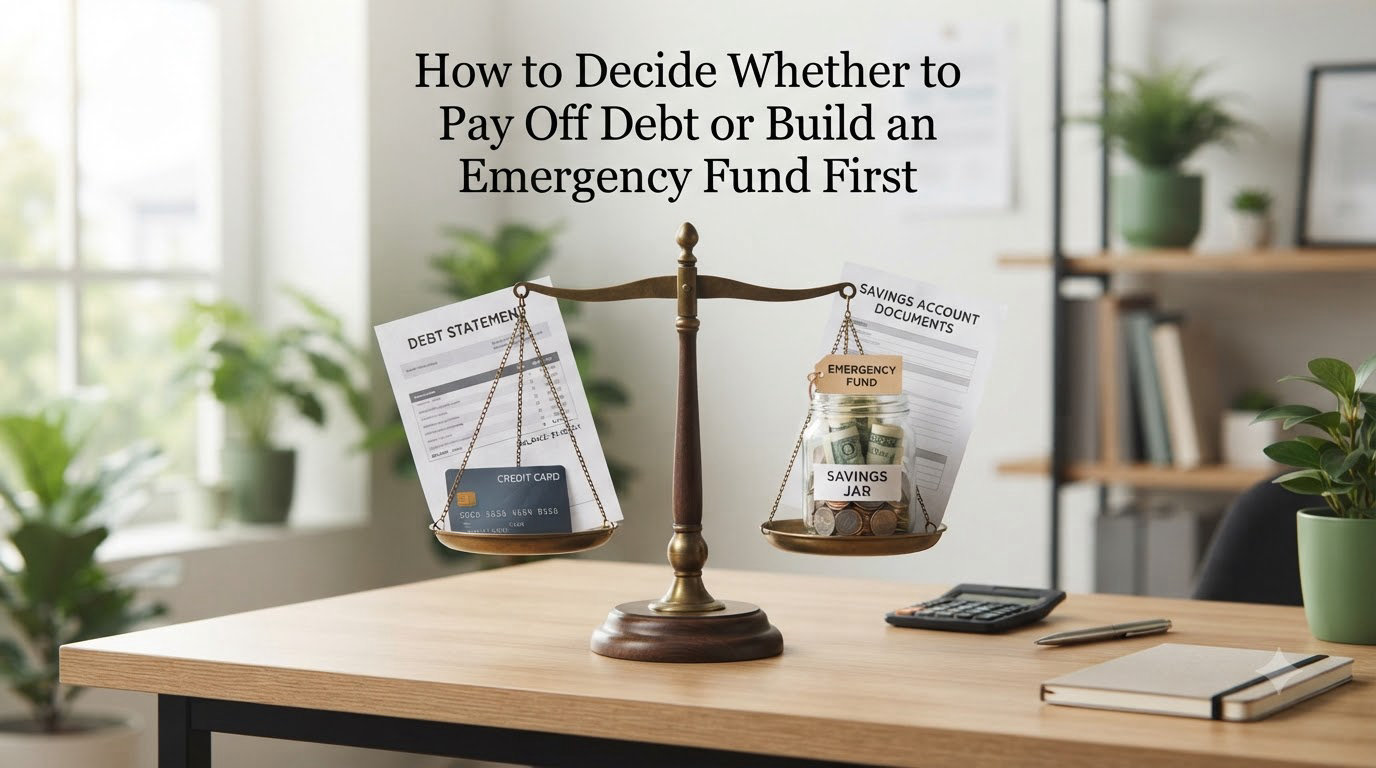
When you are juggling debt payments and an empty savings account, the question of whether to pay off debt or build an emergency fund first can feel paralyzing. The short answer is straightforward: build a starter emergency fund first, then attack your debt aggressively. Most financial experts recommend saving $1,000 or one month of expenses before going all-in on debt payoff, because this cushion stops the cycle of paying down debt only to charge it back up when life happens.
I have seen this pattern play out repeatedly in personal finance communities. People throw every spare dollar at their credit card balances, feel great for a few weeks, then a $500 car repair puts them right back at the starting line. A small cash reserve breaks that cycle before it begins.
You do not have to choose between savings and debt forever. The decision is about sequencing, and getting the order right can save you months of frustration and thousands in interest. In this guide updated for 2026, I will walk you through exactly how to decide whether to pay off debt or build an emergency fund first based on your interest rates, income stability, and personal risk factors.
Table of Contents
What Is an Emergency Fund and Why Does It Matter?
An emergency fund is cash set aside specifically for unexpected expenses that you cannot predict or plan for in your monthly budget. Think job loss, medical emergencies, urgent car repairs, or a broken furnace in the middle of winter. It sits in a separate savings account, not your checking account, so you are not tempted to spend it on everyday purchases.
The purpose is simple. Life throws curveballs, and without a cash buffer, those curveballs end up on a credit card. That is how people get trapped in the debt cycle that Reddit users on r/personalfinance describe over and over again. You pay down debt, an emergency hits, you charge it, and you are back where you started.
Your emergency fund is a financial shock absorber. It absorbs the impact so your debt payoff progress does not get wiped out by a single unexpected bill. Without it, every step forward is fragile.
Should You Pay Off Debt or Build an Emergency Fund First?
In most cases, you should build a starter emergency fund first before aggressively paying off debt. The consensus among financial advisors, personal finance communities, and consumer protection agencies is clear on this point. Save $1,000 or one month of expenses first, then redirect your extra money toward debt.
Here is why sequencing matters so much. If you put every dollar toward debt with zero savings, the next emergency forces you to borrow again. You end up deeper in debt with nothing to show for your months of effort. A starter fund prevents that scenario from derailing your progress.
There is one notable exception to this rule. If your debt carries an extremely high interest rate, such as payday loans or credit cards above 20% APR, the math shifts. Some financial experts recommend splitting your focus in that situation. Put a portion toward a small emergency fund and a portion toward that high-interest debt simultaneously, because interest compounding at that speed works against you fast.
The Starter Emergency Fund Strategy
The starter emergency fund is a small, intentionally modest savings goal that comes before everything else. Most personal finance experts, including Dave Ramsey and the r/personalfinance community, recommend $1,000 as the starter amount. If your monthly expenses are higher than average, aim for one full month of expenses instead.
This is not your final emergency fund. It is a temporary shield designed to get you through the debt payoff phase. Think of it as a bandage that stops the bleeding while you work on the underlying problem.
The starter fund exists for one reason: to keep you from reaching for a credit card when something breaks. Once it is fully funded, you can move on to debt payoff with the confidence that a surprise expense will not knock you off track.
How Much Should You Save in Your Emergency Fund?
Your target emergency fund size depends on your income stability, number of dependents, and monthly expenses. The general guideline is 3 to 6 months of living expenses for most people. But the right number for you could be higher or lower depending on your situation.
Several benchmarks can help you decide on a target:
1 month of expenses: A bare-minimum starter fund while you are actively in debt payoff mode
3 months of expenses: Sufficient for stable, dual-income households with low financial risk
6 months of expenses: The standard recommendation for most single-income families and households with dependents
9 to 12 months of expenses: Recommended for freelancers, commission-based earners, or anyone with irregular income
Suze Orman takes a more conservative stance, suggesting 8 to 12 months of expenses. Her reasoning is that job searches take longer than people expect, especially during economic downturns. The Consumer Financial Protection Bureau also recommends the 3 to 6 month range as a baseline.
I recommend starting with 3 months as your initial target. You can always grow it based on your comfort level and personal risk factors.
The 3-6-9 Money Rule Explained
The 3-6-9 rule is a simplified framework for sizing your emergency fund based on your employment situation and income predictability. It scales your savings target to match how stable your paycheck is.
Here is how the rule works:
3 months of expenses if you have a stable, single job with a steady paycheck and no dependents
6 months of expenses if you are a single-income household, have dependents, or work in an industry with moderate layoff risk
9 months of expenses if you are self-employed, a freelancer, a commission-based salesperson, or have highly irregular income
The logic is straightforward. The less predictable your income, the larger your cash reserve needs to be. Someone with a salaried government job and a working spouse can feel comfortable with 3 months. A freelance graphic designer with variable monthly income needs closer to 9 months to account for slow periods and late payments.
To use this rule, calculate your monthly essential expenses first. Include housing, food, utilities, insurance, and minimum debt payments. Multiply that number by 3, 6, or 9 based on your employment situation. That is your target.
When Debt Payoff Should Come First
Debt payoff should take priority when your interest rates are eating away at your finances faster than savings can grow. If you are carrying credit card debt at 24% APR while your savings account earns somewhere between 0.01% and 4%, the math clearly favors paying down that debt once your starter fund is in place.
Think about it this way. Every dollar you keep in savings earning 4% while carrying debt at 20% is effectively costing you 16% in net interest. That is real money leaving your pocket every single month you delay.
The tipping point is generally around 7% to 10% APR. If your debt interest rate sits above that range, prioritize payoff after your starter fund. If it falls below that threshold, you can afford to build more savings first without losing ground.
High-Interest vs Low-Interest Debt
Not all debt is created equal, and understanding the difference helps you prioritize correctly. Categorizing your debt by interest rate is one of the most important steps in building a payoff strategy.
High-interest debt includes credit cards, payday loans, personal loans with rates above 10%, and any debt where the APR exceeds what you could earn in a savings account. This debt should be attacked aggressively after your starter fund is built.
Low-interest debt includes mortgages, federal student loans, and auto loans with rates below 6%. These typically cost less than what you might earn investing or even in a high-yield savings account. There is far less urgency to pay these off early.
Two popular methods can guide your payoff strategy. The debt avalanche method targets the highest-interest debt first, which saves you the most money mathematically. The debt snowball method targets the smallest balance first, which gives you quick psychological wins. Both work. The avalanche saves more money on paper, but the snowball keeps more people motivated enough to finish.
When Income Is Uncertain
If your income is unstable, you should prioritize a larger emergency fund before aggressive debt payoff. Job loss, reduced hours, commission-only roles, and contract work all increase the risk that you will need cash to survive between paychecks.
In this situation, the standard rules shift. Instead of the typical $1,000 starter fund, aim for 2 to 3 months of expenses before redirecting money toward debt. This is not being overly cautious. It is acknowledging that your income could disappear or drop significantly with little warning.
Reddit users in r/personalfinance consistently share stories of layoffs during debt payoff that left them scrambling to cover rent. A bigger cash cushion during uncertain times prevents one income disruption from becoming a full-blown financial crisis.
Signs You Need a Bigger Emergency Fund Before Paying Off Debt
You should pause aggressive debt payoff and grow your emergency fund if any of these situations apply to you. Two or more red flags mean savings should be your clear priority.
You were laid off recently or expect job changes in the next 6 months
You have dependents who rely entirely on your income
You own a home where major repairs fall on your shoulders
You have health issues that could lead to unexpected medical bills
Your vehicle is older and needs frequent repairs
You are self-employed or earn commissions with variable income
You have already drained your savings once during a previous debt payoff attempt
If two or more of these describe your life right now, your priority should be building 3 to 6 months of expenses before you throw extra money at debt. The risk of another setback is simply too high to ignore.
When to Switch from Emergency Fund to Debt Payoff
Once your emergency fund reaches your target level, redirect all extra money toward debt. This transition point is where many people hesitate, because watching a savings balance grow feels safer than watching a debt balance shrink.
The switch is simple in practice. You stop making contributions to your emergency fund and apply that same monthly amount to your debt payments instead. Your emergency fund stays in place as protection. You only touch it for genuine emergencies, not convenience purchases.
How do you know when to make the switch? When your emergency fund hits your target number based on the 3-6-9 rule, you are ready. Until then, split your extra money between savings growth and your minimum debt payments. The full target comes first.
The Psychological Side of Debt vs Savings
The math of debt versus savings only tells half the story. The other half is psychological, and it matters more than most financial advice acknowledges.
For some people, watching debt balances shrink is deeply motivating. They would rather owe $500 less than have $500 more in savings, because the debt feels like a weight being lifted. If that describes you, the debt snowball method with a small starter fund might keep you going longer than a larger savings balance would.
For others, having cash in the bank provides peace of mind that makes them more disciplined with spending. They sleep better knowing they have a cushion, and that confidence helps them stick to their budget and avoid new debt.
Neither approach is wrong. The best strategy is the one you will actually follow through on for months and years. I have seen people succeed with both paths, and the common factor in every success story is consistency, not the specific method they chose.
One psychological trap to watch for is guilt. Many people in personal finance forums feel guilty about building savings while carrying debt. That guilt is misplaced. A starter fund is not a luxury. It is a tool that makes debt payoff sustainable over the long run.
A Step-by-Step Framework for Deciding
Here is a simple framework you can follow to decide your priority and sequence your financial goals. These steps work for the majority of situations.
Step 1: Save $1,000 or one month of expenses as a starter emergency fund. This comes before everything else. Do not skip it, even if your debt feels urgent. Park it in a separate savings account where you will not see it daily.
Step 2: List all your debts with their interest rates and balances. Identify which debts are high-interest, meaning above 7% to 10% APR, and which are low-interest. This categorization determines your attack order.
Step 3: Assess your income stability honestly. Stable W-2 income with a working partner means you can move to debt payoff sooner. Irregular income, freelancing, or expected job changes mean you should build your fund to 3 months first.
Step 4: Attack high-interest debt aggressively. Use the avalanche method for maximum savings or the snowball method for motivation. Keep your starter fund intact throughout this phase.
Step 5: Grow your emergency fund to your full target. Once high-interest debt is eliminated, build your fund to 3, 6, or 9 months of expenses based on the 3-6-9 rule and your personal risk factors.
Step 6: Decide between low-interest debt payoff and investing. After your emergency fund is fully stocked, choose whether to pay off low-interest debt early or invest the difference for potentially higher returns.
This sequence works for the vast majority of people. You can adjust the details based on your specific situation, but do not skip the starter fund. That step is what keeps the whole plan from falling apart.
Common Mistakes to Avoid
Waiting too long to start. You do not need to have the perfect plan before saving your first $100. Start small, build momentum, and refine your strategy as you go.
Treating wants as emergencies. A new phone is not an emergency. Holiday gifts are not an emergency. Define what qualifies as a true emergency before you are faced with the temptation.
Going all-in on debt with zero savings. This is the most common mistake I see in personal finance forums. It leads directly to the debt cycle that traps people for years. Always have a starter fund first.
Comparing your fund to other people. Your coworker might feel comfortable with $2,000 saved. You might need $20,000. Your emergency fund should match your life and your risk factors, not someone else’s.
Forgetting to replenish. If you use your emergency fund for a real emergency, rebuilding it becomes your top priority again. Do not resume aggressive debt payoff until the fund is restored to its target level.
FAQs
What is the 3 6 9 rule for emergency fund?
The 3-6-9 rule recommends saving 3 months of expenses if you have stable employment, 6 months if you are a single-income household with dependents, and 9 months if you are self-employed or have irregular income. It scales your emergency fund based on how predictable your paycheck is.
Where does Dave Ramsey say to keep your emergency fund?
Dave Ramsey recommends keeping your emergency fund in a simple, accessible savings account or money market account that is separate from your regular checking. He advises against investing emergency fund money in the stock market because you need it available immediately when emergencies strike.
Is $20,000 too much for an emergency fund?
Whether $20,000 is too much depends entirely on your monthly expenses. If your essential expenses run $4,000 per month, then $20,000 represents 5 months of coverage, which fits the standard 3 to 6 month range. If your expenses are $2,000 per month, $20,000 covers 10 months and may be more than you need unless your income is irregular.
What is the 3 6 9 rule of money?
The 3-6-9 rule of money is a savings guideline suggesting 3 months of living expenses for people with stable jobs, 6 months for single-income families with dependents, and 9 months for self-employed workers or freelancers. It helps you right-size your emergency fund based on your personal income risk level.
Final Thoughts
Deciding whether to pay off debt or build an emergency fund first does not have to be an either-or question. Start with a $1,000 starter fund, then tackle high-interest debt aggressively, then grow your savings to 3 to 6 months of expenses. That sequence works for almost everyone regardless of income level.
The biggest mistake people make is going all-in on debt with zero savings. A single unexpected expense puts you back at the starting line, and the cycle repeats for years. Breaking that cycle starts with building a small cushion before you throw everything at your balances.
Your financial security comes from having both protection and progress. The right order gives you both, and 2026 is a great year to start.