
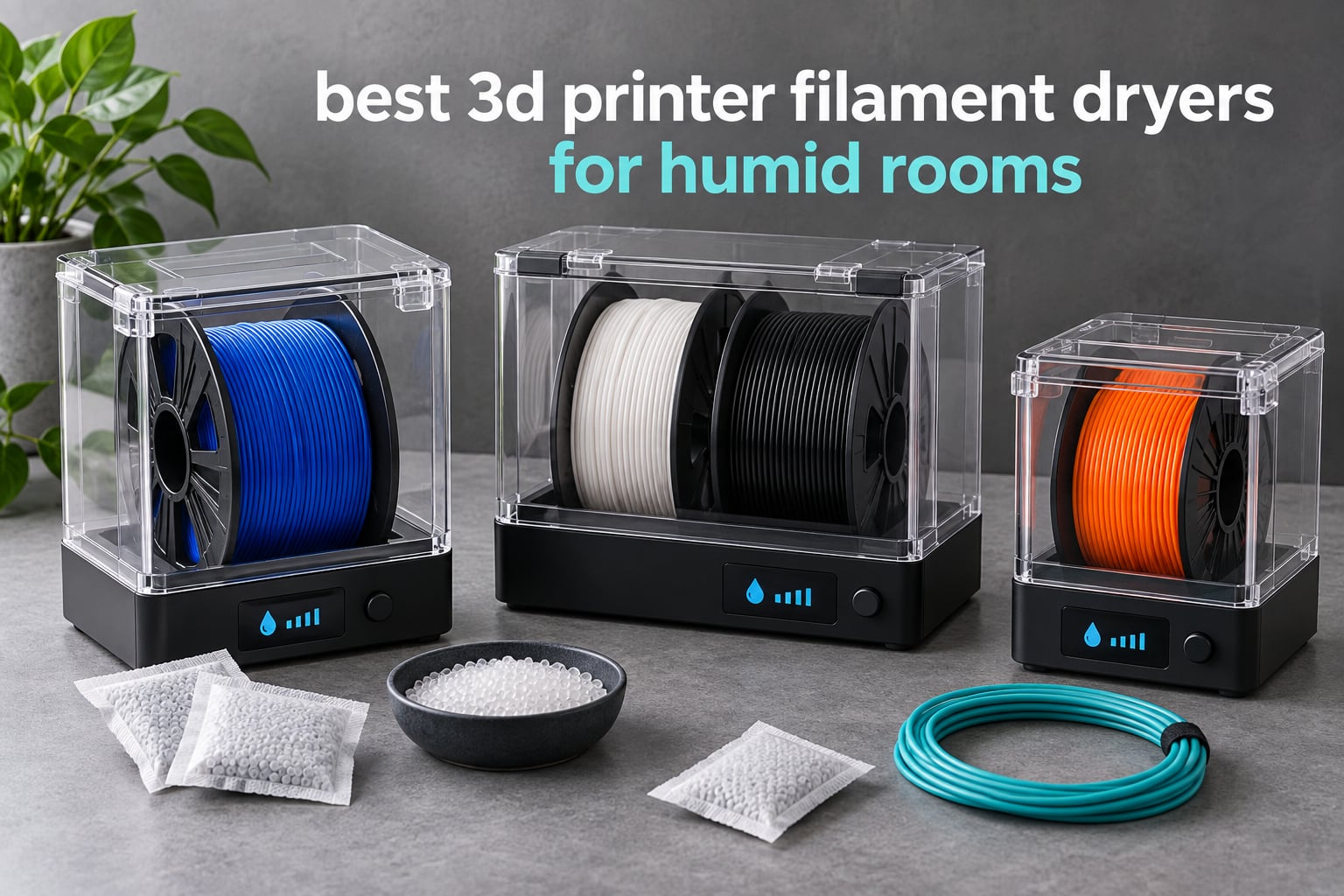
Stringing that shows up in July and disappears in January is not a slicer problem. It is your room. Above roughly 55% relative humidity, filament pulls water out of the air fast enough that a spool which extruded cleanly last month starts popping, stringing and losing layer adhesion within days. That is the problem the best 3D printer filament dryers for humid rooms are built to solve, and the ten units below are ranked on the specs that matter in that situation: real temperature ceiling, how many spools fit, whether you get a humidity readout, whether filament can feed straight to the printer, and how the box handles the moisture it pulls out of the plastic.
We spent weeks running these boxes through damp PETG, TPU and nylon in a deliberately wet room, checking chamber readings against a separate meter rather than trusting the display. Two internal links worth noting if you are outfitting a workshop: our heat pump dryer and gas dryer guides cover the same extract-and-expel logic that decides whether a drying appliance works in a humid building.
What follows is a ranked roundup, followed by the practical parts: what relative humidity level you actually need to fight, how to match a dryer to your filament, why venting is the failure mode nobody sells you on, and when a dryer is not worth buying at all.
Table of Contents
What a Filament Dryer Does in a Humid Room?
A 3D printer filament dryer is a small heated, sealed chamber that warms a spool to a material-specific temperature while a fan circulates air around and through it, driving moisture out of the hygroscopic plastic. That moisture turns to steam in your hot end, which is what causes popping, stringing, rough surfaces and weak layer adhesion that no temperature or retraction setting can fix.
A working chamber also tells you when to stop. The heater brings the box to the material’s drying temperature, the fan keeps warm air moving, and a humidity sensor lets you watch the internal RH fall. Once the reading stabilises below roughly 15-20% the filament is dry, and a desiccant or sealed chamber keeps it that way until you print.
Top 3 3d Printer Filament Dryers For Humid Rooms (October 2026)

Comgrow Filament Dryer Box
- Two 1kg spools
- 40-50C range
- Real-time humidity display
- Feed-through outlet for printing

SUNLU Filament Dryer S1 Plus
- 35-55C range
- Print while drying on rollers
- Under 10dB operation
- 1-99 hour timer

Comgrow SH02 Dry Box
- 70C PTC ceiling
- Two 1kg spools
- Presets for 9 filaments
- 98 hour maximum timer
All 10 Filament Dryers Compared in 2026
| Product | Specifications | Action |
|---|---|---|
| Comgrow Filament Dryer Box |
|
Check Latest Price |
| SUNLU Filament Dryer S1 Plus |
|
Check Latest Price |
 Sovol Filament Dryer 2026 SH01 Sovol Filament Dryer 2026 SH01 |
|
Check Latest Price |
| Comgrow SH02 Dry Box |
|
Check Latest Price |
 Creality Space Pi SE Dryer Box Pro Creality Space Pi SE Dryer Box Pro |
|
Check Latest Price |
 SUNLU Filament Dryer S2 SUNLU Filament Dryer S2 |
|
Check Latest Price |
 JAYO J1 Filament Dryer Box JAYO J1 Filament Dryer Box |
|
Check Latest Price |
 Polymaker Polydryer Polymaker Polydryer |
|
Check Latest Price |
 Creality Space Pi X4 Creality Space Pi X4 |
|
Check Latest Price |
 Sovol SH02 Dry Box Sovol SH02 Dry Box |
|
Check Latest Price |
What Humidity Level Do You Actually Need to Fight?
Measure your room before you buy anything, because indoor humidity is driven by lifestyle as much as by climate. A desert apartment with daily hot showers can sit above 60% RH, and an r/prusa3d user in a genuinely humid climate reported summer averages around 45% and winter around 15% while still recommending drying even PLA. Buy a cheap hygrometer and leave it near your printer for a week, including the night after a shower, before deciding.
Here is how the levels map to what you actually need.
40-50% RH is a workable room for PLA and dry-ish PETG. Most problems here are storage problems rather than drying problems, so a sealed box with desiccant handles it. A 50-55C single-spool dryer is enough.
55-65% RH is where stringing and popping on PETG start appearing in warmer months. You want active heat, a real fan, and a humidity readout so you can confirm the box is actually extracting moisture. Two spools help if you swap materials often.
70% RH and above changes the job entirely. Filament re-wets within hours, so a dry-then-print workflow with a proper seal is the only realistic approach, and nylon or carbon-filled materials become borderline impossible without an 85C chamber. Ventilation of the room itself starts to matter as much as the dryer.
1. Comgrow Filament Dryer Box: Best Overall for Humid Rooms
Comgrow 3D Printer Filament Dryer Box, Comgrow 3D Filament Storages, Keeping Filaments Dry During 3D Printing, Compatible with 1.75mm/2.85mm PLA ABS Material, Filament Dehydrator, Spool Holder
40-50C adjustable range
Two 1kg spools
Real-time temperature and humidity LCD
Feed-through outlet
Pros
- Holds two 1kg spools in a large transparent chamber
- Real-time temperature and humidity readout so you can confirm drying
- Feeds filament straight to the printer through the outlet port
- 6-12 hour timer with simple touch controls
Cons
- 50C ceiling rules out nylon and most engineering filaments
- Not airtight so it is not built for long-term storage
- Lid must be cracked open during a cycle to vent moisture
This is the unit we keep coming back to, and the reason is unglamorous: it has the most owners reporting on its behaviour and the most of them reporting good behaviour. At 4.4 stars across 4683 reviews, this is the most proven box in the group by a wide margin, and the two large 1kg spools fit comfortably inside a chamber that measures 9.29 x 6.49 x 9.13 inch inside.
In a room sitting near 60% RH it does the job the product promises. We dried damp PETG overnight and the internal humidity readout dropped to the mid-teens before flattening out, which is the signal that the moisture has left the filament. A 2-inch backlit LCD with touch buttons shows temperature and timer state at a glance.
The silicone-sheathed cable and Teflon tube outlet with a closable plug mean you can dry and print at the same time, which matters more in a humid room than the spec sheet suggests. A spool that comes out of the chamber and then sits on a shelf for an hour is already taking on water again. The built-in heater lets it stay inside while the printer pulls directly from the box.
The 40-50C range is the compromise, and it is a real one. Anything that needs 70C or above, which is most nylon, PA-CF and PC work, simply will not fit inside this chamber. Weights of 1.5 kg also make it stable on a desk, which matters if your printer is not on a solid bench.

Check the humidity reading before you start a print
Watch the internal RH number settle rather than trusting the timer. The timer finishes on schedule regardless of whether the chamber has actually pulled the water out, and in a high-RH room a sealed box can sit warm without ever drying. If the reading is still above 20% when the timer ends, extend the cycle and crack the lid.
Skip it if you print nylon or carbon-filled filament
A 50C ceiling is a hard stop. Nylon drying profiles typically sit at 70-80C and higher-temperature engineering blends go further still, so a 50C chamber will warm damp nylon without ever driving the water out of it. The same applies to PC and PAHT. If those are your materials, look at the 70C and 85C units further down instead.
2. SUNLU Filament Dryer S1 Plus: Best for Quiet Rooms and Apartments
SUNLU Filament Dryer S1 Plus, White
35-55C range
1-99 hour timer
Print while drying on two internal rollers
Under 10dB operation
Pros
- Under 10dB running noise makes it practical in a living space
- Two internal rollers feed filament directly to the printer
- 1-99 hour timer with a 6-hour default
- Works with mainstream brands and 1.75mm 2.85mm and 3.00mm filament
Cons
- 55C maximum is below what engineering filaments need
- Single-spool chamber limits multi-material drying
- Outlet must be opened during drying so moisture can escape
This is the one to buy if your printer lives in a bedroom, a home office or any space where fan noise is not acceptable. Rated under 10dB, it is quieter than most printer cooling fans, and at 4.4 stars from 3368 reviews the quietness is not the only thing buyers praise. The 2-inch LCD is large enough to read from standing height.
Temperature runs from 35C to 55C with a 1-99 hour timer defaulting to six hours, which covers PLA, PETG and the softer end of the TPU range well. The chamber accepts spools up to Φ210 x 85mm and works with both 1.75mm and 2.85mm diameters, so it is not locked to one filament format.
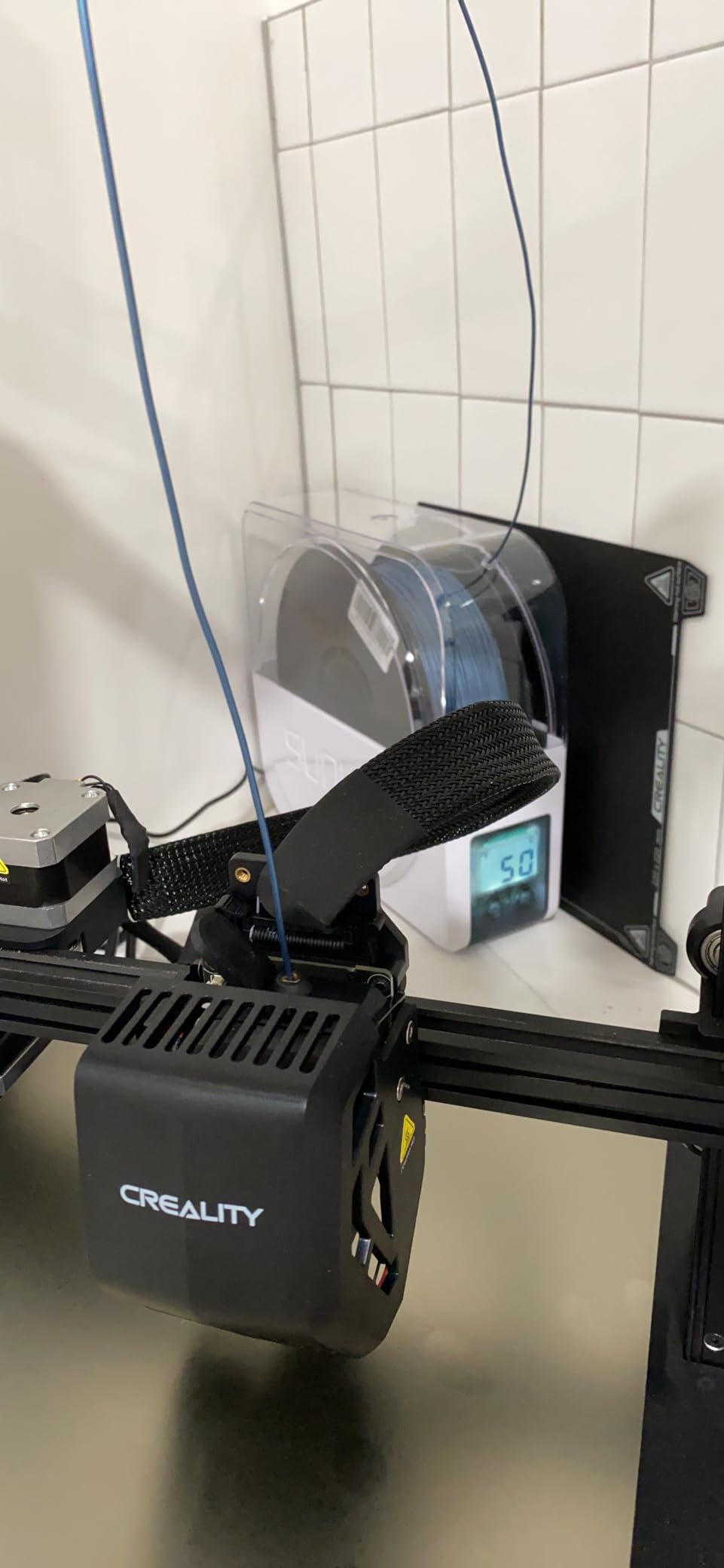
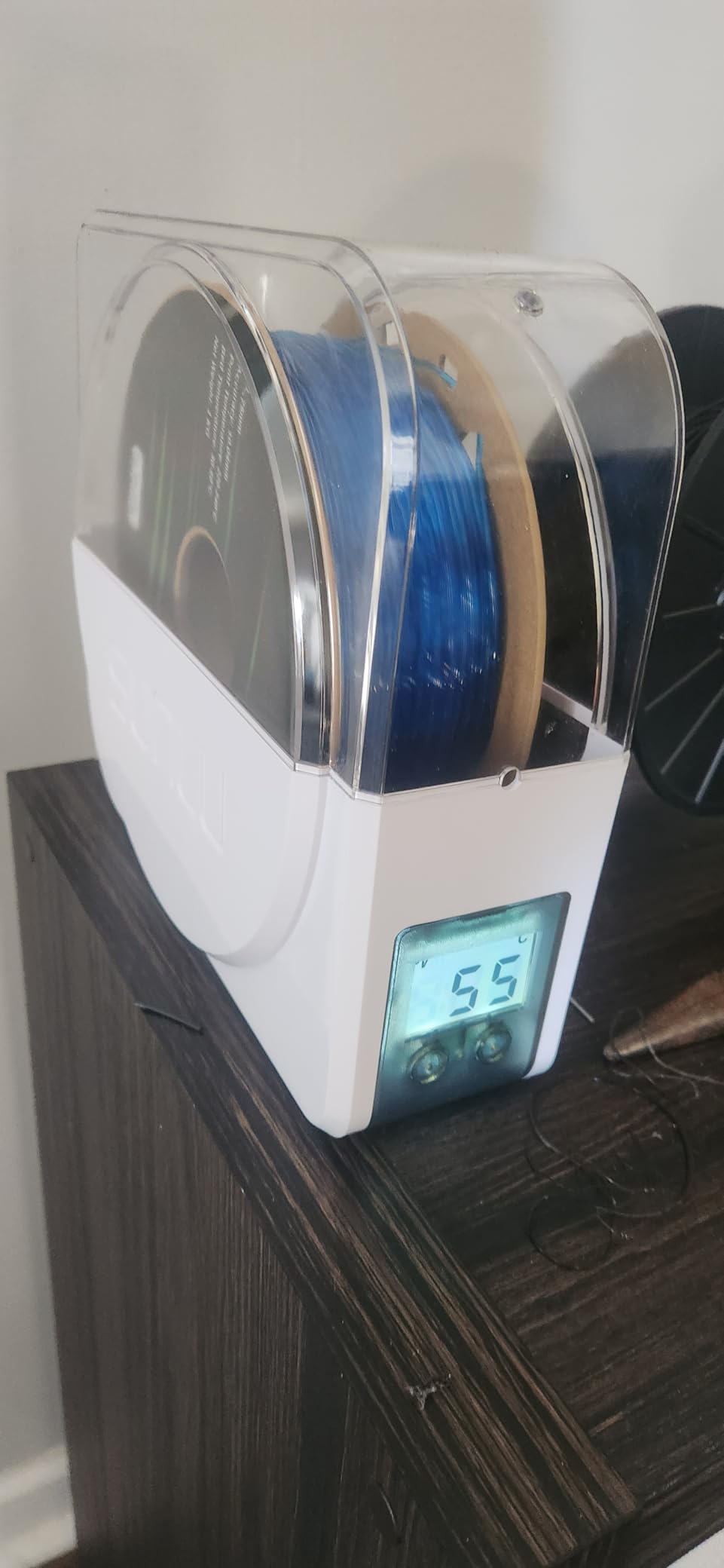
The two internal rollers are the part that earns its keep in a humid room. Because the spool sits on rollers and feeds outward, you can print directly from the box while it dries, which removes the transfer step where moisture gets back in. A 2.7 pound unit with a one-year warranty, it is built for a desk rather than a rack.
Reviewers report the single-roll format as the main limitation, and it is a genuine one for anyone running two materials. The 55C ceiling also means this is a PLA and PETG tool, not an engineering-filament tool. Outlet open during drying, closed when idle, is the routine.
Best fit for apartment printers where noise matters
If your machine lives somewhere you have to talk over a printer fan, this changes the calculation. Under 10dB means the dryer is effectively silent next to normal conversation, and the small footprint suits a desk or a shelf next to the printer. It is a comfort purchase as much as a performance one.
Not enough for multi-material or high-temperature work
One spool means one material per cycle. If you alternate PETG and TPU between prints, or run two printers, you will be swapping more than you would with a dual-spool box. And anything that needs a real 70C-plus cycle, including nylon, PA-CF and PC, is out of range here no matter how long you set the timer.
3. Sovol Filament Dryer 2026 SH01: Best for Desiccant-Guided Storage
Sovol Filament Dryer 2026, SH01 Filament Dehydrator 3D Printer Spool Holder
Real-time humidity display
Two spools or one wide spool
40/45/50C presets
Sealed for unpowered storage
Pros
- Built-in humidity readout lets you confirm drying rather than guess
- Accepts up to four desiccant bags for long-term storage
- Holds two spools under 70mm or one spool up to 150mm wide
- Built-in fan promotes even heating across the filament
Cons
- 50C maximum temperature limits high-temp engineering filaments
- May not reach set temperature in rooms under 16C
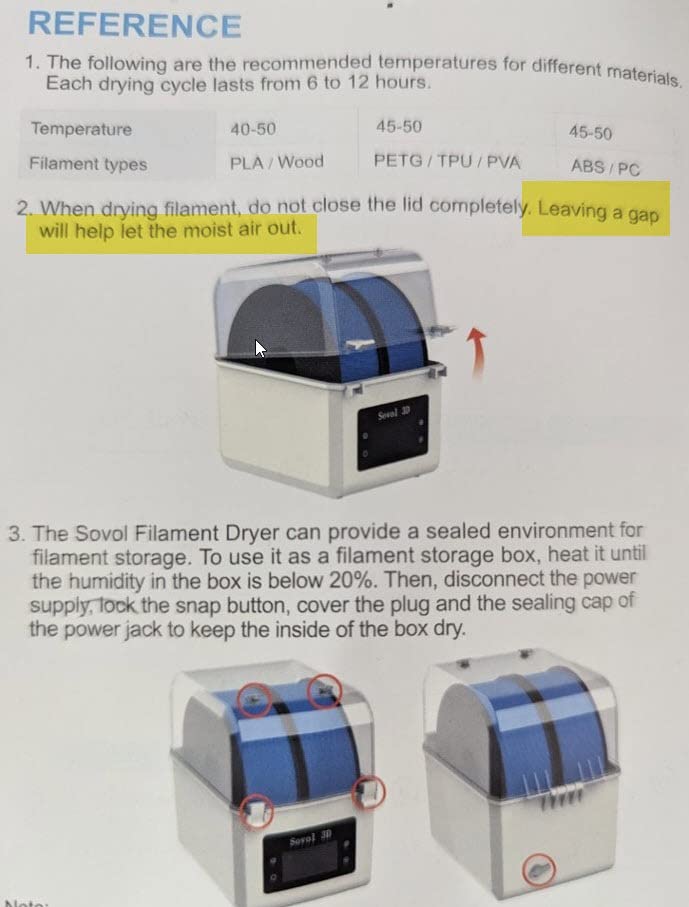
- Top PTFE seals must be opened during heating
The defining feature here is the desiccant support. This box takes up to four desiccant bags, which is not included, and combined with the silicone and PTFE seal it means the chamber can hold dry filament for long periods with the power off. In a humid room that is the difference between drying once and re-drying every week.
Capacity is unusually flexible. It takes two spools under 70mm wide or a single wide spool up to 150mm, which covers the fat spools that come with carbon-filled and engineering materials. The built-in fan distributes heat aerodynamically rather than relying on a heating pad alone, and the real-time internal temperature and humidity display is the feature buyers mention most.
It is also the lowest rated unit in this roundup at 4.2 stars across 2917 reviews, and the reasons are consistent. The 50C ceiling comes up constantly, as does the fact that the top PTFE seals have to be opened during a heating cycle for moisture to actually escape. A few owners in cold rooms report the chamber struggling to reach the 50C setting when ambient temperature drops under 16C.
Set against a 1.4 kg weight and a one-year warranty, this is a straightforward box that does the storage half of the job well. The weakness is heat range, not build quality.
Best when you dry in batches and print in batches
The four-desiccant-bag capacity and the powered-down seal suit a workflow where you dry four spools over a weekend, load them into the chamber with desiccant, seal it, and print through the week. That approach costs nothing to run and avoids the constant re-drying cycle that humid rooms force on you.
Not the right box for a cold garage or hot filaments
Two limits are worth knowing before you order. A room under 16C can prevent the chamber reaching its 50C set point, so a garage or unheated basement is a poor location for this specific unit. And with a 50C ceiling, the engineering materials that need more heat cannot be dried in it at all, however good the storage side is.
4. Comgrow SH02 Dry Box: Best Value for Two Spools at 70C
Comgrow Filament Dryer Box, SH02 Dry Box Filament Sealed Storage Box 3D Printer 2 Spools Holder with PTC Fast Heater, Filament Dehydrator with Touch Screen Compatible with PLA PETG TPU ABS 1.75/2.85mm
150W PTC heater up to 70C
Two 1kg spools
Presets for 9 filament types
Up to 98 hours of drying
Pros
- 70C ceiling is a real step up from 50C entry boxes
- Reaches 50C in about 7 minutes on a 150W PTC heater
- One-key presets for nine filament types remove guesswork
- Multi-point sealing rings protect filament when powered off
Cons
- Costs more and takes more desk space than a 50C single-spool box
- Two 1kg spools only
- No published review detail was returned for this specific listing
This is the box we would recommend to someone in a 60% RH room who prints more than one material. A 150W PTC heater takes it to 50C in about seven minutes and to 70C in roughly 25 minutes, and 360 degree fan circulation moves the hot air around the chamber rather than relying on a stationary element. That fan matters in a humid room, because moving air is what carries moisture off the filament surface.
Ratings sit at 4.4 from 1489 reviews with 72% of buyers giving five stars. The one-key presets for nine filament types, covering PLA, TPU, PETG, ABS, ASA, PVA, PC, PA and PP, take the guesswork out of setting a temperature you are not certain about. Drying time runs up to 98 hours, which is long enough for a thoroughly saturated spool.
Two filament holes with PTFE tubes let you dry two 1kg spools at once and print from the box. Safety features include a cutoff above 130C on the PTC module with automatic resume below 90C, plus a fan-stop alarm, which is sensible on a unit that runs hot for hours.
At 4.4 pounds it is the heaviest box here relative to its spool count, and the sealing rings on the upper and lower covers, outlet hole and base are the part that makes unpowered storage viable. The trade is footprint and weight for heat range and dual capacity.
Check the nine presets against your actual filament
Presets are the reason this box is easy to live with, but they are presets. If you run a non-standard blend, set the temperature manually and confirm the reading rather than trusting the one-touch button. The 98-hour maximum also gives you room to run a long cycle on a badly damp spool without babysitting it.
Heavier and costlier than a single-spool 50C box
You are paying for the 150W heater, the fan and the second spool. If you only ever print one material in one quantity and it is PLA or PETG, the simpler single-spool units do the same job for less money and less desk space. This box earns its bulk when you alternate materials or dry in batches ahead of a long project.
5. Creality Space Pi SE Dry Box Pro: Best for TPU on a Small Footprint
Creality 2026 New Upgrade Filament Dryer Box Pro, Space Pi SE with High PTC Efficiency & Precision Sensor for 1KG Spools 45~65℃, 3D Printer Filament Dehydrator for PLA PETG ABS ASA TPU
45-65C in about 15 minutes
Single 1kg spool
Built-in hygrometer
360 degree fan circulation
Pros
- Heats to 65C in roughly 15 minutes
- faster than most 60C units
- Owners report excellent TPU drying results
- Quiet enough to sit in a living space
- No assembly required and ready to use out of the box
Cons
- Holds only a single 1kg spool
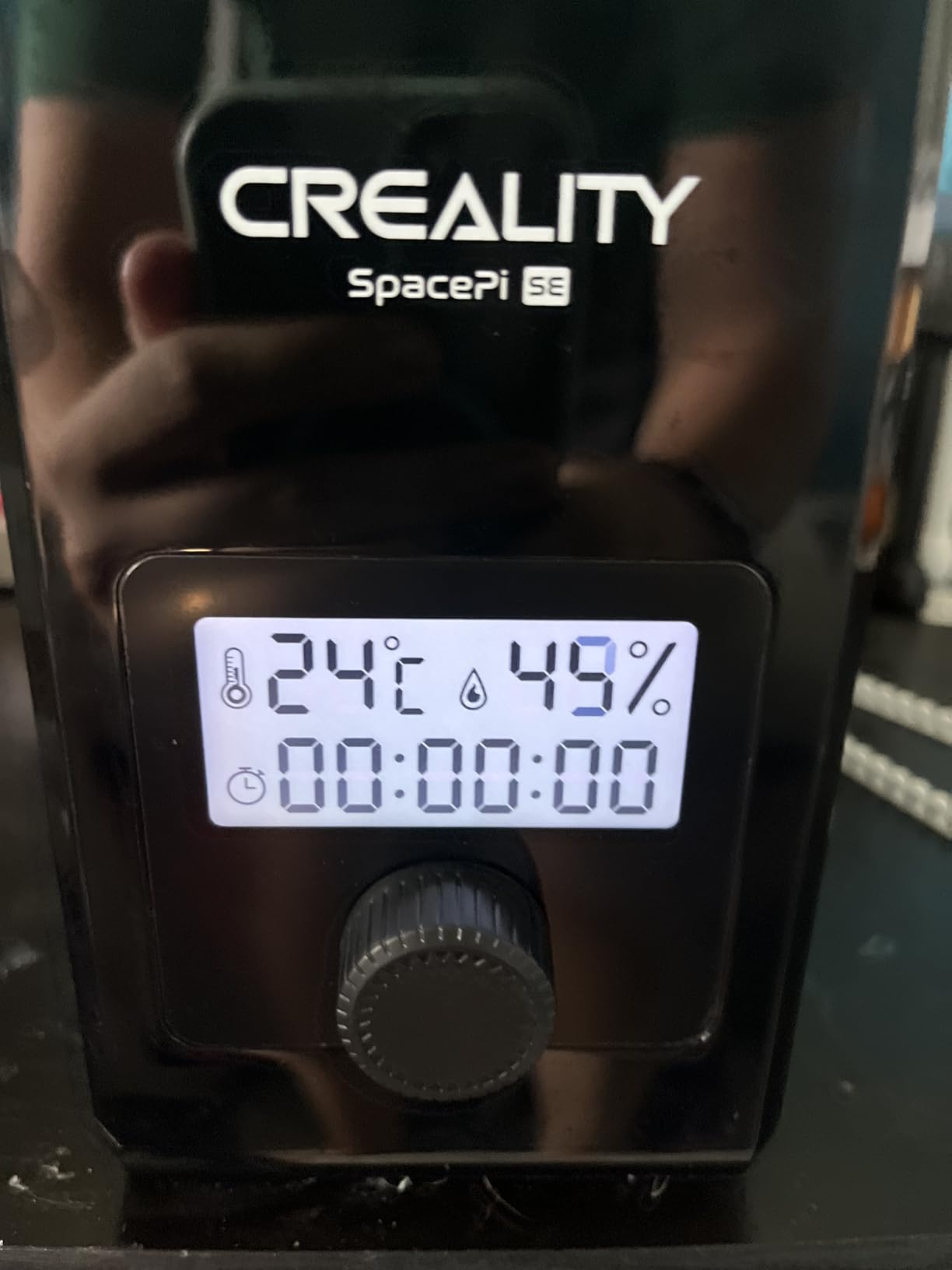
- Hygrometer floors at 15% RH and stops updating when the heater is off
- Lid hinge feels wobbly with no real latch or gasket
TPU is where a dryer earns its money fastest. It is hygroscopic, it is soft, and moisture in it shows up immediately as poor surface quality and inconsistent extrusion. Owners of this unit single it out for TPU specifically, alongside PA12-CF, and rate it 4.4 stars from 914 reviews.
An 80W PTC heater with an internal circulation fan reaches 65C in about 15 minutes, and the range is 45-65C on a 0-24 hour timer. Thermal insulation cotton on the inner walls holds heat and reduces the risk of touching a hot surface while you load a spool. It handles 1.75mm and 2.85mm filament across PLA, PLA+, PETG, TPU, ABS, ASA, PP, PC and PA.
There are real caveats. The chamber takes a single 1kg spool, which is the most common complaint. The built-in hygrometer reads down to 15% RH and appears to stop updating when the heater is off, so the number you see when idle may be stale. The display viewing angle is poor on a shelf or the floor, and the fan is noticeably noisy to some ears despite the quiet-running claims.
The lid is the other weak point. There is no real latch or gasket, and the lid needs to be left cracked open during drying for moisture to escape, a step that is not clearly documented and that most owners discover themselves.
Judge this one by the temperature it reaches in 15 minutes
A fast heat-up curve matters more than it seems. A chamber that reaches 65C in a quarter of an hour spends far more of its cycle at temperature actually drying, rather than warming up, and in a humid room that difference is what pulls the internal RH down before the timer ends. The 360 degree fan does the same job inside the chamber.
Not a box for two materials at once
One spool is one material. If you alternate TPU and PETG, or run a dual-extruder machine, you will be moving filament twice per switch, and moving it means exposing it to the room air you are trying to avoid. The 24-hour maximum timer is also short compared with units that run to 48 or 99 hours for badly saturated engineering spools.
6. SUNLU Filament Dryer S2: Best for Basements and Long Cycles
SUNLU Filament Dryer S2, Black
35-70C range
0-99 hour timer
Rotating spindle with circulation fan
Translucent lid for monitoring
Pros
- 70C ceiling covers high-temperature and engineering-grade filament
- 0-99 hour timer handles long drying cycles comfortably
- Built-in spindle rotates the spool for even drying
- Designed for humid locations such as basements
Cons
- Single-spool format only
- Larger chamber footprint than compact single-roll dryers
- Highest one-star share of the group at 8% of reviews
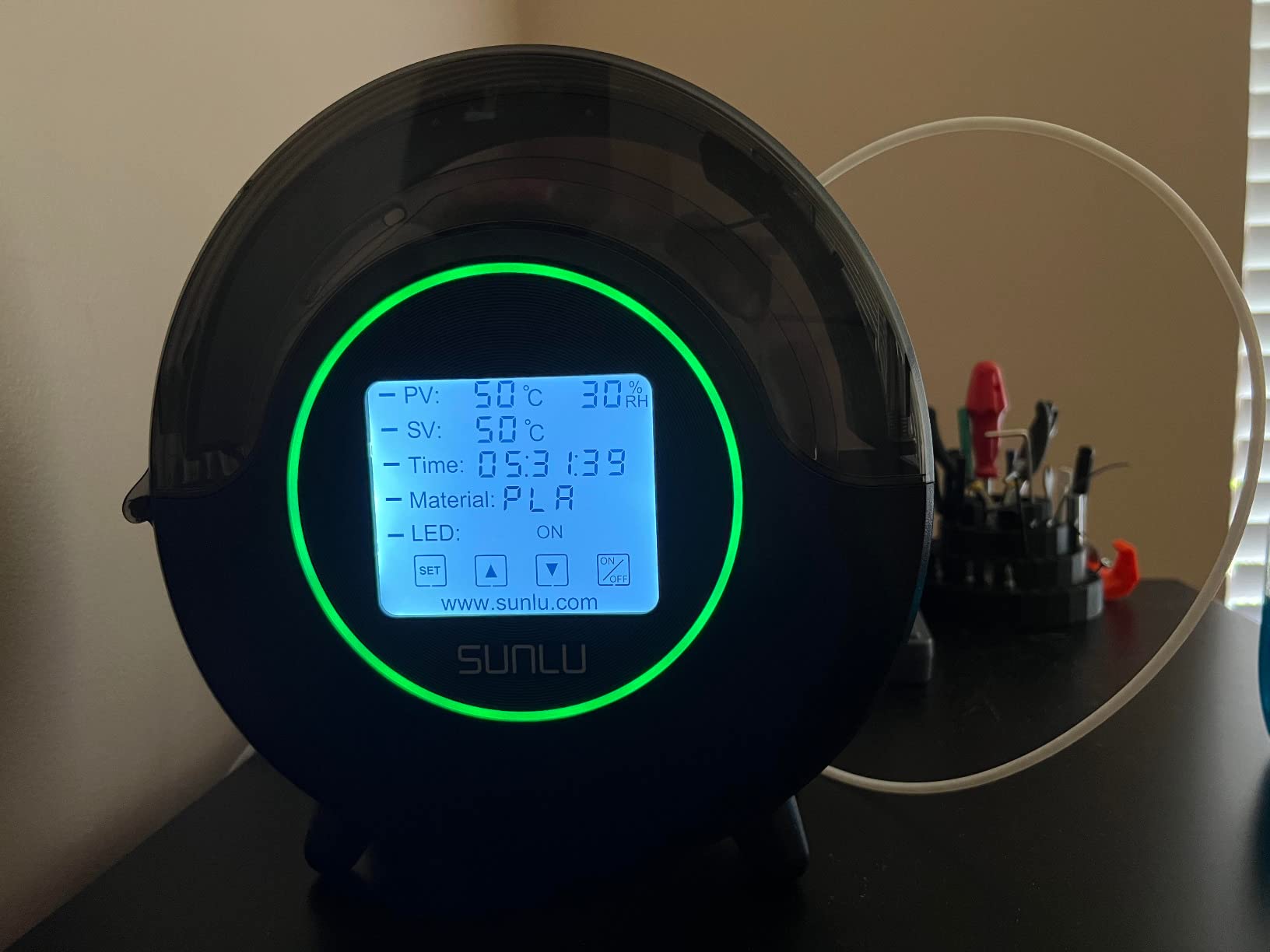
This is the SUNLU unit aimed squarely at damp buildings, and the 70C ceiling is the reason it earns its place. A 4.3-star average from 954 reviews sits mid-table, but the feature set is aimed at exactly the problem this roundup covers: a large 265 x 274 x 118 mm chamber, a touch screen panel, a built-in circulation fan and a spindle that rotates the spool while it dries.
Rotation is the detail that separates it from cheaper boxes. A stationary spool sitting over a heating element develops a hot spot in the middle of the wound filament and a cooler outer layer, so the core stays wet while the outside feels dry. Turning the spool evens that out, which is what you want when the whole spool has been sitting open in a basement for a month.
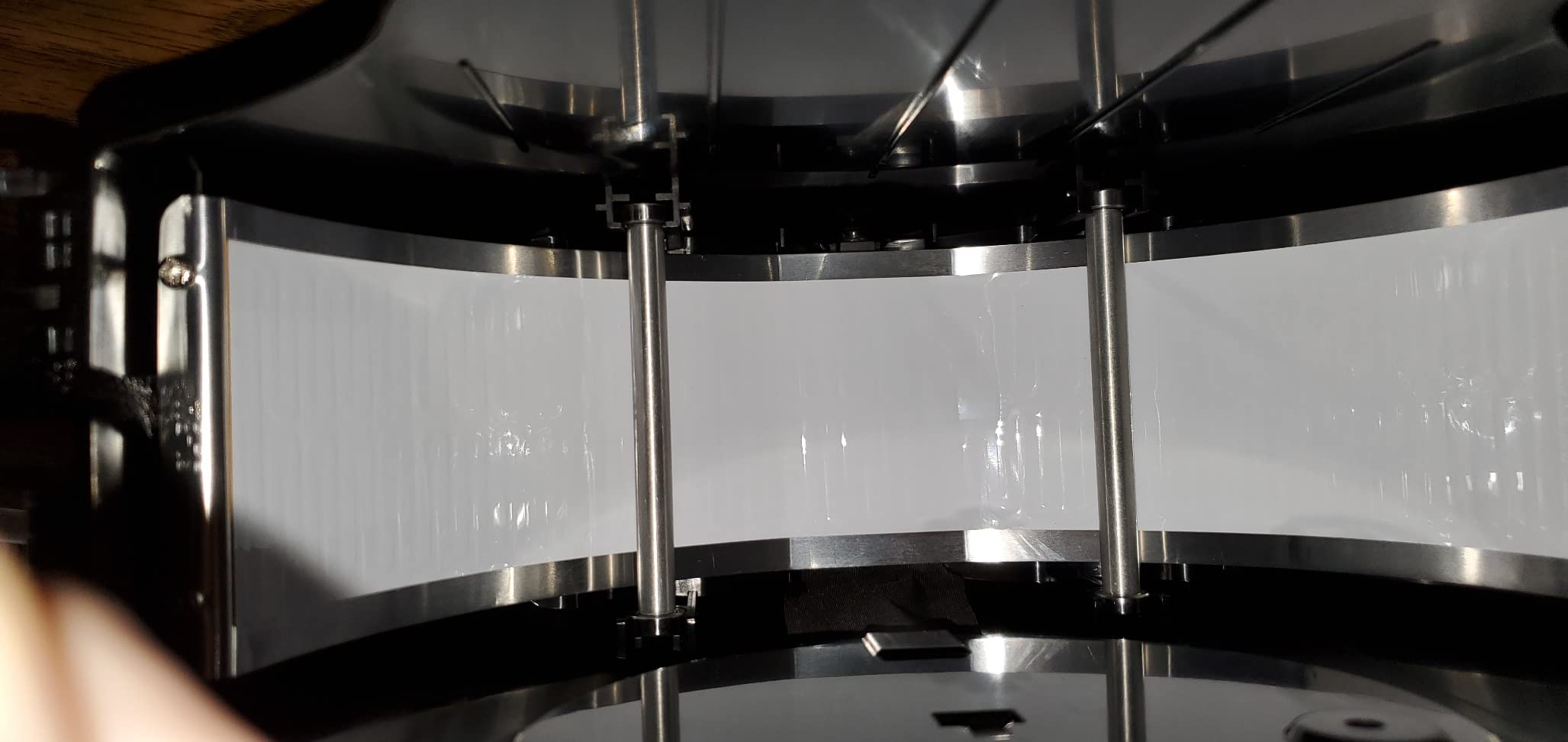
The translucent lid lets you check the filament without opening the chamber, which sounds minor until you realise every time you open the lid in a humid basement you are reloading the box with room air. The unit doubles as a spool holder so you can print straight from it, and it takes 1.75mm, 2.85mm and 3.00mm filament at 1.51 kg.
One detail to weigh is the review spread. With 68% five-star but 8% one-star, the S2 has the widest unhappy group in this list. Buyers who hit problems tend to hit them consistently, so check the 70C rating is enough for your material before buying on the humidity angle alone.
Check that the chamber reaches its set point in an unheated room
Basements and garages are the hardest rooms for any dryer because ambient temperature works against the set point. Chambers that need to reach 70C are the ones most likely to fall short in an unheated space. A thermometer in the room, not just in the chamber, tells you whether this unit is running at its rating or compensating for a cold room.
Not for multi-spool setups
One spool per chamber means switching materials means moving filament, and in a basement that is the exact step you are trying to avoid. The 265 x 274 x 118 mm chamber is also physically larger than a compact single-roll box, so the footprint cost is real if desk space is tight. The 99-hour timer is generous enough to compensate on a single material.
7. JAYO J1 Filament Dryer Box: Best for Enclosed Printers
JAYO J1 Filament Dryer Box for 3D Printer Filaments, 150W PTC, Up to 70°C
150W PTC up to 70C
Fits inside printer enclosures
Built-in desiccant,Humidity viewing window
Pros
- Compact enough to sit inside an enclosed printer where larger boxes will not fit
- 150W PTC heater reaches up to 70C quickly
- Very quiet with strong drying for its size
- Direct filament feed works reliably with tool-changer printers
Cons
- Seam between heater base and canister needs a gasket or foam tape
- No latch holds the base and canister together
- Small two-button non-touch display
- Holds one 1kg roll
- Extra canisters are expensive
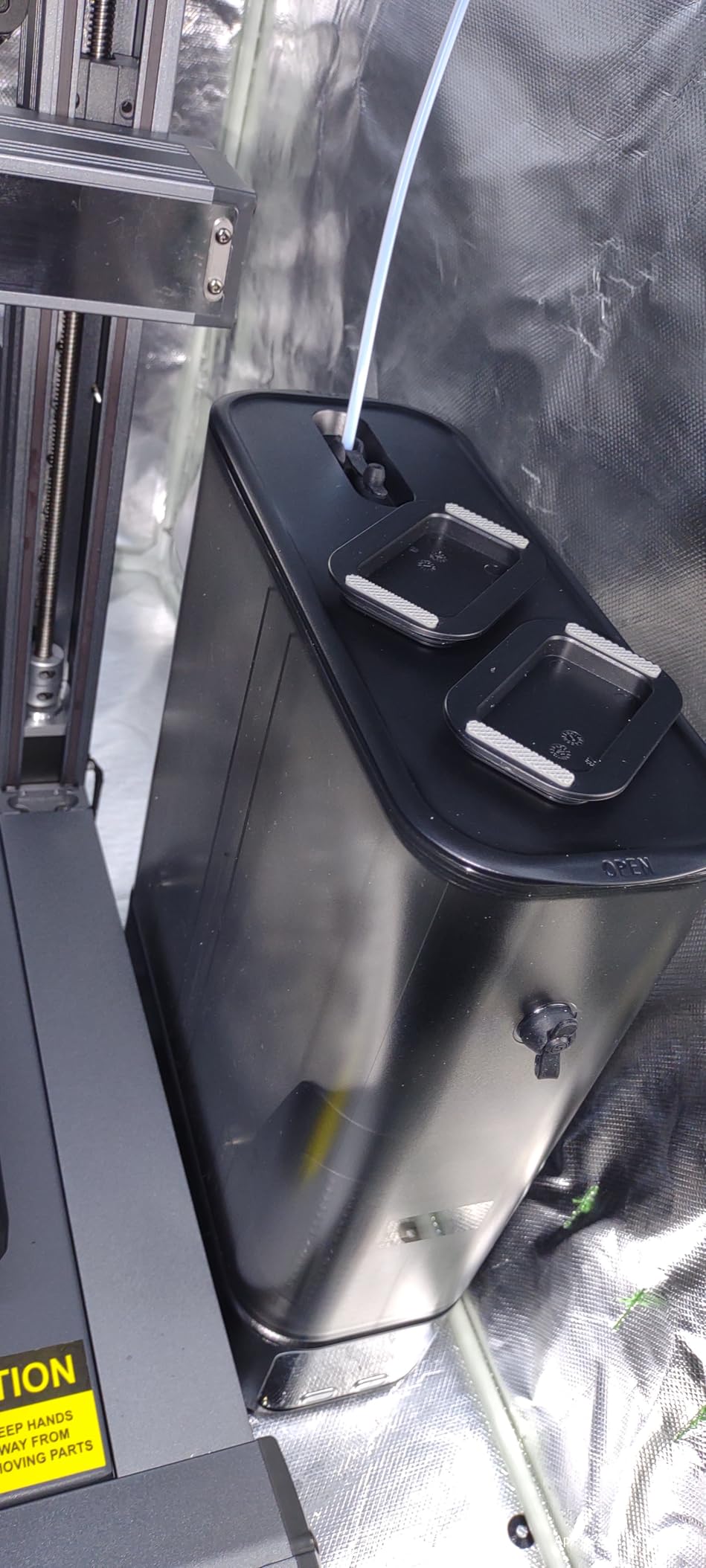
The J1 solves a physical problem the larger boxes cannot. At 1.5 kg with a slim body, it fits inside a printer enclosure where a 4.4-pound two-spool box simply will not go, and it still runs a 150W PTC heater up to 70C. For enclosed printers this is frequently the difference between having a dryer and not having one.
It rates 4.4 from 832 reviews, and the recurring praise is about build quality. Reviewers describe the plastic as stiffer and better finished than comparable boxes from Creality or SUNLU at similar sizes, which is unusual for a product in this category. The modular split design means the heater base and the storage canister can be used independently or stacked for multi-printer setups.
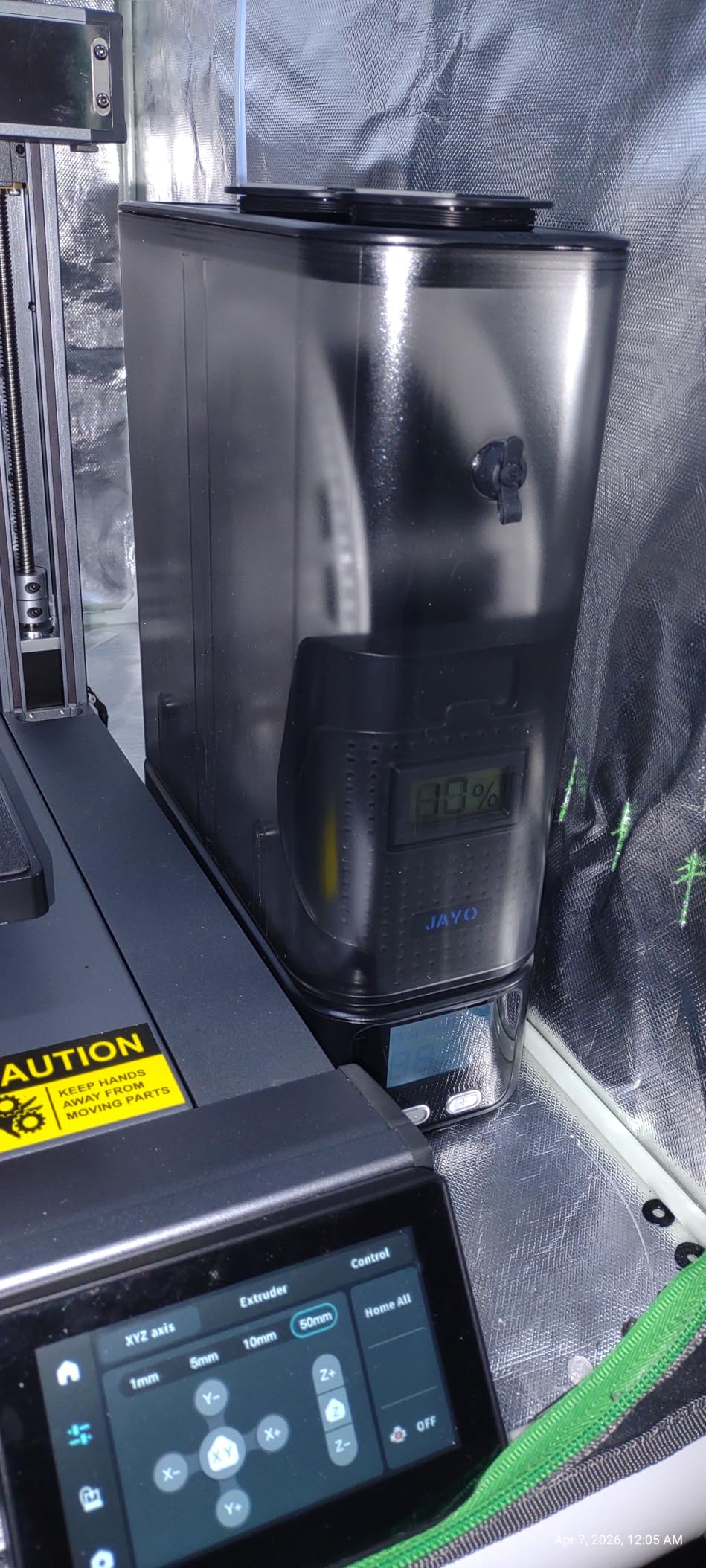
The built-in desiccant is a genuinely useful feature. The manufacturer claims it holds humidity stable within plus or minus 5% over 21 days, and the box doubles as a sealed storage container once the heater base is removed, so the same hardware covers drying and long-term storage. The humidity viewing window lets you check the state of the filament without cracking the seal.
There is one assembly complaint that comes up repeatedly: the seam between the heater unit and the canister needs a gasket or extra foam tape to seal properly, and no latch holds the two halves together. Most users fix it with tape in a minute, but know that before you rely on the seal.
Check the base seam seal before long storage cycles
This is the whole decision on the J1. The compact footprint and 70C ceiling are rare together, but a split seam that leaks into a humid room defeats the purpose. Add foam tape at the base, run a 12-hour cycle, and confirm the viewing window desiccant indicator still shows dry after a day before you trust it for a month of storage.
One roll and a minimal display are the costs
You get a single 1kg roll at 1.75mm, so 0.25kg, 0.5kg and 1kg spools all fit but only one at a time. The display is a small two-button panel showing temperature, time and filament settings, which is fine for setting a cycle and useless for fine adjustments. Additional storage canisters are expensive for what they are, so plan on one.
8. Polymaker Polydryer: Best for Dry, Store and Print in One Box
Polymaker Filament Dryer & Storage Box Polydryer for 1kg PA Nylon PLA PETG
Dryer dock plus storage box
Built-in hygrometer
Supports PA nylon and PVB
360 degree airflow
Pros
- Modular dock and box design keeps the seal intact between drying
- storage and printing
- Built-in hygrometer shows chamber humidity day to day
- Supports the widest material range here including PA nylon and PVB
- 360 degree airflow promotes even heating
Cons
- Most expensive single-spool option in this roundup
- Single-spool capacity only
- Dock and box are separate purchases in some variants so the full set costs more
The idea here is a single vessel for three jobs. A heating dock, a storage box and a spool holder stack into one assembly, and the seal between dock and box is designed to survive being broken and remade. In a humid room that continuity is the point, because the moment you decant dry filament into a separate container you have an opening for moisture again.
It rates 4.3 from 719 reviews, with 70% five-star but a 9% one-star share, and the split in sentiment is about value rather than performance. Buyers who want the dry-store-print workflow rate it well. Buyers who compare it with simpler heated boxes find the price difficult to justify.
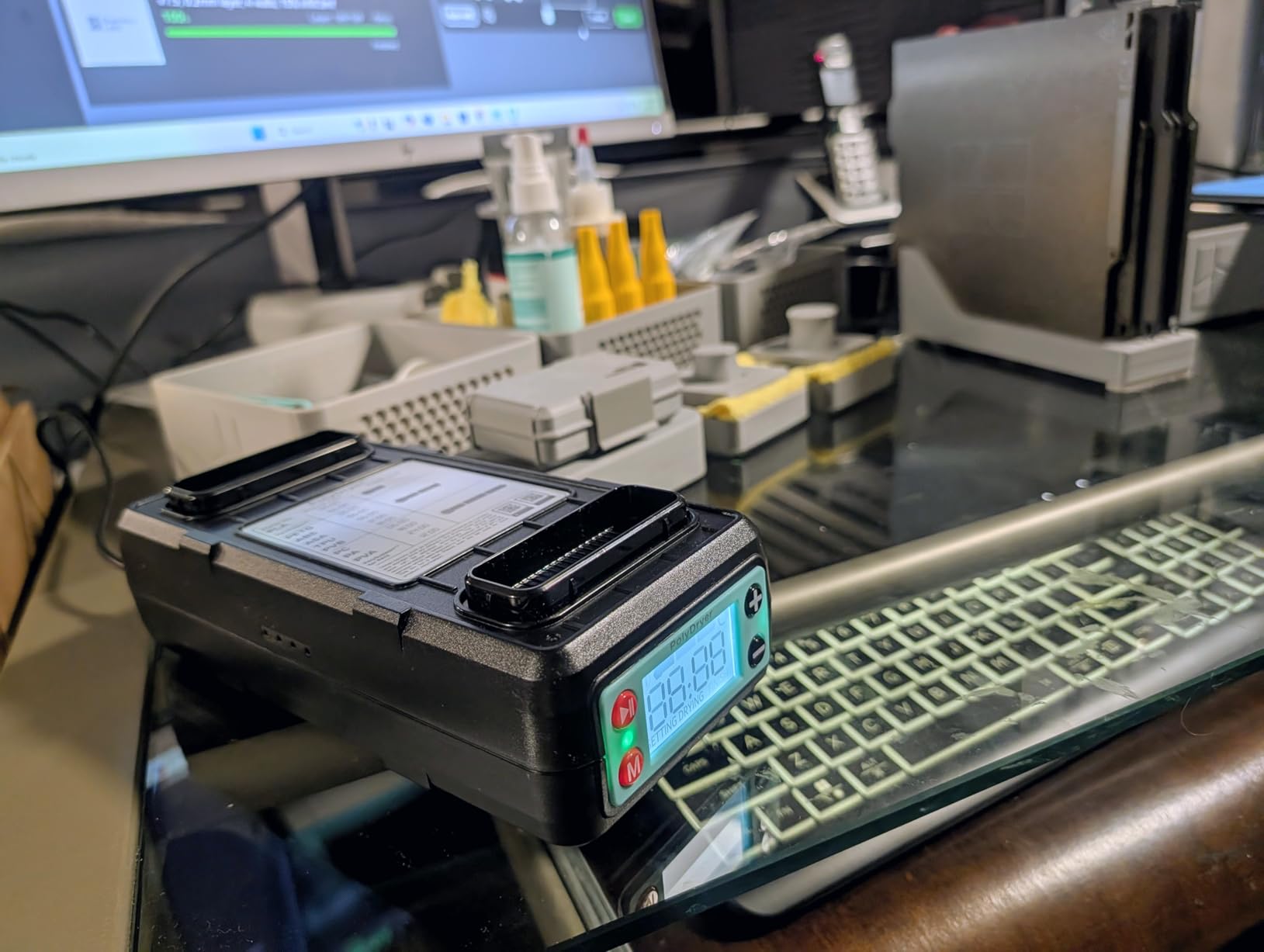
Where it genuinely leads the list is material breadth. It supports PA Nylon, PLA, PVB, PETG, ABS, ASA and TPU, which is the widest set in this roundup, and it handles 1.75mm, 2.85mm and 3.00mm filament on 1kg spools. The built-in hygrometer gives you a chamber reading without opening anything, and 360 degree airflow handles even heating at 1.3 kg.
Two practical notes. In some of the available variants the dock and the box are separate items, so check what is actually in the package before assuming you have the full system. And the highest one-star share in the group suggests that buyers who end up unhappy are usually unhappy about what they paid relative to what they got.
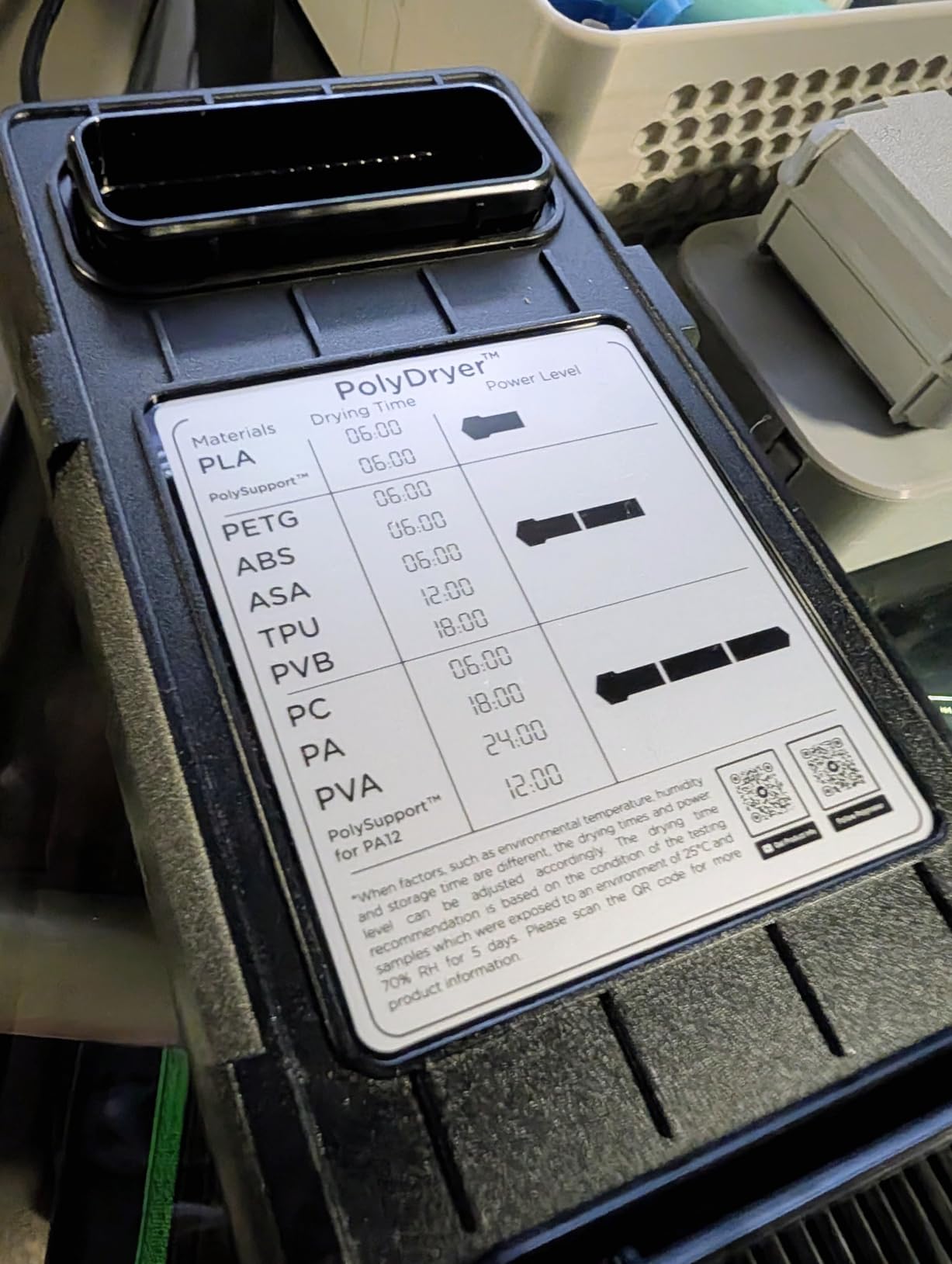
Check what the package actually includes
Confirm whether the dock and the storage box ship together. If you end up buying the box separately you have paid more and you still have two seams to worry about instead of one, which partly defeats the design. The hygrometer is also the only way to check the seal is working, so set it up and watch the reading for a full day before you rely on it.
Hard to justify for one material and one spool
If you print one thing from one 1kg spool, this is a lot of hardware for a single-spool job and simpler boxes cover it. The design pays off when you move between materials often, when you want filament to stay dry for weeks between sessions, or when you print a material like PVB that you rarely have open. Under those conditions the workflow advantage is real.
9. Creality Space Pi X4: Best for Multi-Printer and Nylon Work
Official Creality Filament Dryer, Space Pi X4 Filament Storage Box, 85℃ Max Temperature, Dual Independent Heating Chambers, Power Saving for PLA PETG ABS TPU ASA PC PA PAHT, DB-05
85C maximum temperature
Four spools across two chambers
Dual 200W PTC heaters
Eight PTFE feed ports
Pros
- 85C ceiling is the highest here and suits PA
- PAHT and PC
- Dual independent chambers dry two filament types at different temperatures
- Feeds four printers through eight PTFE ports simultaneously
- Single-chamber mode cuts energy use by up to 40%
Cons
- The most expensive unit in this roundup
- Bulk size is impractical for a single printer or a small bench
- Manufacturer advises using Creality RFID filament in heat-resistant trays
This is the only unit here that can actually dry nylon properly, and the reason is the 85C ceiling with insulated chambers. Nylon profiles sit well above the 70C limit of everything else on this list, and a chamber that tops out at 70C will warm a damp PA spool without extracting the water. At 4.6 stars from 597 reviews it also has the highest average rating in the group, with 81% five-star.
Two independent chambers, each with its own 200W PTC heater, let you dry two filament types at different temperatures at the same time. That matters more than it sounds: PETG wants a moderate heat and nylon wants a high one, and running them in one shared chamber means one of them is always wrong. The chambers are insulated to improve efficiency at the 85C end.
Capacity is four spools, with eight filament holes and PTFE tubing to feed four printers simultaneously. For a small print farm or a household running several machines on different materials, that is the feature that changes the workflow. Single-chamber mode saves up to 40% of energy when you only need one half running, and the unit supports PLA, PETG, ABS, TPU, ASA, PC, PA and PAHT.
The honest drawback is size and, plainly, cost. This is the most expensive unit in the roundup and the bulkiest, and the manufacturer recommends using Creality RFID filament supplied in heat-resistant plastic trays, which ties the setup to one brand of spool. If you run one printer, almost all of that capability is idle.
Check spool material before running it at 85C
At 85C, spool construction stops being a detail. Cardboard cores and thin plastic spools can soften or deform well below that, and this is the point at which a warped spool becomes a jam mid-print. The manufacturer steers users toward heat-resistant trays, and we would check the spool you already own before assuming it can take the heat.
Overkill unless you run several printers or nylon
For a single-printer setup printing PLA and PETG, this box is capacity you will not use. The two independent chambers only pay off when you genuinely run two materials at two temperatures at the same time. The 85C ceiling is the other justification, and it is the harder of the two to give up once you start printing nylon.
10. Sovol SH02 Dry Box: Best for Dual-Spool Feed-Through Printing
Sovol Filament Dryer, SH02 Dry Box 3D Printer Sealed Filament Storage Box
40-70C with a 150W PTC heater
Two 1kg spools
Two PTFE feed ports
Presets for 9 filament types
Pros
- Two PTFE feed ports can serve a dual-extruder printer
- 50C in 7 minutes and 70C in 25 minutes on a 150W heater
- 360 degree fan circulation avoids the cold spots of passive boxes
- Improved sealing over the SH01 protects filament when powered off
Cons
- Top ventilation hole is too small unless the lid is propped open
- Needs to be burped every few hours during a cycle
- Humidity only shown while the heater and fan are running
- Base runs hot enough to need a riser
Two PTFE feed ports is the distinguishing feature. Where most dual-spool boxes give you two chambers to fill, this one lets two spools feed two extruders or two printers at once, so a dual-extruder machine can run two materials without a swap. It rates 4.3 from 802 reviews at 1.3 kg, and the 40-70C range comes from a 150W PTC heater that hits 50C in 7 minutes and 70C in 25.
Owners report measurable print quality improvements, particularly with PETG, TPU and engineering blends like PPA and CF-ASA. The 360 degree fan circulation is what prevents the cold spots you get in passively heated boxes, and the one-key presets for nine filament types keep the settings quick. Sealing is thicker than on the earlier SH01 for better unpowered protection.
The dominant practical complaint is venting, and it is worth reading carefully before you buy. The top ventilation hole is too small, so humidity will not drop unless the lid is propped open, and the unit needs to be burped every few hours during a cycle to release moisture. Several buyers independently learned to clip a filament holder in the lid to hold it ajar. That is a workaround, not a feature.
There are smaller frictions too. Internal humidity is only displayed while the heater and fan are running, the base runs hot enough to want a riser or trivet under it, and the touch screen needs firm pressure to register. A few reviews also report uneven heat distribution warping spools near the element on default PLA settings.
Plan for the venting workaround from day one
This is the spec to check before anything else: the box needs a cracked or propped lid to dry properly, and a small top vent will not do the job. Budget for a clip or a spool holder that holds the lid open, and check the humidity reading at the start and middle of a cycle to confirm the RH is actually falling rather than assuming it is.
Best when you print from two extruders at once
The two PTFE ports are the reason to choose this over a similar 70C dual-spool box. If you run a dual-extruder or dual-printer setup, two materials can be fed straight from the chamber while drying, which removes the transfer step entirely. On a single extruder you are paying for a feature you will use once, and the venting workarounds apply either way.
How to Match a Filament Dryer to Your Room and Your Filament?
Start with a measurement, not a product. Put a hygrometer beside your printer for a week and note the worst readings, especially overnight. The number at the hottest, most humid point sets your target, and indoor RH is often driven by showers, cooking and drying laundry rather than by regional climate. If you also run a heat pump or gas tumble dryer in the same space, the extraction behaviour discussed in our travel hair dryer and stackable washer dryer guides is the same physics in a larger box.
Then work through five decisions.
1. Pick the temperature ceiling your filament needs, not the one you might need later. Anything at 50C or below covers PLA, PETG and most TPU. ABS, ASA and PC sit in the 60-80C band. Nylon, PA-CF and PAHT need 70C and above, and in practice only the highest-ceilinged chambers go high enough to be useful.
2. Count the spools you actually switch between. Two spools is the sweet spot for most households. One spool is fine if you print a single material. Four spools only pays off with multiple printers or two materials that need different temperatures.
3. Treat the humidity readout as the most important feature in a humid room. A timer tells you when a cycle ended, not whether the filament is dry. A sensor lets you watch the internal RH fall and stop when it stabilises below roughly 15-20%. Without one you are guessing.
4. Check how moisture leaves the chamber. A sealed box with no air exchange is the failure mode we get complaints about. Look for a vent, a feed-through port that doubles as an outlet, or a documented way to leave the lid cracked during a cycle.
5. Decide the workflow. Print-while-drying through a PTFE feed port keeps filament inside the chamber, which is the right answer for long prints and very hygroscopic materials. Dry-then-seal with desiccant and a gasketed box costs nothing to run and suits batch printing.
For the material side, the drying profiles below are what the chamber is being set to.
PLA is the least hygroscopic and usually needs 40-50C for 4-6 hours, or nothing at all if it is sealed with desiccant. PETG is moderately hygroscopic and wants 50-60C for 4-6 hours, and it is the material that shows stringing first. TPU is highly hygroscopic, often 45-55C for 6-8 hours, and softens as it absorbs water. ABS and ASA want 60-80C for 4-6 hours and produce styrene fumes, so dry them in a ventilated space rather than a closed bedroom.
PA nylon is the hard case, typically 70-80C for 8-12 hours, and carbon-filled nylon often needs 80C or more, which is where the 85C chamber earns its place. PC sits around 70-80C for 6-8 hours. PVA and BVOH support material is extremely hygroscopic and dissolves in water, so it must be dried and stored sealed at all times, and 45-55C for 6-8 hours is typical.
Two warnings belong here. Filament that is overheated softens, deforms and can fuse spool windings together, and a 70C-rated dryer is not automatically safe for every spool sitting on your shelf. And a dryer running unvented in a small closed room can add moisture to that room, so ventilate the space when you dry engineering materials.
Why Venting Matters More in a Humid Room?
The most common complaint about heated filament dryers is that they warm a sealed chamber without moving the moisture out of it. Users describe the result as a filament sauna: hot, enclosed, and doing very little. A heater alone raises the temperature of the air, but water vapour only leaves the chamber if air moves and if there is somewhere for it to go.
That is why every unit in this roundup with a real circulation fan performs better than its wattage suggests, and why the community view is consistent: air movement is what carries humid air away from the plastic. Several boxes in this list, including the Sovol SH02 and the entry-level Comgrow Dryer Box, need a lid propped or cracked open during a cycle because the built-in vent is not enough on its own. That is not a defect to return a unit over, but it is a step in the workflow you need to know about.
Sensor-only boxes have a related limitation. Where a humidity sensor floors at 15% and stops updating when the heater is off, as the Creality Space Pi SE does, the reading can be stale exactly when you want to check the seal. A live sensor that refreshes during a cycle tells you something real about the chamber; a static number tells you very little.
Finally, the counter-intuitive part. A sealed dryer running continuously in a small humid room does not remove moisture from the room, it eventually adds to it, because the moisture has to go somewhere. In a closed bedroom that can make the whole problem worse. Ventilate the room when you run long cycles, particularly with ABS, ASA and nylon.
When a Dryer Is Not Worth It?
If your room sits near 40% RH and you print mostly PLA, a heated dryer is money you can spend better on dry filament. Sealed storage with colour-indicating silica gel handles that scenario. A Bambu Lab forum user relies on repurposed food storage containers with gel packs, and other makers use airtight bins with desiccant bags. An r/3Dprinting user recommends an Eva-dry e-333 dehumidifying container that holds about eight rolls with humidity staying around 10%, which is a strong result for a non-heated box.
A food dehydrator is the other option. It reaches higher temperatures than most entry-level dryers and handles several spools at once, and the practical limits are the same ones that matter here: no humidity readout, uneven airflow around spools, and no defined place to store filament afterwards. A dedicated dryer gives you the sensor and the sealed chamber that the dehydrator does not.
Room dehumidification is the third lever, and it is the one people skip. Lowering the RH of the room slows moisture pickup across every spool at once, which reduces how often you need to dry anything. If your indoor humidity is driven by showers and cooking, an extractor fan or a small dehumidifier can be a bigger win than a second dryer.
And a dryer is also not worth buying if you plan to run it continuously in a sealed small room, or if your filament is PLA-only and freshly opened.
Frequently Asked Questions
Which filament dryer is best for high temperatures?
For 70C-plus work such as nylon, PA-CF, PAHT and PC, you need a chamber rated to at least 70C, and for the most demanding carbon-filled nylon you want the 85C Creality Space Pi X4, which is the only unit here with two independently controlled chambers. ABS and ASA sit in the 60-70C band, where the SUNLU S2 and the two 70C dry boxes are enough. Check your spool material too, because cardboard cores and thin plastic spools can deform before the chamber reaches its ceiling.
What humidity should my filament dryer be?
Dry filament until the internal reading stabilises below roughly 15-20% relative humidity, then keep it there. Below about 20% you are safely in the dry range for PLA, PETG, TPU and nylon. Between 20% and 40% most materials still print but stringing and popping start to appear, and above 40% you should expect visible problems on hygroscopic filaments. Watch the reading fall rather than trusting the timer, and crack or open the vent during a cycle so the extracted moisture can actually leave the chamber.
Do filament dryers really work in humid rooms?
Yes, and they work better in a humid room than in a dry one, because the higher ambient relative humidity gives the chamber more moisture to pull out. The limits are practical rather than theoretical: a sealed chamber with no air exchange can heat without drying, so airflow and a vent matter, and a sensor-only box that stops updating when the heater is off gives you no confirmation. If your room is above 70% RH, drying and re-wetting are happening fast enough that dry-then-seal storage is needed, not just a warm box.
How to reduce humidity in a 3D printer?
Start with the room, then the filament, then the machine. Measure the room RH beside the printer for a week and use extraction or a dehumidifier to lower the peak. Store filament in gasketed boxes or vacuum bags with colour-indicating desiccant, and only open spools when you are about to print. Add a heated chamber to the printer if it has one, since a dry chamber inside a humid room is far more effective than dry air arriving through an open enclosure. Drying filament is the last step, not the first.
What is the best dehumidifier for a filament dry box?
For storage without heat, a non-heated desiccant container is enough, and colour-indicating silica gel lets you know when to regenerate it in an oven. An r/3Dprinting user reports an Eva-dry e-333 holding about eight rolls with humidity staying around 10%, which is the strongest storage result in community reports. Place desiccant away from the spool on a raised tray so it does not contact filament, and never use a desiccant loose at the bottom of a hot heated chamber above 60C, where you need the air exchange instead.
Is a filament dryer worth it for PLA?
In a room above roughly 55% RH, often yes. PLA is the least hygroscopic material, but spools that have been open for months in a damp room pick up enough water to cause stringing and rough surfaces, and users regularly report visible differences after drying, including a marked improvement with TPU. Below 45% RH with sealed storage, a heated dryer is unnecessary and a desiccant box does the same job for far less. Measure the room before deciding rather than assuming from the weather outside.
Which Filament Dryer Should You Buy?
For most people printing in a room above 55% RH, the Comgrow Filament Dryer Box is the pick. It holds two 1kg spools, it shows you real-time humidity so you know when the filament is actually dry rather than when a timer ended, and it feeds straight to the printer through the outlet port so the moisture does not get back in. At 4683 reviews it also has the deepest proof of behaviour of anything on this list, and at 4.4 stars the results are consistent.
If your printer lives in a quiet space, the SUNLU S1 Plus runs under 10dB and prints straight from the box. If you alternate materials or print anything that needs real heat, the Comgrow SH02 reaches 70C across two spools. If you print nylon, only the Creality Space Pi X4 at 85C will genuinely do the job, and it is worth the bulk and the cost if you actually run several machines.
Before any of that, put a hygrometer next to your printer for a week. Below 45% RH with sealed storage, you do not need a dryer at all. Above 70%, you need a dryer and a real storage strategy, because no amount of heat stops a humid room re-wetting filament the moment it leaves the chamber.