
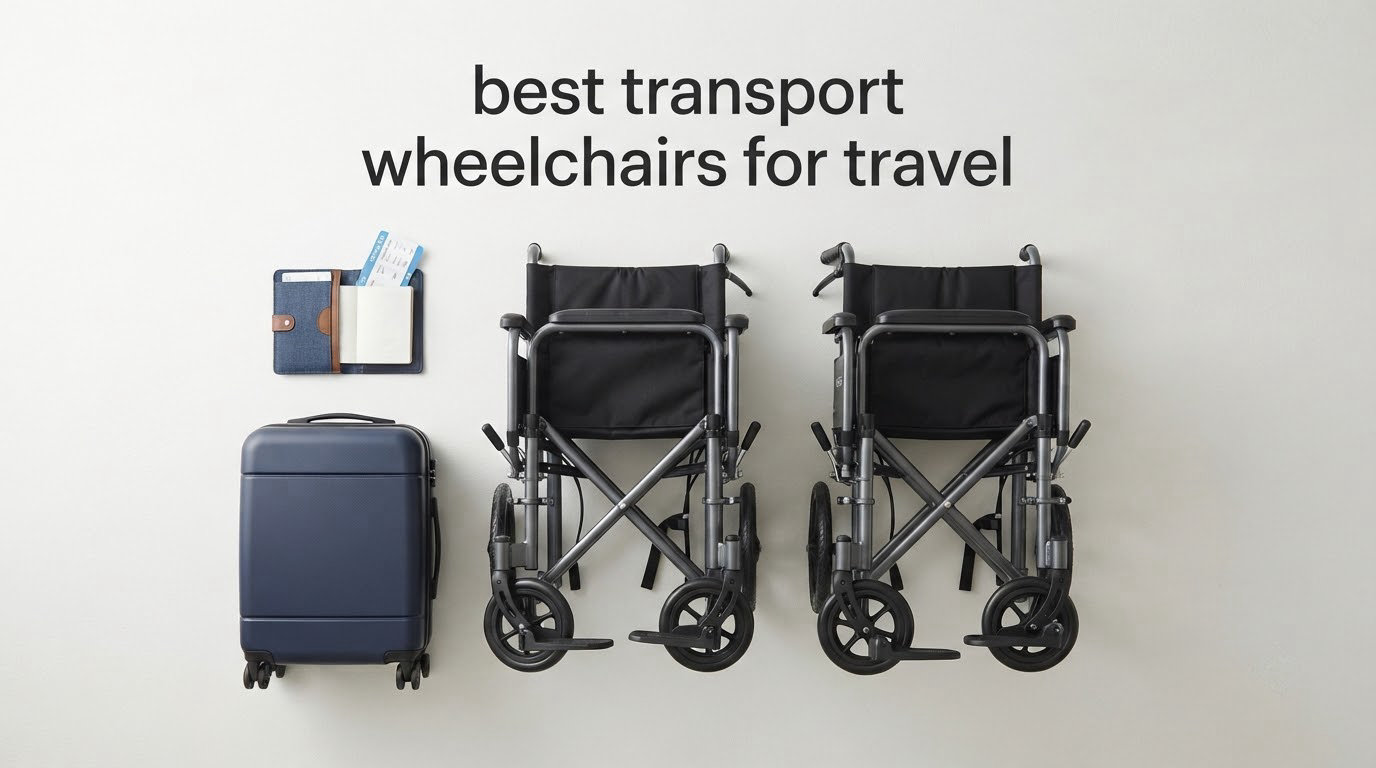
A transport wheelchair is a lightweight folding chair with small rear wheels and no hand rims, designed to be pushed by a caregiver instead of propelled by the person sitting in it. That single design choice is what makes these the only wheelchair category built to be lifted into a car trunk, carried through an airport, and gate-checked onto a plane.
Choosing the best transport wheelchairs for travel is less about peak specs and more about fit. A chair that looks perfect in a showroom can fail the trip at the trunk latch, the jet bridge, or the cruise gangway. Our team compared ten caregiver-pushed chairs across weight, frame material, wheel size, seat width and folded footprint, then mapped each one to the trip it actually handles well.
Everything below was updated for 2026, and every weight, capacity and dimension quoted comes from the manufacturer’s own specification sheet rather than a roundup of roundups. We also pulled in what caregivers say on r/wheelchairs about lifting, folding and airline handling, because that is where the spec sheet stops being useful. One note before we start: this is buying guidance, not medical advice, and anyone with specific positioning or transfer needs should confirm fit with an occupational therapist first.
Table of Contents
Top 3 Best Transport Wheelchairs for Travel in 2026

Medline Lightweight Foldable Transport Chair
- 26 lb aluminum frame
- 300 lb capacity
- 19 inch seat
- 12 inch rear wheels

Drive Medical Silver Sport 1
- Powder-coated steel frame
- 250 lb capacity
- Foldable back
- Carry pocket
Medline Ultra Lightweight Transport Chair
- 15 lb frame
- 300 lb capacity
- Desk-length armrests
- Cup holder
Medline Lightweight Foldable Transport Chair is the one we kept coming back to. At 26 lb with a 300 lb capacity and 12 inch rear wheels, it is the rare chair that is light enough for one caregiver to load and big-wheeled enough to roll over a curb without catching.
Drive Medical Silver Sport 1 takes the top rating in the group at 4.6 stars across more than 8,000 reviews. It is the sturdiest, most conventional choice here, and the foldable back plus carry pocket suit a caregiver who wants one dependable chair rather than a travel special.
Medline Ultra Lightweight Transport Chair is the pick when lifting weight is the deciding factor. Fifteen pounds is the lightest frame in the roundup, and reviewers with hand and back arthritis describe it as the difference between loading a chair and struggling with one.
All 10 Picks Compared Side by Side in 2026
| Product | Specifications | Action |
|---|---|---|
| Medline Lightweight Foldable Transport Wheelchair |
|
Check Latest Price |
| Drive Medical Silver Sport 1 Folding Transport Wheelchair |
|
Check Latest Price |
| Medline Ultra Lightweight Transport Wheelchair |
|
Check Latest Price |
 Drive Medical Folding Transport Wheelchair Drive Medical Folding Transport Wheelchair |
|
Check Latest Price |
 Lightweight Expedition Transport Wheelchair Lightweight Expedition Transport Wheelchair |
|
Check Latest Price |
 Medline Durable Folding Steel Transport Wheelchair Medline Durable Folding Steel Transport Wheelchair |
|
Check Latest Price |
 Ultra Lightweight Folding Wheelchair 12 Inch Rear Wheels Ultra Lightweight Folding Wheelchair 12 Inch Rear Wheels |
|
Check Latest Price |
 McKesson Transport Wheelchair 19 Inch McKesson Transport Wheelchair 19 Inch |
|
Check Latest Price |
 EconoHome Light Weight Folding Transport Wheelchair EconoHome Light Weight Folding Transport Wheelchair |
|
Check Latest Price |
 Super Lightweight Portable Transit Travel Wheelchair Super Lightweight Portable Transit Travel Wheelchair |
|
Check Latest Price |
1. Medline Lightweight Foldable Transport Wheelchair: Best Overall for Travel
Medline Lightweight Foldable Transport Wheelchair with Handbrakes and 12-Inch Wheels, Red Frame, Black Upholstery
26 lb aluminum frame
300 lb capacity
19 inch wide seat
12 inch rear wheels
Pros
- Light aluminum frame one caregiver can lift into a trunk
- Folds flat with the footrest swung away
- Hand brakes plus rear-wheel locks for secure transfers
- 12 inch rear wheels roll over doorways and ramps
- Spacious 19 inch seat with full-length cushioned armrests
Cons
- Requires an attendant
- the occupant cannot self-propel
- Push handles feel low for a tall caregiver
- Wheels stall at thresholds above a quarter inch
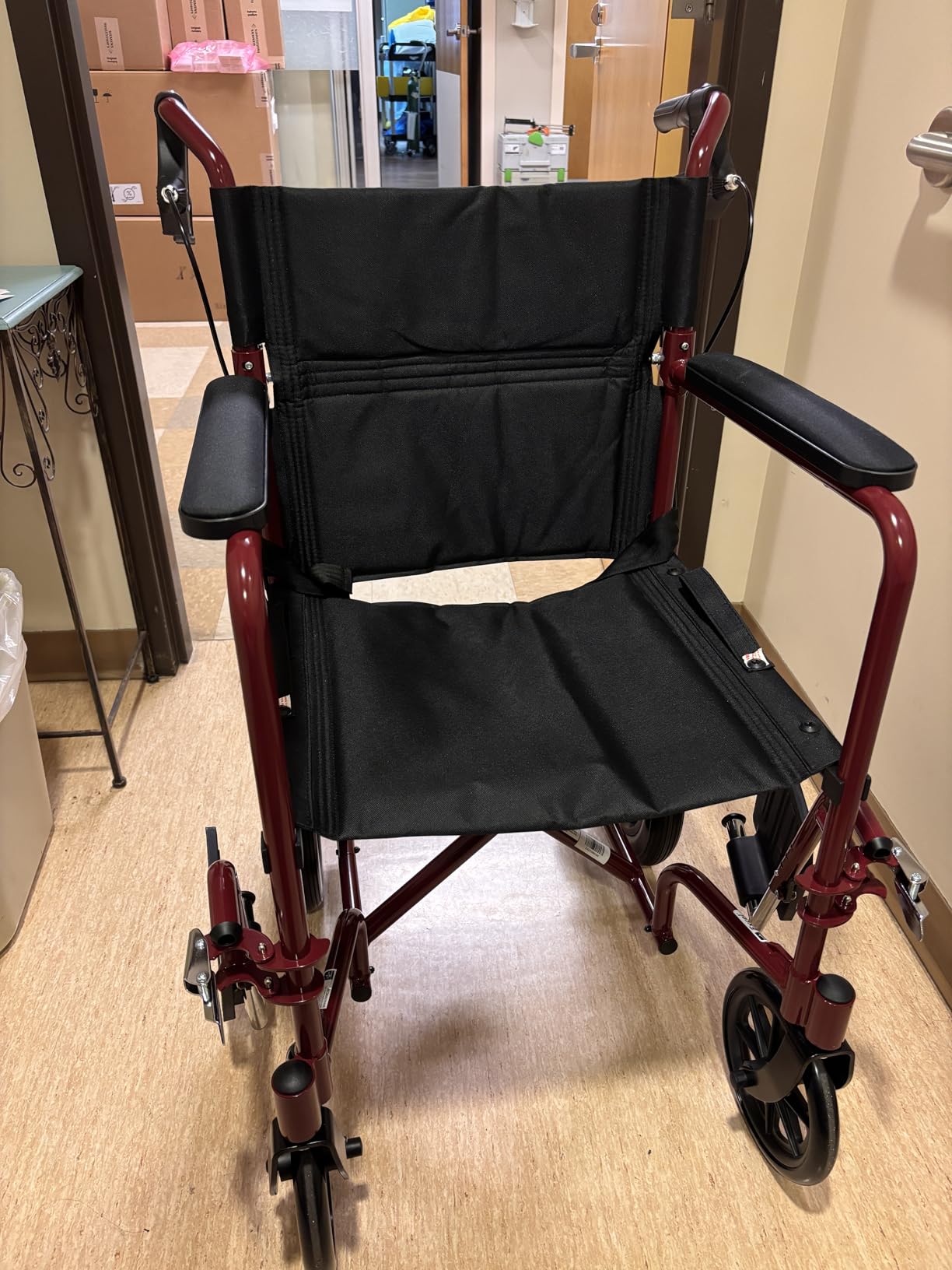
The first thing we checked with this chair was the number that decides most family purchases: how much it weighs. Twenty-six pounds with a 300 lb capacity is the balance point we kept looking for, and it is why this is our editor’s choice for 2026. Caregivers describe lifting it into a trunk as routine rather than a workout.
The dual braking is the detail that separates it from cheaper steel chairs. It carries easy-to-squeeze hand brakes at the push handles for downhill control and separate rear-wheel manual locks that hold the chair steady during a transfer. On airport carpet and hotel floors, that combination is the difference between a calm transfer and a scramble.
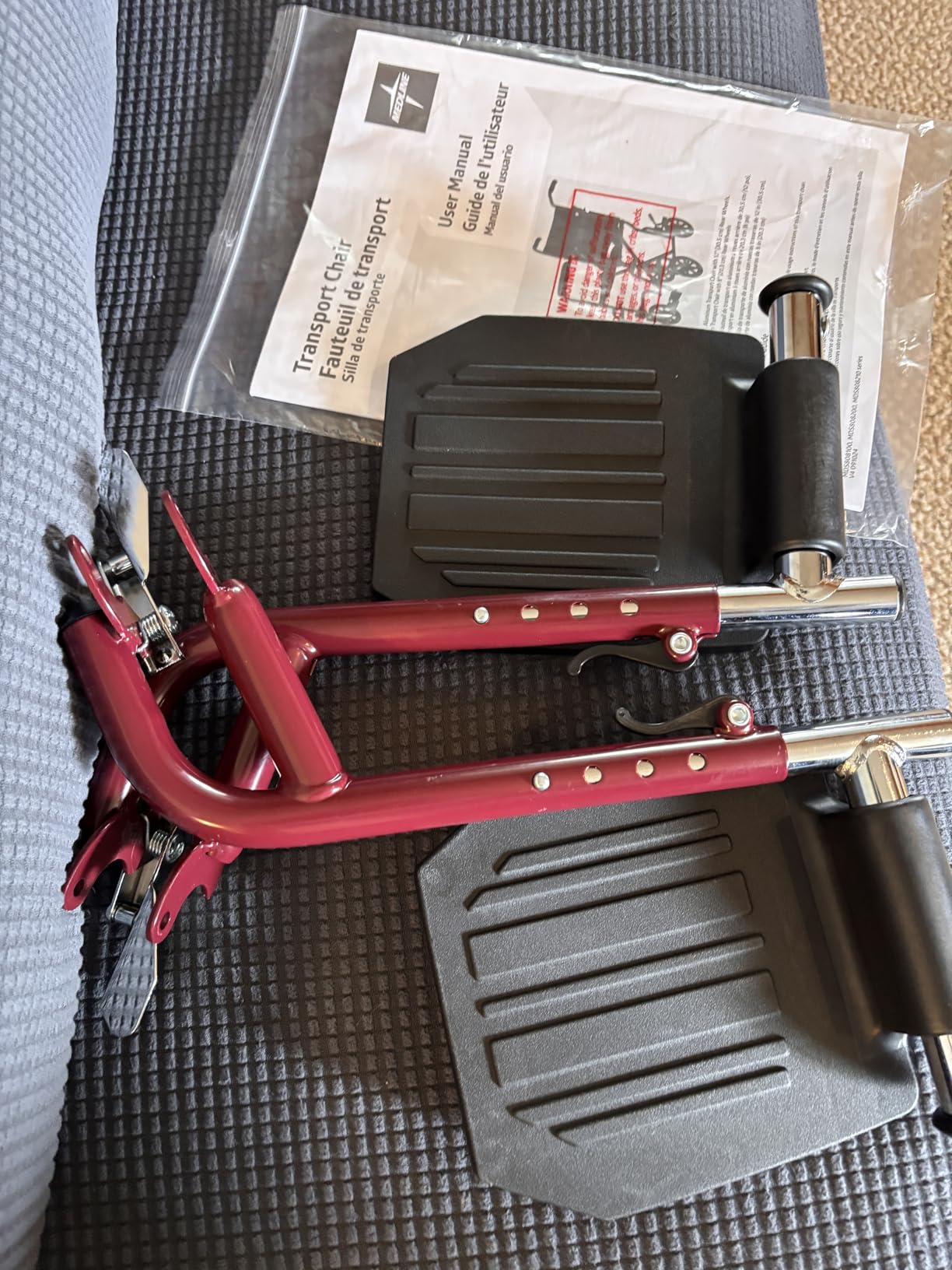
Twelve inch rear wheels are the other reason it beats most of the aluminum chairs in this price bracket. They roll over door sills, ramps and the seams between carpet tiles without the snagging you get with 8 inch casters, and they still fold to something a caregiver can wedge behind a folded rear seat.
Width is the quiet strength. A 19 inch wide by 16 inch deep seat with full-length cushioned armrests gives more room than the 17 inch steel models, which matters when a chair is going to be used for a whole day out rather than a short clinic visit. It arrives needing no assembly and the nylon upholstery wipes clean.
Why we picked it over the lighter aluminum chairs
Lighter is not always better on a trip. A 15 lb chair with 8 inch wheels needs more corrections from the caregiver on uneven ground, and more corrections means more shoulder and wrist strain over a long day. Twelve inch wheels reduce the force needed to keep the chair tracking straight.
For a family that travels occasionally but also uses the chair for errands and appointments, this is the chair that does both jobs without the caregiver switching tactics every time the surface changes.
Where it falls short
The format itself is the limit. There are no hand rims, so the occupant cannot self-propel, and a traveler who wants any independence between seats will find that disappointing.
Reviewers also flag low handle height for caregivers over six feet, and the absence of a rear tipping bar, which means the chair cannot be tilted by leverage over a curb. A wheel that will not pass a threshold taller than roughly a quarter inch will stop you at some older buildings and some airport ramps.
2. Drive Medical Silver Sport 1 Folding Transport Wheelchair: Best Rated and Most Conventional
Drive Medical Silver Sport 1 Folding Transport Wheelchair, Black
37.6 lb steel frame
250 lb capacity
Foldable back
Carry pocket
Pros
- Highest average rating in the group at 4.6 stars
- Long-standing design with a very large review base
- Breathable nylon upholstery with padded full-length armrests
- Carry pocket on the backrest for small items
- Push-to-lock brakes are simple to operate
Cons
- Heaviest frame here at 37.6 lb
- 250 lb capacity is lower than most aluminum chairs
- Steel frame folds less compactly than aluminum
- No hand brakes on the push handles
With a 4.6 star average across more than 8,000 reviews, this is the best rated chair we evaluated, and the volume of feedback behind that rating matters more than any lab spec. When a design has been in production for many years, the failure modes are already known.
What you get is a powder-coated steel frame with urethane tires on composite wheels and push-to-lock brakes. The steel gives a firmer, more predictable push than aluminum, which some caregivers prefer when they are steering over parking lots and pavement rather than airport carpet.
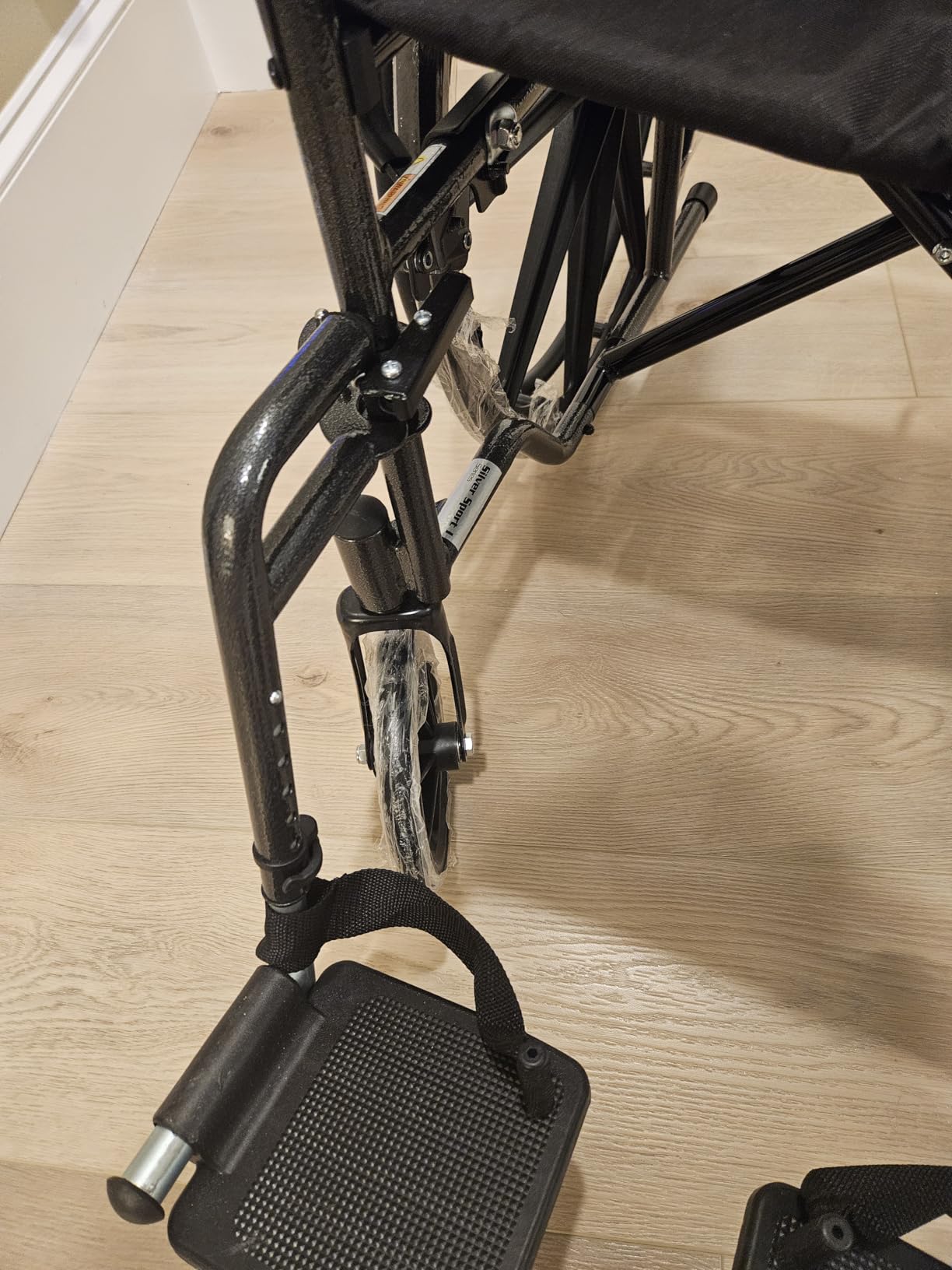
Two practical touches make it livable on a long day. The back folds down, so the chair stands on its own against a wall in a hotel room, and the carry pocket on the backrest holds a phone, keys or a folded blanket without needing a separate bag.
Urethane tires on composite wheels also resist the cracking and perishing that rubber tires pick up after months of airport and pavement rolling. That is a real advantage for a chair that lives in a car rather than a closet.

What this chair is genuinely good at
This is the pick for a family that wants one chair to do everything, from clinic appointments to a long day at a family event. The full-length padded armrests and breathable nylon upholstery are more comfortable over hours than the sling seats on the ultralight models.
It is also a sensible choice for a caregiver who pushes regularly but does not lift the chair alone, since the weight is manageable with two hands from the trunk rather than one shoulder.
Where it falls short
Thirty-seven and a half pounds is the heaviest frame in this roundup, and reviewers with back problems are blunt about it. If a single older caregiver has to load and unload it unaided, this is the wrong chair regardless of how good it is otherwise.
The 250 lb capacity also rules it out for a larger user, and the steel frame does not fold as tightly as aluminum. There are no hand brakes on the push handles, so control downhill depends entirely on the caregiver’s grip.
3. Medline Ultra Lightweight Transport Wheelchair: Best Value for the Lightest Load
Medline Ultra Lightweight Transport Wheelchair for Adults, Foldable, 19-Inch Seat Width, Red Frame, Black Upholstery
15 lb aluminum frame
300 lb capacity
19 inch seat
Desk-length armrests
Pros
- Lightest frame in the roundup at 15 lb
- Caregivers with arthritis describe trunk loading as easy
- Folds compactly enough for a small trunk or a back seat
- Angled armrests let the user pull up to a table
- Cup holder and rear seat pocket included
Cons
- 8 inch rear wheels snag in cracks and roll harder
- One footrest retaining clip has a reported failure mode
- Low push handles strain taller caregivers
- No rear tipping bar
At fifteen pounds, this is the lightest chair in the roundup, and it still carries a 300 lb capacity on a sturdy aluminum frame. For a caregiver with arthritis, a bad shoulder, or a spouse who is simply older, that ratio is the whole argument.
It also holds a top-five position in Attendant and Transport Wheelchairs, which tells you how many people have bought the same thing. Reviewers document use on airlines, cruise ships and cobblestone streets in Europe, which is a harder test than most indoor chairs ever face.

The desk-length cushioned armrests are angled, so the user can pull up to a restaurant or cafe table instead of being stopped by the arm. That is a small feature that changes an entire afternoon out. The cup holder and rear seat pocket are standard, which is unusual at this weight.
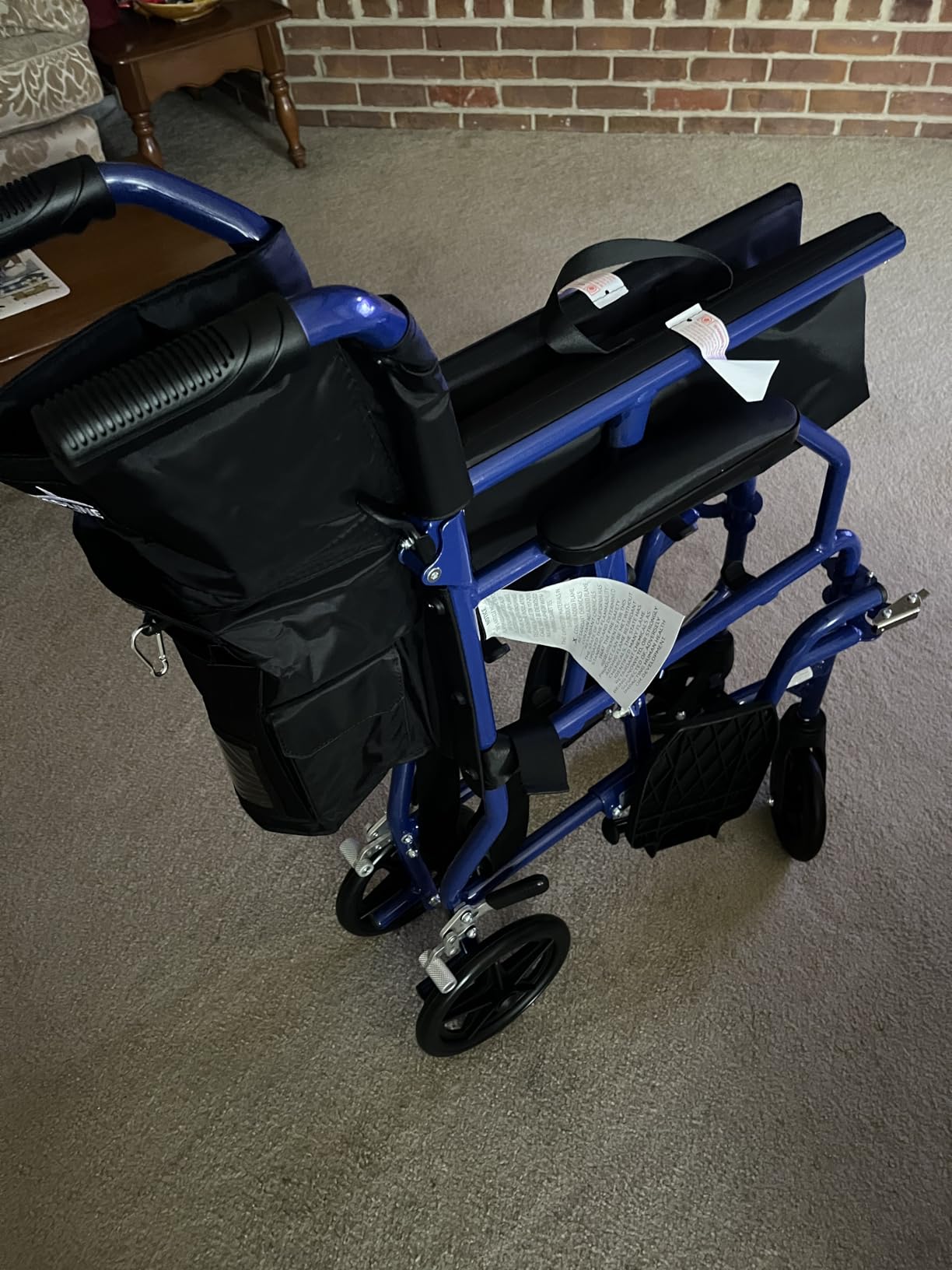
It arrives needing no assembly, the fabric wipes clean, and the swing-away footrests lock in place when the chair folds so they do not swing loose during loading.
Why the light frame matters more than the wheel size
Lifting weight and rolling resistance are the two things caregivers complain about most, and this chair optimizes the first at the cost of the second. The 8 inch rear wheels need more attention on cracks and seams than the 12 inch models, but they are so light that a single person can reposition the chair with one hand.
If your travel is airports, hotels and short car trips, that trade is worth it. If your travel includes uneven paths, gravel or a lot of outdoor sightseeing, look at pick five instead.
Where it falls short
Small wheels are the honest catch. Reviewers report the rear wheels snagging in cracks, and the chair simply does not roll as smoothly or as quietly over rough ground as a 12 inch wheel model.
There is also a documented issue with a rubber retaining clamp on one leg piece, which can let the footrest loosen. Push handles sit low, which puts the load on the shoulders of a taller caregiver, and there is no rear bar to tip the chair over a curb.
4. Drive Medical Folding Transport Wheelchair: Best for a Small Car Trunk
Drive Medical Folding Transport Wheelchair, Swing-Away Footrest, Silver
Steel frame with compact fold
8 inch wheels
17 inch padded seat
Seat belt included
Pros
- Over 10000 ratings from long-term owners
- Compact fold small enough to travel in a cabin on some trips
- Tipping pedals help clear curbs and thresholds
- Seat belt included for passenger safety
- Nylon upholstery resists tearing and staining
Cons
- 17 inch seat is narrow for larger adults over 150 lb
- Swing-away footrests foul the front wheels when reversing
- Low rear brakes require bending to the ground
This is the chair we would put in the smallest car in the comparison. The compact folding profile is the whole design brief, and multiple long-term owners report three or more years of use, including cruises and European cobblestone roads, without a major failure.
With more than 10,600 ratings behind it, the feedback pool is deep enough to see the pattern clearly: people buy this chair because it lets a loved one join family outings they would otherwise skip.
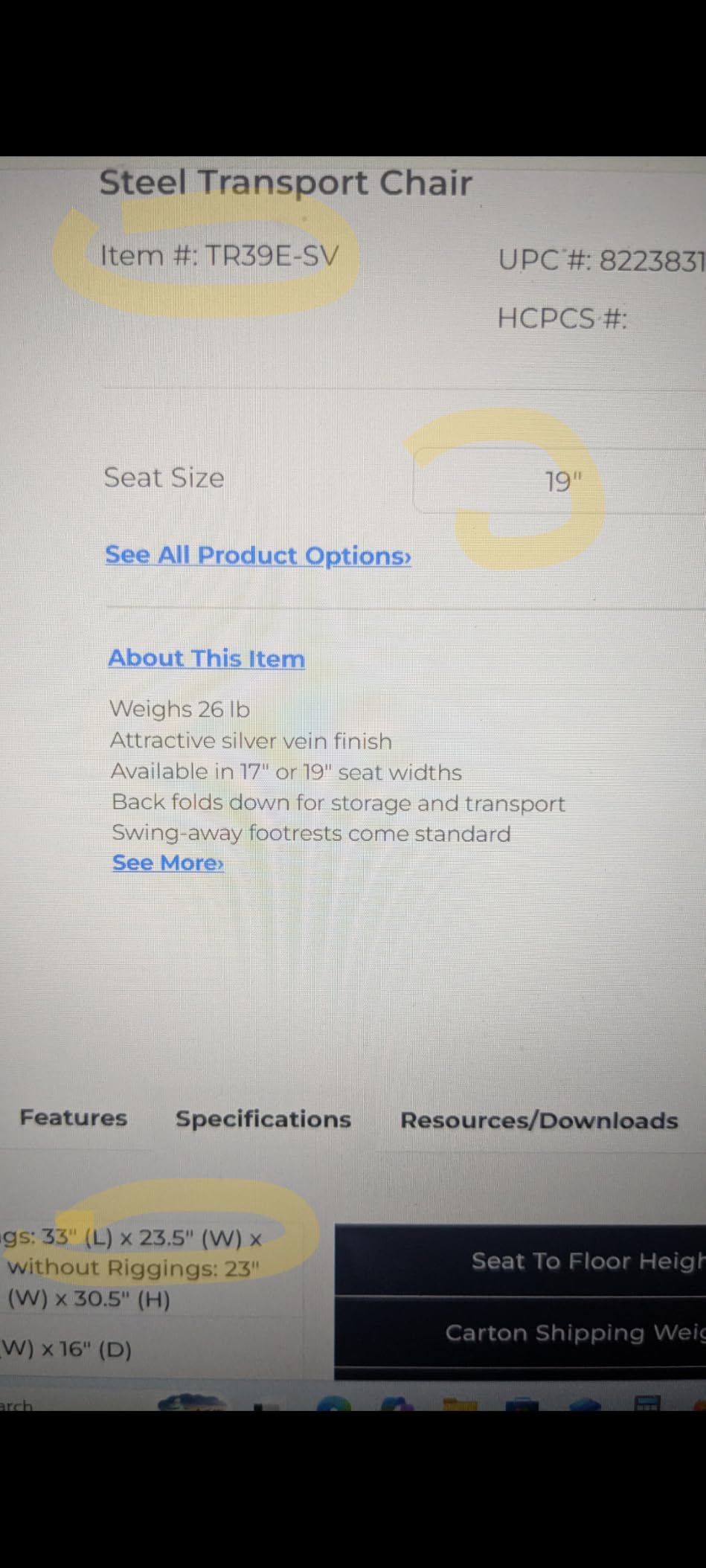
The seat belt is worth noting. Most transport chairs at this level do not include one, and having a belt matters when a user has limited trunk control and you are pushing down a sloped curb ramp.
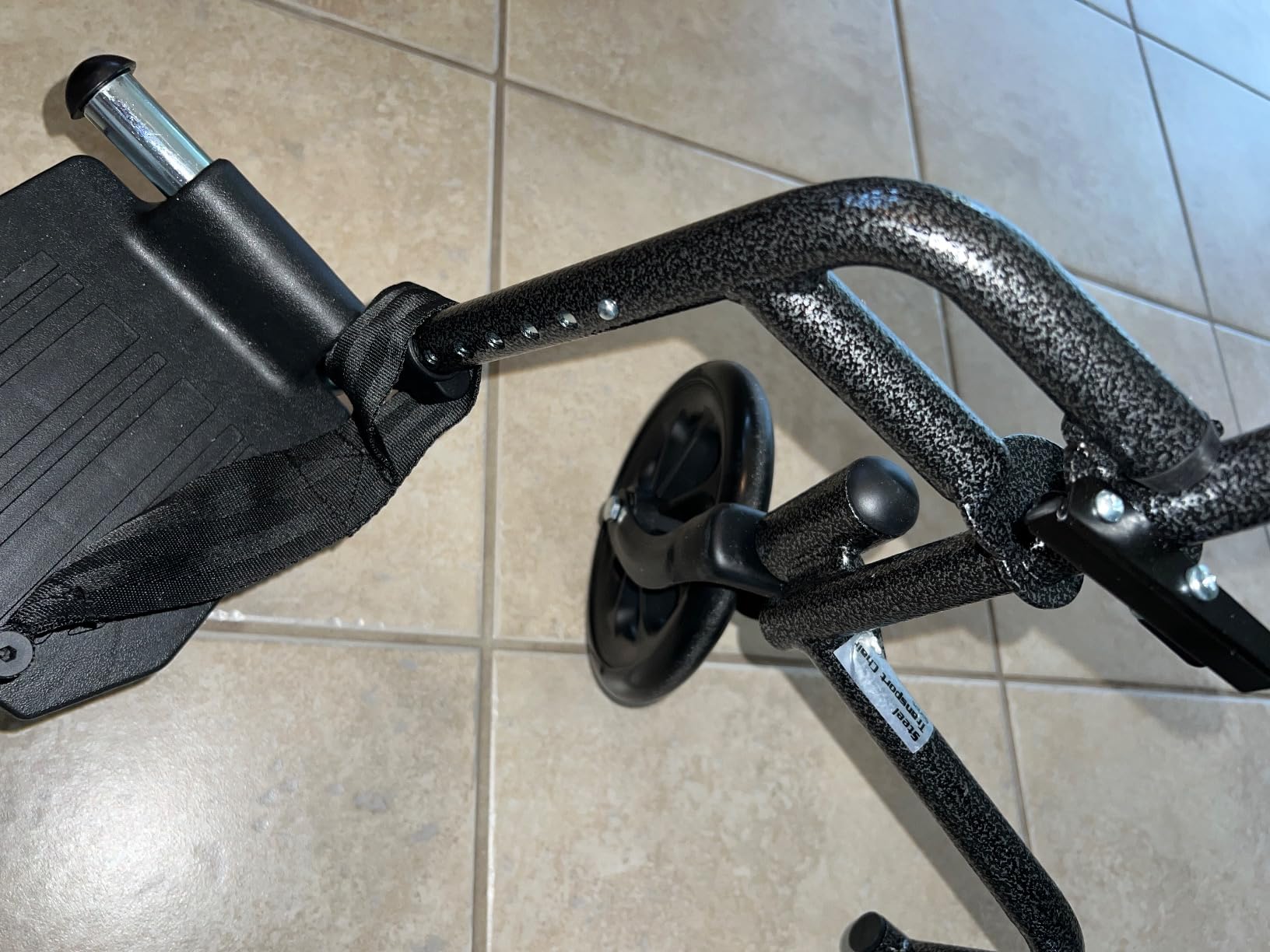
The tipping pedals near the rear wheels let a caregiver tilt the chair over a threshold or a curb step by stepping on them, which removes one of the most common reasons a trip stops. The nylon seat wipes clean and has resisted staining in long-term reports.
Why the compact fold is the deciding factor
Trunk dimensions, not chair weight, decide whether a chair is actually usable. This one folds into a shape that fits behind a folded rear seat or in the boot of a small hatchback, and it has been reported fitting in an airplane cabin on some trips, which is rare for a steel chair.
It also rolls through narrow doorways and tight store aisles, which matters more in a real trip than the unloaded weight figure suggests.
Where it falls short
The 17 inch padded seat is narrow, and some buyers report closer to 14 inch, so it suits a smaller-framed user and can feel confined for anyone over roughly 150 lb.
The rear-wheel brakes sit low enough that a caregiver bends almost to the ground to engage them, and the front wheels can foul the footrests when reversing in a tight space. The seat is best paired with an added cushion for long outings, and there are no storage pockets.
5. Lightweight Expedition Transport Wheelchair: Best for Rough Ground and Sidewalks
Lightweight Expedition Transport Wheelchair with Hand Brakes, Red
19 lb aluminum frame
300 lb capacity
12 inch rear wheels
Curb assist
Pros
- Twelve inch rear wheels clear cracks
- gravel and uneven paths
- Locking loop hand brakes at the push handles
- 19 lb frame is light enough for an older caregiver to load
- Curb assist pedals handle sidewalks and trails
- Reported gate-checked on international flights
Cons
- Front casters are the weakest structural point
- Hand brakes cannot lock independently for unattended transfers
- Separate rear handles feel narrow
- Canvas sling seat needs a cushion for long use
Reviewers consistently describe this as an upgrade from an 8 inch wheel chair, and the reason is the pair of 12 inch rear wheels with curb assist technology. They keep tracking over the cracks, gravel and uneven paths that stop smaller casters dead.
At nineteen pounds on an aluminum frame with a 300 lb capacity, it does something the ultralight 8 inch chairs cannot: it stays light for loading and rolls well when it is loaded. That combination is the hardest thing to find in this category.

The companion-activated loop-lock hand brakes are the other headline. A caregiver can stop and hold the chair from the push handles without reaching down, which is the single most useful safety feature on the whole list when you are descending a ramp at a cruise terminal.
Travel reports are extensive: gate-checked flights, taxis, trains and rental cars across European cities. The rear-lever folding system and the integrated shoulder strap make it easy to lift once folded.

When you should choose bigger wheels instead of lighter weight
If your travel involves sightseeing rather than moving between a gate and a taxi, wheel diameter beats total weight. A few extra pounds are far less disruptive than a chair that jams every time a caster finds a crack in a pavement.
On an r/wheelchairs thread about rough terrain and small wheels, the recurring complaint is exactly this: little wheels are not secure enough outdoors and can get stuck. Twelve inch wheels are the direct answer to that.
Where it falls short
Front casters are the weakest structural point, and one reviewer reported a caster breaking in normal use rather than under overload. Treat that as a real caution rather than an isolated complaint.
The hand brakes cannot be locked independently, so the caregiver has to squeeze and hold them to stabilize the chair during a transfer. The separate rear handles feel narrower than expected, and the canvas sling seat will be uncomfortable for long periods without a cushion.
6. Medline Durable Folding Steel Transport Wheelchair: Best Antimicrobial Build
Medline Durable Folding Steel Transport Wheelchair with 12-Inch Wheels, 19-Inch Seat Width, Gray Frame, Microban, Teal Upholstery
Steel frame rated to 300 lb
32 lb chair weight
Microban upholstery
19 inch seat
Pros
- Sturdy steel frame supports up to 300 lb
- Microban treatment resists bacteria
- mold and mildew
- Generous 19 inch seat with full-length cushioned armrests
- Backrest folds down for compact trunk storage
- Swing-away detachable footrests make transfers easier
Cons
- Heaviest Medline option here at 32 lb
- Lowest average rating in the group at 4.3 stars
- Fold is bulkier than aluminum competitors
- Low rear brakes require a bend-down reach
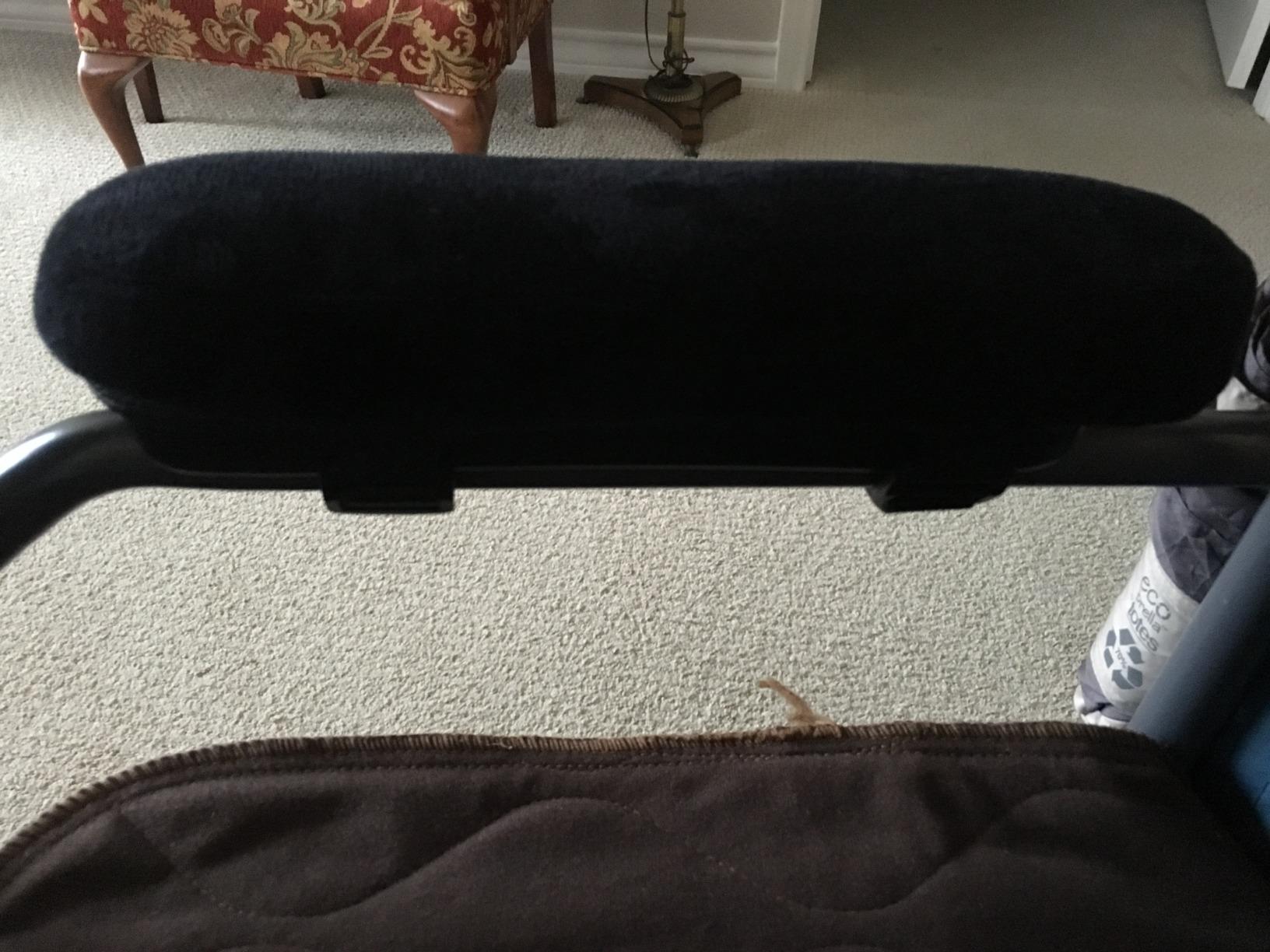
The differentiator here is Microban antimicrobial protection in the upholstery, which is built to slow bacteria, mold and mildew. For a chair that lives in a car, gets bumped through hospital corridors and sits in a humid storage space, that is a legitimate reason to choose this over a cheaper steel model.
It sits near the top of the Attendant and Transport Wheelchairs chart and carries a 4.3 star average across 2,661 reviews, with 69 percent five star and 8 percent one star. That one star share is the highest of the Medline models here, and it is worth understanding why before you buy.
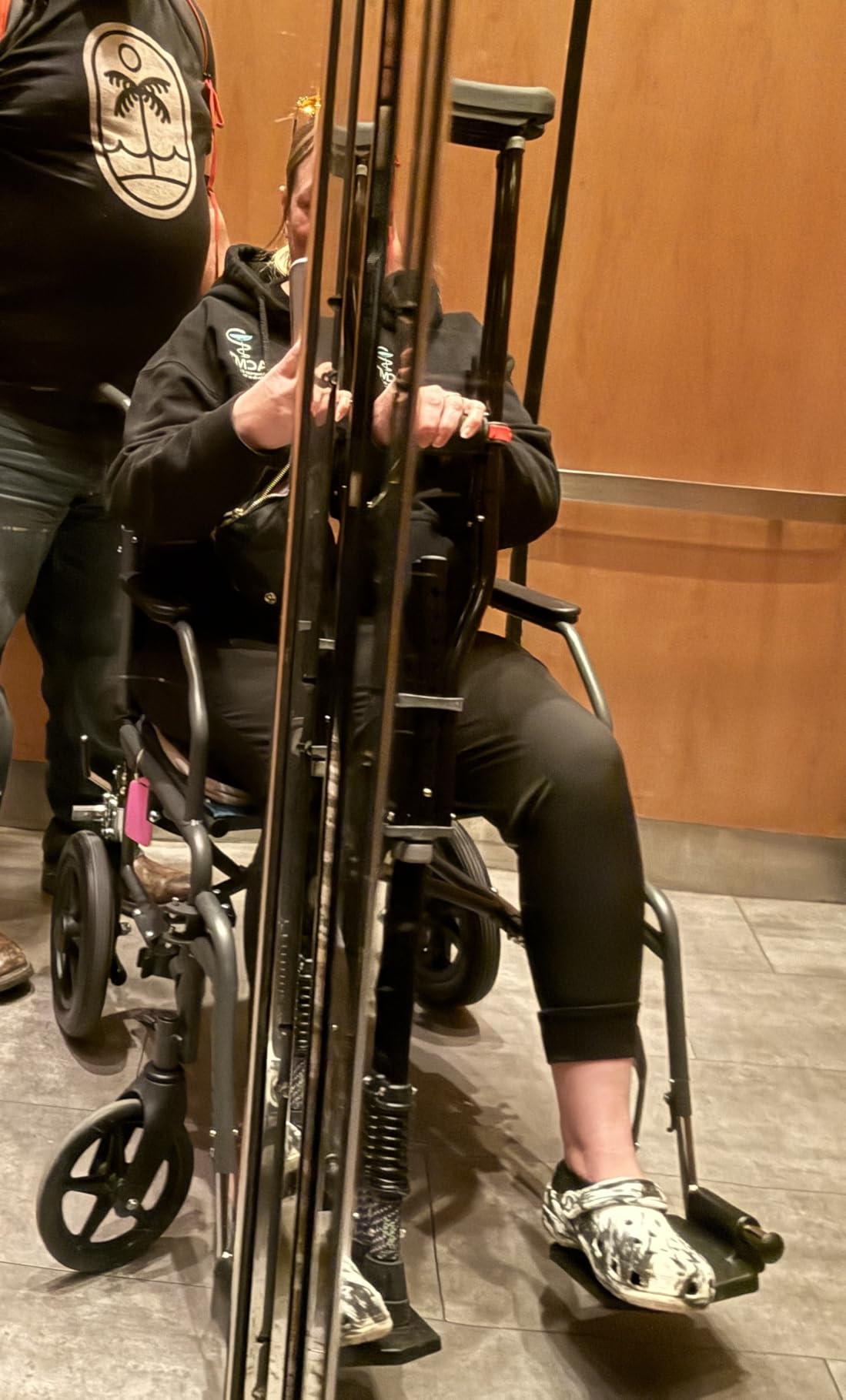
The 19 inch by 16 inch seat with full-length cushioned armrests is genuinely comfortable, and 12 inch rear wheels with 8 inch swivel front casters handle doorways and ramps smoothly. No assembly is required, and the swing-away footrests detach for transfer and loading.
Microban is the most cited positive in reviews, along with the 300 lb steel rating. If the chair is going to be shared between a family member in recovery and a parent in long-term care, the treatment matters.
When the antimicrobial finish is worth a heavier frame
Thirty-two pounds is heavy for a solo caregiver, and the fold is bulkier than the aluminum models. If you are loading and unloading alone, the extra weight is a daily tax and you should spend it on a lighter frame instead.
If a second person loads the chair, or the chair stays in a closet and is brought out for occasional trips, the steel frame and antimicrobial upholstery are a reasonable exchange for a model that will not flex under a heavier user.
Where it falls short
Weight is the recurring complaint. Reviewers with back problems specifically call out lifting it into a car, and the fold, while improved by the folding backrest, is not the tightest in the roundup.
The manual rear-wheel locking brakes need a bend-down reach, and the 4.3 star average is the lowest here. Budget a small cushion for longer outings, because a steel chair with a standard sling seat is not a long-haul seat.
7. Ultra Lightweight Folding Wheelchair with 12 Inch Honeycomb Rear Wheels: Best for Air Travel
Ultra Lightweight Folding Wheelchair for Adults, 12″ Big Rear Tires Transport Wheelchairs, Foldable Portable Travel Wheelchairs for Adults and Seniors Support 220lbs, Airline Approved
16 lb aluminum frame
220 lb capacity
12 inch honeycomb wheels
Telescopic handle
Pros
- Very light at 16 lb for a user with limited strength
- Hidden telescopic handle makes a folded chair easy to move
- Honeycomb rear wheels with spring damping smooth out bumps
- One-key fold and a carrying bag are included
- Armrests rotate up 270 degrees for side transfers
Cons
- 220 lb capacity is the lowest in the roundup
- Lowest average rating here at 4.1 stars
- Newer listing with a short track record
- Tilted backrest and raised seat can feel unusual
The feature that makes this chair different is the telescopic pull handle that hides completely under the seat when it is not in use. After a gate check or a walk down a cruise gangway, that is the difference between rolling the chair and carrying sixteen pounds awkwardly.
It arrives fully assembled, folds with a single key, and includes a carrying bag, which is the standard airline handling configuration. Nothing needs a tool and nothing is loose in the frame.
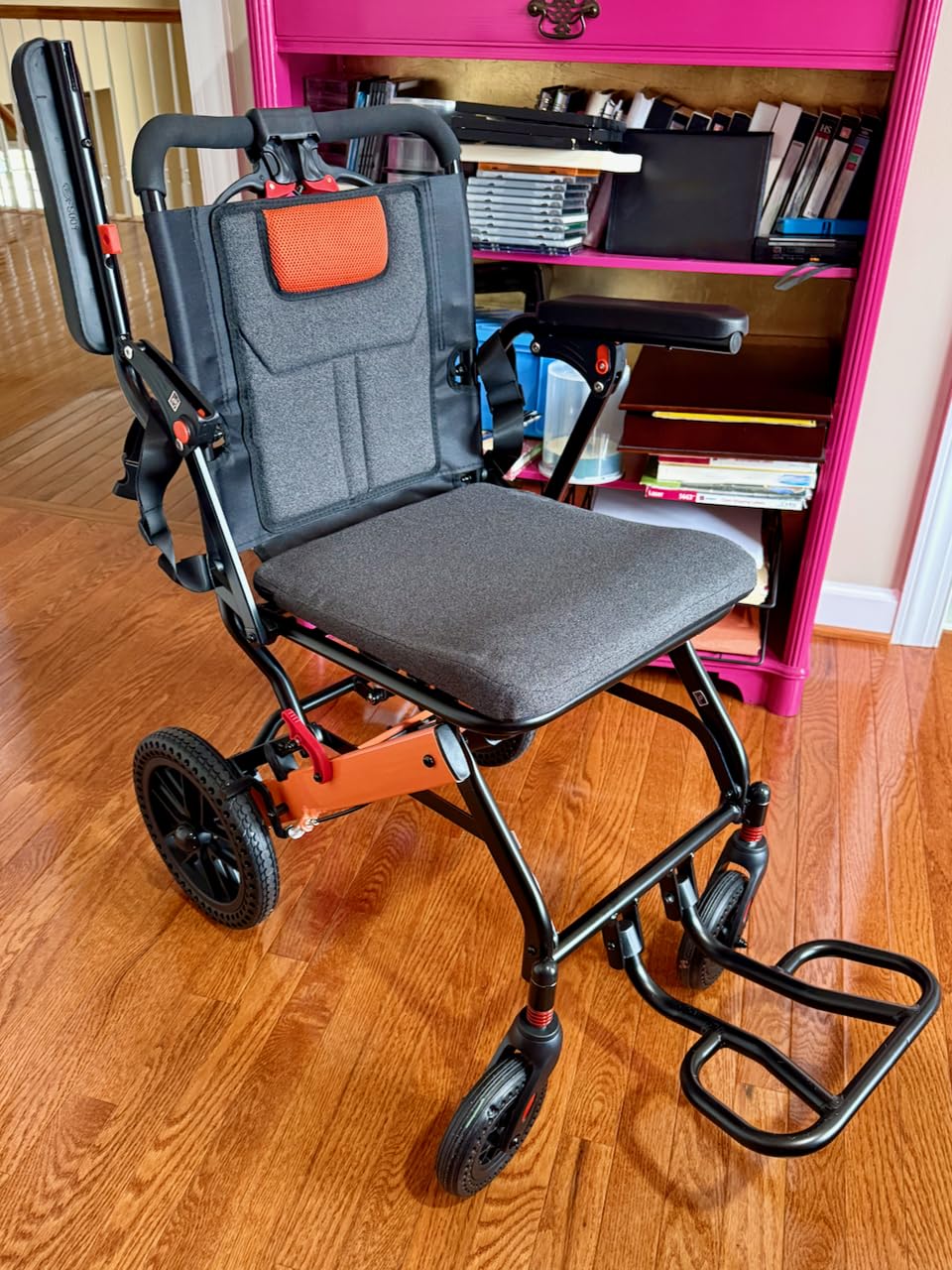
Twelve inch honeycomb rear wheels with spring damping are unusual at this weight and do smooth out bumps better than solid casters of the same diameter. The integrated handbrake and adjustable seat belt are also stronger than the norm for an ultralight chair.
Armrests that rotate up to 270 degrees and 360 degree swivel front casters make side transfers and tight aisle maneuvering far less awkward than fixed-arm chairs.
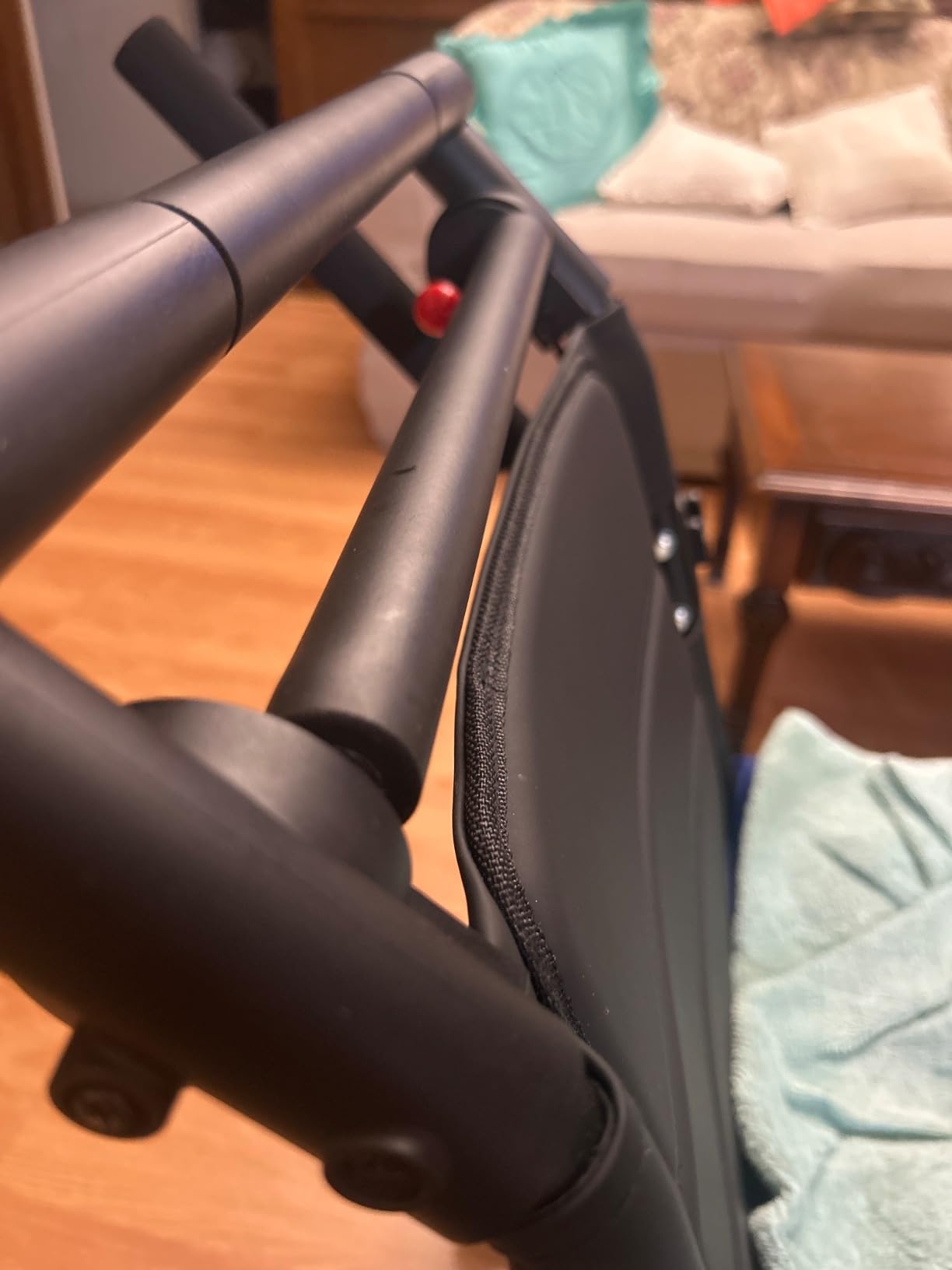
Why the telescopic handle changes airport handling
Most caregivers handle a folded chair by hooking it awkwardly under one arm, which is where back strain starts. A rolling handle puts the load on a wheel instead of a shoulder, and it also makes the chair far easier to move down a jet bridge.
It is also the better chair for a traveler who needs to move between a gate and an aisle seat, because the fold is one motion and the parts stay attached.
Where it falls short
The 220 lb capacity is the lowest in the roundup, and that is not a rounding error. A heavier user needs one of the 300 lb aluminum frames, and skipping this chair is safer than flexing it.
With 288 reviews at a 4.1 star average and a listing that only launched recently, long term durability is unproven. The five degree tilted backrest and raised seat cushion also feel unusual to some sitters, so test it in a showroom if you can.
8. McKesson Transport Wheelchair: Best for Caregiver Back Comfort
McKesson Transport Wheelchair, Silver, Black, 19 in, 1 ct
Steel frame
250 lb capacity
Higher back and tall push handles
Tool-free footrests
Pros
- Higher backrest and taller push handles reduce caregiver slouching
- Tool-free swing-away footrests tuck close in elevators and bathrooms
- Opens and closes with no complicated mechanism
- Fits through standard home doorways
- Scratch-resistant finish suits a clinical setting
Cons
- Heaviest option in the roundup at 34.9 lb
- 250 lb weight capacity
- 8 inch casters catch on uneven outdoor surfaces
- Fixed arms do not detach or swing away
This is the chair we would pick for a caregiver who pushes a long way and pushes often. The higher backrest and taller push handles let the caregiver stand upright rather than hunching, which is where the wrist and shoulder strain caregivers describe actually starts.
The tool-free swing-away footrests tuck in close to the chair body, which is a real advantage in a small elevator, a narrow bathroom or a tight hotel room. Fixed full padded arms add stability on the way down a ramp.
Buyers treat it as a straightforward point A to point B chair and rate it accordingly at 4.5 stars. The foldable back and folding steel frame store it against a wall without a dedicated closet, and the scratch-resistant silver vein finish looks appropriate in a clinic or a home.
A seat belt is included, which is not standard on chairs at this level, and rear wheel locks secure the chair while the user transfers.
Why handle height matters more than most buyers expect
Push handle height determines whether the caregiver’s shoulders take the load. A chair that is too low forces a bend at the waist, and over a full day of airport terminals and museum walks that is how caregivers end up with shoulder pain rather than back pain.
If the person pushing is the one who will also be lifting this chair, check that combination carefully. The height benefit is real, but it is paired with the heaviest frame in the roundup.
Where it falls short
At 34.9 lb this is the second heaviest frame here, and reviewers with existing back pain complain about lifting it into a car more than anything else. The 250 lb capacity also sits below most of the aluminum models.
Solid 8 inch casters catch on uneven outdoor surfaces, the fixed arms do not detach or swing away, and the 224 rating pool is small enough that you should expect less long term data than the Medline and Drive models offer.
9. EconoHome Light Weight Folding Transport Wheelchair: Best Ready to Use
EconoHome Light Weight Wheelchair – Expedition Folding Transport Wheelchairs for Adults with Hand Brakes – Portable Ultra Lightweight Wheel Chair – Fully Assembled, Cover Included – 300 lb Capacity
22 lb fold-flat aluminum frame
300 lb capacity
Arrives assembled
Waterproof cover
Pros
- Lightweight 22 lb fold-flat aluminum frame stores compactly
- Arrives fully assembled so there is no setup before use
- Companion hand brakes lock by pushing the handles down
- Waterproof cover is a useful included extra
- Fits through doorways and maneuvers in tight spaces
Cons
- One footrest has a documented tendency to detach
- Rivets at the seat frame reported loosening within months
- Arrived with no user manual or care instructions
- Seat space is narrow for the stated 300 lb capacity
This chair arrives fully assembled, which matters more than it sounds. A budget chair that arrives in a box with unclear instructions is the single most common complaint on r/wheelchairs about entry-level models, and this one sidesteps that entirely.
At 22 lb on a fold-flat aluminum frame with a 300 lb rating, the numbers are competitive with the Medline chairs, and several owners report keeping one permanently in the car rather than hauling it out for each trip.

The companion hand brakes are a genuine step up for this class. They engage by pushing the handles down, so a caregiver can lock the chair without bending to reach the rear wheels.
Large rear wheels and maneuverable front casters glide over thresholds, curbs and narrow hallways, and the included waterproof cover protects the upholstery in a car boot where nothing is guaranteed to stay dry.
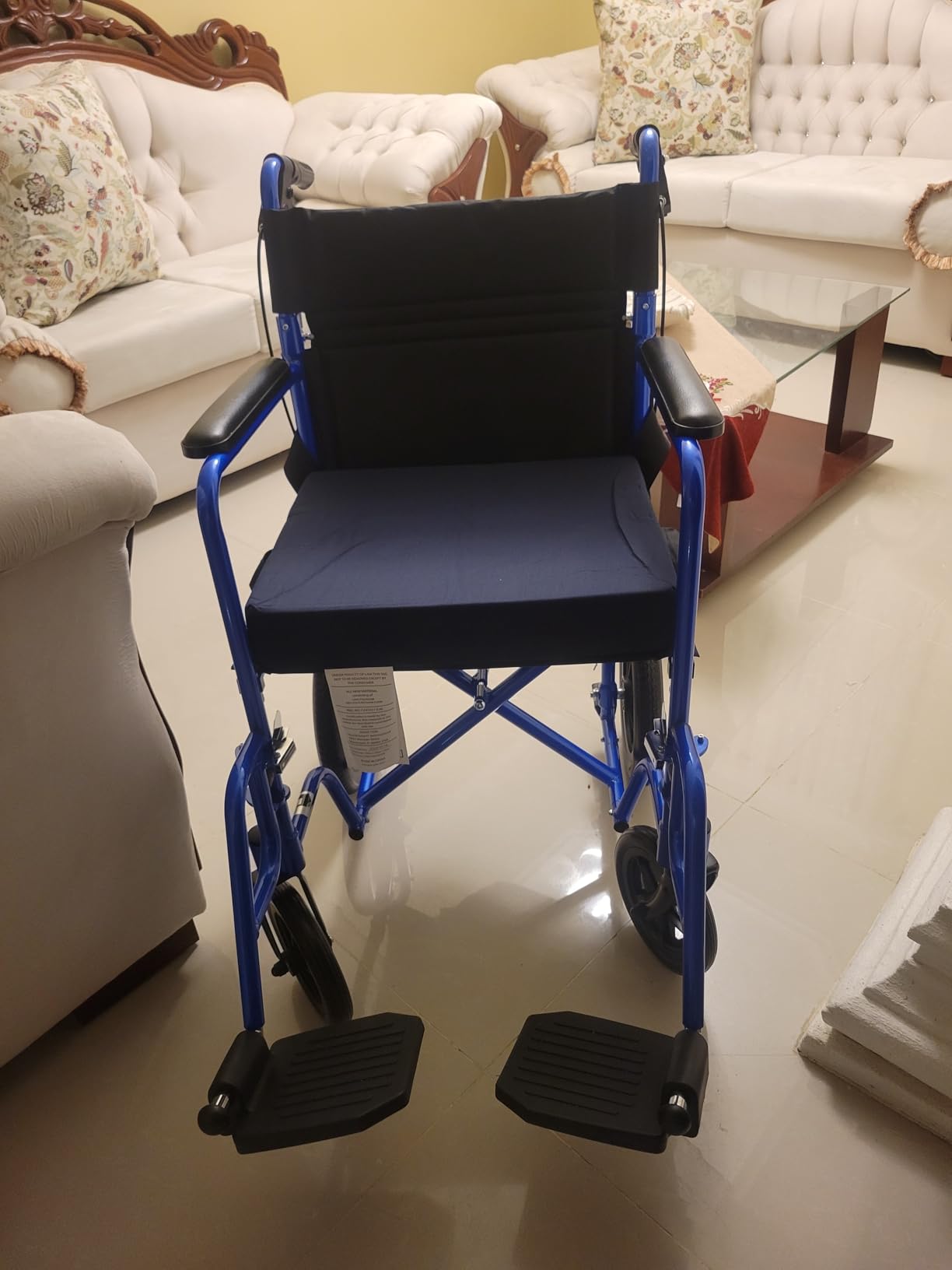
Why the included cover earns its place
A transport chair that lives in a car trunk picks up moisture, road film and whatever else is in the boot. A cover that arrives in the box costs nothing extra to add later, and it is the kind of small thing that keeps an aluminum frame from marking up over a year of weekly use.
It also ranks near the top of the category chart, so it has enough market presence that parts and common hardware are likely to be available if something needs replacing.
Where it falls short
Quality control is the real story here. Reviewers report a footrest that detaches during use, rivets popping at the seat-to-frame joint within a few months, and one chair arriving with a broken hub cap that needed metric tools to fix.
It also shipped with no user manual or care instructions, which is a problem for a fold mechanism that needs a first-time explanation. The seat is narrower than the 300 lb rating implies, the armrest height suits a taller user, and the footrests must be removed before folding.
10. Super Lightweight Portable Transit Travel Wheelchair: Best for Long Rides and Recline
Super Lightweight Portable Transit Travel Wheelchair, Upgraded Folding Transport Wheelchairs (Weight 24lbs) for Adults and Seniors, Come with Telescopic Handle and Travel Bag
24 lb aluminum frame
Reclining backrest
Shock absorbers
11 inch honeycomb wheels
Pros
- Reclining adjustable backrest is the standout feature
- Built-in shock absorbers and honeycomb rear wheels smooth out bumps
- Rear step bar tips the front casters over obstacles
- Travel bag doubles as storage for a cushion or oxygen unit
- Folds to fit a car trunk
Cons
- Folding requires removing the large wheels and takes real strength
- Unlock control for folding is not intuitive
- Footrest can catch if the chair is unfolded first
- Narrower than a 20 inch chair
The reclining adjustable backrest is the feature that separates this chair from everything else in the roundup. Several owners bought it to replace a recliner that had stopped working, and that is a specific kind of need that no other transport chair here serves.
Ride quality is the second draw. Eleven inch honeycomb rear wheels with spring damping plus built-in shock absorbers take the sting out of airport asphalt, promenade pavers and ship decks, and the rear step bar lets the caregiver tip the front casters over a lip.
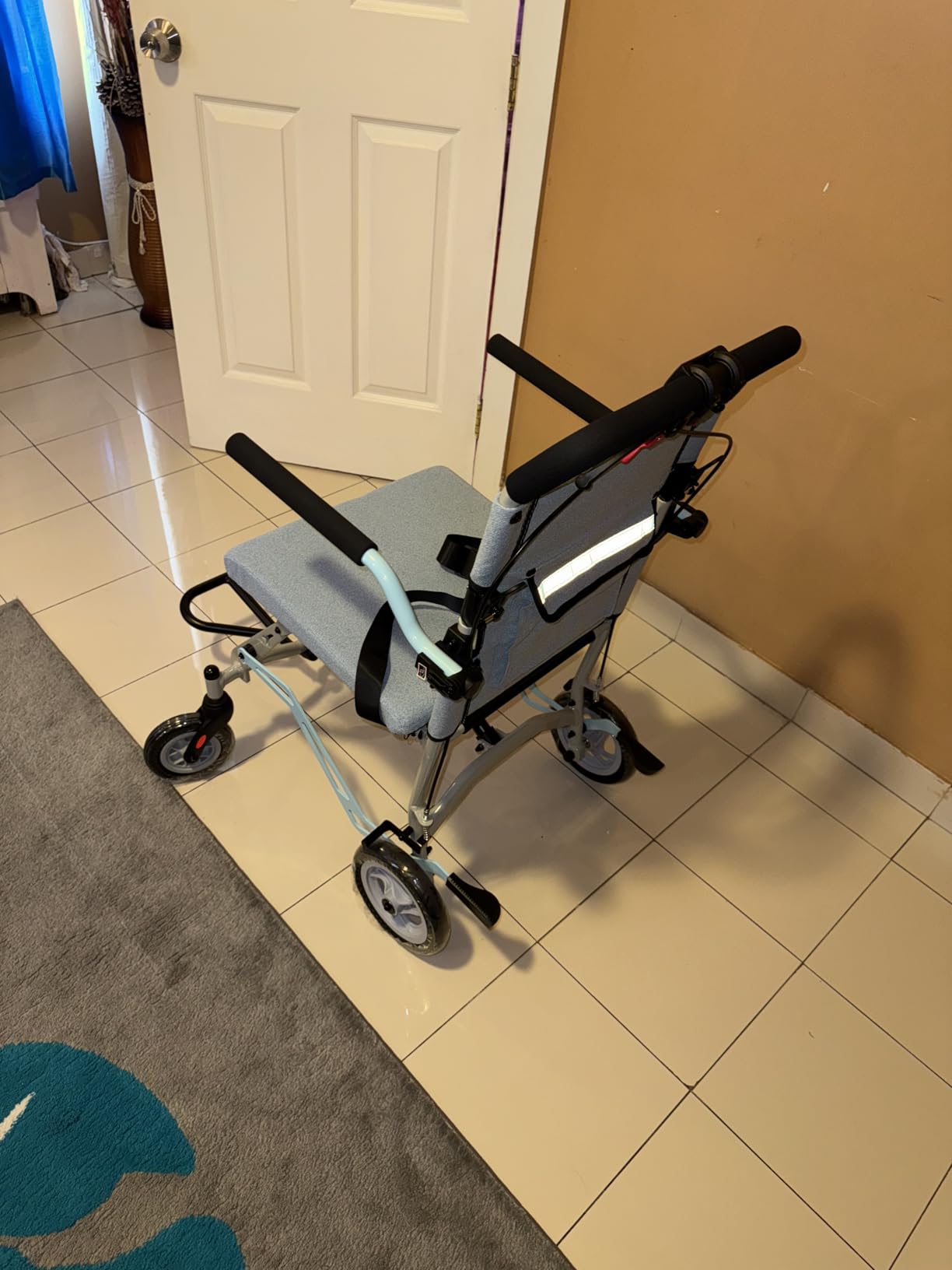
The included travel bag is oversized for the folded chair, and owners use the extra space for a seat cushion or a portable oxygen unit, which turns packaging into useful storage. The telescopic pull handle again hides under the seat when not in use.
It folds to fit a car trunk and is marketed as airline portable, and the integrated handbrake and adjustable seat belt are good safety defaults for a chair in this weight class.
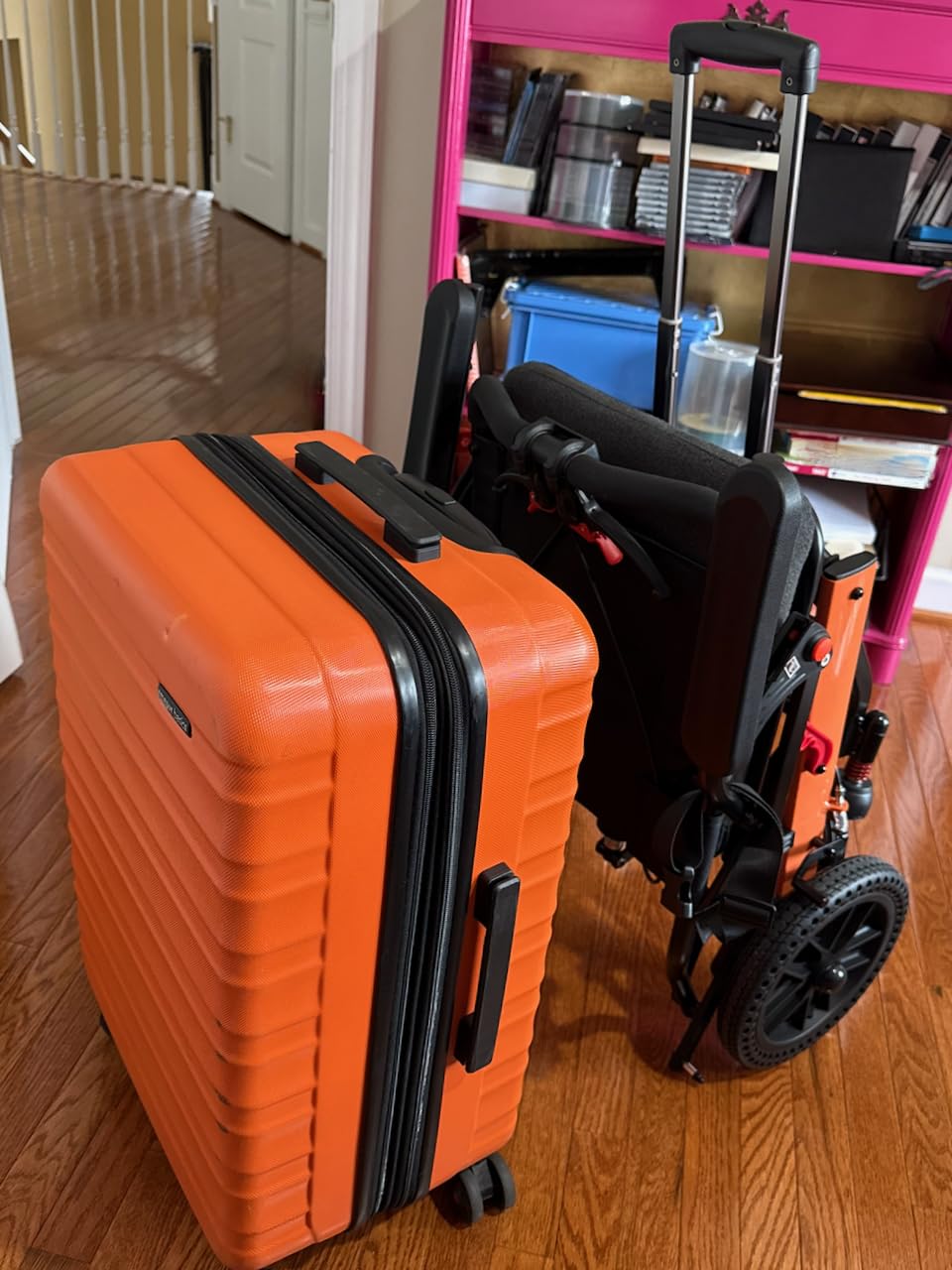
Who the recline actually helps
A tilting or reclining backrest helps a user who cannot hold an upright posture for a full day, who is recovering from surgery, or who tires in the afternoon. It is not a medical positioning device, so anyone with specific tone or pressure management needs should ask an occupational therapist first.
For a long day out, a cruise day, or an airport connection that runs to six hours, the shock absorbers and recline together are worth a great deal. On a short clinic trip they are simply unused.
Where it falls short
The fold is the problem. It requires removing the large wheels before folding and takes real strength, and the unlock control has no obvious grip point, which is exactly the fixed-versus-detachable confusion caregivers describe.
There is also a reported footrest snag when the chair is unfolded before the footrest is opened, several reports of shipping damage to the wheel brakes and plastic parts, a frame narrower than a 20 inch chair, and short push handles that make low curbs difficult.
How to Choose a Transport Wheelchair for Travel
The right way to buy a travel chair is to work backwards from the trip. Measure the trunk opening, check the boarding group’s narrowest door, and count how many transfers the user can manage in a day. Everything else on the spec sheet is secondary to that.
Start with weight, because it is the number caregivers actually judge by. For a solo caregiver lifting repeatedly, anything at or under roughly 26 lb is realistic for a one-handed lift into a boot. Above 30 lb, plan on two people or a ramp, and do not let a lower chair price talk you into a frame you cannot lift. An r/wheelchairs budget thread notes that Drive Medical has several models in the affordable tier, which is where a lot of caregivers start, and Medline is described there as a well-built big brand chair at the budget level rather than a premium one.
Expect to pay more as the frame gets lighter. The steel chairs in this roundup cluster at the entry level, the aluminum models sit in the middle, and the reclining and suspension-equipped designs sit at the top. Price bands track frame material closely, so the weight you need and the budget you have usually line up.
Frame material is the second decision. Aluminum keeps the chair light and folds tighter, which matters for gate checks and ship storage. High-strength steel is heavier but pushes more predictably and usually carries a higher capacity, which matters if the user is heavier or the chair lives in a facility. If you need one chair for both car trips and long outdoor days, aluminum with 12 inch rear wheels is the compromise we would pick.
Wheel size decides how rough the surface can be. Small 8 inch wheels fold smaller and weigh less but catch on cracks, thresholds and airport carpet seams, which is the most common complaint in forum threads about this category. Twelve inch rear wheels with curb assist handle sidewalks and uneven paths far better. The trade is roughly 5 to 10 lb of extra weight, and for a traveler who moves between airports rather than sightseeing, the lighter chair is the right call.
Seat width and seat-to-floor height matter more than most buyers expect. A 17 inch seat is fine for a smaller user and genuinely confining for someone over roughly 150 lb, so match the seat to the user rather than to the weight capacity on the label. A wider 19 inch seat with full-length armrests is more comfortable over a whole day out, and a 15 lb chair with a 14 inch seat is a bad trade.
Folding mechanism and removable parts determine whether loading is smooth or an argument. Look for side release pins or a single-key fold, swing-away footrests that detach in one motion, and armrests that flip back or come off. Budget models with fixed arms and no instructions are where loading goes wrong, and the parts you can remove are also the parts you label before a flight.
On pushing effort, transport chairs are generally easier to move than self-propelled chairs because the total weight is lower and the sitter’s weight is over small wheels. A chair is hard to push when the rear wheels are misaligned or underinflated, when the casters are picking up debris, when the load exceeds the capacity, or when the surface is loose, soft or uneven. Check wheel alignment and caster condition before blaming the chair.
On coverage, a wheelchair bought specifically for travel is usually treated as convenience equipment rather than durable medical equipment, and Medicare and Medicaid funding is therefore unlikely to apply to a second chair requested only for trips. Coverage generally follows a documented mobility limitation, and a primary chair that meets that need is the realistic funding route. If you are relying on coverage, confirm eligibility with your supplier before ordering rather than after.
If you are buying for a parent with limited control of a power chair, an AgingCare caregiver thread makes the case for a transport chair on safety grounds: a power chair driven by someone with poor joystick control can run into people or objects. A caregiver-pushed chair cannot. We cover powered alternatives such as our guides to the best electric wheelchairs and lightweight electric wheelchairs separately.
Flying, Cruise and Car Travel With a Transport Chair
Air travel is the part of trip planning people get wrong, because the airline handles the chair, not you. Request wheelchair assistance when you book, arrive early, and treat the chair as gate-checked equipment that will be returned to you rather than cargo you own.
Ask for a gate-check tag and confirm in advance that your chair will be delivered at the gate on arrival. Caregivers on r/wheelchairs note that flight staff bring the chair to you at the gate when you will need it on landing, which removes the need to wait at baggage claim.
Before you hand the chair over, remove the footrests, armrests, cushion, loose bags and any detachable parts, and put them in one labelled bag that travels with you. Take photographs of the frame, wheels, footrests and underside, and write down the model number and weight. On arrival, inspect the chair at the gate before leaving the terminal rather than discovering damage in a hotel room.
TSA Cares is the screening assistance service for travelers with disabilities, and it is worth using when the sitter cannot pass through a walk-through metal detector comfortably. An aisle chair is the narrow chair a passenger transfers into for the cabin, and you can request one in advance rather than hoping for it at the gate.
On a cruise, the constraints are narrower than on a plane. Gangways are typically narrow, cabin storage is often a fold-down berth, and the salt air works on small wheels and bearings. Confirm that the ship will store a folded chair in the cabin rather than in a hold, and check whether the ship supplies a chair for shore excursions before bringing your own.
For car travel, do one honest trunk test before you buy. Measure the opening, load the folded chair, and check that you can close the boot without shoving. A chair that requires a permanent back seat occupant is not a car transport chair. If you are the sole caregiver, rehearse the lift a few times at home before the trip rather than discovering the technique in a parking structure.
Frequently Asked Questions
What is the difference between a travel wheelchair and a transport wheelchair?
A transport wheelchair is a light folding chair with small rear wheels and no hand rims, so a caregiver pushes it and the occupant cannot self-propel. A travel wheelchair is usually a self-propelled ultralight chair with larger rear wheels, built for the traveler to move independently. A transport chair wins when the user cannot push and the caregiver is doing the work; a self-propelled chair wins when the user wants independence on the move.
Which transport wheelchair is best rated?
In this roundup the highest rated chairs are the Drive Medical Silver Sport 1 and the Medline Ultra Lightweight, both averaging 4.6 stars across thousands of reviews. Our editor’s choice is the Medline Lightweight Foldable Transport Chair because it combines a 4.5 star average, a 26 lb aluminum frame, a 300 lb capacity and 12 inch rear wheels in one package.
Will Medicare pay for a transport wheelchair?
Usually not for a chair bought specifically for travel. Medicare and Medicaid fund durable medical equipment tied to a documented mobility limitation, and a second chair requested only for trips is generally treated as a convenience purchase. Coverage is more realistic for a primary chair that meets an established need, so confirm eligibility with your supplier before ordering.
What is the best airline-approved wheelchair for travel?
The Ultra Lightweight Folding Wheelchair with 12 inch honeycomb rear wheels is the strongest air-travel pick in this roundup because it folds with one key, includes a carrying bag, arrives assembled and has a telescopic handle that hides under the seat for rolling through a jet bridge. The Medline Lightweight Foldable Transport Chair is the better all-round alternative at 26 lb.
Are transport wheelchairs hard to push?
No, they are usually easier to push than self-propelled chairs because the frame is lighter and the sitter’s weight sits over small rear wheels. Pushing gets hard when the rear wheels are misaligned, the casters are picking up debris, the surface is loose or uneven, or the load is above the chair’s capacity. Check alignment and caster condition before blaming the frame.
Why is my wheelchair so hard to push?
Common causes are misaligned or underinflated rear wheels, debris caught in the front casters, an uneven or soft surface such as sand or grass, and a load that exceeds the chair’s stated capacity. Small 8 inch rear wheels also need more correction from the caregiver over cracks and seams than 12 inch wheels do, which is the most common complaint in this category.
The Best Transport Wheelchairs for Travel in 2026
Ten chairs, ten different answers to the same question, and the right pick depends entirely on the trip and on who is doing the pushing. For most families, the Medline Lightweight Foldable Transport Wheelchair is the one to buy: 26 lb, a 300 lb capacity, 19 inch seat and 12 inch rear wheels, with the largest review base in the category behind it.
If lifting weight is the deciding factor, take the Medline Ultra Lightweight at 15 lb and accept smaller wheels. If the trip involves sightseeing on uneven ground, take the Lightweight Expedition with its 12 inch wheels and curb assist. For a long day out with a user who cannot sit upright for hours, the reclining transit chair is the only one here built for it.
Our picks by scenario: the Medline Lightweight Foldable for overall travel, the Drive Medical Silver Sport 1 for a dependable all-purpose chair, the Medline Ultra Lightweight for solo loading, the Drive Medical compact fold for a small trunk, the EconoHome for a chair that arrives ready to use, and the McKesson for a caregiver who pushes a long way. For powered options, read our electric wheelchairs for seniors guide next.
Whichever you choose, do the trunk test before the trip, take photographs before you hand the chair to a gate agent, and check that the seat width actually fits the person using it. Those three steps prevent nearly every problem we found in the reviews.