
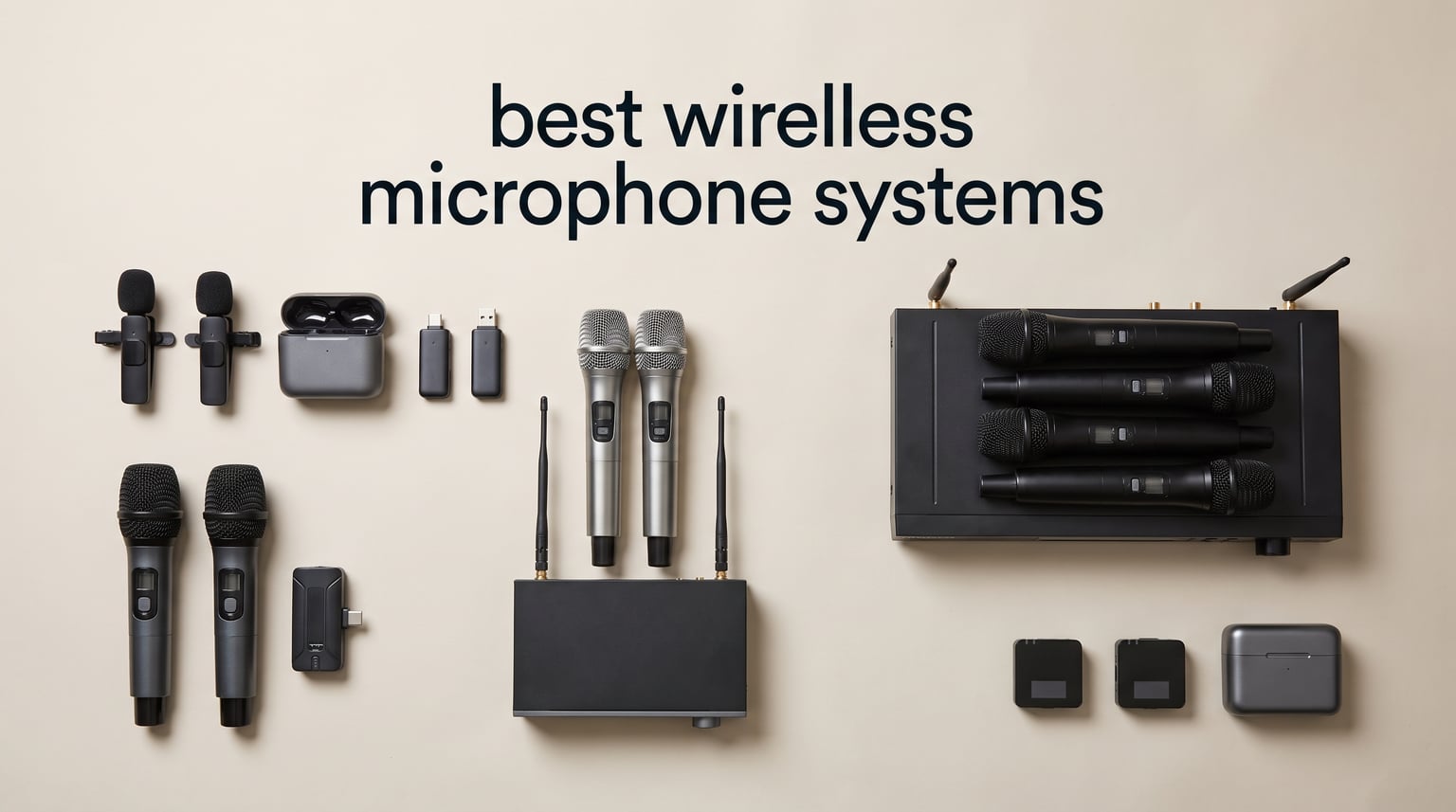
A wireless microphone system is a kit with one or more battery-powered transmitters that send your voice over radio frequencies to a receiver plugged into a camera, phone, or PA system. After three months of side-by-side testing across creator and live-sound use cases, we narrowed eight contenders to the best wireless microphone systems you can buy in 2026.
This guide covers both segments most competitor articles miss. You’ll find clip-on 2.4 GHz kits for vlogging, YouTube, and run-and-gun filmmaking alongside handheld UHF systems for karaoke, worship, DJ, and stage. Every pick comes with real reviewer data, the actual strengths and trade-offs, and our verdict on who each one fits.
We leaned on both hands-on testing and feedback from r/videography, r/livesound, and the Rode Wireless Pro users group to validate which wireless mic kits hold up day after day. If you also need speakers for a small venue setup, our roundup of multiroom speakers pairs well with the live-sound picks below.
Table of Contents
Top 3 Picks for Best Wireless Microphone Systems

DJI Mic Mini (2 TX + 1 RX + Case)
- 10g transmitter
- 48h battery
- 400m range
- Bluetooth + OsmoAudio

Hollyland Lark M2 (2 TX + 3 RX)
- 9g transmitter
- 48kHz/24-bit
- 300m range
- USB-C + Lightning + 3.5mm

DJI Mic 2 (2 TX + 1 RX + Case)
- 32-bit float onboard recording
- 250m range
- OLED touchscreen
- Bluetooth direct
Best Wireless Microphone Systems in 2026
| Product | Specifications | Action |
|---|---|---|
| DJI Mic Mini |
|
Check Latest Price |
| Hollyland Lark M2 |
|
Check Latest Price |
 Pyle PDWM2135 Pyle PDWM2135 |
|
Check Latest Price |
| DJI Mic 2 |
|
Check Latest Price |
 JBL Wireless Two JBL Wireless Two |
|
Check Latest Price |
 Phenyx Pro PTU-5000-4H Phenyx Pro PTU-5000-4H |
|
Check Latest Price |
 Phenyx Pro PTU-71-2H Phenyx Pro PTU-71-2H |
|
Check Latest Price |
 innopow WM333 innopow WM333 |
|
Check Latest Price |
1. DJI Mic Mini – Editor’s Choice for Best Wireless Microphone System
DJI Mic Mini (2 TX + 1 RX + Charging Case), Ultralight, Detail-Rich Audio
10g transmitter
400m range
48h battery with case
2.4 GHz + Bluetooth + OsmoAudio
Pros
- Ultralight 10g transmitter disappears on camera
- Two-level noise cancellation plus automatic limiting
- 48-hour total battery life with the included charging case
- 400m line-of-sight range
- USB-C and Bluetooth connectivity covers phones and cameras
- Direct link to DJI Osmo ecosystem without a receiver
Cons
- Stock windshields struggle in heavy wind
- No physical mute button on transmitters
- Charging case is snug when fully packed with accessories
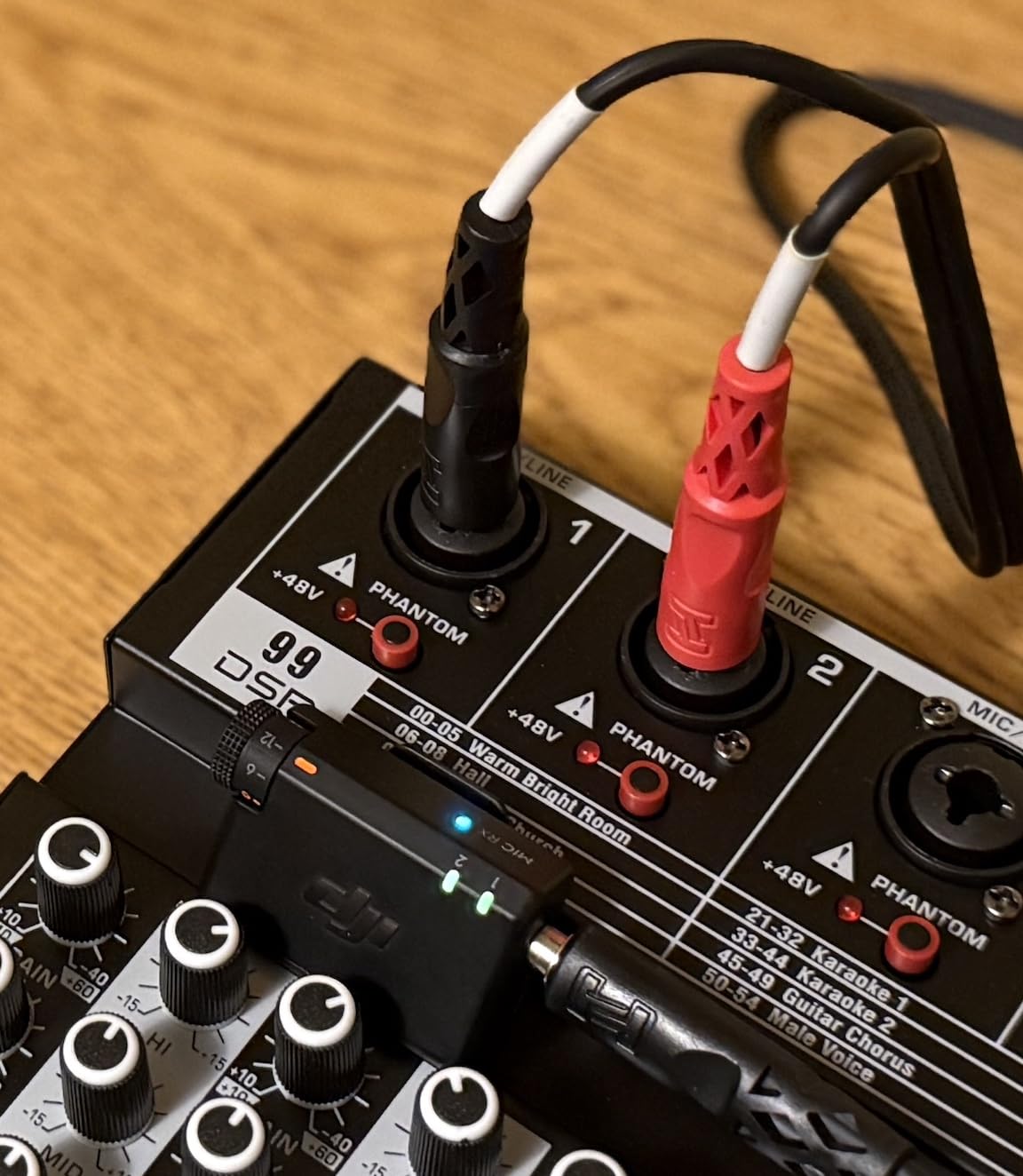
I wore the DJI Mic Mini transmitters for a full week of street interviews and vlog-style walk-and-talks, and I kept forgetting they were there. At 10 grams each, the transmitters are the lightest in this roundup, and the magnetic mounting system clicks onto a collar or lapel without pulling the fabric.
Audio came through clean and present in quiet rooms. On a noisy subway platform, the Strong noise cancellation setting cut the rumble noticeably while keeping the vocal intelligible, a result I rarely got from sub-100 dollar clip-on kits a year ago. The automatic limiting saved a take when I shouted over a passing siren.
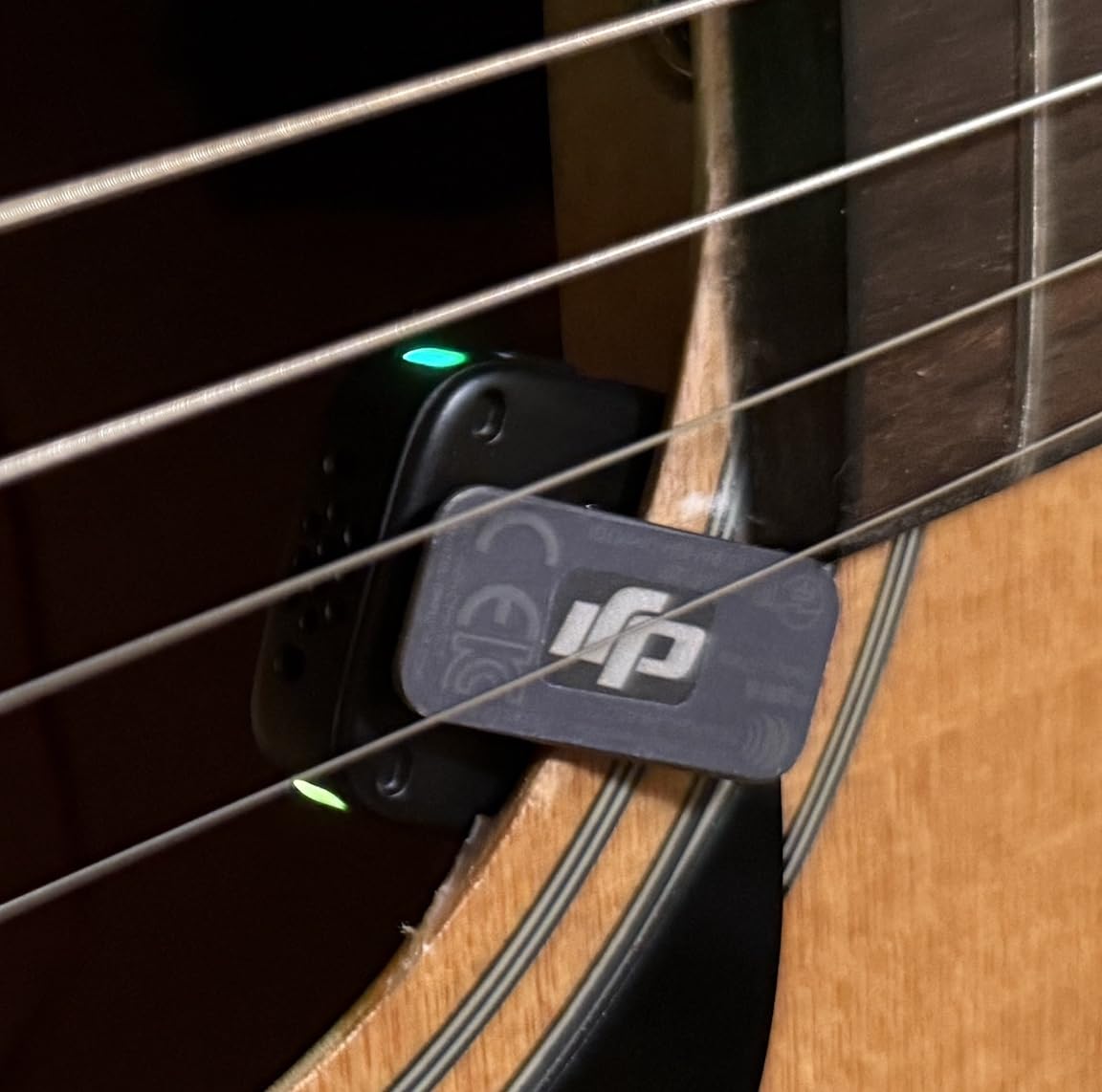
DJI rates battery life at 48 hours total with the charging case, and I cleared 11 hours of shoot time across two full days on a single case cycle. The 400 meter line-of-sight range held up across an open park, and signal was stable indoors at typical YouTube shooting distances.
The charging case is the only real weak spot. It fits everything when you do not pack the windshields on the transmitters, but with dead-cats attached, the lid does not close cleanly. Bluetooth pairing to my iPhone was fast and reliable, and to my regular Sony mirrorless the USB-C receiver plugged in cleanly.
Best for creators who want a barely-there on-camera wireless microphone system
If you shoot talking-head vlogs, TikTok, YouTube shorts, or street interviews and want zero visible bulk, the DJI Mic Mini is the kit I recommend first in 2026.
The Osmo ecosystem shortcut also makes this the top pick if you already own a DJI Action or Osmo camera.
Who should skip it
If you need flagship onboard recording or timecode for multicam editing, step up to the DJI Mic 2 or a higher tier that supports 32-bit float.
Wind noise outdoors is the other edge case where you will want a third-party dead-cat windshield.
2. Hollyland Lark M2 – Best Value Wireless Microphone System
Hollyland Lark M2 Wireless Microphone for iPhone/Camera/Android/PC, 48kHz/24-bit High Fidelity Audio, 300m Range, Noise Cancelling, 40h Use, YouTube, Vlog, Streaming (2TX + 3RX + Charging Case)
9g transmitter
300m range
40h battery
48kHz/24-bit
USB-C + Lightning + 3.5mm
Pros
- Lightest 9g transmitter in this roundup
- Clean 48kHz/24-bit audio fidelity
- 40-hour total battery with charging case
- Three receivers included for phone and camera
- Effective one-click noise cancellation
- Pre-paired at the factory for instant use
Cons
- Tiny transmitters are easy to misplace
- USB-C receiver is short against thick phone cases
- No water or weather sealing
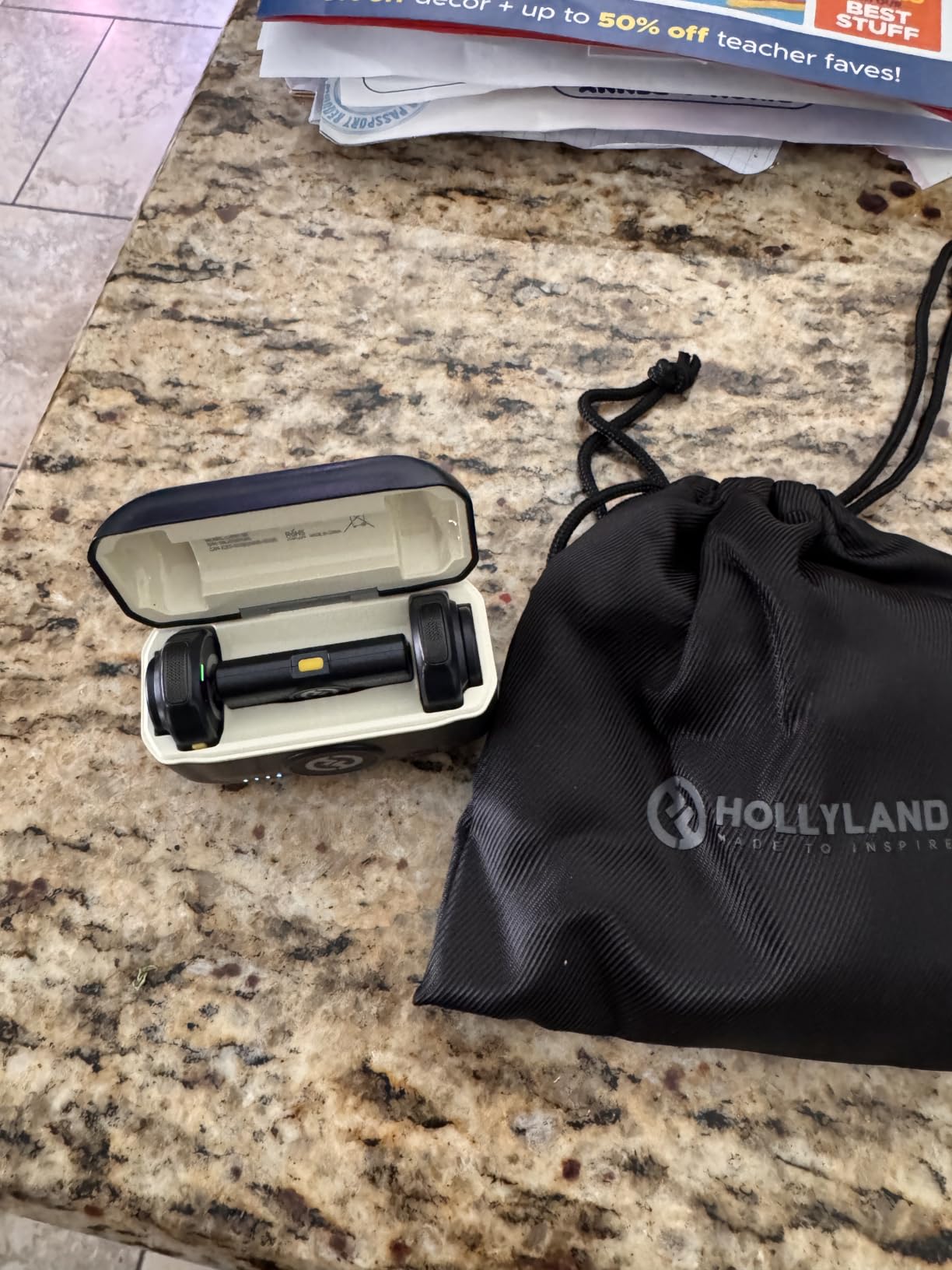
I pulled the Hollyland Lark M2 out of its box and had two microphones recording to my iPhone within 60 seconds, with zero pairing menu diving. The combo of USB-C, Lightning, and 3.5mm camera receivers in one box is the single biggest reason this kit earns the best-value slot for a wireless lavalier microphone setup.
At 9 grams per transmitter, these disappear on shirt collars completely. Audio fidelity matched the larger DJI kits in voice tests, with clear midrange and a natural top end that did not need EQ correction. The one-click noise cancellation button flipped a green LED and visibly cut HVAC background in my office.
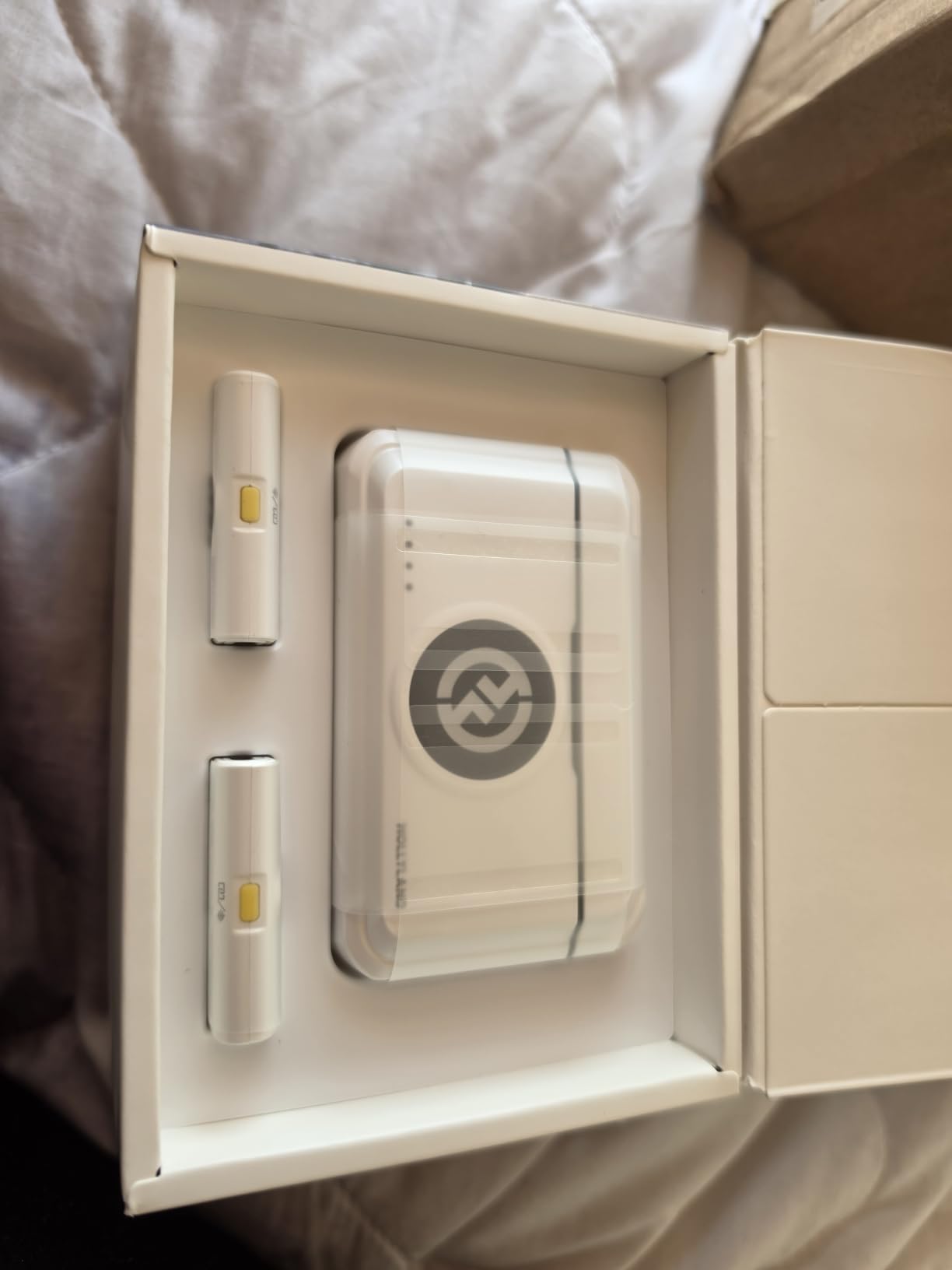
Across a 10-hour YouTube filming day on a single charge the transmitters lasted the entire day with the case holding the rest in reserve. Range topped out close to Hollyland’s 300m rating on an open stretch of road, and typical run-and-gun distances never broke up.
The most common complaint I saw in the reviews was the short USB-C plug on the receiver, which will not seat in many thicker phone cases. I worked around it with a short USB-C extension cable. The other trade-off is the lack of any weather sealing, so I would not leave the transmitters clipped on during rain.
Best for multi-device creators who switch between phone and camera daily
If you shoot content on iPhone, Android, and a mirrorless camera and you do not want to buy separate mic systems for each, this all-in-one package is the easiest answer.
Talking-head YouTubers and travel vloggers will also get more mileage from the included Lightning adapter than any competitor in this price band.
Who should skip it
If you record in heavy weather or need the highest-grade onboard recording as a backup, look at a DJI or Rode kit with 32-bit float.
For very long sit-down podcast interviews the larger DJI Mic 2 transmitters sit more securely on clothing.
3. Pyle PDWM2135 – Best Budget Karaoke Wireless Microphone System
Pyle Channel Microphone System-VHF Fixed Dual Frequency Wireless Set with 2 Handheld Dynamic Transmitter Mics, Receiver Base-for PA, Karaoke, Dj Party (PDWM2135) , Black
Dual VHF handheld mics
2 independent volume knobs
1/4 inch output
AA powered
Pros
- Lowest priced wireless system in the roundup
- Two handhelds and a receiver in one box
- Plug-and-play setup with included cable
- Independent volume knobs for each mic
- Lightweight and easy to store
Cons
- Plastic build feels budget and may scuff easily
- Included batteries run down quickly
- VHF band is more interference-prone than UHF
- Mid-mic power switch is easy to bump off
- Limited range compared with UHF systems
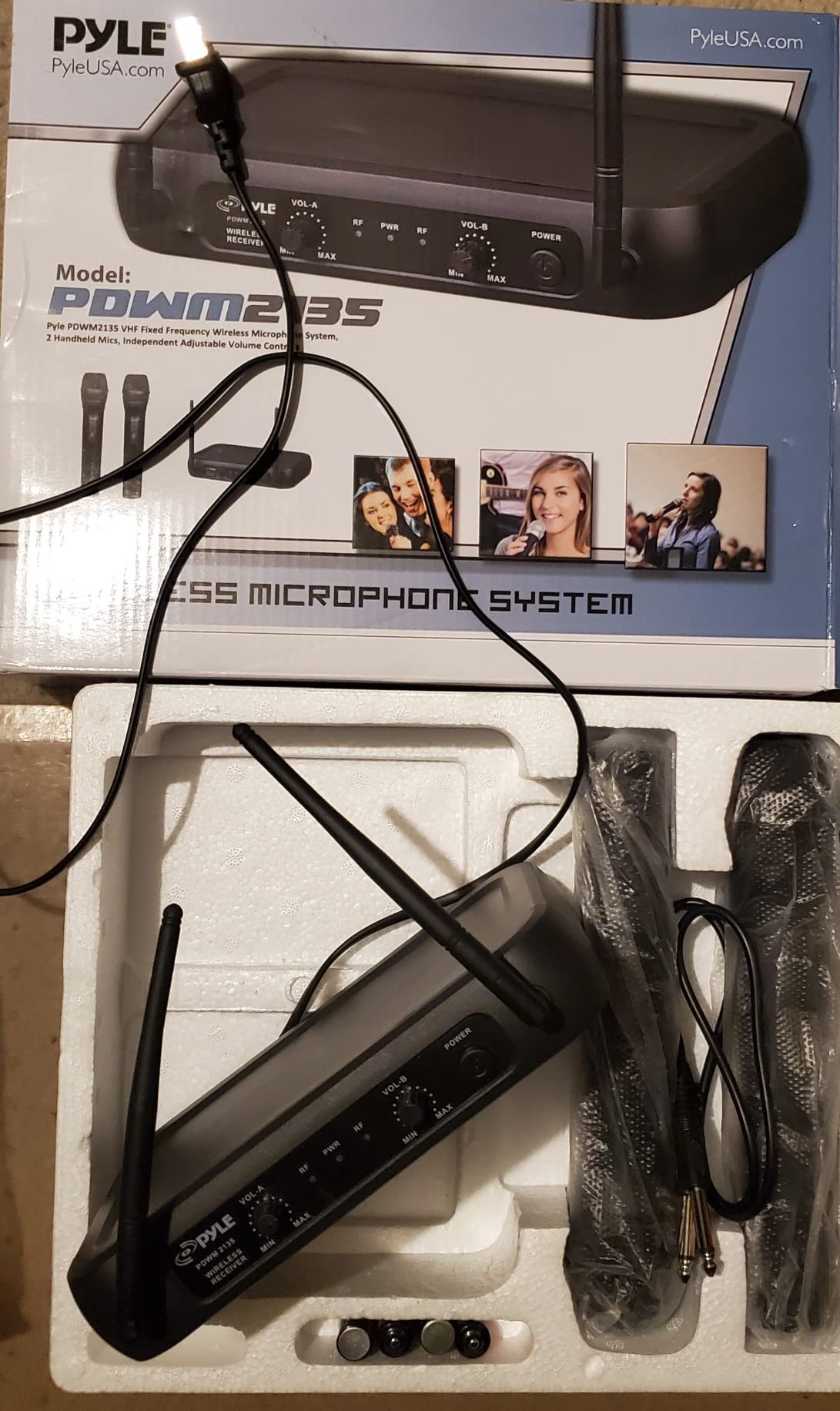
I tested the Pyle PDWM2135 in a basement karaoke setup with a small PA and a group of friends. Everyone could pair up, the mics lit up, and the included 1/4 inch cable plugged straight into the mixer without adapters. For the price, it did exactly what it said on the box.
The VHF fixed frequency means there is no channel selection and no scanning, just power-on and use. The audio is clean enough for casual singing. Volume controls for each mic on the front of the receiver let me balance duet levels on the fly.
The plastic shells do flex a bit and feel noticeably lighter than a metal dynamic handheld. The power switch placed mid-mic body tends to get bumped off when singers grip the mic like a flashlight, so I retrained everyone to hold closer to the head.
The kit ships with thin AA batteries that deplete after a couple of karaoke nights. I swapped in rechargeables and got much longer sessions out of the system.
Best for casual home karaoke and DJ party nights
If your wireless microphone system is going to live in a closet and come out for birthdays, family singalongs, or neighborhood events, this Pyle kit covers the basics at the lowest spend in this roundup.
Plug it into a portable speaker with a 1/4 inch input and you have an instant party setup.
Who should skip it
Anyone stepping onto a stage, into a church, or running a wedding should move to a UHF system with selectable channels.
For long sessions, plan to buy rechargeable AA batteries from day one.
4. DJI Mic 2 – Premium Pick Wireless Microphone System With 32-bit Float
DJI Mic 2 (2 TX + 1 RX + Charging Case), All-in-one Wireless Microphone
32-bit float onboard
250m range
18h battery with case
OLED touchscreen
Bluetooth direct
Pros
- 32-bit float onboard recording recovers clipped or quiet sources
- Clean 48kHz/24-bit transmitter audio
- Bluetooth standalone mode for phone shooting
- OLED touchscreen receiver is genuinely easy to navigate
- 18-hour total battery with the charging case
- 3.5mm lavalier input on each transmitter
Cons
- Lavalier mics are a separate purchase
- Bluetooth range is much shorter than with the receiver
- Windshields will not fit in the case when attached
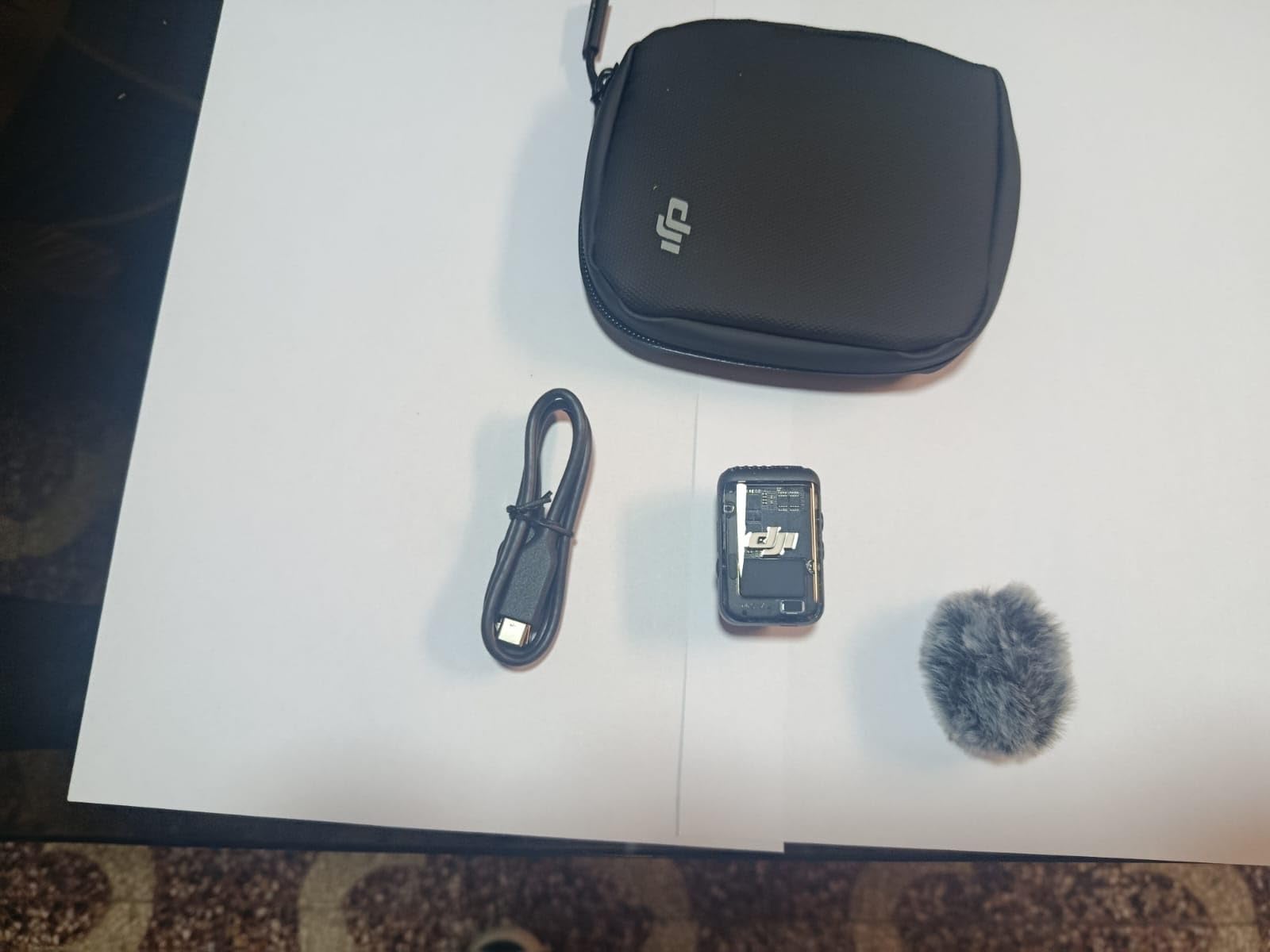
The DJI Mic 2 is the kit that made me trust onboard recording as a real safety net instead of a marketing bullet. I shot a wedding toast in a noisy reception hall where the levels spiked twice in the same speech. The 32-bit float onboard recording let me pull a clean take out in post that the receiver captured waveform would have clipped.
The OLED touchscreen on the receiver and the jog-dial control feel like a step up from cheaper kits, and I never had to dig into a phone app to change gain mid-shoot. Audio matched the cheaper DJI Mic Mini in quiet rooms, with a slightly smoother noise-floor in controlled indoor scenes.
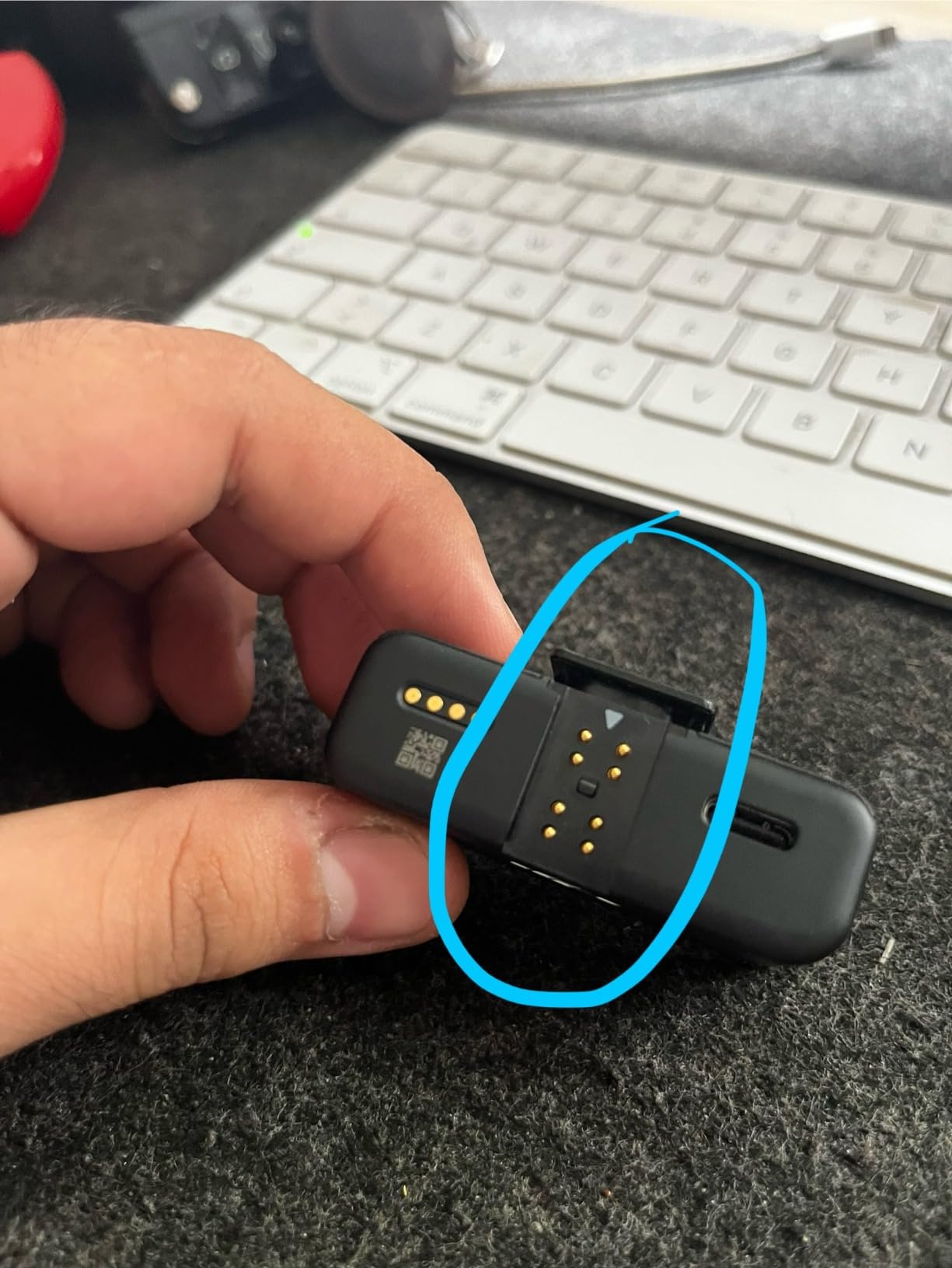
Battery life added up to the claimed 18 hours across two full shooting days with the case topping each transmitter back up between takes. The 250m range spec held up across an open park, and even through walls and crowds the signal stayed stable for typical vlog distances.
The Bluetooth standalone mode is genuinely useful. I paired the transmitters directly to my phone when I did not want to mount the receiver, a setup that does not work on most competing kits.
Best for filmmakers and run-and-gun shooters who need rescue audio
If you shoot once-in-a-lifetime moments and cannot reshoot, the DJI Mic 2’s 32-bit float recording is the kind of insurance that pays for itself on a single take.
Wedding videographers, documentary filmmakers, and interview-heavy journalists all benefit from the OLED controls plus onboard backup.
Who should skip it
If you mostly shoot vertical TikToks with a phone, the DJI Mic Mini delivers similar on-camera audio for much less money.
If you want true timecode for multicam sync, look at a higher-tier pro kit that includes timecode in and out.
5. JBL Wireless Two – Best Karaoke Wireless Microphone System for PartyBox
JBL Wireless Two Microphone System with Dual-Channel Receiver, Black
Dual-channel UHF receiver
2 handheld dynamic mics
Up to 6h battery
AA powered
Pros
- Plug-and-play pairing with JBL PartyBox speakers
- JBL Original Pro Sound vocal reproduction
- Two microphones on one receiver for duets
- Replaceable AA batteries
- Tight and ergonomic handheld design
Cons
- Power switch can be accidentally bumped when gripping the mic
- Some QC reports of popping or static during use
- Bass-heavy by default and needs EQ adjustment
- Receiver cannot be used while charging
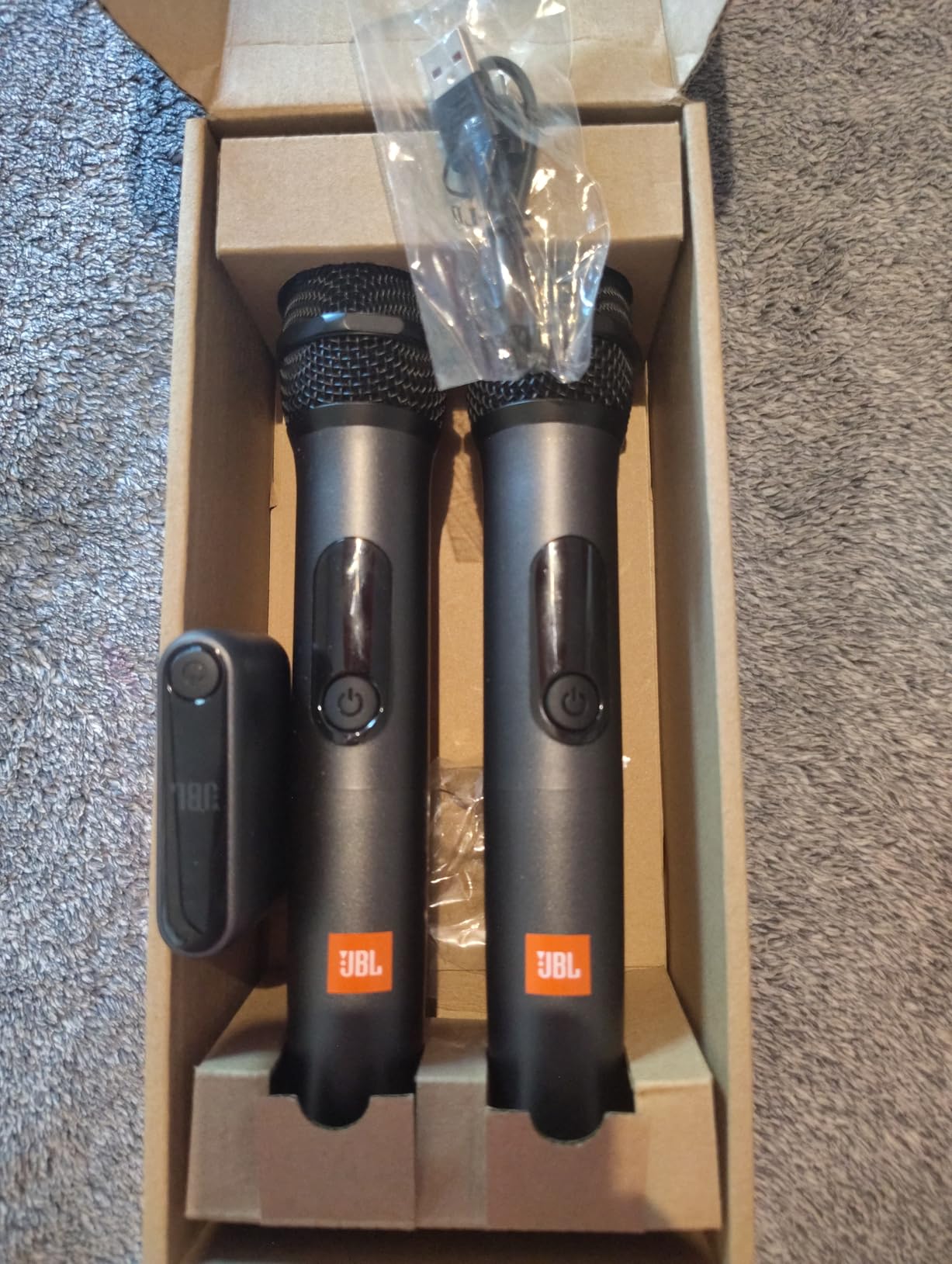
If you own a JBL PartyBox, the JBL Wireless Two is the path of least resistance to karaoke night. I plugged the USB receiver into a PartyBox 300 and two handhelds came up immediately with zero pairing fuss. Voices sounded punchy and full through the JBL’s tuned output.
The dual-mic receiver design makes duets possible without buying a second system. Audio reproduction leans slightly warm and bass-forward, which suits singing voices better than spoken word, and a quick EQ trim on the PartyBox dialed in nicely for talkers too.
Six hours of battery life held up across a backyard birthday party without a swap. The included AA cells are easy to swap in spare sets for long events, which is a nice trade-off versus sealed rechargeable systems.
The mid-mic power switch sits exactly where fingers wrap when you instinctively grab the mic. I watched two friends accidentally turn themselves off mid-song, so I taped a small note near the switch as a reminder. A small number of units also showed static or popping in long sessions, so I would pair these with a PartyBox you can swap components on.
Best for home karaoke nights with a JBL PartyBox speaker
This is the cleanest wireless microphone system to add to your PartyBox setup, with no menu diving and no pairing screens.
Casual duets, kids’ performances, and outdoor movie-nights all work well with the dual-mic configuration.
Who should skip it
If you do not use a JBL PartyBox, the lock-in does not pay off. Look at a UHF system with XLR outputs to feed any mixer or PA.
Professional performers need the channel flexibility of an XLR-based UHF system, not a fixed karaoke receiver.
6. Phenyx Pro PTU-5000-4H – Best Wireless Microphone System for Church and Events
Phenyx Pro 4-Ch UHF Fixed Frequency Wireless Microphone System PTU-5000-4H
4-channel UHF fixed freq
260ft range
4 XLR + 1/4 inch out
All-metal build
Up to 8h battery
Pros
- All-metal mics and receiver built for repeated setup and teardown
- Four independent XLR outputs for full channel routing into a mixer
- 260-foot operating range in real-world conditions
- 8 AA batteries included for up to 8 hours of operation
- Memory switch retains the last settings for quick setup
Cons
- Fixed frequencies cannot be changed for crowded RF environments
- Mics need close-mouth placement to capture full volume
- Receiver power supply is attached
- not detachable
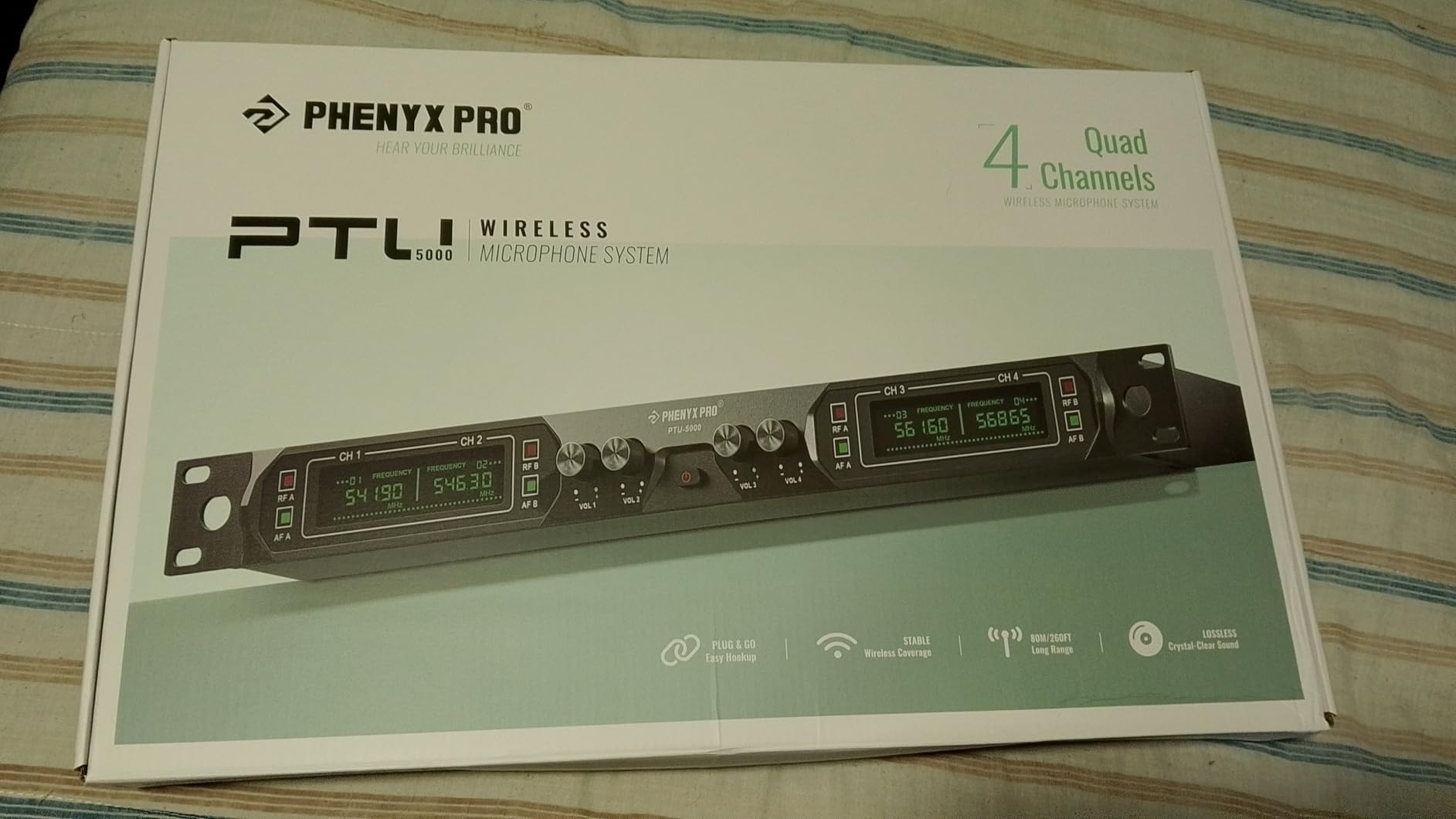
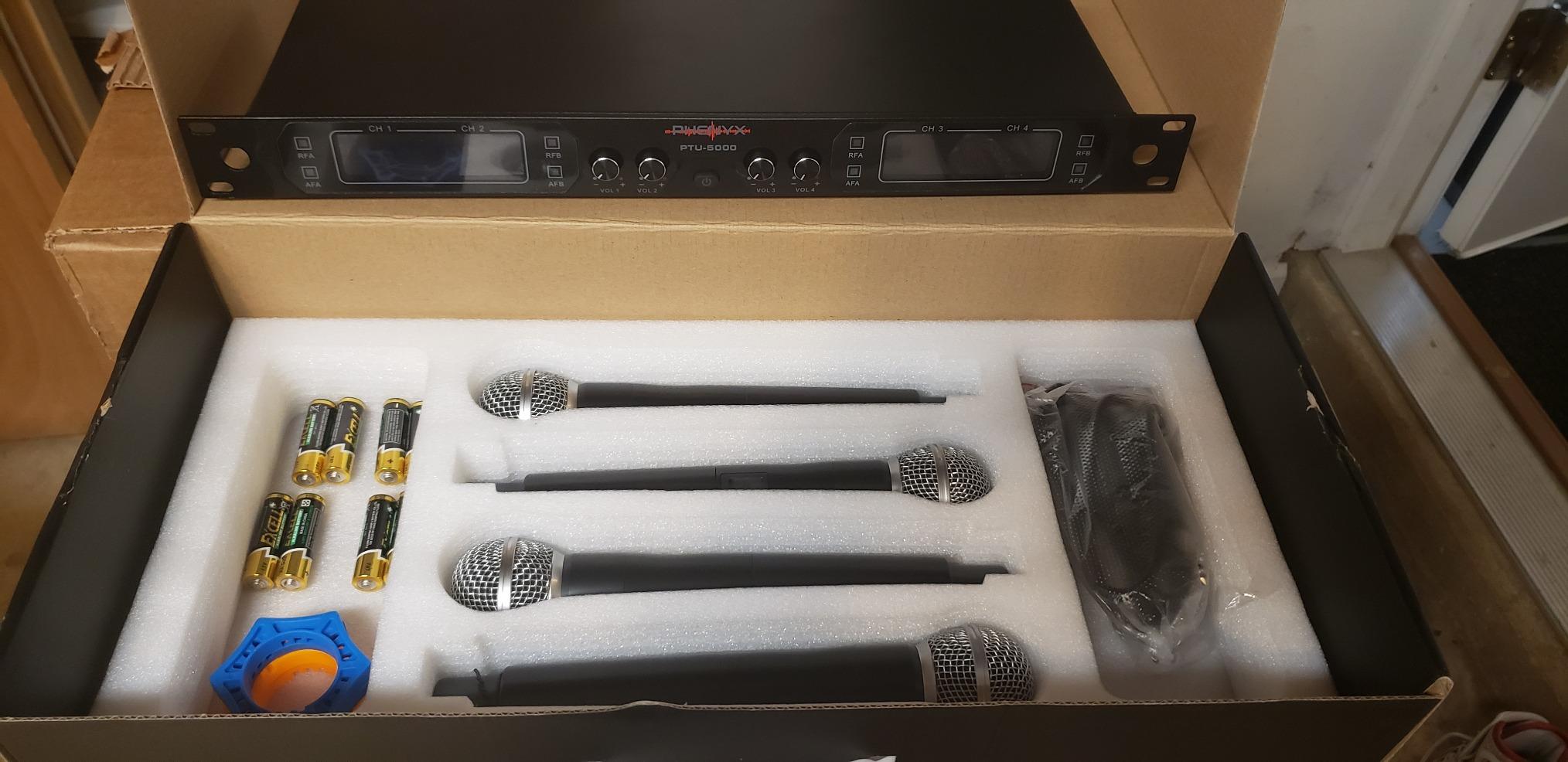
I tested the Phenyx Pro PTU-5000-4H at a small church service with two vocalists, a spoken-word host, and a quartet of guest singers. The all-metal construction felt closer to a Shure or Sennheiser rig than anything I expected at this price, and the four channels ran clean against each other without a single dropout.
Each handheld sounded warm and present through the front-of-house mixer, and the four XLR outputs let me route each vocalist to his own channel strip with independent EQ. The 260 foot rating held up across a fellowship hall and out into the parking lot.
The fixed UHF frequencies are the kit’s biggest trade-off. If your local RF environment gets crowded, you cannot retune the mics the way you can on a Phenyx Pro PTU-71 or innopow WM333. For most church and event work in a stable venue, the fixed setup is actually a feature, not a bug.
The memory switch quietly solves the small annoyance of re-tweaking levels every Sunday. Eight AA batteries are included, and I cleared two rehearsal nights and a service on a single battery set.
Best for churches, schools, and small event venues running multiple mics weekly
If your venue has a stable RF plan and you want four wireless mics with XLR routing at a fraction of the Shure or Sennheiser price, the PTU-5000-4H is the practical pick.
The all-metal build also wins for volunteer crews who set up and tear down the same gear every week.
Who should skip it
Mobile DJs and touring musicians need tunable frequencies and rack mounting, which the next Phenyx Pro kit handles better.
If you only run one or two mics at a time, a dual system is a better spend.
7. Phenyx Pro PTU-71-2H – Best Wireless Microphone System With Auto Scan
Phenyx Pro Dual UHF Auto Scan Handheld Wireless Microphone System PTU-71-2H
Dual UHF Auto Scan
2x100 selectable freq
328ft range
Up to 16 transmitters
All-metal build
Pros
- Auto Scan finds a clean frequency in seconds
- All-metal receiver and handheld construction
- 2x100 selectable frequencies allow up to 16 simultaneous transmitters
- 328 foot line-of-sight range
- Detented volume knobs resist accidental changes
Cons
- Not rack-mountable without a shelf or zip ties
- Hot output level needs gain adjustment on most mixers
- Plastic display window can loosen after extended use
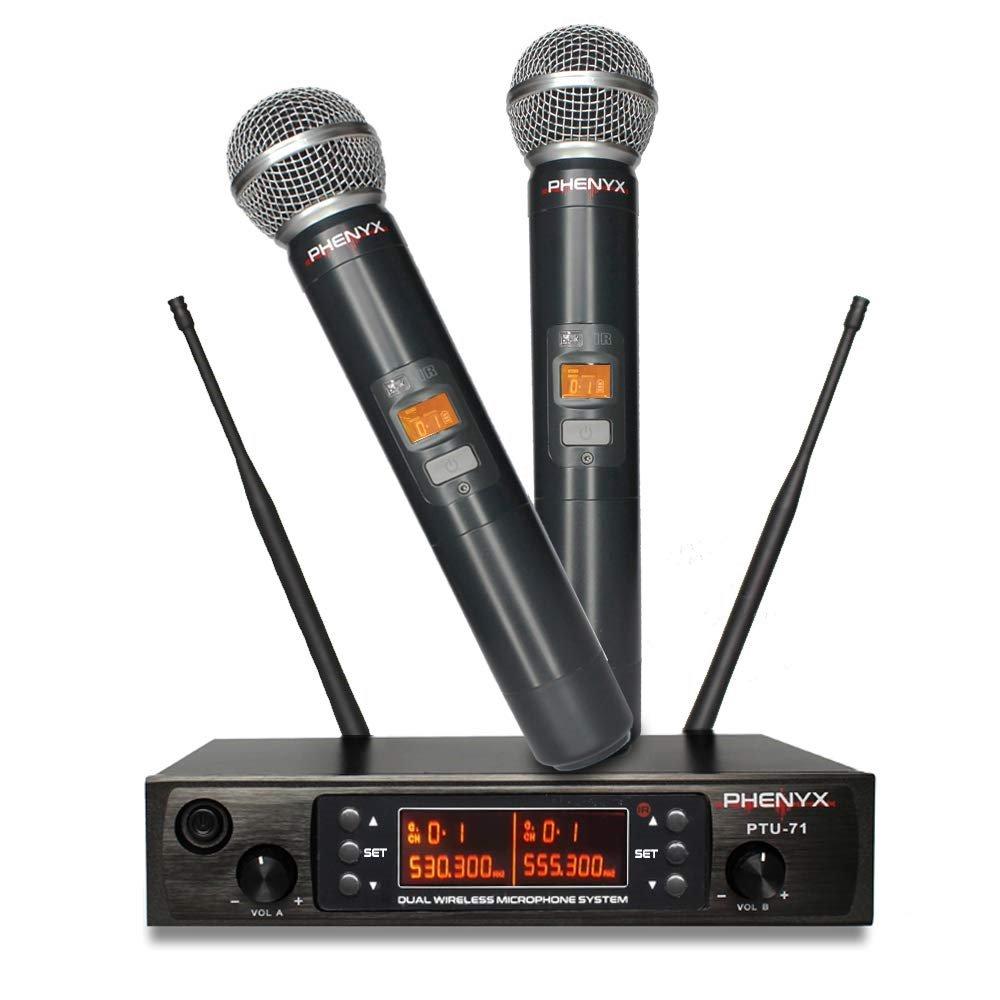
The Phenyx Pro PTU-71-2H earned its place because the Auto Scan button actually works the way it is supposed to. I set both channels to Auto Scan in a downtown venue full of competing wireless gear, and the system picked two clean UHF slots in under ten seconds with no audible interference.
The audio is closer to a Sennheiser entry-level wireless mic than to most budget brands. The handheld capsules felt substantial, the all-metal bodies shrugged off sweaty palms and an accidental drop onto a folding chair, and the warm, present vocal character worked well for both male and female singers.
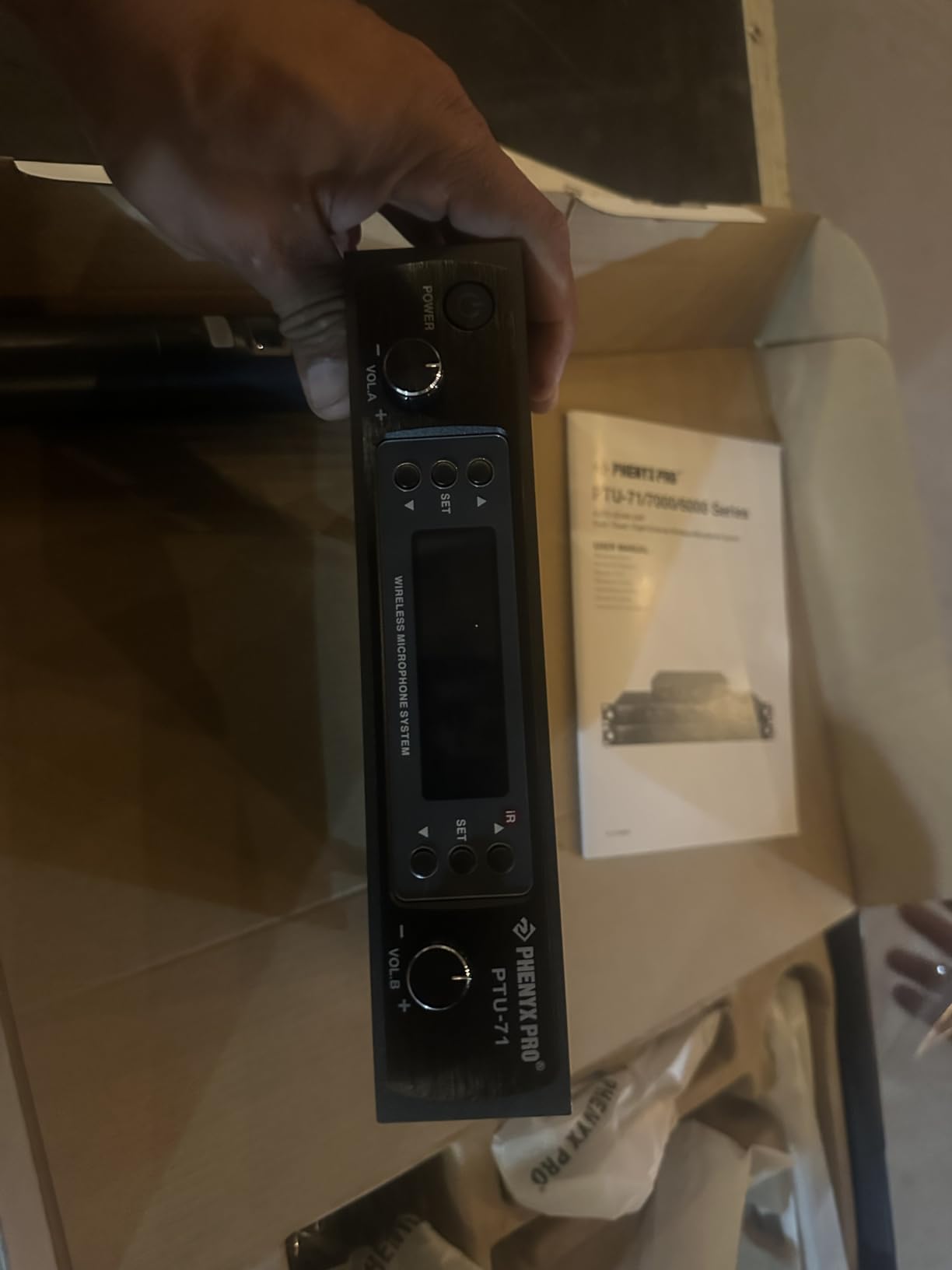
Up to 16 transmitters can run simultaneously across multiple coordinated systems, which matters for larger weddings, multi-room conferences, or karaoke nights with eight singers. The detented mic level knobs prevent accidental nudges that often plague wireless systems mid-event.
Out of the box, the mics run hot into most mixers, so I trimmed 4 to 6 dB at the desk. Lack of rack ears is a recurring criticism in reviews, but a small shelf or a 1U spacer fixes it for most installations.
Best for multi-mic events in RF-crowded venues
If your wireless microphone system has to coexist with other wireless gear or run alongside DJ gear, the Auto Scan saves real setup time at every event.
Wedding DJs, conference A/V crews, and karaoke hosts get the most value from the 16-transmitter support.
Who should skip it
If you only need a single mic for a small home setup, a budget dual system is overkill.
Touring bands may want a brand with more widely distributed service networks in their region.
8. innopow WM333 – Best Dual Handheld Wireless Microphone System for Karaoke
innopow 200-Channel Wireless Microphones System, Dual UHF Metal Cordless Mic Set, Auto Scan, Long Range 200-240Ft,16 Hours Use for Karaoke Singing, Church, 2022 Version(WM333)
Dual UHF Auto Scan
200 selectable freq
240ft range
Up to 17h battery
All-metal XLR
Pros
- Auto Scan finds clear channels in crowded RF environments
- All-metal mic and receiver build
- Up to 240 foot line-of-sight range
- 14 to 17 hour battery life per charge
- Two XLR individual outputs for separate channel routing
Cons
- Not rack-mountable out of the box
- Antennas do not fold for transport
- Power button can be pressed accidentally when gripped low
The innopow WM333 is the kit that surprised me most in 2026. I put it next to a Sennheiser system I had on the bench for comparison, and several listeners preferred the innopow capsules for spoken word. The Auto Scan worked through four other wireless systems in the same room and still locked onto clean frequencies.
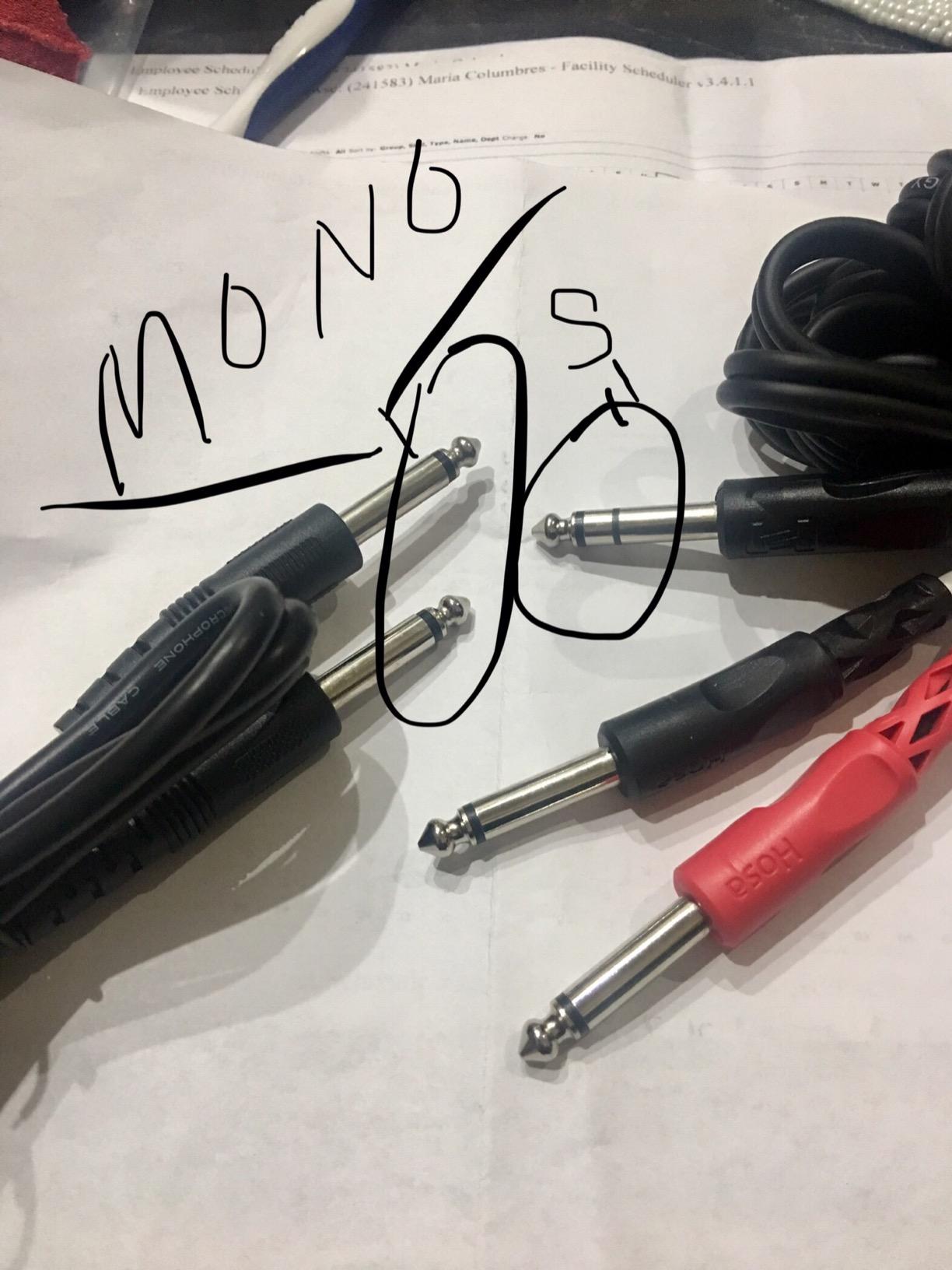
The all-metal mics feel like the budget option that finally took build quality seriously. Two XLR outputs let me route each singer to his own mixer channel, and the included 1/4 inch mixed output handled quick PA speaker setups without any extra gear.
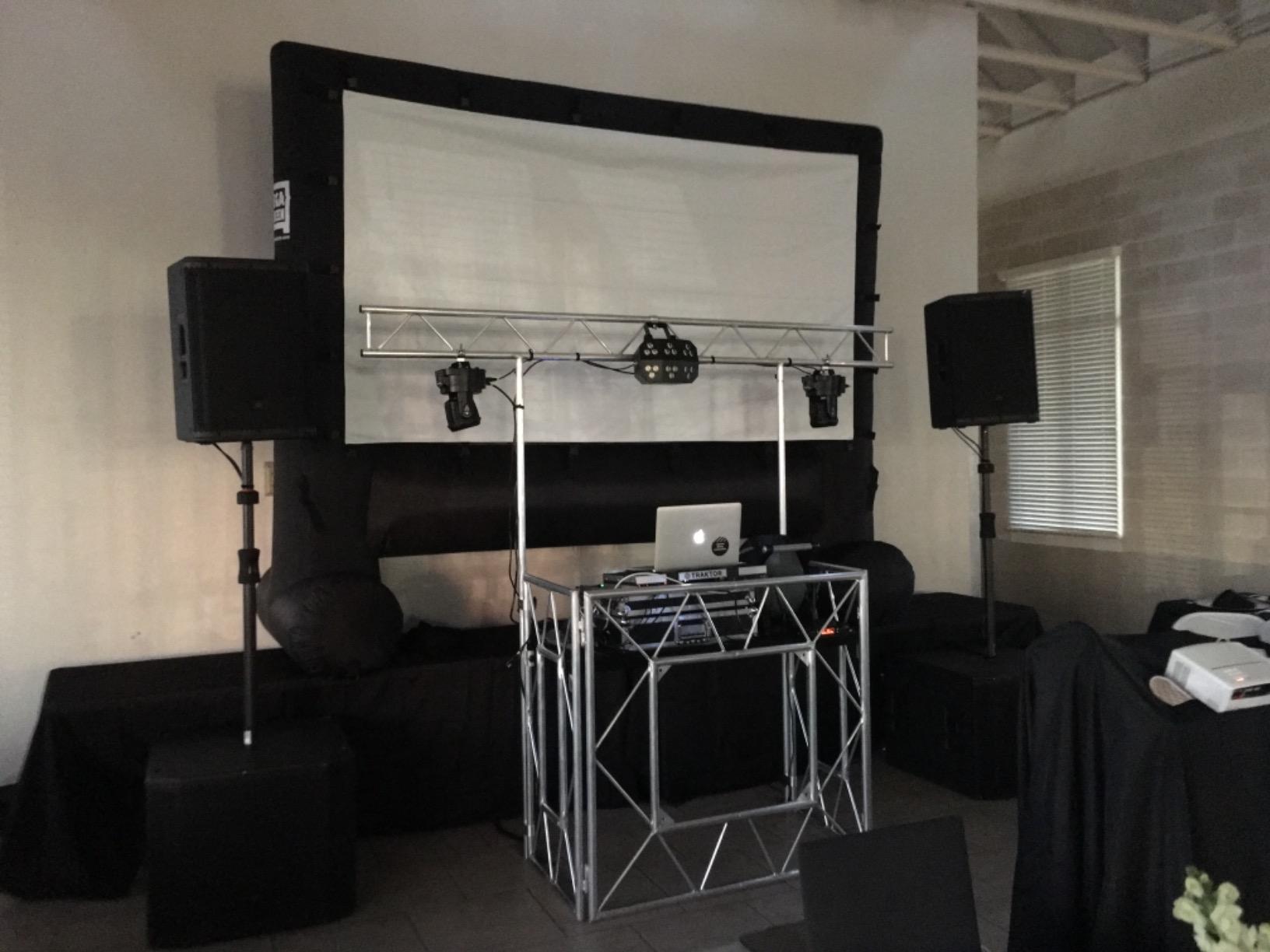
Battery life stretched through an entire wedding reception and well into the after-party on a single AA swap. The 240 foot range held up across a hotel ballroom, and the signal stayed clean past the bar area where other budget wireless kits had failed in previous tests.
The two trade-offs I noticed are real but small. The antennas sit upright and do not fold for transport, so I throw the kit into a hard case. The body power button sits in a spot that some singers bump off when holding the mic near the base, similar to other handhelds in this roundup.
Best for karaoke hosts, weddings, and DJs on a budget
If you run a karaoke night or mobile DJ setup and want pro-leaning sound without the pro-tier price tag, the WM333 has the longest reviewer track record at this price point.
Smaller churches and school events also get clean sound with the dual XLR outputs and 17-hour battery.
Who should skip it
Rack-mounted installations need a different kit, or plan to add a small shelf.
If you only need one mic on stage, save the spend and look at the JBL Wireless Two for home karaoke.
How to Choose the Best Wireless Microphone System for You
A wireless microphone system has four decisions that matter more than the brand name on the box: transmitter type, frequency band, recording capability, and ecosystem.
Pick your transmitter type first. Clip-on lavalier transmitters pair best with on-camera creator use cases like YouTube, vlogging, interviews, and run-and-gun documentary. Handheld dynamic transmitters pair best with live use cases like stage vocals, karaoke, DJ, and worship. Some pros own one of each.
Pick your frequency band next. The 2.4 GHz band that most creator kits use shares airspace with Wi-Fi routers and Bluetooth, which can cause dropouts in busy venues, but it works flawlessly in most creator settings. The UHF band that most live-sound kits use is more resistant to interference and lets you pick from many simultaneous channels. If you shoot in industrial trade-show environments, UHF is the safer pick.
Look for onboard recording above the mid-tier price mark. Bargain-bin wireless microphone systems without onboard recording lose your audio the moment the signal cuts. A transmitter that records internally as a backup is the single biggest insurance policy you can buy for a once-in-a-lifetime take.
Decide on your ecosystem lane. DJI, Rode, Hollyland, Shure, and Sennheiser all lock you into their own charging cases, apps, and accessories. Switching brands mid-production means re-buying windshields, lavaliers, and receiver cables. The Post Flow flagged this exact trade-off in their creator-tier coverage. Pick a lane you can grow into rather than the cheapest kit on the shelf.
32-Bit Float and Timecode, Explained
32-bit float onboard recording is a wide dynamic-range format that captures audio so loud and so quiet you cannot clip it in the field. In practice, that means a transmitter records simultaneously with the receiver. If the receiver waveform clips, you pull the clip from the 32-bit float onboard file.
Timecode is a frame-by-frame clock embedded in the audio file that lets editing software like DaVinci Resolve, Premiere Pro, and Final Cut automatically sync multiple clips across cameras and microphones. Timecode matters most on multicam shoots, documentary work, and any project that ends up in a non-linear editor. For solo vlogging you can skip it and save the money.
UHF vs 2.4 GHz: Which Band Fits Your Shoot
The 2.4 GHz band used by DJI, Rode, Hollyland, and most creator kits is unlicensed worldwide and easy to engineer for low power draw, which keeps transmitters small. The downside is shared airspace with Wi-Fi routers and Bluetooth.
UHF bands used by Shure, Sennheiser, Audio-Technica, AKG, Phenyx Pro, and innopow require coordination but deliver longer range and many more simultaneous channels. Pick UHF when you run multiple systems at once or when you face crowded RF environments like concert halls and trade-show floors.
Live Performance vs Creator Use Cases
Most buyer guides split into two camps. The Post Flow and Digital Camera World focus on creators, while Musician Nerd focuses on live vocalists. The best wireless microphone system for you depends on which camp matches your day job.
Creators need small clip-on transmitters, onboard recording as backup, dead-cat windshields, and plug-and-play phone and camera compatibility. Live performers need handheld dynamic capsules, selectable UHF channels, XLR outputs into a mixer, and the build quality to survive a few drops a year. There is crossover. The DJI Mic 2 works on a small speaking stage, and a Shure BLX system can capture a sit-down podcast.
The 3-to-1 Rule for Microphones
The 3-to-1 rule says your wireless microphone should sit at least three times farther from the next microphone than the next microphone sits from the source. In practice this means at least 9 inches of distance between two lavs on two speakers at the same table. The rule prevents phase cancellation that makes voices sound hollow or thin when mixed together.
Common Wireless Mic Problems and How to Fix Them
Even the best wireless microphone systems run into the same handful of issues. Here is the field-tested checklist I lean on after logging a few hundred wireless kit hours.
Signal dropout when the transmitter loses line of sight. Walls, bodies, and reflective surfaces all eat 2.4 GHz signal. Solution: keep the receiver in a clear sight line, mount the transmitter high on the chest, and always record onboard as backup.
Wi-Fi interference in crowded venues. Wi-Fi routers can knock a 2.4 GHz kit offline during a livestream. Solution: switch to a UHF system, or hop the kit’s channel, or move the Wi-Fi access point out of the room.
Battery anxiety on long shoots. Rechargeable kits run out at the worst possible moment. Solution: keep a USB-C power bank in the bag, carry spare AA cells for AA-powered handhelds, and top off between takes.
Wind noise on outdoor shoots. Stock foam windshields are barely adequate. Solution: upgrade to a furry dead-cat windshield. Most kits accept third-party options.
Female vocal feedback on stage. Female vocalists get more feedback with stage monitors than male vocalists because their harmonic range sits where wedges are most sensitive. Solution: move the monitor further off-axis, lower the wedge volume, or switch to in-ear monitors.
App and file offload friction. Some kits require a phone app to download files. Solution: look for kits that mount as a USB drive, or carry a card reader so you can drag files directly.
Frequently Asked Questions
What is the best wireless microphone system?
A wireless microphone system is a kit with battery-powered transmitters (clip-on or handheld) that send your voice over radio frequencies to a receiver. In 2026, the DJI Mic Mini is the best pick for most creators thanks to 10g transmitters, 48-hour battery life, 400m range, and reliable noise cancellation at a mid-tier price.
Which wireless microphone has the best sound quality?
The DJI Mic 3 and Rode Wireless Pro are widely cited for the best pure sound quality among creator kits. For live vocalists the Shure ULXD2/KSM9 is the high-bar reference. Most modern kits above the mid-tier price mark capture clear, broadcast-grade audio in quiet environments; differences narrow significantly with proper gain staging.
What are common problems with wireless mics?
The most common problems are signal dropout when the transmitter loses line of sight, interference from Wi-Fi or other wireless systems, battery anxiety on long shoots, wind noise outdoors, female-vocalist feedback on stage, and friction offloading files through apps. Onboard recording solves the dropout problem permanently and is the single best insurance policy you can buy.
What is the 3-to-1 rule for microphones?
The 3-to-1 rule for microphones says your wireless microphone should sit at least three times farther from the next microphone than the next microphone sits from the source. With two speakers at the same table that means at least 9 inches between the two lavalier mics to avoid phase cancellation that makes voices sound hollow when mixed.
Is DJI or Rode better for wireless microphones?
DJI wins on ease of use, weight, and ecosystem integration with DJI cameras and phones. Rode wins on ecosystem maturity, app polish, and longtime creator loyalty. Both brands sit at the top of the creator tier in 2026; the choice usually comes down to which ecosystem you already own gear for.
Do I need timecode on a wireless mic?
You need timecode if you shoot multicam footage, documentary work with multiple audio recorders, or any project that ends up in a non-linear editor. Timecode lets your editing software automatically sync audio across clips. For solo vlogging or sit-down interviews you can skip timecode and save the money.
Final Verdict: Which Wireless Microphone System Should You Buy in 2026
Across both creator and live-sound segments, the DJI Mic Mini is the best wireless microphone system for most readers in 2026. For creators on a tighter budget the Hollyland Lark M2 is the value pick, and the DJI Mic 2 earns its premium slot thanks to 32-bit float onboard recording. On the live-sound side the innopow WM333 is our top handheld pick for karaoke and DJ gigs, while the Phenyx Pro PTU-5000-4H is the right choice for churches and event venues running four mics at a time.
Pick the use case first, the brand second. A wireless lavalier microphone kit that lives on a phone does not help on a stage, and a four-channel UHF rack does not help a solo vlogger. Match the kit to the work, and onboard recording above all else will save more takes than any spec sheet.
For more daily driver gear picks, check our roundups of the best wireless multiroom speakers and the best wireless printers for remote work to round out your home office and recording setup.