
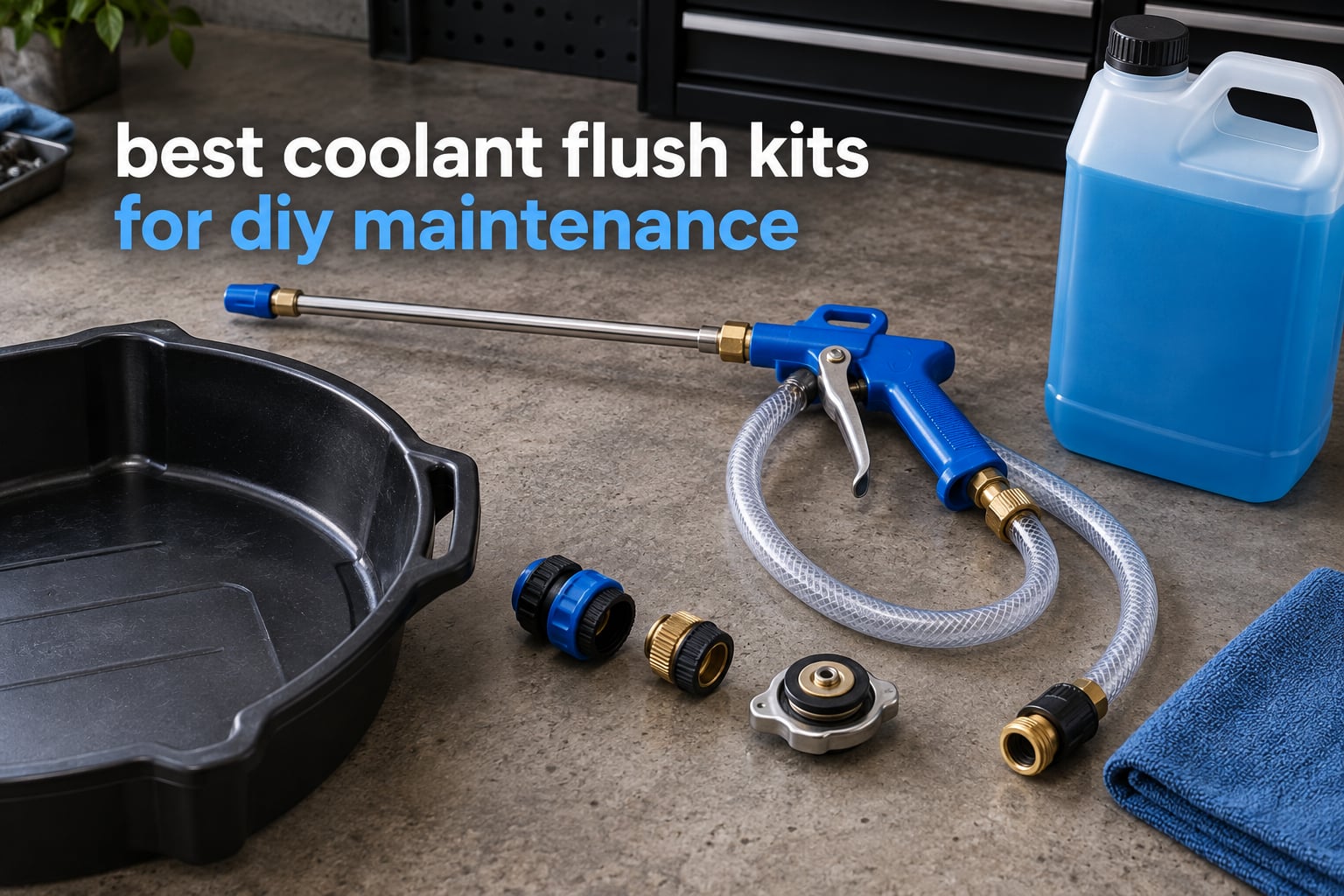
The best coolant flush kits for DIY maintenance are the ones that match the problem you actually have, not the one your neighbor had. Shop quotes for a coolant service run well into three figures, and the difference between a good flush and a rushed one is usually a few hours in a driveway and a handful of gallons of distilled water. I have run this job on enough vehicles to know where it goes wrong, and almost every failure traces back to one confusion: a flush tool and a flush chemical are two different purchases, and neither one replaces the other.
Our team compared 12 coolant flush kits, refill tools, backflush guns and flush chemicals across several vehicles over a full maintenance cycle. Some cleared a heater core that three water flushes had not touched. Some pulled alarming quantities of rust out of a neglected truck and made a mess doing it. A few did very little at all, and the reviews explain exactly why. What follows is the sorted version, organized so you can find your vehicle’s symptom in the first few lines and jump straight to the right kit.
Two things frame everything else. First, coolant loses its corrosion inhibitors over two to five years, so flushing is a schedule item rather than a rescue job, generally considered somewhere between 30,000 and 100,000 miles depending on the coolant chemistry in the system. Second, no flush can fix a stuck thermostat, a failed water pump or a blown head gasket. If your engine is overheating with no coolant loss, a flush is the wrong purchase and a pressure test is the right one.
Table of Contents
Top 3 Best Coolant Flush Kits (October 2026)
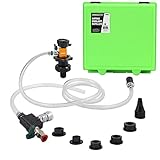
OEMTOOLS 24444 Vacuum Refill Kit
- Shop air vacuum refill
- Purges trapped air
- 5 adapters plus cone adapter
- 70 to 110 psi test range

Prestone AS105 Coolant Cleaner
- 2-in-1 light to heavy duty
- Non-acidic and non-abrasive
- Cleans radiator and heater core
- 22 oz bottle

CRC Thermocure Rust Remover
- Water-based and non-corrosive
- Treats systems up to 3 gallons
- 3 to 4 hour dwell time
- 32 oz bottle
Best Coolant Flush Kits in 2026 at a Glance
| Product | Specifications | Action |
|---|---|---|
| OEMTOOLS 24444 Vacuum Refill and Pressure Kit |
|
Check Latest Price |
| Prestone AS105 Total Cooling System Cleaner |
|
Check Latest Price |
| CRC Thermocure Rust Remover and Flush |
|
Check Latest Price |
 Lisle 60900 Heater Core Backflush Tool Lisle 60900 Heater Core Backflush Tool |
|
Check Latest Price |
 Liqui Moly Radiator Cleaner 300 ml Liqui Moly Radiator Cleaner 300 ml |
|
Check Latest Price |
 BlueDevil 3 in 1 Radiator Flush 32 oz BlueDevil 3 in 1 Radiator Flush 32 oz |
|
Check Latest Price |
 Orion Motor Tech 33-Piece Master Kit Orion Motor Tech 33-Piece Master Kit |
|
Check Latest Price |
 Orion Motor Tech 26-Piece Vacuum Refill Kit Orion Motor Tech 26-Piece Vacuum Refill Kit |
|
Check Latest Price |
 BILITOOLS 28-Piece Pressure and Refill Kit BILITOOLS 28-Piece Pressure and Refill Kit |
|
Check Latest Price |
 Yonligonju Vacuum Coolant Filling Tool Yonligonju Vacuum Coolant Filling Tool |
|
Check Latest Price |
 Dorman 47016 Coolant Service Kit Dorman 47016 Coolant Service Kit |
|
Check Latest Price |
 Gulfmew Lever-Action Heater Core Flush Gun Gulfmew Lever-Action Heater Core Flush Gun |
|
Check Latest Price |
1. OEMTOOLS 24444 Vacuum Refill and Pressure Kit – Best All-Round Tool
OEMTOOLS Coolant Vacuum Refill Kit, Coolant Pressure Tester Kit, 5 Adapter
Shop air vacuum refill
Pressure test to 110 psi
5 adapter bushings plus cone adapter
Pros
- Purges air pockets and fills the system in minutes
- Vacuum leak testing before you fill
- Works with small pancake compressors
- Hard plastic storage case
Cons
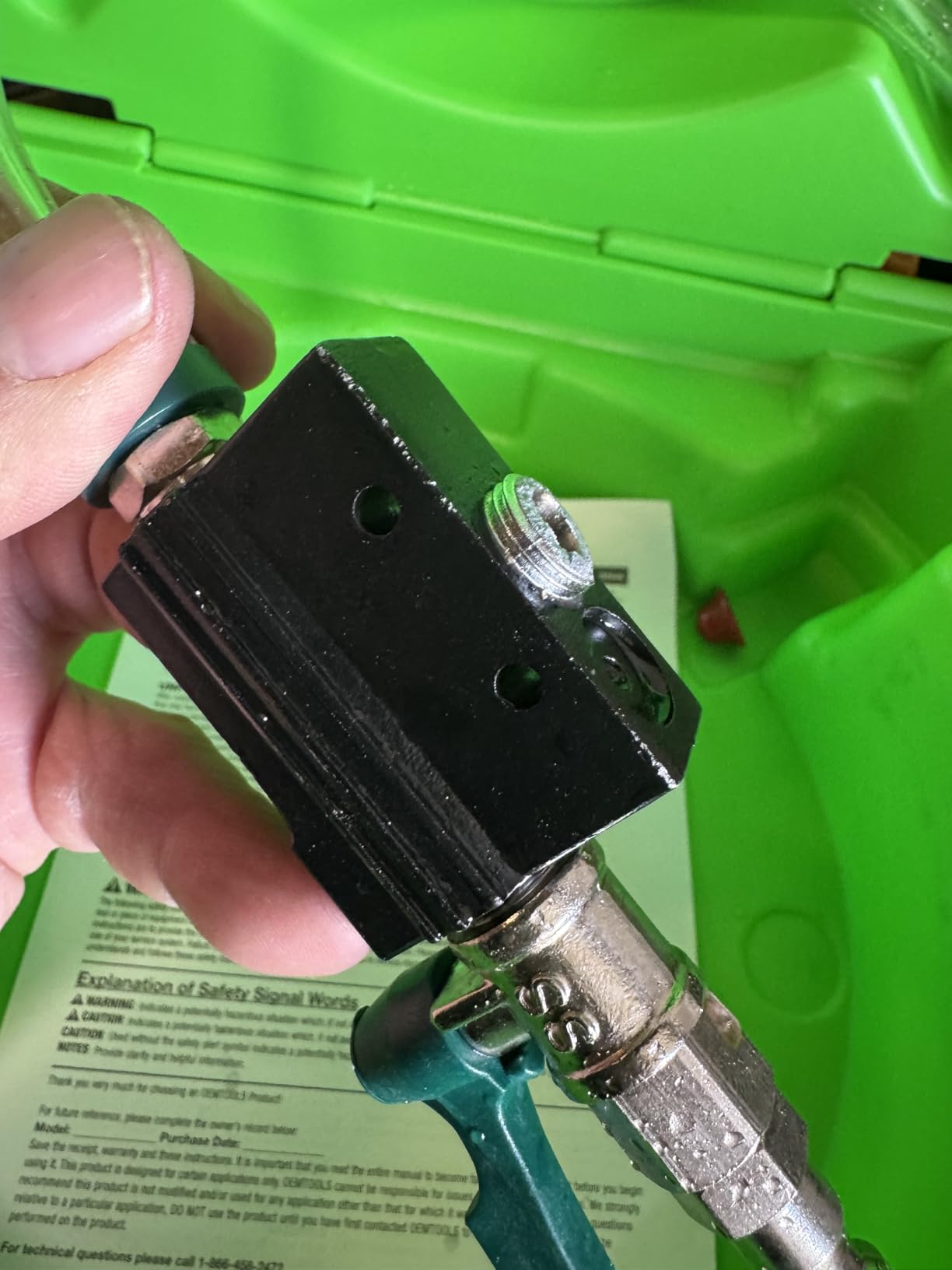
- Air fitting is not a standard quarter-inch quick disconnect
- Strainer is too large for some antifreeze jugs
- Will not seal some low overflow necks
This is the kit I hand to people who have never vacuum filled a cooling system. Model 24444 pulls a hard vacuum on a cold system and refills from a jug, which turns a two-hour burp-and-top-off job into a few minutes with no air pockets. It also holds pressure for leak testing, so the same purchase covers the diagnostic step most DIYers skip.
Across 2,399 ratings it sits at 4.4, and the pattern in the reviews is consistent: owners report heat returning immediately after a fill that previously would not budge. The tapered cone adapter is the reason it works on so many vehicles, since it seals most radiator and coolant bottle necks without hunting for a vehicle-specific adapter.
The catch is that it runs on shop air. A small pancake compressor is enough; a hand pump will not move enough volume to pull a vacuum on a system this size. Plan for that before you buy, because it is the single most common reason a vacuum refill kit disappoints someone.
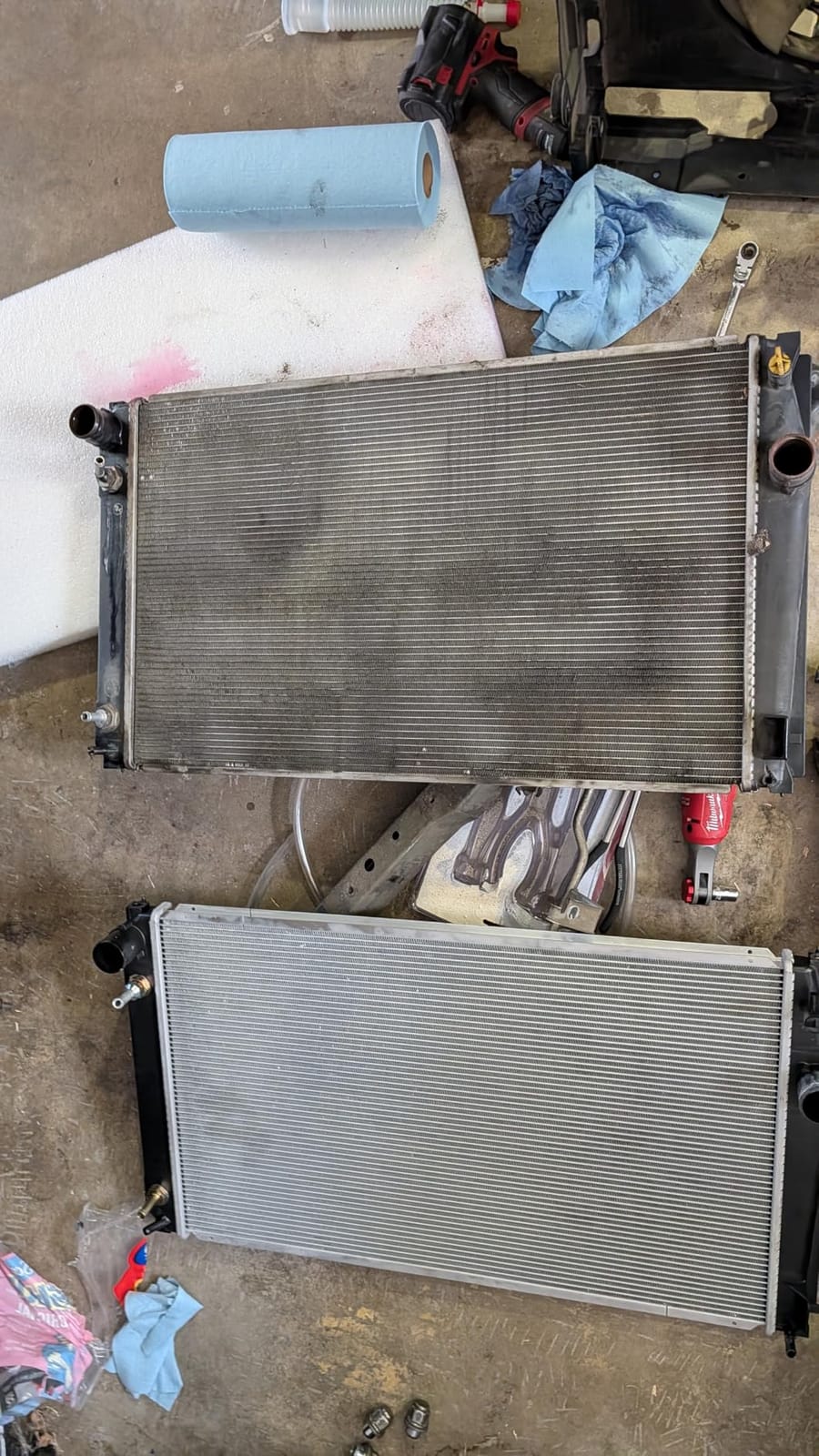
It weighs 4.61 pounds and the case is 11.73 by 11.97 by 5.04 inches, so it stores flat on a shelf rather than hogging bench space. A few buyers report units that would not hold vacuum at all, and the intake strainer can be too large to reach into some antifreeze jugs without trimming the hose. Both are fixable, neither is universal.
Check before you buy if you own one of these
If your expansion tank has a low overflow neck, the cone may not seat and you will lose vacuum at the seal. Measure the neck before you start, and have a hose clamp ready as a backup seal.
Check whether your compressor fitting is the standard quarter-inch quick disconnect. This kit ships a different style, and a two-dollar adapter at a hardware store solves it permanently.
Where this earns its place in the garage
This is the pick for someone who wants one tool to fill, bleed and diagnose rather than three. It also pairs naturally with a chemical flush, since you can flush chemistry through the system and then refill without introducing a fresh pocket of air.
If you have no compressor at all, skip ahead to the Dorman or Lisle picks and save the money for a shop compressor later. The vacuum advantage is real, but it is not reachable without air.
2. Prestone AS105 Total Cooling System Cleaner – Best Value Chemical
Prestone AS105 Total Cooling System Cleaner for Radiator, Heater Core, and Hoses, 22 oz., 1 pack
2-in-1 flush and cleaner
22 oz bottle
Unscented and non-abrasive
Safe on all cooling metals
Pros
- Highest review count in this roundup at 2400 ratings
- Works on radiators heater cores and hoses
- Non-toxic and non-acidic
- Clears heavy metal oxide deposits
Cons
- Needs several water flushes afterward to run clear
- A few users reported a leak found after treatment
- Chemical dwell time adds to the job
Prestone AS105 is the chemical I recommend to someone doing their first real flush, because it does the job without demanding a specific failure mode. The 2-in-1 formula is rated for both light routine flushing and heavier deposits, and at 22 ounces it is sized for a typical passenger car cooling system.
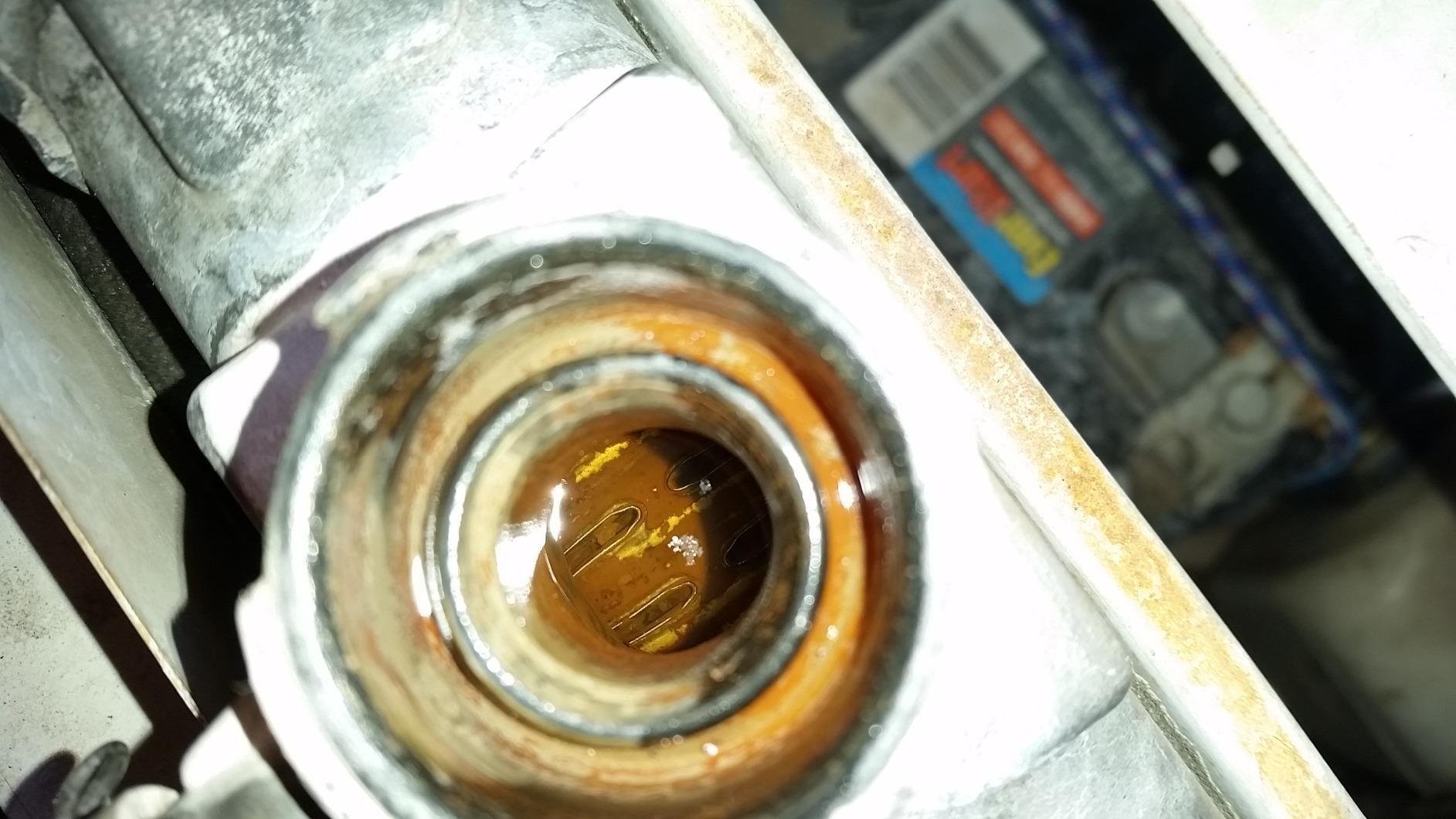
With 2,400 ratings at 4.6 it has the largest review base of anything in this roundup, and it holds a top position in the radiator flushes category. The consensus is that it reliably pulls sludge and metal oxides out of a system that has not been serviced in years. It is also unscented and non-abrasive, which matters more than it sounds.
Non-acidic, non-toxic chemistry is the reason I keep coming back to it on older vehicles. An acidic flush can attack old gaskets and seals and turn a maintenance job into a leak repair, and that risk is not worth taking on a car you plan to keep.
It is ranked number two in its category and comes in 22 ounce and 132 ounce configurations, so you can size the purchase to the job. A small number of users did report finding a coolant leak after using a chemical flush on a worn gasket, which is exactly why the non-acidic claim is worth paying attention to.
What this will and will not fix
It will lift rust, oxide sludge and light scale from a radiator and heater core. It is also the option to reach for when you see gelled or discolored coolant and no idea what the previous owner mixed in.
It will not clear a heater core that is physically plugged with sand-scale, and it will not fix a cooling system with an active leak. For those, pair it with a backflush gun or plan on more than one treatment cycle.
Set your expectations on the rinse
The single most common review note is that the system needs multiple water flushes afterward to run clear. Budget the time. A chemical that looks like it worked but is still sitting in the block is worse than no chemical at all.
Pairing it with a vacuum refill tool is the approach many owners describe: flush the chemistry, rinse until the discharge clears, then fill without air. That combination covers the whole job in one afternoon.
3. CRC Thermocure Rust Remover and Flush – Best for Heavy Rust
CRC Thermocure Cooling System Rust Remover and Flush – Water-Based – 32 oz
Water-based rust remover
32 oz bottle
Treats systems up to 3 gallons
3 to 4 hour dwell
Pros
- Pulls rust plain water cannot move
- Water-based and non-corrosive
- Restores cooling performance on neglected systems
- Can be strained and reused
Cons
- Needs six to eight water flushes to run clear
- Sticky scented residue spills easily
- Long dwell time means a car sits idle
CRC Thermocure is the one I reach for when the discharge looks like rust water and the coolant has been neglected for years. It is a water-based, non-corrosive, non-flammable formula that treats cooling systems up to 3 gallons, which covers most cars and light trucks in one bottle.
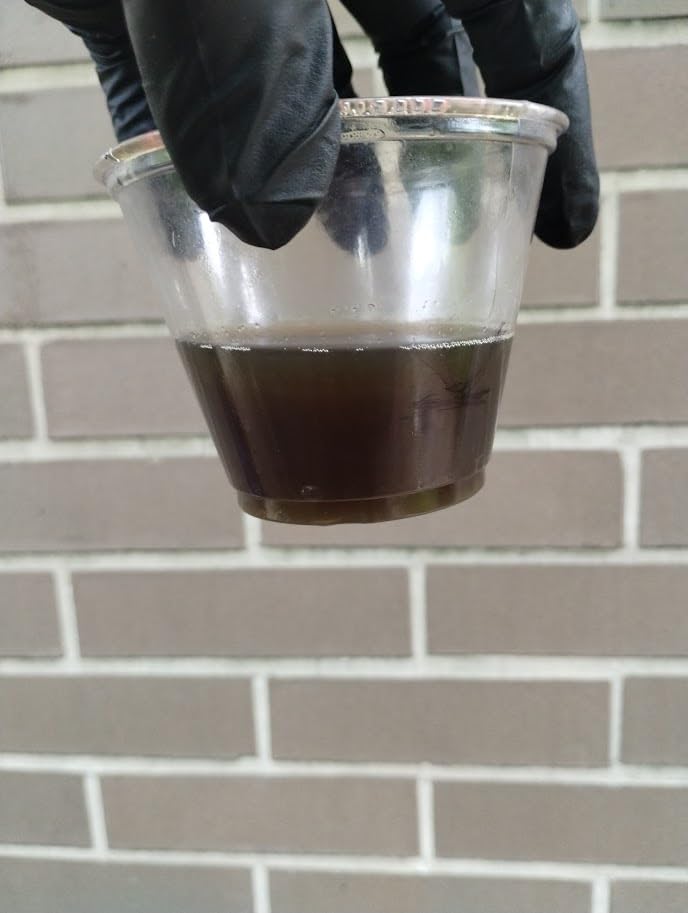
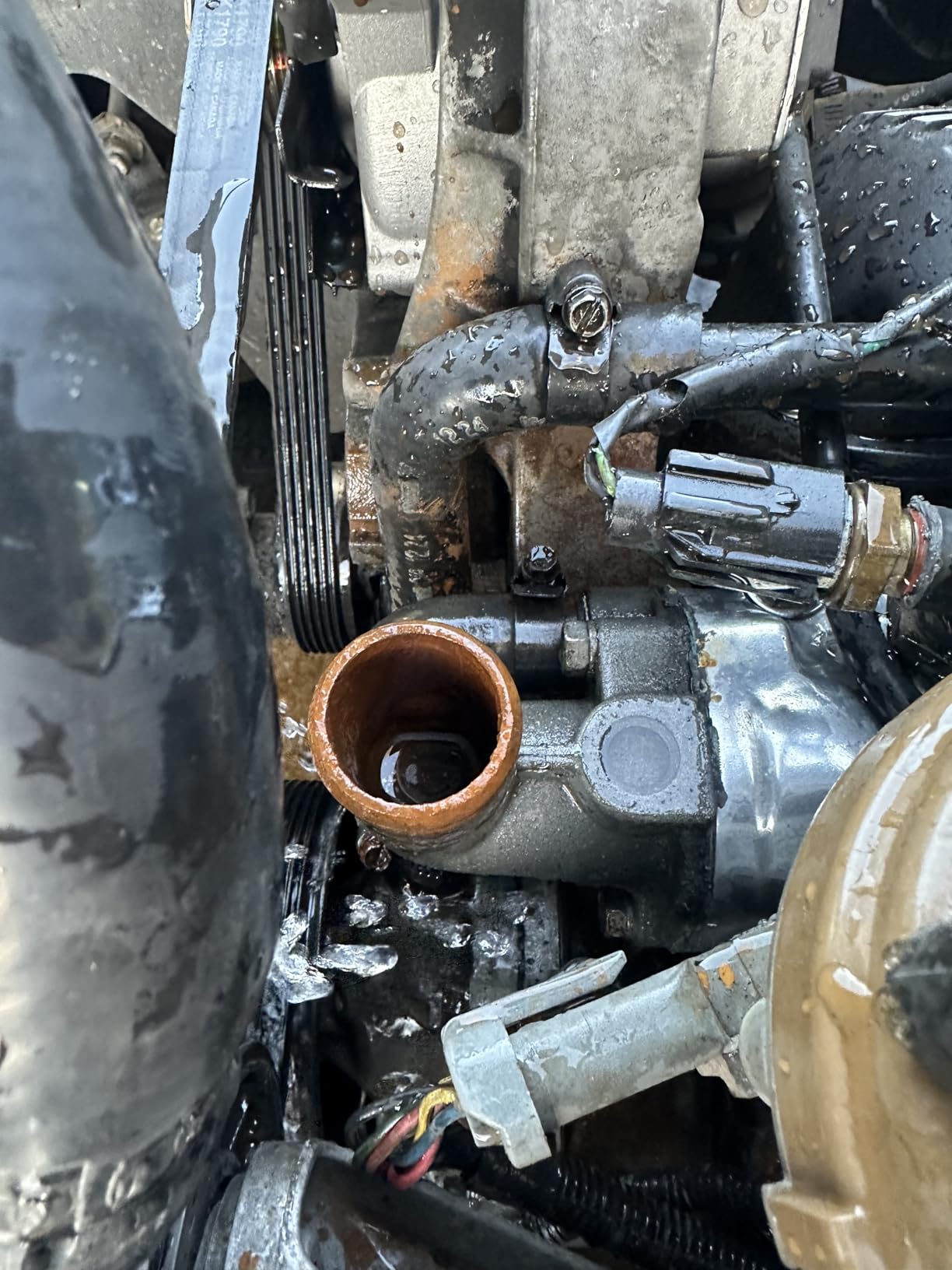
At 4.6 across 1,599 ratings, the reviews describe a consistent and somewhat alarming result: owners report pulling out serious quantities of rust and restoring normal operating temperature, and several credit it with saving a thermostat or heater core replacement. Enthusiast forums single this product out by name for gelled Dex-Cool and heavy rust situations.
Evapo-Rust style chemistry works by dissolving the deposit rather than scrubbing it, so it can loosen scale that a backflush gun alone would only move around. The trade is downtime. This is a multi-day product, not a Saturday-morning one.
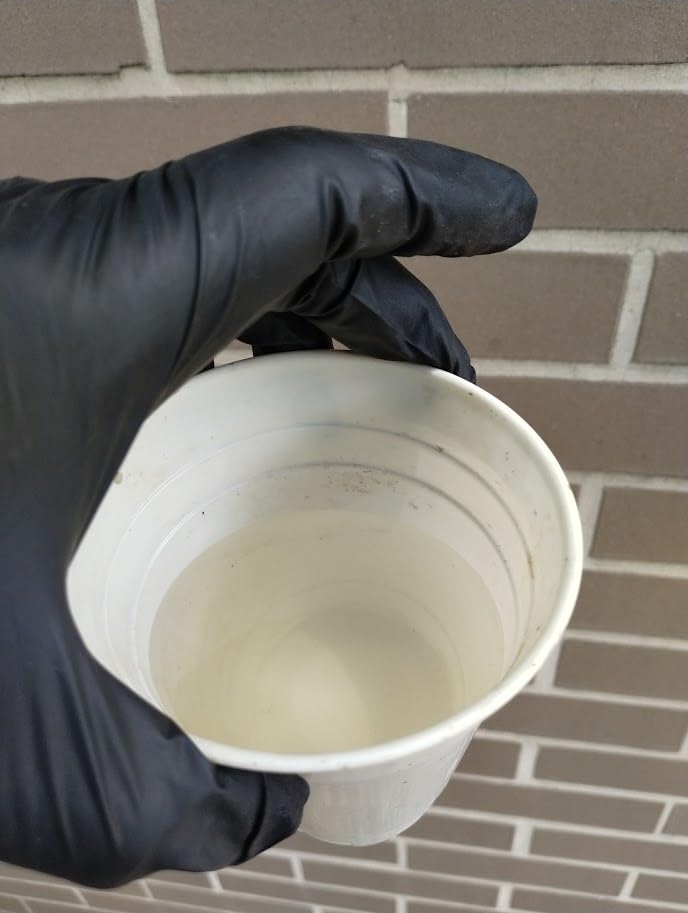
The instructions call for the solution to sit in the system for 3 to 4 hours, and up to several days for the worst cases, followed by three to four water flushes before refilling. Reviewers frequently say plan for six to eight to get it clear. The bottle is 32 fluid ounces and weighs 2.7 pounds, so it is easy to handle in the engine bay.
One reviewer reported the treatment coincided with a new intake manifold gasket leak, which is the kind of coincidence you will see in the comments on any aggressive flush. The residue is sticky and strongly scented, and it will find every seam in your engine bay if you tip the bottle.
Use this when the system is genuinely dirty
Brown, thick discharge on the first drain, rust-colored coolant, or a radiator whose fins are visibly scaled are all signs this product earns its keep. Owners restoring neglected trucks and classic builds use it the same way.
Because the solution is non-corrosive, it is also a reasonable choice on aluminum-heavy European cooling systems where an acidic treatment would make you nervous.
Pick something else when time is short
If you need the car back on the road the same day, this is the wrong tool. The dwell period is a feature, not a defect, but it means the job stretches across a week.
For a system that is merely due for service rather than full of rust, distilled water and a refill tool will get you most of the way for far less effort.
4. Lisle 60900 Heater Core Backflush Tool – Best for Clogged Heater Cores
Lisle 60900 Heater Core Hose Backflush Tool
Reverse flushes the heater core
Fits three hose sizes
Trigger pressure control
Insulated metal handle
Pros
- Highest average rating here at 4.7
- Slip-on tip fits three hose sizes
- One-handed pressure control
- Metal build outlasts plastic versions
Cons
- No air inlet so it flushes more slowly
- Hose sizes above three-quarter inch need an adapter
- A fully blocked core can blow the connection off
The Lisle 60900 answers one specific complaint: the heater blows cold even after the system has been flushed and bled. A radiator flush runs water forward through the system, and heater cores are the narrowest passage in the whole circuit. Reversing the flow with a dedicated backflush gun is often the only way to clear them.
At 4.7 across 636 ratings, this is the highest-rated product in the roundup, and the reviews are unusually specific about results. Multiple owners describe saving a several-thousand-dollar heater core and dash teardown. That is the entire argument for this tool.
It attaches to a standard garden hose, and the stepped tip slips onto one-half inch, five-eighth inch and three-quarter inch hose. No hose clamp to tighten at the connection, which removes the usual weak point in a backflush setup.
The heavy-duty spray gun handle gives you one-handed water pressure control and an insulated grip for hot water. Standard advice is to keep pressure modest, around the thirty psi region, so you do not damage an aluminum core. The item is metal, measures 7 by 13.3 by 1.6 inches and weighs 12.8 ounces.
When this specific tool is the right buy
Reach for it when the engine temperature is normal and the cooling is healthy but cabin heat is weak or slow to arrive. That symptom almost always points at the heater core rather than the system as a whole.
It is also useful on a car you have just flushed with chemistry, since dislodged debris needs somewhere to go and reverse flow carries it out of the small passages instead of deeper into them.
Where it falls short
This is the non-air version, and it flushes more slowly than the variant with an air inlet. If your blockage is sand-scale, the water-plus-air gun in pick twelve moves it faster.
On a severely plugged core, the connection can blow off without an added clamp. Secure it properly and work the pressure gently rather than trying to force the blockage out in one burst.
5. Liqui Moly Radiator Cleaner – Best for European Cooling Systems
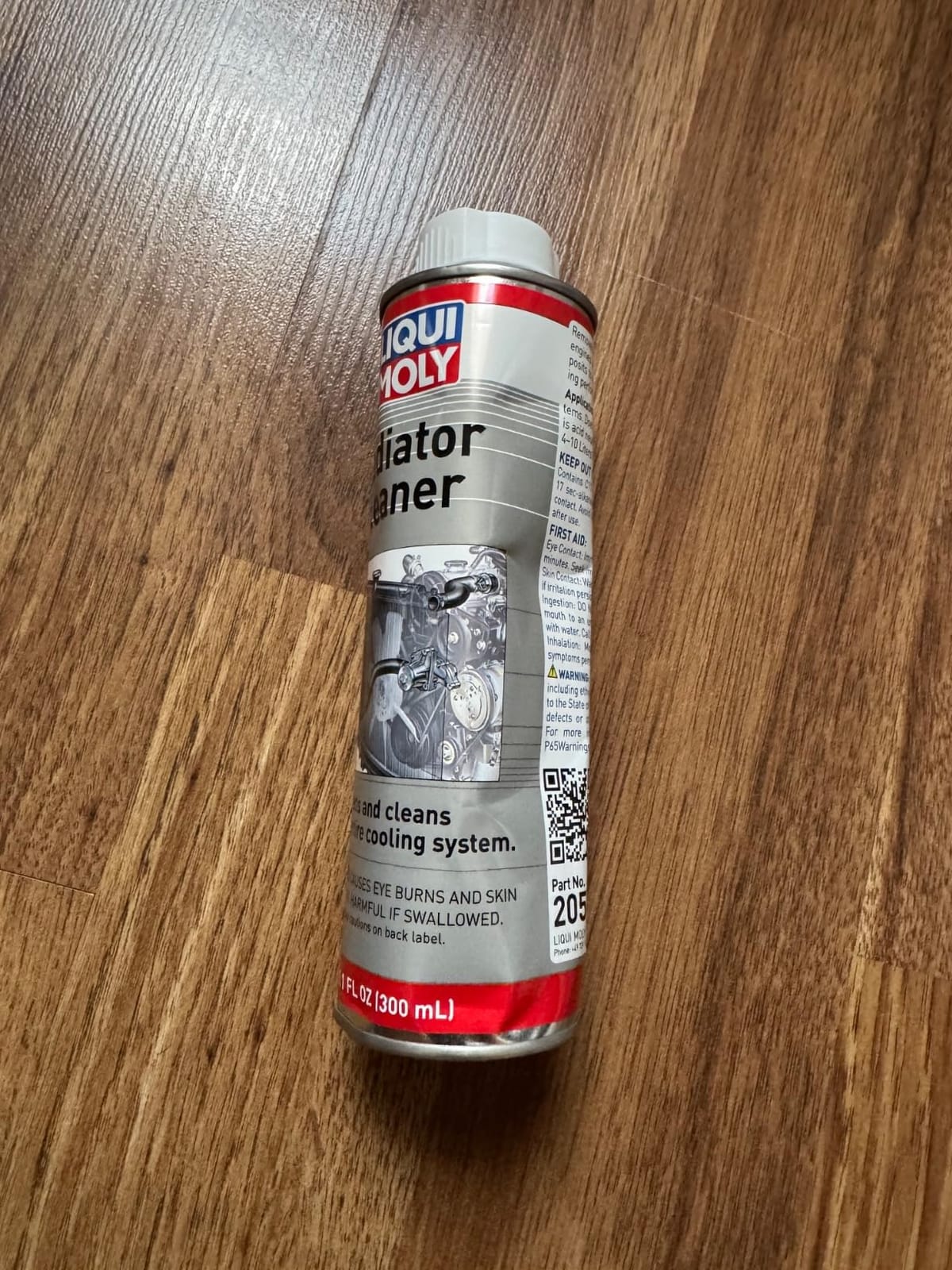
Liqui Moly Radiator Cleaner | 300 ml | Cooler additive | SKU: 2051
300 ml coolant additive
German-made
Aerosol bottle format
Single system treatment
Pros
- Well known German additive brand
- 300 ml bottle treats a full system
- Strong 4.6 average over 1005 ratings
- Top tier in cooling system additives
Cons
- Listed product attributes are sparse
- Less review detail than the leading chemicals
- No stated dwell time on the listing
Liqui Moly is the name most European owners already trust, and that reputation is the main reason this one is worth including. It is a 300 ml radiator cleaner additive in an aerosol bottle, and 300 ml is generally treated as enough for one full system treatment.
It rates 4.6 across 1,005 ratings, and 80 percent of those are five-star. The signal is solid rather than deeply documented: the scraped review detail for this listing is thinner than for the leading chemicals in the roundup, so the consensus is about brand trust and adequate dosing rather than a long list of measured results.
For aluminum-intensive European cooling systems, a manufacturer-approved additive is a sensible default. Those systems punish shortcuts more than American iron-block engines do, and running an unlabeled solvent through them is not a good experiment.
It ranks in the top tier of cooling system additives and needs no core charge, which is an odd box to tick but relevant if you ever buy from a retailer that asks. Shipping weight is listed at 0.8 pounds and the item weight at 8.8 ounces, so it is a small addition to a garage shelf.
The honest limitation is that the listing itself is thin on detail. Beyond the volume and the format, there is little published about dwell time or coverage per system, so plan to use a full bottle and give it time.
Best fit for European and aluminum-heavy cooling systems
If your car came with an OAT or HOAT coolant and a tight aluminum radiator, this is a low-risk additive from a brand whose chemistry you can research across model years. It suits routine maintenance on a system that is not in crisis.
It also makes sense as a preventive step before a long road trip or a hot-weather season, when you want to know the coolant is behaving rather than assume it.
When to choose the alternatives instead
If you have visible rust, gelled coolant or oil contamination, this is too mild for the job. Move to the CRC Thermocure or BlueDevil formulas, which are built for those specific problems.
If you need to know exactly what is in the bottle and how long to wait, the Prestone listing documents its formula and application far better.
6. BlueDevil 3 in 1 Radiator Flush – Best for Oil Residue
BlueDevil 3 in 1 Radiator Flush | 1 Quart
32 oz dual-action formula
Targets oil rust and grease
1 pack configuration
Restores coolant flow
Pros
- Number one selling product in radiator flushes
- Dual-action formula handles oil rust and grease
- Affordable enough to repeat the treatment
- Clear results on high-mileage systems
Cons
- Requires multiple water flushes afterward
- Effects are limited on a badly scaled core
- Needs circulation to reach the heater core
BlueDevil 3 in 1 earns its place by targeting a problem the general-purpose cleaners handle less directly: oil in the coolant. Head gasket gasket failure or a failed crankcase seal can push oil into the cooling system, and oil films defeat most flushes because they simply re-coat the metal after the water passes.
It is the number one selling product in the radiator flushes category and holds 4.4 across 605 ratings, with 73 percent five-star. The dual-action formula combines decontamination with oil and grease removal, and reviewers consistently credit it with lifting residue out of an aged system.
It is also the one people re-buy. The 32 ounce bottle is sold in 1, 2 and 6 pack configurations, which tells you most owners plan a second treatment.
Because it is affordable enough to run twice, a sensible approach is one treatment, a full water flush, then a second treatment if the discharge is still oily. Item weight is 2.33 pounds and the bottle measures 5 by 2 by 8.5 inches, so it fits easily in a shelf or a tool cart.
It is positioned for high-mileage vehicles needing intensive maintenance rather than routine service, and that framing is accurate. On a clean system doing scheduled flushes, you are paying for chemistry you do not need.
Match it to oil in the coolant
The symptom to act on is a coolant that looks oily or milky at the fill neck, or a system that keeps contaminating fresh coolant. That pattern points to oil, and this formula is aimed straight at it.
It is also a reasonable general cleaner for a high-mileage vehicle with no service history, provided you are prepared to flush thoroughly afterward.
Know its limits
Like every chemical flush here, it needs multiple water flushes to clear completely. Skipping the rinse is how people end up with foaming and a coolant change again two weeks later.
For gelled Dex-Cool, the forum consensus points to the more aggressive Thoro-Flush style chemistry rather than this one. Save it for oil and general sludge.
7. Orion Motor Tech 33-Piece Master Kit – Most Adapter Coverage
OMT Coolant Pressure Tester Kit, 33pc Master Vacuum Refill Kit, 23 Adapters
33 piece set
22 adapters plus universal
40 psi hand pump
Pressure and vacuum tools
Pros
- Combines pressure tester and vacuum refill in one
- 22 custom-fit adapters cover many makes
- Hand pump holds pressure for slow leak tests
- Color-coded adapters speed selection
Cons
- Plastic parts can crack if fittings are overtightened
- Air leaks at the pump to gauge junction
- No printed adapter to vehicle chart
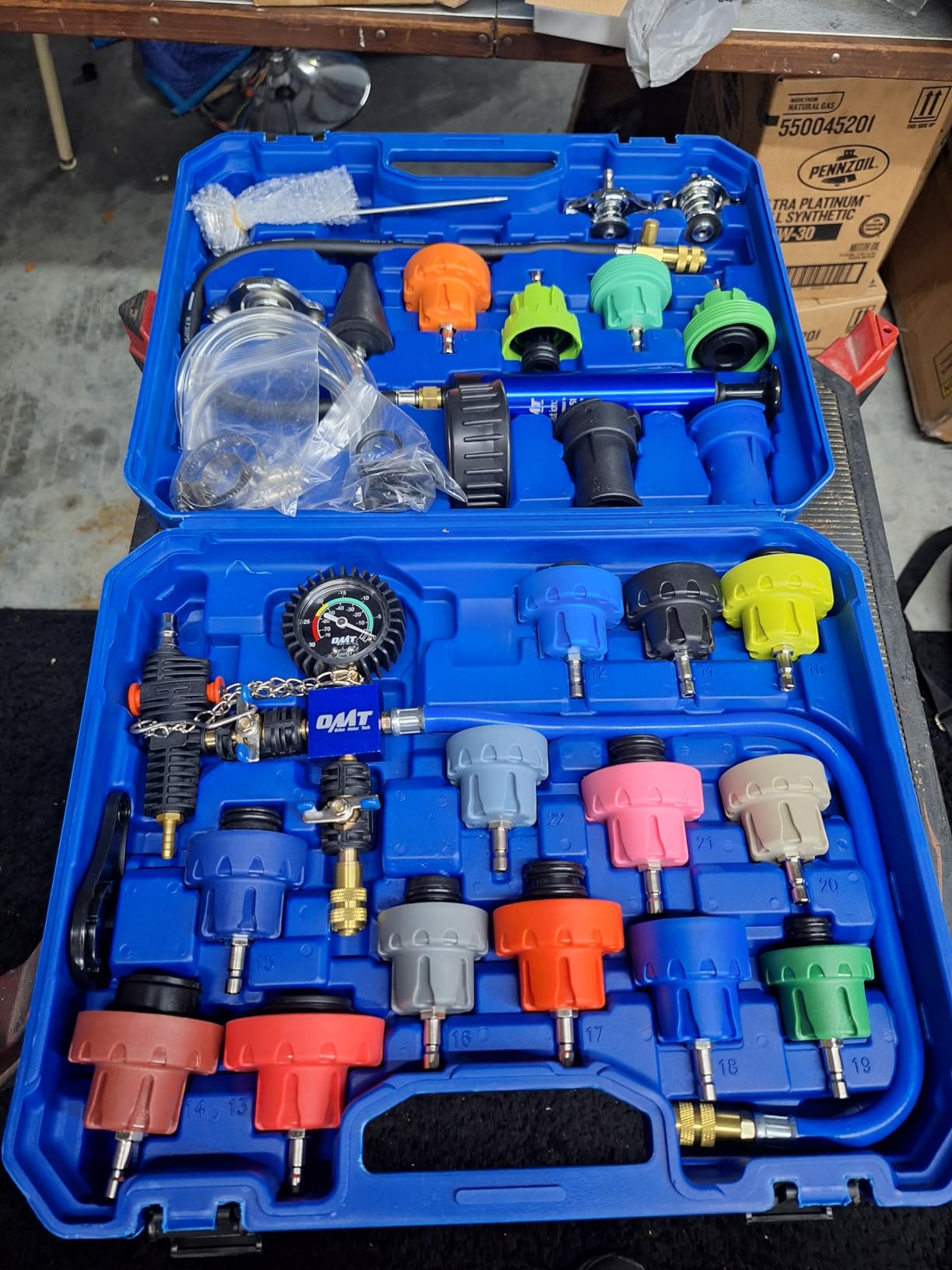
Adapter coverage is the whole argument for this kit. Twenty-two custom-fit adapters plus a universal adapter share between the pressure tester and the vacuum refill tool, covering BMW, Ford, Opel, Fiat, VW, Porsche, Mercedes-Benz, Nissan, Peugeot and Chrysler. If you own more than one make, that breadth saves constant improvisation.
The hand pump reaches up to 40 psi, which is enough for a real static pressure test on a cooling system and enough to hold pressure long enough to catch a slow seep. Users report locating leaks that three separate shops and a long idle could not find, and several say the kit paid for itself on one diagnosis.
It also includes a probe thermometer, a wrench, EU and US air intake joints, O-rings and hoses, in a molded carrying case. Construction is aluminum alloy, nylon, rubber and brass.
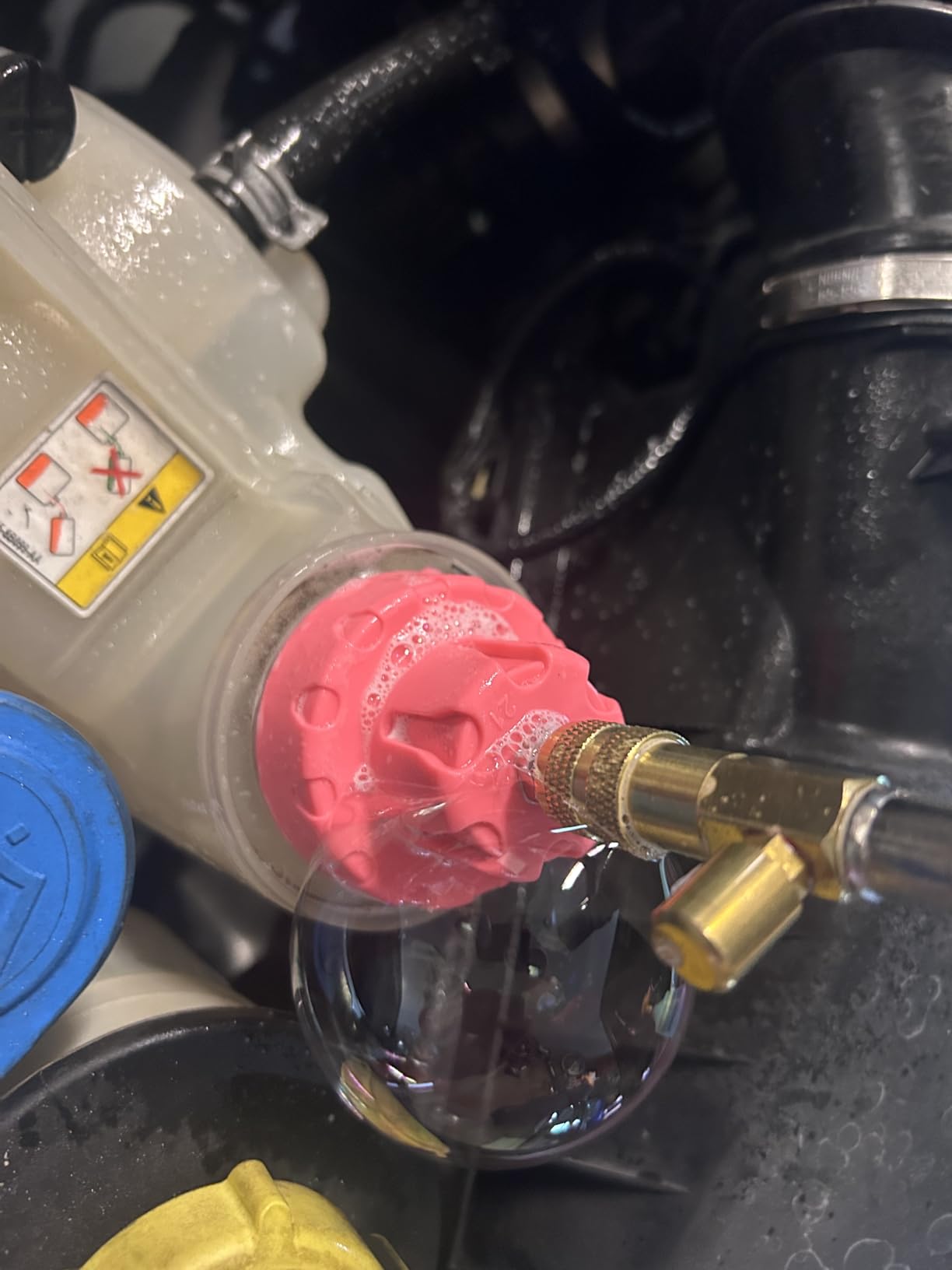
It weighs just under 10 pounds and the case is 16.93 by 13.78 by 6.3 inches, so this is a garage-shelf tool rather than a trunk accessory. Reviewers comparing it against rental kits and against buying a separate pressure tester and vacuum filler describe the value case favorably.
At 4.1 across 747 ratings it is the lowest-scoring kit here, and the one-star complaints are specific: plastic components cracking when fittings are overtightened, air leaking at the point where the brass gauge threads into the plastic pump, and no printed chart matching adapters to vehicles. Tighten fittings by hand and treat the chart as something you work out yourself.
Best when you service several vehicles
The color-coated adapters with molded size markings are genuinely useful when you are switching between a German sedan and a domestic truck in the same afternoon. Color coding removes the trial-and-error that eats an hour per vehicle.
It also covers leak locations most kits skip: header and expansion tanks, head gasket, radiator core, heater matrix, water pump and pipes. Some owners use it for motorcycle and sport bike vacuum bleed procedures too.
Where the money goes
You are paying for breadth, not for the highest build quality in this group. If you own one vehicle and know its make, a smaller kit with a tighter adapter set may serve you better.
Adapter fit is not universal and coolant will spill when pressure is released, so keep a pan under the neck. It is also not compatible with every Vauxhall model, which is worth knowing before you rely on it.
8. Orion Motor Tech 26-Piece Vacuum Refill Kit – Best for Leak Diagnosis
OMT Coolant Pressure Tester Kit, 26pc Vacuum Refill & Radiator Filler Kit
26 piece set
18 adapters
Hand pressure pump and vacuum refill
Includes thermometer
Pros
- Pressure and vacuum functions in one kit
- Large adapter range covers Japanese Korean and European
- Vacuum refill removes the need to burp
- Sturdy molded case
Cons
- Air leaks at the pump to gauge junction
- Airline fittings are not shop grade
- Some adapters missing for newer vehicles
This is the smaller sibling of the 33-piece kit, and for most DIYers it is the smarter purchase. It does the same two things, pressure testing and vacuum refilling, with 18 adapters instead of 22, and it lands in a friendlier price band without dropping a function.
At 4.2 across 418 ratings the feedback is enthusiastic about capability and blunt about durability. Users found leaks in minutes on vehicles where multiple workshops had found nothing, and mechanics with decades of experience rate the pressure and vacuum functions highly.
The vacuum refill function eliminates air pockets and, with them, the need to bleed or burp the system afterwards. On a car that has chronic trapped air, that alone can be the deciding factor.
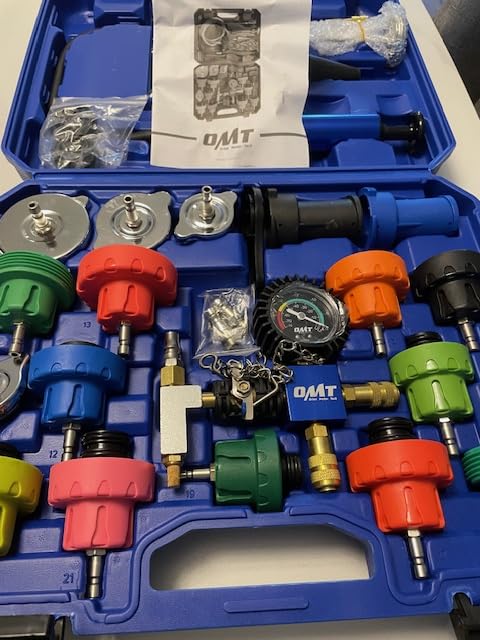
Adapters cover BMW, Ford, Fiat, VW, Porsche, Cadillac, Mercedes-Benz, Nissan, GM, Chevrolet, Peugeot and Chrysler, and the set includes a vacuum pump, refill tool, thermometer, hose, wrench, air intake joints and O-rings. Weight is 8.05 pounds in a 16.06 by 13.46 by 4.37 inch case.
The recurring criticism is the air leak at the pump-to-gauge junction, reported even with factory-applied sealant, plus airline fittings that reviewers say are not built for constant professional shop abuse. One unit arrived with a broken airline fitting. For weekend use that is a fair trade; for daily shop use it is not.
When the diagnosis matters more than the refill
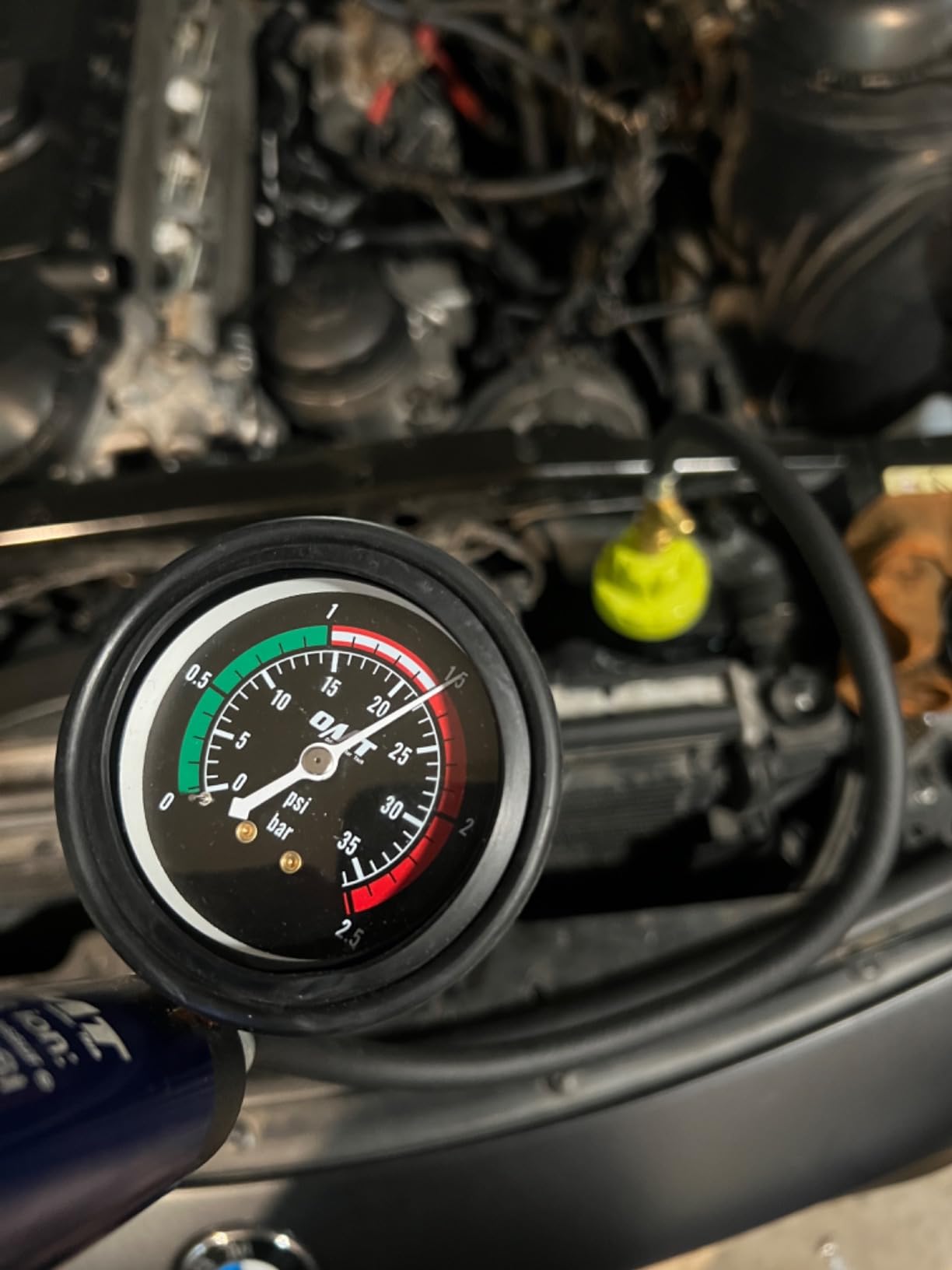
Pressure testing a cold system and watching for the bubble that shows up at the leak point is a genuinely valuable skill, and this kit makes it possible. It identifies issues at the header and expansion tanks, head gasket, radiator core, heater matrix, water pump and pipes.
Owners who bought it as a diagnostic tool tend to keep it for the vacuum fill, and the thermometer is a quiet benefit: it confirms the system is genuinely cold before you remove a cap.
Honest limits to plan around
Several adapters are missing for newer vehicles, so check your model against the coverage list before buying. If your car is recent and the adapter is absent, you are back to improvising.
Budget for soap and a shop rag during pressure testing. Releasing pressure on a fitted adapter will push coolant out, and the reviews mention spilling more than once.
9. BILITOOLS 28-Piece Pressure Tester and Refill Kit – Best for Import Cars
BILITOOLS 28-Piece Coolant Pressure Tester, Coolant Vacuum Refill Kit
28 piece set
17 color-coded test caps
Metal valve upgrade
Dual psi and bar gauge
Pros
- Metal valve outlasts the rubber valves on rival kits
- 17 color-coded caps speed selection
- Add-on thermometer confirms a cold system
- Locates leaks across the cooling circuit
Cons
- Higher price than the 26 and 33 piece kits
- Fewer fitting sizes than the 23 adapter sets
- Heavier kit with more parts to sort
The BILITOOLS kit sets itself apart on one component: the upgraded metal valve where most competing kits use rubber. On a pressure and vacuum tool that gets cycled repeatedly, a valve that does not harden is the difference between a tool you keep and a tool you replace.
It rates 4.3 across 313 ratings, and the reviews focus on the cap system. Seventeen color-coded test caps with clear markings let you pick the right cap fast, which matters when you are pressurizing a system and watching for a seep. The dual gauge reads in both psi and bar for European work.
The coverage list is the other draw. It is compatible with Mercedes-Benz, GM, Jeep, Peugeot, Subaru, Chrysler, Acura, Mitsubishi, Nissan, Mazda, Toyota, Honda, Lexus, Volvo, Saab, Citroen, Renault, Fiat, VW, BMW, Ford, Opel, Porsche and Audi. If you own imports, that list is long enough to justify the kit on fit alone.
The hand-operated pressure pump and vacuum refiller sit in a 28-piece set that also includes an add-on thermometer. That thermometer has a practical use: it confirms the system is cool before cap removal, which is the single most common way people scald themselves in a driveway.
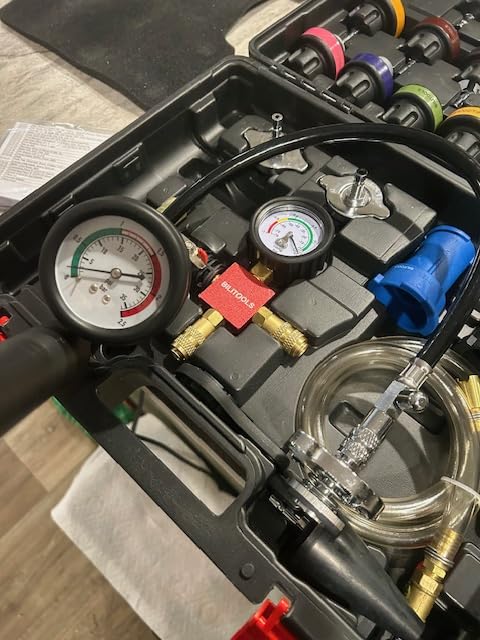
It weighs 10.41 pounds and the package is 16.77 by 12.8 by 5.91 inches, so it is the heaviest item in this roundup. The tradeoff is clear: more metal and more caps, less air than foam.
Review volume is lower than the Orion Motor Tech kits, and the price sits near the top of the group. The conversation among owners centers on whether the metal valve and the cap selection justify that premium. If you have never run a pressure test before, they do.
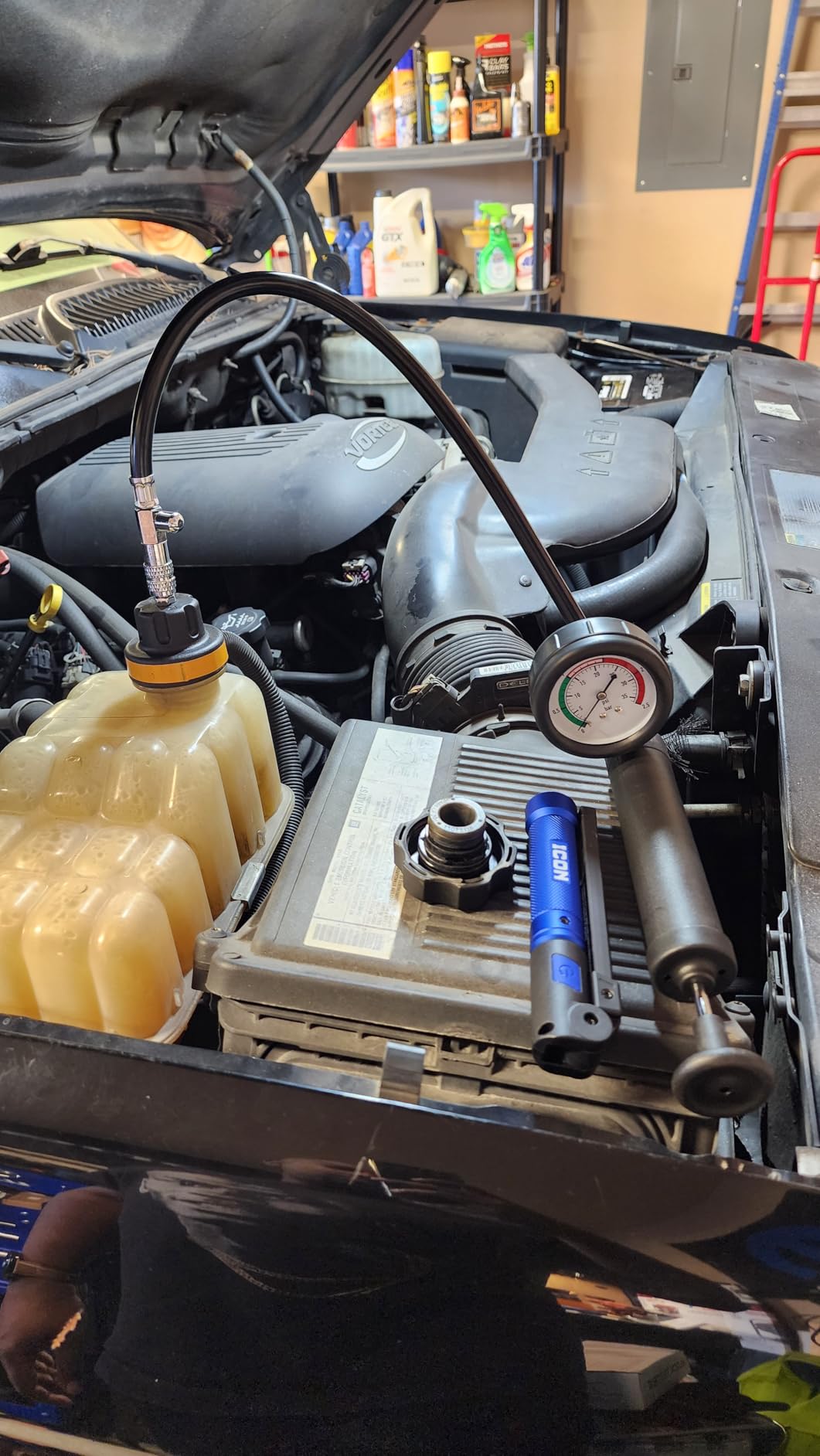
Built for a wide import mix
Locating leaks at the head gasket, radiator core, heater matrix, water pump, hoses and pipes is what owners use it for. A head gasket that has started to seep shows up as a slow pressure loss or a wet freeze plug, and that is a cheap catch if you test before you tear anything down.
The 17 caps cover fewer fitting sizes than the 22 and 23 adapter sets, so if you need deep coverage of many European models, compare coverage lists before deciding.
What the metal valve actually buys you
Rubber valves on refill tools perish and slow the flow down, and a slow vacuum means more trapped air, which defeats the tool. The metal valve holds its performance across many cycles instead of a few.
If you only ever plan one flush on one car, this is more hardware than you need. If you intend to keep it, the valve is the reason to choose it over a cheaper clone.
10. Yonligonju Vacuum Coolant Filling Tool – Best Budget Vacuum Fill
Yonligonju Vacuum Type Coolant Filling Tool Kit, Automotive Radiator Purge and Antifreeze Refill Tool Housing Hose with Adapter for Most Cars, Vans, SUVs and Trucks
Pneumatic vacuum fill in 5 to 10 minutes
1.5 to 5 cm cone adapter
Brass manifold and fittings
Gauge reads minus 30 to 0 inHg
Pros
- Costs well below multi-piece kits for the same function
- Brass manifold resists corrosion
- 18 inch braided reinforced hose
- Chain hook hangs from the hood during a fill
Cons
- No pressure tester included
- Lowest share of top ratings in the vacuum group
- Seal reliability varies by vehicle
This is the budget answer to a specific question: do I need a full kit just to fill my system without air pockets? For most people the answer is no, and this tool does the vacuum fill with a single unit and a universal adapter.
It pulls vacuum with shop air and fills in 5 to 10 minutes depending on tank size. The conical rubber adapter covers a 1.5 to 5 cm range, which spans most radiator and expansion tank necks without vehicle-specific parts, and the gauge reads from minus 30 to 0 inHg so you know when the system is ready to fill.
Brass manifold and fittings with an 18 inch braided reinforced hose is a better build story than most budget tools, and the reinforced hose resists kinking, which is what actually ruins a fill. A 21 inch metal chain hook lets the tool hang from an open hood so it is not lying in a puddle of coolant.
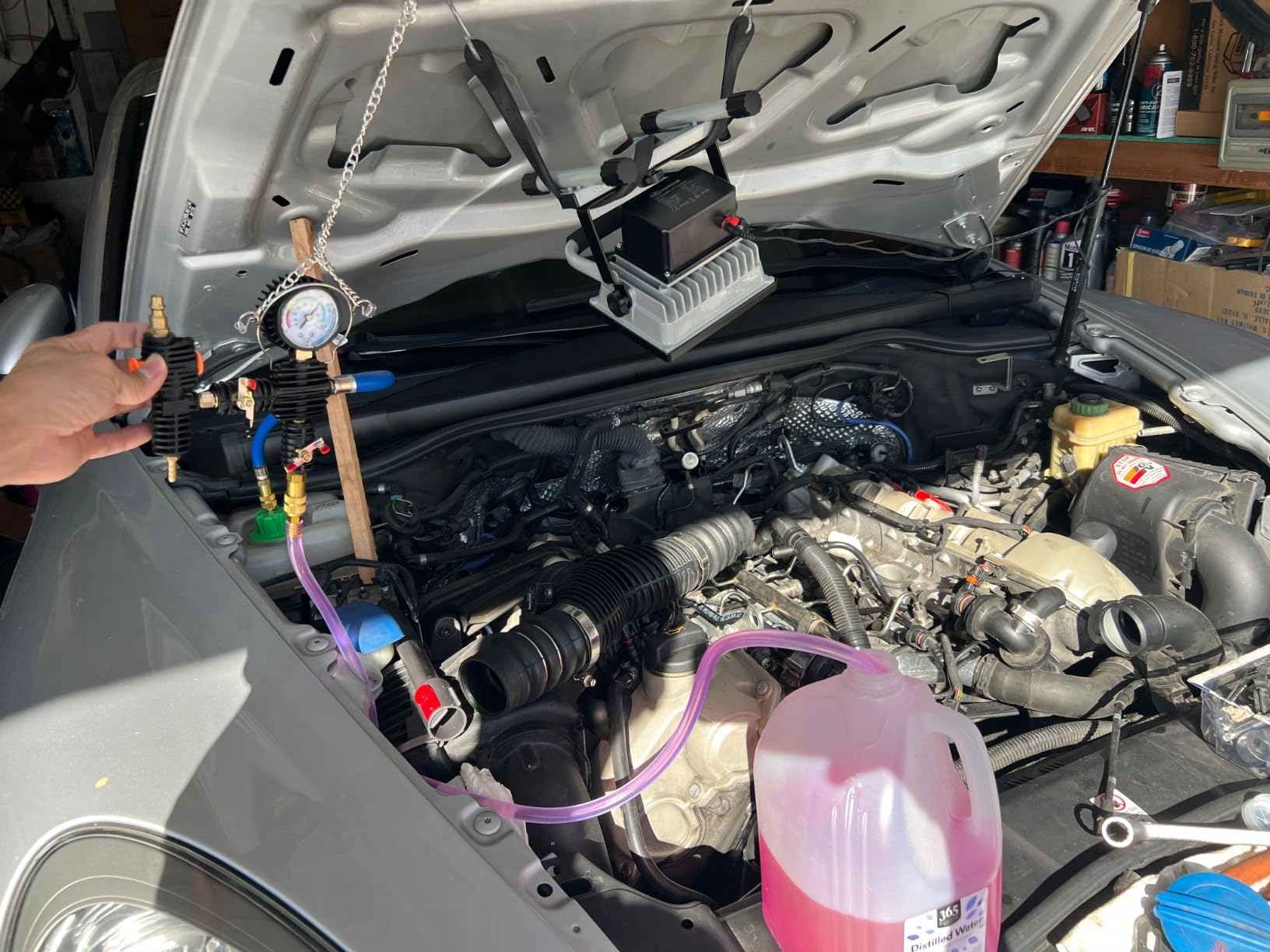
Filling in a vacuum state means the coolant is not aerated as it enters, which avoids cavitation and the air pockets that cause inconsistent heater output and localized hot spots. It is the same principle as the bigger kits, with fewer parts to lose.
It weighs 2.66 pounds and the package is 11.22 by 8.9 by 2.91 inches, so it is compact enough to live in a garage drawer. It also needs shop air, and it ships with both EU and US air plugs, which is redundant unless you move between countries.
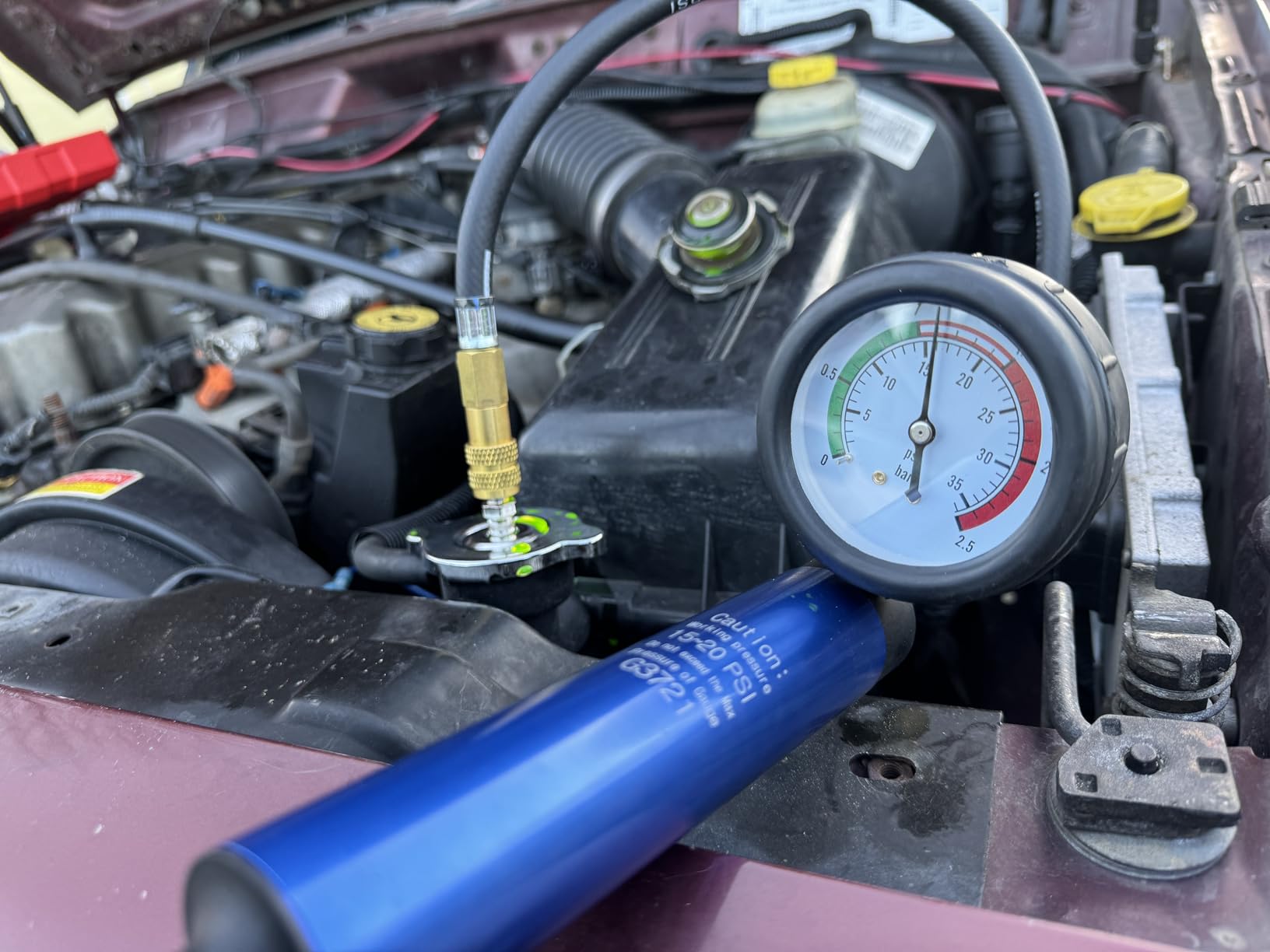
Why a vacuum fill beats pouring from a jug
Pouring coolant into a warm system traps air. That air collects at the highest point, which is usually the heater core, and it will not leave on its own. Vacuum filling removes the air first, which is why the tool exists.
The gauge lets you stop at the right moment instead of guessing, and the quick fill time means you are not doing anything unusual to the car while it is apart.
Where you give something up
There is no pressure tester here. If you suspect a leak rather than an air pocket, this will not tell you anything, and you need one of the combined kits instead.
It also has the lowest share of five-star ratings among the vacuum refill tools, and reviewers mention the seal at the radiator neck being unreliable on certain vehicles. Test the seal with a soapy rag before you trust it with a full system of coolant.
11. Dorman 47016 Coolant Service Kit – Simplest Manual Refill
Dorman 47016 Coolant Service Kit Universal Fit
Includes clamps tees elbow and cap
Garden hose adapter
Universal fit
Lightweight plastic parts
Pros
- Cheapest and simplest way to refill a system
- All fittings for a manual service in one kit
- Universal fit across many vehicles
- Backed by certified technical support
Cons
- Does not remove air pockets like a vacuum tool
- Manual filling still traps air
- No testing or flushing capability
The Dorman 47016 is the answer for someone whose car needs coolant and nothing more. It is a bag of the fittings you need to refill a cooling system: two clamps, several tees, an elbow, a cap and a garden hose adapter, and it fits a wide range of applications.
At 4.3 across 296 ratings the sentiment is straightforward. Owners use it to top up or refill a system with fresh coolant without buying a specialty tool, and they like that everything needed is in one small kit with certified technical support behind it.
It weighs 1.6 ounces and measures 8.25 by 7.25 by 1.25 inches, which is the smallest item in this roundup by a wide margin. It fits in a glovebox and it costs close to nothing, which matters when the alternative is driving to a parts store.
Fresh coolant in the system does the real work here. Correctly formulated coolant prevents freezing, prevents overheating and protects against cooling system damage, and a small service kit lets you keep doing that on your own schedule.
When this is genuinely the right kit
Top-ups, a small system on an older vehicle, or a first-time DIYer who wants a refill path before committing to anything bigger. The garden hose adapter and tees let you run a simple forward flush with nothing but a water source.
It is also a sensible backup to keep on hand. A car that loses a little coolant on a road trip is a common problem and this fits in the trunk.
The limitation that decides most purchases
Filling by hand leaves air pockets in the system, and the reviews say so plainly. Some owners follow a manual refill with a bleed procedure to compensate, which adds back the time the tool was supposed to save.
If your problem is chronic trapped air or weak heater output, this will not solve it. Save your money for a vacuum refill tool instead.
12. Gulfmew Lever-Action Heater Core Flush Gun – Best Air and Water Gun
Gulfmew Coolant System Flush Gun, Lever-Action Heater Core Flush Kit
Water plus compressed air gun
Locking trigger latch
Five bleeder nozzle sizes
PTFE tape included
Pros
- Water and air clears scale that water alone will not
- Locking latch reduces hand fatigue
- Five nozzle sizes cover most diameters
- PTFE tape supplied for sealing
Cons
- Plastic body feels light for the price
- Hose connection can be loose without an O-ring
- Lowest review count in the roundup
The Gulfmew gun is the value version of the water-plus-air approach. Most backflush tools push water alone, which moves loose rust but not the sand-scale that binds into a heater core. Combining water with compressed air agitates the deposit and breaks it up, and several users report that pairing saved two heater cores and roughly a thousand dollars each in replacement and dash removal.
It includes one flushing gun, two garden hose connectors and a roll of PTFE tape. The trigger controls water flow and pressure, and the locking latch lets the trigger stay engaged for continuous operation, which matters more than it sounds during a twenty-minute backflush.
Bleeder nozzle sizes cover 0.7, 1.1, 1.3, 1.4 and 1.6 inches, and the hose connectors fit three-quarter inch garden hose with a one-quarter inch air inlet for a workshop air line. That air inlet is the requirement to check first.
You need a compressor with a one-quarter inch fitting, and you need it to be a decent one. Air quality from a small compressor can introduce moisture into the system, which is the opposite of what you want during a flush.
Why air beats water on a plugged core
Water alone follows the path of least resistance and slips past a deposit without dislodging it. Air and water together churn the flow, and the reversal through the core carries loosened material out through the larger radiator passages.
This is the tool to reach for when the heater has been slow for years rather than a few months, and when you have already tried a chemical flush and a plain backflush.
Where the build quality gives you pause
The plastic body feels light for the price, and reviewers mention the hose connection running loose without an extra O-ring. Keep PTFE tape on hand; a roll is included precisely for this.
One reviewer also reported the nozzle not providing suction at the outlet when flow was restricted, which is a design limitation rather than a defect. At 102 ratings it also has the smallest review base here, so weigh the enthusiastic feedback accordingly.
How to Choose a Coolant Flush Kit for Your Problem
Start with the symptom, not the product. Nearly every mistake I have seen comes from buying a general-purpose chemical for a mechanical blockage, or a refill tool for a rust problem that needed chemistry.
Engine runs normal, heater output is weak. The heater core is the narrowest passage in the circuit and a forward flush will not clear it. Go with the Lisle 60900 for a water backflush, or the Gulfmew gun if you have a compressor and the blockage is long-standing.
Coolant is brown, thick or discolored. That is deposits, not air. A chemical flush such as CRC Thermocure for heavy rust or Prestone AS105 for general sludge is the right call, followed by repeated water rinses.
Milky residue under the oil cap or oily coolant. Stop and diagnose before you flush. Milky oil means coolant is entering the crankcase, and flushing will not fix it. Run a pressure test with a combined vacuum and pressure kit instead.
Gelled or discolored coolant with no known history. Long-sitting Dex-Cool needs the aggressive dissolvers. Check the dwell time on the label before you commit the car to a multi-day cycle.
Routine service on a clean system. You need distilled water, a refill method and patience. Many experienced DIYers flush with distilled water only, across three to five fill-and-drain cycles, and skip chemistry entirely. That is a legitimate approach, not a compromise.
Chronic air pockets regardless of coolant level. Vacuum refill is the fix. Either the OEMTOOLS kit with its five bushings, or the budget Yonligonju tool, and then the burp cycle stops being part of your life.
You do not know whether the system leaks. Buy the combined pressure and vacuum kit. The Orion Motor Tech sets, the BILITOOLS set and the OEMTOOLS kit all pressure test as well as fill, and a leak found early is the cheapest outcome available.
If you enjoy the methodical, buy-it-once approach here and want the same thinking applied to other hands-on purchases, our reviews of DIY home security systems for renters and educational electronics kits follow a similar structure: symptom first, tool second.
The air compressor question, answered plainly
Most lever-action flush guns and all vacuum refill tools need shop air. A vacuum refill tool that pulls a hard vacuum on a cooling system moves real volume, and a small pancake compressor is the minimum that works. The OEMTOOLS reviews specifically mention it performing with small pancake compressors as well as shop units.
If you have no compressor, your realistic options are the Lisle water-only backflush, the Dorman manual service kit, and distilled water flushes with a burp cycle. None of those are compromises in a clean system. They are simply the correct tools for the equipment you have.
Match the chemistry to the metals in the system
Prestone AS105 is non-acidic and non-abrasive and described as safe for all cooling system metals. CRC Thermocure is water-based, non-corrosive and non-flammable. Those two attributes matter on aluminum-heavy European systems, and they matter more on older vehicles with tired gaskets and seals.
Softening an acidic flush can strip protective layers from gasket material and seal surfaces, and a marginal seal that was fine yesterday starts weeping today. On a car you plan to keep, choose non-acidic and accept a slightly longer rinse.
Cast iron engines are more forgiving. Plastic tanking and modern aluminum radiators are less so. When in doubt, read the label for a metal compatibility statement before you pour it in.
Know your coolant chemistry before you refill
IAT coolant uses inorganic inhibitors and typically needs service every two to three years or 30,000 to 50,000 miles. OAT coolant uses organic inhibitors and generally lasts five years or 100,000 miles. HOAT is a hybrid that combines both and falls in between, usually three to five years.
Mixing types is the mistake to avoid. IAT and OAT do not gel the way fully incompatible chemistry sometimes does, but mixing undermines the inhibitor package and shortens service life. Start clean with distilled water and refill with the exact type your owner’s manual specifies.
A 50/50 premix is the simplest path if your manual does not insist on a specific concentrate ratio. Never use tap water for a final fill, because the minerals in it are exactly the scale you are flushing out.
How much distilled water to plan for
A small car cooling system holds roughly 8 to 10 quarts, so a single fill-and-drain cycle uses about 2 gallons plus whatever you keep flushing until it runs clear. Mid-size vehicles and trucks run closer to 3 gallons per cycle.
Enthusiasts on the forums report using 6 gallons across multiple fill-and-drain cycles before the discharge runs clear, and that is the number to buy. A gallon jug of distilled water is the workhorse; buy five or six and stop while you are still down. Repeated short rinses beat one long rinse, because fresh water keeps lifting what the previous pass suspended.
Distilled water beats deionized for this job in practice, because it is less expensive and the mineral content is already low enough. Either is defensible. Tap water is not.
What a flush costs you in time
On a clean system, distilled water flushes with a burp cycle run one to two hours. Add a chemical with a short dwell and you are at half a day. Add a long-dwell rust remover and the car sits for a few days while it works.
For a long-dwell product, treat the downtime as part of the job rather than a surprise. That is also the honest answer to whether a flush is worth it: if you are not willing to give the system a proper rinse afterwards, a chemical flush is not worth doing at all.
How to Flush a Cooling System at Home Step by Step
This is the procedure we use, and it works for a routine distilled water flush as well as a chemical flush. Adjust the dwell steps to the product you are using. Work on a cold engine, always.
1. Confirm the engine is cold. Touch the upper radiator hose or open the cap cautiously and feel the vapor. A pressure tester with a probe thermometer, or an infrared gun, removes the guessing. Never open a hot cooling system.
2. Park level, over a drain area, and set out containers. A large pan under the radiator and a second under the engine block will save your driveway. Set the heater to maximum so the heater core is in the circuit from the start.
3. Drain from the lowest point. Open the radiator drain petcock if the vehicle has one, and pull the lower radiator hose where it does not. If there is no petcock, breaking the lower hose is the standard DIY method, so have a large hose clamp ready to reinstall it.
4. Look at what comes out. This is your diagnosis. Clear fluid means a simple service. Brown sludge means deposits. Oil sheen or a milky film means stop and investigate before you go further.
5. If using chemical, add it now and start the clock. Pour the flush chemical into the fill neck, refill with water to the cold mark, and run the engine with the heater on full blast for the initial circulation period the label specifies. Then shut it off and leave it to dwell, from ten minutes for a light cleaner up to several days for a heavy rust remover.
6. Skip this step for a distilled water only flush. Go straight to the rinse cycles. This is the approach many experienced DIYers prefer on a clean system, and it is genuinely sufficient for scheduled maintenance.
7. Rinse repeatedly. Drain the system, refill with distilled water, run it for several minutes with the heater on high, and drain again. Repeat until the discharge runs clear. On a neglected system expect three to five cycles and more than a single jug of water. This is the step people skip, and it is the step that determines whether the flush worked.
8. Backflush the heater core while you are in there. Disconnect the return hose at the firewall, attach the backflush tool, and push water backward through the core. Alternate flow direction for heavy sediment, keep pressure modest, and clamp the connection properly.
9. Refill with fresh coolant at a 50/50 mix, or pure coolant if your manual specifies it. Then bleed the system: idle with the heater on maximum, throttle gently to move air through the block, and watch the reservoir until it stops rising and dropping. Alternatively, use a vacuum refill tool and skip the burp entirely.
10. Recheck the level cold, then drive. Levels drop as the system fills. Check again after twenty minutes of driving, then recheck once more. Reinstall the cap, and confirm the heater is delivering heat before you consider the job finished.
If your heater still blows cold after a clean flush, the core is physically plugged. Backflush it properly, and if that fails, you are looking at a heater core job rather than another kit purchase. Learning the rest of the process the same way we do helps, and our guides to science lab kits for hands-on learning and sommelier certification study kits cover that step-by-step method in their own fields.
When Not to Flush Your Cooling System
There are situations where flushing is the wrong move, and knowing them saves you from turning a maintenance job into a repair bill.
Signs of head gasket failure. White exhaust smoke, a mayonnaise-like residue under the oil cap, unexplained coolant loss with no visible leak, or bubbles in the expansion tank all point to combustion gases entering the cooling system. Forum consensus is unanimous on this: do not flush a system showing these signs. Get a combustion leak test and a pressure test first.
Vehicles with electric water pumps. Hybrids and many modern European cars use electrically driven pumps that may not circulate coolant with the key in the ignition position. Forcing coolant through a system that has not self-primed can push air into places the pump cannot purge. Check the manufacturer bleed procedure for your model before you start.
Ongoing leaks. If the system is losing coolant faster than you can fill it, you have a leak, not a dirty system. Flushing pressure on a leaking system wastes chemistry and coolant. Pressure test it instead.
Right after an engine repair. Fresh gasket material and sealant need time to cure. Flushing a freshly rebuilt engine can pull sealant out of the joints and undo the work that was just paid for.
Aggressive chemistry on a tired system. If your car has original gaskets, an acidic flush can strip the protective layer and open a small leak that was not there before. On old vehicles, stay with non-acidic formulas and accept the extra rinse cycles.
Used coolant is toxic and it must go somewhere specific. Do not pour it on the ground or down a storm drain. Take it to a household hazardous waste facility or an auto parts store that accepts used coolant, which many do at no charge. Keep it in sealed containers and away from children and pets; antifreeze is attractive to animals and severely toxic to them.
Frequently Asked Questions
Which coolant flush is the best?
The best coolant flush depends on what is wrong. For routine service on a clean system, distilled water with three to five fill-and-drain cycles is enough and chemistry is optional. For heavy rust, CRC Thermocure is the strongest long-dwell option. For gelled coolant, an aggressive dissolver with a multi-day dwell is required. For oil residue, BlueDevil 3 in 1 is built for it. For air pockets rather than dirt, you need a vacuum refill tool, not a chemical.
Can you do a coolant flush yourself at home?
Yes. Draining from the radiator petcock or lower hose, refilling with distilled water, running the engine with the heater on maximum, and repeating until the water runs clear is a straightforward at-home job. It takes one to two hours on a clean system. The only reason people pay a shop is convenience, not difficulty. Work only on a cold engine and dispose of used coolant properly.
Are engine coolant flushes worth it?
For most vehicles, yes, on a schedule rather than as a rescue. Coolant loses its corrosion inhibitors over roughly two to five years, and rust, scale, and oil build up inside the radiator and heater core, restricting flow and raising engine temperature. A flush is generally considered somewhere between 30,000 and 100,000 miles depending on coolant type. It is not worth it on a system showing head gasket failure signs.
Is distilled water necessary for a radiator flush?
For the rinse cycles, yes. Tap water carries dissolved minerals that redeposit as the very scale you are trying to remove, so flushing with tap water partly undoes the work. For a final coolant fill, use the coolant and water mix your owner’s manual specifies, at 50/50 unless it says otherwise. Distilled water and deionized water are both fine; distilled is normally the better value.
How many gallons of distilled water do I need to flush a radiator?
A small car cooling system holds roughly 8 to 10 quarts, so one full fill-and-drain cycle uses about 2 gallons. Mid-size vehicles and trucks run closer to 3 gallons per cycle. Because you repeat the cycle until the discharge runs clear, experienced DIYers report using 6 gallons across several cycles. Buy 5 or 6 one-gallon jugs rather than running short mid-job.
Final Verdict for 2026
The best coolant flush kits for DIY maintenance in 2026 come down to two purchases, not one. The OEMTOOLS 24444 is our top pick because it pulls a hard vacuum, fills without air pockets, and pressure tests the system in the same case, and it holds a 4.4 average across 2,399 ratings, the largest review base in a tool group that most competitors fill with near-identical flush guns.
For chemistry, pair it with Prestone AS105. The non-acidic, non-abrasive formula is safe across all cooling system metals, and at 4.6 across 2,400 ratings it is the most broadly proven cleaner here. Reach for CRC Thermocure instead when the rust is heavy and you can give it the days it needs. For weak cabin heat, skip both and put a Lisle 60900 backflush gun on the core.
Whatever you buy, buy the tool that matches your problem rather than the one that matches your symptoms of curiosity. A clean system needs distilled water and time, a rusty one needs chemistry and patience, and a leak needs a pressure test.