
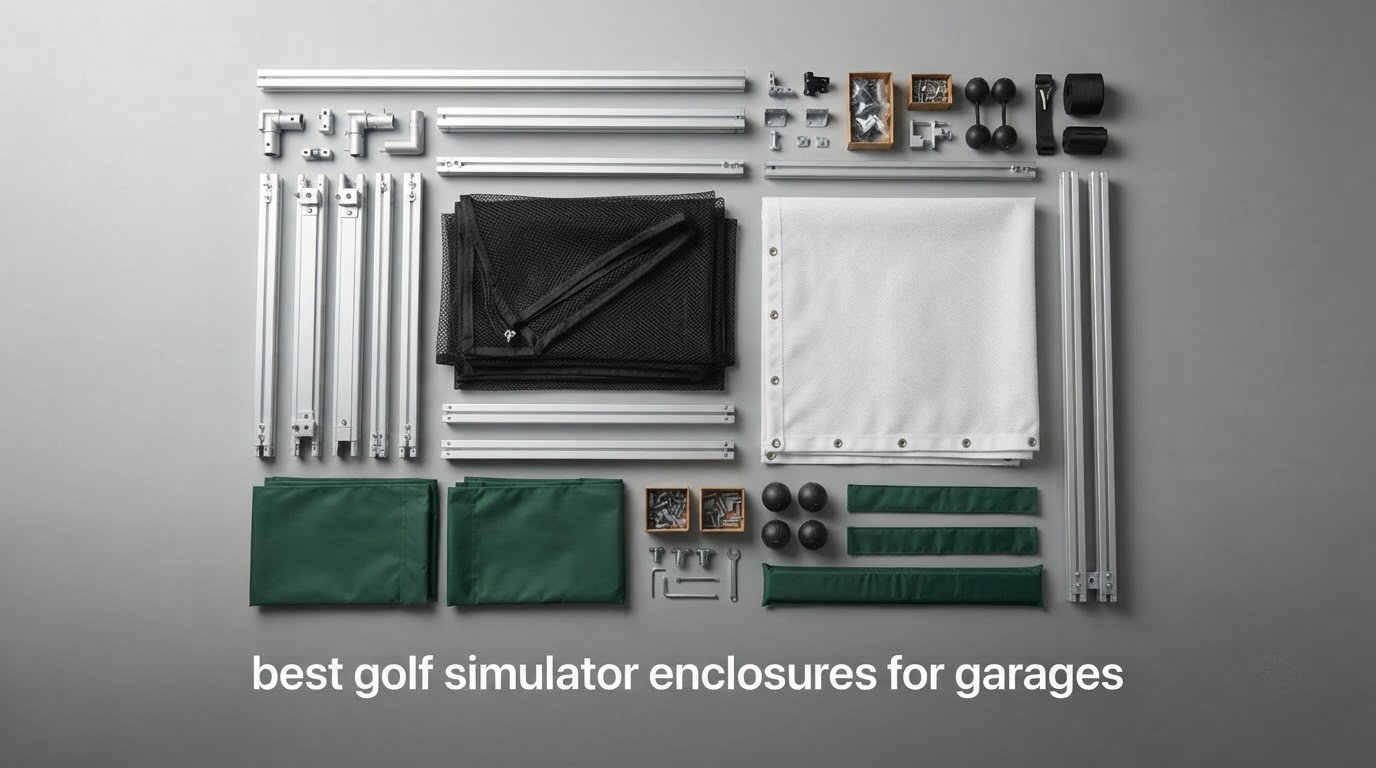
A golf simulator enclosure is the single biggest upgrade you can make to a garage hitting bay. It turns a bare concrete room with a hanging net into a dark, contained space where a projected course looks bright and a mishit stays inside the frame. If you have been searching for the best golf simulator enclosures for garages, the decision comes down to three things: how much ceiling height you have, whether your car still needs to fit, and how thick a screen you can live with.
We spent the last several weeks reading the customer review data on ten of the most-reviewed enclosures sold for garage use, comparing screen construction, frame weight, blackout coverage, assembly time and the failure points owners actually report. Every enclosure here ships as a frame, an impact screen and a fabric surround. Projector, mat and launch monitor are separate purchases in all ten cases.
Our short answer up front: the GoSports kit is the best all-round garage enclosure we found, the ANYTHING SPORTS complete package is the most complete box, and the Durbles kit has the quietest screen. If your garage has to double as a parking space, the fold-up ANYTHING SPORTS unit is the only pick here that clears the floor in about a minute. Our broader golf simulator roundup covers the launch monitors and projectors that pair with these bays.
One note before we start: every dimension below comes from the manufacturer’s own listing, and every performance claim comes from verified buyer feedback. Where a spec is missing, we say so rather than filling the gap.
Table of Contents
How to Measure Your Garage Before You Order?
Most enclosure returns start with a measurement mistake, not a quality complaint. Work through these five steps before you pick a kit.
Measure bay width at three points. Check the wall-to-wall width at the front, middle and back of the bay. Older garages are rarely square, and a 10 ft kit in a 9 ft 8 in gap will not tension properly.
Measure usable ceiling height, not building height. Door tracks, conduit, joists and sprinkler heads all eat into it. Anything under 9 ft rules out several kits in this roundup.
Count depth behind the hitting position. Most of these enclosures are 5 ft to 6 ft deep. Add the depth of your mat and you need roughly 6 ft to 7 ft of clear floor from your ball position to the back of the screen.
Decide about the car first. If the vehicle stays, a 10 ft wide kit in an 11 ft wide bay usually leaves too little door clearance. A wall-mounted fold-up unit or an 8 ft 4 in footprint cage is the practical answer.
Plan power and data before the frame goes up. Builders regularly run out of outlets mid-project, and wireless signal in a metal-framed room is not automatic. Know where your projector and monitor will draw power.
Worth noting: owners on r/Golfsimulator repeatedly ask whether a 56 or 60 degree wedge will chip over the top of the net into the ceiling. That is a real risk on the shorter 8 ft frames in this roundup, and it is the single most common safety complaint we saw. A top baffle or a taller frame solves it.
Top 3 Best Golf Simulator Enclosures For Garages (October 2026)
These three lead the list on the combination of rating, review volume and garage fit. Every other pick is included below because it wins on a specific dimension rather than across the board.

GoSports Golf Simulator Enclosure Kit
- Multi-layer HD impact screen
- True blackout enclosure panels
- Single-person build in about an hour

ANYTHING SPORTS Complete Enclosure
- Projector mount included
- All-in-one metal cage kit
- 12-month no-questions warranty
Durbles Enclosure Kit
- Triple-layer screen for quiet strikes
- Full-coverage foam padding
- Blackout curtain included
Quick Overview: Best Golf Simulator Enclosures for Garages in 2026
The table below lists all ten enclosures in this roundup with the specs that actually change the buying decision. Screen construction, footprint and blackout coverage matter more than any other factor once you are past the assembly stage.
| Product | Specifications | Action |
|---|---|---|
| GoSports Golf Simulator Enclosure Kit |
|
Check Latest Price |
| ANYTHING SPORTS Complete Enclosure Package |
|
Check Latest Price |
| Durbles Enclosure Kit with Triple-Layer Screen |
|
Check Latest Price |
 Diandian 10 x 8 ft Enclosure Kit Diandian 10 x 8 ft Enclosure Kit |
|
Check Latest Price |
 Sturdum Steel Frame Enclosure Kit Sturdum Steel Frame Enclosure Kit |
|
Check Latest Price |
 River Hill Golf 10 x 8 ft Enclosure River Hill Golf 10 x 8 ft Enclosure |
|
Check Latest Price |
 ANYTHING SPORTS Fold Up Enclosure ANYTHING SPORTS Fold Up Enclosure |
|
Check Latest Price |
 ZivPlay 10 x 8 ft Steel Cage ZivPlay 10 x 8 ft Steel Cage |
|
Check Latest Price |
 Garvee 11 x 8 ft Complete Package Garvee 11 x 8 ft Complete Package |
|
Check Latest Price |
 YSDDAOG 10 x 8 x 6 ft Cage Kit YSDDAOG 10 x 8 x 6 ft Cage Kit |
|
Check Latest Price |
1. GoSports Golf Simulator Enclosure Net Kit – Best All-Round Garage Bay
GoSports 10 x 8 ft Golf Simulator Enclosure Net – Complete Set with Frame and HD Impact Screen Kit
10x8, 12x9 or 14x8 ft
Alloy steel frame, 79 lbs
Multi-layer HD impact screen
True blackout panels
Pros
- Single-person build in about an hour
- Multi-layer screen holds up to repeated high-speed strikes
- True blackout fabric clearly improves projector brightness
- Foam padding around the screen frame
- Responsive support that replaced a damaged cover
Cons
- Screen frame padding is thin and can ricochet
- No top baffles for high wedge shots
- Cover eyelets can tear with heavy wedge play
This is the enclosure we kept coming back to. GoSports sells it in three footprints, 10 x 8 ft, 12 x 9 ft and 14 x 8 ft, and the middle size is the one most two-car garages can actually swallow. The frame is alloy steel and the whole unit weighs 79 lbs, which is heavy enough to stay put when a mishit loads the frame and light enough for one person to reposition.
Assembly is the part that surprised us most. The poles are numbered and the instructions are readable, and owners consistently report roughly an hour for the 10 x 8 ft version. A few buyers describe it as a two-evening job, but that is almost always the blackout cover rather than the frame.
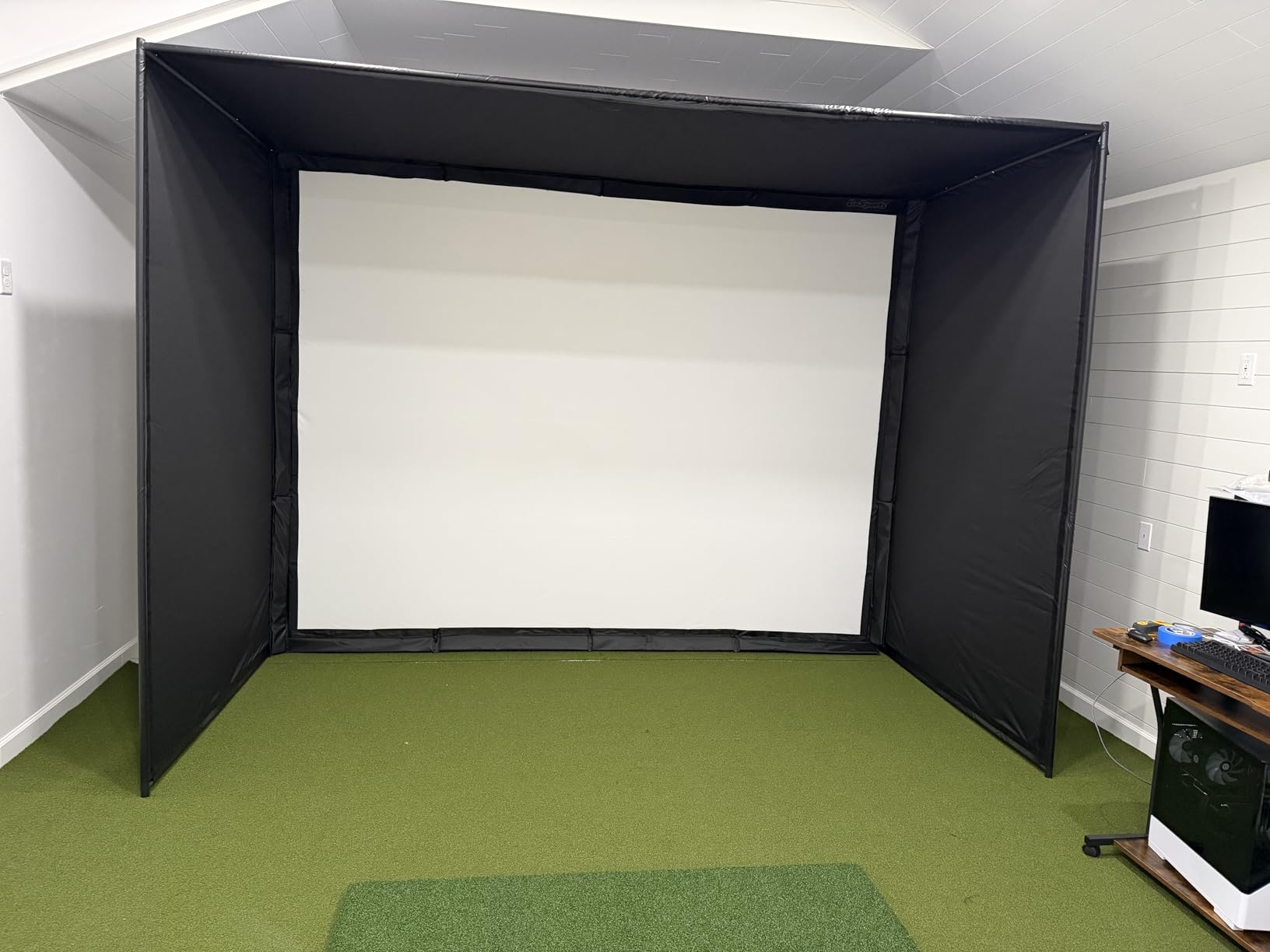
Two things separate this from the cheaper cages. The first is the dyeing process used on the enclosure panels, which blocks more stray light than a standard black tarp and makes a mid-range projector look considerably better in a lit garage. The second is the multi-layer impact screen, which reviewers describe as holding up to repeated full-speed strikes without visible wear.
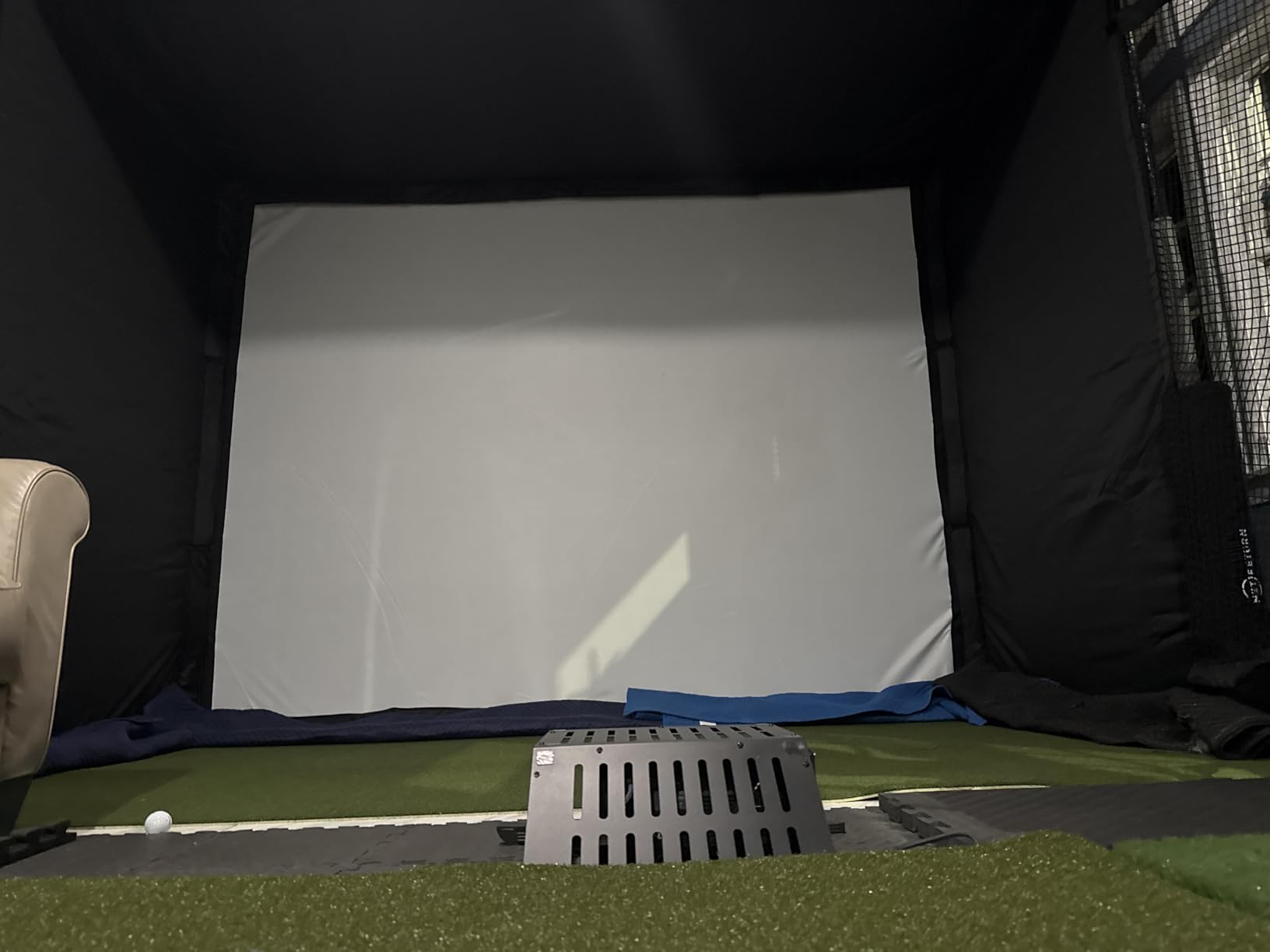
The soft spot is the padding. Owners report that the foam around the screen frame is thin enough that balls ricochet off it, and there are no top baffles, so a high wedge can run over the frame line and into the ceiling area. Some buyers with the 14 ft version also report droop along the top edge unless the tension is adjusted carefully.
Who the GoSports kit suits best?
It suits a homeowner with a standard 10 ft or 12 ft bay who wants a real blackout room and does not want a two-day build. It also suits anyone whose previous experience was a bare hanging net, because the jump in image contrast is immediate and obvious.
If your game is short game and wedges, check the frame height first. The 10 x 8 ft footprint leaves less headroom above the screen than the taller premium enclosures, so add your own baffle.
Where it falls short?
The included padding is thinner than the closed-cell foam most serious builders add themselves, and that is a budget decision rather than a flaw. The missing top baffles and the eyelet tearing reported by heavy hitters are the two complaints we would raise with any buyer who swings a wedge more than a driver.
2. ANYTHING SPORTS Complete Enclosure Package – Best With the Projector Mount Included
Complete Golf Simulator Enclosure Package – 4K-Ready Impact Screen with Blackout Cage, Projector Mount, Frame Poles, Side Shank Nets | Indoor & Garage Practice | Easy Setup | 12-Month Warranty
11 x 8 ft metal cage
Projector mount and poles included
4K-ready impact screen
12-month warranty
Pros
- Projector mount and all poles included in the box
- Sturdy metal frame firms up once covered
- Screen shows no visible wear after 18 months
- Compact 8 ft 4 in option fits a narrow bay
- Fast support that replaced a faulty screen
Cons
- Instructions are weak and in at least one case contradicted the diagrams
- Included pads are thin covers rather than real impact padding
- Top rear crossbar is unpadded and can return wedge shots
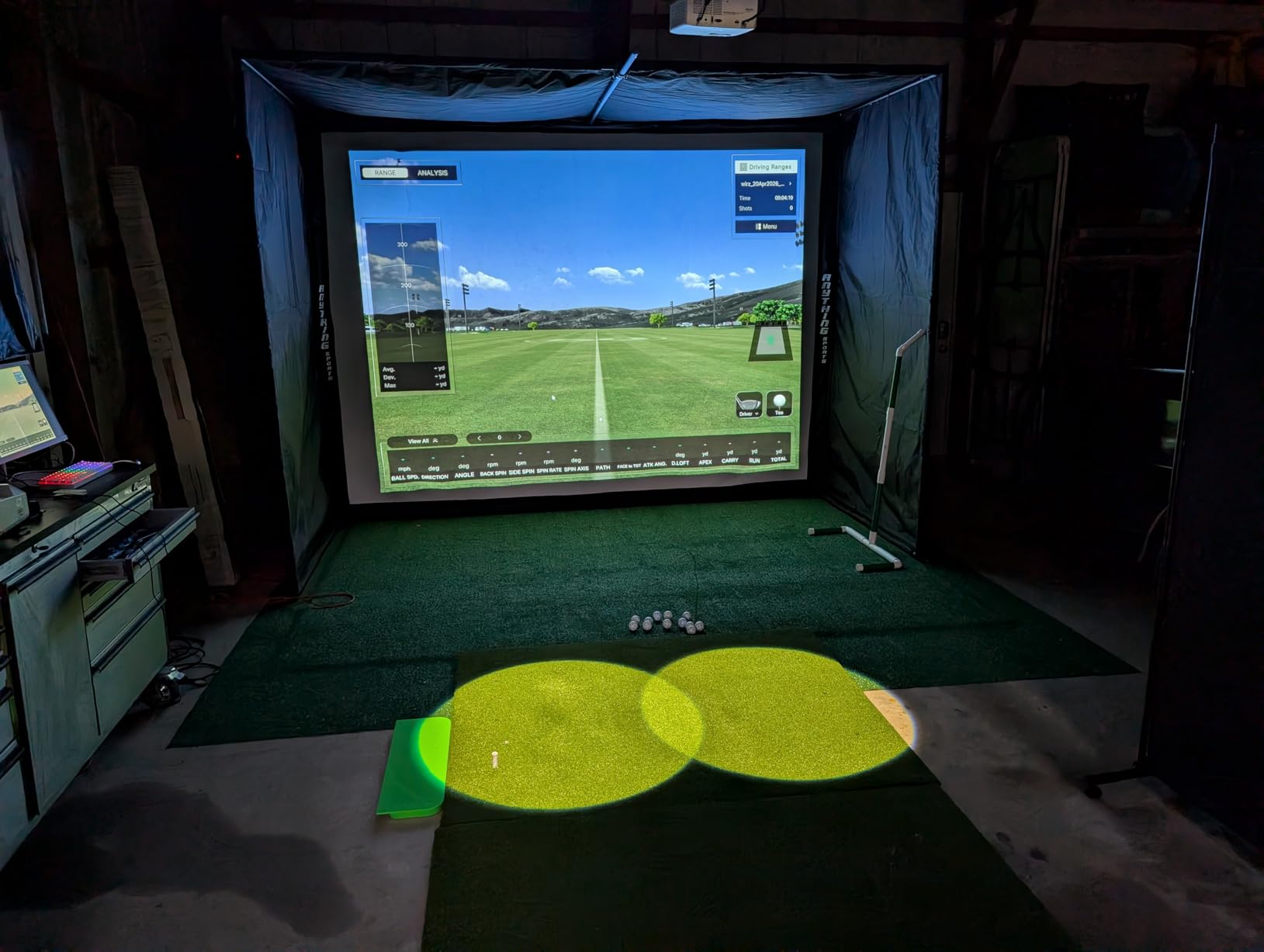
What separates this package from the rest is what arrives in the box. Poles, joints, impact screen, hardware, side shank nets and a projector mount with connecting poles all ship together, which removes the most common reason a garage build stalls midway. You supply the projector, the mat and the launch monitor, and that is it.
Three footprints are offered, 8 ft 4 in by 8 ft 4 in, 11 x 8 ft 4 x 5 ft, and 12 x 9 ft 4 x 5 ft. The 4K-ready screen is cut roughly an inch under the frame width, and that small detail is what keeps light from bleeding around the edges and washing out the projected image.
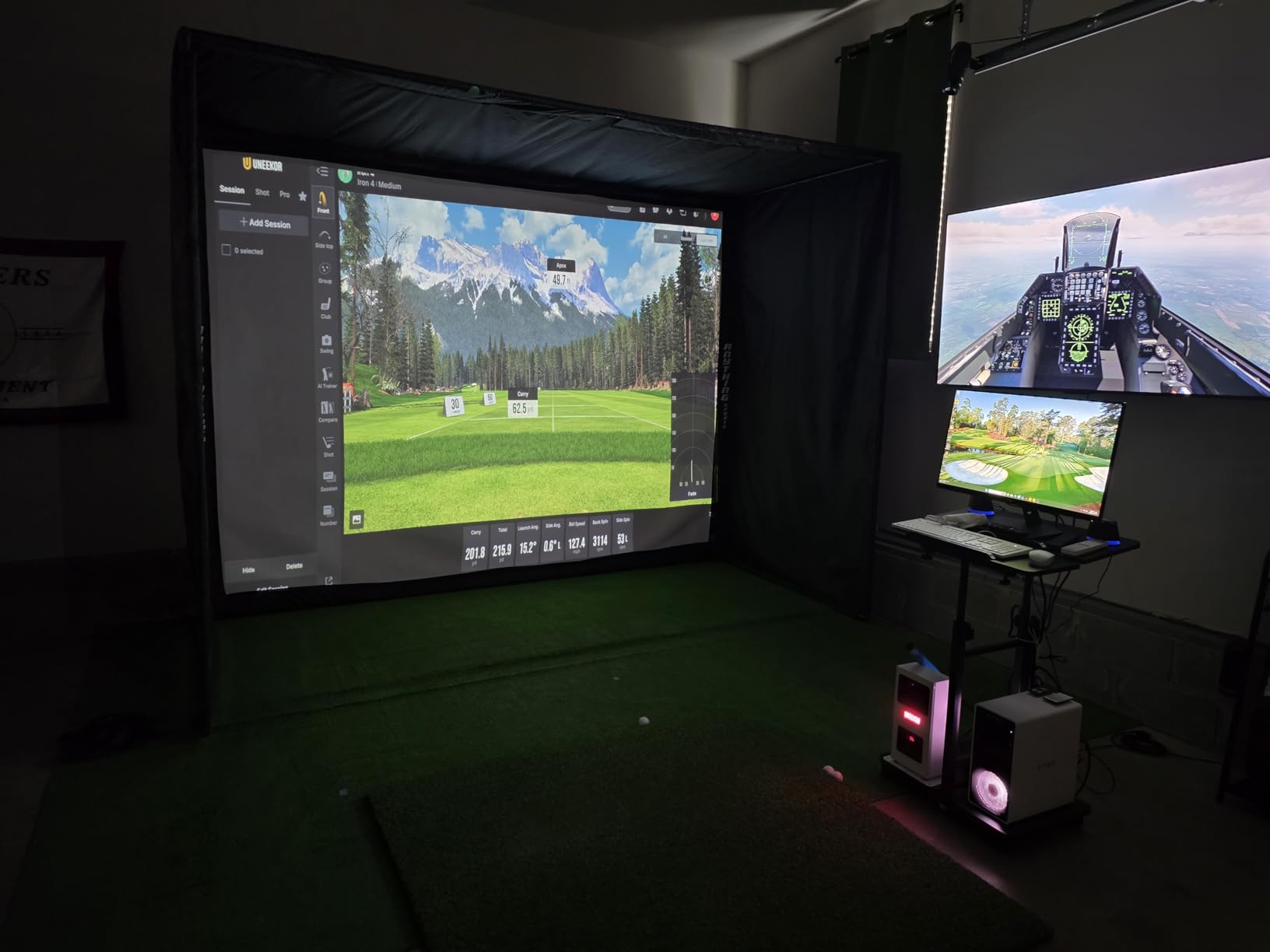
Long-term owners report the rubbery screen surface holding no visible wear after a year and a half, and the metal frame tightening into a genuinely rigid structure once the blackout cover is on. Support response is repeatedly praised, and a faulty screen was replaced quickly for one reviewer.
The weak point is documentation. Multiple buyers describe the instructions as the weakest part of an otherwise solid package, and one found the printed diagrams contradicted the actual pieces. The other recurring issue is safety around the top rear crossbar, which ships unpadded and can send a wedge back toward the hitting position. Add foam before you swing at it.
Who this package suits best?
It suits first-time builders who want one delivery instead of four, and anyone whose bay is narrower than 10 ft. The 8 ft 4 in footprint is the option to pick in a 9 ft wide garage, and it still holds a 4:3 screen.
For households that alternate between a right-handed and a left-handed player, the side shank nets do useful work catching off-centre strikes from both directions.
Where it falls short?
The thin pad covers included in the box are not real impact padding, and the top rear crossbar is bare. Buyers who plan to hit wedges hard should budget for their own foam and a baffle. The 12-month no-questions warranty is a genuine plus, but only if you keep the documentation from the build.
3. Durbles Enclosure Kit with Triple-Layer Screen – Premium Pick Strike
Golf Simulator Enclosure Kit with Premium HD Impact Screen, Full Safety Padding & Blackout Curtain, Home Golf Sim Setup Compatible with Launch Monitors, Indoor Cage Net Golfing Accessories (10 x 8 ft)
10 x 8 ft steel frame
Triple-layer commercial screen
Full foam padding
Blackout curtain
Pros
- Triple-layer screen mutes ball strike noise far better than cheaper screens
- Blackout top darkens the screen from overhead lights
- Full-coverage foam and corner padding reduce ricochets
- Numbered pieces let one person build in about three hours
Cons
- Instructions assume ceilings taller than about 9.9 ft
- Some number 5 poles arrive without pre-wrapped foam sleeves
- Frame has no wiggle room so poles may need trimming in tight rooms
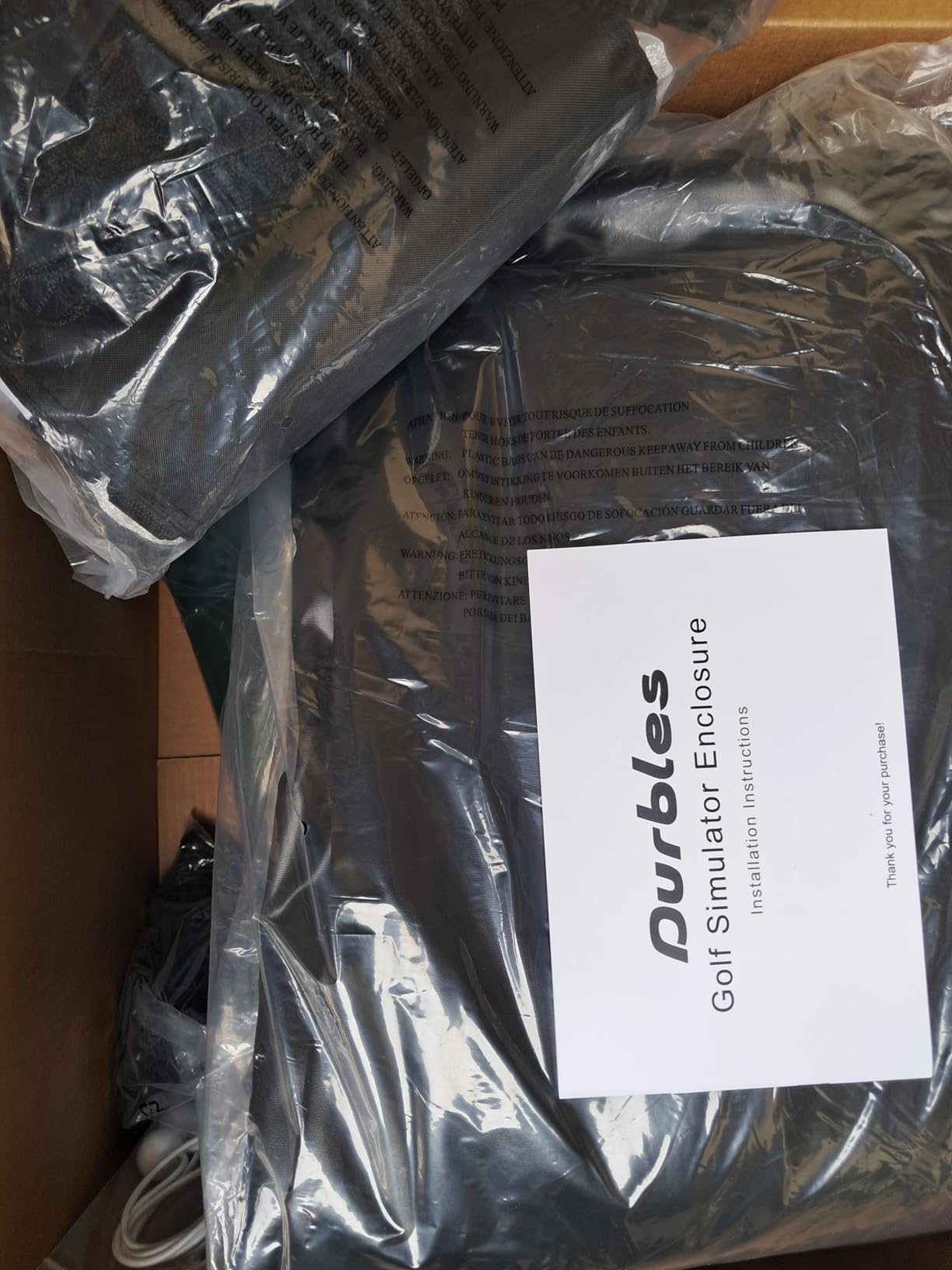
Sound is the reason to buy this one. The triple-layer commercial screen is thick and spongy, and owners consistently report that the strike noise drops noticeably compared with single-layer kits at similar prices. If you are practising at night in a shared wall or an attached house, that difference is the whole pitch.
The complete kit covers a lot of ground: steel frame, blackout curtain, impact screen, full safety padding and golf nets. At 10 x 8 ft it is one of the fuller packages in the roundup, and the 8.4 x 8.4 ft variant covers the narrower bay.
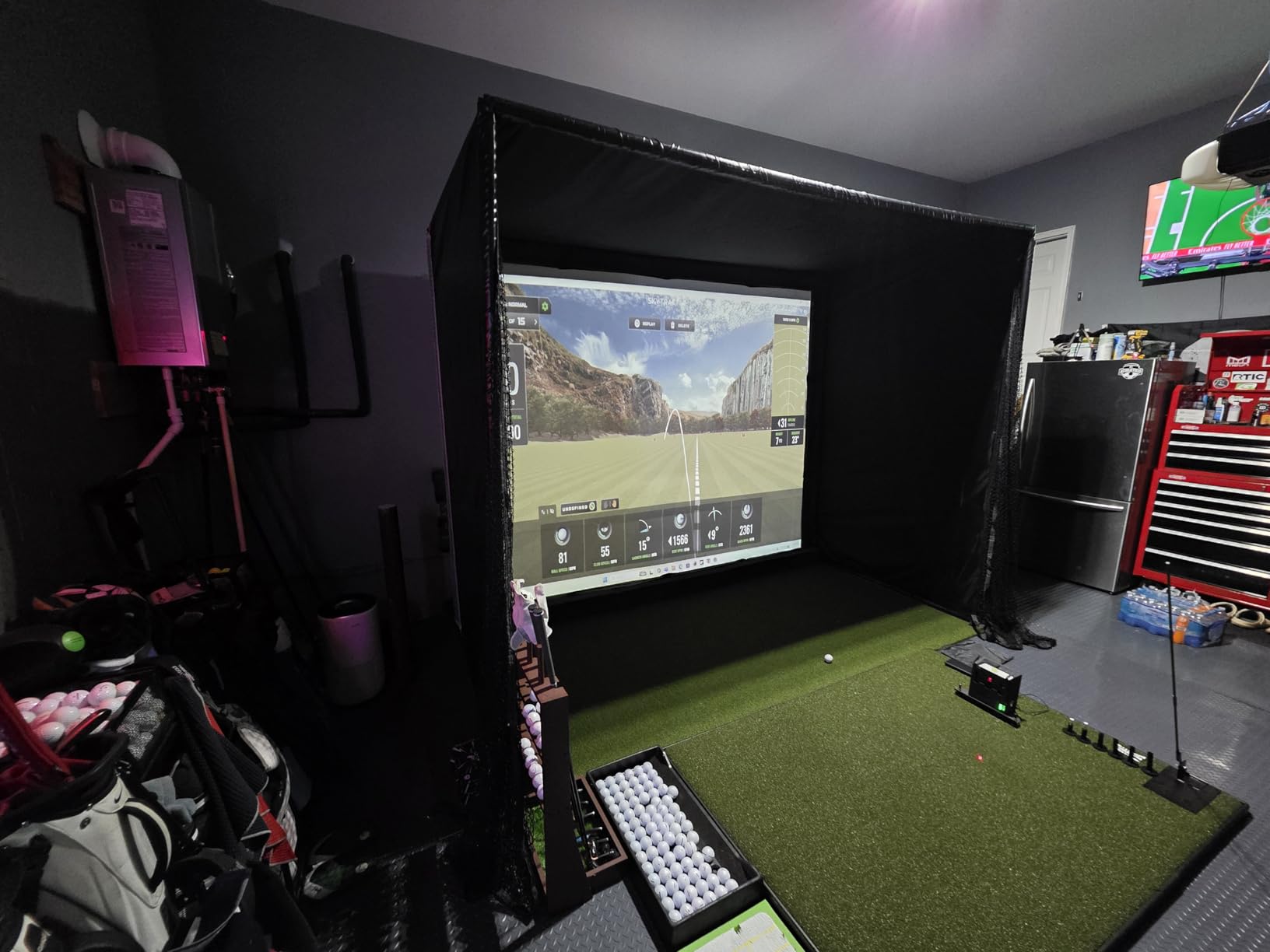
Owners also like the blackout curtain because it darkens the screen from overhead lighting, which is what makes the projected image look premium rather than washed out. The full-coverage foam padding and included corner pieces reduce ricochets, and the numbered hardware lets a single person put it together in roughly three hours.
The catch is ceiling height. The instructions assume a ceiling taller than about 9.9 ft, so below that you are building in place rather than assembling elsewhere and rotating it. A few number 5 poles have also arrived without the pre-wrapped foam sleeves, and the frame has no slack, meaning a room slightly under 10 ft wide may require trimming poles.
Who the Durbles kit suits best?
It suits anyone practising at odd hours in a house with shared walls, and anyone who plans to hit short irons and wedges rather than only drivers. A three-hour build is realistic for one person with basic tools.
Owners also note the 10 ft width uses nearly the full room width, so measure before you commit. This is not the kit to buy first and fit into a tight bay.
Where it falls short?
Low ceilings are the hard limit. If your clear height is under about 9.9 ft, expect to assemble the frame in place. Some buyers also report noticeable bounce back off the screen unless some of the bungee cords are released, which is a simple fix but worth knowing before the first session.
4. Diandian 10 x 8 ft Enclosure Kit – Fastest Tool-Free Build
Diandian Golf Simulator Enclosure Kit 10 x 8 ft with 4K-Ready Impact Screen
120 in W by 96 in H
Dual-layer 4K-ready impact screen
600D Oxford blackout cover
75 lbs, floor mount
Pros
- Spring-button tool-free build in 30 to 45 minutes
- 600D Oxford fabric and mesh screen are quieter than tarp kits
- Foam on poles and interior areas limits balls returning
- Tight blackout wraparound blocks ceiling light
- Light enough to move across a carpeted room
Cons
- One buyer received no instructions at all
- Screen wrinkles and roof sag reported by some owners
- Projector mount and sandbags are not included
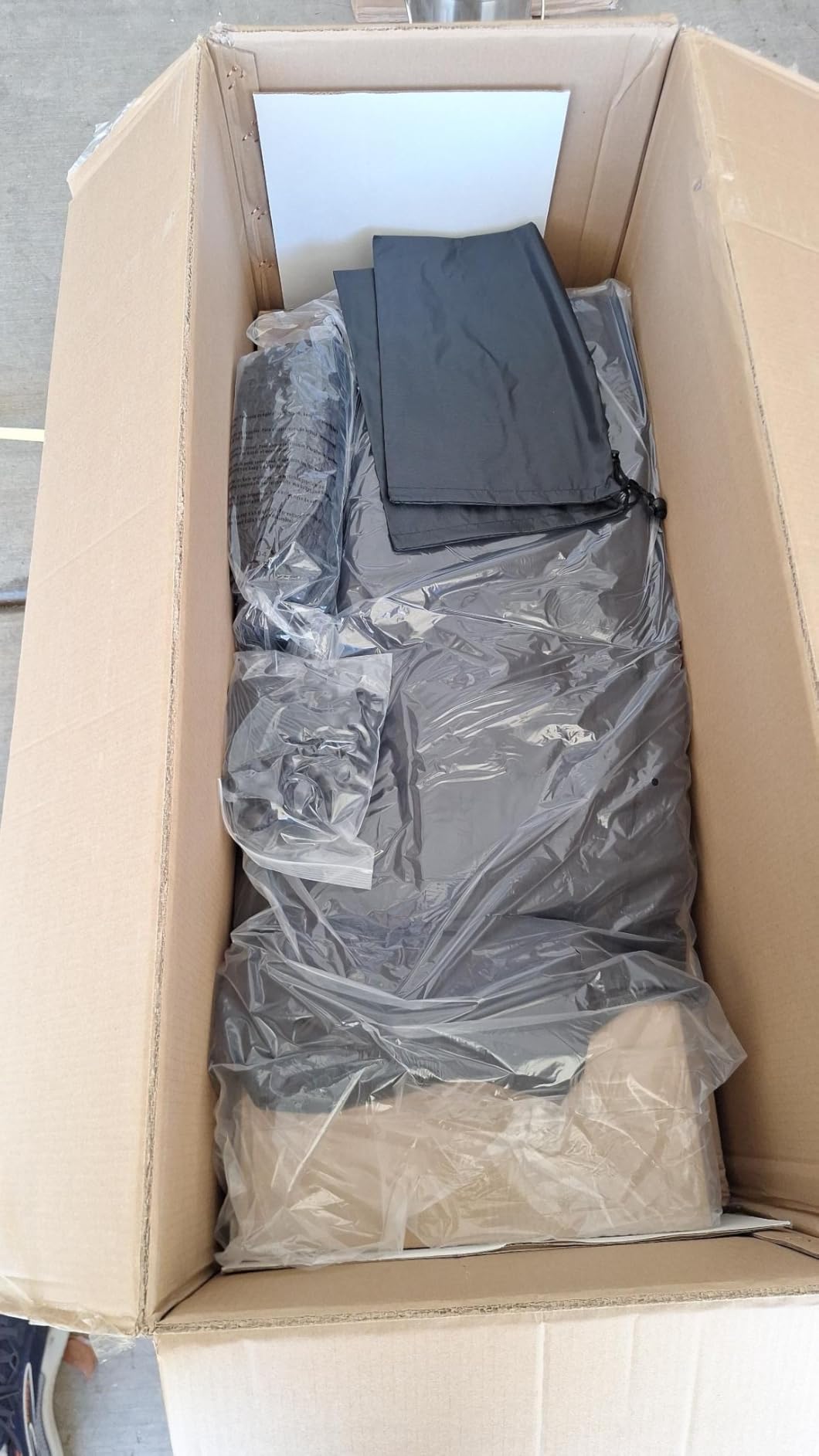
The Diandian kit is the fastest to assemble in the roundup. A spring-button click-lock frame goes together in 30 to 45 minutes for one or two people, with no drilling and no tools beyond what is already in the garage. For a renter or a temporary setup, that matters more than most of the spec sheet.
Materials are better than the tarp kits at similar prices. The blackout cover is 600D Oxford rather than thin polyethylene, and the impact screen is dual-layer with a reinforced rear impact-absorbing layer. Reviewers report noticeably lower hit noise and a tighter, higher-contrast image than cheaper sets.
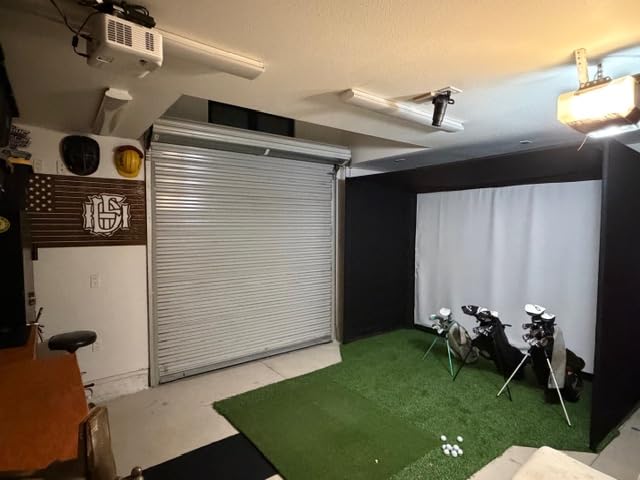
The screen is listed at a 37.5 degree viewing angle with a matte finish, which suits ceiling and mid-height projector mounting in a normal garage. The whole unit weighs 75 lbs, and several owners mention moving it across a carpeted room by themselves, which is unusual at this size.
Weaknesses are concentrated in finishing details. One buyer received no instructions at all and reverse-engineered the build from the pieces. Screen wrinkling and roof sag show up in a handful of reports, and the bottom screen stitching that secures the Velcro tore within days for one owner. The projector mount and sandbags are not included, so you are buying those separately.
Who this kit suits best?
It suits anyone who wants a real enclosure in an afternoon, renters who cannot drill, and golfers practising in a basement or spare room as well as a garage. The 14 x 8.5 ft variant covers the wide-bay case.
It also suits households with children or vehicles nearby, because the foam edge padding and heavy-duty safety side nets do more containment work than the frames in this price range typically do.
Where it falls short?
Documentation is the main risk. Check that the manual is in the box before you start, and inspect the bottom screen stitching because that seam is where the durability reports concentrate. You will also need to buy a projector mount and sandbags to complete the setup.
5. Sturdum Steel Frame Enclosure Kit – Simple Budget Entry
Sturdum 10x10ft Golf Simulator Enclosure Kit with HD Screen and Steel Frame
10 x 8 ft steel frame
Light-blocking curtains
Impact screen, side and ball nets
1-year warranty
Pros
- Complete package includes frame
- curtains
- screen and netting
- Simple design converts a garage or spare room into a studio
- Launch monitor ready layout
- Lowest entry point among the steel-frame kits
Cons
- Weakest average rating in the roundup at 4.1
- Limited published review detail on long-term durability
- One-star feedback runs higher than the other kits here
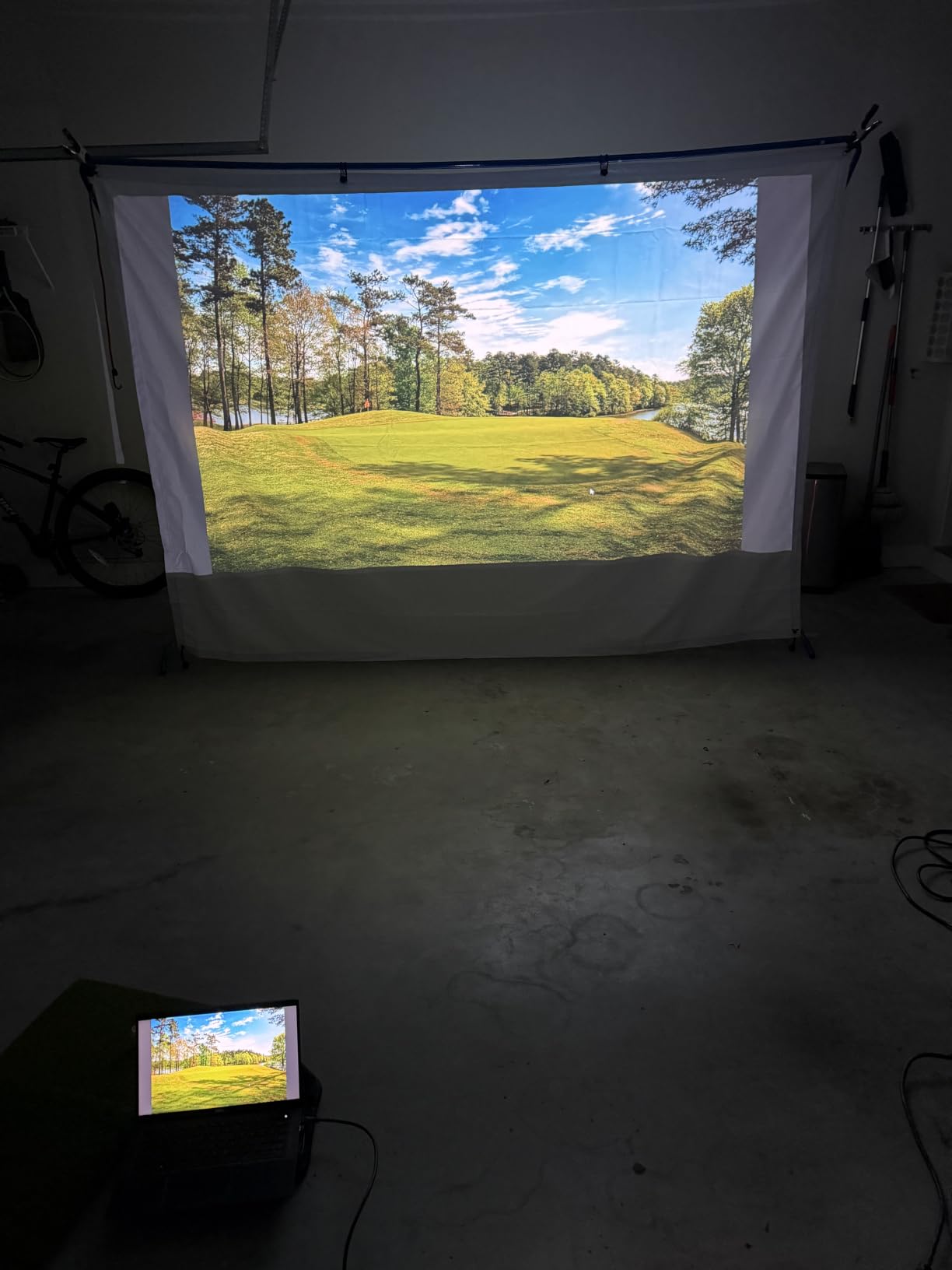
The Sturdum kit does the basic job without pretending to be more than that. You get a 10 x 8 ft steel frame, light-blocking curtains, an impact screen, side netting and a ball net in one box, and the layout is already arranged for a launch monitor beside the ball.
Three variants are listed, 8.4 x 8.4 ft, 10 x 8 ft, and a 10 x 7 ft single-layer impact screen version. The light-blocking curtains are the useful part, because they are what let a projector image read clearly in a garage that still has a light on.
The honest limitation here is the thinness of the evidence. This listing carries 22 ratings and no detailed written reviews were returned, so durability is hard to judge beyond the aggregate score. The 4.1 average comes with a rating distribution where one-star and three-star feedback each run above 11 percent, higher than any other kit in this roundup.
That is not a disqualifier, but it does mean you are buying with less information than with the GoSports or ANYTHING SPORTS packages. If the budget stretches, the extra data on those kits is worth considering.
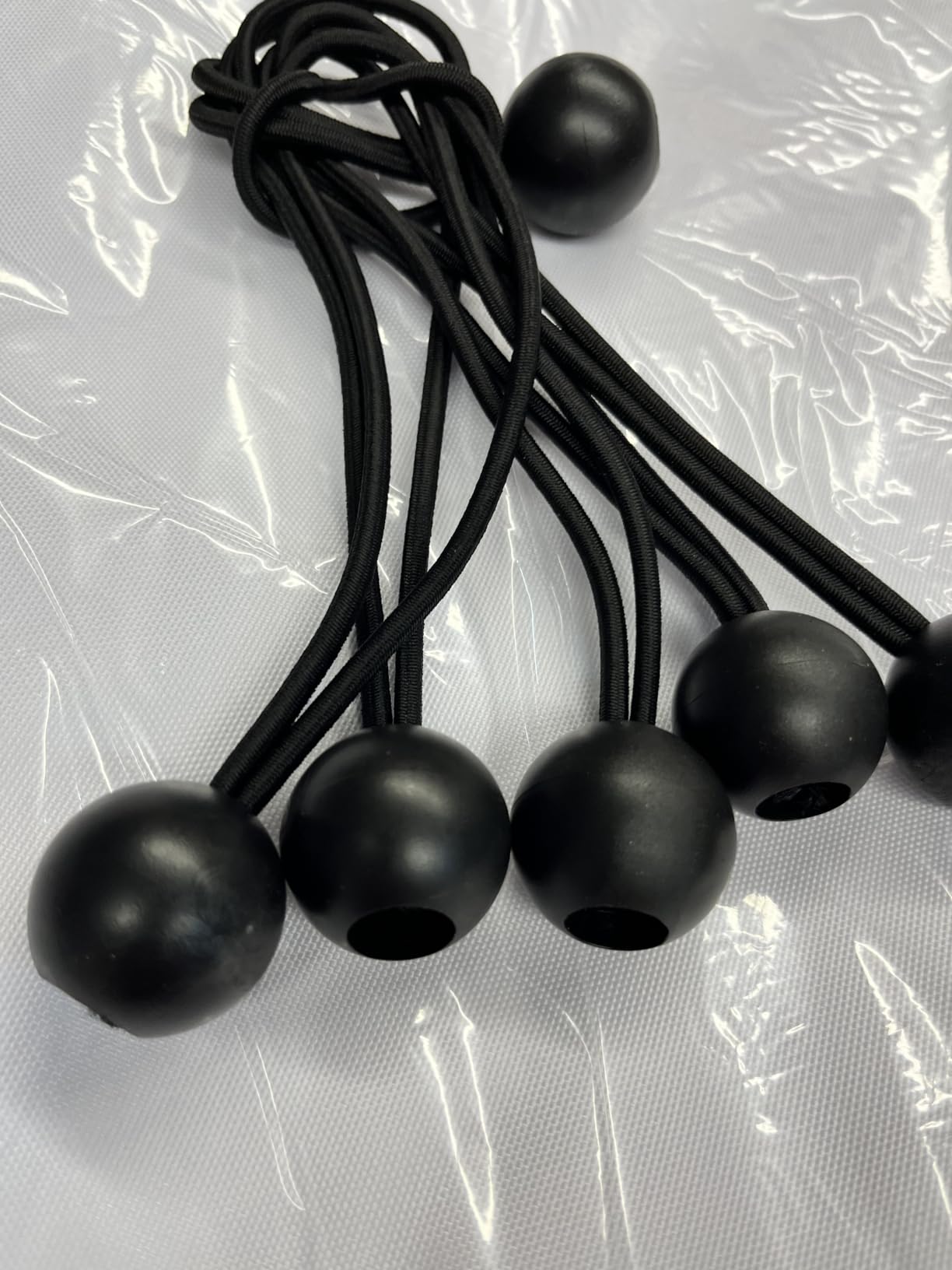
Who the Sturdum kit suits best?
It suits someone converting a spare room rather than a garage, or a golfer who wants data practice and a projector image without spending on premium screen construction. The 8.4 x 8.4 ft variant is the option for a narrow bay.
It also works as a seasonal setup in a space that has to be usable for other purposes, since the frame is straightforward steel with no moving parts.
Where it falls short?
The review base is thin, and the ones that exist are less glowing than the rest of this list. It offers no padding on the screen frame, so add your own if you hit hard shots. Expect a functional room rather than a polished one.
6. River Hill Golf 10 x 8 ft Enclosure – Budget Triple-Layer Option
Golf Simulator Enclosure, 10×8 Ft Indoor Setup with 3-Layer Impact Screen
10 x 8 ft footprint
Triple-layer impact screen
Oxford light-blocking surround
Steel pipe frame
Pros
- Triple-layer screen absorbs impact with minimal sound
- 10 x 8 ft footprint allows full-power swings
- Quick setup and tear down in about an hour
- Heavy-duty frame pipes
- foam
- side netting and sandbags included
Cons
- Push-pin connectors allow noticeable frame wiggle
- Only six screen mounting points limits tension
- Screen aspect ratio leaves dead space with common projectors
The River Hill enclosure is unusual in this price range because it gives you a triple-layer screen, which is normally the reason to step up a tier. Owners report that the ball dies at the screen with minimal sound, and the 10 x 8 ft footprint allows a full-power swing without shortening it.
Three footprints are offered, 10 x 8 x 5.3 ft, 10 x 7 x 3 ft, and a 10 x 8 x 12.8 ft version for anyone who wants a much deeper bay. The surround covers all sides in light-blocking Oxford cloth, and the package includes heavy-duty frame pipes, foam padding, side netting and sandbags.
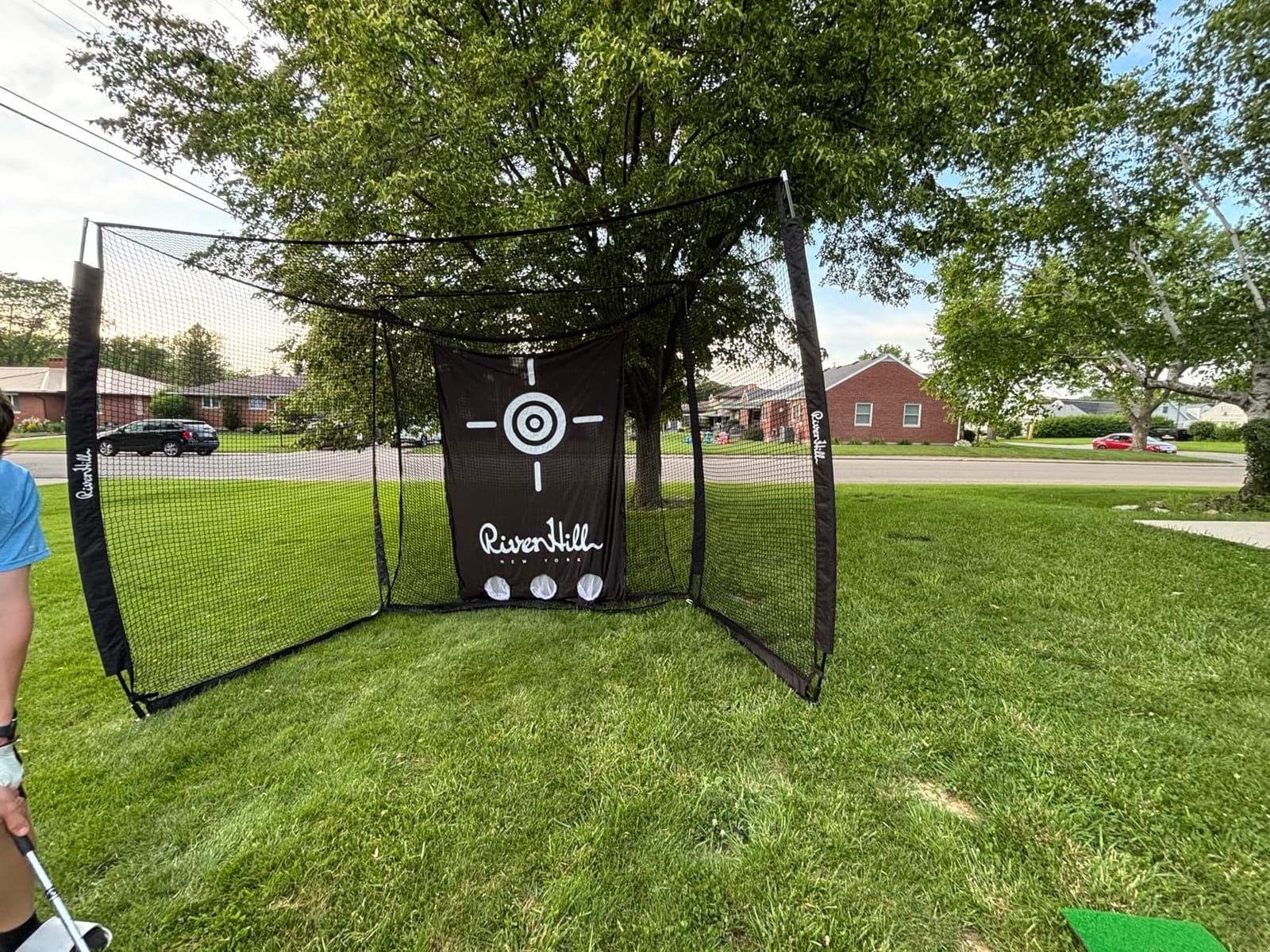
Setup and breakdown are quick. Owners report being running in about an hour, and the kit is easy to modify later, which is why several budget builders treat it as a starting frame and upgrade the screen separately.
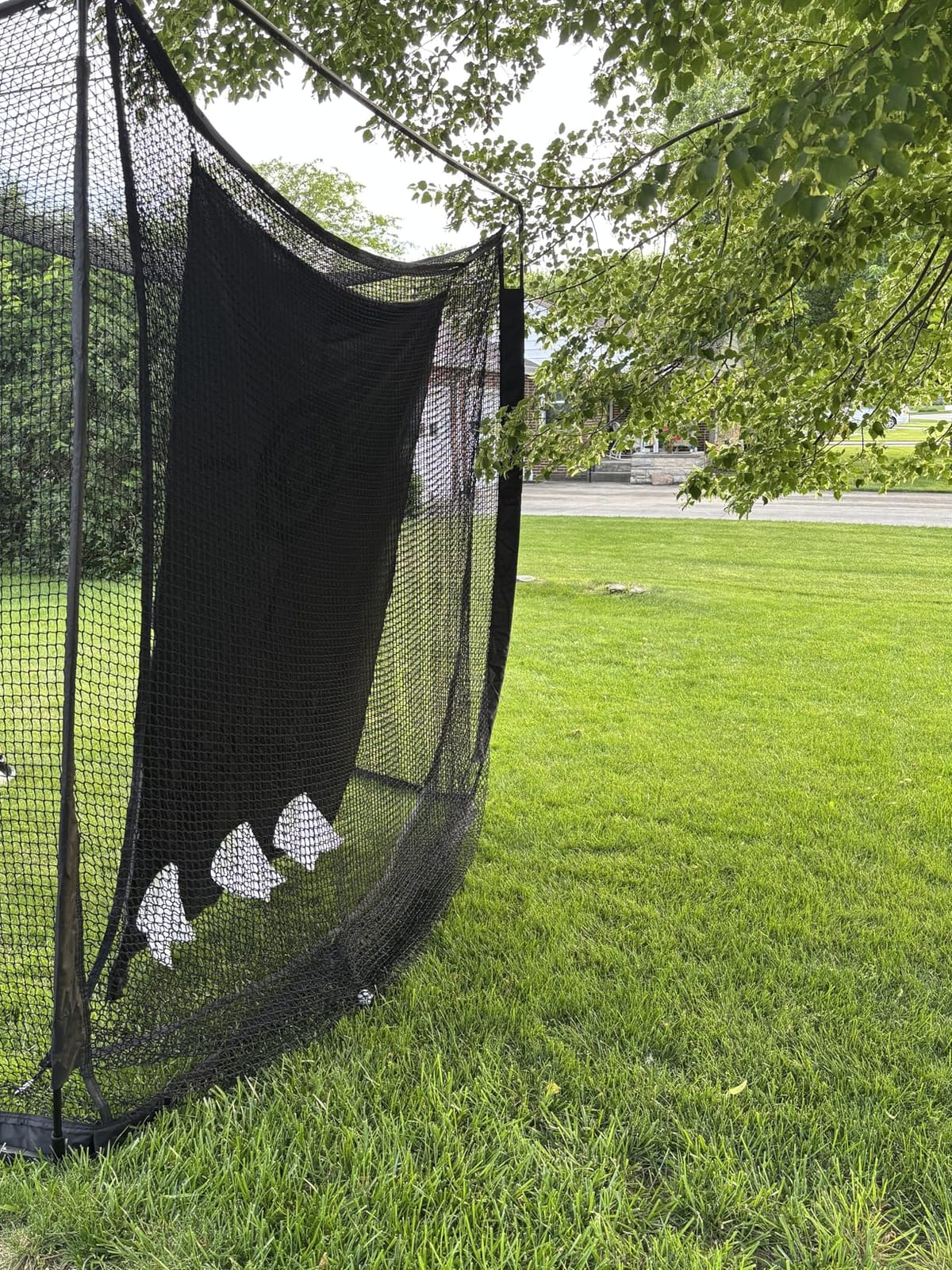
Three structural details work against it. The push-pin connectors allow noticeable wiggle in the frame under load, and there are only six screen mounting points, which limits how evenly you can tension the screen. The screen aspect ratio also does not match common 4:3 or 16:9 projector output, so you will see dead space around the image.
Who the River Hill kit suits best?
It suits a golfer who wants a quiet screen and a proper hitting area on a limited budget, especially if you intend to improve the frame over time. The 12.8 ft deep variant is the pick if your garage runs long and narrow.
It also suits anyone hitting primarily full swings in a compact footprint, since the 10 x 8 ft area does not force a shortened motion.
Where it falls short?
Frame rigidity is the weak point, and the mounting point count limits screen tension, which affects both image flatness and bounce back. The screen proportion wastes projector output, so plan your throw distance around the usable image rather than the full screen.
7. ANYTHING SPORTS Fold Up Enclosure – Best for Shared Garages
Fold Up Golf Simulator Enclosure (8’4 x 8’4 x 5′)
8 ft 4 in wall-mount footprint
91 x 91 inch matte screen
Folds flat in about a minute
1-year warranty
Pros
- Folds flat against the wall in about a minute to free the bay
- All-in-one bundle with screen
- vinyl blackout cover
- shank nets
- mount and sandbags
- Screen absorbs ball energy well and projects a sharp image
- Most of the unit arrives pre-assembled
Cons
- Very heavy
- needs two people and a dolly to mount
- Requires a flush load-bearing wall
- Instructions show round poles while the kit shipped square poles
This is the only enclosure in the roundup designed around the car parking problem, and that is why it earns its place. It folds up or down against the wall in about a minute, which means the same bay can hold a vehicle on Monday and a simulator on the weekend without a rebuild.
The 8 ft 4 in by 8 ft 4 in footprint is wall-mounted with a 91 x 91 inch matte impact screen, the most square screen in this roundup. Most of the unit arrives pre-assembled, so installation is largely a matter of fixing it to a suitable wall.
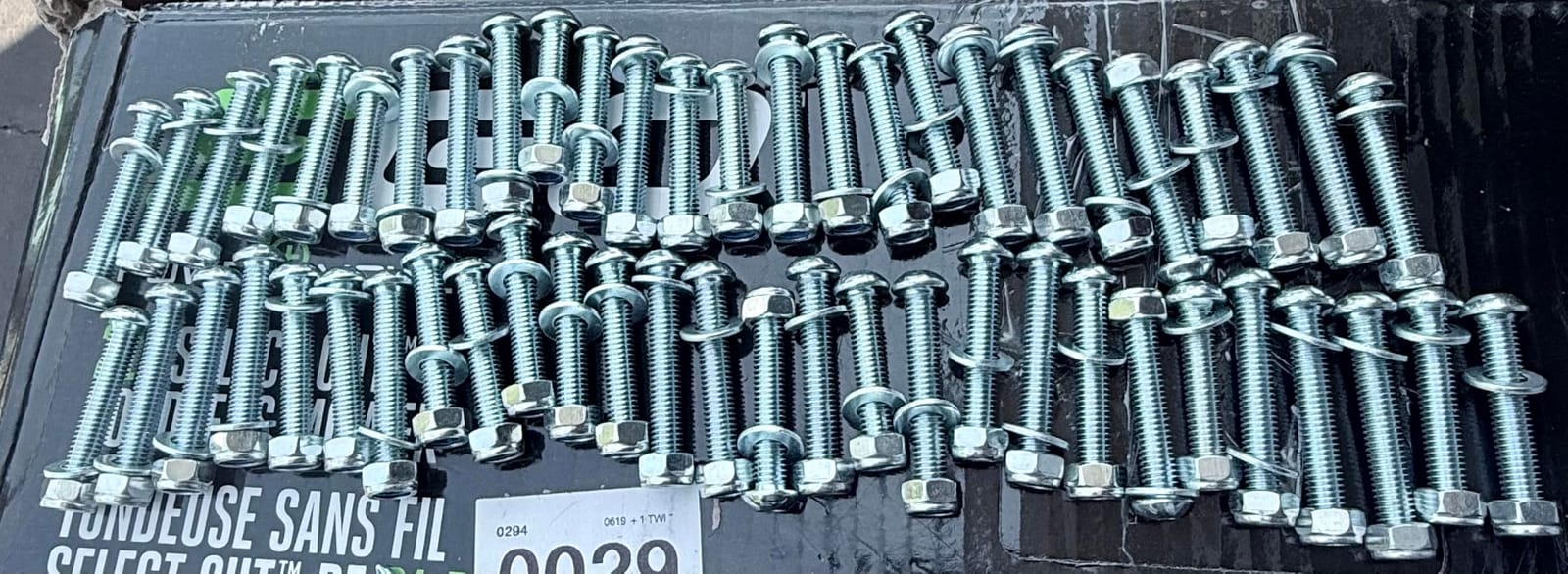
It is also a complete bundle: impact screen, double-stitched vinyl blackout enclosure, two shank nets, a projector mount and sandbags. Reviewers describe the screen as absorbing ball energy well while projecting a sharp image, and the side shank nets catching off-centre shots effectively. At a 4.6 average with no ratings below four stars, satisfaction is consistently high among the buyers who have one.
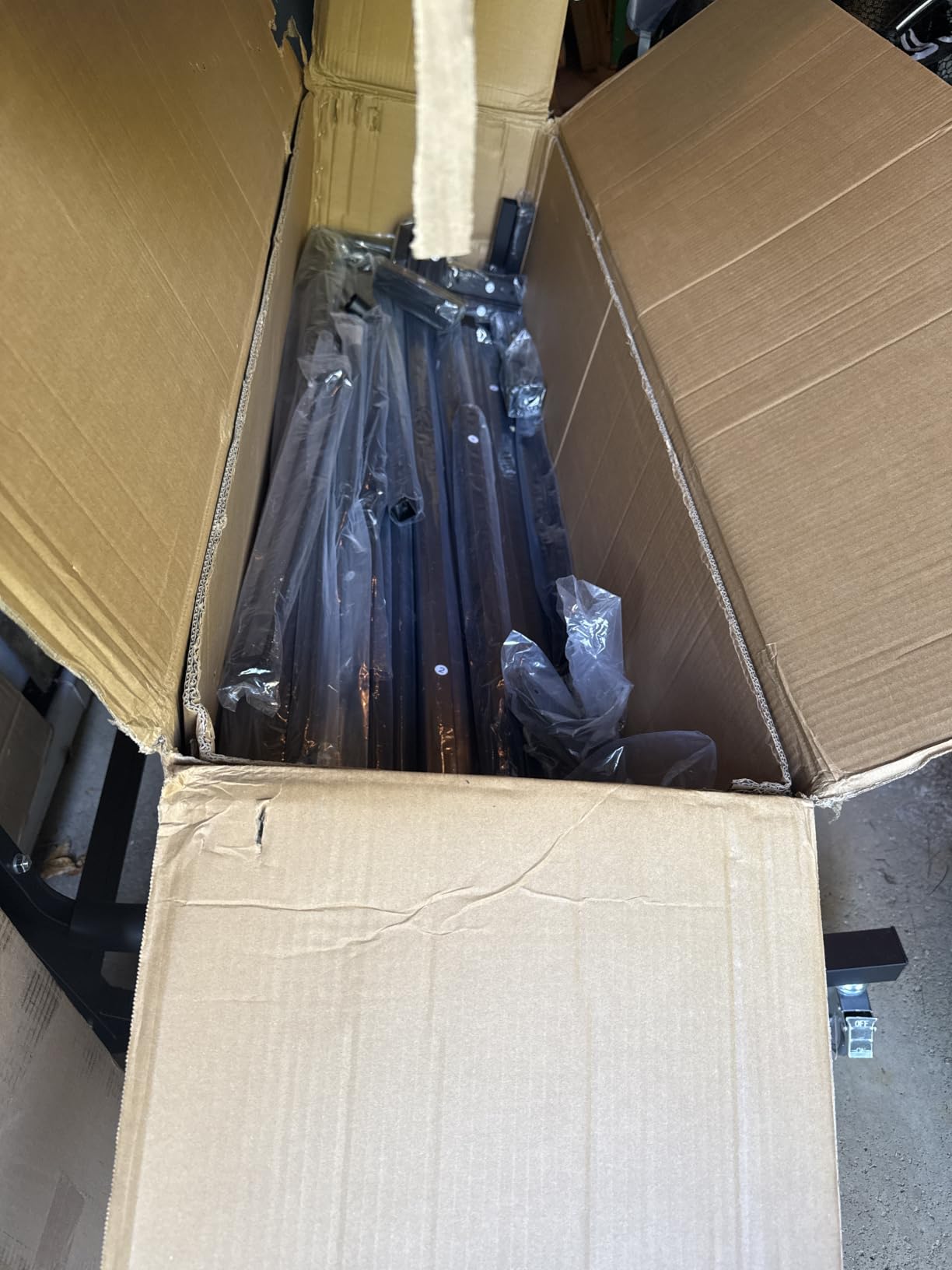
The planning caveats are real. The unit is heavy, and several owners needed two people and a dolly to move and mount it. It requires a flush, load-bearing wall, which makes garages with protruding concrete foundations difficult. The instructions also illustrate round poles while the kit shipped square poles, and the side panels may need removal before the unit will fold.
Who the fold-up enclosure suits best?
It suits two-car households where one vehicle stays parked, and anyone with a gym, workshop or storage use that must come back. Builders on golf simulator forums describe orienting a bay sideways to hit a side wall and preserve parking, and this unit is the same idea made permanent.
It also suits anyone without a level floor area to spare, because the footprint is fixed and shallow once mounted.
Where it falls short?
Check your wall before you order. Protruding foundations, studs that are not load-bearing, and sloped floors all complicate a wall-mount install, and several owners advise having a contractor look first. Sorting many loose screws of three similar lengths is a minor irritation, not a blocker.
8. ZivPlay 10 x 8 ft Steel Cage – Best for Tight Spaces
Golf Simulator Enclosure for Home Garage Indoor Sim Practice with Screen
127 x 60 x 96 in cage
500D polyester HD screen
Foam-padded steel frame
Side nets and sandbags
Pros
- Solid steel frame that feels sturdy and well built
- Assembly in roughly 30 to 60 minutes for one or two people
- 500D polyester screen absorbs impact while keeping image clarity
- Side nets and sandbags catch mis-hits
- Corner and frame foam padding controls rebound
Cons
- Screen leaves an orange resin residue on hands during install
- Screen is bouncy so balls bounce back further than ideal
- Some mounts reported with holes on the wrong side
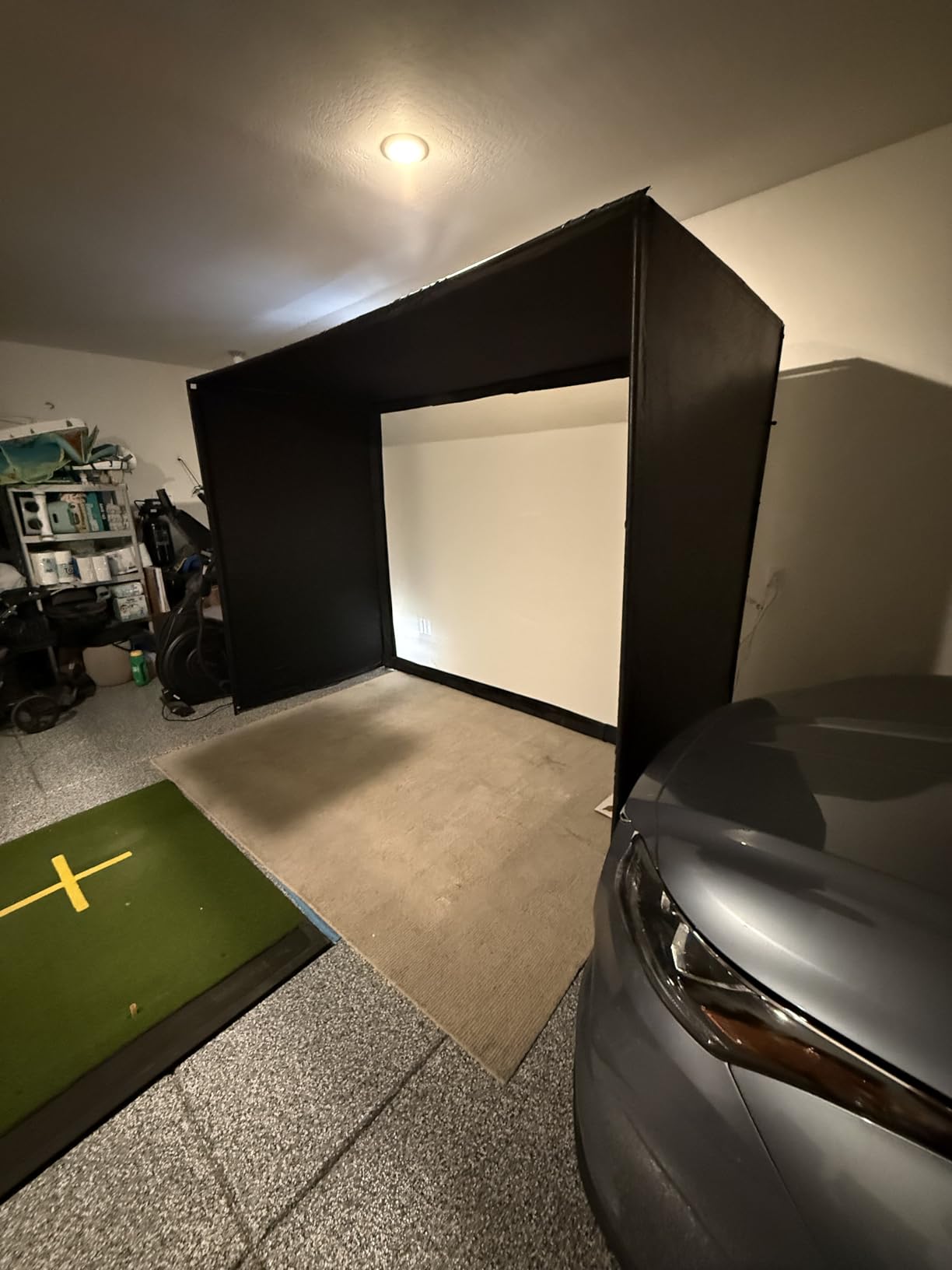
The ZivPlay cage is listed at 10 ft 7 in wide by 8 ft high by 5 ft deep, measured as 127 by 60 by 96 inches, which makes it a genuinely useful width for a bay that is exactly 11 ft from wall to wall. Reviewers repeatedly describe the steel frame as feeling sturdy and well built for a cage at this level.
The impact screen is 500D polyester with a 4:3 ratio sized to line up with projector output, which is a deliberate choice for ceiling and mid-height mounting. Two 8 x 8 ft side nets and sandbags are included, and the steel frame is covered with edge foam padding.
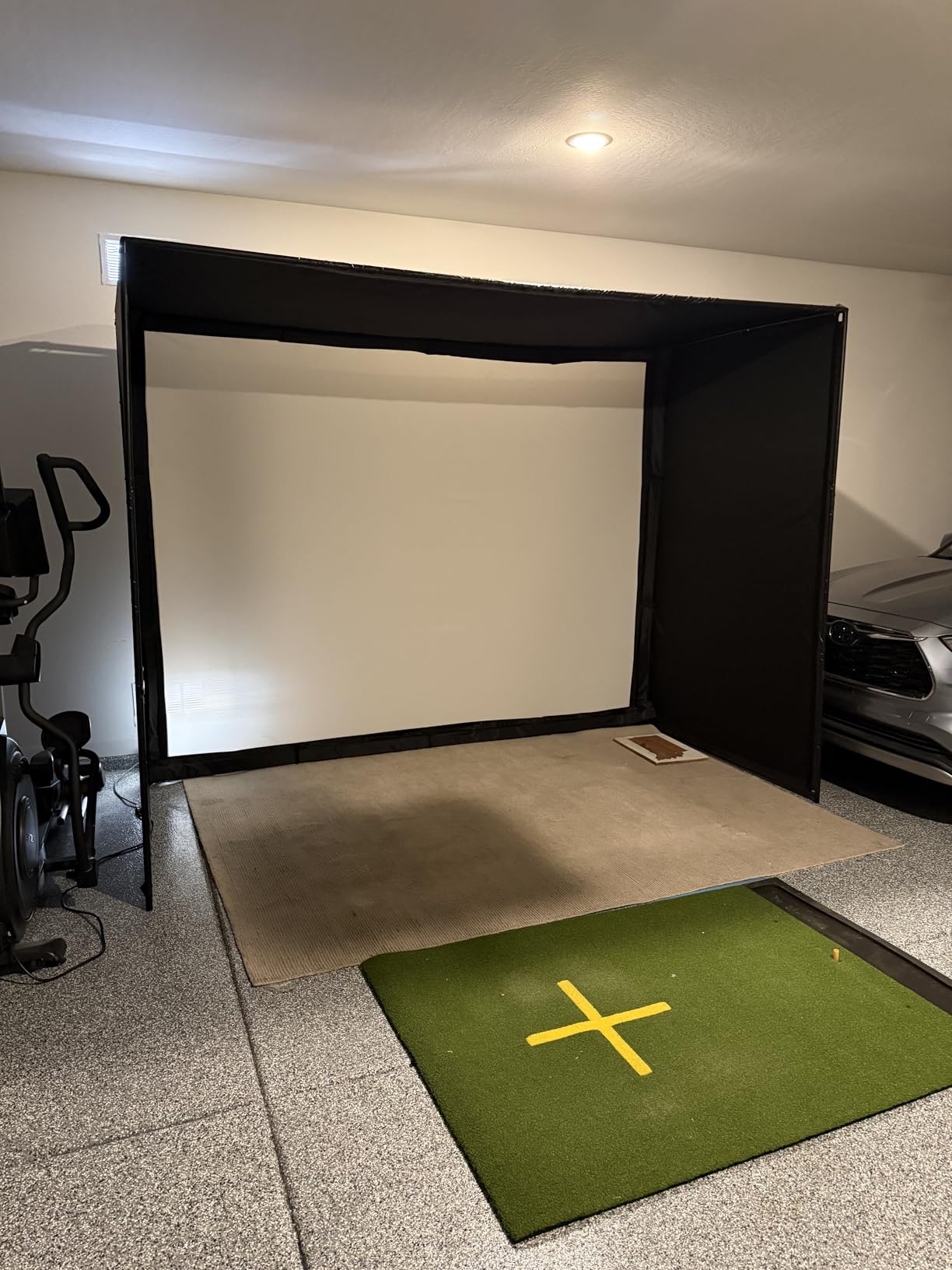
Assembly runs about 30 to 60 minutes for one or two people, and the screen holds up to direct ball impacts. At 70.6 lbs it is heavy enough to stay put without being immovable, and the frame foam does meaningful work controlling rebound on fast shots.
Two negatives recur. The screen leaves an orange resin residue on your hands during installation, which is messy rather than damaging, and the screen is bouncy enough that balls do not drop straight down. A couple of mounts have also been reported with holes on the wrong side, so inspect the hardware before assembly and check the top tarp tension, which some owners found too tight to refit once the screen was in.
Who the ZivPlay cage suits best?
It suits homeowners with a narrow single-car bay who want a genuine steel enclosure rather than a light net, and anyone working from a written 30-minute install target. The 4:3 screen is convenient if your projector is a standard ceiling-mount model.
It also suits people who want the frame to stay put and add their own padding later, since the foam is a separate material rather than a moulded part.
Where it falls short?
Bounce back is the honest weakness, and it is worse than the padding suggests for anyone hitting wedge shots off the face of the screen. The documentation is thin with no assembly video, so budget extra time for figuring out the mount orientation.
9. Garvee 11 x 8 ft Complete Package – Widest Screen in the Roundup
11x8Ft Complete Golf Simulator Enclosure Package
11 x 8 x 5 ft, 129 x 96 inch
Blackout Oxford cloth cage
Steel frame, 76.6 lbs
30-day warranty
Pros
- Steel frame that does not feel flimsy
- Tool-free assembly
- one owner solo in under two hours
- Includes shank nets
- padding
- a bottom ball containment net and sandbags
- Fully enclosed top
- bottom and sides
- Screen sits about 1 inch inside the frame
Cons
- Screen developed heavy scuff marks within two weeks for one buyer
- Support declined to replace a reported faulty screen
- Frame height is short enough that high wedge shots can go over the top
- Only a 30-day manufacturer warranty
The Garvee package gives you the widest footprint in the roundup at 11 by 8 by 5 ft, listed as 129 by 96 inches. That extra width matters if two people share the bay, because it means a left-handed player and a right-handed player can both swing inside the contained area.
It is a genuinely complete box: poles, steel connectors, impact screen, blackout Oxford cloth, side nets, a bottom ball containment net, padding and sandbags. The 4K-compatible screen is cut roughly an inch under the frame width for a tight, low-light-leak fit, and owners report tool-free assembly with one person finishing in under two hours.
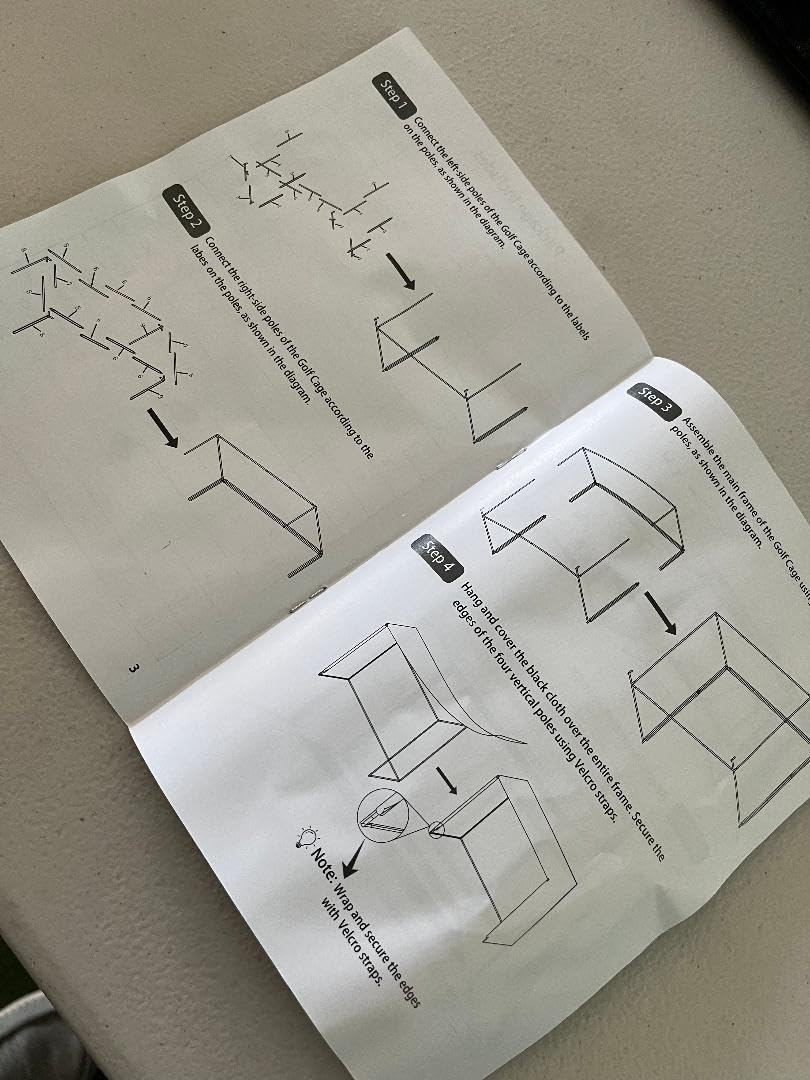
Owners like that the top, bottom and sides are all enclosed, and the bottom ball containment net is a nice touch that stops balls rolling under the frame. The frame is steel and does not feel flimsy, and the setup video proved more useful than the printed instructions for several builders.
There are two serious issues. A screen that scuffed badly within two weeks has been reported, and the response to that report was not good, with support declining to replace or sell a replacement screen. The frame height is also short enough that high wedge shots can go over the top, and the warranty is only 30 days.
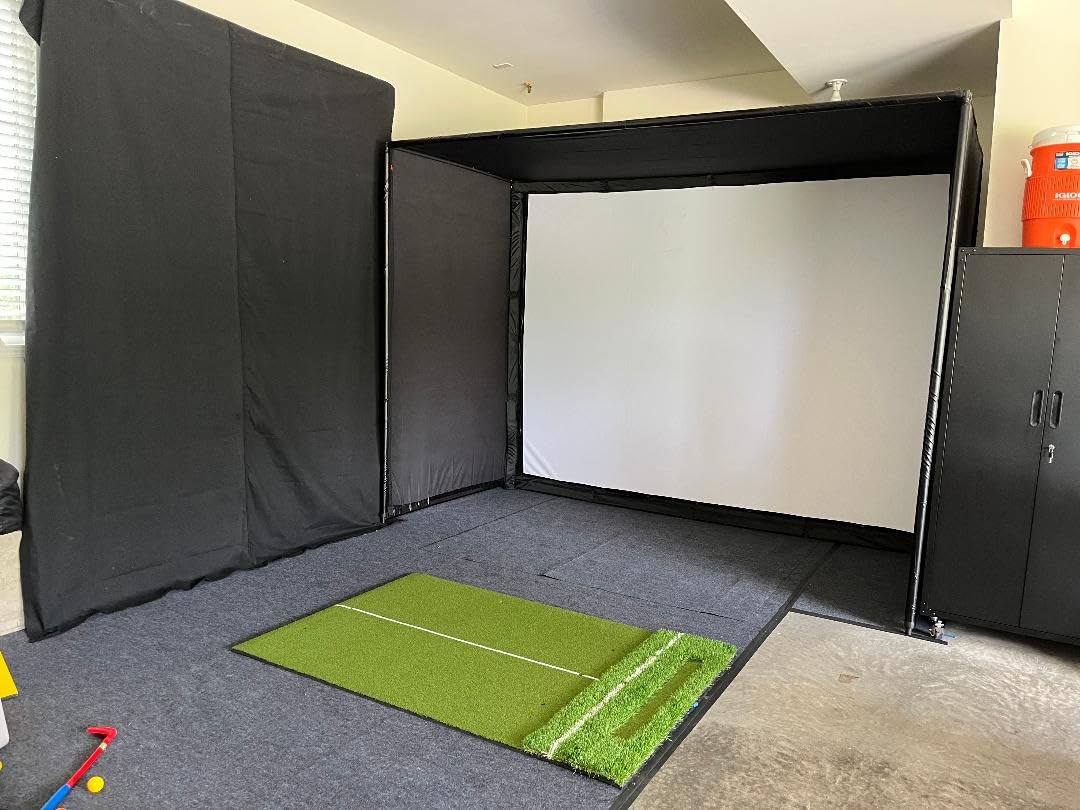
Who the Garvee package suits best?
It suits shared hitting spaces where two golfers need room, and anyone who wants full top, bottom and side containment rather than an open-top cage. The bottom net makes it a sensible choice in a garage with a wall or stored items close behind the screen.
It also suits builders who prefer to follow a video rather than a manual, since that is where the guidance is strongest.
Where it falls short?
The 30-day warranty and the reported support response are the deciding factors for us. If you cannot easily replace a screen yourself, buy from a seller who will stand behind it. The short frame height also makes it a poor fit for heavy wedge players.
10. YSDDAOG 10 x 8 x 6 ft Cage Kit – Deepest Swing Space
10x8x6 ft Golf Simulator Enclosure Net with HD Impact Screen & Frame Kit | Indoor Home Golf Training Cage Simulator Accessories | Gift for Golfers Men Women
10 x 8 x 6 ft, 72.7 lbs
Alloy steel frame
HD impact screen and frame kit
1-year warranty
Pros
- Highest average rating in the roundup at 4.8 with no ratings below four stars
- 6 ft depth gives more room for a full swing and floor turf
- Heavy-duty net
- screen and frame in one package
- Suitable for golfers of all skill levels
Cons
- Only seven ratings so far
- so long-term durability is not established
- No written customer reviews were returned to detail setup or performance
The YSDDAOG cage is the deepest of the group at 6 ft, and that single dimension is the reason to consider it. Extra depth gives you room for a full swing without shortening your motion, and it leaves space for floor turf in front of the screen rather than only a rolled mat.
It is a straightforward package: a heavy-duty enclosure net, an HD impact screen and a sturdy frame kit in alloy steel and polyester, weighing 72.7 lbs. It is listed for indoor home golf training and suits golfers at any level practising year-round.
On paper and in the ratings, it performs well. The average sits at 4.8 with a distribution showing 80 percent five-star and 20 percent four-star, and no rating below four. That is the highest average of any enclosure we evaluated.
The problem is the sample size. Seven ratings is a thin basis for a purchase, and no written customer reviews were returned, so there is no detail on assembly, screen behaviour over time, or how the frame handles repeated full-speed strikes. The 1-year manufacturer warranty is standard for the category.
Who the YSDDAOG cage suits best?
It suits golfers with a long, narrow bay who want depth rather than width, and anyone who wants floor turf rather than a single mat. The 6 ft footprint also gives more room behind the launch monitor, which reduces the chance of clipping a radar unit on a fast swing.
It is a reasonable first enclosure for a practice-focused household rather than a room you will also host in.
Where it falls short?
Everything we can say about it rests on a very small number of ratings. Treat the 4.8 average as encouraging rather than proven, and buy from a seller with a straightforward return process. If you need warranty support in year two, choose a kit with a longer written warranty.
How to Choose a Golf Simulator Enclosure for Your Garage?
Once you have a shortlist, four decisions drive almost everything: screen ply, frame width, blackout coverage and how the bay is shared.
Screen ply is the spec buyers regret skipping
An impact screen is a layered fabric panel designed to absorb a full-speed strike without tearing or returning energy into the bay. Single-layer screens are thin and quiet to install, and they show bounce back and image distortion quickly under repeated driver contact. Dual-layer screens add a rear impact-absorbing layer, which is what the Diandian and ANYTHING SPORTS packages use. Triple-layer screens, found in the Durbles and River Hill kits here, are the thickest and quietest, and they damp strike noise noticeably more.
Our read: dual-layer is the practical floor for a driver swing, and triple-layer pays off if you practise at night or share walls with neighbours.
Frame width decides whether the car stays
This is the decision most garage builds get wrong. A 10 ft wide kit in an 11 ft bay looks fine on paper and leaves too little clearance to open a car door. The forum consensus clusters at 8 x 8 ft for a single-car bay and 8 x 10.5 ft to 9 x 12 ft for a full driver swing with guests.
Three options solve the parking conflict. Buy a narrower footprint such as the 8 ft 4 in units from ANYTHING SPORTS. Buy a wall-mounted fold-up design that clears the floor in about a minute. Or rotate the bay and hit a side wall, which several builders do deliberately.
Blackout fabric decides whether projection looks good
Blackout fabric blocks ambient light so a mid-range projector image reads as bright and contrasty. Polyethylene tarp-style covers are the cheapest and let more light through, which is why projected courses look grey in them. Oxford fabric covers, like the 600D wrap on the Diandian kit and the vinyl enclosure on the fold-up ANYTHING SPORTS unit, cost more and transform the picture.
A related term worth knowing is throw ratio, which is the relationship between how far the projector sits from the screen and how wide the image is. A short-throw projector mounted close to the screen needs less room behind it, which matters in a shallow bay.
Under 9 ft of ceiling changes what you should buy
If your clear ceiling height is under 9 ft, several kits in this roundup are a poor choice. The Durbles instructions assume roughly 9.9 ft of height, and the 8 ft tall frames leave limited headroom above the screen for a high wedge. What to skip in a low garage: anything requiring a ceiling-mounted frame, and any kit whose instructions assume you can assemble it away from the wall and rotate it into place.
What still works: a low-profile freestanding cage you build in place, and any kit with its own legs rather than a ceiling suspension. Measure to the joists, not to the drywall.
Ball containment is a safety decision
Frame padding, side shank nets and top baffles are not comfort features. The most common safety complaints in buyer reviews involve balls ricocheting off unpadded frame poles and wedge shots clearing the top of the screen. Look for foam on every interior pole, and add a top baffle if you hit wedges. Kits with a bottom containment net, like the Garvee package, are worth considering in a narrow garage.
What a full build actually involves?
An enclosure is one of four components. Beyond the frame and screen you need a projector, a hitting mat with a landing area, and a launch monitor. Radar units read ball flight and are more forgiving in a small room; camera-based units need more space behind the ball and consistent lighting. Our equipment testing roundup covers how we approach hardware reviews generally.
Plan power and data before the frame goes up. One builder had to stop mid-project and buy a ceiling-mounted outlet strip because the only free plug ran the garage door opener. Wireless signal through a metal-framed, fabric-lined room is not guaranteed either, so check before committing to a camera-based monitor. The same clearance logic shows up in our racing simulator cockpit roundup, where seat position and pedal clearance decide the whole layout.
Finally, consider how the space behaves after dark and in winter. Unconditioned garages get cold, and fabric plus a steel frame will not do anything about that. Ambient lighting, a comfortable mat and a screen you can actually see in a dim room matter more to enjoyment than any spec on the box. A similar idea shows up in our enclosure roundup for trampolines, where the surround is what makes the space usable rather than merely safe.
Frequently Asked Questions
Who makes the best golf simulator enclosure?
The best golf simulator enclosure depends on your garage rather than the brand. For most two-car bays, the GoSports kit is the strongest all-round choice because of its multi-layer screen, true blackout fabric and one-hour build. The ANYTHING SPORTS complete package is the most complete box because it includes a projector mount. The Durbles kit is the pick if strike noise is your main concern, because its triple-layer screen is the quietest we evaluated.
Can you put a golf simulator in a garage?
Yes, and most home simulators are built in a garage. You need roughly 10 ft of bay width, about 6 ft to 7 ft of depth including your mat, and 9 ft of clear ceiling height. You can still park a car if you size the bay correctly, using a footprint under 9 ft wide or a wall-mounted fold-up enclosure that clears the floor in about a minute.
How much space does a golf simulator enclosure need?
Most enclosures need about 10 ft of width, 5 ft to 6 ft of depth, and 8 ft of internal height. Add 1 ft to 2 ft behind the ball for the launch monitor and mat. For a full driver swing without shortening your motion, plan on 6 ft to 7 ft of clear floor between your ball position and the back of the screen. Measure the bay width at three points before ordering.
What is the best golf simulator package for a garage?
A complete garage setup has four parts: the enclosure with impact screen, a projector, a hitting mat with a landing area, and a launch monitor. The enclosure and screen come as a set in every kit we reviewed. The launch monitor is the largest remaining decision, since radar units are more forgiving in a small room while camera-based units need more space and consistent light behind the ball.
How high should my garage ceiling be for a golf simulator?
Aim for 9 ft of clear height, measured to the joists rather than the drywall. Under 9 ft, skip any kit whose instructions assume you can assemble the frame away from the wall and rotate it into place, and skip ceiling-mounted frames. Low-profile freestanding cages that you build in place still work, and they keep the cost of a usable bay down.
Do I need an enclosure or just a net?
A net contains some balls and costs little. An enclosure adds a tensioned impact screen at the front, light-blocking fabric on the sides and top, and typically foam padding on the frame. That combination is what keeps a mishit off your car, darkens the room so a projected image looks bright, and turns a practice net into a room you will actually use. If you plan to hit a driver at full speed, buy the enclosure.
Conclusion: Best Golf Simulator Enclosures for Garages in 2026
After working through ten enclosures in 2026, the GoSports kit remains our best golf simulator enclosure for most garages, with the multi-layer screen, true blackout panels and a one-person build carrying the most review volume. Buy the ANYTHING SPORTS complete package if you want the projector mount and shank nets in the same box, the Durbles kit if quiet matters most, and the fold-up ANYTHING SPORTS unit if the car has to share the bay.
Whatever you choose, measure first, plan the power run, and add your own padding to the frame poles. Those three steps prevent most of the problems we read about across hundreds of buyer reviews.