
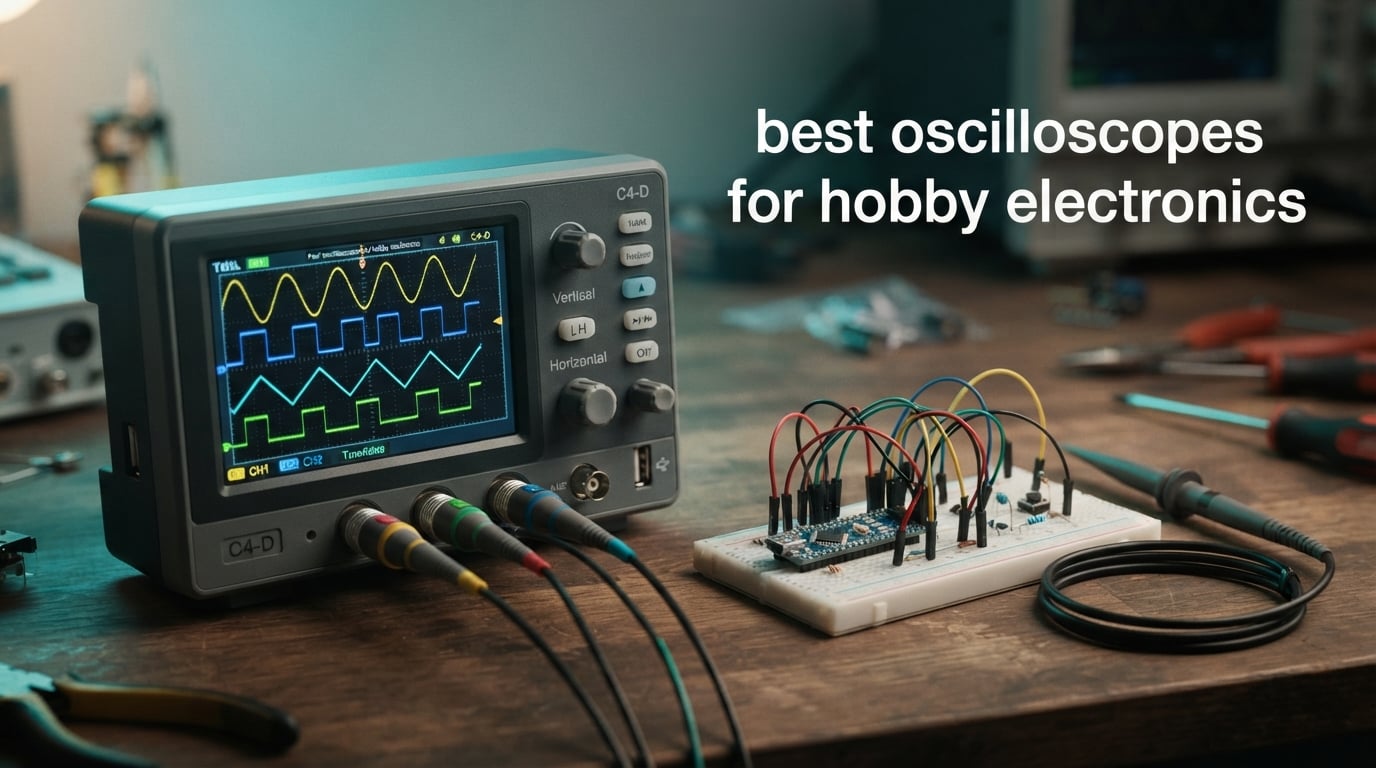
A good oscilloscope for a hobbyist is any scope with two channels, 50 MHz of bandwidth or more, real measurement functions you can read off the screen, and probes that actually hold calibration. That combination covers Arduino timing problems, audio amplifier repair, switching supply ripple and most beginner mistakes without leaving you wanting a different instrument eight months later.
We spent several weeks putting the ten best oscilloscopes for hobby electronics through the same routine: probing known signals, checking what the auto-set button actually finds, and reading through hundreds of owner reviews to separate the advertised specs from the instrument you really receive. The list below spans pocket handhelds at the budget tier through four-channel benchtop models with serial decoding unlocked at purchase.
Two things come up constantly when new hobbyists shop. The first is whether a multimeter is enough, and it usually is not: a meter tells you a 5V rail sits at 5V, while a scope tells you whether that rail is ringing, clipping or carrying switching noise on top of the DC level. The second is how much bandwidth to buy, and the short answer is that for most hobby work 100 MHz is plenty, while 200 MHz pays off only when you are chasing fast edges or working in RF.
If you are still building your bench, our educational electronics kits roundup pairs well with any of the entry-level scopes here. Whichever model you choose, budget for a proper set of 10x probes early, since bundled probes are the weakest link on most affordable instruments. This guide was last checked in 2026.
Table of Contents
Top 3 Best Oscilloscopes For Hobby Electronics (October 2026)

Siglent SDS1104X-E
- 4 channels at 100 MHz with 1 GSa/s dual ADC
- I2C SPI UART CAN LIN decoders included
- Ethernet web server
Rigol DS1054Z
- 4 channels at 50 MHz with 24 Mpts memory
- I2C SPI UART decode in base firmware
- 30000 wfms/s capture rate

HANMATEK HO52
- 2 channels
- 50 MHz handheld
- 4.5-digit true-RMS multimeter
- AC 750 V and DC 1000 V input limits
Quick Comparison of Every Scope in 2026
| Product | Specifications | Action |
|---|---|---|
| Siglent SDS1104X-E |
|
Check Latest Price |
 FNIRSI 2C53T FNIRSI 2C53T |
|
Check Latest Price |
| Rigol DS1054Z |
|
Check Latest Price |
| HANMATEK HO52 |
|
Check Latest Price |
 Rigol DS1202Z-E Rigol DS1202Z-E |
|
Check Latest Price |
 FNIRSI DSO152 FNIRSI DSO152 |
|
Check Latest Price |
 FNIRSI DSO-510 FNIRSI DSO-510 |
|
Check Latest Price |
 ZOYI ZT-703 ZOYI ZT-703 |
|
Check Latest Price |
 HANMATEK DOS1102 HANMATEK DOS1102 |
|
Check Latest Price |
 Siglent SDS1102CML+ Siglent SDS1102CML+ |
|
Check Latest Price |
1. Siglent SDS1104X-E: Four Channels With Decoding Unlocked
Siglent Technologies SDS1104X-E 100Mhz Digital Oscilloscope 4 Channels Standard Decoder, Grey
4 channels, 100 MHz, 1 GSa/s
I2C/SPI/UART/CAN/LIN decode
Web server over Ethernet
Pros
- Serial decoders included with no license unlock
- Dual ADC holds 1 GSa/s on two channels
- Ethernet with a built-in web server for remote viewing
- Bright high-contrast LCD with adjustable brightness
Cons
- Sample rate drops to 500 MSa/s with all four channels active
- Trigger response can feel slow on decoded data
- Optional MSO and AWG modules cost a lot
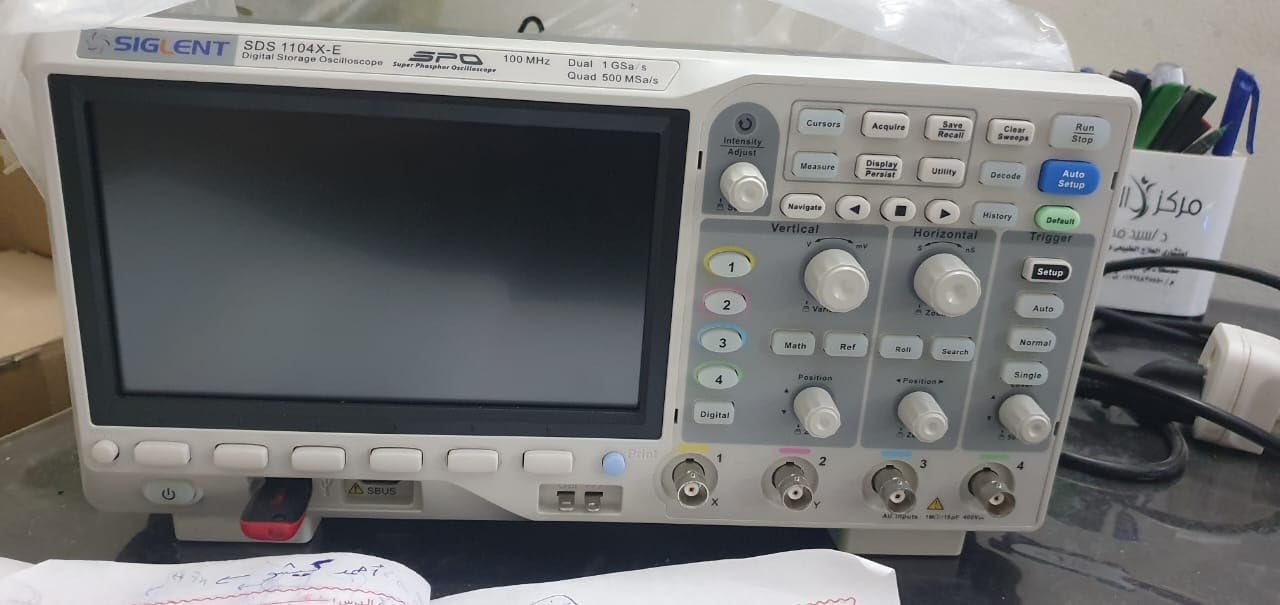
This is the scope we keep coming back to, and after living with it through the comparison it stayed on the bench. It carries four analog channels at 100 MHz with a dual ADC architecture, so two channels still sample at 1 GSa/s rather than being dragged down by the other two. That matters when you are watching an input and an output on a filter at the same time and you want to zoom in without the display going soft.
The feature that separates it from cheaper four-channel units is the decoder set. I2C, SPI, UART/RS232, CAN and LIN are all present on the base model with nothing to unlock, which is the single most common reason owners of budget scopes end up buying a second instrument later. Four passive probes, a calibration certificate and a USB cable are in the box.
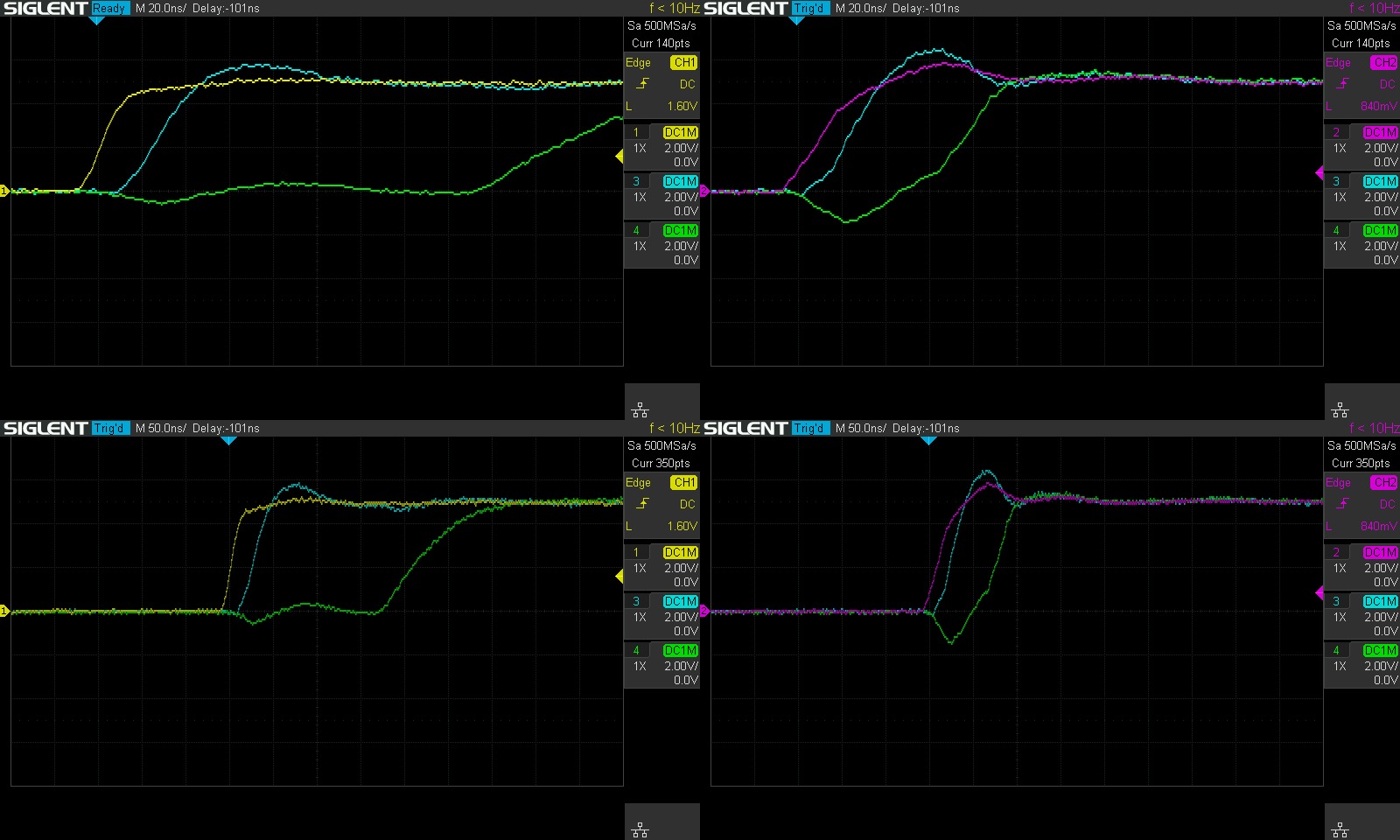
Across 966 reviews this model carries the highest rating and the largest review count of the ten scopes we compared, and the sentiment is consistent: people treat it as the four-channel bench workhorse for hobby projects. The interface feels modern and quick compared with the menu-heavy rivals, and the Ethernet port plus built-in web server let you check a long capture from a phone instead of leaning over the instrument.
The honest compromises are specific. Push all four channels and the sample rate halves to 500 MSa/s. The select knob can overshoot into the neighbouring menu item, which annoys you the first hour and then becomes muscle memory. Settings such as clock sync and the screensaver timeout do not always survive a power cycle, and the fan is audible in a quiet room.
When the SDS1104X-E earns its cost?
This is the right pick when your work involves buses rather than just voltages. Decoding an I2C sensor conversation, watching CAN traffic from an automotive project or comparing two rails during a power supply bring-up all land in this scope’s comfort zone. Four channels also means you can hold reference, input and output traces together without swapping probes.
If your interest is purely analog and low frequency, the four-channel advantage matters less than screen size, and a larger-display two-channel model may serve you better for less money.
When to choose something else?
Skip it if you are on a very tight budget or if you only ever look at one audio channel. The optional MSO and arbitrary waveform generator add-ons are expensive enough that owners regularly treat them as a second purchase, and a deep nested menu structure rewards patience rather than impatience.
Exporting full-depth captures is quicker on models with faster front-panel USB than on this one. If remote PC control and decoding do not matter to you, the Rigol DS1054Z below delivers similar channel count for noticeably less.
2. FNIRSI 2C53T: Scope, Multimeter and Generator in Your Pocket
FNIRSI 2C53T 3-in-1 50MHz 2CH Oscilloscope Multimeter DDS Signal Generator
2 channels, 50 MHz, 250 MSa/s
1 Kpts record depth
19999-count multimeter
DDS generator to 50 kHz
Pros
- Three instruments in one palm-sized body
- 19999-count meter is the strongest section
- 3000 mAh battery with USB-C charging
- FPA and MCU architecture with high-voltage protection
Cons
- 1 Kpts record depth is very shallow
- 2.8 inch screen is hard to read for detail
- Button-driven menu with no dedicated knobs
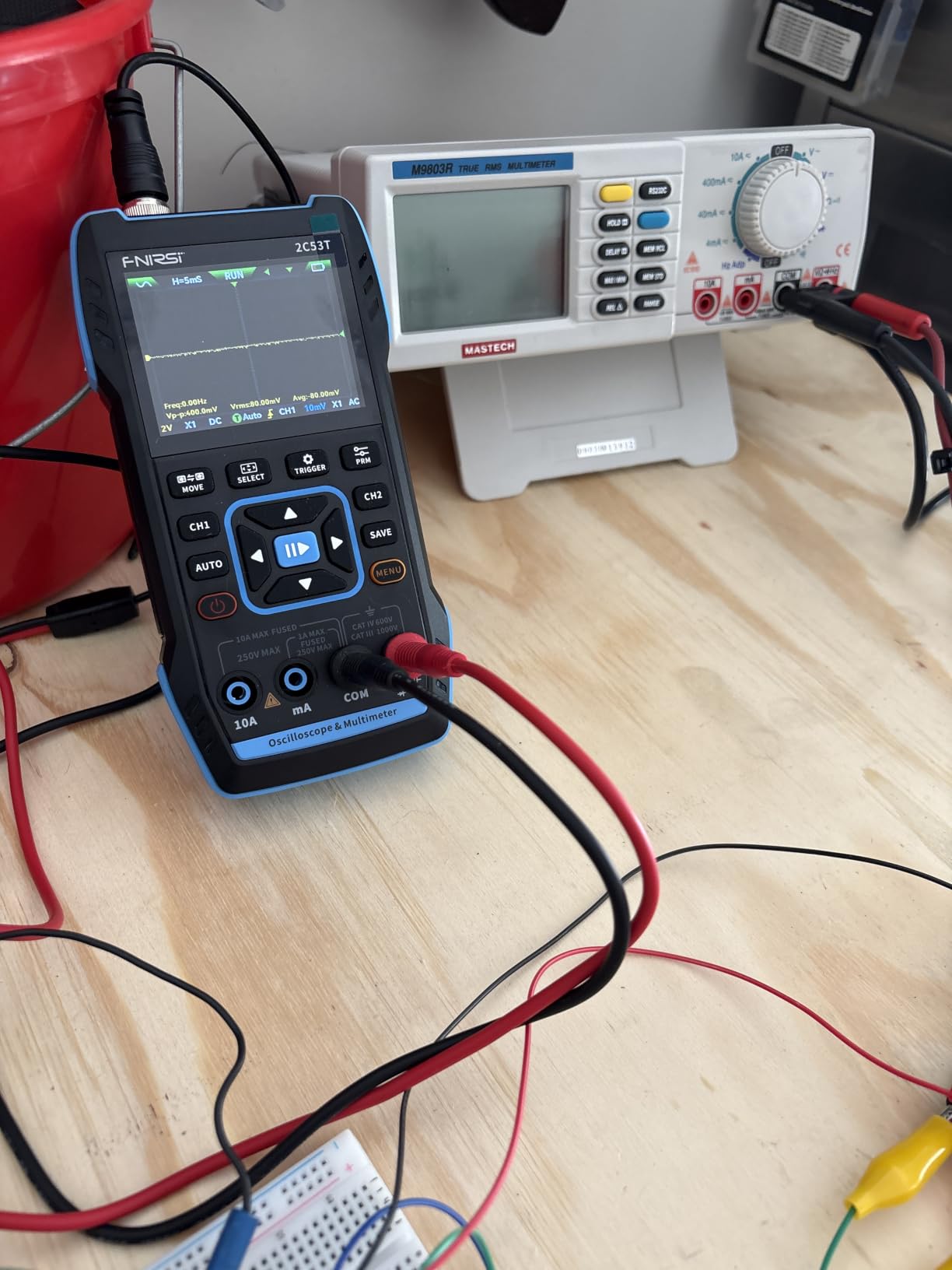
Three instruments in a 400 g body is the headline here: a two-channel 50 MHz scope, a 19999-count multimeter and a DDS signal generator with 13 waveforms up to 50 kHz. Owners frequently single out the meter section as the best part, and for automotive diagnostics where you are half the time measuring resistance and capacitance, that combination is unusually useful.
The generator means you can inject a known signal into a circuit and watch the response, which turns the scope from a passive window into an active test tool. Math, cursor, persistence and XY modes were added over the earlier version, and one-click screen capture plus reference waveform overlay help you compare a good trace against a bad one.
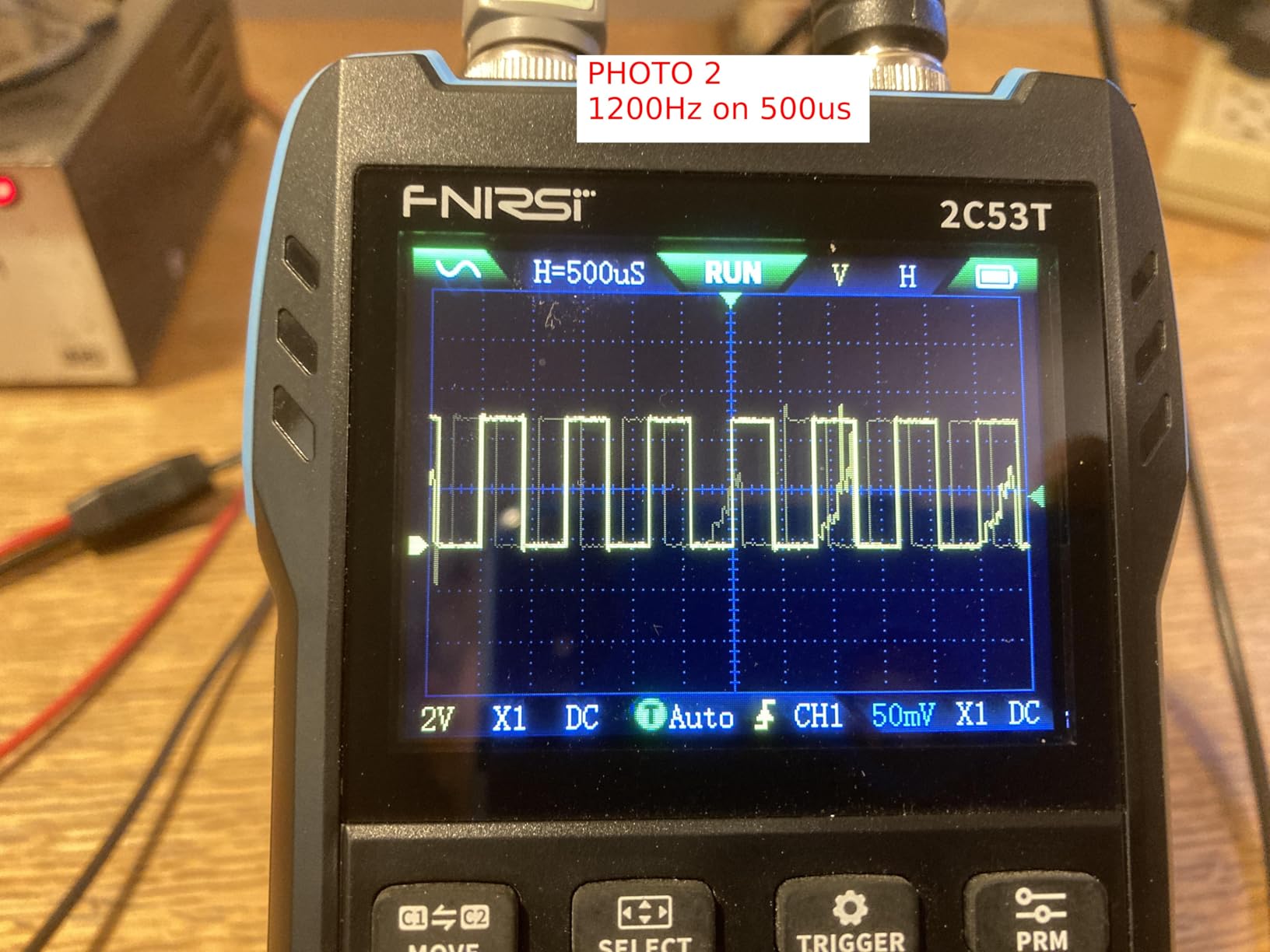
At 883 reviews it is one of the most discussed models in this guide, with a wider spread of ratings than the benchtop instruments. Reviewers are happy with the feature-per-dollar ratio and the fact that it ranks at the top of the Lab Oscilloscopes category, while the recurring frustration is the 1 Kpts record depth once you want to analyse rather than glance.
The 2.8 inch display and 50 MHz ceiling are the format’s hard limits, and the button-driven navigation has no dedicated knobs for divisions or cursors. Owners also report a higher share of one and two star reviews than the larger FNIRSI models.
When the 2C53T earns its cost?
Buy it when your projects are spread across a car, a bench and a client site rather than in one room. A 3000 mAh battery with USB-C charging means it works from a power bank, and the high-voltage protection module is the reason it appears in automotive and mains-adjacent work.
It is also a good first instrument if you are not certain a scope is for you yet, because the meter and generator remove the need to buy those separately while you learn.
When to choose something else?
Do not expect deep memory, fine cursor work or sharp edge detail from it. Any signal above roughly 10 MHz will look rounded, and a screen this small becomes frustrating the moment you are comparing two traces at high magnification.
If you already own a multimeter and only need to see waveforms, the extra functions here are a bonus rather than a reason to buy, and one of the bench scopes will serve you better for the long term.
3. Rigol DS1054Z: The Value Benchmark Four-Channel Scope
Rigol DS1054Z Digital Oscilloscope, 50MHz, 4 Channel, 1GSa/s, Best Value
4 channels, 50 MHz, 1 GSa/s
24 Mpts memory depth
30,000 wfms/s capture
I2C/SPI/UART decode included
Pros
- 24 Mpts memory is unusually deep for the class
- Decoders and triggers included in base firmware
- Built-in help system helps beginners
- Four colour-coded probes and Ethernet included
Cons
- Cooling fan is noticeably loud
- Intensity and select knobs are error-prone
- Bundled probes are of limited quality
The DS1054Z is the scope most hobbyists end up on, and 725 reviews averaging 4.7 stars reflect a long, consistent ownership record rather than a launch buzz. Four analog channels at 50 MHz, up to 1 GSa/s on a single channel, and 24 Mpts of memory depth that still looks generous in this class and lets you zoom into burst data without losing the record.
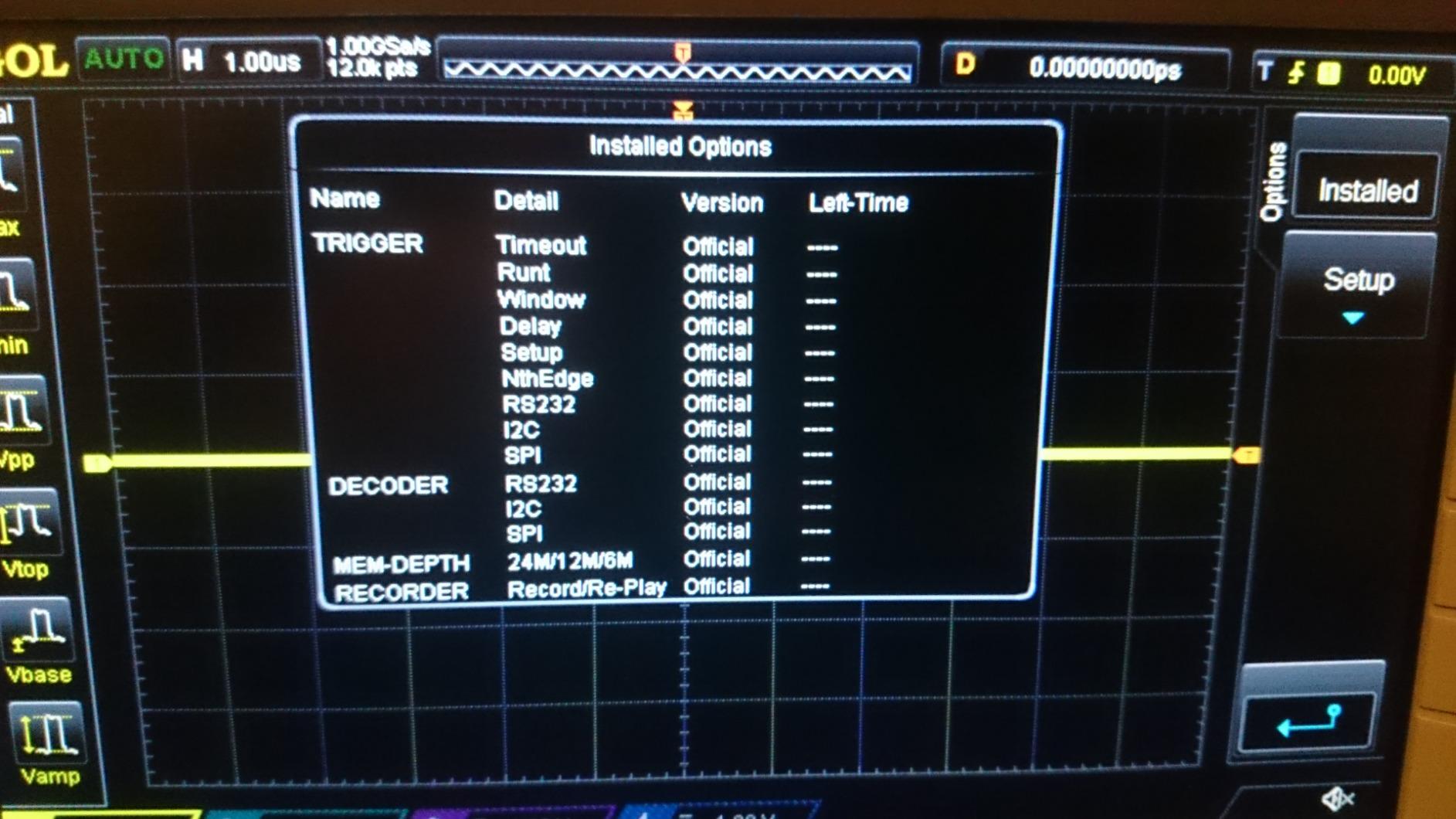
Serial bus trigger and decoding for RS232/UART, I2C and SPI are in the base firmware, along with FFT and filters for basic frequency-domain checks. The UltraVision capture system manages up to 30,000 wfms/s with intensity grading, which is what actually reveals short glitches, and playback stores up to 60,000 frames for reviewing intermittent events.
Beginner-friendliness is a genuine strength rather than a marketing line: the built-in help button and on-screen explanations come up often in reviews as the reason people stopped feeling lost. Interfaces cover USB host, USB device, LAN and an AUX output for trigger and pass/fail, and owners with long careers in electronics describe it as the best instrument they have owned at this level of spend.
The criticisms are all physical rather than feature-based. The cooling fan is loud enough to notice, the rotary encoders are mushy and often jump a step when pressed, and the bundled probes are mediocre, with some examples arriving hard to tune. Channel colour choices are close enough to confuse, and rare USB hangs after extended use are reported.
When the DS1054Z earns its cost?
This suits anyone doing embedded work on a microcontroller with three or four signals to watch, especially when you want deep memory for logging a power rail or a sensor line. The decoders remove the need for a separate logic analyzer on I2C and SPI, which is the cheapest upgrade you can make to a hobby bench.
It is also a strong teaching scope, since the help system shortens the distance between a new user and a useful first measurement. For anyone who will keep the instrument for years, the feature set ages well.
When to choose something else?
Choose a faster model if you are chasing edges above 20 MHz, because 50 MHz of bandwidth will shape those edges even though the sample rate looks impressive on paper. The loud fan and the twitchy encoder are genuine annoyances if you work late at night or sit close to the bench.
Replace the bundled probes early. Several owners note that current units now arrive with most add-on options already enabled, which removes the old unlock hassle that made this model frustrating in earlier years.
4. HANMATEK HO52: Handheld Scope With a True-RMS Meter
HANMATEK Handheld Digital Oscilloscope 50Mhz Bandwidth with 2 Channels HO52 3.5″ TFT Mini Oscilloscope, 2 in 1 Oscilloscope and Multimeter, Backlit Screen, Auto-Calibration Function, Memory Function
2 channels, 50 MHz, 250 MSa/s
8k dot record length
4.5-digit true-RMS meter
AC 750 V and DC 1000 V limits
Pros
- Scope and meter with independent inputs
- Handles AC 750 V and DC 1000 V input
- USB-C exports images and CSV waveforms
- Reference waveform overlay for A/B comparison
Cons
- 8k dot record depth is short
- 3.5 inch TFT is small for detail work
- Button interface with no per-channel knobs
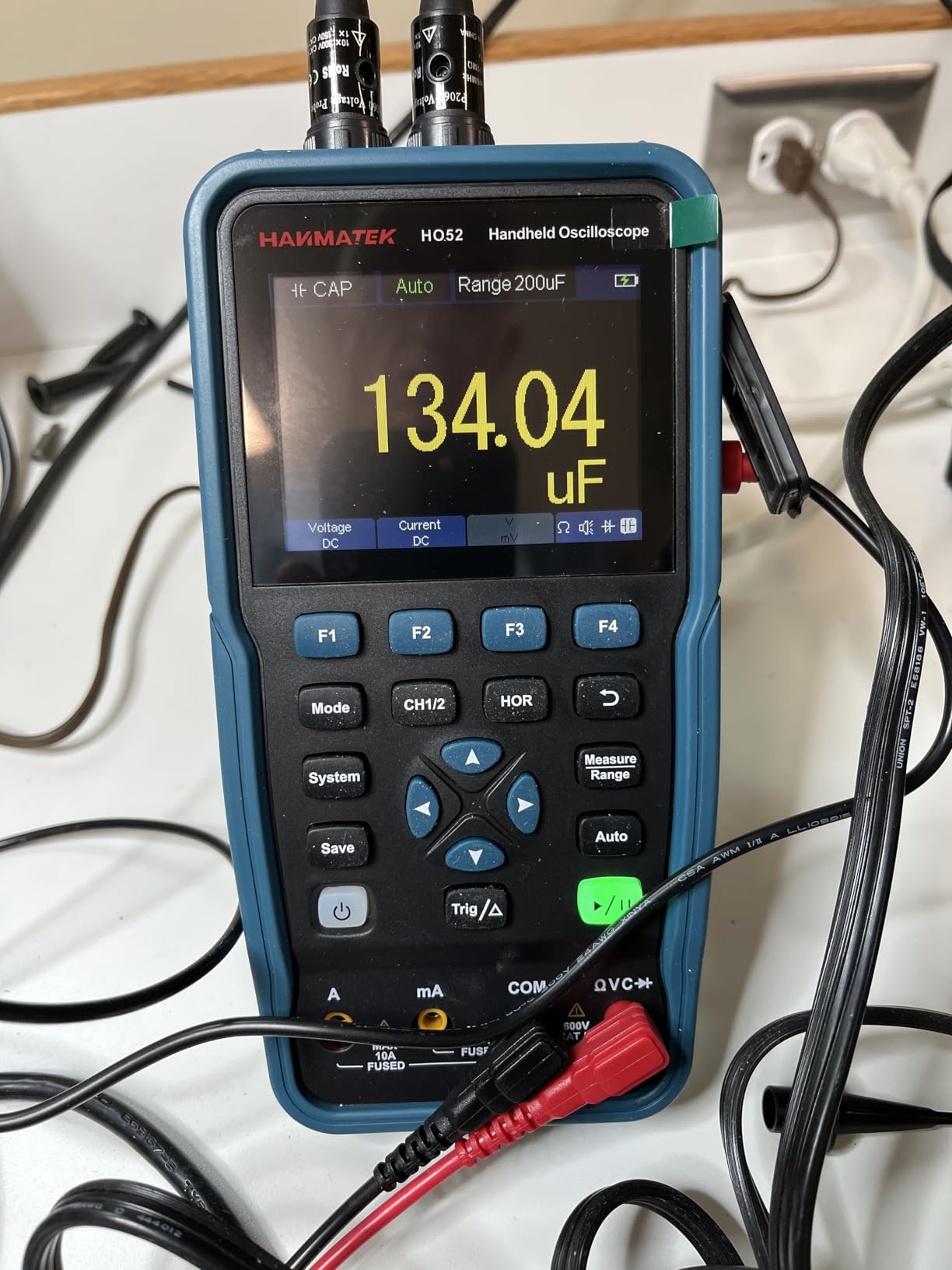
This is our budget pick and the most consistently well-regarded entry instrument here, with 589 reviews holding a 4.7 average and only a small share of one-star ratings. It is a two-channel 50 MHz scope sampling at 250 MSa/s with an 8k dot record length, and it refreshes waveforms at up to 10,000 wfms/s so you see activity without waiting.
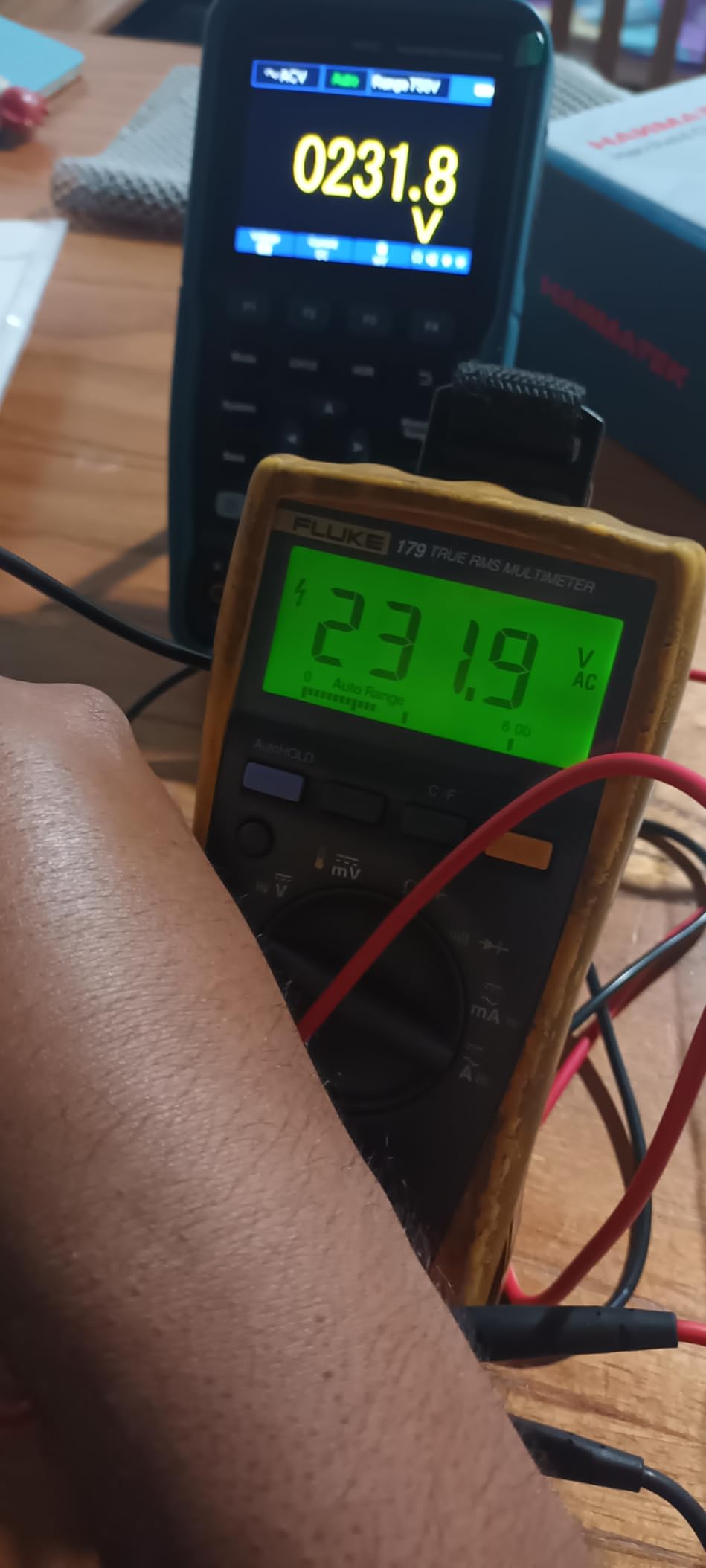
The multimeter section is a 4.5 digit true-RMS unit with auto-ranging across voltage, current, resistance, diode, continuity and capacitance, and the scope and meter inputs are independent so you can meter one point while probing another. AC up to 750 V and DC up to 1000 V are within the meter limits, which is what makes it useful for mains and automotive checks.
Cursor measurement, XY mode, seven automatic measurements with up to six shown at once, a one-key auto-set and a self-calibration routine cover the everyday workflow. You get four slots for settings, four reference waveforms, four images and four CSV waveform groups, and the USB-C port reads all of them back to a PC or runs the unit from a power bank.
What you give up is inherent to the format rather than a defect. The 3.5 inch TFT is small, the 8k dot record is too short for real analysis, 50 MHz stops you well short of RF or fast digital, and there are no dedicated per-channel knobs. Owners rate it as an excellent first tool rather than a final instrument.
When the HO52 earns its cost?
Pick it if your projects move between locations or live in a vehicle, because at 2.6 lb with a battery it is genuinely portable. It is also the pick for anyone who wants one device that can double as a meter, which saves bench space and money versus buying a standalone meter separately.
For first-time buyers it removes almost all setup friction, since the auto-set button finds periodic signals and the self-calibration corrects the baseline with a long press.
When to choose something else?
Do not buy it as a second scope after you outgrow a kit, because you will outgrow this one too. The record depth and screen size will frustrate anyone doing burst analysis or multi-channel comparison work.
If your signals sit above a few megahertz, you need a bench scope instead. This one is built for audio-range and low-frequency troubleshooting, mains checks and field service.
5. Rigol DS1202Z-E: 200 MHz of Headroom in Two Channels
RIGOL DS1202Z-E Digital Oscilloscope, 200MHz, 2 Channel, 1GSa/s Sampling
2 channels, 200 MHz, 1 GSa/s
24 Mpts memory depth
60,000-frame record and playback
7 inch WVGA TFT
Pros
- 200 MHz bandwidth at this spend level
- Quiet fan and solid build feel
- Deep memory with 60000-frame playback
- Serial decode for UART
- I2C and SPI
- Three-year main unit warranty
Cons
- Multifunction knob overshoots its selection
- Full-depth export is slow on USB 2
- Deep menus are steep for beginners
Bandwidth is the spec that decides this one. 200 MHz on two channels means clock edges, switching transients and higher-frequency harmonics arrive with far less rounding than a 50 MHz instrument can show you, which is exactly what you need when the bug only appears in the first 50 nanoseconds after a switching event.
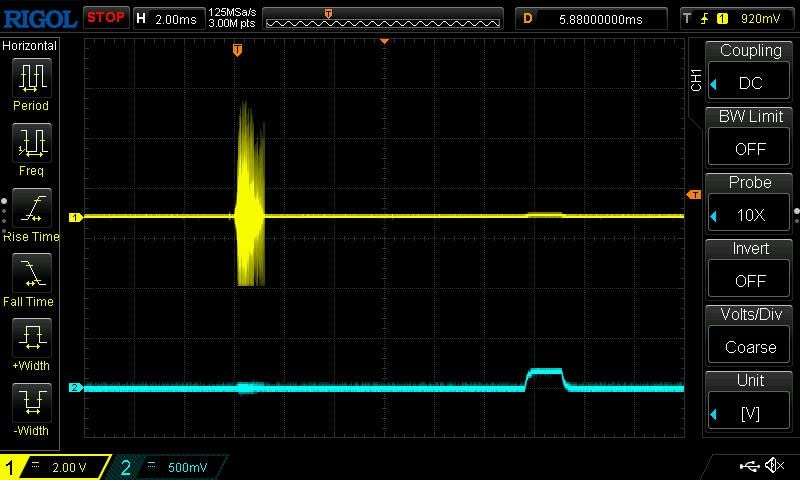
Everything else is equally serious: up to 1 GSa/s real-time sampling, 24 Mpts of memory (12 Mpts in dual-channel), 30,000 wfms/s capture with intensity graded colour, and hardware record and playback up to 60,000 frames. Serial bus trigger and decoding for RS232/UART, I2C and SPI is included, with FFT, math, XY and ROLL modes alongside it.
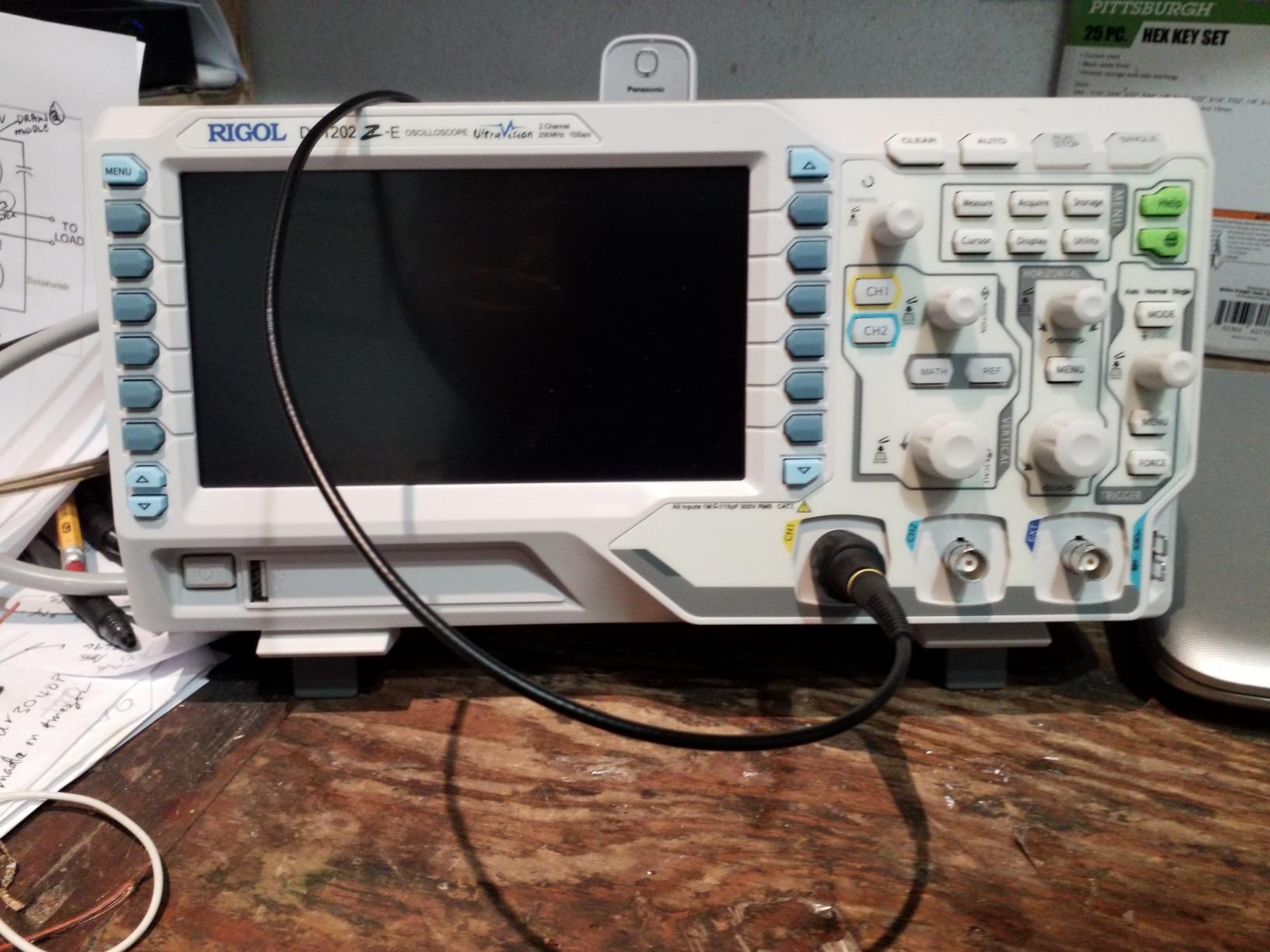
Reviewers with analog-scope backgrounds treat this as a generational upgrade and frequently describe build quality as solid, with smooth knobs and a quiet fan that stays inaudible after an hour of running. The 7 inch 800×480 WVGA display is bright with a large capture area, and the included probes compensate cleanly out of the box. A three-year main unit warranty adds confidence for a bench instrument you plan to keep.
The most cited weakness is the multifunction knob, which is sensitive enough to overshoot its selection regularly. Full-depth 24 Mpoint transfers run only through the front-panel USB 2 port and are slow, and the PC software cannot read full-resolution raw memory. Soft-key legends sit on both sides of the trace and cannot be hidden.
When the DS1202Z-E earns its cost?
This is the scope for power electronics work, where the interesting content lives in switch edges, ringing and secondary-side ripple. It is equally suited to anyone working near radio frequencies below 200 MHz, since the amplitude accuracy stays usable far closer to the corner than a 50 MHz model.
Two channels plus an external trigger input is enough for most single-ended measurements, and the deep memory means a long acquisition window without losing resolution. The warranty length is a genuine advantage over cheaper rivals.
When to choose something else?
Beginners are warned about the menu depth. Several users caution that the nested structure makes it a poor first scope despite the auto button, so pair it with a day of clicking through menus before you need it on a repair.
If you routinely need three or four signals at once, two channels will feel limiting no matter how fast they are. In that case the four-channel models give you more flexibility than raw bandwidth does.
6. FNIRSI DSO152: The Smallest Honest First Scope
FNIRSI DSO152 Handheld Oscilloscope 200kHz Bandwidth, 2.5MS/s Sampling Rate
200 kHz bandwidth, 2.5 MS/s
Single channel
10x probe to 800 VPP
1000 mAh battery
Pros
- Pocket sized at 10.2 oz for field troubleshooting
- Factory assembled with no soldering required
- 10x probe handles up to 400 V signals
- One-key AUTO plus long-press baseline calibration
Cons
- 200 kHz bandwidth covers only low-frequency work
- 320x240 display is small and low resolution
- No signal generator or multimeter in this model
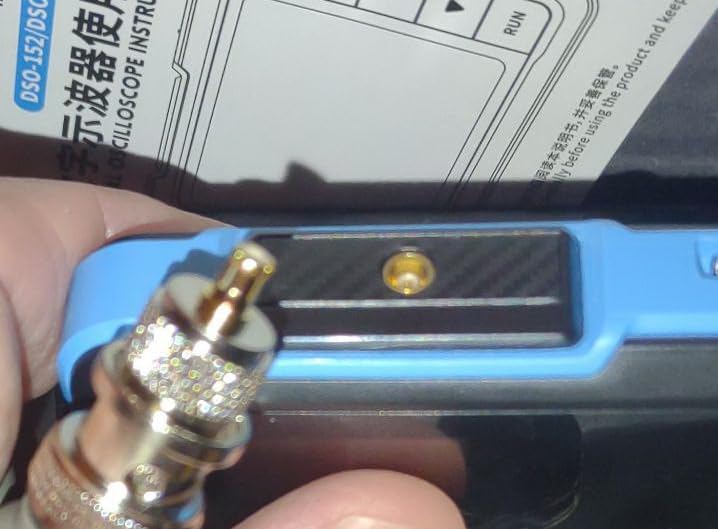
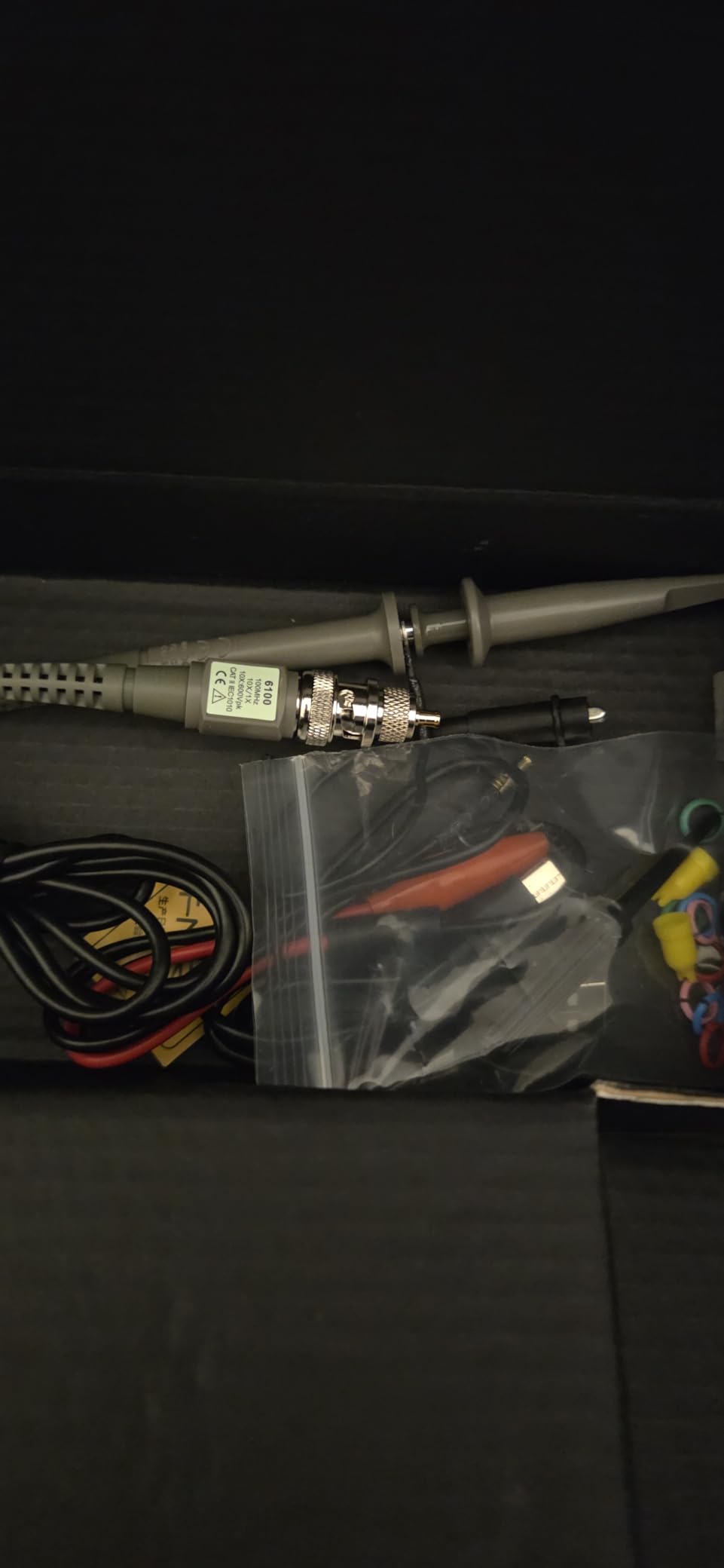
The DSO152 is the smallest instrument in this guide and the most honest about what it is. It is a single-channel scope with 200 kHz of bandwidth and 2.5 MS/s real-time sampling, which means audio-range signals, slow sensor lines and power rail hum sit comfortably in its window. It weighs 10.2 ounces and comes factory assembled, so there is no soldering before first use.
Trigger modes are Auto, Normal and Single, including single-shot capture for transients, and long-pressing the AUTO key recalibrates the baseline. The 10x probe is rated to 800 VPP, equivalent to 280 V AC, with voltages up to 400 V measurable, so mains-level observation is within reach for someone who knows what they are doing.
At 392 reviews it ranks second in the Lab Oscilloscopes category, which tells you it sells on portability and entry cost. The 69 percent five-star share reflects buyers who expected a limited tool and got a working one, with owners using it for field troubleshooting rather than bench analysis.
The ceiling is obvious and worth stating plainly. The 2.8 inch 320×240 screen is the weakest part, the 200 kHz bandwidth rules out anything fast, and there is no generator or meter in this model. Treat it as a first look at waveforms, not a measuring instrument.
When the DSO152 earns its cost?
It suits a student or a complete beginner who wants to see what a sine wave actually looks like before committing to a larger purchase. It also makes sense as a grab-and-go tool for a toolbox, where size and battery life matter more than record depth.
The one-key AUTO setup and baseline calibration mean a first-time user gets a stable trace without learning triggers first, which is a real advantage for the intended buyer.
When to choose something else?
Move up as soon as you start working on microcontroller projects, because anything digital will alias badly at this sampling rate. It also cannot help with amplifier debugging or filter work, where you need to compare input and output.
If you can stretch to one of the mid-range handheld units, the jump in bandwidth and record depth is large for the money and will extend the life of the purchase considerably.
7. FNIRSI DSO-510: Scope Plus DDS Generator for Car Audio
FNIRSI DSO-510 2-in-1 10MHz Handheld Oscilloscope DDS Signal Generator
10 MHz bandwidth, 48 MS/s
50 ns to 20 s time base
DDS generator to 50 kHz
Infinite afterglow display
Pros
- Scope and DDS signal generator in one inexpensive body
- 10 MHz handles audio-range and low-frequency work
- Infinite afterglow reveals transients
- Good for identifying clipping in amplifiers
Cons
- Single probe with no second channel
- Generator frequency accuracy degrades at higher setpoints
- Trigger mechanism takes practice
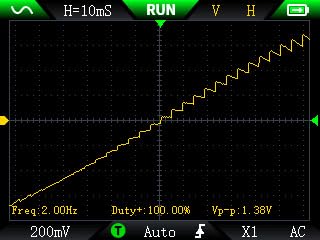
Owners frame this one as a car audio and general hobby tool rather than a universal scope, and the specs support that framing. Ten megahertz of bandwidth with 48 MS/s sampling and a 50 ns to 20 s time base range covers audio-band work comfortably, and infinite afterglow with a level display makes short events visible instead of flashing past.
The built-in DDS signal generator offers 13 waveform types up to 50 kHz, so you can drive a circuit with a known tone and watch what comes out. That combination is why several users report concrete diagnostic wins, including spotting clipping and confirming an amplifier’s output limits rather than guessing at them.
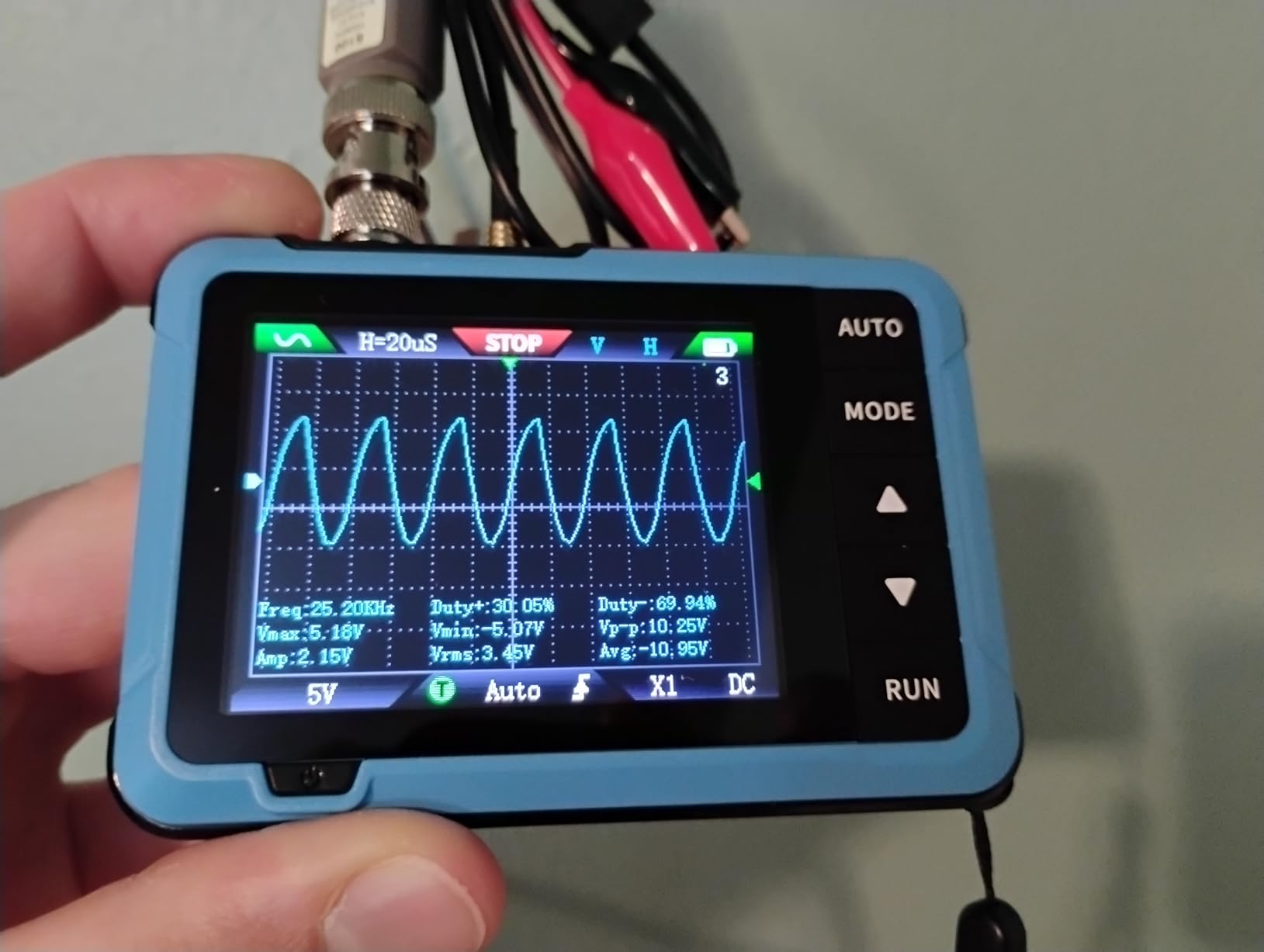
Across 358 reviews the overall sentiment is positive but the most substantive technical criticism comes from a detailed measurement of the generator, which found output frequency and amplitude inaccurate at mid and high setpoints. There is a single probe and therefore no second channel, and the trigger mechanism takes practice to learn.
Quality control is a recurring theme, with probe failures, missing accessories and one report of a previously used model, though the seller is praised for replacing faulty equipment. The probe attenuation factor is also not user-customisable.
When the DSO-510 earns its cost?
It is a strong match for car audio installers and anyone tuning amplifiers, speakers and crossovers, where the signal is slow enough for 10 MHz and the generator makes tone sweeps easy. The 1000 mAh battery and Type-C charging make it easy to keep in a vehicle.
It also works as a bench companion for low-frequency experiments on op-amp circuits, because the 20 s time base lets you watch slow transients and thermal drift.
When to choose something else?
A single channel rules it out for anything needing comparison, and roughly a tenth of its reviews sit at three stars or below, so expect more variation than with a benchtop scope.
If your work touches microcontroller timing or anything above audio frequencies, buy a higher-bandwidth model instead. The generator’s accuracy at higher setpoints also makes it a poor reference source for precise amplitude work.
8. ZOYI ZT-703: Three Instruments in One Field Tool
3 in 1 Handheld Oscilloscope Automotive Dual Channel 50MHz with Digital Multimeter and Signal Generator
Dual channel, 128K samples
200 MSa/s at 30 MHz, 280 MSa/s at 50 MHz
25000-count multimeter
Signal generator with sine, square and triangle
Pros
- Multimeter
- dual-channel scope and generator in one unit
- 25000-count meter is accurate and fast
- Large colour screen keeps traces readable
- Rechargeable battery with USB-C fast charging
Cons
- Measured real bandwidth is closer to 20 MHz than 50 MHz
- Square wave edges deform visibly
- No rotary knobs for divisions or cursors
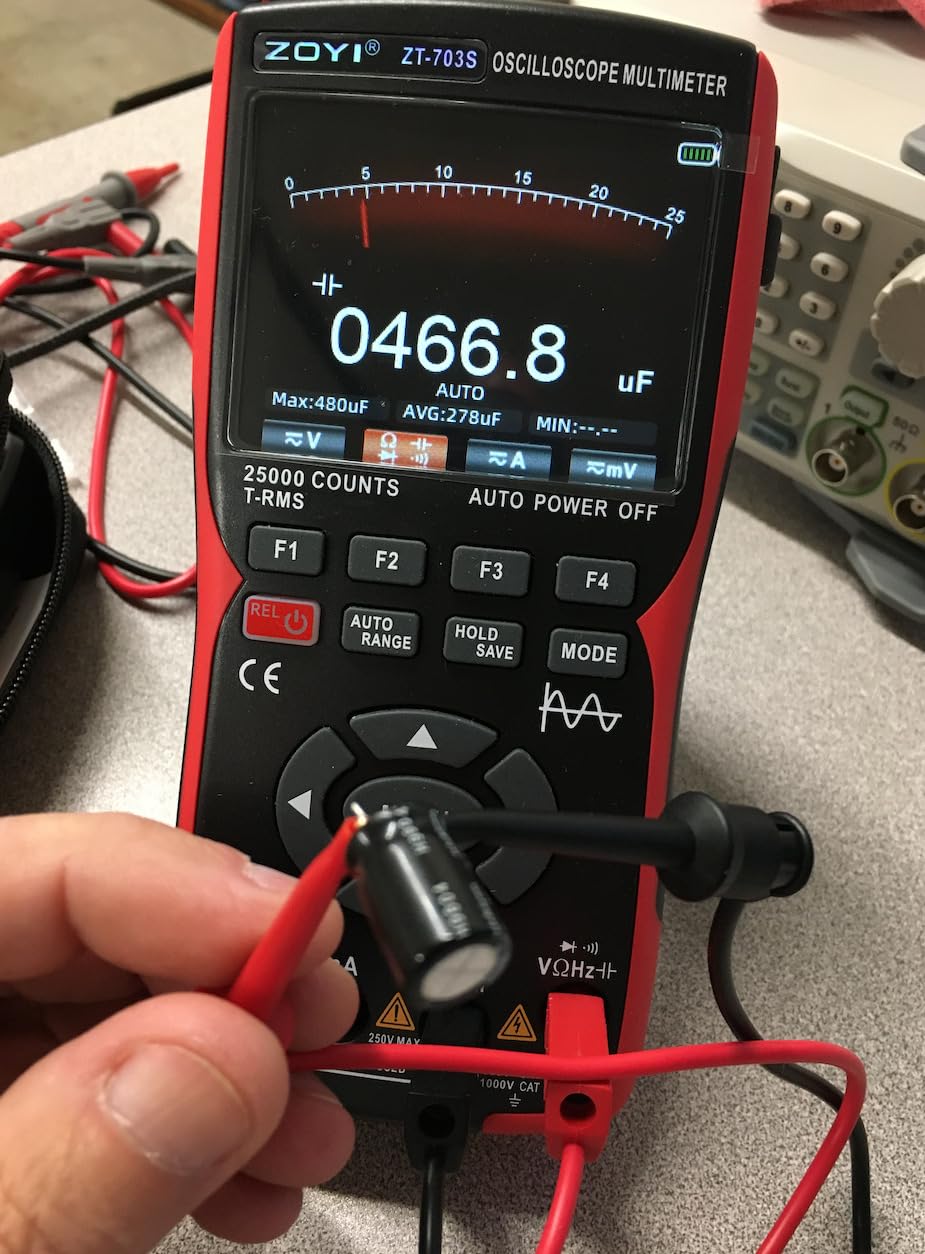
The ZT-703 combines a dual-channel scope, a 25000-count multimeter and a signal generator, and it carries a 4.7 average across 307 reviews. It runs in two speed modes: normal mode at 200 MSa/s with 30 MHz maximum bandwidth, and high-speed mode at 280 MSa/s with 50 MHz, with 128K of storage depth behind both.
The meter handles resistance, capacitance, continuity, diodes and current, and reviewers treat it as the strongest section, accurate and fast enough for most field diagnosis. AUTO recognises waveforms automatically, the generator outputs sine, square and triangle with a synchronous display, and a replaceable rechargeable battery plus USB-C fast charging make it genuinely portable.
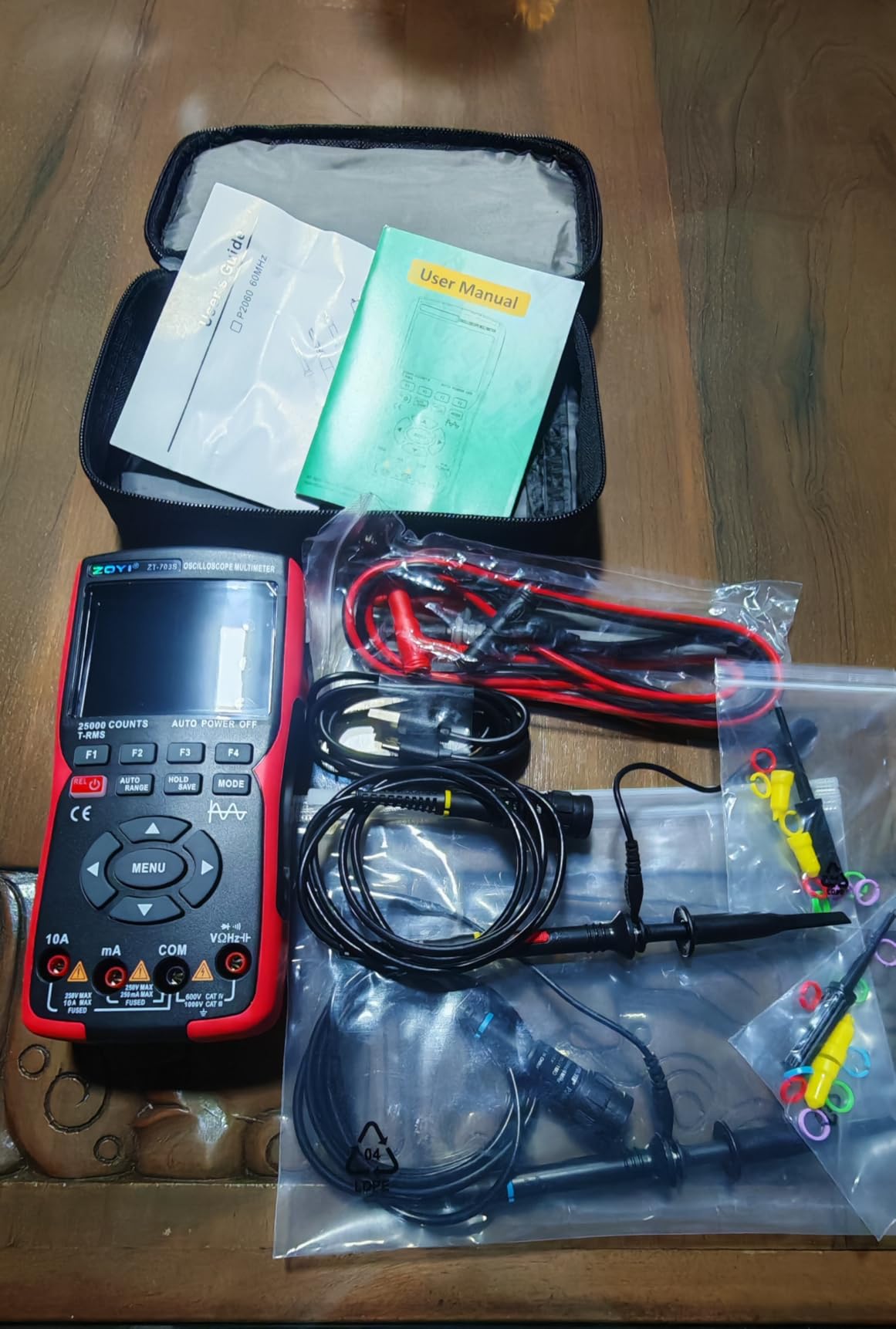
The reviews converge on one use case: an inexpensive all-in-one tool where the meter leads and the scope handles automotive work, speaker phase checks and CAN signal inspection. Construction feels solid, the keys have a good feel, and a carry case, probes, test leads and charging cable are included.
One caveat recurs more than any other. Reviewers measuring the instrument report real bandwidth closer to 20 MHz rather than the advertised 50 MHz, and square wave rise times visibly deform. Owners still rate it well above having no scope at all, while stopping short of recommending it above 10 to 20 MHz.
When the ZT-703 earns its cost?
It is a good choice for automotive and field service work where one device has to cover measurement, waveform capture and signal injection. The two channels matter more here than the bandwidth claim, because automotive diagnosis often means watching two lines at once.
The large colour screen in a small footprint is a genuine advantage for reading traces outdoors or in a vehicle, and the replaceable battery extends its working life beyond typical sealed units.
When to choose something else?
Do not trust the 50 MHz headline. Treat the effective ceiling as roughly 20 MHz and stay below that, or you will be reading artefacts rather than your circuit.
There are no rotary knobs, so changing divisions or cursors means navigating menus, and the display sleep timeout is short and awkward to change. For any precision work, buy a scope you can drive with knobs.
9. HANMATEK DOS1102: A Large 7 Inch Screen at 110 MHz
HANMATEK 110mhz Bandwidth DOS1102 Digital Oscilloscope with 2 Channels and Screen 7 inch / 18 cm, TFT-LCD Display, Portable Professional Oscilloscope Kit with 500 MS/s *2 Sampling Rate
2 channels, 110 MHz
500 MS/s x 2 sampling
7 inch 800x480 TFT
SCPI and LABVIEW support
Pros
- 110 MHz with dual-channel 500 MS/s sampling
- 7 inch true-colour screen is large for the tier
- 30 automatic measurements with a customisable menu
- SCPI and LABVIEW scripting support
- Light at 2.4 lb drawing 18 W
Cons
- Interface and menu structure need a learning curve
- 800x480 on 7 inches makes trace detail coarse
- DC powered so it is not battery portable
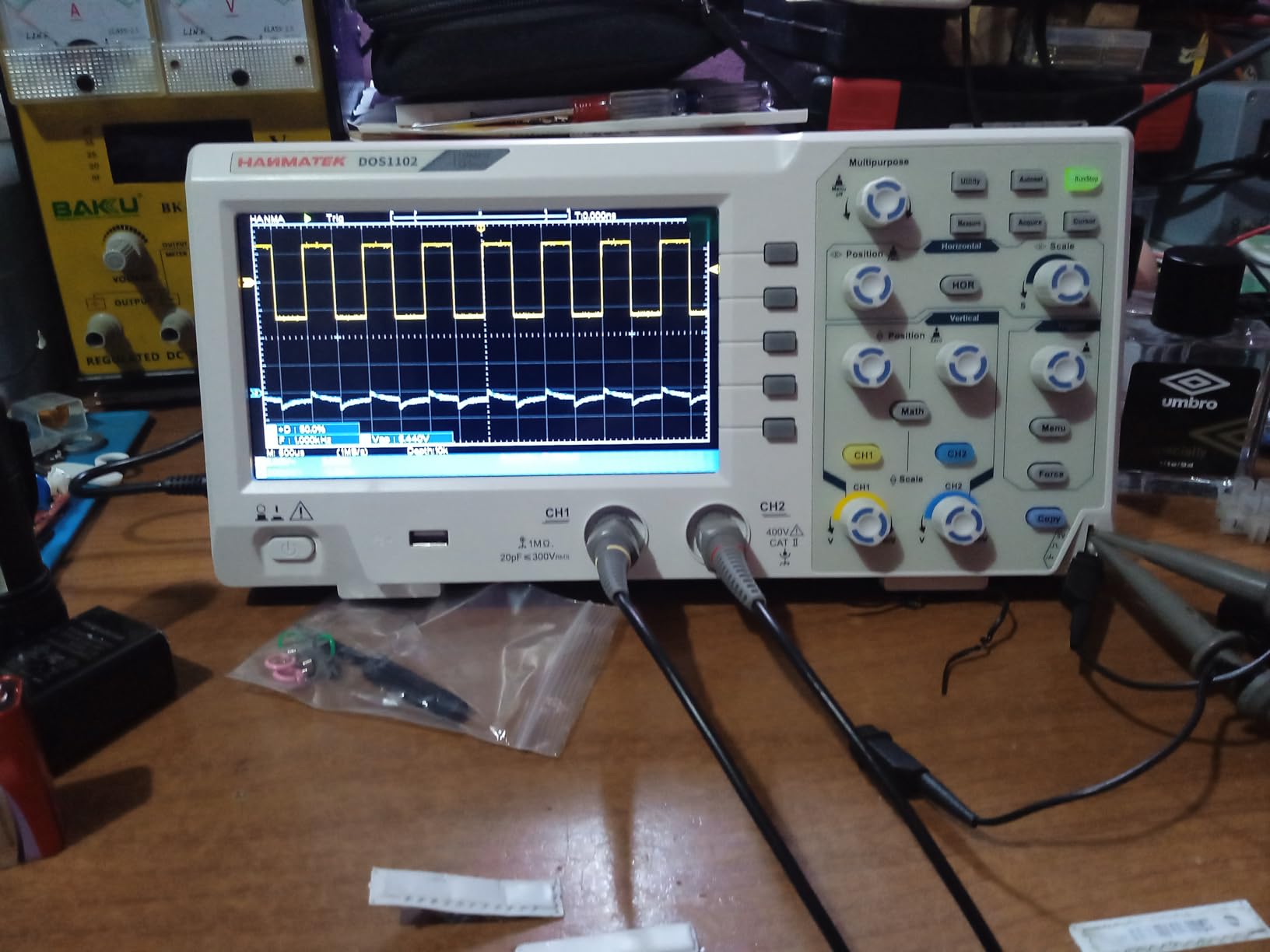
The DOS1102 sits in the gap between pocket handhelds and real benchtop scopes, and the headline is a 7 inch 800×480 true-colour 16:9 TFT, which is unusually large for the money. Two channels run at 110 MHz with 500 MS/s each, and the time base stretches from 2 ns/div to about 1000 s/div.
Vertical sensitivity covers 20 mV/div to 5 V/div with probe attenuation selectable at 1X, 10X, 100X and 1000X. A built-in 6-digit hardware frequency meter reads 2 Hz to 20 MHz, 30 automatic measurements use a customisable menu, and record length exceeds 10K sampling points with at least 16 stored waveform groups.
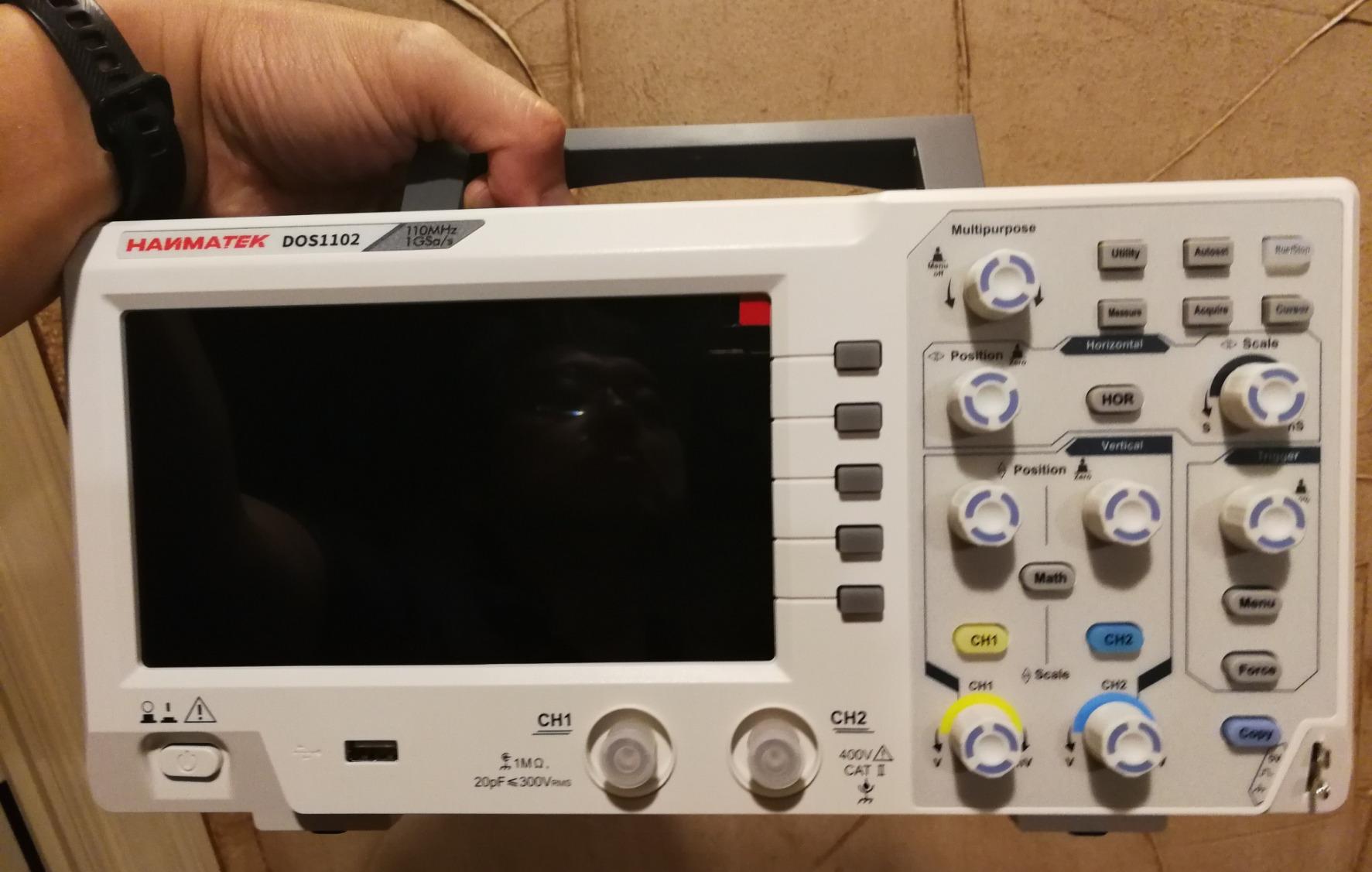
The 70 percent five-star share is among the lower figures in this guide, and the reservations are about usability rather than capability. A large screen with 800×480 resolution gives you room to work but coarse trace detail, and the menu structure takes time to learn. It draws 18 W and runs on DC power, so the portable framing applies to its size rather than its battery life.
One genuinely unusual feature at this level is the SCPI-compliant interface with LABVIEW communication and secondary development support, which lets you script measurements from a PC. Fewer reviews than the other models means thinner long-term reliability data.
When the DOS1102 earns its cost?
The big screen is the reason to pick it. Anyone who squints at a 3.5 inch handheld while working will find the 18 cm display far easier to read, particularly for teaching a second person what a waveform is doing.
At 110 MHz with dual-channel sampling it also covers the range where most hobby digital work happens, and the long time base handles slow events that a handheld cannot capture at all.
When to choose something else?
If your priority is a clean modern interface rather than screen size, the Rigol and Siglent models use their menus more predictably. Resolution is the weak point here: big pixels are not fine pixels, and high-impedance probing of small signals needs more screen detail than this provides.
Anyone planning to script automated measurements will appreciate the SCPI path, but anyone expecting battery operation will not, since it needs mains power.
10. Siglent SDS1102CML+: Two Channels Done Properly
Siglent Technologies SDS1102CML+ Digital Storage Oscilloscope, 100 MHz
2 channels, 100 MHz
1 GS/s real-time sampling
1 Mpts record single channel
USB and LAN with EasyScopeX
Pros
- Independent per-channel vertical knobs
- Build quality and screen clarity for the money
- Two 100 MHz probes calibrated and ready
- Compact at 2.2 lb
Cons
- No serial protocol decoding
- 1 Mpts record is modest
- EasyScopeX needs .NET and VISA installed first
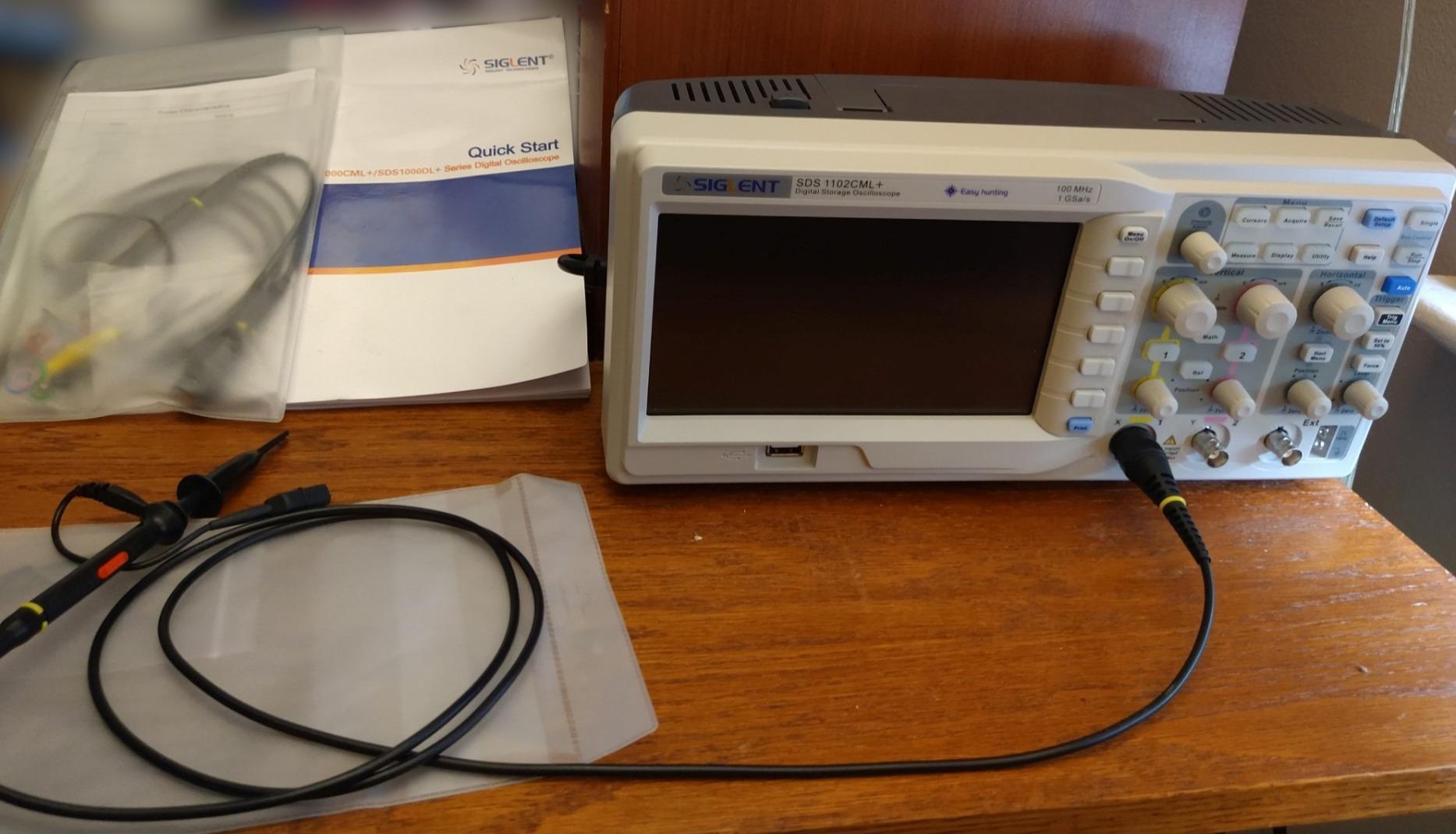
The SDS1102CML+ is a two-channel 100 MHz scope sampling at 1 GS/s with 1 Mpts of record length in single-channel mode, and this revision carries a higher resolution display than earlier versions. At 2.2 lb it is compact next to legacy analog instruments, and it is one of the few budget scopes with independent per-channel vertical knobs rather than menu-driven adjustment.
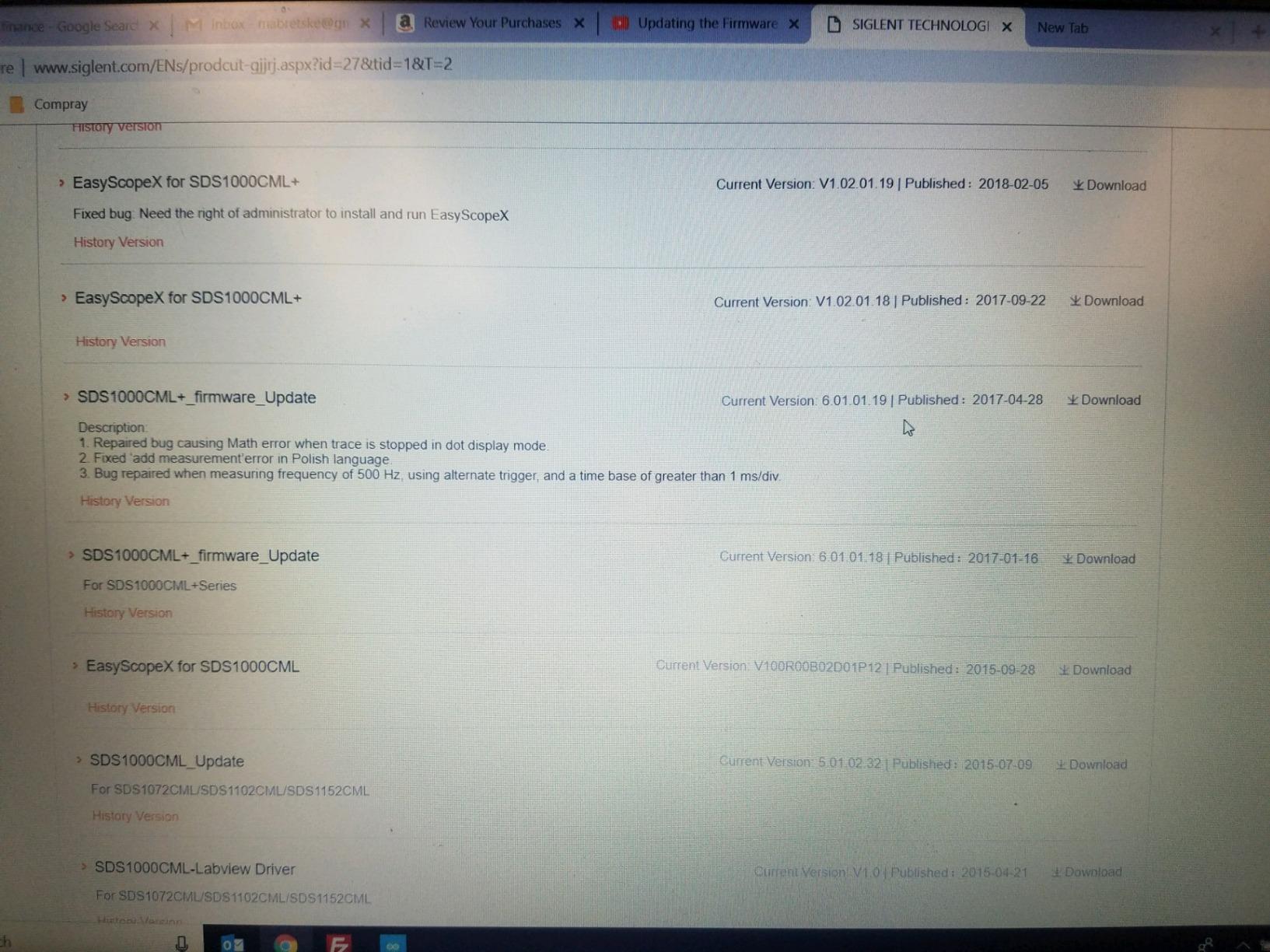
Cursors, math, automatic measurements and a built-in frequency counter cover the essentials, and USB plus LAN with EasyScopeX gives you PC control and screenshot capture. Two 100 MHz passive probes arrive calibrated and ready, each in its own bag.
Across 198 reviews the praise concentrates on build quality, smooth controls and screen clarity at this spend level, with owners comparing it favourably to a Rigol DS1102E and preferring the independent channel controls. Auto mode reportedly stabilises signals with a single press.
The defining limitation is the absence of serial protocol decoding, which pushes embedded-focused users toward the Siglent SDS1104X-E at the top of this list instead. The EasyScopeX software needs .NET Framework and NI-VISA installed first, the selection knob has almost no click detent, and the pink channel 2 trace is hard to read against the grid.
When the SDS1102CML+ earns its cost?
It suits someone who works on analog and power circuits and prefers turning a knob over tapping through menus. Two channels at 100 MHz is a well-balanced pairing for amplifier repair, filter design and supply bring-up.
It also makes sense as a portable bench instrument, since 2.2 lb is light for a benchtop unit with a full-size screen, and the calibrated probes in the box mean you can measure something the same afternoon it arrives.
When to choose something else?
If your projects involve I2C, SPI or UART traffic, look elsewhere. Decoders are the feature that most separates modern scopes, and this one leaves you needing a separate logic analyzer.
The 1 Mpts record is modest for zooming into bursts, and on-screen measurement space is limited to roughly five values across two channels. The design is also dated enough that newer models in the same price bracket offer more.
What to Look for in an Oscilloscope?
Bandwidth is the headline number and the most misunderstood. Use the rule of thumb that your scope should have at least five times the bandwidth of the fastest signal you need to measure, which means a 1 MHz audio tone needs 5 MHz and an I2C bus at 400 kHz with fast edges can still need 50 MHz. For most hobby work 100 MHz is enough; 200 MHz matters when you are chasing switch edges or working near RF.
Sample rate deserves less weight than the marketing suggests. Twice the signal frequency is the minimum for shape, but useful above that, and record length is what actually determines whether you can zoom in later. A scope with 20 Mpts and a modest sample rate will usually give you a more useful capture than one with a huge headline rate and shallow memory.
Matching bandwidth to the job keeps this simple. Audio repair and slow sensor work sit below 1 MHz, microcontroller digital lines with fast edges usually need 50 to 100 MHz, switching power supplies want 100 MHz or more, and RF or radio work pushes toward 200 MHz. Anything below 20 MHz will visibly round square wave edges, which is why one of the units in this list earns its owner complaints about deformed transitions.
Channel count is the other decision that shapes daily use. Two channels cover most single-ended measurements, while four channels let you hold input, output, reference and a control line on screen together, which matters for amplifier and filter work. Decoders are increasingly decisive: if you work with I2C, SPI or UART, a scope with them built in removes the need for a separate logic analyzer.
Do not forget the extras budget. The bundled probes on budget scopes are frequently the weakest part, so plan to buy a decent set of 10x probes soon after purchase. That same 10x attenuation divides your measured voltage by ten and multiplies the probe capacitance effect, which is why it suits most circuits and why you set the attenuation switch correctly before measuring. And never attach an earth-referenced scope ground clip to a mains circuit or to a point that sits above ground, because the clip is connected straight to your protective earth; that is a serious safety hazard, and a differential probe or an isolated instrument is the correct tool for that job.
Protecting the instrument and your bench matters as much as the scope itself. Our guides to surge protectors for expensive electronics and pure sine wave UPS units are worth reading before you set up, since a scope sharing a bench with a switching supply or a noisy bench supply is easy prey to ground loops and switching transients.
Which Type of Oscilloscope Do You Need?
Analog scopes still have a place for repetitive, slow signals because phosphor persistence makes slow events visible and the display reacts instantly. They cost nothing to maintain and are forgiving with bad probe technique, but you get no memory, no measurement functions and no export, and availability on the used market varies.
USB scopes that run on a PC cost little and give you large screens and free analysis software, but you are tied to a working computer and the proprietary drivers are a common source of frustration. Open-source alternatives such as OpenHantek and H-Scope exist for several popular models, which removes most of the lock-in if you check compatibility before buying.
Handheld units trade screen size and record depth for battery power and a meter built in, making them right for field service and automotive work. Benchtop digital storage scopes are the default choice for a home lab, since four channels, deep memory and decoders all sit in one box with no computer dependency. Start where your work happens, not where the spec sheet is best.
What Forum Users Actually Say?
The forum consensus lines up closely with the ranking here. In an r/AskElectronics thread titled Picking my first oscilloscope, users weigh budget models against the Hanmatek line, with the general sentiment favouring a built-in function generator at the entry level and Rigol or Siglent for staying power.
In r/ElectricalEngineering help-me-choose threads, the recurring advice is to go four-channel if the budget allows, with the Rigol and Siglent 100 MHz models treated as the serious hobbyist tier and OWON or FNIRSI named as the value entry. On r/embedded, a first-scope thread recommends a PicoScope on the basis that the software alone justifies more than its cost, provided you already have a working computer.
The r/oscilloscope community leans toward a handheld like the HANMATEK for casual use or a portable set when bench space is the constraint. On electronics.stackexchange, budget scope threads keep arriving at the same conclusion: the bottleneck is measurement technique and probes, not the instrument. One eevblog thread on older analog scopes described a used Rigol DS1054Z bought on the secondary market as a great scope, which supports the idea that the used market is a real path.
The most useful piece of advice in those threads is also the least technical. Several beginners report not knowing what a normal waveform should look like, which means no instrument helps until you have seen a reference trace. Build that reference by measuring something you already understand before you need the scope urgently.
Frequently Asked Questions
What is a good oscilloscope for a hobbyist?
A good hobbyist oscilloscope has two or more channels, at least 50 MHz of bandwidth, real automatic measurements and probes that hold calibration. For most Arduino, audio and power supply work 100 MHz is sufficient, while 200 MHz is worth paying for only when you are chasing fast switching edges or working near RF. Our overall pick is the Siglent SDS1104X-E, because its four channels and serial decoders are unlocked at purchase.
Is a 100MHz oscilloscope enough for hobby electronics?
Yes, for almost everything a hobbyist measures. A common rule of thumb is to have at least five times the bandwidth of the fastest signal, so a 100 MHz scope covers signals up to about 20 MHz with margin. That covers audio, microcontroller digital lines and most switching supply work. Move to 200 MHz only if you are measuring fast edges or signals in the tens of megahertz.
What is a good cheap oscilloscope for hobbyists?
For a first instrument, a handheld unit with a built-in multimeter gives you the most capability for the least spend. The HANMATEK HO52 pairs two 50 MHz channels with a true-RMS meter and USB-C waveform export, while the FNIRSI DSO152 goes lower still if you only want to see what a waveform looks like. Both are stepping stones rather than final instruments.
Do I need an oscilloscope or a multimeter?
You probably need both, but they answer different questions. A multimeter tells you a rail sits at 5V, while an oscilloscope shows whether that rail is ringing, clipping or carrying switching noise. If your work involves timing, audio, filters or anything switching, a multimeter alone will leave you guessing. For pure continuity and resistance checks, the meter is still the faster tool.
Why are oscilloscopes so expensive?
Price tracks bandwidth, memory depth, channel count and display quality, because all four come from specialised high-speed analog and mixed-signal hardware. Four channels, deep memory and built-in serial decoders roughly double the cost of a two-channel model with a small screen, which is why four-channel units dominate the serious hobbyist tier. Licensing optional expansions such as mixed-signal channels or a generator adds cost later on some models.
Which Oscilloscope Should You Buy?
If you want one answer, buy the Siglent SDS1104X-E. Four channels, 100 MHz, serial decoders for I2C, SPI, UART, CAN and LIN included rather than licensed, and the highest rating across the largest review base of anything we tested, which is why it comes out ahead here.
If you spend less, the Rigol DS1054Z gives you four channels, deep memory and free decoding, while the HANMATEK HO52 is the pick when you need one portable device that also works as a meter. For RF or fast switching edges, step up to the Rigol DS1202Z-E at 200 MHz.
Start anywhere on this list and replace the bundled probes early, since the scope you own matters less than how you use it. Our best oscilloscopes for hobby electronics ranking was last checked in 2026, and every pick here has been reviewed and updated since.